Breaking News
Grim roll call of 2025: Indian students who lost their lives this year while studying abroad

[ad_1]

Grim roll call of 2025: Indian students who lost  their lives this year while studying abroad
A string of Indian student deaths across countries shook families and campus communities. Image: AI generated

Across the year, one headline after another chipped away at the glossy study-abroad promise. A student found dead in a room they had just started calling home. Another shot while working a night shift. Someone killed in a crash on an unfamiliar road. Some deaths were violent. Some were sudden. Some came with more questions than answers. But the pattern was hard to ignore: young Indians left for classrooms and campuses—and did not return. What makes 2025 feel heavier is not just the number of deaths, but how scattered and ordinary the circumstances often were. Different countries. Different courses. Different causes. No single story explains them all. Yet together, they force a harder conversation about what studying abroad really involves—beyond rankings, visas, and Instagram sunsets. Here is a look at the Indian students who lost their lives abroad in 2025, and what is known so far about them.

Two Indians Killed In Canada Within A Few Days, Families Raise Question On Safety Of Students Abroad

Shivank Avasthi (20)

Toronto, Canada | December 2025University of Toronto ScarboroughShivank Avasthi was already living the reality of doctoral life at the University of Toronto Scarborough, a phase of education defined less by classrooms and more by isolation, persistence, and intellectual risk. This was not an exploratory stint abroad. It was commitment. Years of research ahead, years already invested.In December 2025, he was shot dead near the campus. A homicide investigation followed, but what lingered longer was disbelief. His death unsettled Indian student communities across Canada because it punctured an assumption many families hold quietly but firmly: that elite universities in developed countries come bundled with safety. In reality, education and exposure often arrive together, especially in global cities where the university is part of the city—not shielded from it.

Ajit Singh Chaudhary (22)

Ufa, Russia | November 2025Bashkir State Medical UniversityAjit Singh Chaudhary was pursuing an MBBS at Bashkir State Medical University. He was one of the countless Indian students who leave home for medicine because competition for medical seats in India is tough to say the least. Medical education abroad, also, is rarely glamorous. It is not only long and demanding but also linguistically alien and isolating.In November 2025, Ajit went missing after leaving his hostel. Days later, his body was found near a dam in Ufa. His family sought answers, clarity, timelines—basic things that become harder to secure when grief unfolds inside an unfamiliar legal system. For Indian medical students abroad, vulnerability is not just academic; it is structural. When something goes wrong, distance amplifies helplessness.

Vijay Kumar Sheoran (30)

Worcester, England | November 2025University of the West of England (UWE Bristol)At 30, Vijay Kumar Sheoran was not a wide-eyed undergraduate. He was an older student at UWE Bristol, managing coursework alongside the logistics of housing, travel, work and routines that are beyond the campus borders. He appeared to be in transition, preparing for what would come after graduation.In November 2025, he was stabbed during an altercation in Worcester. A suspect was arrested; the case was treated as homicide. His death highlighted a grey reality international students quickly encounter: universities may be safe, but student life is rarely confined to them. Risk often appears in the in-between spaces—streets, shared housing, late evenings—where institutional protection fades and everyday unpredictability takes over.

Vaishnav Krishnakumar (18)

Dubai, UAE | October 2025Middlesex University DubaiVaishnav Krishnakumar had barely begun his life abroad. At the age of 18, he was weeks into a BBA course in Marketing at Middlesex University Dubai. He was navigating first lectures, new friendships, and the small freedoms that come with living away from home. In October 2025, during Diwali celebrations, Vaishnav suffered a sudden cardiac arrest and passed away. This was a brutally random medical emergency. But for families, even natural death abroad carries an extra burden apart from sorrow: Hospitals, paperwork, consular coordination, and the long, quiet process of bringing a child home across borders.

Chandrashekar Pole (28)

Texas, United States | October 2025University of North Texas, DentonChandrashekar Pole was pursuing a Master’s in Data Analytics at the University of North Texas, an obvious choice in our tech-driven era. To manage tuition, rent, and loan repayments, he worked night shifts at a gas station.In October 2025, he was shot dead while on duty. A suspect was later arrested. But his death exposed an ugly reality which any study-abroad narrative hardly acknowledges. Financial pressure routinely pushes students into long hours and high-risk environments.

Devesh Bapat (23)

Found in Germany | March 2025Eindhoven University of Technology (TU/e), NetherlandsDevesh Bapat was studying physics at Eindhoven University of Technology, immersed in a demanding STEM programme where progress is incremental and discipline is everything. In early March 2025, he went missing. After weeks of search, his body was found in Germany. Authorities said there were no immediate signs of foul play, but clarity was elusive. In cases like this, death abroad leaves families not just grieving, but suspended. They are caught between closure and the ache of unanswered questions.

Lessons these deaths left behind in 2025

Taken together, these stories are not an argument against studying abroad. They are a reminder of what that journey truly means. Beyond aspiration and access lies exposure—financial, physical, emotional. Campuses do not exist in isolation from cities. Degrees do not shield students from night shifts, medical emergencies, or violence. Distance, when things go wrong, multiplies grief.The promise of studying abroad has not vanished. But in 2025, it came with a clearer, harsher footnote—one that families can no longer afford to ignore.

[ad_2]

Source link

‘$600 mobile bills in New York’: NRI visits home after 8 years; viralpost praises India’s growth and affordability | India News

[ad_1]

‘$600 mobile bills in New York’: NRI visits home after 8 years; viralpost praises India’s growth and affordability

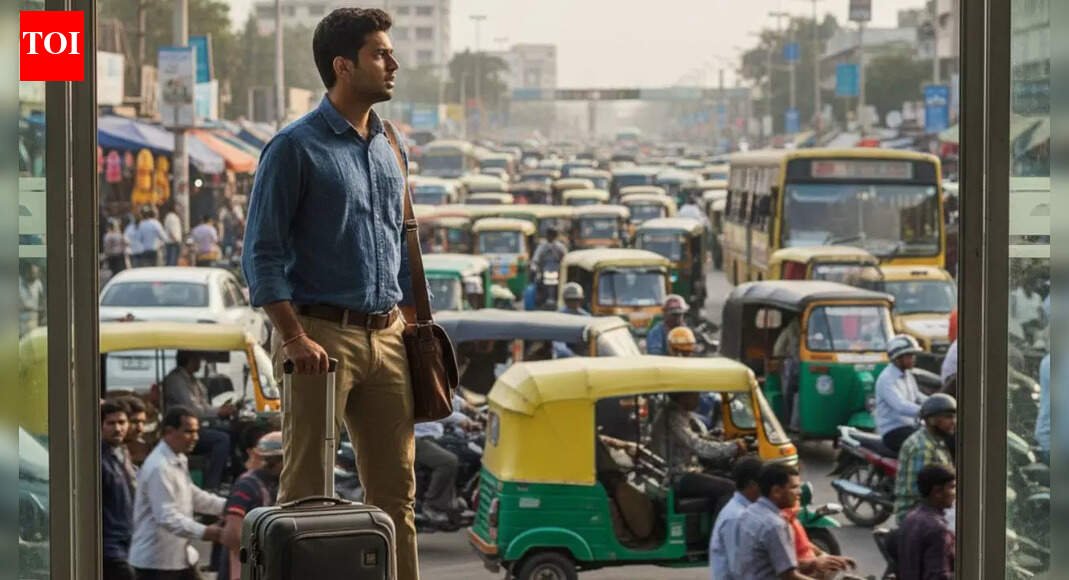
NEW DELHI: An NRI’s praise for India after returning home following an eight-year gap has become viral.Investor Alok Jain wrote on X that a friend from New York had recently visited him. According to Jain, the visitor was struck by the energy in the country and how fast India appeared to be growing.“An outsider’s perspective can be so different from our own,” Jain wrote, comparing it to how people living here may see the country.In his post, Jain said his friend was particularly surprised by how affordable many things in India were. He mentioned medical care, transport, internet and mobile services.The visitor compared these with costs in the US. According to Jain, his friend “pays $600 for mobile and data at his house Pays $30k for health insurance for 4!! Per annum Pays 2 percent as property taxes per year..!!”Jain added that while air quality was better in the US, many good things were happening in India.The post drew a range of responses from social media users. One person wrote that many of their friends living in Bengaluru preferred it to New York City.

Screenshot 2025-12-26 191422

.

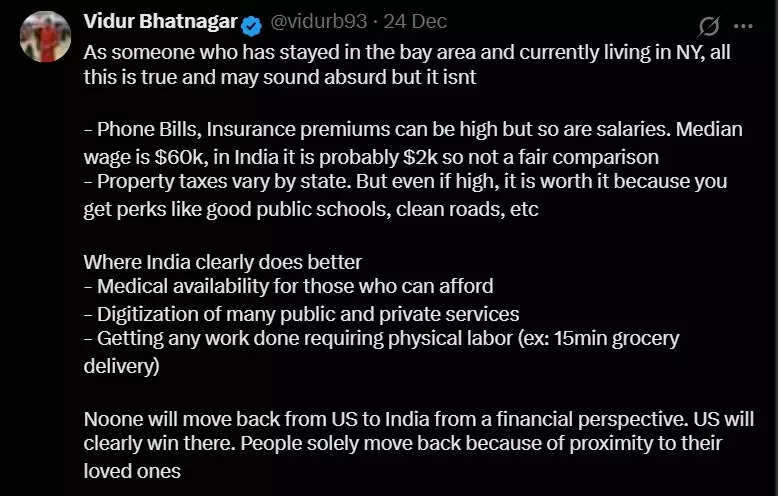
Another user commented that from an outsider’s point of view, India’s main problems came down to a lack of civic sense. “I am an outsider and I can say that everything wrong with the country has to do only with lack of civic sense among the people,” he wrote.Someone who said they had lived in the Bay Area and were currently based in New York, agreed that phone bills and insurance costs in the US was high, but said salaries were also much higher, making direct comparisons difficult.

Screenshot 2025-12-26 191600

.

The user added that property taxes varied by state and often fund services like public schools and clean roads. They said India stood out in areas such as access to medical care for those who can afford it, digital public services, and the availability of affordable physical labour.

[ad_2]

Source link

Coal policy change: Govt eases approval process for opening coal, lignite mines; boards get more authority

[ad_1]

Coal policy change: Govt eases approval process for opening coal, lignite mines; boards get more authority

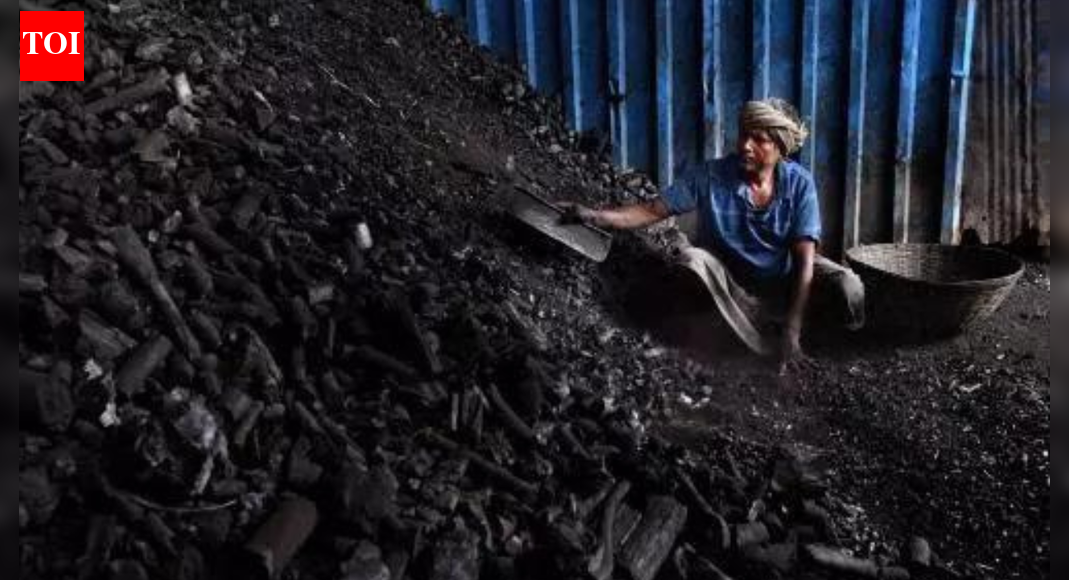
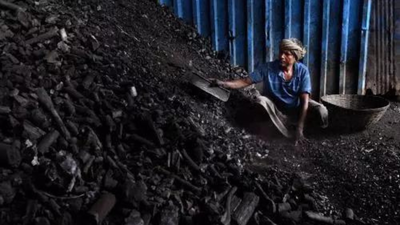
The government has amended rules to streamline approvals for opening coal and lignite mines, a move aimed at cutting procedural delays and speeding up mine operationalisation while retaining regulatory oversight, PTI reported .Under the earlier framework, Rule 9 of the Colliery Control Rules, 2004 required mine owners to obtain prior approval from the Coal Controller’s Organisation (CCO) to open a coal or lignite mine, as well as individual seams or sections of seams. Permission from the CCO was also mandatory to restart operations if a mine remained closed for 180 days or more.To remove what it described as procedural redundancies, the government has now scrapped the requirement for prior opening permission from the CCO by amending Rule 9, the coal ministry said in a statement.Under the amended rules, the authority to approve the opening of mines or seams has been delegated to the board of the concerned coal company. The ministry said this change is expected to reduce mine operationalisation timelines by up to two months.“As a safeguard, it has been provided that the board of the concerned coal company can approve mine/seam opening after the requisite approvals from Central/State Government and statutory bodies have been obtained,” the statement said.The government said the reform strikes a balance by delegating operational decisions to company boards while retaining statutory and regulatory safeguards. By shortening approval timelines and placing accountability at the highest corporate level, the amendment is expected to improve efficiency, boost coal production and strengthen confidence in the coal regulatory framework, according to the ministry.

[ad_2]

Source link

Weathering the storm: From 50% Trump tariffs to new FTAs – how India steered through turbulent trade waters in 2025

[ad_1]

Weathering the storm: From 50% Trump tariffs to new FTAs - how India steered through turbulent trade waters in 2025

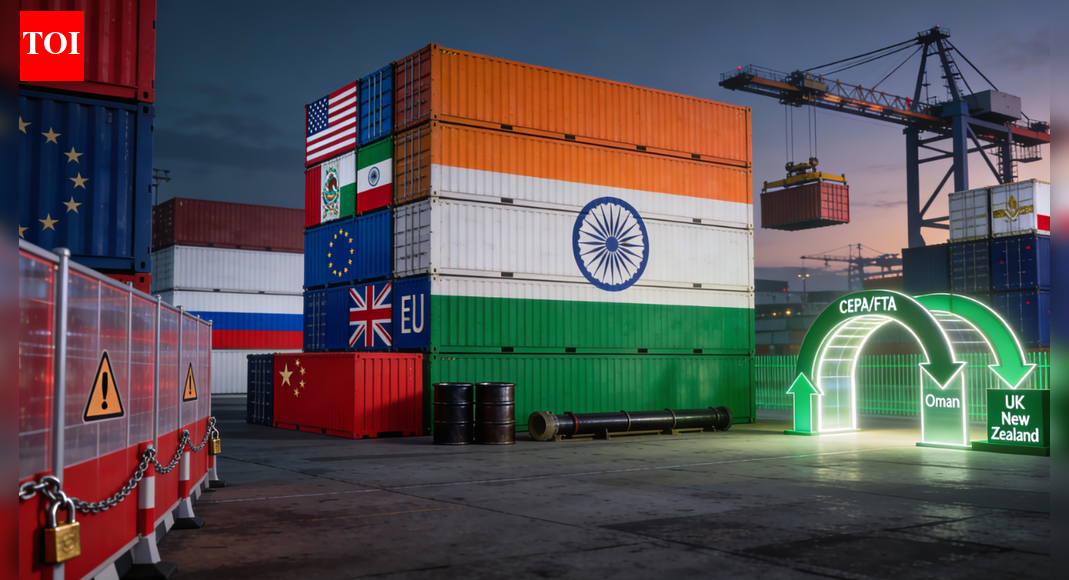
2025 has cemented itself as the year of the “Tariff Wall.” With India now facing a new landscape of protectionism from the West, and complicated energy issues developing in the global energy market, India’s economic relationship with the world has been defined by a series of flashpoints.Although government officials say that India’s external sector remains strong, a closer look at the numbers shows a complicated network that will shape the economy in 2026.From the corridors of Washington to the ports of Vladivostok, here is the state of India’s trade map.

Trade Dynamics Decoded

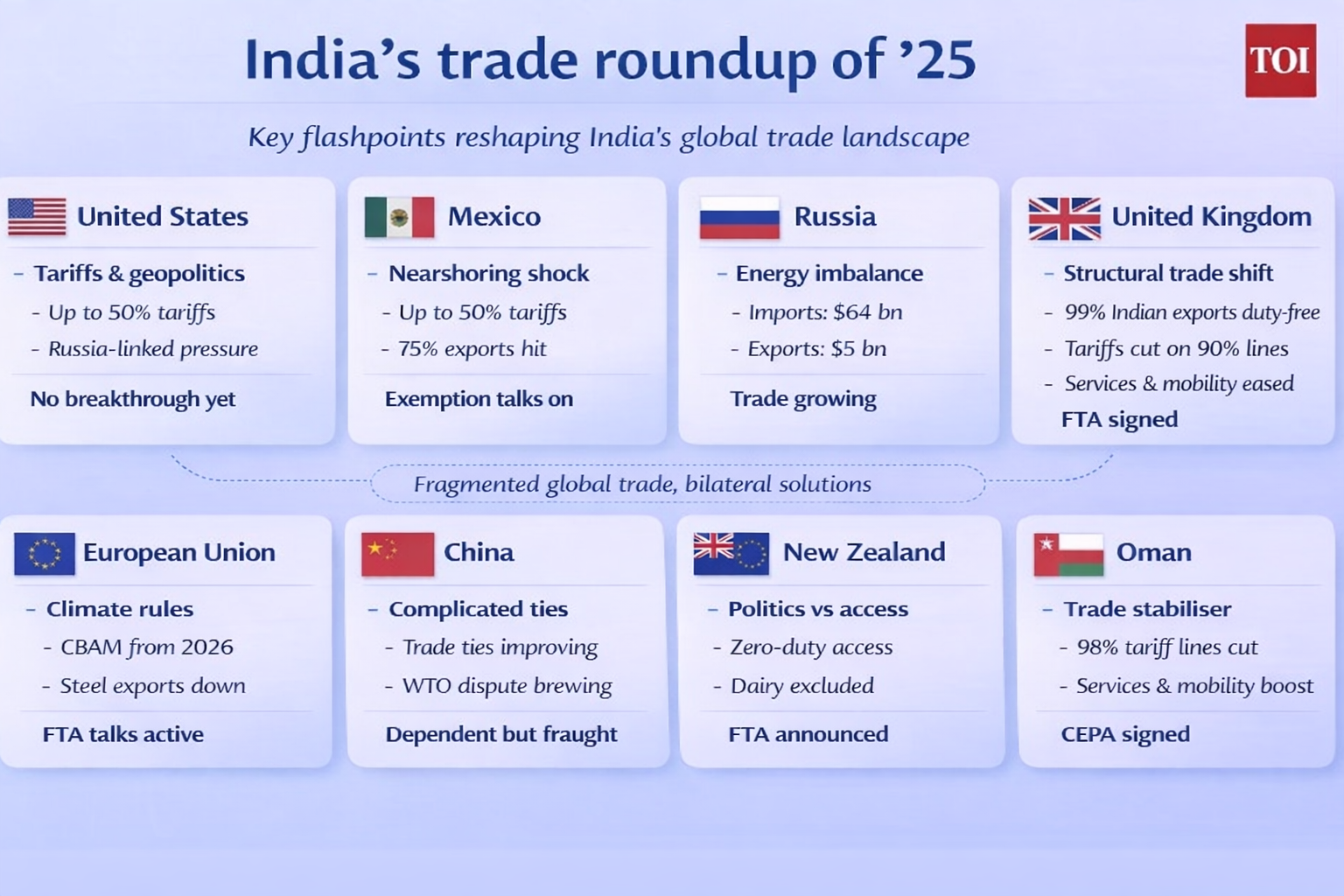
Trade roundup for 2025

U.S. To Empty 100 American Embassies Worldwide? Dems Flag Trump Plan To Axe 30 Envoys From Biden-era

US: Trump 2.0

India’s “strategic partnership” with the United States is facing one of its most complex economic phases, even as political engagement remains publicly cordial. Government sources continue to underline Prime Minister Narendra Modi’s working relationship with US President Donald Trump as strong, but trade negotiations are not progressing swiftly amid tariff pressure, market-access demands, and immigration linkages. Currently, India faces tariffs of up to 50%, being in one of the highest set of tariffed countries.What began as a US push to narrow its trade deficit with India has gradually widened into a broader economic and geopolitical confrontation. While Washington initially framed tariffs as a response to trade imbalance, it soon became about India’s continued engagement with Russia, which has hardened the US negotiating posture.Trade Deficit: The original triggerThe US initially claimed its widening trade deficit with India as a key concern, arguing that India maintains relatively high tariffs on American goods and imposes restrictions that constrain US access to the Indian market. We “we have a massive trade deficit with India” Trump had said right before the initial 25 per cent tariffs came to effect in August.The Russia complexityIndia’s purchases of discounted Russian crude are no longer just a diplomatic irritant; they have become a direct economic pressure point in India–US trade talks.Indian officials have consistently defended Russian oil imports as essential for energy security and inflation management, especially amid global price volatility following the Ukraine war.However, under Trump’s 2nd term, Washington has explicitly linked India’s Russia trade to punitive economic measures, levying additional tariffs of up to 25 per cent (over the initial 25 per cent) on Indian exports to the US.This marks a clear shift:

  • Earlier: Trade deficit and market access were the stated reasons for tariffs
  • Now: Strategic alignment on Russia has become an unstated condition for trade flexibility.

In effect, Russia has become the shadow looming in India–US trade talks.Also read: Donald Trump’s tariff gamble: Who blinked, who pushed back & did it ‘make America great again’?Immigration & trade roomTrade talks have become entangled with immigration policy with the H-1B visa fee increased to $100,000 and more stringent compliance requirements. H-1B and H-4 visa applicants have to face mandatory social media screening. It is anticipated that these changes will negatively affect India’s largest & fastest growing means of supplying services to America: the IT industry, among other things.From New Delhi’s perspective, professional mobility is an important aspect of the bilateral trade in services.Defence dealsIndia has expanded defence procurement from the US, positioning such deals as confidence-building measures. India and the US signed an expansive new defence framework aimed at strengthening their strategic partnership over the next decade, as reported last month. The ‘Framework for the US–India Major Defence Partnership’ was inked during a meeting between Defence Minister Rajnath Singh and his US counterpart, Pete Hegseth, on the sidelines of the ASEAN meet in Kuala Lumpur. “The framework will usher in a new era in our already strong defence partnership. It is a signal of our growing strategic convergence and will herald a new decade of partnership. Defence will remain the major pillar of our bilateral relations,” said defence minister Rajnath Singh, while signing the deal.However, there has been no indication that such a deal would impact the trade deadlock between the two nations.Situation nowNegotiations remain open, but there is no major breakthrough. Tariffs, immigration, energy choices, and geopolitics are now part of a single negotiating matrix.Negotiations are happening with the commerce ministry and other officials indicating that a deal could happen soon but nothing concrete has been revealed yet. A formal round of talks was held earlier this month after previous rounds did not result in any key agreements.

Mexico: The 50% shock

A big shock came not from a superpower, but from Mexico. In a bid to stop Chinese trans-shipments from entering the US duty-free, Mexico imposed a blanket of up to 50% tariff hike on imports from non-FTA countries in December.Impact

  • The hike hits 75% of India’s exports to Mexico, a market that has grown to over $5 billion. “Nearly 75% of India’s $5.75 billion exports to Mexico will be affected as tariffs jump from 0-15% to around 35%,” think-tank GTRI said.
  • Mexico will impose duties ranging from 5% to 50%, with India’s largest export categories namely- automobiles and auto components—bearing the brunt.
  • Passenger vehicles valued at $938.35 million will see tariffs rise from 20% to 35%, while auto components worth $507.26 million will face duties of 35%, up from the current 10–15%. Motorcycle exports, valued at $390.25 million, will also be hit with a 35% levy, ANI reported.

Situation nowCommerce Ministry officials are currently in “urgent consultations” with Mexico City. The proposal on the table is a “Country-Specific Exemption” or a limited Preferential Trade Agreement (PTA) to bypass the new wall.As India grapples with Mexico’s steep tariff hike of up to 50 per cent, an official said New Delhi is actively engaging with Mexican authorities, describing the move as a “unilateral” decision affecting a broad range of products. The official, quoted by PTI, added that discussions aim to identify mutually beneficial solutions while preserving the option to safeguard Indian exporters’ interests.

European Union: The ‘green wall’

If US protectionism is loud, the European Union’s approach is technical—and arguably more challenging. Steel and aluminium shipments face fresh hurdles as the EU’s Carbon Border Adjustment Mechanism (CBAM) moves toward full implementation from 2026, according to a Global Trade Research Initiative (GTRI) report. Initially covering steel, aluminium, cement, electricity, hydrogen, and fertilisers, CBAM is designed to align import carbon costs with those of EU-produced goods.Compliance challengesAlthough the tax has not yet been collected, Indian exports are already under pressure due to mandatory emissions reporting, introduced on October 1, 2023. Compliance difficulties, especially for small and mid-sized exporters, contributed to a 24.4 per cent drop in India’s steel and aluminium exports to the EU, falling from $7.71 billion in FY2024 to $5.82 billion in FY2025. Steel exports fell 35.1 per cent to $3.05 billion, while aluminium slipped nearly 10 per cent.CBAM adds to existing trade barriers, including safeguard quotas and anti-dumping duties. Meanwhile, India has its own Carbon Credit Trading Scheme (CCTS) as mandated by the amended Energy Conservation Act 2022 and is currently in the early stages of implementation. Given the anticipated low domestic carbon price (less than $10/tonne), when the CCTS becomes operational, this will create an additional burden on Indian exporters since they will still need to bridge the price gap with respect to the EU Emission Trading System at €65 (~$71)/tonne.Economic implicationsThe limitations of the CBAM exemption (the €150 per consignment shipment threshold and a de minimis allowance for imports <50 tonnes) were too restrictive to provide useful support for commercial consignments, according to a GTRI report. Among recommended policies include expediting the implementation of a Centralised Certificate of Origin system (CCTS), setting a clear set of sectoral benchmarks, subsidising reporting expenses for MSMEs, and developing a dedicated helpdesk for exporters. Without prompt measures to support the adoption of the CBAM, the EU’s trade deficit with India will likely expand, and ongoing EU/India trade negotiations will become increasingly complicated.Situation nowCommerce Minister Piyush Goyal announced that negotiations for a Free Trade Agreement (FTA) between India and the European Union (EU) are progressing positively. There is already an outline of the FTA which was developed during Minister Goyal’s meeting with EU Commissioner Maros Sefcovic.Both parties have issued statements indicating their strong desire to conclude the FTA as soon as possible with the understanding that there are 23 different policy areas to be negotiated regarding this FTA. These include areas related to trade in goods and services, investment, and intellectual property rights; government procurement; geographical indications; and so forth. The EU is currently the biggest trade partner for India in terms of trade with goods, with total bilateral trade between these two economies amounting to $136.53 billion in 2024-2025, of which exports from India accounted for $75.85 billion and imports from the EU were recorded at $60.68 billion.If completed, the FTA should help increase India’s competitiveness in exporting products such as ready made garments, pharmaceuticals, steel, petroleum products, electrical machinery, and more, as well as provide India with an additional opportunity to respond to questions related to the carbon-border adjustment mechanism (CBAM) and other non-tariff trade barriers.

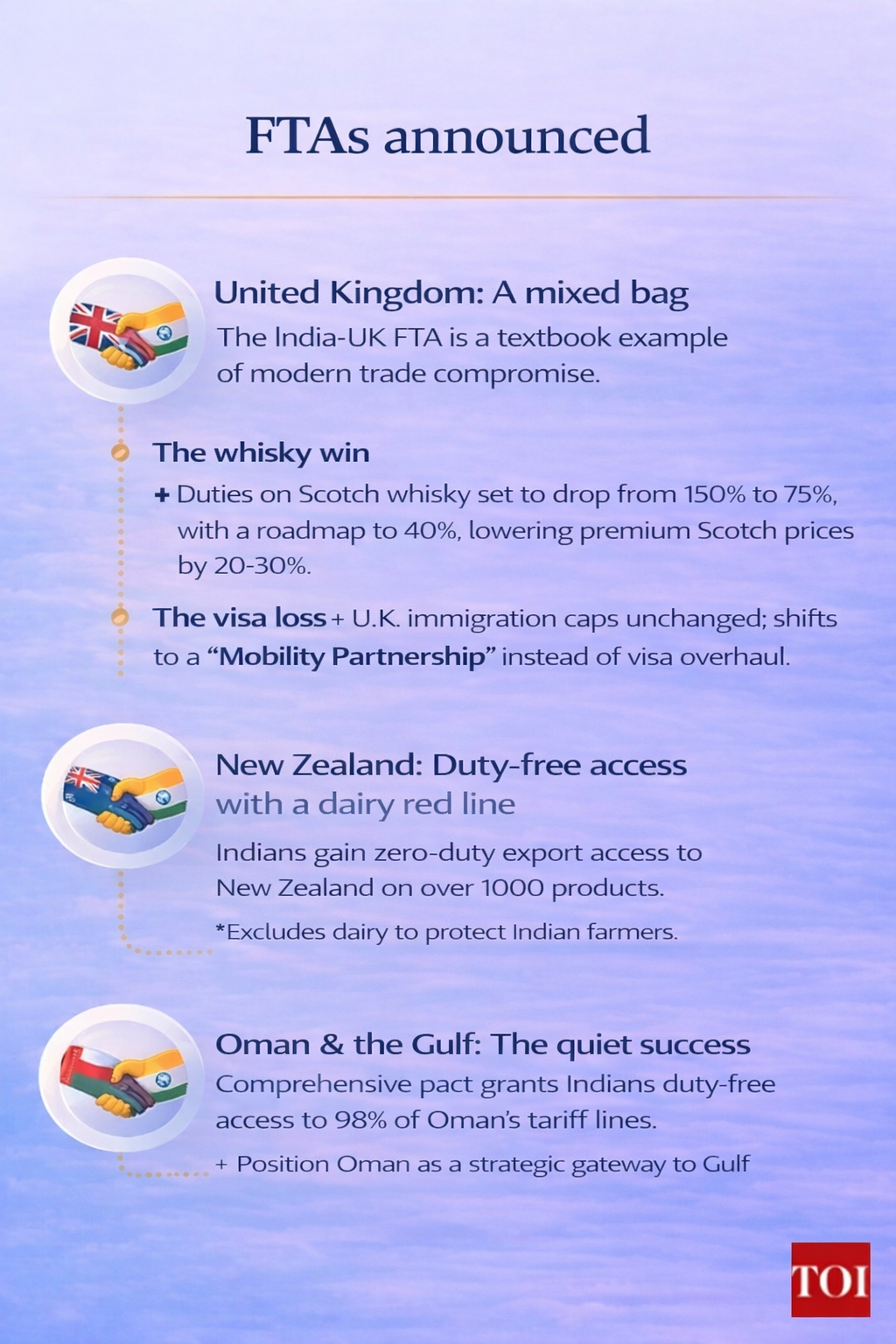
FTAs announced

FTAs

United Kingdom: A calibrated breakthrough

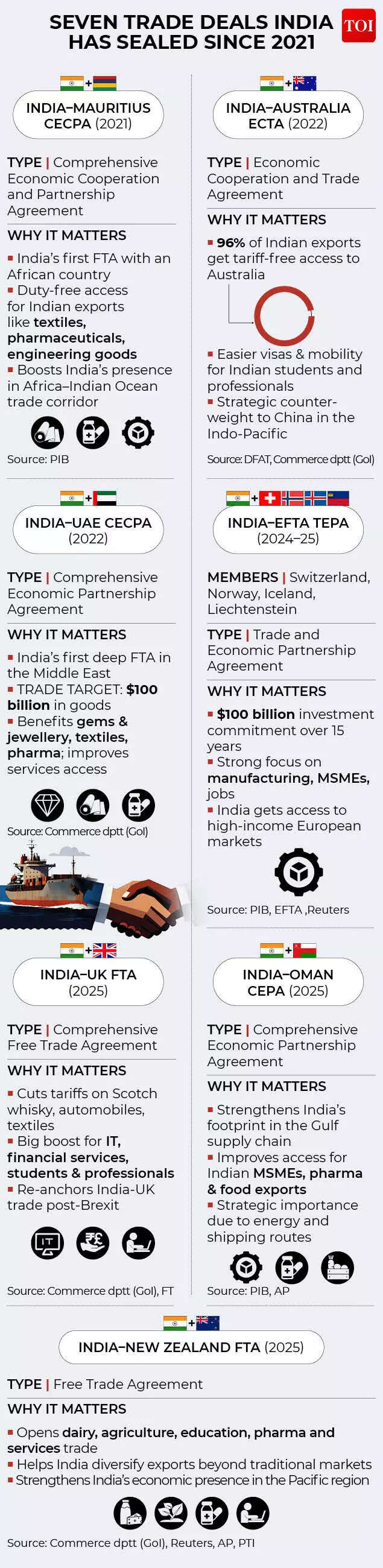
The India–UK Free Trade Agreement (FTA) signed in July this year, represents a structural shift in bilateral commerce rather than a headline-driven political bargain. Signed during Prime Minister Narendra Modi’s visit to the UK in July.Greater access to UK marketsFor India, the agreement delivers substantial market access gains. Nearly 99 per cent of Indian exports will receive duty-free access to the UK, covering almost the entire trade value. Labour-intensive sectors such as textiles, leather, footwear, gems and jewellery, marine products, engineering goods, auto components, toys and organic chemicals are expected to benefit most, reinforcing employment generation and export diversification.On the import side, India has committed to tariff reductions across 90 per cent of tariff lines, with 85 per cent becoming fully tariff-free within ten years. This is expected to lower input costs for Indian industry, particularly in advanced machinery, medical devices, aerospace components and other capital goods that support domestic manufacturing and value-added production.The whisky and luxury cars concessionThe most visible element of the deal is the phased reduction in duties on Scotch whisky. Import tariffs will fall from 150 per cent to 75 per cent immediately, with a further reduction to 40 per cent over a ten-year implementation period. While this strengthens the competitive position of British whisky producers in India, the impact is concentrated in the premium and mid-premium segments and forms part of a broader tariff rationalisation that also covers automobiles (under a quota framework), cosmetics, soft drinks and specialised food products.The pact also paves the way for a sharp reduction in customs tariffs from levels above 100 per cent to as low as 10 per cent over time. The concessions primarily benefit ultra-luxury internal combustion engine vehicles from brands such as Jaguar and Land Rover, Rolls-Royce, Bentley and Aston Martin, with tariff cuts applied within a quota-based framework to protect domestic manufacturers. For large-engine petrol cars above 3,000 cc and diesel vehicles over 2,500 cc, duties will be progressively lowered to 10 per cent over 15 years under a quota that begins at 10,000 units and rises to 19,000 units by year five, while mid-sized and smaller cars will see similar phased reductions. Vehicles imported beyond these quotas will continue to attract steep tariffs, ensuring controlled market access while marking India’s first-ever auto tariff concession under an FTA.Services, mobility and cost reliefIn services, the FTA improves predictability and operating conditions for Indian firms in IT/ITeS, financial services, consulting and other professional services, alongside assurances on digital service delivery.A key commercial gain is the three-year waiver on social security contributions under the Double Contribution Convention for Indian professionals temporarily working in the UK, reducing costs for Indian service providers and enhancing their competitiveness. The agreement also facilitates smoother movement for defined business-linked categories — including contractual service suppliers, business visitors, investors, intra-corporate transferees and certain independent professionals — without altering overall migration policy.Business momentum buildsBusiness sentiment has shifted decisively following the signing of the pact. Grant Thornton’s International Business Report shows that 72 per cent of UK firms now view India as a priority market for international growth, up from 61 per cent last year. While only 28 per cent of surveyed UK companies currently operate in India, 73 per cent of those without a presence plan to enter, many within the next 12 months.Situation nowThe India–UK FTA has been signed, with British Prime Minister Keir Starmer pushing for implementation “as quickly as humanly possible.” While the pact now awaits ratification by the British Parliament, both governments are treating it as an execution-phase agreement rather than a negotiation-in-progress.Commercial momentum is building ahead of formal rollout, as UK firms are looking at India as a priority growth market.Simultaneously, Indian firms are also readying themselves for increased activity in their operations, despite the existing obstacles of regulatory complexity, foreign currency exchange controls and underdeveloped infrastructure.However, many believe that the pact will ultimately serve as a catalyst to reduce both barriers to entry and speed up the process of making business decisions. As soon as ratification has been completed, a significant increase in both trade and investment is anticipated.

New Zealand: Duty-free access with a dairy red line

India and New Zealand finalised a landmark Free Trade Agreement (FTA) aimed at deepening bilateral economic ties and expanding trade, investment, and mobility. Duty-free accessThe most significant advantage of this FTA for Indian exporters is that their exports will now enjoy zero duties charged by New Zealand across nearly all products and across many sectors. Labour-intensive industries are not the only beneficiaries; there are also several manufacturing industries benefited by this FTA, including textiles, apparel, leather and footwear, engineering, automotive, electronics, pharmaceuticals, chemicals, and many more. A large focus of this agreement is also on services and mobility, whereby New Zealand has opened a total of 118 service sectors for Indian service providers and has also agreed to provide “Most Favoured Nation” treatment for 139 services sectors. In addition, Indian students will now be able to receive post-study work visas in New Zealand for up to four years, and skilled professionals will be able to apply for temporary employment and working holiday visas. Additionally, New Zealand has committed to invest $20 billion in India over a period of 15 years, with manufacturing, infrastructure, service provision, innovation, and job creation in focus. Another important area of focus for this FTA is Agricultural Cooperation and has provided for better access to New Zealand markets for Indian exports of fruits, vegetables, coffee, spices, and processed foods, while at the same time protecting sensitive industries, including dairy, sugar, oils, and precious metals.Signs of trouble?Despite the overall positive outlook, the FTA faced internal opposition in New Zealand. Foreign Affairs Minister Winston Peters of New Zealand First criticized the deal as “neither free nor fair,” arguing that it gives too much to India, particularly on immigration, while failing to adequately protect New Zealand’s key dairy exports. Peters expressed concern that the deal was rushed without securing a parliamentary majority for approval and highlighted that New Zealand First had already rejected it internally. He emphasized that the opposition was not directed at India but reflected differences within New Zealand’s coalition government. Peters also noted that New Zealand’s past FTA negotiations with other countries followed a more cautious and measured approach.Situation nowTrade relations between India and New Zealand remain relatively small in terms of the value of the merchandise traded (approximately $1.3 billion for FY 2024-25) as well as for total trade (approximately $2.4 billion). Approximately $1.24 billion of this total was related to services only. The agreement is anticipated to greatly increase opportunities for movement, trade, and investment, as well as potentially double the amount of bilateral trade within the next five years. It is expected that the FTA will have a positive impact on farmers, micro and small enterprises, workers, students and young people across many industries. Additionally, New Zealand will gain improved access to the 1.4 billion consumers in India through this FTA.

Oman & the Gulf: The quiet success

The Middle East has emerged as one of India’s most dependable trade fronts. The India–Oman Comprehensive Economic Partnership Agreement (CEPA), signed this month in Muscat, marks a significant win in New Delhi’s trade diversification efforts.Duty-free accessUnder the pact, Oman will eliminate duties on over 98 per cent of its tariff lines, covering more than 99 per cent of India’s exports by value. This provides immediate and meaningful relief to Indian exporters across labour-intensive sectors such as textiles, gems and jewellery, leather, engineering goods, pharmaceuticals, medical devices and automobiles, where import duties currently hover around 5%.Strategic gatewayThe Oman CEPA is explicitly expansionary, being positioned as a logistics and services hub at the mouth of the Gulf. It will provide India with greater access to GCC supply chains and a more diverse range of services and investment opportunities.In addition, through India’s continuing commitment to more services, 100 per cent FDI access in Oman, and a more liberalised and enhanced mobility framework for Indian professionals, the CEPA continues to strengthen and deepen the relationship between Oman and India during a time when resilience and diversification are strategically important for both countries.Situation nowBilateral trade between India and Oman was approximately $10.5 billion in FY 2024–25, with Indian exports totalling about $4 billion to Oman and Indian imports totalling $6.54 billion from Oman. India is Oman’s third-largest export market of all GCC nations.Oman has approximately 700,000 Indians living in Oman sending nearly $2 billion remittances each year, and more than 6,000 Indian companies doing business in Oman. With CEPA anticipated to be in effect starting from Q1 of the next calendar year, this agreement further strengthens an already strong bilateral trade relationship between the two countries due to both volume and population factors.

FTA over the years

Improving ties– but imbalances linger

Russia: The imbalanced structure

The India-Russia energy corridor continues to defy Western pressure but faces a crippling internal contradiction: a massive trade imbalance.The numbersBilateral trade between India and Russia has expanded sharply as both sides work toward a $100 billion trade target by 2030, but the relationship remains heavily skewed. In fiscal year 2024–25, India’s imports from Russia — dominated by crude oil and petroleum products — stood at roughly $63.8 billion, while Indian exports to Russia were only about $4.9 billion.Oil dependencyIndia remains heavily reliant on Russian crude oil, despite Western sanctions. In November 2025, India imported 1.77 million barrels per day (bpd) from Russia, which was a 3.4% increase over October. According to estimates, the amount of oil imported from Russia in December 2025 could reach as much as 1.5 million bpd by the end of the month, due to the high expected volumes in December exceeding 1.2 million bpd.As a result of the low prices being offered by Russia`s non-sanctioned companies to their clients in India; refiners purchasing these crude oils have displayed great interest in procuring Russian crude oil at these low prices. While some of the state-owned refiners – Indian Oil Corporation and Hindustan Petroleum Corps till today still continue buying Russian crude oil by utilizing the lower prices being offered by the non-sanctioned Russian oil producers; private refiners such as Nayara Energy have continued to purchase Russian oil.These imports have complicated India–US trade negotiations, as the Trump administration has linked tariffs to India’s energy dealings with Russia. Russian producers are using domestic swaps to ensure India continues to receive crude without breaching sanctions.Situation nowThe trend of growing bilateral trade between India and Russia is evident but lopsided. Imports from Russia surged from $5.94 billion in 2020 to $64.24 billion in 2024, led by crude oil. Crude oil has driven this increase and is now the highest proportion of the goods flowing from Russia to India.New Delhi has identified nearly 300 high-potential products, spanning engineering goods, pharmaceuticals, chemicals, agriculture, textiles, and light engineering, that could help narrow the gap. Currently India’s share of Russia’s overall imports is only 2%-3%, with particular areas of strong growth potential for India in pharmaceuticals, engineering products and agri-foods. For example, India is exporting approximately $546 million in pharmaceuticals, however, Russia’s current import demand for pharmaceuticals is $9.7 billion.The bilateral trade agenda gained further momentum during President Vladimir Putin’s December visit to India, which reinforced energy and strategic cooperation while emphasising the $100 billion trade target by 2030.

China: Headline gains, underlying volatility

India’s exports to China grew tremendously in November, with an overall growth of approximately $2.2 billion, or roughly 90 per cent from October, but there continues to be a significant level of volatility of trade relations. From April through November, India had an overall increase of approximately 33 per cent ($12.2 billion compared to $9.3 billion), however, the overall growth was concentrated within a few categories. The largest increases included Naphtha and some electronics including Printed Circuit Boards & Mobile Phone Components. However, several other major items such as Iron Ore and Shrimp have exhibited fluctuating trends based solely on the demand from China and not based on a well-planned export strategy from India.Heavy import dependenceNearly 80 per cent of India’s imports from China consist of machinery, plastics, organic chemicals and electronics and the electronics sector alone made up $38 billion worth of imports for the period January through October. The largest component of the electronics sector was mobile phone components, integrated circuits, laptops, solar modules, lithium-ion batteries and memory chips. Machinery was the second largest import (at $25.9 billion) and the remaining import categories of organic chemicals ($11.5 billion) and plastics ($6.3 billion) made up the additional 20%.WTO disputeAmid the seemingly improving ties, came a hurdle that could signal trouble in ties.China has approached the WTO over India’s tariffs and subsidies on solar cells, solar modules, and information technology products. China claims that India is giving preferential treatment to domestic manufacturing and discriminates against Chinese products.On the other hand, India recently implemented anti-dumping tariffs on certain products of Chinese origin, including cold-rolled steel, in addition to India’s ongoing plans to offer incentives for electric vehicles and battery manufacturing.Situation nowIndia’s trade deficit with China continues to widen, with an anticipated $106 billion gap in 2025, but estimates from China predict an even larger gap of $115 billion. The disparity arises mainly from the disproportionate growth rate of Indian exports, which increased by only 17.5 billion dollars, versus a tremendous increase in imports to 123.5 billion dollars that create an outsize discrepancy in India–China trading activity.Divergences between Indian and Chinese trade figures suggest that import records from one country may not reflect actual purchases by that country, implying potential under-invoicing practices. Overall, the current standing reflects a situation of narrow export gains, heavy import reliance, and structural imbalance.

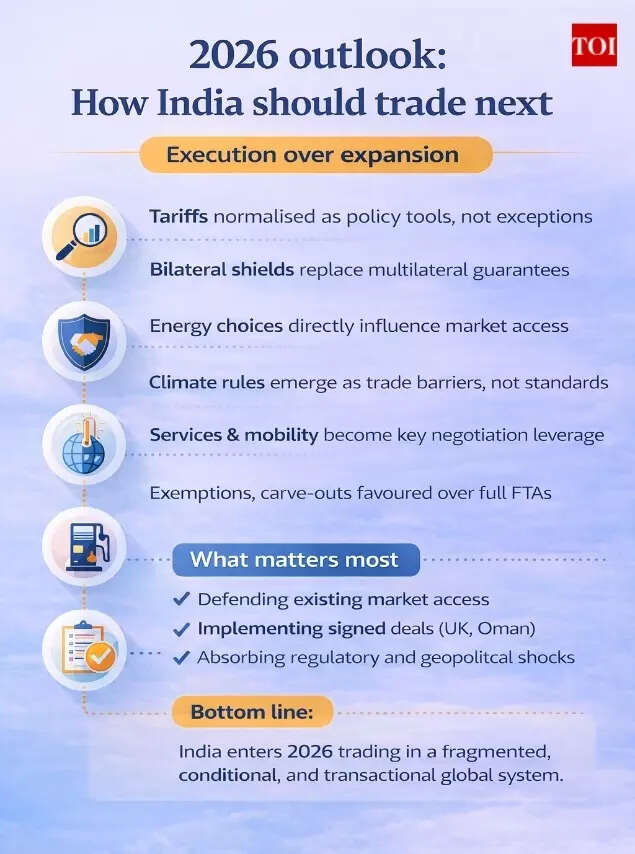
2026 outlook

What to do in 2026?

The data and negotiations of 2025 suggest that India’s trade strategy in 2026 will be defined less by new headline agreements and more by execution, insulation, and selective engagement. The resurgence of tariffs as a tool amongst global economies indicates that India is trading in a fragmented global trading system whereby bilateral arrangements are becoming more important than multilateral norms.The immediate priority will be to operationalise the agreements recently concluded with Oman and the UK that are aimed at achieving measurable positive export outcomes through the implementation of tariff concessions, services access and mobility provisions. These agreements will provide stabilisation to India’s largest export markets in an era of volatility.Simultaneously, the unresolved tariff exposures on the US and Mexico with respect to trade actions being driven recently by national security, nearshoring or political considerations rather than the traditional deficit arguments, creates a likelihood of engagement being tactical and focused on exemptions and carve outs or temporary relief rather than full trade reset of those markets.Taken together, 2026 is shaping up as a year of trade diversification, where success will be measured by India’s ability to defend market access, absorb regulatory shocks, and extract value from agreements already signed, in a world where trade openness is increasingly conditional and transactional.

[ad_2]

Source link

Coforge-Encora deal: IT firm to acquire AI player Encora for $2.35 bn; PE investors to hold one-fifth stake

[ad_1]

Coforge-Encora deal: IT firm to acquire AI player Encora for $2.35 bn; PE investors to hold one-fifth stake

IT services firm Coforge on Friday announced the acquisition of Silicon Valley-based AI firm Encora in an all-stock deal valued at $2.35 billion (about Rs 21,133 crore), marking one of the largest overseas acquisitions by an Indian mid-tier IT company, PTI reported.The acquisition will be funded entirely through equity, with Coforge issuing preferential shares worth about $1.89 billion to Encora’s existing shareholders, including private equity firms Advent International and Warburg Pincus. On completion, the sellers will collectively hold about 20% of Coforge’s expanded share capital, the company said in a regulatory filing, according to PTI.“Coforge has signed a definitive agreement to acquire 100 per cent shares of Encora from Advent International, Warburg Pincus and other minority shareholders. The enterprise value of the transaction is $2.35 billion,” the company said.Coforge CEO and executive director Sudhir Singh said the acquisition strengthens the company’s AI-led engineering capabilities. “The acquisition establishes a scaled AI-led engineering capability moat for Coforge, underpinned by capabilities to help create enterprise data cores and cloud foundations purpose-built for AI,” Singh said.Encora, an AI-native software engineering services firm, is projected to report revenue of about $600 million in FY26, with an adjusted EBITDA margin of nearly 19%.Following the acquisition, Coforge said the combined entity will form a $2.5 billion technology services platform, with AI-led engineering, data and cloud services together expected to generate nearly $2 billion in revenue by FY27.“AI-led product engineering business is likely to be a $1.25 billion-plus business, Cloud services a $500 million business, and Data engineering a $250 million-plus business,” the company said, adding that its hi-tech and healthcare verticals are expected to scale up to annualised revenues of over $170 million each immediately after the transaction.According to the filing, the transaction will also involve a bridge loan or a qualified institutional placement of up to $550 million to retire Encora’s existing debt.The deal has been agreed at a share price of Rs 1,815 per share, representing a premium of about 8.5% to Coforge’s closing price on Friday.

[ad_2]

Source link

Steel inputs squeeze: Curbs on low-ash coke raise costs for makers; GTRI highlights input-side challenges

[ad_1]

Steel inputs squeeze: Curbs on low-ash coke raise costs for makers; GTRI highlights input-side challenges

India’s steel capacity expansion is coming under pressure from a policy mismatch that raises input costs even as the government seeks to protect domestic producers, according to a report by the Global Trade Research Initiative (GTRI).“Protecting domestic metcoke producers is valid, but stacking quotas and duties on a non-substitutable input risks over-correction and macroeconomic consequences,” said Ajay Srivastava, founder of GTRI, referring to restrictions on low-ash metallurgical (LAM) coke alongside safeguards, anti-dumping duties and Quality Control Orders on finished steel imports.As quantitative restrictions approach expiry at the end of 2025, Srivastava said policy recalibration is needed. “India should restore predictable and adequate access to LAM coke by lifting or sharply expanding quotas, avoiding overlapping controls, and recalculating duties using realistic dry-bulk freight. A calibrated approach would lower steel costs, improve productivity, support MSMEs and strengthen growth. In steel — and in growth — inputs matter,” he said.LAM coke accounts for around 35–40% of steel production costs and is a critical input in the blast furnace–basic oxygen furnace steelmaking route. Its low ash content improves furnace efficiency, lowers fuel consumption and supports higher productivity. With most domestic coal carrying ash levels of 14–15%, imports of low-ash coke are technically unavoidable for many Indian steelmakers, the report said.Over the past year, controls on LAM coke imports have tightened through safeguard measures, quantitative restrictions and provisional anti-dumping duties, constraining both volumes and prices. A safeguard investigation in 2023 led to import caps, followed by country-wise quotas from January 2025 limiting imports to 1.4 million tonnes per half-year, a ceiling extended through December 2025, GTRI report claimed. In parallel, an anti-dumping probe covering Australia, China, Colombia, Indonesia, Japan and Russia resulted in provisional duties of $60–$120 per tonne in November 2025, the report noted.GTRI flagged freight benchmarking as a key concern in the anti-dumping investigation. While LAM coke is shipped largely as dry bulk with freight costs of about $20–25 per tonne, container freight benchmarks were reportedly used, inflating landed values and dumping margins beyond what trade economics would justify.The impact on supply is already visible, the report said. In the first half of 2025, steelmakers secured about 1.5 million tonnes of metallurgical coke against demand exceeding 3 million tonnes, increasing reliance on uneven domestic supply and raising the risk of production disruptions. With LAM coke making up roughly 38% of finished steel costs, a 20–25% rise in coke prices translates into a 3–5% increase in steel prices, squeezing margins and affecting competitiveness in domestic and export markets.Restricted access to quality coke has also reduced productivity by increasing coke consumption, raising energy use and causing operational downtime. MSMEs in secondary steel, foundries and ferro-alloys have been hit hardest, with cost pressures cascading into downstream sectors such as automobiles, infrastructure and engineering exports, the report noted.

[ad_2]

Source link

‘Flagged, engaged’: India on cancellation of pre-scheduled H-1B visa interviews — Here’s what MEA said | India News

[ad_1]

'Flagged, engaged': India on cancellation of pre-scheduled H-1B visa interviews — Here's what MEA said

India on Friday flagged its concerns to the US over the cancellation of pre-scheduled H-1B visa interviews for large numbers of Indian applicants and said both sides were engaged on the issue. The interviews of thousands of H-1B visa applicants slated from the middle of this month in India were abruptly postponed by several months to scrutinise their social media posts and online profiles.

End Of H-1B Lottery: Donald Trump Overhauls US Work Visa System Prioritising High Pay And Skills

Some applicants whose visa appointments were scheduled last week received emails from US immigration authorities informing them that their interviews were being pushed back as late as May next year. The Indian government had received several representations from Indian nationals facing problems with the rescheduling of their visa appointments, External Affairs Ministry spokesperson Randhir Jaiswal said at his weekly media briefing. Visa-related issues pertained to the sovereign domain of any country, he said, adding: “we have flagged these issues and our concerns to the US side, both here in New Delhi and in Washington DC.” Jaiswal said several Indians had been stranded for extended periods in India, causing a lot of “hardships” to them and their families. “The Government of India has received multiple representations from Indian nationals facing delays and difficulties in scheduling or rescheduling US visa appointments. While visa matters fall under the sovereign domain of the issuing country, India has raised these concerns with the US authorities in New Delhi and Washington DC. These delays have caused extended hardships for affected individuals and their families, including disruptions to education. The government remains actively engaged with the US side to address the issue and minimise the impact on Indian nationals,” Jaiswal said.

Mass cancellation push applicants to more trouble

The mass cancellation of scheduled interviews for H-1B visa applicants, in view of enhanced vetting measures, resulted in significant delays in their return to the US. The rescheduling applied to all applicants who were previously given appointments from December 15 onwards. Most of them were already in India and were unable to return to the US pending their new interview dates since they did not have a valid H-1B visa to travel back for their jobs.Hundreds, possibly thousands, of high-skilled workers had appointments cancelled between December 15 and 26, a period many H-1B holders target since it coincides with the US holiday season.

[ad_2]

Source link

Forex watch: India’s reserves rise $4.36 billion to $693 billion; gold holdings lead weekly gains

[ad_1]

Forex watch: India’s reserves rise $4.36 billion to $693 billion; gold holdings lead weekly gains

India’s foreign exchange reserves rose sharply by $4.368 billion to $693.318 billion in the week ended December 19, data released by the Reserve Bank of India showed on Friday, PTI reported.The latest increase follows a rise of $1.689 billion in the previous week, taking the country’s overall forex buffer to its highest level in recent weeks.Foreign currency assets (FCA), the largest component of the reserves, increased by $1.641 billion to $559.428 billion during the reported week. The RBI noted that FCA figures, expressed in dollar terms, reflect the impact of movements in non-US currencies such as the euro, pound sterling and Japanese yen held in the reserves.Gold reserves registered a stronger gain, rising by $2.623 billion to $110.365 billion, according to the central bank data.Special Drawing Rights (SDRs) with the International Monetary Fund edged up by $8 million to $18.744 billion, while India’s reserve position with the IMF increased by $95 million to $4.782 billion during the week.

[ad_2]

Source link

Mobility infra shift: RRTS can reshape urban travel and spur decentralised growth; Knight Frank flags investment, housing opportunities

[ad_1]

Mobility infra shift: RRTS can reshape urban travel and spur decentralised growth; Knight Frank flags investment, housing opportunities

The Regional Rapid Transit System (RRTS) has the potential to fundamentally change urban mobility patterns while acting as a catalyst for decentralised economic growth along transit corridors, real estate consultant Knight Frank said in a new report, PTI reported.According to a Knight Frank India study released on Friday, titled ‘Regional Rapid Transit System: Testing the Commuters’ Pulse’, the RRTS represents a significant step in India’s push for faster, more efficient and better-integrated regional transport, PTI reported.The report said the high-speed rail system could sharply reduce travel time, expand labour markets and help peripheral cities integrate more closely with national and global value chains, strengthening their economic relevance.The flagship Delhi–Ghaziabad–Meerut RRTS corridor, being implemented by the National Capital Region Transport Corporation (NCRTC), has already begun phased operations. Approved at a cost of over Rs 30,000 crore, the 82-km corridor is expected to cut travel time between Delhi and Meerut to under an hour.Shishir Baijal, chairman and managing director of Knight Frank India, said the RRTS should be viewed as more than a transport project. “RRTS is not only a transport solution, but a catalyst for decentralised economic growth,” he said.“For investors and developers, RRTS corridors represent tangible opportunities for growth where infrastructure dovetails with land-use planning and commercial momentum,” Baijal added, while noting that long-term success would depend on coordinated planning across transport, land use and investment priorities.The report described RRTS as a structural intervention in India’s urban growth dynamics, stressing that its impact would hinge on more than timely infrastructure delivery. It called for coordinated efforts to expand economic opportunities, strengthen social and physical infrastructure, and ensure the availability of affordable housing along RRTS corridors to support sustainable urbanisation

[ad_2]

Source link

Boozeball or Bazball? The hangover of wannabe cricket Ultras reduced to ashes | Cricket News

[ad_1]

Boozeball or Bazball? The hangover of wannabe cricket Ultras reduced to ashes
England’s Ben Stokes reacts after attempting to stop a boundary on the first day of the fourth Ashes cricket Test match between Australia and England at the Melbourne Cricket Ground (MCG) in Melbourne. (AFP)

New Delhi: The Bazballers arrived on Australian shores with plenty of noise, wrapped in bravado and belief, armed with soundbites about fearlessness and a self-appointed mission to save Test cricket — a cause they have gone gaga over for the past few years. But the aura has thinned. The defiance feels rehearsed. Australia have done what they have done to almost every visiting side — barring India in 2017–18 and 2020–21 — strip away the noise, test the method, and grind it down to its barest truths.This was not a clash of philosophies; it was a reality check.

Gautam Gambhir’s year as India coach ends like it started – on a chaotic note

England swung hard, spoke louder, and clung to conviction even as conditions, quality, and context caught up with them. England’s Bazball didn’t just lose the Ashes in 11 days; it lost its credibility. The idea still survives, loudly defended by its believers, but the illusion of invincibility is gone. And once that disappears, cults are forced to confront the hardest question of all: what remains when faith turns to failure?Go Beyond The Boundary with our YouTube channel. SUBSCRIBE NOW!Eight weeks into this Ashes, the Bazball philosophy lies bruised on the mat, sobered and unmistakably exposed. Australia is not an easy place to win. The scoreline is unforgiving at 3–0, and after Day 1 at the MCG, there appears to be no end to England’s suffering. Twenty wickets fell on a frenetic opening day, but it was the home side who emerged on top with a sizeable first-innings lead of 46 runs.England have been under intense scrutiny since landing Down Under, with several former greats — including former captains Michael Vaughan, Ian Botham and Geoffrey Boycott — publicly questioning Brendon McCullum’s side and its preparation for the series.

Ashes advantage England: Visitors take 4 Australian wickets after winning the toss at the MCG

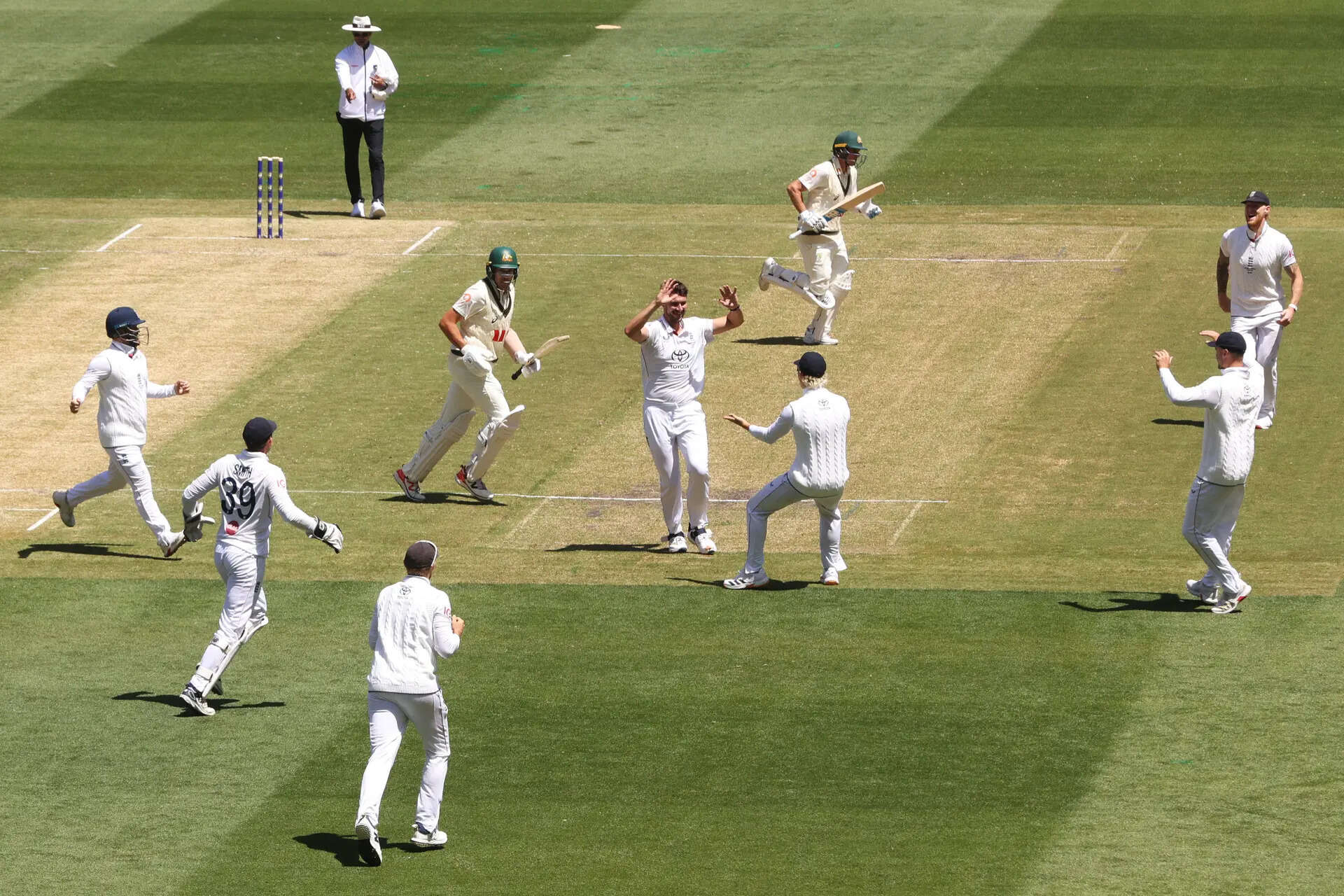
England’s Josh Tongue, center, celebrates the wicket of Australia’s Marnus Labuschagne, left, during their Ashes cricket test match in Melbourne, Friday, Dec. 26, 2025. (AP Photo/Hamish Blair)

There had been genuine optimism ahead of the tour that England might finally end their 14-year wait for an Ashes triumph in Australia. Instead, history repeated itself. England once again fell short, extending their winless run on Australian soil to 18 Tests. That number may well reach 19 by the end of the week.Individually, two of England’s modern day greats – Joe Root and skipper Ben Stokes – have never won a Test in Australia. Overall, Root has lost 21 Ashes Tests and Stokes 17.England have also drawn attention during the tour for their off-field activities. The team was first spotted playing golf in Perth both before and immediately after their two-day defeat in the opening Test.

Ashes: Australia vs England

England’s Ben Stokes, second right, celebrates with teammates. (AP/PTI Photo)

Following their eight-wicket loss at The Gabba, the ‘Bazballers’ then took a pre-arranged mid-series break in Noosa. Players were seen relaxing with drinks and a casual kickabout on the beach. In the aftermath of the third Test, the BBC reported that England’s players had been out drinking for six days following the second Test.During England’s 4–1 mauling at the hands of Rohit Sharma’s young Indian side a couple of years ago, former England captain Nasser Hussain had remarked: “At times, Bazball in this regime has been described as a cult where you cannot criticise, either within or externally.”That mindset has been one of the cornerstones of Stokes and Brendon McCullum’s leadership since they took charge in the summer of 2022. No finger-pointing, only good vibes. Crusty old quotes from former players, media and critics are ignored, irrespective of results. Winning, as has been said repeatedly, isn’t even the most important thing.

Hertha Berlin

Hertha Berlin supporters

Bazball may sound like a novel idea in modern cricket, but it finds precedent in the world of club football — particularly among the Ultras. The term refers to supporters whose loyalty crosses into fanaticism, defined by uncompromising devotion to their teams.Their history has often been marred by violence and gang rivalries, giving the movement a bloodstained reputation. Yet the intensity of their support is such that Ultras, usually stationed behind the goals, wield real influence, commanding the attention of players and club hierarchies alike. Trophies matter, but what truly defines an Ultra is the disciplined, almost militaristic backing of the club through success and failure.Take the example of Berlin’s top clubs. Hertha Berlin and Union Berlin, shaped on opposite sides of the Wall, carry a more understated identity than Germany’s global powerhouses Bayern Munich and Borussia Dortmund. There were even periods when Berlin lacked a top-flight club altogether. Still, beneath the surface, the city’s football culture has remained vibrant and deeply entrenched.

Australia England Cricket

England players celebrate the wicket of Australia’s Scott Boland, center left, during their Ashes cricket test match in Melbourne, Friday, Dec. 26, 2025. (AP Photo/Hamish Blair)

“If you want to define culture as being about success, titles, numbers and industry, f**k off. Then you have to go to Bayern Munich or Borussia Dortmund,” rapper Liquit Walker, a lifelong Union Berlin fan, once told Copa90. “But if you want to see real culture, real football culture, this is the place to be.”Much like football Ultras, the Bazball movement has found loyal supporters — particularly among sections of the media and former cricketers, who have sold the idea as though cricket has been reinvented.But cricket can never be football. No matter how it is packaged, the Bazball idea is falling flat, and its accompanying arrogance has only made matters worse.Take Alastair Cook, England’s hero during the 2010–11 Ashes — the last time they won in Australia. Cook scored 766 runs. In India in 2012, another rare overseas triumph, he made 562 runs. Substance, not slogans, defined those victories.

Australia England Cricket

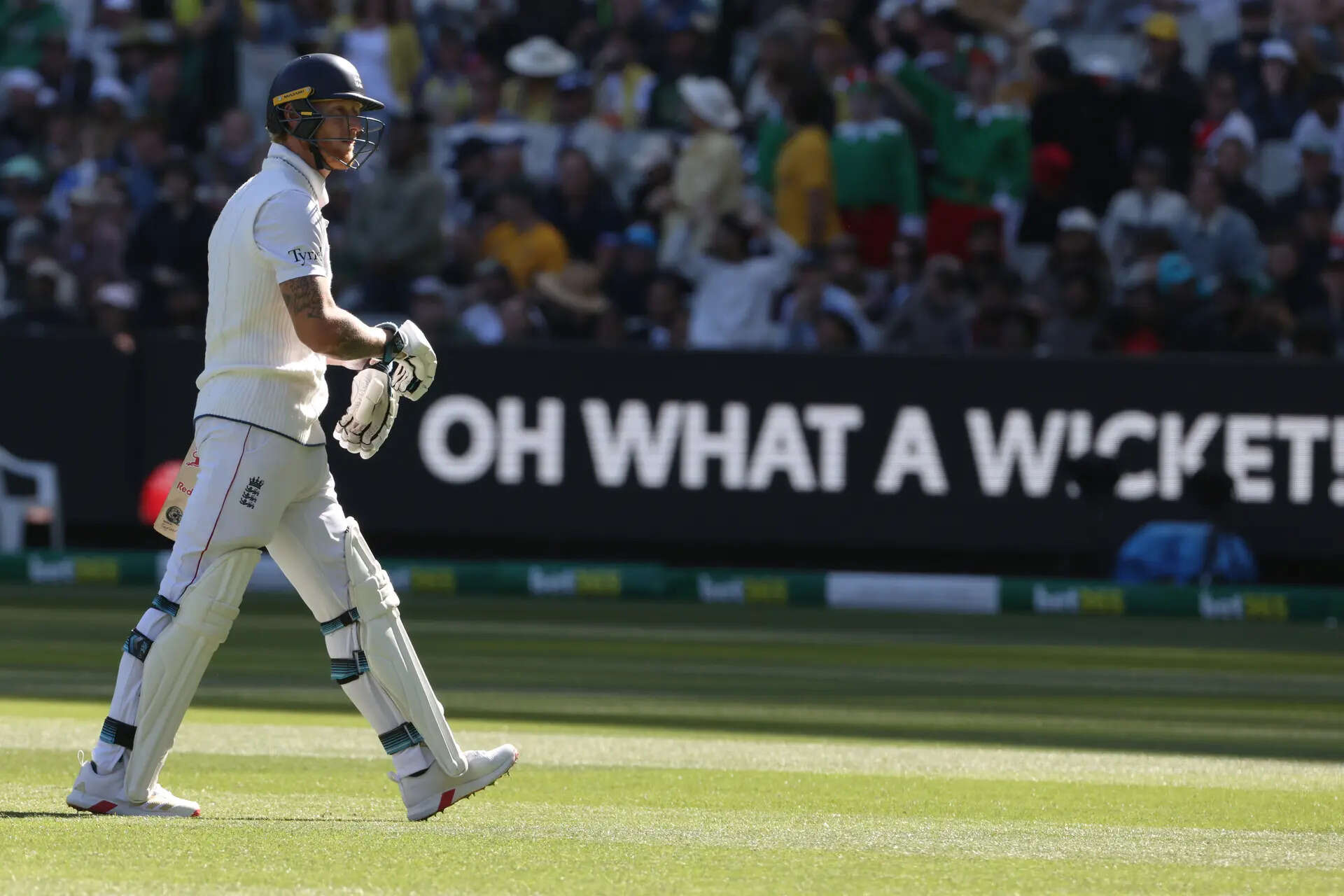
England’s Ben Stokes walks off after losing his wicket to Australia during their Ashes cricket test match in Melbourne, Friday, Dec. 26, 2025. (AP Photo/Hamish Blair)

But Stokes has famoulsy said that even England’s greatest past players might not have survived in the current regime. They went all in on the cult of Bazball and initially found the backing of fans to flourish. But in recent weeks, Australia — a side Stuart Broad had labelled the “weakest since 2010” — have outplayed England in every facet, despite not fielding their best XI in every Test.This England side, like many cults before it, is beginning to fracture. The Bazballers, once tipped to be invincible, appear closer to their reckoning.

Poll

What do you think is the main reason for England’s struggles in the Ashes series against Australia?

Former England captain Mike Atherton captured it succinctly in his column for The Times: “The biggest fascination for me about ‘Bazball’ was always whether ‘no-consequence’, carefree cricket could hold up under the fiercest pressure… The answer, clearly, has been no. The harsh realities of professional sport have resurfaced and swamped them.”So far, this Ashes for the Bazballers has been defined by golf, beaches, booze — and batterings.

[ad_2]

Source link