Breaking News
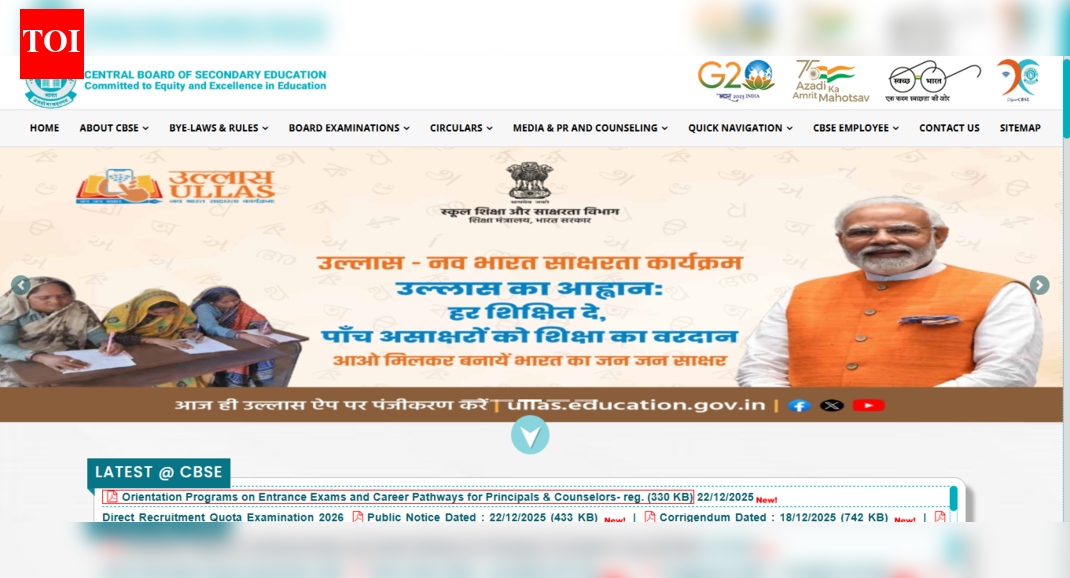
CBSE announces orientation programme on entrance exams and career pathways for principals, counsellors in UP: Direct link to register here

[ad_1]

CBSE announces orientation programme on entrance exams and career pathways for principals, counsellors in UP: Direct link to register here

The Central Board of Secondary Education (CBSE) has announced the rescheduled dates for the Orientation Programme on Entrance Exams and Career Pathways for Principals and Counsellors of CBSE-affiliated schools in Shahjahanpur, Uttar Pradesh.According to the official notice, the programme was earlier postponed following an advisory dated August 11, 2025, due to rising river water levels in the region. The postponement was formally communicated through a circular issued on August 14, 2025. The Board has now confirmed that the programme will be conducted offline on December 30, 2025.The orientation aims to strengthen career guidance mechanisms in schools and align counselling practices with the National Education Policy (NEP) 2020, which places strong emphasis on structured counselling systems to help students make informed academic and career decisions.

Viksit Bharat Shiksha Adhishthan Bill Explained: Education Reform Or A Quiet Erosion Of Federalism

Objective of the programme

The initiative is designed to equip school leaders and counsellors with updated insights into entrance examinations, emerging career pathways, and student guidance strategies. Through this programme, CBSE seeks to enhance schools’ capacity to support students in navigating higher education options, scholarships, internships, and evolving career landscapes.

Programme details

Here are the key details of the orientation programme.

Particulars Information
Date December 30, 2025 (Tuesday)
Time 10:00 AM to 02:00 PM
Mode Offline
Venue Seth M. R. Jaipuria School, Shahjahanpur, Uttar Pradesh – 242001
Reporting time 9:30 AM (for pre-program formalities)
Registration link https://forms.gle/MgA3YdWTdYUYz1Li9

Expected outcomes

According to CBSE, the orientation programme will focus on the following outcomes:

  1. Equipping Principals and Counsellors with practical tools for effective student guidance
  2. Sharing information on higher education opportunities, scholarships, and internships
  3. Aligning school-level career counselling practices with the National Education Policy 2020
  4. Enhancing awareness of diverse and emerging career options for students

Important instructions for participants

  • The programme has limited seats, and registrations will be accepted on a first-come, first-served basis
  • Confirmation emails will be sent to selected participants after registration
  • There is no registration fee for attending the programme
  • Travel and accommodation expenses (TA/DA) will be borne by the participants themselves

Who should attend

The programme is open to Principals, Vice Principals, and Counsellors of CBSE-affiliated schools in the Shahjahanpur region of Uttar Pradesh. Eligible school representatives are encouraged to register and participate to strengthen career guidance frameworks within their institutions.Read the official notice available here.

How to register

Interested and eligible participants can follow the steps below to complete the registration process.

  • Visit the official registration link
  • Fill in the required details
  • Review the information entered carefully before submission
  • Submit the form online
  • Wait for the confirmation email from CBSE, which will be sent to selected participants

Direct link to apply here.Note: For any queries related to the programme, participants may contact CBSE at: cbsecareer.counseling@gmail.com

[ad_2]

Source link

Infra output: Eight core sectors grow 1.8% in November; cement and steel lift momentum as energy drags

[ad_1]

Infra output: Eight core sectors grow 1.8% in November; cement and steel lift momentum as energy drags

Eight core infrastructure industries recorded a modest expansion in November 2025, with overall output rising 1.8% year-on-year, supported by strong growth in cement, steel, fertilisers and coal, official data released by the Ministry of Commerce & Industry showed.The combined Index of Eight Core Industries (ICI), which accounts for 40.27% of the Index of Industrial Production (IIP), improved from a marginal contraction of 0.1% recorded in October 2025. Cumulative growth during April–November 2025-26 stood at 2.4% on a provisional basis.Cement emerged as the strongest performer during the month, posting a sharp 14.5% rise over November last year, while steel output increased 6.1%. Fertiliser production grew 5.6% and coal output rose 2.1%, providing the main boost to overall core sector growth.

From Power Cuts To 500 GW Grid, India Emerges As Global Data Centre Hub Under Modi: Piyush Goyal

In contrast, energy-linked segments continued to weigh on performance. Crude oil production declined 3.2% year-on-year, while natural gas output fell 2.5%. Electricity generation also contracted by 2.2% during the month. Petroleum refinery products saw a marginal decline of 0.9%.On a cumulative basis, steel output expanded 9.7% during April–November, while cement grew 8.2%. Fertilisers posted a 1.3% increase and refinery products edged up 0.2% over the same period. Coal, crude oil, natural gas and electricity recorded cumulative declines.The eight core industries comprise coal, crude oil, natural gas, refinery products, fertilisers, steel, cement and electricity, and are widely tracked as key indicators of industrial and infrastructure activity in the economy, the ministry said. The index is released every month.

[ad_2]

Source link
Tax nudge: Income tax dept ropes in MNCs to flag undisclosed foreign assets; employees face Dec 31 deadline

[ad_1]

Tax nudge: Income tax dept ropes in MNCs to flag undisclosed foreign assets; employees face Dec 31 deadline

With just days left before the year-end compliance window closes, the Income Tax department has begun reaching out directly to multinational companies, asking them to alert Indian employees about undisclosed foreign assets and income, according to multiple tax advisors.Several large multinationals — including a global consumer healthcare firm, a wireless technology major and a US-based semiconductor designer — have received formal communications from the department, indicating that a number of their India-based employees fall under mandatory foreign asset reporting for the assessment year 2025-26, according to an ET report.In one such email reviewed by advisors, the tax office said it already possesses relevant data and urged cooperation from employers. “Data received indicates that 30 of your employees are subject to mandatory reporting for the assessment year 2025-26. To ensure confidentiality, the department is not disclosing the specific names of the employees in this email. We request your cooperation in ensuring statutory compliance,” the communication stated.The companies have been advised to sensitise staff on the urgency of disclosing overseas assets and income, warning that failure to do so could invite assessment proceedings, a penalty of Rs 10 lakh, and even prosecution under the Black Money law.Tax professionals say many such lapses arise from misconceptions rather than intent. Indian employees of multinational firms often fail to report employee stock option plans (ESOPs), overseas dividends or capital gains, assuming that foreign income will not come to the attention of Indian authorities. However, information now routinely reaches the department through global data-sharing frameworks such as the US Foreign Account Tax Compliance Act (FATCA) and the Common Reporting Standard (CRS).“This places a disproportionate onus on employers, requiring them to monitor and interpret employees’ foreign assets — an area that often extends beyond payroll visibility. The onus of reporting foreign assets in Schedule FA (in the I-T return) rests with the employees. On ESOPs, a longstanding issue that requires clarification from CBDT is whether disclosure is necessary at the time of grant or vesting,” said Ashish Karundia, founder of the CA firm bearing his name, ET quoted.What has surprised advisors is the speed at which the information exchange is now occurring. “The exchange of information is moving at a speed that’s unheard of. The government is getting data within six months of the year-end. The department is sending reminders via SMS and emails, which would help genuine assessees to revise or update returns without getting into litigation. As things stand, residents have no option but to disclose overseas assets in ITRs,” said Rajesh Shah, partner at Jayantilal Thakkar & Co.The outreach forms part of the second phase of the Central Board of Direct Taxes’ ‘NUDGE Campaign’, launched in 2024, which offers taxpayers an opportunity to file revised or updated returns by December 31, 2025. Individuals who earned interest, dividends, rental income or capital gains from unreported foreign assets are being asked to correct their filings.However, experts caution against misplaced reliance on updated returns alone. “There is a misconception that disclosing foreign assets through an Updated Return, or ITR-U, (u/s 139(8A) of the Income Tax Act) provides immunity from the stringent penalties of the Black Money Act. However, a closer reading of Section 43 of the Black Money Act reveals a significant legal gap. Since section 43 does not explicitly recognize an updated Return for penalty waiver, taxpayers relying on ITR-U may still be liable for the ₹10 lakh penalty,” said Mohit Bang, partner at Trivedi & Bang.He added that disclosure and correction before the December 31 deadline would help taxpayers avoid penalties for both non-reporting and tax evasion.The Black Money (Undisclosed Foreign Income and Assets) and Imposition of Tax Act, which came into force on July 1, 2015, empowers authorities to tax and penalise undisclosed overseas assets, including foreign bank accounts, offshore trusts and unlisted entities with concealed beneficial ownership.

[ad_2]

Source link
‘Won’t let them become communal labs’: Why Christmas row erupted in Kerala schools; minister flags alleged ban | Thiruvananthapuram News

[ad_1]

‘Won’t let them become communal labs’: Why Christmas row erupted in Kerala schools; minister flags alleged ban
Kerala’s Education Minister V. Sivankutty has warned private schools against blocking Christmas celebrations, citing concerns of divisive religious models

THIRUVANANTHAPURAM: Kerala education minister V Sivankutty on Sunday flagged reports of some private schools in the state blocking Christmas celebrations on campus, warning that the LDF government would not tolerate “divisive models based on religion and belief, as seen in north India”.“Such actions are unheard of in a state like Kerala, known for its…secular culture…Our schools are places where children learn and grow together beyond caste and religious thoughts. We won’t let them become communal labs,” Sivankutty said.The minister’s remarks followed allegations by CPM mouthpiece Deshabhimani that some “Sangh Parivar-run” schools and another institution with a “Hindu management” had decided not to hold Christmas programmes. At least one institute allegedly collected contributions for the festival before reversing the decision. Sources said some parents jointly petitioned the minister against a school in Thiruvananthapuram that cancelled the celebrations after planning them.Sivankutty said schools in Kerala had traditionally celebrated Onam, Christmas and Eid with equal fervour. “It is through such gatherings that children learn to love and respect each other. The act of cancelling celebrations after collecting money and then returning it is both hurtful and cruel to young minds,” he said.The minister stressed that all schools — government-run, aided or private — “have a responsibility to uphold the secular principles enshrined in India’s Constitution”. Without naming any institution or organisation, he warned of strict action against anyone attempting to turn schools into what he described as “places that protect narrow political and communal interests”.PTI quoted an RSS functionary as saying it was implausible that any institute would have decided to prevent children from celebrating a festival. “We are not against any sort of cultural celebration,” he said.Officials of the “Hindu-management school” referred to in the CPM mouthpiece clarified that there was no ban on Christmas celebrations in their institution. “But a restriction is imposed on cutting cakes as part of the celebration in view of concerns of any possible food poisoning. Christmas celebrations will be held as such,” an official told PTI.Sivankutty said instructions would be issued to officials concerned to conduct an urgent inquiry into the matter and submit a report.

[ad_2]

Source link
Foxconn ramps up hiring! Recuri 30,000 at all women led iPhone unit — What’s next for the Apple components plant?

[ad_1]

Foxconn ramps up hiring! Recuri 30,000 at all women led iPhone unit — What's next for the Apple components plant?

Foxconn has rapidly scaled up its newest iPhone manufacturing facility near Bengaluru, hiring close to 30,000 workers within eight to nine months, marking the fastest workforce expansion by any factory in India to date. The swift ramp-up at the Devanahalli plant underscores Apple’s push to diversify its supply chain beyond China, according to people familiar with the development, ET reported. Spread across 300 acres, the facility is notable for its predominantly female workforce. Around 80% of the employees are women, most of them aged between 19 and 24 and entering the workforce for the first time, the people said. “The factory started testing production in April-May this year with iPhone 16 and now makes the latest iPhone 17 Pro Max models,” said a person privy to the details. More than 80% of the output from the plant is exported, the person told ET. As production scales up, employment is expected to rise further. A second person said the unit has the capacity to engage up to 50,000 workers once it reaches peak production next year. “There are six large dorms, several of which are currently functional to house the women staff, and construction for the rest are also in full swing,” the person told ET.

What’s next…a mini township?

With its planned expansion, the Devanahalli facility is expected to house more women workers at a single location than any government or private entity in the country. Women migrants from neighbouring states have already found employment at the plant, which is envisioned to eventually function as a mini township. Plans for the site include residential facilities, medical services, schools and entertainment spaces within the premises. Industry estimates suggest that, along with free accommodation and subsidised food, workers earn an average monthly salary of about Rs 18,000, placing it among the better-paying blue-collar jobs for women. Foxconn, Apple’s largest contract manufacturer, is investing Rs 20,000 crore in the project. Once fully completed, it is expected to become India’s largest factory in terms of both production capacity and employment. “With a production floor space of nearly 250,000 sq ft, it’s massive by any standards but certainly amongst the largest in the country,” said the first person. The new plant is set to surpass Foxconn’s first iPhone manufacturing unit in Tamil Nadu, which currently employs around 41,000 workers. People tracking the Bengaluru project said the facility is likely to house up to a dozen iPhone assembly lines in the future, compared with about four at present.Apple has beensteadily shifting iPhone production to India, aided by the production-linked incentive (PLI) scheme introduced in 2021. “Apple’s operations in India are a shining example of government-industry partnership,” said a government official. “This size and speed of expansion was unimaginable just four years ago. Apple’s plant has broken multiple records setting a new benchmark for what is possible in manufacturing and exports from India.According to ET, all iphone models are made in India from the start and then exported globally. The rapid scale-up has been supported by the expansion of Apple’s supplier network in India to nearly 45 companies, including local component manufacturers and sub-assembly firms.

[ad_2]

Source link

Life under the river: How the east–west metro is redrawing Kolkata’s daily map | Kolkata News

[ad_1]

Life under the river: How the east–west metro is redrawing Kolkata’s daily map
Kolkata’s new East-West Metro, the Green Line, has revolutionized city travel with its groundbreaking underwater tunnel beneath the Hooghly River

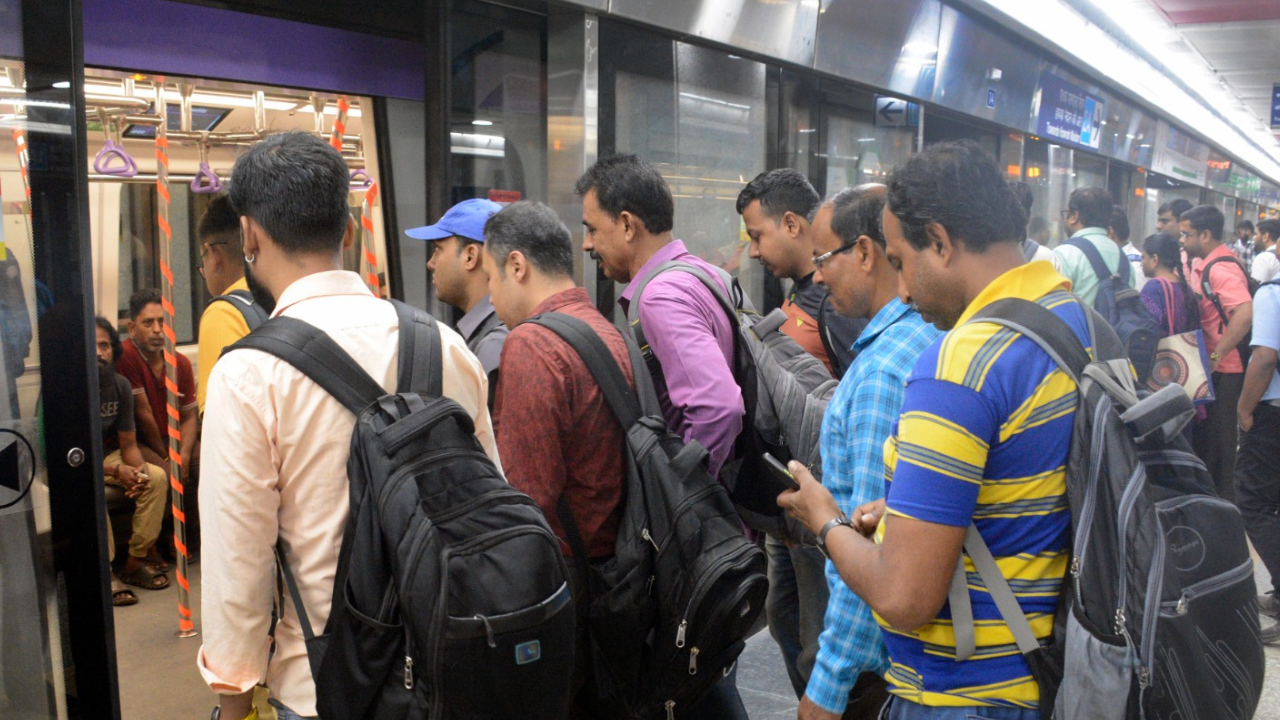
KOLKATA: Imagine slipping beneath a great river in the comfort of an air-conditioned metro cutting hours of travel into minutes and reshaping the daily rhythm of a city. This is now part of everyday life in Kolkata thanks to the East–West Metro, the city’s second metro line, also known as the Green Line. The city’s first metro, the North–South corridor (Blue Line), opened in October 1984, making Kolkata the first Indian city to have a metro, a title it held until Delhi Metro launched its first line in 2002.

-

A new passage under a historic river

-

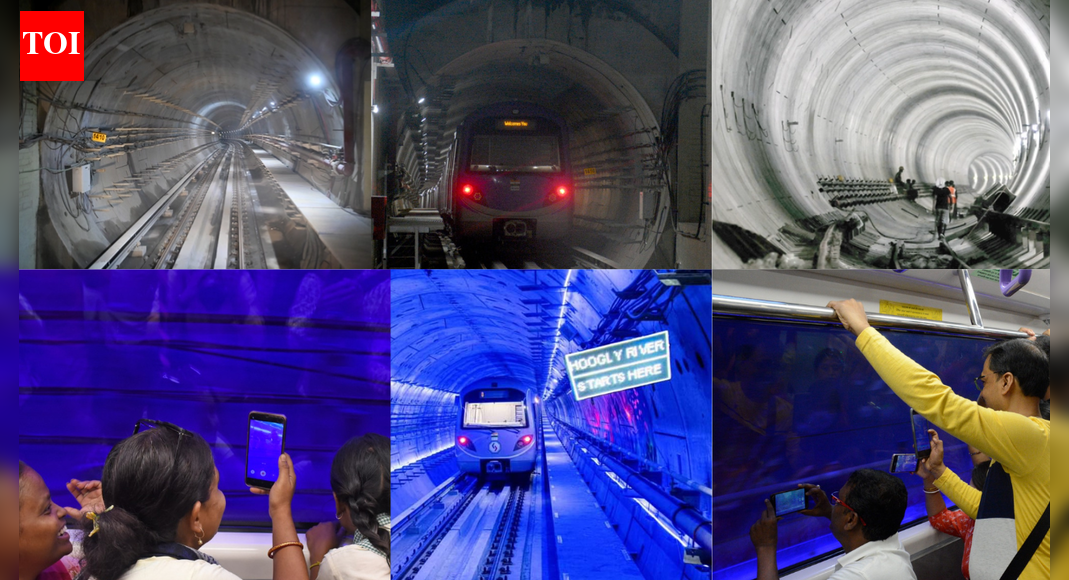
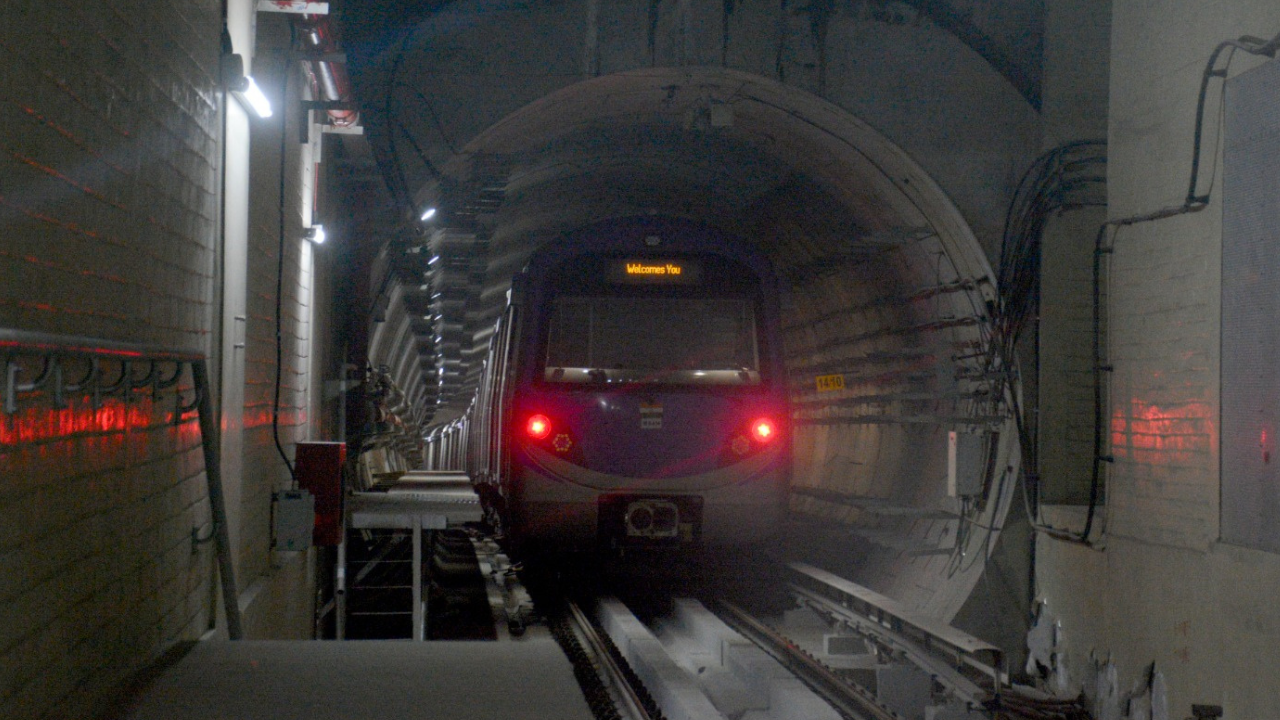
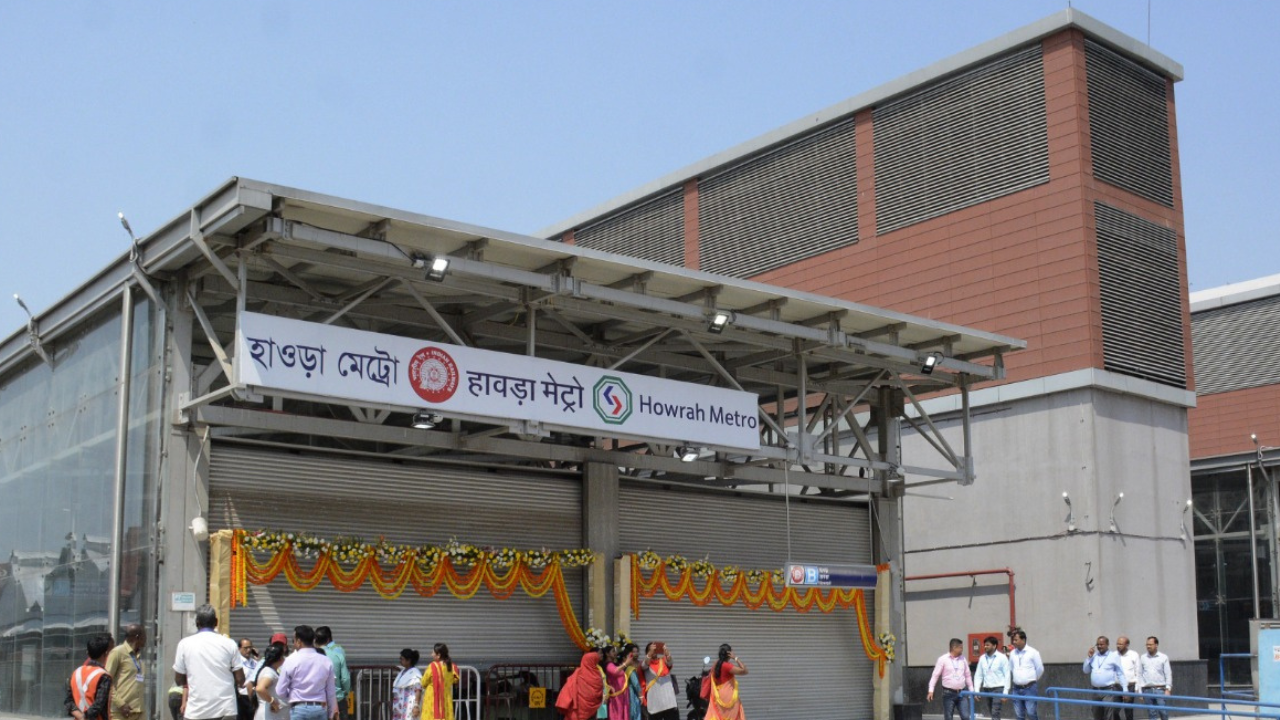
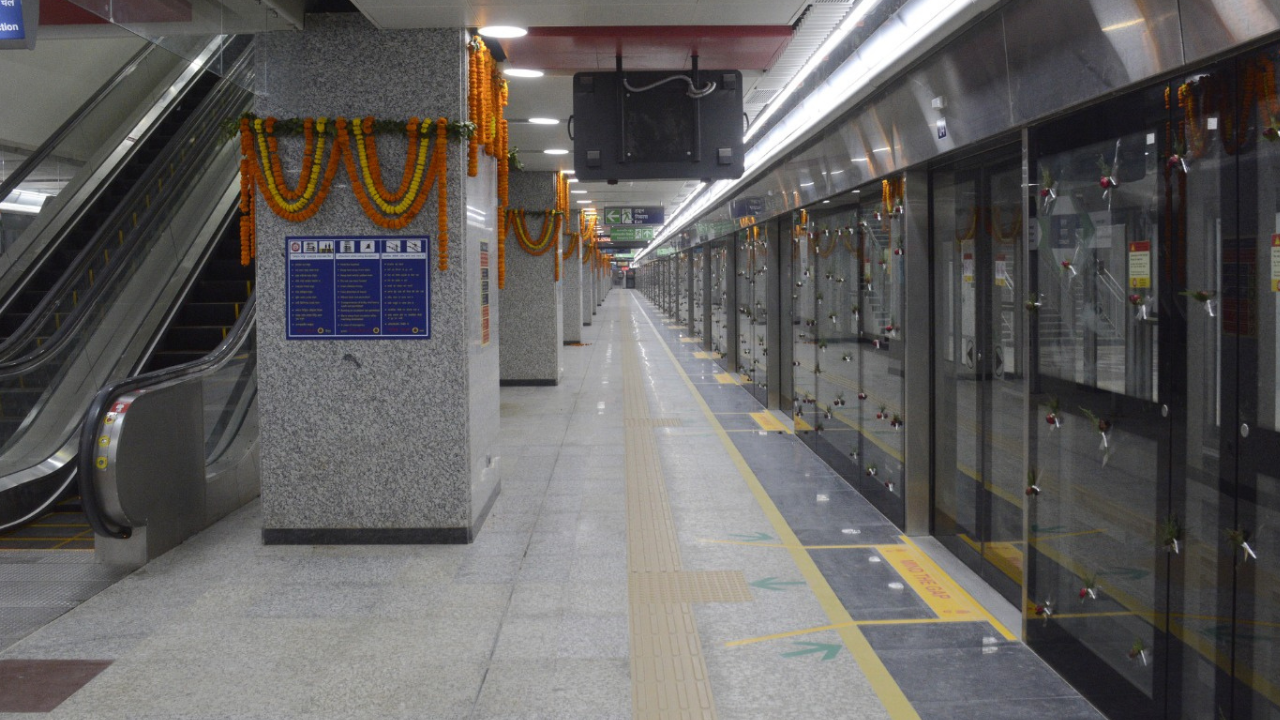
The East–West Metro runs 17 km from Sector V in Salt Lake on the east to Howrah Maidan on the west bank of the Hooghly River. A key feature of this line is its underwater tunnel: a 520-metre stretch beneath the river, India’s first transport tunnel of its kind.

Can other cities learn from India’s only water metro experience? #kochi | I Witness

Trains run about 16 metres below the riverbed, while the Howrah station on this route is now India’s deepest, built around 30 metres underground.The metro has transformed commuting for lakhs of residents between Salt Lake and Howrah, as well as hundreds of thousands from the suburbs who access the service via Howrah and Sealdah railway stations two of the busiest in India, serving nearly 20 lakh passengers daily.

On April 20, 2023: Kolkata Metro train runs through Hooghly river tunnel during trial from Howrah Maidan to Esplanade

Engineering against the odds

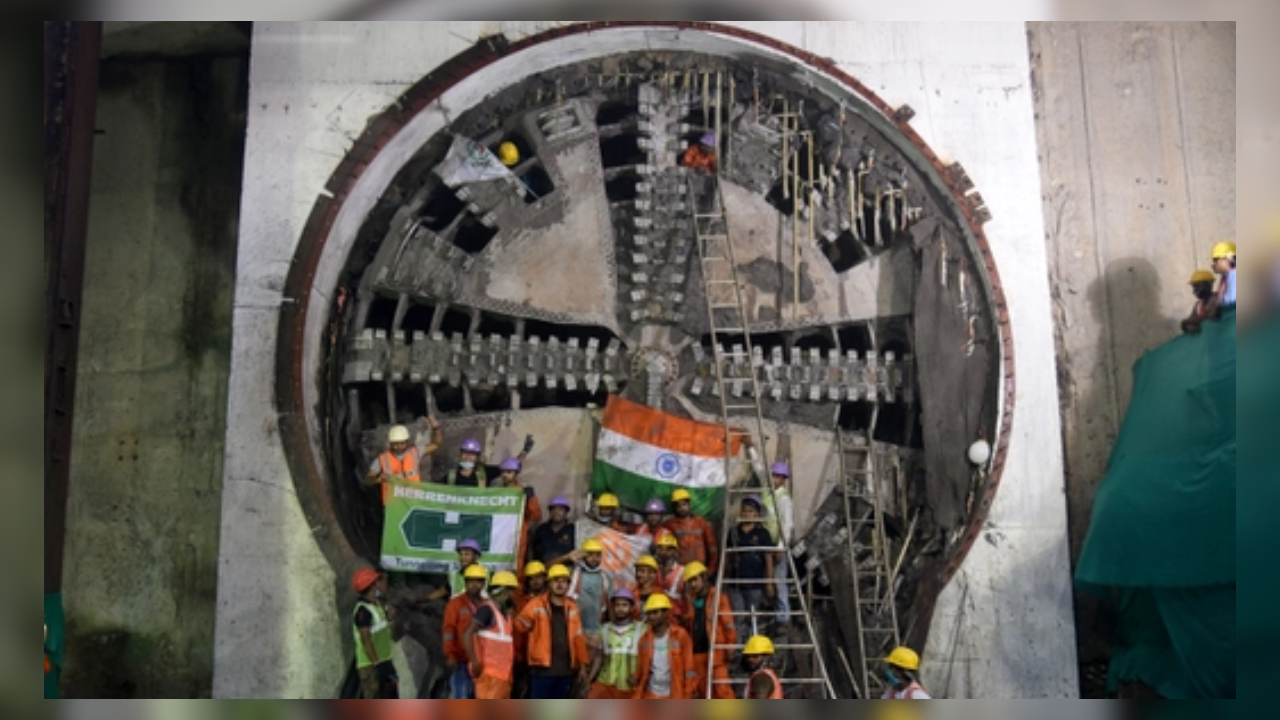
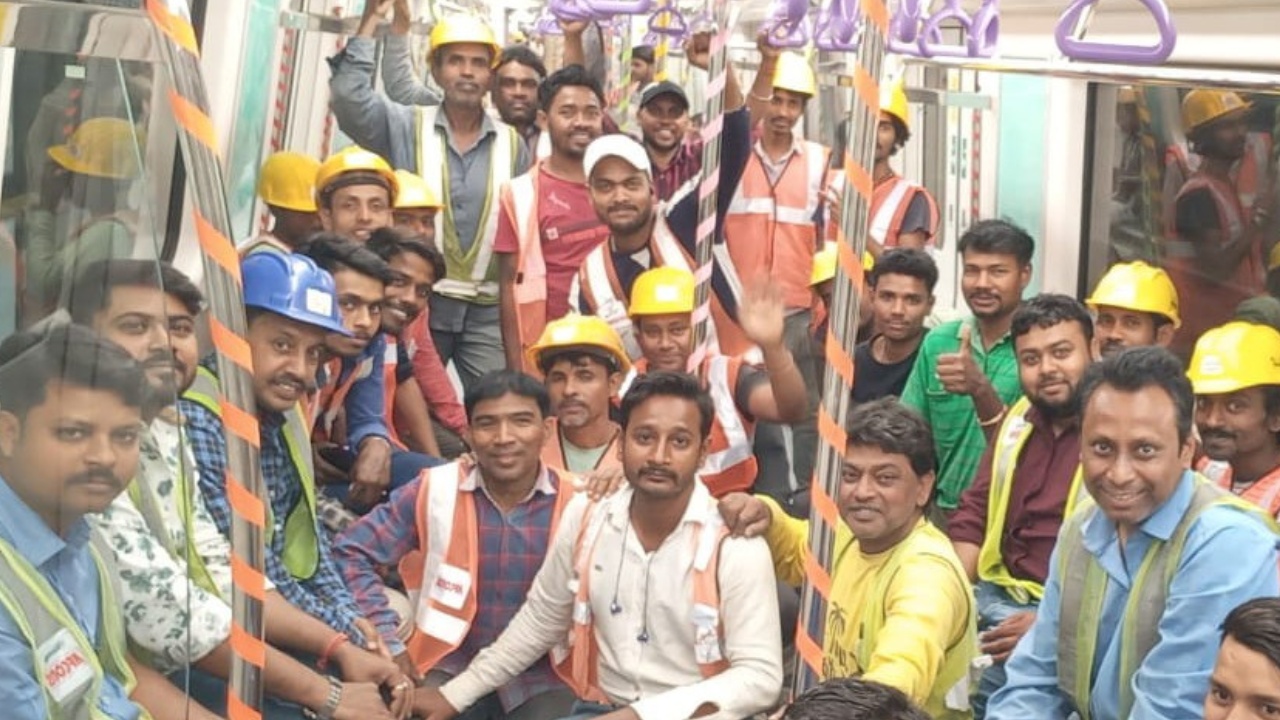
Laborers of the Metro Rail as the east-bound underground tunnel of the 'East-West Metro'

Construction of the Green Line stretched over more than a decade. River tunnelling was completed in a record 67 days in 2017. Engineers had to dig through soft, unpredictable alluvial soil and build waterproof tunnel linings designed to last over 120 years.Central Kolkata, particularly Bowbazar, posed significant challenges. Ground subsidence and water ingress disrupted tunnelling, delaying parts of the project for years before the river crossing could be completed. The twin tunnels were excavated using earth pressure balancing tunnel boring machines, cutting through predominantly stiff clayey silt beneath the riverbed.

-

Interestingly, the underwater tunnel is not a new idea. Sir Harley Dalrymple-Hay, a Birbhum-born British engineer, drafted plans for an underwater railway in Kolkata as far back as 1921.From trials to daily routine

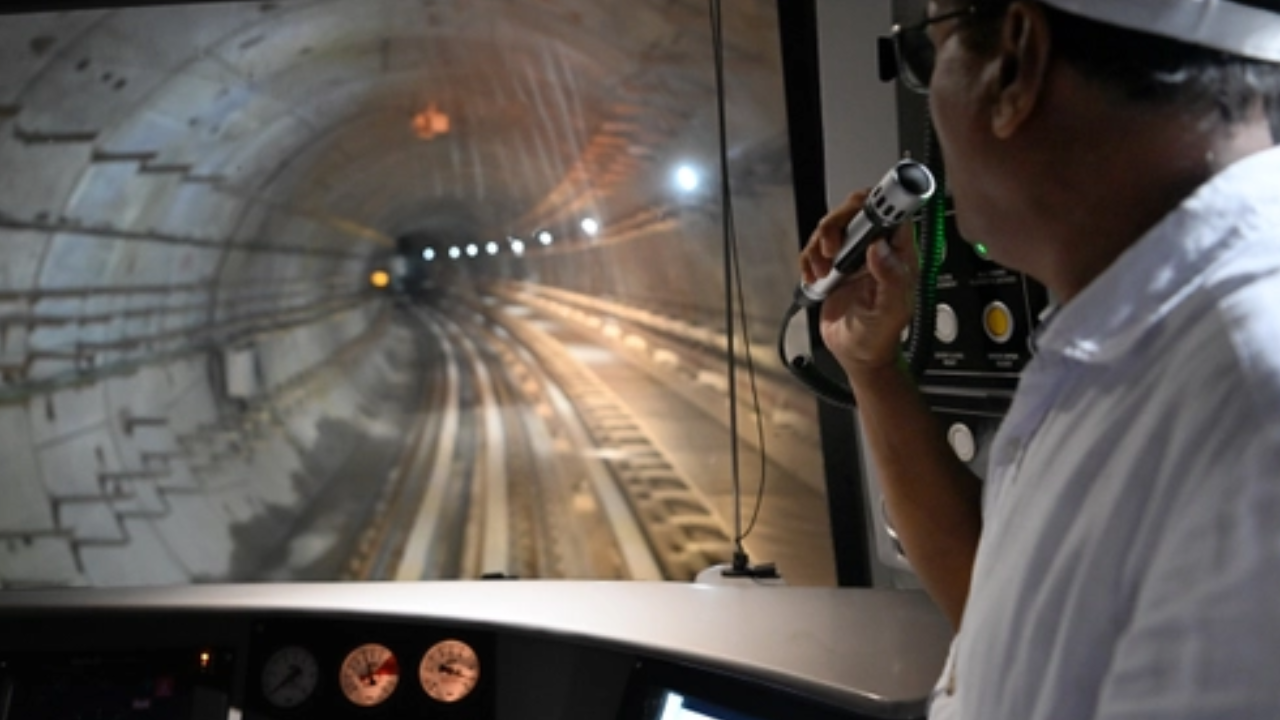
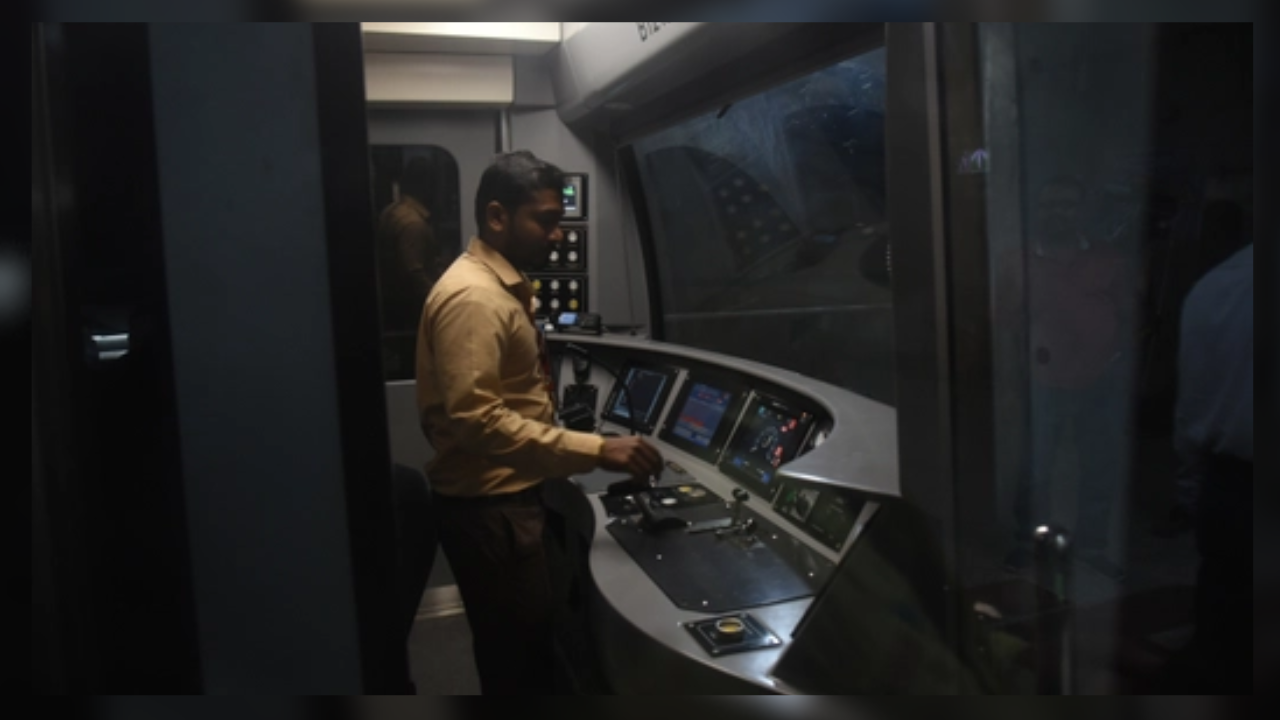
During trial run through Hooghly river tunnel between Howrah Maidan and Esplanade

After years of construction and testing, the East–West Metro opened for commercial service in March 2024. Thousands of commuters boarded the first trains with excitement as the Green Line began stitching the city together in a new way.Within the first 15 days, around 53,570 passengers used the Esplanade–Howrah Maidan stretch daily — equivalent to removing hundreds of bus trips from city roads. Many commuters switched from cabs and cars to the metro for speed, comfort, and reliability. On the very first public day, over 70,000 passengers rode the under-river section.

-

The underwater journey itself takes just 45 seconds. Where the bus ride across Howrah Bridge used to take 3-4 minutes on a lucky day against 15-20 minutes in heat and congestion during rush hours and sometimes up to an hour or more during political rallies and protests, commuters now travel in air-conditioned comfort. The journey from Howrah Maidan to Esplanade takes barely eight minutes by the metro. This would take a minimum of 30-40 minutes by bus. Metro that changes daily life

-

For thousands in Kolkata and Howrah, the Green Line has become part of everyday life.Shorter commutes: Travelling between Kolkata and Howrah now takes minutes instead of hours.Comfort and reliability: Unlike road transport, the metro provides air-conditioned comfort and predictable travel times, easing stress during peak hours.

-

Beyond convenience, the East–West Metro addresses broader urban challenges. It reduces traffic congestion, lowers air pollution, and offers a more sustainable commute. “Howrah and Kolkata have always been twin cities, but crossing the Hooghly was a pain. The East–West Metro has changed that — Howrah now truly feels like a twin city,” said Ruby Saha, a Howrah resident.

-

Suburban commuters also benefit. Local train passengers arriving at Howrah Station can now interchange directly to the Green Line, avoiding crowded bus stands and congested roads.Crowding concerns on older lines

-

The success of the East–West Metro has increased pressure on the North–South Blue Line, operational since 1984. Daily trains now carry more passengers, especially during evening peaks, sometimes causing overcrowding. Commuters report longer waits to board, particularly after the Green Line section opened.

-

While the Esplanade–Howrah Maidan stretch is fully operational, work continues to complete the 16.6-kilometre corridor from Sector V to Howrah. About 65% of the line runs through underground twin tunnels, including the 520-metre river crossing, with the rest mostly on elevated viaducts. This under-river tunnel is India’s first transportation tunnel beneath a river.A system built for interchange

-

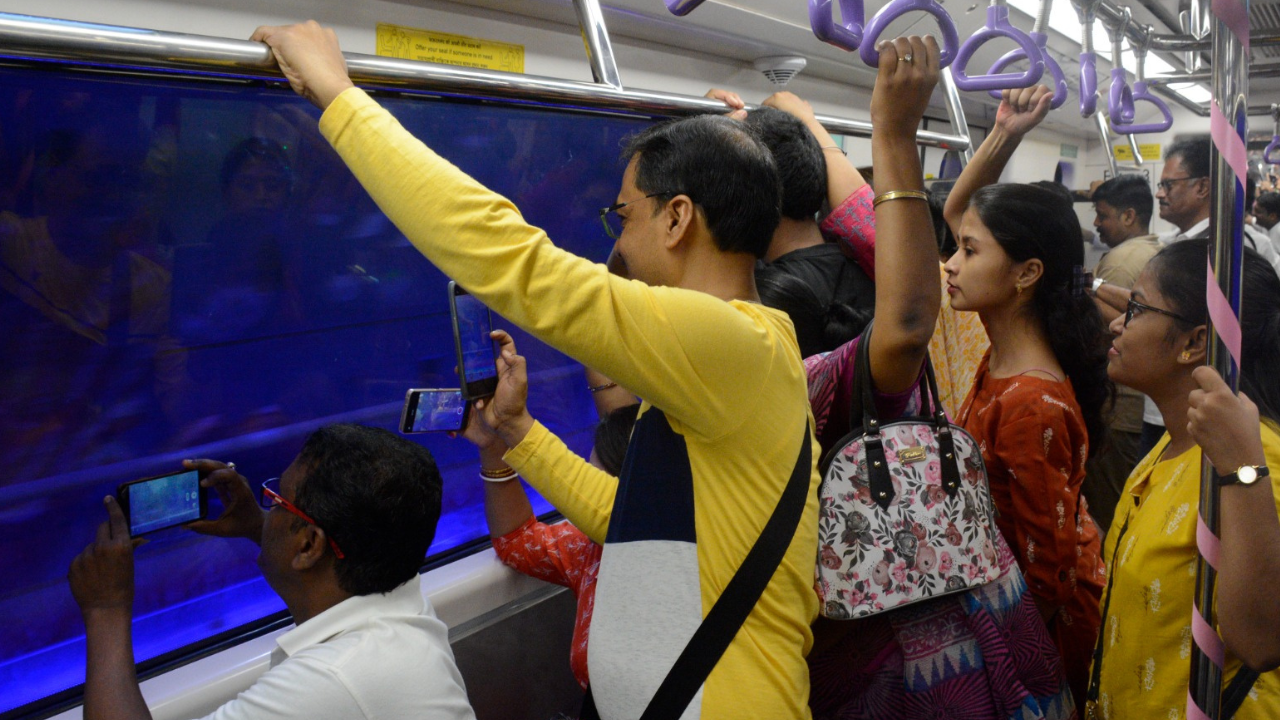
The Green Line intersects the Blue Line at Esplanade, allowing passengers to travel north to Dakshineswar or south to New Garia. Blue lights along the tunnel mark the under-river stretch, making the journey visually interesting for commuters between Howrah and Mahakaran stations.Transforming the city’s geography

-

The East–West Metro has reshaped Kolkata’s daily map. By connecting previously separated neighbourhoods beneath the Hooghly, it links residential areas with IT hubs, business districts, and railway stations. Dependence on surface transport has reduced, carbon emissions have dropped, and travel is more predictable. For many, commuting has become faster, more comfortable, and less stressful.Today, the underwater metro is not just transport — it is a living part of Kolkata’s rhythm, redefining how hundreds of thousands begin and end their daily journeys.

[ad_2]

Source link

Dhurandhar Full Movie Collection: ‘Dhurandhar’ box office collection day 18 (LIVE): The Ranveer Singh, Akshaye Khanna starrer stars third Monday on a slow note after crossing Rs 550 crore |

[ad_1]

'Dhurandhar' box office collection day 18 (LIVE): The Ranveer Singh, Akshaye Khanna starrer stars third Monday on a slow note after crossing Rs 550 crore

‘Dhurandhar’ that released on December 5 has been a solely reigning at the box office ever since the film released. While on day 1, the film may have opened to mixed reviews, it proved to be this juggernaut of a film that went on to break records. It became a talking point on the internet with scenes from the movie going viral along with the songs. Not to mention, it also started breaking records at the box office one by one. ‘Dhurandhar’ became the biggest second weekend grossing movie of all time.Dhurandhar Movie ReviewIt collected Rs 253 crore in the second week, which is more than the first week collection. This happens so rarely. It had made Rs 207.25 crore in week one. After completing week 2, the film has begun on a slow note on third Friday and now may gradually begin to see a dip. On day 15, which is Friday, it made Rs 22.5 crore. On third Saturday, it saw growth of around 52 percent and made Rs 34.25 crore. And now it has started day 17, Sunday also on a decent note. It may end up making the same number as Saturday if not more. The film’s collection on Sunday as per early estimates is Rs 38.50 crore. This is a great number for a third Sunday. The film has begun the third Monday on a slow note which is also expected.

Dhurandhar’s 26/11 Scene That Shook A Survivor

On Monday, day 18, till afternoon, the collection is Rs 2.26 corre. The film’s total collection so far in India is Rs 558.01 crore.

Day wise collection of ‘Dhurandhar’

Day 1 [1st Friday] ₹ 28 Cr –Day 2 [1st Saturday] ₹ 32 CrDay 3 [1st Sunday] ₹ 43 CrDay 4 [1st Monday] ₹ 23.25 CrDay 5 [1st Tuesday] ₹ 27 CrDay 6 [1st Wednesday] ₹ 27 CrDay 7 [1st Thursday] ₹ 27 CrWeek 1 Collection ₹ 207.25 Cr –Day 8 [2nd Friday] ₹ 32.5 CrDay 9 [2nd Saturday] ₹ 53 CrDay 10 [2nd Sunday] ₹ 58 CrDay 11 [2nd Monday] ₹ 30.5 CrDay 12 [2nd Tuesday] ₹ 30.5 CrDay 13 [2nd Wednesday] ₹ 25.5 CrDay 14 [2nd Thursday] ₹ 23.25 CrWeek 2 Collection ₹ 253.25 CrDay 15 [3rd Friday] ₹ 22.5 CrDay 16 [3rd Saturday] ₹ 34.25 CrDay 17 [3rd Sunday] ₹ 38.5 CrDay 18 [3rd Monday] ₹ 2.26 CrTotal ₹ 558.01 Cr

[ad_2]

Source link

Taj expands wings in Africa, to have a hotel in Cairo

[ad_1]

Taj expands wings in Africa, to have a hotel in Cairo

NEW DELHI: Cairo will soon have a Taj hotel with an existing property there going to be run by the Tata Group company. The Indian Hotels Company Limited (IHCL, Taj parent) Monday signed a 300-key Taj Cairo. This will be the second Taj property in Africa, after a hotel in Cape Town. Among Indian hospitality companies, IHCL has the maximum properties abroad followed by Oberoi and then ITC.IHCL MD & CEO Puneet Chhatwal said: “..Debuting the iconic Taj brand in Cairo aligns with IHCL’s international growth strategy of being present in key gateway cities of the world and extending the brand’s hallmark warm and sincere service. We are excited for this landmark development and thank Hon’ble Prime Minister Mostafa Madbouly for his support.”Hisham El Demery, CEO of EGOTH (Egyptian General Company for Tourism & Hotels), said: “The transformation of the Grand Continental Hotel into Taj Cairo is a defining moment in our mission to restore Egypt’s architectural heritage. As the custodians of this iconic landmark, EGOTH is committed to ensuring that its legacy is honoured through thoughtful redevelopment and world-class standards. Our partnership with IHCL brings trusted expertise to this endeavour, and together we are creating a destination that will contribute meaningfully to Cairo’s tourism landscape and its continued revitalisation ”Incorporated by Tata Group founder Jamsetji Tata, the Company opened its first hotel – The Taj Mahal Palace, in Bombay in 1903. IHCL has a portfolio of 602 hotels including 247 in the pipeline globally across four continents, 14 countries and in over 250 locations.

[ad_2]

Source link

‘Desh ke andar do namune hai’: Yogi’s veiled swipe at Akhilesh, Rahul; SP chief hits back | India News

[ad_1]

'Desh ke andar do namune hai': Yogi's veiled swipe at Akhilesh, Rahul; SP chief hits back
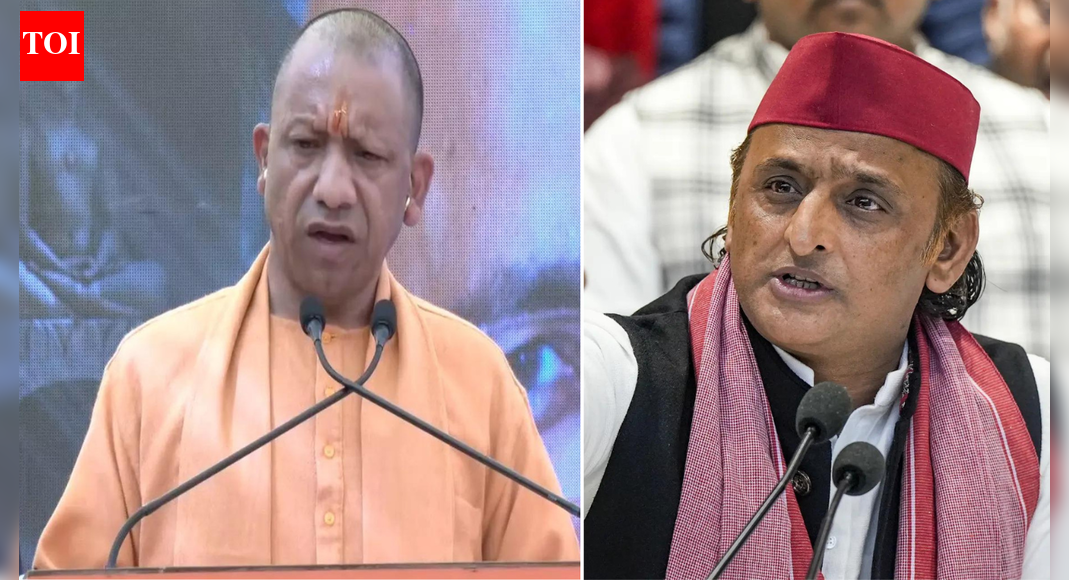
Yogi Adityanath and Akhilesh Yadav (Images/Agencies)

NEW DELHI: Uttar Pradesh chief minister Yogi Adityanath on Monday took a veiled dig at Samajwadi Party chief Akhilesh Yadav and Congress leader Rahul Gandhi during a state Assembly session, saying “desh ke andar do namune hain” (There are two specimens in the country).The remarks came amid a heated debate in the Assembly over the alleged illegal trade of codeine-based cough syrup, prompting strong protests from the SP and noisy demonstrations inside and outside the House.

Yogi Adityanath Targets Nehru Over Kashmir, Links Historic Blunder To India’s Long Terror Crisis

Speaking during the winter session, Adityanath said, “ ‘Desh ke andar do namune hain’. One sits in Delhi and the other in Lucknow. When there is any discussion in the country, they immediately flee the country, and I think the same thing is happening with your ‘Babua’. He will also leave the country again for a trip to England, and you people will keep shouting here.”The remarks came in response to opposition questions on deaths allegedly caused by codeine syrup, though UP CM did not name them explicitly.He categorically denied any fatalities due to the syrup in Uttar Pradesh: “No deaths have occurred in Uttar Pradesh due to codeine cough syrup. Secondly, action will be taken in this case under the NDPS Act. The Uttar Pradesh government has won this case in court.” Yogi added that the biggest wholesaler first apprehended by the STF had been licensed during the Samajwadi Party’s tenure in 2016.Giving an update on enforcement, the chief minister said, “The government has registered 79 cases, named 225 accused and arrested 78 people. Raids have been conducted on 134 firms. No accused in this case will escape, and preparations will also be made for bulldozer action when the time comes.” He also suggested that a deeper investigation may reveal links to the Samajwadi Party.“I think if you delve deeper into this matter, you’ll find that ultimately, some leader or individual associated with the Samajwadi Party is involved. The High Court has ruled that this entire case should be prosecuted under the NDPS Act. The Uttar Pradesh government has fought this battle and won.” he stated.The remarks drew strong reactions from Akhilesh Yadav. He criticised the public spat between leaders and the use of personal attacks in political discourse.In a post on X, Samajwadi chief wrote: “Self-Acceptance! No one expected the Delhi-Lucknow feud to escalate to this point. People holding constitutional positions should at least maintain some public decorum and not cross the bounds of propriety. BJP folks should not bring their party’s internal squabbles out to the crossroads.”Earlier, Akhilesh had alleged that the codeine racket originated from the Prime Minister’s parliamentary constituency. “A state’s chief minister lies, and those standing with him also lie. You can’t imagine that an illegal cough syrup business is operating from the Prime Minister’s parliamentary constituency… it’s worth thousands of crores. This is an international issue,” he said. Yadav called for strict bulldozer-style action against all “mafias,” irrespective of political affiliation.

What were the protests about?

Earlier today, Samajwadi Party members held demonstrations outside the Uttar Pradesh Legislative Assembly. The protest came amid outrage over the alleged illegal trade of codeine-based cough syrup and what the party described as government inaction.SP legislators, including both MLAs and council members, staged a sit-in near the main gate of Vidhan Bhavan, holding placards with anti-government slogans and demanding strict action against those involved in the syrup racket.During the protest, SP members raised slogans against UP CM, alleging that people from his own caste and close associates were involved in the illegal trade. The party accused the government of prioritizing profits over public health and youth welfare. A statement from the Samajwadi Party media cell on X read: “Chief Minister Adityanath is running the business of poisonous and intoxicating cough syrup. People from his own caste and his close associates are involved in the illegal trade. Is their greed for money so intense that the deaths of children and addiction among youth have no effect on them? What kind of yogis are these who have gone to such extremes for money? How do they call themselves honest with what face? Is this their yoga, this their saintliness, and this their so-called honesty?”SP legislators also raised other issues during the protest, including alleged manipulation of voter lists, curtailment of reservation rights, and collapse of health services. The Uttar Pradesh police said a Special Investigation Team is probing the illegal network involved in storage and distribution of regulated codeine-based cough syrups, including financial transactions and cross-border links to Nepal and Bangladesh.

[ad_2]

Source link

How long should you hold a stock? Why in equity investing, time beats timing – explained

[ad_1]

How long should you hold a stock? Why in equity investing, time beats timing - explained

Your job is not to constantly fiddle with the portfolio, but to give your chosen businesses enough time and space to prove themselves. (AI image)

The biggest rewards in equities come to those who endure the dull years and survive the scary ones.One of the most common questions we get is, “How long should I hold this stock?” People expect a neat answer like “three years” or “five years”, the way you might answer about a fixed deposit. Unfortunately, that’s not how equity works. With stocks, the real question is not “how many years”, but “how many cycles”.If you look at any long-term compounding business, its share price does not move in a straight line. Over ten or fifteen years, it might go from Rs 10 to Rs 300, multiplying your money several times over. But within that journey, there will be stretches where nothing happens for two or three years, and sharp falls of 30-40 per cent that arrive without warning. If you only look at the price chart from a distance, it looks like steady progress. If you live through it day by day, it feels like chaos.Take a good-quality stock like Titan as an example. Suppose you had bought it around 2010, when it traded at roughly Rs 170. Between 2013 and 2016, it went sideways, starting around Rs 300, going up to around Rs 450 and coming back to Rs 300. Similar things happened between 2019 to 2020 and many investors who bought near Rs 1,300 in 2019 lost patience and sold with tiny gains or small losses by the end of 2020 after witnessing it crash to below Rs 850 in 2020. But if you zoom out and see what happened by 2025, when the stock traded around Rs 3,900, the picture changes completely. Over that full period of 15 years, the annualised return was roughly 23 per cent. That’s the reward for sitting through what looked like “dead” years and scary corrections.This is why we often say that time in the market matters far more than timing the market. If you keep jumping in and out, trying to catch the perfect bottom and top, you rarely give compounding a chance to work. The big moves in stocks often come in short, unpredictable bursts. If you spend a decade trying to outsmart every twist and turn, you will likely miss a few of those bursts—and missing just a handful of the best days or months can destroy your long-term return.On Value Research, we’ve shown this with index data as well. Take a broad market index from 2010 to 2025. If you stayed invested throughout, your annual return might be about 12 per cent. But if you were out of the market on just the 10 best days—because you panicked during volatility or tried to time every correction—that return drops to roughly 8.7 per cent. Miss a few more strong days and you might end up barely beating a fixed deposit. The market does not pay you for being clever. It pays you for staying invested through noise.When we add a stock to Value Research Stock Advisor (VRSA), we assume a holding period that is measured in years, not quarters. We are not looking for things that will “do well this results season”. We are looking for businesses whose earnings and cash flows are likely to grow steadily over a long stretch. When we eventually recommend an exit, it is almost always because something fundamental has changed in the business or the valuation, not because the price zig-zagged for a few months.That doesn’t mean you should blindly hold everything forever. If the original reason you bought the stock no longer holds, you should reassess. But most investors do the opposite of what works. They hold on stubbornly to bad businesses, hoping to “get back to cost”, and sell good businesses at the first sign of boredom or a small correction. Over time, this habit produces a portfolio of leftovers rather than winners.The simple way to think about “how long” is this: if the business is growing roughly as you expected, the balance sheet is sound, and the valuation is not utterly insane, then the default answer is to hold. You are an owner, not a trader. Your job is not to constantly fiddle with the portfolio, but to give your chosen businesses enough time and space to prove themselves.Of course, the market will keep tempting you. A sharp correction will whisper, “Get out now, you can always buy back lower.” A hot new theme will suggest, “Sell this boring old compounder and chase me instead.” It’s in those moments that your time horizon really shows. At Value Research Stock Advisor, we try to anchor our decisions in written investment rationales. When price volatility hits, we go back and ask, “Has this story fundamentally changed, or is the market just being moody?” That disciplined question is what allows you to stay invested through difficult patches.So, how long should you hold a stock? As long as the business is compounding, the thesis is intact and the price you paid still makes sense in light of future prospects. That might be three years, or it might be twenty. If you can make peace with that uncertainty, and focus on owning good businesses through cycles rather than predicting every twist, you’ll be far ahead of most people who spend their time guessing what will happen next month.(Ashish Menon is a Chartered Accountant and a senior equity analyst in Value Research’s Stock Advisor service.)

[ad_2]

Source link