Breaking News
Top stocks to buy today: Stock recommendations for December 12, 2025 – check list

[ad_1]

Top stocks to buy today: Stock recommendations for December 12, 2025 - check list
Top stocks to buy (AI image)

Stock market recommendations: According to Bajaj Broking Research, the top stock picks for December 12, 2025 are Eternal, and Divi’s Laboratories. Here’s its view on Nifty and Bank Nifty:Index View: NiftyBenchmark indices traded in a range with corrective bias and is currently placed around 25,900 levels as domestic markets tracked the global risk-off tone, pressured by persistent FII selling, a softer rupee, and ongoing uncertainty around US–India trade talks. In the short term, market direction will hinge on central bank commentary and clarity on trade-related developments. In the near term, market trajectory is likely to be dictated by currency stabilization dynamics, especially whether the rupee can find a durable floor. Moreover, clarity on evolving India–US trade negotiations could influence sector-specific outlooks, particularly in export-linked and tariff-sensitive industries. Nifty has key support placed at 25,700–25,800, which aligns with the bullish gap from November 12, the 50-day EMA, and a key retracement zone of the prior uptrend. Sustaining this band will be crucial for continuing the positive momentum of the last 3 months.We expect the Nifty to consolidate in the range of 25,700–26,200. A clear breakout or breakdown will determine the next directional move.A close below the key support area of 25,700 will signal extension of the corrective decline towards the 100 days EMA placed around 25400 levels. On the higher side, a move above the recent swing high of 26,200 will signal extension of the rally towards 26,500 levels in the coming weeks. Nifty BankBank Nifty traded in a range, digesting its recent strong gains. The index consolidated in a 700-points range oscillating in a positive and negative territory.We expect the index to extend consolidation and form a base in the range of 58500-60100 in the coming sessions. A follow-through strength above recent high 60,100 will open further upside towards 61,000 levels in the coming weeks.The entire up move of the last 2 months is well channelled signaling sustained demand at elevated levels. Key support is placed at 58,300-58,600 levels being the confluence of the last two weeks lows and recent breakout area. Holding above the support area will keep the short-term bias positive.

Stock Recommendations:

EternalBuy in the range of ₹ 285-292

Target Return Time Period
₹ 323 12% 6 Months

Eternal has been in a corrective phase over the past two to three months and is now consolidating around a major demand zone. This technical setup points to a favorable risk-reward profile, suggesting the potential for a bullish reversal and a rebound from its current oversold levels.The current corrective phase seems to be losing momentum, with price action hinting at a possible rebound toward the ₹323 area in the coming months. This zone aligns with the 50% Fibonacci retracement of the entire drop from ₹368 to ₹280 and also matches the November 2025 high, strengthening its significance as a major resistance level.Divi’s LaboratoriesBuy in the range of 6350-6450

Target Stoploss Return Time Period
₹ 6850 ₹ 6110 7% 3 Months

The stock is at the cusp of generating a breakout above a falling channel signaling resumption of up move thus offers fresh entry opportunity.The stock has already taken 6 weeks to retrace just 50% of its preceding 5 weeks rally (5636-6904). A shallow retracement signals a higher base formation and an overall positive structure.We expect the stock to head towards 6850 levels being the trendline resistance joining the highs of July and November 2025.(Disclaimer: Recommendations and views on the stock market, other asset classes or personal finance management tips given by experts are their own. These opinions do not represent the views of The Times of India)

[ad_2]

Source link
‘Nicolas Maduro’s nephews, oil tankers’: US imposes new sanctions on Venezuela — details

[ad_1]

'Nicolas Maduro’s nephews, oil tankers': US imposes new sanctions on Venezuela — details

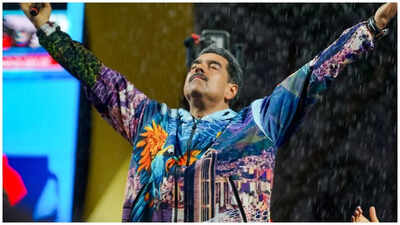
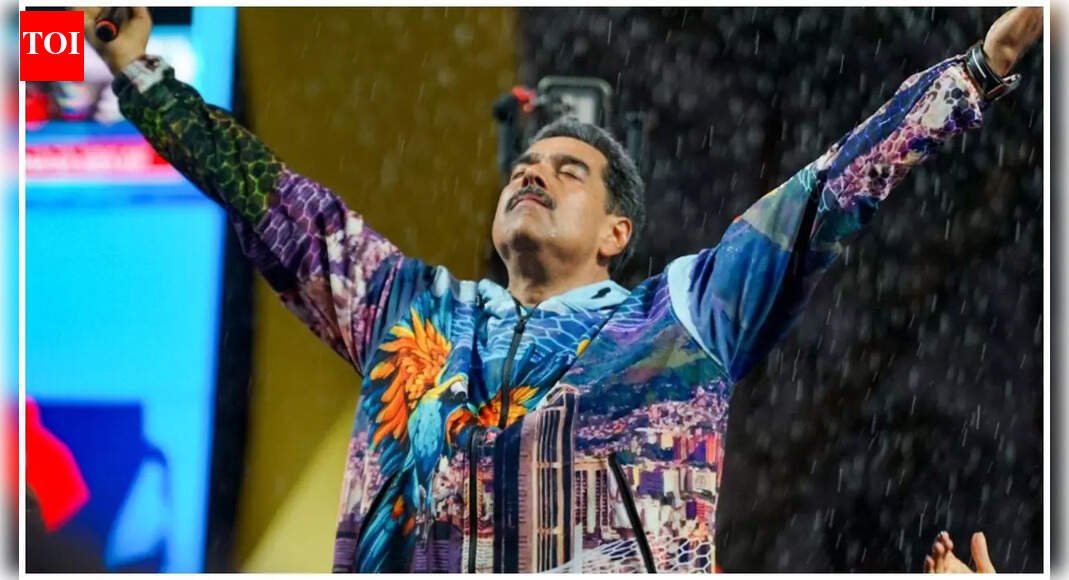
The United States on Thursday imposed new sanctions on Venezuela, targeting three nephews of President Nicolas Maduro’s wife, along with six crude oil tankers and associated shipping companies. The action coincided with a large-scale US military buildup in the southern Caribbean and President Donald Trump’s campaign for Maduro’s ouster. On Wednesday Trump said the US had seized a sanctioned oil tanker off the coast of Venezuela, Reuters reported.

Maduro Vows To ‘Break Teeth’ As US Seizes Oil Vessel; ‘Don’t Interfere In Latin America’ | Trump

The US Treasury Department said in a statement it imposed sanctions on six shipping companies moving Venezuelan oil, and on six crude oil tankers that it said “have engaged in deceptive and unsafe shipping practices and continue to provide financial resources that fuel Maduro’s corrupt narco-terrorist regime.” Four of the tankers, including the 2002-built H. Constance and the 2003-built Lattafa, are Panama-flagged, with the other two flagged by the Cook Islands and Hong Kong. The targeted vessels are supertankers that recently loaded crude in Venezuela, according to internal shipping documents of state oil company PDVSA. Franqui Flores and Efrain Antonio Campo Flores, nephews of Venezuelan first lady Cilia Flores, were also sanctioned. The two were detained in Haiti in 2015 in a US Drug Enforcement Administration operation, convicted in 2016 of attempting a multimillion-dollar cocaine deal and sentenced to 18 years in prison, but released in a 2022 prison swap with Venezuela. A third nephew, Carlos Erik Malpica Flores, sanctioned for his alleged role in a corruption plot at PDVSA, was also designated. Wednesday’s seizure of a Venezuelan oil cargo was the first under US sanctions in force since 2019 and the first known tanker action by the Trump administration since the military buildup. The administration plans further tanker seizures, according to sources. US Attorney General Pam Bondi posted on X that the FBI, Homeland Security and Coast Guard, backed by the US military, carried out a warrant authorising the seizure of a crude tanker transporting sanctioned oil from Venezuela and Iran. The move sent oil prices higher and sharply escalated tensions between Washington and Caracas.President Maduro on Thursday slammed the US seizure of an oil tanker from his country, calling it an act of “naval piracy” that escalated tensions between Washington and Caracas.“They kidnapped the crew, stole the ship and have inaugurated a new era, the era of criminal naval piracy in the Caribbean,” Maduro said at a presidential event, adding “Venezuela will secure all ships to guarantee the free trade of its oil around the world.” Trump has repeatedly raised the possibility of military intervention in Venezuela, accusing it of sending narcotics to the United States. The US has already conducted more than 20 strikes against suspected drug vessels, raising concerns among lawmakers and legal experts.

[ad_2]

Source link

Silver prices at new high of over Rs 1.9L/kg

[ad_1]

Silver prices at new high of over Rs 1.9L/kg

MUMBAI: Relentless rally in silver continued in global markets on Thursday that in turn, combined with the rupee’s recent weakness, pushed up domestic prices on the MCX to an all-time high level of over Rs 1.9 lakh/kg. In the international market, in mid-day trades, silver prices touched a new life-peak at $63.25/ounce. In the spot market in most metros the price of silver crossed the Rs 2 lakh mark during the day.According to Hareesh V, head of commodity research, Geojit Investments, the US Fed’s decision to cut interest rates reduces the opportunity cost of holding non-yielding assets like gold and silver, attracting fresh investment flows. “The sharp rally in bullion is underpinned by structural supply deficits, robust industrial demand for silver, and sustained ETF inflows.”Additionally, after the rate cut decision, the dollar weakened further, which in turn made it cheaper to buy gold and silver, since these precious metals are globally priced in greenback. “With bullion already at record highs, this policy shift adds momentum to the rally, as investors seek safe-haven assets amid economic uncertainty and inflationary pressures.”

[ad_2]

Source link

Now, Mexico to slap tariffs; may hit Indian car companies

[ad_1]

Now, Mexico to slap tariffs; may hit Indian car companies
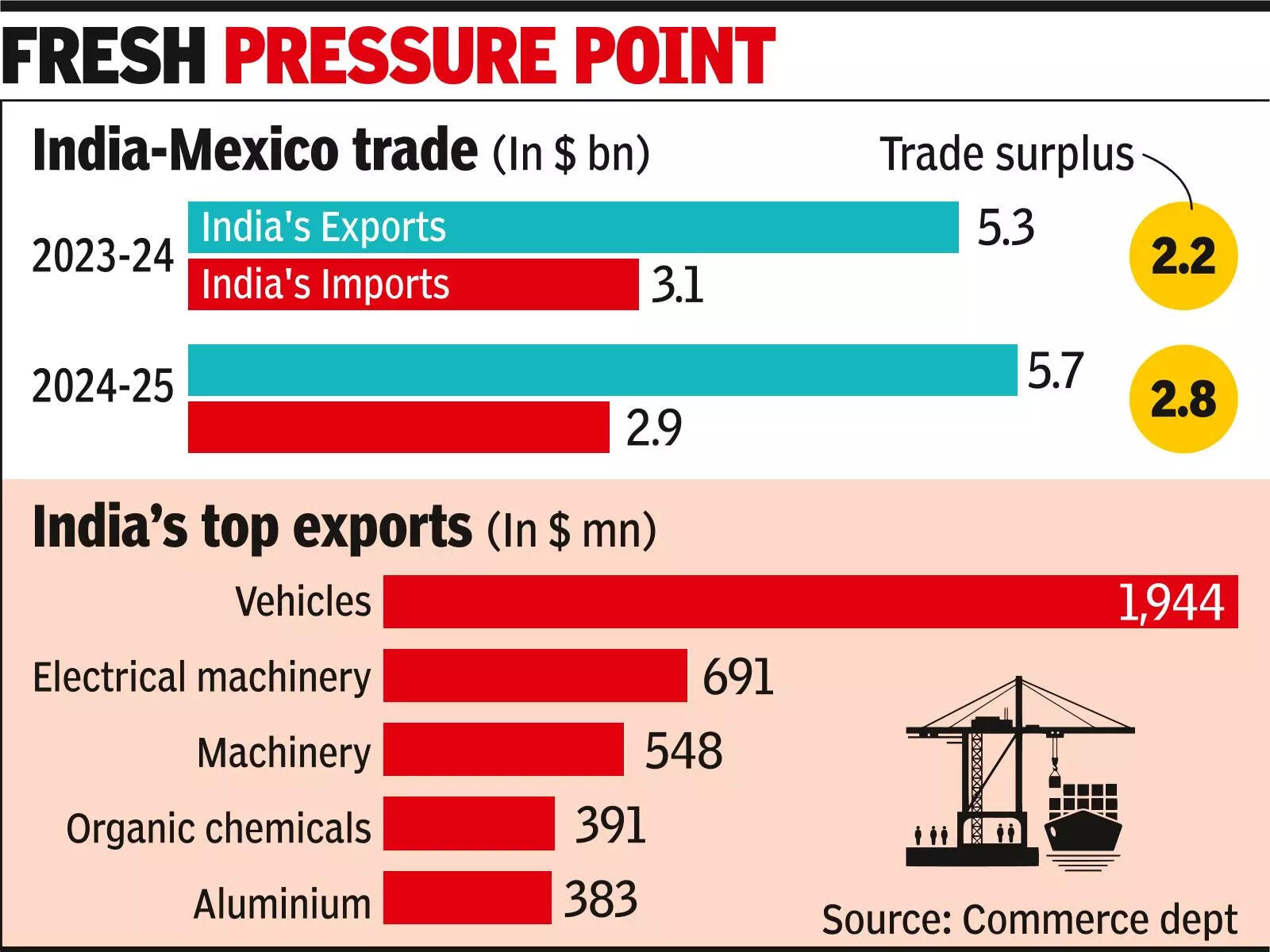
Mexico’s Senate approved a bill imposing 5-50% tariffs on over 1,400 Asian products, including India’s, starting next year. This move, targeting China’s massive output, could significantly impact India’s automotive and auto parts exports, valued at $1.1 billion. The tariffs aim to boost Mexican revenue and potentially ease US trade pressure.

Mexico’s Senate Wednesday voted in favour of a bill that imposes tariffs of 5% to 50% on over 1,400 products from Asian nations, including India. The levies will take effect from next year and hit products ranging from clothing to auto parts, with the massive output of Chinese factories emerging as the legislation’s focus.

Mexico’s decision to impose 5-50% tariffs to affect India

Exports Of Auto, Components, Among Others Will Be Hit

For India, which has a trade surplus with Mexico, this could be bad news for automobiles and auto parts. Annual exports of firms such as Volkswagen, Hyundai and Maruti Suzuki added up to around $1.1bn with 90,000 units being shipped. Two-wheeler brands like Royal Enfield, TVS, Bajaj and Honda may also be hit.

Mexico’s decision to impose 5-50% tariffs to affect India

After the US, now Mexico is erecting tariff barriers for countries with which it does not have a trade agreement, including India.Mexico’s Senate on Wednesday voted in favour of a bill that imposes tariffs between 5% and 50% on more than 1,400 products from Asian nations, Bloomberg reported. The new levies will take effect starting next year and hit a wide range of products from clothing to metals and auto parts, with the massive output of Chinese factories emerging as the legislation’s focus.For India, which has a trade surplus with Mexico, the move could be bad news for automobiles and auto parts. Companies such as Volkswagen, Hyundai and Maruti Suzuki, whose exports added up to around $1.1 billion in 2024-25, shipments of around 90,000 units may be hit.“India has been a strong export base for Skoda Auto Volkswagen for many years and that continues to guide how we build and engineer cars for global markets… Mexico has consistently been one of our important export markets, given rising demand there and traction of India-made models. We are monitoring the situation. For the moment, we have come to the conclusion that our business activities are not affected,” Skoda Auto Volkswagen said.Two-wheeler brands such as Royal Enfield, TVS, Bajaj and Honda are also understood to be exporting to the Latin American country. Besides, component exports to Mexico were estimated at around $850 million in 2024-25 and some of these were used by companies to manufacture vehicles headed to the US.“India’s auto component exports to Mexico largely comprise powertrain and driveline parts, precision forgings, chassis and brake systems, and key electrical and after-market products. There is a strong demand, especially for forgings and precision machined components,” Auto Component Manufacturers Association director general Vinnie Mehta told TOI.While higher taxes will yield around $2.8 billion revenue for the Mexican govt, it is seen to have facing US President Donald Trump’s pressure on Mexican President Claudia Sheinbaum to reduce imports from China.“…(It) is a signal of deepening global trade tensions, closely linked to future bilateral agreements. This is likely to disrupt established supply chains that used Mexico as a base to push exports into US … sectors such as auto components, textile, and engineering goods are likely to be impacted by these tariffs. The new Mexico tariffs ranging from 35% to 50% on these products will make Indian exports through the countries with US FTA more cost-competitive if Indian is able to conclude long-term bilateral agreements with those nations,” said Saurabh Agarwal, tax partner at EY India.

[ad_2]

Source link

Samsung wants India to lead global design, production and innovation efforts

[ad_1]

Samsung wants India to lead global design, production and innovation efforts

NEW DELHI: As it completes three decades of operations in India, Korean electronics giant Samsung has said that the company will shift gears and deepen its manufacturing, design, and innovation initiatives in the country.“The next decade will see more products built in India, designed in India, and innovated for the world,” the company said as it unveiled a new innovation vision for the country which will be built around AI.Samsung said it has filed 14,000 patents from India, making it into a global innovation centre.“From selling our first TV in India in 1995, when liberalisation was unlocking new possibilities to becoming the most trusted technology partner for Bharat today, Samsung’s journey has been shaped by India’s confidence, creativity, and limitless ambition… We believe the next era of meaningful global innovation will be led by India — where the future of smart homes, connected living, and intelligent devices is rapidly taking shape with AI that understands India’s cultural diversity,” said JB Park, President & CEO, Samsung Southwest Asia.He said the company will continue to work closely with the Indian govt for a Viksit Bharat, creating a digitally-empowered nation where innovation fuels inclusive progress and co-prosperity. “Our vision is clear: to build advanced technologies here that will shape how the world lives, works, and connects tomorrow,” Park said.From a fledgling brand when it entered the country, Samsung now has reached a revenue of Rs 1.1 lakh crore. “For 30 years, Samsung has believed in one simple philosophy: India powers innovation.”Samsung has two manufacturing plants (in Chennai and Noida), three R&D centres (Delhi, Noida, and Bengaluru), and a design centre in Delhi NCR region. It said that its R&D teams are leading advancements in AI, accessibility, streaming, and digital displays along with pushing the boundaries of language intelligence and next-generation networks.The company said it is expanding its university collaborations and open innovation initiatives with Indian startups — ensuring that more ideas born in India scale globally. And through various initiatives, the company is nurturing India’s next-generation workforce, aligned with the requirements of Industry 4.0. “Samsung is providing students across the country access to grants, incubation support, skills in AI, IoT, digital technologies, and employment opportunities.

[ad_2]

Source link

IND vs SA: India crumble in 214 chase as South Africa level T20I series 1-1 | Cricket News

[ad_1]

IND vs SA: India crumble in 214 chase as South Africa level T20I series 1-1
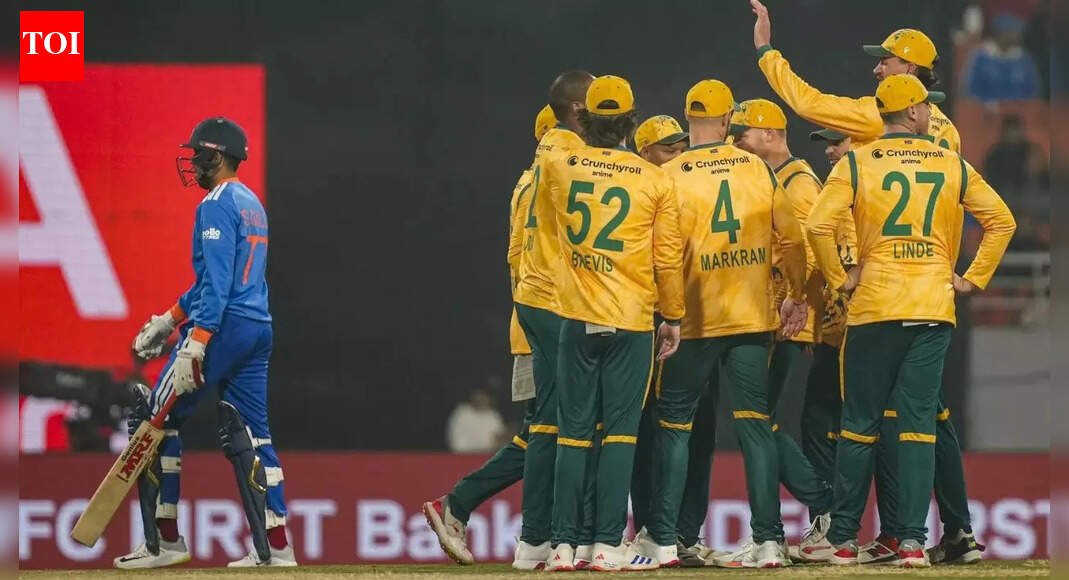
South Africa’s players celebrate the wicket of Shubman Gill during the second T20 International cricket match between India and South Africa, at Maharaja Yadavindra Singh International Cricket Stadium, in New Chandigarh. (PTI Photo)

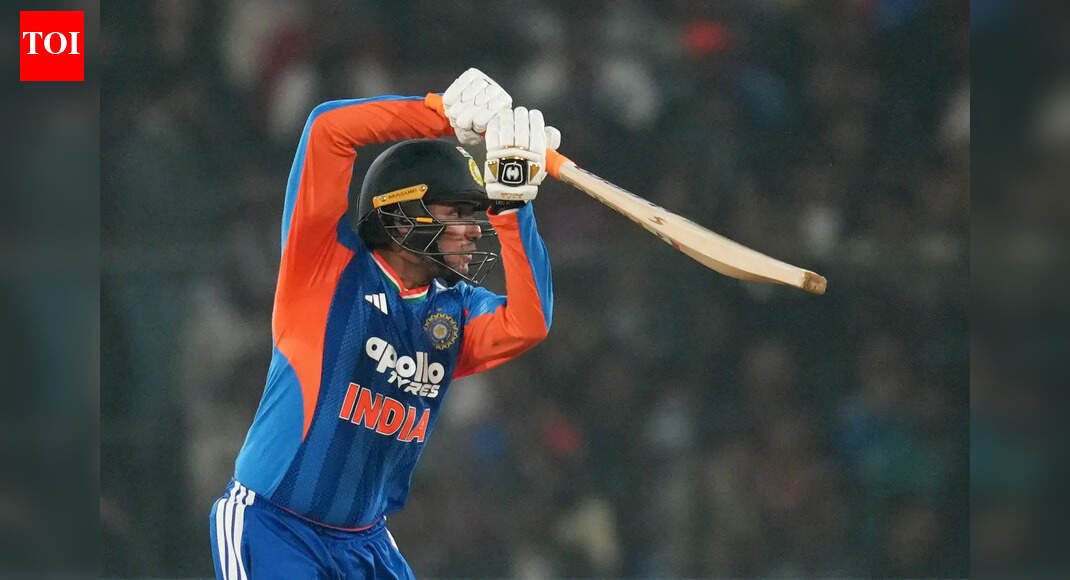
NEW DELHI: India fell short in their chase of 214 and were bowled out for 162 in 19.1 overs at New Chandigarh’s Maharaja Yadavindra Singh International Cricket Stadium, which hosted its first men’s international match on Thursday. South Africa won the second T20I by 51 runs and levelled the five-match series 1-1.India lost wickets regularly and never built momentum in the chase. Tilak Varma scored 62 off 34 balls and was the lone warrior for the Men-in-Blue. South Africa put India under pressure early by removing Shubman Gill, Abhishek Sharma and Suryakumar Yadav in the powerplay, and continued to strike at regular intervals.

Gautam Gambhir Press Conference: Team India head coach heaves fire after 2-1 ODI series win over SA

Ottneil Baartman took four wickets for South Africa, while Lungi Ngidi, Marco Jansen, and Lutho Sipamla picked up two each.Earlier, Quinton de Kock scored 90 off 46 balls and took South Africa to 213 for four. He hit seven sixes and five fours, with most of the sixes going towards deep square leg.De Kock, who recently reversed his ODI retirement and was uncertain about his T20 plans after last year’s World Cup, returned with strong intent. An innings like this just less than a week before the IPL mini auction will also create the buzz among the franchises, who might indulge in a bidding war for the multi-skilled cricketer.India chose to bowl first after winning the toss. Arshdeep Singh, who dismissed de Kock in the series opener, went for runs this time. De Kock began with a six over mid-wicket off Arshdeep before adding another with a pull shot. Jasprit Bumrah also conceded 16 runs in his second over after Reeza Hendricks hit him for a six. Hendricks was later dismissed by Varun Chakravarthy, but de Kock kept scoring and took South Africa to 53 for one in the powerplay.Arshdeep returned in the 11th over but struggled with his lines after de Kock hit him for a straight six. The over included seven wides and went for 18 runs. De Kock looked set for a second T20I hundred but was run out by wicketkeeper Jitesh Sharma while attempting a single.South Africa continued to score quickly after his dismissal. Donavan Ferreira made 30 not out off 16 balls and David Miller added 20 not out off 12 in the final overs.Bumrah also went for runs at the end, conceding 18 in the 20th over as Ferreira hit two sixes. India gave away 123 runs in the last 10 overs.The five match series now stands at 1-1 with the third match scheduled in Dharamsala on December 14.

[ad_2]

Source link

Foreign exchange risk alert: Fitch warns rupee fall could hit ratings; which Indian firms face the biggest exposure?

[ad_1]

Foreign exchange risk alert: Fitch warns rupee fall could hit ratings; which Indian firms face the biggest exposure?

Indian corporates with inadequate foreign-exchange hedging could face rating pressure if the rupee weakens sharply, global credit rating agency Fitch Ratings cautioned in a new commentary released on Thursday. The agency said that companies in sectors with limited natural hedges remain the most vulnerable to currency swings, ANI reported.Fitch noted that “in sectors with significant vulnerability to rupee depreciation, we anticipate that a hypothetical failure by issuers to substantially mitigate foreign-exchange (FX) risks through hedging could put downward pressure on ratings.” While most rated firms either hedge actively or have natural protection through local-currency revenues, a few sectors continue to face heightened sensitivity.

RBI Slashes Rates After Rupee Fall, Boosts Liquidity And Lifts India’s GDP Forecast To 7.3%

According to Fitch, renewables, power utilities and toll-road operators carry the greatest risk because they lack strong natural hedges and rely more heavily on foreign-currency debt. Many companies have hedged a sizable portion of their exposure, keeping risks manageable. However, where hedging is partial — especially on principal repayments — a sharp rupee fall could lift hedging costs and strain debt-coverage ratios.The agency said a rupee depreciation of over 10% against the US dollar in the next 6–12 months could significantly increase hedging costs. Even in such a scenario, issuers are expected to continue hedging, but failure to do so “could negatively affect credit profiles.”“We believe companies with FX vulnerabilities would continue to substantially hedge US dollar exposures under such a scenario, but any failure to do so could put downward pressure on ratings,” Fitch added.Fitch also highlighted that several other large sectors — including building materials, technology, pharmaceuticals and automobiles — remain better insulated due to export earnings or overseas business operations that act as natural FX hedges.


[ad_2]

Source link

‘He’s scared of Yuvraj’s scolding’: The tough-love mentorship behind Abhishek Sharma’s rise | Cricket News

[ad_1]

'He's scared of Yuvraj's scolding': The tough-love mentorship behind Abhishek Sharma's rise
Abhishek Sharma (AP Photo)

NEW DELHI: As Abhishek Sharma gears up to play his first international match at home when India face South Africa in the second T20I in Mullanpur on Thursday, those who shaped his journey insist that his rapid rise is anything but a surprise. Behind the six-hitting power and effortless elegance sits a work ethic sculpted from childhood — and a strict mentor he is still “scared” of.Go Beyond The Boundary with our YouTube channel. SUBSCRIBE NOW!Abhishek’s father and childhood coach, Rajkumar Sharma, recalls a teenager who already lived like a seasoned pro. “His days started at 4am,” Rajkumar told The Indian Express. “From gym and exercise to running and swimming — he did everything he could to constantly improve as a player.”

Smriti Mandhana opens up on ‘love’, World Cup win and more

Once the fitness grind was done, Abhishek wanted only one thing — to bat. Punjab junior coach Arun Bedi still marvels at the sight of an 11- or 12-year-old effortlessly lifting bowlers over the ropes.“Abhishek would hit sixes with lofted shots at an age when boys are still learning to middle the ball. It spoke volumes about his skill,” Bedi said.

Poll

How important do you think a mentor is in shaping a young athlete’s career?

Cricketing legends have shaped him along the way — VVS Laxman and Rahul Dravid with India, Ricky Ponting and Brian Lara in the IPL. But no influence has been stronger, or sterner, than Yuvraj Singh, who began training with Abhishek during the lockdown.Rajkumar laughs as he describes the tough love that drives the youngster even today. “Even now, when he thinks Abhishek has made a mistake, he will pick up the phone and call and scold him,” he said. “And Abhishek is scared of him too.”The 25-year-old has also embraced golf thanks to Lara and Yuvraj — not as a pastime but as a tool to refine his batting rhythm. “It has improved his bat swing, made it cleaner,” Rajkumar explained.


[ad_2]

Source link

Rupee hits new record low: Currency weakens to 90.46 versus US dollar; RBI likely intervened to stem fall

[ad_1]

Rupee hits new record low: Currency weakens to 90.46 versus US dollar; RBI likely intervened to stem fall

Rupee versus dollar (AI image)

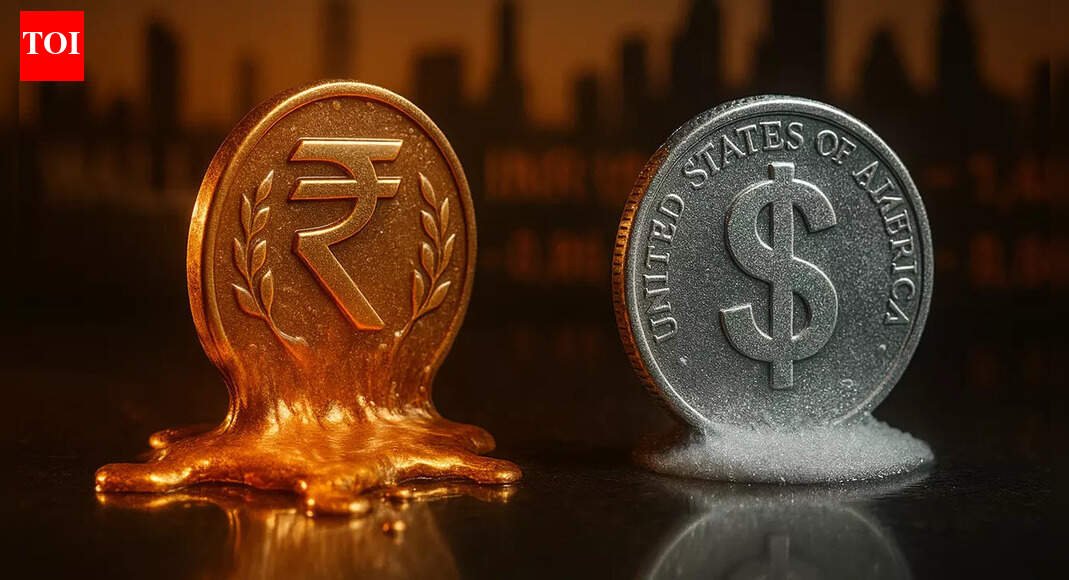
The Indian rupee tanked to a fresh record low on Thursday, going past the 90 mark versus the US dollar again. The rupee has been depreciating sharply this year, influenced by ongoing challenges on the India-US trade deal front and increased corporate dollar demands.The rupee declined to 90.4675 versus the US dollar, surpassing its previous historic low of 90.42 recorded on December 4.The Reserve Bank of India (RBI) reportedly stepped in on Thursday to prevent further depreciation of the rupee’s value, five traders were quoted as saying by Reuters.The rupee has declined over 5% against the dollar in 2025, ranking as the third-poorest performer amongst 31 primary currencies, with only the Turkish lira and Argentina’s peso showing greater losses. This downward trend is significant, coming at a time when the dollar’s strength measure has reduced by more than 7%.Several elements contribute to the rupee’s negative performance, including growing trade deficits, hefty 50% US tariffs on Indian goods, and outward foreign capital movement. The lack of successful negotiations with the Donald Trump administration has further weakened the currency’s position.The currency continues to experience pressure after falling past the crucial 90 mark, which is 50% of its 2011 value. This situation creates additional difficulties for RBI governor Sajay Malhotra and central bank officials in their efforts to maintain balance between rupee flexibility and market steadiness, while steering clear of past financial issues.India’s capital controls restrict the rupee’s convertibility, requiring RBI’s participation in both domestic and international markets for intervention. In global markets, rupee trading occurs primarily through non-deliverable forwards (NDFs), which are derivatives contracts setting exchange rates with dollar settlements.The RBI implements interventions via the Bank for International Settlements, working alongside selected major banks as trading partners in continuous markets operating across Singapore, Dubai and London.


[ad_2]

Source link

‘Under pressure, hands trembling’: Rahul Gandhi takes a dig at Amit Shah over Lok Sabha speech — watch | India News

[ad_1]

'Under pressure, hands trembling': Rahul Gandhi takes a dig at Amit Shah over Lok Sabha speech — watch

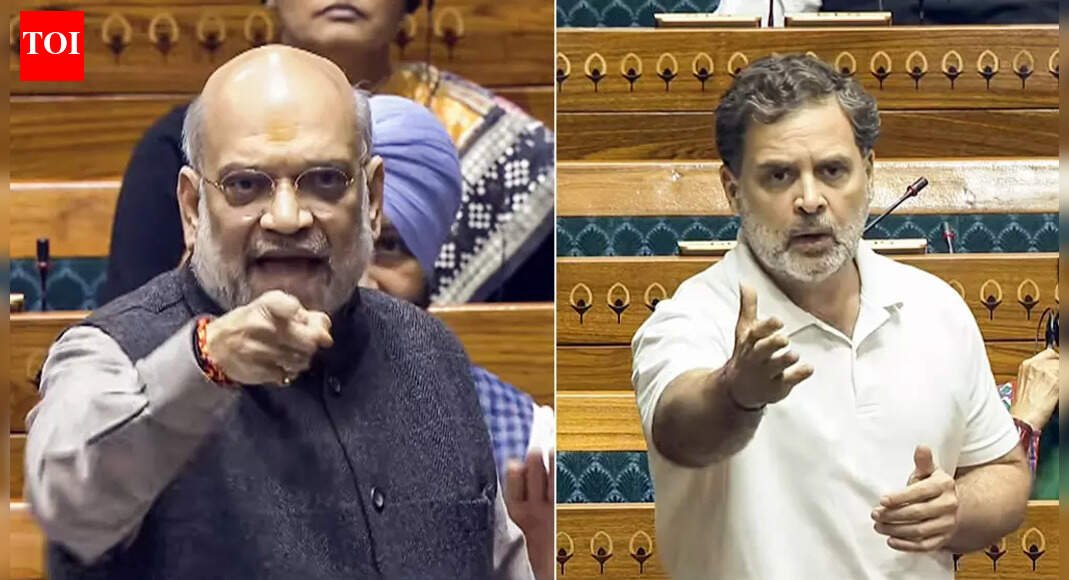
NEW DELHI: Congress MP Rahul Gandhi on Thursday repeated his claim that Union home minister Amit Shah appeared ‘nervous’ and used ‘foul language’ during his Lok Sabha speech the previous day.Also Read | SIR row debate in Lok Sabha: Rahul Gandhi interrupts Amit Shah with ‘open challenge’; gets ‘I will decide’ reply “He (Shah) used foul language. His hands were trembling. Mentally, he is under pressure, and it was seen in Parliament. Whatever I had asked, he gave no replies and provided no proof. I challenged him openly to discuss over my press conferences, but nothing happened. Everyone now understands the reality,” Gandhi told reporters.During his Lok Sabha speech on electoral reforms, Shah clashed with Gandhi over the Congress leader’s repeated claims of vote chori’ (theft)” by the Election Commission and the ruling BJP.The Lok Sabha leader of opposition, who has held three press conferences on the issue, challenged the home minister to a debate based on those briefings. In response, Shah remarked that the “House will not function according to his (Gandhi’s) wishes.”The heated exchange erupted when Gandhi interjected during Shah’s address in the Lok Sabha on electoral reforms. Criticising the opposition over the Special Intensive Revision (SIR) of electoral rolls, the senior BJP leader argued that he had responses to all their accusations, including those raised in Gandhi’s three press conferences.“In his press conference, the LoP claimed the voter list is flawed and needs correction. That is exactly what SIR is — a process to clean up the rolls. Yet he opposes it. Your defeat is certain; the voter list has nothing to do with it. Double standards won’t work in a democracy. When you win, the EC is great; when you lose, the EC is biased. I have answers to all these allegations — those three press conferences included,” Shah remarked.Gandhi then interrupted and challenged him to a debate. “Yesterday, I asked why Election Commissioners were given full immunity. We want to understand the reasoning behind it. He (Amit Shah) mentioned Haryana, but there are many other examples — including 19 lakh fake voters. Let’s debate my press conferences. Amit Shah ji, I challenge you to a debate on all three,” the Rae Bareli MP asserted.Shah responded that Gandhi could not dictate the order of his speech and should remain patient. “You cannot run Parliament through obstinacy. I will decide the order of my address. The House won’t function like this. He should be patient. I will respond to every point,” he countered.Opposition MPs walked out of the Lok Sabha during Shah’s reply to the discussion on electoral reforms.


[ad_2]

Source link