Breaking News
OECD pegs India GDP growth at 7.6% in FY26, sees moderation next fiscal

[ad_1]

OECD pegs India GDP growth at 7.6% in FY26, sees moderation next fiscal

India’s economy is projected to expand by 7.6% in the current fiscal before moderating to 6.1% in 2026-27, the Organisation for Economic Cooperation and Development (OECD) said in its interim Economic Outlook report, PTI reported.The multilateral body said the evolving conflict in the Middle East has “human and economic costs” for countries directly involved and could test the resilience of the global economy by disrupting energy supplies and raising commodity prices.“The decline in (US) tariffs should support growth in India, though gas rationing will disrupt some production activities and fiscal support is expected to fade, with growth easing from 7.6 per cent in fiscal year (FY) 2025-26 to 6.1 per cent in FY 2026-27 and 6.4 per cent in FY 2027-28,” the OECD said.According to the report, disruption of shipments through the Strait of Hormuz and damage to energy infrastructure have triggered a surge in energy prices and affected the global supply of commodities, including fertilisers.The OECD also warned that inflationary pressures could rise as the deflationary effects of earlier food and energy price shocks recede. It projected inflation to increase from 2% in FY 2025-26 to 5.1% in FY 2026-27 before easing to 4.1% in FY 2027-28.Among emerging-market economies, India may need to raise policy rates temporarily in the second quarter of 2026 to counter stronger inflationary pressures, the report said.The OECD noted that US bilateral tariff rates have declined following a US Supreme Court ruling against levies imposed under the International Emergency Economic Powers Act. While this has resulted in significant tariff reductions for several emerging-market economies, including India, the overall US effective tariff rate remains higher than levels seen before 2025.Globally, growth is expected to soften to 2.9% in 2026 before improving slightly to 3% in 2027.“The energy price surge and the unpredictable nature of the evolving conflict in the Middle East will raise costs and lower demand, offsetting the tailwinds from strong technology-related investment and production, lower effective tariff rates and the momentum carried over from 2025,” the OECD said.

[ad_2]

Source link

Donations to national parties surged 161% in FY25, BJP accounted for over 91% share: ADR | India News

[ad_1]

Donations to national parties surged 161% in FY25, BJP accounted for over 91% share: ADR

NEW DELHI: The Bharatiya Janata Party (BJP) accounted for more than 91 per cent of all donations declared by national parties in 2024-25, as overall political funding above Rs 20,000 shot up 161 per cent from the previous fiscal, according to a report by the Association for Democratic Reforms (ADR).The report, released on Thursday, said total donations above Rs 20,000 declared by the national parties stood at Rs 6,648.563 crore from 11,343 contributions in FY25.Of this, the BJP alone received Rs 6,074.015 crore from 5,522 donations, followed by the Congress with Rs 517.394 crore from 2,501 donations.The BJP’s declared donations exceeded the combined total of the Congress, the Aam Aadmi Party (AAP), the Communist Party of India-Marxist (CPI-M) and the National People’s Party (NPEP) for the same period by more than tenfold, the report pointed out, as cited by PTI.Overall donations to national parties rose by Rs 4,104.285 crore in 2024-25 as compared to 2023-24. The BJP’s collections alone jumped 171 per cent from Rs 2,243.947 crore in the previous fiscal. Donations to the Congress increased by 84 per cent, from Rs 281.48 crore in 2023-24 to Rs 517.394 crore in 2024-25.Among other parties, the AAP received Rs 27.044 crore — a 244 per cent increase — while the NPEP got Rs 1.943 crore, an increase of 1,313 per cent, the report said.The Bahujan Samaj Party (BSP), meanwhile, declared that it did not receive any donations above Rs 20,000, as it has been doing so for the last 19 years.Corporate donations dominated political funding, accounting for Rs 6128.787 crore, or 92.18 per cent of the total contributions, across 3,244 donations. Individual donors contributed Rs 505.66 crore through 7,900 donations, making up 7.61 per cent of the total.The BJP received Rs 5,717.167 crore from 2,794 corporate donations, more than 13 times the combined contributions received by all other national parties, which stood at Rs 411.62 crore. It also received Rs 345.94 crore from 2,627 individual donors.The Congress received Rs 383.86 crore through 112 corporate donations and Rs 132.39 crore from 2,357 individual contributors during the fiscal year.Among the top donors, Prudent Electoral Trust donated a total of Rs 2413.465 crore to the BJP, the Congress and the AAP combined. Of this, Rs 2180.7119 crore went to the BJP (35.90 per cent of total funds received by party), Rs 216.335 crore to the Congress (41.81 per cent of total funds received by party) and Rs 16.4178 crore to the AAP (43.08 per cent of total funds received by party).Progressive Electoral Trust donated Rs 834.97 crore through two donations, AB General Electoral Trust donated Rs 621 crore through 16 donations, and New Democratic Electoral Trust donated Rs 155 crore through seven donations to the BJP and the Congress.Serum Institute of India Pvt Ltd donated Rs 100 crore through three donations, and Rungta Sons Private Limited donated Rs 95 crore through four donations to the BJP in 2024-25.

[ad_2]

Source link

Oil & energy price shock: Goldman Sachs sees India’s macro outlook worsening; cuts Nifty target

[ad_1]

Oil & energy price shock: Goldman Sachs sees India’s macro outlook worsening; cuts Nifty target
Strategists at Goldman Sachs now project Brent crude to average about $105 in March and rise to $115 in April. (AI image)

As a direct fallout of the US-Iran war and rising crude oil prices, Goldman Sachs has adopted a more cautious view on Indian equities, revising its rating to “marketweight,. The global brokerage has also lowered its target for the Nifty, and cautioned that an earnings downgrade cycle driven by an energy shock is likely to emerge. The bank has reduced its 12-month Nifty target, for end-March 2027, to 25,900 from an earlier 29,300. This suggests expected returns of about 13% in rupee terms and 12% in dollar terms over the next year, which is lower than the 19% upside projected for the MXAPJ index. It expects these returns to be supported partly by earnings growth of 8% and 13% in calendar years 2026 and 2027, respectively, along with a modest re-rating in valuations to a lower fair value multiple of 19.5 times, compared with its earlier estimate of 20.8 times, as earnings downgrades take effect.The firm said persistently high oil prices amid tensions around the Strait of Hormuz have weakened India’s macroeconomic outlook and are expected to lead to downward revisions in profit estimates over the coming quarters, according to an ET report.Earlier this week, Bernstein also trimmed its year-end Nifty target to 26,000 and warned that, in a worst-case scenario, the benchmark index could fall to as low as 19,000.Goldman Sachs further noted that returns are likely to be skewed toward the latter part of the period. “We see risks tilted to the downside in the next 3 to 6 months as we think the market may not be pricing in the full extent of the earnings downgrades, and low earnings visibility in the near-term could demand a higher risk premium,” it said.The firm added that, historically, forward returns tend to remain subdued when valuations are in the 18–20 times range during an earnings downgrade phase. However, it pointed out that equities have typically recovered once earnings stabilise after about two to three quarters, as has been seen during past energy-related shocks.Strategists at Goldman Sachs now project Brent crude to average about $105 in March and rise to $115 in April, before gradually easing to $80 in the fourth quarter and stabilising at that level through 2027. The report highlights that, within Asia, India is particularly exposed to potential energy supply risks due to its relatively lower per capita income and heavy reliance on energy imports.The change in global energy dynamics has led the firm to significantly revise its outlook for India’s macroeconomic indicators. Since the onset of the Iran conflict, Goldman has cut its 2026 GDP growth forecast for India by 1.1 percentage points to 5.9%, increased its inflation projection by 70 basis points, widened the current account deficit estimate to 2% of GDP, lowered its outlook for the rupee, and factored in an additional 50 basis points of rate hikes in 2026.Its latest internal estimates for calendar year 2026 now assume real GDP growth of 5.9%, average CPI inflation of 4.6%, a current account deficit of 2% of GDP, a fiscal deficit of 4.7% of GDP, a year-end repo rate of 5.75%, and an average Brent crude price of $85 per barrel.Goldman also expects the weaker macro environment to eventually reflect in corporate earnings. Its VAR-based analysis indicates that if oil prices remain about $45 per barrel higher on average for three months, India’s full-year earnings growth could decline by roughly 9%, which is a larger impact compared to the estimated 6% hit to earnings for the MXAPJ index.

[ad_2]

Source link

Candace Owens sparks uproar with claims about Erika Kirk’s “secret location” during Charlie Kirk assassination

[ad_1]

Candace Owens sparks uproar with claims about Erika Kirk’s “secret location” during Charlie Kirk assassination
Candace Owens has intensified scrutiny over Erika Kirk’s location during the assassination of Charlie Kirk. She claims Erika was inside a secretive, unmarked aviation building, contradicting her account of being at a medical facility. Owens also pointed to a lack of witnesses, calling the situation “secretive,” and raising broader questions about the timeline and transparency surrounding the events of that day.

Fresh claims surrounding the final hours of Charlie Kirk are now pulling his widow into a storm of suspicion. What was once a tragic and widely reported timeline is being questioned again, this time by Candace Owens, who argues that key details about that day do not add up. Her version challenges the accepted narrative and shifts attention toward a location few had even heard of before.Erika Kirk is in the centre of the scandal and people want to know where she was during the assassination. Owens now asserts that the truth could have been far more censored and secret than she had previously told it. The debate on the difference between these two versions hit the air and the questions are becoming increasingly loud, rather than becoming silent.

Candace Owens questions timeline and raises doubts over “hidden” location

Watch

REVEALED: Erika Went To A Weird Place On 9/10 | Candace Ep 315

Owens alleges that Erika was not at a public medical facility, but inside a discreet aviation-linked building in Scottsdale. Describing the site, she questioned its very existence as a normal business, asking, “‘Why are we staging there in this obscure building of Hopkinson Aircraft which is not known to anybody? How’d she get there?'” Her remarks go further, suggesting the environment felt unusual and secretive. She even compared it to something covert, saying it resembled a setup that did not operate like a “real business.”Her suspicions did not stop at the building itself. Owens openly shared her discomfort with the situation, stating, “‘there’s something about this that feels secretive.'” She then added a more pointed observation: “‘It feels like Erica was being protected that day.'”These claims stand in sharp contrast to Erika’s own account. In a past interview, she described a deeply personal and chaotic moment after learning of her husband’s shooting. “‘I sprinted out of her treatment center, just collapsed in the middle of the parking lot, called our security,'” she recalled. “‘Unbelievable nightmare.'”Owens, however, continues to challenge that version, pointing to what she calls a lack of witnesses. “‘Nobody saw Erika on the day of Charlie’s assassination,'” she said, arguing that such a public scene would not have gone unnoticed.As scrutiny expands to organizations like Turning Point USA, the debate is shifting from grief to unanswered logistics. For now, the conflicting narratives have left a lingering question. What really happened in those critical hours remains far from settled.

[ad_2]

Source link

DGCA seeks corrective action from Air India over wrong plane on Delhi-Vancouver route

[ad_1]

DGCA seeks corrective action from Air India over wrong plane on Delhi-Vancouver route

In a regulatory intervention following an operational lapse, aviation watchdog Directorate General of Civil Aviation (DGCA) has asked Air India to take corrective measures after the airline operated a Delhi–Vancouver flight with an aircraft that was not approved for the route, a senior official said on Thursday.Action has also been initiated against an airline official over the incident, the official at DGCA told PTI.The Air India Boeing 777-200 LR aircraft, which took off for Vancouver on March 19, was recalled to Delhi after remaining airborne for over seven hours when it was found that the flight was cleared only for operation by a Boeing 777-300 ER.The regulator subsequently sought a report from the airline and has now directed it to put in place safeguards to prevent a recurrence of such lapses. Specific details of the action taken could not be immediately ascertained.There was no immediate response from Air India, as reported PTI.Sources had earlier indicated on March 20 that an apparent lapse in updating operational requirement lists for Canada-bound services may have led to the deployment of the incorrect aircraft.In a statement issued the same day, the airline said, “Air India flight AI185, operating from Delhi to Vancouver on 19 March, returned to Delhi due to an operational issue and in line with established standard operating procedures. The aircraft landed safely, and all passengers and crew had disembarked.”

[ad_2]

Source link

Government assures strong fuel security: No LPG shortage, crude reserves secured, PNG transition underway

[ad_1]

Government assures strong fuel security: No LPG shortage, crude reserves secured, PNG transition underway

The government, on Thursday, moved to reassure citizens that the country’s fuel supply situation remains fully stable. The ministry of petroleum and natural gas said India’s petroleum and LPG systems are secure and under firm control, with no shortage of petrol, diesel or LPG anywhere in the country. It also warned against what it called a coordinated misinformation campaign intended to create unnecessary panic.This follows the Centre’s earlier clarification dismissing reports that LPG refill booking timelines had been changed. It said the claims were incorrect and misleading, and reaffirmed that the existing timelines “remain unchanged and continue to” operate under the current time limit.Here’s what the government said:

‘Oasis of energy security’: Fuel supply stable across India

The ministry reiterated India’s fuel security, saying that the country continues to function as an “oasis of energy security.” In a press release, the government pointed out that “India is the world’s 4th largest refiner and 5th largest exporter of petroleum products, supplying refined fuel to over 150 countries.”Commenting on petrol and diesel availability, the Centre assured that, being a net exporter, India’s petrol and diesel availability is “structurally assured.” It confirmed that all 1 lakh-plus retail fuel outlets across India are operating normally and dispensing petrol and diesel without interruption.The ministry said no outlet has been instructed to ration fuel. It also highlighted that, unlike several countries facing rationing, price shocks, odd-even vehicle restrictions and even station closures, with some declaring a “National Energy Emergency,” India has no requirement for such measures.According to the ministry, reports of shortages at select locations were driven by panic buying triggered by misinformation circulating on social media. It said that despite temporary surges in demand, fuel continued to be supplied to all customers, while oil company depots operated round-the-clock to strengthen distribution. Oil companies have also extended credit limits to petrol pumps to more than three days, up from one day earlier, to ensure smooth working capital flow and uninterrupted supply.

Crude tanks — already covered

Addressing concerns over global supply routes, the ministry stated that even with disruptions at the Strait of Hormuz, India is currently receiving higher crude volumes from over 41 international suppliers than what previously came through the strait.It added that increased availability in global markets, particularly from the western hemisphere, has fully offset any disruption. All Indian refineries, it said, are operating at over 100% capacity utilisation.The ministry further stated that crude oil requirements for the next 60 days have already been secured, and there is no supply gap in the system. “Crude oil supplies for next 60 days have already been tied up by Indian Oil companies.”

LPG

Commenting on LPG supply, a major concern for consumers amid the Middle East crisis, the ministry said that there is no shortage anywhere in the country and production has been significantly ramped up following the LPG Control Order.Domestic refinery output has increased by 40 per cent, reaching 50 TMT per day, more than 60 per cent of the country’s total daily requirement of around 80 TMT. As a result, the net import requirement has been reduced to 30 TMT per day.It said 800 TMT of LPG cargoes have already been secured and are currently en route from countries including the United States, Russia and Australia. These supplies are arriving across 22 LPG import terminals, compared to 11 in 2014.The ministry said about one month of LPG supply is fully secured, with further procurement ongoing. Oil companies are currently distributing over 50 lakh cylinders daily. It noted that demand had briefly surged to 89 lakh cylinders due to panic buying but has since returned to normal levels. Commercial cylinder allocation has been increased to 50% in consultation with state governments to prevent hoarding and black marketing.

A PNG transition

The ministry once again highlighted the push for piped natural gas expansion, stating that it is part of a planned and ongoing transition towards cleaner, cheaper and safer household energy, being implemented in coordination with state governments. It further clarified that this expansion is not linked to any shortage situation and rejected claims that PNG is being pushed due to LPG scarcity. It said LPG supply remains fully secure.India produces 92 MMSCMD of natural gas domestically against a total requirement of 191 MMSCMD, making gas relatively less import-dependent than LPG.Till now, city gas distribution networks have expanded from 57 geographical areas in 2014 to more than 300 at present. Domestic PNG connections have grown from 25 lakh to over 1.5 crore.

Strategic reserves — A bigger picture

The ministry also dismissed claims circulating online that India has only six days of fuel stock, saying the country has a total reserve capacity of 74 days, with current stock cover at around 60 days.This includes crude stocks, product inventories and strategic storage in underground caverns. The ministry noted that this is the position even as the country is on the 27th day of the ongoing Middle East crisis.It said that almost two months of steady supply is already secured, with additional crude procurement for the next two months also tied up. It asserted that India remains fully secure for the coming months, and stressed that claims of depleted reserves are false. “Nearly two months of steady supply is available for every Indian citizen regardless of what happens globally. Next 2 months of crude procurement has also been secured. India is completely secure for next many months and the quantity in strategic cavern storage becomes secondary in such a supply situation.”

Government’s warning

Expressing serious concern, the ministry said misleading videos and social media posts are circulating that misuse images of queues, foreign rationing situations and fabricated claims about fuel emergencies in India.It also said certain posts have misinterpreted routine administrative orders such as the Natural Gas Control Order and LPG Control Order as emergency declarations, when they are standard supply management measures.The Ministry said these false narratives are being spread by miscreants and amplified by motivated elements, causing avoidable public anxiety. It urged citizens to depend only on official government communication for accurate information.It further warned that spreading misinformation on essential commodities is a punishable offence under law, and said strict action will be taken against those responsible for deliberately creating panic.

[ad_2]

Source link

New flight ticket refund & cancellation fee rules effective today: How will passengers benefit? Explained

[ad_1]

New flight ticket refund & cancellation fee rules effective today: How will passengers benefit? Explained
Aviation experts are of the view that the new rules address a bulk of complaints from passengers. (AI image)

Booked an air ticket but had to cancel it? Effective today, the new Directorate General of Civil Aviation (DGCA) rules for refunds come into force easing passenger pain points on several accounts and also revoking some charges that have otherwise been implemented by airlines in the past.For example, airlines can now not charge you an additional fee for processing refunds. A timeline has been defined for processing the refunds, you will not be forced to keep your refund amount in a credit shell for future use etc.The issue of refund of tickets by airlines has become a major source of grievance amongst airline passengers. A large number of complaints are regularly received,” said the DGCA in its circular issued late February, which made it clear that the new rules will be effective March 26, 2026.DGCA also held that the volume of complaints with regards to refunds is rising, necessitating action. “The matter has been discussed in several meetings with the airlines with no improvement in the system adopted by airlines for refund of tickets. It is now considered that the onus rests with the Government to fix some minimum bench marks, as far as the refund policy is concerned in order to stem the growing dissatisfaction among the passengers regarding the refund procedures adopted by some airlines,” DGCA explained.What type of complaints is DGCA looking to address?

  • Cases of delays in refunds of unused tickets
  • Complaints around the amount that airlines refund against cancelled tickets.
  • The ongoing policy where airlines do not refund tickets but instead adjust the amount against tickets to be purchased by the passenger for future travel in the same airline which in turn is valid for a limited period of time.

The circular is clear that the change in refund rules underlines the ‘minimum requirements for refund of ticket’. This includes tickets for both domestic and international travel, booked with domestic and international airlines operating to and from India.

New Airline Refund Rules: Top Points To Know

  • If a passenger has purchased the air-ticket using credit card as a payment system, then the airline is mandated to issue a refund within seven days of the ticket cancellation
  • If the payment for the flight ticket has been done via cash transactions, then the refund has to be immediate at the airline’s office from which the ticket was purchased.
  • If you have used a travel agent or a travel portal to book your flight ticket, then the refund onus lies with the airlines, since agents act as their representatives. In such a case, the airlines have been asked to make sure that the refund is issued within 14 working days.
  • Airlines are also now not allowed to charge any additional amount for processing refunds
  • Not only that, airlines have also been asked to make sure the refund includes all taxes and user development fee (UDF), airport development fee (AFD), and passenger service fee (PSF) in cases of no show, non-utilisation of tickets, and cancellation. What is important to note is that this condition is also applicable for tickets which have special fares, promotional offers or where the basic fare is non-refundable.
  • The window for a ‘look-in option’ has been kept at 48 hours after the ticket is booked. In this time period a passenger can cancel or even amend the ticket without any additional charges, except for the ‘normal prevailing fare’ that is applicable for the new flight.
  • However, an option is not available in case your flight is scheduled to depart in less than 7 days and less than 15 days for domestic and international booking respectively when the ticket is booked directly through the airline website. The facility is not available after the 48 hour window and in such cases the passenger will have to pay whatever is the fee decided by the airline for cancellation or ticket amendment.
  • Yet another important point in the DGCA circular is the insistence on optional credit shells. What this means is that when you cancel your flight ticket, the airline has to mandatorily ask you if you want the refund to be issued or you would prefer to keep the amount in a credit shell for future use.
New Airline Ticket Refund Rules- 10 Key Points

  • Airlines have also been asked to make the refund amount clearly visible along with a detailed break up. The amount and the break-up can be indicated on the ticket or any separate form for this purpose. The refund policy and amounts are required to be displayed on the airline’s website as well.
  • For the knowledge of passengers and for the sake of transparency, airlines have been asked to prominently display the cancellation charges at the time of the flight ticket booking
  • The DGCA guidelines are unambiguous: Under no circumstances, can the airline or its agent implement a cancellation charge that is more than the basic fare plus fuel surcharge. However, this excludes any charges that are levied by the travel agent, which have been fully disclosed at the time of booking. The airline is responsible for this through their contracts with travel agents/portals.
  • Foreign carriers that operate to and from India have to refund the tickets in accordance with regulations of their country of origin.
  • In case your name is wrongly spelt or incomplete, an airline cannot charge you extra for correction in the name of the same person. This is applicable when the error is pointed out by the passenger within 24 hours of making the booking when the ticket is booked directly through the airline website.
  • If you are cancelling your flight ticket due to a medical emergency, where you or your family member who is listed on the same PNR gets admitted/hospitalized during the travel period, airlines have been asked to provide either a refund or a credit shell. For other situations, refunds will be issued by the airline once an opinion on the passenger’s fitness to travel certificate is received from an airline’s aerospace medicine specialist or a DGCA empanelled aerospace medicine specialist.

Apart from this, recently the government asked airlines not to charge additional fee for seat allocation for up to 60% seats on domestic flights. Similarly, passengers on the same PNR have to be seated together. Currently, 20% of the flight seats can be booked free of charge.According to a PTI report, airlines are in the practice of charging anywhere between Rs 200 to Rs 2,100 for choosing seats.

How Do New Refund Rules Benefit Passengers?

Aviation experts are of the view that the new rules address a bulk of complaints from passengers. However, they stress on the need for effective implementation and also further steps to ease the gap between travel agent, portals and airlines.Ashish Chhawchharia, Partner and Aviation Industry Leader at Grant Thornton Bharat is of the view that the revised DGCA refund framework revises passenger rights and airline obligations, making the latter more accountable. “The most immediate benefit will be the reduction in refund timelines, mandating refunds within seven days for credit card transactions when purchased directly from the airline and 14 working days when purchased through agents/OTAs,” he tells TOI.“Further, by mandating that taxes, UDF and PSF needs to be refunded in all instances, DGCA has proposed to streamline and curb various extortionate practices often deployed by airlines or agents,” the aviation expert adds.

Addressing grievances

More clarity on the limits on cancellation charges and timelines for refunds will improve passengers’ confidence in the booking process and address one of the main passenger grievances.“It would have been beneficial if DGCA could have also introduced measures to the ever-increasing tariffs charged by the airlines for excess baggage and seat selection,” he adds.Dr. Preet Sandhu, Founder & MD, AVPL International tells TOI that the guidelines mark an important shift for passengers. “For many travellers, prolonged refund delays have been a source of genuine frustration, so this clarity and commitment to timelines will certainly bring relief,” he says.“The 48-hour free cancellation window for domestic flights booked at least 7 days in advance also offers people the confidence to review their plans without feeling financially locked in. These are practical steps that will make air travel less stressful for sure,” he adds.For Sandhu, one particularly meaningful correction is the requirement that airlines obtain explicit passenger consent before issuing credit shells. In the past, many passengers found themselves automatically moved to vouchers instead of receiving cash refunds. “Restoring that choice is important. It aligns India more closely with global aviation practices and could reduce grievances by an estimated 30 to 50 percent based on previous complaint trends,” he believes.

What Do New Rules Mean For Airlines?

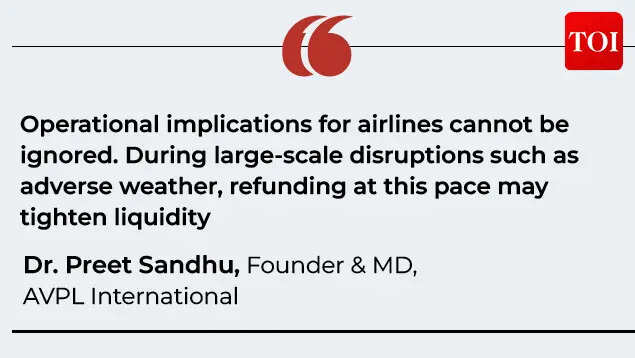
Dr. Preet Sandhu says the operational implications for airlines cannot be ignored. “During large-scale disruptions such as adverse weather, refunding at this pace may tighten liquidity, particularly when bookings are routed through agents but responsibility rests with the airline. With cancellation charges capped at the basic fare plus fuel surcharge and processing fees no longer permitted, traditional revenue buffers will narrow,” he tells TOI.

Hit for airlines

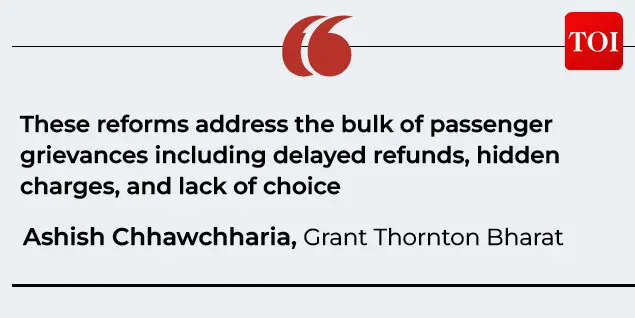
“We have already seen the regulator take enforcement seriously, including the Rs 22 crore penalty imposed on IndiGo, which underlines the intent behind these reforms,” he notes.Ashish Chhawchharia of Grant Thornton Bharat says that compliance may not be a huge challenge for airlines in adapting their IT systems, however, adverse impact of these measures is expected on their cashflow cycles and working capital requirements. “This would be especially relevant in case of substantial refund requirements due to large scale disruptions such as weather events, geo-political events like we are witnessing at present or public health crises we faced during Covid,” he says.“Overall, these reforms address the bulk of passenger grievances including delayed refunds, hidden charges, and lack of choice. Yet, further measures could strengthen consumer protection, including automatic refunds triggered at cancellation and stricter enforcement mechanisms to ensure compliance,” Ashish Chhawchharia adds.Dr. Preet Sandhu says that areas like agent mark-ups may still need further oversight, but the overall framework is moving in the right direction. As he concludes: These guidelines address long-standing concerns that we all faced around delays, forced vouchers, and opaque fee structures. The intent is constructive. The next phase will depend on consistent enforcement and technology-driven systems that can manage mass disruptions efficiently without compromising either passenger rights or operational stability.

[ad_2]

Source link

NASA’s $20 billion moon base plan: How humans could soon live on the lunar surface |

[ad_1]

NASA’s $20 billion moon base plan: How humans could soon live on the lunar surface

The moon has been a symbol of exploration for years. However, now it is not just a symbol of exploration but also a destination for long-term human presence. NASA has just announced its new plan to build a moon base for $20 billion. This is a huge step for space exploration and a new way of thinking for space organisations. This ambitious plan, which is associated with the Artemis program, will enable humans to live permanently on the surface of the moon. This plan will be executed by conducting multiple missions and developing new technologies to achieve this ambitious goal.

NASA’s $20 billion ‘Moon Base’ plan

The focus of the proposal by NASA is the establishment of a permanent base on the Moon in the next decade. This would be done through a series of missions aimed at building up the infrastructure on the Moon, thus allowing humans to return and stay for extended periods.The latest announcements suggest that the agency is planning to send several missions to the Moon and establish an “enduring presence” on the Moon, thus moving beyond the short-term goals set in the Apollo program.The latest plan by the agency is in line with the broader Artemis program, which has a focus on sustainable exploration of the Moon. According to the agency, the focus of the program is to develop “a sustained presence on and around the Moon” in preparation for deep space missions.

Why NASA wants a ‘Moon Base’

The rationale behind such an enormous investment is beyond mere exploration. The Moon is now considered an essential stepping stone to further space exploration, particularly to Mars.The major reasons behind this mission include:

  • Testing new technologies: Life support systems, habitats, and energy
  • Using resources found on the Moon: Utilising water ice as an oxygen and fuel supply
  • Preparing for Mars: Finding ways to sustain human life in extreme environments

NASA has stressed that the Artemis mission is intended to assist in demonstrating “key elements needed for the first human mission to Mars.” The lunar south pole is considered an ideal place because of its potential to obtain water ice as well as stable levels of sunlight.

How will the Moon Base be built

The development of a moon base will not be instantaneous but will be a gradual process. The development will occur in various stages. According to the plans, this will be a process that includes:

  • Multiple missions
  • Surface habitats
  • Mobility systems
  • Power systems

NASA’s Artemis Base Camp is already a concept that includes features such as a lunar cabin, mobility systems such as rovers, and facilities for staying for weeks or even months on the moon.In addition to this, it is also important to note that this will not be a one-nation mission but will be a collaborative effort involving nations across the globe.

Challenges of living on the Moon

As attractive as it may sound, however, establishing a moon base is not an easy task. Some of the serious challenges that come with the moon’s environment include:

  • Extreme temperature changes
  • High levels of radiation
  • Presence of micrometeoroids
  • Limited availability of natural resources

Studies conducted by Cornell University indicate that even a moon base protected from harm will be constantly exposed to space particles, though this will be reduced to a large extent due to modern shielding.

Why is the plan so crucial

NASA’s $20 billion moon base is more than just an investment in space exploration; it is an investment in human aspirations. NASA’s plan is not just an investment in space exploration; it is an investment in human aspirations.The NASA plan could mean:

  • New economic opportunities in space
  • New technological advancements
  • New generations of scientists and explorers

As NASA moves forward in its plan to build a moon base, the Moon is no longer just something in the sky; it is something we will soon call home.NASA’s plan to build a moon base is an audacious, complex plan that is full of challenges, but it is also full of promise. NASA’s investment in space exploration is an investment in humanity’s future. If successful, it could redefine humanity’s relationship with space. NASA’s plan could redefine humanity’s relationship with space by making the Moon a portal to humanity’s next great era of space exploration.

[ad_2]

Source link

UAE car insurance explained: Third-party vs comprehensive, which is right for you and does it cover flood damage

[ad_1]

UAE car insurance explained: Third-party vs comprehensive, which is right for you and does it cover flood damage
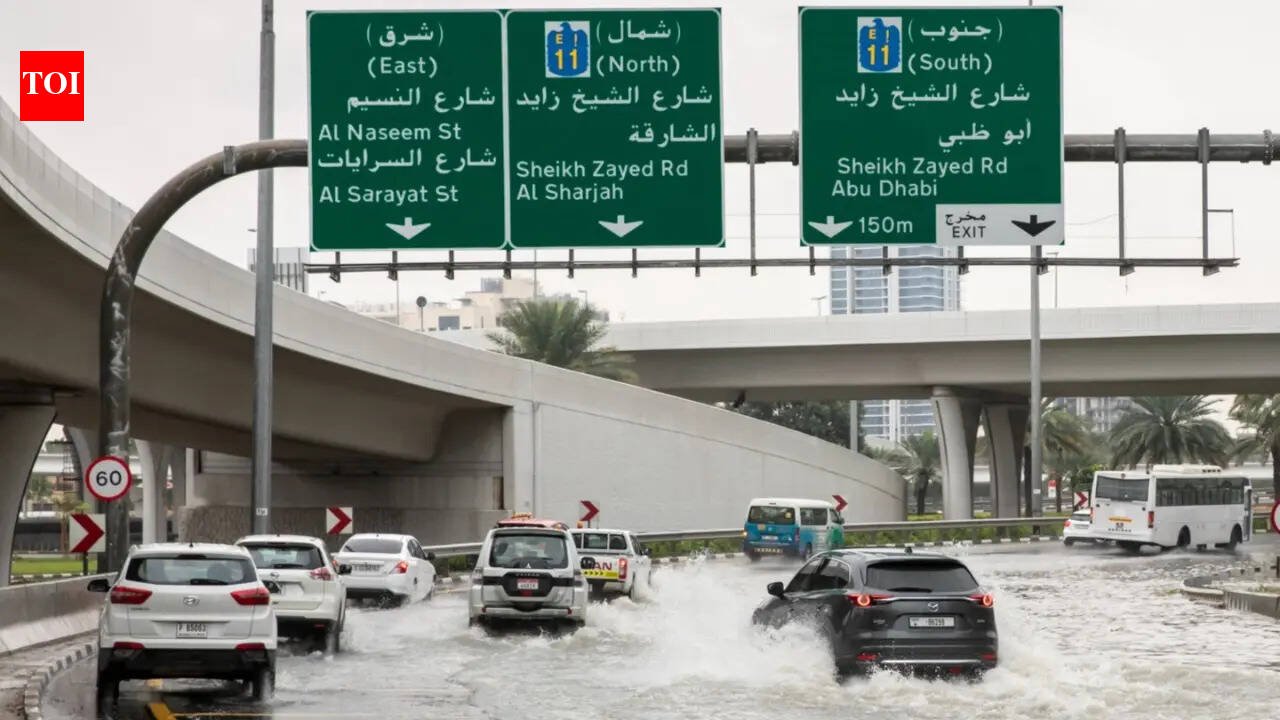
UAE Car Insurance: Third-Party or Comprehensive? The Decision That Could Cost You Thousands

As car ownership continues to rise across the UAE along with repair costs, extreme weather risks and high-value vehicles, one question keeps surfacing among residents: Should you choose comprehensive insurance or stick to basic third-party cover? The difference is not just technical, it can mean the gap between minor inconvenience and major financial loss.

The basic car insurance rule in the UAE: One is mandatory, the other is optional

In the UAE, you cannot legally drive without insurance but the law only requires the most basic form:

  • Third-party insurance is mandatory
  • Comprehensive insurance is optional upgrade

Without at least third-party coverage, your car cannot be registered or legally driven.

Third-party car insurance in the UAE: The legal minimum

Think of this as the bare essentials.

What third-party car insurance in the UAE covers:

  • Damage to another person’s vehicle
  • Injury or death of third parties
  • Damage to public or private property

What third-party car insurance in the UAE does NOT cover:

  • Damage to your own car
  • Your medical expenses
  • Theft, fire, or natural disasters

In simple terms, it protects others from you, not you from loss. This is why it is cheaper and widely used for older or low-value cars.

Comprehensive car insurance in the UAE: Full-spectrum protection

This is where coverage expands significantly.

What comprehensive car insurance in the UAE covers:

  • Everything included in third-party insurance
  • Damage to your own vehicle (even if you’re at fault)
  • Theft, fire, vandalism
  • Natural disasters (rain, floods, sandstorms)
  • Sometimes personal injury and add-ons

In simple terms, it protects both you and others across most scenarios. This makes it the preferred option for:

  • New cars
  • Luxury or financed vehicles
  • Drivers seeking peace of mind

Cost difference: Why many still choose basic car insurance cover in the UAE

The biggest deciding factor is the price. Typical UAE insurance costs (2026):

  • Third-party: AED 450 – 2,000/year
  • Comprehensive: AED 1,200 – 5,000+/year

That is often 2–3x more expensive, which is why budget-conscious drivers lean toward third-party but there is a trade-off:

  • Lower premium
  • Higher risk out-of-pocket

Side-by-side comparison –

Feature Third-Party Insurance Comprehensive Insurance
Legal requirement Mandatory Optional
Covers damage to others Yes Yes
Covers your own car No Yes
Theft/fire/natural disasters No Yes
Cost Low Higher
Best for Older cars New/high-value cars

Recent trends in the UAE are reshaping how residents think about insurance:

  • Rising repair costs – Modern vehicles, especially EVs and luxury cars, are expensive to fix.
  • Extreme weather risks – Heavy rain and flooding events have made natural disaster coverage more relevant.
  • Dense urban driving – More cars on the road means higher accident probability.

All of this makes comprehensive insurance less of a luxury, more of a safeguard.

So, which car insurance cover should you choose in the UAE?

Choose third-party car insurance cover if:

  • Your car is old or low-value
  • You want the cheapest legal option
  • You can afford repair costs yourself

Choose comprehensive car insurance cover if:

  • Your car is new, financed or expensive
  • You want protection from theft or weather damage
  • You prefer financial security over risk

The hidden risk most car drivers ignore in the UAE

The catch that many residents underestimate in the UAE is that if you are at fault in an accident with third-party insurance, the insurer pays for the other person’s damage while you pay for your own repairs, fully out of pocket. In the UAE, that can easily run into thousands of dirhams.Car insurance in the UAE is evolving from a legal checkbox into a financial strategy decision where third-party insurance is for compliance while comprehensive cover is for protection. As vehicles become more expensive and climate risks increase, more residents are reassessing whether saving on premiums today could cost far more tomorrow.Remember, third-party insurance keeps you legal while comprehensive insurance keeps you protected. The real question is not which one is better, it is how much risk you are willing to carry on UAE roads.

[ad_2]

Source link

‘It was already open’: Pakistan’s Khawaja Asif jabs US’ ‘shifted war goal’ on Strait of Hormuz

[ad_1]

'It was already open': Pakistan’s Khawaja Asif jabs US’ ‘shifted war goal’ on Strait of Hormuz
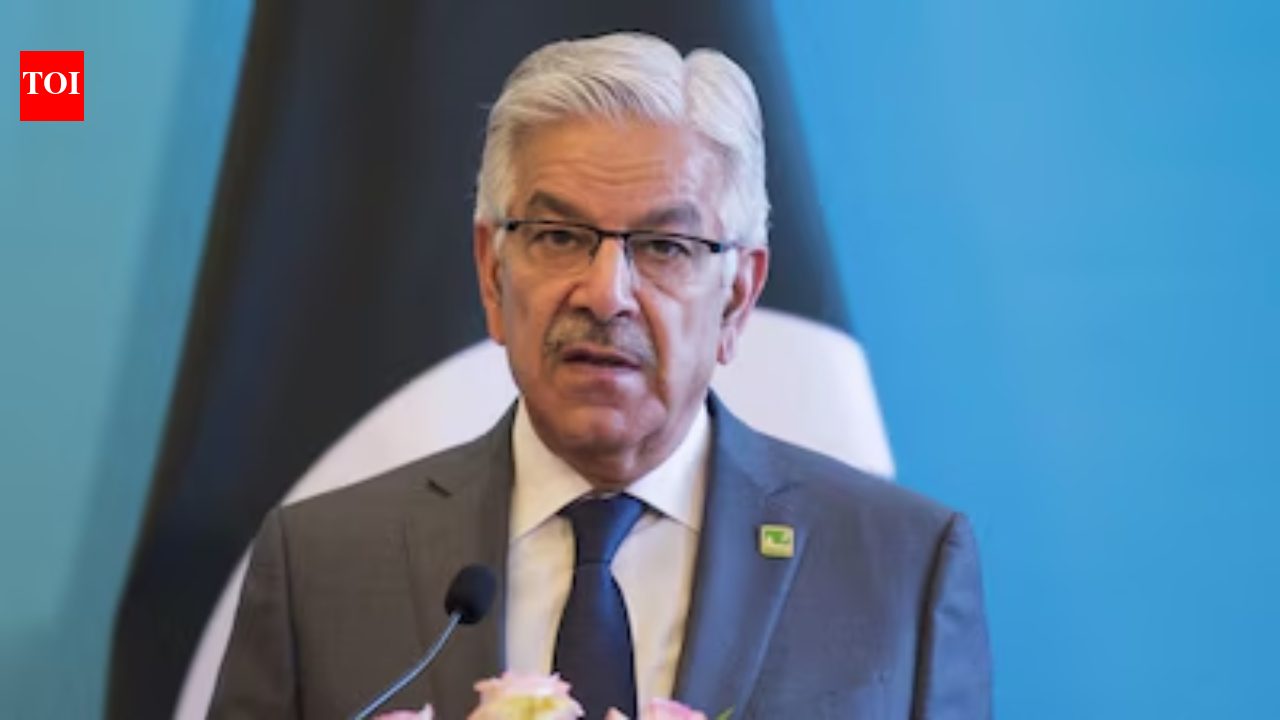
Khawaja Asif (File photo)

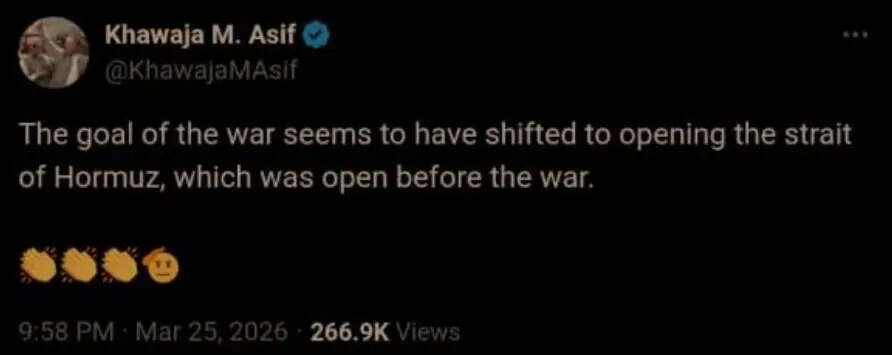
NEW DELHI: Pakistan defence minister Khawaja Asif took a jibe at the United States and Israel, saying that the goal of their war against Iran has “shifted to reopening the Strait of Hormuz.”Click here for live updates“The goal of the war seems to have shifted to opening the Strait of Hormuz, which was open before the war,” Asif posted on X on Wednesday.

Khawaja Asif  X post

Khawaja Asif X post

Iran has effectively blocked the Strait of Hormuz in retaliation for the US and Israeli strikes on February 28. The waterway is a key global route, carrying about 20% of the world’s crude oil shipments, making it crucial for international energy supplies.Also Read | ‘Friendly nations’ only: Iran allows India, Pakistan, 3 other countries to use Strait of Hormuz amid warOn Monday, US President Donald Trump backed off his threat to “hit and obliterate” Iran’s power plants after giving Tehran a 48-hour “ultimatum” to reopen the Strait of Hormuz. He announced a five-day pause, saying there were “productive talks” between Washington and Tehran.Iran, however, rejected that claim.Previously, Trump pressed US allies to send their navies to help escort vessels through the Strait of Hormuz, but many countries declined to commit warships despite his calls.Iran has maintained that the waterway remains open for international shipping except for its “enemies” — a not‑so‑veiled reference to the US and Israel.Pakistan has reportedly offered to mediate between the United States and Iran, with US Vice President JD Vance expected to travel to Islamabad for the talks.Also Read | Iran wants to negotiate with JD Vance, rejects Kushner, Witkoff: Who’s involved in peace talks?According to reports, Pakistan is positioning itself as a “neutral venue,” with contacts underway to hold a meeting in the neighbouring country’s capital.Pakistan’s powerful army chief, Asim Munir, is also said to have spoken with Trump, while Prime Minister Shehbaz Sharif has held multiple conversations with Iranian President Masoud Pezeshkian.

[ad_2]

Source link