Breaking News
‘Exceptional’: SBI hails RBI’s repo rate cut; report says Central bank played its part, now markets should remain disciplined

'Exceptional': SBI hails RBI's repo rate cut; report says Central bank played its part, now markets should remain disciplined

The Reserve Bank of India (RBI) slashed the repo rate by a quarter point to 5.25% on Friday, at a time when the economy is growing strongly and inflation remains exceptionally low. SBI, in its latest report hailed the decision hailed as “exceptional” and said that the central bank had played its role in ensuring that the monetary policy continues to support the country’s economic growth.The bank further added added that it was now up to the markets to remain disciplined and avoid overreaction. The RBI’s Monetary Policy Committee voted unanimously to reduce the repo rate while maintaining a neutral stance. The cut comes amid global uncertainty, even as India’s GDP expanded by over 8.2% in the July–September 2025 quarter and inflation slipped to just 0.25% in October. SBI Research noted that such a move is rare internationally. “Historical data of other countries reveal that there have been minimal instances across the UK, China and Indonesia, where central banks have reduced their rates even when GDP growth was high,” the report said. In past cases, these cuts were typically made from higher interest rate levels and during periods of higher inflation. The report cited the UK in the early 1970s, when chancellor Anthony Barber enacted a “dash for growth” by cutting rates despite inflation at 11% and growth at 12.5%. Similarly, Indonesia cut rates successively from 1995 to 1997, with growth at 8.6% and inflation at 7.4% prior to the Asian financial crisis. “Its only China that had cut in 2012 and 2015 when inflation was averaging 1.8% and growth at 7.4%,” the report added. India’s downward inflation trajectory is supported by lower food prices, strong kharif production, healthy rabi sowing, adequate reservoir levels, and favourable soil moisture. As a result, the RBI has revised its inflation forecast for 2025–26 to 2.0 %, down from 2.6% in October and 4.2% in February. “We forecast inflation for FY26 at 1.8% and for FY27 at 3.4%. With such unprecedented level of downward revisions and further prospects of downward revision looming large, the RBI has kept the door ajar for future rate decisions. However, for now, repo rate at 5.25% will be lower for longer,” SBI Research said. The central bank also adjusted its GDP projections, with real growth for 2025–26 now seen at 7.3%. The first and second quarters of 2026–27 are projected at 6.7% and 6.8% respectively. SBI Research cautioned, however, that external demand could be affected by “ongoing tariff and trade policy uncertainties,” and that “prolonged geopolitical tensions and volatility in international financial markets caused by risk-off sentiments of investors also pose downside risks to the growth outlook. Despite these headwinds, the report expects GDP growth above 7% in the third and fourth quarters, bringing full-year growth for 2025–26 to 7.6%. Commenting on the policy decision, RBI Governor Sanjay Malhotra described India’s current economic climate as a “rare goldilocks period,” with strong growth and low inflation. “The economy witnessed robust growth and benign inflation…We approach the new year with hope, vigour and determination to further support the economy and accelerate progress,” he said.




Source link

Assam tea, Kashmiri saffron & more: What PM Modi gifted Putin — in pictures | India News


Assam tea, Kashmiri saffron & more: What PM Modi gifted Putin — in pictures
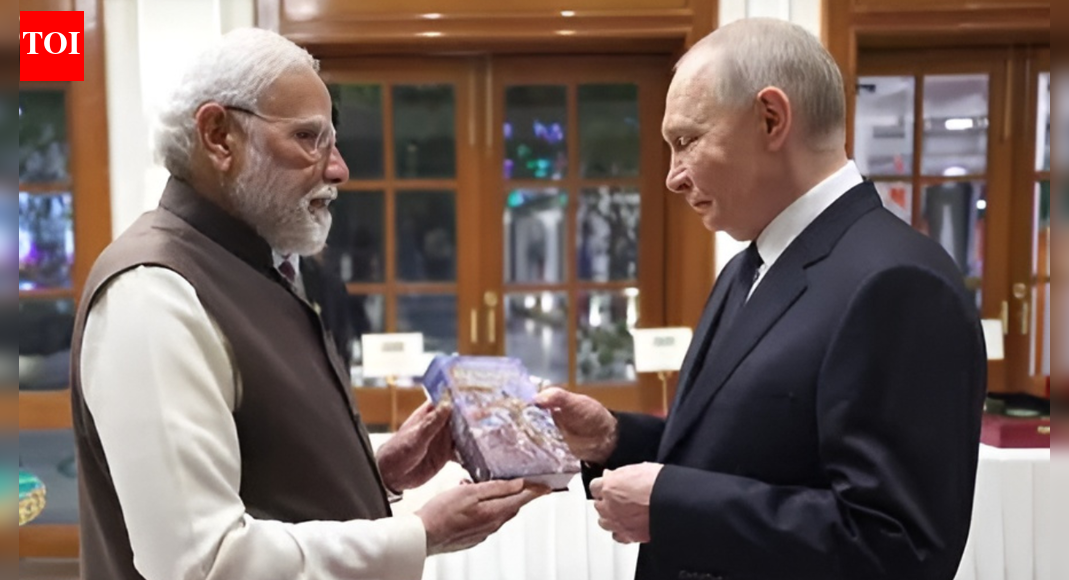
PM Modi presents Srimad Bhagavad Gita to Russian President Vladimir Putin (IANS photo)

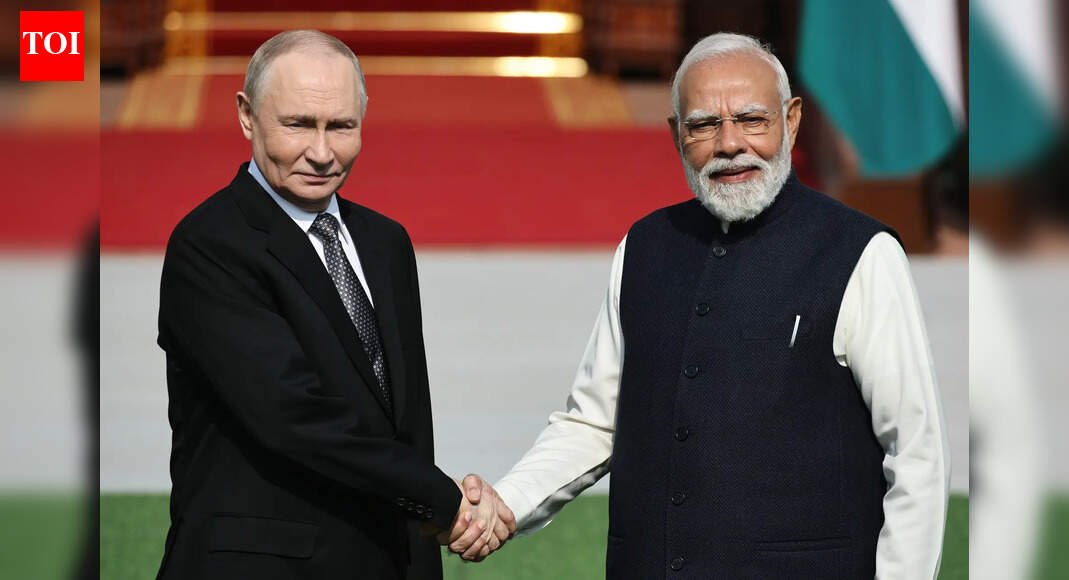
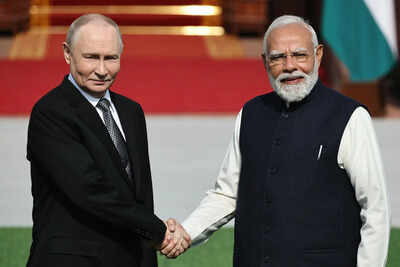
NEW DELHI: Prime Minister Narendra Modi presented a set of specially curated gifts to visiting Russian President Vladimir Putin during his two-day trip to India. The gifts showcased India’s culture, craftsmanship, and heritage.They included a Russian edition of the Srimad Bhagavad Gita, GI-tagged fine Assam tea, Kashmiri saffron, and an ornate silver tea set.

PM Modi, Putin Share Another Car Ride, Russian President Says It Was His Idea To Show Friendship

Putin was in India for a special edition of the 23rd India–Russia Annual Summit, a tradition that has continued since 2000. His visit included a joint statement with PM Modi, several trade and business agreements, and other official engagements.

Assam black tea

The finely processed Assam black tea, grown in the Brahmaputra plains, is known for its strong flavour and bright colour. It received the GI tag in 2007 and is valued not only for its taste but also for its cultural significance and health benefits.

Assam black tea

Ornate silver tea set

The Murshidabad silver tea set from West Bengal features detailed hand engravings. It represents India’s rich artisanal tradition and also reflects the shared importance of tea culture in both India and Russia.

Ornate silver tea set

Srimad Bhagavad Gita (Russian edition)

PM Modi gifted President Putin a Russian copy of the Srimad Bhagavad Gita. Part of the Mahabharata, the text contains Lord Krishna’s teachings to Arjuna on duty, the soul, and spiritual wisdom—guidance that continues to inspire people around the world.

Srimad Bhagavad Gita in Russia edition

Kashmiri saffron

Kashmiri saffron, known locally as Kong or Zaffran, is one of the costliest spices in the world. Recognised with GI and ODOP tags, it is valued for its deep colour, aroma, and flavour. Hand-harvested in Kashmir’s highlands, this “red gold” supports local farmers and carries enormous cultural significance.

Kashmiri saffron

Handcrafted silver horse

The Prime Minister also gifted a handcrafted silver horse from Maharashtra, known for its detailed artistry and fine metalwork. In both India and Russia, the horse symbolizes dignity and valour. Its forward-moving stance represents the strong and steadily progressing partnership between the two countries.

Silver horse

Putin’s first India visit since 2021

Russian President Putin concluded his two-day visit on Friday with a special dinner hosted by President Droupadi Murmu at Rashtrapati Bhavan. This was his first visit to India after December 2021 and his first since the Ukraine war began in 2022. During the trip, he attended the 23rd annual India–Russia summit in New Delhi.


Source link

President Murmu’s banquet dinner for Putin: Jhol momo, saffron pulao, bharwan aloo & more; what was on the menu | India News


President Murmu’s banquet dinner for Putin: Jhol momo, saffron pulao, bharwan aloo & more; what was on the menu
Putin at state banquet (@rashtrapatibhvn)

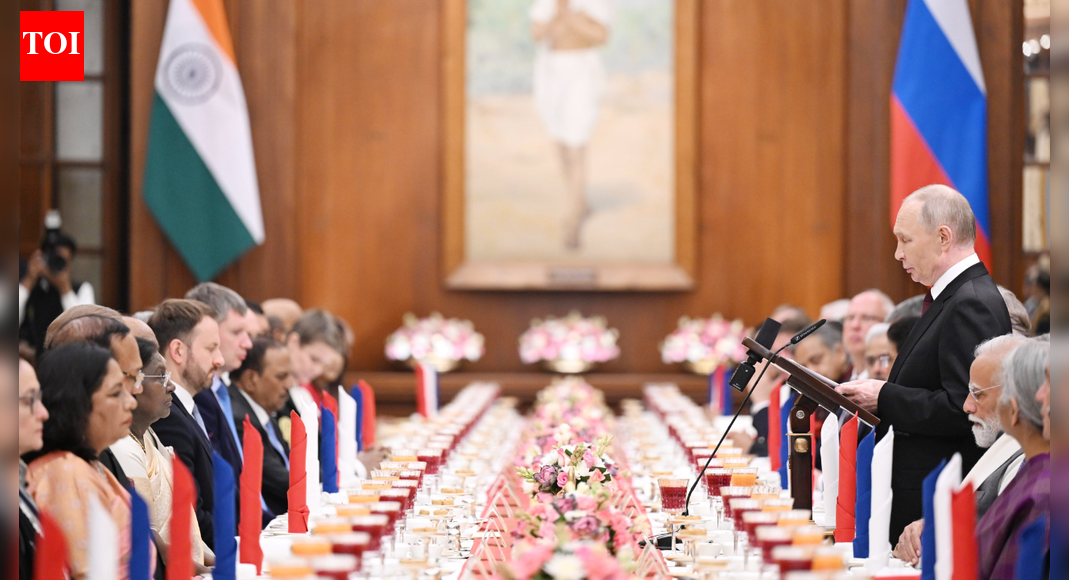
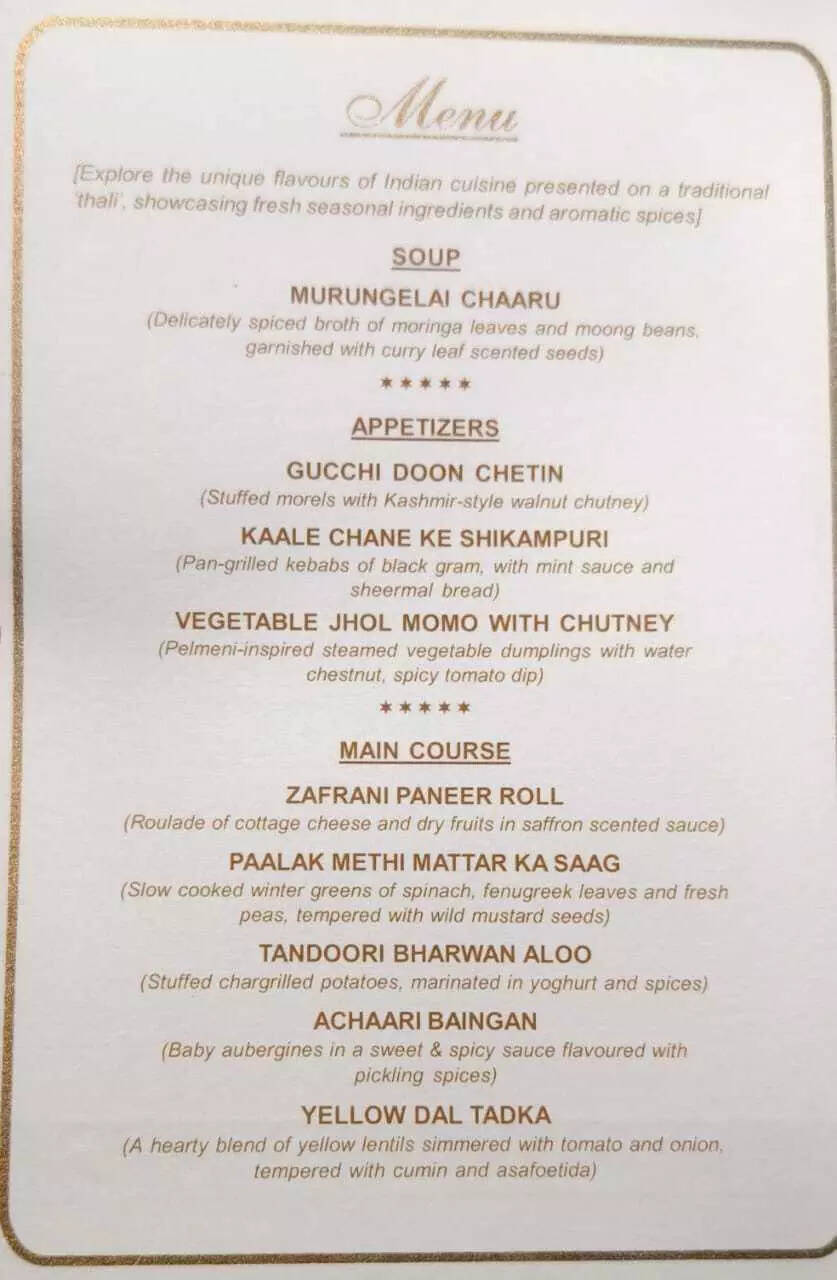
NEW DELHI: President Droupadi Murmu hosted Russian President Vladimir Putin at Rashtrapati Bhawan for a lavish state banquet on the second day of his India visit, featuring an all-vegetarian menu presented as a traditional thali built around fresh ingredients and aromatic spices. The carefully curated spread was designed to highlight India’s regional diversity and culinary heritage while remaining light, elegant and festive.The meal began with murungelai chaaru soup, a light broth of moringa leaves and moong beans garnished with curry leaf-scented seeds, setting a delicate and comforting tone for the evening. This was complemented by gucchi doon chetin (stuffed morels with white walnut chutney), kaale chane ke shikampuri (black gram kebabs) and vegetable jhol momo served with chutney, offering a mix of textures and flavours that moved from earthy to tangy and subtly spiced.

Starters and main course menu

Putin attends lavish banquet at Rashtrapati Bhawan hosted by President Droupadi Murmuu (PTI)

For the main course, guests were served zaafrani paneer roll, palak methi matar ka saag, tandoori bharwan aloo, achaari baingan and dal tadka. Together with the variety of gravies and dry preparations, harmonised the international palate while staying firmly rooted in Indian traditions.

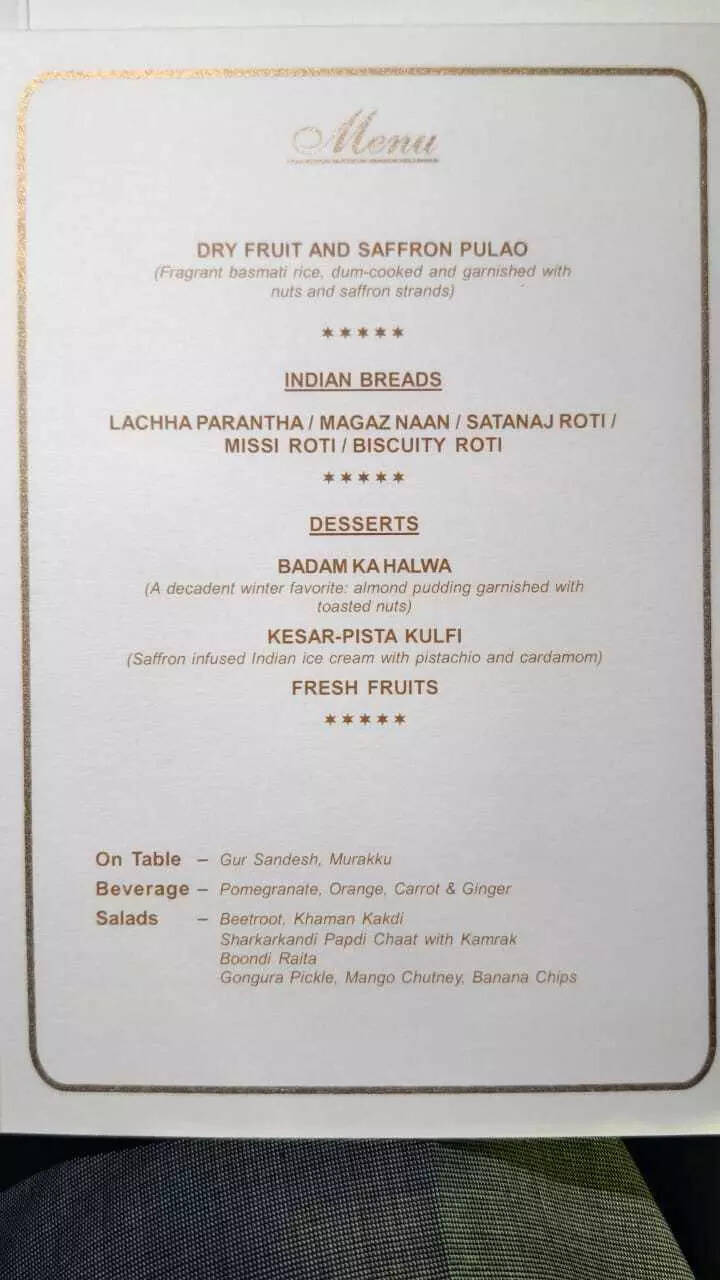
Breads and desserts menu for state banquet

Putin was presented with lavish vegetarian menu during the state banquet

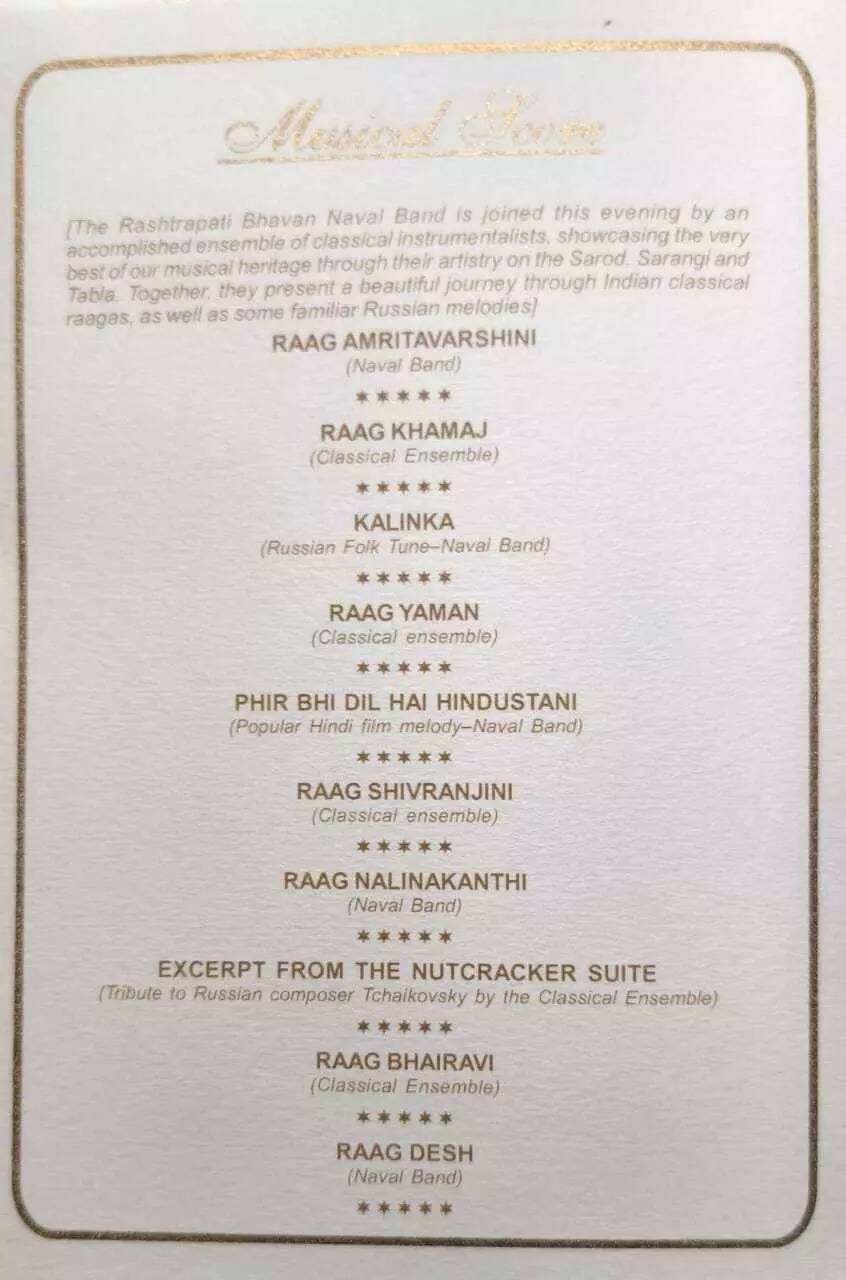
These dishes were paired with dry fruit and saffron pulao and an assortment of Indian breads, including lachha parantha, magaz naan, satanaj roti, missi roti and biscuity roti, ensuring ample options for guests to sample different combinations. Desserts featured badam halwa, kesar pista kulfi and fresh fruits, rounding off the meal with a blend of rich, nut-based sweetness and light, refreshing elements.Alongside this culinary journey, a parallel “raag menu” on the table introduced an ensemble of classical instrumentalists on the sarod, sarangi and tabla, who performed Indian classical ragas accompanied by familiar Russian melodies, turning the dinner into a cultural exchange as much as a gastronomic one.

Music Score

Music score for the lavish banquet at Rashtrapati Bhawan

The melodies included a Bollywood number like “Phir Bhi Dil Hai Hindustani” and Indian classical pieces like raag Shivranjini and raag Yaman, which were harmoniously supplemented by Russian melodies such as an excerpt from “The Nutcracker Suite” as a tribute to Tchaikovsky and “Kalinka”, a Russian folk tune rendered by a naval band. Together, the food and music created a carefully choreographed atmosphere of warmth, respect and soft diplomacy, blending Indian and Russian traditions in a single, memorable evening.Putin underlined the breadth of the India–Russia partnership, saying the joint declaration with PM Modi spans cooperation in politics, security, economy and trade, energy, education and more, and stressed that both countries are working to build a “fairer and just world order,” framing the relationship as one of “go together, grow together.” He later departed Delhi after the banquet, with External Affairs Minister S. Jaishankar seeing him off at the airport.


Source link

‘Treated worse than animals’: 12 labourers from UP reportedly stranded in Kyrgyzstan; families allege fraud by local agents


‘Treated worse than animals’: 12 labourers from UP reportedly stranded in Kyrgyzstan; families allege fraud by local agents

Twelve labourers from Pilibhit, reportedly stranded and facing harassment in Kyrgyzstan, are at the centre of a detailed report submitted by the district administration to the Uttar Pradesh Home Department, officials said on Friday.District magistrate Gyanendra Singh stated that the report was prepared following a directive from the Home Department, which had asked for factual details and instructed the Superintendent of Police to conduct an inquiry.“Information about all 12 persons stranded in Kyrgyzstan has been compiled and sent to the government so that the due process can be initiated for their safe return,” Singh was quoted as saying by PTI. The families identified the workers as Ravi Kumar, Ajay, Chandrapal, Santram, Rohit, Ramesh, Harswaroop, Shyamcharan, Sanjeev, Prempal, Ramasare, and Harishankar, saying they were sent to Kyrgyzstan nearly three months ago by agents of a local recruitment agency. Each worker reportedly paid around Rs 2.5 lakh and was sent on a 59-day visa under “misleading contracts,” relatives claimed.The families alleged that the men are being forced to work in different cities, denied adequate food, and prevented from returning home. They further claimed the workers were being beaten and treated “worse than animals.” Families of the stranded labourers have alleged that the men are being tortured abroad, and that local agents are demanding up to Rs 2 lakh for their return. The workers have also been sending video messages to their families, pleading for rescue.Relatives have repeatedly approached police and administrative officials for assistance. Earlier this week, several family members met with Singh and superintendent of police Abhishek Yadav to recount the ordeal.Officials stated that all 12 workers want to return to India as soon as possible, and their video appeals have been included in the ongoing investigation. According to the district magistrate, the administration’s report will assist the state government in taking steps to facilitate their repatriation, PTI. SP Abhishek Yadav confirmed that the case has been assigned to CO City Deepak Chaturvedi for investigation. He said the families have submitted written complaints alleging that a local firm operating from a city colony, along with its representatives, played a role in sending the workers abroad on false promises.


Source link

India, Russia agree to boost efforts on joint climate action | India News


India, Russia agree to boost efforts on joint climate action

Russian President Vladimir Putin, left, and Prime Minister Narendra Modi (AP photo)

NEW DELHI: India and Russia on Friday agreed to intensify their bilateral efforts for implementing different climate actions under global goals approved on multilateral forums such as the UN Convention on climate change and its Paris Agreement.The statement, issued after the meeting between PM Narendra Modi and Russian President Vladimir Putin, noted the agreement of both countries to continue development of joint approaches to mobilise “increased access to climate finance and technologies” for developing countries and economies in transition.Russia comes under the ‘economies in transition’ (EIT) category, and therefore, does not fall under the group of developed countries who are obligated to provide climate finance to assist developing countries to undertake emissions reduction activities under the UN Convention.Under the convention, developed countries have to take all practicable steps to promote development and transfer of environmentally friendly technologies to EIT and developing countries. The India-Russia joint approach may help in mobilising climate finance by leveraging their combined efforts at multilateral forums.Noting the importance of expanding efforts to combat climate change and achieving the goals of United Nations Framework Convention on Climate Change and Paris Agreement, both India and Russia agreed to “intensify the bilateral dialogue on implementing mechanisms of the Article 6 (carbon trade) of the Paris Agreement, developing low-carbon technologies and using sustainable finance instruments”.The joint statement said both countries also agreed to continue interaction within G20, Brics and SCO on climate change. “Both sides encouraged fruitful cooperation in the area of addressing climate change in Brics during the India chairship in 2026,” it said. The statement also welcomed the first meeting of the joint Russia-India working group on issues of climate change and low-carbon development held on Sept 10 in New Delhi.


Source link

Gautam Gambhir under fire! ‘Stop confusing him’: Ex-India star blasts team management | Cricket News


Gautam Gambhir under fire! 'Stop confusing him': Ex-India star blasts team management
Rohit Sharma with head coach Gautam Gambhir (PTI Photo/Kunal Patil)

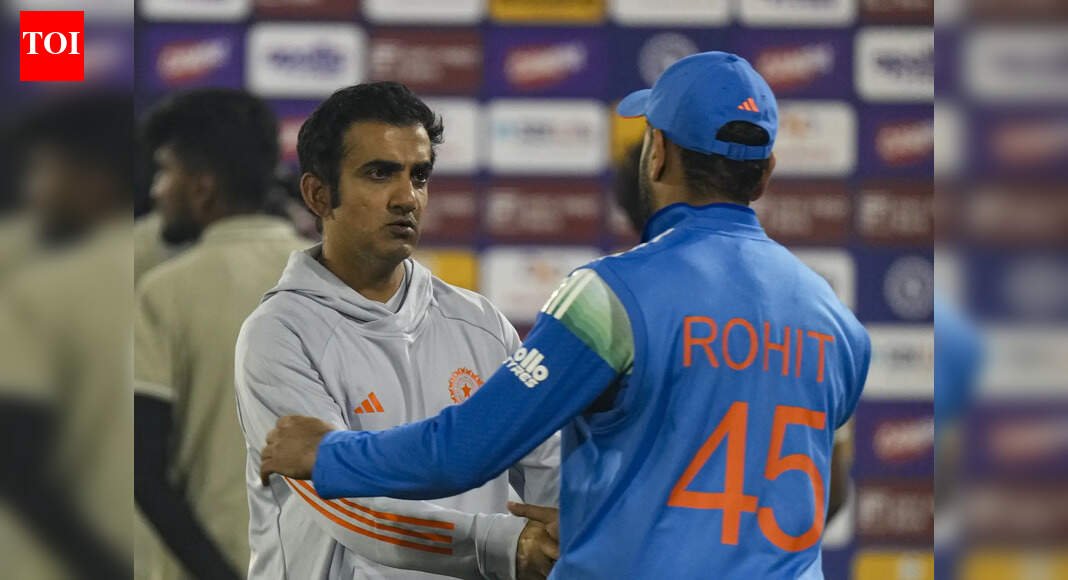
Former India off-spinner Ravichandran Ashwin has called on head coach Gautam Gambhir to provide Washington Sundar with clear direction ahead of the third and final ODI against South Africa in Vizag. The three-match series has seen Sundar struggle to make any meaningful impact, raising fresh concerns over how the team management intends to use him. Sundar has been shuffled around the batting order in the first two games, walking in at No.5 in the series opener before being pushed down to No.6 in the second match. The uncertainty has been reflected in his returns: scores of 13 and 1, and a combined seven overs with the ball, without a wicket. His limited involvement has added to the debate surrounding his place in the XI.

Harbhajan Singh lashes out at Virat Kohli, Rohit Sharma critics

Ashwin, speaking on his YouTube channel, said Sundar needs to be handled as a primary bowler who can contribute with the bat, not the other way around. “Once you decide to play Washington Sundar, you must treat him as a bowler who can bat,” Ashwin said. “He needs to get his full set of overs. Only then will he think like a bowler who can bat. If he’s just batting and bowling a few overs, he’ll keep searching for who he is. Don’t leave him in that space. Give him proper role clarity.” Ashwin also highlighted India’s lack of finishing power with the bat. Despite being 284 for 4 after 40 overs in the second ODI, India ended with only 358. He questioned whether the team might be better served with a fast-bowling all-rounder such as Nitish Kumar Reddy in Sundar’s place. “India haven’t finished well in both games,” he said. “Without someone like Hardik Pandya, why wasn’t a powerful finisher like Nitish Kumar Reddy tried? I’m not sure if they see Rishabh Pant as a finisher. India are missing that punch at the end. Should a fast-bowling all-rounder play instead of a spinning one?” Ashwin added that, with India’s bowling resources depleted, this team may regularly need an extra 30–40 runs to feel safe, particularly if Jasprit Bumrah is not available. “We’ve lost many experienced bowlers in Tests and white-ball cricket,” he said. “The X-factor is Bumrah. If he isn’t a full-time part of the squad, India must score 30 to 40 extra every match.


Source link

Home loans set to fall to historic low of 7.1% with rate cut


Home loans set to fall to historic low of 7.1% with rate cut

MUMBAI: Home loan rates are set to drop to levels last seen before the global financial crisis in 2008, with the RBI’s monetary policy committee reducing the repo rate by 25 basis points to 5.25%.Several banks — Union Bank, Bank of India, Bank of Maharashtra and Indian Overseas Bank — currently offer home loans at 7.35%. Borrowers at this rate will see their interest rate decline to 7.1%, which is also the deposit rate offered by some private banks. On a Rs 1 crore home loan for 15 years, a 0.25 percentage-point reduction in the rate reduces the EMI by roughly Rs 1,440 per month.

RBI Slashes Rates After Rupee Fall, Boosts Liquidity And Lifts India’s GDP Forecast To 7.3%

Bankers say that for home loans to be priced at 7.1% for new borrowers, lenders will have to sharply cut deposit rates or revise the spread over the benchmark rate. If this happens, new borrowers could end up paying more interest than existing floating-rate borrowers.While banks will see a compression in net interest margins until deposit rates fall, non-banking finance companies will benefit immediately because of lower funding costs. “For the NBFC sector, and specifically for last-mile financiers like Shriram Finance, this policy is a significant enabler. The continued neutral stance, combined with the Rs 1 lakh crore OMO purchase announcement, ensures that liquidity remains congenial. This will facilitate the faster transmission of rate cuts to the grassroots level, benefiting the small truck operator, the rural entrepreneur and the MSME borrower, who are the engines of this 8.2% growth,” said Umesh Revankar, executive vice-chairman, Shriram Finance.Bankers said the reduction in lending rates will push lenders toward greater granularity in credit, chasing small-business loans that offer higher returns. “Most large corporates are already raising funds from outside the banking system through equity and bonds. If you look at RBI credit numbers, it is the MSME and retail segment that is driving credit growth,” said the head of credit at a private bank.Although lenders are seeking higher-yielding loans, they remain wary of defaults. RBI data on sectoral deployment of bank credit shows that banks are shifting toward secured loans such as gold and auto loans and away from unsecured personal loans.


Source link

US embassy to H-1B, H-4 visa applicants: Starting December 15, change your Facebook, Twitter, Instagram and other social media settings to …


US embassy to H-1B, H-4 visa applicants: Starting December 15, change your Facebook, Twitter, Instagram and other social media settings to ...

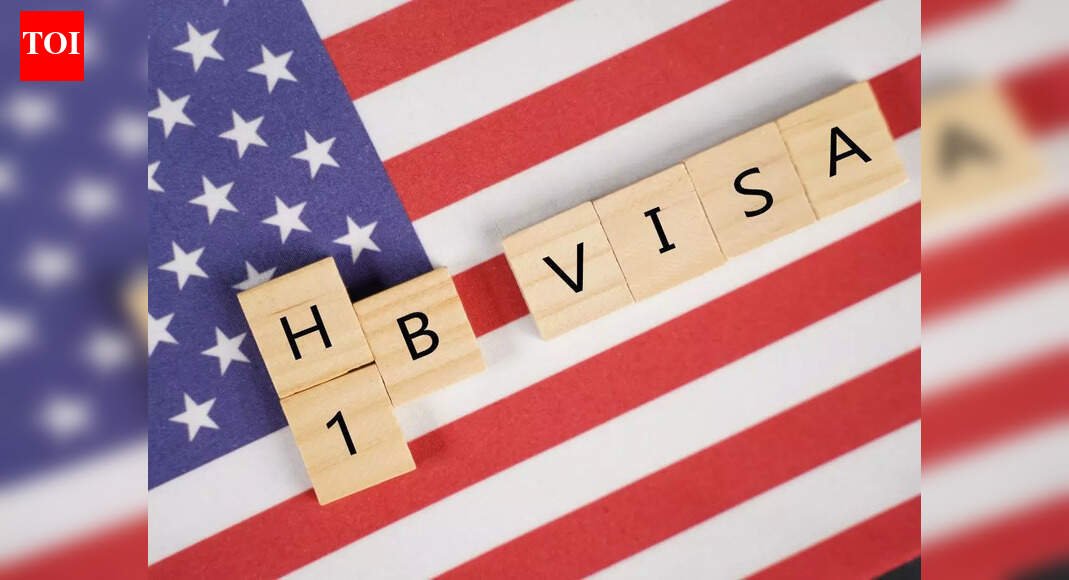
Following its policy to make US visas stricter, the Trump administration is making the US visa-vetting system tighter. The US State Dept announced recently that all H-1B workers and their H-4 dependents will have to undergo social-media screening from December 15. Applicants will have to switch their social-media accounts to “Public” settings to enable scrutiny. The requirement is part of broader vetting procedures introduced by the US State Department in recent years. As part of the updated rules, applicants must list IDs used on platforms such as Facebook, Twitter, Instagram, LinkedIn, YouTube, and others—even if the accounts are no longer active from the last five years.The US State Department reiterated that “every visa adjudication is a national security decision” and stressed that a US visa is “a privilege, not a right”. Internal guidance circulated in June for student visas suggests the parameters officers may rely on. Negative inferences can be drawn if applicants keep portions of their accounts private or have no online presence at all. Officers are also expected to evaluate whether any content reflects hostility toward US citizens, institutions or culture; support for designated terror groups; attempts to access or misuse sensitive US technology; or a pattern of political activism that could continue after entering the US. Derogatory or questionable material can lead to follow-up interviews, prolonged background checks or visa refusal.

Donald Trump’s Stricter H-1B Visa Rule Hits Indian Talent, Background Check Screening Expanded

Read the full order announcement of expanded screening and vetting for H-1B and dependent H-4 visa applicants

As of December 15, the Department will expand the requirement that an online presence review be conducted for all H-1B applicants and their dependents, in addition to the students and exchange visitors already subject to this review. To facilitate this vetting, all applicants for H-1B and their dependents (H-4), F, M, and J nonimmigrant visas are instructed to adjust the privacy settings on all of their social media profiles to “public.The State Department uses all available information in visa screening and vetting to identify visa applicants who are inadmissible to the United States, including those who pose a threat to U.S. national security or public safety. We conduct thorough vetting of all visa applicants, including online presence review of all student and exchange visitor applicants in the F, M, and J nonimmigrant classifications.Every visa adjudication is a national security decision. The United States must be vigilant during the visa issuance process to ensure that those applying for admission into the United States do not intend to harm Americans and our national interests, and that all applicants credibly establish their eligibility for the visa sought, including that they intend to engage in activities consistent with the terms for their admission. A U.S. visa is a privilege, not a right.

US embassy warning on removing social media information from Visa application

In June this year, the US Embassy in India issued a clear warning for visa applicants. “Omitting social media information could lead to visa denial and ineligibility for future visas,” the embassy said in a post on microblogging site X (previously known as Twitter). The post reminded visa applicants to disclose all social media usernames or handles they’ve used over the past five years while filling out the DS-160 visa application form. “Visa applicants are required to list all social media usernames or handles of every platform they have used from the last 5 years on the DS-160 visa application form” the post read. “Applicants certify that the information in their visa application is true and correct before they sign and submit.”The requirement is part of broader vetting procedures introduced by the US State Department this year. As part of the updated rules, applicants must list IDs they use on platforms such as Facebook, Twitter, Instagram, LinkedIn, YouTube, and others. The mandate is also for accounts that are no longer active (from the last five years).


Source link

Chinese hardware giant takes the US government agency to court; says: Not threat to your national security


Chinese hardware giant takes the US government agency to court; says: Not threat to your national security

One of the biggest Chinese companies, Hikvision, is taking America’s Federal Communications Commission (FCC) to court. Chinese surveillance equipment manufacturer Hikvision announced that its US subsidiary has filed a legal challenge against a new FCC rule, escalating the ongoing dispute between Washington and Chinese technology companies over national security concerns. Hikvision stated it has filed a petition seeking judicial review of the FCC’s recent decision. The company argues that the commission exceeded its statutory authority and “seeks to retroactively curtail lawful authorizations without a sufficient legal or evidentiary basis.” Hikvision, best known for its video surveillance and security camera systems, also sells network transmission equipment and accessories.The legal action targets recent regulatory moves that allow US government agencies to tighten restrictions on telecommunications equipment manufactured by Chinese companies deemed to pose security risks. “Our legal action seeks to protect our established market rights and the lawful interests of our customers and partners, and to support a stable, transparent and predictable regulatory environment for all law-abiding businesses,” Hikvision said in a statement.

Dispute over “Covered List”

The dispute centers on the FCC’s “Covered List,” a designation for companies considered a threat to U.S. national security. The list effectively bars the FCC from authorizing the import or sale of new equipment from named firms. Hikvision, along with other major Chinese entities such as Huawei, ZTE, China Mobile, and China Telecom, has previously been placed on this list.This filing follows a series of regulatory crackdowns. In February, a U.S. appeals court rejected a separate bid by Hikvision to lift a 2022 FCC ban on approvals for its new video surveillance and telecommunications equipment.The regulatory pressure has extended beyond legal filings to the retail market. In October, FCC Commissioner Brendan Carr announced that major American retail websites had removed several million listings for prohibited Chinese electronics. These items, which included home security cameras and smartwatches from Hikvision, Huawei, ZTE, and Dahua Technology, were removed for being on the Covered List or lacking agency authorization.The lawsuit comes as the American government continues to widen the scope of its restrictions on Chinese tech infrastructure. On October 15, the FCC announced it was moving to revoke the operating authorization of HKT, a leading Hong Kong telecom carrier and subsidiary of PCCW, citing national security concerns.Additionally, the FCC has recently moved to withdraw recognition from equipment test labs owned or controlled by Chinese entities, further tightening the compliance bottleneck for Chinese manufacturers attempting to enter or remain in the US market.


Source link

Stock market today: Nifty50 opens above 26,000; BSE Sensex flat


Stock market today: Nifty50 opens above 26,000; BSE Sensex flat
Market experts anticipate a period of sideways movement. (AI image)

Stock market today: Nifty50 and BSE Sensex, the Indian equity benchmark indices, opened flat in trade ahead of the RBI policy. While Nifty50 was above 26,000, BSE Sensex was around 85,250. At 9:18 AM, Nifty50 was trading at 26,037.90, up 4 points or 0.016%. BSE Sensex was at 85,243.19, down 22 points or 0.026%.Nifty managed a slight uptick on Thursday, breaking a four-day declining streak, though upside remained limited due to continued foreign investor outflows and the rupee touching historic lows. Experts anticipate a period of sideways movement.Dr. VK Vijayakumar, Chief Investment Strategist, Geojit Investments Limited says, “Today the market focus will be on the monetary policy. More important than the rate action, which is very tricky in the context of low inflation, high growth and depreciating rupee, the market will be keen to know what the governor says about the emerging macro trends. RBI’s action on the liquidity front will be keenly watched. If there is a rate cut, that will be the last cut in this rate cutting cycle. A rate cut in the present context will be negative for banks since it will impact their NIMs and ability to mobilise deposits. On the contrary, a rate cut will be positive for rate sensitives like autos and real estate. If there is no rate cut, banking stocks will rally.”“Rupee’s sharp recovery yesterday to 89.97 from the low of 90.42 is signalling some sort of stability in the currency market. The RBI governor’s views on the rupee today will significantly influence the near-term direction of the currency.”US stocks finished largely flat on Thursday as investors assessed labour market reports and additional economic indicators, whilst market sentiment remained buoyed by expectations of a Federal Reserve rate reduction next week.Regional Asian shares declined in early deals following an uninspiring US session that impacted technology shares and bonds, as attention shifted to upcoming US inflation figures on Friday.WTI oil prices approached weekly gains of nearly 2% during early Friday trading. The rise was supported by anticipated Federal Reserve interest rate reductions, heightening US-Venezuela tensions and halted peace negotiations in Moscow.Gold prices maintained stability on Friday, with increasing US Treasury yields counteracting benefits from a weakening dollar. Markets awaited US inflation data later in the day to understand the Federal Reserve’s policy direction before next week’s meeting.Foreign portfolio investors sold shares worth Rs 1,944 crore net on Thursday. Meanwhile, DIIs were net purchasers at Rs 3,661 crore.(Disclaimer: Recommendations and views on the stock market, other asset classes or personal finance management tips given by experts are their own. These opinions do not represent the views of The Times of India)


Source link