Breaking News
Made-in-India bullet train to run on Ahmedabad-Mumbai route in 2027


Made-in-India bullet train to run on Ahmedabad-Mumbai route in 2027
Revised Cost Estimate Under Sanction: Govt

NEW DELHI: Now it’s official that railways will run B28, the bullet train being manufactured in India, on the first stretch of Ahmedabad-Mumbai bullet train project that is scheduled to be operational in Aug 2027. The railway ministry informed a parliamentary panel that the national transporter has decided to start the operation on the Surat to Vapi (97 km) section of the corridor using the trainset being manufactured by BEML.The report of parliamentary standing committee on railways, which was tabled in both Houses of Parliament on Tuesday, mentioned that when it inquired about the updated completion timeline of Mumbai-Ahmedabad High-Speed Rail (MAHSR) project the ministry said, “Bullet train project is a very complex and technology intensive project. The project involves technology transfer and procurement/ supply from Japan and other countries. The development of the E10 series of Shinkansen is under way in Japan; therefore, detailed information regarding the same is not available. However, a decision has been taken to start the operation using B28 (Bharat made bullet trainset).”The ministry also informed the panel that tenders for alternative signalling systems (based on ETCS L2) have been awarded and work has commenced. It added that manufacturing of B28 is currently underway at BEML. The ministry said anticipated timelines for the commencement of the project can be ascertained after the completion of all associated works of civil structures, track, electrical, signalling and telecommunication and supply of trainsets.“However, efforts are underway to start ops using B28 (Bharat made bullet, 280 kmph) for Surat-Vapi (97km) in Aug 2027,” the report said.Regarding the anticipated cost escalation, major contributing factors and the specific measures being undertaken to prevent cost overruns, the ministry informed the panel that the original estimated cost of the project was Rs 97,636 crore in Dec 2015 and this was based on the feasibility report. Construction was initially planned partly on viaduct and mostly on embankment.The ministry told the committee that there has been cost escalation due to factors that were not considered in the feasibility report – taxes and cess (Rs 29,330 crore), utility shifting (Rs 2,625 crore), station approach development (Rs 2,195 crore), power sourcing arrangement (Rs 1,250 crore), indigenous trains and ETCS signalling system (Rs 16,500 crore), ticketing (Rs 283 crore) and statutory charges owing to forest clearances (Rs 400 crore).“In addition the escalation due to the rise in economic factors of production (inflation and price rise) is Rs 19,084 crore as the project was sanctioned in the year 2015. The substantial increase in land rates particularly in urban areas including cost of land at Mumbai, has led to the increase in the land, resettlement and rehabilitation cost to Rs 16,695 crore. The revised cost estimate for the project of Mumbai Ahmedabad High Speed Rail Line is under sanction,” the ministry said.


Source link

In crunch, government says domestic PNG, CNG, LPG production priority


In crunch, government says domestic PNG, CNG, LPG production priority

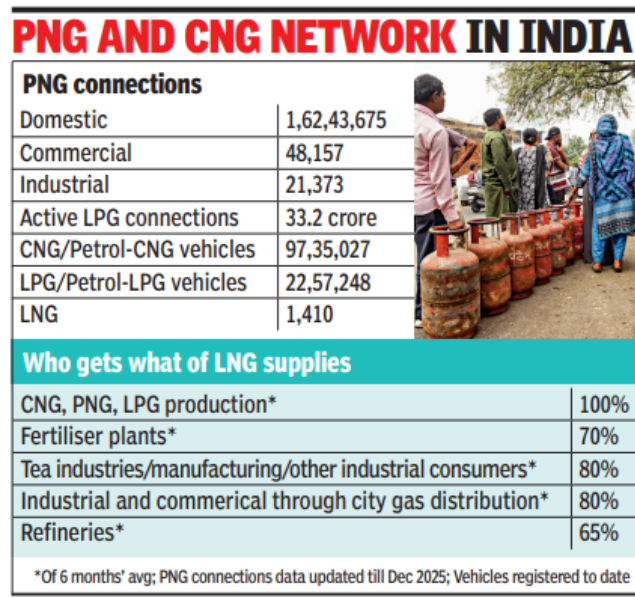
NEW DELHI: Facing a severe LNG (liquefied natural gas) crunch, govt on Monday invoked the Essential Commodities Act, 1955, to reallocate gas supply and slashed allocation for fertiliser and other industries, while seeking to ensure full availability for priority sectors such as domestic piped natural gas (PNG) for kitchens, compressed natural gas (CNG) for transport and LPG production.The decision came days after petroleum ministry insisted that supplies were comfortable, and it was seeking more flows from Canada and Australia amid outages in Qatar, the top source of LNG for India. Hours after the notification, PM Modi met petroleum minister Hardeep Puri and external affairs minister S Jaishankar for an assessment of the situation and its impact on energy flows.During a Cabinet meeting earlier in the day, Modi asked his colleagues to take stock of the situation in their respective ministries and interact with all stakeholders to ensure people do not suffer because of the conflict in West Asia.While fertiliser units, many of which are advancing shutdown, will be supplied 70% of their average consumption in the last six months, availability for industrial units will be 80% of the average for the last six months.

-

Govt in talks with several countries to import LNG through other routes

The notification added that the gas required to meet the needs of the priority sectors would be met through full or partial curtailment of gas supplied to petrochemical facilities and power plants, and by reducing gas allocation to refineries to 65% of their requirement.India imports nearly half of its natural gas requirements of around 190 million standard cubic metres per day (mscmd). More than 50% of the imported LNG comes from Qatar and the UAE through the Strait of Hormuz, which has effectively remained closed to vessel movement for nearly 10 days now. Officials said govt was in talks with several countries to import LNG through other routes, while refiners have made spot purchases to meet their requirements.Ministries such as shipping and road transport have held stakeholder consultations and are holding regular meetings to address concerns. Officials said inter-ministerial consultations were also taking place to ensure prices of essential commodities remained under control, considering that govt has enough buffer stock of rice, pulses and other items.

-

The fact that availability of PNG and CNG impacts millions of people in India has forced govt to invoke the Essential Commodities Act and categorise them as priority sectors along with LPG production to ensure there is no shortage of the fuel.Though the fuel is also used as feedstock for fertilisers, petrochemicals, tea industries, manufacturing and power generation, among others, the gazette notification considered it necessary to regulate production, sector-wise allocation and diversion of LNG supplies. The notification said this was done to ensure equitable distribution and continued availability of natural gas for priority sectors.GAIL (India), in coordination with Petroleum Planning and Analysis Cell, will manage the supplies of natural gas to implement the directives.


Source link

Bareilly Brain Dead Woman: ‘Brain-dead’ woman jolted back to life by pothole in UP | Lucknow News


'Brain-dead' woman jolted back to life by pothole in UP

Pilibhit: A pothole on Bareilly-Haridwar NH-74 turned out to be a blessing for a 50-year-old woman from Uttar Pradesh, reviving her, quite literally, after there was clinically “no sign of life in her”.Declared ‘brain-dead’ by doctors and discharged from a Bareilly hospital with almost “no hope of survival”, Vineeta Shukla was being brought back home by her mournful husband, Kuldeep Kumar Shukla, on Feb 24, when the ambulance struck upon the pothole-riddled stretch of the highway. Then, a sudden, violent jerk did the unthinkable.“I told my family to prepare for her last rites. She was not breathing, there was only a sinking heartbeat. As the ambulance reached Hafizganj, it struck a large pothole and the vehicle moved violently,” her husband told TOI on Tuesday.The next moment, Kuldeep said, was nothing short of a miracle. “My wife started breathing normally again… I immediately informed my family to suspend all the funeral preparations,” he said.Conquered her death: UP woman’s husbandKuldeep then rushed her to Neurocity Hospital in Pilibhit. There, after undergoing critical medical care, she returned home on Monday, “conquering her death,” Kuldeep, Vineeta’s husband, said, adding, “she is now not just awake, but talking to us…”Dr Rakesh Singh, neurosurgeon at Neurocity Hospital, went through a thorough inquiry procedure about the patient’s physical condition and medical diagnosis from his counterparts at the Bareilly hospital before starting her meticulous treatment.Based on the medical information, Singh told TOI that the brainstem reflexes of Vineeta were found absent in the Bareilly-based hospital, while her Glasgow Coma Scale dropped to three points against the normal level of 15 points, indicating complete unresponsiveness.“The examination of her eyes showed mydriasis (dilation of pupils), indicating the death of her brain and constantly sinking signs of life in her. During a series of quick medical tests, heavy neurotoxins were detected in her bloodstream and lymphatic system. The diagnosis and consequent treatment helped remarkably in her recovery,” the neurosurgeon said.According to her family, Vineeta, who was a senior assistant in the copy section at judicial courts in Pilibhit, suddenly fainted on the evening of Feb 22 while managing her household work.Her family took her to Autonomous State Medical College in Pilibhit, from where doctors referred her to an advanced medical facility in Bareilly.


Source link

Indian shops, restaurants in UK’s Wembley vandalised in targeted attacks


Indian shops, restaurants in UK's Wembley vandalised in targeted attacks

LONDON: Gangs of suspected Somalian men have allegedly been terrorising Indian-origin shopkeepers and restaurant owners in Wembley and trashing their shops in targeted attacks of late. This follows the attack in Harlow last week, wherein a gang attacked Holi revellers. Wembley shopkeepers felt it could be the same group.Bob Blackman MP raised the Harrow attack in Parliament on Monday, stating: “Thugs from the Central Mosque attacked the annual Holi celebration in Harrow, attempting to assault over 1,000 peaceful worshippers. 20 attackers, one arrest… The Met has questions to answer.”Manek Chowk Indian restaurant on Ealing Road, Wembley, was attacked twice in the past week — March 5 and March 7. Videos showed the miscreants, most in thobes and all in face coverings, descending upon the restaurant and wrecking it. Another showed tables and chairs turned over, with food and crockery all over the place.A local PIO store owner, who witnessed the vandalism, said: “It started in Traders Wembley last Wednesday. Three men from Daman and Diu were beaten up in the toilets and left bleeding. It was a Somalian gang of young boys. Next, they targeted Manek Chowk. It was a gang of 15 to 20. They came from the mosque area and attacked the restaurant, and 10 or 12 youths got off the bus and joined them and started smashing the restaurant. They didn’t speak with anyone. They just started throwing tables and chairs. They attacked the tills and broke the lights. An Indian man who tried to intervene was hit with a bottle. It keeps happening after 8pm and is totally unprovoked.”Another video, shot March 6, showed a gang of masked men in thobes pulling fruit and veg boxes out at Panesar Food and Wine in Harrow Road, Wembley, throwing them on the ground and treading on them. “They destroy the places, video it and go. It looks like they are paid,” a local said.Both times, by the time police showed up, the gang had fled after causing destruction worth thousands of pounds.On Monday night, a Gujarati-origin man was stabbed in Ealing Road and rushed to A&E. A Brent Council spokesperson said: “Any violent or targeted intimidation of local businesses is utterly unacceptable and will not be tolerated in Brent. We encourage anyone with information or footage to come forward to the police without delay.”


Source link

Air India fuel surcharge: Airline to levy Rs 399 charge on domestic tickets from March 12


Air India fuel surcharge: Airline to levy Rs 399 charge on domestic tickets from March 12

Air India and Air India Express will start levying a fuel surcharge of Rs 399 on each domestic flight ticket from March 12, as airlines face rising operating costs following a sharp increase in aviation turbine fuel (ATF) prices amid tensions in Middle East, reported PTI.The airline group said the surcharge will be implemented in phases across domestic and international routes due to the steep rise in jet fuel prices linked to the geopolitical situation in the Gulf region.In the first phase, a fuel surcharge of Rs 399 per domestic ticket will be imposed from March 12. The same surcharge will also apply to flights to SAARC destinations, the airline said in a statement on Tuesday.For West Asia routes, the surcharge will be USD 10 per ticket, while the charge for Africa flights will increase by USD 30 to USD 90. The surcharge for Southeast Asia services will rise by USD 20 to USD 60.The airline also said the surcharge will now apply to flights to and from Singapore, where no such charge was levied earlier.“Air India group today announced a phased expansion of a fuel surcharge on its domestic and international routes, necessitated by the steep rise in jet fuel prices arising from the geopolitical situation in the Gulf region,” the statement said.


Source link

Donald Trump Ufo Files Release: Obama thinks they are real, Donald Trump has ‘UFO speech ready’: Are we close to finding aliens?


Obama thinks they are real, Donald Trump has 'UFO speech ready': Are we close to finding aliens?

AI image (Picture credit: Google Gemini)

For decades, the idea of alien life has lived somewhere between science and science fiction. From Hollywood & Bollywood films to grainy UFO footage on the internet, the possibility that humanity is not alone in the universe has fascinated people across the world. But in recent years, the conversation has moved increasingly from speculation to scientific inquiry.Renewed interest has been triggered by reports that the United States government may release additional classified records related to unidentified aerial phenomena (UAPs), the modern term for UFOs. The push gained momentum after US President Donald Trump said his administration would direct the Pentagon and other federal agencies to identify and release such records. In a social media post, he cited the “tremendous interest” in extraterrestrial matters following comments by former US president Barack Obama, saying the public deserved greater transparency.These files, expected to come from agencies such as the Pentagon and US intelligence departments, are believed to contain observations of aerial objects that remain unexplained. While scientists caution that such documents are unlikely to confirm alien spacecraft, they have reignited a broader question: are we any closer to discovering life beyond Earth?The answer is complicated: both yes and no. Humanity has learned more about the universe in the last three decades than in the previous three centuries. Thousands of planets have been discovered beyond our solar system.

How big is the universe?

Telescopes can now analyse the atmospheres of distant worlds. Space missions continue to search for microbial life on Mars and icy moons.Yet despite these advances, one puzzling question remains unresolved: if the universe is so vast and old, why have we not found clear evidence of alien civilisations?The fascination with extraterrestrial life is not limited to scientists. At times, it has also reached the highest levels of political power in the United States.

From Carter to Trump: The alien question in American politics

Curiosity about aliens and UFOs has long extended into the highest levels of American politics. For decades, several US presidents have publicly spoken about extraterrestrial life, sometimes seriously, sometimes jokingly, reflecting how deeply the topic has entered public imagination.The debate gained fresh attention recently after former US president Barack Obama said in a podcast interview that aliens are “real,” though he clarified he had seen no evidence of extraterrestrial contact during his presidency. Obama later explained that statistically the universe is so vast that the odds of life existing somewhere else are high, even if visits to Earth are unlikely.Earlier American leaders also showed fascination with the idea. Jimmy Carter once reported witnessing what he believed was a UFO in Georgia in 1969, an experience he later documented with the International UFO Bureau. As president, Carter even placed a message from Earth aboard the Voyager Golden Record, launched on the Voyager 1 and Voyager 2 spacecraft in 1977, intended for any extraterrestrial civilisation that might encounter them.During the Cold War, Ronald Reagan famously used the idea of an alien threat to highlight humanity’s shared destiny. Speaking at the United Nations in 1987, Reagan remarked that global divisions might disappear quickly if humanity faced “an alien threat from outside this world.”Former president Bill Clinton also expressed interest in the mystery. In a 2014 television interview, he said he had asked aides to investigate Area 51, the secretive US Air Force testing facility long associated with UFO speculation, to ensure there was no hidden alien activity there.More recently, the topic resurfaced during the presidency of Donald Trump. Trump previously said he had received briefings about UFOs during his first term but remained sceptical about extraterrestrial visitors.
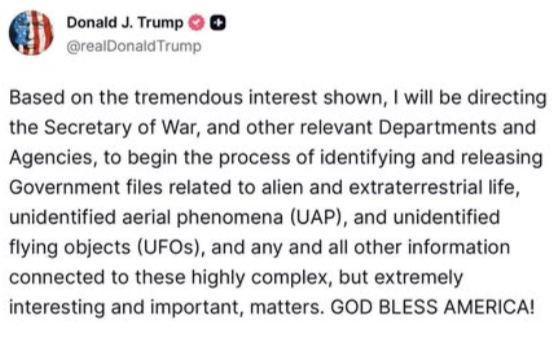
Trump UFO files release announcement

Trump UFO files release announcement (Image Source – Truth/Donald Trump)

However, his daughter-in-law Lara Trump recently suggested in a podcast interview that Trump may have “a speech ready” about extraterrestrial life that could be delivered at the right time.Together, these comments illustrate how the possibility of alien life, once confined largely to science fiction, has occasionally surfaced even in presidential conversations, reflecting both scientific curiosity and the enduring mystery surrounding the universe.This puzzle lies at the heart of one of science’s most famous ideas — the Fermi Paradox.

The great cosmic puzzle

The paradox is named after Italian-American physicist Enrico Fermi, who raised a simple but profound question during a conversation with colleagues in 1950. Looking at the immense scale of the universe, Fermi reportedly asked, “Where is everybody?”

The Fermi Paradox explained

The logic behind the question is straightforward. The Milky Way Galaxy alone contains hundreds of billions of stars. Many of those stars likely host planets. Over billions of years, some of those planets could have developed intelligent life. Given enough time, such civilisations might develop advanced technology and explore space.In theory, even a single technologically advanced civilisation could spread across the galaxy in a few million years — a short period on cosmic timescales. If that is possible, then traces of alien technology, signals or visits should already be visible.Yet humanity has found none.This contradiction between high probability and zero evidence is what scientists call the Fermi Paradox.Over the decades, scientists, philosophers and futurists have proposed many explanations. Some suggest alien life is extremely rare. Others argue that intelligent species often destroy themselves before exploring the stars. A few theories even suggest that aliens may already be aware of humanity but deliberately avoid contact.Here are some of the most intriguing explanations that attempt to solve the mystery.

10 ways scientists explain the Alien silence

The rare Earth hypothesis

One possibility is that intelligent life is extraordinarily rare.The Rare Earth Hypothesis suggests that while microbial life might be common, the conditions required for complex organisms — and eventually intelligent species — are incredibly unlikely.Earth’s history offers several examples of unlikely events that made complex life possible. These include the presence of a large stabilising moon, plate tectonics that regulate climate, a protective magnetic field and a relatively stable star. Even small changes in these conditions could have prevented the emergence of complex life.Under this theory, Earth may simply be one of the very few places where all the necessary factors came together.

The great filter

Another influential idea is known as the Great Filter hypothesis.This theory proposes that somewhere between the formation of planets and the rise of interstellar civilisations lies a difficult barrier, a “filter” that most life forms fail to pass.The filter could occur at many stages. Perhaps life rarely begins in the first place. Maybe complex organisms almost never evolve. Or perhaps intelligent species tend to destroy themselves through nuclear war, environmental collapse or uncontrolled technology.If the Great Filter lies ahead of humanity, it would imply that technological civilisations often collapse before achieving long-term survival.

The distance problem

Even if intelligent life exists elsewhere, the sheer size of space may make contact extremely difficult.The nearest star system, Proxima Centauri, is more than four light-years away. Current spacecraft would take tens of thousands of years to reach it.Human radio signals have travelled only about a hundred light-years into space since the first broadcasts in the early twentieth century. That is a tiny fraction of our galaxy.Civilisations might exist thousands or millions of light-years away, separated by distances too vast for practical communication.

The zoo hypothesis

Some researchers have proposed a more unusual idea: that aliens deliberately avoid contacting humanity.Known as the Zoo Hypothesis, the theory suggests advanced civilisations may observe Earth without interfering, much like humans watch animals in a wildlife reserve.Under this scenario, extraterrestrial societies might follow ethical rules that prevent them from influencing developing worlds until those worlds reach a certain level of technological maturity.While there is no evidence for this idea, it remains a popular concept in discussions about extraterrestrial intelligence.

The dark forest theory

A darker explanation is known as the Dark Forest Hypothesis.According to this theory, the universe may be filled with intelligent civilisations, but they remain silent out of fear. In a galaxy where resources are limited and survival is uncertain, revealing one’s location could invite attack from a hostile civilisation.As a result, every advanced society might hide quietly, avoiding communication with others.This concept has gained popularity in recent years through science fiction but also raises serious philosophical questions about cosmic survival.

The simulation hypothesis

Another controversial idea suggests humanity might not be living in a natural universe at all.The Simulation Hypothesis proposes that reality could be an advanced computer simulation created by a highly advanced civilisation.If that were the case, alien life might not appear simply because the simulation’s creators chose not to include it.While the theory remains speculative, it has been discussed by physicists and philosophers exploring the limits of technological possibilities.

The self-destruction theory

Some scientists believe intelligent civilisations often eliminate themselves through technological risks.Once a species develops advanced technology, it gains the power to alter or destroy its environment. Nuclear weapons, artificial intelligence, bioengineering or environmental collapse could threaten long-term survival.If most civilisations collapse shortly after reaching technological maturity, the window for detecting them may be extremely small.Humanity itself is only about a century into the age of modern technology — a blink of time on cosmic scales.

The ocean worlds hypothesis

Another possibility is that alien life may exist in places that are difficult for humans to observe.Several moons in our solar system, such as Europa and Enceladus, are believed to contain vast oceans beneath thick layers of ice.If microbial life exists in these oceans, it might thrive in darkness far below the surface. Detecting such organisms from Earth would be extremely challenging.Life could therefore be widespread but hidden in environments humans have barely explored.

The technological mismatch

Another theory suggests alien civilisations may communicate using technologies humans cannot detect.The SETI Institute, which leads the Search for Extraterrestrial Intelligence, has traditionally searched for radio signals from space. But advanced societies might use entirely different methods, such as laser communications or technologies not yet understood by human science.If alien signals exist in forms beyond our detection capabilities, humanity might simply be listening to the wrong channels.

The “They Are Already Here” idea

Perhaps the most controversial explanation is that extraterrestrials have already visited Earth.Supporters of this idea often point to mysterious sightings of objects in the sky — commonly known as UFOs.In recent years, governments have begun referring to these sightings as Unidentified Aerial Phenomena, a broader term that includes any unexplained objects observed in the atmosphere.However, scientists stress that unexplained does not necessarily mean extraterrestrial.

The UFO sightings that captured public imagination

Several high-profile incidents have fuelled speculation about alien visitors.One of the most famous is the Roswell Incident in 1947, when debris recovered in New Mexico was initially described by local authorities as a “flying disc”. The US military later said the material came from a secret surveillance balloon.Another widely discussed case involved US Navy pilots encountering an unidentified object during exercises near the Pacific Ocean in 2004. The incident, often called the USS Nimitz UFO encounter, involved radar detections and infrared footage of a fast-moving object that appeared to defy conventional aircraft behaviour.In 2017, several such videos were released publicly by the United States Department of Defence, drawing renewed attention to unexplained aerial sightings.Despite the mystery surrounding some cases, many UFO sightings eventually turn out to be misidentified aircraft, weather balloons, satellites or natural atmospheric phenomena.

UFO reports beyond the West

Unidentified objects in the sky are not limited to the United States.In India, reports of strange lights have occasionally emerged from remote regions. In 2012, residents and military personnel in the Himalayan region of Ladakh reported seeing glowing objects moving across the night sky near the India-China border.Investigations suggested the lights were likely Chinese lanterns or astronomical phenomena, but the sightings attracted widespread media attention.One of the most famous modern cases occurred in November 2023 at Imphal Airport. A bright, white, ball-like object hovered directly over the airfield in broad daylight. The Indian Air Force (IAF) didn’t take it lightly; they scrambled two Rafale fighter jets to intercept it. The pilots saw the object on their sensors, but as they closed in, it simply vanished. The airport was shut down for over three hours, and to this day, no official explanation has been given.Further north, in the Kongka La Pass of the Himalayas, locals have reported “silent, triangular craft” for years. This area is a “no-man’s land” between India and China, making it one of the most remote places on Earth. In 2024 and 2025, reports of glowing orbs emerging from the mountains became so frequent that local Indian Army units reportedly logged them as “unidentified technical observations.” These aren’t just stories; these reports were logged in official military records, though no conclusive explanation has been provided..Similar stories have appeared around the world for decades. Most remain unexplained, though few provide evidence of extraterrestrial technology.

The scientific search for life

While UFO sightings capture public imagination, the real scientific search for alien life focuses on astronomy and planetary science.One of the most promising areas of research involves exoplanets — planets that orbit stars outside our solar system.Since the 1990s, astronomers have discovered thousands of such worlds using telescopes like the Kepler Space Telescope and the James Webb Space Telescope.Some of these planets lie within the “habitable zone” of their stars, where temperatures might allow liquid water to exist.

Where scientists are looking for life

Scientists are now beginning to analyse the atmospheres of distant planets, searching for gases such as oxygen or methane that could indicate biological activity.Meanwhile, robotic missions continue exploring our own solar system.Rovers on Mars are searching for signs that microbial life may once have existed there. Future missions may attempt to drill into the icy crusts of moons like Europa to search for organisms in subsurface oceans.Even microbial life beyond Earth would represent one of the most important discoveries in human history.

What scientists really think

Despite growing public interest in UFOs, most scientists remain cautious.There is currently no verified evidence that extraterrestrial spacecraft have visited Earth. At the same time, many astronomers believe the universe is so vast that it would be surprising if life existed only on our planet.The real challenge lies in detecting that life across immense cosmic distances.Astronomers often compare humanity’s search for alien signals to scooping a glass of water from the ocean and concluding that whales do not exist because none appeared in the sample.Humanity has only just begun to explore the cosmos.

A question that defines our era

The search for alien life is not just about curiosity. It touches on some of the deepest questions humanity can ask.

Three questions scientists still cannot answer

Are we unique in the universe? Is intelligent life a common outcome of evolution? Or is Earth an extraordinarily rare exception?New telescopes, space missions and scientific techniques may begin to answer these questions in the coming decades.For now, the universe remains silent.But as astronomers continue to scan the skies and explore distant worlds, the possibility remains that one day humanity may detect a signal, faint, distant and unmistakably artificial.If that moment comes, it would transform humanity’s understanding of its place in the cosmos.Until then, the mystery remains unresolved.And the question that Enrico Fermi asked more than seventy years ago continues to echo across modern science:“Where is everybody?”




Source link

First-person account: How Dubai keeps its tempo under missile alerts


First-person account: How Dubai keeps its tempo under missile alerts
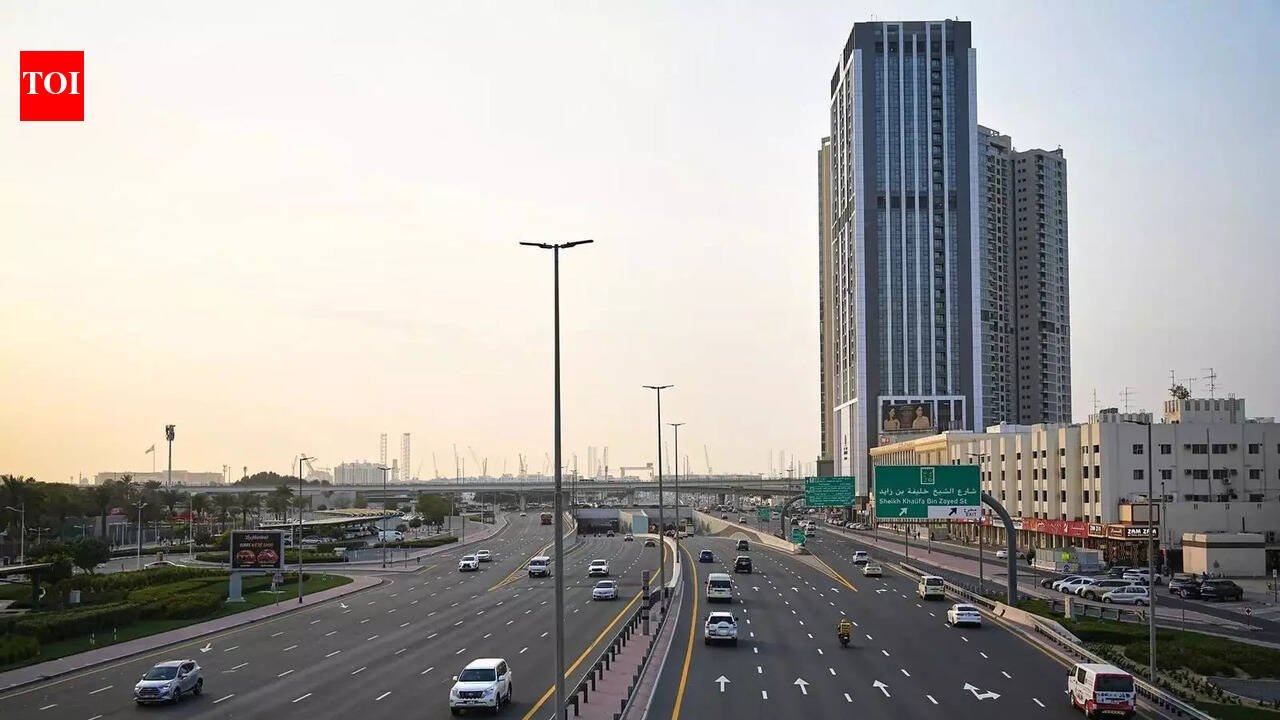
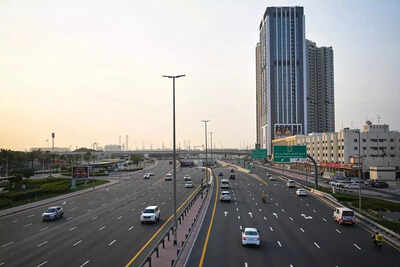
Light traffic moves along a main road in Dubai, United Arab Emirates, Tuesday, March 3, 2026. (AP photo)

Yalla Habibi, Let’s GoThe National Emergency Crisis and Disaster Management Authority of the UAE had an important announcement to make on 9th March. They were going to change the alert tone between 10.30 pm and 9 am to a regular chime. Residents complained that the original alarm, a shrill siren, was causing anxiety. The government agreed.As a resident, I can attest to that. The alarm was triggering at bedtime. From the kids because of the noise. From me because I was afraid of how long sleep time would take.I don’t know many places where civil defence adjusts the sound design of a national warning system based on public feedback. Did someone at civil defence say, “Can we please make the safety alert slightly less stressful?” or, like distractors will say, it’s a sign of a country living in a bubble – that Habibi, is up for debate.Since February 28th, I have noticed three different types of narratives coming from people who don’t live here.First, there’s the gleeful commentary from part of the US, UK, India, and elsewhere, usually about Dubai, the UAE and the people who moved here to save tax. Particularly when amplifying rumours about Burj Khalifa being attacked. It wasn’t. It responded the next day by lighting its façade in the colours of the UAE flag.Second, there’s television news coverage, looping dramatic footage of interceptions and debris. This often comes 13 hours after an incident has been announced and contained.Third, there are parents and friends, who are panic-struck. They can’t reconcile what they see on television with what residents are saying.“How are you going to the mall?” they ask.As a couple with young children, we have our ready-to-go bag packed, the car tank full, and cash withdrawn for an emergency. And that’s about it. People are out for walks, they’re going to the gym, and as I write this, I see a gentleman, sunning himself on a rooftop pool.In Dubai, it’s been business as usual. Stand outside, stare at the sky for 10 mins and you will see at least 2 commercial aircraft either descending or taking off. EACH and every delivery service is working; there was an outage with Amazon initially, but local delivery service Noon is still delivering water and chocolates in under 15 mins. Everything from Dubai Chocolate to Sushi are being delivered, and there have been no reports of people hoarding essentials or supermarkets running out of supplies.Anywhere else in the world – Mumbai, New York, London, you’d hear sonnets about the ‘spirit of the city’. But when Dubai keeps functioning, somehow the narrative becomes, ‘they are living in a bubble’. The irony is hard to miss.It’s a city that also never stops moving; everyone is out drinking coffee, working, or on a date. Everyone is going somewhere, doing something. Not sitting at home, reading the news, and hyperventilating.Supermarkets are open. So are organic farmers’ markets. McDonald’s is open, so are craft coffee shops, offices are open, so are beach clubs. Roof-top pools are open, and so are outdoor cafes (despite it being Ramadan).Once, or sometimes twice a day, the Ministry of Defence issues a statement and an infographic; it’s coherent, well-designed, and echoes a city confident in its skin.The day after the first missile was launched, schools were closed until March 4. Then extended to the 6th. Then the spring break, originally scheduled for later in the month was simply brought forward. It happened quietly, without confusion or panic. Schools were closed. But kids’ activities, parkour classes, sports continued. Playgrounds never shut.A couple of days ago, debris hit a building in an upmarket part of Dubai called Dubai Marina, causing a small fire. Earlier in the conflict, something similar happened on the facade of the Burj Al Arab. But Dubai went to sleep, woke up, and Habibis and Habibtis went to work.Did people carry on because that’s the spirit of the city? Or because it’s an expensive city and people still have jobs to get to? Probably both. The same argument could be made for London, New York or Mumbai.I do think one thing is different in the UAE: there have been a slew of small, absurd-sounding, almost inconsequential measures in isolation. But oddly effective. For instance, a couple of days ago, at the peak of the crisis, an announcement was made – some banks would be open till midnight, and they were also waiving ATM withdrawal charges. A princely sum of 2.1 AED (About 50 rupees). It sounds trivial but it’s the kind of detail that tells you, someone is thinking about the small inconveniences too.Have my wife and I both acquired super hearing? Yes. Do we confuse trucks for Missiles and motorcycle exhaust for interceptions – sometimes. That’ll take some time to go away, but we’ll take it.The country’s attention to detail has been astounding. When the first missiles were launched, Abu Dhabi’s Department of Culture and Tourism issued a now viral directive to hotels – “extend the stay of travelers, send us the bill.”True, small measures don’t get a city back up on its feet; it needs to do that itself. But a slightly less shrill alert, regular, specific information helps. It’s the hand that dusts off your trousers. And let’s face it, we can always use a hand there, whether we trip or are targeted by 253 ballistic missiles, 1440 drones and 8 cruise missiles (as of March 9th 2026).Until then, the city continues. Everyone is on the streets telling everyone else, Yalla Habibi! (the only translation that comes close to this is Let’s Go, Let’s go!).


Source link

Russian sanctions easing linked only to India? Trump’s message to Europe allies amid Middle East oil shock


Russian sanctions easing linked only to India? Trump’s message to Europe allies amid Middle East oil shock
Donald Trump indicated that Washington might consider lifting ‘certain oil-related sanctions’ in order to help bring down prices. (AI image)

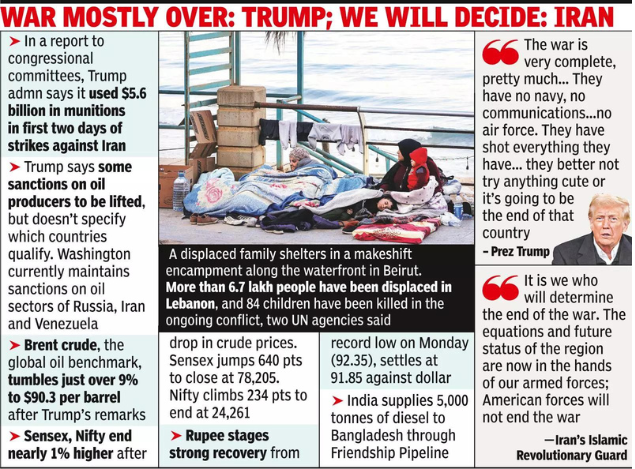
Even as the world economy reels under the global oil supply shock, the Donald Trump administration has reportedly made it clear to European countries that any easing on Russian crude oil sanctions would be related to supplies to India. On Monday, President Donald Trump indicated that Washington might consider lifting ‘certain oil-related sanctions’ in order to help bring down prices. However, he did not elaborate on the proposal, apart from noting that the matter had come up during a phone conversation with Russian President Vladimir Putin earlier that day. According to a Bloomberg report, the United States has informed its European partners that any additional easing of sanctions on Russian crude would largely be confined to shipments destined for India. Oil prices have been climbing since the start of the US-Israel-Iran war. The message comes at a time when India has stepped up its purchases of Russian crude oil as supplies from the Middle East are stuck due to the Strait of Hormuz closure.

India’s Russian Crude Oil Buys

The US claims it has provided a waiver to India to get Russian oil cargoes that were already in transit. India on its part has said that it never stopped buying Russian crude oil and doesn’t need ‘permission’ from anyone to take decisions related to its energy security.India has continued purchasing crude oil from Russia and has not halted such imports, despite US President Donald Trump linking the removal of a proposed 25 per cent penalty tariff under a potential trade agreement to New Delhi allegedly committing to stop buying Russian crude.Officials told TOI that India has never required approval from any country to procure oil from Russia, noting that Moscow remained the country’s largest supplier of crude in February. They emphasised that India’s decisions regarding energy procurement are guided by the principle of “national interest.” “We source crude from wherever supplies are available, competitively priced and deliverable, and we will continue to do so,” a government source said according to a TOI report.Sources also said that the announcement by senior US officials of a “30-day waiver” allowing India to import Russian oil was primarily intended for their domestic audience.During a conference call held Monday among finance ministers of the Group of Seven nations, the United States underscored that the decision concerning India was strictly limited in both duration and scope, said European Union Economy Commissioner Valdis Dombrovskis.“They do not expect substantial impact of this on Russian oil revenues,” Dombrovskis said at a press conference later that evening after participating in the G-7 discussion.People familiar with the deliberations added that US officials stressed any further sanction relief would likely follow the same narrow and carefully defined approach. They also noted that the final decision ultimately rests with Trump.Meanwhile, oil output reductions across the Middle East are intensifying as activity in the strategically vital Strait of Hormuz has slowed almost to a halt. The disruption pushed crude prices close to $120 per barrel on Monday.Trump said the same day that the United States and Israel were making meaningful progress in their military campaign against Iran and that the conflict could conclude “very soon,” a development that helped temper the earlier surge in oil prices.Nevertheless, as hostilities continue, the G-7 countries said on Monday they remain prepared to release oil from their strategic reserves if required. Some member states, however, believe the situation has not yet reached the threshold necessary for such a step, according to people familiar with the matter.


Source link

Centre sets up 3-member panel to tackle ‘LPG shortage’; steps up domestic production by 10% | India News


Centre Invokes Essential Commodities Act To Regulate LPG Supply Amid Iran War

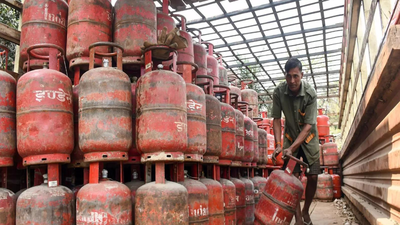
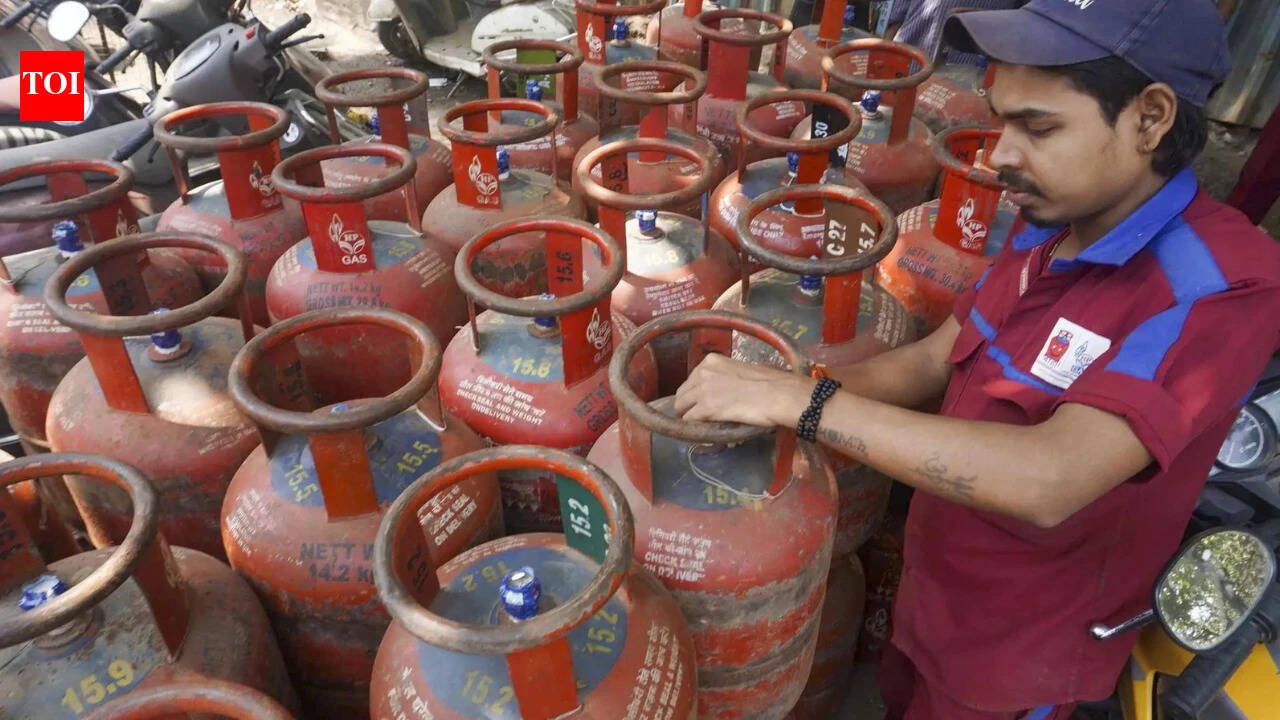
NEW DELHI: The Centre has constituted a three-member committee to address the ongoing LPG shortages that have severely affected the hospitality industry, following concerns raised amid the continuing crisis in the Middle East.According to government sources cited by news agency ANI, the new panel will assess the scale of disruption, consult hotel and restaurant industry associations, and reorganise supply distribution to meet genuine commercial requirements.

Centre Invokes Essential Commodities Act To Regulate LPG Supply Amid Iran War

The panel is comprised of executive directors from Indian Oil Corporation (IOC), Bharat Petroleum Corporation Limited (BPCL) and Hindustan Petroleum Corporation Limited (HPCL).The move comes after the Federation of Hotel and Restaurant Associations of India (FHRAI) wrote to the petroleum and natural gas minister, Hardeep Singh Puri, flagging “widespread disruption of LPG supply at the ground level” and urging immediate government intervention.In response, the three-member committee has been tasked with identifying the bottlenecks in commercial LPG availability and interacting directly with hospitality stakeholders to address their grievances.The officials said supply will be reprioritised where necessary to ensure continuity for essential commercial sectors such as hotels and restaurants.The Centre has already directed a 10 per cent ramp-up in domestic LPG production in recent days, while additional consignments of LPG and LNG are being sourced from multiple international suppliers to stabilise the situation.Government sources said India had faced a challenging period initially following the Iran–Israel conflict, but has since mitigated major supply risks due to its diversified oil sourcing strategy. Currently, around 70 per cent of India’s crude oil imports are sourced from regions outside the Strait of Hormuz, providing a strategic buffer against Middle East disruptions.Authorities added that Indian refineries are operating at full capacity and the country is better positioned than many others to recover swiftly once geopolitical tensions subside. No decision has been taken yet regarding restrictions on refined oil exports, the sources confirmed.


Source link

Iran war: Saudi Arabia, Iraq, UAE and Kuwait cut oil output as Hormuz disruption rattles energy markets


Iran war: Saudi Arabia, Iraq, UAE and Kuwait cut oil output as Hormuz disruption rattles energy markets

The ongoing crisis in the Middle East has brought the Strait of Hormuz to the brink of closure, disrupting global oil supplies and forcing Gulf nations like UAE, Iraq and others, to slash production. With storage tanks filling rapidly, analysts warn of the growing risk of a total production shutdown if output is not carefully managed.The latest addition to this list is Saudi Arabia, the world’s largest oil exporter, which has reduced production by between 2 million and 2.5 million barrels a day. The kingdom is rerouting some supplies through the Red Sea to maintain exports, although the pipeline there cannot fully handle the usual volumes.“Saudi Arabia, the world’s largest oil exporter, is also rerouting some supplies through the Red Sea to maintain exports,” a source told Bloomberg.Earlier, the UAE also lowered output by between 500,000 and 800,000 barrels per day, rerouting some exports through Fujairah, which has also been struck by Iran. While this alternative route helps maintain shipments, it covers only a fraction of the Gulf’s usual exports. “The ongoing war in the Middle East has brought maritime traffic through Hormuz nearly to a halt, with mostly only Iranian shipments moving through,” Bloomberg reported.Kuwait Petroleum Corporation began cutting oil output last week and declared force majeure. The company said the reduction was precautionary and would be reviewed as the situation develops, adding that it remained ready to restore production levels when conditions allow. Back in February, Kuwait produced around 2.6 million barrels per day of crude oil. The production cut comes as the disruption of oil flows through the Strait of Hormuz begins to fill storage tanks, prompting proactive reductions to prevent storage facilities from reaching capacity too quickly.Iraqi oil production from its main southern fields has fallen by 70%, to just 1.3 million barrels per day, down from 4.3 million barrels per day before the war. Exports dropped sharply to an average of around 800,000 barrels per day, with only two tankers loading because vessels cannot move freely through the Strait of Hormuz.Iraq’s storage capacity has likely been exhausted, prompting output cuts of around 1.5 million barrels per day last week. Rystad Energy warned that Iraq’s remaining operational oil fields “face an imminent, near-certain shutdown.”Qatar, India’s largest supplier of imported natural gas, declared force majeure on LNG deliveries following a halt in production after an Iranian drone strike. Sources said the disruption has cut supplies to Indian industry by up to 40%, affecting power generation, fertiliser production, CNG distribution, and piped cooking gas networks.“Gas importer Petronet LNG Ltd has informed gas marketers of Qatar halting its liquefied natural gas production after Iran continued to strike Gulf countries in retaliation for Israeli and US strikes against it,” sources said.

Impact on global oil prices

The conflict has pushed oil prices to nearly $120 a barrel after Israel struck Iran’s energy infrastructure and Tehran announced Mojtaba Khamenei as Iran’s new Supreme Leader. Earlier on Monday, Brent crude reached $119.50 before easing to around $100 per barrel, still over 20% higher than pre-war levels.The war has created fresh fears for energy infrastructure across the Middle East, with producers already grappling with damaged sites from Iranian attacks and the closure of the Strait of Hormuz, the world’s most critical oil shipping route.

How much more can their tanks store?

With storage tanks nearing capacity, Gulf oil-producing nations face the risk of a complete production halt. The Strait of Hormuz carries roughly one-fifth of global oil and LNG flows, making its closure a worst-case scenario for energy markets.“Collectively, Gulf nations can store about 343 million barrels of oil to delay an inevitable production stoppage,” JP Morgan said as cited by Deutsche Welle. However, with around 15 million barrels per day of crude and over 4 million barrels per day of refined products typically flowing through the Strait, storage buffers are extremely limited. Iraq, which had just six days of storage, has likely already reached its limit, prompting Baghdad to cut output by around 1.5 million barrels per day last week. Rystad Energy, a Norwegian research firm, warned on Monday that Iraq’s remaining operational oil fields “face an imminent, near-certain shutdown.”Saudi Arabia, by contrast, had 66 days of storage as of 28 February, according to JP Morgan, assuming the kingdom could reroute some exports through alternative routes. Rystad Energy cautioned, however, that the Saudis may have only seven to nine days of “effective runway before forced output cuts,” as cited by Deutsche WelleSaudi Aramco is redirecting as much oil as possible to the Red Sea port of Yanbu, while the UAE is sending some of its exports through Fujairah, despite the port also being targeted by Iran. These alternative routes currently handle only about a third of the volume that normally passes through the Strait of Hormuz.Bloomberg News reported that Saudi Arabia has reduced oil production by up to 2.5 million barrels per day, with the UAE cutting output by 500,000 to 800,000 barrels daily. Kuwait has also lowered production by half a million barrels per day, and Iraq by roughly 2.9 million, according to sources familiar with the matter.


Source link