Breaking News
Arihant, Arighaat, Aridhaman: Inside India’s growing nuclear submarine triad against China, Pakistan
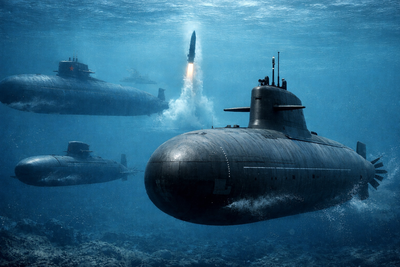

Arihant, Arighaat, Aridhaman: Inside India’s growing nuclear submarine triad against China, Pakistan

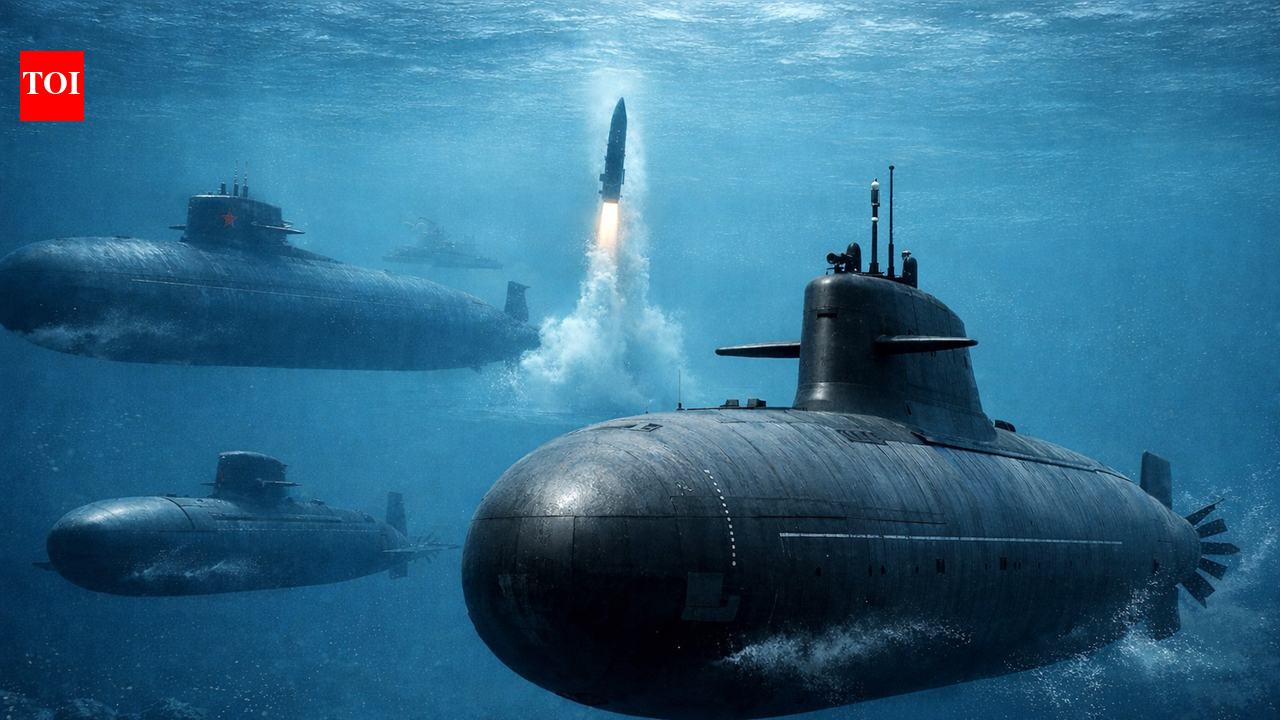
NEW DELHI: India’s underwater deterrence is set to enter a decisive new phase with the induction of INS Aridhaman, the third Arihant-class nuclear-powered ballistic missile submarine, by May 2026. Once INS Aridhaman joins INS Arihant and INS Arighat, India will operate three indigenously built SSBNs under the Strategic Forces Command.At a time when China is expanding its nuclear and conventional submarine footprint across the Indo-Pacific and Pakistan is inducting advanced Chinese-origin boats with air-independent propulsion, New Delhi’s strategic planners are steadily reinforcing the most secure and resilient leg of the nuclear triad — the sea. Larger, quieter and armed with longer-range K-4 submarine-launched ballistic missiles, Aridhaman strengthens India’s second-strike capability and moves it closer to continuous at-sea deterrence.

Inside the Indian Navy’s Future: Carriers, Submarines, Drones & Power Projection | Open Collar EP#3

With Aridhaman joining INS Arihant and INS Arighaat, India now operates three indigenously built SSBNs under the Strategic Forces Command. This marks not just an incremental addition to naval inventory but a structural shift in India’s strategic posture. As Beijing fields one of the world’s largest submarine fleets and Islamabad bolsters its underwater arsenal, India’s expanding SSBN force ensures credible minimum deterrence along with a devastating second-strike capability —stealthy, nuke-proof, and unstoppable — from the deepest depths of the Indian Ocean.

INS Arihant: The pioneer of India’s sea-based deterrence

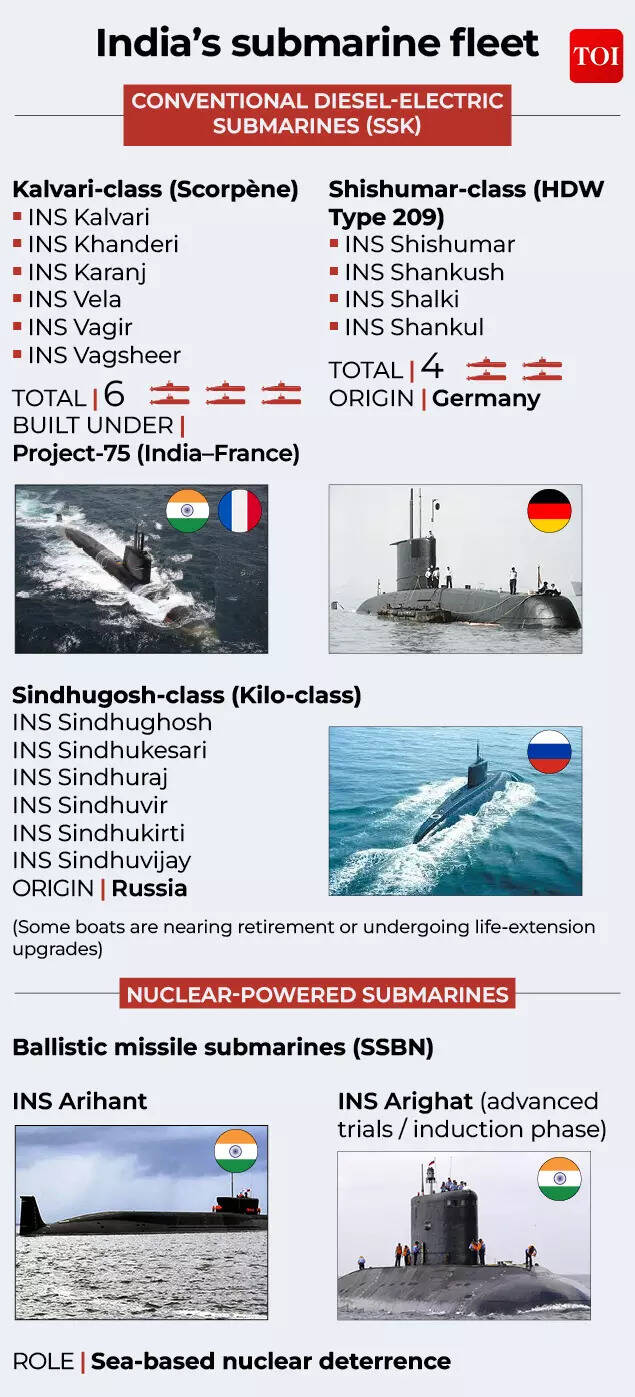
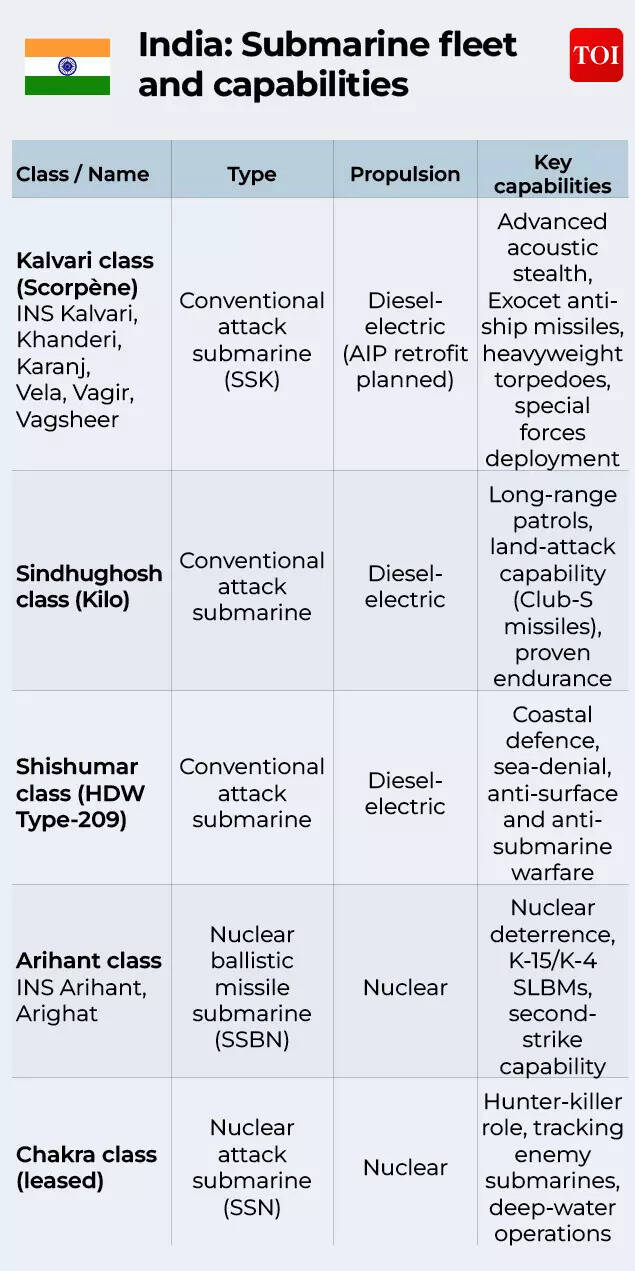
Commissioned in August 2016, INS Arihant was the culmination of decades of classified work under the Advanced Technology Vessel programme. Built at the Shipbuilding Centre in Visakhapatnam, Arihant displaced around 6,000 tonnes and was powered by an 83 MW Compact Light Water Reactor developed with significant indigenous input.Measuring roughly 111.6 metres in length, Arihant introduced India to the elite group of nations operating nuclear-powered ballistic missile submarines. Its propulsion allows virtually unlimited range, with endurance limited primarily by crew supplies. Capable of speeds of around 24 knots submerged, it is designed for extended stealth patrols in the Indian Ocean Region.In terms of armament, Arihant carries four vertical launch system tubes. These can be configured to deploy up to 12 K-15 Sagarika submarine-launched ballistic missiles with a range of approximately 750 km, or four K-4 missiles with a reach of around 3,500 km. It also features six 533 mm torpedo tubes for defensive and conventional strike roles.The most important milestone came in 2018, when Arihant completed its first deterrence patrol. That patrol marked the operationalisation of India’s sea-based nuclear deterrent, completing the triad alongside land-based missiles and air-delivered systems. For Indian planners, Arihant represented assured retaliation — the guarantee that even in the worst-case scenario, India would retain a secure response capability beneath the sea.

INS Arighaat: Strengthening and sustaining deterrence

Commissioned on 29 August 2024, INS Arighaat built upon the foundation laid by Arihant. While similar in baseline displacement at around 6,000 tonnes, Arighaat is considered a refined and improved iteration of the class.Constructed at the same Visakhapatnam facility, Arighaat underwent extended harbour and sea trials before induction. Its nuclear propulsion system remains based on the pressurised light water reactor design, enabling prolonged submerged operations with minimal acoustic signature.Arighaat retains four vertical launch tubes but is widely regarded as optimised for longer-range K-4 missile deployment. The K-4 significantly expands India’s maritime strike envelope, allowing strategic targets to be held at risk from deeper within the Indian Ocean, reinforcing India’s protected retaliatory capability.Like Arihant, Arighaat carries six torpedo tubes and incorporates indigenous sonar suites such as USHUS and Panchendriya for underwater detection and combat management. Improvements in onboard systems, quieting measures and operational protocols are believed to make it more capable during deterrence patrols.The induction of Arighaat was strategically important. A single SSBN cannot guarantee continuous deployment due to maintenance cycles and crew rest requirements. With two boats available, India moved closer to rotational deterrence patrols, ensuring greater availability of a secure and enduring second-strike platform.

INS Aridhaman: The 7,000-tonne evolution

INS Aridhaman represents the most advanced evolution of the Arihant-class to date. Weighing approximately 7,000 tonnes, it is significantly larger than its predecessors, allowing expanded missile capacity and system enhancements.One of its most consequential upgrades is the increase in vertical launch system tubes from four to eight. This expanded configuration enables Aridhaman to carry up to 24 K-15 missiles or eight K-4 intermediate-range ballistic missiles. Reports also suggest potential accommodation for future K-5 missiles with ranges extending to around 6,000 km.Aridhaman is powered by an upgraded 83 MW Compact Light Water Reactor designed for reduced acoustic signature. A seven-blade propeller, advanced sound-dampening measures and extensive use of anechoic tiles enhance stealth characteristics. Submerged speeds are estimated at around 24 knots, with surface speeds between 12 and 15 knots.The increase in displacement provides greater internal volume for improved command-and-control systems, crew habitability during long patrols and advanced combat systems integration. Sonar systems, including USHUS and Panchendriya, enhance underwater situational awareness, while improved quieting measures strengthen its stealth advantage against adversary anti-submarine warfare platforms.Strategically, Aridhaman is pivotal because it accelerates India’s transition toward Continuous At-Sea Deterrence. With three SSBNs, the navy can maintain at least one submarine on patrol at any given time, while others undergo maintenance or training cycles. This layered deployment model is central to India’s assured retaliatory posture.

The broader Indian Navy nuclear framework

India’s SSBN fleet operates under the Strategic Forces Command, which oversees nuclear assets. The sea-based leg is considered the most important component of the nuclear triad, as submarines operating silently beneath the ocean are far more difficult to detect and neutralise compared to fixed land-based systems.The submarines are expected to operate from Project Varsha, a high-security naval base near Visakhapatnam featuring underground pens designed to protect nuclear assets. The location provides strategic access to the Bay of Bengal and the wider Indian Ocean.India’s nuclear submarine ambitions extend beyond ballistic missile platforms. The navy is also set to induct Chakra III, a Russian Akula-class nuclear-powered attack submarine expected by 2027–28. Unlike SSBNs, attack submarines focus on anti-ship, anti-submarine and escort missions, complementing strategic deterrence assets.

Conventional submarine modernisation: Project-75I

Parallel to the SSBN expansion, India is pushing forward with Project-75I, a programme to build six next-generation diesel-electric submarines equipped with air-independent propulsion. These boats are intended to replace ageing conventional platforms and enhance sea denial capability.The project, valued at approximately $8 billion, is designed to boost indigenous manufacturing under the Strategic Partnership Model. The selected German Type-214 Next Generation submarine features fuel-cell-based air-independent propulsion, allowing extended submerged endurance without snorkelling.
Indian navy

.

Air-independent propulsion provides critical tactical advantages in contested waters, reducing detection risk and enabling covert surveillance and strike roles. Under the current plan, the submarines will be constructed at Mazagon Dock Shipbuilders Limited with technology transfer arrangements.Project-75I complements the SSBN fleet by strengthening conventional underwater capabilities, ensuring that India’s submarine arm can perform both strategic and tactical missions across the Indo-Pacific.
Indian navy

.

Towards continuous at-sea deterrence

Continuous At-Sea Deterrence requires more than one submarine. Maintenance, refuelling, crew training and refits create availability gaps. Three operational SSBNs allow staggered deployments, ensuring that at least one remains on patrol.Aridhaman’s expanded missile payload also increases strike flexibility. The ability to deploy longer-range K-4 missiles from safer patrol areas enhances operational depth and strategic reach. As missile ranges increase in future variants, patrol patterns may evolve further into secure ocean bastions.India’s pursuit of second-strike capability reflects a doctrine rooted in credible minimum deterrence. The objective is not numerical parity but guaranteed retaliation capability.

Comparison with China and Pakistan’s submarine fleets

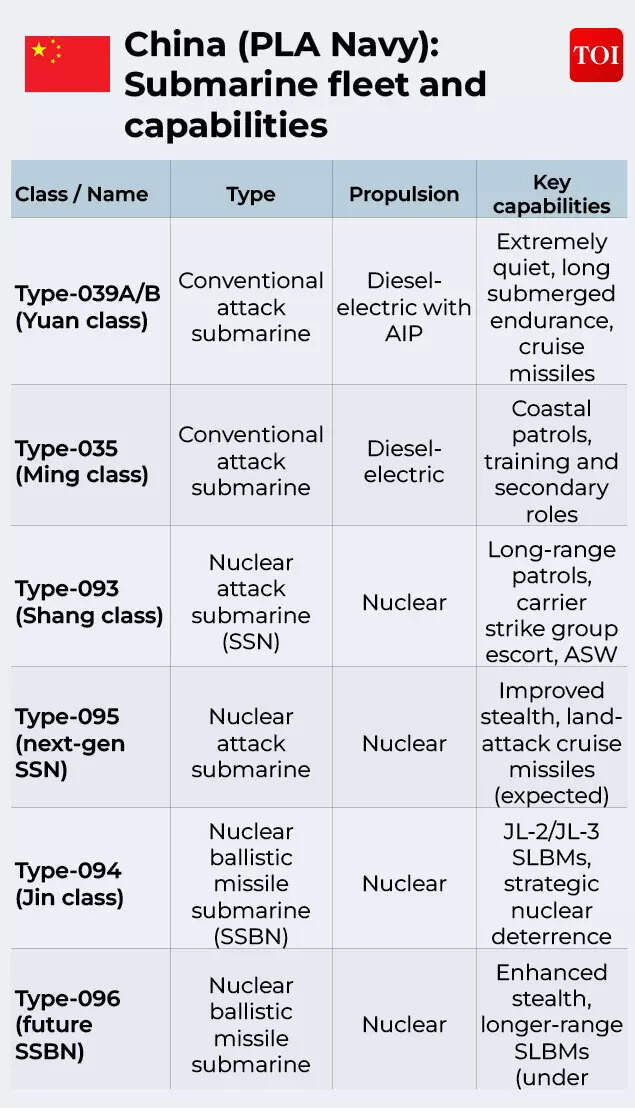
India’s expanding SSBN fleet must be viewed against the backdrop of rapid underwater modernisation by both China and Pakistan. While New Delhi has prioritised a credible sea-based nuclear deterrent anchored in three Arihant-class boats, Beijing and Islamabad are pursuing parallel — though structurally different — submarine strategies.China operates one of the world’s largest submarine forces under the People’s Liberation Army Navy. Open-source defence assessments estimate that China fields more than 50 diesel-electric submarines and around 10 nuclear-powered submarines, including both attack submarines (SSNs) and ballistic missile submarines (SSBNs). Its Jin-class SSBNs are armed with JL-series submarine-launched ballistic missiles, giving Beijing an established sea-based nuclear capability. Chinese nuclear submarines have increasingly deployed into the Indian Ocean, occasionally docking at regional ports, a development closely monitored by Indian naval planners.
China submarine fleet

..

Pakistan, though operating a much smaller fleet, is upgrading steadily with Chinese assistance. The Pakistan Navy currently relies on ageing Agosta-class submarines but is in the process of inducting eight Yuan-class diesel-electric submarines from China, many equipped with air-independent propulsion. While Pakistan does not yet operate nuclear-powered submarines, its conventional fleet — particularly with AIP — enhances underwater endurance and sea-denial capability in the Arabian Sea.
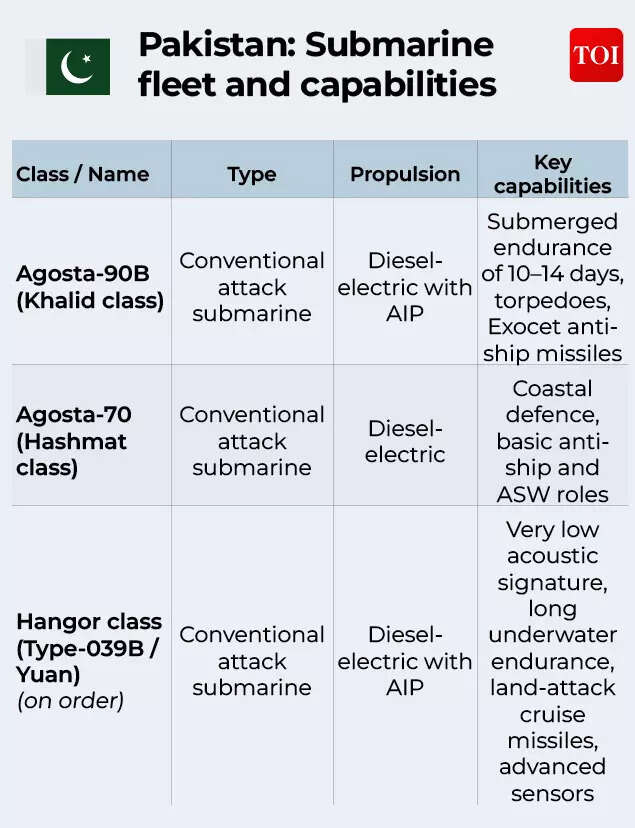
Pakistan Submarine fleet and capabilities

.

The strategic distinction lies in composition and doctrine. China maintains a full-spectrum submarine fleet spanning nuclear attack submarines, ballistic missile submarines and advanced conventional boats. Pakistan focuses on sea denial and coastal defence, aiming to counterbalance India’s conventional naval superiority. India’s approach sits between the two: a modest but growing SSBN fleet for strategic deterrence, complemented by conventional submarines under Project-75 and Project-75I, and future nuclear-powered attack submarines.Numerically, India trails China in total submarine count. However, its objective is not parity but credible deterrence within its maritime theatre. Against Pakistan, India retains an edge in nuclear-powered capability, as Islamabad lacks SSBNs or SSNs. The induction of INS Aridhaman and the planned arrival of Chakra III strengthen that qualitative advantage.In effect, India’s submarine modernisation is less about fleet size and more about stealth, endurance and strategic depth. As China expands its blue-water reach and Pakistan upgrades its conventional arm, India’s triad-backed SSBN force is intended to ensure that deterrence remains intact beneath the surface of the Indian Ocean.


Source link

Did Yunus try to ‘destabilise’ Dhaka? Bangladesh president alleges ‘conspiracy’ to remove him


Did Yunus try to 'destabilise' Dhaka? Bangladesh president alleges ‘conspiracy' to remove him

Bangladesh president Mohammed Shahabuddin has accused former chief adviser Muhammad Yunus of constitutional lapses and alleged attempts to destabilise the country and the presidency during the interim government period, according to The Daily Star.In the interview with Bangla daily Kaler Kantho, Shahabuddin said Yunus failed to maintain constitutionally mandated communication, including not briefing him after foreign visits.“The chief adviser did not follow any provision of the constitution. Whenever he went abroad, he was supposed to meet the president after returning and inform me in writing about the outcomes. He travelled abroad 14 to 15 times, but not once did he inform me. He never came to see me,” the president said.Shahabuddin said he was kept “completely in the dark” during the period and claimed that two of his planned visits, to Kosovo and Qatar, were blocked. Referring to the political climate, he added, “In that situation, I did not receive any phone call from Dr Yunus. He was neither in favour of me nor against me. Of course, I also did not make any request to him seeking help.”

Attempted removal

Alleging attempts to remove him after the 2024 mass uprising, the president said, “At one point, even a conspiracy was made to bring a former chief justice and seat him in my place through unconstitutional means,” adding that the judge declined, citing constitutional constraints.He described the October 22, 2024 protests outside Bangabhaban as a “terrifying night”, claiming mobs attempted to loot the presidential residence before the situation was brought under control with military deployment.Shahabuddin said the armed forces and leaders of the Bangladesh Nationalist Party (BNP) supported constitutional continuity. According to him, the three service chiefs told him: “You are the supreme commander of the armed forces. Your defeat means the defeat of the entire armed forces. We will prevent that at any cost.”

Pushed into isolation

The president further alleged that his office was deliberately isolated, including the withdrawal of the entire Bangabhaban press wing following a courtesy meeting with newly elected leaders of the Dhaka Reporters Unity.“Very shamelessly, three people, the press secretary, deputy press secretary and assistant press secretary, were withdrawn together,” he said, adding that two long-serving photographers were also removed. “We cannot even issue a simple press release congratulating the national cricket team when they win an international match,” he said, describing his office as “completely handicapped.”He also claimed that during the interim period, his photographs and messages were excluded from state supplements on national days, and that his portraits were removed from Bangladesh missions abroad.“That night, my photos were removed from almost all Bangladesh high commissions and consulates around the world. That incident was essentially an indication or the first step to remove me,” he said, adding that he later lodged a written protest with the foreign ministry.Despite what he termed “humiliating situations,” Shahabuddin said he remained firm to ensure constitutional continuity.


Source link

Why are gold prices rising? Finance minister Nirmala Sitharaman explains


Why are gold prices rising? Finance minister Nirmala Sitharaman explains

Union finance minister Nirmala Sitharaman on Monday explained the reason behind the rise in gold prices and assured that the government is closely monitoring the hikes. After the customary post-Budget meeting with the Central Board of Directors of the Reserve Bank of India, she said, “Most countries today, particularly their central banks, are buying gold and silver and storing them...Now the spike is largely due to central banks also buying and storing.” The FM further noted, “Gold has always been a favoured investment for households…The high-pitched demand for domestic consumption also sees a seasonal spike during festival season…We are watching it, but I’m not sure it has reached such alarming proportions. I think it has not gone beyond a certain limit. But of course, RBI will also be monitoring it.”Meanwhile, the yellow metal has continued to climb, mirroring global trends amid fresh tariff related concerns. Gold prices jumped Rs 2,946 to Rs 1,59,822 per 10 gram in Monday’s futures trade. On the Multi Commodity Exchange (MCX), April gold contracts rose by Rs 2,946, or 1.88%, to Rs 1,59,822 per 10 grams, with a business turnover of 7,515 lots. Internationally, gold futures on Comex gained $96.61, or 1.9%, to $5,177.51 per ounce.She also spoke on the India-US trade deal, saying the finance ministry is assessing the possible impact of the Supreme Court of the United States’s ruling that struck down Donald Trump’s tariff framework. “It is early to comment,” she said. The development followed a landmark verdict by the US Supreme Court, which struck down Trump’s emergency tariffs imposed under the International Emergency Economic Powers Act (IEEPA), declaring them illegal and reshaping the global tariff landscape. She also urged the nation to contribute to the country’s economic growth, “everybody should participate in India’s growth story.The post-Budget meeting was attended by Sitharaman, minister of state for finance Pankaj Chaudhary, and the RBI governor.


Source link

Earthquake Los Angeles: US: 3.5-magnitude earthquake strikes off Southern California coast near Rancho Palos Verdes


US: 3.5-magnitude earthquake strikes off Southern California coast near Rancho Palos Verdes
3.5-magnitude earthquake strikes off Southern California coast near Rancho Palos Verdes

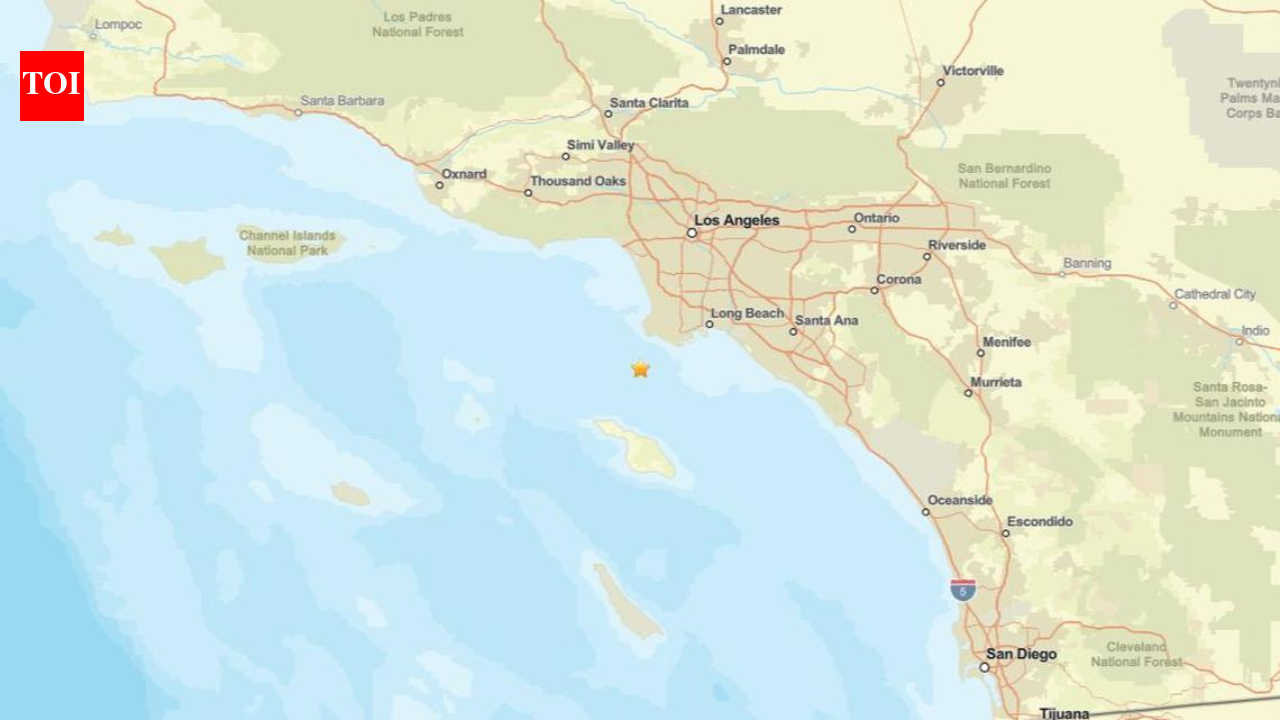
A late-night tremor rippled across parts of Southern California on Sunday after a 3.5-magnitude earthquake struck offshore near Rancho Palos Verdes. The quake was felt along stretches of the Los Angeles County coastline and into northern Orange County, though authorities reported no injuries or damage.According to the United States Geological Survey, the earthquake occurred at approximately 9:40 p.m. on 22 February. Its epicentre was located in the Pacific Ocean about 14 miles south south-west of Rancho Palos Verdes, positioned north of Catalina Island. The tremor originated at a depth of roughly 6.7 miles beneath the ocean floor, with the agency also reporting the depth as nearly seven miles.Initial reports through the USGS “Did You Feel It?” Programme indicated that by around 10:15 p.m., residents had submitted accounts of shaking from several areas. People reported feeling the quake along the Orange County coastline south of Huntington Beach, in Long Beach, and northwards into Inglewood and Los Angeles. Additional reports extended as far east as northern Orange County near Fullerton.Despite the wide area in which the tremor was noticed, no injuries or property damage have been reported. Emergency officials and local authorities continue to monitor conditions, but there are no immediate safety concerns linked to the seismic activity.The incident marks the third offshore earthquake affecting Southern California within a week. Earlier, a 3.0-magnitude quake was recorded 11 miles south-east of Port Hueneme in Ventura County. In a separate event, a 2.9-magnitude tremor struck four miles west of Malibu.


Source link

Teela jamalpura murder: Stabbed 24 times in 30 seconds: 2 minors storm snooker club, hack Class 10 boy; chilling video posted on Instagram | Bhopal News


Stabbed 24 times in 30 seconds: 2 minors storm snooker club, hack Class 10 boy; chilling video posted on Instagram
Two 16-year-old boys allegedly attacked another 16-year-old with a large knife at a pool club in Teela Jamalpura, inflicting over two dozen blows

BHOPAL: A video went viral on social media platforms on Monday showing two 16-year-old boys allegedly entering a pool club and attacking another 16-year-old boy with a large knife in Teela Jamalpura area. In the video, the accused were seen repeatedly stabbing the minor, reportedly inflicting more than two dozen blows in less than 30 seconds. The incident occurred around 9:15 pm on February 15 and is said to have stemmed from an old dispute. Teela Jamalpura Police Station has registered a case against the two minor accused and served them notices. Investigation officer Sub-Inspector Mahipal Singh said the complainant, a 16-year-old boy, a Class 10 student, is a resident of Gautam Nagar. He said that on the night of February 15, he had gone to watch a pool game on the first floor near Ganesh Chowk in Teela Jamalpura. While he was sitting there, the two accused arrived, abused him and allegedly threatened him, saying he was acting overly dominant in the pool game and that they would “teach him a lesson.When he objected to the abuse, the two allegedly assaulted him with fists and then attacked him with a sharp-edged weapon. The victim said he tried to defend himself with his left hand but sustained injuries to his left palm, fingers, below the elbow, as well as below the right elbow and on his back. He began bleeding profusely. Pool club employees Junaid and Arham intervened and separated them. Before leaving, the accused allegedly threatened to kill him if they saw him again at the pool club. The injured boy later informed his father, who took him to Hamidia Hospital for treatment. Due to severe injuries to his fingers and palm, he was admitted and underwent surgery. He was discharged on February 16 and subsequently approached the police station with his father to lodge a complaint. The video was reportedly shared by the accused itself on Instagram.SI Singh said a case was registered on February 16. As the accused are minors, they were served notices in the presence of their parents. He said the attack was a fallout of an old dispute between the accused and the injured boy. Prior to the incident, the injured minor had allegedly assaulted the accused. All three boys involved are 16 years old. Further investigations are on and more stringent sections can be included in the case.


Source link

‘He’s sweating now’: Activists hang ex-prince Andrew arrest photo inside France’s Louvre Museum


‘He’s sweating now’: Activists hang ex-prince Andrew arrest photo inside France's Louvre Museum
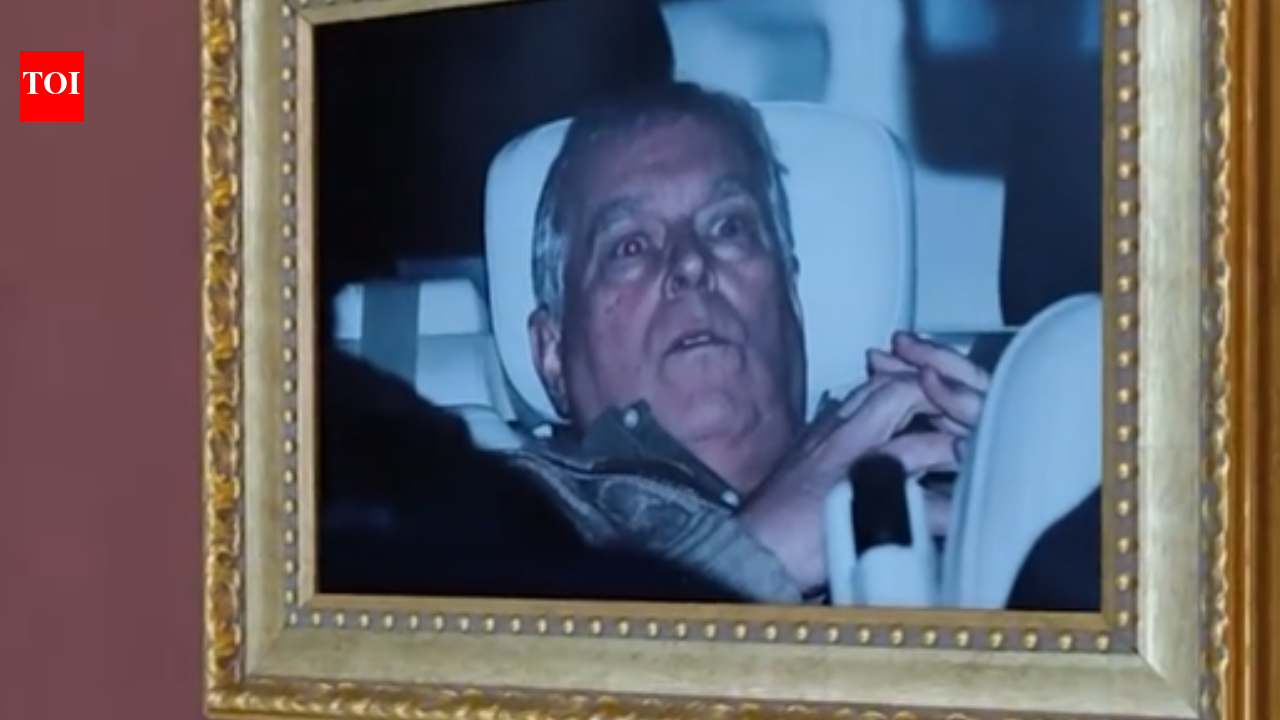
An anti-billionaire activist group called ‘Everyone Hates Elon’ has hung a photograph of former Prince Andrew on the day of his arrest in the Louvre museum. (Screenshot)

A British activist group staged a provocative stunt inside the Louvre Museum of France, hanging a framed image of ex-Prince Andrew — born Andrew Mountbatten-Windsor — following his arrest on suspicion of misconduct in public office.Andrew was arrested for 11 hours after the United States Department of Justice released additional files linked to disgraced financier Jeffrey Epstein. Andrew was detained Thursday, intensifying scrutiny over his long-running association with Epstein.The image, captured by Reuters photographer Phil Noble, shows Andrew seated in the back of a car, appearing to shield his face from view shortly after the arrest. Noble later told Reuters he was struck by the moment he captured. “I couldn’t believe I’d got him as well as I did,” he said, adding that he asked a colleague to confirm it was indeed Andrew in the frame.According to a report by stuff.co.nz, the UK-based anti-billionaire collective “Everyone Hates Elon” said it secretly installed the photograph inside the Paris museum with a caption reading: “He’s Sweating Now.”The phrase references Andrew’s widely criticised 2019 interview on Nightline, in which he addressed allegations made by Virginia Giuffre. Giuffre had claimed Andrew was “profusely sweating” during an encounter at a London nightclub in 2001.In the interview, Andrew had responded: “There’s a slight problem with the sweating because I have a peculiar medical condition which is that I don’t sweat or I didn’t sweat at the time.”Sharing footage of the museum stunt online, the group wrote: “They say ‘hang it in the Louvre’. So we did.”


Source link

El Mencho Death: Who was ‘El Mencho’ and what’s next for Mexico’s fastest-growing cartel?


Who was 'El Mencho' and what's next for Mexico's fastest-growing cartel?

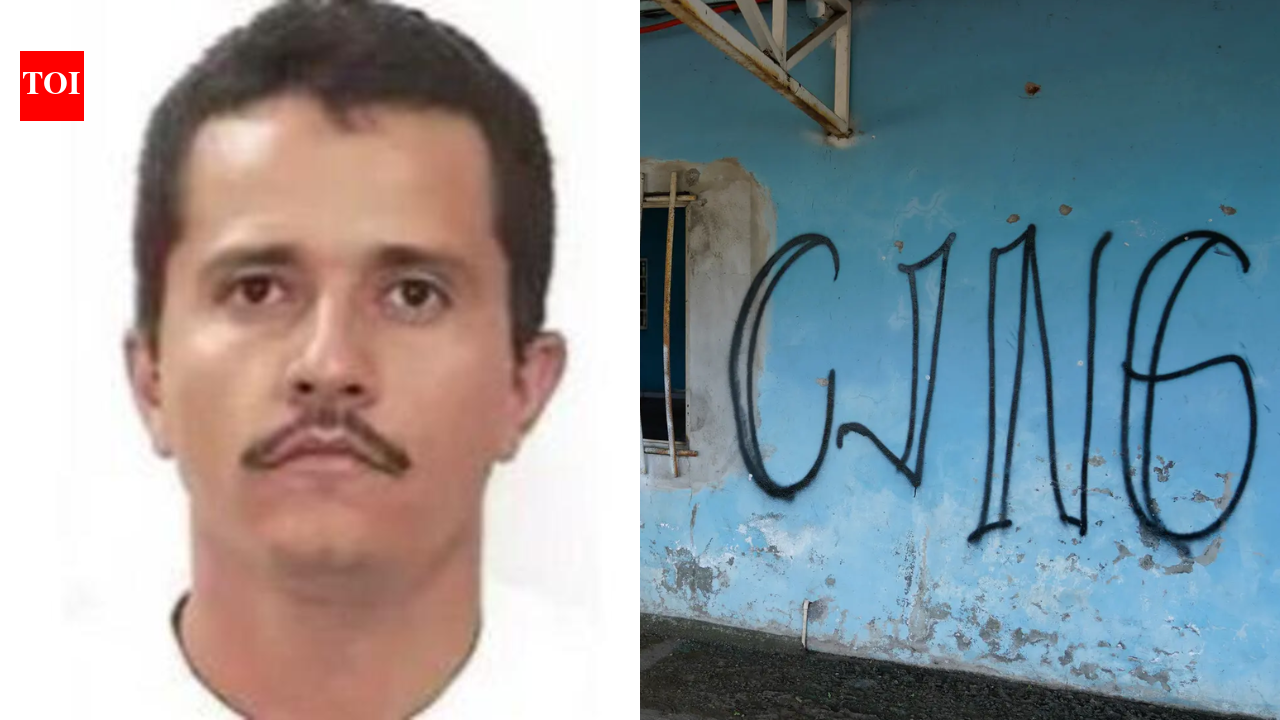
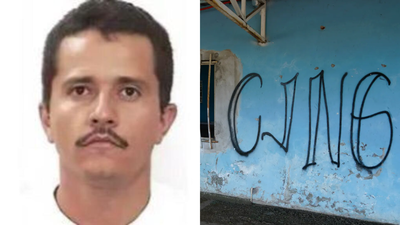
The most-wanted cartel boss in Mexico, Nemesio Oseguera Cervantes known as El Mencho, was killed Sunday after a government operation to capture him. The longtime leader of the Jalisco New Generation Cartel died from injuries during a mission in Tapalpa, a town of about 20,000 in the western coastal state of Jalisco where his gang was based. He passed away while in transport to Mexico City for medical attention. His death incited violence across the country, with armed groups blocking roads and setting fire to supermarkets, banks, and vehicles in one of the most widespread eruptions of turmoil in recent history.The killing set off swift violence, with Jalisco suspending public transportation and warning hotels to keep guests inside, and Nayarit canceling classes Monday.Follow Mexico El Mencho News Live UpdatesOseguera Cervantes, better known as “El Mencho,” was a former police officer and Mexico’s most wanted man. The 59-year-old from Michoacan had ties to organized crime for at least three decades. In 1994, he was tried for trafficking heroin in the US and served three years in prison. Back in Mexico, he rose quickly through the drug underworld. Around 2009, he founded the Jalisco New Generation Cartel, which became Mexico’s fastest-growing criminal organisation. It moved cocaine, methamphetamines, fentanyl, and migrants to the United States.Oseguera faced multiple US indictments, with a $15 million reward for his arrest. The Trump administration designated his cartel and others foreign terrorist organisations a year ago. El Mencho led the cartel for years, controlling everything like a country’s dictator, as one observer noted.Also read | Cartel goes on revenge spree after El Mencho killed — what’s happening in Mexico?

What is the Jalisco New Generation Cartel?

A breakaway gang that split from Mexico’s powerful Sinaloa Cartel around 2009 or 2010, the Jalisco New Generation Cartel, or CJNG, grew to become one of Mexico’s dominant drug trafficking organizations and the strongest, most aggressive competitor to Sinaloa. It expanded rapidly across Mexico, with a presence in at least 21 of 32 states and activity in almost all US states, plus global reach. Based mainly in the west, including the Tierra Caliente region, strongholds in Jalisco, Nayarit, and Colima, its assets exceed $20 billion.Made up of 15,000 to 20,000 members, it takes in billions annually from drug trafficking, extortion, fuel theft, kidnapping, illegal logging, mining, and migrant smuggling. It’s a main distributor of synthetic drugs like cocaine, methamphetamine, and fentanyl on the continent, with key roles in US, Europe, and Asia markets. The cartel innovates in violence using drones and improvised explosive devices. It remains the most aggressive in Mexico, per Stratfor, fueling violence in Tijuana, Juarez, Guanajuato, and Mexico City. Attacks include downing an army helicopter with a rocket-propelled grenade, killing dozens of state officials, hanging victims’ bodies from bridges, public executions publicized on social media, and assassinations of politicians, judges, and law enforcement. Its efforts to expand control drive persistent violence.The group recruited aggressively online and earned a reputation for brazen attacks on security forces, including downing a military helicopter in Jalisco in 2015 and attempting to assassinate Mexico City Police Chief Omar García Harfuch, now Mexico’s federal security secretary.

What’s next?

Under President Claudia Sheinbaum, Mexico launched its most aggressive offensive against cartels in over a decade. El Mencho’s death could ease pressure from US President Donald Trump, who threatened strikes.Turmoil’s spread depends on succession. It’s unclear who will succeed Oseguera or if anyone can hold the 21-state, global organisation together. His absence could slow growth and weaken it against Sinaloa, which faces its own struggles between El Chapo’s sons and Ismael “El Mayo” Zambada’s faction in US custody.If relatives take control, Sunday’s violence could continue, per security analyst David Saucedo. Others might turn the page. The greatest fear is indiscriminate narcoterrorism like Colombia’s 1990s—car bombs, assassinations, and aircraft attacks against the government. Without clear succession, fragmentation could spark new bloodshed, according to Brookings expert Vanda Felbab-Brown, as reported by the New York Times.


Source link

‘Without Mamata di …’: Mani Shankar Aiyar’s advise to Rahul Gandhi on INDIA bloc leadership | India News


'Without Mamata di …': Mani Shankar Aiyar's advise to Rahul Gandhi on INDIA bloc leadership

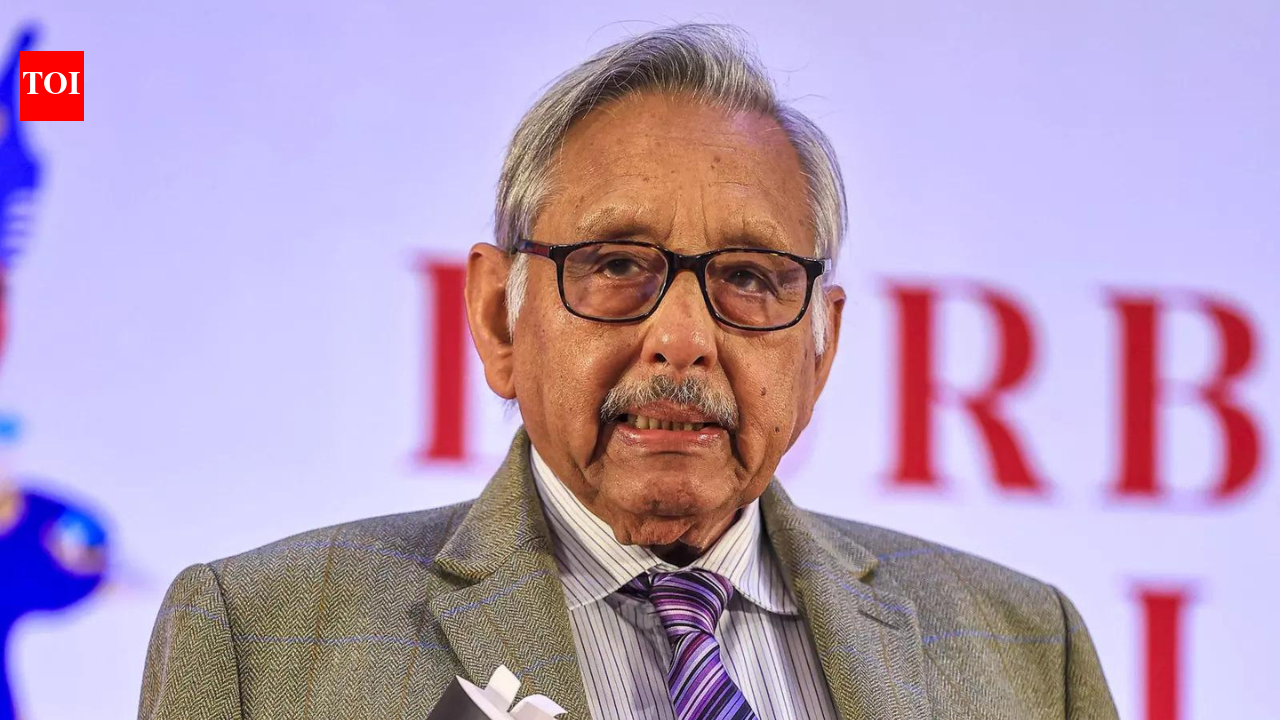
NEW DELHI: Days after publicly hoping for Pinarayi Vijayan’s victory in the upcoming Kerala elections, veteran Congress leader Mani Shankar Aiyar claimed West Bengal chief minister Mamata Banerjee is central to the survival of the opposition INDIA bloc.While talking to news agency IANS, Aiyar suggested that Congress leader Rahul Gandhi should allow leaders of smaller parties to steer the INDIA bloc.“Without Mamata di, the ‘I’, ‘N’, ‘D’, ‘I’, ‘A’ of the INDIA alliance will all be gone. Because Mamata Banerjee is the leader of this alliance,” Aiyar said.“I hope that instead of trying to remain in this position, which belongs to smaller parties — be it MK Stalin, Mamata Didi, Akhilesh Yadav, Tejashwi Yadav, or someone else — Rahul Gandhi should let them handle it,” he added.Recalling his early political association with Mamata Banerjee, Aiyar said he briefly joined the Trinamool Congress in 1997 and served as its first National Secretary but left within weeks, concluding that the party was rooted in Bengali identity.Responding to whether he is still in Congress, Aiyar said he still considers himself in the party but suggested possible disciplinary action against him.“I consider myself to be in Congress, but it seems they may have decided to expel me. However, I have not received any formal letter,” Aiyar said.He added that although reports suggested he had been expelled, he had received no official communication.“If you want the Congress’ view, ask a Congressman,” Aiyar remarked, while also saying that he believed many within the Congress support Mamata Banerjee.Earlier, Aiyar praised the Left Democratic Front (LDF) government in Kerala, led by chief minister Pinarayi Vijayan.Things escalated rapidly when Aiyar, speaking to ANI, dismissed the authority of the current Congress leadership and declared: “I am a Gandhian, I am a Nehruvian, I am a Rajivian, but I am not a Rahulian.”Invoking BR Ambedkar’s description of dissent as being “a part but apart,” Aiyar positioned himself as an ideological insider with the right to rebel. The tone, however, soon turned confrontational.Targeting Congress spokesperson **Pawan Khera**, Aiyar said: “I have absolutely no respect and complete contempt for Pawan Khera… He is not a spokesperson, he is a parrot.”Within hours, Congress distanced itself from the remarks and publicly severed any association with Aiyar.Khera issued a statement on X distancing the party from Aiyar’s comments: “Mr Mani Shankar Aiyar has had no connection whatsoever with the Congress for the past few years. He speaks and writes purely in his personal capacity.”


Source link

18 dead, several injured in Nepal after passenger bus plunges into river in Dhading


18 dead, several injured in Nepal after passenger bus plunges into river in Dhading

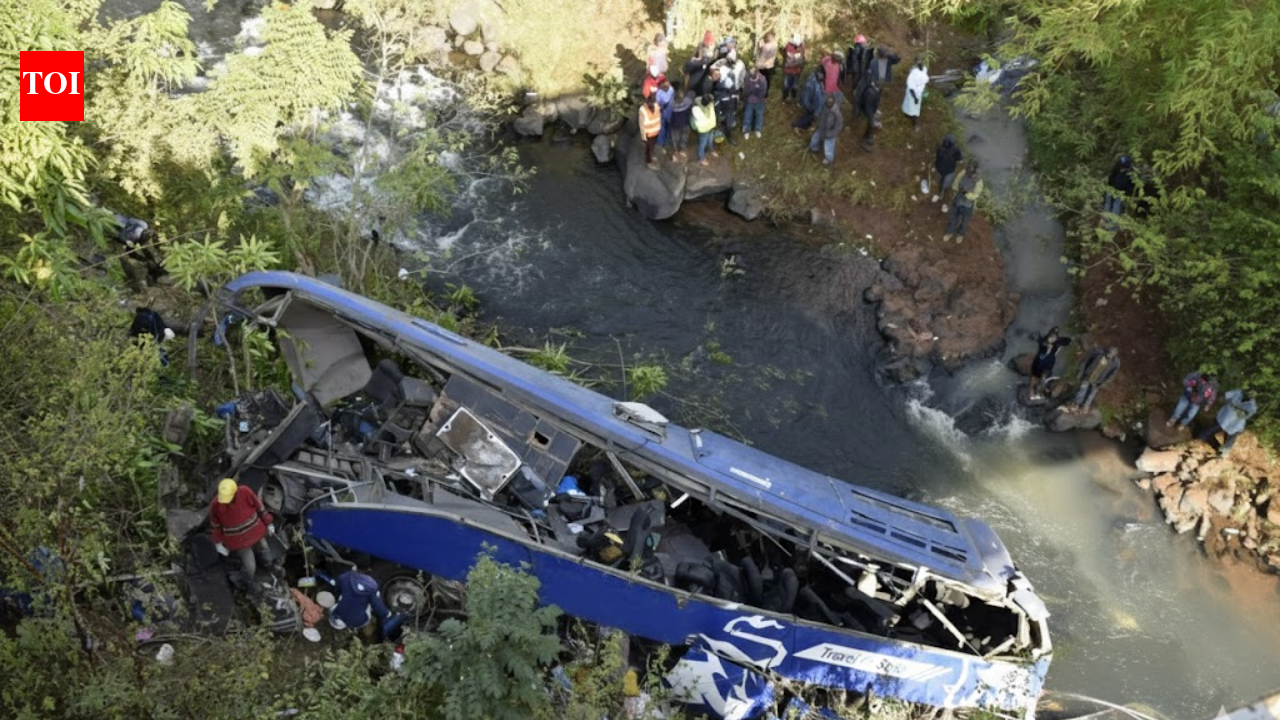
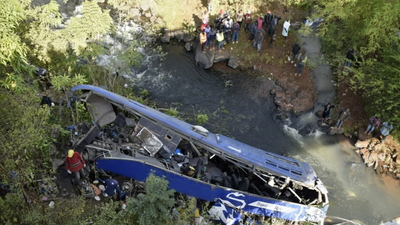
At least 18 people died and more than two dozen others were injured after a passenger bus travelling from Pokhara to Kathmandu plunged into the Trishuli River in Nepal’s Dhading district early Monday. The bus, carrying more than 35 passengers, fell into the river near Gajuri along the Prithvi Highway, about 90 km west of Kathmandu, at around 1.15–1.30 am. The crash site is at Chinadhara near Charaundi in ward 3 of Benighat Rorang Rural Municipality. Chief of the District Traffic Police Office, Dhading, Shishir Thapa said the death toll has reached 18, reported the Kathmandu Post. Bishnu Prasad Bhatta, spokesperson at the Armed Police Force, said 17 bodies have been recovered from the accident site and 28 injured passengers were pulled out of the bus. Rajkumar Thakuri, chair of the Highway Rescue Management Committee, said the injured passengers have been sent to different hospitals for treatment. Personnel from the Nepal Army, Armed Police Force, Nepal Police and local residents are involved in the rescue operation. Authorities said the nighttime incident has made rescue efforts difficult. Among those killed was a male passenger from New Zealand. A Japanese woman and a Dutch woman were among those injured in the incident. Police said the exact cause of the crash has not yet been determined, but overspeeding is suspected to have led to the accident. Further details are awaited.


Source link

BAFTA 2026’s biggest quotes and moments: From Alan Cumming’s humour to Jessie Buckley’s heartfelt speech | English Movie News


BAFTA 2026’s biggest quotes and moments: From Alan Cumming's humour to Jessie Buckley's heartfelt speech

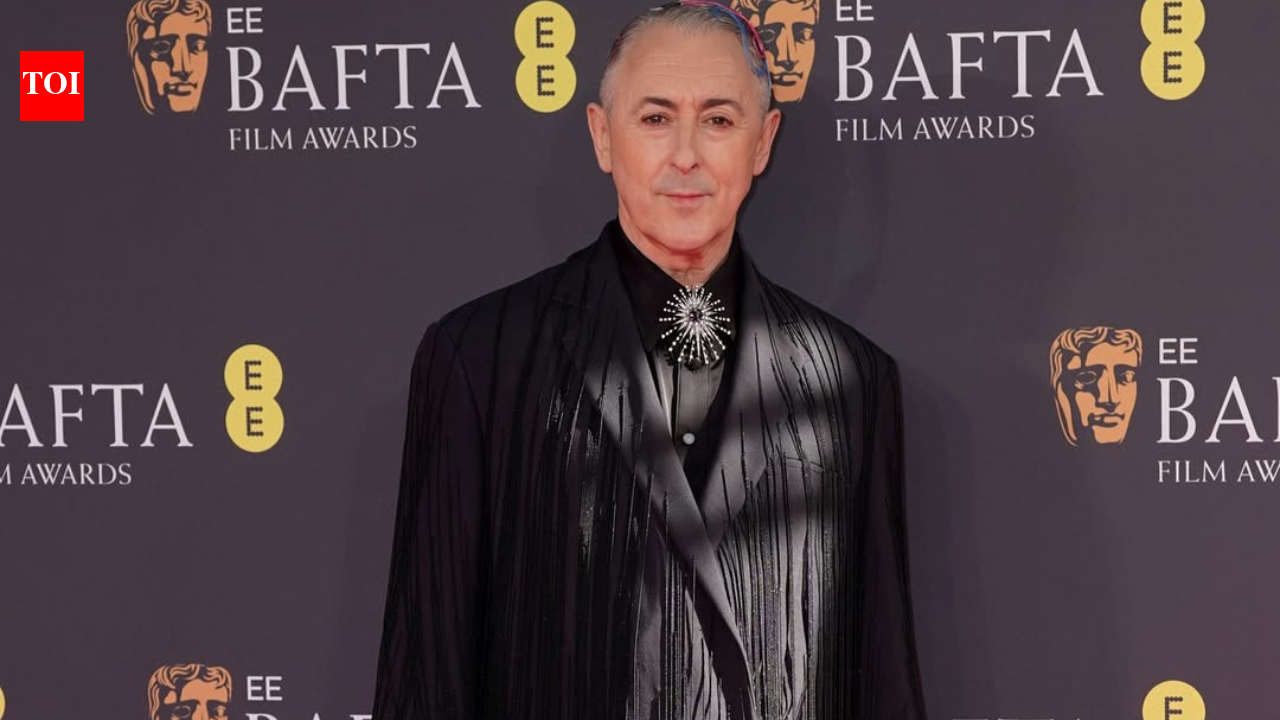
The 2026 BAFTA Film Awards at London’s Royal Festival Hall delivered unforgettable moments through sharp wit and emotional depth. Host Alan Cumming set a lively tone while winners shared profound gratitude. The night celebrated films like’ One Battle After Another’ and ‘Sinners’ with global stars.

Alan Cumming

Alan Cumming kicked off with humor targeting real-world echoes in cinema. “Are you familiar with the storyline of ‘Zootropolis 2’? Deceitful leaders, oppression, and persecution of a race. Isn’t it a bit too soon, Disney? It feels like current events are influencing filmmakers. Does this resonate with you, particularly those in America?” he quipped about the animation winner during his opening monologue. He also bantered with Kylie Jenner, asking, “Hey Kylie, have you ever had a giant Jammie Dodger?” while offering snacks on stage.

Robert Aramayo’s winning speech

Robert Aramayo won Best Leading Actor for ‘I Swear’ and expressed sheer disbelief. “I can hardly believe it; I can’t fathom that I’m standing here among individuals like you, let alone that I have received this accolade. Honestly, it doesn’t seem real to me. The talent in this category leaves me in awe,” Robert Aramayo remarked as he accepted the leading actor award. He namechecked mentor Ethan Hawke, saying, “When I was at Juilliard, Ethan Hawke came to speak to us, delivering an incredible talk on longevity in acting and the importance of safeguarding your craft while avoiding self-destructive habits. To be in this category with you tonight is truly remarkable. Thank you, Ethan,” Robert Aramayo stated while receiving the best leading actor award for ‘I Swear’.

Joachim Trier makes history

Joachim Trier’s ‘Sentimental Value’ became the First Norwegian Film winning Bafta for Best Non-English Language Film. “It’s the first time a Norwegian film has won this BAFTA. We are usually better at skiing,” he said while receiving the award. Norwegian director Joachim Trier etched his name in BAFTA history as Sentimental Value became the first film from his country to win Best Film Not in the English Language.

Wunmi Mosaku’s heartfelt gratitude

Wunmi Mosaku triumphed in Best Supporting Actress for ‘Sinners’ with a family tribute invoking Aesop. “To my daughter, you are my greatest mentor… To my mum, dads, sisters, niece, and nephews, I cherish you all. Mum, thank you for your sacrifices… Like Aesop’s fable The Sun and the Wind, you radiated love and granted me the freedom to make my own choices and to dream big,” Wunmi Mosaku shared as she accepted the best supporting actress award for Sinners. Adding to this, Ryan Coogler, while winning the Best Original Screenplay prize for ‘Sinners’ said, “Look at that blank page, think of who you love, think of someone you see in pain and help them feel better. Let that love inspire your work. I will always be grateful for this, thank you all,”

Another heart-to-heart from Akinola Davies Jr.

Akinola Davies Jr. used his Outstanding British Film win to advocate. “I am grateful to the jury for this recognition and what it signifies the children the dias. To those whose families moved for a better life, to those enduring oppression, dictatorship, and genocide: you are important For Nigeria for London the Congo for Sudan. Free Palestine, thank you,” Akinola Davies Jr stated while winning BAFTA for outstanding by a writer, director, or producer.

Jessie Buckley’s special nod to her daughter

Jessie Buckley won Best Leading Actress for ‘Hamnet’ and honored her daughter. “I share this award with my daughter, who has been by my side since she was six weeks old on this journey. Being your mother is the most fulfilling role I have ever had, and I promise to continue to be rebellious so you can embrace the world in all your wildness as a young woman,” Jessie Buckley expressed as she accepted the best leading actress award for Hamnet.

Royal reflections backstage

BAFTA president Prince William commented backstage on the nominees. He described ‘Sinners’ as “a bit dark,” ‘One Battle After Another’ as “weird,” and ‘F1’ as “fantastic… primarily due to the music.” These quotes captured the night’s blend of humor, heart, and cinema’s power.


Source link