Breaking News
Sergey Brin: Google cofounder Sergey Brin to employees at town hall: This year a big role will be played by … |


Google cofounder Sergey Brin to employees at town hall: This year a big role will be played by ...

Google employees have been buzzing about a new internal tool called Agent Smith, named after the antagonist in The Matrix. The tool is created to automate various tasks such as coding, run asynchronously in the background, and even be accessed via mobile phones. According to a report by Business Insider, the tool became so popular within the organisation that Google had to restrict access in order to manage demand. Designed on Google’s existing agentic coding platform Antigravity, Agent Smith interacts with various internal tools and can autonomously plan and execute workflows. Unlike earlier assistants, it can pull up documents linked to employee profiles and be used directly from Google’s internal chat platform.

Google cofounder Sergey Brin’s message to employees

As per the BI reports, at a recent town hall with sales employees, Google cofounder Sergey Brin also stressed on the fact that AI agents will be a major focus for Google in 2026. Brin, who returned to hands-on work at Google in 2023, said agents represent the next big leap in productivity. Along with this, he also hinted at tools similar to “OpenClaw,” though it’s unclear if he was referring to Agent Smith or another project.In the same meeting, Google’s business chief Philipp Schindler also joked that he could tell when Brin’s agent was responding to messages on his behalf underscoring how deeply these tools are already being integrated into workflows.

AI adoption becoming mandatory at Google

Google’s leadership, including CEO Sundar Pichai, has been pressing employees to adopt AI tools across technical and non-technical roles. In some cases, usage of AI is now factored into performance reviews. Engineers were told last year that AI adoption was expected, and more recently, non-technical staff have been given the same directive.Beyond top-down mandates, employees themselves are experimenting with initiatives like Project EAT, aimed at standardizing AI adoption across Google’s infrastructure teams.The comments made by Brin highlight the boarder industry trend as Meta CEO Mark Zuckerberg is also reportedly building his own AI agent to help run the company, while other tech giants are racing to embed agentic AI into daily operations.




Source link

Delhi Police nab Lashkar-e-Taiba commander Shabbir Ahmed Lone near Bangladesh border | Delhi News


Delhi Police nab Lashkar-e-Taiba commander Shabbir Ahmed Lone near Bangladesh border
Shabbir Ahmed Lone (File photo)

NEW DELHI: Delhi Police special cell has arrested Lashkar-e-Taiba commander Shabbir Ahmed Lone from near Bangladesh border, sources said. Lone was running a Lashkar cell from his hideout near Dhaka. The operation, monitored closely by police commissioner Satish Golcha, was the result of a cat-and-mouse chase of two months. A special team led by additional CP Pramod Kushwaha, ACP Lalit Negi and inspector Sunil Rajain had been tracking Lone after his role emerged in recruitment of youths for terrorist activities in Delhi, Kolkata and Tamil Nadu. Lone was earlier arrested by Delhi Police on terror charges in 2007. He fled to Bangladesh after getting bail in 2019 and had become a headache for the security agencies and Delhi’s ATS after it emerged that he had set up a terror cell in that country.

-

However, he is not the only terror kingpin with Delhi links who the agencies are after. Besides Lone, the agencies are now aggressively trying to locate Sheikh Sajjad Gul who was arrested from Nizamuddin station in Delhi in 2002 and was lodged in Tihar for over a decade after being convicted in 2003. He was sentenced to 10 years before being released in 2017. Gul also fled to Pakistan around the same time and is now at the helm of Lashkar’s new face, The Resistance Front (TRF), which has been behind several terror strikes including the Pahalgam attack.


Source link

Stock market crash today (March 30, 2026): Nifty50 opens below 22,500; BSE Sensex down over 1,100 points on rising oil prices, US-Iran war


Stock market crash today (March 30, 2026): Nifty50 opens below 22,500; BSE Sensex down over 1,100 points on rising oil prices, US-Iran war
Stock market today (AI image)

Stock market crash today: Nifty50 and BSE Sensex plunged in opening trade on Monday. Nifty50 opened the trading day below 22,500 and BSE Sensex dropped over 1,100 points. At 9:16 AM, Nifty50 was trading at 22,488.20, down 331 points or 1.45%. BSE Sensex was at 72,477.66, down 1,106 points or 1.50%.Dr. VK Vijayakumar, Chief Investment Strategist, Geojit Investments Limited says, “With the conflict in West Asia entering the fifth week, there are signs of escalation of the war with the Houthi’s joining the conflict and the US sending additional troops to reinforce the attack. Brent crude has again shot up to $116. The Goldilocks macro scenario which India had before the war has almost disappeared thanks to the war. Instead of high GDP growth, low inflation, moderate fiscal and current account deficits and expectations of higher corporate earnings growth in FY27, now we face prospects of lower GDP growth, higher inflation, higher fiscal and current account deficits and lower earnings growth for FY27.”The market has largely discounted these negatives as reflected in the decline in the Nifty trailing PE ratio to about 19.9 times. This is fair but not yet cheap valuations. But there are segments which are attractively valued like financials. A significant development today is likely to be strengthening of the rupee in response to the RBI directive capping the net open position (NOP- INR) in the offshore deliverable market at $100 million. Unwinding of large dollar positions will strengthen the rupee in the near-term.”US markets witnessed a sharp selloff last week. All three major indices closed at their lowest levels in more than seven months on Friday, and the Dow officially entered correction territory as the ongoing conflict in the Middle East dampened investor sentiment.Asian equities came under pressure while crude oil prices moved higher amid escalating tensions, with Iran-backed Houthi forces joining the conflict and an expanded US military presence raising fears of a prolonged standoff.Foreign institutional investors remained net sellers, offloading shares worth Rs 4,367.30 crore on Friday. In contrast, domestic institutional investors provided some support by purchasing equities worth Rs 3,566.15 crore.(Disclaimer: Recommendations and views on the stock market, other asset classes or personal finance management tips given by experts are their own. These opinions do not represent the views of The Times of India)


Source link

Top stocks to buy: Stock recommendations for March 30, 2026 week – check list


Top stocks to buy: Stock recommendations for March 30, 2026 week - check list
Top stocks to buy (AI image)

Stock market recommendations: Ipca Laboratories, and AU Small Finance Bank are the stocks that Motilal Oswal Wealth Management Research Desk recommends buying for the week starting March 30, 2026. Target prices and potential upsides are listed below:

Stock Name CMP (Rs) Target (Rs) Upside (%)
Ipca Laboratories 1595 1820 14%
AU Bank 883 1250 42%

Ipca LaboratoriesIpca Laboratories is witnessing improving growth visibility driven by a recovery in its domestic formulations business and a gradual pickup in exports. The company is strengthening its domestic portfolio through therapy expansion in cardiology, pain management, and entry into high-end dermatology, while reinforcing key brands like Zerodol. Export growth is supported by increasing traction in branded markets and a steady ramp-up in generics, aided by product relaunches in the United States and participation in European tenders. The integration of the Unichem business is progressing, with focus on improving cost efficiencies through API integration and rebuilding the product pipeline, although near-term performance remains impacted by pricing pressure. Overall, improving operating leverage, portfolio optimization, and better execution across segments position the company for steady earnings growth.AU Small Finance BankAU Small Finance Bank’s transition from a SFB to a universal bank expands its addressable market across retail, MSME, and mid-corporate lending, while lower priority sector requirements and broader product capabilities improve portfolio flexibility, cross-selling opportunities, & long-term return potential. A granular deposit base, improving CASA mix, and expanding network of 2,700+ touchpoints support liability growth and operating leverage. The secured-heavy loan portfolio and disciplined underwriting are expected to keep credit costs contained, supporting sustainable long-term profitability. Loans are expected to grow at ~24% CAGR over FY26-28, driven by a strong branch-led distribution network and expansion across secured lending segments. This, along with moderating funding costs and stable asset quality, is likely to drive ~36% earnings CAGR over FY26-28.(Disclaimer: Recommendations and views on the stock market, other asset classes or personal finance management tips given by experts are their own. These opinions do not represent the views of The Times of India)


Source link

Oil prices today: Crude jumps as Houthis enter Iran war; US boosts troop presence in Middle East


Oil prices today: Crude jumps as Houthis enter Iran war; US boosts troop presence in Middle East

Oil prices surged sharply on Monday, with Brent crude crossing the $110 mark and West Texas Intermediate (WTI) climbing past $100 a barrel, as the Middle East conflict completed its one month. Markets remained on edge as Houthis enter the Iran war and US plans to extend onground presence in the region, further fueling uncertainty over the trajectory of the war.Around 7 am IST, Brent Crude stood at $116.4 per barrel, up 3.84 or 3.41%, after gaining over 4% in its previous session on Friday. WTI Crude followed the rally, jumping to $103.1, up 3.44 or 3.45%, after recording a gain of 5.5% last week. So far this month, Brent has climbed 59%, marking its steepest monthly rise and exceeding gains seen during the 1990 Gulf War. The surge comes after Iran tightened its noose on the Strait of Hormuz effectively disrupting the strategically crucial route that sees around one-fifth of global oil and gas supplies pass.The conflict, which began on February 28 with US and Israeli strikes on Iran, has expanded across the Middle East. Over the weekend, Yemen’s Iran-aligned Houthis carried out their first attacks on Israel since the start of the war, raising further concern over key shipping lanes in the Arabian Peninsula and the Red Sea. The US also stepped up its military footprint in the Middle East, with around 3,500 Marines and sailors aboard the USS Tripoli deployed to the region. The move, described as potentially the largest US buildup there in nearly two decades, was confirmed by US Central Command. It comes after almost a month of conflict involving Iran and is being viewed as part of Washington’s effort to expand its operational options in the region.Meanwhile, according to data from Kpler, cited by Reuters, Saudi crude exports redirected from the Strait of Hormuz to the Yanbu port in the Red Sea reached 4.658 million barrels per day last week.JP Morgan analysts said that if exports from Yanbu were disrupted, Saudi oil flows could be forced to shift towards Egypt’s Suez-Mediterranean (SUMED) pipeline to the Mediterranean.Tensions in the region intensified further over the weekend after attacks damaged Oman’s Salalah terminal, despite ongoing attempts to advance ceasefire discussions.Iran has said it is prepared to respond to a US ground offensive, accusing Washington of planning a land attack while simultaneously pursuing negotiations.Meanwhile, Pakistan’s foreign minister Ishaq Dar said that efforts had been discussed on possible ways to achieve an early and lasting end to the conflict, along with potential US-Iran talks in Islamabad.


Source link

Indian worker killed in Iranian attack on Kuwait power, desalination plants


Indian worker killed in Iranian attack on Kuwait power, desalination plants

An Iranian strike on a power facility in Kuwait killed an Indian worker and caused damage to infrastructure at the site, the Gulf nation’s electricity ministry said on Monday.“A service building at a power and water desalination plant was attacked as part of the Iranian aggression against the State of Kuwait, resulting in the death of an Indian worker and significant material damage to the building,” ministry spokesperson Fatima Abbas Jawhar Hayat said.The wider conflict in the Gulf has intensified, with airstrikes knocking out electricity in parts of Tehran and nearby areas on Sunday. The disruption came as a senior Iranian official accused the US of preparing for a ground invasion while continuing to signal openness to negotiations.Amid rising tensions, Pakistan said it was willing to facilitate and host “meaningful talks” between Washington and Tehran in an effort to end the month-long US-Israel war with Iran.In Israel, lawmakers were set to vote overnight on the 2026 budget, which includes a sharp increase in defence spending. The proposal would raise the military budget by more than $10 billion, taking it beyond $45 billion.Israel, which has been engaged in conflict with Iran alongside the US since February 28, is also continuing operations against Iran-backed Hezbollah in southern Lebanon.Iran’s energy ministry reported outages across the capital, surrounding regions and Alborz province, attributing the disruptions to strikes on electricity infrastructure. Authorities said efforts were underway to restore supply.US President Donald Trump has previously warned that Iranian power stations could be targeted if Tehran refuses to agree to a peace deal, even as deadlines for negotiations have been repeatedly extended.Iranian parliamentary speaker Mohammad Bagher Ghalibaf on Sunday warned that any US ground operation would be met with force, following the arrival of a US warship carrying an additional 3,500 troops to the region.“The enemy publicly sends messages of negotiation and dialogue while secretly planning a ground attack,” Ghalibaf said in a statement carried by the official IRNA news agency.“Our men are waiting for the arrival of the American soldiers on the ground to set them on fire and punish their regional allies once and for all,” he added.The conflict has now widened into a broader regional crisis. Iran has launched attacks on Gulf states and moved to shut down the Strait of Hormuz, a key global oil transit route. The disruption has sent energy markets into turmoil and raised concerns over the global economic outlook.Ghalibaf urged national unity, describing the conflict as being “at its most critical stage.”


Source link

Govt eyes flexible-fuel vehicles’ faster rollout


Govt eyes flexible-fuel vehicles’ faster rollout

NEW DELHI: The ongoing West Asia conflict and concerns over energy supplies have prompted govt to explore faster rollout of flexible-fuel vehicles (FFVs), which can run on blended petrol as well as 100% ethanol. At a meeting called by the petroleum ministry on Saturday, original equipment manufacturers (OEMs) flagged the need to address consumer concerns, particularly regarding the need to lower fuel costs as vehicle mileage decreases when using ethanol, for faster adoption.People aware of the developments said since major car and two-wheeler manufacturers have their prototype FFV models ready, now govt needs to create the ecosystem for adoption of these vehicles. Govt has maintained that 20% ethanol blending in petrol has helped India save imports of around 4.5 crore barrels (700 crore litres) of crude annually.

Govt eyes flexible-fuel vehicles’ faster rollout

Crude crisis: A ‘visible option’

Officials and industry sources said that FFVs are more viable option than increasing ethanol blending in petrol, as higher blending levels would impact performance of existing vehicles. A person aware of the discussions said, the meeting focused on enabling conditions for FFVs. TOI has learnt that the industry sought clear road map about the fuel stations that would dispense ethanol, compensation for mileage loss, which is around 27%-30% less than petrol. “Industry made a clear point that consumers should not feel ‘cheated’ for buying such vehicles on account of less mileage ,” said a person who attended the meeting. Last year, petroleum minister Hardeep Singh Puri had written to FM Nirmala Sitharaman seeking GST parity of FFVs with EV. Currently, the GST for FFVs is 28% compared to 5% for EVs.


Source link

RBI’s forced dollar unwind to keep rupee from sliding, bruise banks | India News


RBI’s forced dollar unwind to keep rupee from sliding, bruise banks

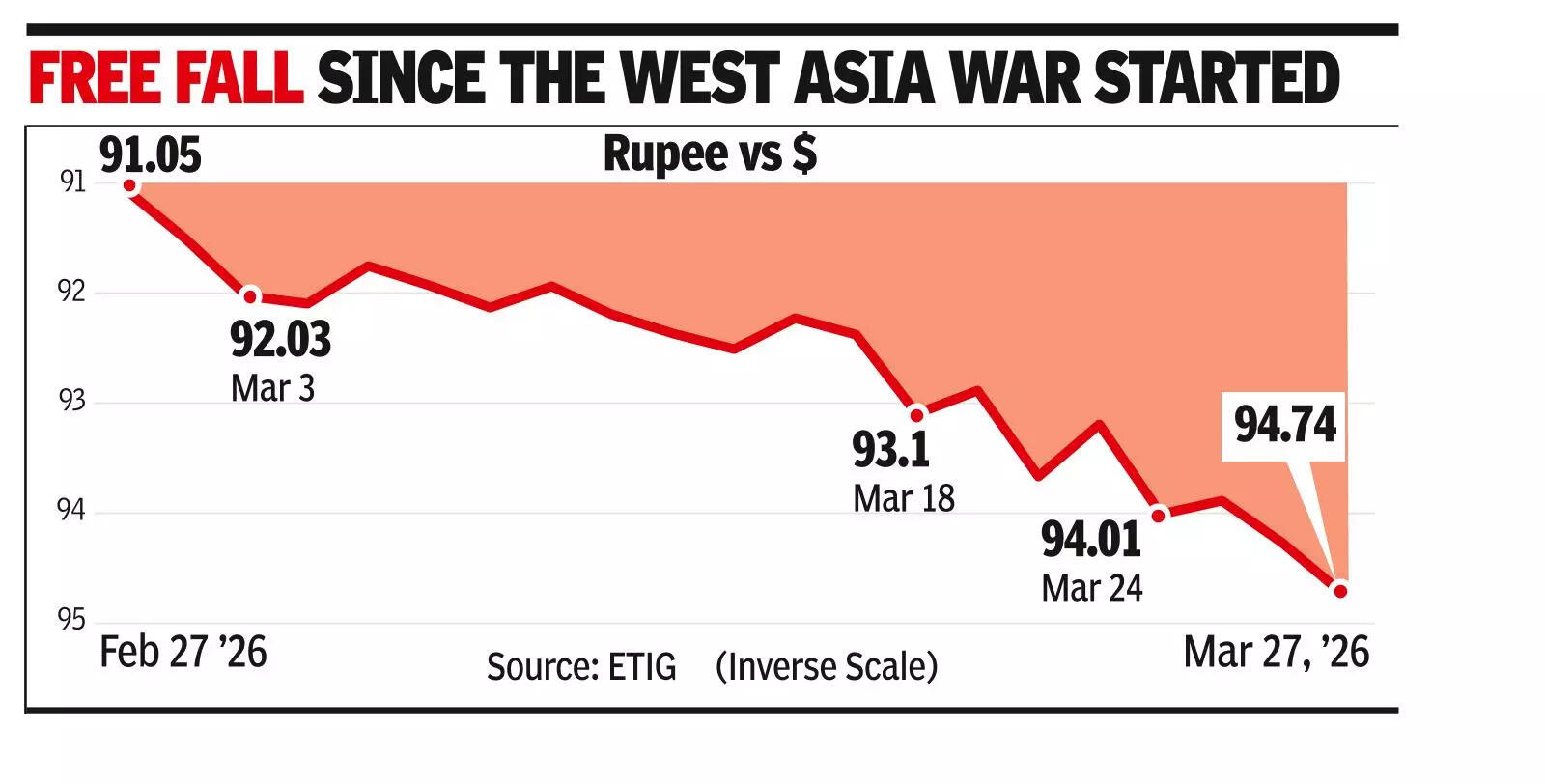
MUMBAI: The RBI’s unorthodox move to steady the rupee by forcing banks to unwind foreign exchange positions beyond $100 million will prevent its slide towards 95, even as markets fret over a possible escalation in the Iran conflict and the prospect of a US ground invasion.The move will also cause banks with large open positions to lose money. Over the weekend, banks pressed RBI to either relax or grant more time. With RBI standing firm, banks will have to start unwinding on Monday to meet the April 10 deadline.Until Friday, banks could run net open positions of up to 25% of their net worth. In practice, large lenders often accumulated sizeable long dollar bets, sometimes in excess of of $1 billion, on expectations of rupee depreciation. The new cap forces a rapid reversal. By April 10, 2026, banks must cut these exposures to $100 million. This compels them to sell dollars and buy rupees to close the gap.

RBI’s forced dollar unwind to keep rupee from sliding, bruise banks

Free fall since the West Aisa war started

Uday Kotak, called the move “an unconventional policy action” triggered by a West Asia crisis that has entered “uncharted territory”. “Reminds me of Bimal Jalan play book as RBI Governor in 1998 when the rupee was depreciating sharply post Asian crisis. If things get worse geo politically, is there an opportunity for a new version of FCNR (B) scheme?” he said.Some bankers are sceptical of special schemes to raise dollars. Earlier dollar mopping exercises relied on offering guaranteed returns to non-resident Indians, who borrowed cheaply abroad and parked funds in India. Such tactics may be less effective now. Investors have access to a wider array of structured products, and it is cheaper for the RBI to raise dollars through rupee dollar swaps, bankers said.Despite the RBI move pressure persists as dollar is expected to gain globally due to geopolitical tensions rise and fuel inflation fears and FPIs selling across markets. “FPIs were net sellers on all trading days in March, so far, taking total selling through March 27 to a record Rs 1,18,093 crore,” said VK Vijayakumar. The key drivers are the West Asia conflict, Gulf remittance-risk, hit to growth and earnings from high crude prices.


Source link

Foreign brokerages cut India Inc’s earnings, index targets


Foreign brokerages cut India Inc’s earnings, index targets

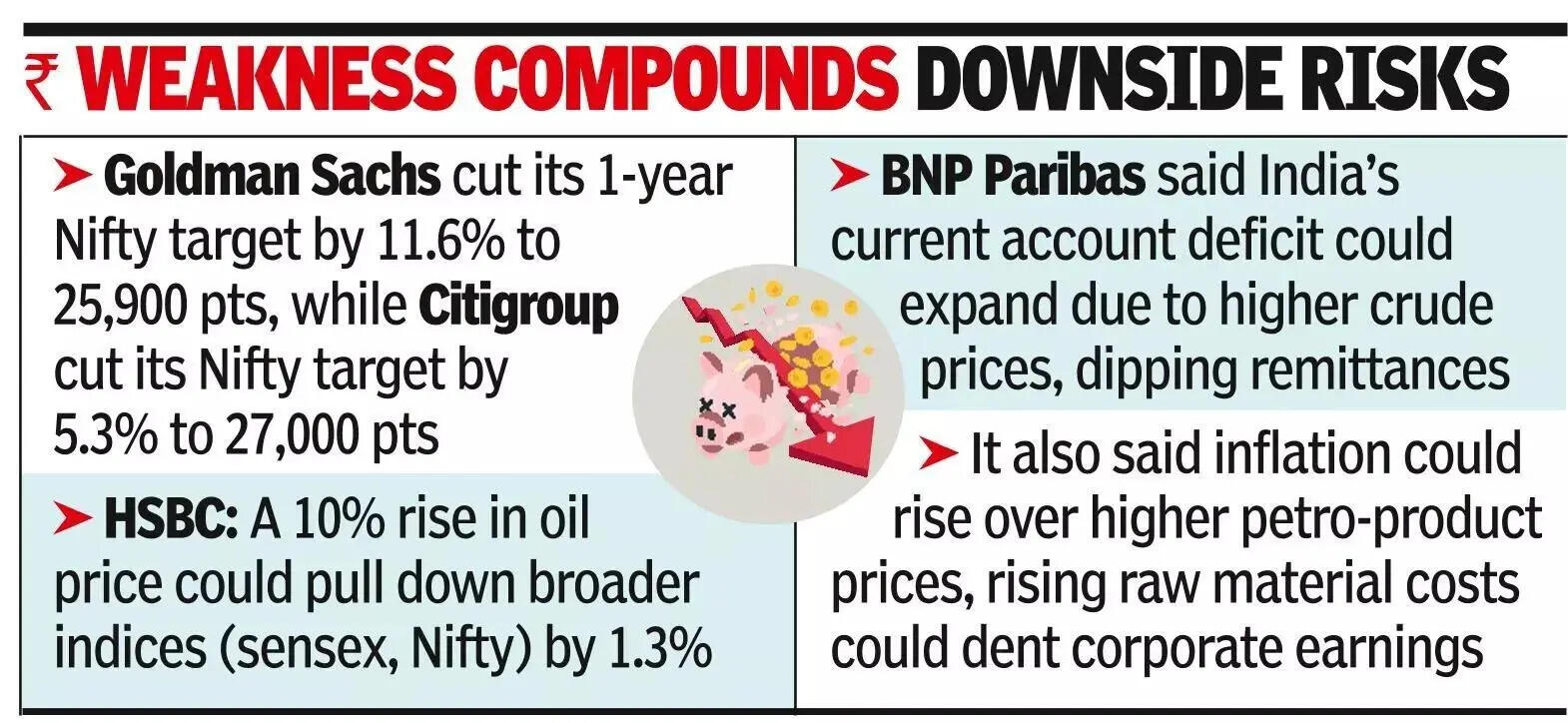
MUMBAI: Thanks to the war in West Asia and the ensuing oil price-led shock that the Indian economy is currently facing, top foreign brokerages and analysts have cut earnings estimates for India Inc as well as targets for Nifty by nearly 12%. They also warned that if the war continues for long and the oil price surges to a new all-time peak, the impact on the economy and the market could be severe.Foreign broking major Goldman Sachs has cut the Nifty target to 25,900 points from 29,300 points earlier while Citigroup has revised down their target for the index to 27,000 points from 28,500 points earlier. On its part, HSBC said that historical trend shows that a 20% rise in oil price could drag down earnings of India Inc by 1.3 percentage points. Since the war started crude oil prices are up about 50-55%.

Foreign brokerages cut India Inc’s earnings, index targets.

Rs weakness compounds

Goldman Sachs downgraded India to ‘market weight’ from ‘overweight’ on a less attractive risk-reward matrix compared to some of the other Asian markets, amid worsening macro and slowing earnings growth, a note from the financial services major said. Analysts expect India Inc would show earnings growth of 8% in 2026 and 13% in 2027. “We see risks tilted to the downside in the next three to six months, as we think the market may not be pricing in the full extent of earnings cuts. (The potential) upside catalysts include earlier-than-assumed resumption of oil flows, and a clear recovery in India’s earnings cycle.”In its report, HSBC said that data shows a 10% supply-driven rise in oil price has led to about a 1.3% decline in the broader Indian equity index, with consumer discretionary, tech services, and financials typically more exposed. “The risk gets compounded by currency weakness: A 1% (rupee) depreciation tends to translate into a further 1% market drag. These relationships are broadly consistent with recent performance: oil has risen about 55% since the outbreak of the conflict, while the (rupee) has depreciated about 3.5%, this implies an overall market impact of around 11%.The BNP Paribas report said that “A 10% increase in oil price leads to about 35 basis points (bps) rise in current account deficit (CAD).” It also noted that with the war continuing, remittances from West Asia could slow down, further impacting CAD.


Source link

India accounts for 1 in 10 global maternal deaths: Lancet report | India News


India accounts for 1 in 10 global maternal deaths: Lancet report

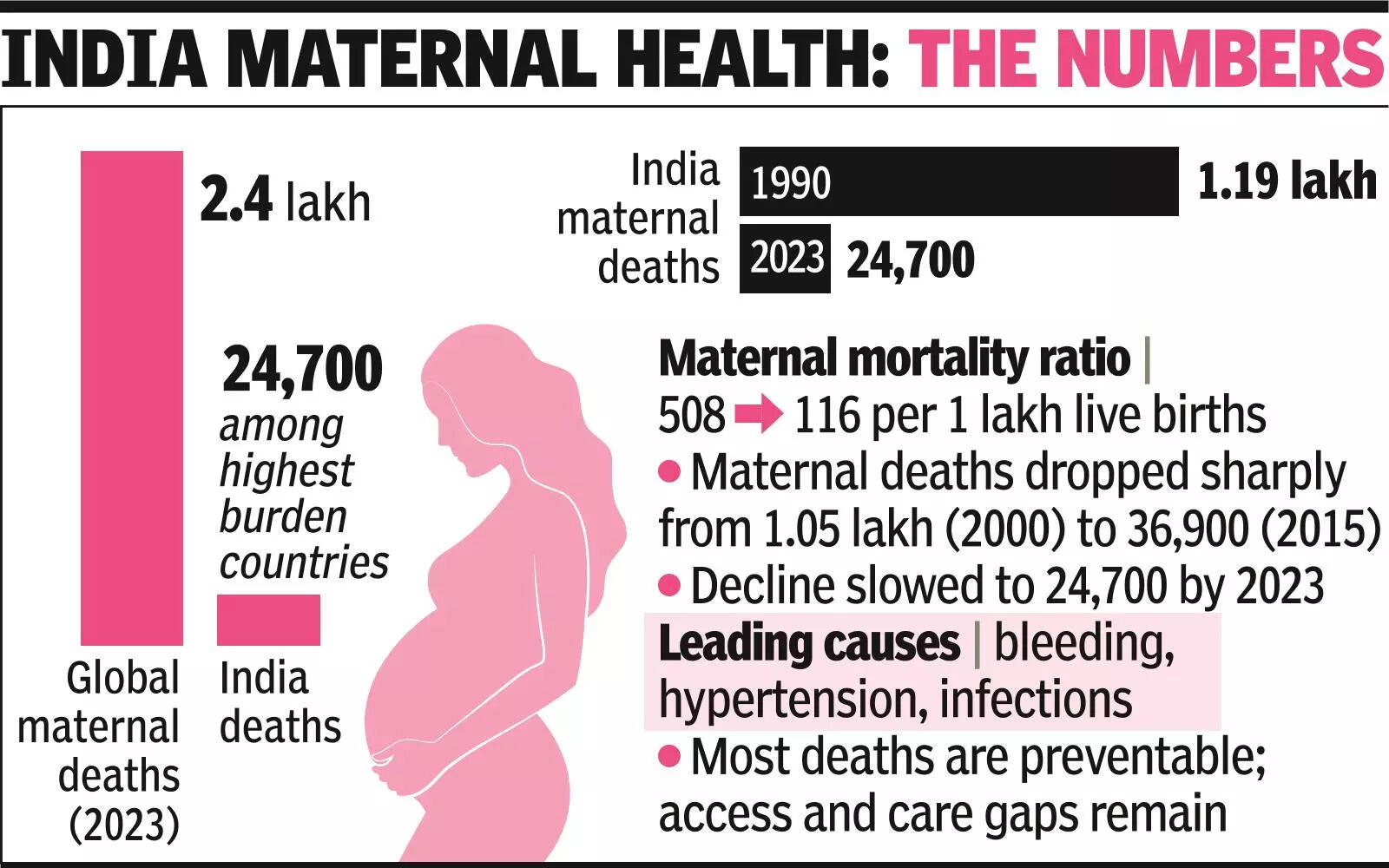
NEW DELHI: India remains among the countries with the highest number of maternal deaths globally, a major study published in The Lancet Obstetrics, Gynaecology & Women’s Health has found, with progress slowing down post 2015 after years of rapid decline.Around 2.4 lakh women died globally in 2023 due to pregnancy and childbirth-related causes, the study estimates. India accounted for about 24,700 of the 2.4 lakh deaths, placing it among the highest-burden countries alongside Nigeria, Pakistan and Ethiopia.India’s long-term numbers reflect both progress and persistent gaps. Maternal deaths fell sharply from about 1.19 lakh in 1990 to 36,900 in 2015 and further to 24,700 in 2023. And the maternal mortality ratio declined from 508 in 1990 to 116 per one lakh live births in 2023, indicating substantial gains but also unfinished work.

India accounts for 1 in 10 global maternal deaths: Report

Deaths Continue To Be Driven By Largely Preventable Causes, Says Study Published In The Lancet

“Maternal mortality has declined significantly since 1990 due to better awareness, institutional deliveries and govt programmes, although progress remains uneven across states, with some like Kerala and Tamil Nadu nearing global targets while others such as Uttar Pradesh, Bihar and Madhya Pradesh continue to report higher maternal mortality,” said Dr Abha Majumdar, director, Centre of IVF & Human Reproduction, Sir Ganga Ram Hospital.The steepest decline happened between 2000 and 2015, driven by expanded institutional deliveries, improved antenatal care and wider public health interventions. However, the pace has slowed down in recent years, pointing to systemic challenges that are harder to address.The study points to a persistent pattern in India, where deaths continue to be driven by largely preventable causes such as haemorrhage, hypertensive disorders, infections and complications linked to pre-existing conditions. Delays in receiving care, gaps in quality of services and uneven access across regions remain key concerns.Globally, the maternal mortality ratio stood at 190 deaths per one lakh live births in 2023, still far above the Sustainable Development Goal target of fewer than 70. More than half of the countries have not reached this level yet. Researchers also flagged the impact of the Covid-19 pandemic, which disrupted maternal health services and contributed to additional deaths in several regions during peak years.Experts say the findings underline the need for India to sustain gains in maternal health, strengthen public health systems and improve quality of care, particularly for high-risk pregnancies and underserved populations. With progress slowing down and risks persisting, the study warns that without renewed focus, countries may fall short of the 2030 goal of making childbirth safer for all women.


Source link