Breaking News
India-Jordan ties: Crown Prince Al Hussein bin Abdullah II drives PM Modi to museum as special gesture — see pics | India News


India-Jordan ties: Crown Prince  Al Hussein bin Abdullah II drives PM Modi to museum as special gesture — see pics

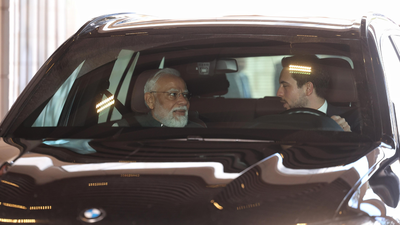
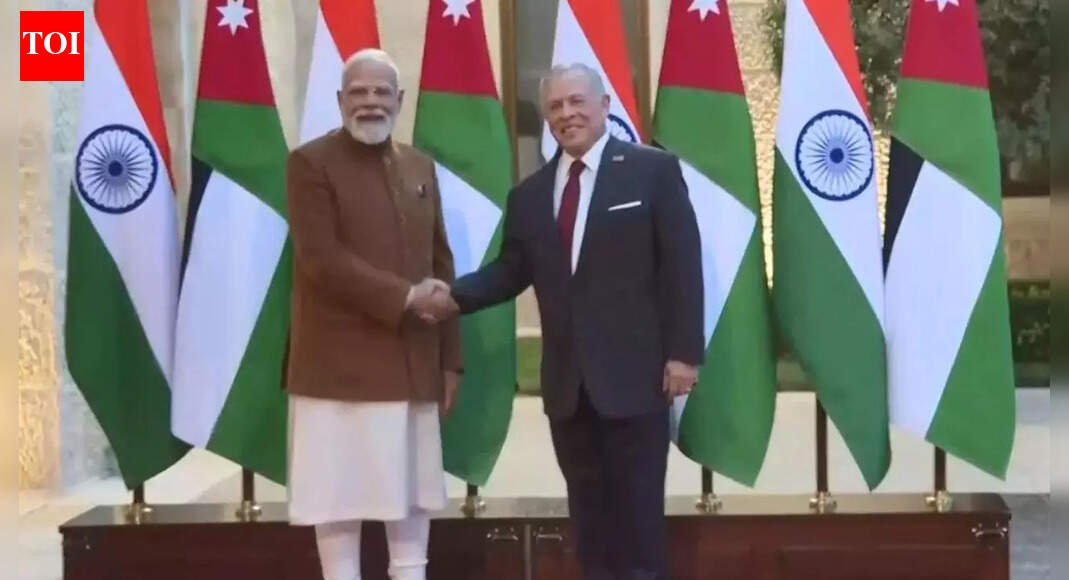
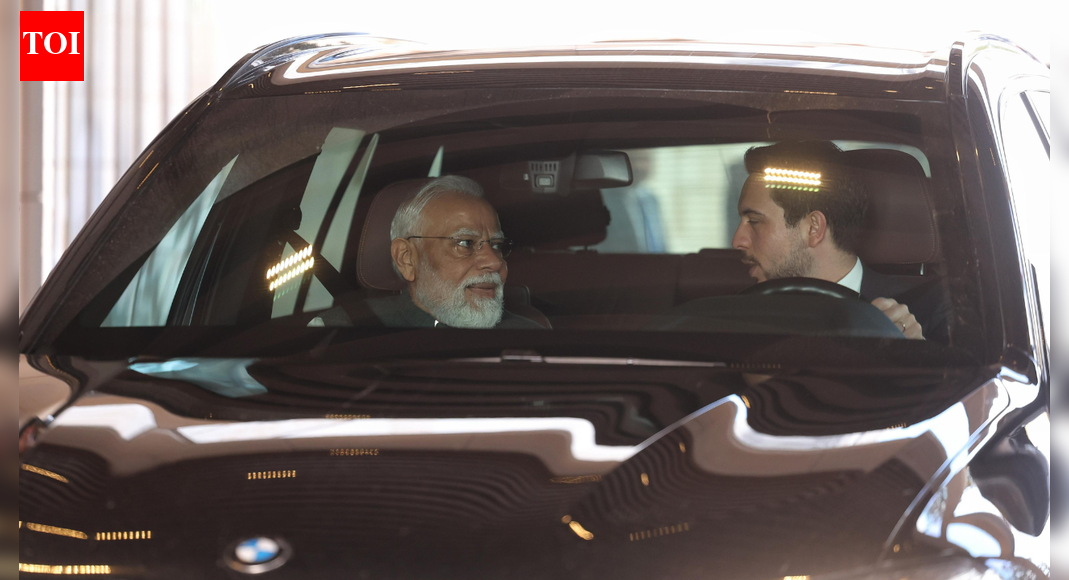
NEW DELHI: In a rare gesture, Jordan Crown Prince Al Hussein bin Abdullah II on Tuesday drove Prime Minister Narendra Modi to the Jordan Museum.This comes as PM Modi is visiting Jordan to mark the 75th anniversary of the establishment of diplomatic relations between the two countries.

.

Earlier on Monday, Jordanian Prime Minister Jafar Hassan welcomed PM Modi at the airport on his arrival for a two-day visit at the invitation of King Abdullah II ibn Al Hussein.

PM Modi Praises Jordan’s Fight Against Terrorism As India And Jordan Strengthen Strategic Relations

PM Modi received a warm welcome from members of the Indian community in Jordan’s capital, Amman. He greeted people and interacted with children who had gathered to welcome him, and also witnessed a cultural performance on arrival.The Prime Minister expressed confidence that his visit would boost bilateral ties between the two nations. As he began his two-day visit, he also thanked his Jordanian counterpart for the warm reception at the airport.“Deeply touched by the warm welcome extended by the Indian community in Amman. Their affection, pride in India’s progress and strong cultural bonds reflect the enduring connection between India and its diaspora. Also grateful for the role the diaspora continues to play in strengthening India-Jordan relations,” Modi posted on X.During the visit, PM Modi will hold discussions with King Abdullah II, with both leaders expected to review the entire gamut of India-Jordan relations and exchange views on regional issues.This is Prime Minister Modi’s first full-fledged bilateral visit to Jordan. He had earlier transited through the country in February 2018 while en route to the State of Palestine.“Even though it was a transit visit, exceptional courtesies were accorded to him by His Majesty the King, making it more than just a transit visit. The current full bilateral visit is taking place after an interval of 37 years. India and Jordan share warm and friendly relations marked by mutual trust and goodwill. The relationship spans political, economic and defence cooperation, as well as strong people-to-people ties,” Ministry of External Affairs (MEA) Secretary (South) Neena Malhotra said ahead of the visit.“Our bilateral relations are marked by strong understanding at the leadership level. Since His Majesty’s visit to India in 2018, the two leaders have met four times, the latest on the sidelines of the G7 Summit in Italy in June 2024. The leaders remain in touch telephonically as well. They also spoke in April 2025 after the Pahalgam terror attack, during which His Majesty condemned the attack and reiterated support for India’s fight against terrorism,” she added.


Source link

’24L dead, 12L missing’: EC publishes list of 58L deleted voters under SIR in Bengal – all you need to know | India News


'24L dead, 12L missing': EC publishes list of 58L deleted voters under SIR in Bengal - all you need to know

NEW DELHI: The Election Commission on Tuesday published a draft list of deleted voters after the Special Intensive Revision (SIR) of electoral rolls in West Bengal. The list features voters whose names were included in the state’s electoral rolls in 2025 but were deleted from the draft rolls of 2026.This comes after the first phase of the SIR exercise ended on December 11. The second phase – starting after December 16 – will involve filing of claims and objections. The notice phase, which includes issuance, hearings, verification and decisions on enumeration forms, as well as disposal of claims and objections, will be carried out concurrently by Electoral Registration Officers (EROs).

Owaisi Calls SIR a ‘Backdoor NRC’ in Lok Sabha, Warns of Selective Religious Disenfranchisement

All you need to know

  • The poll body said voters’ names were deleted from the rolls on grounds of being absent from their registered addresses, having permanently shifted, being deceased, or being marked as “duplicate” voters in more than one constituency.
  • The number of “uncollectable SIR enumeration forms” exceeds 58 lakh, news agency PTI reported, citing sources.
  • According to EC the deleted voter list includes 24.17 lakh deceased voters, 19.88 lakh relocated voters, 12.20 lakh missing voters and 1.38 lakh duplicate or fake voters.
  • The list is currently available on the commission’s portal: ceowestbengal.wb.gov.in/asd_sir.
  • “The BLO, in consultation with the BLAs, has prepared the following list of voters whose enumeration forms have not been received. Aggrieved persons can submit their claims in Form 6 along with the declaration form and supporting documents after publication of Draft Roll 2026 during the period fixed for receiving claims and objections,” the poll body said.
  • Election officials stressed that inclusion in the draft list does not guarantee final retention and that all flagged voters will be given an opportunity to be heard.
  • The commission said that of the 7.66 crore enumeration forms issued for electors based on their presence in the 2025 rolls, over 58 lakh forms were found “uncollected” due to voters being absent at their registered addresses, having permanently shifted, being deceased, or having duplicate roll entries.
  • EC-appointed special observer Subrata Gupta said, “Of the total enumeration forms we collected, over 1.34 crore contain logical discrepancies. These range from the same names appearing as both father and mother of certain voters to abnormal age differences between electors and their parents or grandparents. These errors may be bona fide in nature. They could also be mala fide.”
  • “Some 30 lakh unmapped forms with the 2002 list have also been received and are included in this discrepancy list. Over 85 lakh forms have name mismatch issues with the 2002 rolls. There will also be claims and objections from aggrieved voters whose names get deleted from the draft rolls. Hearings will be conducted in each case to ensure an accurate final roll,” the retired IAS officer said.

The SIR process began on November 4 after the Election Commission announced the schedule on October 27, when West Bengal’s electorate stood at 7,66,37,529.Enumeration forms were printed for all voters and delivered door-to-door by BLOs. Officials said voters who submitted signed forms — even if partially filled — have been retained in the draft list, though their details will be subject to further verification.According to PTI, poll body data shows that a significant number of voters have been flagged during the process. Over 30 lakh voters have been placed in a “no-mapping” category as their names could not be linked with the 2002 electoral rolls. Hearings for this group are scheduled to begin on Wednesday.In addition, around 1.7 crore voters have been placed under varying degrees of scrutiny, with BLOs tasked to re-verify their details through door-to-door checks after the draft rolls are published. At the same time, the scale of exclusions has begun to draw attention.


Source link

‘Truth prevailed’: Relief for Rahul, Sonia Gandhi in National Herald case; court refuses to take cognisance of ED chargesheet | India News


'Truth prevailed': Relief for Rahul, Sonia Gandhi in National Herald case;  court refuses to take cognisance of ED chargesheet

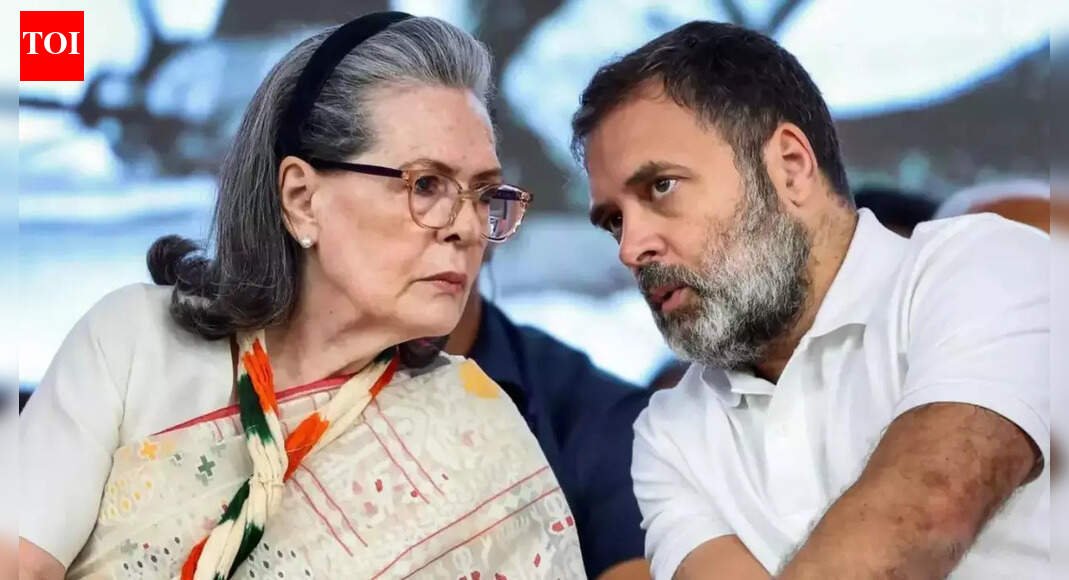
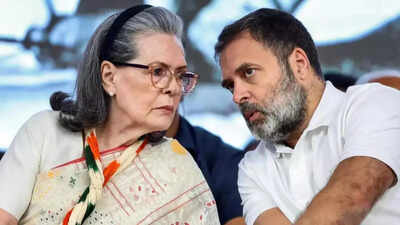
NEW DELHI: Delhi’s rouse avenue court on Tuesday refused to take cognisance in proceedings arising from a fresh FIR registered in the National Herald case, observing that the Enforcement Directorate’s probe is based on a private complaint and not on any FIR.The court also ruled that leader of opposition Rahul Gandhi, former Congress president Sonia Gandhi and other accused are not entitled to a copy of the FIR at this stage. However, it allowed the ED to continue further investigation in the matter.The court noted that cognisance could not be taken as the ED’s case stems from a private complaint filed by BJP leader Subramanian Swamy and the magistrate’s summoning orders, and not from an FIR.

Explained: What’s the National Herald case and why was Rahul Gandhi questioned by ED

Reacting to the court’s decision, the Congress said the proceedings initiated by the ED against its top leadership were politically motivated and legally untenable. The party said the court had found the ED’s action to be without jurisdiction, as there was no FIR, which it termed a prerequisite for such proceedings.“Truth has prevailed. The malafide and illegality of the Modi govt stands fully exposed. Proceedings of ED against the Congress leadership – Smt Sonia Gandhi Ji and Shri Rahul Gandhi Ji, in the Young Indian case have been found completely illegal and malafide by the Honourable Court,” the grand old party said in a post on X.“No case of money laundering, no proceeds of crime and no movement of property – all baseless charges that have been a part of political witch hunt, propaganda, reputation assassination and campaign which stands defeated today,” it added.The Delhi Police’s Economic Offences Wing (EOW) registered an FIR against Sonia Gandhi, Rahul Gandhi and others on a complaint by the ED as part of its money laundering probe into the high-profile National Herald case.Reacting to the FIR, the Congress accused the BJP of pursuing a “politics of harassment, intimidation and vendetta” against its top leadership. The party alleged that the “Modi-Shah duo” was misusing investigative agencies and maintained that the National Herald case was “completely bogus,” asserting that justice would ultimately prevail.Rejecting these allegations, senior BJP leader and former Union law minister Ravi Shankar Prasad termed the Congress’s claims “baseless.” He said Prime Minister Narendra Modi was not in office when the private complaint was filed, pointing out that the matter dates back to 2008.“Congress is levelling false and baseless allegations. We vehemently condemn it and request them to give an account of the loot they committee instead of giving speeches… Let the law take its course.” Prasad further added, “The country should know that in the FIR filed by Delhi Police, Sonia Gandhi and Rahul Gandhi have been charged under section 120 (B) for criminal conspiracy and Section 420. The case has been filed under the old penal code because the case is old.


Source link

‘Shameless’: Video of Nitish Kumar trying to remove doctor’s hijab sparks row; oppn slams Bihar CM | India News


‘Shameless’: Video of Nitish Kumar trying to remove doctor’s hijab sparks row; oppn slams Bihar CM

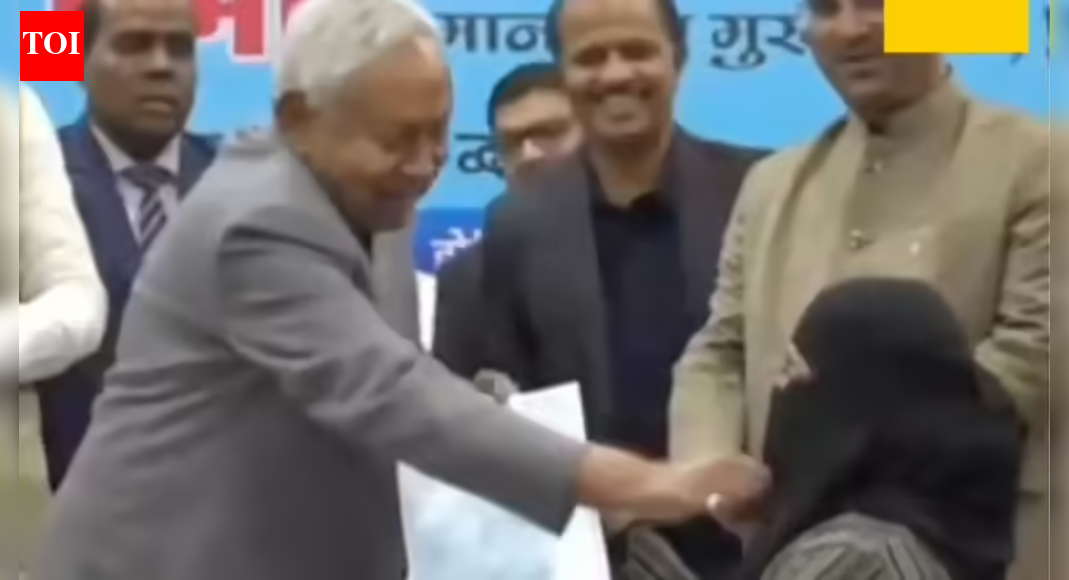
NEW DELHI: Bihar chief minister Nitish Kumar on Monday triggered a controversy after he pulled the hijab of a woman doctor during an appointment letter distribution programme.A video shared by the Rashtriya Janata Dal (RJD) on X shows Nitish on stage alongside deputy chief minister Samrat Choudhary and health minister Mangal Pandey.The incident took place at a programme held at the chief minister’s residence, where appointment letters were being distributed to newly recruited AYUSH doctors.When it was the turn of Nusrat Parveen, who had arrived with her face covered with a hijab, Nitish frowned and exclaimed, “What is this?”Standing on a raised platform, Nitish then bent down and pulled the hijab down. The visibly flustered appointee was soon pulled aside by an official present at the event, while d CM Samrat Choudhary, standing beside Kumar, was seen tugging at his sleeve in an apparent attempt to restrain him.The incident drew sharp reactions from the opposition, with questions raised about Nitish Kumar’s conduct and mental health.Sharing the video on X, the RJD wrote, “What has happened to Nitish Ji? Has his mental state completely deteriorated, or has Nitish Babu now become a 100 per cent member of the Rashtriya Swayamsevak Sangh?”Reacting to the incident, RJD MP Manoj Jha said the visuals were unsettling and raised serious concerns.“I have seen the visuals and they were unsettling. The Deputy CM even tried to stop him. It should be a matter of concern. As someone who has grown up in Bihar, I am worried that such visuals do not give a good message and raise several doubts,” Jha said.The Congress also attacked the Bihar chief minister, calling the act “vile.”“This is Bihar’s chief minister Nitish Kumar. Look at his shamelessness—a female doctor had come to collect her appointment letter, and Nitish Kumar pulled off her hijab. A man occupying the highest position in Bihar is openly indulging in such a vile act,” the party said in a post on X.“Nitish Kumar should immediately resign for this disgusting behaviour. This vileness is unforgivable,” it added.Congress MP Sukhdeo Bhagat also condemned the incident, accusing the chief minister of violating traditions and faith.“This does not seem appropriate from any angle. Treating a woman like this is condemnable,” Bhagat said.Shiv Sena MP Priyanka Chaturvedi also criticised the act, saying no one should be allowed to publicly humiliate an adult woman.“It is her dignity and knowledge of being an equal that makes her stand there to receive the acknowledgement she deserves. No father figure, CM, PM, brother or husband should be allowed to publicly humiliate an adult, educated woman for her choice of dress,” she wrote on X.According to the Chief Minister’s Office, the appointees included 685 Ayurveda doctors, 393 homeopaths and 205 practitioners of the Unani system of medicine.Of them, 10 appointees received their job letters in person from Kumar, while the rest were issued appointment letters online.


Source link

‘Steadily recovering’: Low visibility disrupts flight ops in Delhi; airport issues advisory | India News


‘Steadily recovering’: Low visibility disrupts flight ops in Delhi; airport issues advisory

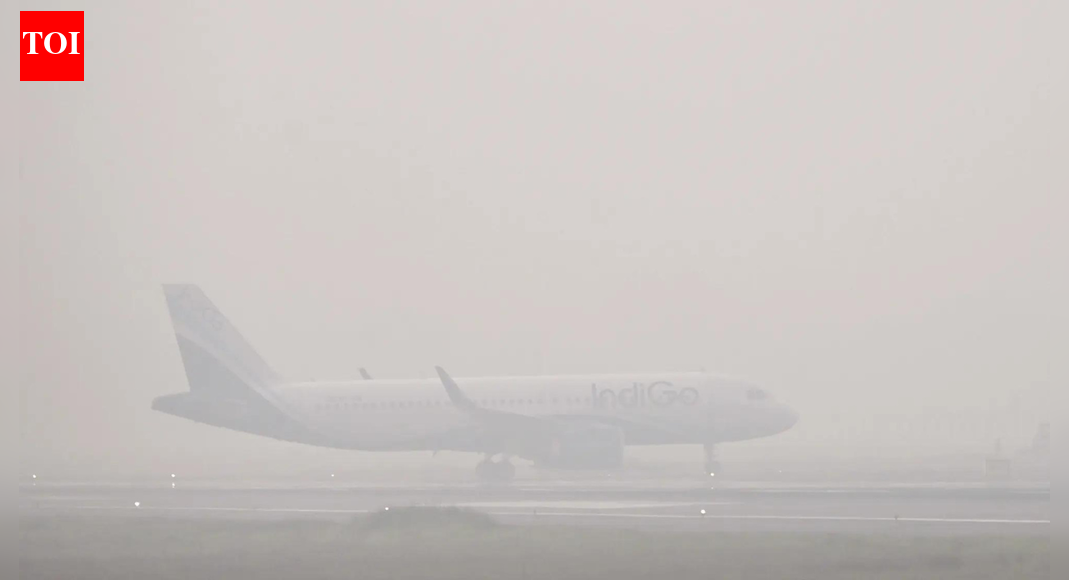
NEW DELHI: Delhi airport on Tuesday issued an advisory to flyers, warning that disruptions in flight operations may persist for some arrivals and departures due to dense fog.In a post on X, Indira Gandhi International Airport (IGIA) urged passengers to check with airlines for real-time updates on flight schedules.“Flight operations are steadily recovering, but disruptions may persist for certain departures and arrivals. For accurate and timely updates, please contact your airline directly,” IGIA said.“Our personnel are available across terminals to assist passengers and provide necessary support,” it added.Low visibility had disrupted operations on Monday as well, with 228 flights — 131 departures and 97 arrivals — cancelled and five diverted to nearby airports, according to airport officials.Air India said it cancelled around 40 flights due to poor visibility, while other airlines, including IndiGo, did not share exact numbers of cancellations or delays.“Low visibility (below minima), due to dense fog, has severely impacted operations at Delhi and other airports across northern India,” IndiGo said, adding that some flights may face delays or proactive cancellations to prioritise safety.Air India also said operations would resume as soon as conditions improve, stressing that cancellations were made in the interest of passenger safety.Delhi airport, the country’s busiest, handles around 1,300 flight movements daily.


Source link

Anti-dowry laws suffer from ineffectiveness, misuse: SC | India News


Anti-dowry laws suffer from ineffectiveness, misuse: SC

New Delhi: Noting that the social evil of dowry still prevails showing the ineffectiveness of the anti-dowry laws and at the same time the law is being misused by women for ulterior motives, Supreme Court Monday said this contradiction needed to be resolved as it is creating judicial tension.A bench of Justices Sanjay Karol & N K Singh highlighted this issue while convicting a man and his 94-year old mother in dowry death case when a 20-year old girl burnt to death in 2001 for not fulfilling the demand for a colour television, a motorcycle and Rs 15,000 cash. Bringing the curtain down on the case after almost a quarter of century, the court awarded life imprisonment to the husband but refrained from incarcerating the mother considering her old age.The bench expressed concern over delay in deciding the case and passed a series of directions for social measures to tackle the menace of dowry by spreading awareness among youth as the law had been ineffective in curbing the practice.“While on the one hand, the law suffers from ineffectiveness and so, the malpractice of dowry remains rampant, on the other hand, the provisions of this (Dowry Prohibition) Act have also been used to ventilate ulterior motives along with Section 498-A, IPC. This oscillation between ineffectiveness and misuse creates a judicial tension which needs urgent resolution. While this urgent resolution cannot be stressed upon enough, at the same time it is necessary to be recognised that particularly when it comes to the giving and taking of dowry, this practice unfortunately has deep roots in society, hence, it not being a matter of swift change, instead needs concentrated effort on part of all the involved parties, be it legislature, law enforcement, judiciary, civil society organisations etc,” the bench said.In this case a 20-year old Nasrin was set on fire by pouring kerosene oil on her and she died within a year of her marriage. The trial court convicted both her husband and mother-in-law but Allahabad HC set aside the conviction and acquitted them. The HC decision was based on one part of the deceased father’s statement in which she said that his daughter was happily married.Setting aside HC order and convicting both the accused, SC said, “When the harassment for dowry is proved and so is the fact that such harassment was made soon before her death, then a mere statement of one of the witnesses that she was apparently happy, would not save the Respondents from guilt”.“The HC appears to have been misdirected by the use of the word ‘happily’, at least insofar as the testimony of PW1 (father) is concerned. Reading the entire statement as extracted herein above, clearly establishes that the deceased went back to her matrimonial home having been persuaded and assured by her father. He also states that she had been assaulted and dowry had been demanded from her. Therefore, the use of one word does not colour the entire tenor of the evidence. The sum of the evidence is to be understood, taking into account all aspects testified to therein,” the bench said.As the present case took 24 years to be concluded, SC said there would be many such similar cases and requested all high courts to take stock of the situation, ascertain the number of cases pending dealing with Section 304-B, 498-A from the earliest to the latest for expeditious disposal.


Source link

Watch: India rebukes Pakistan at UNSC; says J&K, Ladakh are integral parts of the country | India News


Watch: India rebukes Pakistan at UNSC; says J&K, Ladakh are integral parts of the country

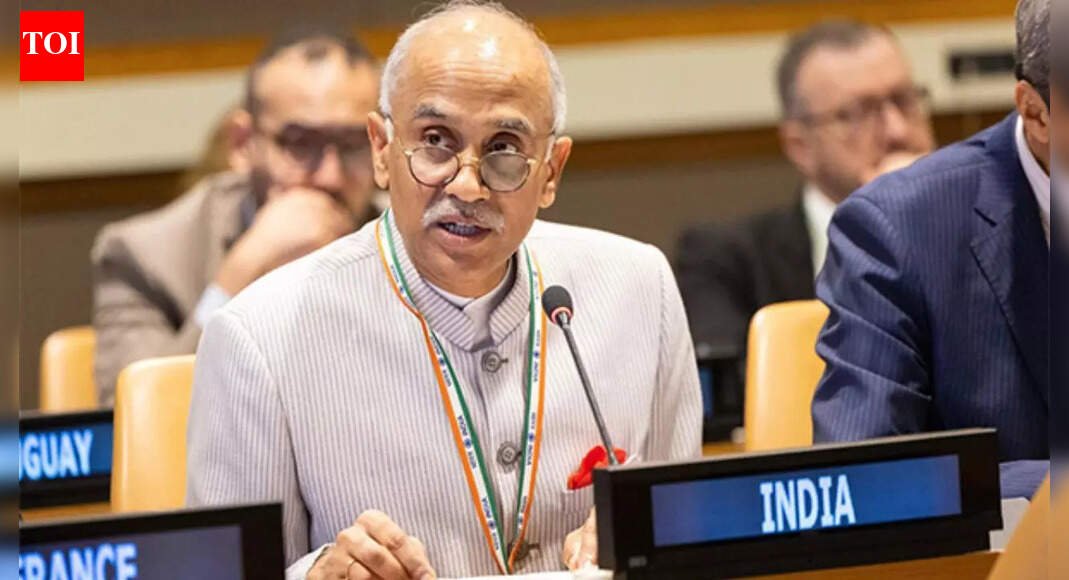
NEW DELHI: India on Tuesday firmly rejected Pakistan’s reference to Jammu and Kashmir during an open debate at the United Nations Security Council, saying the Union Territories of Jammu & Kashmir and Ladakh are an integral part of India and will always remain so. Speaking at the UNSC Open Debate on “Leadership for Peace”, India’s Permanent Representative to the UN, Ambassador Harish P, said Pakistan’s repeated mention of Jammu and Kashmir reflected an “obsessive focus” on harming India and its people. He said: “I refer to the statement made by the representative of Pakistan today. India would like to reiterate that the Union Territories of Jammu & Kashmir and Ladakh are an integral and inalienable part of India. They were, are, and will always remain so. Pakistan’s unwarranted reference to Jammu & Kashmir in today’s open debate attests to its obsessive focus on harming India and its people. A serving non-permanent Security Council Member that chooses to further this obsession in all meetings and platforms of the UN in pursuit of its divisive agenda cannot be expected to fulfil its designated responsibilities and obligations.”The Indian envoy said India signed the Indus Waters Treaty 65 years ago in good faith and with a spirit of friendship. However, he said Pakistan had violated the spirit of the treaty over the decades by waging three wars and sponsoring thousands of terror attacks against India. He added that tens of thousands of Indian lives have been lost in Pakistan-sponsored terrorism over the last four decades.Referring to the April 2025 Pahalgam terror attack, the ambassador said, “The Pahalgam terror attack in April 2025, involved religion-based targeted killings of 26 innocent civilians by Pakistan-sponsored terrorists. It is in this backdrop that India has finally announced that the Treaty will be held in abeyance until Pakistan, which is a global epicentre of terror, credibly and irrevocably ends its support for cross-border and all other forms of terrorism.Ambassador Harish also criticised Pakistan’s internal political situation, referring to the jailing of a former prime minister, the banning of a political party, and constitutional changes that grant immunity to military leadership.He further India would continue to counter Pakistan-sponsored terrorism in all its forms with full resolve.


Source link

Jordan visit: PM Modi meets King Abdullah II in Amman; leaders discuss Gaza, counter-terrorism | India News


Jordan visit: PM Modi meets King Abdullah II in Amman; leaders discuss Gaza, counter-terrorism

Prime Minister Narendra Modi met Jordan’s King Abdullah II bin Al Hussein at the Husseiniya Palace in Amman on Monday for delegation-level talks, marking his first bilateral visit to Jordan in 37 years. The leaders discussed bilateral relations, regional issues, and counter-terrorism efforts while celebrating 75 years of diplomatic ties between the two nations.The meeting focused on strengthening cooperation across multiple sectors and addressing regional stability, particularly concerning Gaza.Prime Minister Modi recalled their previous interactions on extremism and moderation, including their first meeting at the UN in 2015 and the King’s visit to India in 2018.“During your visit to India in 2018, we participated in a conference on Islamic heritage. I recall that our first meeting also took place on the sidelines of the UN in 2015, at an event focused on countering violent extremism. Even then, you delivered inspirational remarks on this subject. Your efforts to promote moderation are extremely important not only for regional peace but also for global peace. We will continue to move forward concretely in this direction together. We will further strengthen all other dimensions of our mutual cooperation,” PM Modi said.PM Modi also acknowledged Jordan’s stance against terrorism and praised King Abdullah II’s role in promoting regional stability, particularly regarding Gaza.“You have played a very active and positive role on the issue of Gaza from the very beginning. We all hope that peace and stability will prevail in the region. We share a common and clear stance against terrorism. Under your leadership, Jordan has sent a strong and strategic message to all of humanity against terrorism, extremism, and radicalisation,” PM Modi stated.King Abdullah II welcomed the signing of new agreements and emphasised the potential for increased business cooperation.“We warmly welcome the signing of the agreements and MoUs during your visit, as they will further advance our cooperation and open new avenues for collaboration. We also look forward to the Jordan-India Business Forum taking place tomorrow as an opportunity to discuss business-to-business partnerships and the potential for joint investments in vital sectors,” the King said.The Jordanian monarch also highlighted the strong partnership between the two nations.“Our nations enjoy a strong partnership and a shared desire to advance prosperity for our peoples. And over the years, our collaboration has expanded across multiple sectors. Your visit today provides an important opportunity to chart new paths of economic cooperation across industry, ICT, pharmaceuticals, agriculture, energy, and many more promising fields of mutual benefits for our people,” King Abdullah II stated.PM Modi was welcomed at the airport by Jordanian Prime Minister Jafar Hassan, who expressed optimism about the visit on social media.“It is an honour to welcome Prime Minister Modi of the Republic of India to Jordan today, as a valued guest, in a visit that reflects seventy-five years of close and enduring relations,” Hassan posted.Upon arrival at his hotel, PM Modi met with members of the Indian community in Jordan.“Deeply touched by the warm welcome extended by the Indian community in Amman. Their affection, pride in India’s progress and strong cultural bonds reflect the enduring connection between India and its diaspora. Also grateful for the role the diaspora continues to play in strengthening India-Jordan relations,” PM Modi shared on social media.India and Jordan maintain strong economic ties, with India being Jordan’s third-largest trading partner and bilateral trade reaching USD 2.8 billion. Jordan serves as a major supplier of fertilizers to India, particularly phosphates and potash. The country hosts an Indian diaspora of over 17,500 people working in various sectors including textiles, construction, and manufacturing.This visit marks the first stop of Modi’s four-day, three-nation tour.


Source link

Delhi air pollution: Schools told to shift to online mode up to Class V; hybrid mode for others | India News


Delhi air pollution: Schools told to shift to online mode up to Class V; hybrid mode for others
Increasing air pollution in Delhi (PTI image)

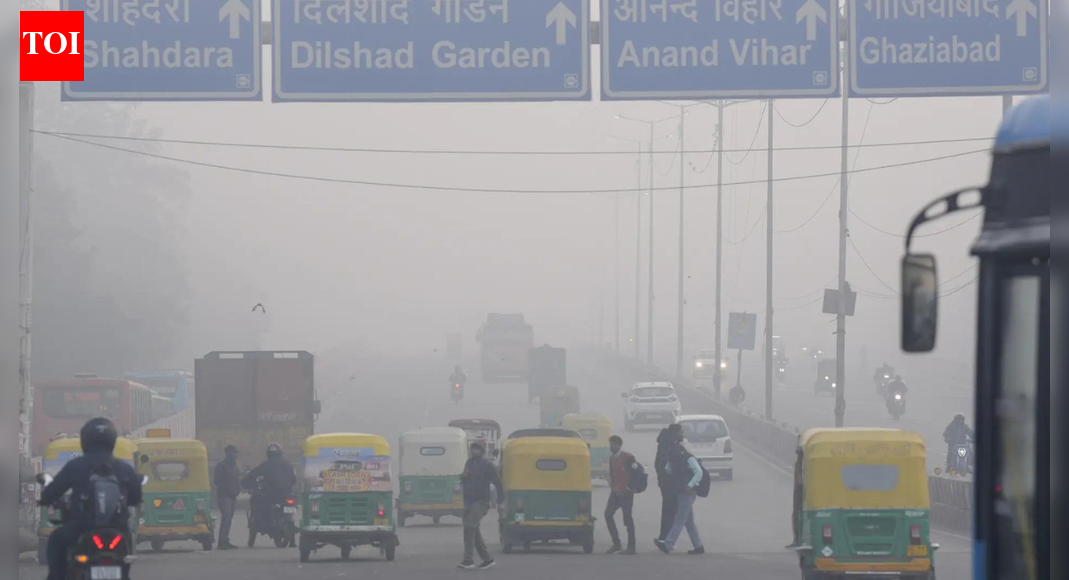
NEW DELHI: The Delhi government on Monday directed schools to shift students up to Class V from hybrid to fully online mode in view of the capital’s worsening air pollution.According to a circular issued by the Directorate of Education (DoE), physical classes for students from nursery to Class V in all government, government-aided and unaided private recognised schools in Delhi have been discontinued until further orders due to the prevailing high Air Quality Index (AQI).The order applies to all government, government-aided and private recognised schools in Delhi. School heads have been instructed to ensure that online classes are available for younger students and to inform parents and guardians immediately.The circular clarified that classes for Class VI and above will continue without any change and will be conducted as per earlier instructions issued on December 13. District and zonal education officials have also been asked to ensure smooth implementation of the directions.Delhi remained shrouded in dense smog with the AQI touching 498, close to the maximum level of 500. The city’s air quality monitoring stations recorded ‘severe’ levels at 38 locations and ‘very poor’ at two stations, with Jahangirpuri recording the worst AQI of 498.Several residents complained of breathlessness, low visibility and health risks. Pollution levels have steadily worsened over the past two days, raising concerns especially for children and other vulnerable groups.The situation had worsened from Sunday when the AQI climbed to 461, marking Delhi’s most polluted day this winter and the second-worst December air quality day on record. According to the Central Pollution Control Board, an AQI between 0 and 50 is considered ‘good’, 51 to 100 ‘satisfactory’, 101 to 200 ‘moderate’, 201 to 300 ‘poor’, 301 to 400 ‘very poor’ and 401 to 500 ‘severe’.The Air Quality Early Warning System forecasts that Delhi’s air quality is likely to remain in the ‘severe’ category, with predictions for the next six days showing ‘very poor’ conditions.The current pollution levels pose serious health risks to the city’s population, with authorities advising people to take necessary precautions. The situation remains particularly concerning as the winter season typically sees increased pollution levels in the capital region.


Source link

MGNREGA to be replaced with VB–G Ram G: What it is and how it’s different — key FAQs answered | India News


MGNREGA to be replaced with VB–G Ram G: What it is and how it’s different — key FAQs answered

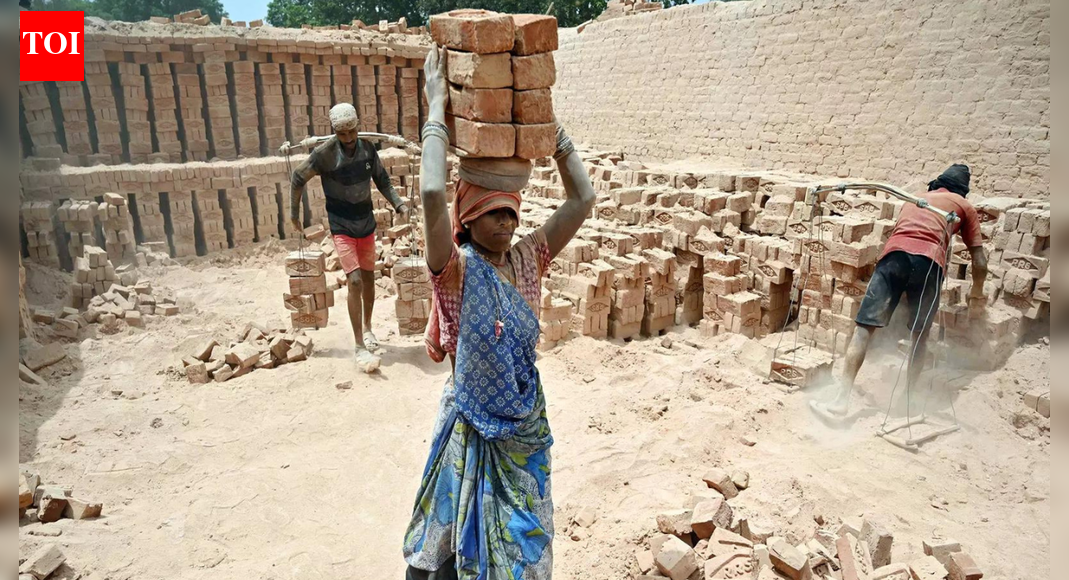
NEW DELHI: Centre is set to introduce a new rural employment law in the Lok Sabha, proposing to repeal the two-decade-old Mahatma Gandhi National Rural Employment Guarantee Act (MGNREGA) with another legislation, titled the Viksit Bharat Guarantee for Rozgar and Ajeevika Mission (Gramin) (VB–G RAM G) Bill, 2025.The bill seeks to replace the MGNREGA with a revamped framework aimed at aligning rural employment and development with the national vision of Viksit Bharat 2047. It has been listed in the supplementary list of businesses issued on Monday.

Congress Questions BJP’s Renaming Of MGNREGA, Hits Out At Gandhi Hatred

Here are some of the frequently asked questions:

What is VB–G RAM G?

The Viksit Bharat Guarantee for Rozgar and Ajeevika Mission (Gramin) Act, 2025 represents a major overhaul of MNREGA. Under the proposed law, the government “establishes a modern statutory framework aligned with Viksit Bharat 2047, guaranteeing 125 days of wage employment per rural household whose adult members volunteer to do unskilled manual work,” as per a statement released.The Act aims to create both employment and durable rural infrastructure through four priority verticals:

  • Water security through water-related works
  • Core-rural infrastructure
  • Livelihood-related infrastructure
  • Special works to mitigate extreme weather events

All assets created under the scheme will be consolidated into the Viksit Bharat National Rural Infrastructure Stack, aimed at “ensuring a unified and coordinated national approach to rural development,” it said.

How is the new act different from MGNREGA? What makes it better?

The new Act represents a major upgrade over MGNREGA, fixing structural weaknesses while enhancing employment, transparency, planning, and accountability.Key improvements include:

  • Higher Employment Guarantee: Guarantee increases from 100 → 125 days, giving rural households higher income security.
  • Strategic Infrastructure Focus: MGNREGA works were scattered across many categories without a robust national strategy.
  • Localised, Spatially Integrated Planning: The new Act mandates Viksit Gram Panchayat Plans, prepared by panchayats themselves and integrated with national spatial systems like PM Gati-Shakti.
  • The new Act focuses on 4 major types of works ensuring durable assets that directly support water security, core rural infrastructure, livelihood-related infrastructure creation and climate adaptation

How will the new scheme benefit the rural economy?

The Act strengthens the rural economy through productive asset creation, higher incomes, and better resilience:

  • Water Security: Water-related works are prioritised. Mission Amrit Sarovar has already created/rejuvenated 68,000+ water bodies, demonstrating clear agricultural and groundwater impact.
  • Core Rural Infrastructure: Roads, connectivity and foundational infrastructure boost market access and rural business activity.
  • Livelihood Infrastructure: Storage, markets, and production assets support income diversification.
  • Climate Resilience: Infrastructure for water harvesting, flood drainage, and soil conservation protects rural livelihoods.
  • Higher Employment & Consumption: 125 guaranteed days increase household earnings, stimulating the village economy.
  • Reduced Distress Migration: With more rural opportunities and durable assets, migration pressures fall.
  • Digital Formalisation: Digital attendance, digital payments and data-driven planning increase efficiency.

How will the new scheme benefit farmers?

Farmers benefit directly through both labour availability and better agricultural infrastructure.

  • Guaranteed Labour Availability: States may notify periods aggregating up to 60 days during peak sowing/harvesting when MGNREGA work stops. This prevents labour shortages during critical farm operations and avoids labour being diverted away to guaranteed-wage worksites.
  • Preventing Wage Inflation: Stopping public works during peaks prevents artificial wage inflation that raises food production costs.
  • Water & Irrigation Assets: Prioritised water works improve irrigation, groundwater and multi-season cropping potential (supported by the 68,000+ Amrit Sarovar water bodies achievement).
  • Better Connectivity & Storage: Core and livelihood infrastructure helps farmers store produce, reduce losses, and access markets.
  • Climate Resilience: Flood-drainage, water harvesting and soil conservation protect crops and reduce damage.

How will the new scheme benefit labourers?

Labourers gain from higher guaranteed days, better wages, strong protections, and transparent systems.

  • Higher Income: 125 guaranteed days = 25% more potential earnings.
  • Predictable Work: Hyperlocal Viksit Gram Panchayat Plans ensure planned, advance-mapped work availability.
  • Digital Payments & Protection: Electronic wages (already 99.94% in 2024-25) continue with full biometric and Aadhaar-based verification, eliminating wage theft.
  • Unemployment Allowance: If work is not given, states must pay unemployment allowance.
  • Asset Creation Benefits Workers Too: Workers build and benefit from improved roads, water, and livelihood assets.

Why is there a need to change MGNREGA now?

  • MGNREGA was built for 2005, but rural India has transformed.
  • Poverty fell sharply from 25.7% (2011–12) to 4.86% (2023–24), supported by rising consumption, incomes and financial access recorded in MPCE and NABARD RECSS surveys.
  • With stronger social protection, better connectivity, deeper digital access and more diverse rural livelihoods, the old framework no longer matched today’s rural economy.
  • Given this structural change, MGNREGA’s open-ended model had become outdated.
  • The Viksit Bharat – Guarantee for Rozgar and Ajeevika Mission (Gramin): VB – G RAM G (विकसित भारत – जी राम जी) Bill modernises the system, raising guaranteed days, refocusing priorities, and building a more accountable, targeted, and relevant employment framework for today’s rural economy.

Why shift from demand-based to normative funding?

  • Normative funding aligns MGNREGA with the budgeting model used for most Government of India schemes, without reducing the employment guarantee.
  • A demand-based model leads to unpredictable allocations and mismatched budgeting. Normative funding uses objective parameters, ensuring predictable, rational planning while still guaranteeing that every eligible worker receives employment or unemployment allowance.

Does normative funding weaken the guarantee of 125 days?

No, the guarantee is strengthened with employment days increased to 125.

  • Forecasting accuracy shown by FY 2024-25 when allocation matched demand perfectly
  • States + Centre share responsibility
  • Special relaxations allowed during disasters
  • If work is not provided, the unemployment allowance is mandatory
  • Thus, the right to guaranteed employment remains legally protected.

Were no attempts made to improve MNREGA earlier?

Major improvements were made, but they could not overcome deeper structural problems. Key gains (FY 13-14 vis-à-vis FY 2025-26):

  • Women’s participation: 48% → 56.74%
  • Aadhaar-seeded active workers: 76 lakhs → 12.11crore
  • Workers on APBS: 0 → 11.93crore
  • Geo-tagged assets: 0 → 6.44 crore+
  • e-payments: 37% → 99.99%
  • Individual assets: 17.6% → 62.96%

Despite these advances, misappropriation continued, digital attendance was bypassed, and assets often failed to match expenditure. The scale and persistence of these issues showed that MNREGA’s architecture had reached its limits, making a new, modernised Viksit Bharat – Guarantee for Rozgar and Ajeevika Mission (Gramin): VB – G RAM G (विकसित भारत – जी राम जी) Bill necessary.

What were the problems with MNREGA that necessitated a change?

While many attempts were made to improve its functioning, major systemic failures persisted:

  • Investigations in 19 districts of West Bengal found non-existent works, rule violations, and fund misuse, leading to a freeze.
  • Monitoring across 23 states in FY 2025–26 revealed works “not found or not commensurate with expenditure,” machine use where labour was required, and large-scale bypassing of NMMS attendance.
  • In 2024–25, misappropriation totalled ₹193.67 crore across states. Only 7.61% of households completed 100 days in the post-pandemic period.
  • These entrenched issues such as leakages, weak verification, and poor compliance required a new framework, not minor tweaks. The GRG Act creates a clean, digitally governed, accountable, and infrastructure-focused system.

What transparency and social protection measures are built into new Act?

  • AI-based fraud detection
  • Central + State Steering Committees for oversight
  • Focus on 4 key verticals for rural development
  • Enhanced monitoring role for Panchayats
  • GPS/mobile-based monitoring
  • real-time MIS dashboards
  • weekly public disclosures
  • stronger social audits (twice a year for every GP)

Why shift from a central sector to a centrally sponsored scheme?

Because rural employment is inherently local.

  • States now share cost & responsibility
  • Better incentives to prevent misuse
  • Plans tailored to regional conditions through Gram Panchayat Plans
  • Centre retains standards, while states execute with accountability
  • This partnership model improves efficiency and reduces misuse.

Will this burden states financially?

No. The structure is balanced and sensitive to state capacity.

  • Standard ratio: 60:40 (Centre: State)
  • North-east & Himalayan states/UT: 90:10
  • UTs without legislature: 100% funded by Central Funds
  • States already paid 25% materials & 50% admin earlier
  • Predictable normative allocation aids budgeting
  • States can request extra support during disasters
  • Better oversight reduces long-term losses from misappropriation

Why is a 60-day no-work period mandated, and what happens to workers then?

  • It ensures labour availability during sowing/harvest
  • Prevents sharp wage inflation that raises food prices
  • Workers naturally shift to agriculture, which pays higher seasonal wages
  • 60 days is aggregated, not continuous
  • Workers still get 125 guaranteed days in the remaining ~300 days
  • Thus, farmers and labourers both benefit.


Source link