Don’t need anything for myself, give jobs to my sons: Mathura | Nagpur News
NEW DELHI: What India’s metros are breathing may have a link with rising acute respiratory illness (ARI) cases hospitals are logging. There were 2 lakh ARI cases in Delhi during 2022-24, with thousands needing hospitalisation — a surge the health ministry Tuesday linked to rising air pollution, while noting that the causal pathways remain complex. Responding to a question by Dr Vikramjit Singh Sahney in RS, junior health minister Prataprao Jadhav said polluted air is a “triggering factor” for respiratory diseases, and worsening air quality in urban centres is being closely monitored through an expanding national surveillance system.Govt data shows that Delhi’s six central hospitals together reported 67,054 ARI emergency cases in 2022, 69,293 in 2023, and 68,411 in 2024, with admissions rising from 9,878 to 10,819 over the same period. Similar spikes were seen in Chennai and Mumbai, where thousands sought emergency care for breathing difficulties during severe pollution episodes. According to the Health Ministry, the impact of polluted air is shaped by multiple factors — including food habits, occupation, socio-economic conditions, immunity and medical history — making some people far more vulnerable than others.To capture these patterns in real time, the National Centre for Disease Control (NCDC) now operates over 230 sentinel surveillance sites across 30 States and UTs. Digital ARI surveillance was also launched in August 2023 through the Integrated Health Information Portal.
NEW DELHI: Supreme Court Tuesday said intruders and illegal immigrants have no legal right and hoped every citizen is aware of this problem in northeastern and eastern states, amplifying a concern that had prompted SC in 2005 to observe that Assam faced “external aggression and internal disturbance” due to influx of Bangladeshi migrants.Dealing with a habeas corpus plea on whereabouts of five Rohingya illegal immigrants untraceable after their detention, a plea strongly opposed by solicitor general Tushar Mehta, a bench of CJI Surya Kant and Justice Joymalya Bagchi took exception to petitioner Rita Manchanda’s counsel referring to Rohingyas as “refugees”.India’s poor have priority over illegal migrants: SC The CJI said the apex court was adopting a humane approach towards them. “Once these illegal migrants are in India, they claim right to food and shelter and help for their children. We have many poor people in the country. They have a right over the country’s resources, not the illegal migrants. True, the illegal migrants cannot be subjected to custodial torture,” the CJI said.SC’s remark came amid growing demand from certain quarters to recognise Rohingyas — Muslims based in the Rakhine province of Myanmar who are considered by the junta there to be Bengali intruders and not Myanmarese citizens — as refugees. There have been instances of Rohingyas trickling into West Bengal from Bangladesh where they have been living after escaping Myanmar.Mehta said in the guise of a habeas corpus petition, the petitioner seeks to know the details of process followed for deportation of Rohingya, the talks India had with countries on this issue, and disclosure of the contents of files on this issue. The bench adjourned the hearing to Dec 16, when other matters relating to Rohingya illegal migrants would be taken up.In its 2005 judgment in the Sarbananda Sonowal case, SC had said, “There can be no manner of doubt that the state of Assam is facing ‘external aggression and internal disturbance’ on account of large-scale illegal migration of Bangladeshi nationals. It, therefore, becomes the duty of the Union of India to take all measures for protection of the state of Assam from such external aggression and internal disturbance as enjoined in Article 355 of the Constitution.”On May 8, a bench of Justices Kant, Dipankar Datta and N Kotiswar Singh had refused to stay purported deportation of illegal Rohingya immigrants from Delhi brushing aside fervent pleas from advocates Colin Gonsalves and Prashant Bhushan who claimed that these immigrants face genocide in Myanmar and have a right to stay in India.The bench had said the right to reside anywhere in India is available only to Indian citizens and foreigners would be dealt with in accordance with the Foreigners Act.
SRINAGAR: Over the past four days, a Himalayan black bear has been spotted nearly 10km apart at two premier institutions in Kashmir — University of Kashmir (UoK), Hazratbal, and Sher-i-Kashmir Institute of Medical Sciences (SKIMS), Srinagar’s leading tertiary-care hospital — triggering panic. The wildlife department has placed cages at key locations, deployed drones, and is reviewing CCTV footage to trap the animal.A Himalayan bear was first spotted Friday near the girls’ hostel at UoK. CCTV footage showed the animal being chased by dogs outside the varsity gate, before climbing an electricity pole and leaping into the campus near the hostel. A UoK official said two black bears had been seen near Hazratbal area that evening, and one of them entered the campus after being chased by street dogs. The animal was believed to be hiding in the Botany Department’s botanical garden, prompting a search by the wildlife department.On Sunday, the varsity declared the campus safe after wildlife officials completed a thorough search and found no trace of the bear.On Monday evening, the black bear was sighted inside SKIMS. CCTV footage captured the animal roaming in the institute. Wildlife officials placed a bear trap within the premises to capture it. Senior institute officials said a search is on, but the animal has yet to be found.A senior wildlife official said a Himalayan black bear, first spotted in Saidpora area, had travelled through several localities before entering UoK and later moving toward SKIMS. An operation was underway to track the animal, he said, urging citizens not to dispose of garbage in the open as it attracts bears.Bear and leopard sightings around Srinagar have increased in recent years, particularly in late autumn. Last month, a bear was seen entering Amar Singh Club, Srinagar, near the posh Gupkar Road that houses the residences of the CM and some cabinet ministers.Senior wildlife official Intisar Suhail said black bears hardly go into hibernation now. “The effects of climate change, characterised by less precipitation, mainly snow; coupled with the availability of food in the form of garbage dumps, improperly disposed kitchen waste, and left-out fallen fruit in orchards, have enabled bears to skip hibernation and remain active through the winters,” he said.
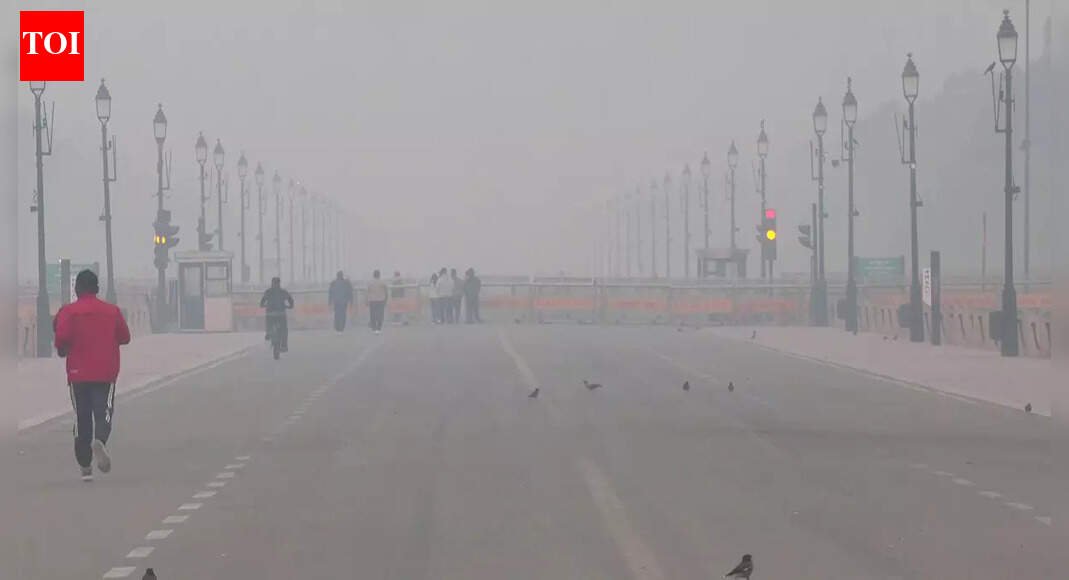
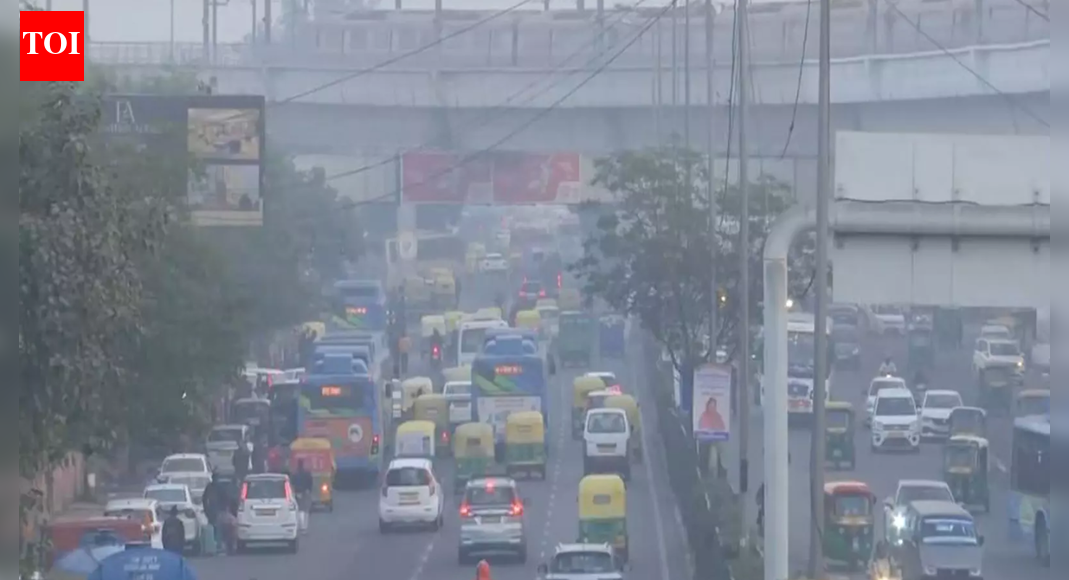
NEW DELHI: Delhi’s air quality deteriorated sharply Tuesday evening, with the overall AQI climbing to 372, again edging close to the ‘severe’ category. More than 15 locations have already crossed that mark.According to the Central Pollution Control Board (CPCB), the city’s 24-hour average AQI at 4 pm stood at 372, rising from 304 on Monday and 279 on Sunday.
Out of 39 monitoring stations, 16 recorded readings above 400 — a level known to seriously impact health. Stations in the ‘severe’ category included Burari, Anand Vihar, Mundka, Bawana, Vivek Vihar, Rohini, Sonia Vihar, Ashok Vihar and Punjabi Bagh. The Air Quality Early Warning System for Delhi said the city’s AQI is expected to remain in the ‘very poor’ range over the next few days, with mist or haze likely during the night.Weather officials said surface winds are likely to blow from the southwest at calm to light speeds, picking up slightly in the afternoon. Wind speed is expected to rise to about 10 kmph from the north during the evening and night.Data showed the transport sector was the highest local contributor to Delhi’s pollution on Tuesday at 18.4 per cent. This was followed by peripheral industries at 9.2 per cent and emissions from neighbouring cities including Noida (8.2 per cent), Ghaziabad (4.6 per cent), Baghpat (6.2 per cent), Panipat (3.3 per cent) and Gurugram (2.9 per cent). Transport emissions are forecast to contribute 15.6 per cent on Wednesday.On the weather front, Delhi recorded a maximum temperature of 25.8°C and a minimum of 9.6°C, both marginally above normal. The IMD has forecast fog on Wednesday, with temperatures expected to settle around 24°C and 8°C.
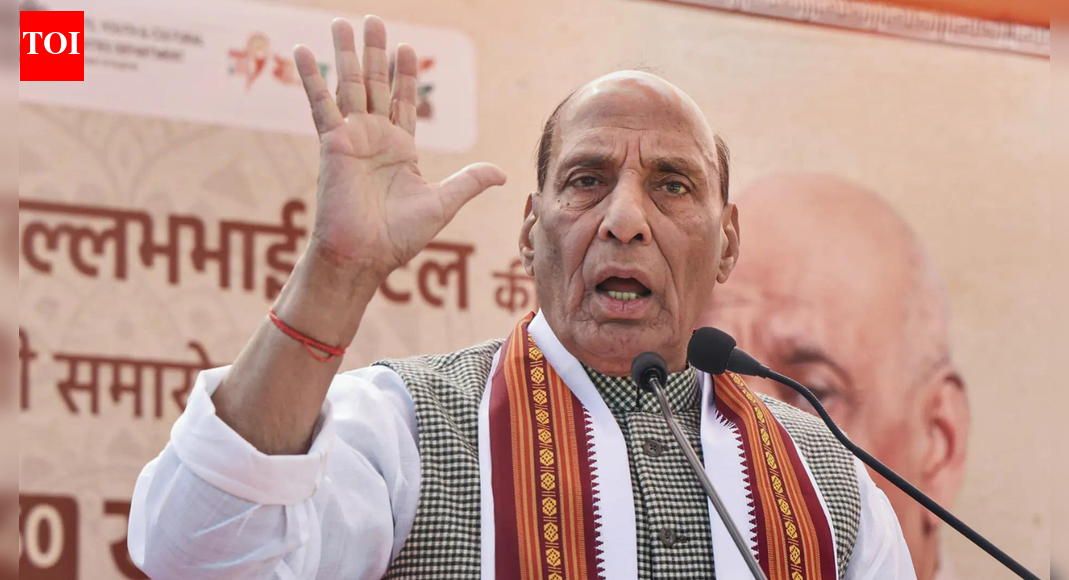
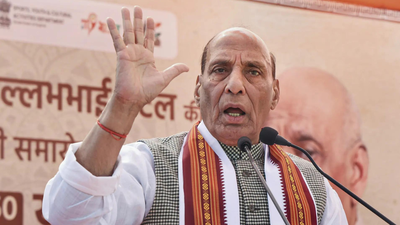
NEW DELHI: Defense minister Rajnath Singh on Tuesday said Operation Sindoor had sent a clear signal that India responds firmly when pushed, drawing a parallel between the government’s action against terrorism and the decisive leadership of Sardar Vallabhbhai Patel. Speaking at the ‘Sardar Sabha’ in Vadodara’s Sadhli village during the Unity March organised to mark Patel’s 150th birth anniversary, he said the operation demonstrated India’s ability to act when peace efforts are ignored.
“India showed the world through Operation Sindoor that it is capable of giving a befitting reply to those who do not understand the language of peace and goodwill”, Singh said, as quoted by news agency PTI.Singh praised the armed forces for the success of the mission, stating that “the world is today acknowledging the bravery and capabilities of Indian soldiers.” He added that Patel too believed in dialogue but did not hesitate to take a hard line when required, recalling his role in Hyderabad’s merger. According to him, the present government had upheld the same value through Operation Sindoor, which is “being discussed not only on Indian soil but also in other countries around the world”.The minister targeted former Prime Minister Jawaharlal Nehru over the Babri Masjid issue, saying Nehru intended to construct it using public funds, a proposal prevented by Patel. Singh said Patel had also clarified that the restoration of the Somnath Temple was different because the Rs 30 lakh required had been contributed by ordinary citizens. “Similarly, the government didn’t give a single rupee to construct the Ram Temple in Ayodhya,” he said, calling it an example of “real secularism”.Singh said the Modi government had strengthened Patel’s vision of a united India, citing the removal of Article 370. He argued that if Patel’s approach had been followed during the accession of Kashmir, the issue would not have lingered for decades. He also criticised attempts by earlier governments to minimise Patel’s legacy, claiming that even memorial funds raised by people were redirected on Nehru’s instructions.He questioned why Patel was not given the Bharat Ratna at the time, noting that Prime Minister Narendra Modi later honoured him through the Statue of Unity.Emphasising national security and defense modernisation, Singh said Patel had long pushed for indigenous capability — an approach the current government is pursuing through Make in India. India aims to achieve defense production worth Rs 3 lakh crore and exports of Rs 50,000 crore by 2029, he said, highlighting that defense exports had risen nearly 34-fold in 11 years.He also spoke of the proposed Constitution (130th Amendment) Bill 2025, which seeks ethical conduct from those in high office, providing for automatic removal if a person arrested on serious charges does not secure bail within 30 days.Singh said Patel himself cared little for position, recalling that he stepped aside in 1946 on Mahatma Gandhi’s advice, allowing Nehru to become Congress president despite having majority backing.Senior leaders, including Punjab governor Gulab Chand Kataria and Uttarakhand chief minister Pushkar Singh Dhami, also attended the event.
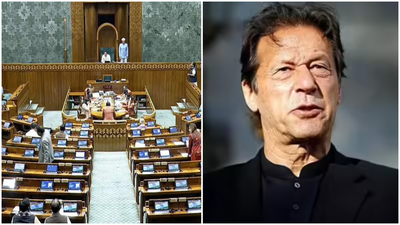
NEW DELHI: Parliament is set to hold key discussions on electoral reforms and the 150th anniversary of the national song, Vande Mataram, after lawmakers reached an agreement to resume proceedings smoothly following days of disruptions. Meanwhile, in Pakistan, former Prime Minister Imran Khan received a visit from his sister at Adiala Jail, breaking weeks of restricted access that had sparked protests by PTI supporters and family members.
Navy chief Admiral Dinesh K Tripathi announced the upcoming commissioning of the country’s third indigenous nuclear submarine and highlighted the Navy’s strategic role during Operation Sindoor, which pressured Pakistan’s naval forces to remain close to their ports.Here are the top 5 news stories of the day:
The government and opposition reached an agreement to ensure smooth functioning of Parliament after two days of disruptions, clearing the way for a detailed 10-hour discussion on electoral reforms on December 9 and 10. The decision was finalised during a Business Advisory Committee meeting chaired by Speaker Om Birla, who also scheduled a debate on the 150th anniversary of Vande Mataram for December 8. Read full story
Authorities at Rawalpindi’s Adiala Jail allowed Imran Khan’s sister, Uzma Khanum, to meet the former Pakistan prime minister after several weeks of denied access that had fuelled protests by PTI supporters. PTI workers gathered outside the jail as family members demanded clarity on Imran’s health. The meeting followed weeks of blocked visits despite an Islamabad High Court order and growing tensions over alleged police assaults on Imran’s sisters during recent demonstrations. Read full story
Telecom minister Jyotiraditya Scindia clarified that the government’s Sanchar Saathi cybersecurity app is completely optional for users. Speaking outside Parliament, he said the app does not enable call monitoring or snooping, and users can choose to register, remain inactive, or delete it at any time. Read full story
Congress leader Rahul Gandhi weighed in on the controversy surrounding MP Renuka Chowdhury bringing a stray dog to Parliament, questioning why pets are allowed “inside” but not outside the complex. He said, “What has the poor dog done? I guess these are the things India is discussing these days,” as per PTI. The remarks drew criticism from the BJP, which accused Gandhi of likening leaders to dogs. Read full story
Navy chief Admiral Dinesh K Tripathi announced that India’s third indigenously built nuclear-powered submarine will be commissioned soon. Speaking ahead of Navy Day, he said the Navy’s swift and aggressive action during counterterror Operation Sindoor forced Pakistan’s naval forces to stay close to their ports near the Makran coast. Read full story
NEW DELHI: With a little over 3 lakh property uploads initiated on the Central Waqf Portal (UMEED) so far and the six month deadline set out under the Waqf (Amendment) Act 2025 coming to an end on December 5, the ministry of minority affairs on Monday urged people who have still not registered to “hurry” and upload details as it is “mandatory” and only “4 days are left”.The ministry’s post on X to expedite uploads came after the Supreme Court refused to extend time for the mandatory registration of all waqf properties under the UMEED portal. For those who fail to upload by Friday, the only option will be to approach the waqf tribunal. Only if the tribunal is satisfied with the reasons for not filing within the deadline, it can allow extension of time up to six months.
West Bengal which has been strongly opposing the amended Waqf Act last week reportedly issued directions to the state authorities to adhere to the deadline and upload details of all waqf properties. It had not joined the process earlier even though there was no official communication to the ministry on its stand on registration on the portal. The number of properties from the state that have initiated uploading stood at 5,478 on Monday evening.Of the 3 lakh plus uploads initiated, the properties are at different stages of verification and as of Monday 7,353 were rejected and over 41,000 were awaiting approval.While the status of uploads stands at zero for Arunachal Pradesh, Mizoram, Nagaland and Sikkim from the northeast and Goa in West and Ladakh in the north, the maximum uploads have been initiated so far from Karnataka (54,150) followed by Maharashtra (45,310) and Uttar Pradesh (37,104).The ministry will be holding an online meeting with Waqf Boards on Tuesday to meet the deadline. The wide variation in data uploads across states indicates a probability of decline in the total number of properties that might finally end – up successfully uploading the information within the deadline.On concerns related to glitches and complexities in uploading being cited by some Muslim bodies and Muttawalis, the ministry has claimed that adequate training and meetings have been held with waqf boards.At the time of the launch of the portal that aims to bring transparency in the database, the ministry had shared that there were over 8.72 lakh properties registered as waqf as per data shared by states. However, ministry officials said that the data on the earlier – Waqf Assets Management System of India (WAMSI) was found to be severely lacking necessitating a new portal (UMEED) that seeks to plug the gaps.
NEW DELHI: The central government’s dictum to makers regarding pre-installation of the Sanchar Saathi application on all mobile handsets manufactured or imported in India has sparked a massive political row over concerns of privacy breach.While the department of telecommunications (DoT) justified the measure as a move for “curbing IMEI misuse”, the opposition has raised red flags calling it a “snooping app” and terming the move “unconstitutional”. Some even compared it with Pegasus spyware.
The International Mobile Equipment Identity (IMEI) is a unique number used to identify mobile phones. Most phones have one IMEI, but dual-SIM phones have two.
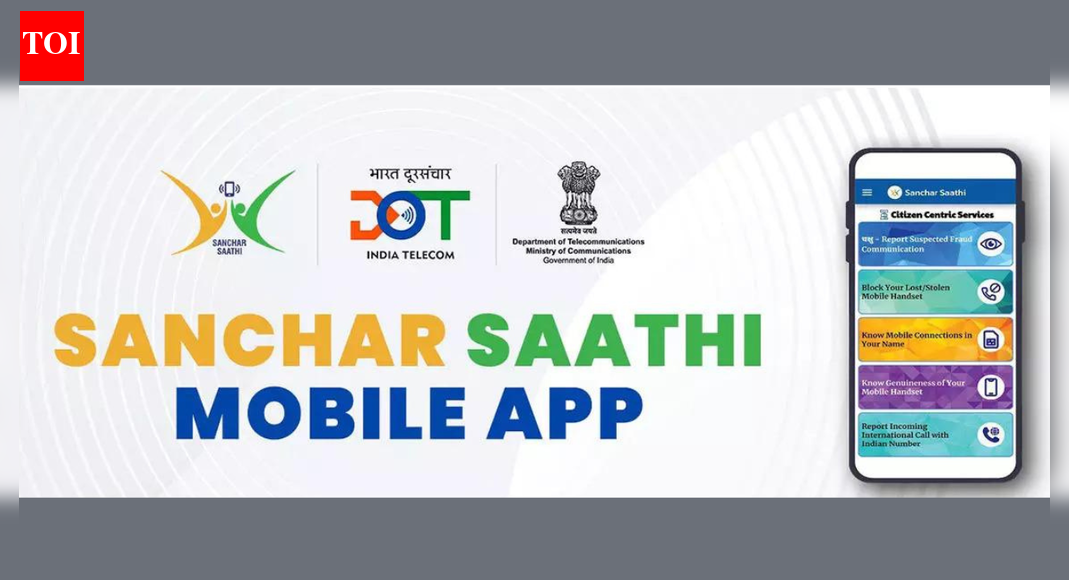
Sanchar Saathi App is a “citizen centric initiative of DoT to empower mobile subscribers, strengthen their security and increase awareness about citizen centric initiatives.”It offers services like reporting fraud calls or messages, checking phone genuineness through IMEI, finding and blocking lost phones, seeing all mobile numbers in your name, and reporting suspicious international calls. It requires permissions for call/SMS logs, sending SMS for registration, accessing photos/files, and using the camera for IMEI scanning.The controversy erupted after DoT directed all mobile manufacturers and importers to pre-install the Sanchar Saathi app on devices sold in India, calling it a move towards “strengthening cybersecurity and curbing IMEI misuse.”
Calling it a “dystopian” move, Congress general secretary KC Venugopal questioned the constitutionality of the move saying, “A pre-loaded government app that cannot be uninstalled is a dystopian tool to monitor every Indian. It is a means to watch over every movement, interaction and decision of each citizen.”“Big Brother cannot watch us. This DoT Direction is beyond unconstitutional. The Right to Privacy is an intrinsic part of the fundamental right to life and liberty, enshrined in Article 21 of the Constitution,” he said.Echoing similar sentiments, Congress MP Priyanka Gandhi slammed the Centre for “turning this country into a dictatorship”. She termed it a “snooping app” and said that it was an “excuse to go into every citizen’s telephone”.“It is a snooping app. It’s ridiculous. Citizens have the right to privacy. Everyone must have the right to privacy to send messages to family, friends, without the government looking at everything… They are turning this country into a dictatorship in every form,” she said.“There’s a very fine line between reporting fraud and seeing what every citizen of India is doing on their phone. That’s not how it should work. There should be an effective system to report fraud. We’ve discussed this at great length on cybersecurity. There’s a need for cybersecurity, but that doesn’t mean that it gives you an excuse to go into every citizen’s telephone. I don’t think any citizen would be happy,” she added.“They brought in Pegasus and have been unable to keep it under control. MPs and MLAs all say that their phones are being tapped. For the last 11 years, basic rights of the Indians have been taken away… This is the real violation of National Security,” Congress MP Renuka Chowdhury said.Interestingly, Congress MP Shashi Tharoor said that the app could be “useful provided they are voluntary”.“I have not studied the issue in full detail, but common sense tells me that these apps can be useful provided they are voluntary. Everybody who needs them should be able to download them. Making anything compulsory in a democracy is troubling. But I need to look a little more into what the logic is of the government. In fact, the government should explain all this to the public instead of just passing an order that the media reports. I think we need to have a discussion where the government explains what their thinking is,” he said.
Shortly after the row, Union communications minister Jyotiraditya Scindia clarified that the app could be deleted, dismissing opposition leaders’ “snooping” charges.“When the opposition has no issues, and they are trying to find some, we cannot help them. Our duty is to help the consumers and ensure their safety. The Sanchar Saathi app enables every consumer to ensure their safety… Sanchar Saathi portal has more than 20 crore downloads, and the app has more than 1.5 crore downloads… Sanchar Saathi has enabled the disconnection of nearly 1.75 crore fraudulent mobile connections,” he said.“Around 20 lakh stolen phones have been traced, and around 7.5 lakh stolen phones have been handed over to their owners, all because of Sanchar Saathi… This app does not enable snooping or call monitoring. You can activate or deactivate it as per your wish… If you don’t want Sanchar Saathi, you can delete it. It is optional… It is about customer protection. I want to clear all misconceptions… It is our duty to introduce this app to everyone. Keeping it on their devices or not is up upto the user… It can be deleted from the mobile phone just like any other app,” he added.
NEW DELHI: What if spotting a cluster of fevers or sudden diarrhoea cases in your neighbourhood could help stop an outbreak? A new nationwide system launched by the National Centre for Disease Control (NCDC) is now making that possible — by turning ordinary citizens into the country’s earliest disease sentinels.At the heart of the system is a simple QR code. Anyone can scan it from the Health Ministry or NCDC website, or from posters and materials being rolled out across states. Once scanned, the user enters basic details and selects what they’re reporting — a fever cluster, recurring diarrhoea, jaundice, dog bites, suspected food poisoning or any other unusual health event. Photos or short videos can also be uploaded. The moment a report is submitted, the alert lands simultaneously in district, state and national surveillance dashboards, where officers verify it and initiate investigations if required.Dr Ranjan Das, director NCDC said that the tool fills a critical gap in India’s surveillance network. Many outbreaks begin silently in homes, neighbourhoods or small gatherings well before patients reach hospitals. A citizen report — sometimes within hours — can help health authorities intervene early, contain spread and prevent large-scale outbreaks.Dr Himanshu Chauhan, additional director and HOD IDSP call this a “game changer,” especially during dengue, diarrhoea, influenza and waterborne disease seasons. But they caution that the system will work only if citizens use it responsibly — and consistently.To protect users, all submissions are routed through secure government servers, with personal data safeguarded under national cyber-security protocols. False or irrelevant reports are filtered through a combination of automated checks and manual verification by trained district teams.The Community Reporting System, introduced in January 2024 under the Integrated Disease Surveillance Programme (IDSP), was envisioned to give communities a direct role in early outbreak detection. Despite being launched in 2024, the tool remained largely unknown due to poor efforts to popularize it, resulting in only about 100 valid reports so far. The low utilisation highlights the gap between technology and public engagement, though officials say even this early trickle shows that once people know the platform exists, they are willing to report.The message from NCDC is clear: public health isn’t just a government job — it needs citizen vigilance too. Sometimes, a QR scan and 30 seconds may be all it takes to stop the next outbreak.