Breaking News
‘India stands in solidarity’: PM Modi speaks to UAE prez, condemns attacks by Iran | India News


'India stands in solidarity': PM Modi speaks to UAE prez, condemns attacks by Iran

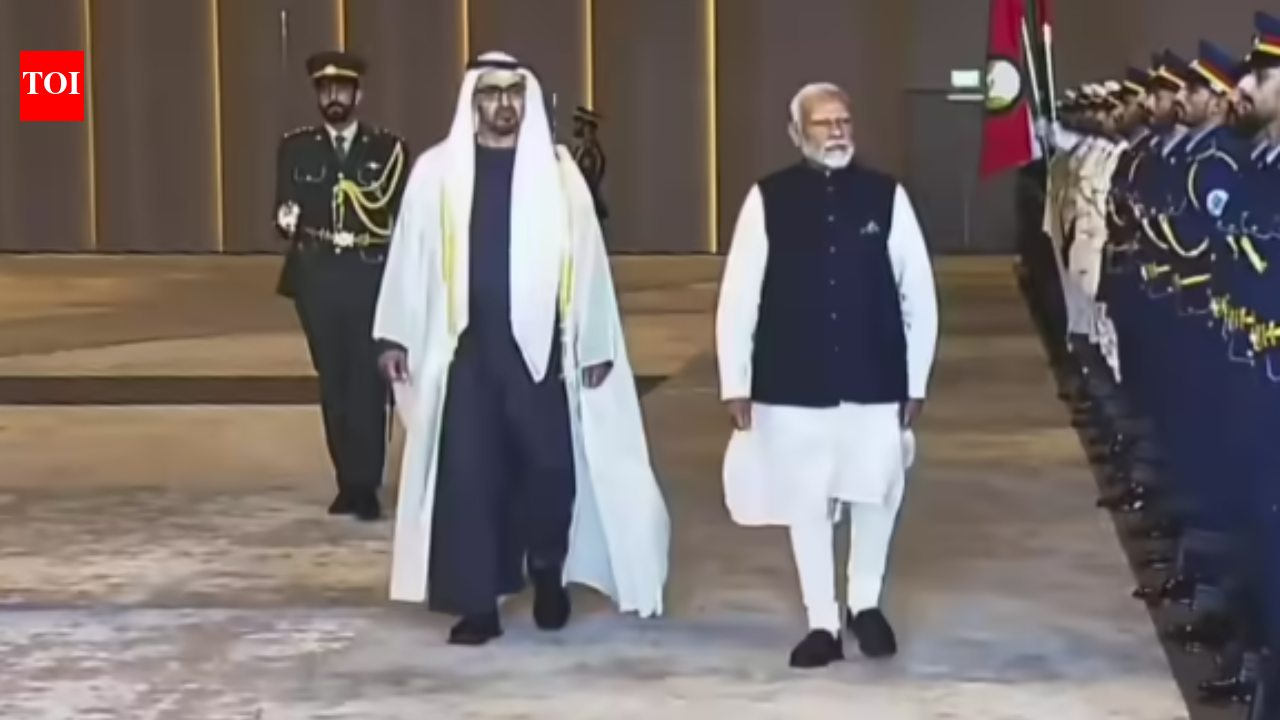
NEW DELHI: Prime Minister Narendra Modi on Sunday spoke to Mohamed bin Zayed Al Nahyan as Iran’s retaliatory missile and drone campaign battered parts of the Gulf, killing civilians and striking key infrastructure across the region.In a message posted on X, PM Modi said: “Spoke with President of the UAE, my brother Sheikh Mohamed bin Zayed Al Nahyan. Strongly condemned the attacks on the UAE and condoled the loss of lives in these attacks. India stands in solidarity with the UAE in these difficult times. Thanked him for taking care of the Indian community living in the UAE. We support de-escalation, regional peace, security and stability.”The Prime Minister’s remarks came as Emirati authorities confirmed that four people had been killed and dozens wounded since Iran began its counterstrikes following US and Israeli operations that eliminated Tehran’s supreme leader and other senior officials. Explosions were heard for a second day in cities including Dubai and Abu Dhabi, with Gulf states scrambling to intercept missiles and drones.The UAE’s defence ministry said it had detected 165 ballistic missiles since Saturday, destroying 152 of them, while intercepting two cruise missiles. Of 541 Iranian drones launched, 506 were shot down. Despite the high interception rate, debris from downed projectiles caused casualties and damage. Three foreign nationals — from Pakistan, Nepal and Bangladesh — were reported among those killed in the UAE. Two people were injured when debris struck a building complex in Abu Dhabi that houses foreign missions.Civilian infrastructure across the Gulf has been affected, including airports, seaports and residential buildings. Fires were reported at prominent sites in Dubai, while airports in the UAE and Kuwait were also hit. In Bahrain, drones caused minor damage at the capital’s airport.


Source link

LoC drone intrusions force closure of Kashmir schools till March 3 | India News


LoC drone intrusions force closure of Kashmir schools till March 3

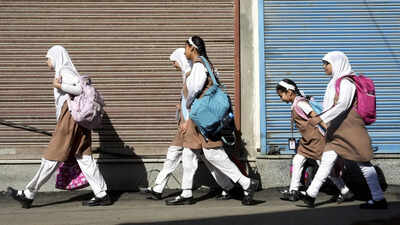
NEW DELHI: Schools across Jammu and Kashmir will remain closed on March 2 and 3 due to multiple Pakistani drone intrusion attempts along the Line of Control (LoC) and escalating tensions in West Asia, the directorate of school education, Kashmir, announced today.Authorities postponed the scheduled reopening of schools up to Class 8th—originally set for tomorrow after winter vacations—to prioritise student safety amid a rapidly evolving security situation. The order covers all government and private recognised schools in the region.

Suspected Pakistani Drones Spotted Along LoC, IB Near Samba, Rajouri & Poonch Districts In J&K

In the latest incident, Indian Army troops thwarted 2-3 small quadcopters trying to breach Indian airspace in the Poonch sector along the LoC between 5:45 AM and 6:00 AM today. Vigilant personnel deployed swift counter-drone measures, forcing the drones to retreat without causing harm.This marks the latest in a series of drone sightings along the LoC and International Border over recent days, prompting the Army to ramp up surveillance and readiness against further violations.The closures coincide with heightened regional instability triggered by joint Israeli-US missile strikes on Iran—codenamed Operation Roaring Lion and Operation Epic Fury—which reportedly killed Supreme Leader Ayatollah Ali Khamenei, his daughter, grandchild, daughter-in-law, and son-in-law in explosions across Tehran and other cities. US President Donald Trump confirmed the strikes, while Iranian state media echoed the leadership casualties.Iran retaliated by targeting US bases in Dubai, Doha’s Qatar, Bahrain, and Kuwait, further stoking fears of broader conflict spillover into South Asia. Officials in Jammu and Kashmir cited these combined threats as driving the two-day shutdown to protect children.


Source link

PMO seeks third-party audits for road, rail projects; highway ministry asked to study GQ-era construction | India News


PMO seeks third-party audits for road, rail projects; highway ministry asked to study GQ-era construction

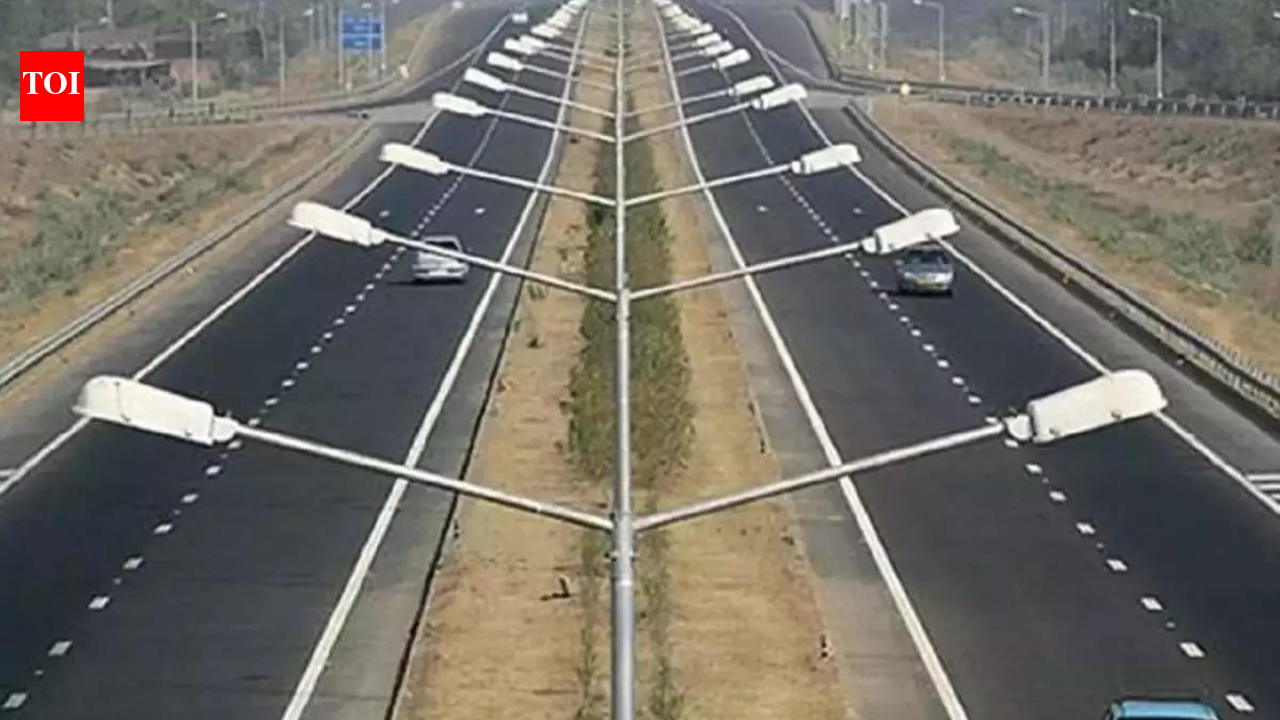
New Delhi: Amid the increased pace of construction and the laying of new road and rail corridors, the PMO has directed the road transport and railway ministries to introduce independent third-party audits to ensure high-quality work. They have also been asked to eliminate delays in project execution.TOI has learnt that PM Narendra Modi has also asked the road transport ministry to study Golden Quadrilateral-era construction practices, taking note of why there were very few quality-related complaints during the execution of the country’s first flagship highway development programme.PMO has also suggested that the ministry study the practice of third-party independent audits in Indonesia, which has institutionalised the mechanism to improve quality and accountability in large infrastructure projects. Last year, Malaysia too introduced “external audits” for the purpose.Both ministries have been directed to take measures for faster movement of trains and vehicles on their corridors, considering the high investment being made in these sectors. As per the directives, road ministry will identify constraints and gaps that result in average speed of freight trucks on high-speed corridors being around 50 kmph as against the desired speed of 70 kmph and address them. Similarly, railways will set phased targets for increasing train speed on corridors from 110 kmph to 130 kmph and further to 160 kmph and above 200 kmph.Officials involved in highway projects admitted the need to focus on quality issues considering that the next phase of highway development will have more expressways and economic corridors for faster movement of freight and passengers.They added that ministry has already identified issues relating to quality and started the process to address them. Revising the timeline for construction of highways in contract documents from the current 2-2.5 years to three years and doing away with the provision of bonus to contractors for early completion of works are some of the first steps being taken.Engineers who have been involved in both GQ and current highway projects said that though the scale of construction during that phase was lower, the monitoring of material and work quality was stringent. “The authority engineers and consultants were mostly from abroad, and they wouldn’t compromise on quality. There were big and credible highway builders, and even govt engineers were strict when it came to quality,” said a former NHAI member.In fact, the chief of a major highway construction firm, while participating in a meeting on quality improvement chaired by top officials, had shared how govt engineers and consultants wouldn’t budge on any pressure to compromise on quality during implementation of GQ.“Objective and strict monitoring of quality of material and construction by field staff is the only solution. We must give enough time for preparation of project reports and construction rather than rushing for completion,” said an official overseeing the sector.A former director general of roads said the quality of construction has taken a backseat with the sudden increase in number of highway builders, including many that were earlier into subcontracting and maintenance contracts.“Good engineers and independent consultants supervising projects face pressure from different quarters over being strict and often contractors complain against them. There should be clarity — that the authorities will not spare those into mischief-making and will stand by competent govt employees and consultants. We also need to have more credible quality testing agencies that don’t compromise at any cost,” he added.

PM Modi Unveils Seva Teerth, A New PMO Hub Marking Governance Shift In National Capital Delhi


Source link

Ban, regulate or reform? Social media & under-15s – The India question | India News


Ban, regulate or reform? Social media & under-15s – The India question

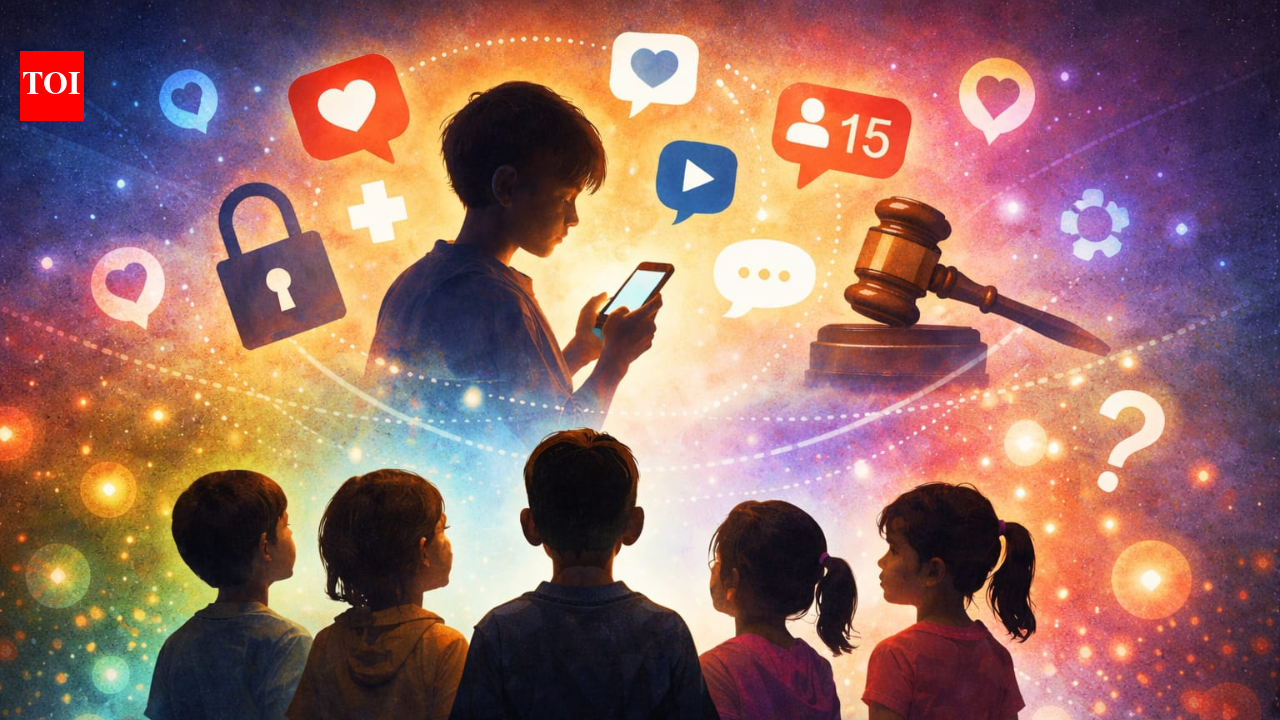
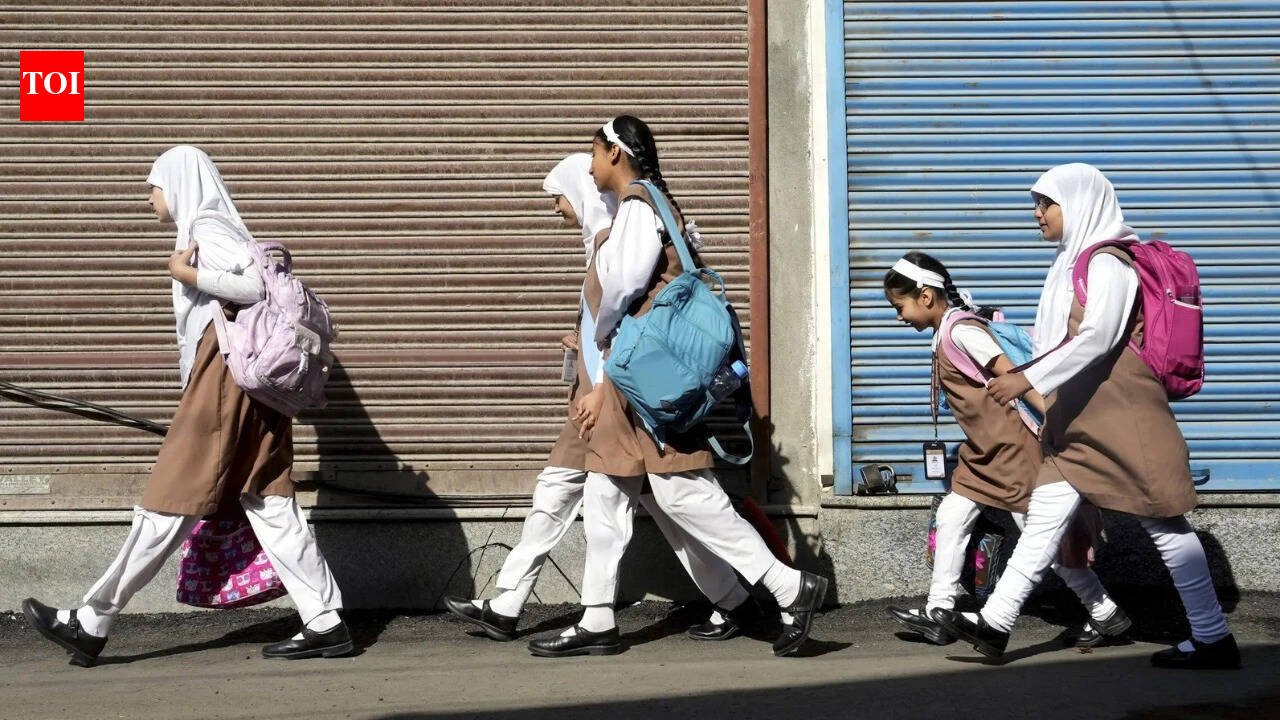
At 9, Aahana checks her mother’s phone before brushing her teeth. By the time she leaves for school in Gurugram, she has scrolled through multiple short-video feeds, probably texted in two group chats. Her mother says she worries about how much she is engaged now to what happens on a screen.Across India’s cities and small towns, this scene is no longer unusual. Smartphones are often handed to children before they enter their teens, at times when they are toddlers. Social media accounts, sometimes created despite platform age limits, follow soon after. What began as a tool for communication has become an ecosystem where friendships, validation and identity increasingly take shape.

.

Australia Enforces World’s First Under-16 Social Media Ban, Sparks Global Debate| Global Pulse

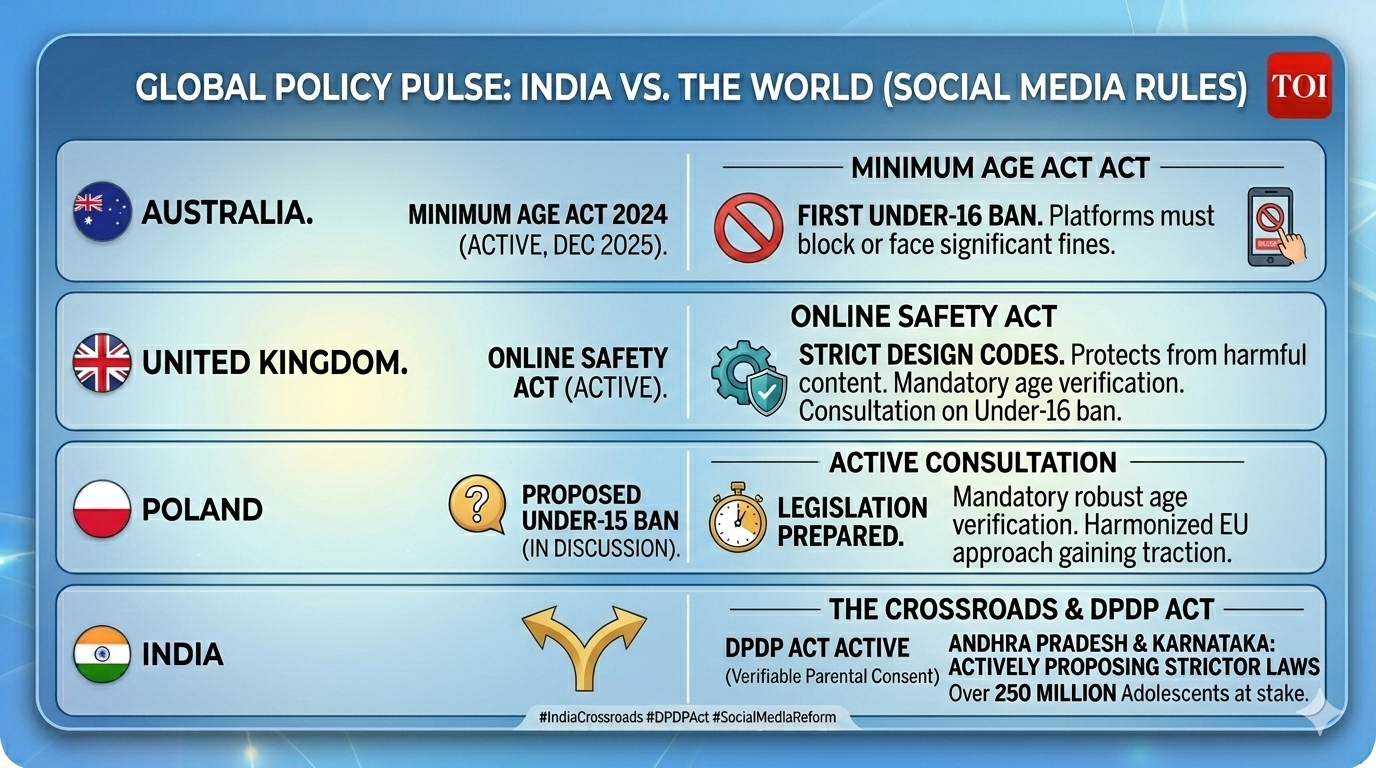
Now, as countries from Australia to the United Kingdom tighten digital safety norms for minors, India faces a policy crossroads: confronting a difficult question: should social media platforms be off-limits for those under 15? The debate is no longer theoretical, rather have shifted from anecdotal parental anxiety to a public health and regulatory conversation backed by research. Mental health professionals are reporting patterns. Concerns around screen addiction, online bullying, harmful content and declining mental health indicators among adolescents have pushed policymakers to study global precedents worldwide to consider stricter age-gating laws. In India, home to over 250 million adolescents and one of the world’s largest internet user bases, the stakes are significantly higher. For millions of Indian children, the smartphone is no longer a device of privilege but of routine. Classrooms moved online during the pandemic. Friendships migrated to messaging apps. Entertainment, identity formation and peer validation increasingly unfold through short videos and algorithm-driven feeds. Yet, alongside opportunity lies unease: how much exposure is too much, and at what age? The question is no longer whether social media affects children. It is whether prohibition is the answer, or whether regulation, design reform and digital literacy can achieve better outcomes.

Global regulatory shifts: A growing policy trend

Governments have begun responding to mounting evidence linking heavy social media use to mental health challenges among adolescents. And in effect have moved toward stronger age restrictions on social media use.In Australia, the government has moved from debate to implementation. The Online Safety Amendment (Social Media Minimum Age) Act 2024 took effect on 10 December 2025, making Australia the first country to ban social media accounts for users under 16, with platforms required to take “reasonable steps” to block access or face significant fines. Early evaluation of the law’s impacts, on youth wellbeing, family dynamics and usage patterns, has begun, with findings to be published through 2026 and beyond. In the United Kingdom, the Online Safety Act continues to impose stricter obligations on platforms to protect children from harmful or explicit material and enforce age-appropriate design. Regulators have fined major services for failing to adequately verify users’ ages, and the government is now consulting on potentially raising age restrictions or even exploring a formal under-16 ban after Australia’s example. Elsewhere in Europe, several countries are actively pushing similar measures. Poland’s ruling party is preparing legislation to ban social media for children under 15 and mandate robust age verification, while France, Denmark and other EU states are debating or enacting age limits between 15–16 years. Efforts toward a harmonised EU approach are gaining political traction amid rising concern over youth mental health, as reported by Reuters.

.

In the United States, the picture remains complex and contested. Multiple state laws aimed at age verification, parental consent or outright limits on minors’ social media use have been introduced. Notably, a Virginia law that would have limited under-16 usage to one hour daily and required age checks was blocked by a federal court in February 2026 for infringing constitutional speech rights, illustrating the legal challenges such measures face. While outright bans are still uncommon and legally fraught in the US, the direction of travel is clear: policymakers are increasingly shifting accountability from families to technology companies through design rules, verification obligations, and platform-level safeguards.The global policy shift is emphasised by mounting research linking heavy social media use among adolescents to anxiety, depression, sleep disturbances and body image issues, concerns now cited widely on public health grounds rather than purely moral arguments.For India, observing these global experiments offers both cautionary and instructive lessons. Enforcement challenges, the privacy implications of stringent age verification, and constitutional protections around free speech and access to information complicate the feasibility of blanket prohibitions. Ongoing debate reflects these tensions, with commentators urging a balanced focus on digital literacy, safer defaults, and family-oriented safeguards rather than top-down bans alone.

The impact of social media on children: Evidence and counterpoints

Screen time, mental health and behavioural risks

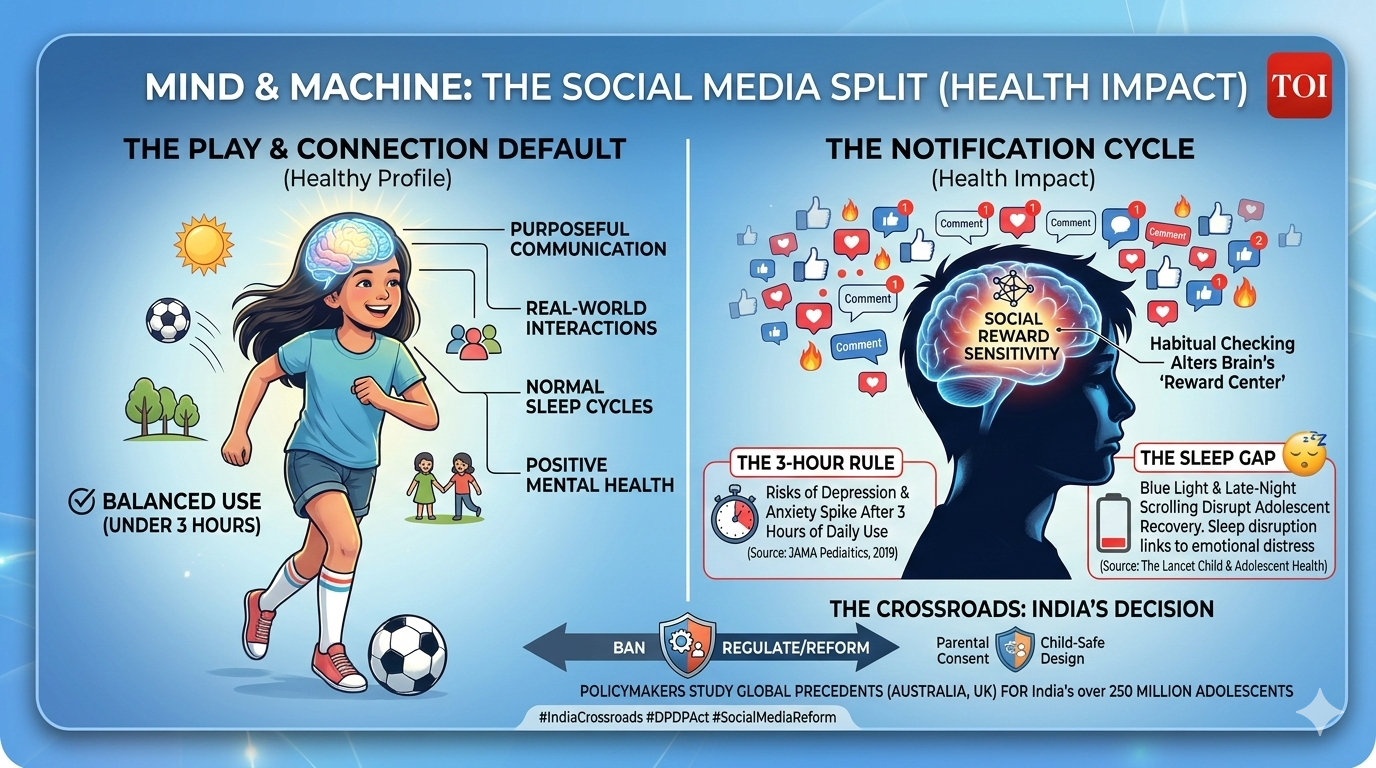
Research has consistently flagged correlations between excessive social media use and adverse psychological outcomes in adolescents.A 2019 study published in JAMA Pediatrics tracked nearly 6,600 adolescents and found that those spending more than three hours a day on social media faced a significantly higher risk of mental health problems, particularly internalising symptoms such as anxiety and depression.In 2023, another study in the same journal reported that habitual checking of social media was associated with changes in brain development patterns related to social reward sensitivity in early adolescence. While researchers cautioned that correlation does not prove causation, they noted measurable neural differences in frequent users.Similar research published in The Lancet Child & Adolescent Health has found that heavy social media use among teenage girls was associated with poorer sleep, lower self-esteem and higher rates of depressive symptoms. Sleep disruption emerged as a key pathway linking screen exposure to emotional distress.

.

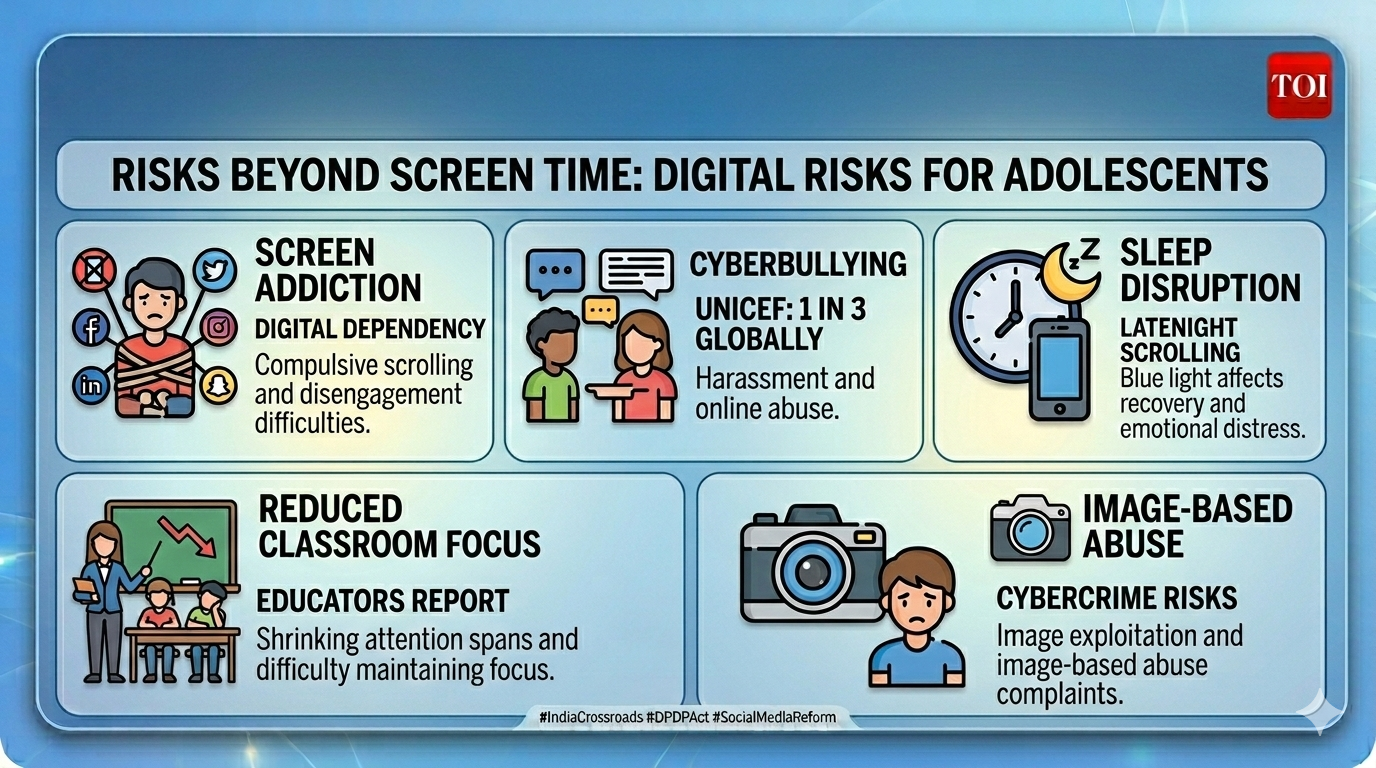
The WHO has flagged problematic digital use as a growing behavioural concern, noting associations with sedentary lifestyles, cyberbullying and compulsive use patterns.Dr Rhea Mehra, a Delhi-based child psychiatrist, says she has observed a steady increase in digital dependency cases among children aged 11 to 15. “We are seeing children who struggle to disengage from their devices, whose mood fluctuates based on online interactions,” she says. “In some cases, sleep cycles are severely disrupted because screen time extends past midnight (when left unchecked).”She adds that early adolescence is a vulnerable developmental stage. “Impulse control and emotional regulation are still developing. Social media platforms are designed around instant feedback and comparison, which can amplify insecurities.”

Cyberbullying and exposure risks

The risks are not limited to screen duration.A UNICEF report has highlighted that one in three young people globally reports experiencing cyberbullying. In India, cybercrime data show increasing complaints involving minors, including harassment and image-based abuse.Parents recount similar concerns. “It’s not just about time,” says Mohit, a Delhi-based father of an 11-year-old. “It’s about what they are seeing. There are trends and challenges that can be dangerous. And sometimes we don’t even know what’s circulating in their groups.”Another parent, Prathamesh Singh from Pune, says monitoring has become a daily task. “You don’t want to invade privacy, but you can’t be completely hands-off either. It’s a constant balancing act.”

.

Academic and developmental concerns

Educators report shrinking attention spans and difficulty maintaining classroom focus. Studies have linked excessive device use to reduced academic performance, though causation remains debated.Dr Mehra notes, “Some children show signs of reduced face-to-face social skills. They are comfortable online but anxious in real-world interactions.”

The counterpoint: Not all use is harmful

Research also cautions against sweeping conclusions.Studies have shown that moderate, purposeful use, such as communicating with known peers, does not uniformly predict poor mental health. For some adolescents, online communities provide support, particularly for those who feel isolated offline.The American Psychological Association has stated that the impact of social media depends on content, duration and individual vulnerability factors.“Blanket demonisation of technology is not helpful,” Dr Mehra says. “The question is how it is used, at what age and with what safeguards.”

India’s regulatory landscape: What exists

India does not currently ban social media for minors under 15. Most platforms prohibit users under 13, consistent with global standards, but enforcement relies largely on self-declared age.The Digital Personal Data Protection Act, 2023, mandates verifiable parental consent for processing children’s data and places obligations on data fiduciaries to protect minors’ information.The IT Rules, require intermediaries to remove unlawful content and establish grievance mechanisms. However, age verification remains technically and administratively complex. India’s vast user base, with hundreds of millions of internet subscribers, makes enforcement challenging.Legal experts also note that any outright ban would have to withstand scrutiny under constitutional protections related to speech and access to information, as interpreted by the Supreme Court of India.Enforcement, however, is India’s perennial challenge. With millions of new internet users each year and widespread access to shared devices, age-based prohibitions could prove difficult to implement uniformly. Rural-urban divides, digital literacy levels and socio-economic disparities further complicate the regulatory equation.

Should India impose a ban?

Among parents of children under 15, opinion is divided.Those advocating a ban argue that children under 15 lack the cognitive maturity to navigate algorithm-driven ecosystems designed for engagement maximisation. Some favour stricter age barriers, citing distraction, exposure to inappropriate content and peer pressure. Others worry that an outright ban would push usage underground, making monitoring harder.

.

Parents describe a daily negotiation: balancing academic needs with leisure use, setting screen-time limits and modelling digital discipline themselves. Many acknowledge that devices have become integral to schooling and social belonging, making complete prohibition unrealistic.“Regulation has not kept pace with platform design,” says Dr Mehra. “Younger adolescents are particularly susceptible to peer comparison and online validation cycles.On the regulation front, the argument in policy circles is also that, don’t wait for regulations, as current regulations are neither adequate, nor sufficient, nor can be termed as over -regulations.Parents like Mohit support stricter age thresholds. “If there was a clear law, it would make it easier for parents to say no,” he says. However, critics question feasibility. Children may bypass age checks using older relatives’ credentials. Overly intrusive verification could compromise privacy. And educational, creative and social benefits may be curtailed. Prathamesh believes prohibition could backfire. “If you ban it outright, they will find workarounds. It might push things underground.”Public health experts increasingly suggest a layered approach rather than an absolute ban.Child psychiatrists in metropolitan centres report an uptick in consultations linked to excessive gaming, social media dependency and anxiety triggered by online comparison. At the same time, mental health professionals caution against attributing complex psychological issues solely to social media. Family dynamics, academic stress, urban isolation and pandemic after-effects also play substantial roles.

What India could consider

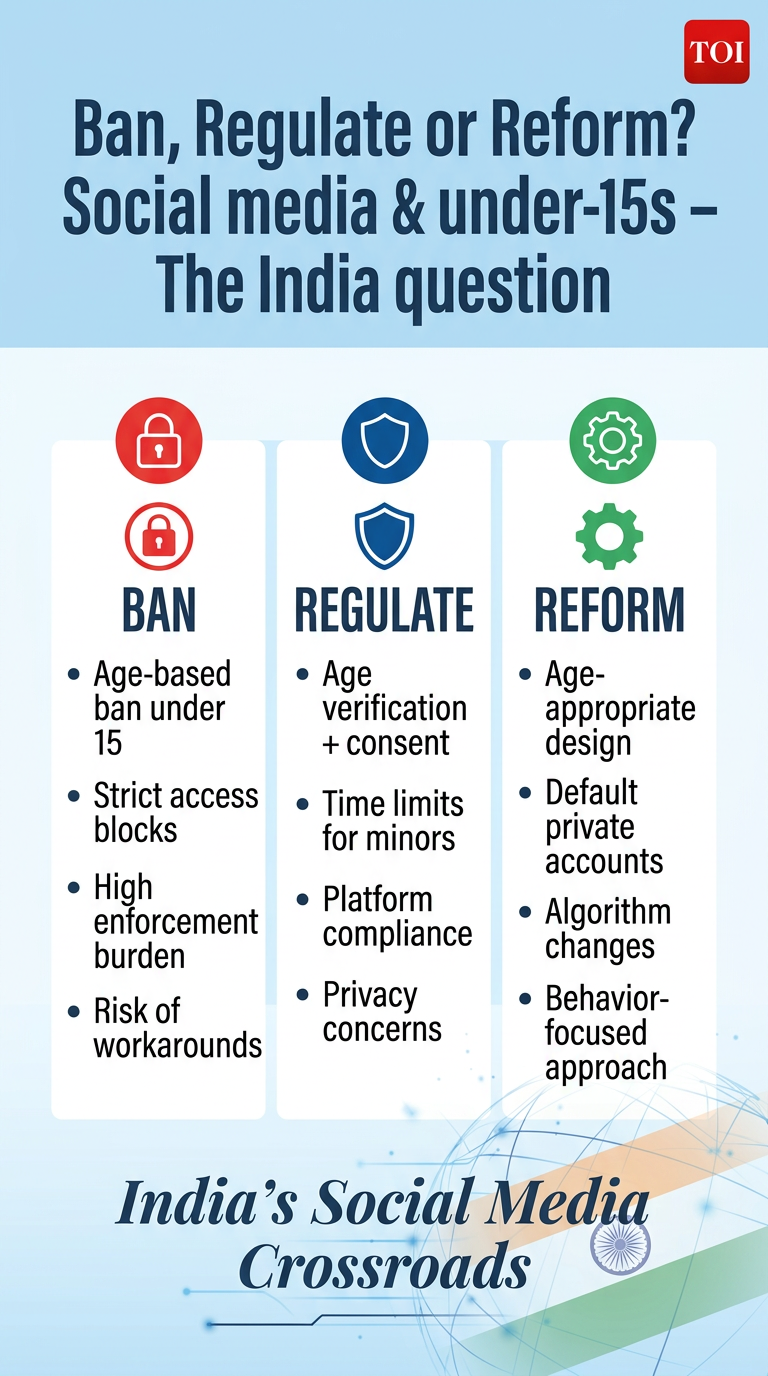
Borrowing from the UK’s age-appropriate design code, India could mandate that platforms default minors to private accounts, disable targeted advertising, remove public follower counts for young users, and limit algorithmic amplification of sensitive content. This approach shifts focus from access to environment.There is also a case for time-bound restrictions rather than outright bans, for instance, limiting usage hours for verified minor accounts or mandating built-in digital well-being tools. However, such measures depend heavily on platform cooperation and technical integration.Digital literacy is another lever. Experts argue that equipping children with critical thinking skills, teaching parents to set boundaries, and integrating online safety modules into school curricula may prove more sustainable than prohibition. The ministry of education’s ongoing digital awareness programmes could be expanded to include structured modules on cyberbullying, misinformation and privacy.

The constitutional and social balancing act

Any move toward a ban would likely invite legal scrutiny. Access to the internet has been described by courts as integral to freedom of expression and trade in certain contexts. While reasonable restrictions to protect minors are permissible, proportionality would be tested.India’s demographic reality adds complexity. A large chunk of its population is under 18. A uniform prohibition for under-15s could affect tens of millions of users, a scale unmatched by most Western nations experimenting with similar policies. Socio-economic context matters too. For children in resource-constrained settings, free digital platforms often double as learning tools, networking spaces and gateways to opportunities. Restrictive policies could inadvertently widen inequality if alternative safe platforms are not simultaneously developed.

Policy options include:

Public health experts increasingly advocate a layered approach:

  • Stronger age-verification systems, balanced against privacy concerns.
  • Age-appropriate design mandates, such as disabling targeted ads for minors and limiting algorithmic amplification.
  • Increase transparency in algorithms that recommend content to young users.
  • Default privacy settings for verified minor accounts.
  • Enforce stricter data protection norms for minors.
  • Strengthen reporting mechanisms for cyberbullying and harmful material.
  • Invest in digital literacy education for both children and parents.
  • Clearer parental control frameworks built into platforms.

Dr Mehra supports design reform. “If platforms reduced visible metrics like follower counts for minors, it could lower comparison anxiety,” she says.Research published in JAMA Pediatrics and The Lancet Child & Adolescent Health suggests that intensity and type of engagement matter more than mere access. Policymakers may therefore need to focus on the environment rather than outright exclusion.Such a framework recognises that the digital ecosystem is unlikely to recede. Instead of attempting to eliminate children’s access entirely, regulation could focus on reshaping the environment in which that access occurs.

Conversation already underway

Within India, the conversation is no longer theoretical. Andhra Pradesh has emerged as one of the most proactive states examining whether social media access should be restricted for school-going children. During a recent Assembly session, state home minister Vangalapudi Anitha informed lawmakers that a proposed law could limit social media use among minors. A government sub-group has since begun reviewing regulatory models, including age-based access controls and mechanisms to curb misinformation.IT and HRD minister Nara Lokesh publicly articulated the state’s concerns. In a post on X, he wrote:“Trust in social media is breaking down. Children are slipping into relentless usage, affecting their attention spans and education. Women are facing non-stop online abuse. This cannot be ignored.”He further noted that children below a certain age may lack the emotional maturity to process harmful online content, adding that the government is studying global best practices, including Australia’s under-16 framework. Official data cited by the state indicates over 1,300 cases linked to inappropriate online content, with more than 1,000 individuals taken into custody before court proceedings, figures that underscore enforcement challenges already underway.At the national level, TDP parliamentary party leader Lavu Sri Krishna Devarayalu has submitted a memorandum to Union minister Ashwini Vaishnaw seeking structured consultations on age-based regulation for minors. The Centre is expected to consider forming an expert panel before advancing any nationwide framework.Karnataka, meanwhile, is adopting a consultative approach. Chief minister Siddaramaiah recently sought feedback from university vice chancellors on restricting mobile phone use among students, referencing measures discussed in countries such as Australia, Finland and the UK.“Today we are discussing this… I want your opinion on this. We are looking at this,” he said, clarifying that any proposal would focus on minors rather than adult learners.Deputy chief minister DK Shivakumar has also raised concerns over rising screen dependence among youth. At the same time, Karnataka has rolled out a digital wellbeing initiative in partnership with Meta, covering nearly three lakh students and one lakh educators. The programme emphasises responsible and mindful technology use rather than outright bans, with outcomes currently under review. Together, these state-level experiments illustrate India’s emerging dilemma: whether to impose strict age-based bans, strengthen regulatory oversight, or prioritise digital literacy and behavioural reform. As debates intensify, the country appears to be testing multiple pathways before settling on a unified national position.

The balancing act ahead

The debate over banning social media for under-15s in India is ultimately about more than apps or algorithms. It reflects a broader anxiety about childhood in a hyperconnected age.India has one of the world’s youngest populations. Any move affecting under-15 users would impact tens of millions of families. The global momentum toward tighter regulation provides reference points, but India’s scale and diversity demand context-specific solutions.The evidence shows associations between heavy social media use and mental health risks, particularly among early adolescents. It also shows nuance: not every user experiences harm, and not every platform interaction is detrimental.For parents like Mohit, the question remains immediate. “We didn’t grow up like this. We are learning as we go,” he says.For clinicians like Dr Mehra, the trend is visible but complex. “This is not a single-cause issue. But social media is now a significant variable in childhood development.”Whether India chooses to ban, regulate or redesign access for under-15s, the policy must rest on evidence, enforceability and proportionality. The debate is less about whether children are online, they already are, and more about what kind of digital environment the country is willing to permit for them.

Source link

President Murmu to launch free pink mobility card for women in Delhi | India News


President Murmu to launch free pink mobility card for women in Delhi

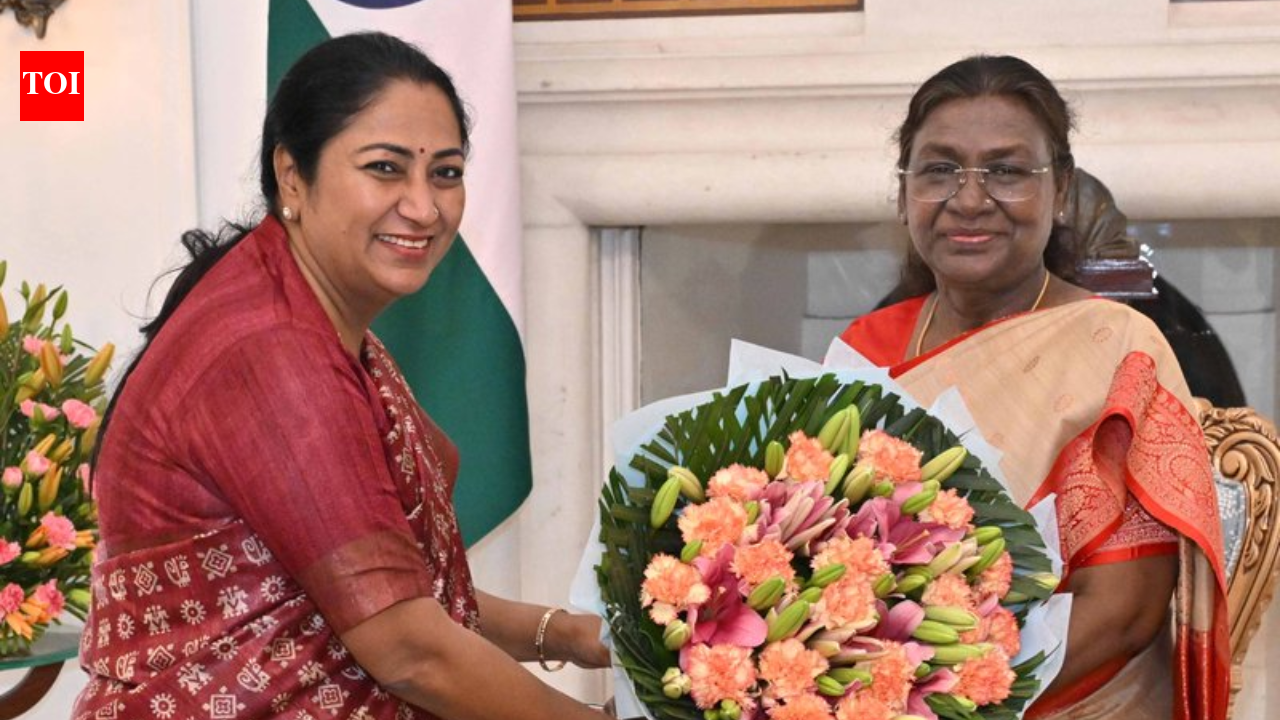
The Delhi government will launch a Pink National Common Mobility Card (NCMC) on Monday, aimed at providing free bus travel to women in the national capital and enabling seamless access to multiple public transport systems through a single smart card.The scheme will be formally launched by President Droupadi Murmu at a programme titled “Sashakt Nari, Samriddh Delhi” at the Indira Gandhi Indoor Stadium, according to a statement.At the same event, the President will also formally launch a scheme to provide two free LPG cylinders annually to all ration card-holding families in Delhi on the occasions of Holi and Diwali.According to Chief Minister Rekha Gupta, the benefit will be provided through Direct Benefit Transfer (DBT).An amount equivalent to the prevailing price of one LPG cylinder will be credited to the Aadhaar-linked bank account of the head of the family in whose name the ration card has been issued, the statement stated.It stated that the scheme is expected to cover approximately 1.55 million ration card-holding families to ease the financial burden of cooking fuel expenses and enable families to celebrate festivals with dignity and comfort.Gupta said the Pink Card would allow women residents of Delhi to travel free of cost on Delhi Transport Corporation (DTC) buses, while also being usable for paid travel on the Metro, Regional Rapid Transit System (RRTS) and other public transport services.She said the initiative is designed to make public transport more accessible and digital, while reducing daily travel costs for women and improving access to education, employment and healthcare.Under the scheme, three types of mobility cards will be issued — Pink for eligible women residents, Blue for general commuters and Orange for monthly pass users, the statement stated.In the first phase, Pink and Blue cards will be rolled out, with the Orange card to follow later, it added.The Delhi Transport Corporation has authorised Hindon Mercantile Limited (MufinPay) and Airtel Payments Bank Limited to issue the cards, it stated.The cards will be integrated with the existing Automatic Fare Collection System across Delhi’s public transport network, it stated and added the Pink Card will be provided free of cost, with expenses borne by the Delhi government.As per the statement, around 50 centres, including District Magistrate and Sub-Divisional Magistrate offices and selected DTC locations, will be set up for card issuance. Minimal documentation will be required to ensure a simple and transparent process.Each Pink Card will be linked to the beneficiary’s mobile number and Aadhaar to verify age, gender and Delhi residency, it stated.The Pink Card will replace the existing paper-based pink tickets, offering touch-free travel, digital records of journeys and improved transparency in revenue accounting, it mentioned.It added that selected women beneficiaries will be handed over the Pink NCMC cards at the launch event, marking a key step towards a more integrated and women-friendly public transport system in the capital.

‘Prachand’ Moment: President Murmu Flies in Indigenous Combat Helicopter Near India-Pak Border


Source link

Solo act or silent understanding? Congress and the Left in Bengal | India News


Solo act or silent understanding? Congress and the Left in Bengal

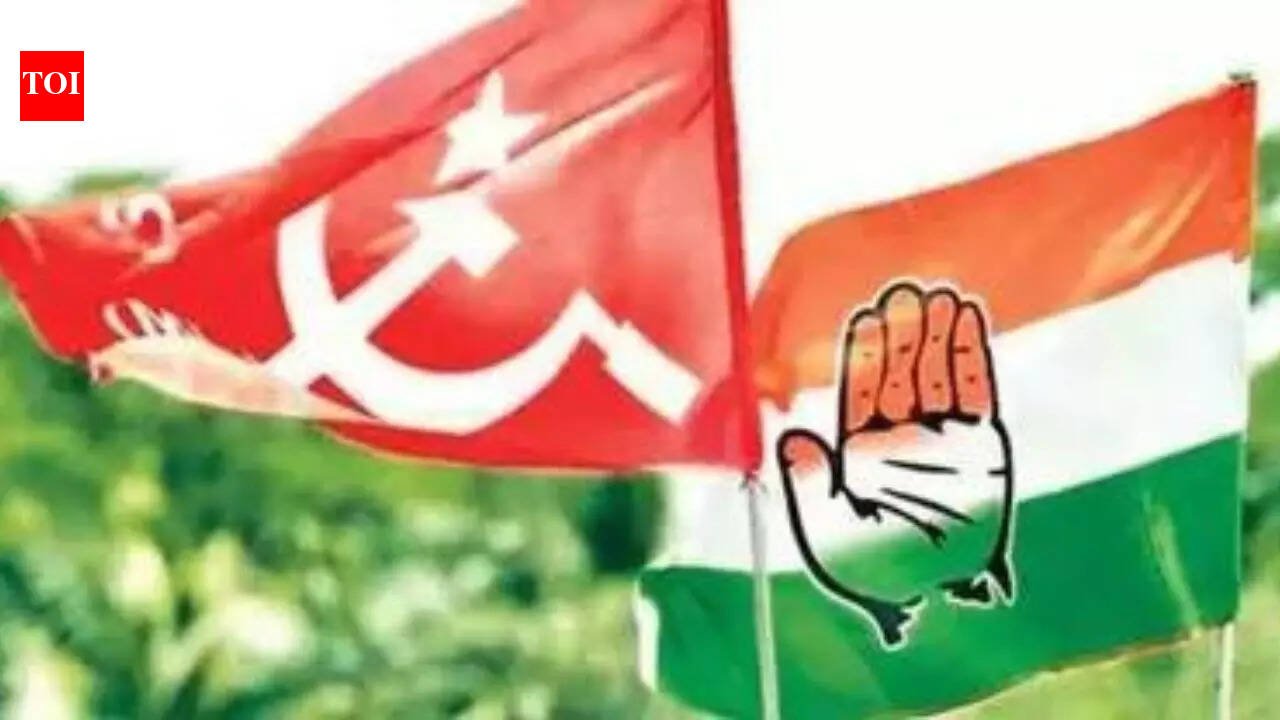
The Congress and the Left are set to contest the upcoming West Bengal assembly elections independently after the Congress earlier this month ended their tie-up. The move has triggered fresh speculation in a state where politics is dominated by chief minister Mamata Banerjee’s Trinamool Congress and its principal challenger, the BJP.Also Read | Congress’s Bengal dilemma: Who should grand-old-party target in 2026 polls – BJP or Mamata Banerjee?The decision marks another turning point for the two once-dominant forces that now find themselves struggling for relevance in Bengal’s increasingly bipolar political landscape.What drove the Congress to go it alone and what does the split mean for both the party and its now-former ally?

PM Modi’s Sharp Swipe At Congress Allies Says No Honest Work Done Ahead Of Polls

The Congress’ calculus

The Congress’ decision to go it alone has raised eyebrows given the party’s shrinking footprint in West Bengal. Explaining the rationale, a West Bengal unit leader said the central leadership believes the party has little to lose by contesting independently.

The central leadership feels the party has nothing left to lose, and we should therefore fight the battle on our own

A senior leader of West Bengal Congress

At the same time, the leader acknowledged that the contest would now be dominated by the TMC and the BJP.“The breakdown of our understanding with the Left has effectively left no space for a third pole in Bengal’s politics,” the leader told news agency PTI, requesting anonymity.

This election will now be fought almost entirely on the TMC-versus-BJP axis

West Bengal Congress leader

With the alliance no longer in place, the Congress plans to focus on consolidating its own vote share rather than relying on alliance arithmetic.

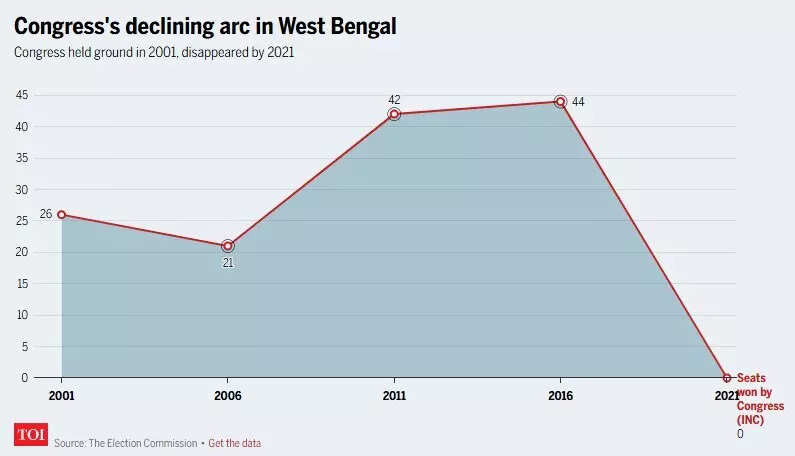
Congress' declining arc in Bengal

Congress’ declining arc in Bengal

Political observers also point to a contrast between the party’s current state leadership and its previous leadership. They say the relatively conciliatory approach of Subhankar Sarkar, the current boss, made it easier for the central leadership to end the Left alliance. The previous chief, ex-Lok Sabha MP Adhir Ranjan Chowdhury, was a known Mamata Banerjee critic and had set aside differences with the Left in an effort to unseat a common adversary.

Left’s response — and its options

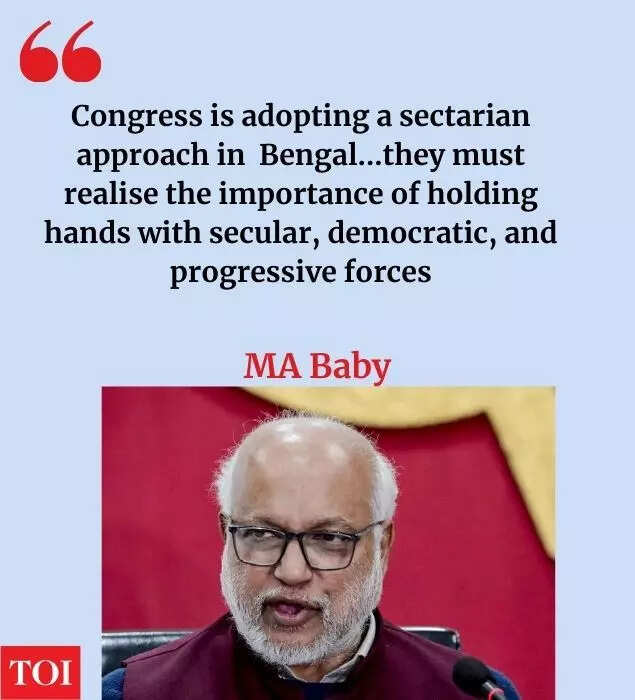
After staying silent for a few days, the Left responded to the Congress through CPI(M) general secretary MA Baby, a senior leader of the bloc.Also Read | ‘Congress will suffer’: CPM’s MA Baby on grand old party’s decision to contest Bengal polls alone“Congress is adopting a sectarian approach in West Bengal. We can cooperate with them only if they realise the importance of holding hands with secular, democratic, and progressive forces,” Baby said in Kolkata on February 13.

MA Baby on Congress

MA Baby on Congress

He added that in the struggle against “communal forces,” particularly the BJP, the Left favours alliances wherever feasible with like-minded parties, including the Congress.Some Left leaders say the bloc now intends to formalise all political arrangements — both official and tacit. They add that this would give the grouping time to deliberate on candidate selection with allies before finalising the list.Could such an understanding also exist with the Congress?

Congress’ exit to impact Left bloc?

The Congress’ absence from any prospective Left-led coalition could limit, if not significantly dent, the bloc’s electoral impact. This, political analysts say, is because the split could lead to a division of votes, mostly benefiting the TMC. As such, some form of ground-level understanding between them cannot be ruled out.At the same time, the Left and the Congress are direct rivals in Kerala, which is scheduled to go to the polls around the same time as West Bengal. The Left secured a second consecutive term in Kerala in 2021, breaking the long-standing pattern of power alternating between the Left and the Congress every five years. With anti-incumbency likely after a decade of Left rule, the Congress believes it has a realistic opportunity to reclaim power.In that context, contesting separately in West Bengal allows both parties to avoid uncomfortable questions about Kerala. Yet a tacit understanding in Bengal would also signal that despite sharp political attacks against each other, there is no irreparable strain in their broader political relationship.

Congress and Left: How arch-rivals became political allies

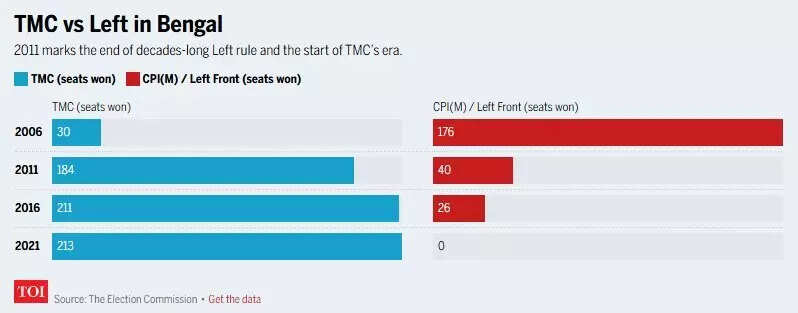
The old adage goes that politics makes strange bedfellows, often uniting rival forces against a common enemy too formidable to tackle alone. For the Congress and the Left in West Bengal, that adversary was Mamata Banerjee.The rise of Banerjee and the TMC pushed the two once-dominant political forces to the margins of Bengal politics. Since toppling the Left in 2011, the Trinamool has not only retained power but also expanded its dominance, crossing the 200-seat mark in successive assembly elections.

TMC vs Left in Bengal

TMC vs Left in Bengal

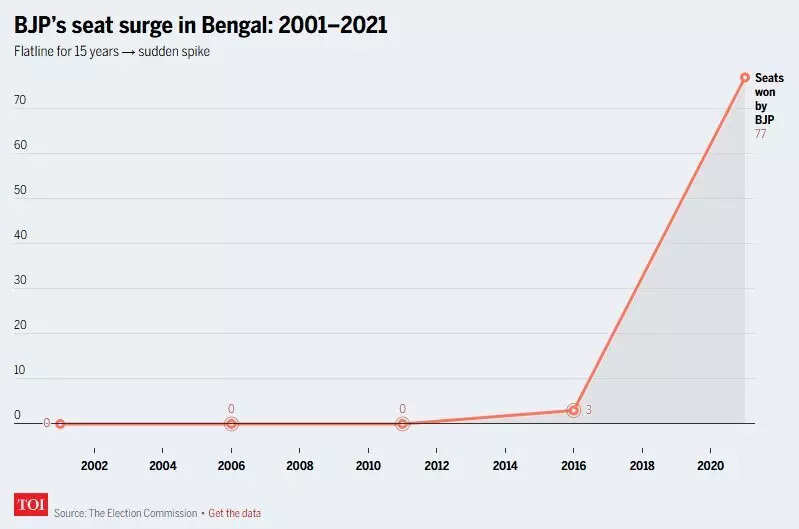
This meant that the Congress and the Left had little choice but to join hands, only to soon confront a relatively new but rapidly expanding challenger in the BJP.In 2019, as the Modi wave swept the country for a second consecutive general election, the BJP increased its tally from two seats in 2014 to 18 of West Bengal’s 42 Lok Sabha seats, reducing the TMC’s count from 34 to 22. In the 2021 assembly polls, the BJP cemented its role as Banerjee’s principal rival by winning 77 seats in the 294-member state assembly, a sharp jump from just three in 2016, even though several of its legislators later defected to the ruling camp.

BJP's seat surge in Bengal

BJP’s seat surge in Bengal

With the two principal players firmly entrenched, the Congress and the Left were reduced to marginal players in a contest they had once dominated.

Congress-Left alliance: What numbers say

The current Congress-Left alliance breakup in West Bengal is not their first. They went their separate ways in March 2019, ahead of the Lok Sabha elections. They came together again in December 2020, just months before the state held assembly polls in March-April 2021, and now have parted ways once again.The Congress last fought the West Bengal assembly elections independently in 2006, securing 21 seats. In 2011, it doubled its tally to 42 when it fought in alliance with the TMC.The 2016 assembly polls marked the first time the Congress and the Left joined forces as formal alliance partners. The Congress once again delivered a creditable performance, winning 44 seats, while its Left allies accounted for the remaining 33 seats won by the bloc.In 2021, the Indian Secular Front (ISF) secured the Left Front’s lone seat. The Congress later opened its account by winning a by-election, taking the alliance tally to two seats.Taken together, the numbers show that the Congress-Left alliance has struggled to translate cooperation into meaningful electoral gains, except to some extent in 2016.

A double-edged sword?

The Congress’ decision to contest alone in West Bengal is a bold but risky strategy. While even a second-place finish appears extremely unlikely, the party could aim to establish itself as the state’s third major political force. This may not translate into many seats, but it could reflect in its overall vote share. On the other hand, there’s a real risk of being pushed further to the margins.The ballot that will determine the future of both the Congress and the Left Front in West Bengal is fast approaching. These former dominant parties face a crucial test of their relevance, voter base, and ability to reclaim even a fraction of their past influence. The coming weeks will reveal whether they can mount a revival or continue their slide toward the margins of state politics.


Source link

UP, Kashmir, ‘Hindi’ & more : What was Ayatollah Ali Khamenei’s India connection — explained | India News


UP, Kashmir, 'Hindi' & more : What was Ayatollah Ali Khamenei's India connection -- explained

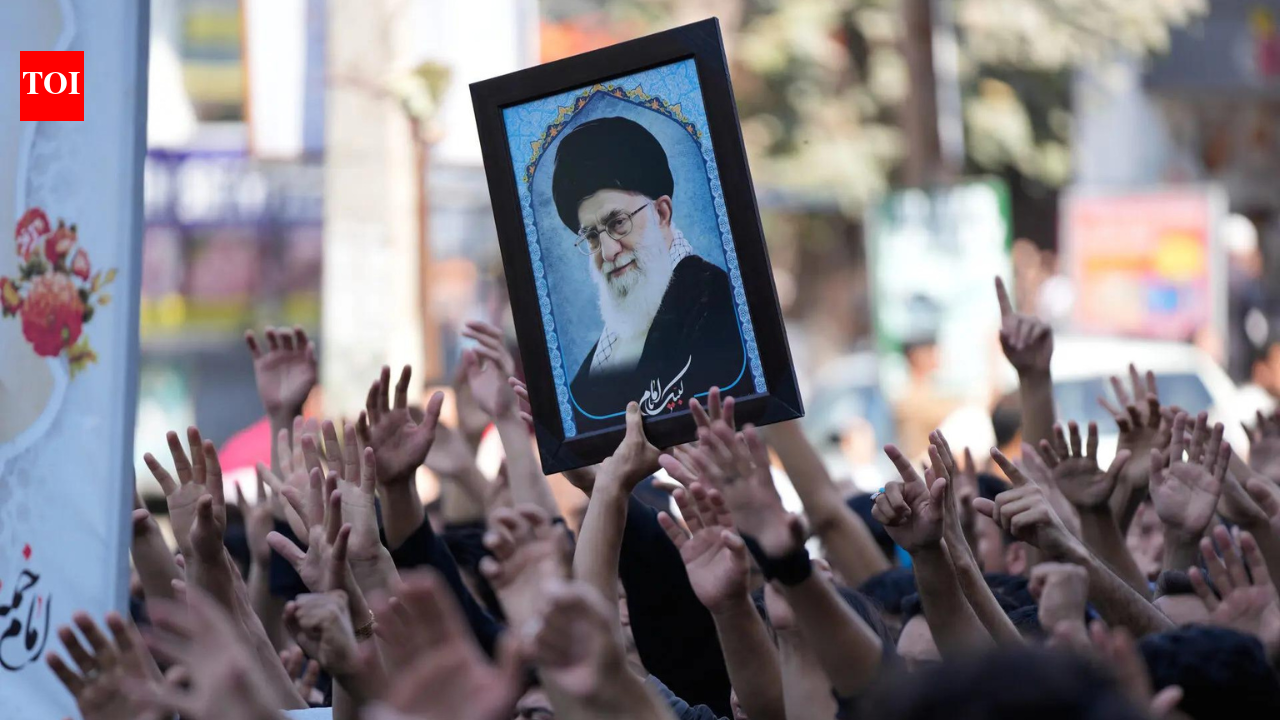
Iran’s Supreme Leader Ali Khamenei was killed in strikes on Sunday, an event that sent shockwaves far beyond West Asia. The echoes were heard in India as well, with sections of the Shia community and clerics condemning the death.In Jammu and Kashmir, home to a sizeable Shia population, demonstrations took place in Srinagar’s Lal Chowk and Saida Kadal, as well as in Budgam, Bandipora, Anantnag and Pulwama. Protesters marched through the streets, beating their chests and raising slogans, while political and religious leaders appealed for calm.

Iran’s Supreme Leader Khamenei Killed In US‑Israeli Strikes, Protests Erupt In Jammu & Kashmir

In Lucknow, crowds gathered near the Bara Imambara mosque, holding posters and observing mourning rituals. Protests were also reported in Ludhiana in Punjab, Ajmer and Jodhpur in Rajasthan, and parts of New Delhi, Bihar, Jharkhand and Telangana, where demonstrators voiced anger over the strikes. In contrast, Alipur village in Karnataka’s Chikkaballapur district, which Khamenei had visited in the 1980s, observed a voluntary shutdown, with residents announcing a three-day mourning period and suspending public events.Follow live updates on US-Israel strikes on IranWhile Khamenei was born in Mashhad and rose to power in post-revolution Iran, his life and lineage intersected with India in multiple ways, from ancestral ties in Uttar Pradesh to visits to Kashmir and Karnataka in the early years after Iran’s 1979 revolution.

Khamenei’s Kintoor connection

Though Iran’s Supreme Leader Ali Khamenei has no direct Indian ancestry, the clerical lineage behind Iran’s 1979 revolution traces back to Kintoor, a village in Uttar Pradesh’s Barabanki district, about 70 kilometres from Lucknow. The village is linked to Syed Ahmad Musavi Hindi, the grandfather of Ruhollah Khamenei, who was born there in the early 19th century before migrating to Najaf and later settling in Khomeyn, Iran. Kintoor, once a centre of Shia scholarship in the former kingdom of Oudh, now has only a handful of Shia families. The Musavi family had originally moved from Nishapur in Iran to India in the early 18th century, settling in Kintoor. Syed Ahmad’s return to Iran around 1830 reconnected the family to its Persian roots and laid the foundation for the Khamenei lineage that would later lead the Islamic Revolution.

Khamenei’s Kashmir visit

Khamenei also shared a notable connection with Kashmir, stemming from a visit in late 1980 or early 1981. In his memoir, activist Qalbi Hussain Rizvi Kashmiri wrote that the most defining moment of that trip was Khamenei’s participation in Sunni Friday prayers in Srinagar. He stood alongside Mirwaiz Maulawi Farouq at a prominent Sunni mosque and delivered a brief address — an unprecedented gesture at a time when sectarian divisions between Shias and Sunnis in the Valley ran deep.Rizvi described how, historically, mistrust between the two communities had been so intense that members of one sect would avoid entering the other’s mosques, and social barriers were rigidly observed. Against that backdrop, Khamenei’s appearance and speech carried symbolic weight far beyond its duration. According to Rizvi, the gesture helped soften long-standing hostilities and opened space for greater religious interaction. In the months and years that followed, he recalls, it became more common for Shias and Sunnis to pray in each other’s mosques and participate more freely in shared religious spaces — a rare period of inter-sect accommodation that he attributes in large part to the impact of that visit.J&K CM Omar Abdullah expressed concern over Khamenei’s killing. He said that those mourning his death should be allowed to do so in peace and urged the Union territory’s administration to “exercise utmost restraint and refrain from using force or restrictive measures”.“I’m deeply concerned about the unfolding developments in Iran, including the killing of Iran’s Supreme Leader, Ayatollah Ali Khamenei. I appeal to all communities to remain calm, uphold peace, and avoid any actions that could lead to tension or unrest. We must also ensure that those who are mourning in Jammu and Kashmir are allowed to grieve peacefully. The police and administration should exercise utmost restraint and refrain from using force or restrictive measures,” he said in a post on X.J&K PDP chief Mehbooba Mufti condemned Khamenei’s death terming it a “shameful point in history”.“Today marks a deeply tragic & shameful point in history with Israel & USA boasting about the killing of Iran’s beloved leader Ayatollah Ali Khamenei. What’s more disgraceful & shocking is the explicit & implicit support given by Muslim countries who chose convenience & expedience over conscience. History will stand testaments to who fought for justice & who helped the oppressors. Prayers with the people of Iran. May Allah grant them strength & victory over forces of tyranny & injustice,” she said.

Khamenei’s Karnataka connection

Khamenei also had a little-known connection to Karnataka through Alipur, a Muslim-majority village in Gauribidanur taluk of Chikkaballapur district where Shias make up nearly the entire population.In 1981-82, Khamenei visited Alipur to inaugurate a hospital constructed with assistance from the Iranian government, a moment that cemented the enduring link between the small south Indian village and Iran’s clerical establishment. The village has long maintained spiritual, cultural and educational ties with Iran, with several institutions set up with support from Iranian agencies.


Source link

Evening news wrap: IDF reveals Khamenei’s location at time of strike; Alireza Arafi named Iran’s interim supreme leader & more | India News


‘KHAMENEI IS DEAD!’: Trump Declares End Of Iran Supreme Leader In Israel-US Attack

  • The IDF confirmed killing Iran’s Supreme Leader Ayatollah Ali Khamenei in a large-scale airstrike in Tehran, ending his decades-long rule. Iran acknowledged his death and announced interim leadership arrangements.
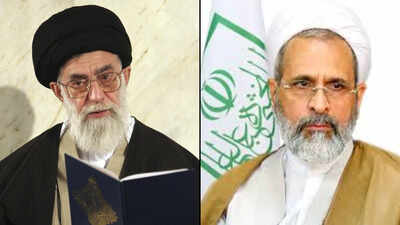
  • Iran appointed Ayatollah Alireza Arafi as interim Supreme Leader after Khamenei died in US–Israeli strikes. A senior cleric and Guardian Council member, he now leads Iran through a tense transition.
  • A 28-year-old man was shot dead, and a college student was injured in Aligarh after two bike-borne assailants opened fire near a college. Police suspect ragging-related rivalry and past enmity.
  • Nine protesters were killed after a mob stormed the US consulate in Karachi following Khamenei’s death in US-Israel strikes. Iran retaliated with missile attacks, escalating regional tensions.
  • Astrologer Greenstone Lobo predicted India would defeat West Indies in their crucial Super 8 clash, citing favourable planetary alignments, despite NRR concerns and the knockout stakes at Eden Gardens.

Here are the top 5 news updates for today:

IDF issues statement after striking Khamenei

The Israeli Defence Forces confirmed that Ayatollah Ali Khamenei was killed in a precise airstrike on his leadership compound in Tehran, describing him as the architect of anti-Israel operations and regional militancy. Iran acknowledged his death following US-Israeli strikes, after President Trump’s announcement. Authorities said the president, judiciary chief, and a Guardian Council jurist would manage the transition, though succession details remain unclear.

‘KHAMENEI IS DEAD!’: Trump Declares End Of Iran Supreme Leader In Israel-US Attack

Read the full story

Alireza Arafi becomes the interim Supreme Leader of Iran

Following Ayatollah Ali Khamenei’s death in US–Israeli airstrikes, Iran named Ayatollah Alireza Arafi as interim Supreme Leader. A senior cleric with deep ties to Iran’s religious and political institutions, Arafi previously served in key roles including the Guardian Council. His appointment ensures continuity within the clerical establishment as Iran navigates regional tensions, internal uncertainty, and a formal succession process.Read the full story

Shooting outside Aligarh college leaves 1 dead, 1 injured after Holi Milan function

A 28-year-old factory worker was killed and a 25-year-old BA student injured when two men allegedly opened fire near Shri Varshney Mahavidyalaya in Aligarh after a Holi event. Police booked the accused for murder and attempt to murder. Investigators suspect the attack stemmed from a ragging dispute and prior rivalry, as the victims and accused reportedly knew each other.Read the full story

Mob storms US Consulate in Pakistan after Khamenei’s death; 9 killed

At least nine protesters died and 36 were injured after a mob attacked the US consulate in Karachi following Iran’s confirmation that Ayatollah Khamenei was killed in joint US-Israel strikes. Police used force to disperse crowds as unrest spread. Iran retaliated with missile attacks on Israeli and Gulf targets, vowed revenge, and declared national mourning, while President Trump warned Tehran against further escalation.Read the full story

West Indies to falter; India set to storm into semifinal

Ahead of the virtual Super 8 knockout between India and the West Indies, astrologer Greenstone Lobo predicted an Indian victory, citing favourable planetary patterns. With both teams tied on points and a semifinal spot at stake, India’s poor net run rate adds pressure. Lobo suggested squad changes, including Sanju Samson, could boost India’s chances in the high-stakes Eden Gardens clash.Read the full story


Source link

BJP MP Baluni plays Holi in ‘ghost village’, seek return of ex-residents | India News


BJP MP Baluni plays Holi in 'ghost village', seek return of ex-residents
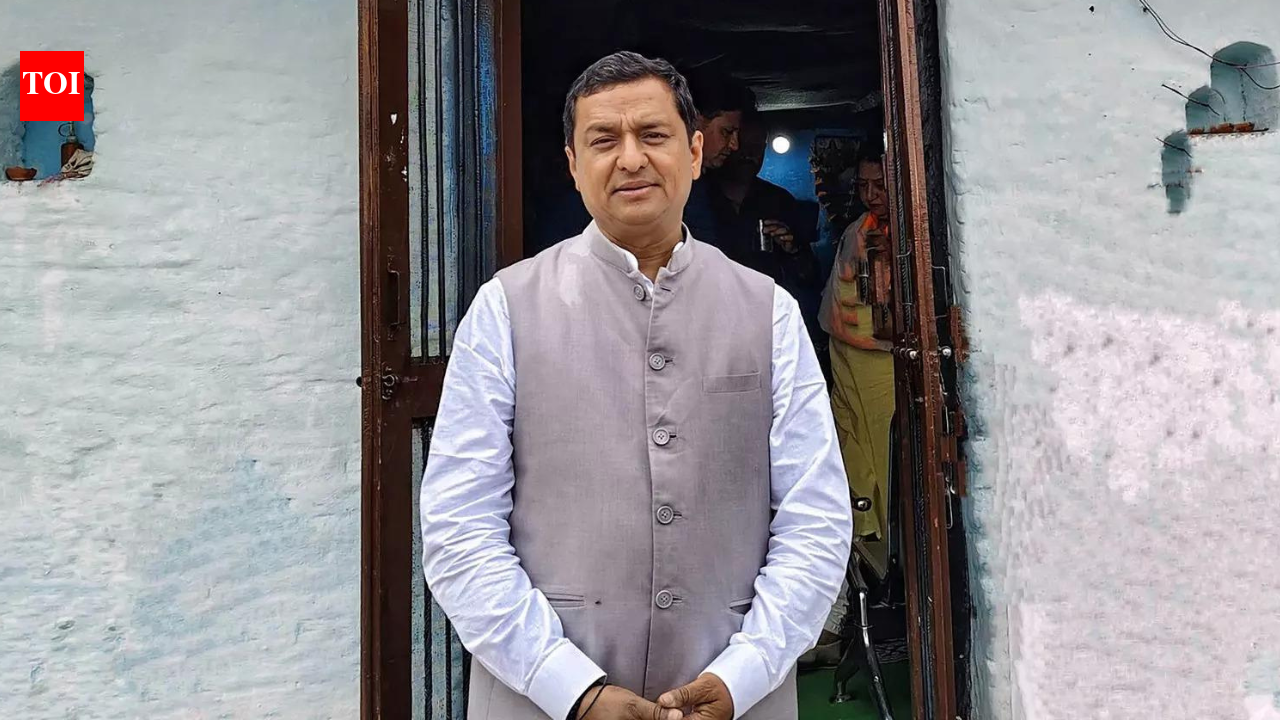
Garhwal MP Anil Baluni (PTI image)

NEW DELHI: As part of his campaign to re-populate settlements hit by exodus of locals in Uttarakhand, Garhwal MP Anil Baluni played Holi with current and former residents of Dhoor village during his visit to the constituency. Several former residents returned to the village briefly to play the festival of colour to render the almost empty village a vibrant feel, which reminded them of a bygone era before they relocated to different cities in search of livelihood. “Since childhood, I have seen villages being deserted because people sought better lives in cities. Today, many of them are called ghost villages . But now, with improved roads, electricity, water and other facilities, it is time to return to our roots, where our heritage truly thrives,” Baluni said.Baluni, who was a Rajya Sabha member before being elected to Lok Sabha in 2024, has been spearheading a campaign to revive traditional festivals, a call given by PM Narendra Modi, and to bring back former residents to their native villages to revive the old way of life in these remote, hilly areas which have suffered stagnation as people left.Once vibrant with laughter and livestock, these hamlets, numbering hundreds across Uttarakhand, lie abandoned now, their terraced fields covered with wild weeds and the houses locked and crumbling, he said. Migration has taken a toll on the region, he added. Baluni said Pauri had eight Assembly constituencies earlier but the number has come down to six and it can fall further after the next “delineation”. Several districts across the hill state are facing the same crisis, he said. Amid the splash of colours and bursts of laughter, Holi was celebrated with the handful of families still staying put in Dhoor. They were joined by many former residents who returned from distant cities on the occasion. Baluni has been visiting such villages at frequent intervals in his efforts to repopulate them. As part of his efforts, the BJP leader has also launched the “Apna Vote Apne Gaon” campaign, urging people to register themselves as voters in their native villages.


Source link

For 61 lakh ‘doubtful’ voters, it’s a race against time to get on electoral roll | India News


For 61 lakh 'doubtful' voters, it's a race against time to get on electoral roll

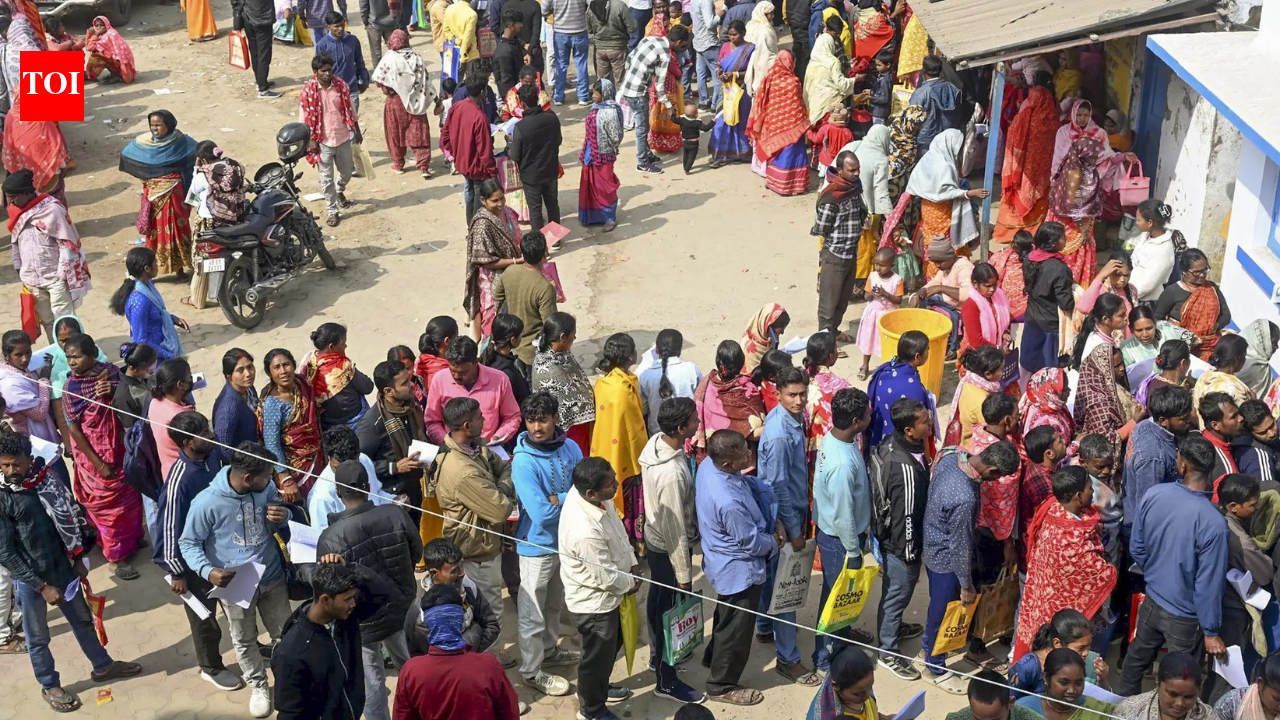
NEW DELHI: Around 60 lakh electors in West Bengal have been categorised as ‘doubtful’ by Election Commission, and their cases have been sent for adjudication by judicial officers appointed by the Kolkata high court. This is in line with the Supreme Court‘s directive dated Feb 20. With assembly elections in the state likely to be announced in the second half of March, this means that it would be a race against time for the “doubtful” voters to be made a part of the electoral list.Sources said that the final electorate of Bengal is around 6.4 crore, with a total 1.2 crore deletions since Oct 27, 2025 (15.9%). Of these, around 61.8 lakh were deleted on account of being deceased, shifted, migrated and registered at multiple places and another 60 lakh categorised as ‘doubtful’ voters under adjudication.Such ‘doubtful’ electors, as and when their cases are approved by the court-appointed judicial officers, shall be added back to the state’s roll by way of supplementary lists to be published later. Until then, these voters will not be eligible to vote in any election.A senior EC functionary told TOI that the majority of these ‘doubtful’ electors are likely to be illegal immigrants from Bangladesh. “Despite stiff resistance, the SIR exercise in Bengal has been a huge success,” said another EC official.According to the rules, the electoral roll of a state is frozen 10 days before the last date for nomination in Lok Sabha or assembly elections. So only those ‘doubtful’ voters whose cases are disposed of within the prescribed deadline can vote in the upcoming Bengal assembly elections.It remains to be seen how much time the judicial officers will take to dispose of cases of the 60 lakh ‘doubtful’ voters in West Bengal. The cases of thousands of ‘doubtful’ or ‘D’ voters in Assam, categorised as such since 1997 and not allowed to vote, have been under adjudication by the foreigners tribunals for decades. Only after the tribunals declare the ‘D’ voters as bona fide citizens can they vote. If ruled as foreigners, they are sent to detention centres and deportation proceedings initiated.The judiciary-appointed officers in Bengal will now have to do the same for those categorised as ‘doubtful’ voters due to SIR, ostensibly on grounds of being Bangladeshis. So effectively, the judicial officers will act like foreigners tribunals, examining and confirming citizenship of ‘doubtful’ electors before restoring their voting rights.At the start of the SIR exercise on Oct 27, 2025, Bengal’s electorate stood at 7.7 crore. The draft roll published on Dec 16, 2025, put the strength of the electorate at 7.08 crore after 58.2 lakh deletions. The final roll published on Saturday listed 6.4 crore voters, with 3.6 lakh net deletions since draft roll publication.


Source link