Breaking News
Setback to BJP as its rebel elected Bhiwandi mayor of Cong-led front | India News

Setback to BJP as its rebel elected Bhiwandi mayor of Cong-led front
Action Will Be Taken Against Him, Says BJP

Bhiwandi: In a setback to the BJP, its rebel corporator Narayan Chaudhary who broke away from the party along with five other corporators and aligned with the Congress-led ‘Bhiwandi Secular Front’ was on Friday elected mayor of the Bhiwandi-Nizampur Municipal Corporation (BNMC). Contesting as mayoral candidate of the front, which included Congress with its 30 corporators and NCP (SP) with 12, Chaudhary got 48 votes in a House of 90 effectively reduced on Friday to 89 with one corporator abstaining. The BJP’s nominee Sneha Mehul Patil got 16 votes, while Vilas Patil of the Konark Vikas Aghadi (KVA) polled 25 votes. Congress’ Tariq Momin was elected deputy mayor; he got 43 votes. Maharashtra BJP president Ravindra Chavan said action would be taken against Chaudhary and the other corporators who had allegedly defied the party whip in the mayoral polls. In the Jan 15 civic elections, the Congress had emerged as the single largest party with 30 seats, followed by BJP (22), Shiv Sena (12), NCP-SP (12), SP (6), KVA (4), Bhiwandi Vikas Aghadi (3) and one independent. The Shiv Sena did not go with the BJP for the mayoral election. While the BJP initially announced that Chaudhary would be its mayoral candidate, it later replaced him with Sneha Patil, resulting in Chaudhary’s rebellion and his joining hands with Cong-NCP (SP), who agreed to field him as the mayoral candidate of the ‘secular front.’ Interestingly, while the ‘Bhiwandi Secular Front’ secured 48 votes in the mayoral contest, with six of BJP’s rebel corporators including Chaudhary voting for it, the Congress won the deputy mayor’s post with 43 votes. The dispute between BJP and the Shinde Sena also worked in favour of the Congress-led front in the deputy mayor’s election as the presence of three candidates worked to the Congress’ advantage.
Source link

Despite differences, AI summit has set stage for cooperation: Indian officials | India News


Despite differences, AI summit has set stage for cooperation: Indian officials

New Delhi: After a week of packed halls, high-level diplomacy and billion-dollar pitches, several national delegations at the India AI Impact Summit will issue a joint statement on how the world should handle artificial intelligence Saturday, a day later than planned, as the govt works to widen global consensus on the document. The declaration, already backed by over 70 countries, comes amid companies committing to invest more than $250 billion in the country and reinforced India’s push to shape global AI agenda for the Global South. Union minister for electronics and IT Ashwini Vaishnaw said on Friday there was “huge consensus”, with discussions continuing. “The declaration and its contours will be shared transparently tomorrow,” he said, adding that India hoped the final signatory count would cross 80. Despite differences, summit has set stage for cooperation: Indian officials Countries had failed to reach a consensus at the last summit in Paris but there appears to be greater synergy on several issues, among govts and companies. Substantive disagreements also surfaced on global governance. While the UN announced formation of an independent scientific panel on AI, the US delegation warned against centralised global control of generative AI, underlining the difficulty of forging binding global rules. Despite differing views, Indian officials said the summit had laid the groundwork for collaboration rather than confrontation. “This is about real action, not just paper,” Vaishnaw said, pointing to bilateral discussions, industry commitments and plans for an expanded AI Mission 2.0. Ashwini Vaishnaw said the scale and diversity of participation underlined global confidence in India’s approach. “World has confidence in India’s role in the new AI age. That is very important for all of us,” he said. According to the minister, over five lakh visitors have attended the summit and the expo, with “practically every major AI player in the world” participating. A key highlight, Vaishnaw said, was the acceptance of PM Modi’s vision of “ManavAI” – AI of the humans, by the humans, for the humans – which places responsible and ethical use of AI at the centre. “For the first time, discussion on ethical and responsible AI has been brought to the forefront in such a meaningful way,” he said. Investment commitments also featured prominently. Vaishnaw said infrastructure-related pledges linked to AI, data centres and allied technologies had already crossed $250 billion, while around $20 billion in deep-tech venture investments had been completed. “Numbers are important, but what is more important is the trust the world has shown in India,” he said.


Source link

India bleeding talent to US: Mistral CEO | India News


India bleeding talent to US: Mistral CEO
Mistral CEO Arthur Mensch

New Delhi: For years, Europe watched its best AI researchers migrate to the US. India has faced the same challenge – a steady bleeding of top engineering and computer science talent to Silicon Valley. Reversing this flow is central to the global AI race, says Arthur Mensch, co-founder and CEO of French startup Mistral AI. “Like Europe, India was bleeding talent to the US,” Mensch said in an interview with TOI. “The more talent you retain and create value locally, the better.” Founded in 2023 by Mensch, Guillaume Lample and Timothee Lacroix, Mistral AI was created to challenge the opaque, closed nature of “big AI” and make frontier models more accessible through open architectures. In just three years, the company has scaled rapidly – reaching a $400 million revenue run rate and targeting over $1 billion in revenue soon. As of last year, it was valued at $14 billion. But for Mensch, the AI race is not just commercial. It is structural – and geopolitical. With Europe heavily reliant on overseas digital infrastructure, particularly US hyperscalers, Mistral has chosen to build its own capabilities. “We don’t position ourselves as a sovereign alternative. We position ourselves as a global competitor in the AI race,” he said. “But tactically, to have capacity you fully control, you need infrastructure – the servers that run the technology. About 60% of Mistral’s business comes from Europe and 40% from the rest of the world. Some customers opt for its platform precisely because it can be deployed on their own infrastructure, reducing dependence on hyperscalers. Sovereign AI, he believes, is both a strategic and political necessity. As AI begins to run large parts of the global economy, govts and defence systems cannot risk external control. For businesses, over-dependence weakens negotiating leverage and continuity. India, with one of the world’s largest developer pools, has a similar inflection point. “We’ve brought many European researchers back to Europe. India has a unique opportunity to do the same. Universities here produce excellent AI and computer science talent. The focus should be on ensuring they innovate and build value here,” Mensch said. Mistral is currently building commercial partnerships in India, with a local technology centre a possible next step. While rivals such as OpenAI and Anthropic explore IPO paths, Mensch said a listing is “down the road.” Profitability and global scale would be prerequisites. Mensch argues that much of enterprise AI adoption has stumbled because companies treated GenAI as a collection of tools rather than a platform shift. Early chatbot deployments focused on small productivity gains. “That doesn’t change the bottomline,” he said. Instead, Mistral focuses on high-ROI use cases that address major sources of business friction. At the core of its strategy is open source. “If you have access to model parameters, you can deploy wherever you want – including local infrastructure,” Mensch said. Open models also allow customisation. “Running a business should not mean over-dependence on a single service provider. I’ve said it multiple times – Europe cannot become an AI colony of the US.”


Source link

SC deploys judicial officers in Bengal for SIR hearings | India News


SC deploys judicial officers in Bengal for SIR hearings

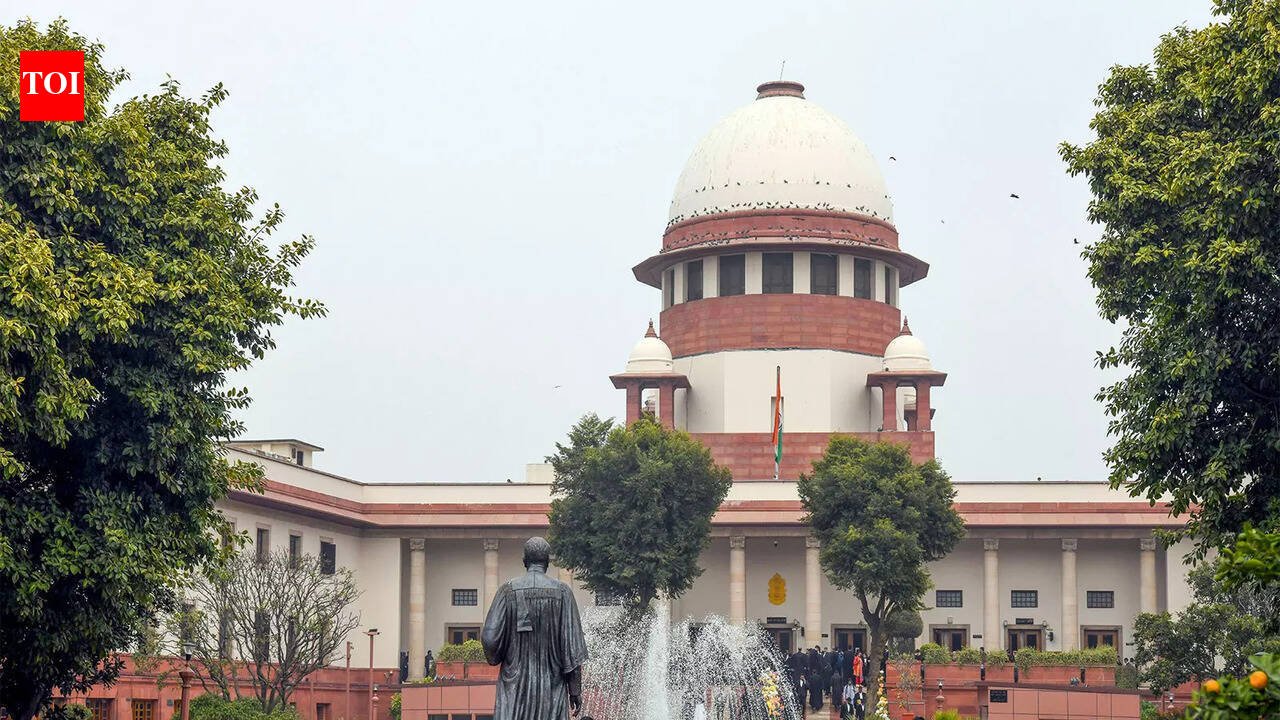
New Delhi: In an unprecedented decision, the Supreme Court on Friday used its “extraordinary powers” to deploy judicial officers in West Bengal to decide claims for inclusion in voter list and speed up the completion of Special Intensive Revision of electoral rolls. The court emphasised that CM Mamata Banerjee should be aware of the consequences if the revision exercise is not concluded. The court explained that the unprecedented judicial intervention under Article 142 of the Constitution was necessitated by the “extraordinary situation” that has arisen in Bengal due to trust deficit and non-cooperation between EC and the Bengal govt. A bench of CJI Surya Kant and Justices Joymalya Bagchi and Vipul M Pancholi also, despite objections by the TMC-led govt, allowed the Election Commission (EC) to publish the revised electoral roll – 95% of the total list – on Feb 28, the deadline for publication of the final voter list, while the remaining inclusion claims are still being decided. The bench also did not agree with the contention of the state govt that electoral registration officers (EROs), and not the judicial officers, should have the final say in deciding claims of inclusion in the voter list.TMC: SC order on SIR a no-trust vote against ECTrinamool Congress on Friday described Supreme Court’s order supplanting judicial officers over EC-appointed officers to hear SIR’s logical discrepancy cases as a “no-trust vote against the EC”. In a post on X, the party said: “This constitutes a scathing indictment of a constitutional body that has failed in the faithful discharge of its duties. It is also a powerful vindication of our principled fight to safeguard the rights of the people and uphold the integrity of the democratic process.” TMC spokesperson Kunal Ghosh said: “Even the topmost court of the land appears convinced that the poll body is not neutral, nor competent, after saddling people with unjustifiable hearing notices.”


Source link

Relying on decades-old rulings, SC acquits stepdad of 6-yr-old’s murder | India News


Relying on decades-old rulings, SC acquits stepdad of 6-yr-old's murder

New Delhi: A six-year-old girl went missing in 2018. She was last seen with her stepfather. When he was arrested eight days later, he led police to the place where her charred remains were found. Supreme Court found this evidence weak and acquitted him of the murder charge. Finding no other evidence to link the man to the murder except that he was the last person to be seen with the child according to a neighbour and he was the one to lead the police to the victim’s bones, a bench of Justices Sanjay Kumar and K Vinod Chandran acquitted him, saying the investigation was botched and left many questions unanswered. “In the present case, the murder of a six-year-old girl went unpunished and her stepfather was incarcerated on mere conjecture,” SC said. In the case from Chhattisgarh, what tilted the scales towards the stepfather, Rohit Jangde, was the peculiarity of the interpretation by SC in earlier judgments on the admissibility of a statement by an accused that leads to discovery of fact relating to the crime – in this case, the recovery of the girl’s body. More than 65 years ago, SC had ruled that the statement of an accused leading to discovery of facts relating to the crime would be admissible evidence only when it had been made in custody. Justices Kumar and Chandran also relied on a similar interpretation used in a nearly 100-year-old ruling by Calcutta HC. Interestingly in the 1931 judgment, the then CJ of Calcutta HC had expressed anguish that the law permitted reliance on a statement made to police that led to discovery of fact only when the person was in police custody and had termed it absurd, but left it to the legislature to make suitable amends. Relying on these decades-old judgments, SC termed weak the telltale evidence incriminating Jangde. Justice Chandran said even if the evidence was accepted, it would not by itself nail the guilt on the stepfather. “The knowledge of the accused, which led to the detection of the bone remnants though not acceptable under Section 27 would all the same be acceptable evidence under Section 8, which by itself is a weak piece of evidence. The evidence under Section 8 can only offer corroboration and cannot by itself result in a conviction,” he said. Acquitting the accused, the bench said, “The long gap when there was no complaint made about the missing child and the factum of none having questioned the accused, despite the family and police having been told that she went with the accused, tilts the scales in favour of the accused… Pertinent also is that since the corpus delicti was not recovered, there is no time of death specified. We are hence unable to uphold the conviction of the accused, and he has to be necessarily given the benefit of doubt.


Source link

US-sanctioned Iran-linked oil tanker spent 8 days in Pak maritime boundary: FIR | India News


US-sanctioned Iran-linked oil tanker spent 8 days in Pak maritime boundary: FIR

NEW DELHI/MUMBAI: One of the three US-sanctioned Iran-linked oil tankers seized by the Indian Coast Guard (ICG) on Feb 6 off the country’s coast had spent days inside Pakistan’s maritime boundary with its tracking systems switched off, according to an FIR registered in Mumbai.The ICG had seized three ships — Asphalt Star, Stellar Ruby and Al Jafzia — around 100 nautical miles west of Mumbai for investigation and lodged a police complaint on Feb 15 at the Yellow Gate police station against nine persons, including the owner of the three ships for alleged illegal activities and smuggling oil linked to Iran. There were 55 crew members on board all three seized vessels.Based on the complaint of Aniruddha Dharampal Dabash (40), an ICG commandant, Mumbai police filed an FIR and arrested the captain of MT Asphalt Star and a crew member for their alleged role in oil smuggling and forgery. TOI has the copy of the FIR.On the ship’s presence in the Pakistan maritime zone, the FIR said, “Electronic chart display & information system data of MT Asphalt Star was examined by Coast Guard Officer assistant commandant P Siddharth Ratnam. It was observed that between Jan 20 and Jan 28, the vessel had entered Pakistan’s maritime exclusive economic zone (EEZ).”“On Jan 28, at approximately 11 hours, the vessel had switched off its automatic identification system (AIS), very high frequency (VHF) and all sensors, thereby concealing its identity and carrying out suspicious movements. Upon further questioning, the master stated that the ship’s voyage data recorder (VDR) system had stopped functioning,” it said. All three ships used AIS spoofing and false identity data to evade detection.Jogendar Singh Brar, an Indian national who is currently based in Abu Dhabi, UAE, and is said to be the owner of the ships, is named as one of the accused in the FIR.Through sustained rummaging, corroboration of electronic data on board suspect vessels and verification documents and interrogation of crew, the ICG specialist boarding team established the modus operandi of criminals.“We have arrested Shyam Bahadur Chauhan and one more person in this case. They were produced before a court and sent in police custody till Feb 23,” said a police officer. Chauhan is the master of MT Asphalt Star. In the UAE, Brar claimed that his ships were providing essential supplies to other ships in distress far from the Indian coast and that the ships were not engaged in any illegal activity, say local media reports.The FIR stated that MT Asphalt Star was found to have illegally transferred 30 metric tonnes of heavy fuel oil to MT AL Jafiza in the EEZ of the Indian Ocean by conducting ship to ship operation without informing any Indian govt authorities. It was also found to have illegally transferred 5473 metric tonnes of Bitumen used for road construction to MT stellar Ruby.


Source link

Army chief charts ways to expand defence cooperation during Australia visit | India News


Army chief charts ways to expand defence cooperation during Australia visit
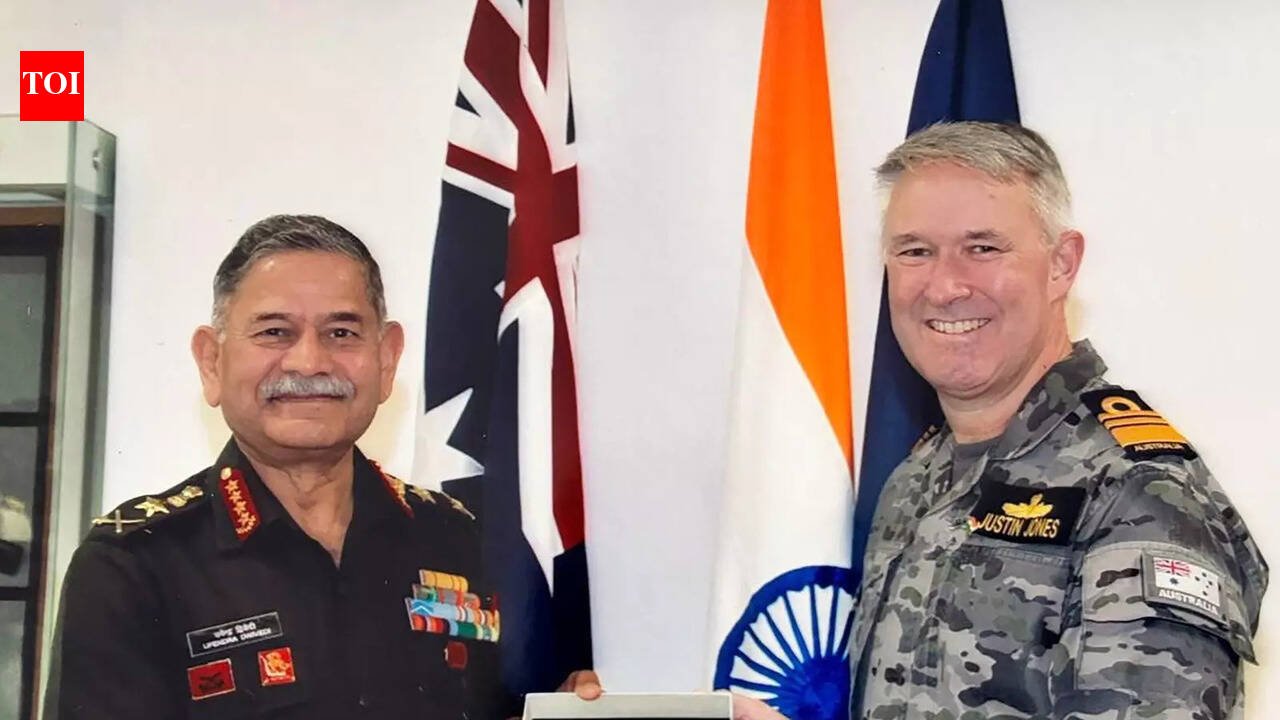
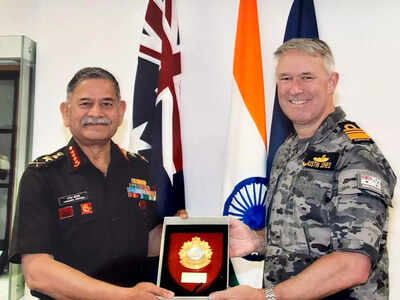
Army chief Gen General Upendra Dwivedi called on Vice Admiral Justin Jones, Chief of Joint Operations, Australian Defence Force, at the Joint Operations Command.

NEW DELHI: Army chief General Upendra Dwivedi, during his Australia visit from Feb 16 to 19, engaged extensively with the senior leadership of Australian defence forces to review ongoing bilateral engagements and chart pathways for expanding army-to-army cooperation.Discussions focused on enhancing the scope and complexity of joint exercises, strengthening professional military education exchanges and promoting greater interoperability between the two forces. His visit advanced India-Australia defence cooperation and deepened strategic alignment between the two nations, an Army statement said.As part of his high-level engagements, General Dwivedi called on the chief of defence forces and the secretary of the department of defence. At Headquarters Joint Operations Command (HQJOC), the General reviewed Australia’s integrated and multi-domain operational framework with the commander joint operations, gaining insights into joint planning and execution mechanisms, the statement noted.In Sydney, Gen Dwivedi interacted with the leadership of Forces Command, Special Operations Command and the 2nd Division of the Australian Army. The exchanges enabled both sides to share perspectives on force readiness, operational concepts and training methodologies. Particular attention was given to the bilateral Army Exercise AUSTRAHIND, with both sides expressing commitment to further enriching its forthcoming edition in India in 2026.In Canberra, General Dwivedi held substantive discussions with Lt General Simon Stuart, Chief of Australian Army. Drawing upon their shared professional association as alumni of the US Army War College (class of 2015), the two chiefs reaffirmed their commitment to strengthening institutional linkages and expanding avenues of cooperation. A comprehensive round table discussion at Australian Defence Forces Headquarters examined issues related to force modernisation, emerging technologies and future operational environments. The Army chief also called on Vice-Admiral Justin Jones, Chief of Joint Operations, Australian Defence Force, at the Joint Operations Command.


Source link

BRO clears snow, NH-701A thrown open before time | India News


BRO clears snow, NH-701A thrown open before time

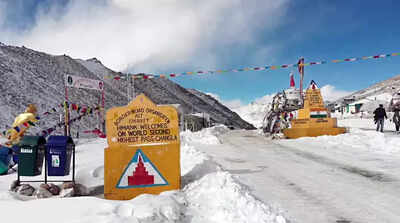
JAMMU: Border Roads Organisation completed snow clearance on National Highway 701A (Old Mughal Road), and two of its stretches were opened on Friday, ahead of schedule. These roads usually open around March-end.BRO teams cleared the stretch from Bufliaz (Poonch) to Peer Ki Gali (Poonch) under Project Sampark, and the stretch from Shopian to Peer Ki Gali under Project Beacon. “During the road opening, MoRTH director-general VK Rajawat, along with CE Project Sampark and Beacon, were present at Peer Ki Gali,” defence PRO Lt Col Suneel Bartwal said Friday.“Snow accumulation still exists on the adjoining hill slopes at certain vulnerable locations. Due to prevailing weather conditions, the possibility of avalanches cannot be ruled out,” Lt Col Bartwal said. He urged commuters to follow traffic advisories issued by the district administrations of Poonch and Shopian.An official spokesperson advised commuters to exercise extreme caution while travelling on the stretch. “Movement may be regulated depending upon weather conditions and safety assessments by authorities,” the spokesperson said.“DG MoRTH lauded all ranks involved in snow clearance operations under extremely harsh weather conditions. He said route recce and planning for the widening of NH-701A was in progress,” Col Bartwal said. “During the visit, DF MoRTH also reviewed work progress on NH-144A in all packages, and gave directions to expedite the same,” he added.


Source link

Operation Jwala: Arms, ammo recovered near LoC in J&K’s Rajouri | India News


Operation Jwala: Arms, ammo recovered near LoC in J&K’s Rajouri

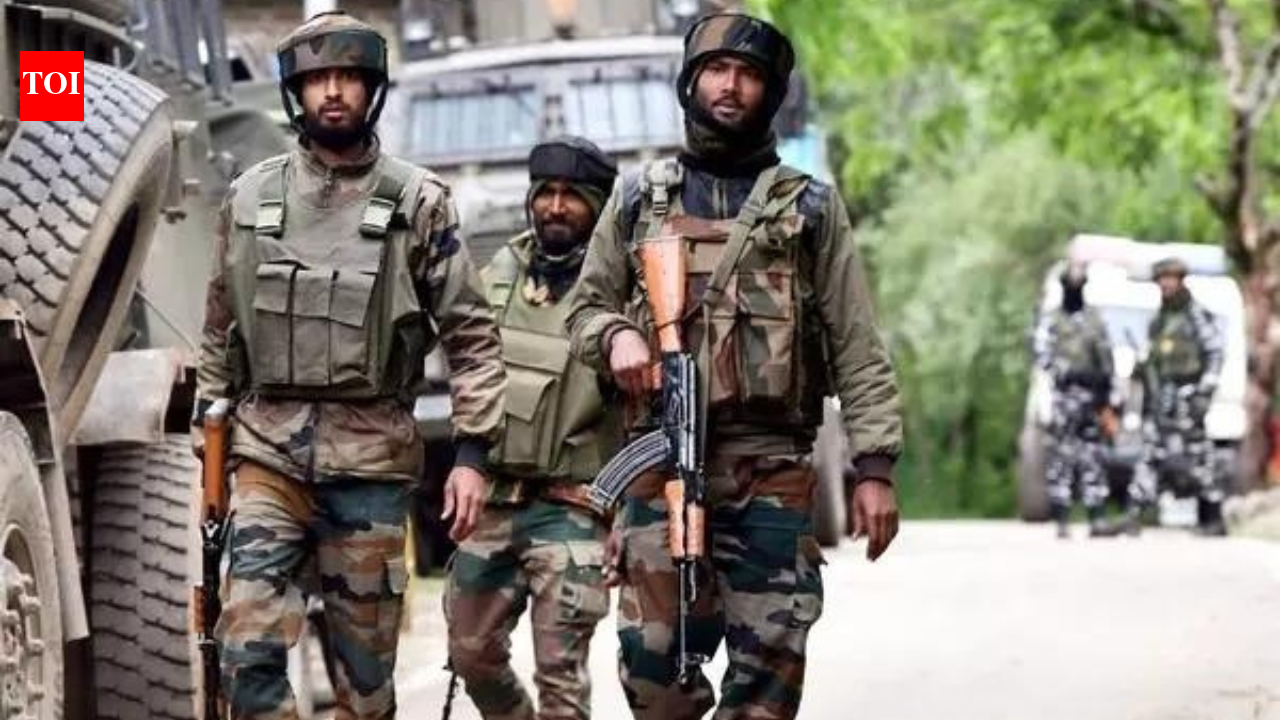
JAMMU: A joint team of the Army and Rajouri Police recovered a cache of arms and ammunition during a search operation in Nathua Tibba area in Sunderbani sector along the LoC in J&K’s Rajouri district on Friday.The searches under Operation Jwala came a day after security forces foiled an infiltration bid in the area. The recovery included an AK-47 rifle, two magazines, along with ammunition, three rucksacks, blankets, rations, and clothing, the Army’s White Knight Corps posted on X.The post stated that heavily bloodstained tracks were spotted, indicating serious injuries to the terrorist(s). “Operations remain ongoing with heightened vigilance and firm domination of the area,” it added.GOC White Knight Corps Lt Gen P K Mishra Friday visited forward areas in Balnoi sector in the frontier district of Poonch to review the prevailing security situation and assess the operational preparedness of Army units deployed along the border.Later in the day, Lt Gen Mishra, accompanied by GOC Counter Insurgency Force, visited the forward areas of Sunderbani sector to review the security situation following the thwarting of the infiltration attempt.


Source link

‘Traitor Rahul’: BJP protests Congress’s shirt-off disruption at AI event | India News


BJP Targets Rahul Gandhi Over AI Summit Protest Row

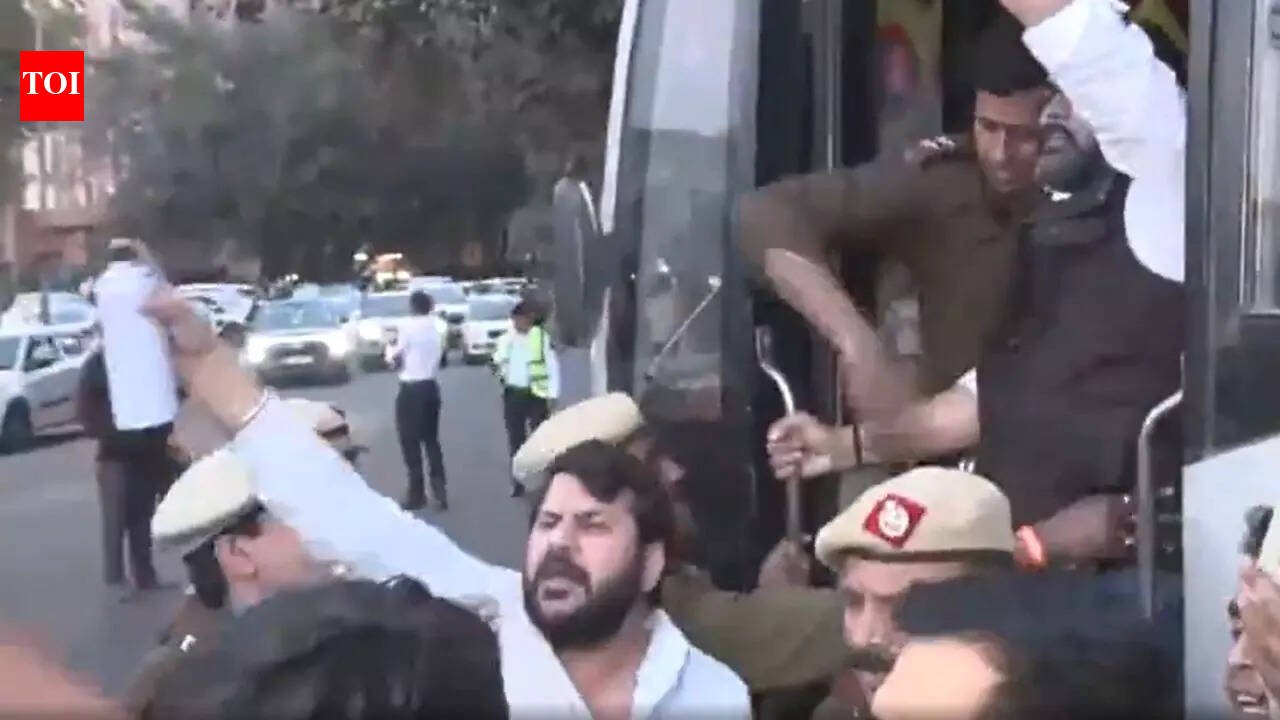
BJP youth wing protesting outside Rahul Gandhi’s house. (Screengrab)

NEW DELHI: The ruling Bharatiya Janata Party’s (BJP) youth wing on Friday staged a protest outside Congress leader Rahul Gandhi‘s Delhi house, hours after the members from the rival camp tricked their way into Bharat Mandapam and tried to disrupt the government’s ambitious ongoing AI summit.The incident opened a new front of contention between the political nemeses, with the BJP accusing the Congress of tarnishing the nation’s reputation.

BJP Targets Rahul Gandhi Over AI Summit Protest Row

Calling Rahul Gandhi a “traitor,” a protesting BJP Yuva Morcha leader, who was being bundled into a van, said, “This shows their ideology against the country. If you want to protest, protest the policies. They have protested against their own country.”“The way Rahul Gandhi and the Congress Party tarnished India’s reputation by storming the AI Summit…Rahul Gandhi continues to try to tarnish India’s reputation on the international stage. Traitor Rahul Gandhi,” a BJP Yuva Morcha leader told news agency ANI.The demonstration followed after the members of the Indian Youth Congress (IYC) staged a protest at the Bharat Mandapam venue of the Al Impact India Summit by removing their shirts with slogans that read, “Compromised PM”.In a statement, the Indian Youth Congress said its workers were protesting against a “compromised Prime Minister who has traded the identity of the country at the Al Summit”.“Indian Youth Congress workers raised their voice and protested against the compromised Prime Minister who has traded the identity of the country at the AI Summit,” the organisation said in an official post.“Instead of leveraging India’s talent and data, the AI summit is a disorganised PR spectacle – Indian data up for sale, Chinese products showcased,” it added.“The truth cannot be hidden behind the glittering stage of the AI Summit. When corporate interests are placed above the nation’s welfare and there is visible softness in foreign policy, protest becomes a duty,” the organisation said in a separate post.Meanwhile, Delhi Police have detained four IYC workers during a protest at the convention centre in the national capital.Also, Delhi BJP chief Virendra Sachdeva announced a protest outside the Congress headquarters on Saturday to condemn Youth Congress workers’ “hooliganism” at the “AI Impact Summit”.Sachdeva said he will lead the protest march from Man Singh Road roundabout to the Congress office at 24 Akbar Road to expose the negative mindset of the Congress and its attempt to malign the country.The Delhi BJP chief said the 10 people detained by police for their “shirtless” protest at the Summit venue on Friday were not Congress workers but hired goons.“At a time when India’s youth are showcasing their innovations at the AI Summit and saluting the leadership of Prime Minister Narendra Modi, these individuals created disruption,” said Sachdeva.“If they believe that such actions will damage the nation’s image, they should dispel this misconception. These people claim to be workers of the Congress party led by Rahul Gandhi, who goes abroad and speaks in a manner that harms India’s image,” he said.


Source link