Breaking News
Angry youth won’t stay silent’: Congress defends shirtless protest at AI summit | India News


Angry youth won't stay silent': Congress defends shirtless protest at AI summit

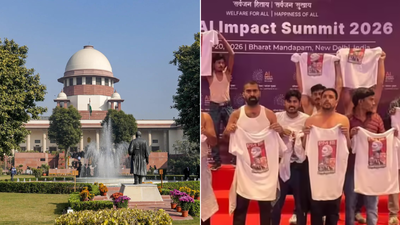
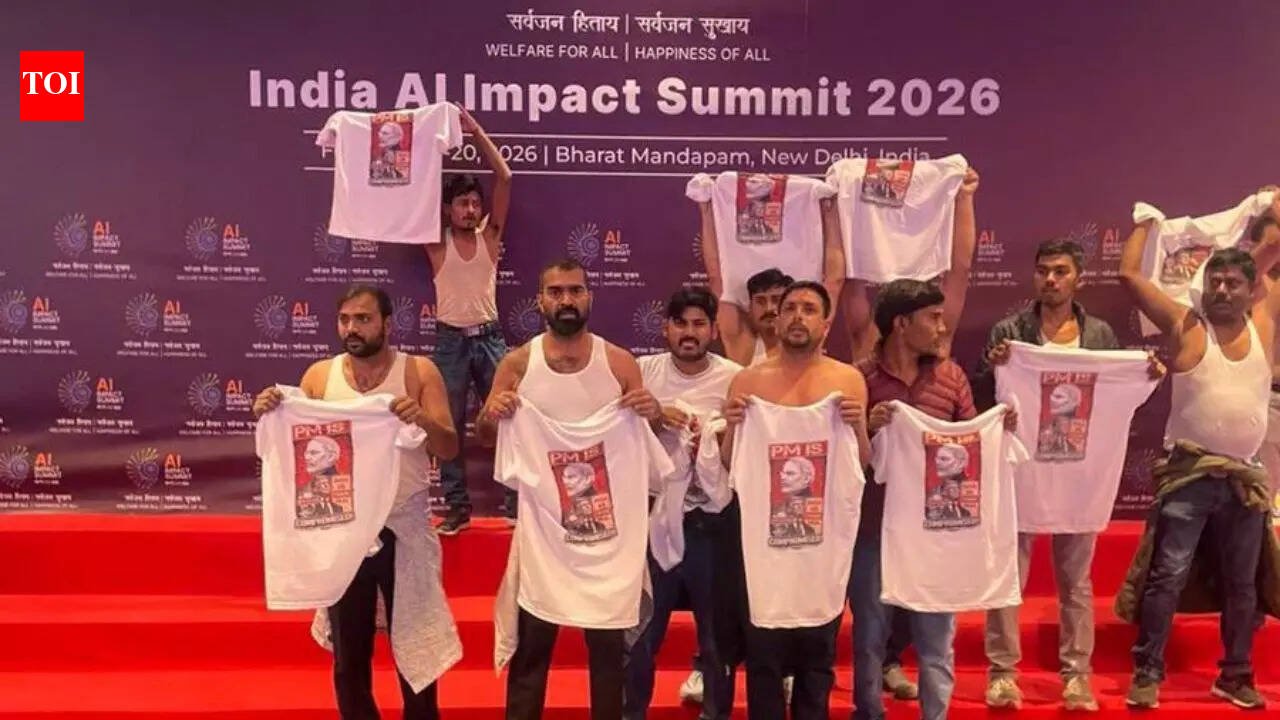
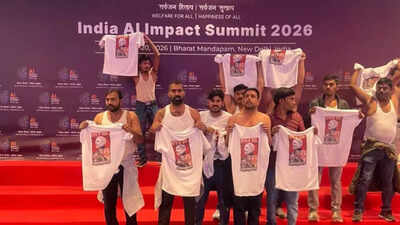
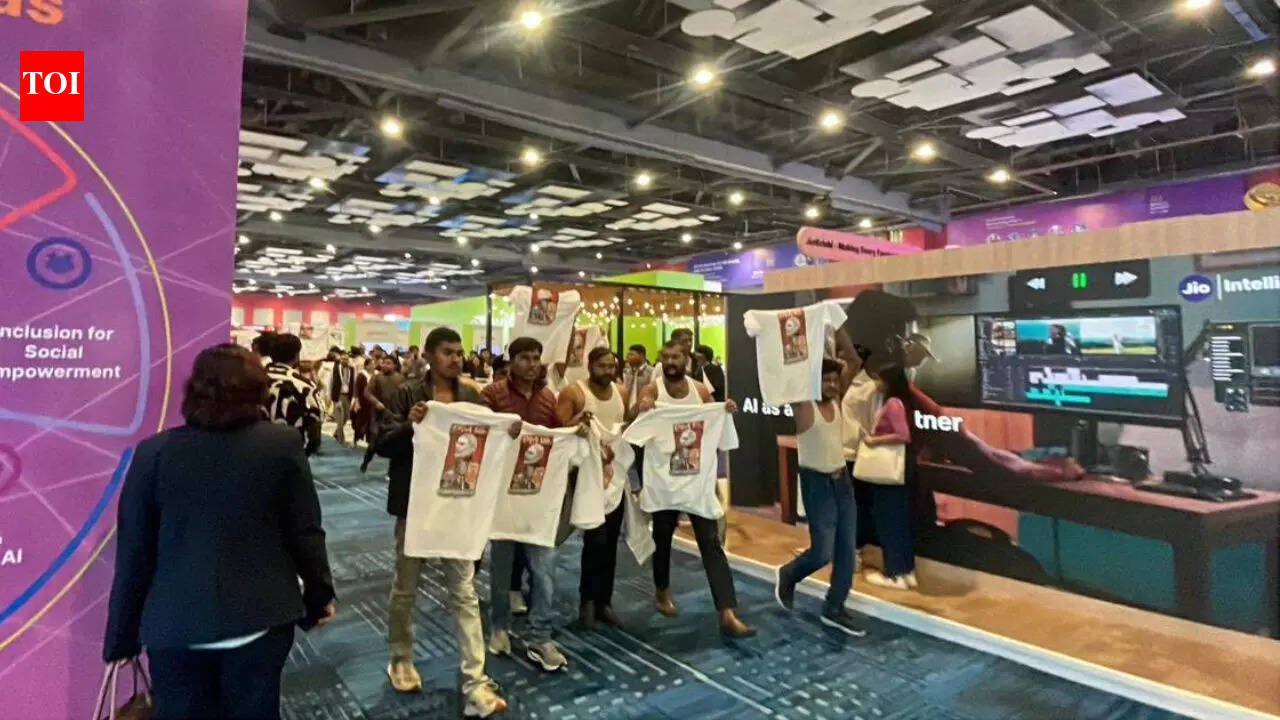
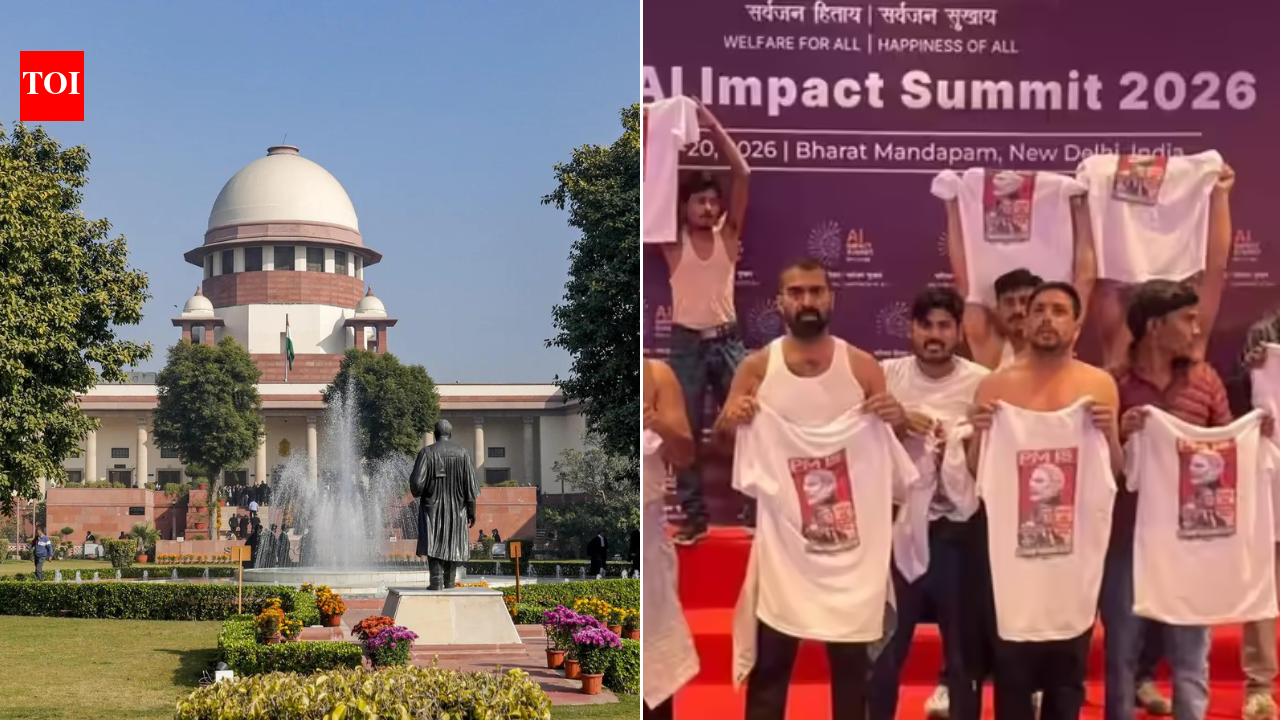
NEW DELHI: The Indian Youth Congress (IYC) on Friday defended its shirtless protest at the AI Summit venue at Bharat Mandapam, saying the demonstration was the “voice of millions of angry unemployed youth” aimed at the “compromised” Prime Minister Narendra Modi. The youth wing said that they are “not against the AI Summit, and they “will no longer sit quietly.”“Today, during the AI Summit, Youth Congress comrades raised slogans of ‘PM is Compromised’, clearly conveying the message that the youth of the country will no longer sit quietly,” IYC President Uday Bhanu told ANI.“‘PM is Compromised’ is not just a slogan, but the voice of the anger of millions of unemployed youth. PM Modi’s trade deal with America appears to be against the interests of farmers and the common people, with America gaining more benefit from it,” Bhanu said.“Youth Congress will continue to fight for the rights of the country and will keep speaking the truth on every platform,” he added.In an earlier statement, the organisation said its workers “raised their voice and protested against the compromised Prime Minister who has traded the identity of the country at the AI Summit.”In a series of social media posts, the IYC said that the truth cannot be buried behind the glittering stage of the AI Summit.“When corporate interests are placed above the nation’s welfare and a softness in foreign policy is clearly visible, then protest becomes a duty!”It added that its workers went to Bharat Mandapam “so that a voice can be raised against the ‘Compromised PM’ and the Modi government is forced to answer for the compromises being made on the country’s honour!”The organisation also said, “We’re not against the AI Summit. We’re against the compromises being made with India’s interests.”“If we know how to follow the path shown by Mahatma Gandhi, we also know how to follow the path shown by Sardar Bhagat Singh. We absolutely will not allow the interests of the country’s youth and farmers to be traded away,” it said.These remarks came after around 10 Indian Youth Congress (IYC) workers were detained after they briefly raised slogans against Prime Minister Narendra Modi inside Bharat Mandapam’s Exhibition Hall No. 5, police said.Additional Commissioner of Police Devesh Mahla said the incident took place around 12.30 pm and that the protesters had registered online to attend the summit.The protesters had marched inside the venue wearing or holding white T-shirts bearing images of Prime Minister Narendra Modi and US President Donald Trump, along with slogans such as “India-US Trade Deal”, “Epstein Files” and “PM is compromised,” leading to heated exchanges with some attendees.Officials said those detained are being identified and appropriate legal action is being taken.The “topless” protest triggered sharp reactions, with BJP leaders accusing the Congress and leader of opposition in Lok Sabha, Rahul Gandhi of orchestrating the disruption.Union commerce minister Piyush Goyal accused Rahul Gandhi of attempting to “humiliate India.” In a post on X, he wrote, “This is CONGRESS ARROGANCE & FRUSTRATION on display! So, Mr. Rahul Gandhi, humiliating India to target the Government is your idea of opposition!”“While you want to CHOKE India’s development by peddling lies about the recent trade deals, your foot soldiers are marching shirtless at the prestigious AI Summit, attempting to embarrass 140 crore Indians globally. This disruption strategy only exposes your and your party’s lack of vision for India,” he added.Union minister Bhupender Yadav termed the protest “Absolute shamelessness from Congress!” and said, “At a time Bharat is taking strides positioning itself as a global technology powerhouse, Congress is going all out to embarrass the country. This is not political opposition, this is an attempt at sabotaging India’s global image. Despicable.”


Source link

Evening news wrap: SC orders judicial officers to be part of SIR duty in Bengal; Centre slams Congress’ ‘topless’ protest at AI Summit | India News


PM Modi-Trump Meeting Speculation Grows As US Envoy Sergio Gor Drops Massive Hint, Says 'Stay Tuned'

  • The Supreme Court passed an “extraordinary order” directing the Calcutta high court to appoint serving and retired judicial officers as Electoral Registration Officers to adjudicate claims and objections in West Bengal’s SIR process, with administrative and security support from state authorities.
  • The Centre criticised Congress and Leader of Opposition Rahul Gandhi after around 10 Indian Youth Congress workers were detained for staging a shirtless protest and raising slogans against Prime Minister Narendra Modi at the AI Summit.
  • US envoy Sergio Gor said India is diversifying its oil sourcing, reaffirmed that commitments on Russian oil are part of the new India-US trade deal, and noted ongoing talks over potential Venezuelan oil sales.
  • Women’s rights groups have sought action against Rajasthan BJP MLA Bahadur Singh Koli for likening BJP budgets to “sons” and Congress budgets to “daughters,” calling the remarks patriarchal and regressive.
  • The Baloch Liberation Army released a video purportedly showing Pakistani Army personnel in its custody, with the detainees displaying identification documents and appealing to authorities as a prisoner swap deadline nears.

Here are top 5 news of the day:

PM Modi-Trump Meeting Speculation Grows As US Envoy Sergio Gor Drops Massive Hint, Says ‘Stay Tuned’

SC takes ‘extraordinary’ step in Bengal vs EC case, judicial officers to be part of SIR duty

The Supreme Court issued what it described as an “extraordinary order,” asking the Calcutta high court to designate serving and retired judicial officers in poll-bound West Bengal as Electoral Registration Officers (EROs) to decide claims and objections arising from the Special Intensive Revision (SIR) of the state’s electoral rolls, according to Live Law. The Court further stated that these judicial officers would be assisted by micro-observers and state government officials, and instructed district collectors and Superintendents of Police to extend logistical assistance and security to them. Read full story

Centre slams Congress after youth wing’s shirtless march at AI Summit, blames Rahul Gandhi

The BJP-led central government criticised the Congress and targeted Leader of Opposition in the Lok Sabha Rahul Gandhi after members of the party’s youth wing carried out what it called a “despicable” shirtless protest at the ongoing AI Summit. The reaction followed the detention of around 10 Indian Youth Congress workers, who briefly shouted slogans against Prime Minister Narendra Modi inside Exhibition Hall No. 5 at the summit venue, according to the police. Read full story

‘India diversifying oil sourcing,’ says US envoy Sergio Gor

The United States reaffirmed its position that India’s commitments on oil procurement from Russia form part of the recently finalised trade agreement between New Delhi and Washington. US envoy Sergio Gor said Washington has observed India diversifying its oil sources and noted that active talks are underway over the possible sale of Venezuelan oil to India. He added that the final trade deal is expected to be signed soon. Read full story

Women’s groups seek action against Rajasthan MLA for ‘son vs daughter’ quip

Women’s rights organisations have written to Rajasthan assembly Speaker Vasudev Devnani seeking action against Bharatpur BJP MLA Bahadur Singh Koli for remarks in the House likening the BJP government’s budgets to “giving birth to a son” and Congress-era budgets to “giving birth to a daughter.” Koli claimed that “son” budgets were productive, while “daughter” budgets led to Congress losing power. Calling the analogy patriarchal and deeply regressive, the groups said it reflected an anti-women mindset. Read full story

BLA releases video claiming Pakistani army personnel in custody amid prisoner swap deadline

The Baloch Liberation Army (BLA) has reportedly released a video allegedly showing Pakistani Army personnel in its custody as the deadline for a proposed prisoner exchange approaches. The footage, circulated on social media and shared by the Balochistan Post citing the group’s official channel, appears to show several men presenting service cards and national identity documents while identifying themselves as detained servicemen. In the video, they appeal to Pakistani authorities, saying they were formally recruited and assigned postings, and question why the authorities are allegedly not acknowledging them. Read full story


Source link

‘PM Modi torn between grips of US & China’: Rahul returns with jiu-jitsu analogy; explains why he used it in Parliament | India News


'PM Modi torn between grips of US & China': Rahul returns with jiu-jitsu analogy; explains why he used it in Parliament

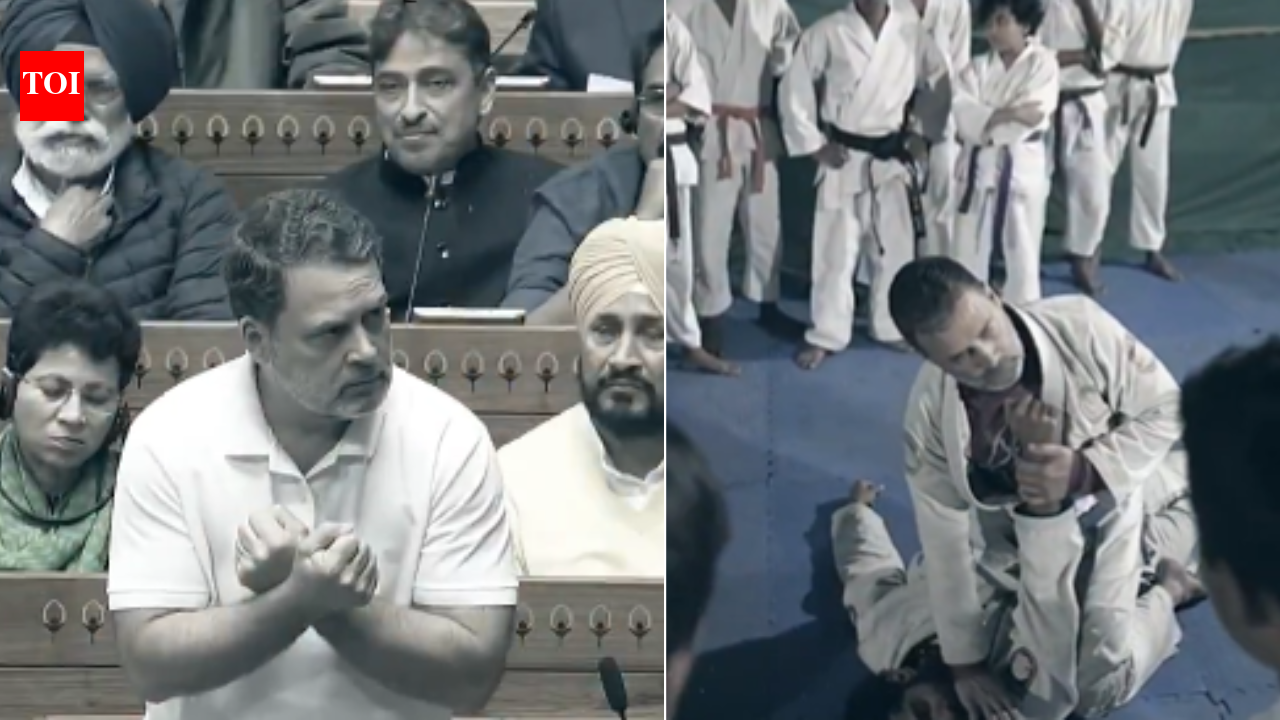
NEW DELHI: Lok Sabha Leader of Opposition on Friday unpacked his fiery “jiu-jitsu” analogy from the Budget Session speech, detailing the “political grips and chokes” squeezing Prime Minister Narendra Modi. In a video post on X, Gandhi highlighted the Gautam Adani indictment, plus the Epstein files that mention Union minister Hardeep Singh Puri and Anil Ambani. He also slammed the India-US trade deal as lopsided, heavily favoring American interests over India’s.“On one side, there is China sitting on our border, and on the other side, there’s the USA. And our Prime Minister is torn between these grips. He’s trapped,” Rahul said, explaining why he used the jiu-jitsu analogy in his Parliament speech during the Budget Session.“The real grip on Mr Narendra Modi is the fake image he has built, that has been built for him. An image that has required huge amounts of money. The key to that image is now in the hands of the US. And that’s why Indian farmers are going to suffer. Indian textiles are going to suffer. We will be forced into buying imports from the US,” he added.

Lok Sabha Sees Massive Ruckus As Rahul Gandhi Mentions Epstein Files, Adani Case; Slams PM Modi

“Why did I use a Jiu-Jitsu analogy in my Parliament speech on the trade deal? The reason I used the idea of grips and a choke is because these exist in the sport of Jiu-Jitsu and it is how you control an opponent in this sport,” he said.“But they also exist in the political realm. In my experience of politics, political grips and chokes are mostly hidden. The average person can’t see them. And you have to look carefully to see where the choke is being applied. It expressed very powerfully what our Prime Minister is going through,” he added.In a post on X, he raised several questions: “Why were our farmers sacrificed to please the Americans? Why was India’s energy security compromised by allowing the US to dictate our oil supplies? Why agree to increase US imports by $100 billion a year without a reciprocal promise? Why did I say this deal could turn India into a data colony?”“Why would Modi ji agree to a deal where India gives so much and appears to get so little?” he asked, before he went to reply “the answer to this abject surrender lies in the ‘grips’ and ‘chokes’ placed on the PM.”“But most important is the data. The fact that our data is being handed over by Mr Narendra Modi to American companies to the United States for a pittance. And mark my words, we are going to become a data colony,” he added.Earlier, Rahul had criticised the government over the organisation of the AI Summit, calling it a “chaotic PR exercise” and alleging that instead of harnessing India’s talent and data, the event put Indian data at risk while promoting Chinese products.On Friday, members of the Indian Youth Congress staged a shirtless protest at Bharat Mandapam against Prime Minister Modi, targeting the AI Impact Summit and accusing him of being “compromised.” As part of the demonstration, party workers took off their shirts to signal dissent.


Source link

Who after Vijayan? Left’s tryst with first-time voters and survival in Kerala | India News


Who after Vijayan? Left’s tryst with first-time voters and survival in Kerala

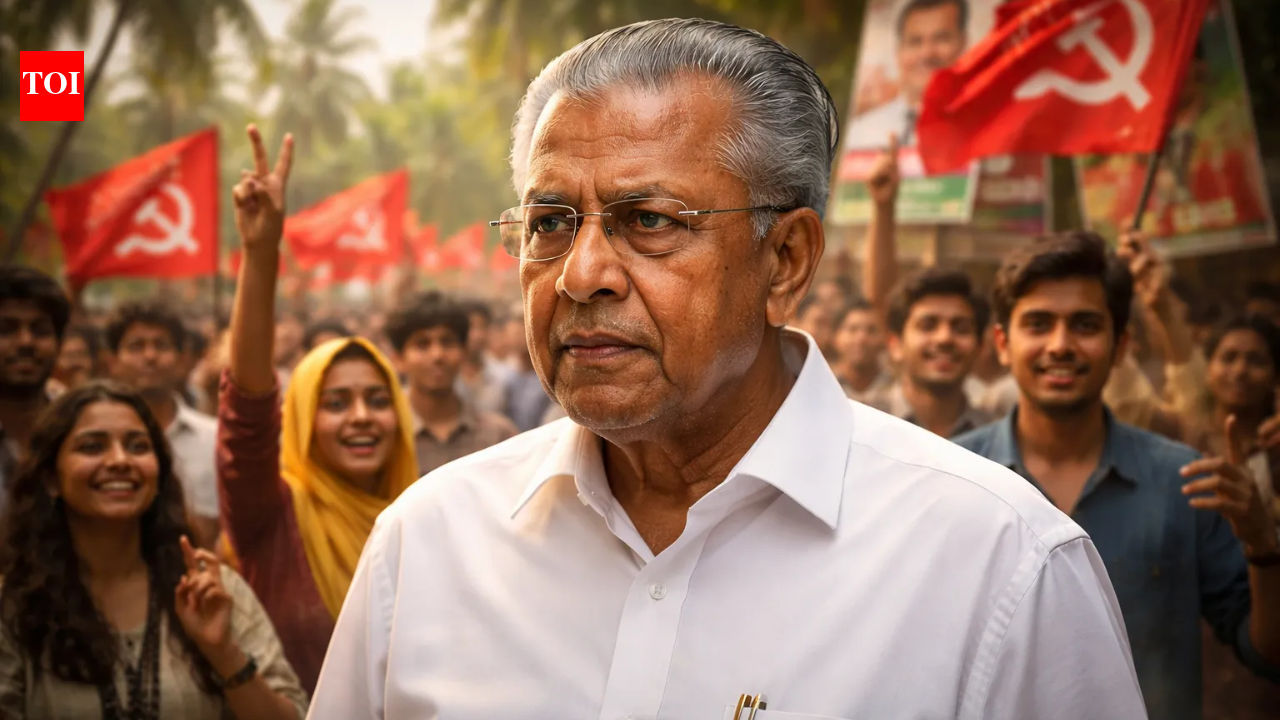
As Kerala heads toward the 2026 assembly elections, a question hangs over the state’s political landscape: what does the future of the Left look like beyond Pinarayi Vijayan?For nearly a decade, Vijayan has been the undisputed face of the Left Democratic Front (LDF), steering it through floods, a pandemic, fiscal strain and, in 2021, a historic re-election that broke Kerala’s four-decade pattern of alternating governments. But as the chief minister approaches 81, the conversation within party ranks and among voters has quietly shifted from governance to succession.

Congress In Damage Control Mode After Mani Shankar Aiyar’s Baton Remark To Kerala Chief Minister

Vijayan

Kerala remains the only state currently governed by the Left. That makes the 2026 election more than a routine contest; it is a referendum on the future of communist politics in India, and on whether the LDF can renew itself in time to connect with a new generation of voters.

Vijayan factor: Age, authority and continuity

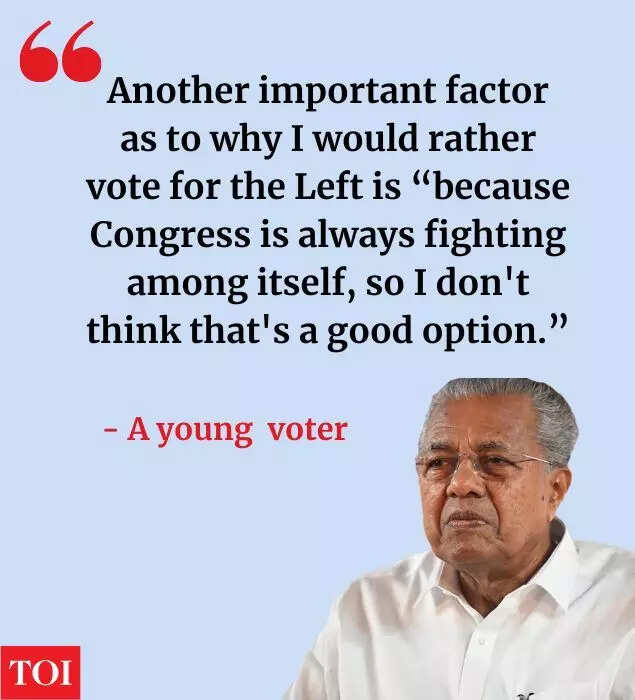
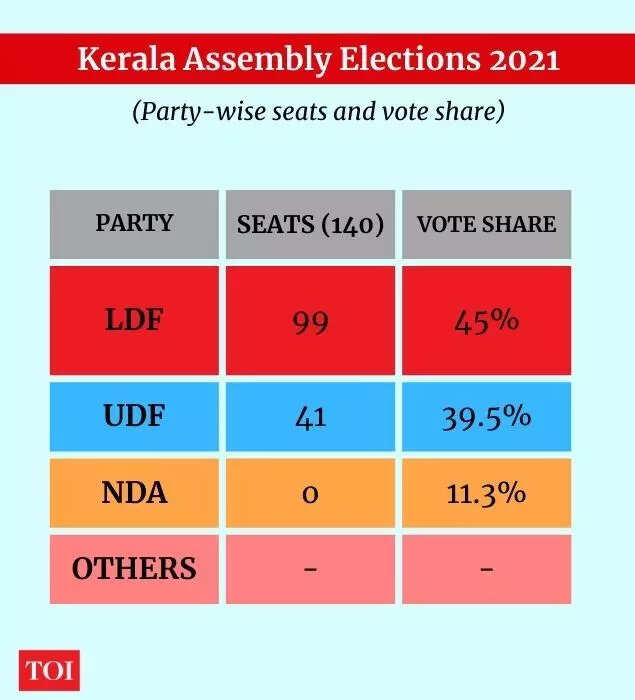
At 80, Vijayan remains the central pivot of the LDF’s campaign and governance narrative. His leadership received wide credit for the LDF’s 2021 victory, when the front secured 99 of 140 seats, the first time in four decades that an incumbent returned to power in Kerala.The government has since highlighted welfare expansion, including raising social security pensions from Rs 600 to Rs 2,000, infrastructure spending estimated at nearly Rs 2 lakh crore through budgetary and extra-budgetary resources, and a push towards a “knowledge economy”.Yet, the question is less about performance and more about continuity. “Leadership transition is a structural issue for cadre-based parties,” said a political science professor at Delhi University. “The Left’s strength has always been collective leadership, but electorally, Kerala voters increasingly respond to identifiable faces.” Sherwin, a young freelancer from Thrissur based in Delhi, believes, “If not for Vijayan, the Left possibly won’t be coming back to power.” He highlights another important reason he would rather vote for the Left: “because Congress is always fighting among itself, so I don’t think that’s a good option.”He adds, “It’s always the least bad option you vote for, not the best, that is the case in politics, I think, everywhere now.”

What voters say

Dhristi, a member of a Left student group, says, “Vijayan is not all that glossy it might look, maybe right now there is nobody to replace him, but that doesn’t make him a good choice.” She adds, “I think it’s time that more young faces are given a chance, just look at the politburo, the people sitting there just have no connection with the ground and the kind of issues youths are facing.”

The missing second rung

Unlike previous phases in Kerala politics, no widely projected younger leader is positioned as Vijayan’s natural successor. While several senior ministers and party leaders remain influential within the Communist Party of India (Marxist), the bigger partner in LDF, none currently command statewide mass appeal comparable to the chief minister.A member of the Left’s student wing says that projecting a successor prematurely could trigger factional tensions. “The party prefers continuity and collective functioning. The focus is on policies, not personalities,” he said.

Nearing 81, can Pinarayi Vijayan still defy Kerala’s political gravity.

But electoral politics is increasingly personality-driven. The absence of a clearly visible next-generation face may complicate outreach to first-time voters, particularly in urban constituencies where three-cornered contests are sharpening, with an increasing BJP/NDA footprint.

First-time voters: A shifting electorate

The scale of the youth electorate is becoming clearer. According to official figures cited by AIR News following the publication of draft electoral rolls for the state, over 1,21,000 applications have been received for updates and corrections. Of these, 96,785 were submitted for the inclusion of first-time voters who have turned 18 or sought constituency transfers. For the LDF, engaging Gen Z voters presents both opportunity and challenge. This demographic has grown up in a hyper-connected political environment, shaped as much by social media narratives as by traditional cadre networks. Increasingly, these first-time voters have become the most sought-after political entity that every party wants to sway on their side. Vishnu, a 22-year-old first-time voter from Alappuzha studying in Delhi, said, “Development and jobs matter more to us than ideology. We want to see opportunities in the state so we don’t have to leave Kerala.” Another student from Kozhikode noted that while welfare measures are important, “the conversation online is different, people talk about entrepreneurship, start-ups, global exposure.”The LDF has responded with a renewed focus on digital outreach, alongside its traditional house-visit programme, where leaders, from state-level figures to branch secretaries, are engaging households directly to gather feedback.But Sherwin says, “although there is a very active young group of people working for Left on ground, and they always come up with different schemes of things, but the Congress does the same as well, so I don’t see anything different that they are doing to woo the youths.”

Local body polls 2025

If the 2021 assembly verdict was historic for the LDF, the 2025 local government elections served as a reality check.The scale of losses was significant. LDF’s control in grama panchayats fell from 577 to 340, in block panchayats from 111 to 63, and in district panchayats from 11 to 7. In urban Kerala, the slide was steeper: municipal corporations under LDF control dropped from five to one, while municipalities declined from 43 to 29.The most symbolic blow came in Thiruvananthapuram, where the BJP captured the Corporation for the first time, winning 50 of 101 wards. For a front that had dominated the capital’s civic body since 1980, the loss carried political weight beyond numbers.However, vote share data tells a more nuanced story. Despite seat losses, the LDF polled close to 40% of the vote statewide. The UDF secured 43.21%, maintaining a lead but not a landslide margin. The BJP-led NDA’s vote share remained around 16%, marginally higher than in previous local polls, and lower than its 19.4% performance in the 2024 Lok Sabha election. The party’s gains came from concentrated seat conversion rather than dramatic vote expansion.In assembly segment terms, the UDF held leads in 81 constituencies, while the LDF led in 57. However, in 32 constituencies, the margin of defeat for the LDF was between 1,000 and 10,000 votes, indicating that micro-swings could reshape the 2026 map.There were also demographic undercurrents. With minorities constituting nearly half the state’s population, the LDF’s near-40% vote share suggests that it retained a substantial segment of minority voters as well among other sections, even as sections appeared to consolidate behind the UDF in parliamentary-style contests. The data indicates shifts, but not collapse.From the Left’s point of view, the local body verdict reflects three trends:

  • Sharper three-cornered contests
  • More efficient seat conversion by the UDF and BJP, and
  • Vulnerability in urban middle-class pockets, especially among younger voters

Whether the 2025 results were a precursor to 2026 or a mid-term correction remains an open question.

Between welfare and perception

The DU professor argues that anti-incumbency alone does not explain the LDF’s recent setbacks. Instead, “electoral shifts reflect layered dynamics, consolidation of minority votes behind the UDF, sharper arithmetic in urban areas, and the BJP’s targeted expansion”. Adding, at the same time, it seems, after two consecutive terms, the LDF is recalibrating its political messaging amid demographic and ideological churn.

.

That recalibration became visible to the world during the row over Jamaat-e-Islami Hind. The CPM and the BJP accused the Congress-led UDF of accepting support from the organisation. The controversy escalated when senior CPM leader A K Balan warned that a UDF government could allow Jamaat influence over the home ministry and lead to incidents like the 2002–03 Marad riots. CM Vijayan backed Balan’s remarks, though the CPM later described them as his “personal view” after criticism that the rhetoric echoed narratives usually associated with the Sangh Parivar. But, the incident was uncharacteristic of the Left, who compared to much of the country’s political landscape has avoided getting into the arena of communal/polarising rhetoric. Simultaneously, the Left moved to reinforce ties with sections of influential Muslim bodies such as Samastha, including the nomination of Ummer Faizi Mukkam to the Kerala State Waqf Board, a step widely interpreted as calibrated engagement with constituencies seen as distinct from the IUML.On the majority side, the government’s role in facilitating the Global Ayyappa Sangamam, linked to the Sabarimala temple managed by the Travancore Devaswom Board, drew attention given the Left’s earlier strong backing of the 2018 Supreme Court verdict allowing entry of women of all ages. Meanwhile, as the polls approach and Sabrimala snowballs into a larger electoral issue, the Left is increasingly taking a vague stand, with its ministers straightly refusing to give any clarity.

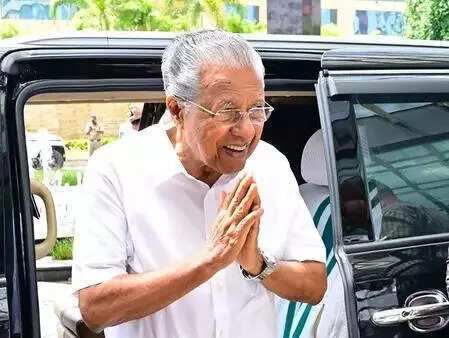
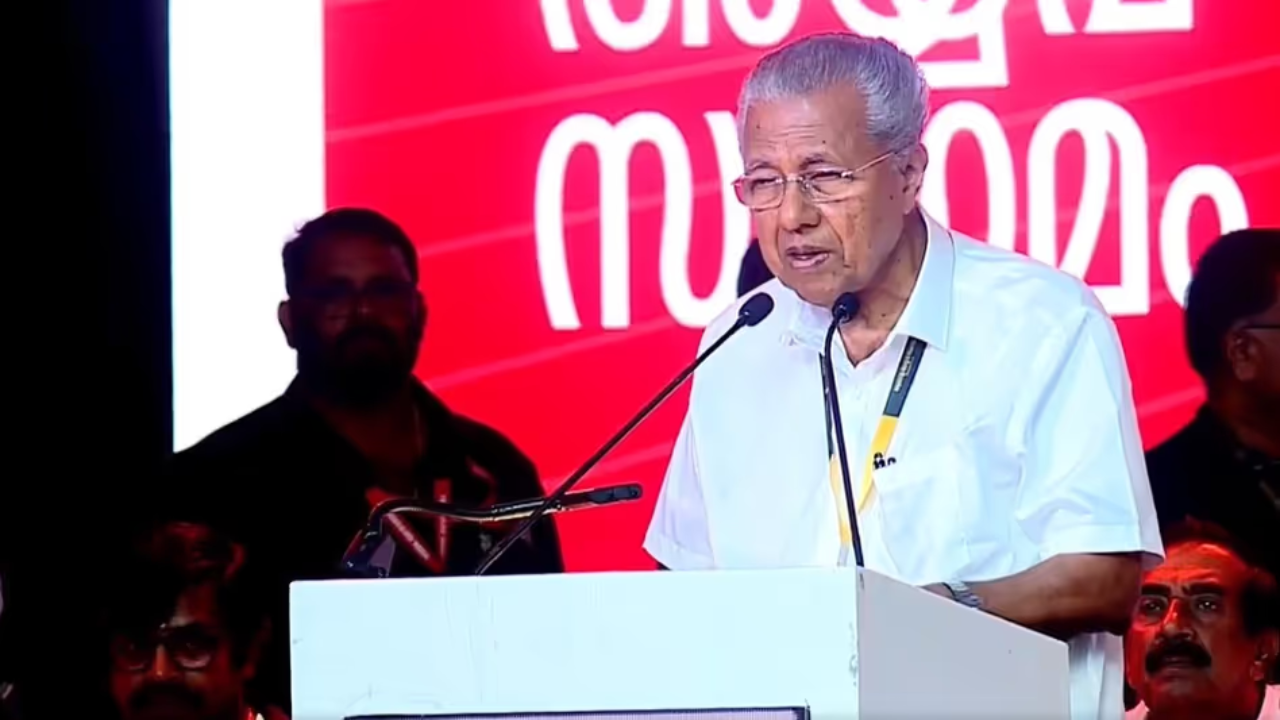
Pinarayi Vijayan speaks at Ayyappa Sangamam

Taken together, these episodes reflect the LDF’s attempt to navigate a more polarised landscape, balancing welfare governance with identity-sensitive politics, as it prepares for 2026.

Revival playbook

Party leaders have acknowledged the need to “learn from the people” and correct gaps in policy implementation and political communication. A statewide house-visit programme has been launched. Parallelly, the LDF has intensified its campaign against what it terms fiscal discrimination by the Centre. Issue-based mobilisation is also being sharpened, including campaigns around MGNREGA allocations and the implementation of labour codes. The deeper challenge, however, is political positioning. The Left’s historical growth in Kerala was rooted in class mobilisation cutting across caste and religion. Recent elections exposed tensions between welfare-driven governance, secular positioning, minority anxieties, and attempts at broader social outreach. A sustainable revival may require clarity in ideological messaging as much as administrative efficiency.The revival question, therefore, is less about arithmetic and more about adaptability.

What next for the Left?

For the Left, 2026 is not merely about retaining power but about redefining relevance. The stakes are national: Kerala is the last state under communist governance. A defeat would mean the absence of a Left-led state government anywhere in India.The immediate strategy appears two-fold: consolidating welfare beneficiaries through grassroots engagement, and countering opposition narratives via coordinated political campaigns and social media mobilisation.But the structural question remains unresolved: can the LDF transition from a leadership model anchored in Vijayan’s authority to one that inspires confidence among younger voters?As Kerala’s electorate expands with tens of thousands of first-time voters, the 2026 contest may hinge less on legacy and more on generational trust. Whether the Left can bridge that gap, organisationally and politically, will determine if its red bastion remains intact or enters a new phase of churn.The question, for now, is simple and unavoidable: After Vijayan, who?


Source link

Ai Summit: AI Summit: ‘Topless, brainless, shameless’ Centre slams Congress after youth wing’s shirtless march, blames Rahul Gandhi | India News


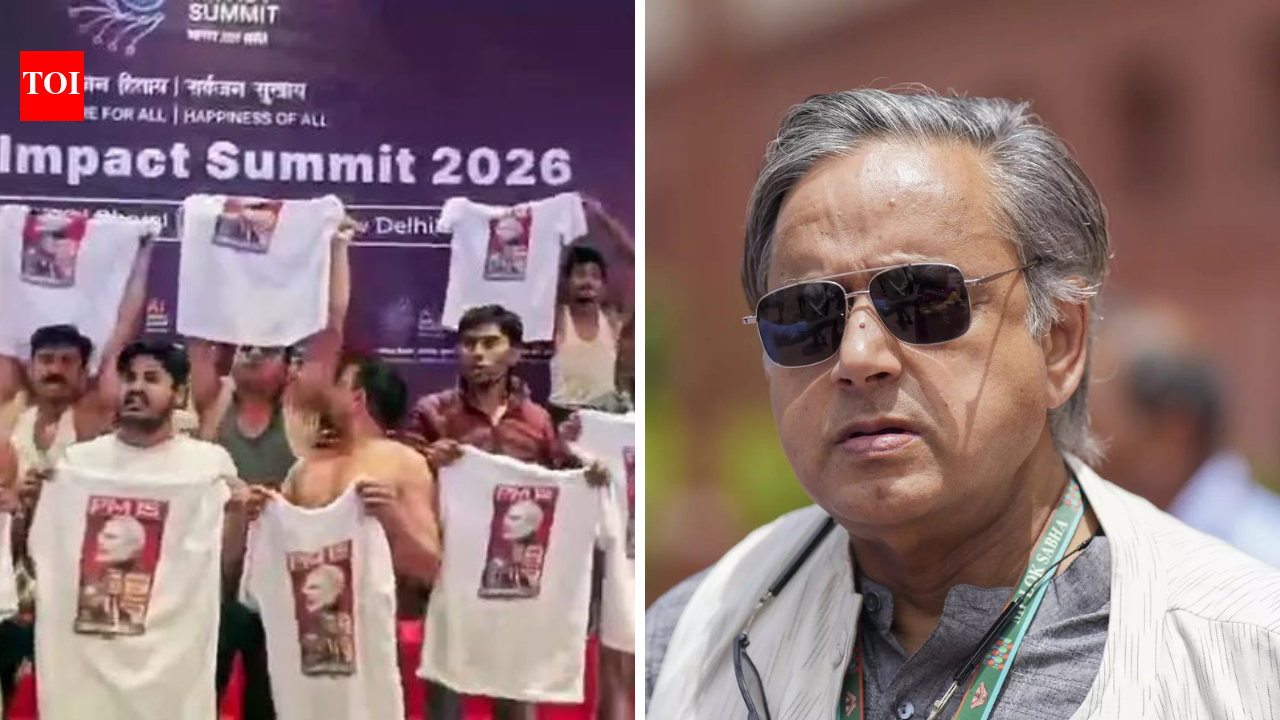
Congress Paradox: Tharoor Lauds AI Summit While Youth Stages Shirtless Protest at Venue

(Photo credit: Agencies)

NEW DELHI: BJP-led central government on Friday slammed Congress and trained guns on leader of opposition in Lok Sabha Rahul Gandhi after members of the party’s youth wing staged a shirtless “despicable act” at the ongoing AI Summit.These remarks came after around 10 Indian Youth Congress (IYC) workers were detained after they briefly raised slogans against Prime Minister Narendra Modi inside Bharat Mandapam’s Exhibition Hall No. 5, police said.The “topless” protest triggered a political war of words, with BJP leaders accusing the Congress of orchestrating the disruption.

BJP Targets Rahul Gandhi Over AI Summit Protest Row

‘Topless, brainless, shameless’

BJP MP Sambit Patra said, “Rahul Gandhi and the Congress Party are traitors of the highest order. The nation’s biggest traitors. Wherever the country progresses, wherever happiness prevails, they will surely spoil it. These are traitors…I have only three words for Congress: topless, brainless, shameless.”“Today, they went topless, brainless. Congress doesn’t have that much wisdom that this AI summit that is going on is not a BJP summit. This is an AI summit of the entire world,” he said.“The Gen-Z will never forgive the Congress Party. I request the Gen-Z to google Nehru, Edwina, and snake. You will see Pandit Nehru laughing calling India a country of snake charmers in front of Edwina Mountbatten and the Britishers. Rahul Gandhi today did exactly what Nehru did then…” he added.

‘Sabotaging India’s global image’

BJP IT department head Amit Malviya also criticised the protest, saying, “At a time when India is hosting a prestigious global AI Summit, showcasing its innovation and leadership in technology, the Congress party chose disruption over dignity.”He alleged that the act was “clearly designed to embarrass India on the world stage” and added, “Political opposition is a democratic right, but sabotaging India’s global image is not… India deserves better.”In another post, Malviya said, “Narsimha Yadav, one of the main organisers of today’s naked protest at the AI Summit, has pictures with Rahul Gandhi.” “This should leave no doubt that the disruption was not incidental, it was orchestrated. Such theatrics on an international stage only damage India’s image and undermine the very platform meant to showcase the country’s technological leadership. Political disagreements are part of democracy. Embarrassing India before the world is not,” he addedA photograph circulating on social media shows Rahul Gandhi walking alongside Narsimha Yadav, who is alleged to have organised the protest.

‘Congress is an anti-India party’

BJP national spokesperson Pradeep Bhandari also hit out at the party saying, “Congress Party has committed an anti-national act. This was the World AI Summit, led by India. It wasn’t a personal political forum. Just as an anti-national person feels uncomfortable, irritated, and jealous of the country’s prestige, the Gandhi-Vadra family instructed their Congress workers in the same way and committed this anti-national act...”In another post on X, he said Congress workers stormed the venue and raised “objectionable slogans on the instructions of Rahul Gandhi.” He further demanded that “Rahul Gandhi, Congress and Gandhi-Vadra family should apologise to the country and its youth.”

Congress arrogance & frustration on display

Union commerce minister Piyush Goyal accused Rahul Gandhi of attempting to “humiliate India.” In a post on X, he wrote, “This is CONGRESS ARROGANCE & FRUSTRATION on display! So, Mr. Rahul Gandhi, humiliating India to target the Government is your idea of opposition!”“While you want to CHOKE India’s development by peddling lies about the recent trade deals, your foot soldiers are marching shirtless at the prestigious AI Summit, attempting to embarrass 140 crore Indians globally. This disruption strategy only exposes your and your party’s lack of vision for India,” he added.

‘Congress party chose the path of disruption’

Highlighting the same sentiment against the Congress party defence minister Rajnath Singh said, “While the entire world was watching India host the AI Impact Summit at Bharat Mandapam in New Delhi and witnessing our growing global leadership in the fields of technology and innovation, the Congress party chose the path of disrupting the event instead of enhancing the nation’s honour.”“The shameful manner in which Youth Congress workers created a ruckus at the venue by indulging in inappropriate behaviour is not only unfortunate but also an attempt to tarnish India’s reputation on the international stage…” he added.

‘Despicable act’

Uttar Pradesh chief minister Yogi Adityanath said, “Today, the youth wing of the Congress party attempted a shameful incident at Bharat Mandapam. An attempt has been made to tarnish India’s image globally, and we condemn it… Strict action should be taken against those behind this.”Union minister Bhupender Yadav termed the protest “Absolute shamelessness from Congress!” and added, “At a time Bharat is taking strides positioning itself as a global technology powerhouse, Congress is going all out to embarrass the country. This is not political opposition, this is an attempt at sabotaging India’s global image. Despicable.”

What happened at the event?

The protesters had marched inside the venue wearing or holding white T-shirts bearing images of Prime Minister Narendra Modi and US President Donald Trump, along with slogans such as “India-US Trade Deal”, “Epstein Files” and “PM is compromised,” leading to heated exchanges with some attendees.In a statement, the Indian Youth Congress defended the protest, saying its workers were raising their voice against a “compromised Prime Minister who has traded the identity of the country at the AI Summit.”“Indian Youth Congress workers raised their voice and protested against the compromised Prime Minister who has traded the identity of the country at the AI Summit,” the organisation said in an official post.“Instead of leveraging India’s talent and data, the AI summit is a disorganised PR spectacle – Indian data up for sale, Chinese products showcased,” it added.“The truth cannot be hidden behind the glittering stage of the AI Summit. When corporate interests are placed above the nation’s welfare and there is visible softness in foreign policy, protest becomes a duty,” the organisation said in a separate post.“That is why the fearless workers of the Indian Youth Congress arrived at Bharat Mandapam.. so that a voice can be raised against the “Compromised PM” and the Modi government is forced to answer for the compromises being made on the country’s honour!” it added.


Source link

Shashi Tharoor: Congress paradox: Shashi Tharoor praises AI Summit, youth leaders protest on spot | India News


Congress paradox: Shashi Tharoor praises AI Summit, youth leaders protest on spot

NEW DELHI: Hours after Congress MP Shashi Tharoor praised the organisation and global stature of the AI Impact Summit in New Delhi, Youth Congress workers staged a shirtless protest at the venue on Friday against the India-US trade deal, forcing security personnel to intervene on the summit’s final day.According to officials, several Youth Congress members removed their shirts and raised slogans against Prime Minister Narendra Modi at Bharat Mandapam before being swiftly detained and taken away to prevent disruption of the high-profile international event attended by government officials, industry leaders and foreign delegates.

“We Can’t Be Seen As Weak”: Tharoor’s Bold Claim On Rafale Deal

The protesters were swiftly detained and taken away from the venue to prevent disruption of the high-profile international event attended by government officials, industry leaders and foreign delegates.Interestingly, this comes just hours after Congress MP heaped praises for the AI Summit, claiming that the event was organised “extremely well.”While talking to reporters, Thiruvananthapuram MP said, “These first couple of days have gone extremely well. There have been some glitches, but these things happen in a large event.”“What has been impressive is the attendance of Presidents, Prime Ministers, and world leaders, and they’ve come with a strong message of wanting to see a newly integrated world in AI development, where the impact upon society would be the Principle. Preoccupation in India has clearly led the drive in this area,” Tharoor said.“As far as the French Rafale is concerned, parts of it are being manufactured in India, and that is a very important aspect of the deal because it is part of strengthening our defence, but also increasing our self-reliance in the defence sector. Defence is important for India not because we want to go to war, but because we don’t want others to think that we are so weak that they can be tempted to go to war. It is a defensive defence literally, and I support the government on that,” He further said.This is not the first time Shashi Tharoor has taken a contrasting stance from the party and commended the government.After India launched Operation Sindoor after Pahalgam attack, Tharoor participated in government’s diplomatic outreach to garner international support.


Source link

Why rights exist but justice remains out of reach for the poor | India News


Why rights exist but justice remains out of reach for the poor

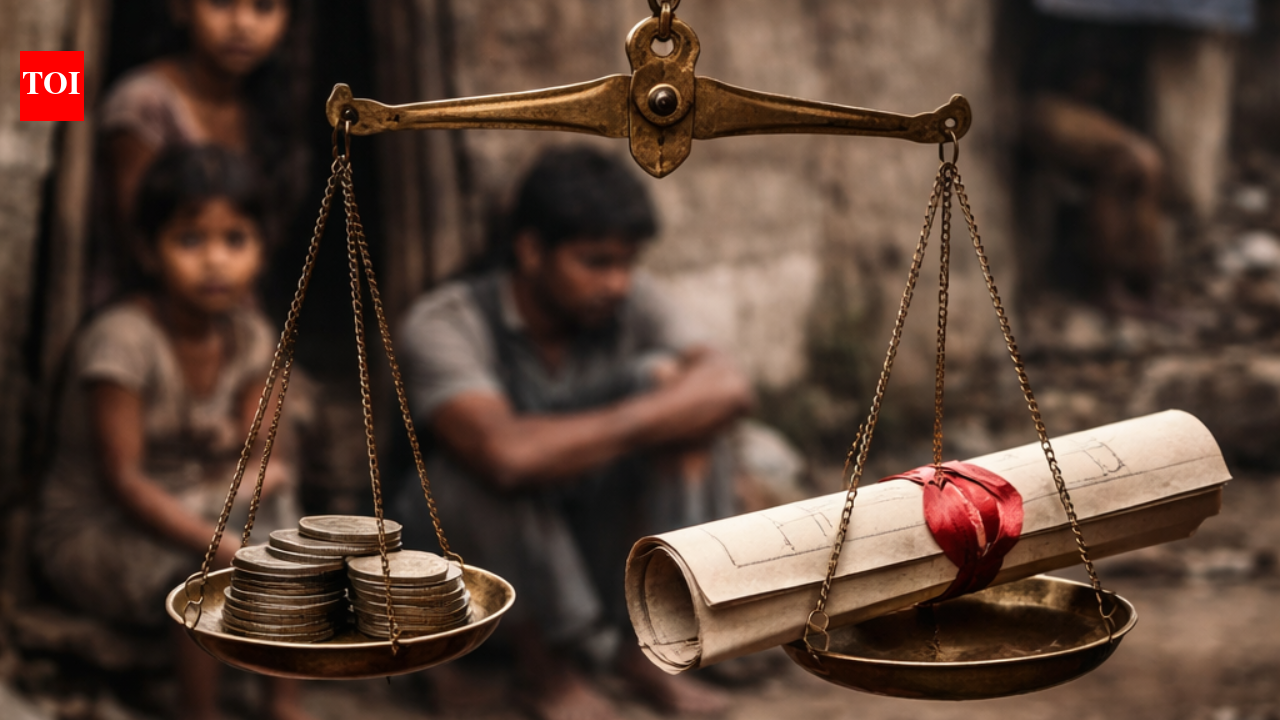
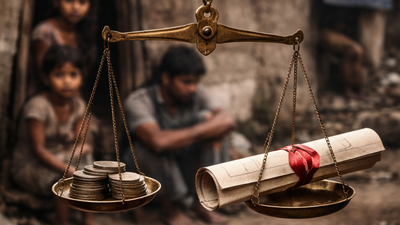
Justice comes with hidden costs that those already burdened by the perpetual cycle of poverty, a cycle that shackles every step each day, feel too acutely to ignore. Rights exist. Legal aid is free for them. However, they do not have the privilege of affording the costs, both literal and opportunity-related, associated with recurring court dates. Injustice in any form hits them harder. Some remain under the dark cloud of lack of awareness about their existing rights, while others fear the consequences that may follow if they assert them.Poverty not only strips away social standing, hinders growth, and erodes health, but also robs dignity, striking most brutally at the vulnerable.When poverty forces people from disadvantaged backgrounds to toil relentless hours under harsh conditions just to ensure their child sees a meal on his plate, even if not the future he dreams of but enough to keep hope alive, survival becomes the only priority.Poverty cements their feet and, at the same time, pushes them into legal vulnerability.And when such individuals are confronted with injustice of any sort, whether a wrongful accusation, workplace exploitation, eviction, domestic abuse, discrimination, or even a sudden legal summons, it takes far more than courage to access their own legal rights.

The constitutional promise vs ground reality

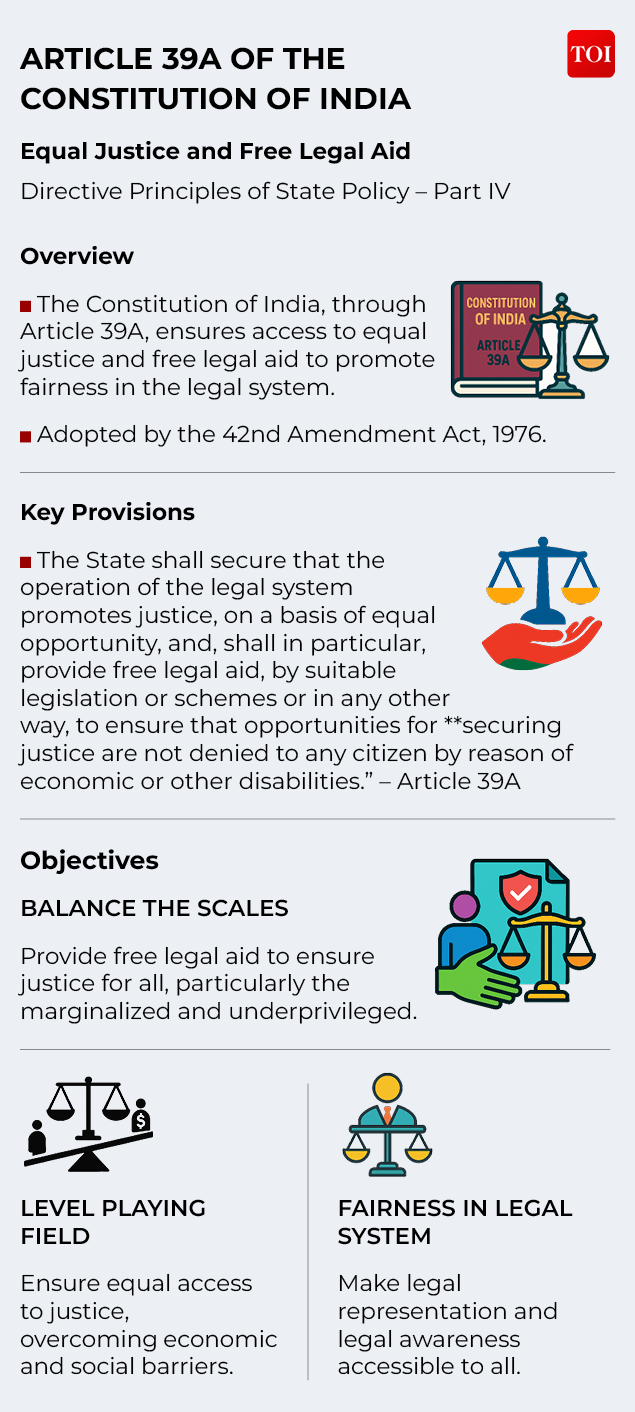
To ensure that no person is denied justice merely because they cannot afford legal representation, Article 39A of the Constitution of India, introduced through the 42nd Amendment in 1976, mandates the State to provide free legal aid and ensure equal justice for all.
12 (1)

.

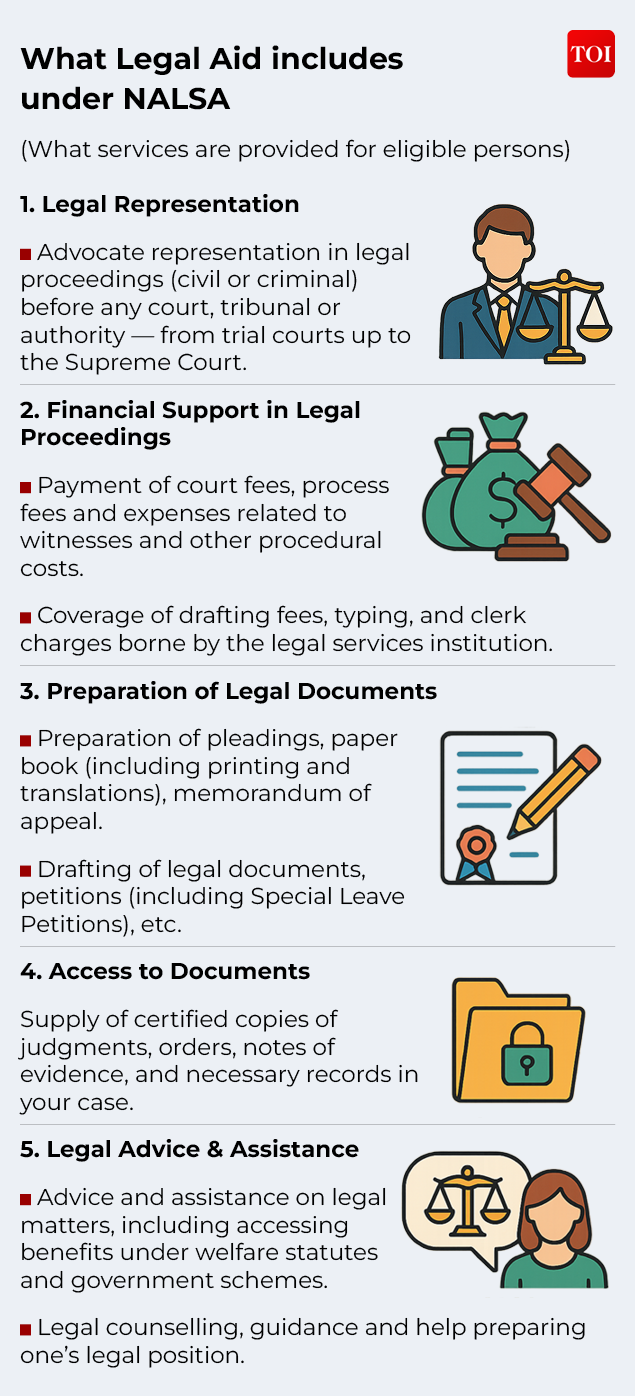
This constitutional vision was institutionalised through the Legal Services Authorities Act, 1987, under which the National Legal Services Authority (NALSA) was established in 1995 as the central body to implement legal aid programs across the country.The legal aid system in India is structured as a nationwide network, from the National Legal Services Authority (NALSA) at the Centre, chaired by a Supreme Court judge with the Chief Justice of India as Patron-in-Chief, to State and District Legal Services Authorities, and local Taluka bodies. At the grassroots, paralegal volunteers, drawn from communities, including teachers, social workers, Anganwadi workers, law students, and marginalized groups serve as bridges between citizens and the justice system.
14 (1)

.

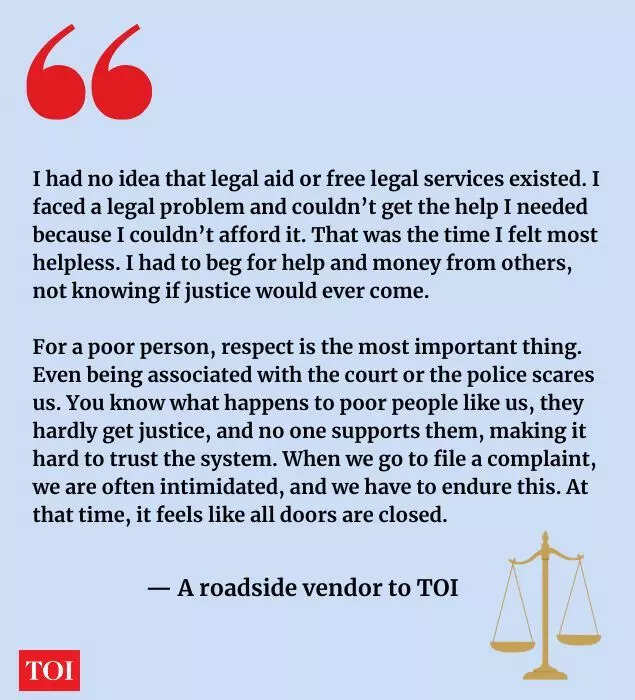
The idea being simple yet ambitious, justice should reach the doorstep of the poor.Yet access remains low. Former Chief Justice of India, former Judge of the Supreme Court of India, and former Executive Chairman of the National Legal Services Authority (NALSA), Justice Uday Umesh Lalit, in an interview to Sansad TV, noted after reviewing nationwide data:“Statistics showed that people get legal aid in less than 1% of the cases where justice is required. If we look at how many people are below the poverty line, it is inconsistent that only 1% would need legal aid. Either they do not know it is their right, or they do not have confidence in the system.”That single statistic exposes a deep structural contradiction, a country with millions eligible for free legal assistance sees only a tiny fraction accessing it.Amid the daily struggles of poverty, many people remain unaware of their right to legal aid or free legal services. A roadside vendor narrated how police use court cases to intimidate them. When asked if he knew that legal aid is free, he expressed shock.“I had no idea that legal aid or free legal services existed. I faced a legal problem and couldn’t get the help I needed because I couldn’t afford it. That was the time I felt most helpless. I had to beg for help and money from others, not knowing if justice would ever come. For a poor person, respect is the most important thing. Even being associated with the court or the police scares us. You know what happens to poor people like us, they hardly get justice, and no one supports them, making it hard to trust the system. When we go to file a complaint, we are often intimidated, and we have to endure this. At that time, it feels like all doors are closed,” he told TOI.
SC (3)

.

Poverty and legal vulnerability: A reinforcing cycle

According to the latest World Bank data, between 2011‑12 and 2022‑23, India lifted roughly 269 million people out of extreme poverty, reducing the poverty rate from 27.1% to 5.3%. Yet around 75 million people still live in extreme poverty, leaving them vulnerable not only to deprivation in food, healthcare, and education, but also to challenges in accessing legal protections and exercising their rights effectively.
1 (2)

.

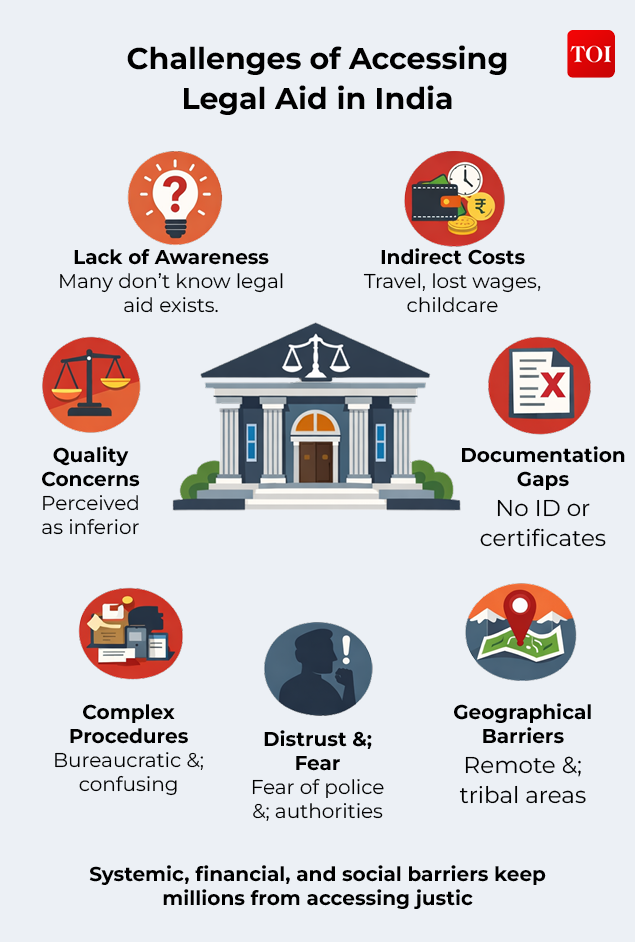
People living in deprivation often face:

  • inability to miss daily wages to attend hearings,
  • lack of transport to courts,
  • absence of identity or property documents,
  • fear of police or authority figures,
  • dependence on informal or exploitative intermediaries,

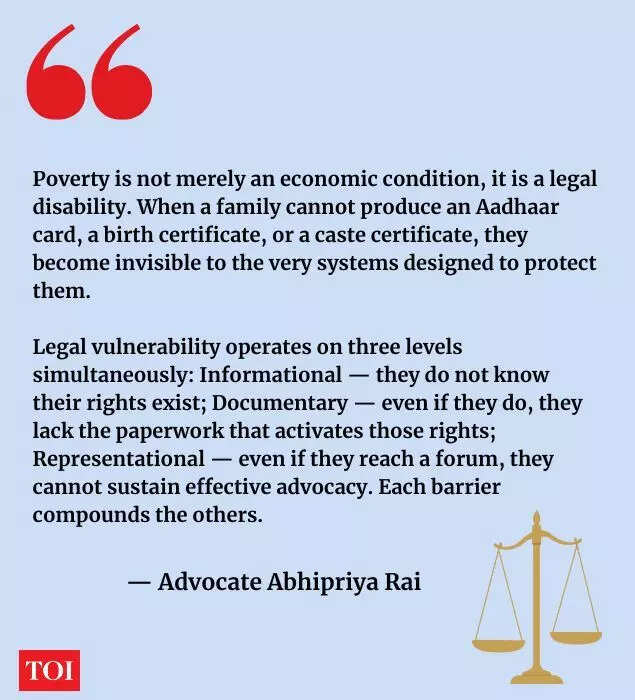
For many, even receiving a legal notice or court summons can trigger panic rather than protection. Without awareness or guidance, such notices may be ignored, not out of defiance but confusion or fear, sometimes worsening legal consequences.Advocate Abhipriya Rai explained, “Poverty is not merely an economic condition, it is a legal disability. When a family cannot produce an Aadhaar card, a birth certificate, or a caste certificate, they become invisible to the very systems designed to protect them.”
SC (4)

.

She added that legal vulnerability operates on three levels simultaneously. “Informational: they do not know their rights exist. Documentary: even if they do, they lack the paperwork that activates those rights. Representational: even if they reach a forum, they cannot sustain effective advocacy. Each barrier compounds the others.”Legal vulnerability therefore becomes not a separate condition, but a direct extension of economic vulnerability.

What grassroots organisations witness

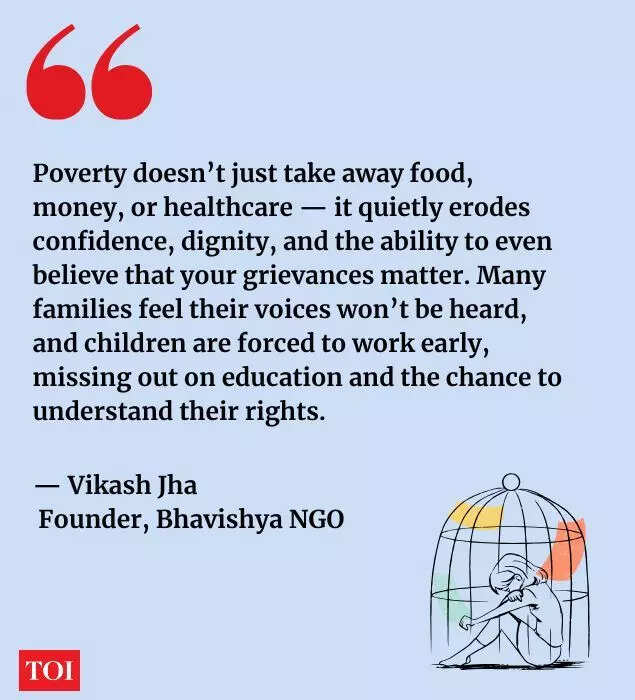
NGO workers who interact daily with marginalised families consistently observe how poverty quietly erodes agency and confidence.According to Vikash Jha, founder of Bhavishya NGO, poverty often prevents families from even believing their grievances will be heard. Lack of access to nutritious food, clean water, healthcare, and quality education weakens both physical and psychological resilience. He noted that many children from such backgrounds begin working early to support their households, further reducing their chances of awareness about rights or legal remedies.
SC (5)

.

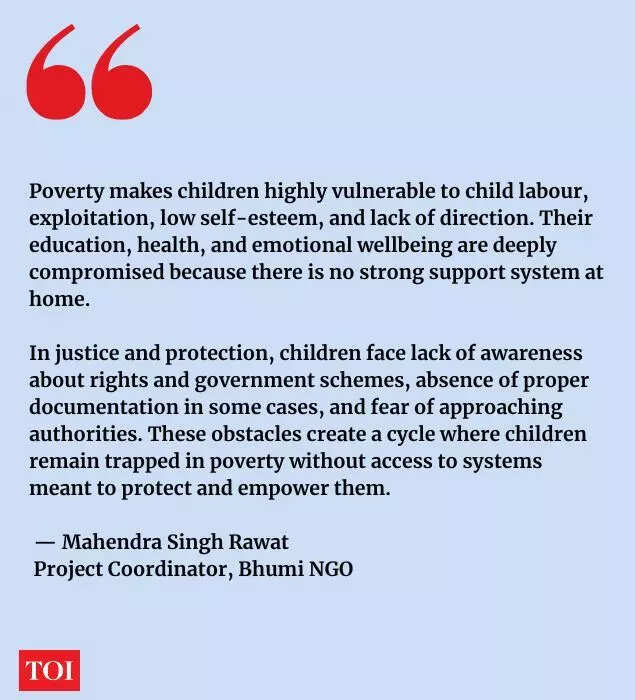
TOI also spoke to Mahendra Singh Rawat, project coordinator at Bhumi NGO, Delhi, who has worked with underprivileged children in shelter homes and slum communities for over three years. He highlighted how poverty affects every aspect of a child’s life:“It is not only financial deprivation, but also limits awareness, opportunities, confidence, and aspirations. Many parents are daily wage workers with unstable incomes. Many children drop out early, and some are pushed into begging or work to support their families”. He further noted that there is lack of awareness about rights and government schemes, absence of proper documentation in some cases, and fear of approaching authorities that further perpetuates lack of access to justice among the poor even when the legal aid framework exists.
quote 1

.

A Delhi-based cleanliness worker who wished to remain anonymous added: “Demanding better conditions is a privilege daily wage workers like me cannot afford. Even if it badly affects our health, we cannot quit. Nobody cares. I may be useful to the system, but I am not treated as a dignified part of it and I don’t feel that my voice would be heard even if raised.”

Why free legal aid alone is not enough

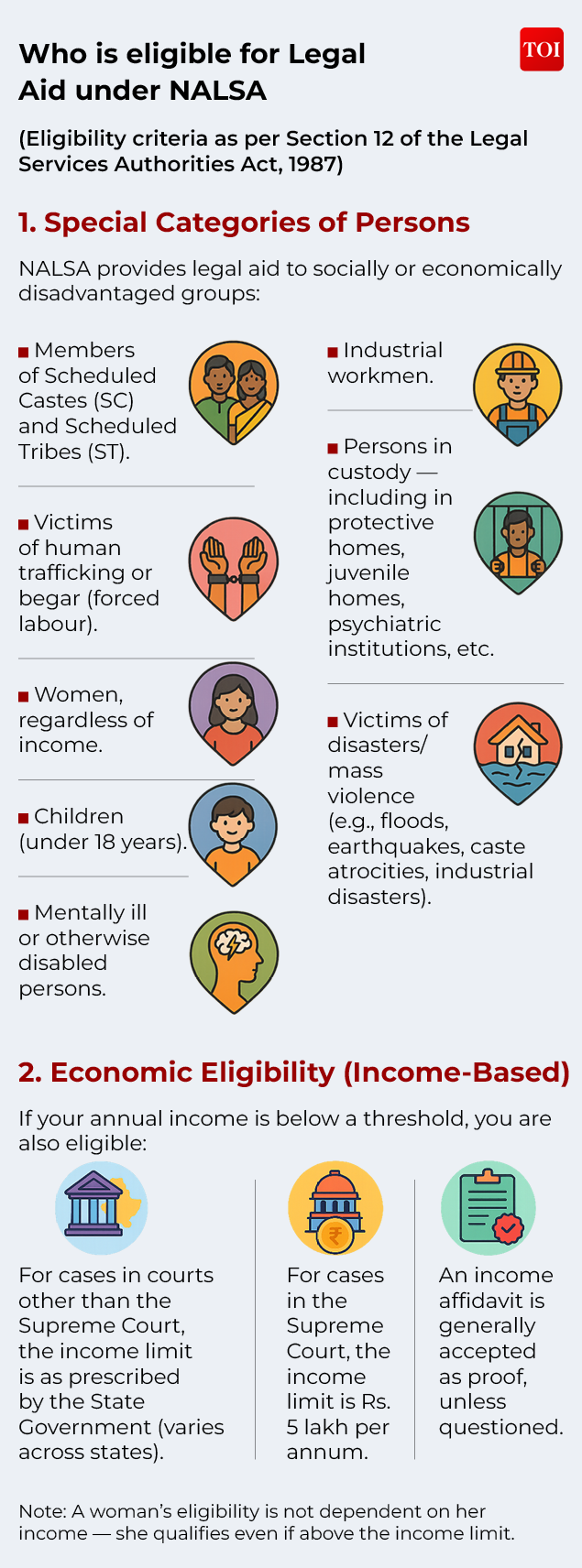
India’s legal aid framework is widely regarded as one of the most comprehensive in the world. Eligibility typically includes:

  • persons below income thresholds,
  • women and children,
  • Scheduled Castes and Scheduled Tribes,
  • persons with disabilities,
  • victims of trafficking or disaster,
  • industrial workmen,
  • those in custody,
13

.

Services may include legal advice, representation, drafting documents, and mediation, all free of cost.Yet access gaps persist because formal entitlement does not automatically translate into practical accessibility.

Common barriers include:

  • lack of awareness about the rights, legal aid framework, and eligibility,
  • distrust of state institutions,
  • language barriers,
  • social stigma,
  • procedural complexity,
  • perception that free services are inferior,

The Hidden Costs of Justice

Although legal representation may be free, justice still carries indirect expenses:

  • travel costs to courts,
  • lost wages from attending hearings,
  • childcare arrangements,
  • repeated procedural delays,

Reflecting on these hidden costs, Adv. Abhipriya observes:“A worker who cannot read the summons served to her, who has been told by police to ‘go home and settle,’ does not see the law as a resource. She sees it as a threat. That fear is rational.” On the broader framework, she notes, “India has one of the most elaborate statutory frameworks for protecting the poor in the developing world. But a right that cannot be exercised is not a right. It is a promise that was never kept.”For daily wage earners, a single missed workday can mean a missed meal. Multiple court dates can therefore translate into financial distress, discouraging people from pursuing even legitimate claims.

Can legal aid help alleviate poverty?

Adv. Abhipriya noted that legal aid, when delivered effectively, has immediate, tangible impacts. The mechanism is more direct than people assume:When a woman who has been illegally terminated recovers her wages through a legal aid lawyer, she has protected her family’s food security for months. Similarly, when a family obtains a stay against illegal demolition, children stay in school.She added that legal aid, when delivered well, is poverty alleviation, without a welfare scheme label attached.Between 2015 and 2025, over 1.61 crore citizens received legal aid, while over 40 crore cases were settled through National Lok Adalats, and the Legal Aid Defence Counsel System disposed of nearly 8 lakh criminal cases in three years.Government funding for NALSA for 2022‑23 was Rs. 190 crore, which was increased to Rs. 400 crore for 2023‑24, dropped to Rs. 200 crore in 2024‑25, and rose again by 25 percent to Rs. 250 crore in the Union Budget 2026‑27.However, structural challenges still persist:Awareness: Judges and legal experts have emphasised that many eligible people are unaware of free legal aid, with most assuming they cannot access assistance because it is unaffordable.Quality: Justice Nagarathna emphasized that “legal aid to the poor does not mean poor legal aid.” Panel lawyers are often junior, overloaded, and inadequately compensated. Wide disparities persist between legal aid representation and private representation. This is not a criticism of individual lawyers but a systemic design failure.Geography: Tribal families in remote areas often cannot reach District Legal Services Authorities, and the digital divide creates additional barriers for accessing online portals.Fund utilisation: Hon’ble Chief Justice Surya Kant disclosed at the Conference that by September 2025, only 16.93% of the Legal Aid and Advice budget had been utilised, while outreach expenditure had exceeded its allocation. Money meant for representation and aid delivery remained unspent, while funds for awareness were overspent, an inversion of priorities.

Why this conversation matters

On World Social Justice Day, observed annually on February 20 by the United Nations, the global spotlight turns to poverty, inequality, exclusion, and human rights. For India, it underscores the urgent challenge of bridging the gap between legal rights and actual access to justice.As harsh as it may sound, society often reserves dignity for those who are affluent and demands subservience from those who struggle simply to survive, educate, and aspire. Poverty does not only deprive, it silences. Understanding how poverty intersects with legal vulnerability is essential not merely for policy reform, but for safeguarding democracy itself. Because access to justice is not just another welfare benefit, it is the foundation that determines whether rights exist only on paper or in reality.


Source link

Six e-commerce firms face action as CCPA targets unauthorised sale of anti-drone & signal jammers | India News


Six e-commerce firms face action as CCPA targets unauthorised sale of anti-drone & signal jammers

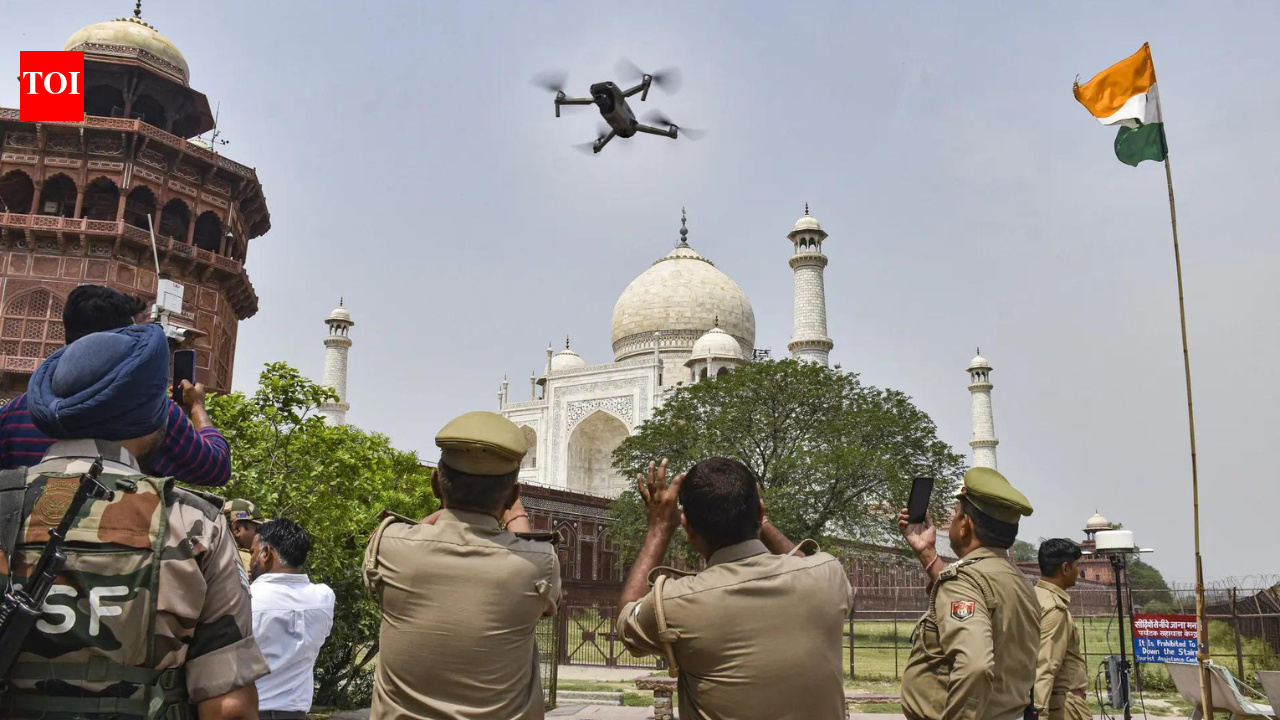
NEW DELHI: Cracking down on the online sale of “anti-drone” and “GPS jammer” devices, the Central Consumer Protection Authority (CCPA) has issued notices to six e-commerce platforms and entities. These entities face the risk of punitive action for misleading listings and regulatory non-compliance, officials said.The CCPA has sought detailed information on import licences, regulatory clearances, and buyer details from Everse, Indiamart, Xboom, Javiat Aerospace, AirONE Robotics, and Maveric Drones & Technologies Pvt Ltd.The authority observed that these devices were being listed online without disclosure of mandatory licensing requirements, without valid Equipment Type Approval (ETA) or Wireless Planning and Coordination (WPC) certification details, and without clearly stating that civilian possession and use without statutory authorisation is prohibited. It stated that the sale of such products on e-commerce platforms is likely to mislead consumers into believing that these devices are freely purchasable.The CCPA has directed the entities to furnish detailed information, including the source of procurement and import, along with copies of import licences, invoices, and related documents. They have also been asked to submit copies of regulatory approvals and authorisations obtained from the WPC, Department of Telecommunications (DoT), Directorate General of Foreign Trade (DGFT), Cabinet Secretariat, and Ministry of Home Affairs (MHA).The authority has further sought the legal basis for offering the restricted equipment for commercial sale; the number of units sold over the past two years along with complete purchaser details; particulars of third-party sellers listing similar equipment; steps taken to discontinue such listings and prevent recurrence; and a complete list of similar radio frequency or wireless transmitting equipment offered on their platforms.Drone jammers and signal jamming equipment are regulated under the Indian Telegraph Act and the Wireless Telegraphy Act, and are subject to strict licensing and regulatory control by the Department of Telecommunications (DoT) and the Wireless Planning & Coordination (WPC) Wing. The import of such restricted equipment is governed by the Foreign Trade (Development and Regulation) Act, 1992, and applicable DGFT notifications. Such equipment is ordinarily permitted only for authorised government agencies and law enforcement authorities, subject to statutory approvals.


Source link

Defamation case: Rahul Gandhi records statement in Sultanpur court over remarks on Amit Shah | India News


Defamation case: Rahul Gandhi records statement in Sultanpur court over remarks on Amit Shah

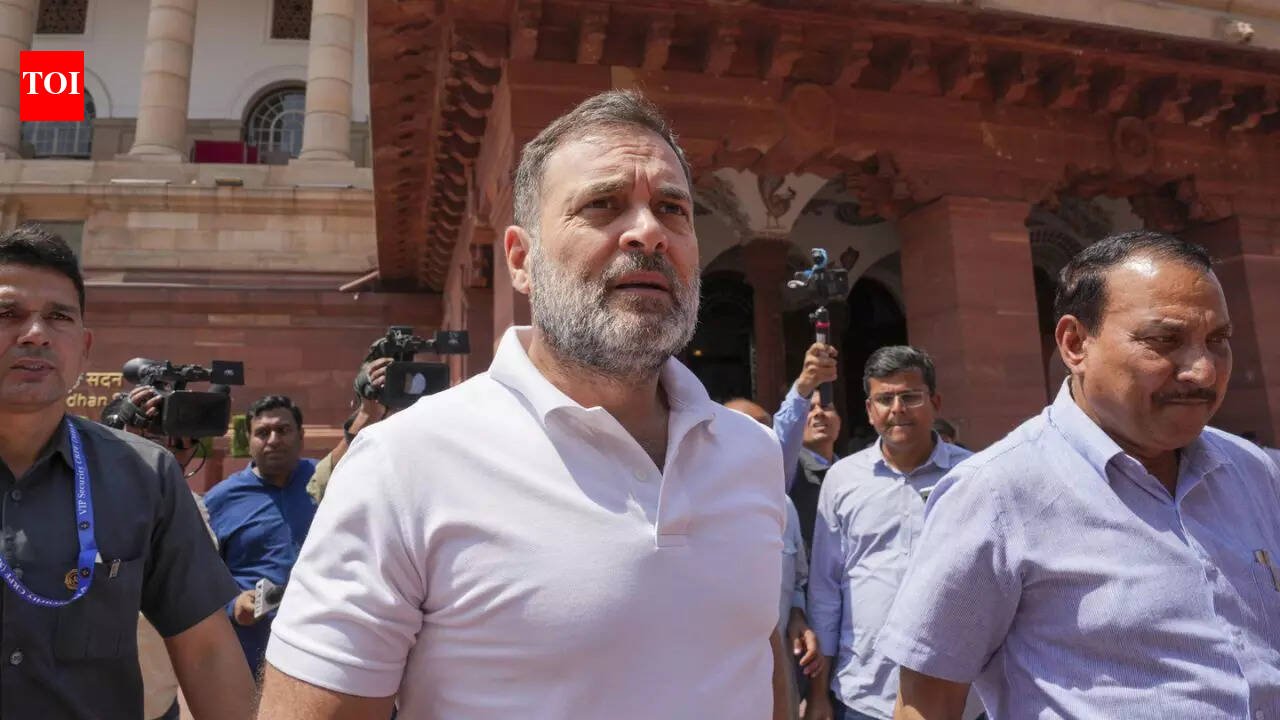
NEW DELHI: Leader of opposition in the Lok Sabha and Congress MP Rahul Gandhi on Friday appeared before the MP MLA court in Sultanpur and recorded his statement in connection with a 2018 criminal defamation case linked to his alleged remarks about Union home minister Amit Shah. He later left the court premises after attending the hearing.Next hearing for the case is scheduled for March 9. The case stems from statements Gandhi allegedly made during the 2018 Karnataka Assembly election campaign. A complaint was filed on August 4, 2018, by Vijay Mishra, a BJP leader in Sultanpur, alleging that Gandhi made objectionable and defamatory remarks against Amit Shah at an election rally in Bengaluru.

‘I Challenge Rahul Gandhi’: Amit Shah Slams Cong For ‘Misleading Farmers’ On India-US Trade Deal

According to the complaint, Rahul Gandhi had said that while the BJP claims to believe in honest and clean politics, it is led by a “party president who is an accused in a murder case”. At the time, Amit Shah was serving as the BJP national president.The remarks referred to the 2005 Sohrabuddin Sheikh fake encounter case. However, in 2014, a special CBI court in Mumbai had discharged Shah in the matter when he was Gujarat’s home minister. The complainant contended that Gandhi’s statement was defamatory and harmed Shah’s reputation.The Sultanpur MP MLA court later took cognisance of the complaint. In December last year, the court issued a warrant against Gandhi after he failed to appear in person.On February 20, 2024, Gandhi appeared before the court, surrendered and was granted bail. His counsel moved an application seeking bail, which was allowed after two sureties of Rs 25,000 each were submitted. The court subsequently fixed March 2 for the next hearing.In July 2024, Gandhi recorded his first statement before the court, denying the allegations and terming the case politically motivated.Following the cross examination of the complainant and witnesses, the court in January 2026 directed Gandhi to appear personally for examination under Section 313 of the Code of Criminal Procedure. This stage allows the accused to explain the evidence presented against him.His appearance on Friday was in compliance with that directive.The case is among several defamation matters filed against the Congress leader over remarks made during political campaigns. Gandhi has maintained that such cases are politically driven, while Congress leaders have said they have faith in the judiciary.Further proceedings in the matter are expected as the court continues to examine the evidence and hear arguments from both sides.


Source link

Emmanuel Macron: ‘Thank you India!’: French President Macron shares highlights of his three-day visit | India News


From Google To Chanel: French President Emmanuel Macron Highlights India Global Influence In Mumbai

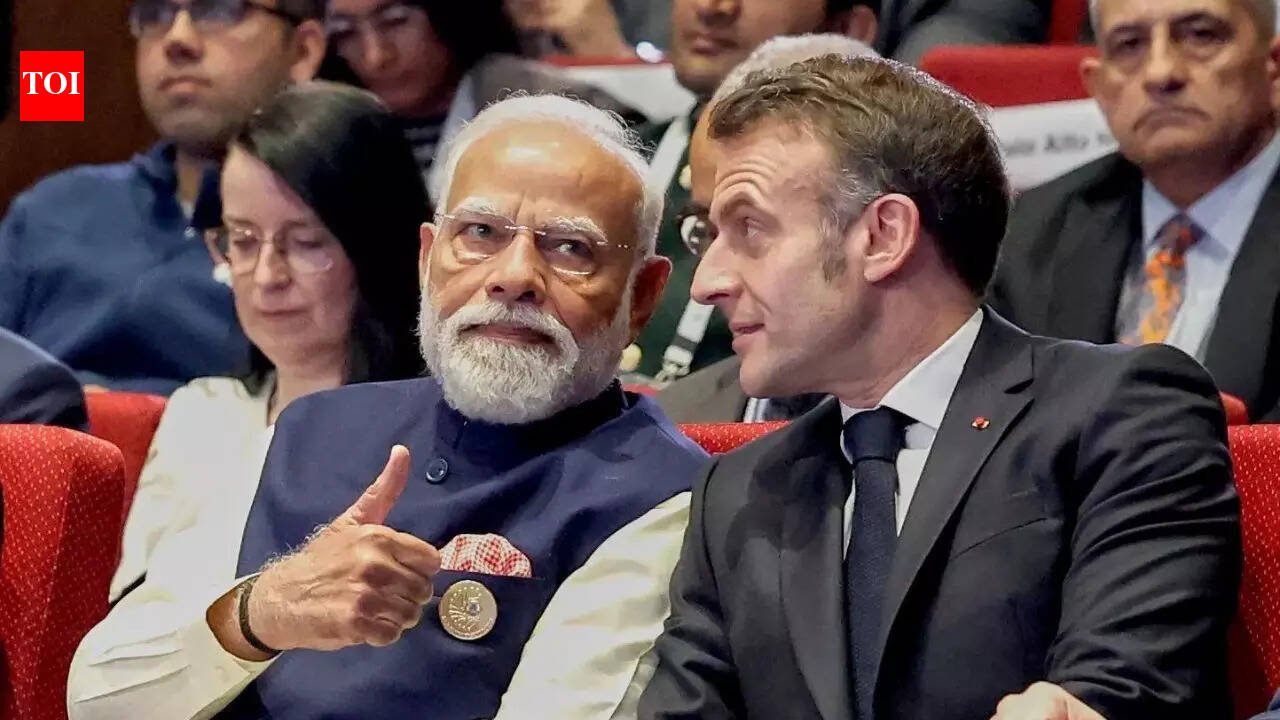
NEW DELHI: French President Emmanuel Macron on Thursday concluded his three day visit to India with a “Thank You India!” message, after attending the India AI Impact Summit 2026 and holding bilateral talks with Prime Minister Narendra Modi.In a post on X, Macron shared a video of moments from his visit along with a note saying “Thank You India!”, appreciating the warm welcome he received during the trip.

From Google To Chanel: French President Emmanuel Macron Highlights India Global Influence In Mumbai

During the visit, Macron met Prime Minister Narendra Modi and interacted with global technology leaders, signalling deeper cooperation between Paris and New Delhi in artificial intelligence, innovation and strategic sectors.Addressing the India AI Impact Summit 2026, Macron began with a greeting that drew applause from the audience.“Namaste. Thank you very much for welcoming us to this magnificent city, in this magnificent country. It’s great to be back after my 2024 state visit for this Artificial Intelligence Impact Summit hosted by you, Prime Minister,” he said.Praising India’s digital transformation over the past decade, he said, “10 years ago, a street vendor in Mumbai could not open a bank account. No address, no papers, no access and today the same vendor accepts payments on his phone.”He added, “India built something that no other country in the world has built. A digital identity for 1.4 billion people. A payment system that now processes 20 billion transactions every month. A health infrastructure that has issued 500 million digital health IDs. Here are the results. They call it the India Stack Open Interoperable Sovereign.”On the sidelines of the summit, Macron met Google CEO Sundar Pichai and discussed digital cooperation and the priorities of the French G7 Presidency.“Solutions to our digital challenges are not found on Google, but built with Google and all stakeholders. At the Delhi AI Summit, together with Sundar Pichai, we discussed the priorities of the French G7 Presidency. And I shared one message: Choose France!” Macron posted on X.Pichai responded, “With its leadership of the G7, France has a pivotal role to play in unlocking the opportunities of AI, and we are proud to be a partner.”Macron also held talks with Meta’s chief AI officer Alexandr Wang.“Constructive discussions with Alexandr Wang from Meta at the Delhi AI Summit. We discussed what France has to offer: talent, research, and data centres. In two words: Choose France!” he wrote.“We also reviewed measures to protect young people on social media, in particular the proposal I support to ban access for those under 15. Good news: Meta is committed to moving forward with us,” he added.On the broader India France partnership, Macron said ties were at their strongest.“And as for the bilateral relationship, I really believe it’s at the highest point, and we want to do much more again because it’s based on our relationship,” he said.Prime Minister Narendra Modi also held a bilateral meeting with Macron in the capital on the sidelines of the summit.Macron described India’s progress in digital governance and technology as a global benchmark, underlining continued momentum in the India France strategic partnership with a focus on artificial intelligence and emerging technologies.


Source link