Breaking News
Divya Dutta reveals how Aditya Chopra’s advice made her walk away from 20 signed films: ‘Why don’t you leave a legacy behind?’ |


Divya Dutta, who began acting at 16, struggled for steady work before Veer Zaara brought success and many offers. After signing 20 films, a candid chat with Aditya Chopra made her rethink her choices. She returned several projects, later winning a National Award for Irada and starring in Chiraiya on OTT.

Divya Dutta entered Bollywood as a teenager, just 16, making her debut with ‘Ishq Mein Jeena Ishq Mein Marna’. She earned recognition with the 1999 Punjabi film ‘Shaheed-e-Mohabbat Boota Singh’. However, she admits that finding consistent work wasn’t easy for several years. Things took a turn after ‘Veer Zaara’, which brought her widespread success and a flood of offers. Divya ended up signing around 20 films but eventually returned the money for many of them after a conversation with Aditya Chopra.

Divya Dutta reflects on her early years

In her conversation with Hindustan Times, Divya reflects on her career and why she now focuses on quality rather than quantity. She admits, “I felt out of place. For me, finding my place was a journey in itself. Along the way, you realise what you want. As life happens to you, it is when that clarity of thought comes to you ki mujhe kya chahiye (what do I want). You find your niche, your calling, and you know what your next step should be.

Watch

ACTRESS DIVYA DUTTA AT VIKSIT BHARAT AWARD 2025

Divya Dutta recalls signing 20 films

Reflecting on her career, the actor recalls that around 2007 she took on 20 odd films because there was a time when she didn’t have any. After a long phase without work, she was suddenly offered many projects, so she decided to take them all.

Divya Dutta’s advice from Aditya Chopra

Divya eventually stepped back from all the films she hadn’t yet started after an unplanned conversation with Aditya Chopra, her collaborator on Veer-Zaara and Aaja Nachle. “One day, I went to Aditya Chopra to just meet and have a cup of chai. We had just finished Aaja Nachle. I told him I signed 20 films. He did not respond, so I asked him, ‘Aren’t you excited for me?’ He said, ‘Is there a dearth of work for you or financially?’ I was very taken aback and said no. Then he asked me why I was signing so many films. ‘You are a very good actor, why don’t you leave a legacy behind?’,” recalls Divya.

Divya Dutta changes her perspective

Divya shares that her meeting with Aditya Chopra turned out to be a turning point in how she approached her career and choices. “It hit me hard,” she says, “I had not thought of it this way. It was my choice whether to listen to him or continue making money with those 20 films. There was a lot at stake. But I went back and returned the signing amounts of the films I hadn’t started. From then on, I only did stuff that I enjoyed. That was the stand I took.

Poll

What matters more in an actor’s career?

Divya Dutta’s National Award and recent projects

In 2017, Divya’s performance in Irada earned her the National Award for Best Supporting Actress. Over the years, she has also been part of several successful films, including ‘Bhaag Milkha Bhaag’, ‘Badlapur’, and ‘Chhaava’. Most recently, she appeared in the web series ‘Chiraiya’, which is currently streaming on JioHotstar.


Source link

Special NDPS court in Mumbai acquits duo in 2017 drug case, cites procedural lapses | Mumbai News


Mumbai: A special NDPS court recently acquitted two men, including a 75-year-old Jammu and Kashmir resident, in a 2017 case involving the alleged seizure of over 20 kg of charas. Both accused, Haji Hakim and Irfan Qureshi, had spent five years in jail before being granted bail in 2022. The court ruled that the prosecution failed to prove the charges beyond reasonable doubt, citing significant procedural lapses regarding the search of the accused and the methodology used to collect drug samples for forensic analysis. The duo were arrested in July 2017 by the Anti-Narcotic Cell (ANC) near Foras Road following a tip-off. While the prosecution claimed to have recovered 15.6 kg of charas from Hakim and 5.2 kg from Qureshi, the judge found substance in defence lawyer Anil Lala’s submissions that the mandatory safeguards under the NDPS Act were not strictly followed. The judge noted that while the law requires an accused to be informed of their right to be searched before a magistrate or a gazetted officer, the evidence in this case was “not convincing.The court pointed to discrepancies in how the accused were apprised of these rights. Though the police produced letters signed by the duo, the judge observed that the replies were not in the handwriting of the accused and appeared identical. Further, the investigating officer admitted that the appraisal might have occurred during the preparation of the panchnama rather than before the actual search. Regarding these procedural failures, the judge held, “If this statement... is accepted to be true, then admittedly the appraisal of right under section 50 was not before the search was conducted. The evidence of prosecution on the point of appraisal about right of accused under section 50 of NDPS Act is not convincing.”Another blow to the prosecution’s case was the failure to follow Section 52-A of the NDPS Act, which mandates that samples be drawn in the presence of a magistrate to serve as primary evidence. The court found that the police had instead collected samples by “scratching” the seized charas rolls themselves. “Admittedly, the procedure under section 52-A of NDPS Act is not followed in the present case. It is an admitted fact on record that the sample from the seized substance were not drawn by the police in the presence of the magistrate, therefore, the samples drawn would not be a valid piece of primary evidence in the present trial,” the judge said. The judge further questioned the representative nature of the samples, noting that the investigating team did not weigh each charas roll separately or collect individual samples from every piece. As the prosecution failed to establish that the samples sent for chemical analysis accurately represented the bulk of the seized material, the judge found the evidence insufficient for a conviction. “The prosecution has failed to establish compliance under section 52-A of the NDPS Act. The prosecution has failed to prove charge against accused beyond reasonable doubt,” the judge said.


Source link

Massachusetts Robbery: High-tech robbery using jammers in Massachusetts targeting Indians as they keep cash, jewelry at homes


Two men charged for robbery targeting Indians in Massachusetts appeared in court recently. (CBS News)

A high-tech gang has been busted in Massachusetts for orchestrating sophisticated robberies, where they targeted Indians and East Asians specifically, as they are known to keep cash, jewelry, heirloom valuables with them inside their homes as part of their culture. The robberies took place last summer when the thieves stole hundreds of thousands of dollars in cash and jewelry from five homes in Woburn, Wilmington, Burlington and North Reading in June and July of 2025.CBS reported that three men have been accused of using GPS trackers, hidden cameras and WiFi jammers in their sophisticated home break-in scheme. David Rondon-Castro and Yeison Ramirez-Garcia of New York, and Itan Dami Beltran of Pennsylvania have charged with conspiracy to commit residential break-ins. Rondon-Castro and Yeison Ramirez-Garcia appeared in court recently.Middlesex County District Attorney Marian Ryan said all these men were intensively surveilling the individuals who would become their victims.

Camera inside the house, GPS trackers for cars

The thieves attached GPS trackers to the cars of the families and installed hidden video cameras in the yards or inside their targeted properties. Using Wi-Fi jammers, they used to disable the security systems that the victims might have had in their homes. Ryan said the suspects targeted the victims “based on their race and ethnicity and apparent belief that they may be more likely to have valuable heirlooms, jewelry, gold and cash in their homes as part of their heritage and culture.” The suspects are part of a group targeting homes in Massachusetts and the East Coast, Ryan said. She said they were tracked down by investigators who analyzed cell phone data and license plates of “suspicious vehicles” seen in the area of the break-ins.CBS reported that a similar pattern of targeted robbery in Massachusetts was reported in 2023 as well, where the thieves knew when the owners would be gone and stole their jewelry.

Stay updated with our Live Blog for minute-by-minute coverage of the Israel Iran War including breaking news, missile attacks, and Middle East crisis Latest Updates


Source link

Wwii Bomb Singapore: Singapore safely detonates massive 250kg WWII bomb near airport without disrupting flights | World News


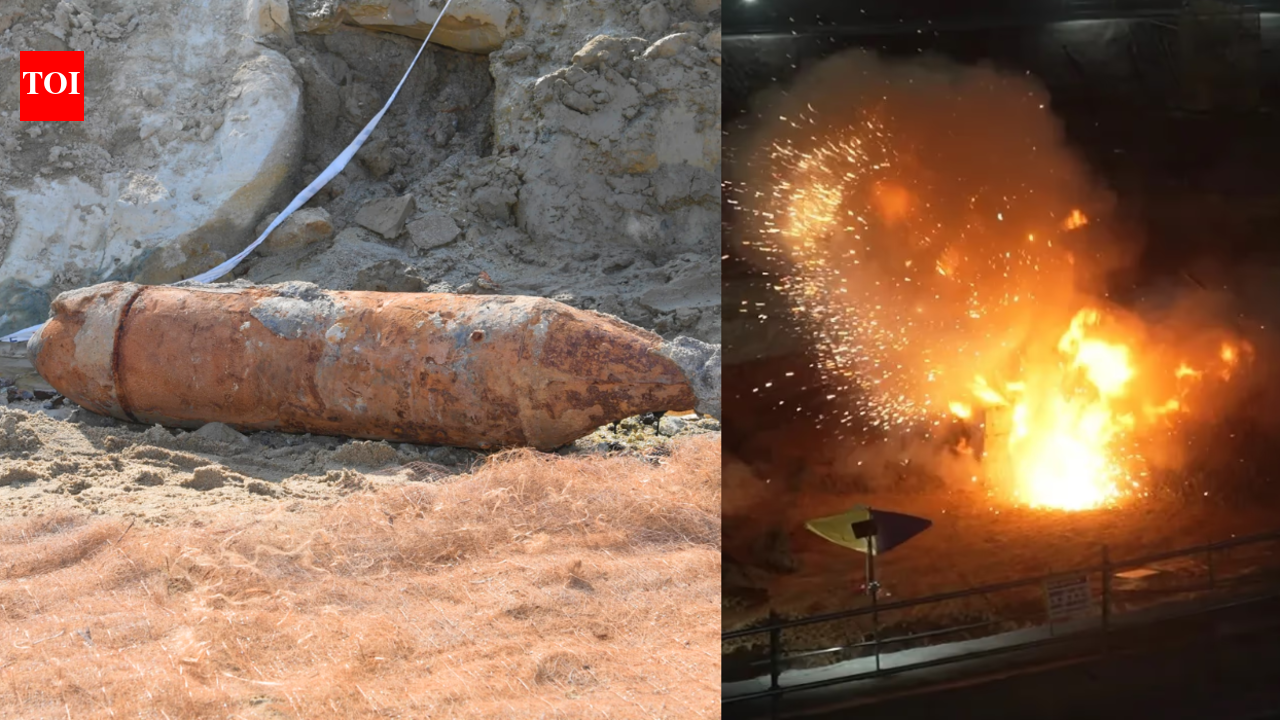
Singapore authorities safely detonated a 250kg World War II aerial bomb near Changi Airport overnight without disruption/ Image: Ministry of Defence, Singapore (MINDEF)

A 250kg World War II-era aerial bomb discovered at a construction site near Changi Airport has been safely disposed of following a carefully coordinated overnight operation involving multiple Singapore agencies, with authorities confirming there was no impact on airport operations. The unexploded ordnance (UXO), found during works along Tanah Merah Coast Road within the Changi East development zone, was assessed by the Singapore Armed Forces (SAF) as too unstable to be moved, requiring a controlled on-site detonation instead.

Discovery, assessment and risk

According to the Singapore Police Force, officers were first alerted to the war relic at 4.55am on March 31 during construction works. The SAF’s Explosive Ordnance Disposal team later identified it as a 250kg World War II aerial bomb, likely a Type 3 “skipping bomb”, historically used to strike maritime targets such as ships. Given its condition, the SAF determined the device was unsafe to transport. A disposal window was scheduled between 2.30am and 4.30am on April 2, with the detonation eventually carried out at approximately 2.23am.

Chnagi Airport

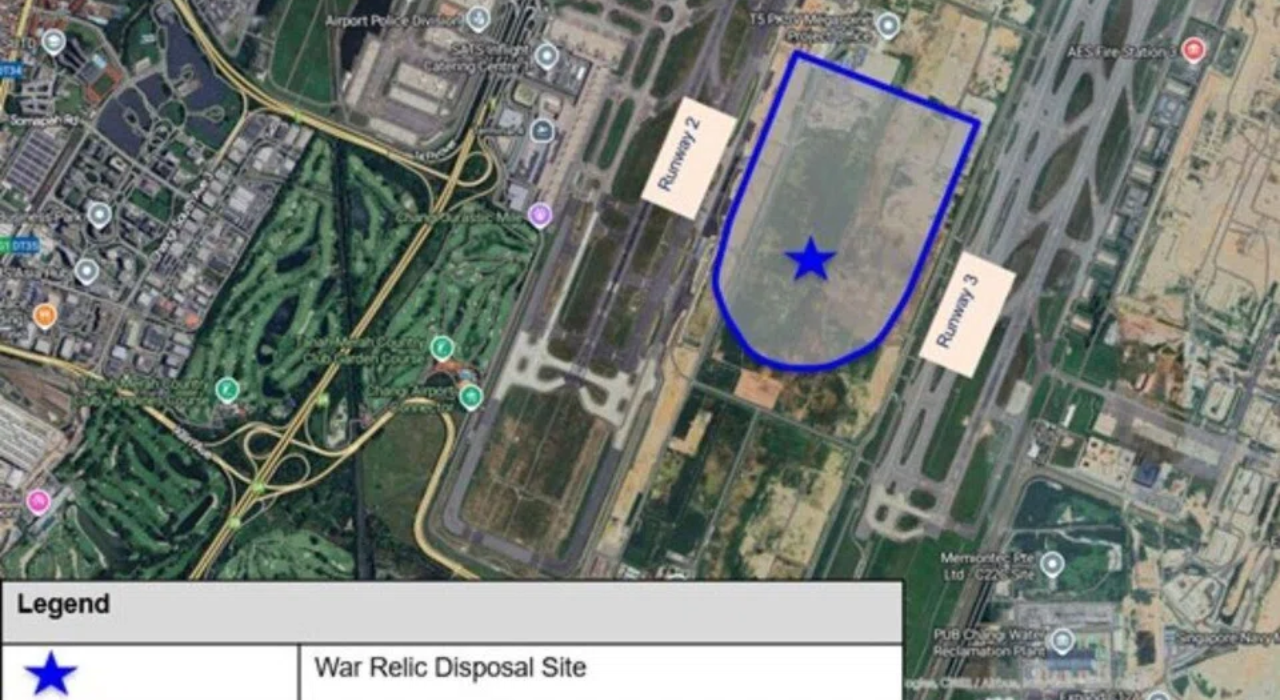
The bomb was safely detonated at a construction site flanked by two runways at Singapore’s Changi Airport./PHOTO: SINGAPORE POLICE FORCE

Authorities had earlier warned the public to expect loud sounds during the operation, which was contained entirely within the construction site. The disposal site, flanked by two runways at Changi Airport (including Runway 2), lies near Changi Jurassic Mile and the Tampines Course of Tanah Merah Country Club, within the Changi East development zone earmarked for Terminal 5, Singapore’s largest aviation expansion to date.

How the bomb was neutralised

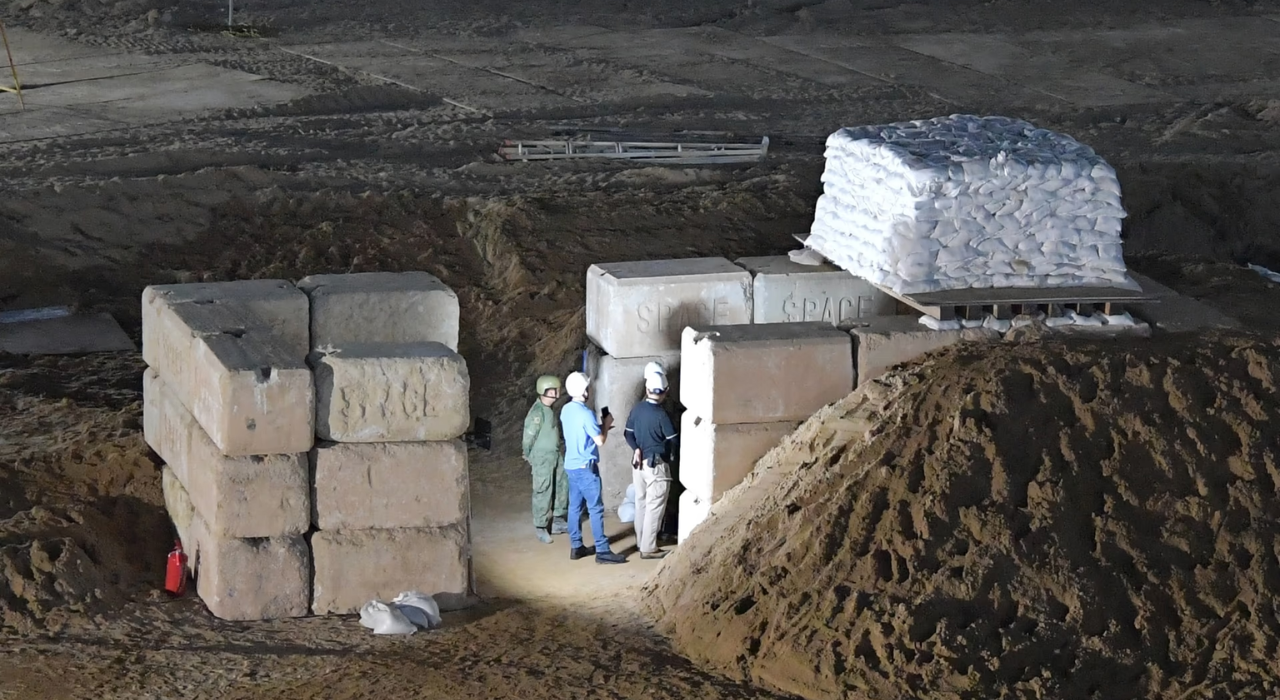
In a detailed statement, the Ministry of Defence (Singapore) said personnel from its Chemical, Biological, Radiological and Explosives Defence Group constructed extensive protective works around the bomb. These included “compacted sandbag overhead cover and reinforced concrete barriers” designed to contain both blast pressure and fragmentation.

Singabore WW2 bomb

Authorities safely detonated the bomb using compacted sandbags and reinforced concrete barriers to contain the blast and fragmentation/ Image: Ministry of Defence, Singapore (MINDEF)

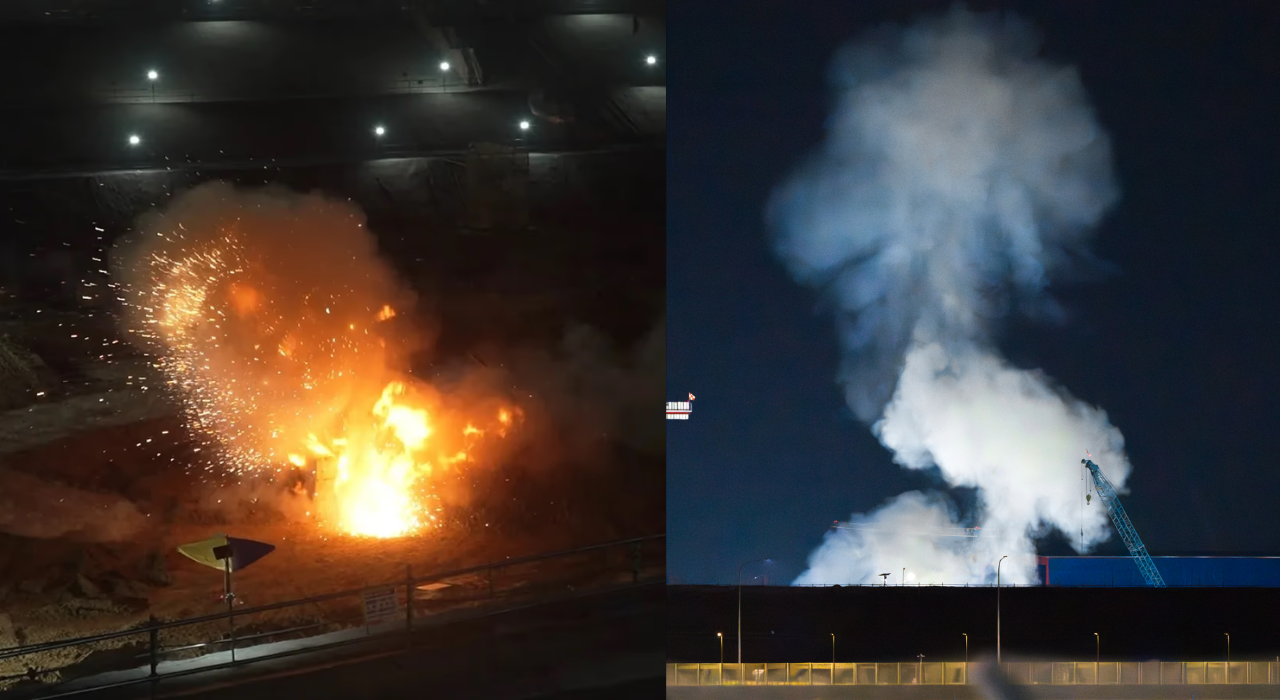
“The ordnance was subsequently disposed (of) through a controlled detonation in the early morning, minimising disruption to the public and airport operations,” MINDEF said. The agency added that “safety cordons were established and protective measures implemented to safeguard personnel, infrastructure, and the public.” Visuals from the scene described a bright flash followed by a loud explosion seconds later, with a plume of smoke rising over the site.

1280x700 - 2026-04-02T192018.861

A bright flash lit the site, followed by a loud explosion and a rising plume of smoke/ Image: Ministry of Defence, Singapore (MINDEF), Asiaone

Coordination across agencies

The operation involved close coordination between multiple bodies, including the SAF, the Defence Science and Technology Agency (DSTA), the Civil Aviation Authority of Singapore, the police, and Changi Airport Group. Lieutenant Colonel Tay Jun Jie, Commanding Officer of the 36th Battalion Singapore Combat Engineers, emphasised the operational approach, saying: “We maintain a high level of operational readiness and remain committed to safeguarding Singapore’s security. For such incidents, we respond swiftly, plan thoroughly and work closely with partner agencies to mitigate risks effectively and execute operations safely.” From a technical standpoint, DSTA’s senior principal engineer Ng Chor Boon explained how modelling shaped the response: “We applied advanced numerical modelling techniques to determine the effects of the fortified structure’s blast leakages on the surroundings… These enabled us to compute the safety zones which enabled the SAF commanders and planners to better balance operations and mitigate risks to the surroundings.”

No disruption to flights or infrastructure

Despite the scale of the operation, airport activity continued largely uninterrupted. In response to queries from outlets including CNA and The Straits Times, CAG confirmed the disposal was completed “successfully early this morning” and that “the infrastructure and systems in the vicinity of the site were checked, and no issues were observed.” As a precaution, Runway 2 was temporarily closed, but flights continued via Runway 1. Vincent Hwa, director of air traffic services at CAAS, said: “Since flight paths did not traverse over the disposal site, no airspace restrictions were imposed. There was no impact to flight operations.” At the time, there were 10 inbound and 18 outbound flights scheduled during the disposal window.

One of the largest found in Singapore

Singapore’s Defence Minister Chan Chun Sing later said in a Facebook post that the bomb was “one of the largest ever discovered in Singapore”, thanking all agencies involved for ensuring the operation caused minimal disruption. Unexploded ordnance discoveries are not uncommon in Singapore due to its wartime history, though they are not always handled on-site. A 100kg bomb found in 2023 in Upper Bukit Timah required evacuations and caused structural damage to nearby homes, while a 227kg bomb in 2016 was disposed of on Pulau Senang. This time, however, the combination of precise engineering, inter-agency coordination and controlled execution ensured a high-risk operation concluded without incident, in one of the busiest and most sensitive locations in the country


Source link

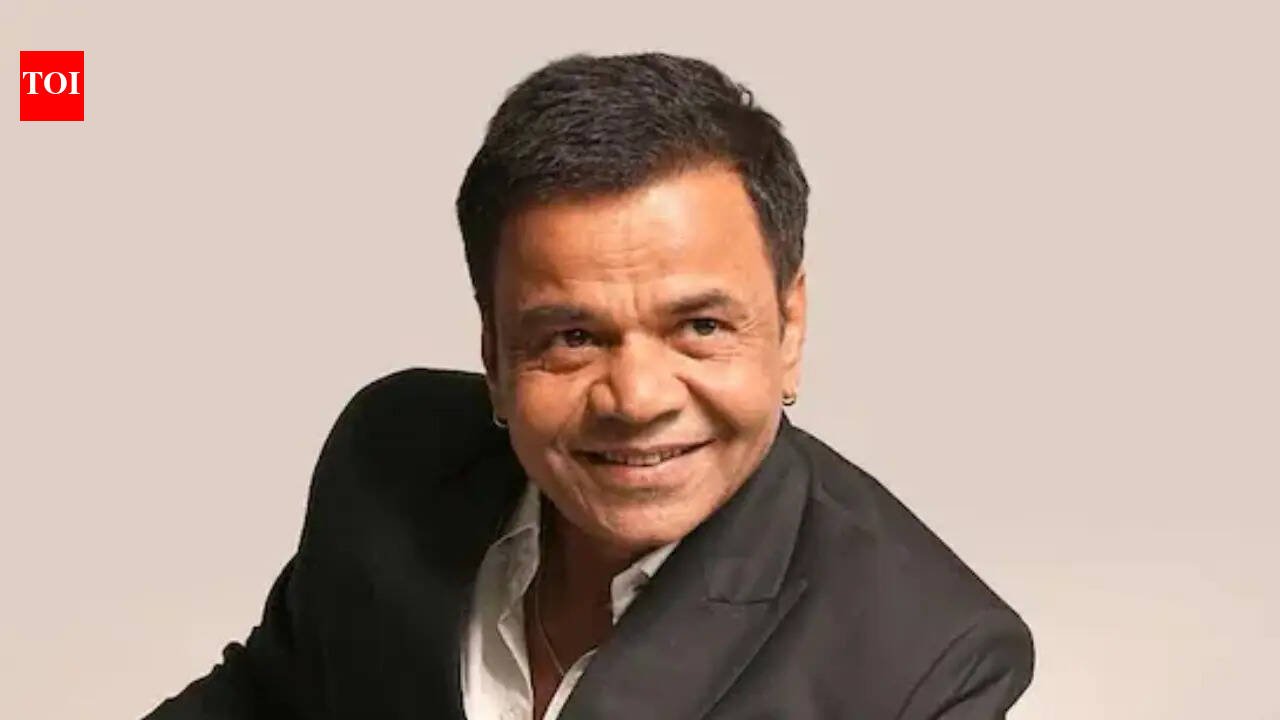
Rajpal Yadav: Delhi High Court reserves its verdict in Rajpal Yadav’s Rs 9 crore debt case, the actor makes an emotional plea | Hindi Movie News


Actor Rajpal Yadav has been in the news after he embroiled in a major legal controversy after being sent to Tihar Jail in connection with a Rs 9 crore cheque bounce case. The actor was out on bail but the matter was still in court. According to the latest update, the Delhi High Court on April 2 reserved its verdict after multiple attempts to reach a settlement failed, despite sustained judicial intervention. During the hearing, the actor also made an emotional plea before the court.The matter was heard by Justice Swarana Kanta Sharma according to ANI, who expressed dissatisfaction over the actor’s inconsistent stance on repaying the dues. The judge remarked, “I am not getting my answers. The undertaking said something else, and now you are saying something else.”

Watch

Rajpal Yadav Breaks Silence On Sonu Sood Offer After Jail Ordeal, Announces Bhoot Bangla Comeback

Representing the complainant, advocate Avneet Singh Sikka argued that the actor had already accepted his conviction and could not now avoid liability. He pointed out that a revision petition filed in 2024 came with an unexplained delay of 1894 days and lacked sufficient justification for condonation. He further said that completing a sentence does not eliminate financial responsibility. Sikka added that despite repeated assurances, the dues remained unpaid, leaving the complainant with no choice but to proceed under Section 138 of the Negotiable Instruments Act.Throughout the proceedings, the court made several efforts to broker a settlement between the parties. At one point, the complainant agreed to accept Rs 6 crore as a full and final settlement.However, in an emotional response, Rajpal rejected the offer, stating that he had already faced significant financial hardship. Appearing virtually, he told the court that he had sold five flats and paid a considerable amount already. He stated, “I am not emotional… send me to jail five more times.”In a bid to resolve the impasse, the court also suggested a structured payment plan of ₹3 crore within a stipulated timeline, clarifying that it was only a judicial proposal and not a binding agreement. Even this effort failed to yield consensus. The court also criticised the conduct of the proceedings, cautioning, “Never think the judge weak if the judge is nice to you,” while noting that valuable judicial time was being wasted.With no agreement reached and differences persisting, the court ultimately reserved its judgment.The origins of the case date back to 2010, when Rajpal Yadav borrowed ₹5 crore from Delhi-based Murali Projects Pvt Ltd to finance his directorial venture Ata Pata Laapata (2012). The film’s poor box office performance resulted in heavy losses, eventually leading to a financial dispute. In 2018, a magisterial court convicted the actor under the Negotiable Instruments Act for cheque dishonour, sentencing him to six months in prison—a ruling later upheld by a sessions court in 2019. Over time, the outstanding amount escalated to nearly ₹9 crore.Rajpal was later granted interim bail and released from jail on February 16. The Delhi High Court extended interim bail until March 18, with conditions set by Justice Swarana Kanta Sharma, including a ₹1 lakh bail bond and one surety. Earlier, the court had directed him to deposit ₹1.5 crore by 3 PM to secure interim relief. After the complainant’s counsel, representing M/S Murli Project, confirmed that the amount had been credited to the company’s bank account against the bounced cheque, bail was granted.


Source link

Eight nuclear and space scientists behind America’s most classified secrets have vanished or died: Inside the mystery of the missing and the dead |


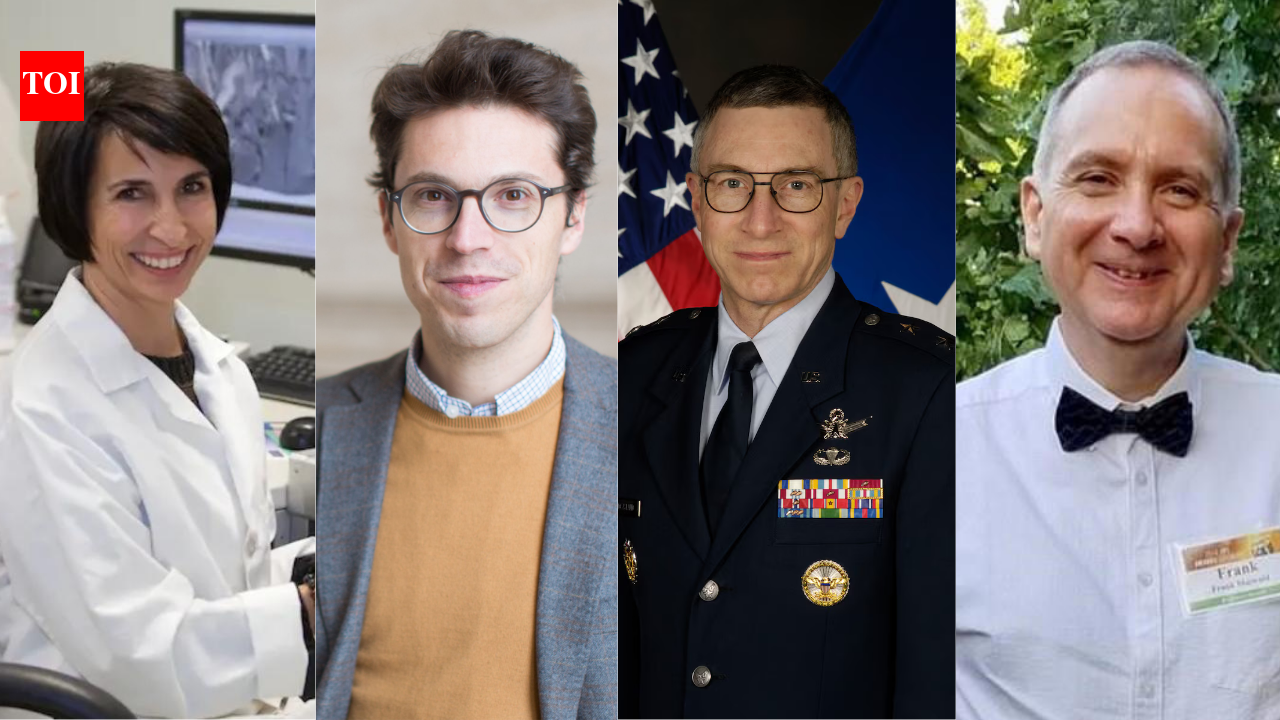
Left to right: Monica Jacinto Reza, Nuno Loureiro, William Neil McCasland, and Frank Maiwald — among the scientists linked to sensitive US defence and research programmes

Between July 2024 and February 2026, a sequence of disappearances and deaths involving individuals connected to sensitive US nuclear, aerospace, and advanced research programmes has drawn quiet but persistent attention. Eight figures, ranging from a senior rocket engineer and a retired Air Force general to laboratory staff and leading researchers, have either vanished without a trace or died in circumstances that range from unexplained to clearly criminal. At first glance, the cases appear to form a pattern, particularly given their proximity to high-security work. Yet a closer examination reveals a far more complex picture: a mix of genuine mysteries, crimes and ambiguous deaths, all increasingly woven together by speculation that often moves faster than verified evidence.

A timeline of scientist deaths and disappearances

The chronology of events has played a major role in shaping the narrative. The sequence begins on July 4, 2024, when NASA-affiliated scientist Frank Maiwald died in Los Angeles at the age of 61. Maiwald had spent decades at the Jet Propulsion Laboratory working on advanced space instrumentation and planetary detection systems, including research aimed at identifying signs of life on worlds like Europa and Enceladus. His death initially drew little public scrutiny, but the absence of a disclosed cause and reports that no autopsy was conducted later raised questions.Nearly a year later, on May 4, 2025, Anthony Chavez, a former Los Alamos National Laboratory employee, disappeared while out walking in New Mexico. Chavez had been associated with one of the United States’ most sensitive research environments, where work often intersects with nuclear science, national security and classified technologies. With no phone or wallet on him and no confirmed sightings since, his case quietly remained unresolved.
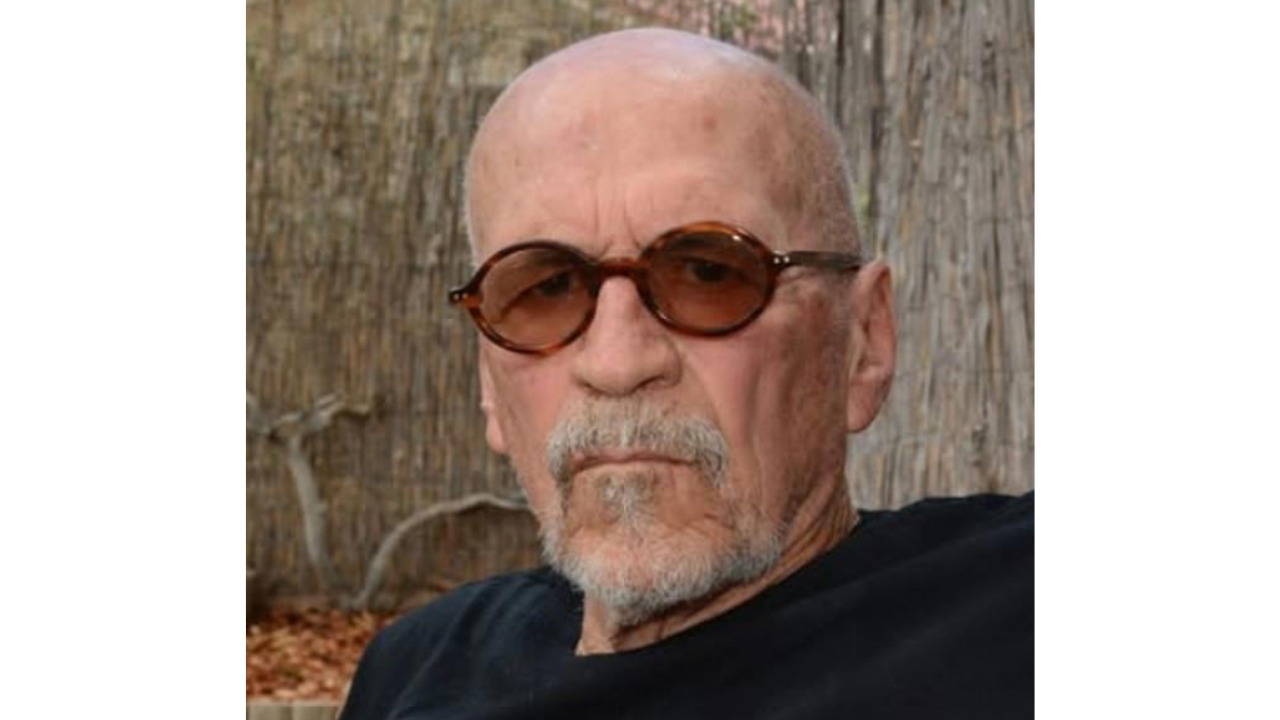
Anthony Chavez

Anthony Chavez

The situation intensified in June 2025. On June 22 at around 9:10 a.m., Monica Jacinto Reza, a senior aerospace engineer and former Technical Fellow at Aerojet Rocketdyne, vanished while hiking near Mount Waterman in California. Reza was a leading figure in advanced rocket propulsion materials, co-inventing a nickel-based superalloy used in next-generation engines designed to reduce reliance on foreign propulsion systems. Despite an extensive search lasting until June 30, involving helicopters, drones and canine units, no trace of her was ever found. Just four days later, on June 26 at approximately 2:20 p.m., Melissa Casias was last seen walking alone along State Road 518 in New Mexico. Casias worked as an administrative professional at Los Alamos National Laboratory, placing her within a high-security scientific ecosystem tied to nuclear and defence research. Her disappearance stood out not only for its suddenness but for the discovery that her phones had been left behind and wiped clean.By late 2025 and early 2026, the list expanded further. Jason Thomas, who disappeared on December 12, 2025, had been serving as assistant director of chemical biology at Novartis, a senior role in pharmaceutical research involving complex biochemical systems. His body was later found on March 17, 2026. Around the same time, on December 15, 2025, Nuno Loureiro, director of the MIT Plasma Science and Fusion Center and a globally recognised expert in plasma physics and fusion energy, was shot and died the following day. Carl Grillmair, a Caltech astrophysicist known for his work on galactic structures, stellar streams and asteroid tracking, was killed on February 16, 2026. Less than two weeks later, on February 27, retired Air Force General William Neil McCasland vanished without a trace. McCasland had previously commanded the Air Force Research Laboratory and overseen advanced space and defence programmes, placing him at the highest levels of US military science and technology.

The missing: Cases with no clear answers

Among all eight individuals, four cases remain particularly troubling due to the complete lack of resolution. Monica Jacinto Reza’s disappearance during what should have been a routine hike remains one of the most baffling. As a senior aerospace engineer deeply involved in cutting-edge propulsion systems and materials science, her work sat at the intersection of innovation and national security. She was last seen behaving normally, and yet vanished in a matter of minutes in an area that was thoroughly searched, leaving investigators with no physical evidence to follow.
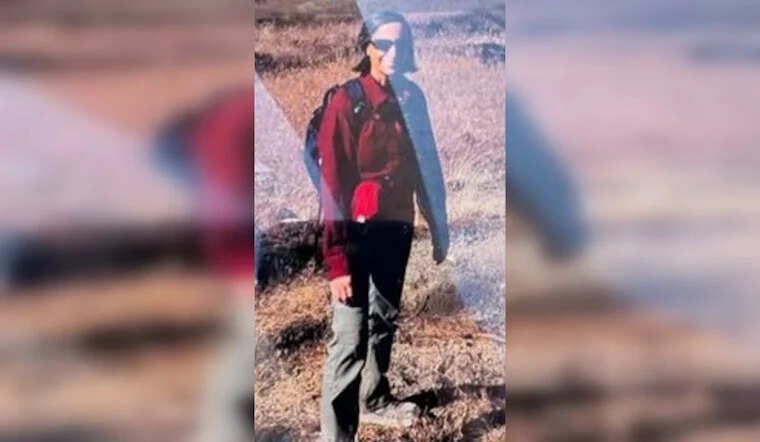
Los Angeles County Sheriff's Department

Monica Reza, Los Angeles County Sheriff’s Department

Melissa Casias’s disappearance is equally puzzling, though for different reasons. While her role at Los Alamos National Laboratory was administrative, it still placed her within one of the most tightly controlled scientific institutions in the United States, where even support staff operate within secure environments. The wiping of her phones introduces an element that investigators have not publicly explained. Combined with her leaving home without essential belongings and being spotted miles away alone, the case stands out as behaviourally unusual.William Neil McCasland’s disappearance adds another layer due to his seniority and background. As a former commander of the Air Force Research Laboratory, he had oversight of highly advanced and often classified aerospace and defence projects. Leaving behind all personal devices but taking a firearm suggests a deliberate decision, yet no trace of his movements has been uncovered despite extensive search efforts. His profile makes his disappearance one of the most sensitive in the list.Anthony Chavez’s case is quieter but no less unresolved. As a former employee of Los Alamos National Laboratory, he had been part of an institution historically central to nuclear weapons development and national security research. His disappearance shares similarities with others, particularly the absence of personal items and the lack of any subsequent sightings or evidence, reinforcing the sense that some of these cases, while different on the surface, may share deeper unanswered questions.

Deaths that raise questions but lack clarity

Not all cases involve disappearance, but some deaths remain difficult to fully contextualise. Frank Maiwald’s passing in 2024 continues to draw attention due to the lack of publicly available details. His recent work on technologies aimed at detecting life beyond Earth adds an additional layer of intrigue, even though no evidence suggests foul play.Jason Thomas’s case, while officially not considered suspicious, still contributes to the broader narrative. His disappearance and later recovery from a lake, combined with known personal struggles, present a tragic but largely explained scenario. However, its timing alongside other incidents has led to its inclusion in wider discussions.In contrast, some observers argue that dismissing these cases as isolated incidents may overlook deeper patterns. They suggest that even events with apparent personal motives do not necessarily rule out broader connections, particularly when individuals are linked to sensitive scientific or defence work. According to this view, the convergence of timelines, professional backgrounds and unusual circumstances raises questions that cannot be fully explained by coincidence alone. Supporters of this perspective also point to the limited public information in several cases, arguing that gaps in transparency leave room for possibilities that have yet to be explored or disclosed.

Real overlaps that keep the mystery alive

Despite the lack of a single explanation, certain overlaps between cases are real and noteworthy. Several individuals were connected to institutions such as Los Alamos National Laboratory or to defence-related research networks. Monica Reza and William McCasland, in particular, shared indirect professional links through advanced propulsion and Air Force research structures.There are also behavioural similarities that stand out. Multiple individuals disappeared while outdoors and without their phones or tracking devices, a detail that has drawn repeated attention. While these overlaps may be coincidental, they are significant enough to sustain ongoing interest and concern.

The conspiracy layer: where speculation takes over

It is within these overlaps and gaps in information that conspiracy theories have flourished. One line of speculation suggests the possibility of foreign intelligence agencies targeting individuals connected to sensitive technologies. While such concerns are not inherently implausible, no evidence has been presented to confirm such activity in these cases.Another layer involves claims related to unidentified aerial phenomena and alleged classified programmes. These theories often cite McCasland’s name appearing in leaked communications and attempt to link it to a broader narrative of secrecy. However, these claims largely originate from non-official sources and remain unverified.Social media has amplified these ideas by presenting the cases as interconnected, often ignoring key differences or confirmed explanations. This has created a perception of a coordinated pattern that does not fully align with the available evidence.

A fragmented mystery, not a single story

The most grounded interpretation is that this is not one unified mystery, but several overlapping stories. Four cases remain genuinely unresolved and deserve continued investigation, particularly given their connection to sensitive fields. At the same time, other cases have clear explanations that do not support the idea of a broader pattern.What emerges is a fragmented narrative shaped as much by unanswered questions as by speculation. The absence of definitive answers in some cases ensures that the story remains open, but the evidence so far points toward complexity rather than conspiracy.


Source link

‘Went to London while Arvind Kejriwal was arrested’: AAP MP Raghav Chadha not seen at key party events of late | Delhi News


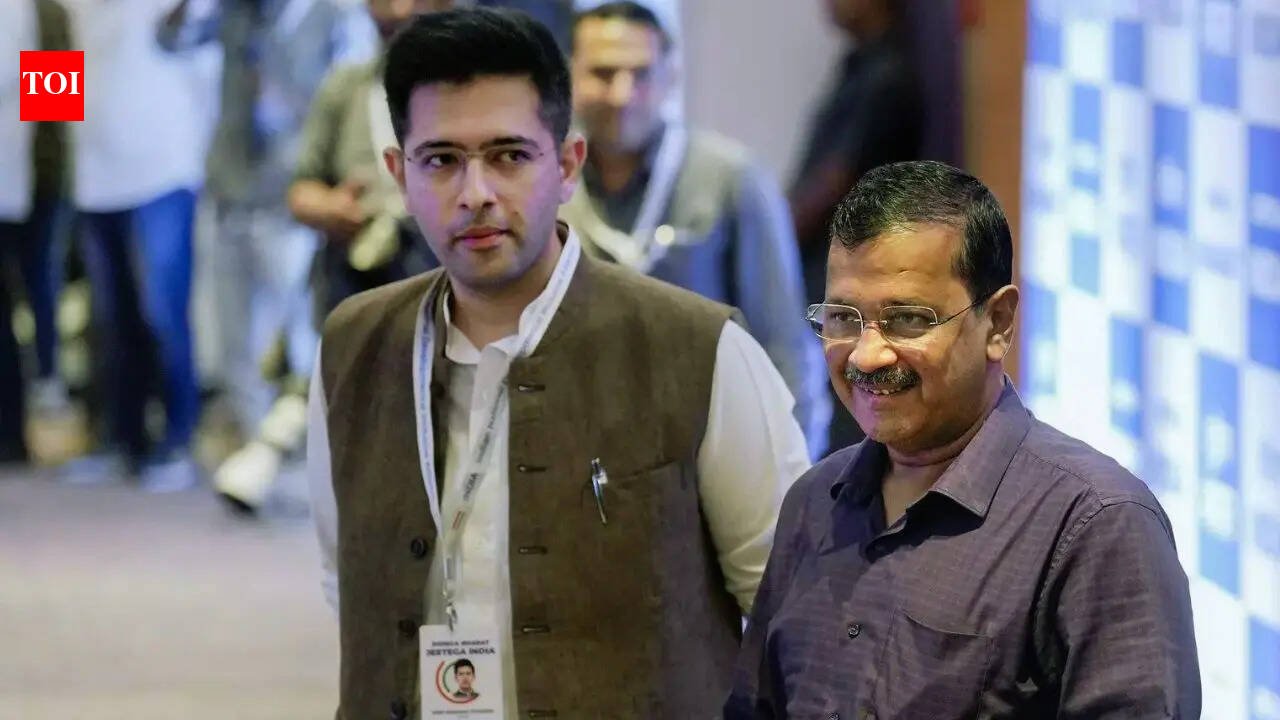
AAP convenor Arvind Kejriwal with party leader Raghav Chadha (PTI Photo)

NEW DELHI: Once a trusted aide of former Delhi chief minister Arvind Kejriwal and a key figure in the Aam Aadmi Party (AAP), Raghav Chadha has recently appeared sidelined, with his absence from public events and silence on key issues fuelling speculation about his role in the party.Chadha, who previously served as the party’s national spokesperson, has not been seen at several recent appearances alongside Kejriwal.

Watch

“Silenced Not Defeated”: Raghav Chadha Hits Back After AAP Drops Him From RS Post

His silence on issues raised by senior leaders has also drawn attention.The first signs of a possible rift emerged in March 2024, when Kejriwal was arrested in connection with the excise policy case. Chadha was notably absent at the time due to medical reasons.While the party said he was abroad for medical reasons, his prolonged absence and lack of public engagement raised questions.Punjab Congress president Amarinder Singh Raja Warring said, “It is now clear that Raghav Chadha is separate from the Aam Aadmi Party. People realised this long ago, when he went to London while Kejriwal was arrested. Public perception now is that Chadha will leave or be removed from the party and join elsewhere.”More recently, Chadha did not comment after Kejriwal, Manish Sisodia and others were discharged in the excise case. He also skipped key party events, including a press conference and a rally at Jantar Mantar.

Here’s what happened

The Aam Aadmi Party (AAP) has informed the Rajya Sabha Secretariat that Ashok Kumar Mittal will be its new deputy leader in the Upper House, the party said on Thursday.Mittal replaces Raghav Chadha in the role.A Rajya Sabha MP from Punjab, Mittal was elected to the House in April 2022 and has since served on several parliamentary committees, including the Committee on Defence and the Committee on Finance. In February 2026, he was also made a member of the India-US Parliamentary Friendship Group.He was part of an all-party delegation led by Kanimozhi that visited Russia, Latvia, Slovenia, Greece and Spain after the Pahalgam terror attack last year.Chadha has also been a Member of Parliament since April 2022 and has made headlines on several occasions for raising public issues in Parliament.Last month, Chadha raised concerns over the practice of “sarpanch pati” or “panchayat pati”, where women elected to reserved panchayat seats often serve as figureheads while real power is exercised by their male relatives. He urged the government to ensure that women representatives in local bodies can exercise genuine authority as intended under the 73rd Constitutional Amendment.He had also raised the issue of menstrual hygiene in Parliament, stating that it is a matter of health, education and equality, which affects over 35 crore women and girls in India. Chadha said if a girl misses school because there are no sanitary pads, water, and privacy, it is not her personal problem but a collective failure. He added that society has turned a biological fact into a social taboo.Amid the gig workers’ agitation earlier this year, he had spent a day as a delivery partner to understand firsthand the pressure and challenges associated with the job.


Source link

‘Agenda against me, they’re jealous’: Ajinkya Rahane’s no-holds-barred swipe at critics | Cricket News


Kolkata Knight Riders’ captain Ajinkya Rahane (AP Photo/Rafiq Maqbool)

Ajinkya Rahane launched a fiery defence of his batting and leadership after Kolkata Knight Riders slumped to a crushing 65-run defeat against Sunrisers Hyderabad at Eden Gardens.Under scrutiny following a slow start to the season, Rahane did not hold back in the post-match press conference, taking aim at critics questioning his intent and strike rate.

Watch

IPL 2026: Ajinkya Rahane backs KKR’s young pace attack after loss

“My strike rate… I think I have one of the best strike-rates so far. People who are talking about me are probably not watching the game or they have certain agendas,” Rahane said. “They don’t like me playing, they don’t like to watch me play. The amount of success I’ve had, I guess they are jealous of me.”The veteran opener endured a tough outing, scoring just eight off 10 balls as KKR’s chase of 227 never got going. Despite a strong start from Finn Allen and a fluent half-century from Angkrish Raghuvanshi, KKR collapsed dramatically and were bowled out for 161 in just 16 overs.Rahane made 67 off 40 balls in KKR’s opening match on March 29 when they lost by six wickets to Mumbai Indians at the Wankhede.Rahane also captained KKR last season. He had a strike rate of 147.73 last season, scoring 390 runs from 13 matches and was kkr highest run scorer last season.Rahane, however, insisted that criticism over a single innings was misplaced and backed his approach.“Just one innings where you don’t get that rhythm, that flow. My intent was there. People either don’t understand the game or want me to play a different way,” he added. “I know what I’m doing. I back myself rather than thinking about whoever is talking.”Earlier, SRH produced a near-complete performance to return to winning ways. Heinrich Klaasen anchored the innings with a composed 52, while Travis Head and Abhishek Sharma provided a blistering start with an 82-run opening stand.KKR’s problems were compounded by poor running between the wickets, including a chaotic mix-up that led to Cameron Green’s run-out. Their much-vaunted batting line-up failed to build partnerships, raising further questions over team balance and leadership decisions.Rahane, though, remained defiant in the face of mounting pressure.

Poll

How do you rate the team’s chances of bouncing back after two defeats?

“They didn’t expect Ajinkya Rahane to improve his game this much. I’m happy people are talking about me, whether negative or positive. Let them talk,” he said.With two defeats to start their campaign, the spotlight on Rahane and KKR is only set to intensify, but the skipper has made it clear he is not backing down anytime soon.


Source link

Anti-conversion law and Middle East conflict will reflect in Good Friday themes | Mumbai News


MUMBAI: The 40-day penance of Lent will peak at Good Friday April 3. The Christian community will lead live tableaux depicting the final hours of Jesus Christ followed by his crucifixion. Concern over the new anti-conversion law enacted in Maharashtra, and the conflict in the Middle East, will resonate in the themes.Around 600-800 parishioners of Our Lady of the Forsaken Church in Malwani will arrive for Good Friday service, said parish priest Fr Wilfred Vaz. “There is no mass since Jesus is absent [crucified], but we distribute communion which has been blessed on Holy Thursday. At the end of the service youngsters enact Christ’s crucifixion. In fact people ask why do you call it Good Friday, what is good about it if Christ died this day. However, the term derives from the fact that Christ died for the good of humanity,” Fr Wilfred said.Fr Nigel Barrett, spokesperson for the archdiocese of Bombay, is also parish priest of St Andrew’s Church, Bandra. He said, “Lenten observances culminate on Maundy Thursday with a life-size Last Supper display and on Good Friday with the Crucified Christ solemnly being brought down from the cross and entombed. Though seemingly defeated, the king of the universe was crowned with thorns, enthroned on the cross, and used his divine power to forgive his executioners, as he bore the sins of humanity.Around 10.00 am Friday at Sacred Heart Church in Santacruz, hundreds of Christians will attend the live Stations of the Cross enacted in Broadway musical style organised by the Christi Sevak Federation. Organiser Joseph Dias said the parade started 37 years ago when many non-Christians believed that Good Friday was a feast, rather than mourning.This year CSF will pray for “persecuted Christians and innocent people who may be affected by the anti-conversion law” passed by the Maharashtra state assembly. Taking a cue from Pope Leo, the gathering will also pray for peace in the Middle East.A 23-year-old marketing professional Del Jacinto will enact the part of Jesus. He says carrying the actual wooden cross for six hours as he walks through the streets does not pose a burden thanks to the love and faith of thousands of spectators who line the route. “Some people are so moved they come to seek my blessings. I do not bless them because I am not God, but I pray for them,” Jacinto said.Meanwhile in Thane after 52 years of litigation, parishioners of Our Lady of Mercy Church were able to offer Maundy Thursday mass at the 1562 church, said activist Melwyn Fernandes.


Source link

HC raps duo over vulgar song | Delhi News


Justice Purushaindra Kumar Kaurav observed that the song, reportedly dating back to 2006, was deeply offensive and had no artistic or social merit.

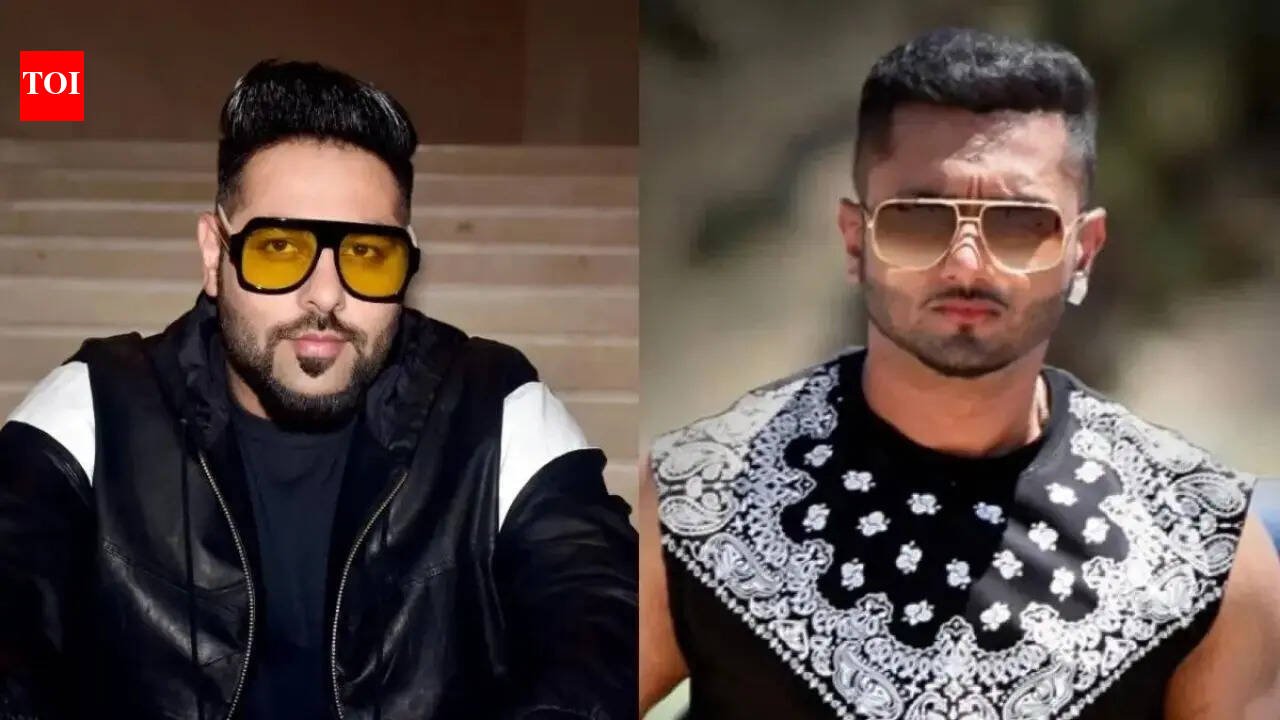
NEW DELHI: Delhi High Court on Thursday ordered removal of an allegedly “vulgar” and “derogatory” song linked to rappers Yo Yo Honey Singh and Badshah, stating that its content violated even basic standards of decency.Justice Purushaindra Kumar Kaurav observed that the song, reportedly dating back to 2006, was deeply offensive and had no artistic or social merit.Indicating the deep distaste with which the court viewed the song, the high court added that the lyrics were demeaning towards women and promoted an unacceptable portrayal that reduced them to objects, besides being grossly vulgar, obscene which no civil society can permit to remain on digital platforms.Directing immediate takedown, the high court expressed serious concern and said the availability of such content on public platforms, especially those accessible to minors, could not be justified under the protection of artistic freedom or free speech.It issued notices to both artists following a petition filed by an organisation called the Hindu Shakti Dal and directed the duo, along with any other entities holding any rights, to ensure the removal of the song and its versions from online platforms.It also instructed Central govt to take necessary steps to block additional links identified by the petitioner that host the track.During proceedings, the court remarked that the song’s content crossed acceptable limits of civility and should not remain in circulation. The judge further noted that the title itself was inappropriate to be recorded in the order.

Poll

Should offensive content be removed from public platforms?

The petition claimed that the song was originally released unofficially around 2006–07 and contains objectionable lyrics that promote misogyny and violence against women. It also pointed out that despite both artists reportedly denying involvement, portions of the song were allegedly performed by Honey Singh at a recent concert, reigniting the controversy.The petitioner has also sought a public apology from the artists, citing their influence and responsibility as public figures with large followings.


Source link