Breaking News
350 volunteers remove 3,000 kg plastic waste at Manori Beach on World Water Day | Mumbai News


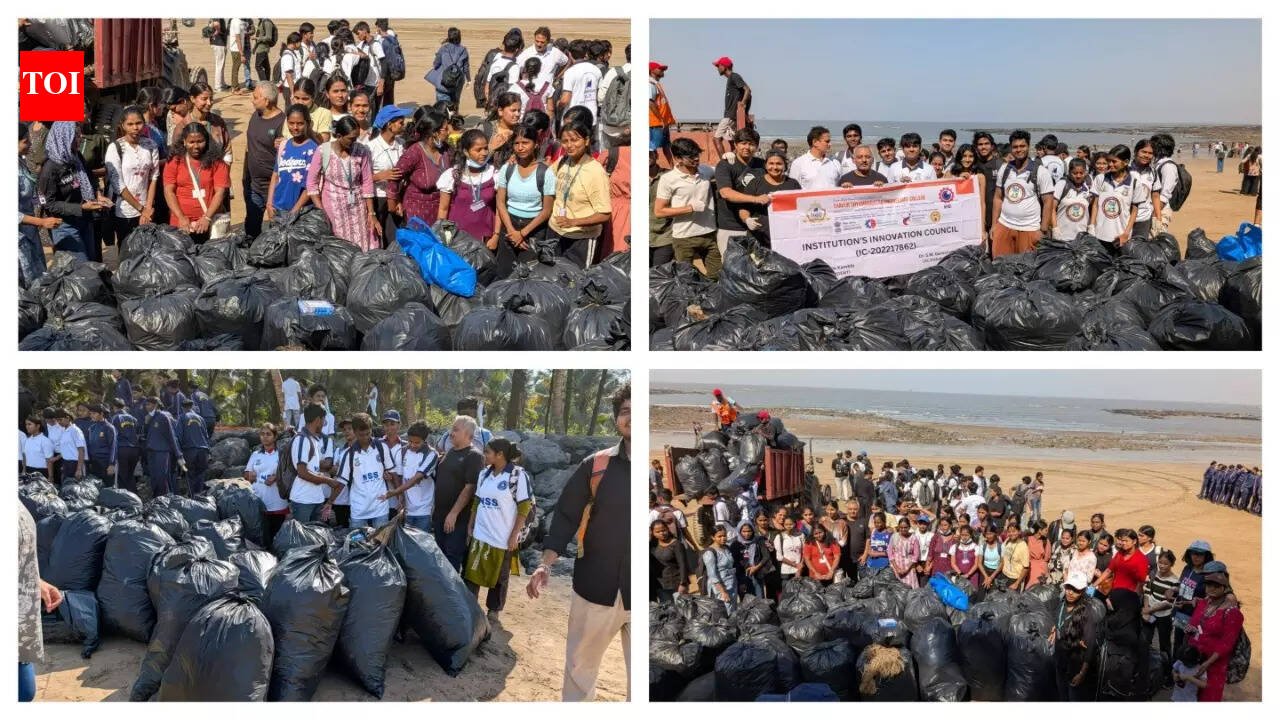
On World Water Day, 350 volunteers, led by environmentalist Subhajit Mukherjee, removed 3,000 kg of plastic from Manori Beach. This significant cleanup, involving students and various groups, filled over 400 garbage bags. The initiative, supported by Leave India, marks the start of a year-long mission to tackle the 100 tonnes of plastic still polluting the coastline.

In a powerful show of collective action on World Water Day, as many as 350 volunteers came together at Manori Beach to remove an astonishing 3,000 kilograms of plastic waste, highlighting both the scale of coastal pollution and the urgency to address it. Led by environmentalist Subhajit Mukherjee, popularly known as Mumbai’s “Green Man,” the large-scale cleanup drive was conducted on the morning of March 22, 2026, drawing participation from students, citizens and environmental groups across the city. A MORNING OF IMPACT The initiative began early, around 7:30-8:00 am, and continued till late morning, with volunteers working tirelessly for nearly four hours. By the end of the drive, more than 400 garbage bags had been filled with single-use plastic waste collected from the shoreline. Participants included students from 11 educational institutions, with active involvement from NSS, NCC and Green Clubs, underscoring the growing role of youth in environmental action. TACKLING A MOUNTING CRISIS The waste collected, ranging from plastic bottles and wrappers to other disposable material, was sent for recycling, ensuring that the effort extended beyond collection to responsible disposal. Subhajit, who has built a reputation for sustained environmental work, said the drive is only the beginning of a much larger mission. “This is the beginning of a movement and we will work throughout the year to keep the beach clean because we still have nearly 100 tonnes of plastic that needs to be removed,” he said, urging more citizens to join the effort. A CONTINUING MOVEMENT Known for his extensive work in climate action, including planting over 82,000 trees and organising regular clean-up drives, Subhajit emphasised that consistent community participation is key to restoring Mumbai’s fragile coastal ecosystems. The Manori Beach drive stands as a reminder that while the scale of pollution is daunting, collective civic action can create visible, measurable impact. As the city marked World Water Day, the message from its shores was clear: the fight against plastic pollution must be sustained, inclusive and urgent.


Source link

Mumbai artist Bina Aziz curates Alchemy of Light with eight contemporary artists | Mumbai News


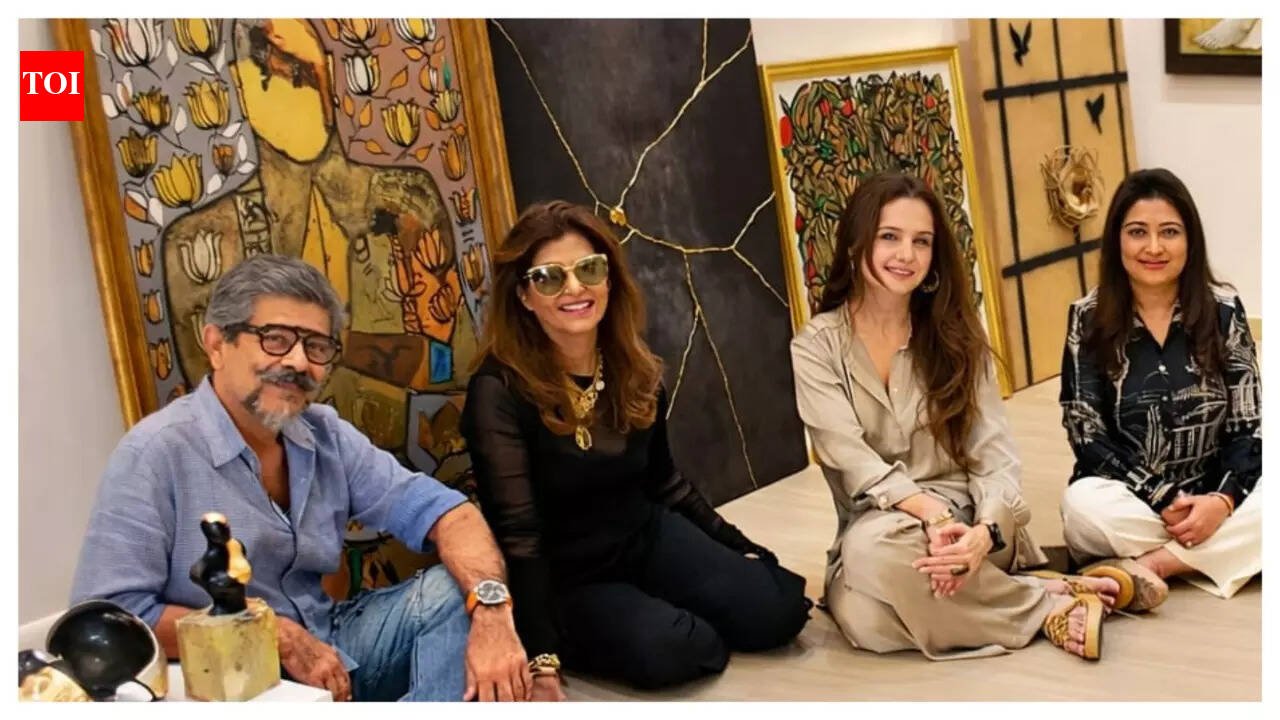
An upcoming exhibition in Worli, ‘Alchemy of Light,’ will showcase eight artists exploring metal leafing techniques from April 12 to May 11, 2026. Curated by Bina Aziz, the show features artists like Arzan Khambatta and Laila Khan, who use gold, silver, and copper leaf to create works that dynamically respond to light, highlighting texture, fragility, and renewal.

A luminous exploration of material, texture and inner expression is set to unfold in the city next month, as eight artists come together for a unique exhibition titled ‘Alchemy of Light’. Scheduled from April 12 to May 11, 2026, the show will be held in Worli and promises to be a first-of-its-kind showcase centred on the intricate technique of metal leafing. Curated by artist Bina Aziz, the exhibition brings together a diverse roster of creators including Arzan Khambatta, Venkatesh Pate, Sharvari Luth, Archana Srivastava, Laila Khan, Jaya Lamba and Shola Carletti, each interpreting the theme through their own visual language. A SHARED LANGUAGE OF LIGHT AND METAL At the heart of ‘Alchemy of Light’ lies the transformative quality of metal leafing, using gold, silver, copper and champagne finishes to create works that respond dynamically to light. “Each artist brings their own aura, their own creativity and their own colour to the canvas and the art that glitters here is, in essence, gold,” says curator Bina Aziz, describing the conceptual core of the show. “The materials, provided by Shehzad Khan, have enabled artists to experiment with a wide spectrum of tones and textures. The use of gold, silver, copper and champagne leafing brings a sense of opulence while allowing the works to remain fluid and alive, shifting with perspective and light itself,” Bina adds. EXPERIMENTATION ACROSS MEDIUMS For sculptor Arzan Khambatta, the exhibition marks yet another step in an ongoing journey of creative exploration. “Every creative show like this is a starting point for me… if you have done something and you love it, it becomes the beginning of many more works,” he says. His pieces for the show combine wood, resin, metal and leafing, resulting in layered, tactile forms. Meanwhile, artist Laila Khan approaches the theme from a more introspective space. “A painting or sculpture represents the inner being of an artist over many days. I am working towards an inner flame where materials like gold leaf reflect light. Through meditation and quiet depth, I am trying to bring that luminosity into my work,” she explains, adding that gold leafing lends a sense of sacredness to Indian art traditions. TEXTURE, FRAGILITY AND RENEWALHosting the exhibition at Les Trésors Art Gallery, artist Archana Srivastava, has spent months developing the concept alongside Bina. “We both have discussed the concept for the last few months. This is the first exhibition using gold leafing in my gallery, and I am excited about it,” she says. Her own series, titled ‘Broken Yet Blossoming’, explores contrasts, juxtaposing the rough texture of jute with the smooth sheen of gold. “We are all broken in some way, yet there is immense potential to blossom,” she reflects. ART THAT SHIFTS WITH LIGHT What sets ‘Alchemy of Light’ apart is not just its material focus but its interaction with the viewer. As light falls on each piece, surfaces shimmer, shift and transform, making the experience fluid and ever-changing. With its blend of introspection, experimentation and visual opulence, the exhibition aims to offer audiences more than just a viewing, it invites them into a dialogue with light itself. As Mumbai’s art calendar gears up for the summer, ‘Alchemy of Light’ promises to stand out as a radiant confluence of creativity, material innovation and spiritual depth.


Source link

Iran launches 10 million rial note, highest-ever denomination, as war deepens economic crisis


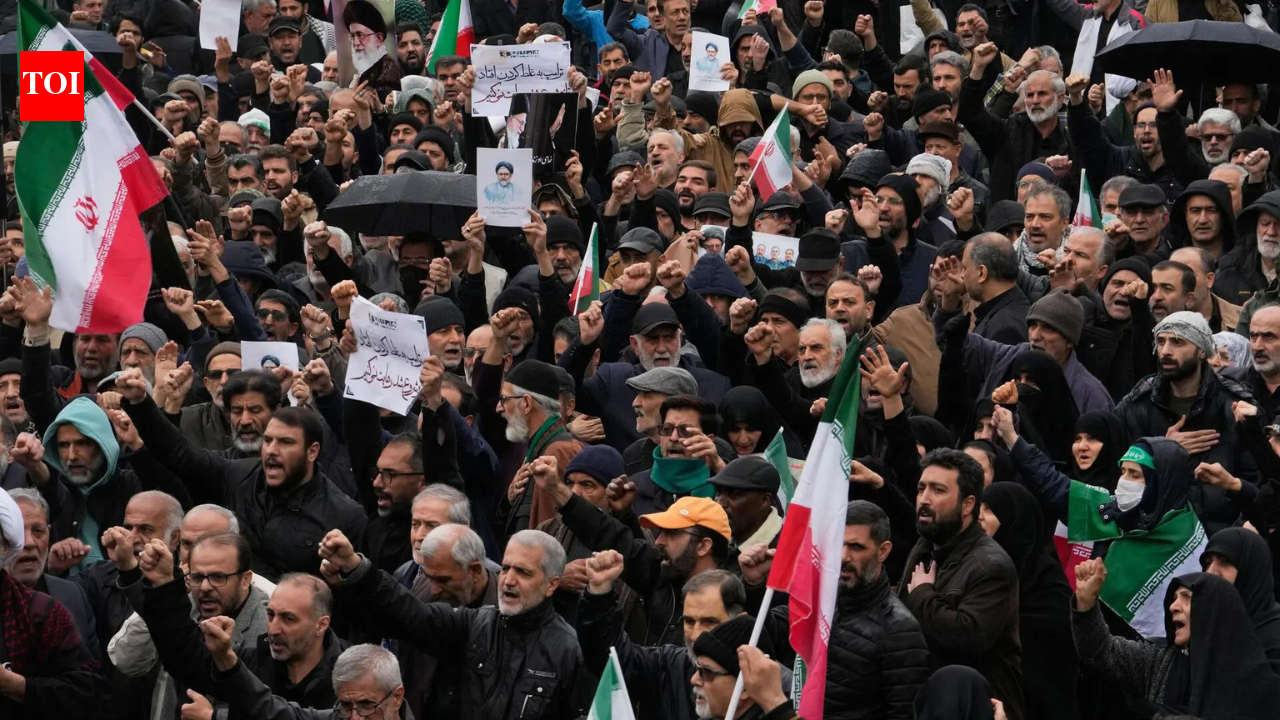
Iran has introduced its highest-value banknote yet — a 10 million rial note — as war and economic turmoil push the country’s financial system to the brink. According to Financial Times reporting, the new note, worth roughly $7, has already begun circulating through banks as long queues form outside cash machines, with many running dry amid fears that electronic payment systems could fail during the ongoing US-Israel conflict.The move marks a sharp escalation in Tehran’s response to spiralling inflation and a collapsing currency. The pink banknote, featuring the historic Jameh Mosque of Yazd on one side and the ancient Bam Citadel on the other, overtakes the 5 million rial note introduced just weeks earlier. Authorities insist the measure is designed to “ensure public access to cash”, even as digital banking remains officially prioritised.

Watch

Inside Trump’s ‘Secret Mission’ To Secure Iran’s Nuclear Stockpile Amid War

The rapid rollout reflects a deeper crisis. Iran’s rial has plunged to around 1.6 million to the US dollar, close to record lows, eroding purchasing power after years of sanctions and economic isolation. Inflation has surged, with basic goods becoming increasingly unaffordable. Food prices have doubled over the past year, while some staples have risen far more sharply, forcing families to cut back drastically on essentials.The strain has been building for months. Protests that erupted earlier in January over the rising cost of living were met with a sweeping crackdown, including the closure of dozens of businesses accused of supporting the unrest. Internet shutdowns during that period wiped out incomes for many small entrepreneurs, particularly those reliant on online platforms, leaving lasting scars on already fragile livelihoods.

Poll

Do you believe the introduction of a 10 million rial banknote will help ease Iran's economic crisis?

Now, the war has intensified the pressure. Continued US and Israeli strikes, including attacks on key nuclear facilities such as Natanz, have deepened uncertainty. While officials say there has been no radiation leak, the conflict has rattled markets and further weakened investor confidence. Cash transactions have surged, with traders and merchants increasingly avoiding credit or cheques amid fears of instability..


Source link

Is Nora Fatehi’s work permit in India in trouble after the ‘Sarke Chunar’ controversy? Lawyers approach Ministry of Home Affairs |


Actress Nora Fatehi has been in the news after her latest track ‘Sarke Chunar’ sparked a controversy and was eventually banned. The Hindi version of this song from the Kannada film ‘KD Devil’ was criticised over its alleged ‘double-meaning’ lyrics. The situation has escalated further now, with a group of ten lawyers reportedly approaching the Ministry of Home Affairs, demanding cancellation of Nora’s work permit and her deportation from India.As per reports, the complaint has also been forwarded to several key authorities, including the Ministry of Information and Broadcasting, the Central Board of Film Certification, the Ministry of Electronics and Information Technology, and the National Commission for Women, underscoring the seriousness of the issue.

Watch

‘Sarke Chunar Teri Sarke’ Divides Internet As Nora Fatehi Faces Backlash

In their petition, the lawyers have alleged that the song is obscene, sexually suggestive, and offensive to public morality as well as the dignity of women. They further argued that Nora has misused her privilege to work in India by associating with such content. Referring to provisions under the Foreigners Act, 1946, they stated that the government holds the authority to act against foreign nationals whose actions may disrupt public decency or order. They also cited the Passport (Entry into India) Act, 1920, along with other legal provisions.The plea additionally claims that the song violates multiple laws, including sections of the Bharatiya Nyaya Sanhita, the Indecent Representation of Women (Prohibition) Act, 1986, and the Information Technology Act, 2000.Beyond the legal framework, the lawyers argued that such portrayals contribute to obscenity, promote the objectification of women, and reinforce problematic societal narratives.Earlier, responding to the backlash, Nora had stated that she was unaware of the meaning of the lyrics, as she had performed the song in Kannada. She also claimed that a translated version was used without her consent. The actress took to her social media and clarified in a video, “I shot this song three years ago in Kannada. When I shot this song, I said yes to it because it was part of a big film and also alongside Sanjay Dutt, who would say no to it. It was a remake of what I thought was ‘Nayak Nahi Khalnayak Hoon Main.'”She further revealed that she had no role in the Hindi adaptation and was unaware of the changes made later. “When they translated this song, nothing seemed inappropriate or vulgar to me, but I do not understand Kannada, so I rely on whatever they say to me. Whatever they have done right now, dubbing it in Hindi and the lyrics, they did not take any permission or approval from me. I had no idea about it,” she added.The actor also recalled her reaction when she attended the song’s launch event, where she first noticed certain issues. “When I attended the launch, I saw the Kannada version, and I had a major issue because they used unflattering photos in the lyrical video. They also used an AI photo of Sanjay and me. I was very irritated at the event when I saw all that. However, I kept my calm,” Nora continued.It was when she saw the Hindi version that she was left shocked. “I was conflicted with what I saw. When I saw the Hindi version, I knew it would get backlash. I told the director that this was not okay, and I dissociated myself from the project. I did not promote it anywhere. I told the director my image and reputation are on the line.”Speaking more broadly about the limitations faced by performers, she said, “The thing with us artists is that we do not have power, we have little power and control. Thankfully, in Bollywood, many have respected my work. However, there are certain industries that do not care about my opinion. But because of the backlash, they had to take it down, and I am thankful.”However, the petitioners dismissed her clarification, calling it an afterthought. They maintained that performers cannot take credit and remuneration for a project while distancing themselves from its content. The lawyers also asserted that the involvement of AI tools does not absolve individuals of responsibility.Adding to the controversy, the Muslim Personal Darul Ifta in Aligarh issued a fatwa against the actress after the song sparked outrage online. The body reportedly deemed the content objectionable and contrary to Islamic principles.Amid mounting criticism, the Union government on Wednesday confirmed that the song has been banned. Union Minister for Information and Broadcasting Ashwini Vaishnaw announced the decision in the Lok Sabha while responding to a query raised by Samajwadi Party MP Anand Bhadouria.


Source link

Brace for megablock on Trans Harbour line today; another block for Thane platform extension | Mumbai News


Commuters faced disruptions today as Central Railway implemented a megablock on the Trans Harbour line between Thane (File Photo)

MUMBAI: Commuters could be inconvenienced today due to megablock on Trans Harbour line of Central Railway.The block is being carried out on the line between Thane and Vashi/Nerul stations from 11.10 am to 4.10 pm for carrying out various engineering and maintenance works today, an official said.The Up and Down Trans-Harbour line services will remain suspended between Vashi / Nerul and Thane stations during the block period. The Down line services for Vashi / Nerul / Panvel leaving Thane from 10.35 am to 4.07 pm and the Up line services for Thane leaving Panvel / Nerul / Vashi from 10.25 am to 4.09 pm will remain cancelled.On the Main line, Central Railway carried out a special traffic and power block overnight for extension of platform no 3 and 4 at Thane station and extension of platform 1A, 1 and 2 at Dombivli station for accommodating 15 coach rakes. The block was from midnight to 10 am.Suburban services were cancelled during the block period and it also impacted running of long distance trains crossing Thane.


Source link

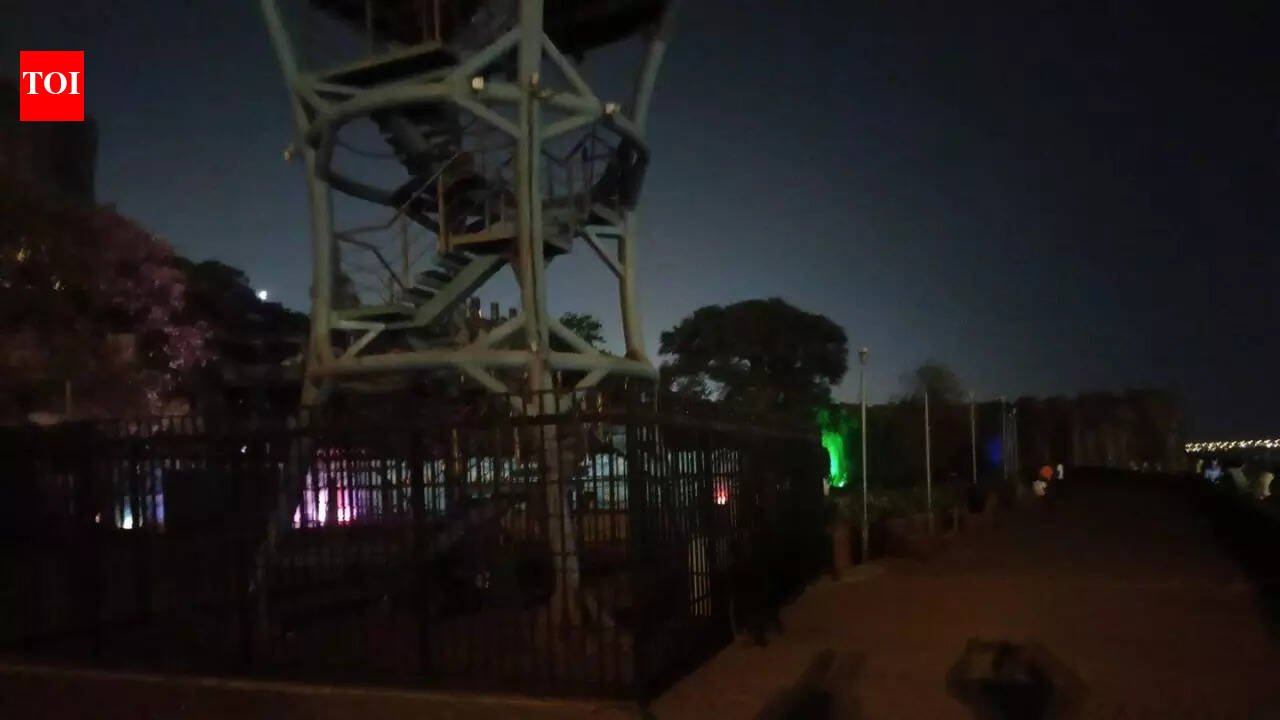
Poor illumination at Mumbai’s Mahim beach is putting public safety at risk’ | Mumbai News


Safety concerns mount as Mahim Reti Bunder Beach lacks lighting

MUMBAI: Mahim social worker Syed M. Ismail has urged the BEST electricity wing and the Brihanmumbai Municipal Corporation to immediately restore and expand street lighting at Mahim’s Reti Bunder Beach, warning that poor illumination is putting public safety at risk.According to Ismail, several street lights along the beach are non-functional, leaving large stretches of the area in darkness after sunset. He said the lack of proper lighting has created an unsafe atmosphere for residents, visitors and families who frequent the beach, particularly during the evening hours.“The absence of adequate lighting makes the area vulnerable and increases the possibility of untoward incidents or criminal activity,” Ismail said, stressing that the issue requires urgent civic attention.He also pointed out that the current lighting infrastructure is insufficient, with only a few working lamps covering the beach. In addition to repairing faulty lights, he has called for the installation of more street light poles in the inner sections of Reti Bunder Beach.Ismail has appealed for high-focus street lights to be installed to improve visibility and deter anti-social activities. Local residents have supported the demand, saying better lighting would significantly enhance safety and make the beach more accessible and secure for the public.


Source link

A Rajya Sabha rummy: How BJP manages ‘floating majority’ with bellwether backings | India News


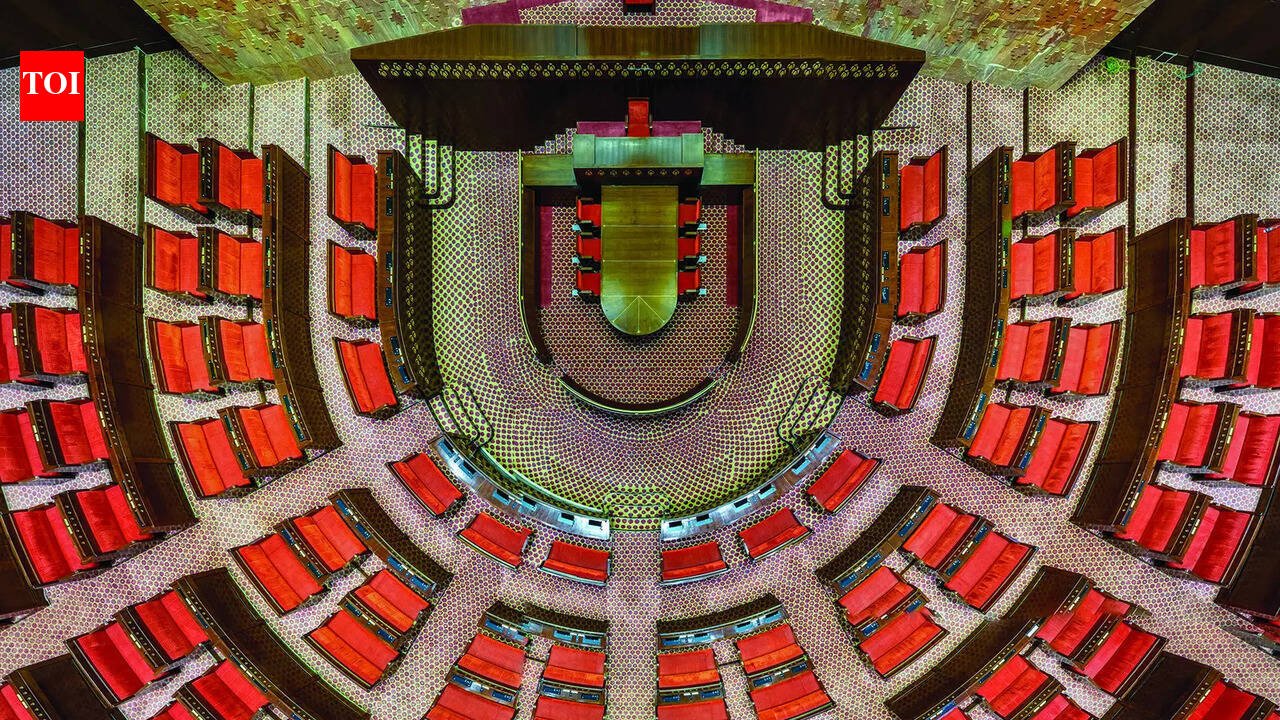
The new Rajya Sabha is 1.5 times larger than the old Rajya Sabha. Inspired by the traditional red tint of the Upper House, the leitmotif here is the lotus, India’s national flower.

Monday’s Rajya Sabha elections did more than just fill a handful of Upper House vacancies. They told a familiar political story in a fresh setting, one where numbers, not noise, determine outcomes.Absentee legislators in Bihar cost the opposition a seat it should have won. Cross-voting in Odisha rewrote a settled arithmetic. And in Haryana, invalid ballots and defections turned what should have been a straightforward contest into a midnight cliffhanger.

Watch

NDA Victory in Rajya Sabha Polls Triggers War Of Words As Opposition Split Widens In Bihar

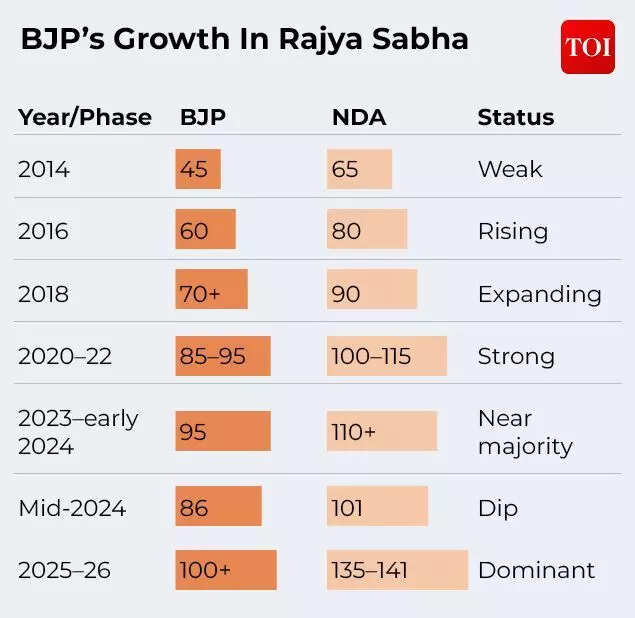
Individually, these may appear as state-specific disruptions. Taken together, they underline a deeper and more enduring pattern. The Bharatiya Janata Party’s (BJP) growing “mastery” over the Rajya Sabha’s numbers game, and the opposition’s continuing inability to hold its ranks when it matters most.This is not a new story. It has been unfolding, quietly but decisively, since 2014.

The Upper House paradox

When the BJP swept to power in 2014 with a decisive majority in the Lok Sabha, it did not carry that dominance into the Rajya Sabha. The Upper House, by design, is insulated from electoral waves. Its members are elected by state assemblies, and their terms are staggered, ensuring continuity and preventing sudden shifts.This meant that even as the BJP commanded brute strength in the Lower House, it remained a minority in the Upper House for years. That imbalance mattered!
Non-NDA Support For BJP4

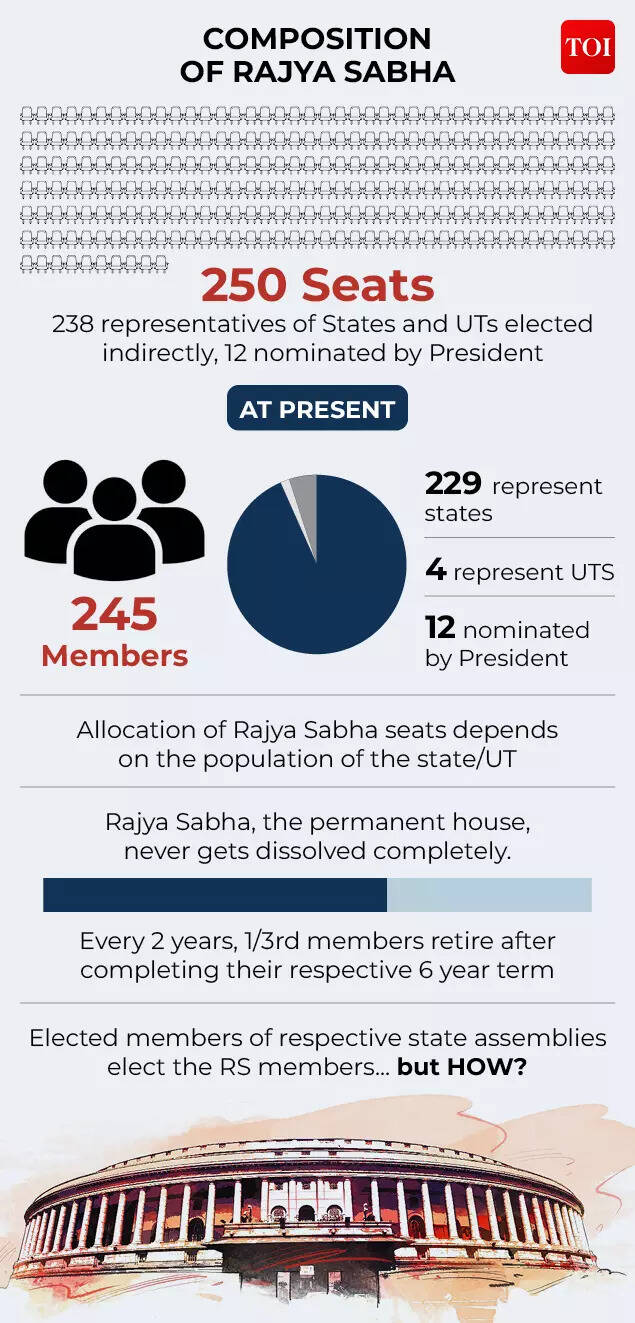
Composition of Rajya Sabha

Unlike the Lok Sabha, where a majority can push legislation through with relative ease, the Rajya Sabha demands negotiation, persuasion and, at times, political ingenuity. For the BJP, this became both a constraint and an opportunity. A constraint because it could not legislate unilaterally, and an opportunity because it forced the party to develop a different kind of political playbook.

The slow climb

From 2014 onwards, the BJP began a steady climb in the Rajya Sabha through a mix of electoral expansion and strategic positioning. Each state election victory translated, over time, into incremental gains in the Upper House.States like Uttar Pradesh, Maharashtra, Assam and later parts of the Northeast became critical to this expansion. But no state illustrates this mechanism better than Uttar Pradesh.With 403 MLAs, Uttar Pradesh is the single biggest contributor to the Rajya Sabha, sending 31 members. After the BJP’s sweeping victory in the 2017 assembly elections, it dramatically improved its Upper House numbers through successive election cycles.This is the core mechanic of the Rajya Sabha, which mandates political parties to control state assemblies, and over time, it leads to the reshaping of the composition of the Upper House in favour of the party with most numbers of seats in the state assemblies.Yet, even as the BJP’s numbers improved, it still did not consistently cross the majority mark on its own. And still, legislation kept moving.

-

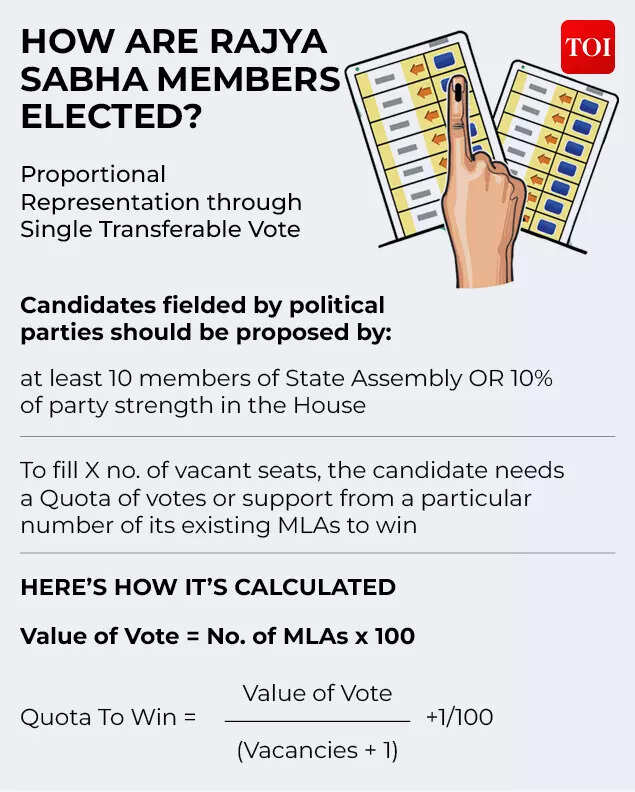
How Rajya Sabha election really works

Rajya Sabha elections are not direct. MLAs vote using proportional representation through the single transferable vote (STV) system.
Non-NDA Support For BJP5

Rajya Sabha formula

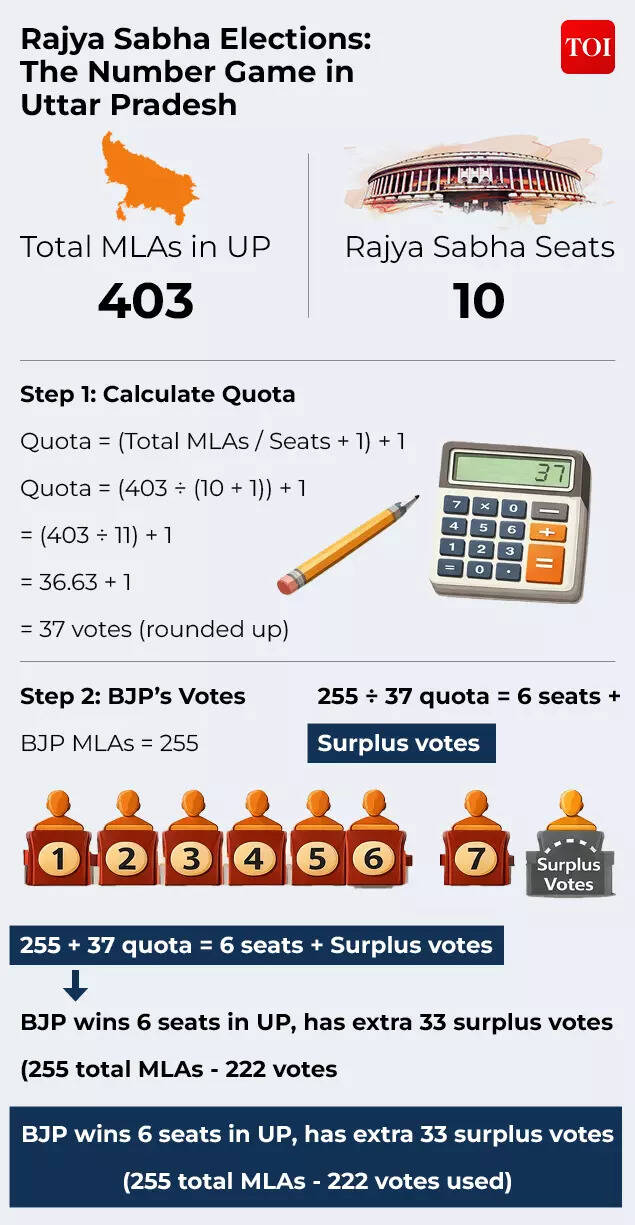
And this is where the system becomes politically sensitive.A handful of cross-votes, a few abstentions, or even incorrectly marked ballots can flip outcomes. The events in Bihar, Odisha and Haryana this week demonstrate just how fragile and fluid these calculations can be.The heart of this system lies in a deceptively simple formula.An Uttar Pradesh Example:
Non-NDA Support For BJP6

How votes are calculated in Rajya Sabha

Managing the numbers: The BJP playbook

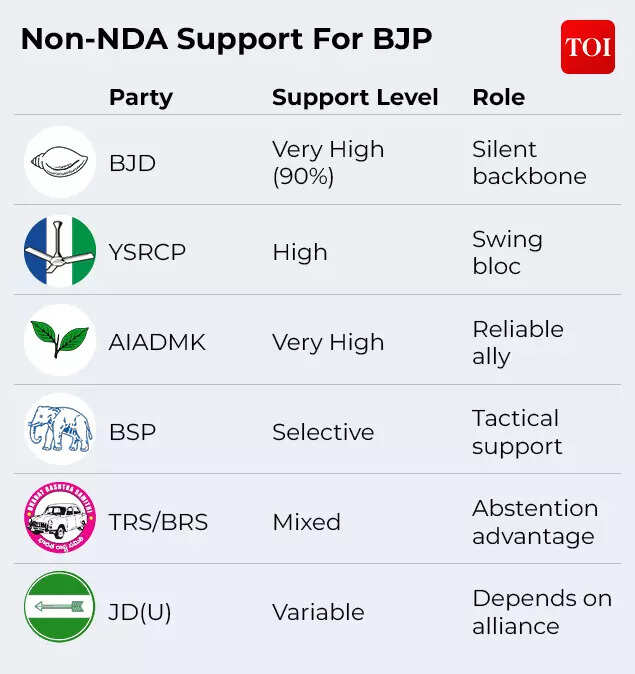
Over the past decade, the BJP has demonstrated a consistent ability to navigate the complexities of the Rajya Sabha’s numbers game, relying not on a single strategy but on a “combination of approaches” that together create a working majority even without a formal one. A key pillar of this has been the steady expansion of its electoral base, with victories in state assemblies translating into incremental gains in the Upper House over time. Where it has fallen short, the party has built tactical, often issue-based understandings with regional players such as the Biju Janata Dal (BJD), YSR Congress Party (YSRCP) and AIADMK, whose support, though not always formal, has proved decisive in crucial votes.
Non-NDA Support For BJP

Non-NDA support for BJP

At the same time, the BJP has benefited from cross-voting and dissidence within opposition ranks, a recurring feature of Rajya Sabha elections that has tilted outcomes in its favour, as seen in the recent Odisha contest. The party has also shown flexibility in candidate selection, at times backing independents or accommodating allies to maximise its chances, while complementing these efforts with careful floor management inside the House. By timing the introduction of key legislations, ensuring attendance when it matters, and navigating debates with a close eye on arithmetic, the BJP has repeatedly managed to secure passage of bills despite lacking a clear majority of its own.

Passing laws ‘without a majority’

The BJP has, over the past decade, managed to secure passage of several key legislations through a calibrated mix of political support, timing and procedural strategy. This has often involved backing from non-NDA regional parties, abstentions and walkouts by sections of the opposition, and careful scheduling of debates when the numbers were favourable. For instance, during the passage of the Muslim Women (Protection of Rights on Marriage) Act, 2019, the government did not have the required numbers on its own, but abstentions by parties such as the JD(U), AIADMK and TRS reduced the effective strength of the House, allowing the bill to pass with a comfortable margin. Similarly, the Jammu and Kashmir Reorganisation Bill, 2019, which paved the way for the abrogation of Article 370, saw active support from parties like the Biju Janata Dal, YSR Congress Party and AIADMK, despite their not being part of a formal alliance with the BJP. The Citizenship Amendment Act (CAA), 2019 followed a comparable pattern, with regional parties backing the government and helping it secure a majority in a tightly contested vote. In other cases, procedural tools have played a role, as seen during the passage of the farm laws in 2020, where a voice vote was used amid opposition demands for division, effectively sidestepping a potentially uncertain headcount. Walkouts, too, have frequently lowered the voting threshold, turning what might have been close contests into manageable ones for the government. Taken together, these instances highlight a recurring paradox reflecting how a government without a formal majority in the Upper House rarely found its legislative agenda blocked, largely due to a combination of opposition fragmentation and strategic floor management.

The opposition’s missed moment

If the BJP’s story is one of adaptation and strategy, the opposition’s is one of missed opportunities.For much of the past decade, the opposition had, at least numerically, the ability to influence legislation in the Rajya Sabha. It could have demanded deeper scrutiny, negotiated amendments, or even stalled contentious bills. That potential has frequently gone unrealised.The reasons are structural as well as political:

  • Fragmentation across regional and national parties
  • Factionalism within parties
  • Coordination failures in key moments
  • Strategic missteps such as walkouts and absences

The Haryana episode is particularly revealing. Despite having sufficient numbers, Congress saw its margin shrink dramatically due to cross-voting and invalid ballots, turning a comfortable win into a narrow escape.In Bihar, absence cost a seat. In Odisha, cross-voting overturned arithmetic. These are not isolated failures, but recurring patterns.

Cross-voting: Symptom of deeper issue

Cross-voting has long been part of Indian politics, but its recurring impact in Rajya Sabha elections points to deeper issues of party discipline and internal cohesion.In tightly contested elections, even a handful of defecting votes can alter outcomes. For the BJP, such moments have often translated into unexpected gains. For the opposition, they have exposed organisational weaknesses.The recent elections have once again highlighted how fragile opposition unity can be under pressure.

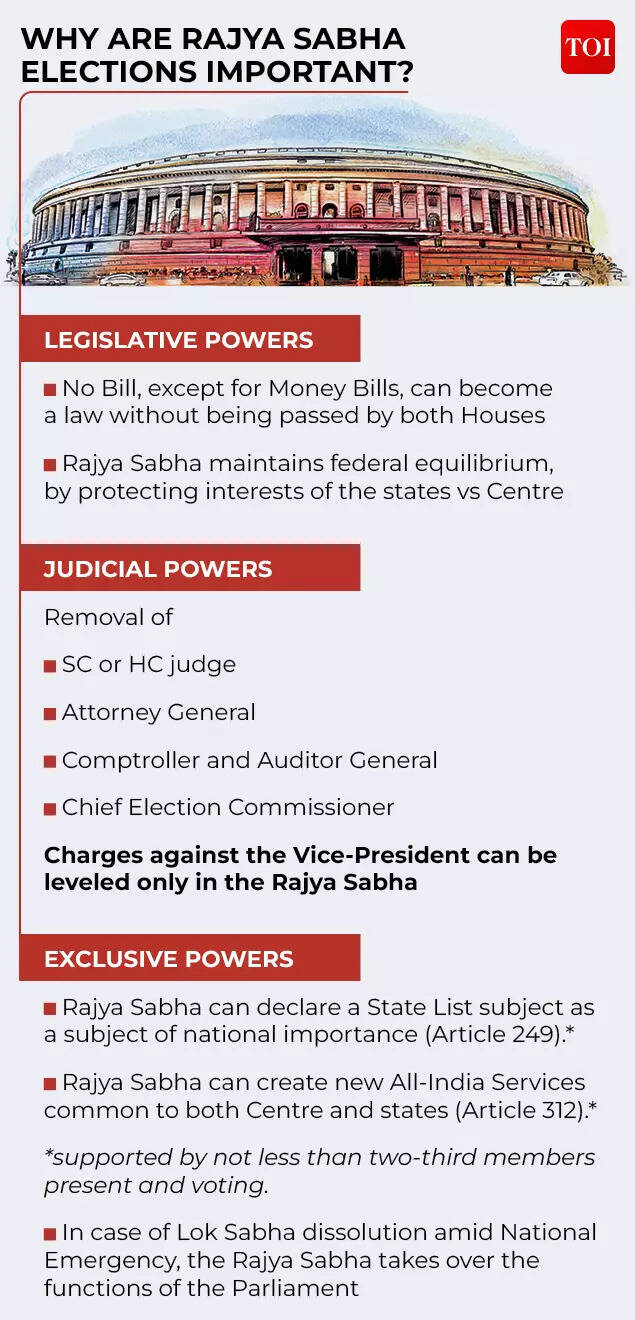
Why Rajya Sabha still matters

In public discourse, the Lok Sabha often dominates attention. But the Rajya Sabha remains crucial to India’s parliamentary system.It serves as:

  • A legislative check on the executive
  • A forum for representing state interests
  • A continuing body that ensures institutional stability

In theory, it is designed to deepen debate and improve legislation. In practice, its effectiveness depends on how political actors engage with it.
Non-NDA Support For BJP3

Why Rajya Sabha elections mattter

Power beyond numbers

The BJP’s experience in the Rajya Sabha over the past decade offers a broader outlook about how parliamentary politics functions beyond simple arithmetic. Power in the Upper House is not determined solely by numbers, but by how those numbers are mobilised, negotiated and, at times, fragmented across parties. The BJP, despite starting from a position of numerical disadvantage, has used issue-based support, timing and floor coordination to advance its legislative agenda. At the same time, this phase has also highlighted the challenges before the opposition. While opposition parties have often had the combined strength to influence or slow down legislation, differences in political priorities, regional considerations and coordination gaps have limited their ability to act as a cohesive bloc. In several instances, this has resulted in either support from non-NDA parties or reduced resistance through abstentions, shaping outcomes in the government’s favour. The overall trend, therefore, reflects not just the ruling party’s strategy, but also the opposition’s struggle to consistently translate its numerical presence into sustained parliamentary leverage.A few absent MLAs in Bihar. A handful of cross-votes in Odisha. Invalid ballots and factional cracks in Haryana. Each episode reinforces the same underlying truth that in the arithmetic of the Rajya Sabha, discipline and coordination matter as much as numbers.The Rajya Sabha was envisioned as a counterbalance, a chamber where legislation would be tested through debate and consensus. Over the past decade, it has instead become a space where strategy often determines outcomes as much as structure.The BJP may not have had a majority of its own in the Upper House for much of this period. But it has repeatedly found ways to create one when it matters.And as recent events show, the difference between victory and defeat in this House is often not a sweeping mandate, but a handful of votes that stay, stray or simply do not show up!

Source link

Blocks on Western Railway over night, no day block today | Mumbai News


MUMBAI : There will be no day block on the Western Railway suburban today and this will be a relief to several commuters.A block was undertaken overnight between Vasai Road and Virar from 12.15 am to 4.15 am, while a major block was also carried out at Prabhadevi station from 1.30 am to 6 am for de-launching of girder of Prabhadevi Road Over Bridge.During the Vasai Road – Virar block, all slow line trains ran on the fast line between Virar/Vasai Road and Borivali. During the block at Prabhadevi, some suburban services were cancelled, short-terminated and reversed from Dadar and Bandra, and no suburban train services ran between Churchgate and Prabhadevi station and also at Matunga Road and Mahim stations during the block period, an official said.


Source link

From training with reserves to senior team, Raynier tries to find his feet again | Goa News


Raynier Fernandes believes he’s getting there, slowly, steadily, but surely

Panaji: At the start of the season, Raynier Fernandes didn’t know where he would end up.The former India midfielder had another year left on his existing contract with FC Goa, but having been loaned to Odisha FC last season, he was surplus to requirements at the club. There was no spot for him in a crowded midfield that had Ayush Chhetri, Sahil Tavora, Harsh Patre, Prachit Gaonkar, besides the two foreigners, David Timor and Borja Herrera.When Goa kicked off their campaign in the AFC Champions League Two, Raynier waited at home, hoping someone would call. The uncertainty surrounding Indian football didn’t help, and it was not until December that he was told he can start training again, not with seniors, but the developmental team of FC Goa.Raynier, 30, trained earnestly, not even knowing if he would play in the top tier of Indian football. A month later, with foreigners parting ways with the club, he was asked to return to the senior team.“I was just waiting for an opportunity to be called back to the (senior) team,” Raynier told TOI during the pre-match media interaction on Friday. “With the reserves, I got some training; I was out of football for seven months. Training with the development team helped me. It got my confidence back. It wasn’t there for quite some time. After the coach and staff called me, it helped. As player, we need to keep faith, cannot afford to give up.Manolo too appears to trust Raynier more than at the start of the campaign. For the away clash against Punjab FC last week, the midfielder was a second-half substitute and kept the ball moving. His 19 forward passes in the final third were more than any other player.“At the start, it was a new experience for me, training with the development team, trying to get my rhythm and fitness back. Individually you can do a lot, but you require a team to play, so that helped me get my confidence back,” said Raynier.Raynier is nowhere close to the form that made him such an invaluable player with Mumbai City when they won the double, or when Stephen Constantine and Igor Stimac handpicked him for the national team. He was also an automatic starter during Manolo Marquez’s first season at Goa, starting 11 of the first 12 games, a fantastic run that saw the club remain unbeaten and on top of the league ladder.But Raynier believes he’s getting there, slowly, steadily, but surely.“I am trying to do my best. The coach always wants the best for the team, for the players. I’m trying to win the coach’s confidence, trying to do well for the team. Obviously, I had a couple of chances to score which I could not. I am not 100 % happy (with my performance), I still have to improve,” said Raynier.It would have been music to Raynier’s ears to hear from Manolo – seated next to him for the media interaction – that the coach was happy with his second-half performance against Punjab FC, even though the 1-1 result was disappointing in the end.“Training with the development team is not good, but it’s better than training individually,” said Manolo, sympathising with Raynier. “I had similar cases in Spain when players who are (still) contracted or on loan trained with the reserves. It’s not easy. The best thing is to train with a team. We have examples here of Ishan (Pandita) and Daniel (Lalhlimpuia), and it’s very clear that physically they are not in the same situation as other players.


Source link

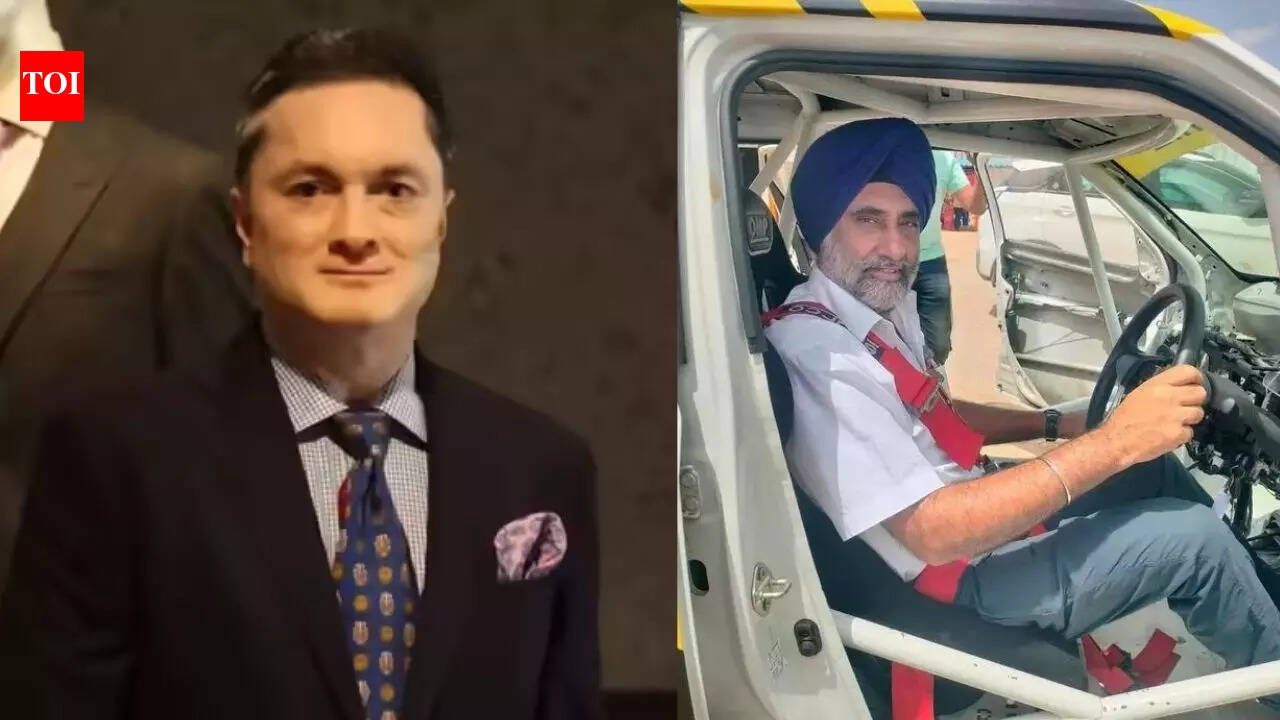
Maldives Speedboat Crash: Ace rally driver missing, Raymond MD Gautam Singhania injured in Maldives speedboat crash | Chandigarh News


CHANDIGARH: India’s ace rally driver, Hari Singh, 59, is missing after a speedboat overturned in the Maldives on Thursday night. Gautam Singhania, chairman and managing director of Raymond Group, was injured in the accident but is safe.Hari’s long-time friend Shashi Pal Singh Garcha, president of Chandigarh Motorsports Association, told TOI on Friday, “We still don’t have any news about Hari and another person missing in the incident. Search operations were called off late Friday evening due to darkness.”Singhania and Hari, a five-time Indian National Rally Championship winner, were among a group of seven on the speedboat when it overturned near Felidhoo, as per media reports. Singhania and the others were rescued but the search continues for Hari and the other missing person. Family and friends are praying for their safety.“Gautam Singhania suffered minor injuries following an unfortunate accident. He is recovering under due care in Mumbai. We thank you for the wishes and pray for the well-being of the affected friends,” said a spokesperson for the industrialist.Garcha, also a five-time national motocross champion, said they were keeping their fingers crossed. “Manik Bhimsen Bhardwaj, from Bengaluru, who was also on the boat, suffered a severe injury and his arm had to be amputated,” he said.News of the accident has shaken the motorsports fraternity. Delhi-based international rally driver Gaurav Gill visited Hari Singh’s house in Sector 8, Chandigarh, on Friday evening.

Poll

Would you participate in motorsport events after hearing about this accident?

Rattan Dhillon, a rally driver from Chandigarh, posted on X: “How unfortunate… Mr Hari Singh sir, a true legend of Indian motorsport and closely associated with JK Tyre and Mercedes, has gone missing following a speedboat accident in the Maldives. It’s been over 22 hours since rescue operations began, and the Indian Navy, along with Maldivian authorities, are continuing the search. Thankfully, 6-7 people on board, including Gautam Singhania, have been rescued safely. Hari Sir needs our prayers right now, hoping for his safe return!”Hari is the first Indian to win the Asia Zone Rally Championship, and is currently head of operations at JK Tyre Motorsport where he works on developing new racing and rallying talent across India. He is married and has two children.


Source link