Breaking News
In a 1st, EV registrations across segments cross 2 million in 2025

[ad_1]

In a 1st, EV registrations across segments cross 2 million in 2025

CHENNAI: This calendar year has turned out to be an impressive one for battery-powered electric vehicles in the country. For the first time, total EV registrations across all segments have crossed the milestone of 2 million units – and the year is still not over, with more than a month to go. The surge highlights rising consumer interest, better product availability and continued policy support for EV adoption. As of Tuesday, for this calendar year, EV registrations (excluding hybrids) stood at 2.02 million units as against 1.95 million units in 2024.Despite EV policy changes, demand has remained strong, driven by falling battery costs, a gradually expanding charging network, and new longer-range models.As sales of electric vehicles (EV) gain momentum, the growth is mainly powered by electric two-wheelers. According to Vahan data, electric two-wheeler segment continues to be the major driver of total EV registrations, accounting for 57% of the total volumes during this calendar year.“We expect mid-teen growth in 2025, softer than last year’s 27% surge but still healthy, supported by firm two-wheeler demand, steady three-wheeler fleet electrification and a competitive four-wheeler launch pipeline, indicating a sustainable growth cycle,” said Poonam Upadhyay, director, Crisil Ratings.It is gathered that magnet shortages are manageable for now, with softer battery costs and rising localisation helping cushion the impact. The launch of higher-range, faster-charging models is also supporting demand.Total electric two-wheeler sales have grown to 1.2 million units year-to-date, slightly higher than the full-year number of 1.15 million achieved in 2024. “Established OEMs have driven electric two-wheeler growth this year, leveraging extensive dealer networks, competitive pricing, and higher-range models to expand customer base and boost retail confidence despite policy changes,” Upadhyay added.Among all categories, the electric passenger vehicle segment which include electric cars and SUVs) recorded a growth of 57% at 156,455 units year-to-date, compared with 99,429 units in 2024.Electric cars and SUVs are gaining traction, driven by a wider range of mid-range models and improved total cost of ownership. “While charging infrastructure remains a consideration for long-distance travel, it’s no longer a major concern for urban buyers who can rely on home and workplace charging. Expanding networks and increasing ranges are easing earlier infrastructure concerns,” she said.Electric three-wheeler sales stood at 6.9 lakh units year-to-date as against 6.91 lakh units in 2024.


[ad_2]

Source link

Online money games used to fund terror, govt tells SC | India News

[ad_1]

Online money games used to fund terror, govt tells SC

NEW DELHI: Justifying its decision to ban online money games by bringing Promotion and Regulation of Online Gaming Act, Centre on Tuesday told Supreme Court that the unregulated online gaming sector had links with terror financing and money laundering, but said it was premature to examine validity of the law as it had not yet been notified after President’s assent.In an affidavit filed in court on a batch of petitions challenging validity of the law, the Centre told the court that the Act was meant to protect individuals, especially youth and vulnerable populations, from the adverse social, economic, psychological and privacy related impacts of online money games and to safeguard the integrity of financial systems and security and sovereignty of the country.“Unchecked expansion of online money gaming has been linked to financial fraud, money laundering, tax evasion, and in some cases, the financing of terrorism, thereby posing threats to national security, public order and integrity of the state… There is enough material and data that indicates the unregulated online gaming sector has links with terror financing and money laundering, yet again establishing the exclusive compete-nce of Parliament to regulate the same,” the affidavit said.It said data pertaining to money laundering and terror financing links to online money games were classified but agreed to place the same in SC in a sealed cover. “An analysis of data from Suspicious Transaction Reports and Cross Border Wire Tra-nsfer Reports revealed online gaming companies registered in small island countries where user accounts were registered with Indian banks in the name of proxy persons. The money collected from the users has been remitted out of India by misdeclaring purposes of remittances,” the affidavit said.


[ad_2]

Source link

Vande Bharat sleeper, Amrit Bharat with AC coaches & more – what will train travel on Indian Railways look like in 2026?

[ad_1]

Vande Bharat sleeper, Amrit Bharat with AC coaches & more - what will train travel on Indian Railways look like in 2026?
With Vande Bharat sleeper trains, newer versions of Amrit Bharat Express, passengers can hope for better travel experience in the coming years.

Train travel in India is a vibe, with Indian Railways transporting millions of passengers. With the launch of the Vande Bharat Express trains a few years ago, Indian Railways has aimed to change the face of train travel, and several more new train projects are expected to deliver in 2026. While Vande Bharat – a chair car train set – has attempted to transform the day travel experience, there is growing demand for better and faster trains for overnight travel.In this regard, the Vande Bharat sleeper train project – launched a few years ago in the hope of rolling out an experience more premium than the Rajdhani Express trains – may prove to be a game changer. Simultaneously, Amrit Bharat Express and NaMo Bharat trains are expected to make travel more comfortable for the common man. India may also soon see its very own, indigenous bullet train. What trains can passengers look forward to in the coming years? What will be the features of these trains and rollout timelines? We explore:

Vande Bharat Sleeper Trains

Over 200 Vande Bharat sleeper trains are expected to be rolled out in the coming years as Indian Railways looks to revamp long-distance train travel. Three major projects are currently in the works: BEML is manufacturing 10 Vande Bharat sleeper train sets with the help of ICF; Indo-Russian joint venture Kinet has been tasked with rolling out 10 train sets; and a Titagarh-BHEL consortium will make 80 Vande Bharat sleeper trains. Additionally, ICF is also looking to roll out its own version of the Vande Bharat sleeper train soon.The first prototype of the Vande Bharat sleeper train project awarded to BEML was originally supposed to be ready in the first half of 2024. Several deadlines have since then been missed. Two prototype rakes have been manufactured by BEML. Railway Minister Ashwini Vaishnaw has said that the Vande Bharat sleeper train requires ‘minor’ retrofitting. He believes that they will be launched in December.
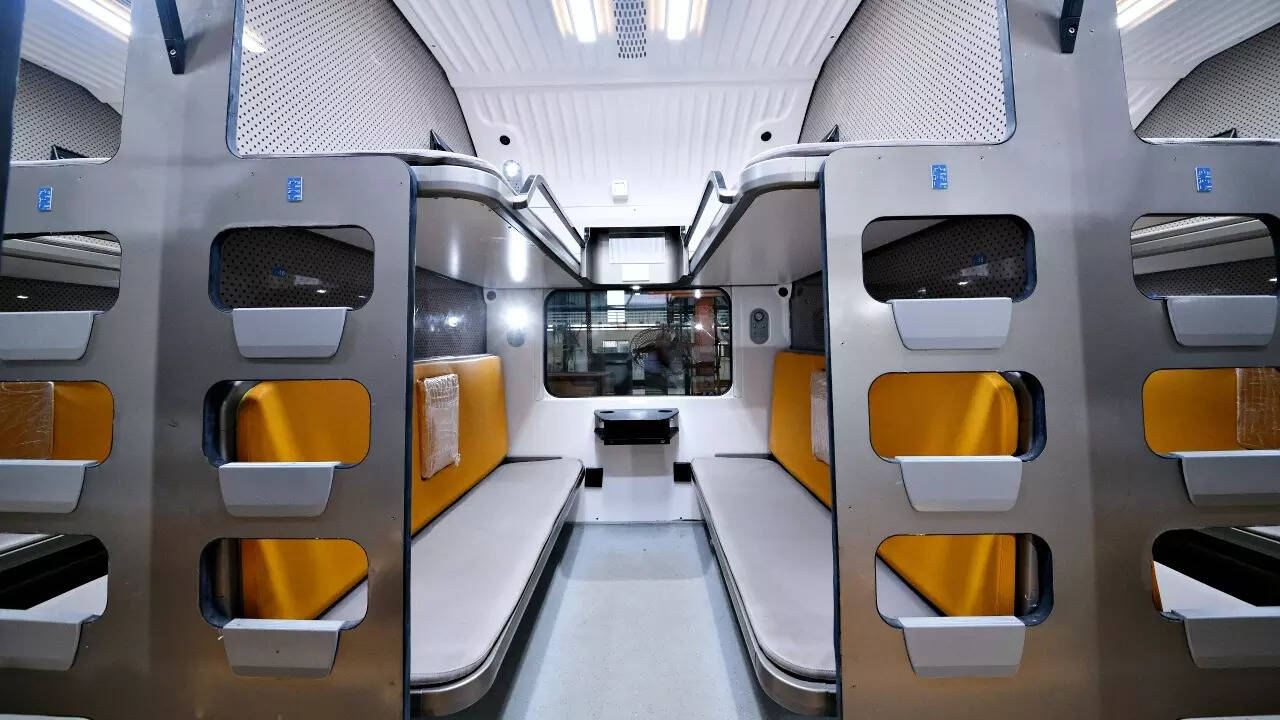
Vande Bharat Sleeper

Vande Bharat Sleeper

Sharing details about the Vande Bharat sleeper train projects, Integral Coach Factory (ICF) GM U Subba Rao told TOI, “Initially, we have given orders for 10 trains to BEML. The first prototype came out a few months back. We wanted some upgradations and improvements in the train so the second rake has come to us with the changes.” “We have already given BEML the go ahead for the other eight trains. The Railway Board will take the call on whether the two rakes will be launched together. From here on, BEML may manufacture one train a month,” he said.What are the expected features of the Vande Bharat sleeper train?

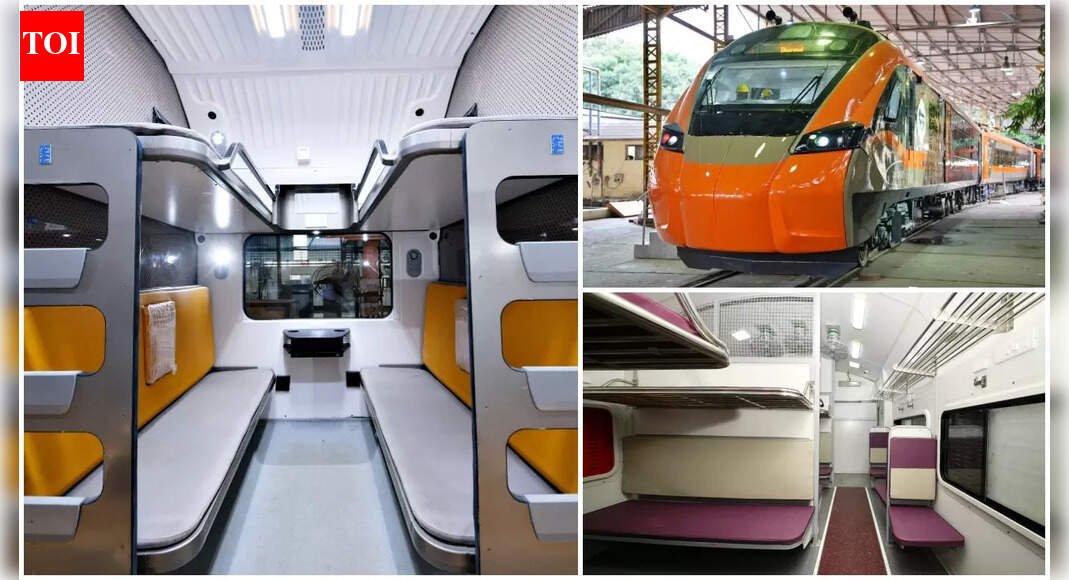
  • The first prototype of the Vande Bharat sleeper train has 16 passenger coaches – this includes 11 AC 3 tier coaches, 4 AC 2 tier coaches, and one AC First class coach.
  • The new train is capable of running at 160 kmph (testing speed 180 kmph) making it a semi-high speed train. However, most stretches on the Indian Railways network do not allow for such high train speeds.
  • Taking inspiration from European trains, the Vande Bharat sleeper train will have cushioned berths with enhanced comfort. The upper berth access has been redesigned for easier climbing.
  • The new train will have special night lights, integrated announcement systems with visual displays, CCTVs, and modular pantry units.
  • The train will feature modern bio-vacuum toilets, similar to those is aircrafts. There will also be a toilet for disabled passengers, which will also have a baby care station. The AC First class will include shower facilities with hot water provision.
  • The Vande Bharat sleeper train is equipped with the indigenous KAVACH anti-collision system. Like the chair car versions, the sleeper variant makes use of regenerative braking technology for optimal energy usage.
  • The coaches have automatic interconnecting doors. The gangways are sealed completely to maintain clean air and effective temperature control.
  • Each coach has individual reading lights, charging points, refreshment tables, and GFRP panel interiors. The train doors open automatically at the designated station.
  • The train has a Centralised Coach Monitoring System. Emergency communication systems connect passengers with the driver.

ICF too is looking to manufacture its own variant of the Vande Bharat sleeper. “We are working on a 24 car rake, which will be one of the longest sleeper trains being produced in India. We are working on the designs. It is slightly different from what BEML has produced, because we are trying to increase the number of toilets since it’s a long-distance train,” U Subba Rao said.
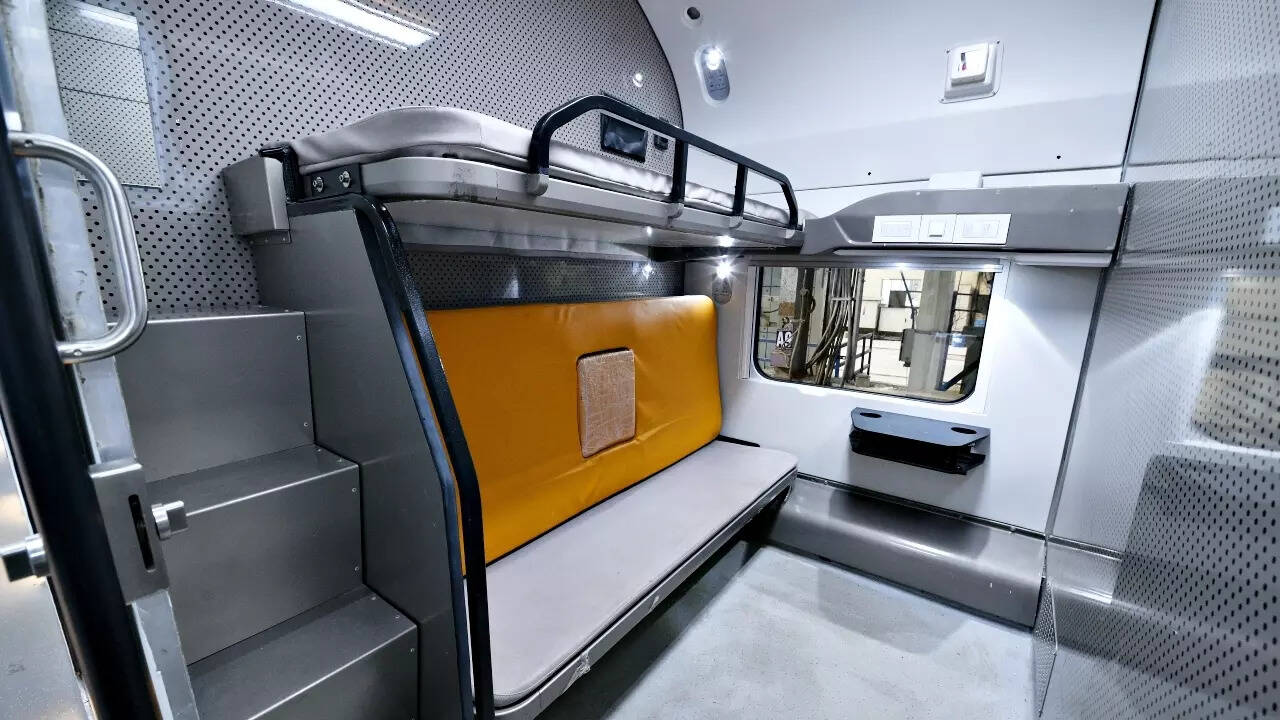
Vande Bharat Sleeper AC 1st

Vande Bharat Sleeper AC 1st

“We also plan to have a pantry car for food to be heated up and served, which is not available in the other version of Vande Bharat sleeper. So, the configuration is slightly different. We are also trying to improve upon the interiors…we are on the drawing board right now,” he added.So when does ICF plan to roll out its own version of the Vande Bharat sleeper train?“Major assemblies have been ordered. For example, the propulsion system has already been ordered, and other major assemblies like doors and brake systems, the tender is going to be floated anytime soon. Specifications have been kind of finalized. By December 2026 we are targeting that the prototype Vande Bharat sleeper rake should be ready,” he said.Meanwhile, Kinet recently unveiled the design of the First AC coach of the Vande Bharat sleeper train. The production is expected to begin at Indian Railways’ Latur factory soon.

Vande Bharat Sleeper Kinet design

Vande Bharat Sleeper Kinet design

Amrit Bharat Trains For Common Man

Even as it launches a premium long-distance train, Indian Railways is also looking to introduce more modern trains for the common man. Amrit Bharat trains, first launched in 2023-end will continue to be introduced in the coming years as well. ICF is already rolling out Amrit Bharat 2.0 trains with better comforts compared to the first prototypes.Amrit Bharat Express is a push-pull train with non-AC coaches with a mix of general and second-class sleeper coaches. With a faster acceleration and deceleration, thanks to its push-pull technology, the Amrit Bharat train has a maximum speed of 130 kmph. In the coming months an Amrit Bharat 3.0 train is expected to be rolled out with AC coaches as well.
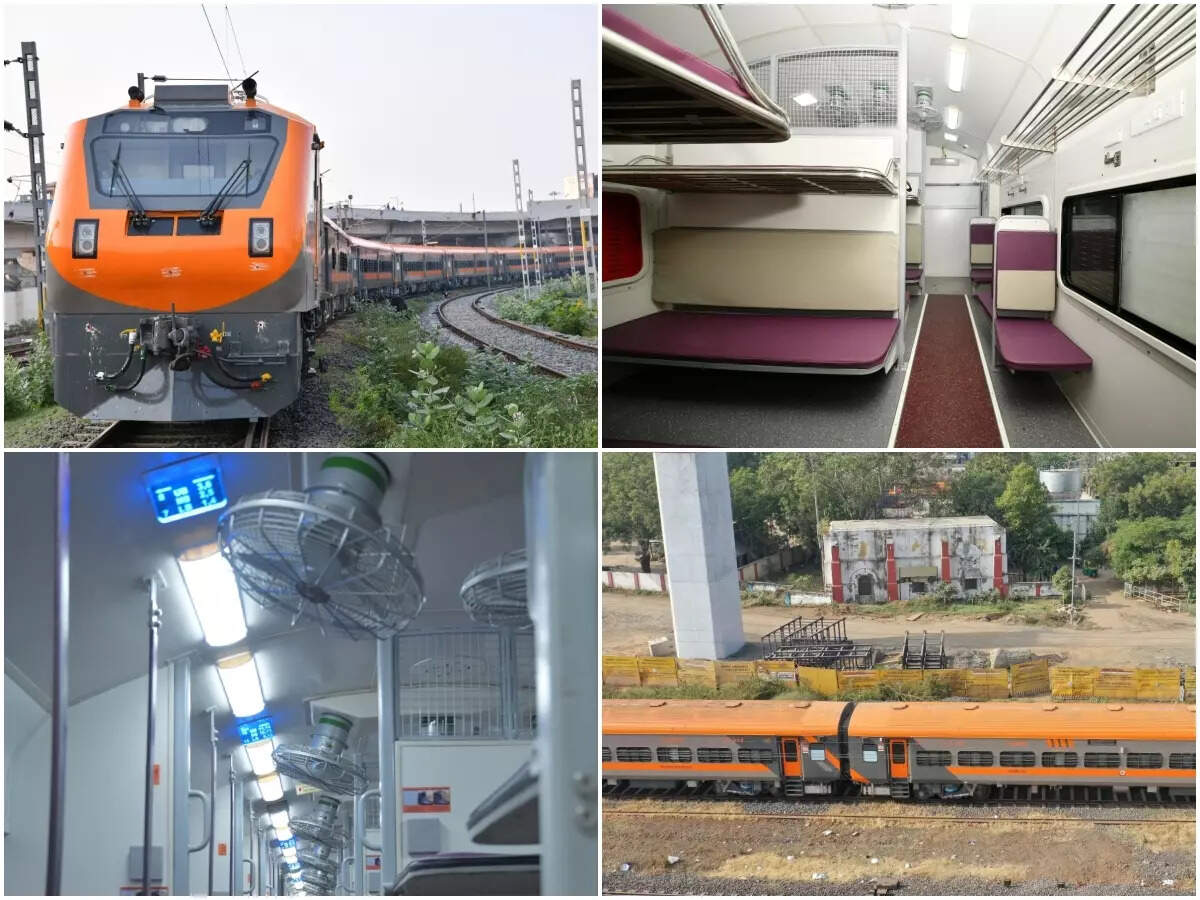
Amrit Bharat Express

Amrit Bharat Express

  • Foldable Snack table, improved Seats & berths, streamlined-LED light fitting, Fans with sleek SS grills
  • Air spring suspension bogies, Public Address & Passenger Information System (PAPIS), Mobile holder, Radium Illuminated flooring strip, Toilet Indication light
  • 2 Indian & 2 Western style toilets in each coach with electro Pneumatic Pressurised Flushing system
  • Aerosol-based fire suppression system in toilets and electrical cubicles, Foldable bottle holder, Sealed Gangway (Vestibule), Automatic-soap dispenser
  • Mobile charging socket for each passenger, Improved interior panelling with Aluminium Composite Panels
  • Semi-automatic couplers instead of semi-permanent for easy attachment and detachment
  • Crashworthy features, Electro pneumatic assisted brake system for quick brake application
  • Fully sealed gangway for quick coupling & decoupling, Vacuum evacuation system similar to Vande Bharat
  • Best in class toilets for maintenance friendly & better aesthetics, Automatic hygiene odour control system in FRP Modular toilet
  • External emergency lights to provide basic lighting during emergency situations, Charging sockets USB A & C type ports

ICF GM U Subba Rao told TOI that there is an order for 100 Amrit Bharat trains. “We have got an order for 50 Amrit Bharat 2.0 trains and 50 more trains will be manufactured by RCF,” he said. “We have already produced 10-12 trains. Two rakes a month, we are producing right now,” he added.Talking about AC coaches for Amrit Bharat Express, he said, “We are trying to introduce the Amrit Bharat 3.0 train as well. We have been asked to make five of those trains. We are working on the designs of the AC coaches. In this financial year, maybe by March 2026, we are trying to introduce the first prototype.”“The features will be similar to Rajdhani Express trains, but also much better because we also worked on non-AC coaches and made them better than the regular non-AC coaches. It’s an ongoing, continuous process,” he added.

NaMo Bharat trains, bullet trains & hydrogen

Several other projects that Indian Railways is working on include NaMo Bharat trains for short-distance inter-city travel, India’s own indigenous bullet train, and a hydrogen train which is a technology demonstrator project. NaMo Bharat trains, already launched on some routes, are a metro-style variant of the Vande Bharat Express trains, capable of 130 kmph speed.Some of the major features of NaMo Bharat trains are:

  • Fully Air Conditioned train, Fully sealed wider gangway, Centrally Controlled Double leaf Automatic Plug Doors, Electro Pneumatic Braking and Regenerative Braking System
  • 20.32 T axle Bolster less Bogie – Fully suspended Traction motor
  • Passenger information & infotainment system, Disaster lights for lighting during power failures, Train Control & Monitoring system, Continuous LED lighting
  • FRP Modular toilets with Vacuum Assisted Bio-toilet. PRM toilet in DTC, CCTV
  • Emergency Talk Back Unit (ETBU), FRP Panelling with luggage rack
  • Cushioned Bench Type Seats, Fire Detection and Suppression System, LED Route map indicator

“We have produced one NaMo Bharat train, one was produced by RCF, Both are, right now, already in service. The board has decided that RCF will produce the balance 50 trains. We have already done the designing, and the design was shared with RCF, and they also produced the same design, they will continue with the production,” said ICF GM.
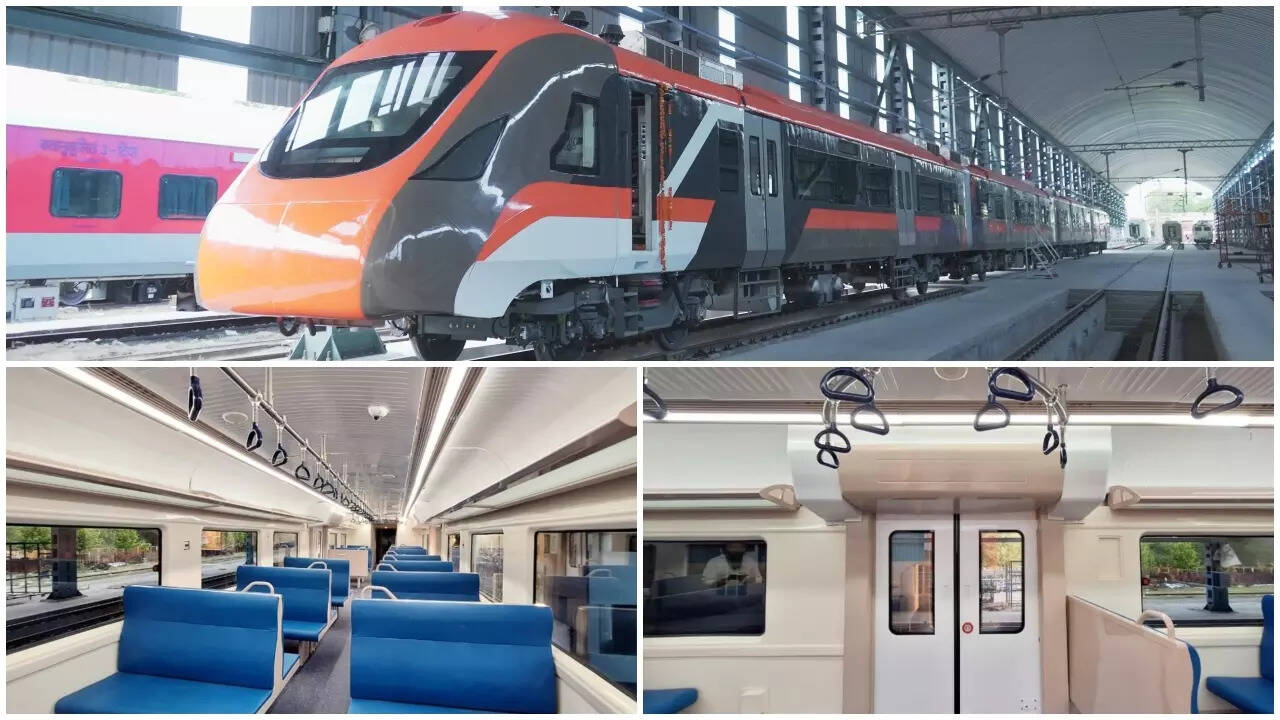
NaMo Bharat train

NaMo Bharat train

Indian Railways has also manufactured its first hydrogen-cell powered train, which is expected to be launched soon on the Jind and Sonipat route in Haryana under the Northern Railway. The new train will have speeds of up to 110 kmph.Talking about the hydrogen train Subba Rao told TOI, “Basically this was a technology demonstrator. We tried to demonstrate the Indian capability of producing a hydrogen train. We will run it for some time and then maybe the government of India will take a call (on whether more such trains should be manufactured).”
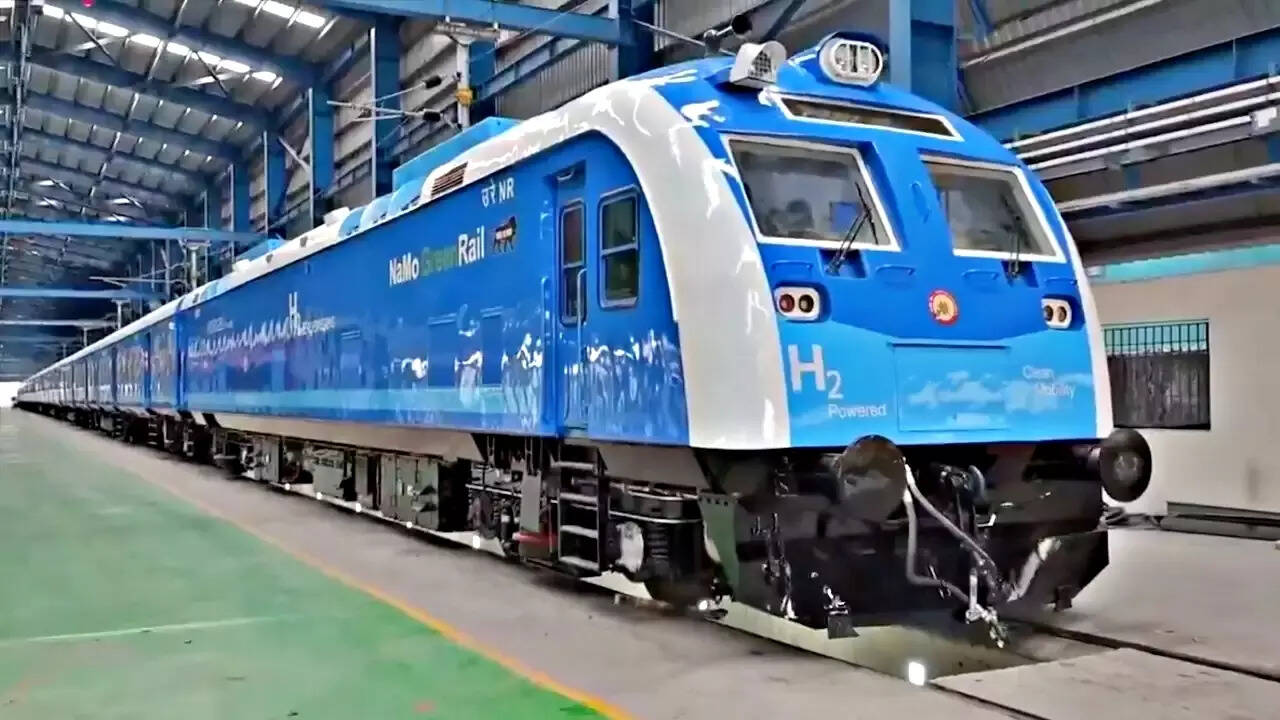
Hydrogen train

Hydrogen train

“You know, hydrogen technology is totally new. It’s at an initial stage all over the world. So we are working on it. I’m sure it’ll be successful,” he said.India is also looking to manufacture its own bullet train and a project has been awarded to BEML, in collaboration with ICF for manufacturing two high-speed train sets. The train will be indigenously designed and manufactured. “High speed rail is being manufactured by BEML. We have given the order to BEML – ICF, NHRCL, and BEML are collaborating on that project. The preliminary designs are all ready. They are also finalizing the vendors for all the sub-assembles and all important components. Orders are also being placed,” Subba Rao shared. “The final designs will be done and once some components arrive the manufacturing of the prototype car body will start. By early 2027, the first train should be running,” he added. Talking about the India-specific features of the bullet train, the ICF GM said, “It will be an air-conditioned chair car train suited for Indian conditions. Tropicalization has to be done. That’s why designing the train within India is very important, since we know the conditions much better. In Europe, it is very cold, so they had to concentrate more on heating systems, whereas in India it is quite hot. So we have to concentrate on the AC system. So that’s one of the basic differences.”“The second difference is our country is quite dusty, so that aspect also has to be taken into account. The filters have to be much better so that the air quality inside the coach is acceptable,” he added.With Vande Bharat sleeper trains, newer versions of Amrit Bharat Express, NaMo Bharat, bullet trains, and hydrogen trains in the pipeline, passengers can hope for better travel experience in the coming years.




[ad_2]

Source link

ICC T20 World Cup 2026: India–Pakistan match set for February 15; check Men in Blue’s full schedule | Cricket News

[ad_1]

ICC T20 World Cup 2026: India–Pakistan match set for February 15; check Men in Blue's full schedule

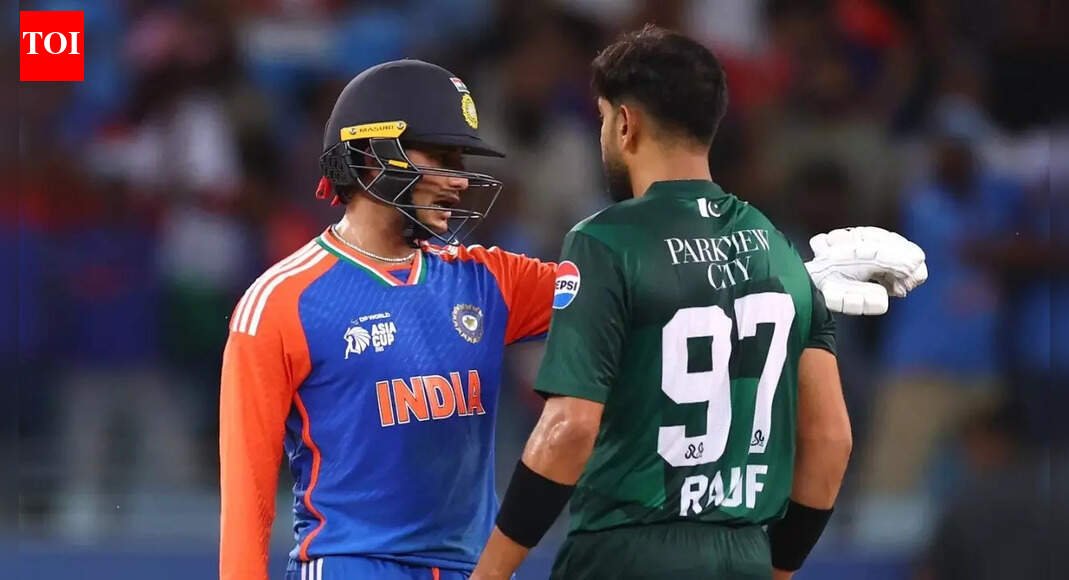
NEW DELHI: The International Cricket Council (ICC) on Tuesday released the full schedule for the upcoming 2026 T20 World Cup. The tournament will start on February 7 in Colombo with Pakistan facing the Netherlands, followed by West Indies playing Bangladesh.India will open their title defence later the same day against the USA in Mumbai. The defending champions’ second match is against Namibia in Delhi on February 12. The India-Pakistan match is set for February 15 in Colombo, and India will complete their group-stage fixtures against the Netherlands in Ahmedabad on February 18.

India vs Pakistan again at an ICC event; T20 World Cup schedule is out!

The group stage will feature three matches each day.Under an agreement finalised earlier this year for multi-nation events hosted by India or Pakistan, the ICC has alternate venues in place for the knockout stage. If Pakistan reach the semifinals or the final, those matches will be held in Colombo. If Pakistan do not reach the final, the title match will be staged at the Narendra Modi Stadium in Ahmedabad on March 8. Mumbai will host one semifinal and Kolkata the other if Pakistan are not in the knockout rounds.India and Sri Lanka will jointly host the 20-team event across 29 days at eight venues — five in India and three in Sri Lanka. The grounds are: Narendra Modi Stadium (Ahmedabad), MA Chidambaram Stadium (Chennai), Arun Jaitley Stadium (New Delhi), Wankhede Stadium (Mumbai), Eden Gardens (Kolkata), R. Premadasa Stadium (Colombo), Sinhalese Sports Club Cricket Ground (Colombo) and Pallekele International Cricket Stadium (Kandy).A total of 40 group matches will take place from February 7 to 20, after which the top two teams from each group will move to the Super Eights starting February 21.

Groups for the 2026 T20 World Cup:

Group A: India, USA, Namibia, Netherlands, PakistanGroup B: Australia, Sri Lanka, Zimbabwe, Ireland, OmanGroup C: England, West Indies, Bangladesh, Italy, NepalGroup D: South Africa, New Zealand, Afghanistan, Canada, UAE


[ad_2]

Source link

Price strain: US retail sales cool in September; businesses face higher input costs; consumer resilience tested

[ad_1]

Price strain: US retail sales cool in September; businesses face higher input costs; consumer resilience tested

US retail sales grew slower than expected in September as consumers grappled with persistently higher prices and companies faced rising input costs, according to government data released on Tuesday.Retail sales rose 0.2% month-on-month, the Commerce Department said, easing from 0.6% in August and falling short of analyst estimates. The moderation in spending comes at a time when households are feeling the pinch of elevated prices, while businesses continue to pass on higher costs.A separate Labor Department report showed producer prices rose 0.3% in September, in line with expectations. But the increase was driven largely by a 0.9% jump in goods prices, highlighting the steeper cost pressures across energy and food categories.As President Donald Trump’s tariffs ripple through the economy, analysts say attention remains on how consumers — the backbone of the world’s largest economy — will absorb higher price levels. Several companies have already flagged a rise in input costs linked to the new duties. The administration last week widened tariff exemptions for select agricultural products to offer relief amid voter concerns over living costs.Both data releases were delayed due to the record 43-day government shutdown between October and mid-November, which halted the compilation of multiple economic indicators including inflation and jobs numbers. As a result, full reports for October were cancelled and remaining figures will now be incorporated into the November update.Commerce Department data showed September retail sales were up 4.3% year-on-year. Among categories, sales at motor vehicle and parts dealers declined, while food and beverage store sales softened. Clothing, hobby and electronics retailers also posted negative readings.In the producer price index, the rise in goods prices — up 0.9% — was fuelled primarily by higher energy and food costs.


[ad_2]

Source link

‘No good and bad Taliban’: Pakistan refutes attacking Afghanistan; Kabul vows retaliation

[ad_1]

'No good and bad Taliban': Pakistan refutes attacking Afghanistan; Kabul vows retaliation

Pakistan’s military on Tuesday rejected accusations from the Taliban government that it carried out airstrikes inside Afghanistan, where an overnight raid reportedly killed 10 people near the Durand Line.“Pakistan has not attacked Afghanistan,” army spokesperson lieutenant general Ahmed Sharif Chaudhry said on state broadcaster PTV, calling the Afghan administration’s allegations “baseless.”“Whenever Pakistan attacks someone, it announces it,” Sharif Chaudhry said.He further added, “In our view, there are no good and bad Taliban.”Afghanistan, however, strongly condemned Pakistan for strikes in Paktika, Khost and Kunar provinces, calling them a direct violation of its sovereignty and a breach of international norms. The Taliban government said it would respond “at an appropriate time.”Afghan government spokesperson Zabihullah Mujahid said Pakistan’s “hostile actions” reflected the “ongoing failures of Pakistan’s military regime,” adding that defending Afghanistan’s airspace, territory and citizens was its “legitimate right.”


[ad_2]

Source link

Gold loan boom: Credit market poised for major expansion; NBFCs plan 3,000 new branches as demand jumps

[ad_1]

Gold loan boom: Credit market poised for major expansion; NBFCs plan 3,000 new branches as demand jumps

India’s gold loan market is gearing up for strong expansion, with non-bank lenders preparing to open around 3,000 dedicated branches over the next year to meet rising demand. The market, which is largely led by public-sector banks, grew 36% year-on-year to Rs 14.5 lakh crore by the end of September.According to sector heads quoted by ET, this is the largest annual branch expansion undertaken by gold loan companies. Lenders are setting up exclusive gold-loan centres and adding the product to many existing branches to tap what they see as a fast-growing opportunity.George Alexander Muthoot, managing director of Muthoot Finance, was cited by ET as saying that demand for gold loans is increasing sharply, as borrowers struggling to secure unsecured microfinance loans are turning to secured lending against jewellery. Microfinance firms have become more selective due to heavy stress in their asset quality.Rising gold prices have also boosted loan ticket sizes, making the product particularly attractive to farmers and small traders seeking working capital. Rating agency ICRA has projected the organised market will reach Rs 15 lakh crore in FY26, a year ahead of earlier expectations.Shaji Varghese, CEO of Muthoot Fincorp, said that he expects the momentum to continue, noting that global central bank demand is driving gold prices, reported ET. His firm plans to open 200 branches by March. Major players such as Muthoot Finance, Muthoot Fincorp, IIFL Finance and Bajaj Finance together intend to add about 1,800 branches. Bajaj Finance alone aims to open 900 by March 2027, while IIFL Finance plans 500 by this fiscal year.New entrants are also expanding aggressively. L&T Finance, which entered the gold loan market in February after acquiring Paul Merchants Finance’s 130-branch business, plans to add 200 more outlets. Microfinance players such as Keertana Finserv and Uttrayan Financial Services are diversifying into gold loans to stabilise their portfolios. “We are scaling down our microfinance business,” Padmaja Reddy said, adding they will set up 175 gold-loan branches by FY26, ET reported.Setting up a gold loan branch requires significant security infrastructure, from strong rooms to vaults and cameras, costing between Rs 8 lakh and Rs 20 lakh. Such branches usually break even within 1.5–2 years.ICRA expects NBFC gold-loan assets under management to grow 30–35% in FY26, supported by high gold prices and slower growth in unsecured loan products. Public-sector banks remain dominant in the segment, with their gold loan portfolios growing at a CAGR of 27% in FY24 and FY25, compared with 22% for private banks.


[ad_2]

Source link

How to be a value investor when Nifty is at 26,000, Sensex at 85,000: Guide to finding value when the market looks pricey

[ad_1]

How to be a value investor when Nifty is at 26,000, Sensex at 85,000: Guide to finding value when the market looks pricey

Value investing is not about chasing the latest momentum darling. It is about spotting fundamentally sound businesses. (AI image)

When the Nifty hovers around 26,000 and the Sensex sits near 85,000, investors naturally wonder: Is there any juice left in the market? The answer is an unequivocal yes. Expensive markets are not uniformly expensive. Even near record highs, pockets of value quietly exist for investors who are willing to look past the noise and choose patience as their strategy.Value investing is not about chasing the latest momentum darling. It is about spotting fundamentally sound businesses that the market has temporarily ignored or punished. It requires temperament, not trend-following. Think of it as gardening: you plant when sentiment is dry, nurture your picks, and wait for the cycle to turn.History is full of reminders that value emerges when others are distracted. Midcap and small-cap stocks had surged to expensive valuations in October 2024, before profit taking brought them down to saner levels by the end of the year. Then a warning from Sankaran Naren, CIO of ICICI Prudential Mutual Fund, triggered an alarm in the markets.By March 2025, the BSE Midcap had slipped below 39,000 and the BSE Small Cap below 43000. Within those aggregates were dozens of companies that were fairly priced and not overvalued. But just as a rising tide lifts all boats, a surging tsunami destroys everything it touches. Even good stocks were beaten down, even as the broader indices fell 25% from their October 2024 peak.That was a wonderful opportunity for value investors. As Nathan Rothschild’s once said, “Buy when there’s blood in the streets.” Investors who stepped in during that massacre have pocketed rich rewards. Both the BSE Midcap and the BSE Smallcap have shot up 20% since their March lows.Value investors typically operate in two environments. There are absolute value phases, when there are sudden, fear-driven wipeouts. For instance, in March 2020, the Covid shock sent markets tumbling. At times like that, valuations detach from fundamentals, and quality stocks get thrown out with the junk. These moments don’t come often, but they are the closest thing to a bumper discount sale for a value investor.Then there are relative value periods, when the markets move sideways. Though the indices are stable, several stocks remain stuck in the doldrums. These are ideal hunting grounds. The challenge is to find companies priced well below their intrinsic worth. These are businesses whose long-term earning power is higher than what current prices imply.Valuation ratios like price-to-earnings (PE) and price-to-book (PBV) are good starting points but not always the best way to judge a stock. A stock may appear cheap simply because its growth engine is stalling. Earnings alone are not important. What is more important is the quality of the earnings.Companies often show inflated profits due to a one-off asset sale, divestment or windfall gains. That boosts the EPS but not the business. Sustainable value comes only from operations, not accounting fireworks. Always check whether operating margins are robust and consistent.Margin of safety is the cornerstone of value investing. It is the gap between a stock’s intrinsic value and its market price. The wider this gap, the lower your downside risk and the higher your probability of outsized returns.For example, if a company’s fair value is Rs 400 but trades at Rs 350, you already have a 12.5% buffer. If it corrects further to Rs 320, your margin of safety expands to 20%. For long-term investors, such declines are less of a threat and more of an opportunity. Market pessimism is often the discount coupon for future wealth creation.Bull markets distort perception. When frothy stocks trade at triple-digit PEs, even a PE of 35 can look like a bargain in comparison. But relativity is a trap. Overvaluation is overvaluation, regardless of what your peer group looks like. Never buy an expensive stock simply because another one is even more overpriced.To separate true value from low-quality cheapness, investors must dig deeper into profitability metrics. Return on Equity (RoE) helps measure how efficiently a company uses shareholder capital. Return on Capital Employed (RoCE) assesses overall capital productivity, especially crucial in capital-heavy industries like infrastructure, engineering, or manufacturing. A consistent RoE or RoCE above 10% signals that management is deploying capital wisely. In value investing, good businesses matter as much as good prices.Dividend payout is often overlooked but invaluable. Companies that share profits regularly demonstrate financial discipline and cash-flow strength. A decent dividend yield not only cushions returns during volatile periods but also discourages sharp price declines. ITC is a textbook example—its steady payouts have anchored its stock price through multiple market storms. Dividend-paying companies typically have mature business models, predictable earnings, and conservative capital allocation. These are traits a value investor should love.Value investing is part maths, part mindset. The maths helps you estimate fair value; the mindset helps you stay calm while the market decides what it wants to fret over next. At 26,000 Nifty or 85,000 Sensex, the discipline remains the same: buy businesses you understand, insist on a margin of safety, demand quality earnings, and give time the respect it deserves. Patience, not predictions, is what turns value investing into wealth building.


[ad_2]

Source link

Market watch: Asian shares rebound as rate-cut optimism lifts tech stocks; crude holds steady amid supply risks

[ad_1]

Market watch: Asian shares rebound as rate-cut optimism lifts tech stocks; crude holds steady amid supply risks
File photo (Picture credit: AP)

Asian stocks climbed on Tuesday, buoyed by growing expectations that the US Federal Reserve will cut interest rates in December, while crude prices steadied as traders balanced geopolitical uncertainty with forecasts of a softer oil market next year.As per Reuters, MSCI’s index of Asia-Pacific shares excluding Japan rose 1%, led by a rebound in technology names after last week’s sharp 4% drop. The index is still on track for a 3.8% fall for the month – its first monthly decline since March. Japan’s Nikkei also gained 0.8% on reopening after a holiday, recovering from last week’s 3.5% slump.South Korea’s Kospi surged 2.39%, while the small-cap Kosdaq gained 1.7%, supported by strong moves in heavyweight chipmakers SK Hynix and Samsung Electronics, which were up as much as 5% and 4%, CNBC reported. Australia’s ASX 200 trimmed earlier gains but stayed slightly above the flatline. In Hong Kong, the Hang Seng Index rose 1% and the Hang Seng Tech Index jumped 1.74%, while the mainland’s CSI 300 added 0.53%.As quoted by Reuters, investment director Charlie Aitken of Regal Partners said the return of broad gains was “classic bull equity market behaviour”, noting how markets often bounce after “a short, sharp pullback”.Rate-cut hopes strengthened after Fed Governor Christopher Waller said data showed the US job market remained weak enough to justify another quarter-point cut. Markets now expect an 85% chance of a December cut, significantly higher than the 42% seen a week earlier, according to Reuters. San Francisco Fed president Mary Daly similarly supported lowering rates, telling the Wall Street Journal she saw signs of deteriorating labour conditions.Wall Street rallied overnight, with the Nasdaq jumping 2.69% in its strongest daily performance since May 2024, reported Reuters. Treasury yields were steady in Asian hours, while the dollar softened slightly. The yen, however, stayed fragile near last week’s 10-month low, with political tensions between Tokyo and Beijing over Taiwan still simmering.Bloomberg reported a further uplift in sentiment across Asian markets, with Japanese and South Korean stocks tracking Wall Street. Traders drew confidence after Presidents Donald Trump and Xi Jinping held talks viewed as a positive step in repairing relations following their tariff truce. Fed officials’ consistent signals of support for a December cut reinforced belief that the recent market wobble was a temporary pullback rather than the start of a deeper slide.In commodities, Brent crude slipped 0.3% to $63.20 a barrel and US crude eased 0.2% to $58.71, according to Reuters. Prices had gained 1.3% in the previous session amid doubts over a Russia-Ukraine peace deal that could eventually free up sanctioned Russian shipments. Meanwhile, Deutsche Bank warned of a potential two-million-barrel-per-day surplus in 2026, expecting a “bearish” outlook to persist even into 2027, reported Reuters.Still, crude found some support from rising expectations of a US rate cut, which could help strengthen economic activity and oil demand.


[ad_2]

Source link

Mohammed Siraj’s spidercam prank goes viral! Camera operator’s response steals the show — Watch | Cricket News

[ad_1]

Mohammed Siraj’s spidercam prank goes viral! Camera operator's response steals the show — Watch
Mohammed Siraj hung his cap on the Spidercam during the 2nd Test in Guwahati. (Images via X/Screengrabs)

Mohammed Siraj provided one of the few light moments for Indian supporters on a difficult third day in Guwahati, briefly turning the Spidercam into a stand to hang his cap.Late in the day, with South Africa choosing to bat again instead of enforcing the follow-on, a clip emerged showing Siraj placing his cap on the broadcast camera while standing at his fielding position. The cap hung over the lens, prompting cheers from the crowd as the camera operator lowered the device towards him, seemingly urging the pacer to take it off.

Why Mohammed Shami has been ignored again by selectors

Siraj ignored the nudge at first, waiting for the next delivery to be completed before walking over and removing the cap. The moment drew laughter from the stands and online, offering a rare breather for home fans on an otherwise punishing day for India.That light-hearted exchange came against the backdrop of South Africa’s commanding position, driven largely by Marco Jansen’s standout all-round display. Earlier, India were bundled out for 201 in their first innings, handing the visitors a lead of 288. Jansen was at the centre of the collapse, claiming 6/48 to add to his 93 from the first innings.His haul placed him alongside some of South Africa’s best performances in the country, only behind Lance Klusener and Dale Steyn in terms of figures by visiting pacers. It also made him only the third left-arm fast bowler to take a five-wicket haul in India after Zaheer Khan and Mitchell Johnson.Watch the hilarious moment hereIndia had briefly steadied their innings through Washington Sundar and Kuldeep Yadav, who added 72 runs for the eighth wicket. But once Simon Harmer removed Washington, Jansen returned to finish the innings. Kuldeep fell to steep bounce, and Jasprit Bumrah was the final wicket, edging behind after another short ball.

Poll

Did you think South Africa should have enforced the follow-on?

With India dismissed deep into the final session, South Africa surprised many by choosing not to enforce the follow-on. Ryan Rickelton and Aiden Markram then extended the lead to 314 by stumps, reaching 26 without loss.The visitors now sit in full control with two days left, while India face the prospect of having to save the Test and hopefully, the series.


[ad_2]

Source link