Breaking News
India women cricket team back Indian cricket men’s team ahead of T20 World Cup final 2026 | Cricket News


From one World Cup winner to another: India women back men's team ahead of T20 World Cup final
Jemimah Rodrigues, Suryakumar Yadav

Members of the Indian women’s team, along with head coach Amol Muzumdar, have sent their wishes to India ahead of the final of the ICC Men’s T20 World Cup against New Zealand at the Narendra Modi Stadium on Sunday evening.The men’s team, led by Suryakumar Yadav, will look to achieve several milestones in the final. India are aiming to become the first host nation to win the T20 World Cup, the first team to defend the title, and the first side to win the tournament three times.

Extra trains and poojas: How India is preparing for T20 World Cup final

Last November, the women’s team secured their first ICC title when they defeated the South Africa women’s team by 52 runs in the final of the ICC Women’s Cricket World Cup 2025 at the Dr. DY Patil Stadium.Ahead of the men’s final, the women’s team expressed support through a video shared by the Board of Control for Cricket in India Women on X. The video featured Muzumdar, Jemimah Rodrigues, Deepti Sharma and Sneh Rana sending their wishes to the men’s team. The caption read: “From one Team India that clinched a World Cup at home to the other going for World Cup glory at home tonight.”“I would like to wish everyone all the very best. In Narendra Modi Stadium, there will be a huge crowd. Fantastic ambience to play the World Cup Finals,” Muzumdar said.“All the best men in blue for the World Cup Finals. We all are supporting you. Go get it,” Deepti Sharma said, while Jemimah Rodrigues added, “Let’s bring this home. We are rooting for you.”India have reached the final of the T20 World Cup for the fourth time, the most by any team. Out of the nine previous finals, six have been won by the team chasing. Of the other three, India won two — in 2007 and 2024 — both in matches decided in the final over.


Source link

Interstellar, Einstein and the strange elasticity of time | Mumbai News


Interstellar, Einstein and the strange elasticity of time

In Christopher Nolan’s Interstellar, astronauts land on a planet orbiting close to a black hole. They spend a few hours on its surface. When they return to their spacecraft, they discover that 23 years have passed on Earth. Children have grown up. A lifetime has slipped away.It feels like science fiction, but it’s not fantasy. Einstein’s theory of relativity showed that time is not absolute. It slows down when you move close to the speed of light. It also slows down in strong gravitational fields. The closer you are to a massive object, like a black hole, the more spacetime curves, and the slower time passes for you compared to someone farther away.Atomic clocks on fast-moving aircraft tick slightly slower than identical clocks on the ground. GPS satellites must constantly adjust for relativistic effects. Without those corrections, our navigation systems would drift by kilometres each day.Gravity bends time. The universe does not run on a single master clock. And yet, concepts like the “fourth dimension” or “time relativity” are often dismissed as abstract science fiction ideas.But a generational shift is quietly taking place. We’re moving from merely thinking about these ideas, to feeling their reality, to living in them. “Tesseract” is inspired by my 12-year-old grandson, whom we watched become completely absorbed in Interstellar. Hans Zimmer’s haunting organ theme became his favourite piece to play on the piano, and again and again, he returned to it.

(AI image)

The music itself feels like time unfolding. Slow, expansive, layered, almost architectural. It rises and circles back, like something moving through dimensions we cannot see.One evening, our conversation drifted to the film’s most mind-bending idea: the tesseract – a four-dimensional hypercube. In the movie, time is represented as a physical dimension, something you can move through, like space.To explain it, he reached for paper. Through simple folds of origami, he showed how a two-dimensional square can be unfolded into a three-dimensional cube. Then he asked: if a cube can unfold into something beyond itself, why not imagine a four-dimensional version, a hypercube, unfolding in ways our eyes cannot fully perceive?It was curiosity in motion, a physics lecture from my grandson, who teaches me something new every time I meet him, without fail. For many adults, such ideas still feel abstract. But younger generations are growing up immersed in them, through films, games, simulations, science channels and digital visualisations. They are comfortable imagining spacetime as fabric, dimensions beyond the visible, universes bending under gravity. And perhaps more importantly, they intuitively grasp something about relativity long before they encounter equations.Tell ten children to meditate for five minutes and ask them to open their eyes when they think the time is up. None will stop together, because five minutes on a clock is fixed, but five minutes in the mind is elastic.When bored, time drags. When immersed, in music, in coding, in conversation…it vanishes. Psychologists call this “flow,” a state where attention is so complete that awareness of time dissolves.There are, in fact, multiple layers of relativity in our lives. There’s physical relativity, the Einsteinian bending of spacetime through gravity and velocity. Then there’s psychological relativity, the stretching and compressing of time through emotion, mental state, and attention. And perhaps there’s generational relativity: the way each generation inhabits these ideas differently.For those raised before the digital age, the fourth dimension may feel theoretical. For those raised within immersive storytelling and interactive media, it feels experiential. They don’t merely read about warped spacetime; they visualise it, feel it hear it, model it, and in some sense, live inside it.Many of us assume that children must be taught these concepts from scratch. But often, they are already thinking about them, just in different language. They may not speak of “spacetime curvature,” but they understand that time feels different in different situations. They may not derive equations, but they can imagine moving through dimensions.They will speak about it, but only if they sense genuine curiosity. If we approach children not as teachers, but as their students; if we ask how they imagine the fourth dimension; if we ask what the music makes them feel; if we are willing to truly learn from them.Science fiction once felt like speculation about distant futures. Increasingly, it is becoming a shared cultural vocabulary for thinking about reality itself.Einstein bent time with mathematics. Filmmakers visualised it. Musicians gave it sound. And children are quietly absorbing it, not as fantasy, but as possibility. Perhaps the elasticity of time is not only a feature of black holes, but also a feature of imagination, stretching across generations, waiting to be unfolded. And sometimes, the doorway into the fourth dimension begins not with equations, but with curiosity – and a simple sheet of paper folded into something more than it first appeared.Experience “Tesseract: The Geometry of Truth”, running from 16 to 22 March 2026 at NCPA Mumbai. Book here


Source link

Mamata absent, no water in President Murmu’s washroom, garbage on road: Centre, Bengal govt spar over ‘lapses’ at Santal event | India News


Mamata absent, no water in President Murmu's washroom, garbage on road: Centre, Bengal govt spar over 'lapses' at Santal event
President Droupadi Murmu and West Bengal CM Mamata Banerjee (File photo)

Amid a political storm over alleged “lapses” during President Droupadi Murmu’s visit to West Bengal, the Centre has asked the state government to submit a response by 5 pm on Sunday over suspected violations of protocol related to venue and route arrangements, sources told news agency PTI.In a letter to the West Bengal chief secretary, Union home secretary Govind Mohan asked the state to furnish a detailed explanation regarding alleged violations of the ‘Blue Book’ rules governing protocol, venue and route arrangements.The ‘Blue Book’ is a confidential document that outlines security and protocol rules for the President, Vice-President, Prime Minister and their families.President Murmu on Saturday expressed dismay over the low turnout at a tribal community event near Bagdogra airport and questioned the decision to shift the venue from Bidhannagar.She also noted the absence of West Bengal chief minister Mamata Banerjee and her ministers during her visit.Highly placed sources said the communication sent to the West Bengal chief secretary also sought a response on the absence of the chief minister, the chief secretary and the director general of police at the airport to receive the President, which is considered a serious violation of the Blue Book protocol.Officials said the Centre has also taken note that only Siliguri mayor Gautam Deb was present to receive the President at the airport, which is seen as a breach of protocol.According to PTI sources, the washroom arranged for the President reportedly did not have water, for which an explanation has been sought from the state government.The state has also been asked to explain why the route chosen by the administration for ferrying the President was allegedly littered with garbage.The letter further seeks details on the action taken against the Darjeeling district magistrate, the Siliguri police commissioner and the additional district magistrate, who appear to be directly responsible for the alleged violations.President Murmu had been invited to attend the annual programme of the tribal community, which was originally scheduled to be held at Bidhannagar in Siliguri.However, citing security and logistical reasons, authorities shifted the venue to Goshaipur near Bagdogra airport, officials said.When the President arrived at the venue on Saturday afternoon, only a handful of people were present. Siliguri mayor Gautam Deb was the only representative present at the airport to receive her.“Mamata Banerjee is like my younger sister. I am also a daughter of Bengal. I do not know whether she is upset. Anyway, that does not matter. All of you stay well,” the President said.She also questioned the decision to shift the venue for the tribal community’s annual programme from Bidhannagar to Goshaipur, where the turnout was reportedly low.“Had the programme been held there (at Bidhannagar), it would have been better. There is ample space there and many people could have attended. But I do not know why the state administration did not permit the meeting there. Today’s programme is being held at such a place that it is difficult for people to come here. Perhaps the state government does not want the welfare of tribals, and that is why they were prevented from coming here,” Murmu said.According to protocol, the chief minister or a minister from the state government is usually present to receive the President.Vice President C P Radhakrishnan on Saturday described the alleged lapses during President Murmu’s visit as unfortunate, saying a high constitutional office must always be accorded the dignity it deserves.Prime Minister Narendra Modi also criticised the West Bengal government, calling the incident “shameful and unprecedented” and accusing the Trinamool Congress government of insulting the President during her visit to the state.


Source link

PM Modi to inaugurate two new Delhi Metro corridors: Key routes and how they will help commuters


PM Modi to inaugurate two new Delhi Metro corridors: Key routes and how they will help commuters

Prime Minister Narendra Modi is set to inaugurate and lay the foundation stone for major infrastructure projects in Delhi on Sunday, with a total investment of around Rs 33,500 crore. The projects include two new corridors of the Delhi Metro Rail Corporation, worth over Rs 18,300 crore, aimed at strengthening public transport across the national capital.CM Rekha Gupta said that the metro expansion is expected to make daily commuting smoother, cut traffic congestion and help tackle pollution in the capital. She further noted that the projects would also boost connectivity for residents of the National Capital Region, particularly commuters from Noida and Faridabad, by offering better access to Indira Gandhi International Airport.Here is a look at the projects:

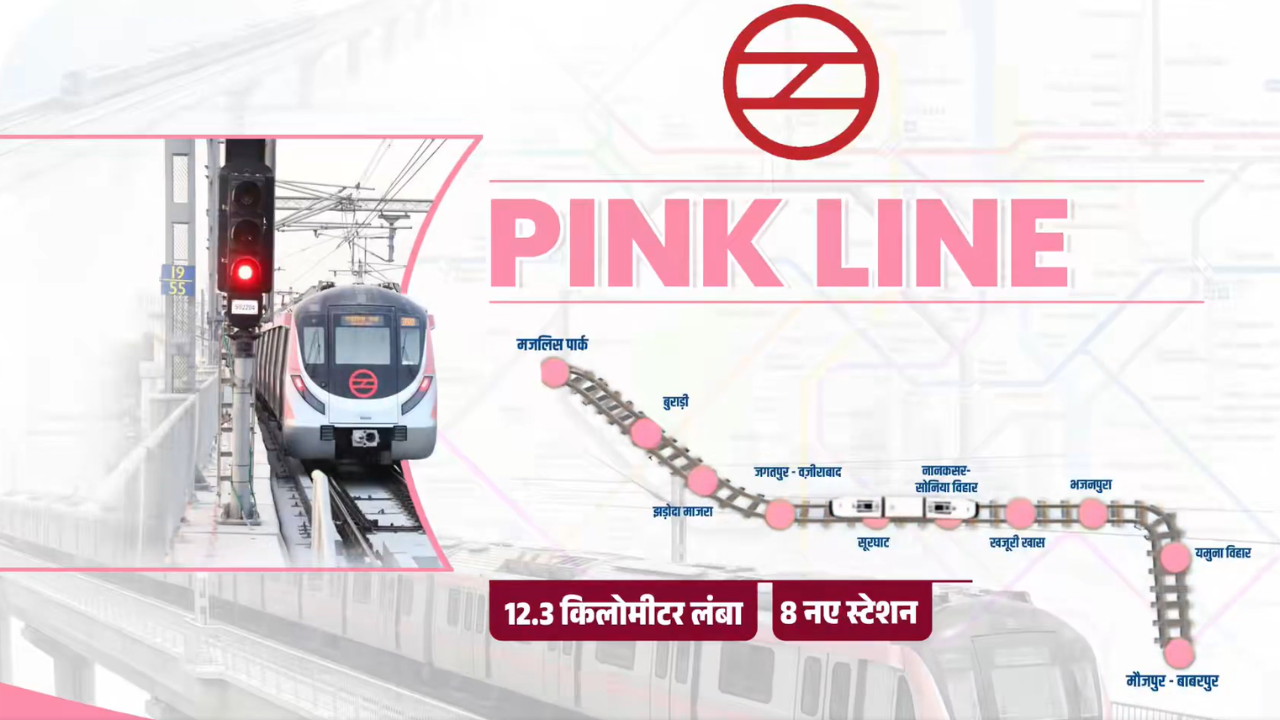
Majlis Park–Maujpur Babarpur corridor (Pink Line)

Pink Line

PM Modi will inaugurate the Majlis Park to Maujpur-Babarpur stretch of the Pink Line, which spans around 12.3 kilometres and includes eight elevated stations. With the addition of this section, the Pink Line will extend to about 71.56 kilometres, making Delhi home to the country’s first fully operational Ring Metro. Stations along the corridor are Majlis Park, Burari, Jharoda Majra, Jagatpur-Wazirabad, Soorghat, Nanaksar-Sonia Vihar, Khajuri Khas, Bhajanpura, Yamuna Vihar and Maujpur-Babarpur.The project also includes the construction of a new bridge across the Yamuna River and a double-decker viaduct that will carry both a metro track and a road flyover.

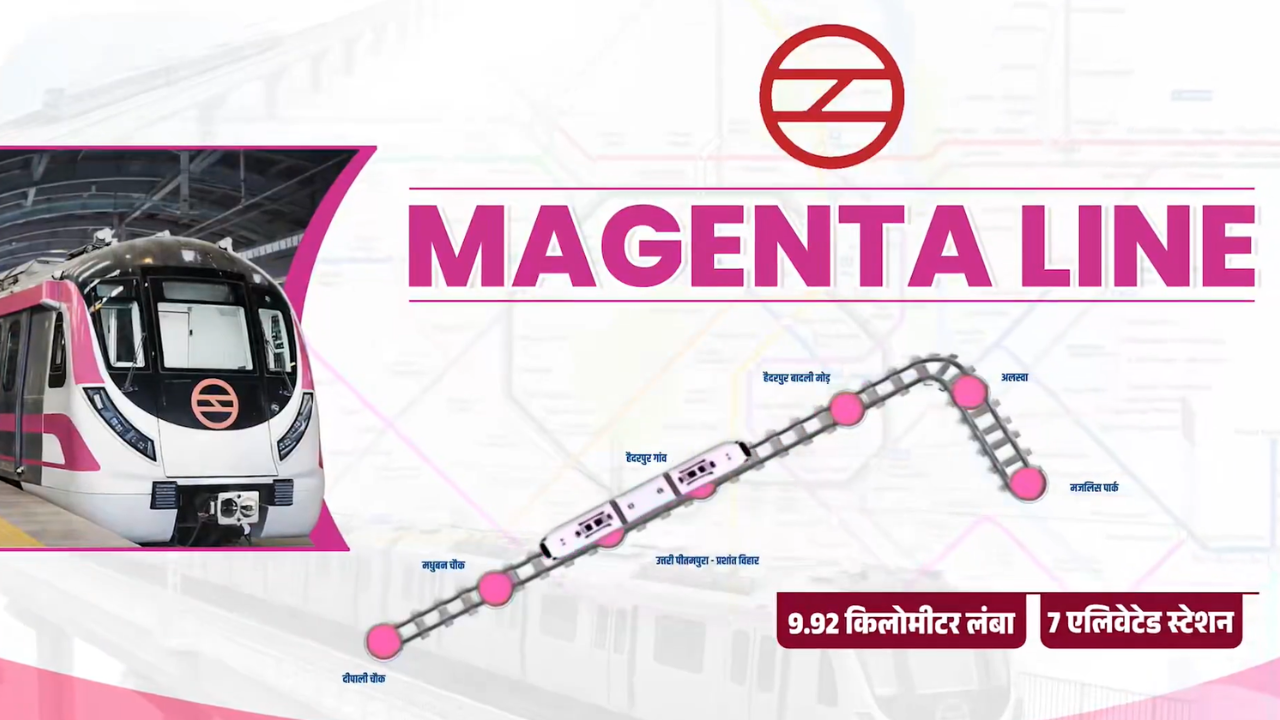
Deepali Chowk–Majlis Park corridor (Magenta Line)

Magenta Line

The second section to be inaugurated is the Deepali Chowk to Majlis Park stretch of the Magenta Line, which is about 9.9 kilometres long.The new link will enhance connectivity for areas such as Madhuban Chowk, Haiderpur Badli Mor, Bhalaswa and Majlis Park, strengthening the overall transport network in northern parts of the city.Talking about the corridor, CM Rekha Gupta said, “These metro corridors are also significant achievements from an engineering perspective. A portion of the Deepali Chowk–Majlis Park corridor reaches a height of approximately 28.36 metres, making it one of the highest elevated sections in the Delhi Metro network.”

New metro corridors under Phase V-A

Alongside the inauguration of the two corridors, PM Modi will also lay the foundation stone for three new routes under Phase V-A of the Delhi Metro, covering a combined route length of around 16.10 kilometres. The proposed corridors include:

  • Central Vista Corridor connecting R.K. Ashram Marg to Indraprastha
  • Golden Line extension from Aerocity to Indira Gandhi Airport Terminal 1
  • Golden Line extension from Tughlakabad to Kalindi Kunj

Officials said that these new routes will improve connectivity to key locations across the capital and facilitate travel for commuters moving between Noida, South Delhi and the airport.

GPRA redevelopment projects

Before the programme, the PM will visit the GPRA Type-5 quarters at Sarojini Nagar and hand over keys to female allottees. He will also inaugurate and lay the foundation stone for projects worth Rs 15,200 crore under the General Pool Residential Accommodation (GPRA) Redevelopment Plan. The projects are being implemented at Sarojini Nagar, Netaji Nagar, Kasturba Nagar and Sriniwaspuri as part of a broader effort to modernise government housing colonies and develop improved infrastructure for government employees and administrative offices.The redevelopment is being carried out through a self-sustainable financial model under which a limited portion of the project area is being developed and monetised for commercial and residential use to finance the overall redevelopment.Once completed, the plan will provide more than 9,350 modern flats for government employees and create about 48 lakh square feet of office space, aimed at enhancing administrative efficiency while also generating monetisation potential.


Source link

How the ‘funniest chart in tech right now’ shows how almost all analysts were ‘very wrong’ on Apple


How the 'funniest chart in tech right now' shows how almost all analysts were 'very wrong' on Apple

A chart from A16Z titled “Apple on Capex: ‘Nah, we’re good'” might be the most humbling visual Wall Street has seen in a while. Sourced from FactSet data as of February 9, 2026, it shows Apple’s quarterly capex sitting nearly flat since 2016—down 19% year-over-year—while Amazon (+42%), Microsoft (+89%), Alphabet (+95%), and Meta (+48%) have each rocketed into the $20–40 billion-per-quarter range. Together, these four hyperscalers are on track to spend roughly $635–700 billion on capex in 2026, most of it poured into AI data centres and GPU clusters. Apple’s projected budget for the entire year? A little over $14 billion—essentially flat year-over-year.The chart’s been called “the funniest in tech right now.” But the real joke landed on the analysts who spent two years calling Apple’s restraint a strategic disaster.

The consensus got Apple’s AI playbook backwards

Through 2024 and into mid-2025, the conventional narrative was that Apple was losing the AI race. Siri delays, no proprietary frontier model, and zero appetite for warehouse-scale GPU buildouts drew downgrades and warnings that the company was one to two years behind competitors. Apple’s Q4 2025 capex actually dropped 17% to just $2.4 billion—a rounding error next to what peers were burning per quarter.What analysts missed was that Apple wasn’t sitting out the AI era. It was building for a different version of it. The M-series unified memory architecture—optimised for edge inference since the M1 launched in 2020—turns out to be exactly what on-device AI needs. An OpenClaw-fuelled ordering frenzy has created genuine Mac shortages, with high unified memory Mac Studio orders now stretching to 54-day wait times. The new M5 Max, with 128GB of unified memory and 614GB/s bandwidth, runs a Llama 70B model quantized to Q6 entirely on a laptop—no data centre in sight. Early benchmarks show it hitting 30 tokens per second on Llama 70B, outperforming clusters that cost $40,000 just eighteen months ago.Apple also struck a deal to use Google’s Gemini to power the next generation of Siri and Apple Intelligence—reportedly worth about $1 billion a year. That’s access to a top-tier model for pennies on the dollar compared to building one from scratch.

The balance sheet tells the rest of the story

Apple posted record Q1 fiscal 2026 revenue of $143.8 billion, up 16% year-over-year, with diluted EPS of $2.84—a 19% jump. It held $145 billion in cash and returned $32 billion to shareholders in a single quarter. The hyperscalers, meanwhile, had a rougher time. Amazon, Google, and Microsoft saw a combined $900 billion in market value erased after earnings reports, as investors grew uneasy about the gap between AI spending and actual returns.Whether Apple’s spending gap represents a failure of vision or an exercise of it depends on a question nobody can answer yet: will AI models become interchangeable commodities? Apple appears to be betting they will. If it’s right, the flattest line on the graph was the smartest one all along.


Source link

From oil to rice, here’s how Middle East crisis may spread across global economy


From oil to rice, here's how Middle East crisis may spread across global economy

The Middle East conflict is entering another week, and its ripple effects are already being felt across the global economy. As tensions intensify, trade flows, energy supplies and food production are coming under strain at a time when markets already spent the last year grappling with tariffs and other disruptions.Although the latest escalation began just a week ago, early signs of pressure are already emerging across global trade networks. Shipments of crucial commodities have been delayed, shipping routes disrupted and prices of critical inputs have spiked. According to economists cited by CNN, the ultimate economic damage will depend on how long the conflict continues.

‘India Were Good Actors’: Bessent’s Oil Waiver Remark Triggers Cong’s ‘Humiliation’ Attack On Modi

Before the United States and Israel carried out attacks on Iran over the weekend, the International Monetary Fund had projected global economic growth of 3.3% this year. The IMF has not yet revised this forecast, saying it is still “too early” to determine the full impact. However, the institution said it is “closely monitoring developments” and warned of several potential risks to the world economy, including further trade disruptions, “surges in energy prices” and “volatility in financial markets”.Dan Katz, deputy managing director at the IMF, said that the expanding conflict could have broad consequences, noting that it could be “very impactful on the global economy across a range of metrics,” including inflation and economic growth.Key ways the conflict could impact the global economyBased on early developments and industry assessments, the war could affect the global economy through several major channels:

1. Rising energy prices

Energy markets are at the centre of the economic risks. Concerns about supply disruptions have pushed Brent crude, the global oil benchmark, to its highest levels in more than 18 months.A major worry is the potential disruption of the Strait of Hormuz, a narrow waterway between Iran and Oman that serves as a vital route for global energy shipments. According to the US Energy Information Administration, around one-fifth of the world’s daily oil and liquefied natural gas production passes through this corridor.If the route becomes effectively impassable, the consequences for energy markets could be severe. Goldman Sachs estimates that European benchmark natural gas futures could more than double from levels seen before the conflict if shipments through the strait are halted for more than two months.Higher energy prices would likely feed into broader inflation across economies.In Europe, consumer inflation, which stood at 2% in January, could rise by more than one percentage point if the conflict lasts several months, according to Holger Schmieding, chief economist at Berenberg bank, as cited by CNN. In that scenario, economic growth in the European Union could also be reduced by up to half a percentage point.Fuel costs are already increasing. Germany has seen double-digit rises in petrol and diesel prices over the past week, according to the country’s largest automobile association, ADAC. Petrol prices have also risen in the United Kingdom, while in the United States they have climbed to their highest level in 11 months.Goldman Sachs estimates that if oil prices remain at current levels for several months, US consumer inflation could rise from 2.4% in January to 3% by the end of the year. That would make it harder for the Federal Reserve to cut interest rates.

2. Greater vulnerability for Asian economies

Asian economies may be particularly exposed to energy shocks linked to the conflict. Consultancy Capital Economics estimates that between 80% and 90% of the crude oil and liquefied natural gas transported through the Strait of Hormuz is headed for Asia.China is among the largest buyers of these supplies. The conflict comes at a sensitive moment for the country, which has recently set its lowest economic growth target in decades.Capital Economics said the attacks on Iran could push inflation higher across Asia. “Most economies in Asia are worse off and facing higher inflation as a result of the attacks on Iran,” the firm’s economists wrote in a note Tuesday.They added that inflation could increase by around half a percentage point in many Asian countries if Brent crude prices remain at their current levels.

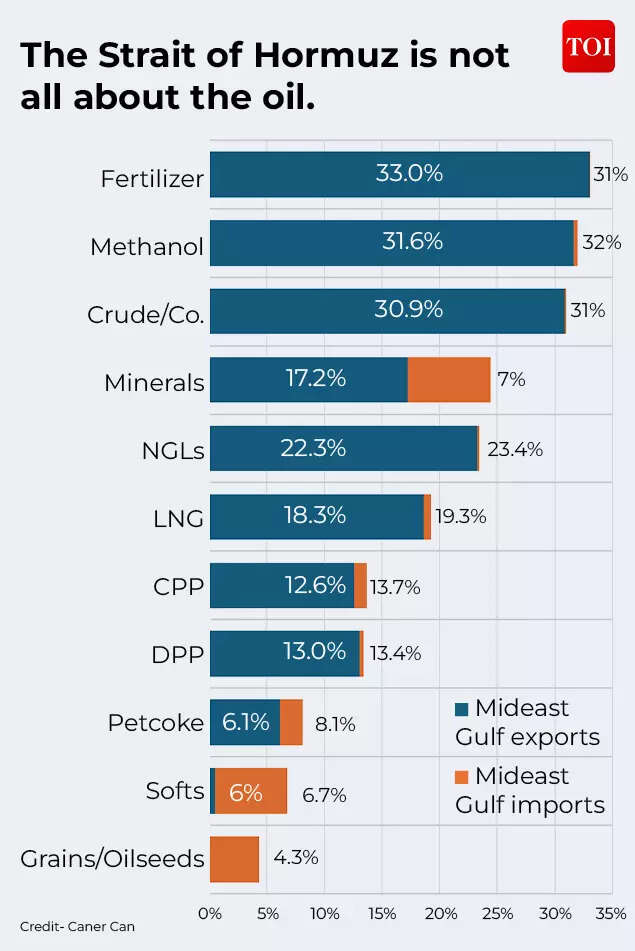
The Strait of Hormuz is not all about the oil.

3. Disruption to exports and global trade

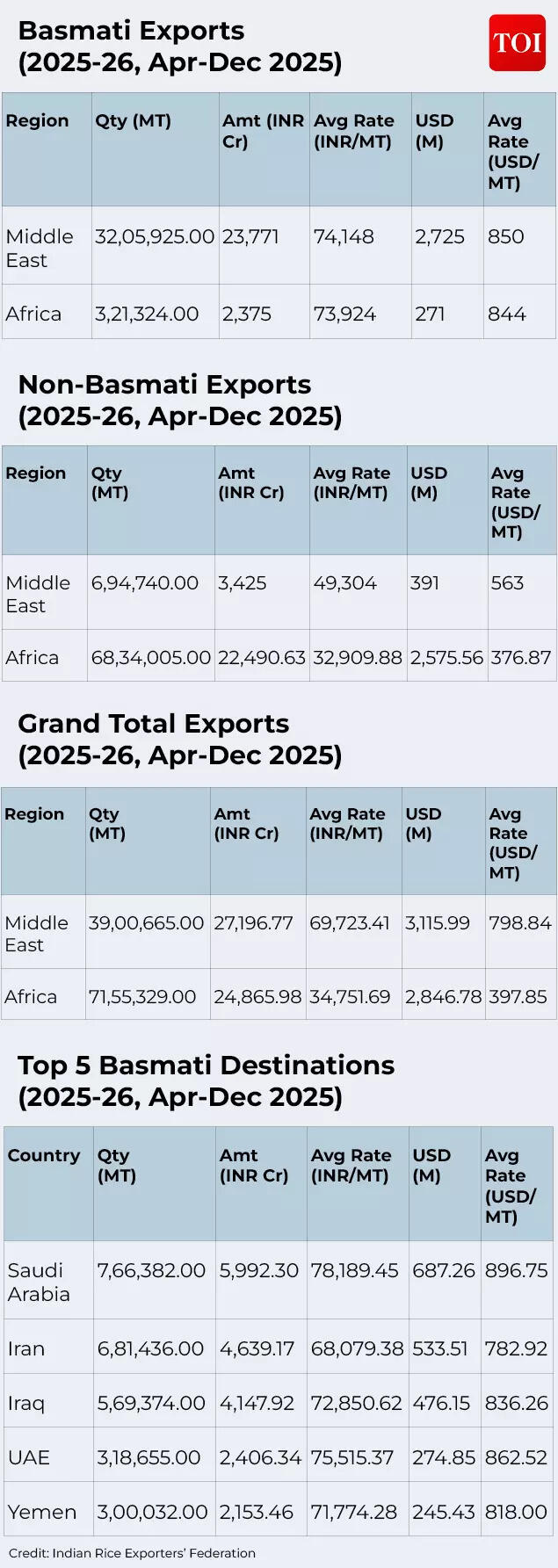
Trade flows are also starting to feel the impact of the conflict. Shipping disruptions across the Middle East have already begun affecting exports.India is one of the countries facing consequences with more than 400,000 metric tons of basmati rice grown in the country for export currently stuck at ports or in transit, because shipping routes through the region have been disrupted.According to Satish Goel, president of the All India Rice Exporters’ Association, around 75% of India’s annual basmati rice exports, roughly 6 million tons, are shipped to the Middle East.The region has become an important export destination for Asian economies that have faced higher tariffs from the United States. Deepali Bhargava, head of Asia-Pacific research at ING, said that if the conflict continues, exporters in India and China could suffer the most.

Basmati exports

4. Pressure on fertiliser supply and food production

Another critical concern is the impact on fertiliser supplies, a key component of global food production.Svein Tore Holsether, CEO of Norwegian chemical company Yara International, warned that the Strait of Hormuz is crucial for the fertiliser trade.“The Strait of Hormuz is essential for global food production,” he told CNN.Holsether noted that around one-third of the world’s urea exports, one of the most widely used fertilisers, pass through the strait. Significant volumes of other raw materials used in fertiliser production also move through the same route.“Fertilizers are not just another commodity – nearly half of global food production depends on them.”Prices are already reacting. Egyptian urea prices, a key benchmark, have surged 35% this week, according to data provider CRU Group. Prices of sulphur, another ingredient used in fertiliser production, have also risen sharply. Nearly half of global sulphur trade originates from Middle Eastern countries.

5. Shipping congestion and supply chain delays

Shipping networks are also beginning to experience disruptions.Containers bound for the Middle East are starting to accumulate at Indian ports after several major shipping companies suspended services to the region, according to Judah Levine, head of research at logistics firm Freightos.If the situation continues, container shortages and reduced shipping capacity could spread to other markets.Shipping analytics company Xeneta warned that the conflict is creating immediate uncertainty for logistics networks. “Escalating conflict in the Middle East is creating immediate uncertainty for supply chains, with vessel movements changing by the hour and shippers left managing cargo that may no longer reach its intended ports.”

6. Impact on air cargo and global trade flows

Air freight operations are also facing disruption. Many aircraft have been grounded in the Middle East while airspace across parts of the region has been heavily restricted.Sportswear company Adidas has already warned that some shipments transported by air freight may face delays.Middle Eastern carriers such as Emirates, Qatar Airways and Etihad together account for about 13% of global air cargo capacity, according to Freightos.Air freight plays a major role in global trade. The International Air Transport Association estimates that it carries roughly one-third of global trade by value, including high-value goods such as smartphones, microchips and electronics.With vessel routes shifting, shipments stalled and airspace restricted, the ongoing conflict is beginning to test the resilience of global supply chains, and the longer the disruption continues, the wider its economic effects could become.




Source link

‘Decimated their whole evil empire’: Is US responsible for Iran school bombing that killed 160? What Trump said


‘Decimated their whole evil empire’: Is US responsible for Iran school bombing that killed 160? What Trump said

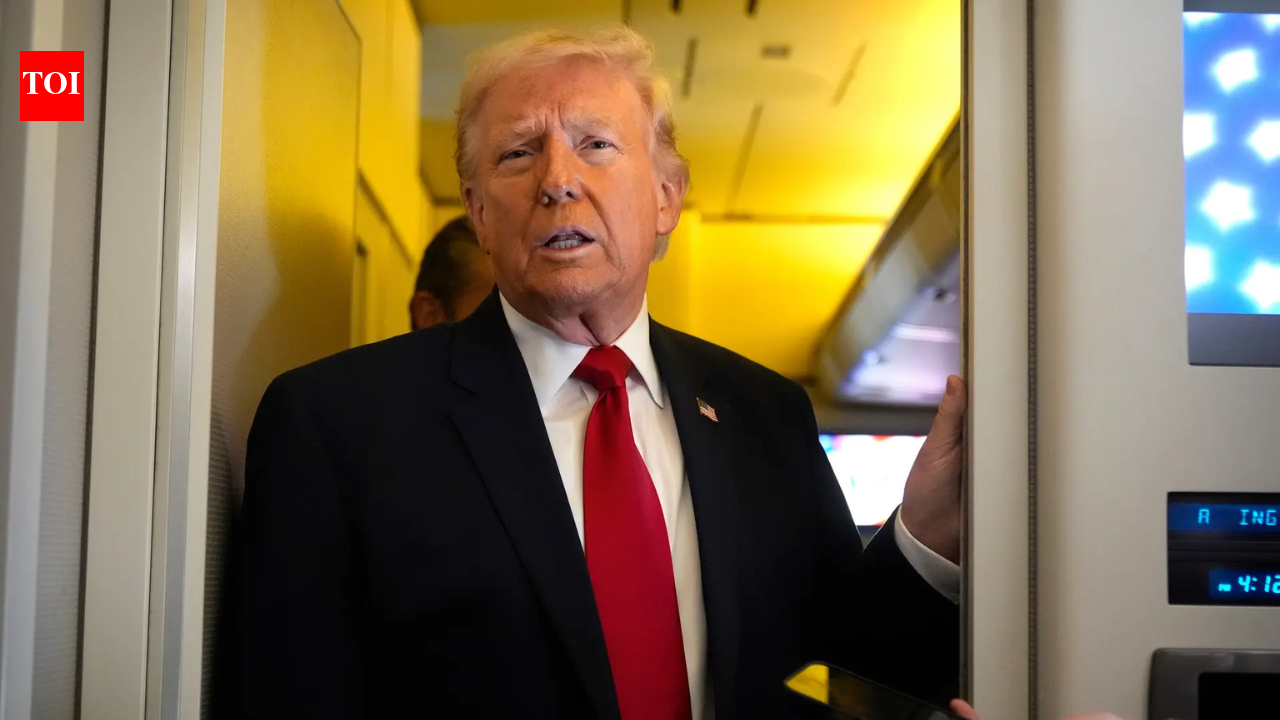
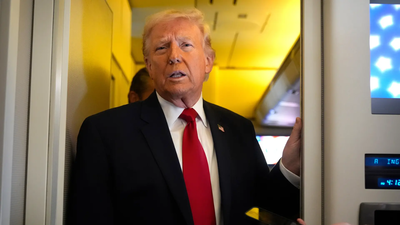
US President Donald Trump on Saturday claimed that the United States had eliminated the entire leadership in Iran, describing the actions as removing a major “cancer” from the face of the earth.Trump made the remarks aboard Air Force One while en route to Miami. Reflecting on the week-long conflict, he asserted, “We’re winning the war by a lot. We’ve decimated their whole evil empire. It’ll continue I’m sure for a little while…The war itself is going unbelievably. It’s as good as it can be.”He detailed the military achievements of the US in the conflict, saying, “We’ve wiped out their (Iranian) navy, 44 ships. We’ve wiped out their air force, every plane. We’ve wiped out most of their missiles. You see the missiles aren’t coming much anymore. We’ve also hit their manufacturing areas where they make the missiles very hard. Their drone capacity is way down and we’ve hurt them where it hurts, including about every form of leadership you can have we’ve wiped out.When asked about allegations that the US bombed an elementary girls’ school in Iran, Trump flatly denied responsibility and blamed Iran, saying, “No, I don’t believe so. Based on what I’ve seen that was done by Iran. We think it was done by Iran because they’re very inaccurate as you know with their munitions. They have no accuracy whatsoever. It was done by Iran.”On the projected six-week timeline for military operations, Trump said, “I never project time, whatever it takes. But the (Iranian) military is almost nonexistent. We could hit their military itself very hard but maybe we will, maybe we won’t, we haven’t made that determination.”He added, “We’ve hit the manufacturing very hard. They’re at about nine per cent of what they sent out in the first two days and we think that’s because they don’t have that much. We’ve also knocked out about 70 per cent of the rockets of the launchers. The launchers are a big deal, very hard to get, very expensive.”Regarding the possibility of a diplomatic resolution, US Special Envoy Steve Witkoff, who was also on Air Force One, said a deal is possible. He said, “I think there is. I think that’s going to be up to the President, that’s what I think. But they didn’t seem to be very amenable in that first set of negotiations. You heard what I said. They said we have the inalienable right to enrich. They bragged about having 60 percent enriched fuel enough for 11 bombs. And they told me and Jared, we’re not going to give you diplomatically what you couldn’t take militarily. So you know I think they’re going to need a change of attitude.”These developments follow the joint US-Israel military strike on February 28 that killed Iran’s Supreme Leader Ayatollah Ali Khamenei and other senior figures. In response, Iran launched ballistic missiles and drones at US assets and regional allies, including Israel, Bahrain, Kuwait, Qatar, Saudi Arabia, the United Arab Emirates, and Jordan, escalating tensions across West Asia and increasing risks for civilians and expatriates.


Source link

China asserts need for more power as Donald Trump embraces war


China asserts need for more power as Donald Trump embraces war
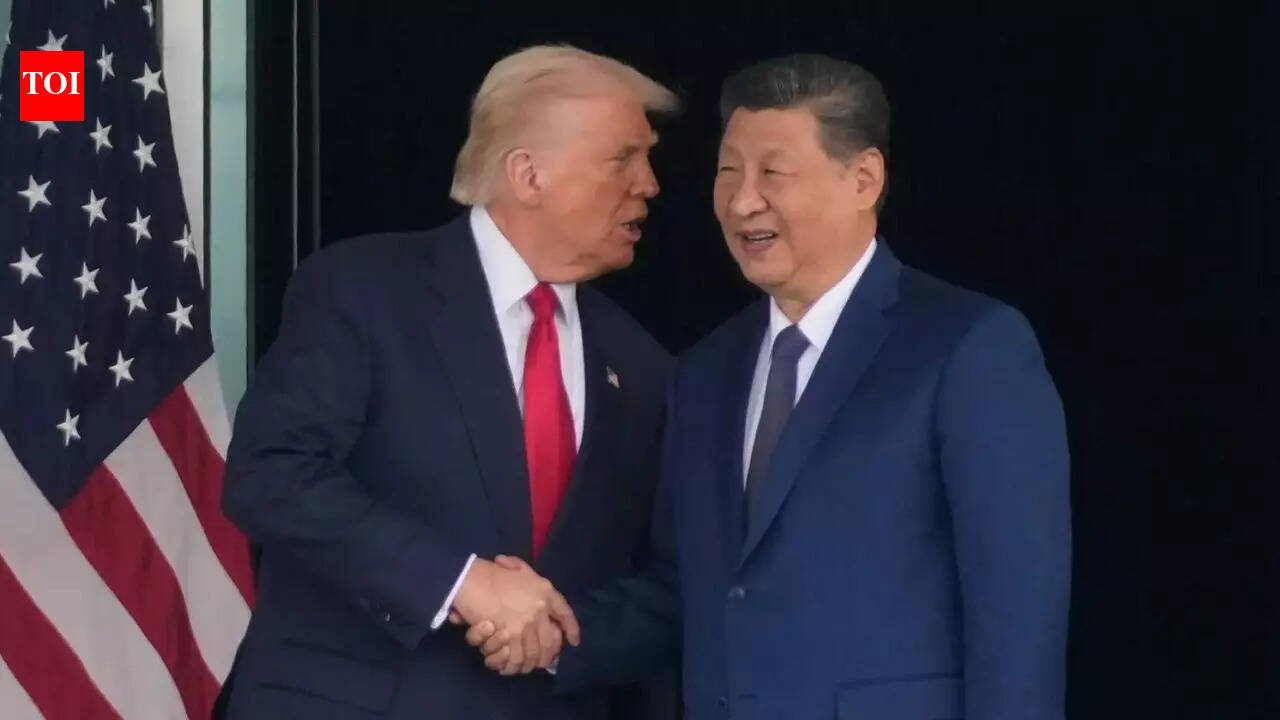
File photo: US President Donald Trump with Chinese President Xi Jinping

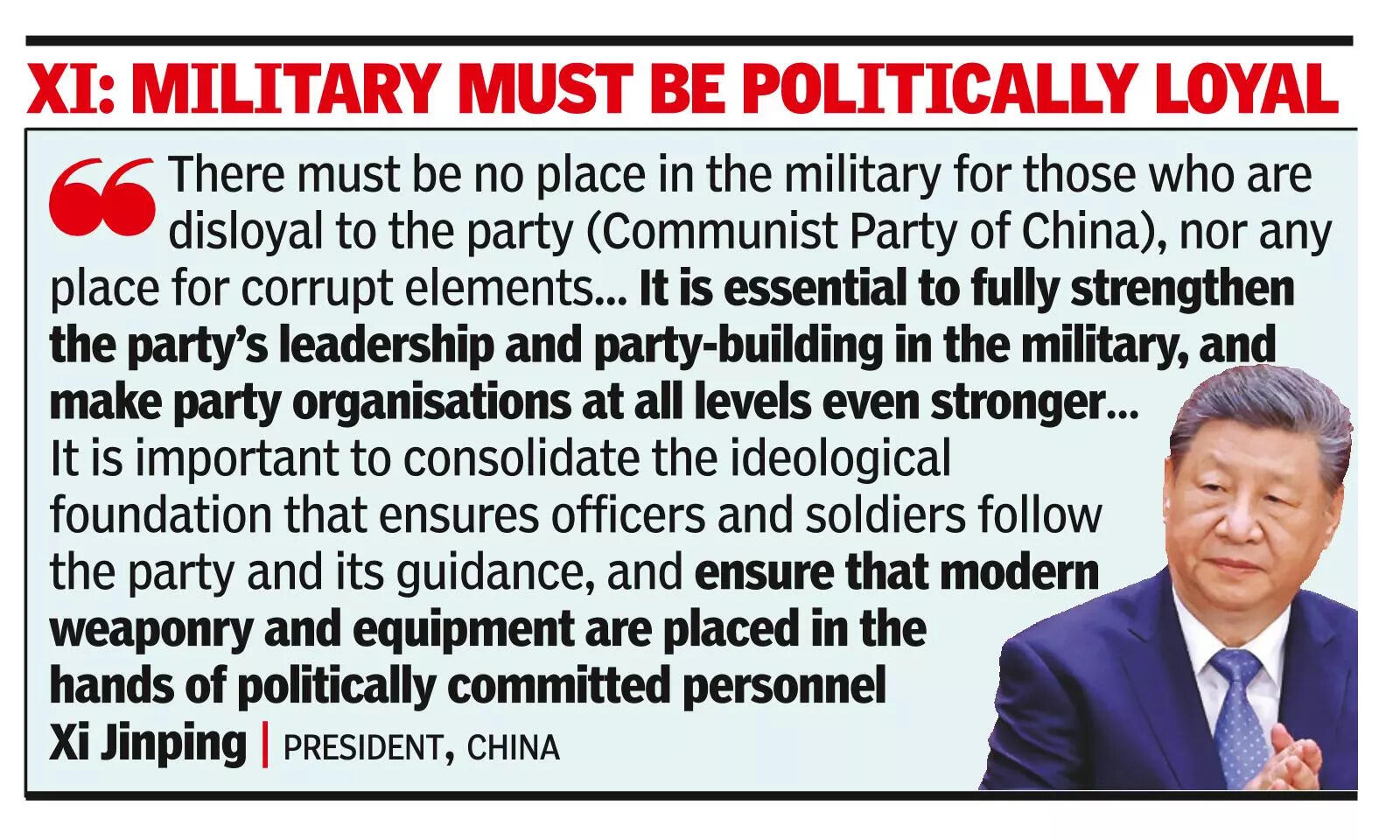
Chinese analysts and officials do not believe the US would target Xi in the same way it did with Khamenei, given China’s status as a nuclear power. But Trump’s embrace of war as a tool to assert American dominance has nonetheless reaffirmed Beijing’s view that the United States remains China’s most enduring threat. China’s military posted a graphic on social media past week listing five lessons from the strikes on Iran. One of it was the importance of “superior firepower,” which echoes Xi’s mantra.

China asserts need for more power as Trump embraces war

It also listed the need for “self-reliance,” most likely a reference to China’s bid to reduce its dependence on other countries for critical inputs like energy and defence production. One pointer says China must guard against “the enemy within,” an apparent catchall to describe Beijing’s long-standing fear of foreign spying and any efforts to foment “colour revolutions” to overthrow govt Last month, the CIA released a new video aimed at recruiting spies within China’s military, hoping to exploit a sweeping anti-corruption campaign by Xi that has purged numerous senior commanders. One of the broadest takeaways being discussed in China is to not be lulled into a false sense of security by entering negotiations with Washington. That the first US-Israeli bombs fell on Iran when the parties were still supposed to be in talks struck Beijing as duplicitous and an abuse of US power. nyt


Source link

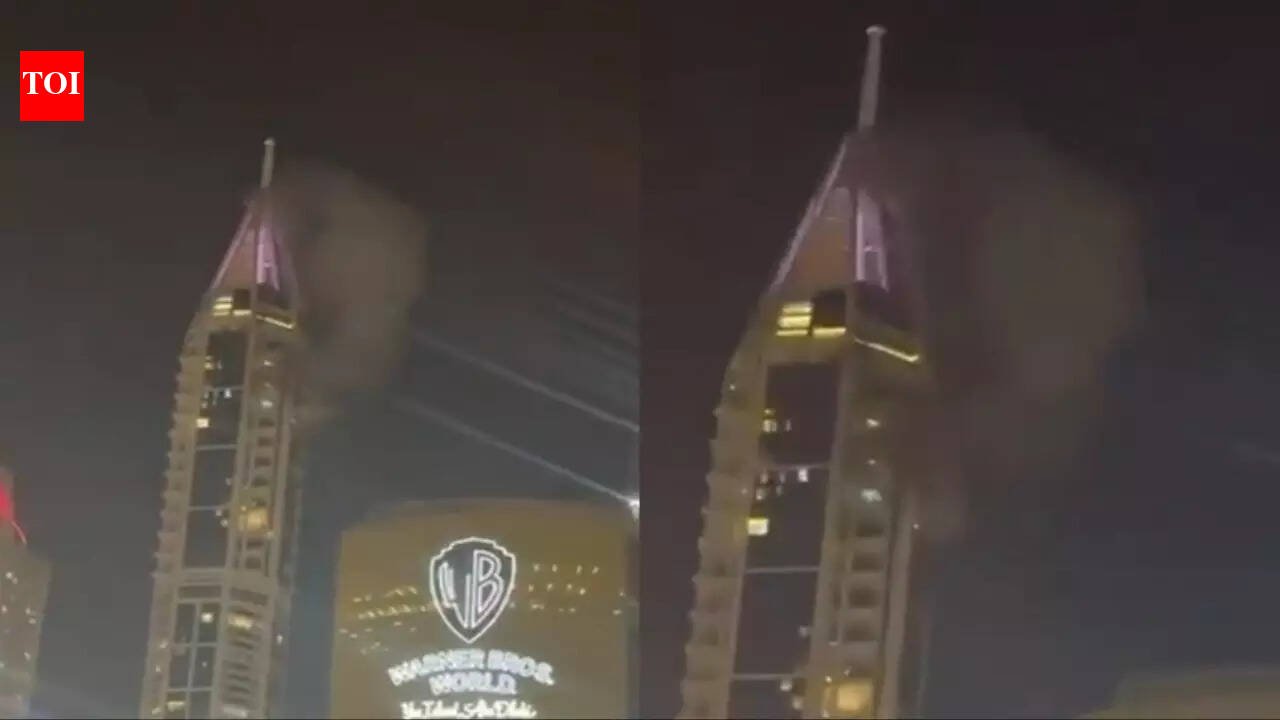
Explosion scare in Dubai Marina: UAE emirate confirms tower hit by falling debris from aerial interception amid Iran and US-Israel clashes


Explosion scare in Dubai Marina: UAE emirate confirms tower hit by falling debris from aerial interception amid Iran and US-Israel clashes
Dubai Confirms Dubai Marina Incident Was Caused by Aerial Interception: What Really Happened In The UAE Emirate

Dubai authorities have confirmed that the recent incident in the Dubai Marina area was caused by debris from a successful aerial interception, reassuring residents that the situation has been contained and that public safety remains intact. The event occurred amid rising regional tensions linked to the ongoing conflict involving Iran, the United States and Israel, which has led to missile and drone activity across parts of the Middle East that host US military bases.While the incident sparked concern after videos of smoke and damage circulated on social media, officials emphasised that it was a minor incident caused by falling debris rather than a direct attack on the city. The clarification has helped calm fears in one of Dubai’s busiest residential and tourist districts.

What happened in Dubai Marina

According to the Dubai Media Office, debris from a projectile that had been successfully intercepted by air defence systems struck the façade of a tower in Dubai Marina. Authorities confirmed that emergency teams responded quickly and secured the area. Officials said the incident was limited in scale and no injuries were reported at the tower, with the damage mainly affecting the building’s exterior.Dubai Marina is one of the emirate’s most densely populated neighbourhoods, home to luxury residential towers, hotels and popular waterfront attractions. Due to its visibility and international profile, even a small incident there quickly drew attention online and in international media. Authorities stressed that the situation was brought under control rapidly and that residents could resume normal activities.The incident did not occur in isolation. It comes during an ongoing wave of missile and drone attacks linked to the escalating Iran-US-Israel conflict, which has spilled into several Gulf states. Since the conflict intensified in late February 2026, the UAE’s air defence systems have intercepted hundreds of drones and missiles, preventing most of them from reaching populated areas. However, fragments from intercepted projectiles sometimes fall back to the ground, creating secondary risks.Experts say this is a common challenge during missile interceptions. When defence systems destroy incoming threats in mid-air, pieces of debris can scatter over wide areas before falling to the ground. In this case, authorities say that the debris that struck the building in Dubai Marina was the result of one such interception.

Dubai air defence and public safety measures

The UAE’s Ministry of Defence has been actively responding to incoming threats using a network of advanced air defence systems designed to detect and intercept missiles and drones. These systems include radar detection, early-warning alerts, and interceptor missiles that destroy incoming projectiles before they reach their targets.Authorities have also taken additional precautionary steps during the conflict, including:

  • Issuing public safety alerts warning residents of potential missile threats
  • Temporarily closing airspace during active interceptions
  • Deploying emergency response teams across key areas
  • Monitoring critical infrastructure such as airports, ports and residential zones

During the recent event, residents across parts of the UAE reportedly received mobile alerts advising them to seek shelter temporarily while interceptions were underway. Shortly afterward, officials issued an “all clear” message confirming that the situation was safe.

Why interception debris can still cause damage

Even when air defence systems work as intended, interceptions can still create risks for civilians. When a missile or drone is destroyed in the air, it breaks apart into fragments. These fragments can include:

  • Pieces of the missile body
  • Fuel tanks
  • Electronics and guidance systems
  • Fragments of the interceptor missile itself

Depending on the altitude of the interception, these fragments may fall back to the ground across a wide radius. Military analysts note that this phenomenon has been seen in several conflicts worldwide, including missile defence operations in Israel, Ukraine and Saudi Arabia. In many cases, the debris causes limited structural damage but can still pose dangers to people and vehicles on the ground.

Dubai’s rapid emergency response

Authorities credit the quick containment of the Dubai Marina incident to the emirate’s well-developed emergency response infrastructure. Emergency teams including Dubai Civil Defence, police units, and medical responders were dispatched immediately after reports of the incident emerged.Their responsibilities included securing the affected building, assessing structural damage, assisting residents if evacuation was necessary and ensuring that no unexploded debris remained. Officials later confirmed that the damage was minor and that residents were safe.Videos and photos from the scene spread rapidly on social media, showing smoke rising from a tower in Dubai Marina. These images led to speculation that the city had been directly targeted. However, authorities quickly clarified the situation, explaining that the damage resulted from interception debris rather than a successful strike.The Dubai Media Office urged residents and media outlets to rely on official sources for accurate information, particularly during periods of heightened regional tensions. Misinformation during security incidents can spread quickly online, sometimes causing unnecessary panic.

The bigger picture: Gulf security during Iran and US-Israel conflict

The Dubai Marina incident reflects the broader security challenges facing Gulf countries during the current regional crisis. Since the escalation began, several countries in the region, including the UAE, Qatar and Bahrain, have reported missile or drone threats linked to the Iran-Israel-US conflict. Many of these attacks have targeted military facilities or strategic infrastructure but defence systems have intercepted the majority before impact.According to official figures, hundreds of drones and missiles have been intercepted over the UAE since the conflict began, significantly limiting the potential damage. However, the falling debris from interceptions remains an unavoidable risk in densely populated urban environments.Security analysts say that the next situation will depend largely on how the wider conflict evolves in the coming weeks. If tensions escalate further, Gulf states may continue to strengthen air defence readiness, early-warning systems and coordination with allied defence forces. At the same time, authorities are likely to continue issuing public safety alerts whenever interception operations occur.For now, officials in Dubai stress that the city remains safe and that the recent Dubai Marina incident was quickly controlled and limited in scope.


Source link

Seismic map rollback hits quake readiness: Experts | India News


DEHRADUN: Union govt’s decision to roll back India’s newly introduced seismic zonation map and revised earthquake design code has triggered concern among seismologists and geologists, many of whom said the move could weaken the country’s preparedness for a future major earthquake.The revised framework, introduced in Nov 2025 by Bureau of Indian Standards (BIS), proposed significant updates to India’s seismic design norms, including placing the entire Himalayan arc under a new Zone VI – the highest seismic risk category.

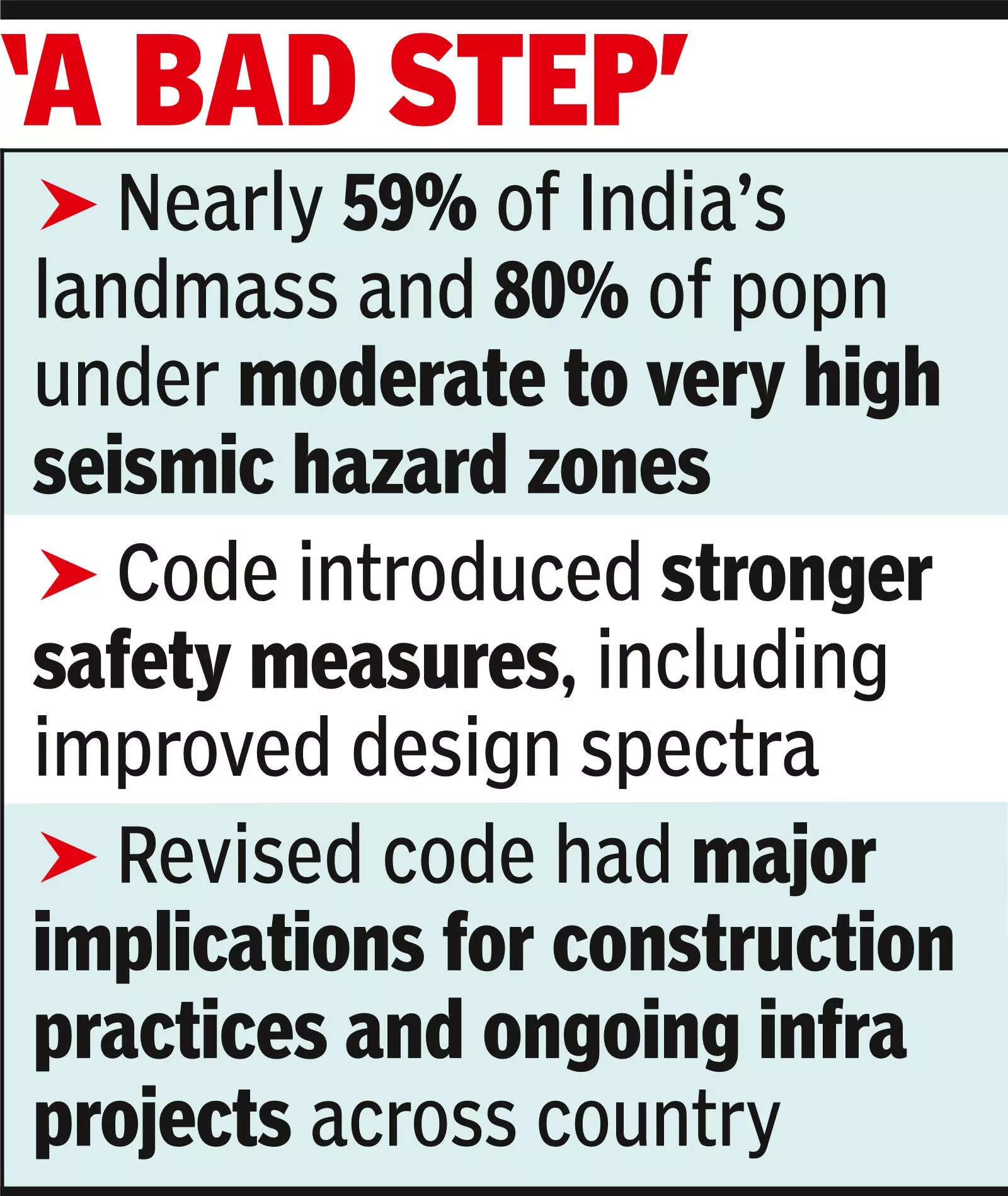
'A bad step'

India’s seismic risk far from marginal, warn geologistsSeveral experts described the withdrawal as “a missed opportunity to strengthen India’s disaster resilience”, particularly in regions that scientists long warned could experience a devastating earthquake.Senior geoscientist CP Rajendran termed the rollback a “bad step”. “We don’t know what triggered the govt to roll back such a bold policy. The new seismic code was based on the knowledge the scientific community had accumulated about earthquakes and its possible impact on India,” he said.Rajendran added that scientists repeatedly warned that the Himalayan region could witness a magnitude eight or a larger quake in future. “New code was a reflection of the real earthquake risks the country faces,” Rajendran said.Geologists pointed out that India’s seismic risk was far from marginal. According to experts, nearly 59% of the country’s landmass and nearly 80% of the population fell under moderate to very high seismic hazard zones.Piyoosh Rautela, geologist and former executive director of Uttarakhand State Disaster Management Authority, said the proposed revisions to the code represented a major step forward in improving the country’s preparedness.“The proposed revisions marked a major step in strengthening India’s seismic design framework to better protect the country’s built environment from future earthquakes,” Rautela said. He added that the newly- proposed Zone VI covering the Himalayan arc acknowledged the persistent tectonic threat along the Indo-Eurasian plate boundary — similar to the earthquakes seen during the 2001 Bhuj and 2015 Nepal earthquakes.Experts further said the revised code introduced stronger safety measures, including improved design spectra, a 10-30% increase in base shear requirements, stricter rules for structural irregularities, and more rigorous geotechnical and dynamic analyses. These changes aimed to promote performance-based engineering — ensuring buildings were designed not only to survive shaking, but also to minimise collapse risks and economic losses during large quakes.At the same time, experts acknowledged that the revised code had major implications for construction practices and ongoing infrastructure projects across the country.


Source link