Breaking News
I don’t use mobile, internet for day-to-day work: NSA | India News


I don't use mobile, internet for day-to-day work: NSA

NEW DELHI: National security adviser Ajit Doval, widely referred to as India’s ‘spymaster or James Bond’, has revealed that he does not use a mobile-phone or internet in his day-to-day work. When asked if he used mobile or internet for routine work, the NSA replied, “It is true that I do not use internet. I also do not use a phone, except for family matters or for speaking to people in other countries, which is necessary. I manage my work that way. There are many other means of communication as well, and some additional methods have to be arranged that people are not aware of.” He said this while addressing the inaugural session of Viksit Bharat Young Leaders Dialogue 2026 at Bharat Mandapam here Saturday. Doval, who has been NSA since 2014, said it is important to take the right and farsighted decisions at the utmost time, particularly for the youth. However, the former IB director advised it is important to think about what “the next two steps will be before a person takes the first step”. He said India needs to strengthen itself as “we had a painful history of attacks and subjugation”. “We were a very advanced civilisation. We never broke anyone’s temples. We did not attack any foreigners, even when the rest of the world was weak, we did not understand the threats to our security. And, so history taught us a lesson. It is important that we remember that lesson because if the youth forget it, then it would be tragic for the country,” the NSA said. “Revenge is not a good word, but it can be a huge force. We have to avenge our history and take this country to the point where it is great again not just in terms of border security, but economy, social development, every aspect,” he said. The NSA spoke about the importance of decision-making in leadership and nation-building. “One common thing between when I was young and how I am today is the ability to make decisions. Whether you realise it or not, decision-making always walks with you. Youth take small and big decisions in daily life, and as you grow, these small decisions add up to big ones,” he said. “Napoleon once said, ‘I am not afraid of 1,000 lions led by a sheep, but I am afraid of 1,000 sheep led by a lion’. That is how important leadership is,” he explained. Expressing confidence in India’s future, Doval said, “India will be developed. The level to which our country has been brought under PM Modi, it will soon achieve the goal of being a developed nation. The real question is – who will lead the nation towards that development? If you want to be leaders on the path of Viksit Bharat, you must start making decisions now, and those decisions should be taken with a forward-looking vision, not just for today but for the future.


Source link

North may remain in cold wave grip for 2 more days | India News


North may remain in cold wave grip for 2 more days
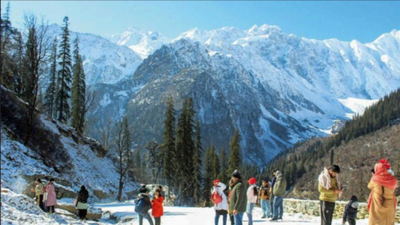
Tourists enjoy in the snow at south portal of Atal Tunnel in Himachal’s Rohtang. In the past 24 hours, minimum night temperatures were below 0°C at some places in the state and Jammu and Kashmir

NEW DELHI: Cold wave to severe cold wave conditions are very likely to continue in Delhi, Rajasthan, Punjab, Haryana, Himachal Pradesh and Uttarakhand for two more days (Jan 12-13), IMD said Sunday. The forecast and prevailing conditions in north India are in sync with the Met department’s earlier prediction about this winter witnessing four-five additional cold wave days, reports Vishwa Mohan. On Sunday, Pilani (east Rajasthan) was the coldest spot in the northern plains at 1.2 degrees C. IMD said cold wave conditions may continue in “isolated pockets” of north and northwest India on Jan 14 (Wednesday) and ease thereafter. It predicted “cold day” in isolated parts of Bihar till Jan 16. Dense fog is very likely to continue during morning hours over northwest India and Bihar for the next five days, it added.North, N-W India to see more coldwave days than normalD ense fog continuing during morning hours over the next few days means cold wave and foggy morning conditions may coincide with both Lohri and Makar Sankranti celebrations in most parts of north and northwest India, and parts of east India. The states in north and northwest India normally get four to six coldwave days from Dec to Feb, but this time the region is expected to get a total of eight to 11 such days, with the maximum number being reported in Jan. A coldwave is declared when the minimum (night) temperature of a meteorological station is 4°C or less in the plains and 0°C or less in hilly regions. Coldwave conditions can also be declared if temperatures are less than 10°C and below normal by at least 4.5°C. Releasing a forecast of minimum (night) temperatures, IMD said “no significant change” is likely over northwest India in the next three days, with a gradual rise of 2–3°C in the subsequent four days. However, it said, there may be gradual rise in minimum temperature of 2–3°C in Maharashtra over the next two days. There may not be significant change over the subsequent five days. During the past 24 hours (till 8.30am on Sunday), minimum (night) temperatures were below 0°C at many places in J&K, Ladakh, Gilgit, Baltistan, Muzaffarabad, a few places in Himachal Pradesh, and at isolated places in Uttarakhand. Minimum temperatures of 1–5°C were recorded at a few places in Punjab, Haryana, Chandigarh, Delhi and north Rajasthan, IMD said. On the other hand, minimum temperatures of 5–10°C were recorded at many places in Uttar Pradesh, Madhya Pradesh; a few places in Odisha, Bihar, east Rajasthan and Gujarat; and at isolated places in Chhattisgarh, Jharkhand, Odisha, West Bengal, Sikkim, Assam, Meghalaya and Maharashtra. Minimum temperatures were 3–6°C “below normal” over northwest India (south Punjab, south Haryana, Delhi, Rajasthan), northwest Telangana and adjoining Maharashtra on Sunday. Over the rest of the country, they were “near normal” during past 24 hours.


Source link

Why did a CM have to personally retrieve file, asks BJP | India News


Why did a CM have to personally retrieve file, asks BJP

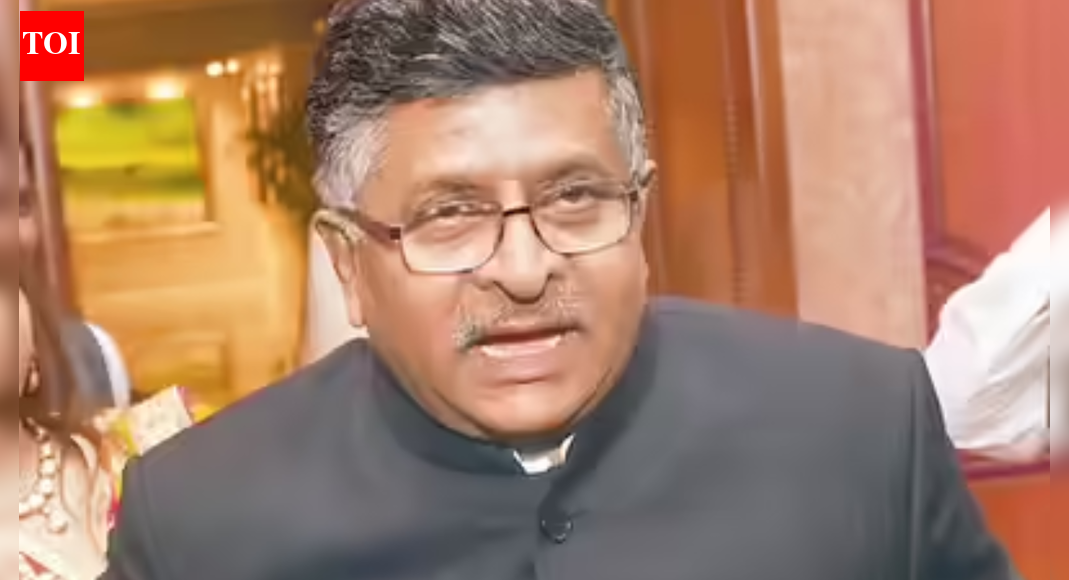
NEW DELHI: BJP on Sunday dismissed West Bengal CM Mamata Banerjee‘s contention that her dramatic intervention in the ED raids at I-PAC premises in Kolkata was in her capacity as TMC president, and suggested that her compulsion to remove evidence linking “coal scam” proceeds to her party might be the real reason. BJP Lok Sabha member Ravi Shankar Prasad also hit out at the state govt for the alleged attack on its Bengal leader Suvendu Adhikari’s convoy and said no FIR was registered despite BJP’s complaint. He said BJP functionaries have often been at the receiving end of such violence, often in the presence of state police. Slamming Banerjee, he said she was seen clutching a specific green file, which was removed during ED raids, and shrugged off her assertion that the central agency was looking to steal her party’s poll strategy, including the list of its probable candidates. “Why did a CM have to personally retrieve a file during a raid? What specific incriminating evidence was in that green file? Names of coal scam beneficiaries, the TMC leaders involved, the route of the hawala money, or the list of officers who facilitated the smuggling,” he asked. Prasad alleged that her “desperation” might be linked to the tunnelling of hawala money to fund her party’s campaign in the last Goa assembly polls.


Source link

Satellite-communication prompts search operation near international border in Jammu’s Kanachak | India News


Satellite-communication prompts search operation near international border in Jammu’s Kanachak

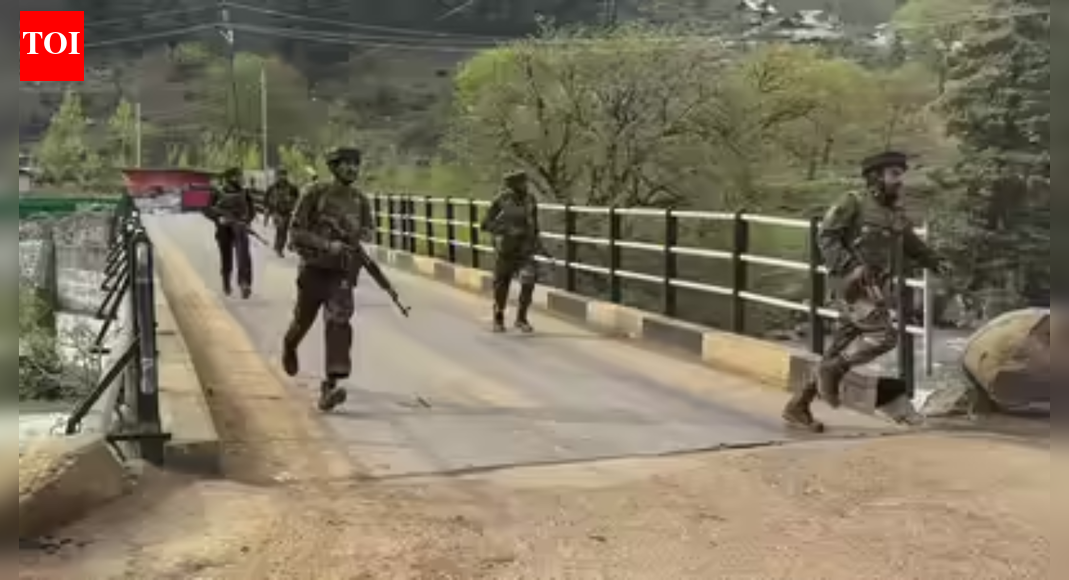
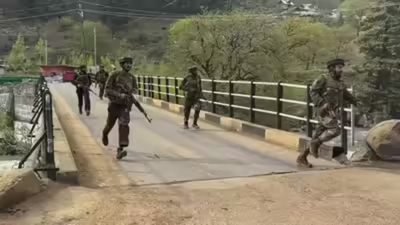
JAMMU: A joint team of security forces launched a massive search operation after intelligence agencies detected satellite communication by suspected terrorists near the border in Rajpura area, in Jammu’s Kanachak sector, on Sunday.The communication was traced to a Thuraya satellite device around 3pm, and its GPS location was tracked, said officials. “Soon after, a joint team of the Army, J&K Police’s SOG, BSF, and CRPF, cordoned off the area and launched a search operation,” an official said.While nothing suspicious had been discovered so far, further combing was underway, officials said.In another security-related development, SSP Poonch chaired a meeting with Village Defence Group members from the border village of Jhullas on Sunday, and directed the volunteers to remain alert, motivated, and committed to protecting their villages while strictly sticking to the SOPs.The volunteers were told to maintain vigilance, assess situations promptly, and share actionable inputs timely with the nearest police and security establishment to prevent loss of life and aid swift neutralisation of threats. Around 150 VDGs participated in the meeting.


Source link

CISF paves way for seamless transfers between RRTS Namo Bharat & DMRC at New Ashok Nagar Metro Station | India News


CISF paves way for seamless transfers between RRTS Namo Bharat & DMRC at New Ashok Nagar Metro Station

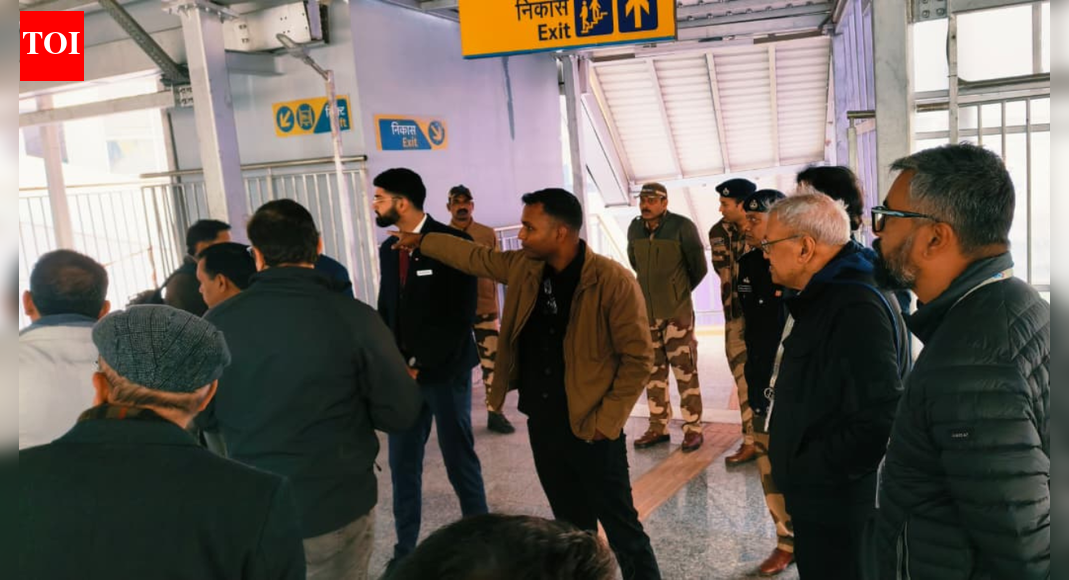
NEW DELHI: Passengers transfers between Regional Rapid Transit System (RRTS) Namo Bharat with the Delhi Metro Rail Corporation (DMRC) will now be seamless at the New Ashok Nagar Metro Station. An integrated passenger movement corridor was formally opened for public use between 8 am and 9.20 am on Sunday. This move is expected to strengthen multimodal urban mobility in the NCR.“This integration enables smooth and secure interchange for passengers travelling between DMRC and RRTS networks, enhancing commuter convenience, reducing transit time, and improving overall travel experience,” said a spokesperson of CISF, which played a key role in facilitating the operational linkage.“The integration has been achieved through meticulous coordination and adherence to a structured standard operating procedure (SOP) jointly developed by CISF unit DMRC in consultation with National Capital Region Transport Corporation (NCRTC) and state security forces. The SOP ensures uniform security protocols, coordinated inspections, controlled access management, and enhanced passenger safety,” the spokesperson added.RRTS ‘Namo Bharat’ project aims to provide fast regional connectivity across NCR. As part of phase-I, the Delhi–Meerut RRTS corridor is being developed to significantly reduce travel time, with trains designed to operate at speeds of up to 180 kmph. CISF has been deployed for securing RRTS stations in Delhi, ensuring seamless integration with DMRC’s established security framework.“The event was conducted in the presence of senior officials from Central Industrial Security Force (CISF), Delhi Metro Rail Corporation (DMRC), and NCRTC. CISF. From CISF, Ajay, senior commandant, Manas De, commandant, along with other CISF officers and personnel were present. DMRC was represented by Pradeep Kumar Yadav, station manager, New Ashok Nagar Metro Station. From NCRTC, Mahendra Kumar, director (DE&RS), M S Upadhyay, chief security principal, and Kapil Bhardwaj, assistant security commissioner, attended the event,” the spokesperson added.


Source link

‘Yogi-Modi trouble-engine govt is so rattled by questions’: Jairam Ramesh condemns police’s lathi charge on NSUI’s ‘Save MGNREGA’ protest | India News


'Yogi-Modi trouble-engine govt is so rattled by questions': Jairam Ramesh condemns police's lathi charge on NSUI's 'Save MGNREGA' protest

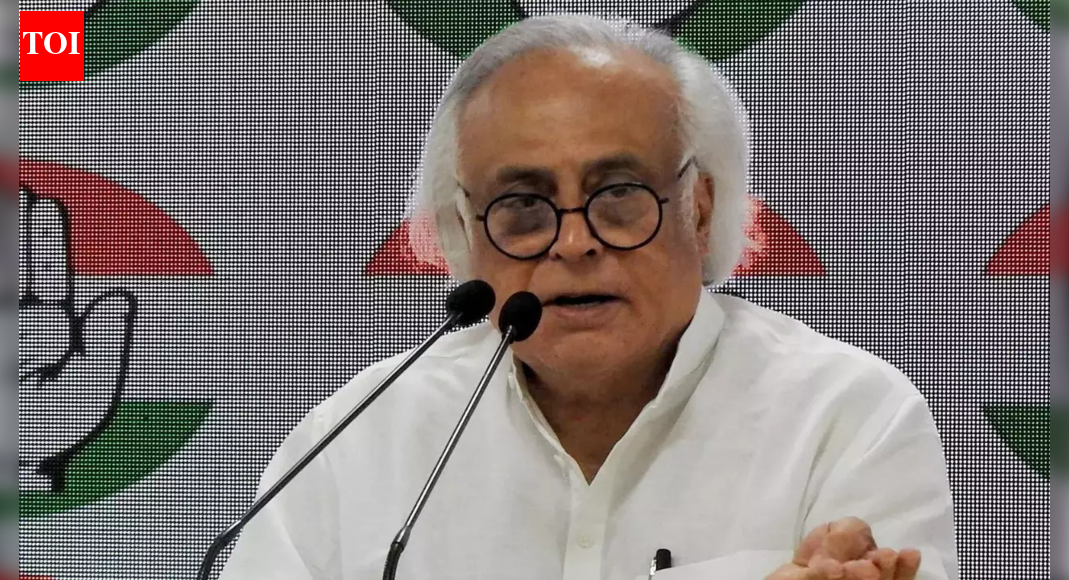
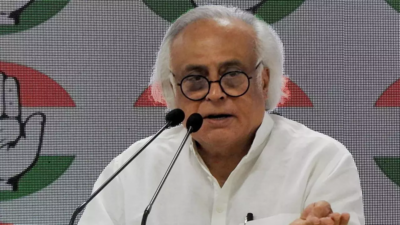
VARANASI: Senior Congress leader and MP Jairam Ramesh on Sunday condemned the police’s brutal lathi charge on NSUI’s “Save MGNREGA” protest in Prime Minister Narendra Modi’s constituency Varanasi. In a post in X, Ramesh criticised the BJP government, calling it “trouble-engine government” rattled by peaceful, democratic protests.

End Of MGNREGA? What VB–G Ram G Means For Rural Workers, Farmers And Viksit Bharat Plan

Ramesh wrote, “In Prime Minister Narendra Modi’s parliamentary constituency of Banaras, students, under the leadership of NSUI’s national president and my young colleague Varun Chaudhary, took out a ‘Save MGNREGA’ campaign march. This was a completely peaceful and democratic demonstration carried out under constitutional rights, but the Yogi-Modi trouble-engine government is so rattled by questions that it unleashed a brutal lathi charge through the police.The post was accompanied by a video purportedly showing police personnel manhandling National Students’ Union of India (NSUI) national president Varun Choudhary during the march.The allegations came amid Congress’s ongoing nationwide protests against the enactment of the Viksit Bharat-Guarantee for Rozgar and Ajeevika Mission (Gramin) Act (VB-G RAM G Act), which replaces the Mahatma Gandhi National Rural Employment Guarantee Act (MGNREGA).Earlier in the day, Congress workers staged a protest under the banner ‘MGNREGA Bachao Sangram’ at Townhall Park in Varanasi. Uttar Pradesh Congress president Ajay Rai, along with party workers, held a symbolic fast near the statues of Mahatma Gandhi and Dr Bhimrao Ambedkar.Speaking to ANI, Rai said, “We are on a fast. Around the Mahatma Gandhi and Bhimrao Ambedkar statue, we are sitting on a fast. This government ended the MGNREGA law, and to protest that each of our Congress workers is sitting on the streets. We want to remove those who want to remove Mahatma Gandhi’s name.”Rai alleged that the ruling Bharatiya Janata Party (BJP) was trying to take away the “rights of the people” and claimed that police were deployed to disrupt the protest, including allegedly stopping opposition leaders at their homes. “They want to even suppress our fast. But still, each of our Congress workers will fight for the rights of the poor people, and we will bring back their rights to them,” he said.Ahead of the proposed NSUI march, Uttar Pradesh Police and paramilitary forces had tightened security arrangements outside the Prime Minister’s public outreach office in Varanasi. All routes leading to the office were placed under strict surveillance.On January 3, the Congress had announced a nationwide three-phase agitation titled ‘MGNREGA Bachao’ following the Centre’s enactment of the VB-G RAM G Act. President Droupadi Murmu recently gave assent to the VB-G RAM G Bill, 2025, marking a major shift in India’s rural employment policy, according to a release from the President’s Secretariat.


Source link

Punjab government preparing youth for competitive exams through Mission Pragati: CM Mann | India News


Punjab government preparing youth for competitive exams through Mission Pragati: CM Mann

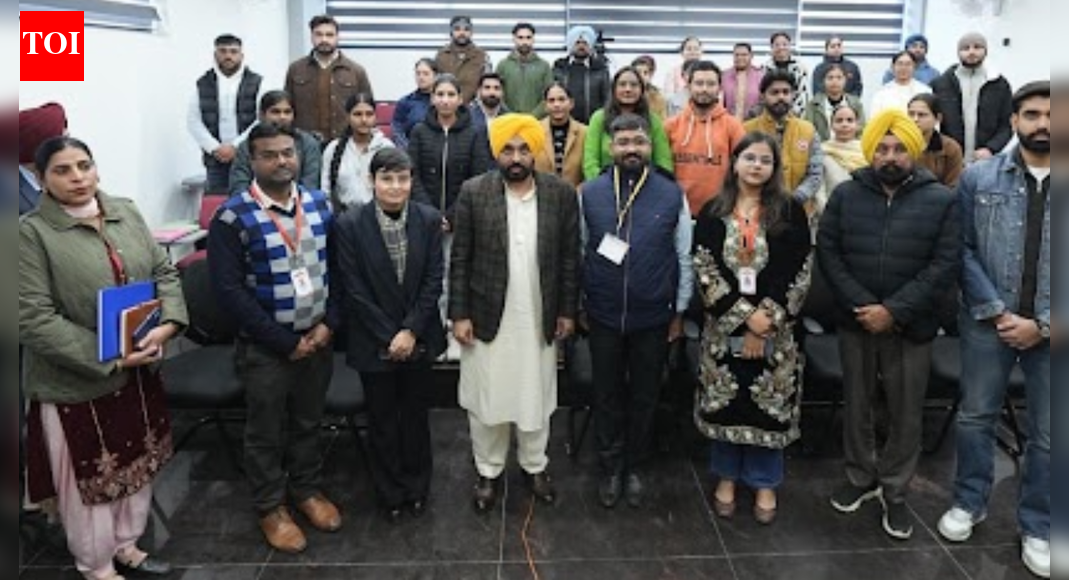
BATHINDA: Punjab chief minister Bhagwant Singh Mann on Sunday said the state government is making focused efforts to prepare the youth for future competitive examinations by providing free academic and physical training under Mission Pragati.Interacting with students at the district library here, Mann said the initiative has been launched to support rural and meritorious students who cannot afford costly coaching.Free coaching has started at the district library for exams related to the Services Selection Board (SSB), police and the armed forces, he added.The chief minister said 40 students have been enrolled in the first batch.Along with classroom teaching, physical training is also being provided by experienced trainers from the Punjab Police to ensure the overall preparedness of candidates.Mann said students will be given free access to books and study material by enrolling them as library members.The programme is being run using existing infrastructure, resulting in minimal expenditure, he added.Highlighting the mentoring model, he said Mission Pragati follows a “youth helping youth” approach, where mentors are candidates who have themselves appeared in competitive examinations.The programme has received support from educationists, universities, police officials, athletes and students, he said.The chief minister said the initiative is based on the principle of “no one left behind” and aims to provide equal opportunities to youth and increase their representation in government services.Reiterating the state government’s vision, Mann said Punjab’s education reforms are focused on transforming job seekers into job providers and ensuring a holistic development of the youth.


Source link

‘Slogans don’t hide zero representation’: Union minister Bandi Sanjay on Owaisi’s ‘burqa-clad PM’ remark; hits back at AIMIM chief | India News


'Slogans don't hide zero representation': Union minister Bandi Sanjay on Owaisi's 'burqa-clad PM' remark; hits back at AIMIM chief
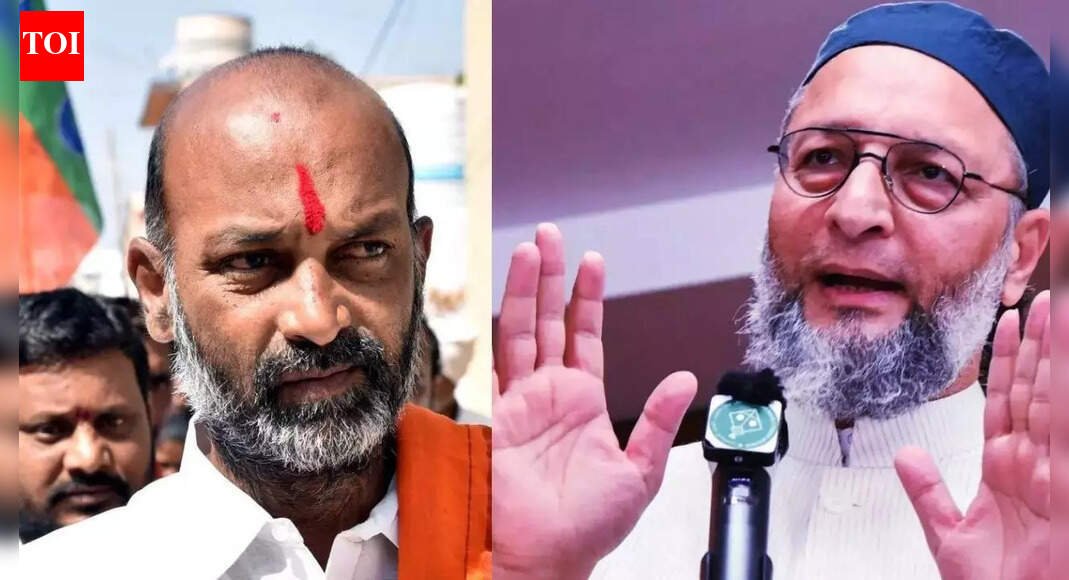
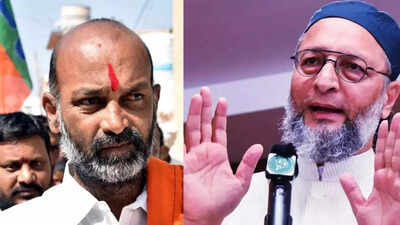
Bandi Sanjay Kumar; Asaduddin Owaisi

NEW DELHI: Union minister and former Telangana BJP chief Bandi Sanjay Kumar on Sunday said no woman has ever held a decision-making post in the AIMIM, reacting to a statement by AIMIM chief Asaduddin Owaisi that India would one day have a burqa-clad woman as its prime minister.Also Read | ‘PM will always be a Hindu’: Assam CM counters Owaisi’s Muslim PM remark; BJP challenges AIMIM to appoint Pasmanda president“How many Muslim women has the All India Majlis-e-Ittehadul Muslimeen actually given tickets to as MLAs or MPs? How many Muslim women hold real decision-making posts in the Majlis? Slogans cannot hide zero representation,” Kumar posted on X. He also recalled the 2018 Telangana assembly elections, in which the BJP fielded a Muslim woman, Syed Shahezadi, against Owaisi’s brother, Akbaruddin, who went on to win.“She was threatened, targeted, and defeated. This is your true face. Today, she serves on the National Commission for Minorities,” the BJP leader added.The minister added that the BJP has a minority wing and grooms women leaders, and asked Owaisi what the AIMIM has “beyond rhetoric.” The Karimnagar Lok Sabha MP also accused the Hyderabad MP and the AIMIM of “intimidating” women activists who raise their voices against the party.Also Read | ‘A tubelight in his mind’: Asaduddin Owaisi hits back at Himanta Biswa Sarma over ‘only Hindu will become PM of India’ remark“We understand your fear. Muslim women can see your hypocrisy clearly. Many view Hon’ble PM Shri @narendramodi ji as an elder brother who acted in their interests instead of confining them. BJP empowers women irrespective of religion. Asaduddin Owaisi, on the other hand, speaks of empowerment while imposing restrictions on women in party, public life, and even at home,” Kumar posted.Addressing an election rally on Friday in Maharashtra’s Solapur ahead of the January 15 civic polls, Owaisi said a hijab-clad woman would one day become India’s prime minister, as the country’s Constitution accords equal status to people from all communities, unlike in Pakistan, where members of only one faith can occupy top constitutional posts.


Source link

‘Chinki, momo, Chinese’: How everyday racism shadows Indians from the Northeast | India News


'Chinki, momo, Chinese': How everyday racism shadows Indians from the Northeast

“You people eat dogs, cats, pigs and all your animals, right?” This was a question Riba says she was repeatedly asked because she hails from the Northeast. Working at a high-profile firm did little to shield her from stereotypes. Friends, colleagues and acquaintances routinely questioned her food habits, appearance and even language.

‘Called Minor Matter, Refused FIR’: Tripura Student Angel Chakma’s Father Blasts Uttarakhand Police

What hurt most, she says, was that many people did not see anything wrong with asking such questions. “It definitely triggered me being questioned every day about what I eat, how I look and where I belong,” she recalls.That casual prejudice, civil rights activists say often escalates into something far more dangerous.These day-to-day casual slurs, which come as no surprise in the lives of people from the Northeast, reveal that even India’s so-called cosmopolitan “melting pots” often fail to be truly inclusive. For many from the region living outside it, these cities remain spaces where identities are questioned and belonging is never fully accepted.

.

‘Oye Chinese

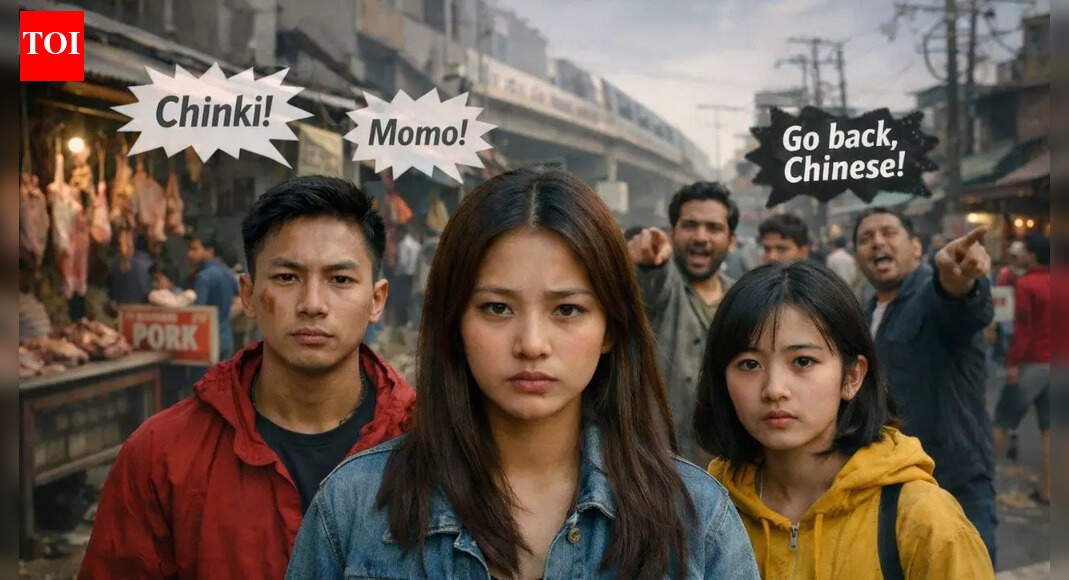
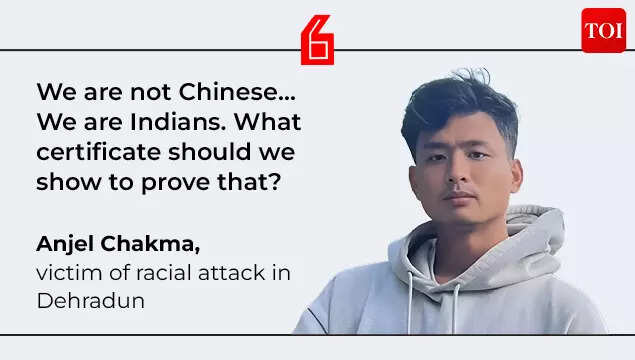
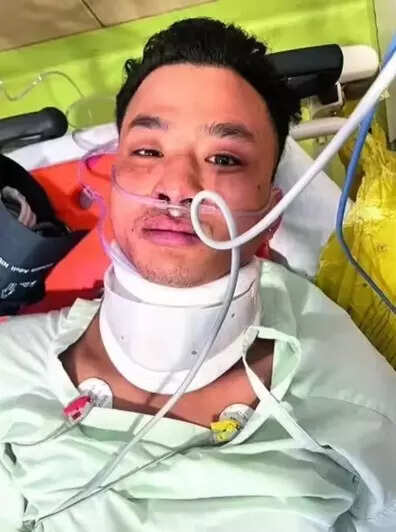
On December 9, what began as a routine visit to a local market in Dehradun ended in fatal violence. Twenty-four-year-old Anjel Chakma from Tripura lost his life.Anjel and his younger brother Michael had been planning a Chandrashila trek scheduled for December 22 and had even ordered new trekking shoes for the trip.The shoes arrived a day after the attack. They were never unpacked.According to Michael and other family members, the brothers were subjected to racial slurs — “Chinki,” “Chinese” and “Momo” during a grocery run in the Selaqui area. One of the men allegedly sneered, “Oye Chinese, have you come to buy pork?”Anjel objected to the abuse and asserted their identity. “We are not Chinese… We are Indians. What certificate should we show to prove that?” he allegedly said.What followed, according to family and friends, was brutal violence.
.

Anjel Chakma

“Soon after Anjel replied, they attacked him and his brother while hurling abuses,” said a friend who stayed at the hospital through the two weeks that followed. “Anjel suffered serious injuries to his neck and spine. Michael is also injured and remains in serious condition.”Dehradun senior superintendent of police Ajai Singh said the comments appeared to target the brothers’ appearance. Police said Anjel was struck with a knife and a metal kada, leaving him critically injured.The case drew national attention after Anjel’s father said his son was attacked despite clearly asserting that he was Indian.

‘I am an Indian’

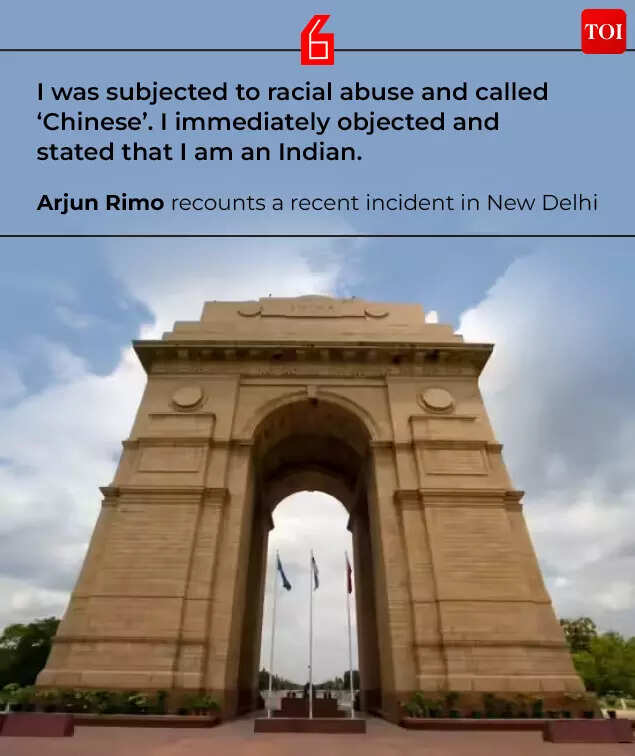
Similar incidents occur with alarming regularity.Arjun Rimo from Arunachal Pradesh recalls a recent incident in Delhi that left him shaken. “On January 8, 2026, in Karol Bagh, New Delhi, while buying meat at a shop, I was mistreated,” he told TOI.“As I chose to leave, I was subjected to racial abuse and called ‘Chinese’. I immediately objected and stated that I am an Indian.”He said a person associated with the shop attacked him first.“I reacted only in self-defence. I punched him, during which he sustained a facial injury. Soon after, two more individuals joined him, and the three of them assaulted me together.”

.

As a crowd of 30 to 35 people gathered, Rimo said he became overwhelmed.“I could no longer protect myself. Fearing serious harm, I sought police assistance,” he said, adding that he personally witnessed the accused being taken into police custody.“This episode,” he said, “highlights a broader, long-standing challenge faced by citizens from India’s North-Eastern region,” who frequently encounter bias and unequal treatment when living or travelling outside their home states, particularly in metropolitan cities.For many, stepping outside the Northeast means confronting suspicion, stereotyping and casual prejudice — not as isolated incidents, but as an everyday reality.

‘Do you even get Maggi there?’

For Sushma Pegu, who works at a high-profile firm in Bengaluru, discrimination followed her into corporate spaces.She recalls being bullied, subjected to racial slurs, and questioned relentlessly about her food habits.“A colleague literally asked me, ‘Do you even get Maggi there? How do you survive with all the non-veg food? I also heard you people eat cats and dogs.’”“I took a stand,” she said, adding that the colleague was eventually terminated.But the questioning, she said, often begins the moment she steps into a cab, with drivers routinely asking, “Which country are you from?” prompted solely by her appearance.

Do you even get Maggi there? How do you survive with all the non-veg food? I also heard you people eat cats and dogs.

A colleague asked Sushma, who hails from Assam

Fear during Covid

Roshni recalls how racial prejudice intensified during the Covid-19 outbreak.“During my time at Lakshmibai College,” she said, “a group of students passed a remark about one of my friends, saying, ‘Mujhe toh isko dekh kar dar lag raha hai’ (I feel scared just looking at her).”She said the comment, though made casually, carried a deep sense of exclusion and fear.“I felt shocked, angry and deeply uncomfortable,” she said.“It created a lasting sense of humiliation and helplessness.”

‘My only mistake is that I look like this’

In October 2025, a 27-year-old flight attendant from Meghalaya alleged that she was racially abused twice within an hour in Delhi; first in north Delhi’s Kamla Nagar and later on the metro.Her Instagram video went viral after Union minister Kiren Rijiju reposted it.In the video, the woman said a group of men sitting on a scooter mocked her using racial slurs and laughed. Shaken, she walked into a nearby Tibetan eatery but found herself unable to eat.“I did not feel like eating anything. My brain could not process what had just happened,” she said.“It breaks my heart,” she added. “My only mistake is that I am born in India and I look like this and I don’t look like what people expect Indians to look like.”Having travelled to several countries, she said she had never been made to feel unwelcome abroad.“But today, in my own country, my fellow Indians made me feel like I did not belong.”Addressing the alleged perpetrators, she said, “You didn’t just insult me. You insulted every person who has ever felt ‘othered’ in their own country. India is diverse our faces, our languages and our cultures are all valid. You don’t get to decide who belongs and who doesn’t.”
.

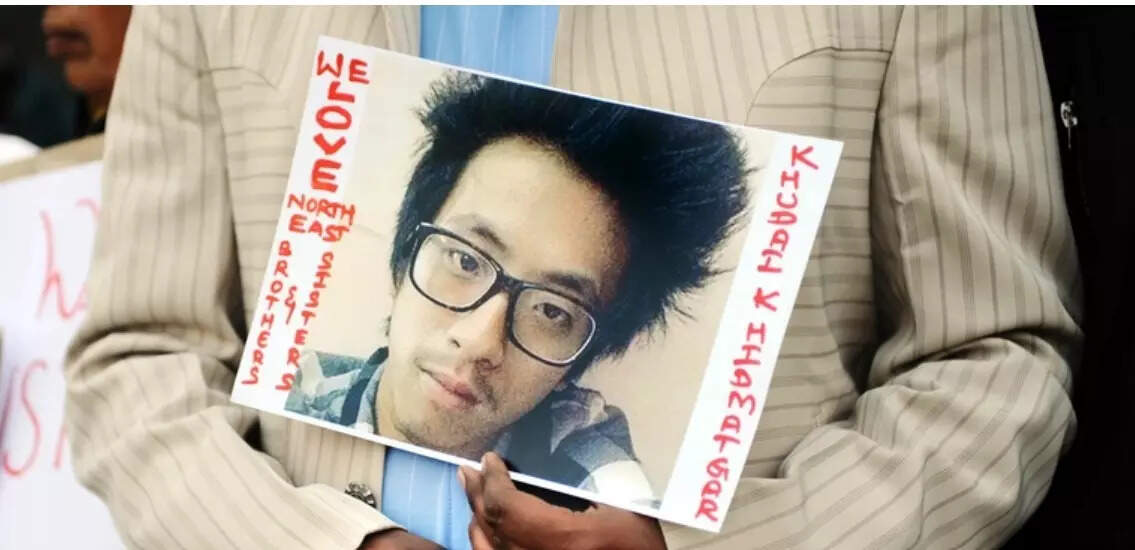
Nido Taniam

India has seen such cases for years

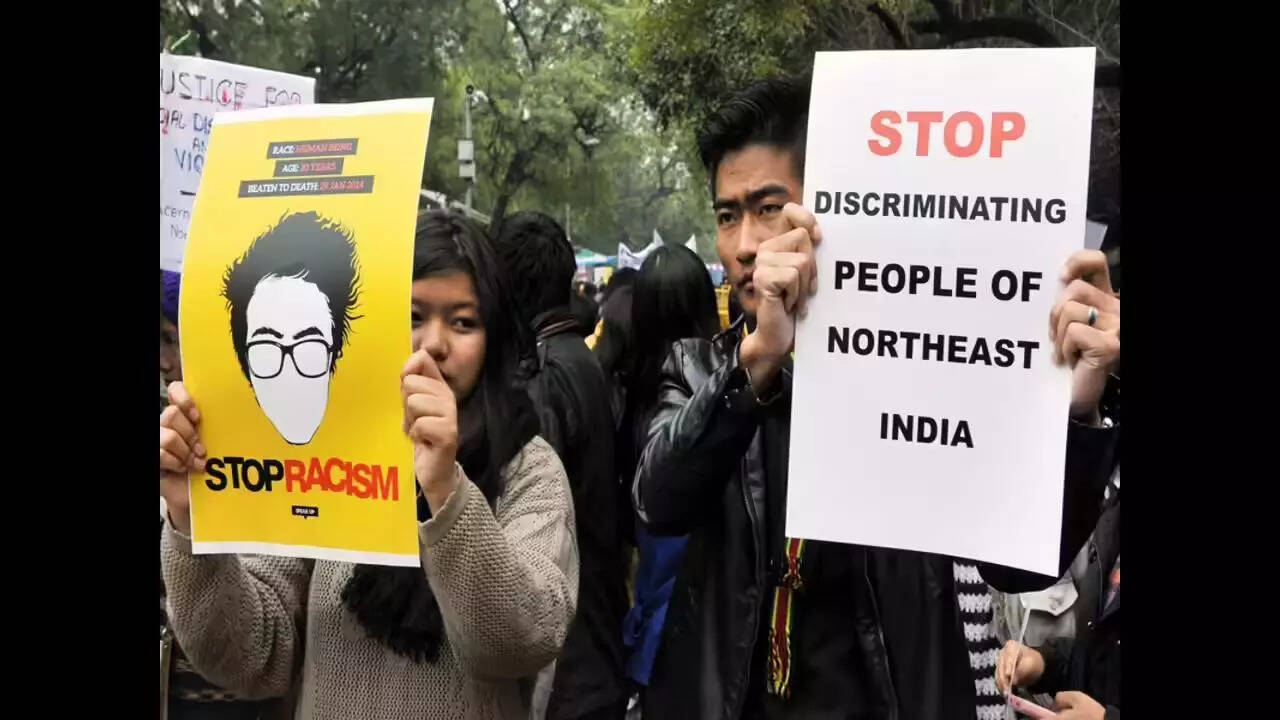
Such incidents are far from isolated.In November 2023, students from the Northeast reported racial and misogynistic abuse near Delhi University’s North Campus. In 2016, two youths from Mizoram were beaten in Bengaluru for not speaking the local language.One of the most chilling cases remains the killing of Nido Taniam in January 2014. The 19-year-old student from Arunachal Pradesh was beaten to death in Delhi’s Lajpat Nagar after shopkeepers mocked his hairstyle.A police investigation report detailed how Nido and his friends had gone to meet another friend when a shopkeeper made derogatory remarks about his appearance.An altercation followed, during which Nido smashed a glass pane. The shopkeeper and his associates allegedly assaulted him while making racist remarks about his caste, race and appearance.Although the immediate dispute was settled after Nido paid compensation, he was later assaulted again by the group and died in his sleep at a friend’s residence.The incident sparked widespread outrage among people from the Northeast living in Delhi, with allegations that the police failed to protect him despite repeated pleas.

.

A legal vaccum

India is a signatory to the International Convention on the Elimination of All Forms of Racial Discrimination, yet does not have a specific law addressing racial discrimination.Following Nido Taniam’s death, the MP Bezbaruah Committee recommended criminalising racial slurs such as “chinki” and “Chinese”, proposing jail terms of up to five years.While some administrative steps were taken, the proposed amendments to the IPC remain pending.In 2016, the Supreme Court directed the Centre to monitor the implementation of the committee’s recommendations. Activists, however, say enforcement remains inconsistent, with racial abuse often dismissed as a social issue rather than treated as a criminal offence.These incidents show how deeply racial prejudice is woven into everyday life. While stronger laws are necessary, activists argue they are not sufficient on their own.The fight, they say, must begin in schools, through education on diversity, history and discrimination. It must be carried forward by police, institutions, political parties and society at large.Multiculturalism cannot remain a slogan. It must be practised.

Source link

No Rahul-Stalin in Tamil Nadu? DMK rejects Congress‘s ‘sharing power’ proposal; CM firm on stand | India News


No Rahul-Stalin in Tamil Nadu? DMK rejects Congress‘s 'sharing power’ proposal; CM firm on stand

NEW DELHI: Senior DMK leader and rural development minister I Periyasamy on Sunday ruled out any scope for a coalition government in Tamil Nadu, asserting that chief minister M K Stalin is firm against sharing power with allies, including the Congress.Responding to questions on the Tamil Nadu Congress’s renewed demand for a share in power, Periyasamy said while it was the party’s right to make such a demand, the DMK had never favoured a coalition arrangement.“There had never been a coalition government,” he said, adding that the state had always been governed by the DMK on its own. “There is no doubt about this stand of the party, there will be no coalition government and the chief minister is firm on this stand,” he told reporters.The Congress has recently revived its pitch for power-sharing ahead of the assembly elections due by March–April. Congress MP Manickam Tagore said it was time to debate “share in power,” while CLP leader and Kanyakumari legislator S Rajeshkumar also spoke in favour of a coalition government. Congress’s in-charge for Tamil Nadu Girish Chodankar had asked if any political party “will say that they don’t want the power; then we should name ourselves as NGO.”Periyasamy’s remarks assert DMK’s long-held position on governance in the state. Since 1967, both the DMK and the AIADMK have formed governments on their own despite contesting elections as part of alliances. The only exception dates back to the first assembly (1952–57) in the then Madras state, when the Congress, lacking an absolute majority, accommodated non-Congress leaders in its Cabinet.In 2006, the DMK ran a full five-year government despite falling short of a majority, relying on outside support from allies, including the Congress, but without sharing ministerial power. Congress leaders had made similar demands during that term as well, without success.


Source link