Breaking News
With Pongal event, Amit Shah reaches out to Tamil Nadu voters | India News


With Pongal event, Amit Shah reaches out to Tamil Nadu voters

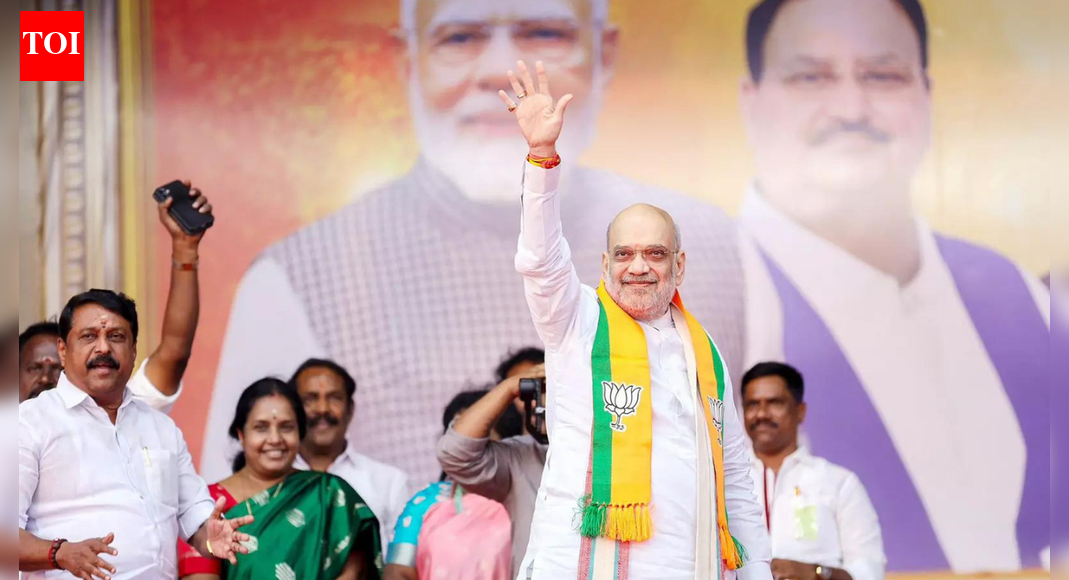
TRICHY: Union home minister Amit Shah’s two-day visit to poll-bound Tamil Nadu ended on an inconclusive note Monday, with no apparent breakthrough in BJP’s efforts to strengthen NDA in the state. There was anticipation that Shah would initiate alliance talks with potential partners, PMK and DMDK during the visit, while also seeking a resolution to the TTV Dhinakaran-O Panneerselvam impasse.AIADMK general secretary Edappadi K Palaniswami was expected to travel to Trichy to meet Shah on Monday. However, the meeting did not take place. “Such a meeting was not scheduled. Also, the public meeting attended by Shah in Pudukottai was a BJP event, not an NDA event. Hence, allies were not invited,” a BJP member said.Former AIADMK minister S P Velumani met Shah twice. Union commerce minister Piyush Goyal, who is BJP Tamil Nadu poll in-charge, was present during the first interaction. However, both AIADMK and BJP functionaries remained tight-lipped about the talks.Meanwhile, BJP sources said Shah may visit Chennai again later this month, when he could meet EPS.Shah also chaired a BJP core committee meeting on Sunday. On Monday, Shah visited Jambukeswarar temple in Thiruvanaikoil and Ranganathaswamy temple in Srirangam. He later reached Trichy-Madurai NH, where BJP organised ‘Namma Ooru Modi Pongal Vizha’, a traditional Pongal celebration featuring 1,008 pots. While party cadres expected Shah to address the gathering, he spent less than 30 minutes at the venue.


Source link

Parents of doctor accused of sexual exploitation held for conversion bid | India News


Parents of doctor accused of sexual exploitation held for conversion bid

LUCKNOW: Parents of the resident doctor of King George’s Medical University, who has been accused of sexually exploiting a colleague and pressuring her for religious conversion for marriage, were arrested from a rented flat in Thakurganj area of Lucknow on Monday.DCP (west zone) Vishwajeet Srivastava claimed Salimuddin (70) and his wife Khateeja (67), parents of the accused doctor, Rameezuddin (38), played a key role in conversion and miscarriage of two women medical students, one at KGMU and the other at Agra medical college.“Both the survivors have given written testimonies in the presence of a magistrate that they were forcibly converted, sexually exploited, and subjected to miscarriage by not just the KGMU doctor ut also his parents,” said a police officer privy to the investigation. Initially, police had announced a reward of Rs 25,000 on arrest of the doctor, which was further increased to Rs 50,000 on Monday.On Dec 23, 2025, one of the survivors had submitted a written complaint at Chowk police station.Based on her complaint, an FIR was lodged under sections of rape, miscarriage, marriage by deceit under BNS, along with Sections 3/5 of the Uttar Pradesh Prohibition of Unlawful Religious Conversion Act.Another medical student from Agra also accused the doctor of sexual assault, conversion, and miscarriage. Police said during investigation, involvement of family of the accused was found.


Source link

Akal Takht summons Mann over ‘anti-Sikh remarks’ | India News


Akal Takht summons Mann over 'anti-Sikh remarks'

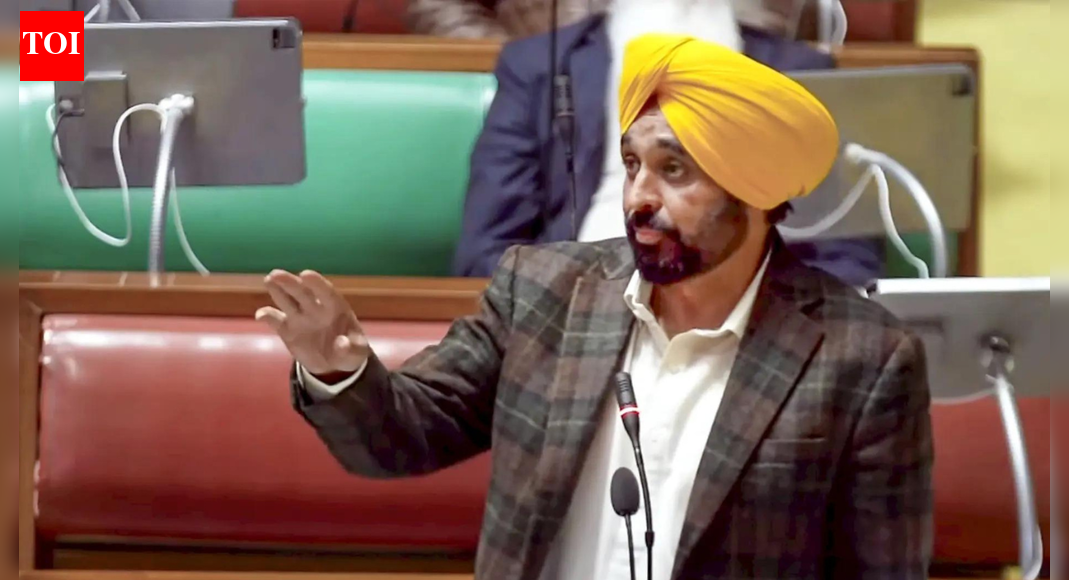
AMRITSAR: The officiating Jathedar of Akal Takht, Giani Kuldip Singh Gargajj, has summoned Punjab CM Bhagwant Mann to appear at its secretariat on Jan 15 over alleged “anti-Sikh remarks”, “objectionable conduct”, and a recently surfaced video that the Takht says deeply hurt Sikh sentiments.Mann posted on X that he would appear before Sri Akal Takht Sahib as a “humble and devout Sikh instead of a chief minister”. “Any command from Sri Akal Takht Sahib Ji is accepted with full reverence and will be obeyed. I will walk barefoot before Sri Akal Takht Sahib,” he said.Mann said though the President is visiting Guru Nanak Dev University in Amritsar on Jan 15, he would still obey the Takht summons. “For me, Sri Akal Takht Sahib Ji is above everything. The command received from the sacred Takht is, was, and will always be supreme to me and my family,” he said. Jathedar Gargajj said the CM, despite holding a high constitutional office, repeatedly made statements that challenged “Sikh Rehat Maryada (code of religious conduct)”, supremacy of Akal Takht, and sanctity of Guru Ki Golak. “These comments reflect an arrogance of power and an anti-Sikh mindset,” Gargajj alleged.Clarifying why the CM was not summoned to appear at the facade (Fasil) of Akal Takht, the jathedar said that Bhagwant Mann is a “patit (apostate)” and, according to Sikh tradition, cannot be summoned to appear at Fasil. “Therefore, he was summoned to personally appear at the secretariat of Akal Takht at 10am on Jan 15 to submit his explanation,” Gargajj said.Jathedar Gargajj said a controversial video that had recently surfaced would be subjected to forensic examination and, if found authentic, strict Panthic action would follow.Mann got support from rather unexpected quarters. BJP criticised the Akal Takht summons, with party Punjab spokesperson Sarchand Singh calling it a “well-orchestrated exercise” to shield senior Shiromani Akali Dal leaders and those who are facing arrest over the 328 missing sacred saroops of Sri Guru Granth Sahib. Invoking “religious defiance” was a tactic to exert pressure on the CM and obstruct the SIT investigation, he said. He said there is no Panthic tradition of summoning a ‘patit’ Sikh even at the Akal Takht secretariat.


Source link

Mamdani letter on Umar Khalid: Ex-Maharashtra CM Prithviraj Chavan defends New York mayor – watch | India News


Mamdani letter on Umar Khalid: Ex-Maharashtra CM Prithviraj Chavan defends New York mayor - watch
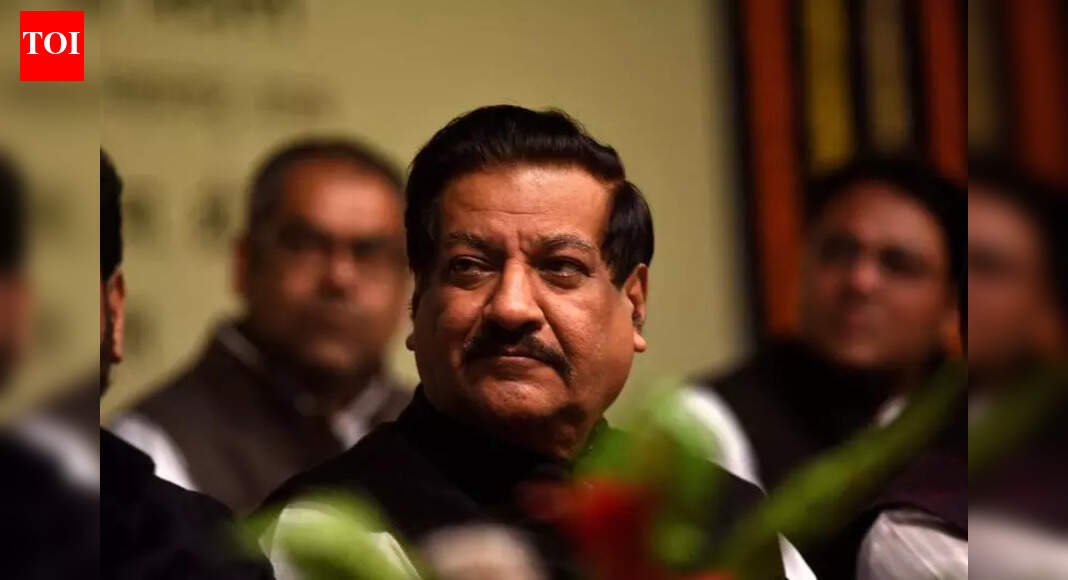
Prithviraj Chavan (File photo)

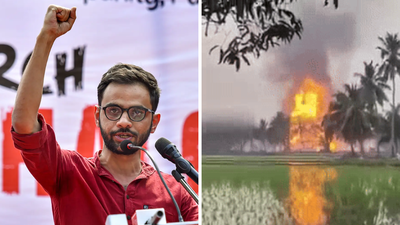
NEW DELHI: Senior Congress leader and former Maharashtra chief minister Prithviraj Chavan on Monday came out in support of New York City mayor Zohran Mamdani for writing a letter to 2020 Delhi riots co-accused Umar Khalid.Chavan said that, as a person of Indian origin, Mamdani had “every right to intervene.”Also Read: Who is he to question? BJP on New York Mayor Zohran Mamdani’s Umar Khalid note“He (Mamdani) has faith in Indian politics. He spoke in Hindi during his campaign, appealing to Indians there. Indian blood flows in him, so if injustice is happening to an Indian, he has every right to intervene, whether he is an American citizen or not. But more importantly, human rights are supreme. So I think there’s no need to panic if he wrote a letter,” Chavan told news agency PTI.

BJP Welcomes SC Denial Of Bail To Umar Khalid And Sharjeel Imam; Opposition Calls It Unfortunate

The socialist Democrat, New York City’s first Muslim and Indian-origin mayor, is the son of filmmaker Mira Nair and academic Mahmood Mamdani. The 34-year-old was sworn in on New Year’s Day after winning the mayoral election in November last year.In his handwritten note to Khalid, who has been in jail since his arrest in September 2020, months after communal riots rocked the national capital in February that year, Mamdani wrote: “Dear Umar, I think of your words on bitterness often, and the importance of not letting it consume oneself. It was a pleasure to meet your parents. We are all thinking of you.”The Supreme Court on Monday rejected the bail pleas of two Delhi riots accused—Khalid and Sharjeel Imam—and granted bail, subject to conditions, to five others. They had challenged the Delhi high court’s rejection of their pleas.Meanwhile, Chavan’s remarks come days after he drew flak for claiming that India was “defeated” on the first day of its four-day conflict with Pakistan in May 2025. He later refused to apologise despite widespread outrage.In July last year, he had also sparked controversy by questioning why anti-terror operations were being given “Hindu names.”


Source link

From classrooms to careers, human capital takes centre stage in India’s AI push | India News


From classrooms to careers, human capital takes centre stage in India’s AI push

NEW DELHI: From retooling classrooms to future-proofing jobs, India’s artificial intelligence strategy is decisively shifting towards people-first reform. Senior policymakers, academic leaders and industry experts on Monday flagged lifelong learning, human augmentation and inclusive skilling as central to India’s AI journey at a high-level Human Capital Working Group meeting hosted at IIT Guwahati.The two-day meeting (January 5–6), jointly organised by the ministry of electronics and information technology (MeitY), the IndiaAI Mission, the Assam government and IIT Guwahati, is expected to shape policy inputs for the India AI Impact Summit 2026 scheduled in New Delhi next month. Chaired by Prof T G Sitharam, the deliberations focused on education reform, workforce transition and responsible, human-centric AI adoption as India prepares for large-scale economic and social disruption.Speakers across government and academia cautioned against narrow, fragmented skilling models and called for a shift towards lifelong learning ecosystems. “The transition to an AI-enabled economy must be inclusive and people-centric,” Sitharam said, stressing that technological progress must translate into dignity, opportunity and resilience for workers.IndiaAI joint director Shikha Dahiya said outcomes from the Guwahati deliberations would directly inform global-level discussions at the summit, with a focus on democratising AI resources, building indigenous models and amplifying Global South perspectives. Assam officials highlighted the risks of unchecked automation, urging policymakers to prioritise human augmentation over replacement and expand AI literacy as a public capability.Day one featured a keynote on democratising competency in the age of AI and panel discussions on gender-responsive AI strategies and redefining education for the cognitive age, flagging risks of widening inequality if policy responses lag technological change.The meeting will conclude on Monday with consolidated recommendations expected to feed into India’s national AI human capital roadmap aligned with Viksit Bharat 2047.


Source link

‘Exercise due caution’: India issues travel advisory for Iran; urges nationals to ‘avoid areas of protests’ | India News


'Exercise due caution': India issues travel advisory for Iran; urges nationals to 'avoid areas of protests'

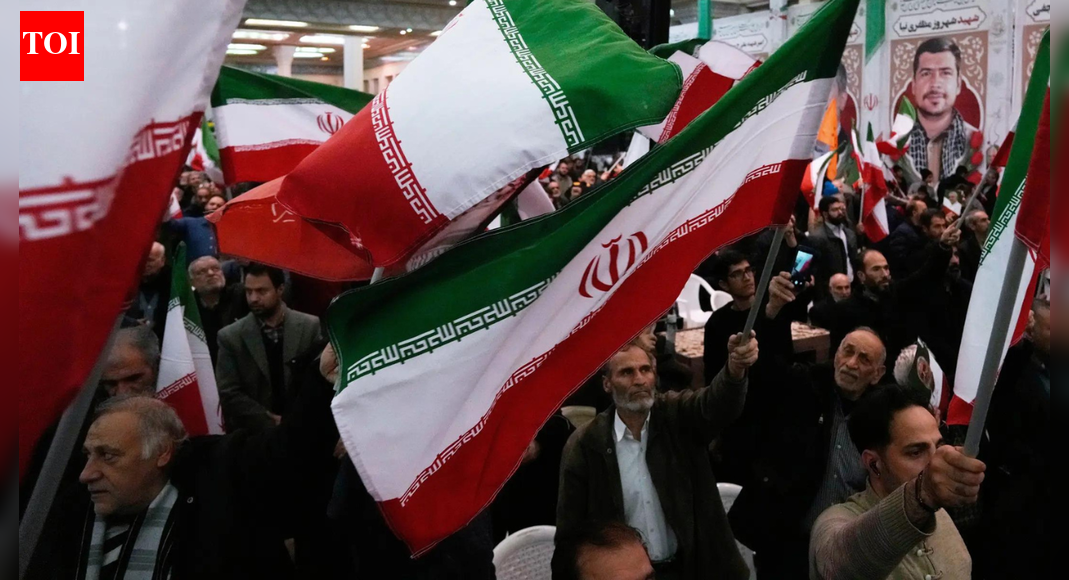
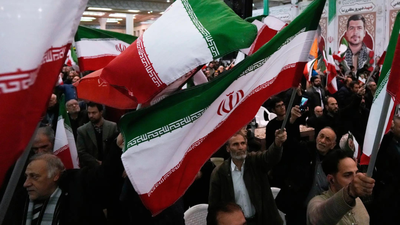
NEW DELHI: The ministry of external affairs (MEA) on Monday issued a travel advisory for Iran urging its nationals to avoid non-essential travel as unrest continues to spread across the country following days of protests.In a statement, the MEA urged nationals in Iran to “avoid non-essential travel”.“In view of recent developments, Indian nationals are advised to avoid non-essential travel to the Islamic Republic of Iran until further notice. Indian citizens and PIOs currently in Iran should exercise due caution, avoid areas of protests or demonstrations, and closely monitor news as well as the website and social media handles of the Embassy of India in Tehran,” the statement read.The protests began on December 28 in Tehran, when shopkeepers went on strike over rising prices and economic stagnation. Since then, demonstrations have spread rapidly, evolving from economic grievances into broader political demands.According to an AFP tally based on official statements and local media reports, demonstrations have taken place in 25 of Iran’s 31 provinces, affecting at least 45 cities, mostly small and medium-sized urban centres in the western parts of the country. Officials say at least 12 people have been killed since December 30 in localised clashes.


Source link

AAP holds protest in Delhi Assembly premises over rising air pollution | India News


AAP holds protest in Delhi Assembly premises over rising air pollution

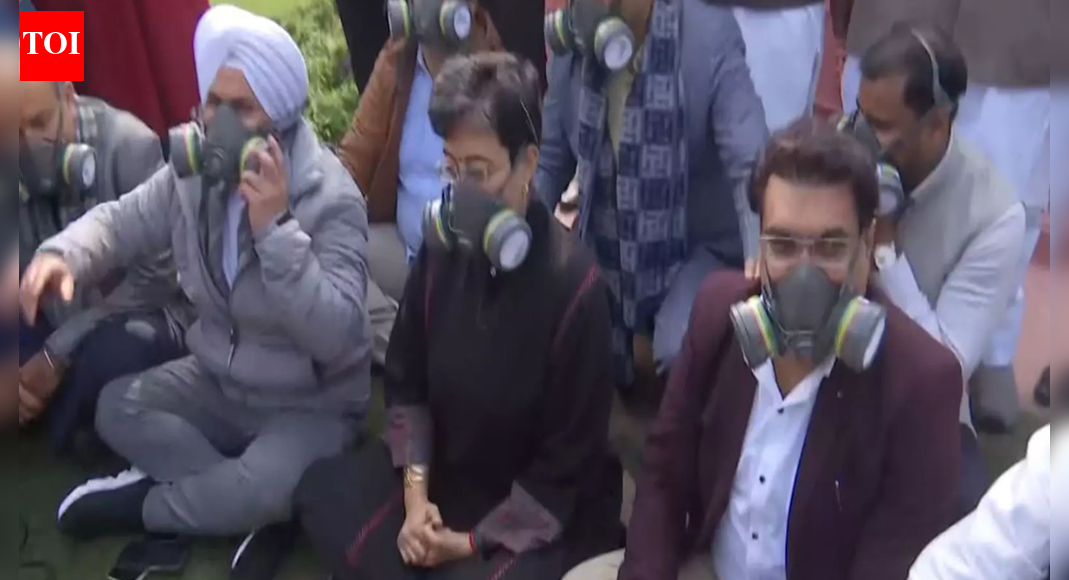
NEW DELHI: Aam Aadmi Party MLAs on Monday staged a protest inside the Delhi Assembly premises, drawing attention to the worsening air pollution levels in the national capital.Leader of opposition in the Assembly, Atishi, led the protest amid AAP’s efforts to press for urgent policy measures and accountability on Delhi’s deteriorating air quality.The protest highlighted concerns over public health, particularly for children, the elderly, and people with respiratory issues, as Delhi continues to struggle with hazardous air quality. Party leaders demanded immediate action by the government to implement stricter measures to curb pollution, including emissions from vehicles, industrial discharges, and stubble burning from neighbouring states.Meanwhile, several Indian cities, including Delhi, Mumbai and Guwahati, woke up to a layer of fog on Monday morning. Air quality varied from ‘poor’ to very poor’ category across several parts of the national capital, while several flights were delayed at the IGI Airport.According to the Central Pollution Control Board (CPCB), Delhi recorded AQI at 260 in the ‘Poor’ category by 8 am on Monday.Visuals from Akshardham showed the Air Quality Index (AQI) at 294, falling in the ‘poor’ category, according to the Central Pollution Control Board (CPCM). At ITO, the AQI was recorded as 256, also categorised as ‘poor’, while Anand Vohar reported a sharper decline at 320, placing the area in the ‘very poor’ bracket.Chandni Chowk remained among the worst-affected areas, recording an AQI of 337, classified as ‘very poor’. Reduced visibility due to fog and smog disrupted flight operations at Delhi’s Indira Gandhi International Airport, with several flights delayed in the early hours.Notably, in Delhi, the Sub-Committee on the Graded Response Action Plan (GRAP) under the Commission for Air Quality Management (CAQM) in the NCR and adjoining areas lifted Stage-III restrictions on Friday evening, citing significant air quality improvement due to favourable meteorological conditions.


Source link

Drug firms get exit from court for minor lapses under new rules | India News


Drug firms get exit from court for minor lapses under new rules

NEW DELHI: Drug makers and medical device firms facing minor regulatory violations can now avoid criminal prosecution and lengthy court battles, with the government rolling out a formal mechanism to settle eligible cases outside courts.The framework, laid out in the Drugs and Cosmetics (Compounding of Offences) Rules, 2025, allows certain offences under the Drugs and Cosmetics Act, 1940 to be resolved by paying a prescribed compounding amount, instead of facing prosecution, signalling a shift towards compliance-based regulation while retaining safeguards for public health.The Central Drugs Standard Control Organisation (CDSCO) has issued a detailed guidance document spelling out eligibility, timelines and procedures for compounding of offences, and the role of a designated Compounding Authority empowered to grant immunity from prosecution in approved cases.Under the rules, companies or individuals involved in the manufacture, import, sale or distribution of drugs, cosmetics or medical devices may apply for compounding either before or after prosecution is initiated. Applications will be examined after seeking reports from the relevant licensing and enforcement authorities, and the authority may allow or reject the request after review and, where required, a personal hearing.If compounding is permitted, the applicant must pay the compounding amount within the stipulated period, following which immunity from prosecution may be granted. The protection, however, is conditional and can be withdrawn if the authority later finds that material facts were concealed, false information was provided or conditions were violated.Officials said the mechanism is intended to reduce litigation over technical or procedural lapses, allowing regulators and courts to focus on serious violations that pose risks to public health, such as spurious or unsafe drugs.The guidance makes it clear that compounding is discretionary and not a matter of right, and that repeat or serious offenders may not qualify. The rules follow reforms under the Jan Vishwas framework aimed at decriminalising minor offences while maintaining regulatory oversight.


Source link

Evening news wrap: Supreme Court rejects Umar Khalid’s bail in Delhi riots case; fire erupts at ONGC well in Andhra Pradesh & more | India News


Evening news wrap: Supreme Court rejects Umar Khalid's bail in Delhi riots case; fire erupts at ONGC well in Andhra Pradesh & more
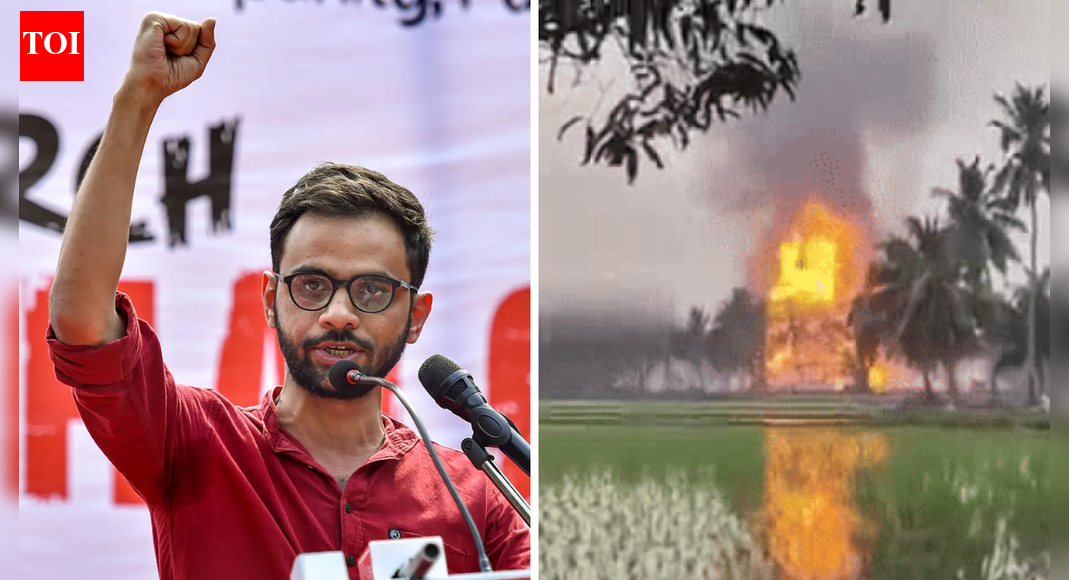
  • 2020 Delhi riots: Supreme Court denied bail to Umar Khalid and Sharjeel Imam in the 2020 Delhi riots case, with Khalid saying jail has now become his life.
  • Fire at ONGC well: A gas pipeline leak at an ONGC well in Andhra Pradesh’s Konaseema district triggered a fire at the site, but no casualties or injuries were reported.
  • Mustafizur row: The Bangladesh government imposed an indefinite ban on the telecast and promotion of the IPL after the controversy surrounding Mustafizur Rahman’s removal from Kolkata Knight Riders.
  • Delhi horror: A gym ownership dispute in East Delhi’s Laxmi Nagar escalated into a violent attack, leaving a man beaten, his wife allegedly molested, and their son assaulted on the street.
  • US strikes Venezuela: Chinese Premier Xi Jinping condemned US actions in Venezuela as “unilateral and bullying acts,” calling on major powers to respect international law and UN principles.

“US Has No Jurisdiction in Venezuela” Ex-UN Envoy Dilip Sinha Slams US Action In Venezuela

Here are the top five stories of the evening:

Supreme Court denies bail to Umar Khalid in Delhi riots case; activist says, ‘ab yahi zindagi hai’

The Supreme Court rejected bail for activist Umar Khalid and Sharjeel Imam, who are accused in the alleged larger conspiracy behind the 2020 northeast Delhi riots. Khalid remarked that jail had now become his life. His partner, Banjyosna Lahiri, quoting Khalid on X, wrote: “I am really happy for the others who got bail. So relieved.” When she mentioned visiting him the next day for a meeting, Khalid replied, “Good, good, aa jana. Ab yahi zindagi hai.” Read full story

Gas leak triggers fire at ONGC well in Andhra Pradesh; no injuries reported

A gas pipeline leak at a well in Andhra Pradesh’s Dr BR Ambedkar Konaseema district sparked a fire on Monday at a site operated by Oil and Natural Gas Corporation’s (ONGC) production contractor, Deep Industries Ltd. According to preliminary reports from a company official, no casualties or injuries have been reported. Senior ONGC officials from Rajahmundry rushed to Mori village following the blaze at the Mori-5 well. Read full story

Bangladesh bans IPL broadcasts indefinitely after Mustafizur Rahman row

The Bangladesh government indefinitely banned the telecast and promotion of the Indian Premier League (IPL) following the controversy over fast bowler Mustafizur Rahman’s removal from the Kolkata Knight Riders squad. An official order confirmed that all IPL-related broadcasts, promotions, and event coverage are suspended with immediate effect. The directive will remain in force until further notice. Read full story

East Delhi gym dispute turns violent, family assaulted in Laxmi Nagar

A man was beaten, his wife allegedly molested, and their son stripped naked and assaulted on the street, after a dispute over a gym operating from a residential property in East Delhi’s Laxmi Nagar turned violent. The complainant, Rajesh Garg, who owns the house and runs a gym in its basement, alleged that the gym’s caretaker, Satish Yadav, cheated him and tried to take over the business, leading to the ongoing conflict, according to his police complaint. Read full story

‘Bullying acts’: Chinese President XI condemns US operation in Venezuela

Chinese Premier Xi Jinping condemned “unilateral and bullying acts” in global affairs, following the arrest of Venezuelan President Nicolas Maduro by US forces. “All countries should respect the development paths chosen by other nations and abide by international law, as well as the purposes and principles of the UN Charter, with major countries leading by example,” Xi said, adding, “In a world beset with changes and chaos, unilateral and bullying acts are severely undermining the international order.Read full story


Source link

Rs 79,000 crore defence push: How India is rearming to counter China and Pakistan | India News


Rs 79,000 crore defence push: How India is rearming to counter China and Pakistan

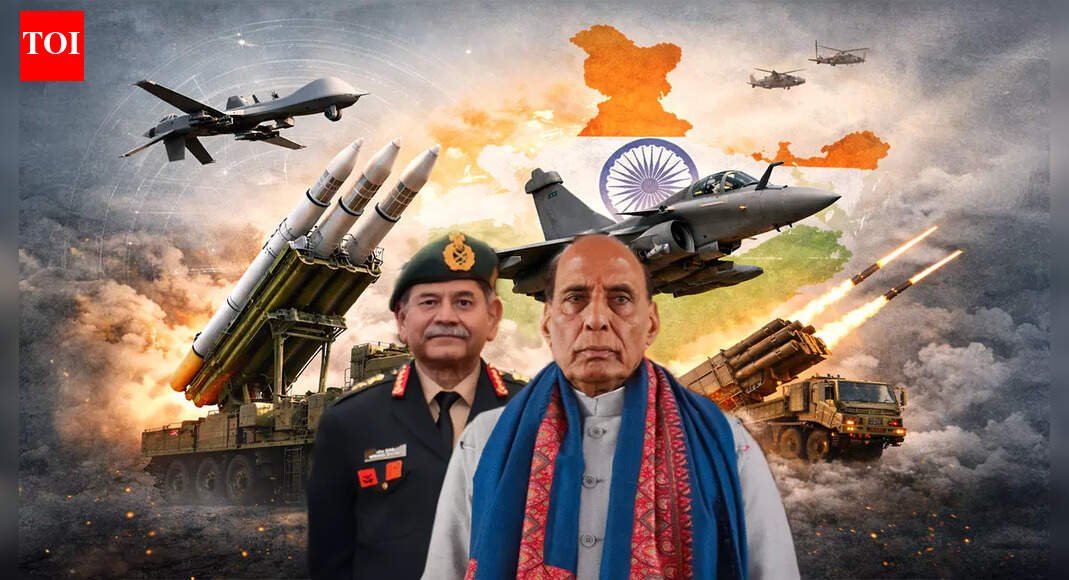
NEW DELHI: Amid a tightening security environment shaped by a militarily assertive China and a volatile Pakistan, the defence ministry has cleared military modernisation projects worth nearly Rs 79,000 crore, marking one of the most consequential procurement approvals in recent years. The clearances were accorded by the Defence Acquisition Council (DAC) chaired by defence minister Rajnath Singh, which approved a wide range of systems spanning air defence missiles, combat drones, long-range rockets, air-to-air weapons, aerial refuellers and counter-drone technologies.Senior military officials have repeatedly stressed that future conflicts will be defined by speed, precision and the ability to fight across domains. “Timely induction of critical capabilities is essential to maintain operational readiness in a rapidly evolving threat environment,” the Chief of the Air Staff, Air Chief Marshal AP Singh, said recently, underscoring the urgency behind such decisions. While Acceptance of Necessity (AoN) is only the first step in the procurement process, it formally establishes the armed forces’ requirements and allows detailed tenders, trials and negotiations to begin.

Rajnath Singh Links Lord Ram’s Ethics To Operation Sindoor, Says India Fought Terror With Dignity

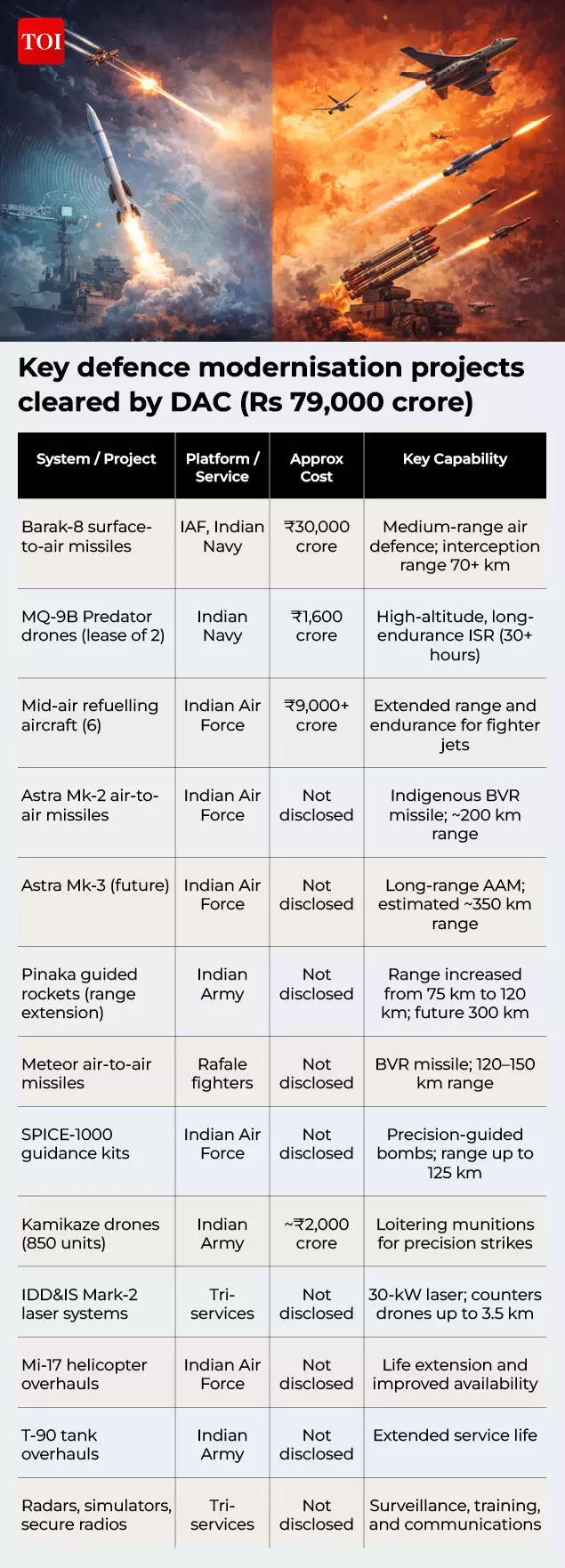
Key defence modernisation projects cleared by DAC

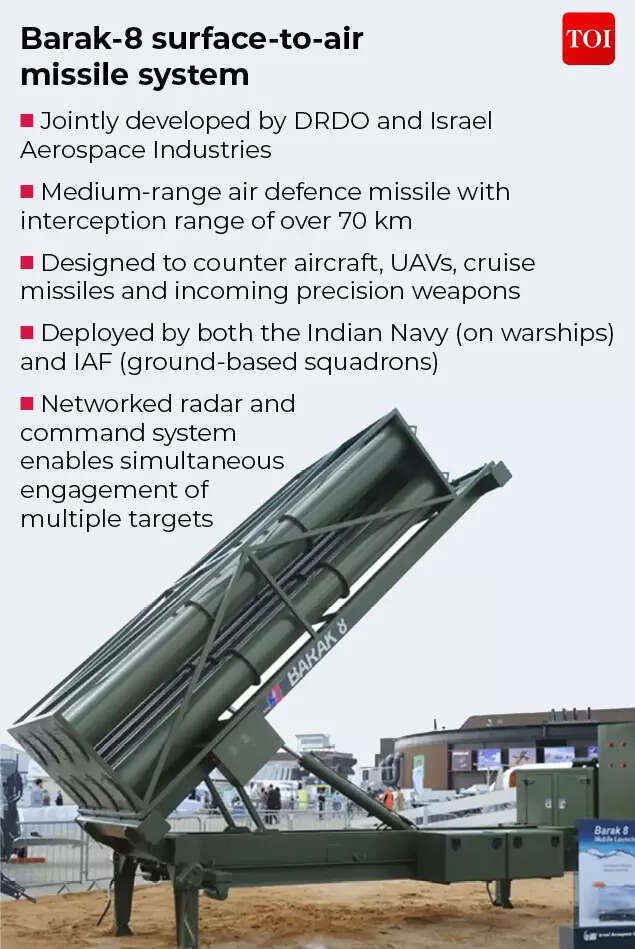
Taken together, the latest approvals offer a revealing snapshot of how India’s armed forces are recalibrating for wars that may unfold under the shadow of drone swarms, long-range missiles, electronic warfare and sustained precision strikes. Many of the systems cleared have been shaped by operational lessons from recent crises, assessed against the growing missile and air power capabilities of China and Pakistan, and aligned with a more pragmatic “Make in India with partners” approach rather than doctrinaire import substitution. What follows is not merely a list of acquisitions, but an emerging blueprint for how India plans to deter, and if necessary fight, high-intensity conflicts across its borders in the coming decade.Barak-8 missiles: Backbone of India’s layered air defenceThe single largest approval under the latest DAC meeting is the Rs 30,000 crore procurement of a large number of Barak-8 medium-range surface-to-air missiles for the Indian Air Force and Navy. Jointly developed by India and Israel, Barak-8 has become the backbone of India’s medium-tier air defence architecture.

Barak-8 surface-to-air missile system

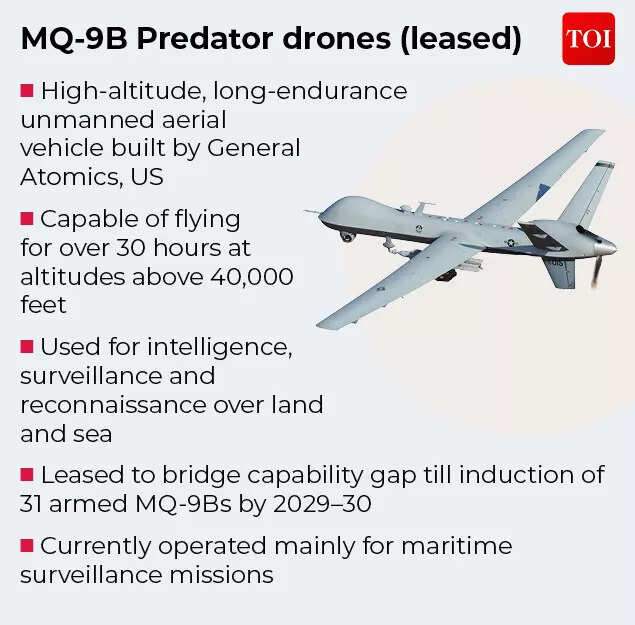
With an interception range of over 70 km, Barak-8 is designed to neutralise a wide spectrum of aerial threats, including fighter aircraft, helicopters, cruise missiles and unmanned aerial vehicles. Its advanced active radar seeker and ability to engage multiple targets simultaneously make it critical in countering saturation attacks.The missile system proved its operational value during the cross-border hostilities in May, when Pakistan launched multiple waves of Turkish-origin drones and Chinese missiles. Barak-8 was part of India’s multi-layered air defence network that successfully intercepted incoming threats, preventing damage to key military installations.For the Navy, Barak-8 is deployed aboard frontline destroyers, frigates and aircraft carriers, providing area air defence against anti-ship missiles and hostile aircraft. For the IAF, ground-based Barak-8 squadrons protect air bases and strategic assets. The new procurement aims to significantly bolster missile stocks, addressing concerns over wartime depletion and sustained engagements.MQ-9B Predator drones: Bridging the surveillance gap till 2030The DAC also approved the Rs 1,600-crore lease of two additional MQ-9B Predator drones for a period of three years. These high-altitude, long-endurance unmanned aerial vehicles will supplement the two Predators currently operated by the Navy.MQ-9Bs are capable of flying for over 30 hours at altitudes exceeding 40,000 feet, providing persistent intelligence, surveillance and reconnaissance across vast areas. They are particularly valuable for maritime domain awareness in the Indian Ocean Region, tracking hostile naval movements and monitoring choke points.

MQ-9B Predator drones (leased)

The leased drones are meant to bridge a critical capability gap until India receives 31 armed MQ-9B remotely piloted aircraft systems under the $3.8 billion deal signed with the US in October last year. Deliveries under that deal are expected only in 2029–30.By opting for a lease rather than outright purchase, the military avoids a capability vacuum during a period of heightened regional tensions, particularly in the Indo-Pacific and along the Line of Actual Control with China.Mid-air refuelling aircraft: Extending IAF’s combat reachAnother major clearance is the long-pending acquisition of six mid-air refuelling aircraft for the Indian Air Force at a cost exceeding Rs 9,000 crore. The lack of adequate aerial refuellers has long constrained the IAF’s ability to sustain long-range air operations.Under the approved plan, Israel Aerospace Industries will convert six second-hand Boeing 767 commercial aircraft into aerial tankers. The conversion involves structural reinforcement, installation of refuelling booms, fuel tanks and mission systems.

Mid-air refuelling aircraft

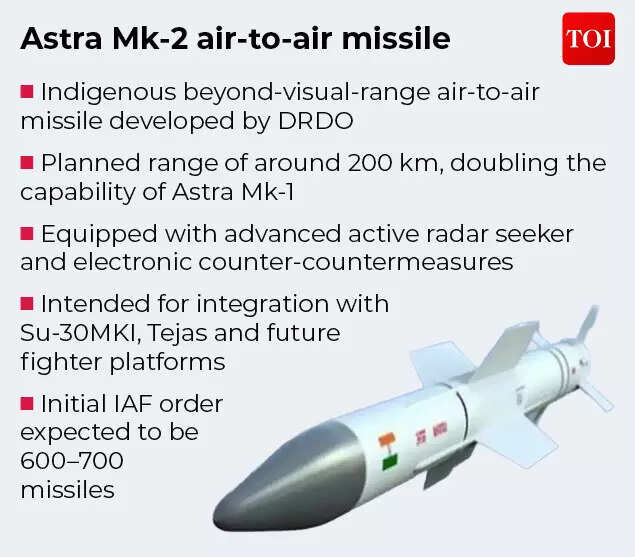
A fresh AoN was required because the tender resulted in a single-vendor situation. Despite that, the urgency of the requirement has pushed the government to move ahead.Mid-air refuellers dramatically extend the operational reach and endurance of fighter jets, transport aircraft and surveillance platforms. They are especially critical for deep-penetration strikes, rapid force mobilisation, and sustained air patrols over contested areas. With China operating a growing fleet of refuellers and Pakistan steadily upgrading its air force, the IAF’s refuelling gap had become increasingly stark.Astra Mk-2 and Mk-3: India’s push for long-range air dominanceTwo crucial indigenous missile projects cleared by the DAC focus on extending India’s air-to-air combat envelope. The first is the Astra Mark-2 air-to-air missile, whose range is being enhanced from the current 100 km to around 200 km.Developed by the Defence Research and Development Organisation (DRDO), Astra is India’s first indigenous beyond-visual-range air-to-air missile. It is already integrated with Su-30MKI fighters and is slated for deployment on Tejas and other platforms.

Astra Mk-2 air-to-air missile

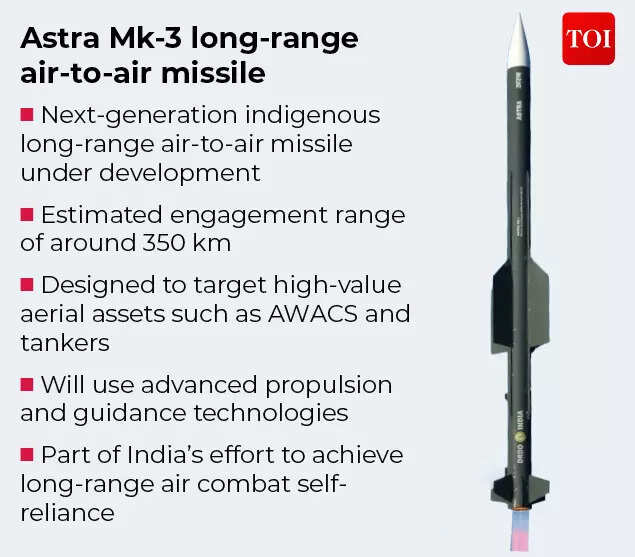
The IAF is expected to place an initial order for 600–700 Astra Mk-2 missiles. In parallel, work is underway on Astra Mark-3, which will have an estimated range of around 350 km, placing it firmly in the long-range interception category.

Astra Mk-3 long-range air-to-air missile

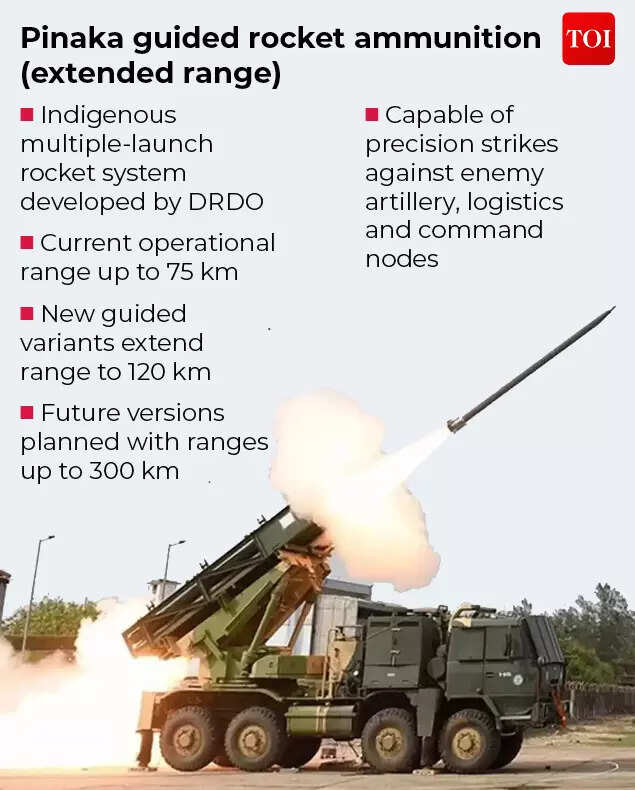
Indigenous long-range air-to-air missiles are increasingly important as aerial combat shifts from close dogfights to stand-off engagements, where detection, tracking and first-shot capability determine outcomes.Pinaka rockets: From 75 km to deep-strike artillery at 300 kmThe DAC’s nod for extending the range of Pinaka guided rocket ammunition marks a major leap in India’s artillery firepower. Pinaka multiple launch rocket systems currently fire rockets up to a range of 75 km, already giving them an edge over older systems.

Pinaka guided rocket ammunition

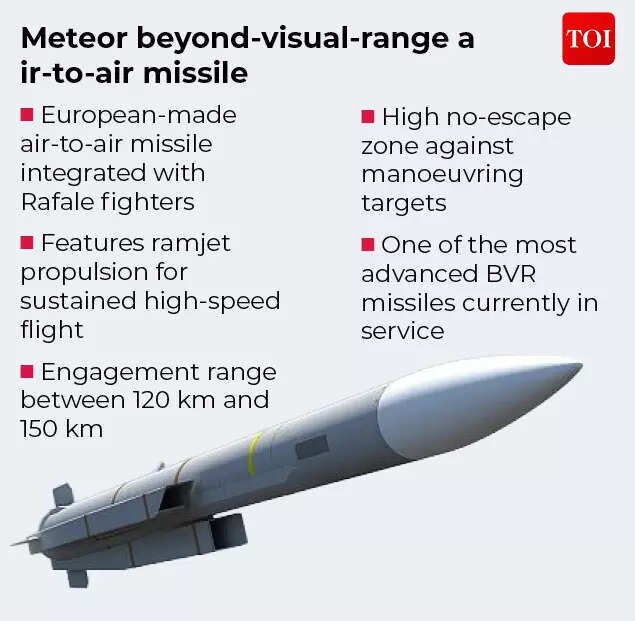
The new guided variants aim to extend that range to 120 km, with future plans to reach up to 300 km. According to officials, the 120-km version was successfully tested on Sunday, demonstrating improved accuracy and lethality.A 300-km Pinaka would fundamentally alter battlefield dynamics, allowing the Army to strike deep into enemy territory without relying on air power. Such capability is particularly relevant along mountainous borders, where terrain and weather often limit air operations.Pinaka’s modular design and compatibility with different warheads make it a versatile system for counter-battery fire, suppression of enemy air defences and destruction of logistics hubs.Meteor missiles and SPICE-1000 kits: Enhancing Rafale’s punchWhile indigenous systems form the core of the modernisation drive, the DAC also approved additional procurements of select foreign munitions to plug immediate gaps. This includes more Meteor beyond-visual-range air-to-air missiles for Rafale fighters.With a range of 120–150 km, Meteor is considered one of the most lethal air-to-air missiles in service today, featuring a ramjet propulsion system that maintains high energy throughout its flight.

Meteor beyond-visual-range a ir-to-air missile

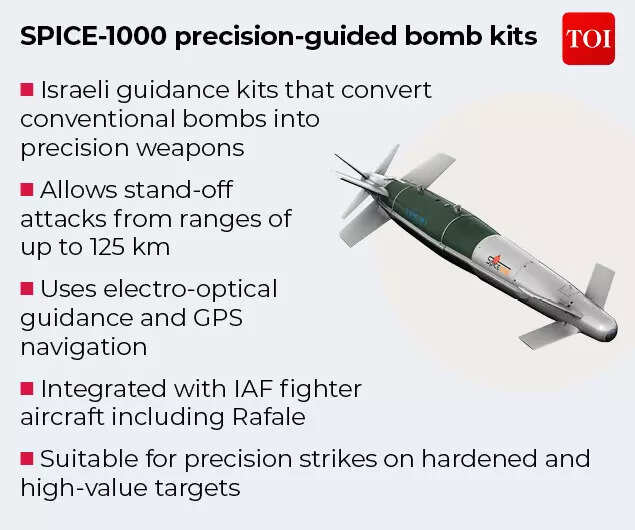
The council also cleared the acquisition of Israeli guidance kits for SPICE-1000 precision-guided bombs. These kits transform conventional bombs into long-range, highly accurate weapons capable of striking targets from up to 125 km away.

SPICE-1000 precision-guided bomb kits

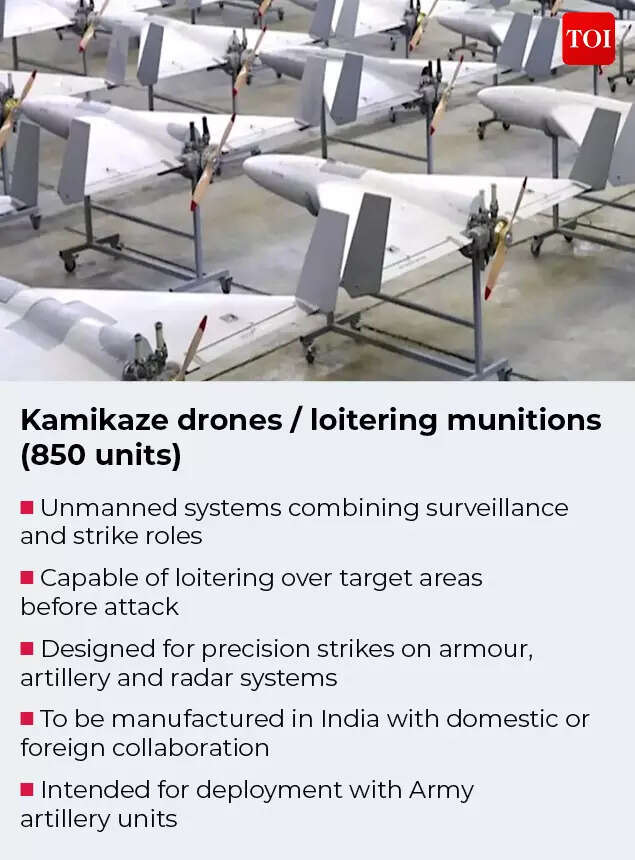
Together, these munitions significantly enhance the Rafale’s stand-off strike and air dominance capabilities, allowing it to engage high-value targets without entering heavily defended airspace.Kamikaze drones for the Army: Precision strikes and battlefield autonomyAmong the most telling approvals is the procurement of 850 kamikaze drones, or loitering munitions, for the Army’s new ‘Shaktibaan’ and ‘Divyastra’ artillery batteries at a cost of around Rs 2,000 crore.

Kamikaze drones/ loitering munitions (850 units)

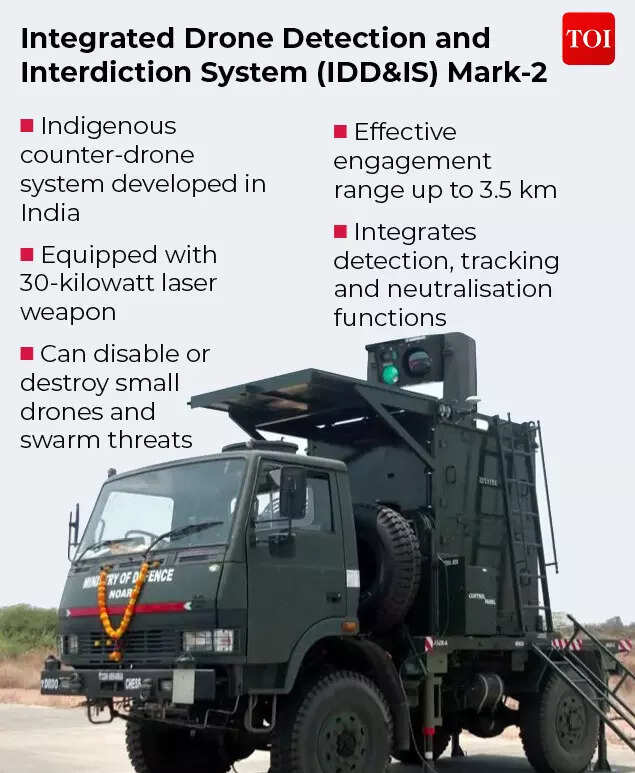
Loitering munitions combine surveillance and strike capabilities in a single platform. They can hover over a target area, identify enemy assets and then dive onto the target with an explosive payload.The drones approved under this programme will be manufactured in India, either by domestic firms or through foreign collaboration. Their induction reflects lessons drawn from conflicts such as Ukraine, where loitering munitions have been used extensively for precision strikes against armour, artillery and air defence systems.For the Indian Army, these drones provide a flexible, cost-effective tool for real-time battlefield engagement without risking pilots or high-value aircraft.Counter-drone laser systems: Preparing for swarm warfareThe DAC also cleared the indigenous Integrated Drone Detection and Interdiction System Mark-2. Equipped with 30-kilowatt lasers, the system can disable, degrade or destroy small remotely piloted aircraft and swarm drones at ranges of up to 3.5 km.

Integrated Drone Detection and Interdiction System (IDD&IS) Mark-2

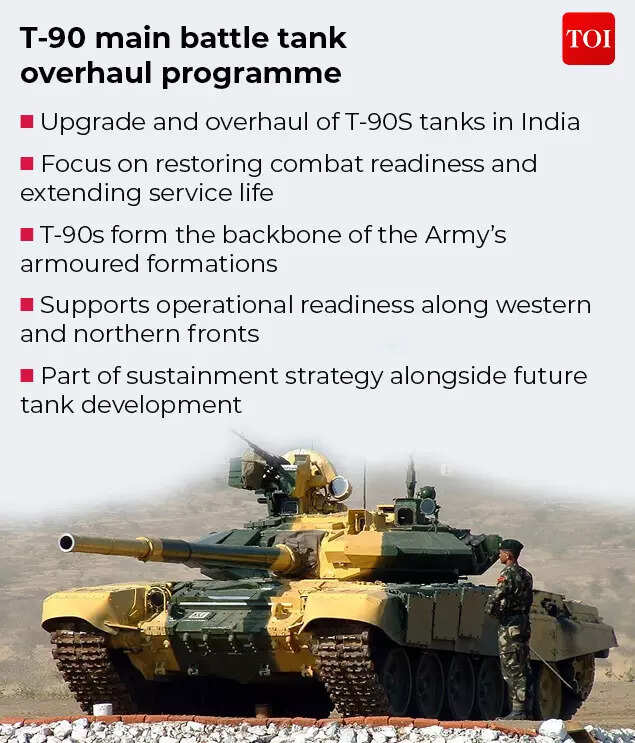
Drone swarms are increasingly viewed as a major threat, capable of overwhelming traditional air defence systems through sheer numbers. Laser-based systems offer a relatively low-cost, rapid-response solution to such threats.The IDD&IS integrates detection, tracking and neutralisation into a single platform, making it suitable for protecting air bases, ammunition depots and critical infrastructure. Its approval signals a recognition that future conflicts will involve contested airspace even at very low altitudes.Upgrades and overhauls: Mi-17 helicopters and T-90 tanksBeyond new acquisitions, the DAC approved overhauls of Mi-17 helicopters in Russia and T-90S main battle tanks in India. These overhauls aim to extend the service life and operational readiness of existing platforms.

Mi-17 helicopter overhaul programme

Mi-17 helicopters form the backbone of the IAF’s medium-lift fleet, supporting transport, casualty evacuation and special operations. T-90 tanks remain central to the Army’s armoured formations, particularly along the western front.

T-90 main battle tank  overhaul programme

Sustaining these platforms is critical even as newer systems are inducted, ensuring there are no capability gaps during the transition phase.Beyond missiles: Radars, simulators and secure communicationsSeveral smaller but vital projects were also cleared. These include low-level lightweight radars for detecting aerial threats, bollard-pull naval tugs for harbour operations, full mission simulators for Tejas fighter jets, and automatic take-off and landing recording systems for the IAF.

Bollard-pull naval tugs

The DAC also approved the acquisition of high-frequency software-defined radios to enable secure long-range communications across services. Such systems are essential for network-centric warfare, allowing forces to share data in real time.While less visible than missiles or drones, these enablers are critical for operational effectiveness, training and safety.

Low-level lightweight radar systems

Taken together, the Rs 79,000 crore modernisation push offers a clear snapshot of how India expects future wars to be fought. The focus is on layered air defence, long-range precision strikes, persistent surveillance, unmanned systems and electronic resilience.Rather than betting on a single platform or technology, the approvals reflect a systems-based approach, integrating missiles, drones, aircraft and sensors into a cohesive combat network. The blend of indigenous development and selective imports suggests a more mature procurement philosophy, driven by operational need rather than ideology.


Source link