Breaking News
CM Rekha Gupta inaugurates NDMC’s two-day flower festival | India News


CM Rekha Gupta inaugurates NDMC's two-day flower festival

NEW DELHI: Delhi chief minister Rekha Gupta on Tuesday inaugurated NDMC’s two-day Flower Festival at Connaught Place, drawing visitors to a colourful showcase of seasonal blooms and various floral-themed displays in the heart of the capital.The New Delhi Municipal Council (NDMC) opened its festival at Connaught Place’s Central Park. The event began with a brief ceremony attended by NDMC officials and citizens.Gupta congratulated NDMC officials, stating that the council has helped build Delhi’s green and positive image.“People used to go to Kashmir to get their pictures clicked with tulip flowers; now they don’t need to go there, central Delhi has ample tulips,” she said while inaugurating the flower festival.“Whenever there is a big event, whether it was G20 or the recent AI India Impact Summit, NDMC has done a commendable job of keeping the area clean and planting thousands of tulip flowers,” CM Gupta said.She also urged other civic agencies in Delhi to draw inspiration from NDMC on how to create more green spaces in the national capital.“NDMC has become a model civic council for creating green spaces in the country. We want all of Delhi to be this green and vibrant,” the CM said on the occasion.If the need arises, the Delhi government will send horticulture departments of other agencies to come and train under NDMC, she added.The CM added that the Delhi government will provide NDMC with all the necessary resources to help build greenery across the city.The festival features a range of flower arrangements, landscaped exhibits and horticultural presentations aimed at promoting urban gardening and green awareness.Families, office-goers and morning walkers were seen stopping by the park throughout the day to view the displays and take photographs, officials said.NDMC officials said the festival will continue on March 4, with the civic body expecting steady footfall over the two days as the venue remains open to the public.The annual event is part of NDMC’s efforts to encourage interest in horticulture while adding a splash of colour to the Connaught Place area during the spring season, the officials said.


Source link

Evening news wrap: Israel launches ground offensive in Lebanon; why India is silent over Khamenei’s demise & more | India News


Evening news wrap: Israel launches ground offensive in Lebanon; why India is silent over Khamenei's demise & more
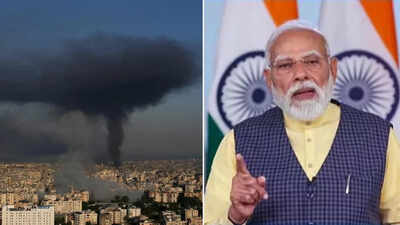
  • Explosions hit Tehran as Israel-Iran fighting intensified. Strikes targeted Beirut’s suburbs, Iran banned food exports, and the UN urged a probe into a reported airstrike on a girls’ school.
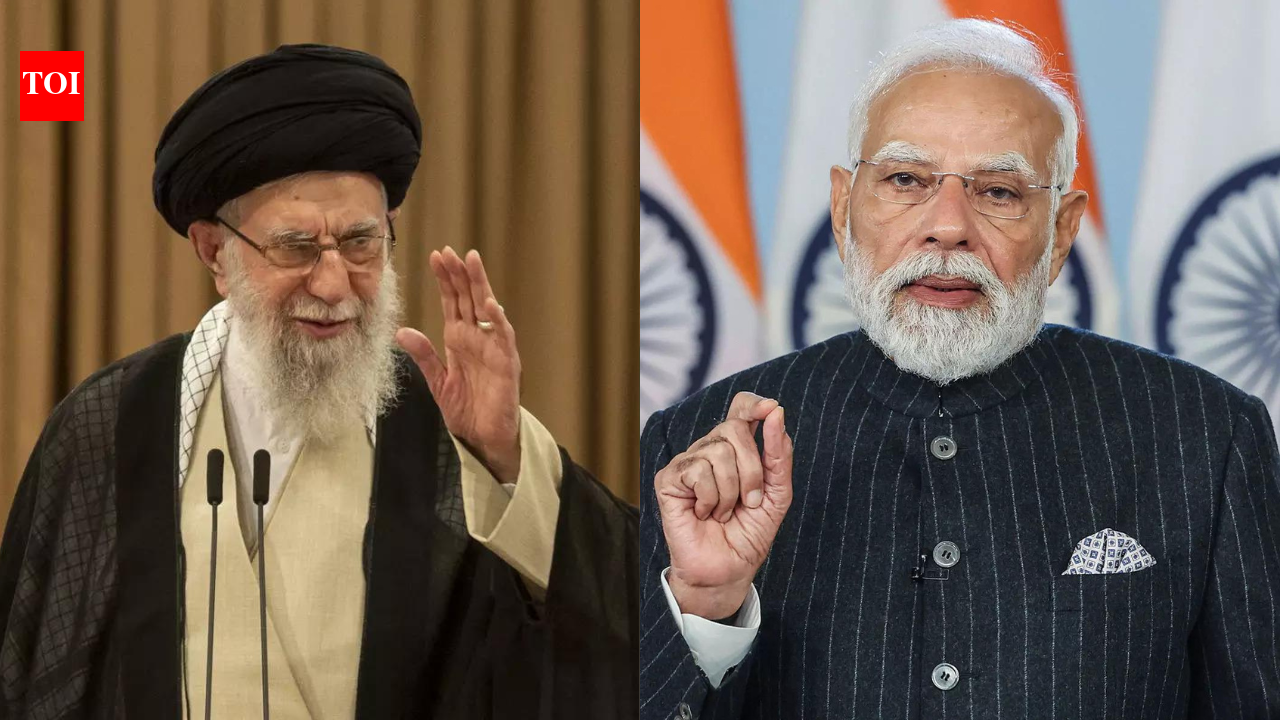
  • India’s measured response to Khamenei’s assassination, where it condemns Iranian Gulf strikes but not the killing, is because of prioritising energy security and diaspora welfare, drawing domestic criticism despite past rebukes of Iran’s interference.
  • Three Indian seafarers were killed and one injured on foreign-flagged vessels amid escalating US-Israel-Iran hostilities. India’s DGS has heightened maritime security monitoring and issued safety advisories.
  • Middle East tensions erased Rs 11 lakh crore from Indian markets as Sensex and Nifty fell over 2.5 per cent. Analysts expect near-term volatility but remain optimistic about long-term fundamentals.
  • Sanju Samson’s unbeaten 97 against West Indies capped a remarkable comeback after being benched early in the T20 World Cup, fulfilling Rohit Sharma’s reassurance to stay patient.

Here are the top five updates from the day:

Israel launches ground offensive in Lebanon; ‘Hezbollah will pay’, says Netanyahu

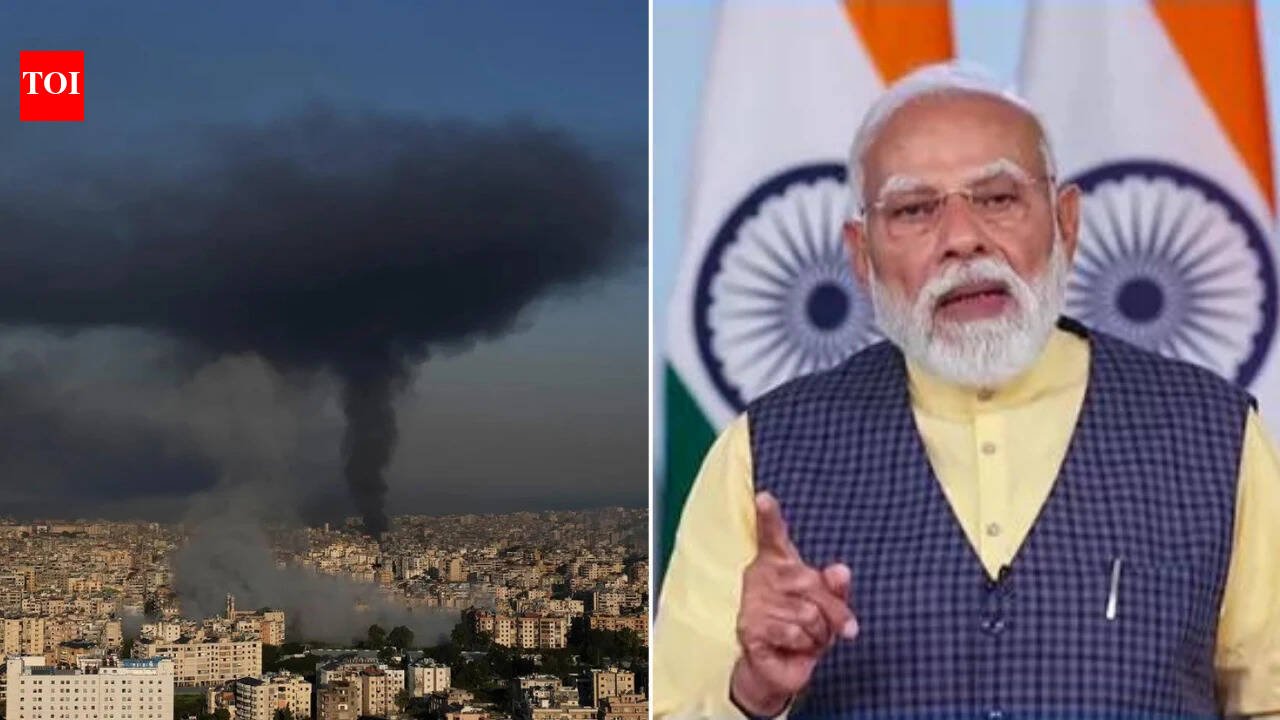
Loud explosions were reported in central Tehran as the Israel-Iran war entered its fourth day. Israeli airstrikes struck Beirut’s southern suburbs, reportedly targeting Hezbollah positions. Iran banned food and agricultural exports to safeguard domestic supplies. Meanwhile, the UN human rights chief called for an impartial investigation into a reported strike on a girls’ school in Minab, amid conflicting claims over responsibility.Read the full story

From CAA to Kashmir: Why India is silent over Khamenei’s demise

India has refrained from condemning the reported assassination of Iran’s Supreme Leader Ali Khamenei, and has called for restraint and dialogue, while criticising Iranian strikes on Gulf nations. The calibrated response has sparked domestic political backlash, with Sonia Gandhi questioning the government’s silence. However, New Delhi cites the move to be in favour of national interests, including energy security, diaspora safety and Gulf partnerships, as tensions escalate across West Asia.Read the full story

Three Indian seafarers killed amid Middle East tensions; Centre issues advisory

Three Indian seafarers were killed and another injured while serving on foreign-flagged vessels in the Middle East amid intensifying US-Israel-Iran conflict. The Directorate General of Shipping is closely monitoring maritime security in the Gulf region, warning of missile, drone and electronic threats. Authorities have activated enhanced surveillance, coordinated with naval and diplomatic agencies, and formed a quick response team to support affected crews and families.Read the full story

How US-Israel-Iran war wiped out Rs 11 lakh crore from stock market

Escalating US-Israel-Iran tensions wiped out Rs 11 lakh crore in market value as Sensex and Nifty dropped over 2.5 per cent, breaching key support levels. Rising crude prices, a spike in India VIX, and safe-haven demand for gold signalled heightened uncertainty. Analysts foresee continued short-term volatility driven by geopolitical headlines, but maintain confidence in India’s strong macro fundamentals and long-term growth outlook.Read the full story

‘Dukhi mat ho bhai’: Rohit Sharma’s hug, 4 words that changed Sanju Samson’s World Cup

Sanju Samson silenced critics with a match-winning unbeaten 97 against the West Indies in the T20 World Cup, sealing India’s highest successful chase in tournament history. Initially benched despite being first-choice opener, Samson drew confidence from Rohit Sharma’s encouragement. After inconsistent performances and setbacks, he seized his opportunity, guiding India into the semifinals and completing a memorable personal comeback.Read the full story


Source link

US-Iran war: PM Modi speaks to leaders of Oman and Kuwait, discusses security of Indians | India News


US-Iran war: PM Modi speaks to leaders of Oman and Kuwait, discusses security of Indians

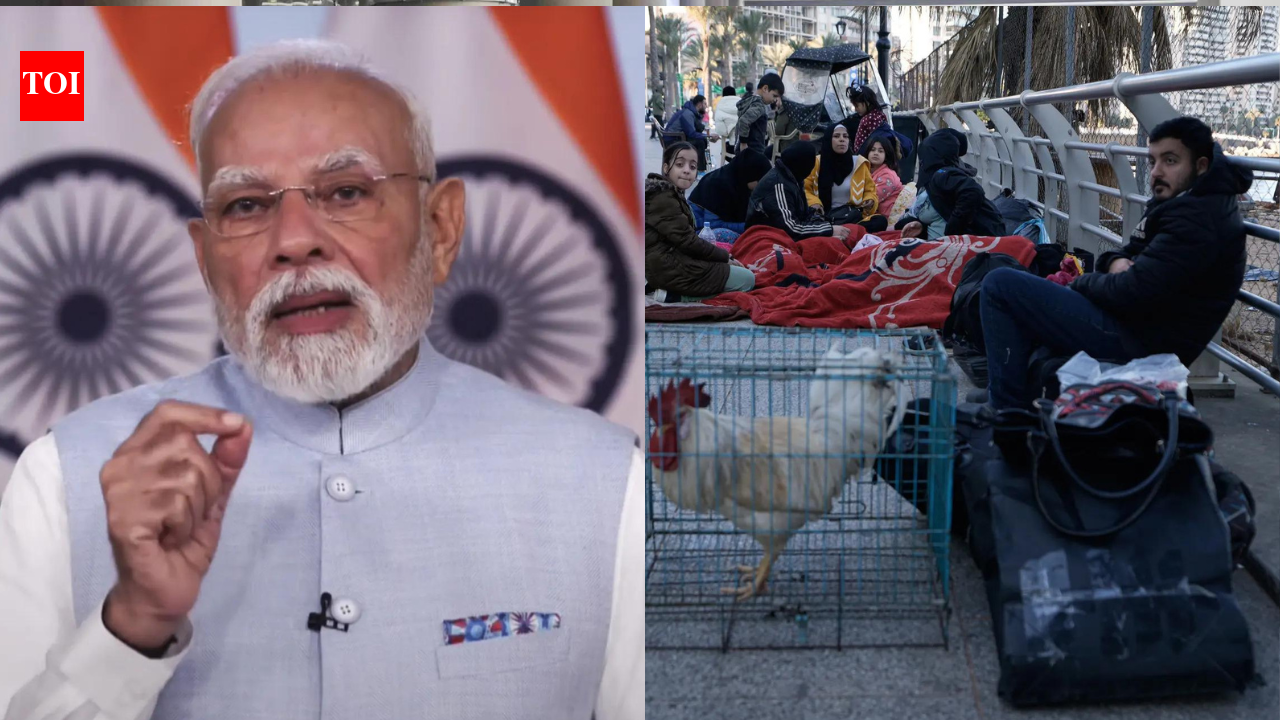
NEW DELHI: Prime Minister Narendra Modi on Tuesday spoke to the Sultan of Oman and the Crown Prince of Kuwait amid escalating tensions in Middle East, expressing concern over recent attacks and reviewing the security of the Indian community in the two Gulf nations.PM Modi held a phone conversation with Sultan Haitham bin Tarik of Oman. He also spoke with Kuwait’s Crown Prince Sheikh Sabah Al-Khaled Al-Hamad Al-Mubarak Al-Sabah.During both discussions, the Prime Minister conveyed India’s concern at the attacks in the respective countries and discussed the welfare and security of Indians residing there.The outreach is part of India’s ongoing diplomatic engagement with Gulf partners following the recent escalation in the region, and as the conflict between the US and Iran has widened across the regionWith a large Indian diaspora living and working across the Gulf, New Delhi has been closely monitoring the situation and maintaining contact with regional leadership to ensure their safety.The ministry of external affairs (MEA) said in a statement that India had expressed “deep concern” at the commencement of the conflict in Iran and the Gulf region on February 28, 2026, urging all sides to exercise restraint, avoid escalation and prioritise the safety of civilians.“Unfortunately, in the holy month of Ramadan, the situation in the region has deteriorated significantly and continuously,” the MEA said, noting that the conflict has intensified and spread to other nations, disrupting normal life and economic activity.India asserted that nearly one crore Indian citizens live and work in the Gulf region, making their safety and well-being a priority. “We cannot be impervious to any development that negatively affects them,” the MEA said, adding that India’s trade and energy supply chains pass through the region and any major disruption would have serious economic consequences.India also reiterated its opposition to attacks on merchant shipping, stating that some Indian nationals have lost their lives or are missing in recent days due to such incidents.In this backdrop, New Delhi “strongly reiterates its call for dialogue and diplomacy” and has called for an early end to the conflict. The government expressed grief over the lives lost.Indian embassies and consulates in affected countries are in close contact with nationals and community organisations, issuing advisories and extending assistance to those stranded. The MEA said the Prime Minister and external affairs minister have been in touch with counterparts in the region and that the government will continue to monitor the evolving situation and take decisions in the national interest.


Source link

India urges calls for early end to Iran-Israel conflict with ‘dialogue & diplomacy’; flags risk for Indians & trade | India News


India urges calls for early end to Iran-Israel conflict with 'dialogue & diplomacy'; flags risk for Indians & trade

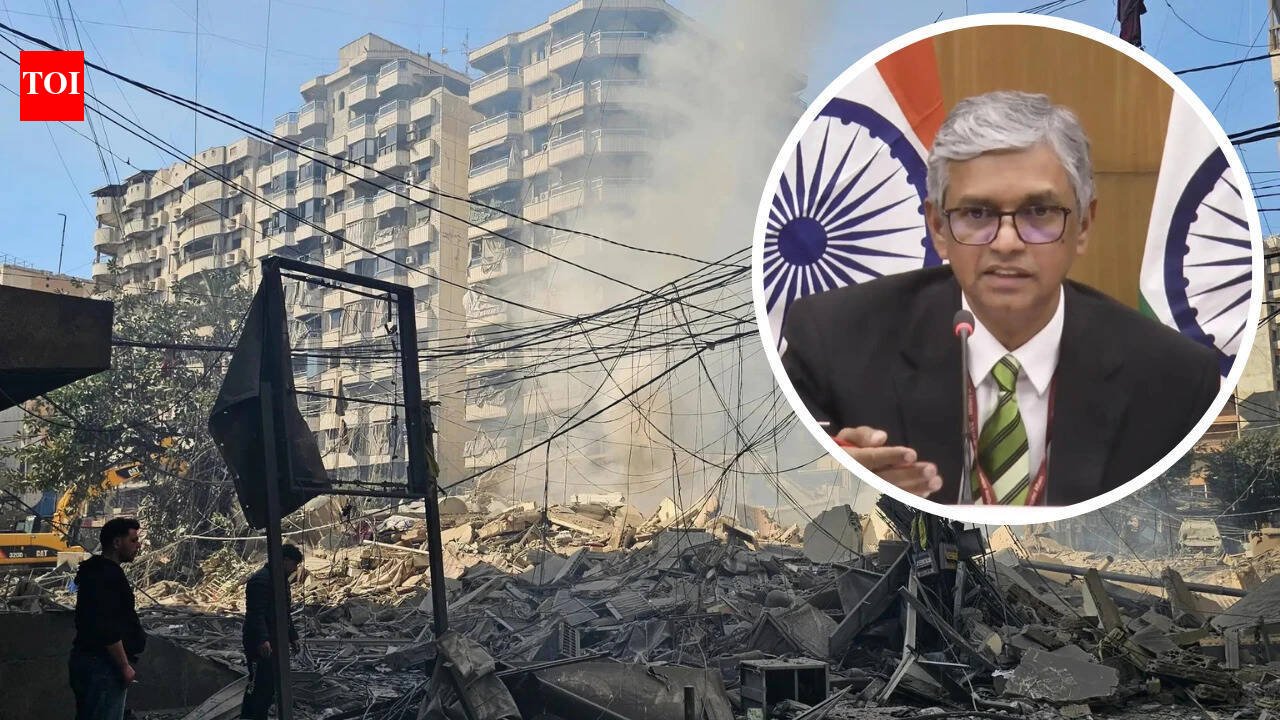
NEW DELHI: India on Tuesday reiterated its call for an “early end to the conflict” in Iran and the wider Gulf region, expressing deep concern over the rapid escalation of hostilities and the mounting civilian toll. The ministry of external affairs (MEA) said the situation, which began deteriorating from February 28, poses serious risks to regional stability, international trade, and the safety of nearly one crore Indian nationals living and working in the Gulf.“India strongly reiterates its call for dialogue and diplomacy. We raise our voice clearly in favour of an early end to the conflict,” the MEA said in an official statement.

US-Israel-Iran War: Why Has India Not Condemned Khamenei’s Death Yet?

According to the ministry, the government is “closely monitoring the evolving situation” and has been in touch with regional governments as well as other key international partners. Both Prime Minister Narendra Modi and external affairs minister S Jaishankar have been speaking with their counterparts to assess developments and coordinate efforts.Jaishankar, in a post on X, shared about his dialogue with the EU’s high representative for foreign affairs and security policy, Kaja Kallas, on the ongoing conflict in Iran and the Gulf. He wrote, “Had a telecon with EU HRVP Kaja Kallas. Our discussions focused on the ongoing conflict in Iran and the Gulf.”PM Modi also spoke to two important leaders from the Gulf region on Tuesday. He had a phone call with Sultan of Oman, his majesty Sultan Haitham bin Tarik and the crown prince of Kuwait HH Sheikh Sabah Al-Khaled Al-Hamad Al-Mubarak Al-Sabah.During both discussions, the Prime Minister expressed concern at the attacks in the respective countries and discussed the welfare and security of the Indian community residing there.The MEA statement also noted that Indian embassies and consulates in the affected countries are actively assisting citizens on the ground.“They have also extended all possible help to those stranded by the conflict,” it said, adding that advisories and support networks are being updated regularly to ensure the safety and welfare of expatriates.India’s concerns extend beyond the welfare of its citizens. The MEA highlighted grave implications for trade and energy supply chains, noting that disruptions in the Gulf could severely affect India’s economy. The statement also condemned attacks on commercial vessels, after reports that some Indian crew members had been killed or gone missing in recent days.“As a country whose nationals are prominent in the global workforce, India is also firmly opposed to attacks on merchant shipping,” the ministry added.Recalling that it had earlier expressed “deep concern” when the conflict began on February 28, India underlined that it had urged “all sides to exercise restraint, avoid escalation and prioritise the safety of civilians.” The ongoing violence, it said, has only deepened its worry as the conflict has now spread to other nations during the holy month of Ramadan.Describing itself as a “proximate neighbour with critical stakes” in the region’s security and stability, India said it would continue to act decisively “in the national interest” while advocating peace and diplomacy.


Source link

From CAA criticism to Kashmir remark: History that frames India’s silence over Khamenei’s demise | India News


From CAA criticism to Kashmir remark: History that frames India’s silence over Khamenei’s demise

NEW DELHI: India has refrained from condemning the assassination of Iran’s supreme leader Ali Khamenei, even as it has criticised Iranian strikes on Gulf countries and called for restraint, dialogue and de-escalation in West Asia.The calibrated response has drawn sharp political reactions at home, with Congress Parliamentary party chairperson Sonia Gandhi terming the government’s silence an “abdication” rather than neutrality. In an opinion piece in The Indian Express, she said India’s lack of a clear response to the killing “signals tacit endorsement of this tragedy” and called for a discussion in Parliament.

Govt response: Restraint, not endorsement

The ministry of external affairs (MEA) has limited its public position to urging “restraint, dialogue and de-escalation.” Prime Minister Narendra Modi has spoken to leaders across the Gulf, including Saudi Arabia, the UAE, Bahrain and Jordan, condemning attacks on their territories and emphasising the safety of the nearly 10 million Indians living in the region.India has not condemned the US-Israel strikes that reportedly killed Khamenei, nor has it issued condolences. Government sources indicate that sovereign responses are guided by national interest, including energy security, diaspora welfare and strategic partnerships in the Gulf.

A history of public criticism

Khamenei had repeatedly commented on India’s internal matters over the past decade, prompting diplomatic protests from New Delhi.In 2017, he called on the Muslim world to support what he described as “oppressed Muslims of Kashmir.” After the abrogation of Article 370 in August 2019, he publicly urged India to adopt a “just policy” on Kashmir, following which the MEA summoned the Iranian envoy.During the January 2020 debate over the Citizenship Amendment Act (CAA), Iran’s parliament speaker criticised the law as “anti-Muslim discrimination,” remarks India rejected as interference. In March 2020, amid the Delhi riots, Khamenei tweeted that India should “confront extremist Hindus,” described the violence as a “massacre of Muslims,” and warned of “isolation from the world of Islam,” using the hashtag #IndianMuslimsInDanger. The MEA again summoned the Iranian ambassador.As recently as September 2024, Khamenei placed India alongside Myanmar and Gaza in a social media post, drawing an official response from the MEA calling the remarks “misinformed and unacceptable.”

Gulf priorities and strategic alignment

India’s sharper condemnation has been directed at Iranian strikes targeting Gulf states, including Saudi Arabia and the UAE, countries that are key energy suppliers and host large Indian communities. PM Modi, in separate conversations, stressed the importance of restoring regional peace and thanked Gulf leaders for ensuring the well-being of Indians.External affairs minister S Jaishankar also spoke to counterparts from all six GCC nations after hostilities escalated, underscoring India’s stakes in regional stability.India’s strategic engagement with the Gulf has deepened significantly over the past decade, spanning energy, defence, maritime security and connectivity. This has coincided with a relatively cautious approach towards Tehran.

Past voting record on Iran

India’s Iran policy has shifted over time. Between 2005 and 2009, the Congress-led UPA government voted against Iran at the International Atomic Energy Agency (IAEA) on three occasions during negotiations over the India-US civil nuclear agreement. In 2022, the NDA government abstained on a similar IAEA resolution concerning Iran’s nuclear programme.

Political divide at home

Sonia Gandhi argued that the assassination of a sitting head of state during ongoing negotiations marks a “grave rupture in contemporary international relations” and said India’s response raises “serious doubts” about the credibility of its foreign policy.The government has not directly responded to her remarks. Officially, India maintains that it has consistently called for peace and stability in MIddle East.With tensions escalating across the region following coordinated US-Israeli strikes and Iranian retaliation, New Delhi’s public messaging remains measured, condemning attacks on its Gulf partners, avoiding direct comment on Tehran’s leadership, and reiterating its position in favour of diplomacy.


Source link

Two titans, two models: How Jyoti Basu & Mamata Banerjee defined Bengal politics | India News


Two titans, two models: How Jyoti Basu & Mamata Banerjee defined Bengal politics
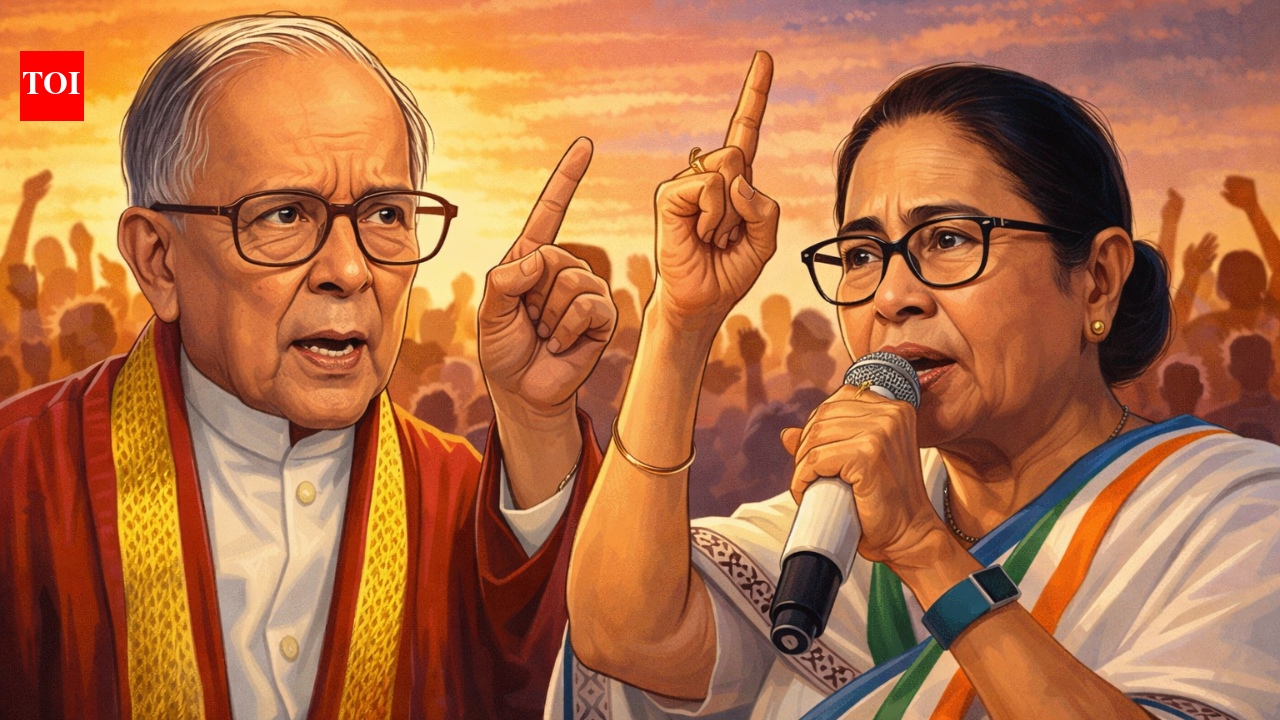
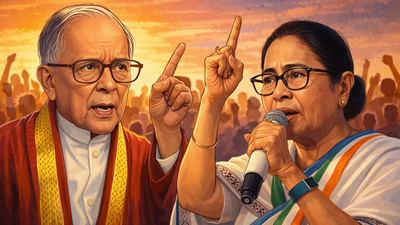
This image is used for representation purpose only (AI-generated)

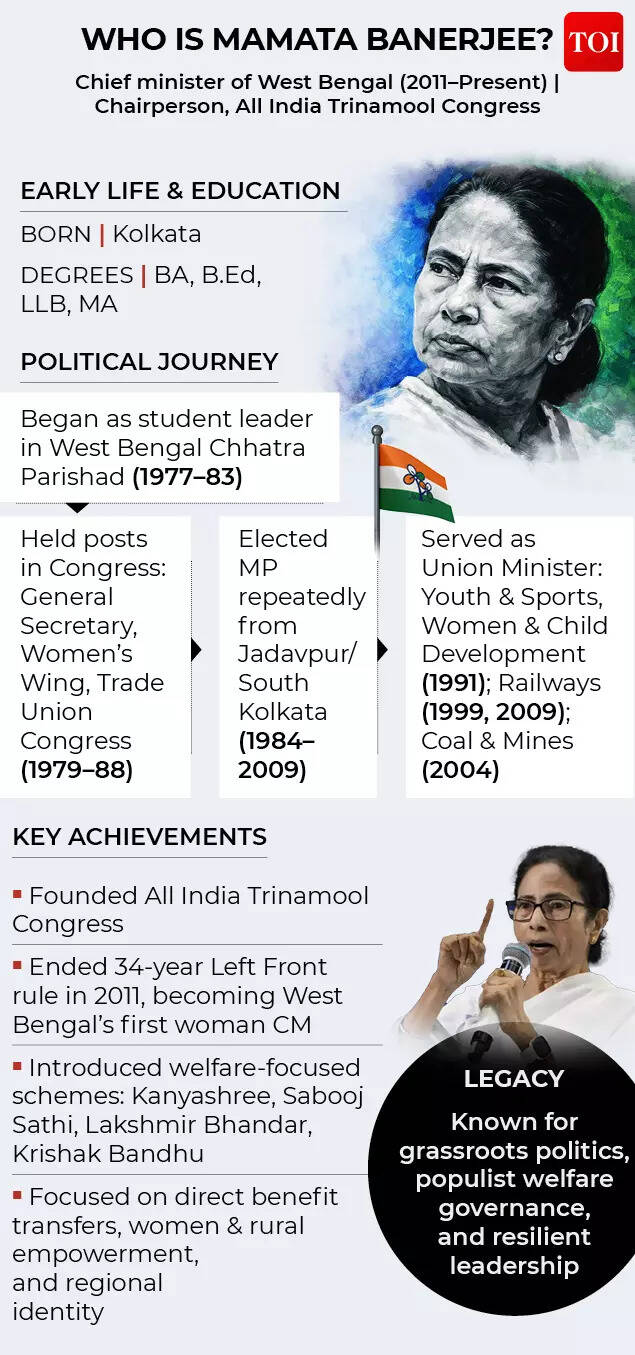
On 20 May 2011, it was a humid summer afternoon in Kolkata. Crowds gathered outside Raj Bhavan as Mamata Banerjee took oath as the first woman chief minister of West Bengal. The moment marked the end of a 34-year Left Front rule and the beginning of a new political chapter.Having visited the Kalighat Kali Temple earlier that day, Mamata arrived at the Governor’s residence shortly before 1 pm. Dressed in her trademark white cotton sari with a blue border and a tricolour uttariya draped over her shoulders, she took the oath in the name of Ishwar in Bengali at exactly 1.01 pm, a time chosen as auspicious by her family priest.

Mamata Banerjee Vows Bengal Poll Win Despite Voter Deletions, Abhishek Claims BJP Won’t Pass 50 Seats

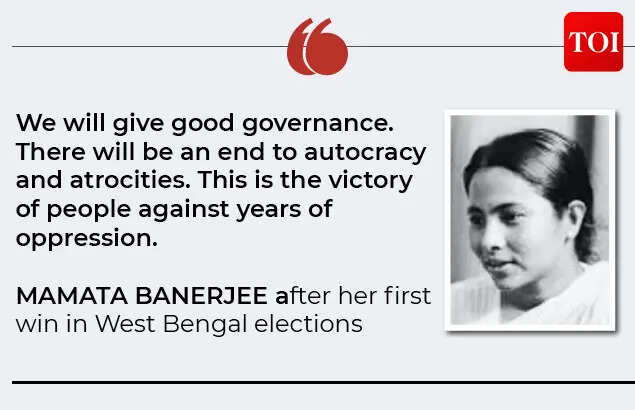
Accusing the communists of failing West Bengal’s 90 million people and contributing to economic decline, she declared, “We will give good governance. There will be an end to autocracy and atrocities. This is the victory of people against years of oppression.”
.

.

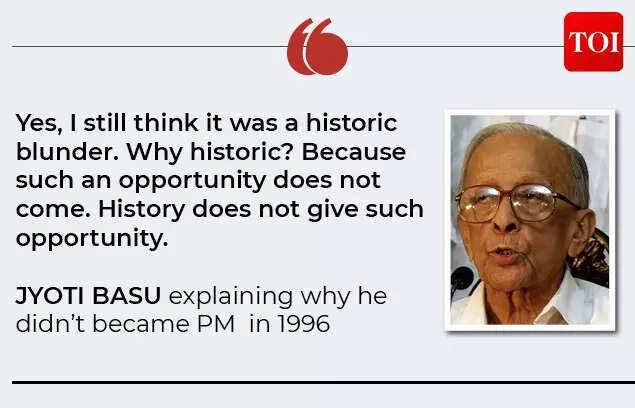
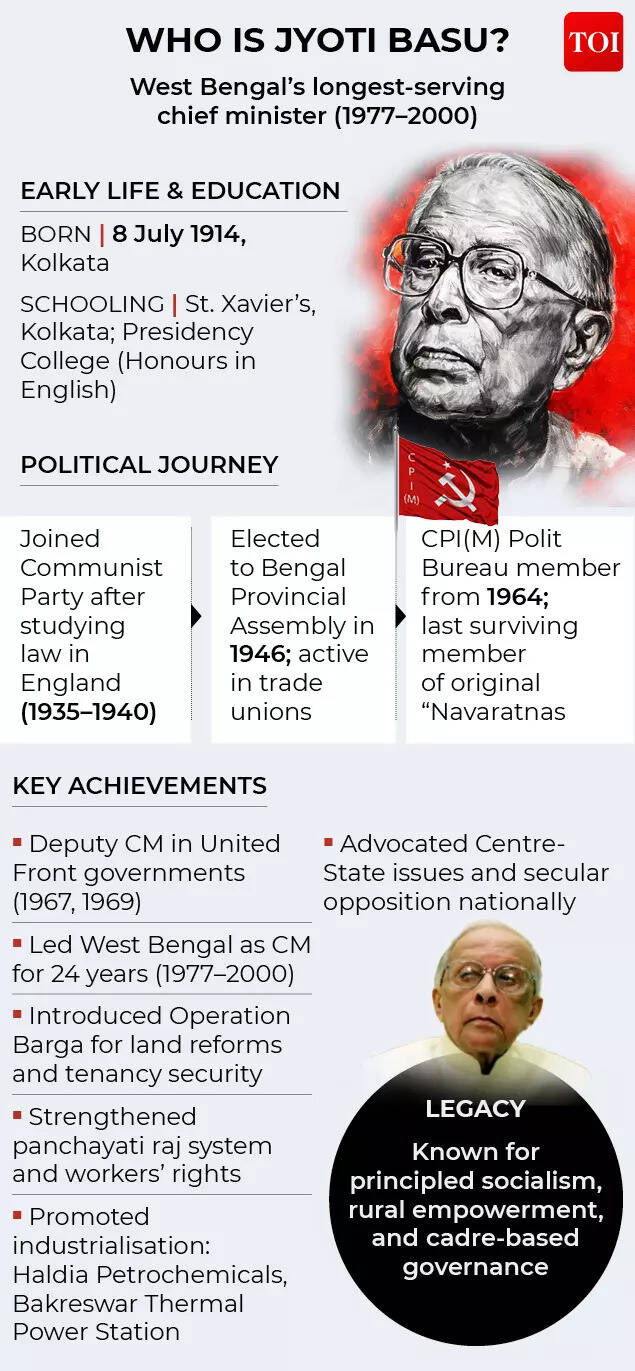
For over three decades, West Bengal had been governed by the Left Front, first under Jyoti Basu from 1977 to 2000 and then under Buddhadeb Bhattacharjee from 2000 to 2011. Bhattacharjee sought to industrialise the state and attract private investment, but the controversies over land acquisition in Singur and Nandigram weakened the Left’s rural base, paving the way for Mamata Banerjee’s decisive victory in 2011.It was, however, Basu who had built that formidable political edifice in the first place. Serving as chief minister for 23 consecutive years, Basu led the Left Front to repeated electoral victories, establishing one of the longest uninterrupted elected governments.His tenure was defined by sweeping land reforms such as Operation Barga, which strengthened tenancy rights and by the deepening of the three-tier panchayati raj system that decentralised power to rural bodies. In 1996, he was proposed as Prime Minister by the United Front alliance, but the CPI(M) declined to join the government, a decision Basu later described as a “historic blunder.”
.

.

As West Bengal gears up for the 2026 Assembly elections, understanding the state’s political grammar requires revisiting the legacies of two of its longest-serving chief ministers, Jyoti Basu and Mamata Banerjee, whose contrasting models of governance have shaped the state’s political and economic trajectory.

Model I: Structural land reform and cadre consolidation under Jyoti Basu (1977–2000)

When Jyoti Basu assumed office in 1977, West Bengal was grappling with political instability, food shortages and industrial decline. Over the next 23 years, he built a governance framework anchored in structural agrarian reform and decentralised rural power.

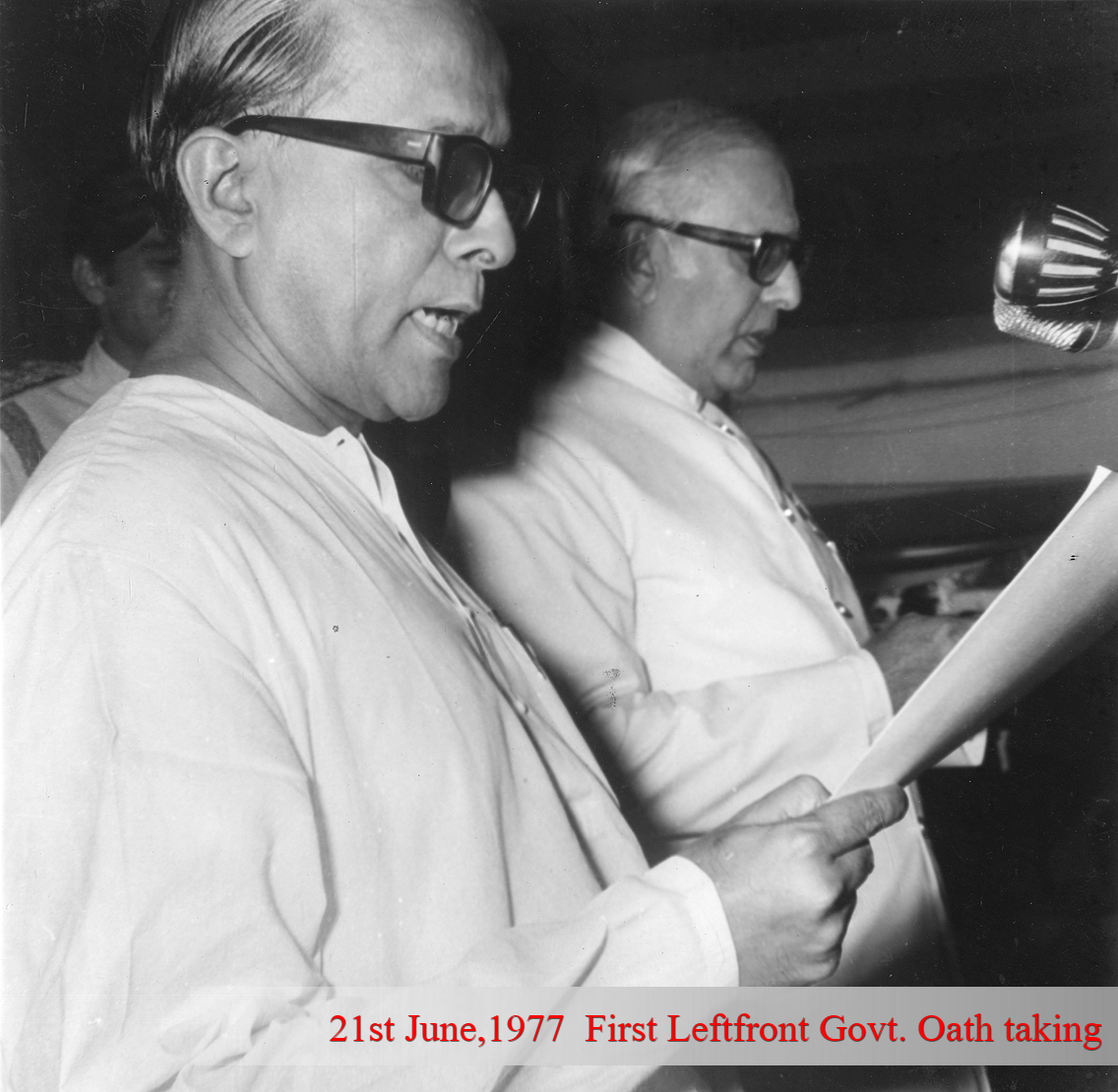
Jyoti Basu taking oath in 1977 (Image/Jyoti Basu Centre for Social Studies and Research)

A defining pillar of his tenure was Operation Barga, a land reform programme that recorded and legally protected sharecroppers, significantly enhancing tenancy security. By the early 1990s, nearly 1.5 million bargadars (sharecroppers) had been registered and millions of acres of ceiling-surplus land were redistributed among the rural poor. Alongside land reforms, Basu strengthened the three-tier panchayati raj system, devolving administrative and financial powers to elected rural bodies. However, Basu’s tenure also faced persistent criticism over industrial stagnation during the 1980s and early 1990s. While land reforms improved rural equity, industrial growth lagged behind western and southern states. Frequent labour strikes and militant trade unionism during the 1980s contributed to the perception of Bengal as industry-unfriendly, leading to companies moving out of the state and slower private investment. By the late 1990s, questions about job creation, urban infrastructure and economic diversification were becoming more pronounced. By the time Basu stepped down in 2000, the Left’s political machinery remained formidable, but the economic anxieties were visible. His successor, Buddhadeb Bhattacharjee, attempted to correct this imbalance through rapid industrialisation, but failed to do so.

Model II: Income support and welfare-driven rural stabilisation under Mamata Banerjee (2011–Present)

When Mamata Banerjee took office in 2011, she inherited a countryside once reshaped by redistribution but unsettled by industrial conflict. Unlike Basu’s structural reform approach, her governance strategy leaned heavily on targeted welfare schemes, direct benefit transfers and symbolic political messaging centred around “Maa, Mati, Manush.”

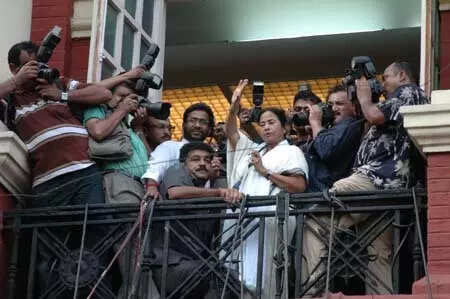
Mamata Banerjee's first day at Writer's building (Image/AITC)

One of her first major decisions was the return of acquired farmland in Singur to unwilling farmers, a move that symbolically reversed the previous government’s industrial land acquisition policy. Over time, her administration shifted from structural land reform to direct financial assistance, most notably through schemes such as Krishak Bandhu. Under the programme, farmers and sharecroppers receive Rs 10,000 per acre annually in two instalments. The scheme now covers over 1.09 crore beneficiaries, with Rs 2,930 crore disbursed in the latest cycle directly into bank accounts. Since its launch in 2019, more than Rs 24,000 crore has been allocated under the scheme. It also provides Rs 2 lakh as social security assistance to families of deceased farmers, benefiting nearly 1.46 lakh households.Where Basu’s reforms focused on strengthening agrarian structures, Banerjee’s model prioritised in providing stability and income support.

Welfare architecture: Institutional reforms vs targeted cash transfers

Under Jyoti Basu: Institutional and structural welfareUnder Jyoti Basu, welfare was embedded within structural reform rather than delivered through direct cash transfers. The emphasis was on land redistribution, tenancy security and decentralised governance through empowered panchayats. Rural employment, agricultural credit expansion and food distribution systems were strengthened through state-backed institutions rather than personalised beneficiary schemes.

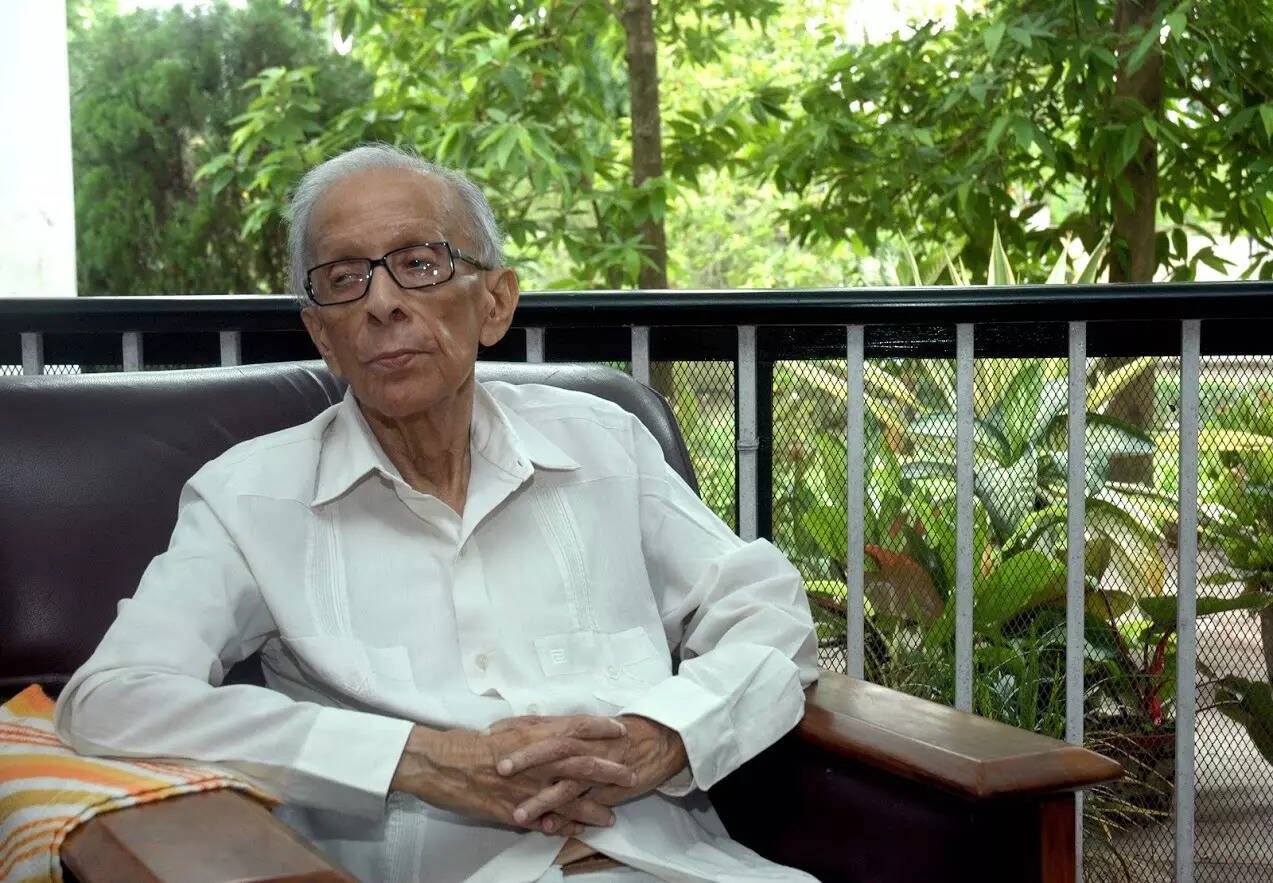
Jyoti Basu

Education and public health spending expanded gradually during the Left Front years, with a focus on government schools, primary healthcare centres and rural outreach. The model relied heavily on institutional delivery and cadre-driven implementation. Welfare, in this framework, was tied to class-based redistribution and long-term social restructuring rather than immediate financial assistance.Under Mamata Banerjee: Direct benefit transfers and beneficiary-centric governanceIn contrast, Mamata Banerjee built a welfare architecture centred on direct financial assistance and identifiable beneficiaries. Her administration rolled out a series of targeted schemes aimed at women, farmers, students and vulnerable households.

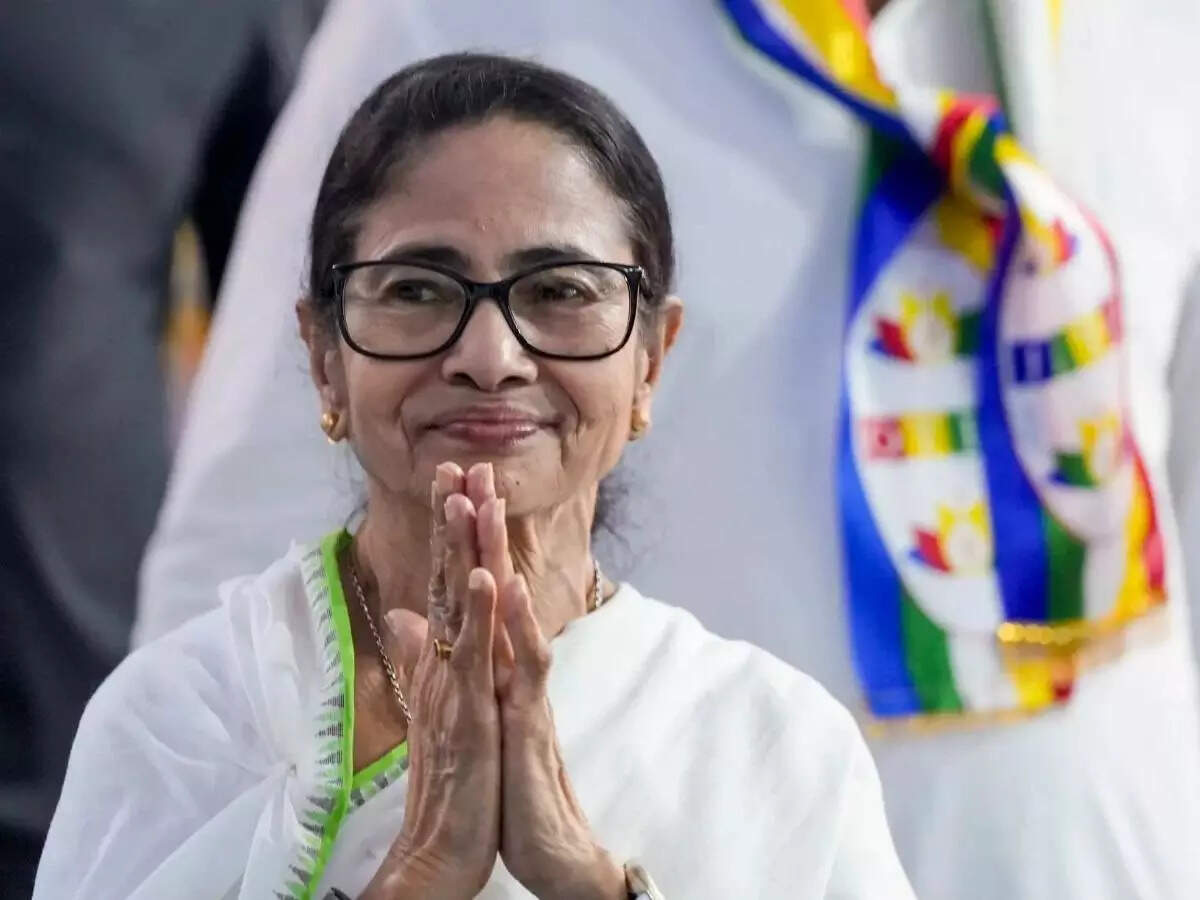
Mamata Banerjee (Image/PTI)

Programmes such as Kanyashree (financial support for girls’ education), Sabooj Sathi (bicycles for students), Lakshmir Bhandar (monthly cash support for women) and Krishak Bandhu (income support for farmers) reoriented the state’s welfare strategy toward predictable cash flows and household-level impact. Benefits were increasingly transferred directly into bank accounts, strengthening the government’s connection with individual beneficiaries.

Left front vs TMC: Education and health models

Jyoti Basu’s era: Expansion in education infrastructure and healthcare restructuringUnder successive Left Front governments led initially by Jyoti Basu, West Bengal saw significant expansion in education infrastructure. Literacy rates rose from 38% in 1977 to 68% in 2001 and further to 77% in 2011.
.

.

In healthcare, the Left initially attempted systemic restructuring. A rural three-tier health model was introduced, linking primary health centres to district hospitals and state-run medical colleges as referral institutions.Infrastructure expanded and budgets were allocated. Infant mortality declined at one of the fastest rates in the country during the latter years of the Left. The seventh Left Front government also launched health insurance schemes covering around 25 lakh workers in the unorganised sector.Mamata Banerjee’s era: Subsidy-driven access and household coverageUnder Mamata Banerjee, education and health policy shifted toward direct household-level support and universal coverage schemes. In education, programmes such as Sikshashree (textbook grants) and Sabooj Sathi (distribution of bicycles to students) aimed to reduce dropout rates and improve mobility for rural students, particularly girls. The emphasis moved from expanding institutions to improving access and retention through targeted benefits.In healthcare, the flagship Swasthya Sathi scheme provides cashless treatment coverage of up to Rs 5 lakh per family and reportedly covers over 2.5 crore households. The scheme positions the state as a primary guarantor of hospital expenses for lower-income families, supplementing national health programmes. Immunisation coverage and key health indicators have continued to improve, supported by both state initiatives and central schemes.

Industry, infrastructure and economy: Structural shifts across two eras

Left Front era: Industrial slowdown and late pragmatismUnder Jyoti Basu, the Left Front inherited an industrial base concentrated in Kolkata, Durgapur, Howrah, Hooghly and the mineral-rich western belt. However, its early industrial policy (1978) prioritised small-scale and cottage industries to generate employment and curb the dominance of large business houses and multinational corporations. New foreign investment was effectively discouraged.Labour militancy, frequent strikes and a perception of an adversarial business climate contributed to industries relocating to western and southern states. Private investment slowed, and Bengal’s share in national industrial output declined over time.A shift came in 1994 when the Left Front announced a liberalised industrial policy welcoming private and foreign investment. Priority sectors included petrochemicals, IT, steel, textiles and tourism. TMC era: Investment outreach, IT expansion and fiscal balancingWhen Mamata Banerjee assumed office in 2011, her government sought to reposition West Bengal as investment-friendly while distancing itself from the contentious land acquisition policies of the late Left period.
.

.

A major recent step was the introduction of the Revocation of West Bengal Incentive Schemes and Obligations like Grants and Incentives Bill, 2025, which scrapped the 2001-era incentive structure introduced under the Left.Her administration has aggressively promoted IT and services. Salt Lake Sector V, often dubbed Kolkata’s “Silicon Valley” hosts around 2,800 IT and ITeS firms, employing roughly 2 lakh professionals as of 2023. The state has also pushed mining projects in coal and shale gas, green technology initiatives, tourism expansion and infrastructure upgrades, including metro rail extensions and airport proposals.

Mamata Banerjee vs Jyoti Basu: Electoral report card

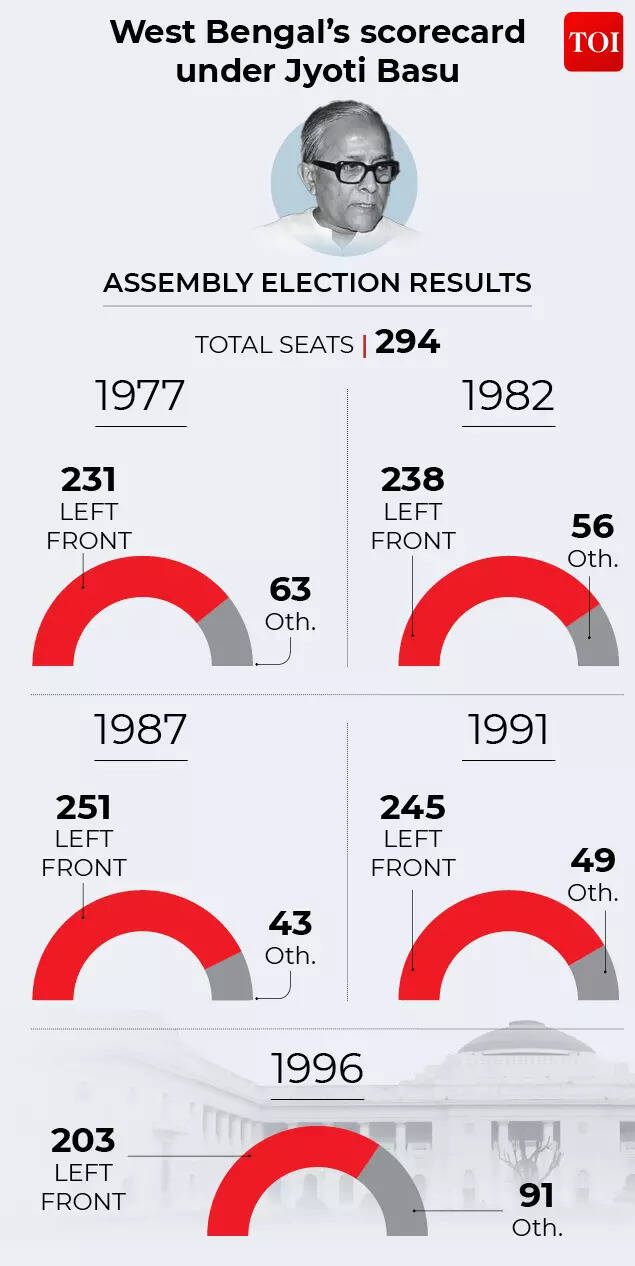
Under Jyoti Basu, the Left Front established one of the longest uninterrupted electoral reigns in Indian politics. Between 1977 and 2000, Basu led the coalition to five consecutive Assembly victories – 1977, 1982, 1987, 1991 and 1996. In each victory, his party had secured stable and often comfortable majorities.
.

.

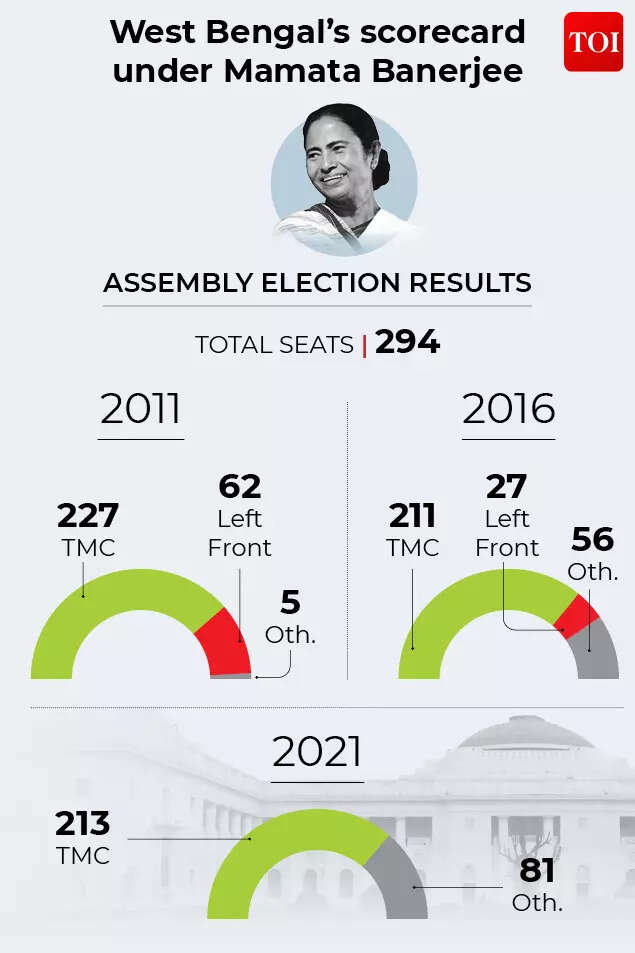
The strength of the Left during this period lay in its deeply embedded rural network, disciplined cadre structure and consolidation of peasant support through land reforms. By the time Basu stepped down in 2000 due to health reasons, the Left’s political machinery was so entrenched that it retained power between 2001 and 2011 under Buddhadeb Bhattacharjee.Basu’s electoral legacy was defined by ideological consistency and organisational discipline. However, by the late 2000s, fatigue within the ruling establishment and unrest over industrial land acquisition eroded the Left’s dominance, setting the stage for political transition.The turning point came in 2011 when Mamata Banerjee and her party, the All India Trinamool Congress, ended the Left Front’s 34-year rule. In that landmark election, the TMC won 184 of 294 seats on its own and, with allies, secured a decisive majority of around 227 seats. Banerjee became the first woman chief minister of West Bengal and the first non-Left leader since 1967.
.

.

Her dominance strengthened in 2016 with an even larger mandate, reinforcing the TMC’s position as the state’s principal political force. In 2021, despite an aggressive campaign by the Bharatiya Janata Party (BJP), Banerjee secured a third consecutive term with 213 seats, a result widely interpreted as a consolidation of her welfare-centric governance model and appeal to regional identity.Unlike the Left’s cadre-based ideological mobilisation, Mamata’s electoral strategy has relied heavily on direct welfare delivery, cash assistance schemes and targeted benefits to women, students and rural households.

Conclusion: Bengal’s next political test

As West Bengal approaches the 2026 Assembly elections, the contrast between these two models has never been sharper.Jyoti Basu institutionalised a cadre-driven, ideology-led governance structure rooted in land reform and class mobilisation. Mamata Banerjee, in contrast, has centralised political authority while expanding direct welfare delivery and targeted income support.The state’s political grammar has shifted: from structural redistribution to beneficiary-based governance and from party organisation to personalised leadership. The next big question is whether Bengal is ready to continue along the path it has chosen or whether 2026 will signal the beginning of another new political chapter?

Source link

Sonia Gandhi: ‘Abdication, not neutrality’: Sonia Gandhi slams PM Modi’s silence on Khamenei assassination | India News


US-Israel-Iran War: Why Has India Not Condemned Khamenei's Death Yet?

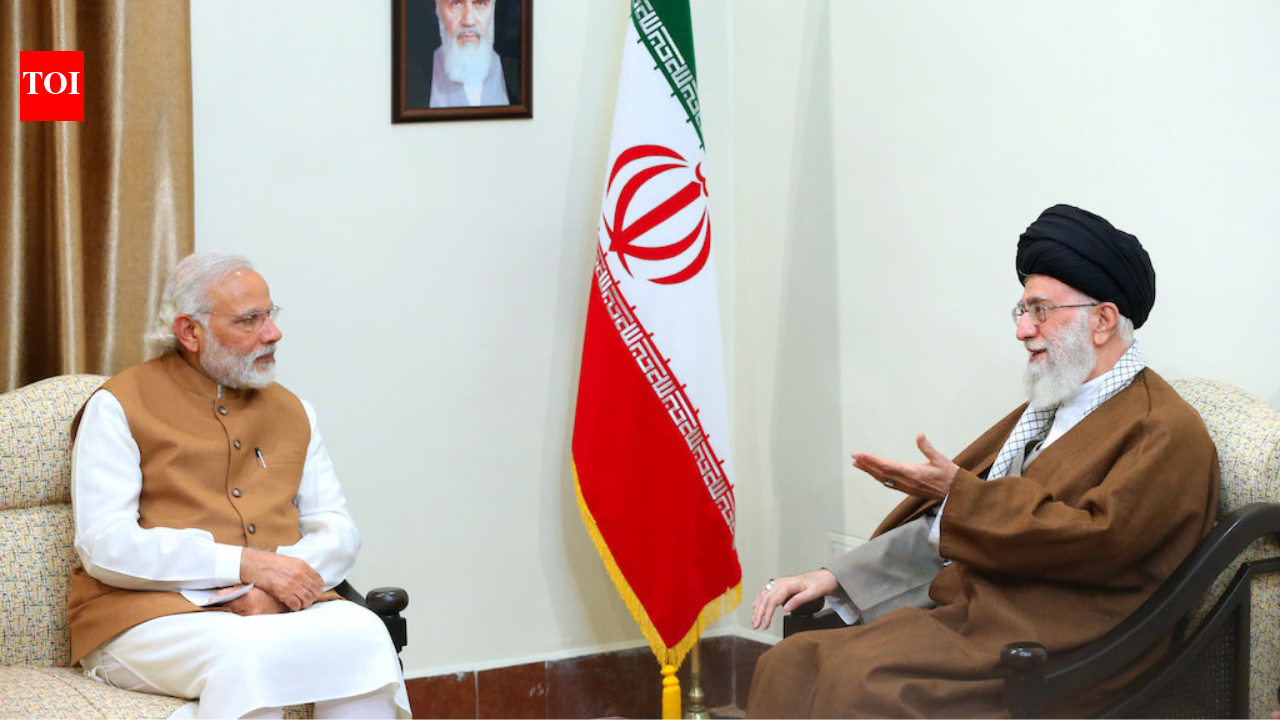
PM Modi with Iran’s Supreme Leader Ayatollah Ali Khamenei in Tehran on 23 May 2016.

Congress Parliamentary Party chairperson Sonia Gandhi on Tuesday sharply criticised the Prime Minister Narendra Modi-led government for its silence over the assassination of Iran’s Supreme Leader Ali Khamenei, calling it an ‘abdication’ rather than neutrality.In an opinion piece published in The Indian Express, Sonia Gandhi said India’s lack of a clear response to the killing “signals tacit endorsement of this tragedy.”

US-Israel-Iran War: Why Has India Not Condemned Khamenei’s Death Yet?

Referring to Iran’s confirmation on March 1 that Ayatollah Khamenei was killed in targeted strikes allegedly carried out by the United States and Israel a day earlier, Gandhi described the assassination of a sitting head of state during ongoing negotiations as a “grave rupture in contemporary international relations.”“Beyond the shock of the event, what stands out equally starkly is New Delhi’s silence,” she wrote.She criticised the Prime Minister for initially condemning only Iran’s retaliatory strike on the United Arab Emirates, without addressing the sequence of events that led to the escalation. According to Gandhi, later remarks expressing “deep concern” and calling for “dialogue and diplomacy” were inadequate, as diplomatic engagement had been under way before what she termed “massive unprovoked attacks” by the US and Israel.She argued that India’s failure to clearly defend sovereignty and international law in the wake of a targeted killing raises “serious doubts” about the credibility and direction of its foreign policy.She also pointed to the timing of PM Modi’s recent visit to Israel, where he reiterated support for the government of Benjamin Netanyahu, even as the conflict in Gaza continues to draw global criticism over civilian casualties.“The unease is compounded by the timing,” she wrote, noting that PM Modi had returned from Israel barely 48 hours before the assassination. She described India’s stance as a “high-profile political endorsement without moral clarity,” particularly when several countries in the Global South and BRICS partners such as Russia and China have maintained distance.Gandhi further demanded a discussion in Parliament during the second half of the Budget Session on what she termed the government’s “disturbing silence.”On Saturday, US and Israeli forces carried out coordinated airstrikes across multiple Iranian cities, targeting military command centres, air-defence systems, missile sites and other strategic infrastructure. The strikes reportedly resulted in the death of Ayatollah Khamenei and four senior Iranian military and security officials, with large explosions reported in Tehran and other cities.In retaliation, Iran launched ballistic missiles and drones targeting US assets and allied nations in the region, including Israel, Bahrain, Kuwait, Qatar, the United Arab Emirates and Jordan. The developments have significantly escalated tensions in the Middle East, raising concerns for regional stability and civilian safety.


Source link

PM Modi’s YouTube account crosses 30 million subscribers, remains most followed world leader on platform | India News


PM Modi's YouTube account crosses 30 million subscribers, remains most followed world leader on platform

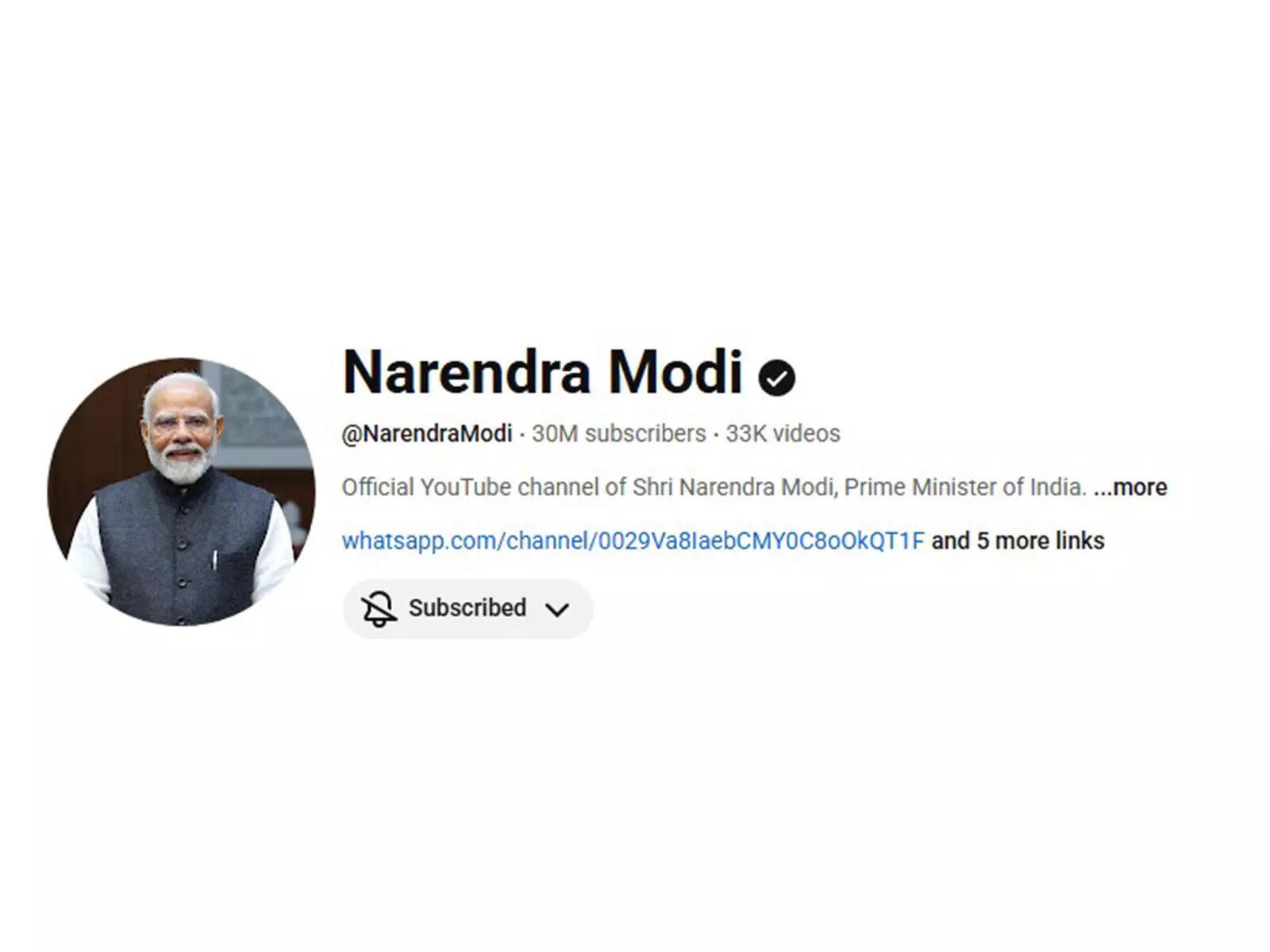
NEW DELHI: Prime Minister Narendra Modi crossed 30 million subscribers on YouTube, further strengthening his position as the most-followed world leader on the platform.Among global leaders, PM Modi has the highest number of subscribers on YouTube. His subscriber base is more than seven times that of US President Donald Trump, highlighting the scale of his digital outreach worldwide.

,

30 million and rising: PM Modi sets global benchmark of subscribers on YouTube

Former Brazilian President Jair Bolsonaro, who ranks second among world leaders on the platform has about one-fourth of PM Modi’s subscriber count.Within India, PM Modi’s YouTube subscriber base is nearly three times that of Rahul Gandhi and more than four times higher than the official channels of the Aam Aadmi Party (AAP) and the Indian National Congress (INC) individually.With over 30 million subscribers, his YouTube channel is currently the most subscribed among world leaders globally.This milestone came after PM Modi’s achievement of crossing 100 million followers on Instagram, becoming the first world leader and politician to reach that mark on the Meta-owned platform.Having joined Instagram in 2014, PM Modi now has more than twice the followers of Donald Trump, who stands second with 43.2 million followers.Indonesian President Prabowo Subianto has 15 million followers, Brazil’s president has 14.4 million, Turkish President Recep Tayyip Erdogan has 11.6 million, and Argentine President Javier Milei has 6.4 million.In India, he is also far ahead of other political leaders on Instagram. Uttar Pradesh chief minister Yogi Adityanath holds the second position with around 16.1 million followers, followed by Rahul Gandhi with approximately 12.6 million.According to data compiled by Statista, PM Modi has around 106.3 million followers on X. Elon Musk tops the list with 235.3 million followers, followed by former US President Barack Obama with 119.1 million, and US President Donald Trump with 110.1 million. The platform’s most-followed accounts are largely dominated by political leaders, celebrities and business figures.


Source link

After thaw, bonhomie: Carney, PM Modi sign $2.6 billion uranium deal | India News


PM Modi, Carney Usher Reset In India-Canada Ties, Declare Landmark Uranium, Critical Minerals Deal

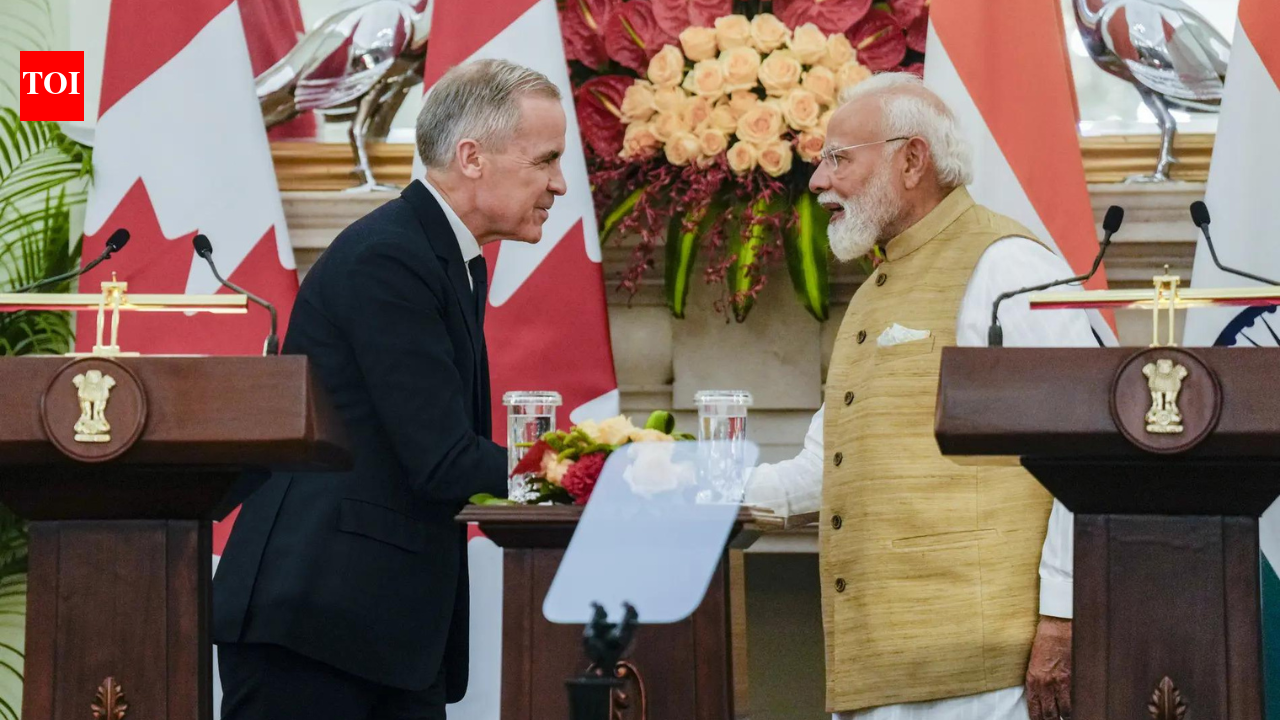
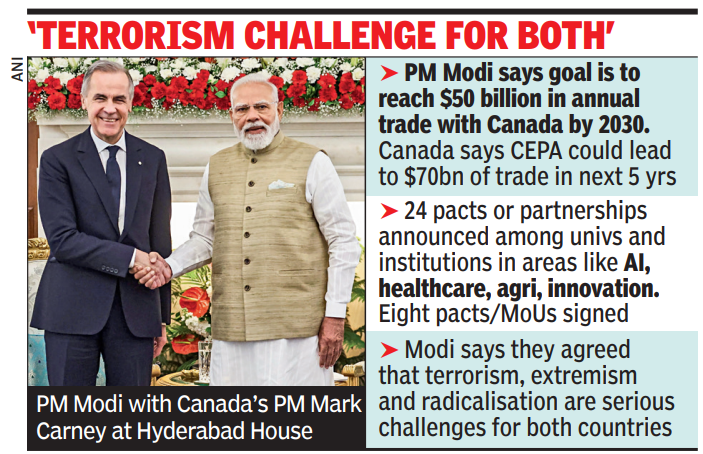
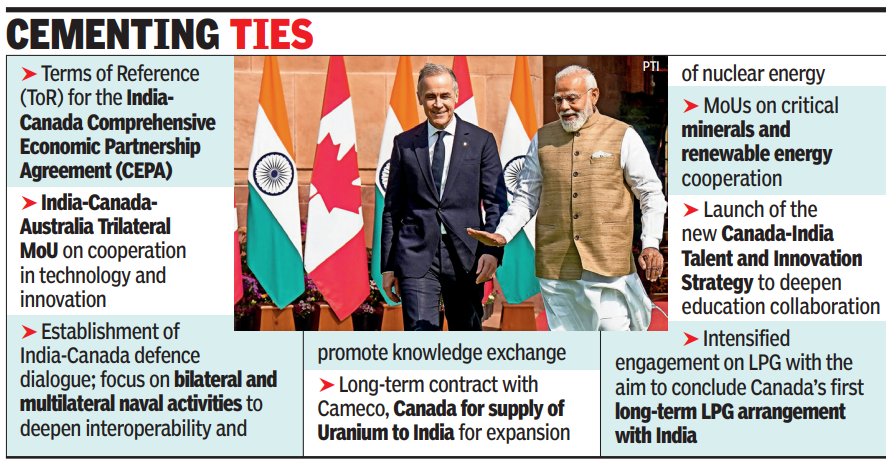
NEW DELHI: The dramatic turnaround in India-Canada relations in the past 10 months culminated in a series of major announcements and agreements, including a landmark $2.6 billion deal for supply of 22 million pounds of uranium to India from 2027 to 2035, as PM Narendra Modi hosted his counterpart Mark Carney for talks.The leaders committed to conclusion of a Comprehensive Economic Partnership Agreement (CEPA) by the end of this year, as both sides finalised the terms of reference, and announced agreements to intensify cooperation on critical minerals while also launching a new strategic energy partnership and defence dialogue.

-

Both sides discussed each other’s security concerns – activities of separatists in India’s case and transnational repression for Canada – but the leaders avoided any explicit mention of these issues in their media remarks as they endorsed in the meeting ongoing security cooperation and focused on consolidating the normalisation of the relationship.Modi gave credit to Carney for the increasing momentum in all areas of cooperation. The Canadian PM responded by saying that this wasn’t just a renewal of the relationship but also an expansion of the partnership as India and Canada were transforming their economies to be more diversified, more independent, and more resilient in a rapidly changing world.

PM Modi, Carney Usher Reset In India-Canada Ties, Declare Landmark Uranium, Critical Minerals Deal

However, the Ministry of External Affairs (MEA) later strongly rejected allegations of involvement in transnational violence or organized crime as reported in the Canadian media, saying these claims were baseless, politically motivated, and “unsupported by credible evidence despite repeated requests”.“India believes that concerns of this nature must be addressed through credible law enforcement and judicial processes, not through public or politicized narratives,” said MEA secretary (east) P Kumaran. The official was responding to questions related to reports in the Canadian media linking Indian officials in Vancouver to the killing of Sikh separatist Hardeep Nijjar and a Canadian readout of the Modi-Carney meeting that said Canada will continue to take measures to combat transnational repression. According to the Canadian readout, the leaders agreed to advance bilateral cooperation on security and law enforcement, including issues of mutual concern to Canada and India.

-

Modi said that the forward movement in ties was being powered by both sides’ unbreakable trust in democratic values, diversity and humanity and the goal was to reach $ 50 billion in annual trade by 2030. The Canadian side said CEPA could see $ 70 billion trade in the next 5 years. While 8 agreements/ MoUs were signed at the government level, there were 24 other agreements or partnerships that were announced among among universities and institutions in areas such as AI, healthcare, agriculture, and innovation. An MoU was also signed under the Australia-Canada-India Technology and Innovation Partnership for development and deployment of AI.“It is our priority to unlock the full potential of economic cooperation. Therefore, we have decided to finalize the CEPA as soon as possible. This will create new opportunities for investment and employment in both countries,” said Modi, calling India and Canada natural partners in technology and innovation.“With Canada and India as innovation partners, we will turn ideas into global solutions,” said Modi, adding that the MoU on critical minerals will also strengthen supply chain resilience.While Carney didn’t touch upon the issue of terrorism in his remarks, Modi said that they agreed terrorism, extremism and radicalisation were shared and serious challenges not only for both countries, but for all of humanity. “Our close cooperation against them is crucial for global peace and stability,” said Modi.A joint statement said that as pluralistic democracies, they agreed to deepen collaboration to address issues relating to violent extremism, terrorism, organized crime, including the illegal flow of narcotics and fentanyl precursors, cybercrime, extortion, financial fraud, trafficking and related criminal networks.The Indian PM also said that the growing cooperation in the field of defence and security symbolised “the maturity of our deep mutual trust and ties”.“We will work to expand defence industries, maritime domain awareness, and military exchanges. For this purpose, today we have decided to establish the India-Canada Defence Dialogue,” he said, as both leaders welcomed a new Maritime Security Partnership in areas such as defence material Cooperation and supply chain resilience, as also appointment of defence attache by both sides.“Our strategic partnership, and the speed at which we are working to unleash its potential in energy, talent, and AI, is the result of two confident, ambitious nations who want to build the future, together,’ said Carney, who also invited Modi to visit Canada.According to Canada, to leverage their strengths as complementary economies, Canada and India announced a new Strategic Energy Partnership, including in LNG, LPG, uranium, solar, and hydrogen. The leaders backed efforts to conclude India’s first long-term LPG supply arrangement with Canada.According to the joint statement, the leaders underscored that closer cooperation between India and Canada will help reinforce international rules and norms that are applied fairly, strengthen economic resilience, promote sustainable development, and address other global challenges.


Source link

2 more panels for Bengal to fast-track CAA applications | India News


2 more panels for Bengal to fast-track CAA applications

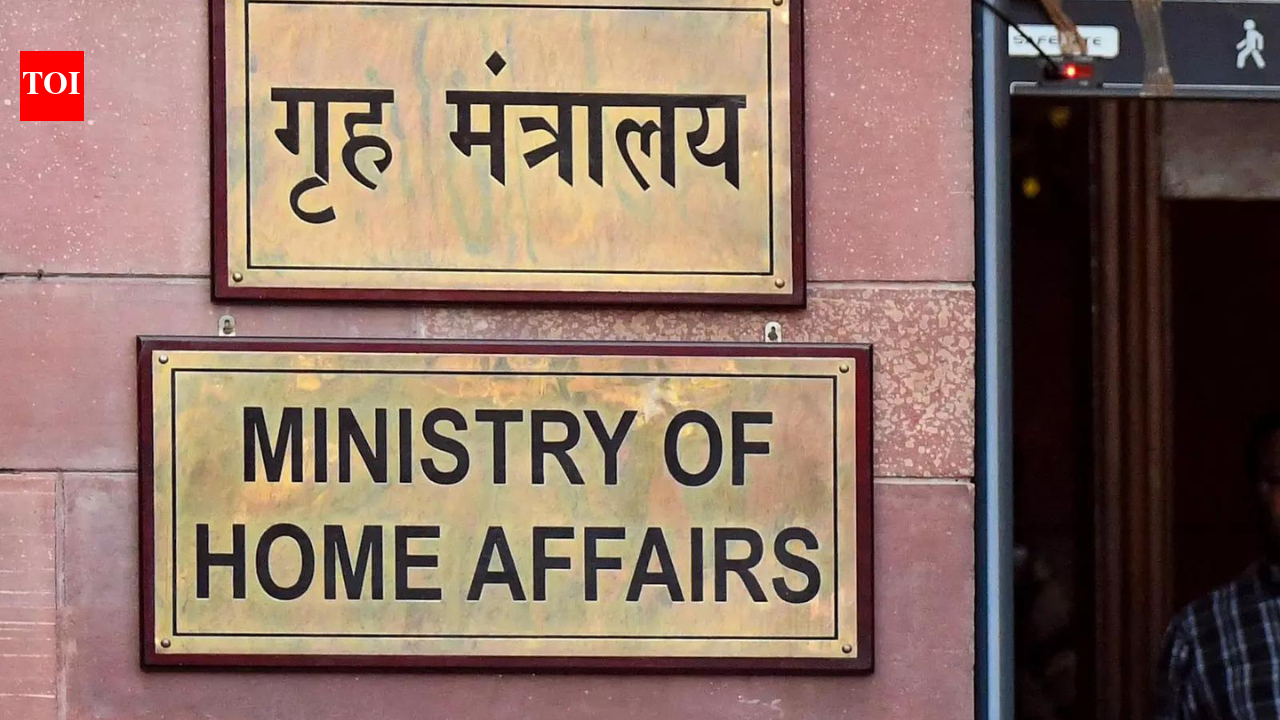
NEW DELHI: The home ministry Friday constituted two more empowered committees for Bengal to fast-track processing of citizenship requests received under the Citizenship (Amendment) Act, 2019. This takes the number of empowered committees functional in the state to four.CAA provides for grant of citizenship to immigrants from Pakistan, Afghanistan and Bangladesh belonging to their six minority faiths — Hindu, Sikh, Christian, Buddhist, Jain and Parsi — who entered India before Dec 31, 2014, fearing religious persecution in their home countries.In a gazette notification issued Monday, MHA said West Bengal’s two additional empowered committees — meant to take the final call on citizenship applications forwarded by district level committees after verification of documents — will be headed by the deputy registrar general, directorate of census operations of the state. The arrangement is in consonance with that for the empowered committee notified by the ministry on Feb 20.The original empowered committee — set up as per a notification issued by the ministry in March 2024 and headed by director, census operations of Bengal — will continue to be in existence. With the three additional empowered committees now sharing work with the original committee, central govt sources told TOI, the high volume of applications under CAA will be tackled more efficiently and the processing time compressed.Bengal has a significant number of Hindu immigrants, such as those belonging to Matua community. BJP has been making an outreach to Matuas to strengthen its electoral prospects ahead of assembly polls in WB.The new empowered committees on CAA allow certain members of the original committee as notified on March 11, 2024 — like the jurisdictional foreigners regional registration officer (FRRO) and state informatics officer — to nominate an officer each not below the rank of under secretary. Other members like an officer of the subsidiary intelligence bureau and post master general or a postal officer nominated by him, remain the same.The new panels will include a representative from the office of Bengal principal secretary (home) or additional chief secretary (home), and a representative of the jurisdictional divisional railway manager, as invitees.


Source link