Breaking News
Western Railway directs AH Wheeler to vacate 55 stalls in Mumbai Central division | Mumbai News


Mumbai: Western Railway has directed AH Wheeler to stop sales and vacate 55 multi-purpose stalls (MPS) across its Mumbai Central division, with the 72-hour notice period ending on March 31 after the letter was served on March 28, officials said.The move marks the end of a long chapter for AH Wheeler, one of the most recognisable names at Indian railway stations. It was founded in 1877 at Allahabad station, now Prayagraj. The company has been asked to hand over vacant possession of all stalls along with railway-owned fixtures and fittings in good condition.The 55 stalls, spread across key stations in the Mumbai division, are currently operating as multi-purpose stalls (MPS). These units were converted from the company’s traditional railway book stalls on April 1, 2021, under a five-year agreement that expires on March 31, 2026.The latest communication issued by the office of the divisional railway manager (commercial), Mumbai Central, states that all sale activity must stop immediately after the contract period ends.The railway has invoked the contract clause requiring the licensee to vacate the premises within 72 hours of expiry and return the stalls in proper condition.Officials said the company has also been instructed to clear all pending dues, including licence fees, electricity charges, fines and penalties, before handing over possession. Station managers and commercial inspectors across the division have been told to ensure compliance and submit no-dues certificates after taking over the spaces.Fresh tenders for these stalls have already been floated, indicating Western Railway’s plan to continue commercial use of the spaces after the present contract expires.The company started when French businessman Emile Edward Moreau and TK Banerjee started selling books to passengers waiting for trains. Named after Moreau’s English friend Arthur Henry Wheeler, the brand grew from a small wooden platform cabinet into a nationwide chain of railway book stalls. Over the decades, it became closely associated with train journeys across India and also helped popularise the early writings of Rudyard Kipling, making it a historic part of railway travel culture.


Source link

Mumbai sessions court nixes ‘perverse order’: NIC app helps put habitual offender back in jail | Mumbai News


Mumbai: The National Informatics Centre (NIC)-developed e-Sakshya app has helped police put a habitual offender back in jail. The app which helps police record and upload crime scene evidence, including searches and seizures, directly to the cloud, led to a sessions court setting aside a magistrate’s “perverse order” releasing a habitual offender on the grounds of an illegal arrest. While the accused, Arvind Sodha, claimed he could not understand the grounds of arrest as it was communicated in Marathi, the court noted that video recordings of the accused’s statement had been uploaded to the “E-Sakshya App”, which showed his comprehension of the language.“Moreover, the accused is born and brought up in Mumbai. So also, he has studied in a Marathi medium school… and he had Marathi language from fifth to ninth standards. All the facts are sufficient to hold that the magistrate, without making any inquiry, released the hardened criminal, and the order of release is perverse and the same is required to be set aside for giving an opportunity to the investigation officer to investigate the matter,” additional sessions judge Mujibodeen S Shaikh said recently. The sessions judge said the magistrate blindly believed the statement of a habitual criminal against whom 14 cases including those for murder, attempt to murder and under the stringent Maharashtra Control of Organised Crime Act (MCOCA) have been registered. Sodha was arrested in an extortion, criminal intimidation and house trespass case filed at Mankhurd police station. The magistrate’s court granted his release on Feb 4. Seeking cancellation of his release, the state argued the magistrate ignored the accused’s educational background and digital evidence proving his linguistic proficiency.The judge directed Sodha to surrender before the investigating officer for probe and remand. “If the respondent (Sodha) will not surrender himself before the IO within two weeks, then the IO may arrest the accused and produce him before the magistrate after mandatory compliance of the legal provision,” the judge said. The state challenged the earlier decision, arguing the magistrate failed to conduct a proper inquiry into whether the accused truly misunderstood the Marathi language or was simply using it as a tactic to avoid custody. The dispute centred on the mandatory communication of the grounds of arrest under BNSS. The prosecution presented records showing Sodha was born and raised in Mumbai and attended Swami Vivekanand Vidyalay, where Marathi was a compulsory subject from the fifth to ninth grades. The sessions judge observed the lower court had acted prematurely by accepting the accused’s statement at face value. “If the magistrate would have been given the opportunity to the IO then he would have produced the recording of the statement of accused which is uploaded on e-Sakshya App.In 2024, Sodha was also booked in the murder case of MCOCA accused Chirag Loke. Loke was fatally attacked with iron rods in Nerul by four me on Feb 13, 2024.


Source link

13 political party members appointed to Mumbai Tree Authority | Mumbai News


Mumbai: Thirteen members from various political parties were appointed to the BMC’s Tree Authority on Monday, with mayor Ritu Tawde announcing the names in the Municipal House. The authority is responsible for making key decisions on tree conservation, tree-cutting permissions, and the city’s green policies.Among those appointed, the BJP is represented by Ganesh Khankar, Sayali Raghunath Kulkarni, Rohan Rathod, Siddharth Sharma and Harsh Bhargav Patel.From the Shiv Sena (Uddhav faction), Kishori Pednekar, Milind Vaidya, Pramod Sawant and Harshala More were included in the committee. The Shiv Sena (Shinde faction) has nominated Varsha Swapnil Tembulkar and Bhaskar Shetty, while Congress has appointed Ibrahim Qureshi, and Vijay Ubale represents AIMIM. Additionally, Hetal Gala, as the chairperson of the Market and Garden Committee, will be an ex-officio member of the Tree Authority.The Tree Authority is considered a crucial body for decisions related to the protection of trees in the city. It plays a key role in granting permissions for tree felling linked to development projects and ensuring compensatory plantation measures. With the appointment of new members, some pending proposals will be expedited.


Source link

Marble Waste Dumping: ‘Toxic tourist destination’: Asia’s largest marble waste dumping yard in Rajasthan draws visitors, experts flag health hazard | Jaipur News


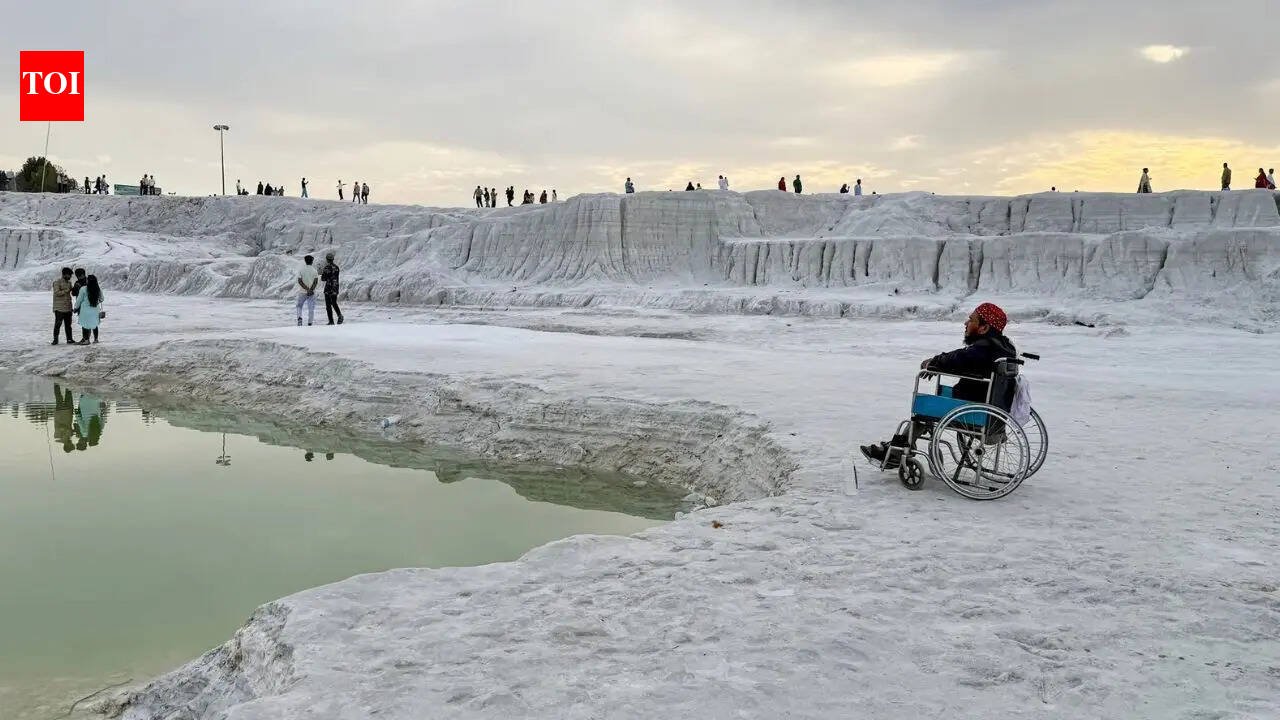
KISHANGARH: Endless white plains shimmer under the sun—no pine trees, no chill in the air—yet the landscape looks like a scene straight out of a winter postcard. Many mistake it for Bolivia’s Salt Flats, snow-covered Gulmarg, or even scenic Switzerland.But this striking location, now a popular spot for social media reels, is actually Asia’s largest marble waste dumping site, located in Kishangarh in Ajmer district, arid Rajasthan.Here, over 700 tankers carrying around 22 lakh litres of marble slurry are emptied every day. The site attracts at least 5,000 visitors daily, with footfall soaring to 20,000 on weekends and holidays.Due to its pristine white appearance, the dumping yard, spread over 350 acres, has also become a popular destination for pre-wedding and commercial shoots. Environmentalists and health experts, however, have flagged it as not just a health hazard but also a pollution hotspot.Scientific studies conducted by the Central University of Rajasthan have flagged it as a “toxic tourist destination”, documenting the health and ecological impacts of this unregulated dumping. The concerns also reached the National Green Tribunal (NGT), which set up a joint committee including members from state and central pollution control boards.“Despite its scale and impact, the dumping yard is being operated in rampant violation of basic environmental safeguards. There is no engineered liner system, no decanting wells, no dust suppression mechanisms, no monitoring of air or groundwater, and no protective green belt.“These failures have led to severe contamination of groundwater, degradation of agricultural land and high levels of fugitive dust pollution, thereby endangering public health,” Laxmi Kant Sharma, Environmental Science professor at Central University of Rajasthan, told PTI.Sharma noted that the university’s studies have found that the toxic contamination of water sources in the vicinity is reflected in total dissolved solid escalating 10 times above the safe limit in a 6-km radius of the dumping site.“The concentration of lead silicate in soil and nitrate and fluoride concentrations in water were found several times higher than normal levels, indicating extreme contamination. Our study also found that the concentration of PM2.5 exceeds the limit of ambient air quality standards of PM2.5,” he said.“Since the waste particles are smaller than 75 micrometres, they can spread far and wide, making the soil infertile. Several people may be suffering from silicosis. The government needs to take immediate action to prevent the situation from getting out of hand,” he added.The Kishangarh marble industry took shape in the 1980s. Around 30 years ago, the Rajasthan State Industrial Development and Investment Corporation (RIICO) allotted two dumping plots to the Kishangarh Marble Association (KMA). That marked the beginning of marble waste being dumped here, and over time, the slurry accumulated to form vast white plateaus and mountains.Today, the city is home to over 1,200 marble cutting units.For years, the site went unnoticed, until comedian Kapil Sharma filmed a song here for his debut film Kis Kisko Pyaar Karoon in 2016, bringing it into the spotlight. Since then, more celebrities have flocked to the location—Nora Fatehi shot her hit song Chhor Denge, Honey Singh and Nushrratt Bharuccha filmed the Saiyaan Ji music video, and Tiger Shroff with Shraddha Kapoor shot Dus Bahane for Baaghi 3.The stunning white landscapes and blue ponds also caught the attention of pre-wedding photographers, who began bringing couples here for shoots.Recognising its potential, the KMA developed an innovative model to turn the dumping yard into a tourist destination, now equipped with a helipad. While entry is free, visitors must obtain a pass from the KMA office, located about a kilometre away. A visitor with a single digital camera pays Rs 500, pre-wedding shoots cost Rs 5,100 per day, and commercial shoots can go up to Rs 21,000 per day.“The revenue is used to maintain the dumping yard. We have made changing rooms for those coming for shoots. There is a helipad too. There are restaurants and options for recreational activities. The dumping yard has put Kishangarh on the national tourism map,” said KMA president Sudhir Jain.“We have not received any health-related complaints from any tourist. In fact, the NGT also did not find anything hazardous here. We have been issued some guidelines for maintaining the area and we will follow them,” Jain added.When this PTI reporter visited the site, she could not find a single person wearing a mask. Several children, who came with their parents and grandparents, were seen rubbing their eyes.The dumping yard has it all for its visitors — horses, jeeps, kiosks for sunglasses and other photo props. Those managing these activities were seen covering their faces with towels and eyes with sunglasses.Lined on the side are several restaurants with a ‘chaupati’ theme where visitors relish delicacies, even as winds blow marble dust. The place also has a dedicated kids zone with various swings and activities available for children to enjoy a fun day.Tankers carrying marble waste could be seen arriving every 10 minutes to offload the slurry waste, but it meant little to tourists who come here nonetheless to click perfect selfies.“We saw so many videos online where people were calling this place mini Switzerland. So, when we were taking a trip to Rajasthan, we had to come here for sure. It is beautiful and amazingly scenic,” said Ashok Puri from Ahmedabad, who was visiting the dumping yard with his family.Farmers from nearby villages such as Tokra, Bhojiyawas, Rahimpura, Phaloda, Mohanpura, and Kali Dungri say that marble dust frequently settles on their fields and contaminates irrigation water, negatively impacting crop yields.“A white layer of marble dust often covers our crops. Ultimately, the production is low. Since my farms are very close to the dumping yard, last year the slurry ran into them and formed a thick layer on my field, making it unfit for sowing,” said Mandraj, who now runs a tea stall.Kishangarh MLA Vikas Chaudhary, however, said the dumping yard is maintained well by the KMA and attracts tourists from across the country.“The machinery that is being used by the industry now generates less waste. The marble association is doing a very good job of maintaining the dumping yard and Kishangarh is being seen as a popular tourist destination. However, if there are any pollution or health concerns, we are open to addressing them,” he said. (With agency inputs)


Source link

Iran Minab School Strike: ‘Remember these two criminals’: Iran names US officers responsible for Minab school strike


Iran on Sunday named US Navy Officers Commander Leigh R Tate and Executive Officer Jeffrey E York of the USS Spruance, as responsible for a missile strike on a school in Minab which claimed 168 lives.According to a post shared by Iran, the officers ordered the launch of Tomahawk missiles three times.

Watch

IRAN IRGC Vs US MARINES: Thousands Of Elite Soldiers Storm Middle East For Ground Invasion

“Remember these two criminals. Leigh R. Tate, the commander, and Jeffrey E. York, the executive officer of the USS Spruance, who ordered the launch of Tomahawk missiles three times, killing 168 innocent children at a school in #Minab,” the post on X read.Earlier this month, a precision strike on an elementary school in Minab, Iran, killed at least 165 people, according to reports. US and Israeli forces carried out the attack on the first day of Operation Epic Fury, targeting the school simultaneously with a strike on a nearby naval base operated by the Islamic Revolutionary Guard Corps (IRGC). US media indicated that the school was damaged as part of coordinated precision operations against military installations in the area.According to The New York Times, official US statements targeting naval facilities near the Strait of Hormuz, where the IRGC base is located, indicate that American forces were the likely perpetrators of the school strike. CBC News reported that the damage was caused by a precision airstrike on a military complex adjacent to the school, noting that the building was part of an IRGC installation.Meanwhile, a preliminary US military investigation found that the missile strike which killed scores of children at the outset of the conflict, was likely the result of an American targeting error, highlighting the possibility of misidentification amid operations against nearby military facilities.The missile strike on the school had become a major controversy in the early days of the conflict. Iranian state media reported funerals for at least 165 victims, including students, after the attack occurred during the school’s morning session. Broadcast images showed mourners gathered over coffins draped in the Iranian flag, some bearing photographs of children. President Masoud Pezeshkian blamed the United States and Israel for the strike, though Israel has denied involvement, with military spokesman Lt Col Nadav Shoshani stating there was “no connection between the IDF and whatever happened in that school.”In Washington, the incident drew growing scrutiny. More than 45 Democratic senators have written to defence secretary Pete Hegseth, seeking clarity on whether the US was responsible and what precautions were taken before targeting the building. Lawmakers also questioned recent cuts to Pentagon programs designed to reduce civilian casualties, including initiatives at US Central Command and the Civilian Protection Center of Excellence, established in 2022 to prevent harm to civilians during military operations.


Source link

Rahul Banerjee Death: Rahul Banerjee passes away at 43: Actor drowned in sea in Talsari | Bengali Movie News


TRIGGER WARNING: This article contains references to death.The Bengali entertainment industry is mourning the loss of Rahul Arunoday Banerjee, popularly known as Rahul. The 43-year-old actor was shooting for the Bengali television show ‘Bhole Baba Par Karega’ in Digha. According to Anandabazar Patrika, the actor drowned in the sea in Talsari and was rescued by technicians after some time.He was rushed to a hospital in Digha around 6 PM, where doctors reportedly declared him dead on arrival. Preliminary reports suggest drowning as the cause of death, although the exact circumstances surrounding the incident remain unclear.Bhaskar Banerjee, who plays another character on the same TV show, told Anandabazar that the entire unit had gone to Talsari for the shoot. According to him, Rahul went into the sea after pack-up. When he did not return for a long time, the team went looking for him.Actor Diganta Bagchi, speaking on behalf of the Artists’ Forum, told Anandabazar that Rahul had gone to the sea after the shoot wrapped. He added that Rahul was still alive when he was rescued by technicians, but was declared dead after being taken to the hospital.Arunoday Banerjee, better known as Rahul, made his stage debut at the age of three with his father Biswanath Banerjee’s theatre troupe, Bijoygarh Atmaprakash, in the play ‘Raj Darshan’. Since then, he had performed in hundreds of stage shows, both with his father’s troupe and with Theatron.Alongside theatre, Rahul ventured into films and television, gaining his breakthrough with the TV show ‘Khela’, where he played the role of Aditya. He later became a household name with the Raj Chakraborty-directed film ‘Chirodini Tumi Je Amar’.He was also known for his performances in projects like ‘Zulfiqar’, ‘Na Hannyate’, ‘Byomkesh Phire Elo’, and ‘Academy of Fine Arts’, among many other notable works in his career.In recent years, he launched his own podcast, ‘Shohoj Katha’, which received praise and recognition.On the personal front, he was married to actress and co-star from ‘Chirodini Tumi Je Amar’, Priyanka Sarkar. The couple separated in 2017 but reunited in 2023. They have a son, Shohoj Banerjee.


Source link

‘Five days, no apology’: BJP attacks AAP over controversial comment on girls | India News


NEW DELHI: The BJP’s Delhi unit on Sunday intensified its attack on the Aam Aadmi Party (AAP), accusing its leaders of misogyny and demanding an apology from senior AAP leader Saurabh Bharadwaj over remarks allegedly made about girls, as the political row escalated on social media ahead of upcoming elections.In a post on X, the BJP’s Delhi account said, “Five days have passed… But Saurabh Bharadwaj ji, you haven’t yet apologised for the vile statement you made about Delhi’s daughters?” It added, “Making such shameful remarks against little girls and shamelessly sticking to them shows just how vile and low the AAP’s mindset is.”BJP’s Delhi account had earlier, in a lengthy post on X, accused AAP leader and the party of having a “misogynistic approach” while claiming that the BJP government is working day and night to empower women. The remarks come in response to a statement attributed to Bharadwaj, as the BJP said, “Unemployed leader Saurabh Bharadwaj said yesterday, the government will give bicycles to those girls, and we will have them campaign for Akhilesh ji in UP. We will hand them brooms.”Citing AAP leader Saurabh Bharadwaj’s words, it said, “This vile statement from Saurabh Bharadwaj shows that every leader of yours is misogynistic.” The post also targeted AAP chief Arvind Kejriwal, saying, “Kejriwal had Swati Maliwal beaten up in the CM’s residence while he was CM. When he himself was in Tihar on corruption charges, he did make Atishi CM out of compulsion, but didn’t let her sit on Kejriwal’s chair; it remained vacant.”It further added, “We’ve seen before how your other leaders, be it Somnath Bharti who abused and behaved indecently with a TV anchor on live TV, or other AAP leaders – the bigger they are, the more misogynistic they are.”The party contrasted its position with that of AAP, saying, “On one side, the BJP government is working to educate daughters, to give them wings, to encourage them, while on the other side, leaders like your Saurabh Bharadwaj are mocking them. Have some shame!”


Source link

Only 1 in 3 schoolchildren meets basic fitness levels | Mumbai News


Report reveals only 34% of Indian schoolchildren meet aerobic fitness benchmarks, highlighting poor cardiovascular endurance nationwide.

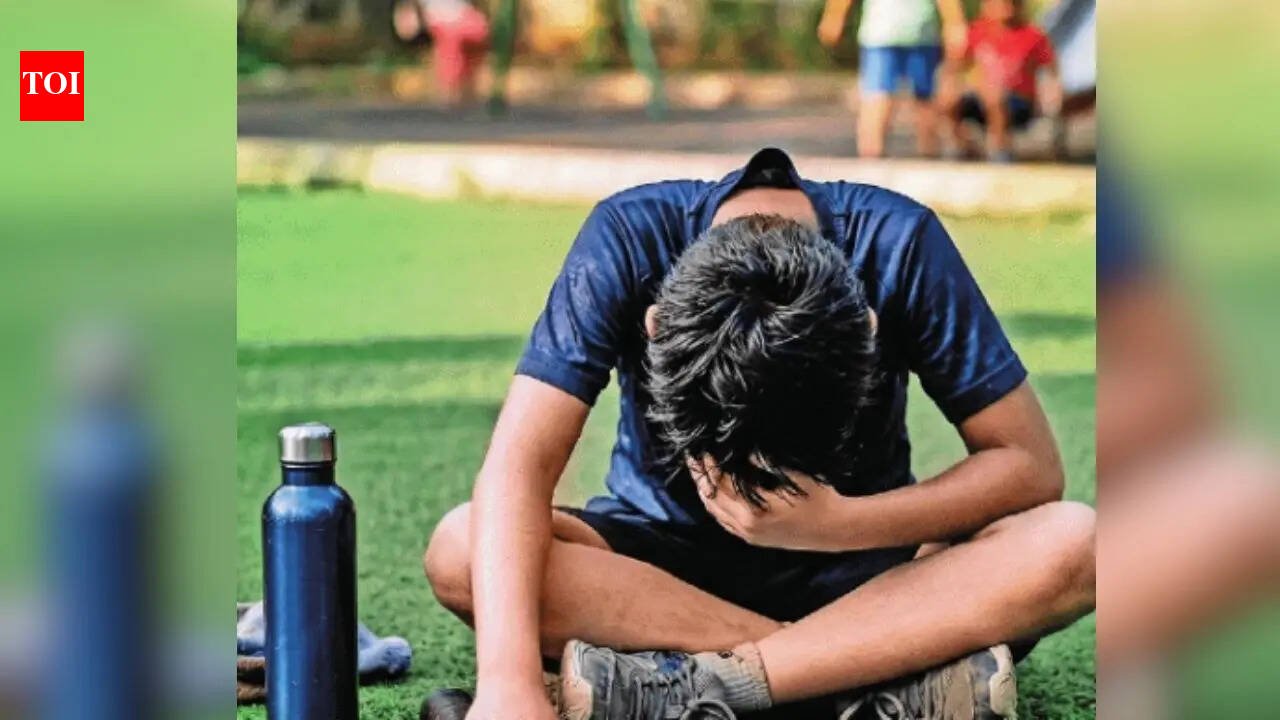
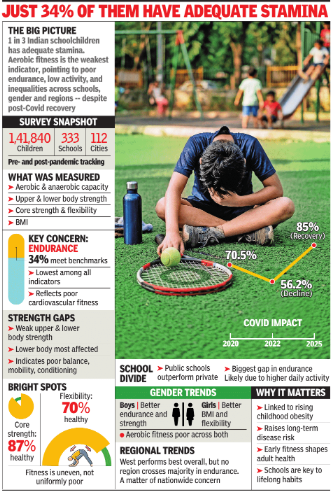
Just one in three Indian schoolchildren has adequate stamina, with only 34% meeting aerobic fitness benchmarks — the weakest among all indicators — according to a report evaluating over 1.4 lakh children across 333 schools in 112 cities. The findings highlight poor cardiovascular endurance, weak muscle strength, and disparities across school types, even as overall fitness levels recover steadily after the Covid-19 slump. The report presents a mixed picture: while flexibility and core strength show relatively strong outcomes, the overall fitness profile remains uneven.Aerobic capacity is the most alarming weakness, with just 34% meeting healthy standards. This reflects low cardiovascular fitness and limited ability to sustain physical activity. “The main reason children are underperforming in aerobic abilities is rising obesity, which is becoming more common every day,” said bariatric surgeon Dr Sanjay Borude.

Just 34% of them have adequate stamina

Just 34% of them have adequate stamina

Beyond endurance, upper and lower body strength remain consistently poor across age groups and regions. Lower body strength is a particular concern, indicating issues with balance, mobility, and overall conditioning.Dr Aashish Contractor, director of rehabilitation and sports medicine at Sir HN Reliance Foundation Hospital, linked these trends to environmental and behavioural factors. “During childhood, the capacity for physical activity is the highest, but one of the biggest barriers today is the lack of open spaces and access to sporting facilities,” he said. “At both a family and institutional level, physical exercise cannot be treated as an afterthought -it must be an integral part of a child’s daily routine.”In contrast, flexibility (70%) and core strength (87%) show better outcomes, suggesting some aspects of fitness are being maintained. The findings are part of the 14th Annual Health Survey released by Sportz Village. Public school students outperform private school students in five of seven fitness parameters. The gap is most visible in endurance metrics like aerobic and anaerobic capacity, suggesting higher daily physical activity among public school children. This may be linked to more opportunities for free play and movement.However, lower body strength remains weak across both systems, indicating structural gaps. Diet may also play a role. “Another reason for lack of strength is inadequate protein intake. Diets, especially vegetarian ones, may not always provide the necessary protein required for muscle development,” Dr Borude said. Gender differences are also evident. Boys perform better in aerobic capacity and lower body strength, indicating stronger endurance. Girls show healthier BMI levels and better flexibility, suggesting better body composition and joint mobility. Despite these differences, poor aerobic fitness is common across both groups.Regionally, western India performs best across most indicators, ahead of the North, East, and South.However, no region reports a majority of children meeting endurance benchmarks, underscoring the nationwide scale of the problem. The report tracks a sharp pandemic-related decline in fitness. Levels dropped from 70.5% in 2020 to 56.2% in 2022 due to school closures, reduced activity, and increased screen time. Recovery has since been strong, with levels rising to around 85% by 2025 after schools reopened. “Since the pandemic, I have observed in my patients that they have become more conscious of their health and have a better understanding of how to preserve it,” Dr Borude said.Children with more than 80 physical education sessions annually perform better across all parameters. “From a preventive healthcare perspective, structured physical education and sports are critical,” said Dr Ranjani Harish, senior scientist at the Madras Diabetes Research Foundation.“Regular physical activity improves cardiovascular health, controls body weight, enhances insulin sensitivity, strengthens bones and supports mental well-being.”She added that these benefits reduce long-term risks of diseases like diabetes, heart disease, hypertension, and obesity. “Schools play a central role in shaping lifelong health behaviours. Children who are physically active early in life are far more likely to remain active as adults,” she said.Emphasising urgent lifestyle changes, Dr Contractor recommends a “steep reduction in ultra-processed foods and controlled and regulated screen time.”


Source link

Satsang, spotlight, stardust: An ode to Tesseract | Mumbai News


TOI’s magical musical Tesseract can be viewed as that rare star, which visits once every few decades. But unlike the ones that burn bright and vanish, this one sticks around, quietly glowing long after. In minds, hearts, and souls.A paradox opened the evening. In a week when Timothée Chalamet offered a hair-brained cultural provocation – that opera and ballet are “obsolete,” that “no one cares” – Tesseract answered not with a clapback, but with choreography: an elegant, assertive inclusion of ballet so ravishing it felt less like rebuttal, and more like revelation. Meera Jain’s curatorial genius, perhaps unwittingly, reframed legacy as living organism, not museum piece, placing ballet where it has always belonged: in the bloodstream of the present. Art demonstrates what argument cannot.The evening’s spell began at the threshold: interstellar music seemed to bend the hallway into a time tunnel, and a gallery of headlines and archives unfolded like a living prologue: premonitory whispers that we were entering a theatre of multiple dimensions.Within minutes, I lost the ordinary measure of time; three and a half hours dissolved with the hush and rush of a lucid dream. Trays full of treats and a bevy of beverages from the redoubtable kitchens of Indian Accent helped too.I am writing after days of reflection and dreaming: reflecting like the shards and mirrors of the Man in the Mirror sequence, dreaming like Sophia, whose journey and her alter ego’s formed a double helix of identity. Their oscillation was so seamless I often felt the protagonist flicker between two bodies of light, two musics of intention; a quiet triumph of performance craft and directorial design.Satsang: Association with truthWhat lingered were not effects but after-effects: layers that adhere to the mind’s inner surfaces and keep releasing meaning. That peeling and unpeeling has not stopped. My spirit felt stirred; my imagination conscripted; new quadrants of thought opened, new coordinates for feelingrevealed. The production felt like a transmission channeling the long arc of Meera and Samir Jain, their thoughts, their values, their hospitality to courage…not as signature, but as atmosphere.

4 (1) (1)

.

Even when the show vaulted into spectacle, what gleamed most was restraint: the discipline that makes technology serve emotion, not smother it; that lets light reveal rather than blind; that turns movement into syntax rather than ornament. The press, surprisingly, got this right. They called it immersive, interdisciplinary, and a philosophical theatre event rather than a mere extravaganza.However, unsurprisingly, they missed out on seeing and feeling beyond the obvious. Forgive the metaphor, but Tesseract was the most exquisite narcotic for the soul. The benevolent kind, the satsang kind. It had the unmistakable charge, vibrations, and high, of a congregation gathered to listen for truth, to dwell in the company of those who have made a life of seeking it. In this sense, the show became a civic ritual: a room of seekers aligning, for a few hours, around questions that are older than the nation-state and younger than each new dawn.It entered my sleep the way good art does – in rapid succession of dreams and visions, and it stirred the REM wilderness Samir Jain once nudged me to research; a reminder that inner archives can be as unruly (and as luminous) as outer ones.And then that finale: like Kairos’s origami, each crease and fold converged until the very idea of the tesseract revealed itself; not as a stunt, but as the geometry of a thought (and truth) that had been quietly forming all night. The eye for detail was relentless. The section on beauty and art, in particular, pinned me to my seat with its tenderness; it was an aria about what makes us human, and why the aesthetic is not indulgence but oxygen. It connected with such elegance to everything I know of the Times of India Group, of satsang, and of Evoke… a skein of beliefs, mythologies of meaning, turned into a theatre of belonging. Spotlight: Shining light on the truthThe stagecraft, from sets, to lighting, and automation, was cutting-edge in the only way that matters: ideas first, then electronics. Having worked closely with Meera Jain, I know her appetite for the frontier; the cutting edge.This went further – it felt pioneering: rooted in Indian ethos, yet speaking fluently to the world; interweaving journalism’s archive with theatre’s alchemy and technology’s sleight of mind. The show assembled global expertise and integrated live performance with large-scale LED, ARenvironments, illusion design, and a sweeping sound architecture… the kind of interdisciplinary rigour that does not imitate “international standards,” but sets them.Threaded through it all was an Indic grammar of courage: the old vow that truth is not a decree but a discipline. Our epics remind us that the boldest journeys are often into ambiguity, and that to “know” is not to arrive but to abide in inquiry. And I found myself wondering – heresy though it may be to a masthead I love – whether TOI’s line might graduate from “Let Truth Prevail” to “The Geometry of Truth.” After all, what is “prevail” if the unasked question is ‘what is truth?’, and ‘who gets to officiate it?’ A quest into Kairos’s origami-like geometry invites us to seek, to question, to listen, to platform polyphonies of approach and opinion. That feels like the paper, and the production, Iwitnessed: “Ekaṁ sat viprā bahudhā vadanti.”Stardust: Tryst with truthIf there is a roadshow destiny, Tesseract must meet it. Tour the country. Cross oceans. Reach for the stars.May Act 2 bloom into Part 2, with the “future of the planet” chapter dilated into its own deep meditation. Imagine a movement from archival intelligence, which we now shorthand as artificial intelligence, into an epoch of planetary intelligence; where biodiversity, species empathy, and human-animal kinship are re-lit as central plotlines rather than footnotes.The rare and inspirational ability to take the personal, make it political, and then sublimate it into art, too, is why Tesseract moved me so much: it insisted that love scale into responsibility, and pain transform into purpose. As a work of language and light, Tesseract oscillates between surrealism, pop art, and Kafkaesque narratives, visuals, motifs.It is a composograph of cosmic intelligence; its architectonic, symbolic, haptic, figurative elements gather into a grammar of awe-someness. It is a show tinged with the aura of spiritual reverence and multi-sensorial engagement.It is saturated with and by illusion and illumination; pulsing with a transcorporeal rhythm and murmur that recalls the oldest theatre there is: the human body and mind convincing itself it can hold more truth than yesterday.And then the ending… the sprinkling of stardust. In Meera Jain’s opening invocation of her son and grandson, the evening disclosed its lineage: pregnant with poise and panache; and yet, nine months of gestation for a vision like this feels, in hindsight, inevitable. A theatre-child born of travel, agency, care, curiosity, beauty, empathy, love, and familial imagination.Not perfect, but pure. Not bound, but beautiful. Not tangible, but true.




Source link

AIFF general body to decide on bids after thorough evaluation | Goa News


Indian Super League (ISL) clubs will get a share of the revenue only after the commercial partner recovers the investment

Panaji: The All India Football Federation (AIFF) has asked accounting firm KPMG to “prepare comprehensive comparison tables evaluating the feasibility and key aspects of the two bids” for the Indian Super League (ISL) and Federation Cup, the two most important domestic men’s football competitions.According to sources, purely on numbers, AIFF is in favour of Genius Sports’ bid that totals approximately ₹2,130 crore for commercial rights of the two competitions, for the next 20 years. The London-headquartered company will offer $7 million or Rs 64.4 crore annually in the first year with 5% annual increment. The federation is guaranteed of approx. ₹12.4 crore annually in “administrative fees” if Genius gets the nod.The second bid of ₹36.6 crore is from FanCode, the federation’s marketing partners for ISL this season.“The executive committee members were happy with the three bids (including one from Capri Sports for women’s football competitions) and we’ve informed them that it’s better to send it to the general body for approval,” AIFF deputy secretary general M Satyanarayantold TOI. “Since this is an important matter, we want the (general body) members to have the final say.”As per AIFF Constitution, any arrangement for a period longer than four years and/or arrangement exceeding amount of Rs. 5 crore “must be approved at an AGM/SGM by at least 75% of members present and eligible to vote.”“The ISL clubs wanted to speak with the bidders and we are more than happy to allow that, to ensure greater clarity and transparency in the process. Whatever queries the clubs have will be addressed directly by the bidders,” said Satyanarayan.A day prior to the executive committee meeting, ISL clubs had urged AIFF not to take any “binding decision” on the new long-term commercial rights holder. The clubs cited lack of meaningful opportunity to evaluate the bidders since the Request for Quotations (RFQ) document was shared with them just 12 hours prior to the bids being opened.Club officials have a bitter-sweet feeling of the bids, given that they will get a share of the revenue only after the commercial partner recovers the investment“If Genius Sports has bid Rs 64 crore, 20% of this amount will straightway go to AIFF as administrative fees. The rest is left for Genius to spend on commercialising the league. Once revenue starts coming in, the model states that Genius can recoup their investment first (of Rs 64 crore), and post that, whatever is left, is split in 60-30-10 ratios (between the clubs, commercial partner and AIFF).“For clubs to see any form of revenue, Genius has to bring back Rs 64 crore worth of revenue. If the commercial partner does not recoup its initial investment, then the tender terms allow them to move that loss into next year’s targets. Apply the same (principle) to Fancode and the threshold for FanCode is much lower since they have bid only Rs 36 crore,” explained a senior club official.AIFF officials said they have asked experts from KPMG to evaluate the two bids and submit a report. One of the big four accounting firms, KPMG was on board to prepare the RFQ.


Source link