Breaking News
CBI arrests Assistant Professor in UKSSSC paper leak case: Here is what happened so far


CBI arrests Assistant Professor in UKSSSC paper leak case: Here is what happened so far
CBI arrests Assistant Professor in UKSSSC paper leak case

The investigation into the Uttarakhand Subordinate Service Selection Commission (UKSSSC) graduate-level recruitment exam has taken a major turn with the arrest of Assistant Professor Suman Chauhan by the Central Bureau of Investigation (CBI), according to an official announcement made by the agency. Chauhan, posted at a government college in Tehri Garhwal, is accused of receiving portions of the exam paper during the test, solving the questions, and transmitting the answers back to a candidate through intermediaries. The CBI described the arrest as an important step in uncovering the broader network behind the paper leak.The leak first came to light after images of three pages of the exam began circulating online, triggering widespread outrage among candidates. The exam, held on 21 September 2025, was conducted for graduate-level posts, including Patwari, Lekhpal, and other administrative positions, with over 1.05 lakh candidates appearing for it.

How the leak allegedly unfolded

According to the FIR and investigation findings reported by TNN, candidate Mohd Khalid Shahzad allegedly photographed the question paper inside the Haridwar exam centre and sent the images to his sisters, Sabiha and Hina, who then forwarded them to Chauhan. Chauhan is accused of solving the questions in real time and sending the answers back to Khalid. The four named individuals are facing charges under provisions related to unfair means in recruitment examinations.Investigators have described the leak as a coordinated effort rather than a spontaneous lapse, highlighting vulnerabilities in exam administration and monitoring. Following the incident, the UKSSSC cancelled the September 21 exam and announced a re-examination within three months to fill the 416 affected vacancies.

Tracing the UKSSSC paper leak: What happened when

Here is what has happened so far in the UKSSSC paper leak case:

  • The exam was conducted on 21 September 2025, and screenshots of three pages began circulating almost immediately, raising alarm among candidates.
  • Within two days, Khalid Shahzad and his sister Sabiha were arrested for allegedly forwarding the leaked paper.
  • Investigation and digital evidence traced the leak to Assistant Professor Chauhan, who was formally named in the FIR along with Khalid and his sisters. Authorities noted this was a coordinated act, not an isolated incident.
  • The leak sparked widespread public outrage, with aspirants and youth groups protesting and demanding accountability from both the accused and exam officials.
  • Responding to public pressure, the CBI officially took over the case at the end of October 2025.
  • The UKSSSC cancelled the exam and scheduled a re-test within three months for the 416 affected vacancies.
  • On 28 November 2025, Chauhan was arrested, marking a major breakthrough in the investigation, which could expand further to uncover the full network behind the leak.

Official actions and CBI probe underway

The Uttarakhand government appointed a one-member inquiry commission headed by Justice (Retd.) UC Dhyani, which submitted an interim report to the Chief Minister. The CBI continues its investigation, indicating that further arrests may follow as the agency maps the complete network behind the leak.The case has reignited calls for stricter monitoring, transparency, and stronger safeguards in recruitment examinations. Experts and aspirants have highlighted that the involvement of a sitting academic professional underscores the persistent risk of insider collusion. As per various reports, India has witnessed over 60 major exam leaks since 2010, affecting millions of candidates, with states such as Rajasthan, Madhya Pradesh, and Gujarat frequently reporting similar incidents.


Source link

Behind home Test slide: Collapsed feeder line, dried up player pool | Cricket News


Behind home Test slide: Collapsed feeder line, dried up player pool
India Test cricket. Image: File

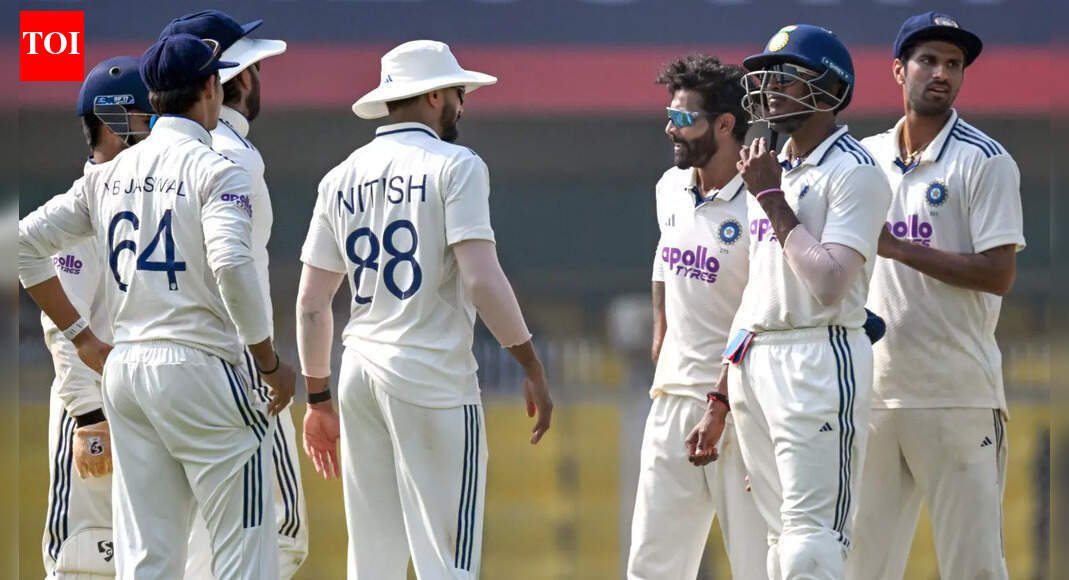
If the famous heist at the Gabba in Jan 2021 had been definitive indication of India’s strong player pool, the meek defeats at home over the last year to New Zealand and South Africa have been the exact opposite — an indication that the feeder line for unearthing new players has completely collapsed.A case in point was the team management’s insistence on playing Nitish Kumar Reddy in the Guwahati Test. Despite all his evident frailties in top-flight international cricket, Reddy was played in the second Test against South Africa ostensibly because the team management wanted an extra right-handed batter in a left-hander dominated line-up. The argument was that a right-hander’s presence would negate the threat of off-spinner Simon Harmer.

Coach Gautam Gambhir, chief selector Ajit Agarkar need to get their act right

If that’s the case, why not play a more experienced right hander with a stronger first-class record? Reddy’s presence in the lineup was a telling commentary on the system’s failure to groom a strong bench of middle-order batters or develop a stronger vision to unearth such potential over the last four-five years. The feeder system created during Rahul Dravid’s time at the National Cricket Academy (NCA), from 2015 to 2021 — along with the presence of a supportive selection committee — had created a bench strength that helped players seamlessly graduate to international cricket. Rishabh Pant, Mohammed Siraj, Washington Sundar, Kuldeep Yadav and Axar Patel — all established names now — were all products of that process. Each of these players hit the ground running when they were drafted into the Test squad.India coach Gautam Gambhir, in his defence after the series sweep, emphatically pointed out that “this is what a transition actually looks like”. Yet, it’s evident confusion over selection has led to instability in the playing XI post the Test retirements of Rohit Sharma, Virat Kohli and Ravichandran Ashwin. MSK Prasad, the chairman of selectors during Dravid’s time at NCA, pointed out how meticulously the feeder system had been created. “The most important thing is that the Indian team management, selectors, NCA and India ‘A’ coaches have to be in sync. During our time we had created a pool of 60 players according to positions and formats. There used to be meetings between head coach Ravi Shastri, Dravid and me to discuss what needed to be worked on,” Prasad told TOI. “For example, we had Shikhar Dhawan, Murali Vijay and KL Rahul as first choice Test openers. Prithvi Shaw, Mayank Agarwal and Shubman Gill were prepared as backups. And when Prithvi and Agarwal graduated, Abhimanyu Easwaran and Priyank Panchal joined the queue,” he added. Keeping Reddy’s selection as a reference point here, Prasad’s then-selectorial colleague Devang Gandhi pointed out that the selectors and team management may have moved on from certain middle-order players too soon. “The fact that Dhruv Jurel and Reddy are the only options to form the middle order makes you wonder if Sarfaraz Khan has been discarded too soon in home conditions. Easwaran and Ruturaj Gaikwad started playing for India ‘A’ during our regime. They are still stuck there even as nobody has cemented a place in the Test team. Dravid and the selectors had made a policy that players above the age of 30 will only be considered for international cricket. India ‘A’ was only meant to groom youngsters,” Gandhi said. “At this moment, they need to identify players according to positions. There is no backup opener either. Pace re sources take time. The current management needs to patiently stick with a plan,” Gandhi added. In this context, the involvement of VVS Laxman, the current head of the centre of excellence (CoE) — a revamped version of the NCA — becomes crucial. TOI understands Laxman and chief selector Ajit Agarkar have been working hard to revive the vibrant ‘A’ programme. But murmurs in BCCI corridors suggest the absolute synergy needed between the Indian team, selectors and developmental sides for this particular task has gone missing. Dravid, for example, took active part in scheduling ‘A’ tours, preparatory camps for senior teams and discussing conditions for domestic cricket. “I feel that someone of Laxman’s stature has to have greater influence on the pathway. At the moment, players are picked with very little experience at the first-class level. Siraj had picked 80 wickets for India ‘A’ before making his Test debut. Pant played almost three Ranji Trophy seasons and lots of ‘A’ tours before he got his debut,” Prasad said.It is learnt that there is disquiet about the present selection committee’s attendance in domestic cricket. Three weeks ago, when the Ranji Trophy was on, three national selectors were overseas. Eight years ago, there was a policy where none of the selectors watched their home state play and covering every team was a must. “It will be a cumbersome process. There were instances when one of my colleagues landed from New Zealand at midnight and travelled to a different part of the country to watch a Ranji match. Covering length and breadth of the country was priority,” Prasad said. The 2-2 result in England is a sign of the potential of the talent that can come through. It’s about firming up a plan that can channel this potential.


Source link

In BJP bastion Mulund, residents question ‘vikas’ amid civic decline | Mumbai News


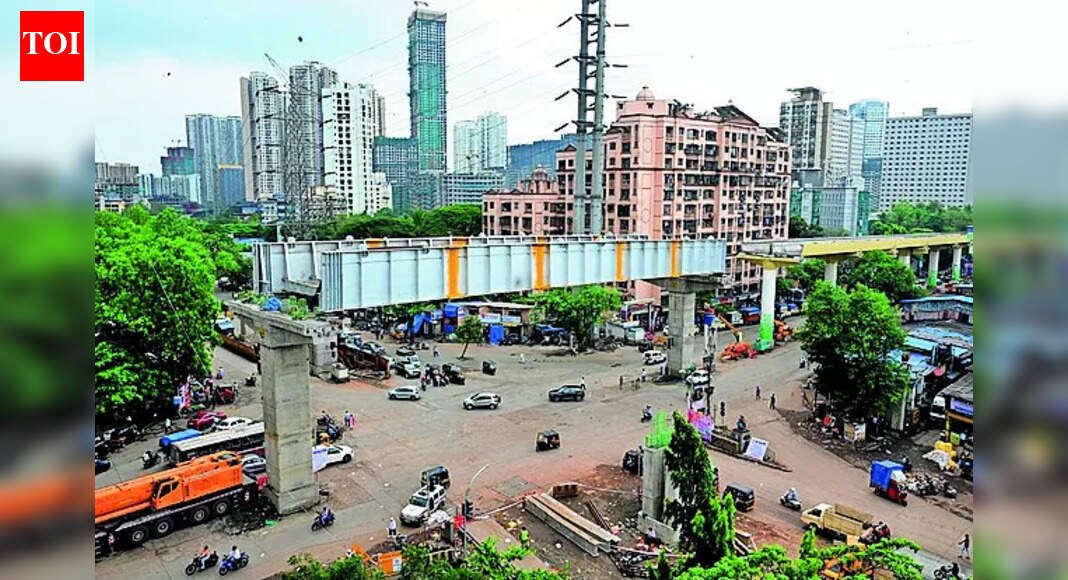
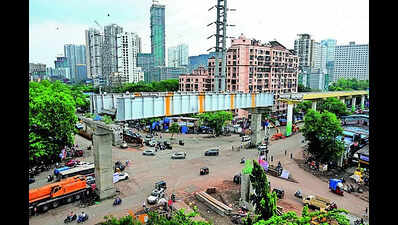
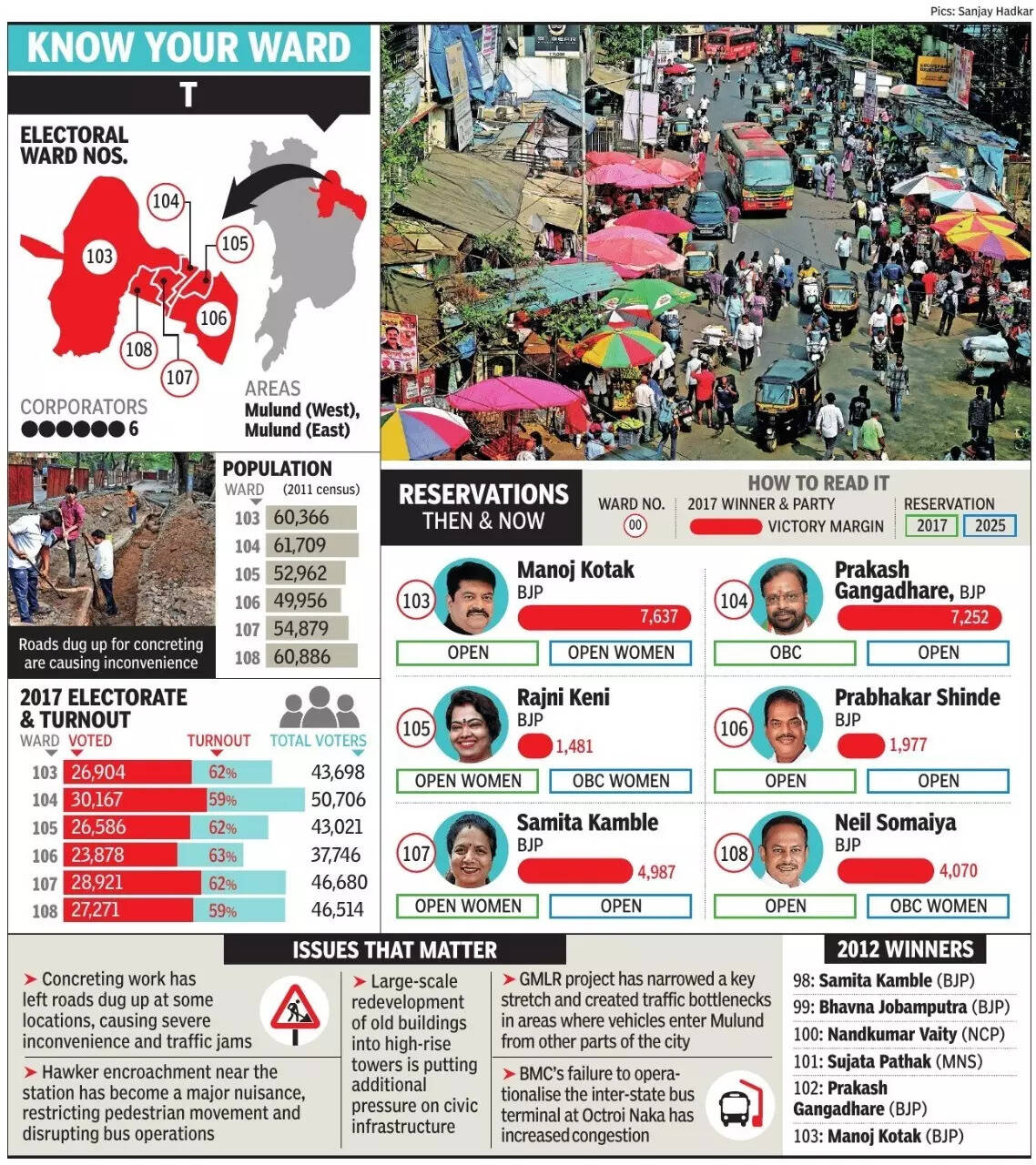
Mulund, one of Mumbai’s earliest planned suburbs with its 1922 Crown & Carter gridiron layout, is today struggling with a widening gap between rapid redevelopment and sluggish civic upgrades. T ward, covering Mulund West and East, faces mounting complaints from residents and activists who say basic infrastructure has failed to keep pace with the construction boom.Politically, Mulund has long been viewed as a BJP bastion. The party swept all six municipal seats in the 2017 BMC polls. In the 2024 Lok Sabha election, BJP’s Mihir Kotecha lost the constituency but still secured over 60,000 more votes than his Shiv Sena (UBT) rival within Mulund. He went on to win the assembly seat for the second time last year with a decisive margin of around 90,000 votes. The suburb’s sizeable Gujarati and Rajasthani voter base traditionally turns out in large numbers for the party.But activists say BJP’s ‘vikas’ narrative contrasts sharply with everyday civic conditions. Prakash Padikkal of Hillside Residents’ Welfare Association (HIRWA) said the strain on Mulund’s infrastructure is evident. “Despite long-standing plans to widen Mulund Colony Road, no progress has been made, even as the population continues to grow. The construction of 4,000 new flats in the Mulund hills has raised concerns about whether existing amenities can cope with the added load,” he said, criticising BMC for halting road improvement work midway, leaving stretches dug up for concreting and causing daily inconvenience to motorists and pedestrians.

-

He also flagged problems with a newly built garden in Mulund (West), which he said lacks basic security and maintenance and has turned into a hotspot for illicit activities. “Water shortages and inadequate sanitation further exacerbate the situation, with some areas still reliant on water tankers and sewage being improperly managed,” he said. Civic activist Bharat Soni echoed these concerns, especially over the narrow approach roads leading to new housing projects and rising air and noise pollution. He warned that using large portions of saltpan land in Mulund (East) for Dharavi rehabilitation could heighten flooding risks, as these lands historically aided natural drainage. “Then again, the incomplete Metro 4 project, which is not connected to any railway station, offers no relief to residents who depend on trains for commuting,” he said. “Not to speak of the shortage of playgrounds and unfinished concreting work, which has worsened traffic.”Mulund MLA Mihir Kotecha pointed to upcoming initiatives that could offer some relief. He said three new gardens and a bird park had been inaugurated recently, and a connector road at Mhada, Mulund (East), had reduced travel time and eased congestion. “A new 428-bed municipal hospital is also set to open in Dec, providing much-needed health facilities,” he said, acknowledging that garbage accumulation and inadequate waste management continue to pose health hazards. “Four left-turn ramps planned on Goregaon-Mulund Link Road are expected to ease congestion at the Eastern Express Highway-Airoli junction within eight months. A road in the Development Plan linking LBS Marg to Raja Industrial Estate (Sarvodaya Nagar Road) would also reduce traffic at Sonapur junction.”Former corporator Sunil Gangwani stressed the need to reopen the revamped MT Agrawal Hospital, which has remained shut for 12 years, compelling residents to travel long distances for medical care. He criticised BMC for failing to improve public health services, the deteriorating condition of roads, the spread of slums and the persistence of hawkers encroaching on footpaths. Gangwani also flagged inadequate garbage collection and serious sewage issues worsened by increased FSI due to redevelopment.“Mulund is grappling with a range of civic issues, from inadequate infrastructure and sanitation to water shortage in hilly areas which depend largely on tankers,” a civic activist said. “Urgent, coordinated action from BMC and elected representatives is essential to restore quality of life in this once well-planned suburb.”


Source link

‘Operation Sagar Bandhu’: India flies 12 tonnes of aid to flood-hit Sri Lanka; island battered by Cyclone Ditwah | India News


‘Operation Sagar Bandhu’: India flies 12 tonnes of aid to flood-hit Sri Lanka; island battered by Cyclone Ditwah

India flies C-130 J plane carrying approx 12 tons of humanitarian aid to cylcone-hit Sri Lanka

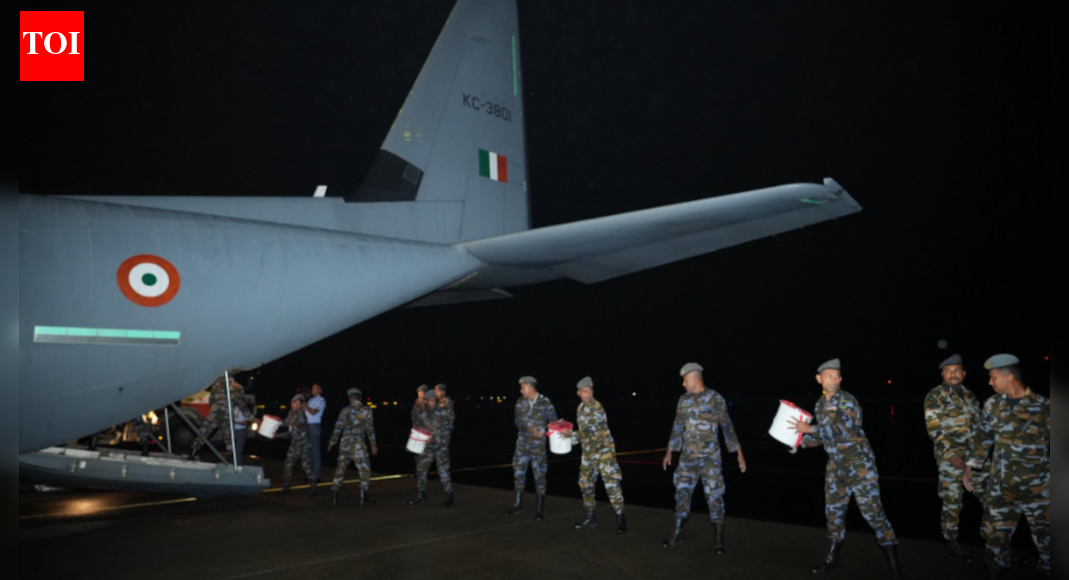
External affairs minister S Jaishankar on Saturday announced that a C-130J aircraft carrying around 12 tonnes of humanitarian aid has landed in Colombo. The delivery is part of India’s Operation Sagar Bandhu, launched on Friday to assist Sri Lanka in the aftermath of Cyclone Ditwah, which has so far claimed 80 lives.Sharing the update on X, Jaishankar wrote, “#OperationSagarBandhu unfolds. @IAF_MCC C-130J plane carrying approximately 12 tons of humanitarian aid, including tents, tarpaulins, blankets, hygiene kits, and ready-to-eat food items, lands in Colombo.”

Cyclone Ditwah Approaches India: Tamil Nadu, Puducherry, Andhra Pradesh Brace For Impact

India initiated Operation Sagar Bandhu as part of its immediate response to assist cyclone-affected areas. The first relief consignments were transported by the Indian Navy’s aircraft carrier INS Vikrant and frontline warship INS Udaigiri, which arrived in Colombo on Friday and handed over supplies to Sri Lankan authorities.Prime Minister Narendra Modi, in a post on X, conveyed his condolences to the people of Sri Lanka, expressing grief over the lives lost in the cyclone and extending solidarity with India’s “closest maritime neighbour.” He noted that India had swiftly dispatched relief supplies and critical Humanitarian Assistance and Disaster Relief (HADR) equipment under the operation.“We stand ready to provide more aid and assistance as the situation evolves,” said PM Modi, adding that the support was guided by India’s Neighbourhood First policy and Vision MAHASAGAR. This comes as India bids to offer help Sri Lanka has been reeling from floods and landslides triggered by Cyclone Ditwah. The island nation is facing one of its most severe disasters in recent years, with widespread damage to infrastructure and rising casualties. According to PTI, more than 80 people have died as the storm unleashed heavy rains across multiple provinces. The Disaster Management Centre (DMC) separately reported 61 deaths and 25 people missing, while nearly 44,000 individuals from over 12,000 families have been affected since adverse weather began on November 16.The crisis intensified as Sri Lanka’s Western Province faced warnings of an “unprecedented disaster situation” owing to rising water levels in the Kelani and Attanagalu rivers. Several districts in the Northern, North-Central, Central, North-Western, Sabaragamuwa and Western Provinces are expected to receive over 200 mm of rain, according to the Sri Lankan Meteorological Department. Rainfall above 150 mm is also likely in parts of Trincomalee, Badulla, Galle and Matara. The DMC reported four homes destroyed and more than 600 partially damaged in the ongoing deluge.(With inputs from agencies)


Source link

Palash Mucchal’s mother drops update on wedding with Smriti Mandhana: ‘Dono takleef mein hai, shadi jaldi hogi’ |


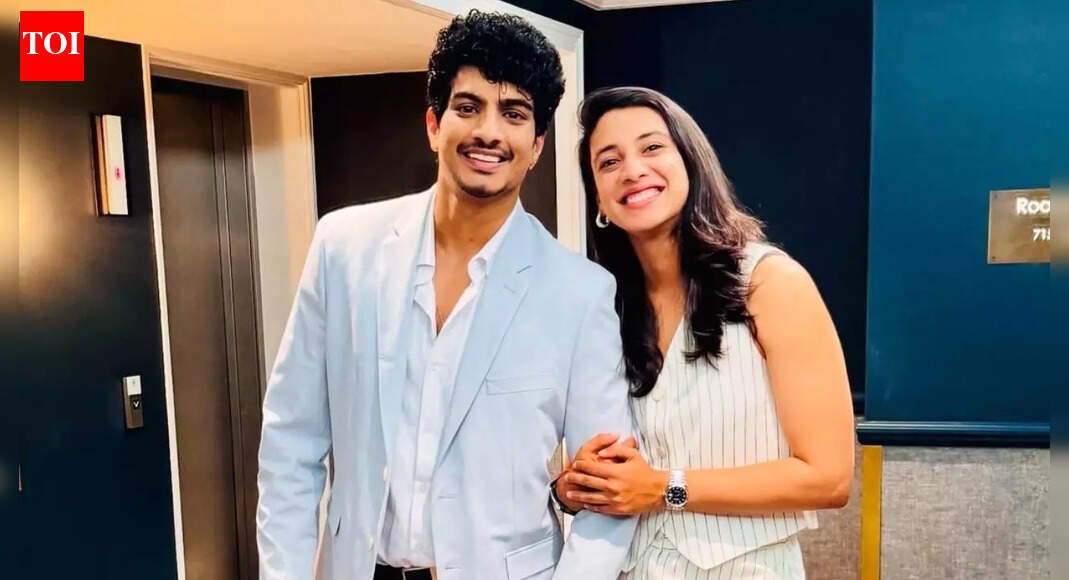
Smriti Mandhana and Palash Muchhal were set to tie the knot but just a day before their wedding, the cricketer’s father’s health deteriorated and he was rushed to the hospital. This led to their wedding being indefinitely postponed. The situation grew more distressing when Palash’s health also declined shortly after, requiring him to be hospitalized as well. With both Smriti’s father and Palash now discharged, fans are anxiously hoping for an announcement regarding a new wedding date. A few days ago, Palash’s sister Palak Muchhal issued a statement regarding the wedding as she said, “Due to Smriti’s dad’s health, Smriti and Palash’s wedding has been put on hold. Would request all of you to respect the privacy of the family in this sensitive time.”Meanwhile now, Palash’s mother Amita Muchhal has dropped an update on the wedding amidst several reports, rumours and speculations across social media. She has reassured that the wedding has not been called off. She told Hindustan Times, “Smriti and Palash dono takleef mein hain… Palash dreamt of coming home with his bride. I had even planned a special welcome…Everything will be fine, shaadi bohot jaldi hogi.Following the sudden delay, Smriti removed most wedding-related posts from her social media, sparking a fresh wave of rumours. However, Palash’s mother’s statement confirms that the deletions should not be misread as signs of a cancellation.In the aftermath of the postponement, Palash’s blood pressure reportedly spiked, leading to his admission to a hospital in Sangli before he was moved to Mumbai for further care. Fortunately, doctors have now discharged him, and his health is said to be stable. Meanwhile, now after their wedding has been postponed, both Smriti and Palash have added evil eye emojis to their Instagram, clearly wanting to protect themselves from ‘nazar’. Also Read: Smriti Mandhana and Palaash Muchhal wedding postponed: Choreographer Gulnaaz Khan breaks silence, ‘False claims about me and my friend Nandika Dwivedi’


Source link

IPO will give more credibility: Meesho’s Aatrey


IPO will give more credibility: Meesho's Aatrey

MUMBAI: SoftBank-backed e-commerce startup Meesho will focus on making online shopping affordable for more consumers and build the value segment of the market where the opportunity is large rather than going after the quick delivery space, said Vidit Aatrey, co-founder and CEO at the company which is set to get listed on the bourses next month. A lot of people in India are still not online and for those who use e-commerce platforms, the frequency of usage is lower compared to other emerging markets, giving room to players such as Meesho to expand growth. A public listing will give the company more credibility, allow it to attract better talent and get more sellers on its platform which competes with Amazon and Walmart’s Flipkart even though an IPO will also bring forth new responsibilities, said Aatrey. The company’s Rs 5,421 crore IPO opens for bidding on Dec 3. Meesho is raising up to Rs 4,250 crore through a fresh issue of shares while a clutch of investors including Peak XV Partners, Elevation Capital and Y Combinator are collectively selling 10.5 crore shares. At the upper end of the IPO price band set at Rs 111 per share, the implied valuation of Meesho is $5.6 billion (Rs 50,096 crore), lower than its initial targets pegged at close to $10 billion and only marginally higher than its peak valuation of $5 billion. “It’s much easier for a listed company to go, offer esops to employees to come on board compared to a private company. We believe that the business has also reached a place where we have enough predictability, there’s enough data that people can look at for the last few years, analyse and project something. We felt we are in the right place,” Aatrey said in an interview. Founders Vidit Aatrey and Sanjeev Kumar who launched Meesho a decade back will hold about 18% in the company post IPO. Meesho operates in the value e-commerce segment that targets price conscious consumers with smaller budgets and its core proposition is lower, affordable pricing. Unlike Flipkart and Amazon, the company doesn’t charge commission to its sellers and has also built its own logistics platform Valmo which allows it to control its logistics costs.


Source link

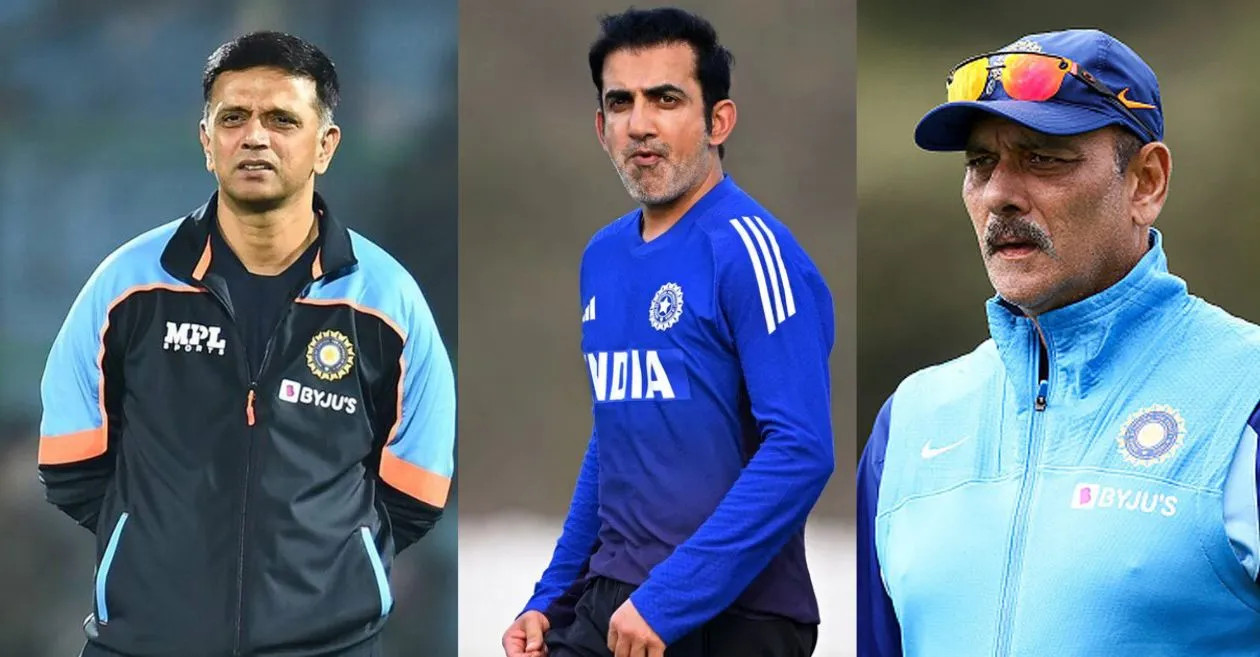
Here’s how India head coaches have fared in home Tests since 2000/01


Since the turn of the millennium, India cricket has witnessed a spectrum of head coaches, each bringing their unique vision and tactical approach to the national Test team. Test cricket on home soil has traditionally been India’s formidable fortress—a venue where great teams are crafted, strategies tested, and reputations both forged and shattered. The performance of Indian head coaches since the 2000/01 season at home in Test matches spells a compelling story of tactical brilliance, consistency, and, at times, unexpected underperformance.

Gautam Gambhir’s struggles in Test highlight home woes

The entry of Gautam Gambhir as India’s head coach in Test cricket was met with plenty of anticipation, given his pedigree as a gritty former opener and his no-nonsense approach to the game. However, Gambhir’s initiation into the role has been distressingly underwhelming, with the team failing to register home dominance under his stewardship. Out of 9 Test matches at home, Gambhir’s India has managed just 4 wins while losing 5, resulting in a disappointing win/loss ratio of 0.80, the lowest for any Indian coach at home in this era. Furthermore, his time has already witnessed 2 home series defeats—something not endured by any other coach post-2000/01 during their stint.

India’s typically unyielding home advantage has come under serious strain during Gambhir’s stint. A string of lacklustre performances, questions over team combinations, and inconsistent batting have all contributed to recent dismal outcomes. Unlike predecessors who managed to either protect or extend India’s legacy on spinning tracks and batting-friendly surfaces, Gambhir’s tactical approaches and selections have not translated into expected wins. The home Test losses under his guidance are stark, spelling the need for urgent recalibration if India wishes to recapture their legendary home resilience.

Also READ: Sunil Gavaskar slams Gautam Gambhir’s critics following India’s home Test whitewash vs South Africa

Comprehensive record of Indian head coaches at home since 2000/01

A closer inspection of Indian head coaches’ home records since the 2000/01 season reveals a landscape generally characterized by stability and high win percentages—until the present scenario. John Wright, the first foreign coach to take charge, captured 11 wins from 24 matches, facing just 1 series defeat alongside a win/loss ratio of 2.75. Greg Chappell’s eventful era saw 3 wins from 6 matches and no series losses.

Gary Kirsten and Duncan Fletcher eras set a gold standard; Kirsten posted 10 wins and just 2 defeats in 19 home Tests (W/L ratio 5.00) while Fletcher went even better (11 wins, 2 losses, 5.50 ratio), though each registered a solitary series defeat. Ravi Shastri revolutionized India’s approach, overseeing 15 wins against a solitary loss in 19 matches, boasting a phenomenal win/loss ratio of 15.00 with no series defeats—among the best in history. Anil Kumble’s shortened but effective tenure delivered 10 wins from 13 matches (W/L ratio 10.00), echoing India’s dominance with no series defeats.

Rahul Dravid kept the home fort safe, recording 9 wins out of 13 and no series defeats, maintaining a positive record. Gambhir’s contrast with all predecessors is stark, with lower wins and the ignominy of repeated home series losses, a rarity in modern Indian Test cricket.

The list below captures the performance at a glance:

  Coach   Matches    Won    Lost    Draw    Win %    Series defeats 
 John Wright     24   11   04   09   45.83            01
 Greg Chappell     06   03   01   02   50.00            00
 Gary Kirsten     19   10   02   07   52.63            00
 Duncan Fletcher     15   11   02   02   73.33            01
 Ravi Shastri     19   15   01   03   78.95            00
 Anil Kumble     13   10   01   02   76.92            00
 Rahul Dravid     13   09   02   02   69.23            00
 Gautam Gambhir     09   04   05   00   44.44            02

Also WATCH: Indian supporters taunt head coach with ‘Gautam Gambhir haaye haaye’ chants following devastating 2-0 series loss to South Africa


Source link

Access Denied


Access Denied

You don’t have permission to access “http://www.ndtv.com/india-news/supreme-court-issues-notice-to-centre-on-plea-to-ban-female-genital-mutilation-among-muslims-9719201” on this server.

Reference #18.c7f5d217.1764378673.65563c3b

https://errors.edgesuite.net/18.c7f5d217.1764378673.65563c3b


Source link

Tere Ishk Mein Full Movie Collection: ‘Tere Ishk Mein’ box office collection day 1: The Dhanush, Kriti Sanon starrer has the second biggest opening for a romantic film this year after ‘Saiyaara’; mints Rs 16 crore |


'Tere Ishk Mein' box office collection day 1: The Dhanush, Kriti Sanon starrer has the second biggest opening for a romantic film this year after 'Saiyaara'; mints Rs 16 crore

Dhanush and Kriti Sanon starrer ‘Tere Ishq Mein’ released in cinemas on Friday, November 28. It clearly looks like this year, intense romantic movies have made a comeback post pandemic. One saw ‘Saiyaara’ minting Rs 20 crore and more on the first day which is the biggest opening ever for a romantic film and now ‘Tere Ishk Mein’ bags the second spot on this list. We also saw how ‘Ek Deewane Ki Deewaniyat’ proved to be a huge hit this year. ‘Tere Ishk Mein’ already looked promising with good advance bookings and one expected the film to touch the Rs 10 crore mark atleast.Tere Ishk Mein Movie ReviewHowever, it did surpass expectations and had a great start. The film earned more through spot bookings due to good reviews and positive word of mouth and the footfalls must have increased in the night shows. According to Sacnilk, ‘Tere Ishk Mein’ has made Rs 16.5 crore on its opening day. With this number, it has beaten the opening day figures of many movies this year such as ‘Jolly LLB’ (which made around Rs 12 crore) and ‘Sitaare Zameen Par’ which made Rs 10.70 crore. It even earned more than Ajay Devgn, Rakul Preet Singh starrer romantic comedy ‘De De Pyaar De 2’ which released two weeks ago.

Dhanush And Kriti’s ‘Tere Ishk Mein’ Review: A Bloated Love Story!

‘Tere Ishk Mein’ is also the highest grossing opener of Dhanush’s Bollywood career. What has perhaps worked in the favour of ‘Tere Ishk Mein’ is also the ‘Raanjhanaa’ nostalgia that the Dhanush-Aanand L Rai reunion as brought. This one is also a tragic love story like ‘Raanjhanaa’. Dhanush and Rai’s previous collaboration was ‘Atrangi Re’ which had released on OTT. Meanwhile, now that ‘Tere Ishk Mein’ has picked up so well, it is expected to dominate over the box office and the other movies like ‘De De Pyaar De 2’, ‘Masti 2’ and ‘120 Bahadur’ which are currently running in cinemas may take a further backseat.


Source link

GDP grew 8.2% in Q2, fastest in 6 quarters


GDP grew 8.2% in Q2, fastest in 6 quarters
India’s GDP growth has consistently surprised on the upside in the last few quarters. (AI image)

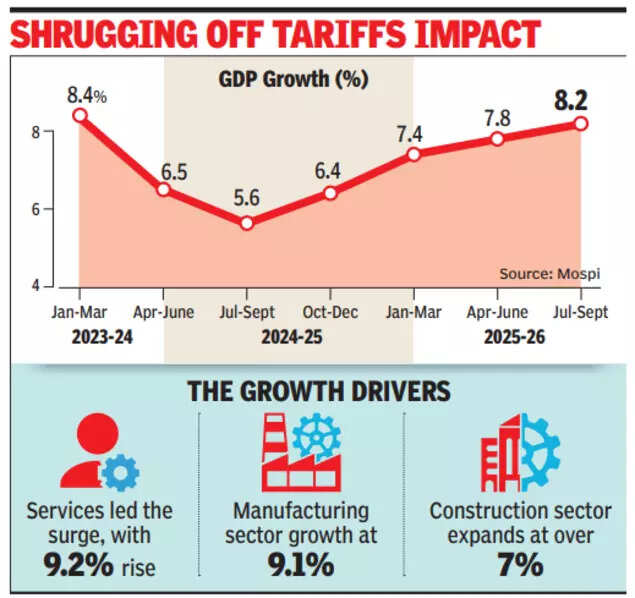
NEW DELHI: The Indian economy grew 8.2% in the July-Sept quarter as a strong comeback by the manufacturing sector and robust services activity helped it clock the fastest pace of expansion in six quarters.Strong domestic demand, which drove factories to produce more ahead of the festival season, helped India remain the fastest growing major economy and shrug off the impact of US tariffs.

The growth drivers

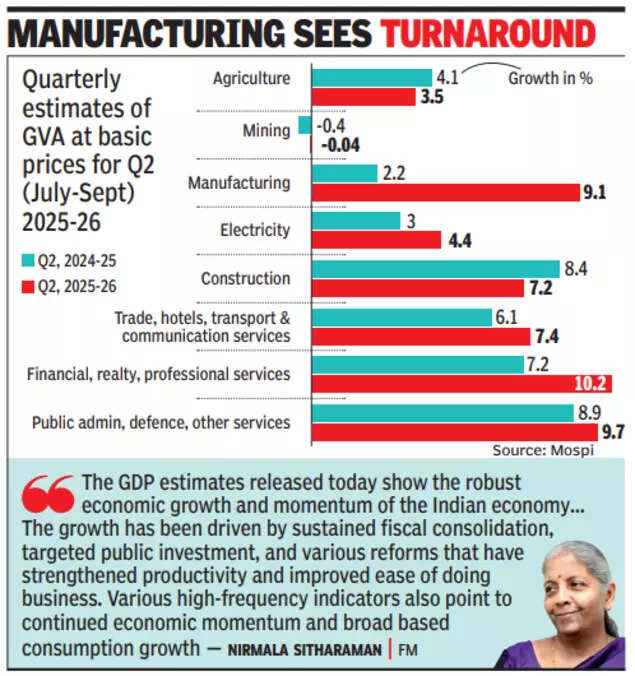
“The 8.2% GDP growth in Q2 of 2025-26 is very encouraging. It reflects the impact of our pro-growth policies and reforms. It also reflects the hard work and enterprise of our people. Our govt will continue to advance reforms and strengthen Ease of Living for every citizen,” PM Narendra Modi posted on X.Combined with 7.8% growth during April-June, the economy expanded at 8% during the first half of the year, with economists and policymakers expecting a good third quarter on the back of strong sales post GST rationalisation.“Now we can comfortably say full year growth will be 7% or north of 7%,” chief economic adviser V Anantha Nageswaran said after the data was released. Govt had budgeted for 6.5-6.8% GDP growth during the financial year.Apart from GST, the govt is also banking on reform measures such as the new labour codes to boost sentiment and further spur economic activity in the months ahead, with low inflation and falling interest rates adding to the positive sentiment.Manufacturing posted a sharp turnaround, clocking 9.1% growth in the second quarter of the current financial year, with service sectors seeing faster expansion. Construction too grew 7.2%, although a tad slower than July-Sept 2024. Agriculture too reported a 3.5% increase on the back of a 4.1% expansion in Q2 of the last fiscal year.‘Pvt consumption main driver of higher growth’Crisil chief economist Dharmakirti Joshi said, “Private consumption was the main driver of higher real growth. From the supply side, manufacturing and services saw a significant rise. There was a prop from statistical low-base effect as well, as the economy grew at a below-average 5.6% in the same quarter last fiscal. A low deflator also lent some buoy. Inflation based on both the Consumer Price Index and the Wholesale Price Index were lower in the second quarter compared with the first. Lower food inflation stoked discretionary spending.”The higher-than-expected estimates prompted economists to revise their forecasts for the full year. State Bank of India is projecting 7.6% growth this year, while Crisil upped its projection by half-a-percentage point to 7%, while cautioning against the impact of US tariffs in the second half.

Manufacturing sees turnaround

“Impact of tariff has started reflecting in exports growth, which grew 5.6% in Q2 on a weak base of 3% growth in 2QFY25. On the other hand imports grew 12.8% in 2QFY26,” said Devendra Kumar Pant, chief economist at India Ratings and Research.“Going forward the headwind will be the tariff impact which will get starker in Oct-Nov. The tailwind is the GST push which can negate and go beyond. This needs to be monitored going ahead,” added Madan Sabnavis, chief economist at Bank of Baroda.Now, all eyes are on the monetary policy committee led by RBI governor Sanjay Malhotra, which meets next week, to decide on interest rates amid low inflation and strong economic growth.


Source link