Breaking News
Nagastra-1 to Project KAL: Can India scale its drone warfare capability?

[ad_1]
Nagastra-1 to Project KAL: Can India scale its drone warfare capability?

The ongoing confrontation between the United States and Iran has once again demonstrated a stark truth about modern warfare: the decisive edge no longer lies in tanks, fighter jets, or even missiles alone, but increasingly in swarms of cheap, expendable, and intelligent unmanned systems. From the deployment of Iran’s Shahed-series loitering munitions to America’s reverse-engineered low-cost strike platforms, the conflict has underlined a structural shift in how wars are fought and sustained.Unmanned aerial systems are no longer auxiliary assets. They are shaping strategy, dictating tempo, and redefining cost equations. A drone costing tens of thousands of dollars can now neutralise assets worth millions, if not more. In such a scenario, endurance, scalability, and production capacity matter as much as technological sophistication.It is within this rapidly evolving global battlefield that India is attempting to define its own drone doctrine. The country’s experience during Operation Sindoor in May 2025 marked a transition point. For the first time, drones were not merely surveillance tools but central to operational planning, execution, and battlefield outcomes. Yet, even as India demonstrated capability, a deeper question emerged: can it scale?

The age of cheap precision: Why drones are redefining warfare

The defining lesson from recent conflicts, particularly the Russia-Ukraine war and the US-Iran confrontation is simple. Warfare has entered an era where affordability and mass production are as critical as precision.Loitering munitions, often described as kamikaze drones, exemplify this shift. These systems combine the persistence of surveillance platforms with the lethality of guided munitions. They can loiter over a target area, identify opportunities, and strike with minimal warning. Unlike traditional missiles, they are relatively inexpensive and can be deployed in large numbers.
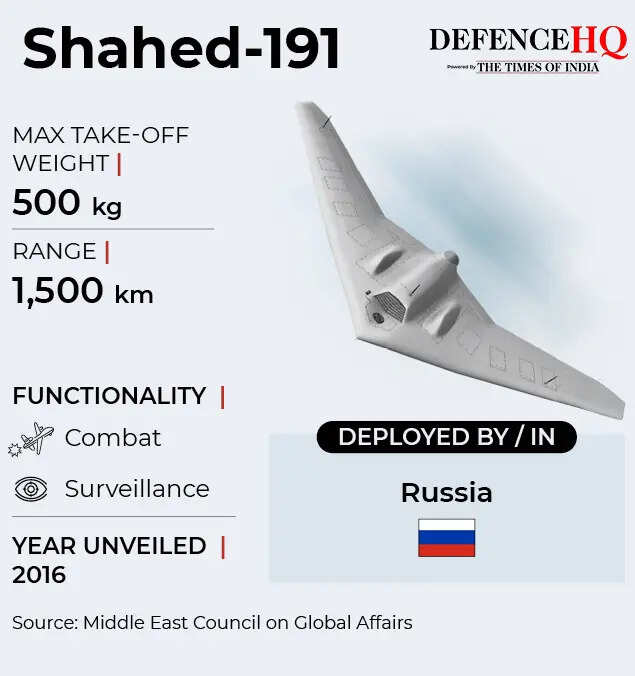
Shahed-191

Iran’s Shahed-136 has become the archetype of this model. With a range of around 2,000 kilometres and a modest warhead, it is not technologically advanced. Yet its strength lies in its simplicity and scalability. Produced in large numbers, it has altered the economics of air defence by forcing adversaries to expend costly interceptors on low-cost threats.
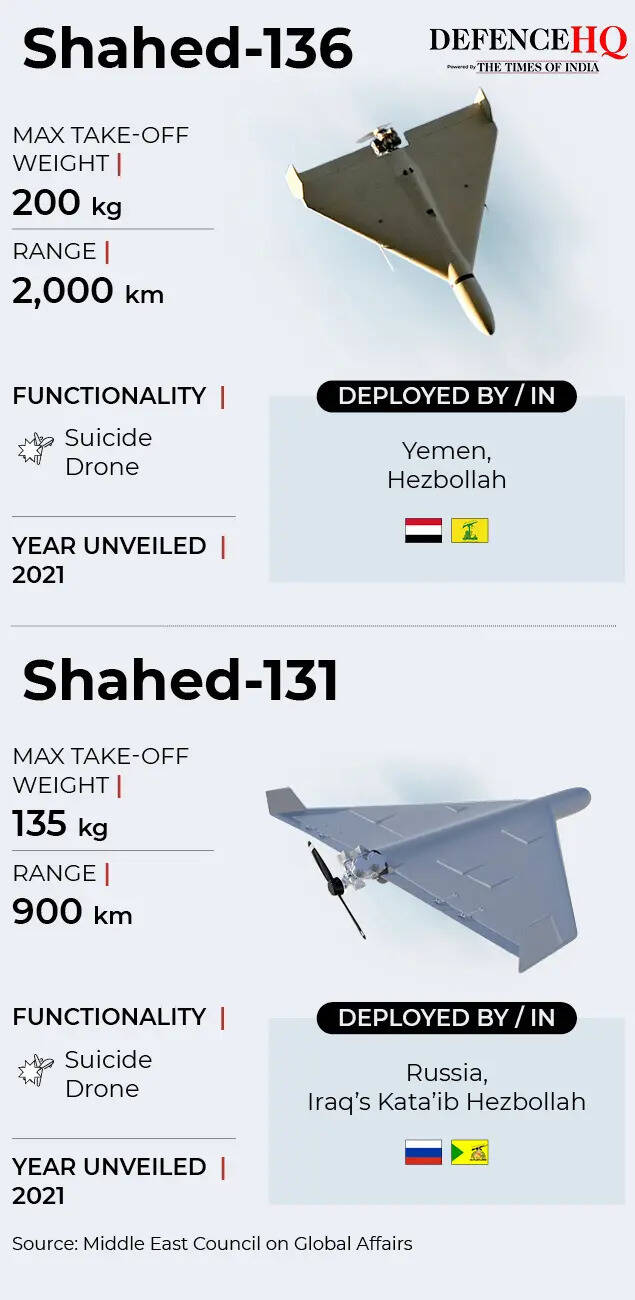
Shahed-136 and Shahed-131

The United States has acknowledged this shift. Its Low-cost Unmanned Combat Attack System, developed by reverse-engineering captured Shahed drones, reflects a pragmatic recognition that the future of warfare lies not in exquisite platforms alone but in mass-producible systems.This is the benchmark against which all emerging drone powers, including India, are now measured.

Where India stands in the global drone race

India today occupies a transitional space in the global drone hierarchy, positioned somewhere between technological competence and industrial under-preparedness. It is neither a laggard nor a leader. Instead, it is a capable but constrained player attempting to bridge the gap between innovation and scale in an ecosystem that is rapidly being defined by mass production and cost efficiency.At a capability level, India has made undeniable progress. Over the past decade, it has developed or inducted systems across the entire drone spectrum, from high-altitude long-endurance platforms to tactical surveillance UAVs, loitering munitions, and counter-drone technologies. Indigenous programmes such as Nagastra, ALS-50, and Switch UAVs demonstrate that Indian industry can design and deploy mission-ready systems tailored to diverse terrains, from deserts to high-altitude borders. Operation Sindoor reinforced this reality by showing that Indian forces can integrate drones into real-time combat scenarios with measurable impact.However, global leadership in drone warfare is no longer determined by the ability to build a few advanced systems. It is defined by the capacity to produce thousands of affordable, expendable platforms and sustain their deployment over extended periods. This is where India’s position becomes more complex.The United States continues to dominate the high-end segment, with platforms such as the MQ-9 Reaper and now newer low-cost experimental systems that blend precision with affordability. At the same time, it is rapidly adapting to the economics of mass drone warfare, as seen in its reverse-engineering of Iranian-style loitering munitions. Russia and Ukraine, through the ongoing conflict, have demonstrated what industrial-scale drone warfare looks like, deploying hundreds of thousands of units annually, particularly first-person view and kamikaze drones.Turkey has carved out a niche by combining affordability with export-driven scale. Its Bayraktar series has become a global benchmark for cost-effective combat drones. Iran, perhaps the most instructive example, has mastered the art of producing simple but effective long-range kamikaze drones in large numbers, fundamentally altering battlefield economics. Even Pakistan has moved aggressively, leveraging Chinese collaboration to build and induct armed drones and loitering munitions at relatively low costs.Against this backdrop, India’s challenge is not one of design but of depth. Its production runs remain limited, often in the hundreds, which constrains both operational flexibility and deterrence value. Without large-scale orders, manufacturers struggle to justify investments in assembly-line production, leading to a cycle where low demand limits supply capacity, and limited capacity restricts demand.Another dimension of this gap lies in supply chains. While India has increased indigenous content in many systems, critical components such as sensors, semiconductors, and communication modules often rely on external sources. In a prolonged conflict scenario, such dependencies could create vulnerabilities, particularly if global supply chains are disrupted.That said, India is not static. Policy interventions, including production-linked incentives, easing of drone regulations, and increased defence procurement from domestic players, are gradually reshaping the landscape. The entry of private players and startups has injected agility into the ecosystem, accelerating innovation cycles. Programmes like iDEX and emergency procurement during Operation Sindoor have also demonstrated that when required, the system can respond quickly and at scale, at least in the short term.The emerging projects such as long-range kamikaze drones and swarm systems indicate that India is acutely aware of where the future lies. The focus is shifting from standalone platforms to networked systems, from individual drone performance to collective operational effect. This conceptual shift aligns with global trends, where the emphasis is on swarming, autonomy, and resilience in contested electronic environments.In essence, India stands at a crossroads in the global drone race. It has crossed the threshold of technological viability but has yet to achieve industrial maturity. The next phase will determine whether it can convert its growing innovation base into a scalable manufacturing ecosystem capable of competing with established drone powers.The distance between India and the leaders is no longer measured in technology alone. It is measured in numbers, production speed, and the ability to sustain a drone-intensive conflict. Bridging that gap will define India’s position in the future battlespace.

Operation Sindoor: India’s drone moment

Operation Sindoor marked a doctrinal shift in India’s military thinking. Rather than treating drones as supplementary assets, the Indian armed forces integrated them across multiple layers of combat operations.From frontline reconnaissance to deep-strike missions, drones played a central role. The operation demonstrated the effectiveness of a networked drone ecosystem, where different categories of unmanned systems worked in tandem to achieve tactical and strategic objectives.
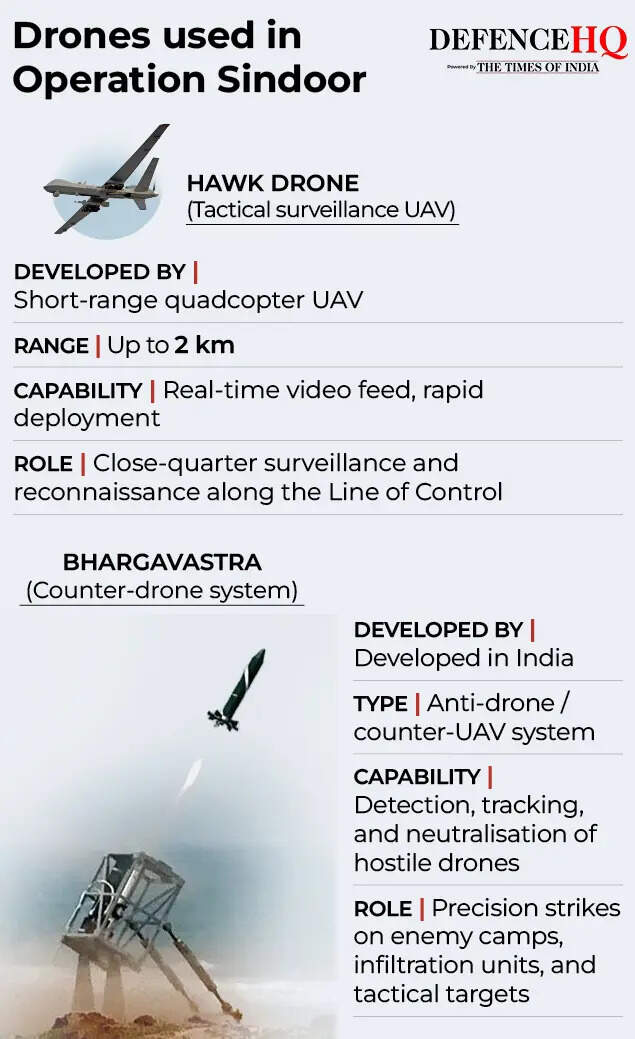
Drones used in Operation Sindoor

First-person view drones provided real-time situational awareness to troops on the ground. Loitering munitions conducted precision strikes against high-value targets. Surveillance UAVs extended operational visibility beyond line-of-sight constraints. Counter-drone systems ensured protection against hostile unmanned threats.This layered approach reduced risk to personnel, improved response times, and enhanced battlefield efficiency. However, the scale of deployment remained limited. India reportedly used around 100 drones during the operation, a fraction of the numbers seen in contemporary conflicts elsewhere.The lesson was clear: capability exists, but scale does not.

Nagastra-1: India’s indigenous loitering munition

At the heart of India’s indigenous drone capability lies the Nagastra-1, a loitering munition developed through collaboration between private industry and defence startups. Designed as a portable, precision-strike system, it represents India’s attempt to build a homegrown equivalent to global kamikaze drones.The Nagastra-1 is a lightweight, man-portable system that can be carried in two backpacks. It combines a fixed-wing UAV with a pneumatic launcher, a ground control station, and communication systems. With a flight endurance of up to 60 minutes and a range of 15 kilometres in manual mode, extendable to 30–40 kilometres autonomously, it offers flexibility across operational scenarios.
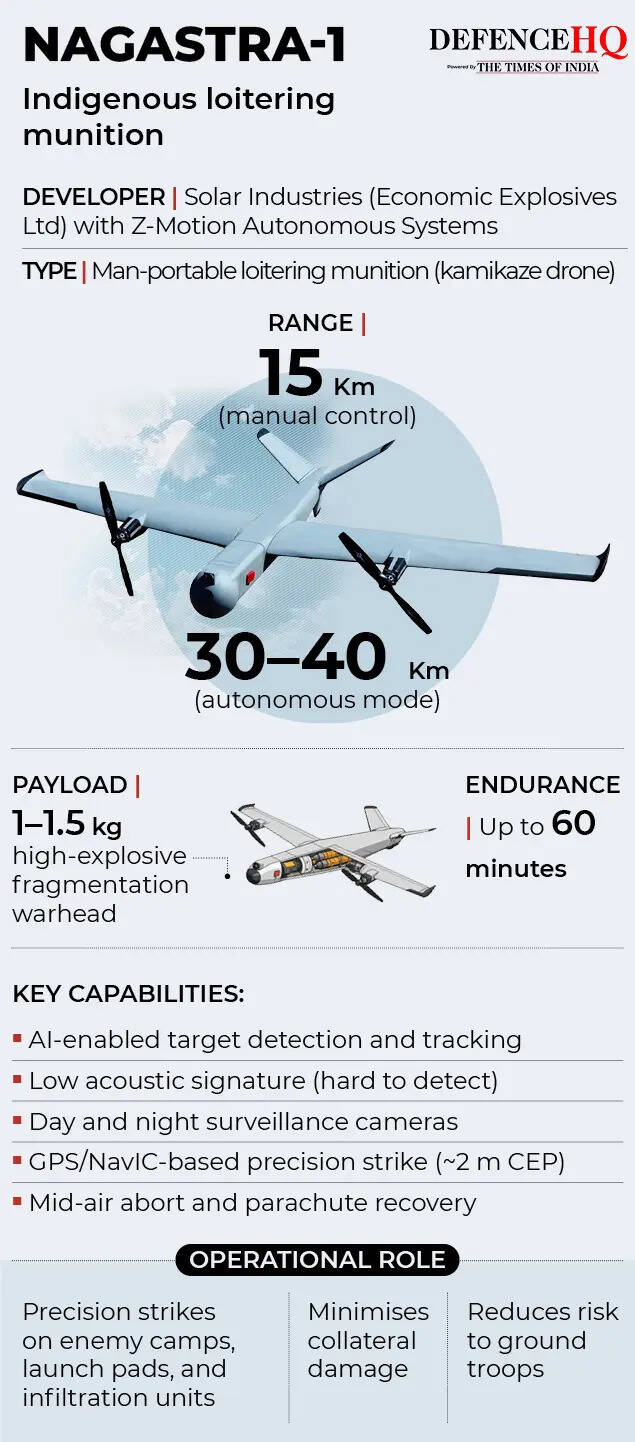
Nagastra-1

What distinguishes the system is its emphasis on precision and adaptability. Equipped with day and night surveillance cameras, it can identify and track targets before executing a strike. Its warhead, weighing between 1 and 1.5 kilograms, is designed for targeted engagements, minimising collateral damage.The drone operates with a man-in-loop system, allowing operators to make real-time decisions. It can abort missions mid-flight and be recovered using a parachute mechanism, a feature that enhances cost efficiency. Its electric propulsion system ensures low acoustic signatures, making it difficult to detect at higher altitudes.During Operation Sindoor, the Nagastra-1 was deployed for precision strikes against selected targets, including launch pads and infiltration units. Its performance validated the concept of indigenous loitering munitions in operational conditions.However, the scale of deployment remains limited. Orders for a few hundred units, while significant, fall short of the thousands required for sustained high-intensity conflict.

Beyond Nagastra: The broader drone ecosystem in Sindoor

Operation Sindoor was not built around a single breakthrough platform. Its significance lay in creating a layered, multi-platform drone ecosystem where different unmanned systems performed specialised roles within an integrated operational framework. This marked a shift from earlier doctrines, where drones were largely limited to surveillance. In Sindoor, they became central to decision-making, strike execution, and defensive operations.At the higher end, India deployed loitering munitions such as the Israeli-origin Harop for suppression of enemy air defences. With long endurance and advanced targeting, these systems were used to neutralise radar sites and command nodes, enabling safer follow-on operations. However, their high cost and import dependence limit their use at scale in prolonged conflicts.
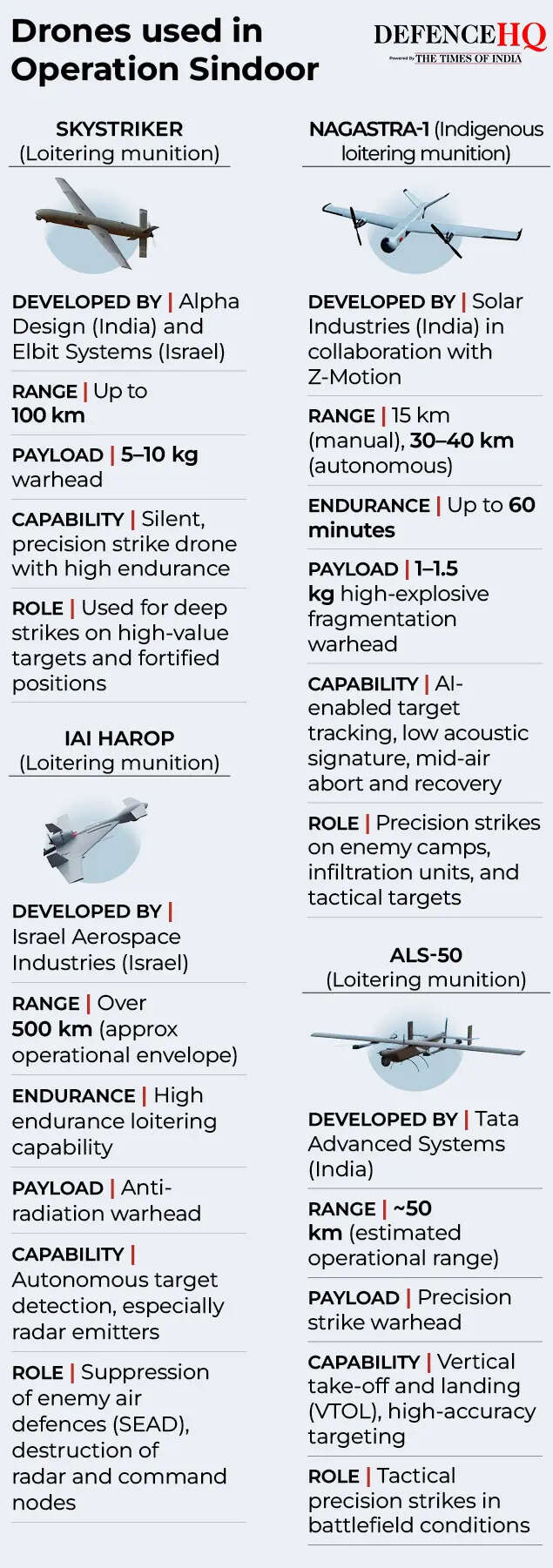
Drones used in  Operation Sindoor

Mid-tier systems like SkyStriker provided a balance between range, payload, and affordability, enabling precision strikes at distances of up to 100 kilometres. Indigenous platforms such as ALS-50 added depth to this layer, reflecting growing domestic capability in precision strike systems, even if production remains limited.At the tactical level, short-range surveillance drones, including quadcopter-based systems, delivered real-time intelligence to troops in complex terrains. First-person view drones further enhanced battlefield agility, enabling precise engagement of small and moving targets at low cost.Equally critical was the defensive layer. Counter-drone systems like Bhargavastra, supported by electronic warfare tools and jammers, ensured protection against hostile UAVs, highlighting the dual nature of modern drone warfare.What made this ecosystem effective was its integration. Surveillance, strike, and defence systems operated in coordination, reducing response times and improving accuracy. Yet, a key constraint persists. High-end capabilities still rely on imports, and overall deployment remains limited by production capacity.Operation Sindoor demonstrated that India has the foundations of a modern drone warfare architecture. The challenge now is to deepen this ecosystem, reduce dependencies, and scale it for sustained, high-intensity conflict.

The cost dilemma: MQ-9B vs mass drones

India’s acquisition of 31 MQ-9B Predator drones represents a significant enhancement in surveillance and strike capability. These high-altitude, long-endurance UAVs can operate for over 40 hours and carry substantial payloads, making them valuable assets for strategic missions.However, their cost raises important questions. At an estimated $3.5 billion for 31 units, the investment reflects a focus on high-end capability rather than mass deployment.
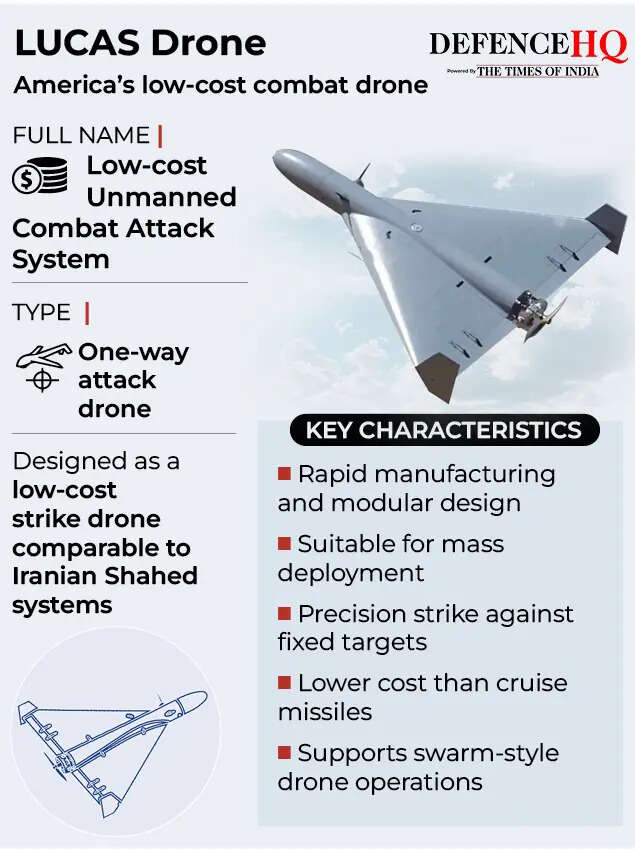
LUCAS Drone

In contrast, the economics of drone warfare increasingly favour low-cost, expendable systems. For the same cost, tens of thousands of kamikaze drones could potentially be produced, offering greater flexibility in prolonged conflicts.This is not to suggest that high-end platforms lack value. Rather, it highlights the need for balance. A modern drone force requires both sophisticated systems for strategic missions and large numbers of affordable platforms for tactical operations.

Project KAL and Sheshnaag-150: India’s answer to Shahed

Recognising the need for long-range, low-cost strike capabilities, Indian defence startups have begun developing systems that mirror the operational philosophy of the Shahed-136.Project KAL, developed by a Noida-based company, is designed as a long-range kamikaze drone with an endurance of three to five hours. Its ability to loiter over target areas, gather intelligence, and execute precision strikes aligns with the emerging requirements of deep-penetration warfare.
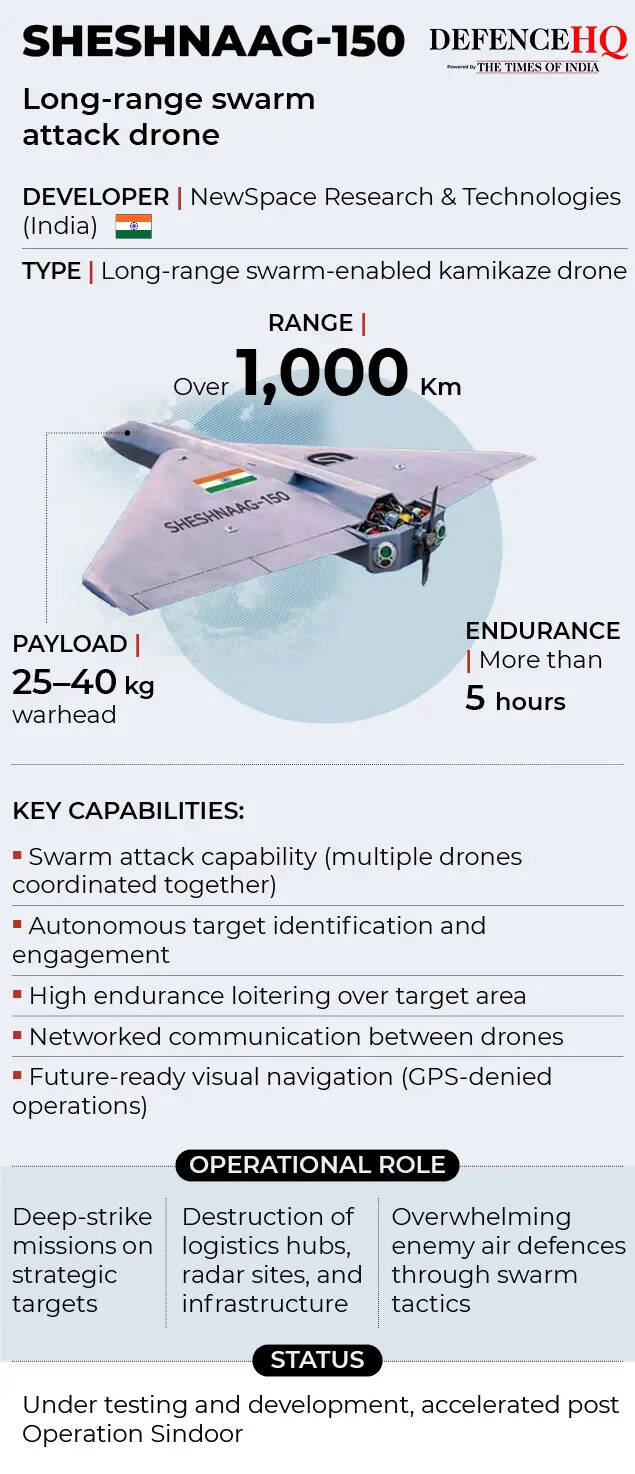
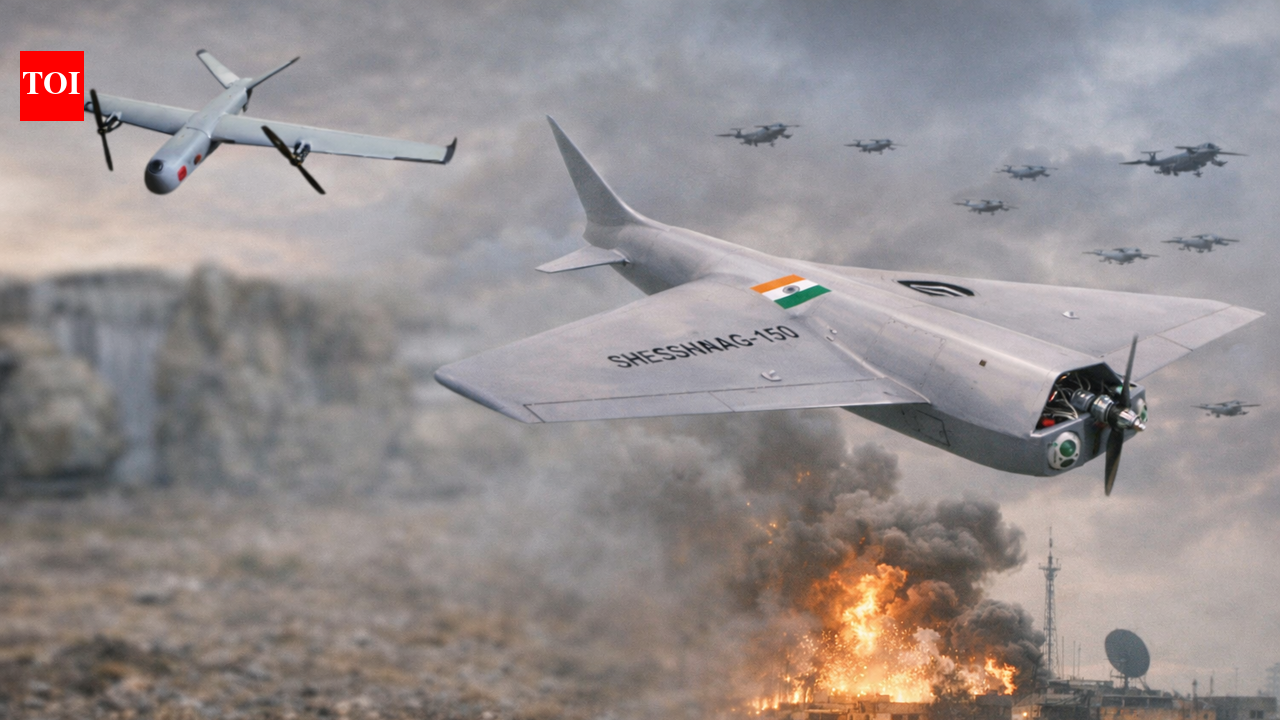
Sheshnaag-150

The Sheshnaag-150 represents a more ambitious evolution. Designed as a swarm-capable attack drone, it combines long range, high payload capacity, and autonomous coordination. With an operational range exceeding 1,000 kilometres and an endurance of over five hours, it is intended to strike strategic targets such as logistics hubs and radar installations.What sets the Sheshnaag-150 apart is its swarm capability. Multiple drones can operate in coordination, overwhelming enemy air defences through sheer numbers and synchronised behaviour. This approach reflects the next stage of drone warfare, where individual platforms are less important than the collective intelligence of the swarm.The system also incorporates advanced software architecture, enabling drones to communicate, adapt, and execute missions with minimal human intervention. Future iterations are expected to include visual navigation systems, allowing operation in GPS-denied environments.Both Project KAL and Sheshnaag-150 remain in development. Their success will depend not only on technological performance but also on the ability to scale production.

Vayu Baan and the evolution of air-launched drones

Another significant development in India’s drone ecosystem is the Vayu Baan programme, which focuses on air-launched unmanned systems and signals a shift towards deeper integration of drones within combat operations. Designed to be deployed from helicopters, these compact unmanned platforms can function both as surveillance assets and precision-guided munitions, expanding the tactical reach of existing air assets without increasing risk to personnel.India’s Vayu Baan programme marks a decisive move towards integrating unmanned systems with traditional manned platforms, reflecting the transition from standalone drone usage to networked, multi-domain warfare. Developed by the Indian Air Force’s Directorate of Aerospace Design, the project centres on air-launched effects, where drones are released mid-flight and then transition into independent surveillance or strike roles.Once deployed, these drones unfold their wings, activate propulsion, and begin autonomous operations. With an expected range of over 50 kilometres and an endurance of around 30 minutes, they are suited for missions such as real-time reconnaissance, target acquisition, and precision engagement. Equipped with electro-optical and infrared sensors, they are designed to operate in contested environments, including GPS-denied scenarios.The concept aligns with a broader global trend of manned-unmanned teaming, enhancing battlefield flexibility while improving survivability. For India, Vayu Baan represents not just a platform, but a doctrinal shift towards faster, more adaptive, and network-centric warfare.

The scale problem: Hundreds vs thousands

Perhaps the most critical challenge facing India’s drone programme is scale. Modern conflicts have demonstrated that effectiveness is not determined solely by technological superiority but by the ability to sustain operations over time.Ukraine and Russia have deployed hundreds of thousands of drones in a single year. These numbers are not anomalies but indicators of the future trajectory of warfare.India’s deployment during Operation Sindoor, while operationally significant, remains modest by comparison. Orders for systems like Nagastra-1 in the hundreds do not justify the establishment of large-scale production lines. Without such infrastructure, scaling up during a conflict becomes difficult.The issue is not merely industrial but strategic. A country that cannot produce drones at scale risks being outpaced in prolonged engagements.

Where is India’s Shahed?

India’s push for indigenous defence manufacturing has begun to deliver visible results, particularly in the drone segment. Platforms such as Nagastra-1, ALS-50, and emerging systems like Sheshnaag-150 reflect a growing domestic capability to design and deploy mission-ready unmanned systems. Much of this progress has been driven by the increasing role of the private sector, with startups and established firms contributing to rapid innovation, supported by government initiatives, procurement reforms, and programmes aimed at boosting self-reliance.Yet, despite these gains, the central question remains: where is India’s equivalent of the Shahed-136?The answer lies in the gap between capability and scale. While India has demonstrated that it can build effective loitering munitions and long-range strike drones, it has not yet translated this into mass production. Supply chain dependencies continue to pose a challenge, particularly for critical components such as sensors, semiconductors, and communication systems. Regulatory complexities and fragmented demand further constrain the ability to establish large, sustained production lines.The Shahed is not just a drone. It is a model of warfare built on simplicity, affordability, and industrial-scale manufacturing. This is where India still lags. Projects such as KAL and Sheshnaag-150 show that the technological foundation exists, and the industrial ecosystem is evolving to support it.However, without the urgency and scale that define leading drone powers, India’s progress remains incomplete. Its drone programme is still transitioning from developing capable systems to deploying them in large numbers. Until that shift happens, India will continue to trail in a domain where numbers, not just technology, define battlefield advantage.

The road ahead: From capability to capacity

Operation Sindoor marked the beginning of India’s drone-centric warfare doctrine. It demonstrated that the country can design, deploy, and integrate unmanned systems effectively.The next phase will be defined by scale, integration, and innovation. Building assembly-line production capabilities, investing in swarm technologies, and developing resilient communication systems will be critical.Equally important will be the integration of drones into everyday military operations. Plans to establish dedicated drone units within infantry formations indicate a shift towards institutionalising unmanned systems.The future battlefield will not be dominated by a single platform but by networks of interconnected systems operating across domains. In this environment, adaptability and scalability will be as important as technological sophistication.India has taken the first steps. The challenge now is to accelerate.

[ad_2]

Source link

Stock market today (March 30, 2026): Which are the top gainers and losers in Nifty50 and BSE Sensex today? Check list

[ad_1]

Stock market today (March 30, 2026): Which are the top gainers and losers in Nifty50 and BSE Sensex today? Check list

Equity benchmark indices Sensex and Nifty ended the last trading session of the 2025-26 financial year sharply lower on Monday, as the ongoing war in West Asia and rising crude oil prices kept investor sentiment under pressure.Weak cues from Asian markets and continued foreign fund outflows further dragged domestic equities.Extending losses for the second straight session, the 30-share BSE Sensex plunged 1,635.67 points or 2.22 per cent to settle at 71,947.55. During the day, it dropped 1,809.09 points or 2.45 per cent to 71,774.13.Here are the top gainers and losers of the day:

Nifty50 top gainers:

  • Hindalco (2.05%)
  • Coal India (1.22%)
  • ONGC (0.96%)
  • Power Grid (0.21%)

Nifty50 top losers:

  • Bajaj Finance (-5.01%)
  • Kwality Wall’s (-4.79%)
  • SBI (-3.94%)
  • InterGlobe Aviation (-3.81%)
  • Bajaj Finserv (-3.72%)
  • Axis Bank (-3.65%)
  • Jio Financial Services (-3.64%)
  • Adani Enterprises (-3.53%)
  • Shriram Finance (-3.51%)
  • Kotak Bank (-3.49%)

BSE Sensex top gainers:

BSE Sensex top losers:

  • Bajaj Finance (-5.01%)
  • Kwality Wall’s (-4.79%)
  • SBI (-3.94%)
  • InterGlobe Aviation (-3.81%)
  • Bajaj Finserv (-3.72%)
  • Axis Bank (-3.65%)
  • Kotak Bank (-3.49%)
  • Bharti Airtel (-3.34%)
  • HDFC Bank (-3.26%)
  • Trent (-3.06%)

The broader market also reflected the sharp sell-off, with 3,563 stocks declining, 876 advancing and 154 remaining unchanged on the BSE.The 50-share NSE Nifty slumped 488.20 points or 2.14 per cent to close at 22,331.40.“The downturn was primarily driven by escalating geopolitical tensions in the Middle East, which dashed hopes of de-escalation and pushed crude oil prices higher, raising concerns over inflation and macro stability for oil-importing economies like India.“Weak global cues, including declines across Asian and US markets, coupled with continued foreign institutional outflows and a weakening rupee, further weighed on sentiment,” Ajit Mishra, SVP, Research, Religare Broking Ltd, said, PTI quoted.Brent crude, the global oil benchmark, jumped 2.18 per cent to $115.1 per barrel. In the last two trading sessions, the Sensex has fallen 3,325.9 points or 4.41 per cent, while the Nifty has dropped 975.05 points or 4.18 per cent.For the full 2025-26 financial year, the Sensex declined 5,467.37 points or 7 per cent, and the Nifty fell 1,187.95 points or 5 per cent.Broader markets also came under pressure, with the BSE MidCap Select index falling 3.13 per cent and the SmallCap Select index declining 2.14 per cent.All sectoral indices ended in the red, with auto, FMCG, consumer durables, capital goods, realty, private banks and PSU banks dropping between 2 per cent and 4 per cent.The BSE PSU Bank index plunged 4.60 per cent, followed by MidSmall Private Banks Quality Tilt (3.96 per cent), Bankex (3.80 per cent), Financial Services (3.46 per cent), Private Banks (3.43 per cent), BSE Top 10 Banks (3.40 per cent), Telecommunication (3.09 per cent) and Realty (3.03 per cent).“Banking stocks were among the key laggards following the RBI’s new restrictions on banks’ foreign exchange positions aimed at stabilising the rupee, which led to sharp declines across major private and public sector lenders.“While valuations now appear more favourable after the recent correction, the trajectory of earnings revisions remains the key determinant of market direction. Continued volatility in oil prices and rupee weakness may exert pressure on input costs, increasing the risk of near-term earnings downgrades,” Vinod Nair, Head of Research, Geojit Investments Limited, said.Meanwhile, the rupee gained 7 paise in a volatile session to close at 94.78 (provisional) against the US dollar, after hitting an all-time intra-day low of 95.22.In Asian markets, South Korea’s Kospi and Japan’s Nikkei 225 plunged nearly 3 per cent, while Hong Kong’s Hang Seng index also ended lower. Shanghai’s SSE Composite index closed in positive territory.Markets in Europe were trading marginally higher, while US markets had ended sharply lower on Friday, with the Nasdaq Composite down 2.15 per cent, the Dow Jones Industrial Average losing 1.73 per cent and the S&P 500 declining 1.67 per cent.“Indian equities extended their decline, with benchmark indices falling over 2 per cent, underscoring a deepening sell-off sentiment driven by persistent global uncertainties and rising crude oil prices,” Hariprasad K, Research Analyst and Founder, Livelong Wealth, said.Foreign Institutional Investors (FIIs) offloaded equities worth Rs 4,367.30 crore on Friday, while Domestic Institutional Investors (DIIs) bought stocks worth Rs 3,566.15 crore, as per exchange data.Foreign investors have pulled out Rs 1.14 lakh crore (about $12.3 billion) from domestic equities in March, marking the worst monthly outflow, amid escalating tensions in West Asia, a weakening rupee and concerns over elevated crude oil prices.

[ad_2]

Source link

‘We didn’t participate’: Iran rejects Pakistan’s mediation role

[ad_1]

'We didn't participate': Iran rejects Pakistan's mediation role

Iran has rejected any suggestion that it is engaging in mediation efforts hosted by Pakistan, insisting it has not taken part in any such diplomatic initiative even as pressure mounts to end the escalating conflict in the region.In a statement posted by the Consulate General of Iran in Mumbai, Tehran’s foreign ministry spokesperson said there were “no direct talks” with the United States, accusing Washington of making “excessive, unreasonable demands via intermediaries”. The spokesperson added that Pakistan’s diplomatic forums were “their own” and made clear: “We didn’t participate.”The remarks come as Pakistan positions itself as a potential mediator in the widening conflict between Iran, the United States and Israel. Islamabad had announced plans to host talks in the coming days, but there has been no formal confirmation from either Tehran or Washington. Iran’s response appears to cast doubt on the credibility of those efforts, even as regional calls for de-escalation grow louder.The diplomatic confusion has unfolded against a backdrop of intensifying military action. The United States and Israel have continued strikes on Iranian targets, while Tehran has expanded its retaliation across the region. Missiles and drones have targeted key infrastructure, including energy and water facilities in Gulf states, as well as sites in Israel.In northern Israel, a fire broke out at a major oil refinery in Haifa following a strike or falling debris, though it was quickly contained. Elsewhere, Iran struck a power and desalination plant in Kuwait, killing one worker and injuring several soldiers. Gulf nations including Saudi Arabia and Bahrain have also reported intercepting incoming missiles.Meanwhile, US President Donald Trump has signalled both openness to negotiations and the possibility of further escalation. He said talks with Iran were progressing “extremely well”, but warned that military options remained on the table, including the potential seizure of Iran’s strategic Kharg Island oil terminal.The conflict has already triggered sharp volatility in global energy markets, with oil prices surging amid fears over disruptions in the Strait of Hormuz, a critical route for global oil shipments.

[ad_2]

Source link

No design, no subsidy: Government draws red line for electronics firms

[ad_1]

No design, no subsidy: Government draws red line for electronics firms

NEW DELHI: The government has drawn a hard line under its electronics push, pairing fresh approvals worth thousands of crores with a blunt warning: subsidies will not flow to companies that treat India as a factory floor without building design muscle. Signalling a shift from scale to strategic value, Union IT minister Ashwini Vaishnaw on Monday said firms under the Electronics Components Manufacturing Scheme (ECMS) must embed design, quality and engineering in India or risk losing support. The warning comes alongside a fresh set of approvals that underline the scheme’s scale. The ministry has cleared 29 new projects involving Rs 7,104 crore investment, taking total approvals to Rs 61,671 crore—surpassing the initial Rs 59,350 crore target.Vaishnaw flagged gaps in industry response, saying the pace of strengthening design and quality capabilities has fallen short of expectations. “Real value gets captured only if design is done in India,” he said, making it clear that incentives will be tied to deeper technological capabilities.He issued a direct warning that approvals alone do not guarantee funding. “We are willing to stop any further disbursements or approvals if the industry doesn’t come up with the commensurate efforts,” he said, adding, “on applications that have been approved, we won’t even disburse if the asks aren’t met.”The scheme now spans 75 applications across 23 product categories and 12 states, with projected production of over Rs 4.5 lakh crore and employment potential exceeding 65,000 jobs, according to official data. The latest approvals include India’s first rare earth permanent magnet manufacturing unit, backed by Rs 700 crore investment and based on indigenous intellectual property, alongside projects in high-end PCBs, capacitors and connectors—segments aimed at building core electronics capabilities.Even as approvals gather pace, the government has tightened compliance. Companies have been given 15 days to submit plans addressing four key requirements—product design, Six Sigma quality standards, talent development and local sourcing.“Manufacturing is easier; translating design into a reliable product is far more complex,” Vaishnaw said, stressing that Six Sigma processes are “essential” for ensuring global-quality output.In a pointed message to industry, the minister said firms failing to align with the government’s integrated approach risk being “weeded out”, adding he may skip the next review meeting if progress remains inadequate. The ministry also indicated stricter monitoring of milestones, linking future incentives to measurable outcomes in design capability, localisation and quality benchmarks across the electronics value chain.

[ad_2]

Source link

Centre’s fiscal deficit at 80.4% of FY26 target by February: CGA data

[ad_1]

Centre’s fiscal deficit at 80.4% of FY26 target by February: CGA data

The Centre’s fiscal deficit stood at Rs 12.52 lakh crore at the end of February, accounting for 80.4 per cent of the full-year target for 2025-26, according to data released by the Controller General of Accounts (CGA) on Monday, PTI reported.This compares with 85.8 per cent of the annual target achieved in the corresponding period last year.The government has pegged the fiscal deficit for 2025-26 at 4.4 per cent of GDP, or Rs 15.58 lakh crore.As per the monthly accounts released by the CGA, the Centre’s total receipts reached Rs 27.91 lakh crore during April-February, or 82 per cent of the budget estimates.This included net tax revenue of Rs 21.45 lakh crore and non-tax revenue of Rs 5.8 lakh crore.Total expenditure during the period stood at Rs 40.44 lakh crore, which is 81.5 per cent of the full-year budget target, the data showed.

[ad_2]

Source link

SSC CPO result 2026 declared: Check Delhi Police SI cut-off marks and PET/PST shortlist

[ad_1]

SSC CPO result 2026 declared: Check Delhi Police SI cut-off marks and PET/PST shortlist

SSC CPO Result 2026: The Staff Selection Commission (SSC) has officially declared the SSC CPO 2025 Paper-I result for recruitment of Sub-Inspectors in Delhi Police and Central Armed Police Forces (CAPFs). Candidates who appeared for the exam held from December 9 to 12, 2025 can now check their qualifying status for the next stage—Physical Endurance Test (PET) and Physical Standard Test (PST).The result has been prepared using normalized marks, and candidates with NCC certificates have been provisionally awarded bonus marks, subject to verification during document checking.Minimum Qualifying MarksAs per SSC guidelines:Unreserved (UR): 30% (60 marks)OBC / EWS: 25% (50 marks)SC / ST / Others: 20% (40 marks)SSC CPO Cut-off 2026: Female Candidates (List-I)

Category Cut-off Marks Candidates Available
Unreserved 128.01610 743
Other Backward Classes 124.22057 1601
Scheduled Castes 100.91972 867
Scheduled Tribes 95.19641 426
Economically Weaker Section 126.55856 660
Ex-Servicemen 40.00000 23
Total 4320

Note: 87 (SC), 26 (ST), 955 (OBC), and 600 (EWS) candidates meeting the UR cut-off are included in their respective categories.SSC CPO Cut-off 2026: Male Candidates (List-II)

Category
Cut-off Marks
Candidates Available
Unreserved 119.47517 4975
Other Backward Classes 115.02519 15858
Scheduled Castes 88.95164 9518
Scheduled Tribes 89.06234 4771
Economically Weaker Section 114.60115 6678
Ex-Servicemen 40.00000 2267
Total 44067

Note: 1608 (SC), 744 (ST), 74 (ESM), 9925 (OBC), and 5456 (EWS) candidates qualifying at UR cut-off are counted under their respective categories.SSC CPO Cut-off 2026: Male Departmental (Delhi Police Only – List-III)This category is specifically for Delhi Police departmental candidates, unlike the above two lists which include both Delhi Police and CAPFs.

Category
Cut-off Marks
Candidates Available
Unreserved 127.92622 46
Other Backward Classes 116.64021 86
Scheduled Castes 101.67331 46
Scheduled Tribes 94.89506 24
Economically Weaker Section 120.78203 26
Ex-Servicemen
Total 228

Important ClarificationList-I (Female) and List-II (Male) include candidates for both Delhi Police and CAPFs.List-III (Male Departmental) is only for Delhi Police serving personnel.What’s Next? PET/PST RoundCandidates shortlisted in Paper-I will now appear for:Physical Endurance Test (PET)Physical Standard Test (PST)These will be conducted by the CAPFs, and schedules will be released soon on the official SSC website.Other Key Updates12 candidates’ results have been withheld due to administrative reasons.Final answer keys and individual marks will be uploaded shortly.Candidates are advised to regularly check ssc.gov.in for PET/PST admit cards and updates.

[ad_2]

Source link

IIP data: Industrial output rises 5.2% in February, manufacturing leads recovery

[ad_1]

IIP data: Industrial output rises 5.2% in February, manufacturing leads recovery

India’s industrial production grew 5.2 per cent in February, driven largely by an improvement in manufacturing output, according to official data released on Monday.Factory output, measured by the Index of Industrial Production (IIP), had expanded 2.7 per cent in February 2025, as per the official statement.Data released by the National Statistics Office (NSO) also showed that industrial growth for January 2026 has been revised upward to 5.1 per cent from the earlier provisional estimate of 4.8 per cent.The manufacturing sector, which forms the bulk of the index, recorded a growth of 6 per cent in February 2026, compared with 2.8 per cent in the year-ago period, supporting the overall expansion.Mining output growth improved marginally to 3.1 per cent from 1.6 per cent a year earlier, while power generation rose 2.3 per cent against a 3.6 per cent increase in February 2025.According to the official data, the IIP index stood at 159.0 in February 2026 compared to 151.1 in the corresponding month last year.Within manufacturing, 14 out of 23 industry groups recorded positive growth. Key contributors included “manufacture of basic metals” (13.2 per cent), “manufacture of motor vehicles, trailers and semi-trailers” (14.9 per cent), and “manufacture of machinery and equipment n.e.c.” (10.2 per cent).In use-based classification, infrastructure and construction goods, intermediate goods and capital goods emerged as the top contributors to growth. Capital goods output rose 12.5 per cent, while infrastructure/construction goods grew 11.2 per cent and intermediate goods by 7.7 per cent.Consumer durables output expanded 7.3 per cent, whereas consumer non-durables contracted 0.6 per cent during the month.During the April-February period of FY26, industrial production growth remained flat at 4.1 per cent compared to the same period last year.

[ad_2]

Source link

Will Middle East tensions affect Indian economy? What Morgan Stanley said in its report

[ad_1]

Will Middle East tensions affect Indian economy? What Morgan Stanley said in its report

India’s economic outlook continues to be supported by strong domestic demand and improving high-frequency indicators, even as rising geopolitical tensions in the Middle East add a fresh layer of global uncertainty and raise the risk of stagflation, Morgan Stanley said in its recent report.The report said that “domestic demand remains resilient; however, headwinds are emerging as ongoing geopolitical tensions create a stagflationary risk,” adding that while macroeconomic stability indicators are currently favourable, “prolonged disruption poses downside risks to growth and could worsen macro stability.”Meanwhile, on domestic front, high-frequency indicators point to broad-based economic strength. The report highlighted an improvement in auto sales across segments, alongside rising credit growth, signalling sustained consumption and lending activity.It further pointed to resilient GST collections, reflecting steady economic activity. The manufacturing PMI has improved, while the services PMI has edged down, indicating some moderation in the services sector.Alongside, labour market conditions are improving in CY2025 and CYTD26, with a gradual rise in employee expenses among BSE-500 companies, indicating strengthening employment trends.Corporate performance has remained steady, with revenues holding up in the December 2025 quarter. The report also said that nominal growth is expected to improve in FY2027E.Financial flows continue to support economic activity. Monthly SIP flows remain upbeat, indicating sustained retail investor participation, while fund flows to the commercial sector remain healthy, pointing to adequate credit availability for businesses.On the policy side, the Reserve Bank of India has taken proactive steps to manage liquidity. The report noted that the RBI has conducted proactive liquidity management, with the policy rate currently at 5.25%, and interbank liquidity remaining in surplus, ensuring adequate system liquidity.However, the report also cautioned that India is still exposed to external risks, particularly due to developments in the Middle East. It noted that the country is vulnerable to volatility in global commodity prices, especially energy. At the same time, the region also remains crucial for India’s external sector, with exports to the region accounting for around 15% of total exports, while it contributes 38% of India’s remittances.

[ad_2]

Source link

‘Modi controls Kerala CM’: Rahul Gandhi counterattacks Pinarayi Vijayan with same BJP ‘B-team’ barb ahead of elections | India News

[ad_1]

'Modi controls Kerala CM': Rahul Gandhi counterattacks Pinarayi Vijayan with same BJP 'B-team' barb ahead of elections
Pinarayi Vijayan and Rahul Gandhi (R)

NEW DELHI: The term “BJP B team” has emerged as a central allegation as both major fronts, the incumbent LDF and the main opposition bloc UDF—trade accusations in Kerala, drawing parallels with the distant third party and the state’s leading BJP.At a poll rally in Kerala’s Pathanamthitta, Rahul Gandhi launched a heavy charge, saying, “LDF is completely supported by BJP.” This came days after LDF face and Kerala chief minister Pinarayi Vijayan labelled the Congress-led UDF as the “BJP B team” in poll-bound Kerala.

Watch

Kerala Polls: VD Satheesan Alleges Collusion Between CPM And BJP, Calls CM Vijayan A Dictator

Rahul Gandhi sharply criticised the incumbent Left government, stating, “The LDF does not behave like a left front in Kerala… It is no longer a left government, but a corporate-funded government…”He added, “We are fighting here in the elections against the LDF which is completely supported by the BJP. On one side is UDF and on the other side is the combination of the LDF and BJP… There is a hidden hand of the BJP in the Kerala elections and it does not want the UDF here because they know the only force that challenges them in the country is the Congress party.”Rahul further claimed, “BJP knows that if they are in power in Delhi, then any LDF government in Kerala is fully under their control… The first proof of this is that the people who fight the BJP get attacked and threatened by them. I myself have been attacked, and have 36 cases against me… There is no attack on the CM of Kerala by the BJP.”“The truth is that Narendra Modi is compromised by Donald Trump and everyone knows it. The same way, Narendra Modi controls your Chief Minister. Pinarayi Vijayan is controlled by his corruption,” he saidRahul also criticised Prime Minister Narendra Modi for ignoring the Sabarimala gold theft in his Palakkad address on Sunday. “In every speech, he talks about temples and religion, but somehow, he forgot about what happened in Sabarimala. He forgot that the left front leaders took the gold of the Ayyappa temple and replaced it with brass,” Rahul said.He accused the Left government of abandoning its ideological roots, calling it a “corporate-funded government.” “The LDF does not behave like a left front in Kerala. It is no longer a left government, but a corporate-funded government,” he added.

Poll

What matters most to you during elections?

Last week, Kerala CM Pinarayi Vijayan made a similar charge, lambasting Rahul Gandhi and the Congress as the BJP’s “B-team”:“Rahul Gandhi is a national leader, yet he lacks the basic awareness of even a common local Congress worker in Kerala; he simply refuses to learn from experience or mistakes. It is hard to understand how such a downfall is happening to him,” he said.“Rahul Gandhi and his Congress are the ‘B-team’ of the BJP in the country, and yet their stance is being adopted across India,” he added.

[ad_2]

Source link

Lok Sabha passes Bill to amend Insolvency and Bankruptcy Code; here’s what it means

[ad_1]

Lok Sabha passes Bill to amend Insolvency and Bankruptcy Code; here's what it means

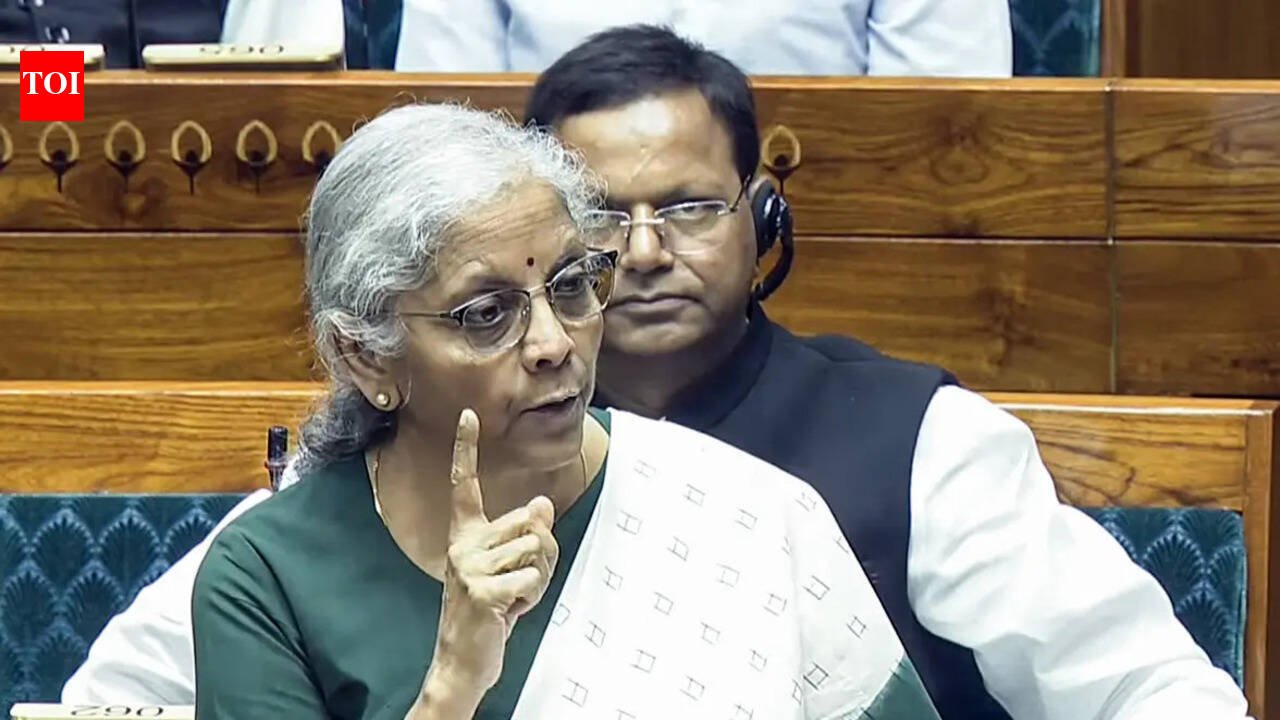
The Lok Sabha on Monday cleared the Insolvency and Bankruptcy Code (Amendment) Bill, 2025, as finance and corporate affairs minister Nirmala Sitharaman highlighted the law’s role in reshaping the country’s banking landscape. Speaking in the House, Sitharaman said that the Bill, introduced a decade back in 2016, has been instrumental in improving the health of the banking sector, particularly through the recovery of non-performing assets. She further stressed that more than half of such stressed assets have been resolved under the framework. The FM stated that the resolution process has also had a wider impact on companies, noting that firms coming out of insolvency have shown improved performance along with stronger corporate governance practices.The amendment Bill, which contains 12 proposed changes, was taken up after being examined by a Select Committee that submitted its report in December 2025. The legislation had originally been introduced in the Lok Sabha on August 12, 2025.Among the changes, the Bill seeks to streamline the admission of insolvency cases by making it mandatory for applications to be admitted within 14 days once a default is established. According to Sitharaman, prolonged litigation has been a key factor behind delays in the resolution process, and the amendments aim to address this by introducing penalties to curb misuse of the system.With this Bill, the IBC has now undergone seven amendments since it first came into force.

[ad_2]

Source link