Breaking News
No plans for public sector banks merger? Government issues clarification; here’s what MoS detailed on FDIs, IDBI offloading & more

No plans for public sector banks merger? Government issues clarification; here's what MoS detailed on FDIs, IDBI offloading & more

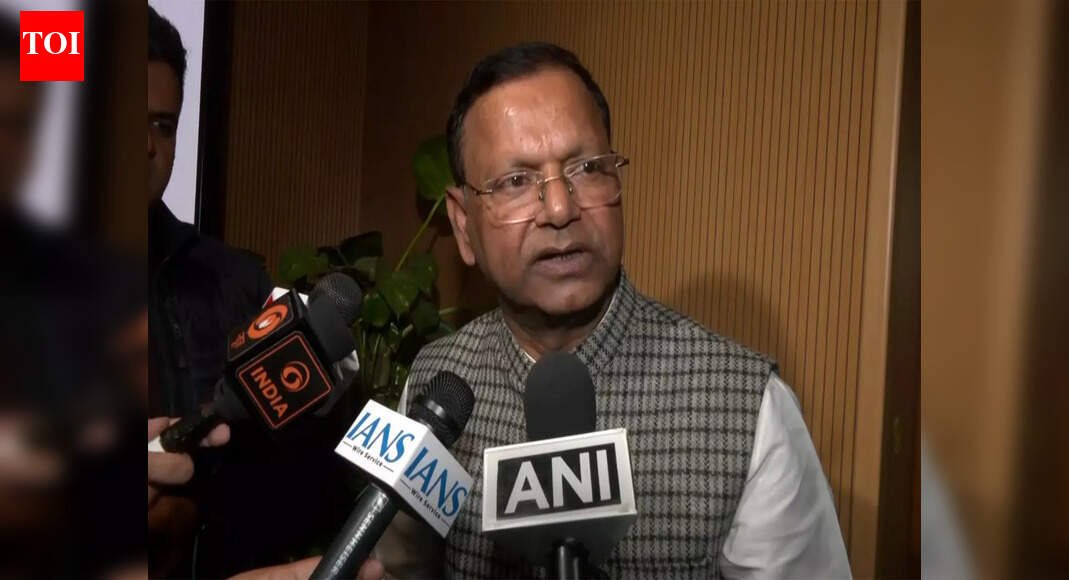
The government on Monday confirmed that there are no ongoing discussions or plans regarding the restructuring or combining of public sector banks.Pankaj Chaudhary, minister of state for finance, in a written reply to the Lok Sabha ruled out any such consideration and clarified, “presently, no proposal on merger or consolidation of Public Sector Banks (PSBs) is under consideration of the Government. In response to a separate question, the minister also detailed the limits on Foreign Direct Investment (FDI) in the banking sector. As per the Foreign Exchange Management (Non-Debt Instruments) Rules 2019, FDI in PSBs is capped at 20%, while private sector banks are permitted up to 74 %.Highlighting the function of overseas investment, he pointed out that “FDI is considered as a major source of non-debt financial resource for the economic development, leading to long-term sustainable capital in the economy and contributes towards technology transfer, development of strategic sectors, greater innovation, competition and employment creation and supplement domestic capital, technology and skills for accelerated economic growth and development. Chaudhary, as cited by PTI, also provided an update on the sale process of IDBI Bank, confirming that the disinvestment will go ahead in line with the decision of the Cabinet Committee on Economic Affairs (CCEA). The CCEA, at its meeting on May 5 2021, granted ‘in principle’ approval for a strategic disinvestment accompanied by a transfer of management control. The approval covered the sale of the government and LIC’s stake, subject to consultation with LIC and within the framework decided by the RBI. According to the minister, 60.72% of IDBI Bank’s shareholding has been put up for strategic sale along with management control. The government will divest 30.48% of its ownership, which will leave it with 15% equity afterwards. LIC will reduce its holding by 30.24%, retaining 19% equity after the sale. As of March 2025, the bank’s outstanding capital and liabilities were approximately Rs 4.11 lakh crore, backed by tangible and intangible assets of an equal amount.The minister also informed about continued improvements in the financial performance of Regional Rural Banks (RRBs), which delivered their highest-ever consolidated net profit of Rs 7,571 crore in FY24, followed by Rs 6,825 crore in FY25, marking their second-highest result. He also explained the reason behind the dip, linking it to the implementation of the pension scheme with retrospective effect from November 1, 1993, along with payments towards computer increment liability. Chaudhary also highlighted the performance of RRBs, which have been strengthening across various key metrics. These measures includes Capital to Risk Weighted Assets Ratio (CRAR), deposits, advances, non-performing assets (NPA) and credit–deposit (CD) ratio.



Source link

Trump tariffs hit India’s manufacturing sector! PMI falls to 9-month low in November; but how big is the loss?


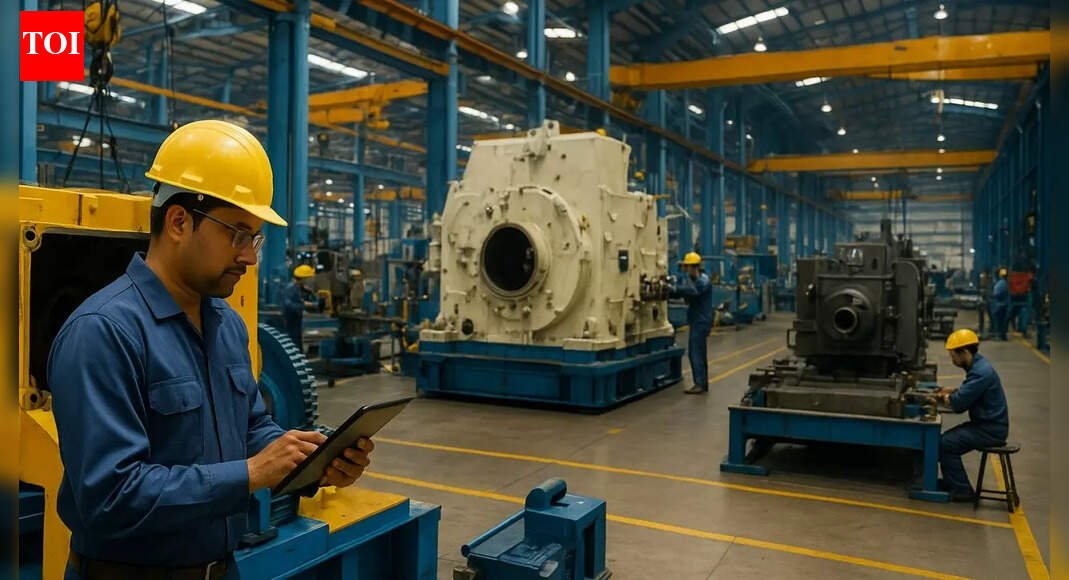
The PMI after seasonal adjustments, declined to 56.6 in November from October’s 59.2. (AI image)

US President Donald Trump’s 50% tariffs on India have hit the manufacturing sector, but the impact has been somewhat cushioned by diversification to other countries. The manufacturing activity in India experienced a slowdown to a nine-month low during November, attributed to reduced sales growth and production amidst difficult market conditions, according to HSBC India Manufacturing Purchasing Managers’ Index (PMI).The HSBC India Manufacturing PMI compiles data from S&P Global, based on responses from questionnaires distributed to a panel of roughly 400 manufacturing purchasing managers.

Politics Increasingly ‘Trumps’ Economics: EAM Jaishankar’s Veiled Swipe At US Amid Trade Tensions

The PMI after seasonal adjustments, declined to 56.6 in November from October’s 59.2, indicating the slowest improvement in operating conditions since February. The PMI methodology indicates expansion when readings exceed 50, whilst figures below 50 signify contraction.“India’s final November PMI confirmed that US tariffs caused the manufacturing expansion to slow,” said Pranjul Bhandari, Chief India Economist at HSBC.Also Read | Explainer: Making sense of India’s 8.2% growth – and IMF’s ‘C’ on GDP data“Although companies suggested that the trend for international sales remained favourable – reflecting greater sales to clients in Africa, Asia, Europe and the Middle East – there was a mild loss of overall growth momentum,” the report noted according to PTI.The data showed new export orders increased at their slowest rate in more than a year.“The export orders PMI dropped to its lowest point in 13 months. Future output expectations indicated a significant decline in November, possibly due to growing tariff-related worries,” Bhandari commented.Earlier on November 28, commerce secretary Rajesh Agrawal expressed optimism about finalising a framework trade agreement with the US within this year, which could potentially resolve tariff-related challenges for Indian exporters.The negotiations between both nations have been ongoing, with initial expectations of concluding the first phase of a bilateral trade deal by fall of 2025. However, the implementation of tariffs on Indian exports by the Trump administration has created complications.Whilst acknowledging that the Bilateral Trade Agreement (BTA) requires additional time, Agrawal confirmed India’s continued engagement with the US in extensive discussions regarding a framework trade deal, aimed at addressing the mutual tariff issues affecting Indian exporters.The impact of GST reductions appears to be diminishing, potentially failing to counter the negative effects of tariffs on demand, as per Bhandari’s observations.November saw a decrease in inflation levels, with both input expenses and selling prices increasing at their lowest rates in nine and eight months, respectively.Also Read | GDP grows at 8.2%, fastest in 6 quarters: What the data really says about Indian economy – explainedIndian manufacturing firms adjusted their recruitment strategies and procurement activities to align with reduced growth in new orders.The report indicated that job creation continued its positive streak for 21 consecutive months, albeit at its most modest rate during this period.Looking forward, whilst businesses maintained optimistic projections for output over the next year, their confidence levels declined to the lowest point recorded in approximately three-and-a-half years.“Downgraded forecasts stemmed from concerns around a competitive landscape, including competition from international firms, as anecdotal evidence showed,” the report said.


Source link

‘If high-command calls …’: D K Shivakumar, Siddaramaiah show united front amid power tussle; inside breakfast meet 2.0 | India News


'If high-command calls ...': D K Shivakumar, Siddaramaiah show united front amid power tussle; inside breakfast meet 2.0

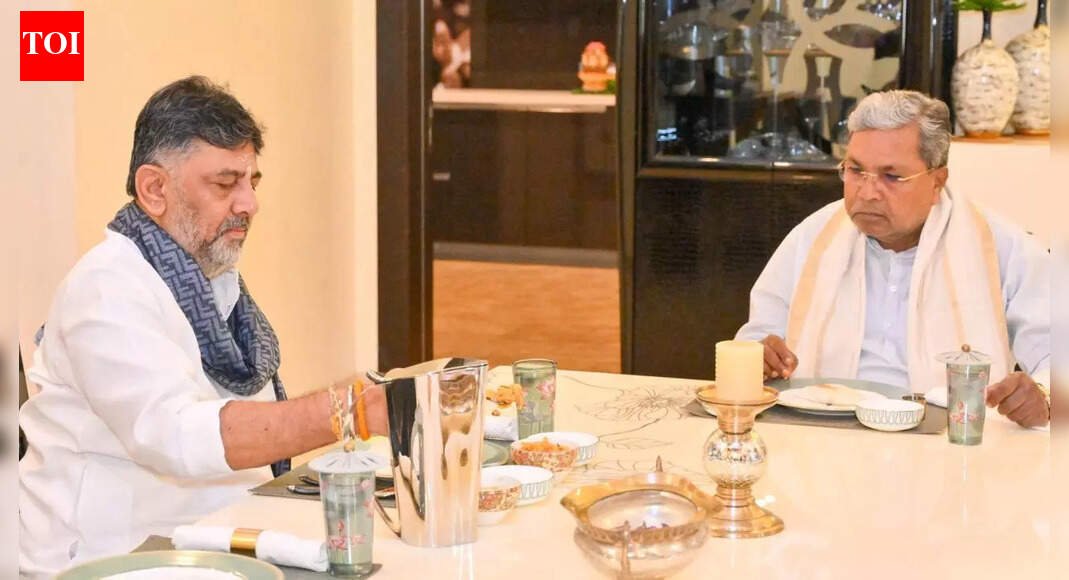
NEW DELHI: Karnataka chief minister Siddaramaiah and D K Shivakumar on Tuesday projected a strong display of unity after their second breakfast meeting at Deputy CM’s residence, declaring that they would “run the government together,” amid escalating leadership tussle within the Congress.Addressing the joint press briefing, Siddaramaiah said a meeting with the party high command was also likely soon. When asked about the possibility of Shivakumar becoming chief minister, he responded, “When the High Command says.”“There are no differences. Me and DK Shivakumar are united. We will run the government together in the future as well. All our MLAs are united, and unitedly we will face the opposition. We are in the same party, we follow the same ideology, and we work together. In the future, too, both of us will work together and bring the party back to power,” he said, setting a confident tone of unity, downplaying the speculated leadership conflict.“This unity is not something new today; we have always been united. Whatever decision Rahul Gandhi makes, we will act accordingly; that is what I have said,” he added, reiterating that their partnership was not new.Siddaramaiah’s breakfast visit was the second in three days. It was seen as another attempt to ease tensions. On Saturday, Shivakumar had joined the CM at his Cauvery residence for a traditional idli–vada–sambar spread. On Tuesday, Shivakumar hosted him with Nati chicken and idlis.The outreach comes after the Congress high command nudged both leaders to present a united front ahead of the Belagavi legislature session starting December 8.

Discussions on MSP, assembly session and party issues

Siddaramaiah said the two discussed issues affecting farmers, including MSP for maize and sugarcane. “After breakfast, we discussed the assembly session. It was decided that we should call a meeting of the MLAs on December 8. We will discuss farmers’ issues and other issues of the state,” he said.Reaffirming loyalty to the leadership, he added, “Both of us will accept the decision taken by the high command, especially Rahul Gandhi, Sonia Gandhi, Priyanka Gandhi Vadra and Mallikarjun Kharge.”The CM also said the opposition was preparing to bring a no-confidence motion, “BJP and JD(S) are planning to oppose whatever decisions we take. Our government is pro-farmer.”Shivakumar echoed this messaging, posting on X, “Honoured to welcome the Hon’ble Chief Minister to my residence today. We stand committed to the development of Karnataka and the progress of our people.”

BJP hits out at Breakfast diplomacy 2.0

Taking a swipe at the Congress leaders, BJP MP Basavaraj Bommai said the state had become a stage for political theatrics. “This is just a teaser, the full picture showing Congress’s condition will release soon… If the CM and Dy CM are engaged in breakfast meetings, then when will they work for the welfare of the people? ‘Karnataka ka natak’ should finish soon,” he said.The display of unity comes amid intense speculation of a leadership change after the government completed half of its five-year term on November 20. Talk of a 2023 “power-sharing” formula, where Siddaramaiah would serve 2.5 years before handing over the CM post to Shivakumar has fueled tensions, though neither leader has acknowledged such an agreement and the party has never confirmed it.While Siddaramaiah insists he will serve the full term, Shivakumar’s camp has pushed for the alleged rotational arrangement. The high command is now attempting to keep both leaders aligned as it works to prevent instability in the state.


Source link

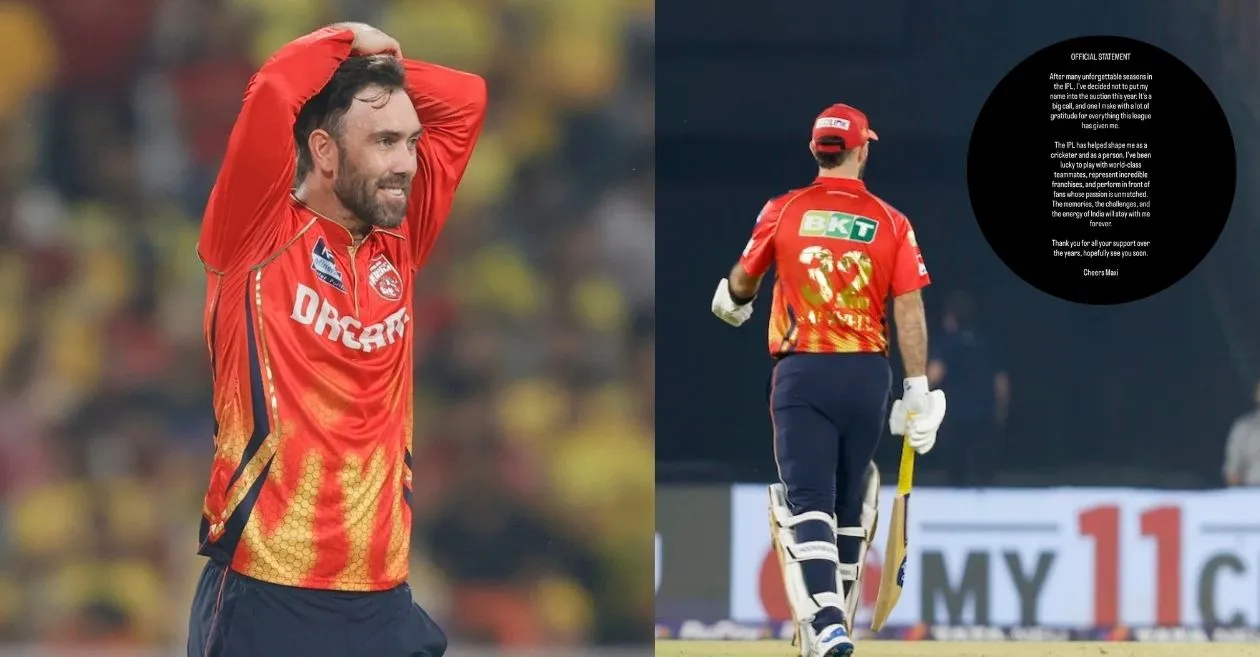
Glenn Maxwell issues a touching statement after withdrawing from the IPL 2026 auction


Australian all-rounder Glenn Maxwell has decided against registering for the IPL 2026 auction, marking a potential end to his storied tenure in India’s premier T20 league. The 37-year-old, who fetched Rs 4.2 crore from Punjab Kings (PBKS) at the IPL 2025 mega-auction, struggled with just 48 runs in seven matches and four wickets before a finger fracture sidelined him midway through the season. This move follows his release by PBKS ahead of retentions, amid a pool of 1,355 players vying for 77 slots at the December 16 auction in Abu Dhabi’s Etihad Arena.​

Glenn Maxwell’s IPL journey of ups and downs

Maxwell’s IPL journey began in 2012, evolving into explosive peaks like 542 runs in 2014 for Kings XI Punjab and 513 in 2021, alongside consistent contributions in 2022 (301 runs) and 2023 (400 runs). Across 141 matches, he amassed 2,819 runs at a strike rate of 155.15, with 18 half-centuries and useful off-spin. Recent dips, including 52 runs in 10 games for Royal Challengers Bengaluru in 2024, fueled scrutiny, yet his global reputation as a match-winner endures.​

Maxwell’s emotional official statement for his absence in IPL 2026 mini auction

Maxwell shared a heartfelt message on social media, expressing deep gratitude for the IPL’s influence on his career and life. He highlighted unforgettable seasons, world-class teammates, franchise loyalties, and the unmatched passion of Indian fans, noting the league’s role in shaping him both on and off the field.

After many unforgettable seasons in the IPL, I’ve decided not to put my name into the auction this year. It’s a big call, and one I make with a lot of gratitude for everything this league has given me. The IPL has helped shape me as a cricketer and as a person. I’ve been lucky to play with world-class teammates, represent incredible franchises, and perform in front of fans whose passion is unmatched. The memories, the challenges, and the energy of India will stay with me forever. Thank you for all your support over the years, hopefully see you soon,” Maxwell wrote on a social media post, leaving the door ajar with hopes of future encounters, signing off affectionately as “Cheers Maxi.”​

This decision aligns with other high-profile exits like Andre Russell‘s IPL retirement and Faf du Plessis opting for the Pakistan Super League. As franchises eye stars like Cameron Green and Steve Smith in the Rs 2 crore bracket, Maxwell’s absence reshapes overseas all-rounder dynamics. PBKS coach Ricky Ponting had earlier cited form concerns, but Maxwell’s statement radiates positivity.​

Fans and analysts ponder if this signals retirement from T20 leagues, given his age and international commitments. Maxwell’s Big Bash League (BBL) exploits, including a record 154 not out, underscore his enduring flair.

Also READ: Cameron Green IN, Glenn Maxwell OUT: 1,355 players register for the IPL 2026 auction

Also READ: IPL 2026 Auction: Complete list of players with base price of INR 2 crore – From Venkatesh Iyer to Steve Smith


Source link

Jaw-breaking golgappa! UP woman’s snack bite turns into terrifying medical emergency | Watch viral video |


Jaw-breaking golgappa! UP woman’s snack bite turns into terrifying medical emergency | Watch viral video

A routine street food stop in Auraiya, Uttar Pradesh, turned into a terrifying ordeal when a woman’s jaw dislocated while eating a golgappa. What began as a simple craving for the popular Indian snack quickly escalated into a serious medical emergency. The sudden dislocation left her mouth stuck open, causing intense pain and discomfort. Family members rushed her to a nearby clinic, but doctors struggled to manage the severity of the situation and soon referred her to a higher medical facility for specialised care. The entire incident was captured on video and has since gone viral, sparking shock and concern among pani-puri lovers nationwide. Experts are now urging caution when consuming large portions of street food.

UP woman’s golgappa bite turns painful jaw dislocation into medical emergency

Inkila Devi, a resident of Auraiya, was visiting a local clinic accompanied by a family member when the pair decided to stop at a roadside golgappa stall. The plan was simple—quench their thirst and enjoy a few crispy, tangy golgappas before returning home. While her companion finished their serving without any trouble, Inkila’s attempt to bite into a particularly large golgappa triggered an unexpected medical crisis.As soon as she tried to take a bite, her jaw suddenly dislocated. The lower jawbone slipped out of its normal position, leaving her mouth stuck open. The sudden onset of pain and discomfort left Inkila in shock, and her family rushed her back to the clinic immediately.

Sudden jaw dislocation forces immediate referral to higher medical facility

Doctors at the local clinic acted swiftly to provide first aid. However, they soon realised that the jaw dislocation was severe and could not be resolved with simple measures. The unusual severity of the dislocation made it impossible to close her mouth fully, leaving the medical team momentarily helpless. Due to the complexity of the case, Inkila was referred to a higher medical facility for specialised treatment.Her family members confirmed that Inkila had never experienced such an incident before. Medical experts emphasised that jaw dislocations, though relatively rare, can occur suddenly and are extremely painful. Such cases often require prompt intervention to prevent long-term complications.

Understanding jaw dislocation

A dislocated jaw, medically known as a mandibular dislocation, occurs when the lower jawbone, or mandible, is forced out of its normal position at the temporomandibular joint (TMJ). This joint connects the jaw to the skull and allows smooth movement for talking, chewing, and yawning. When the jaw becomes dislocated, the mouth cannot close properly, resulting in severe pain, difficulty speaking, and problems with swallowing.Jaw dislocations can happen due to trauma, excessive mouth opening, or sudden force, such as biting into a large food item. Immediate medical attention is crucial. In most cases, doctors will carefully manipulate the jaw back into its proper position, sometimes using sedation to minimise pain. Severe cases may require imaging studies or specialised surgical care to ensure proper realignment.

Dangers of oversized snacks

While golgappas are among India’s most cherished street foods, this incident serves as a cautionary tale for snack lovers. Experts recommend enjoying golgappas in moderation and avoiding excessively large portions that could strain the jaw. Mindful eating, chewing slowly, and taking smaller bites can prevent similar accidents and allow people to enjoy their favourite treats safely.Street foods are a source of joy and social bonding, but they also require a degree of care. Awareness of potential risks, especially for those with underlying jaw conditions or previous dislocations, is essential.Also Read | Powerful food combinations that improve heart, bone, and brain health from morning meals to evening dinners


Source link

Toxic air chokes Mumbai as AQI levels surge | Mumbai News


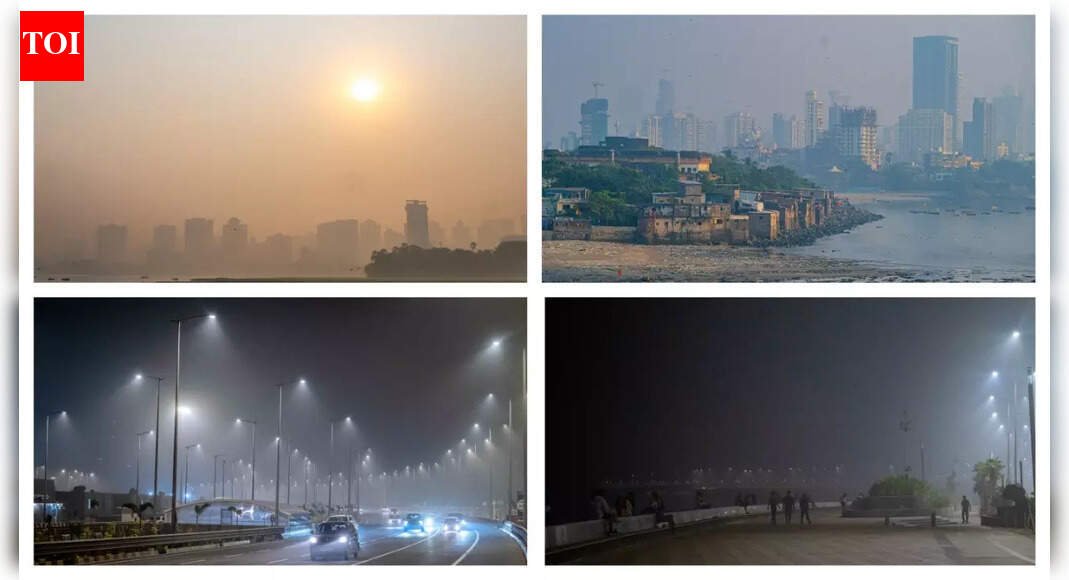
Mumbai’s air quality has plummeted to severe levels, with smog blanketing the city. Experts warn that staying indoors is not a solution, urging citizens to fight for clean air and for developers to adhere to pollution control norms. The Bombay High Court has ordered an audit of construction sites to enforce mitigation rules.

Mumbai’s Air Quality Index (AQI) has slipped into the severe and even hazardous range, crossing 326 in several pockets. Meteorologists attribute the spike to a mix of local pollution sources, stagnant air, and winter conditions that trap pollutants close to the ground. As a thick smog blanket reduced visibility and left the city under a persistent haze, for the last few days, we spoke to Mumbaikars about the growing crisis. ‘Staying indoors is not a solution’“What 99 percent of people forget is that air pollution is a killer. It kills you from inside and you do not realise it. What you are treating as just ‘cough and cold’ is damaging other organs in your body too,” warns environmentalist Stalin Dayanand. He stresses that escaping indoors won’t solve the problem. “Staying indoors, being inside closed areas is not a solution. Fight for clean air. We aren’t asking to stop construction or development. But there is a method to do it, and that has to be followed. It’s not that the US, UK, Europe or China aren’t developed; they simply follow the rules. Pollution is a combination of vehicle emissions, construction, fossil fuels and fugitive dust,” he says, adding that his group’s Public Interest Litigation on pollution is currently before the Bombay High Court. Bombay High Court orders audit of construction sitesThe Bombay High Court emphasised on Friday that although a long-term plan is needed to improve Mumbai’s overall air quality, immediate action may be taken to reduce dust pollution from building sites by strictly enforcing current regulations. An independent five-member committee was established by a Division Bench comprising Chief Justice Shree Chandrashekhar and Justice Gautam Ankhad to examine construction sites and confirm adherence to mitigation rules, following a hearing of several petitions regarding the city’s declining AQI levels. The panel will comprise a public health professional, two representatives from civil society, and one person from each of the Maharashtra Pollution Control Board (MPCB) and the Brihanmumbai Municipal Corporation (BMC). The subject will be heard again on December 15 after the committee submits its findings.‘One air purifier per acre of redevelopment’Long-time Pali Hill Residents Association secretary Madhu Poplai says the health toll is visible every day. “Everyone is suffering. Asthma and breathlessness are on the rise because redevelopment is happening erratically. There are no rules and regulations being enforced on developers,” she says. “In Pali, we’ve made two things compulsory under BMC norms: noise barriers and air purifiers with regular watering. One air purifier is compulsory per acre of land being redeveloped. But 90 percent of developers aren’t following this.”‘Don’t ignore pollution-related symptoms’ Doctors are also seeing a spike in pollution-linked ailments. Dr Priyamvada Shrirang Rane, consulting physician, urges residents not to dismiss symptoms. “If you have prolonged cold and cough, breathlessness, fatigue, exertion, stuffiness in the chest or nose, tightness in the chest, or headaches, you must consult a doctor.” ‘The city needs an upgrade yes, but needs to be done properly’Environmental activist Subhajit Mukherjee argues that Mumbai is ignoring its most powerful natural defence. “Trees are natural air filters, but in Mumbai, their leaves are coated in dust. These must be cleaned immediately. Sprinkle water on trees and plants near your home. Clean leaves matter more than buying multiple air purifiers,” he says. Planting new trees, he adds, isn’t optional. “According to the IQAir World Air Quality Report 2024, India is home to 94 of the world’s top 100 most polluted cities. In the next couple of months, we are planning to plant 100 trees in 100 cities that have over 100 AQI. I am ready to give away tress for free if citizens come forward.” The environmentalist also points to the unprecedented scale of construction. Subhajit says, “In the history of Mumbai, we’ve never had such sudden, massive construction everywhere. The city needs an upgrade, yes — but rules aren’t being followed strictly. That’s why we are suffering.” ‘AIR POLLUTION CAN CAUSE SERIOUS MEDICAL CONDITIONS’ Stalin Dayanand, environmentalist, says, “There is enough medical research to show that air pollution causes diabetes, blood pressure, and heart attacks. If you are not going to worry about the air you breathe, then you got all your priorities wrong.” SIMPLE STEPS TO SAFEGUARD YOUR LUNGS

  • Don’t dismiss prolonged coughing or congestion as just “seasonal”; early care prevents complications.
  • Do not ignore persistent breathing or respiratory symptoms.
  • Always wear a mask when stepping outdoors.
  • If you have recurrent upper-respiratory infections, masking in public spaces is essential.
  • Wipe off dust and keep your home, workplace dust-free
  • Make daily exercise and pranayama part of your routine.


Source link

Bajaj Housing Finance stock price: Share tumbles 9% to hit 52-week low; here’s what triggered the fall


Bajaj Housing Finance stock price: Share tumbles 9% to hit 52-week low; here's what triggered the fall

Bajaj Housing Finance shares tumbled on Tuesday, hitting 52-week low amid buzz of a block deal.The firm’s stock price tumbled 9% to reach Rs 94.90 on the BSE following reports of a large block deal in which the firm’s promoter, Bajaj Finance, is believed to have offloaded 2.35% equity stake, valued at around Rs 1,890 crore.The firm traded at Rs 97.77, down 6.48%, on the National Stock Exchange, at 11:30. On BSE too, the firm traded at a loss of 6.36%, at Rs 97.85.According to reports cited by ET, roughly 19.5 crore shares of the company were exchanged in the block deal at Rs 97 per share. Earlier speculations suggested that the floor price for the transaction was likely set at Rs 95 per share, implying a 9% discount to the stock’s previous close of Rs 104.59 on the National Stock Exchange (NSE). The proposed deal size would involve around 16.6 crore equity shares.At present, Bajaj Finance retains a significant holding in Bajaj Housing Finance, owning 88.70% of the firm, amounting to more than 739 crore equity shares.Meanwhile, the lender has been reporting steady financial performance. For the July–September quarter of FY26, Bajaj Housing Finance posted a net profit of Rs 643 crore, marking an 18% rise from Rs 546 crore in the same period last year. Quarterly revenue climbed to Rs 2,755 crore, up 14% from Rs 2,410 crore a year earlier. Sequentially, profit after tax grew 10% from Rs 583 crore in Q1FY26, while revenue increased 5.3% from Rs 2,616 crore recorded in the April–June quarter, as reported by ET.Bajaj Housing Finance listed on the stock market on September 16, 2024. Since then, the stock has fallen 23% over the past 12 months and is currently trading below both its 50-day and 200-day simple moving averages of Rs 109 and Rs 116, respectively. Technical indicators also show the counter in deep oversold territory, with the Money Flow Index standing near 23, well below the 30 level generally used to flag oversold conditions.The company’s Rs 6,560 crore IPO had attracted significant demand, with the public issue subscribed 67.43 times. Retail investors had placed bids amounting to 7.4 times their allotted quota, against an IPO price band of Rs 66–70 per share.(Disclaimer: Recommendations and views on the stock market, other asset classes or personal finance management tips given by experts are their own. These opinions do not represent the views of The Times of India)


Source link

Access Denied


Access Denied

You don’t have permission to access “http://www.ndtv.com/india-news/parliament-winter-session-live-updates-sir-debate-in-parliament-gst-on-tobacco-red-fort-blast-opposition-protest-at-10-30-am-over-discussion-on-electo-9734176” on this server.

Reference #18.56fdd417.1764658955.684d93ce

https://errors.edgesuite.net/18.56fdd417.1764658955.684d93ce


Source link

Access Denied


Access Denied

You don’t have permission to access “http://www.ndtv.com/education/cbse-releases-updated-guidelines-sops-for-class-10-12-practical-exams-2025-26-9734985” on this server.

Reference #18.77fdd417.1764661995.8d4f8a00

https://errors.edgesuite.net/18.77fdd417.1764661995.8d4f8a00


Source link

Centre asks those who have still not registered their waqf properties on portal to ‘hurry’ | India News


Centre asks those who have still not registered their waqf properties on portal to 'hurry'

NEW DELHI: With a little over 3 lakh property uploads initiated on the Central Waqf Portal (UMEED) so far and the six month deadline set out under the Waqf (Amendment) Act 2025 coming to an end on December 5, the ministry of minority affairs on Monday urged people who have still not registered to “hurry” and upload details as it is “mandatory” and only “4 days are left”.The ministry’s post on X to expedite uploads came after the Supreme Court refused to extend time for the mandatory registration of all waqf properties under the UMEED portal. For those who fail to upload by Friday, the only option will be to approach the waqf tribunal. Only if the tribunal is satisfied with the reasons for not filing within the deadline, it can allow extension of time up to six months.

Supreme Court Stays Key Provisions Of Waqf Amendment Act, Refuses To Suspend Other Proposals

West Bengal which has been strongly opposing the amended Waqf Act last week reportedly issued directions to the state authorities to adhere to the deadline and upload details of all waqf properties. It had not joined the process earlier even though there was no official communication to the ministry on its stand on registration on the portal. The number of properties from the state that have initiated uploading stood at 5,478 on Monday evening.Of the 3 lakh plus uploads initiated, the properties are at different stages of verification and as of Monday 7,353 were rejected and over 41,000 were awaiting approval.While the status of uploads stands at zero for Arunachal Pradesh, Mizoram, Nagaland and Sikkim from the northeast and Goa in West and Ladakh in the north, the maximum uploads have been initiated so far from Karnataka (54,150) followed by Maharashtra (45,310) and Uttar Pradesh (37,104).The ministry will be holding an online meeting with Waqf Boards on Tuesday to meet the deadline. The wide variation in data uploads across states indicates a probability of decline in the total number of properties that might finally end – up successfully uploading the information within the deadline.On concerns related to glitches and complexities in uploading being cited by some Muslim bodies and Muttawalis, the ministry has claimed that adequate training and meetings have been held with waqf boards.At the time of the launch of the portal that aims to bring transparency in the database, the ministry had shared that there were over 8.72 lakh properties registered as waqf as per data shared by states. However, ministry officials said that the data on the earlier – Waqf Assets Management System of India (WAMSI) was found to be severely lacking necessitating a new portal (UMEED) that seeks to plug the gaps.


Source link