Breaking News
‘Will have a beer tonight’: England coach blames ‘too much training’ for Ashes defeat | Cricket News


'Will have a beer tonight': England coach blames 'too much training' for Ashes defeat
England coach Brendon McCullum during an England nets session at Perth Stadium on November 19, 2025 in Perth, Australia. (Photo/Getty Images)

England head coach Brendon McCullum said his team “trained too much” in the build-up to their heavy defeat in the second Ashes Test in Brisbane on Sunday. England’s preparation for the series has been questioned, especially their decision to play three days of intra-squad warm-up cricket at Lilac Hill on a pitch that did not match the conditions at the Perth Stadium.After the first Test ended in two days, England did not send any players to the pink-ball Prime Minister’s XI match in Canberra. They had not played a day/night Test since early 2023, and three players in the current XI had never played one before. Among them was wicketkeeper Jamie Smith, who dropped an important catch. England instead went to Brisbane and trained for five days, adding two extra practice sessions.

Shimron Hetmyer interview: Opens up on hitting sixes, playing T20 leagues and ILT20 experience

England went 2-0 down in the five-match series after another heavy loss to Australia at the Gabba on Sunday.“If anything, we trained too much,” McCullum said in two separate interviews to 7cricket and BBC. “We had five to 10 training session leading into this game.”“That’s something as a coach you have to be aware of. Sometimes there is a tendency to overdo things to make up for it,” he said to BBC.McCullum also said, “As we all know, in this game it is played in the top two inches. We all have to find way that we ensure that we feel prepared physically, technically and we are ready for the battle, but also to make sure we are fresh and make sure we can make those decisions in the heat of the games.”“We will have a beer tonight. I think leading into this Test match I actually felt like we overprepared to be honest,” McCullum told 7Cricket.He acknowledged England’s struggle to adjust to conditions after Australia bowled them out for 241 in their second innings of the day-night Test. “We have got some work to do. We have some time. We have been here before and there is no point feeling sorry for yourself. You pick yourself up and you go again,” he said.“We weren’t at our best. To beat Australia in Australia, you have to be at your best across all three disciplines and we weren’t. That is brutal honesty and we will wear that. From our point of view, we know we have to be better. We have to be a lot quicker to adapt to the conditions in Adelaide. I thought we were a bit slow to adapt to the conditions here.”


Source link

Ashes: Drama at The Gabba! Steve Smith opens up on heated exchange with Jofra Archer – ‘It was good fun’ | Cricket News


Ashes: Drama at The Gabba! Steve Smith opens up on heated exchange with Jofra Archer - 'It was good fun'
Steve Smith of Australia with Jofra Archer of England (Photo by Cameron Spencer/Getty Images)

Australia captain Steve Smith has downplayed his fiery on-field confrontation with England fast bowler Jofra Archer during the closing stages of Australia’s eight-wicket win in the second Ashes Test in Brisbane. The incident, which unfolded late on Sunday, added a flash of intensity to an otherwise one-sided finish as Australia surged to a 2-0 lead in the five-match series.

Andy Flower calls Gautam Gambhir a “forceful mentor”, praises his work

Speaking to the broadcasters after sealing the victory, Smith addressed the much-discussed duel and insisted there was no lingering tension. “It stays on the field (smiles). Nah, good banter. He’s a good competitor, he comes harder, so it was good fun,” he said, opening up about the verbal exchange that gripped spectators in the final overs.The spark came in the ninth over of Australia’s chase, shortly after Smith clipped Archer for a leg-side boundary. According to cricket.com.au, Smith sledged the pacer with the pointed line, “Bowl fast when there’s nothing going on champion,” a remark that immediately escalated the moment. Archer responded with a barrage of short-pitched bowling, including a bouncer exceeding 150 km/h, delivered right after Smith’s pull shot appeared to irritate the quick. When Smith swung and missed an attempted uppercut, Archer walked down the pitch and continued the verbal back-and-forth.Smith, however, answered in the most emphatic way available: with runs. He took 10 from Archer’s next two deliveries, including a six, before the pair briefly exchanged words again.The drama, while compelling, had little impact on the outcome of the match. England, having been dismissed cheaply in both innings, mustered only a 64-run lead after their second batting effort. That left Australia requiring just 65 for victory. England managed to remove Travis Head and Marnus Labuschagne, but Smith and Jake Weatherald shut the door firmly, ensuring no further breakthroughs.Smith fittingly ended the contest in the following over, launching Gus Atkinson for a leg-side six to complete the chase and secure an authoritative win. The victory pushed Australia two Tests clear in the Ashes and highlighted Smith’s composure even amid heated exchanges.


Source link

Gold rate outlook: Prices stay firm as Fed decision nears; analysts say rupee weakness adds support


Gold rate outlook: Prices stay firm as Fed decision nears;  analysts say rupee weakness adds support

Gold prices are expected to remain on a positive footing in the coming week as investors await cues from the US Federal Reserve’s monetary policy decision, with a weaker rupee adding to support in the domestic market, analysts said, PTI reported. The bias for the yellow metal remains constructive amid expectations of an interest rate cut by the Fed and continued purchases by central banks. “Gold is expected to remain on the positive side as traders will be focusing on the US Federal Reserve’s FOMC meeting outcome and the Fed Chair Jerome Powell’s commentary,” said Pranav Mer, Vice President, EBG – Commodity & Currency Research at JM Financial Services Ltd, adding that China’s trade and inflation data and US jobs numbers will also be watched closely.On the Multi Commodity Exchange (MCX), gold futures gained Rs 958, or 0.74 per cent, during the week, outperforming global prices. Analysts attributed this outperformance largely to currency movements. “Gold prices in the Indian markets have rallied more than the Comex gold prices on account of rupee depreciation against the dollar. The rupee is now at the highest mark of 90, which makes gold in Indian currency costlier,” Prathamesh Mallya, DVP – Research, Non-Agri Commodities and Currencies at Angel One, said, PTI quoted.Mallya added that the rally could extend further, supported by expectations of a rate cut, rising central bank demand and fund buying. In contrast, Comex gold futures edged lower by $11.9, or 0.28 per cent, over the week. Mer said global prices largely consolidated within a range but remained supported by a weaker dollar and growing bets of a Fed rate cut at its December 10 meeting.Meanwhile, silver continued to outperform gold, touching fresh record highs on strong industrial demand. On the MCX, silver futures surged Rs 8,427, or 4.81 per cent, during the week. On Friday alone, prices jumped Rs 7,096, or 3.98 per cent, to hit a record Rs 1,85,234 per kilogram.“In the first half of the week, silver futures spiked close to Rs 1.80 lakh per kg and briefly touched fresh highs. Since then, prices have cooled off slightly but are still sitting on massive month-on-month gains,” said Chirag Doshi, CIO – Fixed Income at LGT Wealth India. He added that markets are consolidating at elevated levels, with traders increasingly using sharp intraday spikes to book profits.In overseas markets, Comex silver futures rose $1.89, or 3.30 per cent, during the week, and climbed $2.4, or 4.19 per cent, on Friday to a lifetime high of $59.90 per ounce. “Silver prices rose to yet another all-time high and moved close to $60 per ounce in the international market, while on the domestic market, prices rose close to Rs 1,90,000 per kg,” Mer said, citing strong industrial demand and tight supplies.Mer added that the momentum could push domestic silver prices towards Rs 2,00,000–2,25,000 levels in the short term. Analysts said the coming week will be crucial for bullion markets, with Fed policy cues, macroeconomic data from China and the US, and rupee trends guiding price direction.


Source link

Why food fried in reused oil could expose you to higher cancer risk |


Reusing cooking oil is a common practice in households and food stalls, often motivated by cost-saving or the belief that a pot of oil can be stretched across several meals. Many people assume that if the oil looks clear or smells neutral, it remains safe for frying. However, repeated heating triggers chemical changes that compromise its safety, nutrition, and cooking properties. Oils that undergo multiple heating cycles accumulate reactive compounds and lose essential nutrients, which can influence human health over time. With fried foods remaining a staple in many diets globally, understanding the risks of reused oil and how to mitigate them is crucial for maintaining both food quality and long-term wellbeing.

What happens when cooking oil is repeatedly heated

Repeated heating exposes oil to high temperatures, oxygen, moisture and residual food particles, all of which accelerate chemical reactions. Triglycerides break down into free fatty acids, antioxidants are depleted, and unsaturated fatty acids become unstable. The oil darkens, thickens, and its smoke point declines, making it more prone to burning at moderate temperatures. Over time, sticky polymeric compounds form, altering the texture and flavour of food. These transformations occur silently; oil may appear unchanged, yet it is increasingly degraded at a molecular level, reducing nutritional value and potentially introducing harmful substances.

5 Oils that should be consumed raw for potential health benefits

• Triglycerides split into free fatty acids, reducing overall oil quality and nutritional content.• Antioxidants degrade, increasing susceptibility to oxidation and the formation of harmful by-products.• Smoke point decreases, causing oil to burn more easily and release reactive aldehydes.• Polymerisation thickens the oil, creating residues that affect food texture and frying efficiency.• Colour darkens and unpleasant odours develop, signalling ongoing chemical breakdown.• Loss of unsaturated fatty acids diminishes heart-healthy components and increases trans-fat formation.• Residual moisture and food particles accelerate degradation with each heating cycle.Reused oil becomes stickier and smells sharper with each round of frying, small everyday signs that hint at rising oxidation, unstable lipids and lingering fumes, factors researchers often link to long-term health risks.

How reused cooking oil may increase cancer risk

A study published in Critical Reviews in Food Science and Nutrition demonstrates the potential carcinogenic effects of reheated oils. The study explains that repeated heating produces reactive aldehydes, polymeric compounds and polycyclic aromatic hydrocarbons, all of which can interact with DNA and cellular structures. Over time, these compounds increase oxidative stress, trigger genotoxic effects and induce mutagenicity, creating a higher potential for cancer development. Both consuming foods prepared in degraded oil and inhaling fumes during cooking contribute to cumulative exposure. Evidence suggests a correlation between long-term consumption of reheated oils and increased risk of colon, breast, lung and prostate cancers, particularly with habitual, repeated use.• Aldehydes and reactive molecules increase with repeated heating, potentially damaging cellular DNA.• Oxidative stress rises, overwhelming antioxidant defences and promoting mutations.• Genotoxic and mutagenic effects create a higher risk of cancer over time.• Inhalation of fumes adds to dietary exposure, affecting both cooks and those nearby.• Epidemiological studies associate long-term reheated oil consumption with colon, breast, lung and prostate cancers.• Continuous exposure is more hazardous than occasional use due to cumulative molecular damage.

How to fry safely without reusing oil

Managing risks from reheated oil requires awareness and deliberate kitchen habits. Observing signs of degradation, such as rapid smoking, dark colour, or off-odours, can prevent further use of compromised oil. Selecting oils with higher thermal stability, heating gently, and avoiding prolonged high temperatures slows harmful reactions. Limiting deep frying to one session and reserving used oil only for lighter cooking, such as sautéing or curries, reduces exposure. Proper ventilation helps minimise inhalation of reactive compounds, while filtering out food particles slows chemical breakdown. Incorporating these practices allows safer cooking without eliminating fried foods entirely.• Watch for darkening, burnt smell, or smoke as warning signs of degraded oil.• Choose thermally stable oils, such as refined sunflower or rice bran, for frying.• Maintain moderate frying temperatures to limit chemical reactions.• Use oil only once for deep frying and reuse sparingly for light cooking.• Filter out crumbs and residual particles to slow degradation.• Ensure kitchen ventilation to reduce exposure to harmful fumes.• Avoid mixing old oil with fresh oil, as it does not reverse existing chemical changes.

How reused oil affects your body and kitchen environment

Degraded oil affects more than taste and frying efficiency; it can impact metabolic and cardiovascular health over time. Oxidised fats increase oxidative stress, strain liver function and elevate inflammatory markers. Blood lipid profiles may worsen, promoting higher LDL cholesterol and triglycerides, while fat deposition in the liver may accelerate, increasing the risk of fatty liver disease. The kitchen environment also contributes: repeated frying in poorly ventilated spaces allows reactive fumes to linger, exposing cooks and family members to additional chemical stress. Over time, these cumulative dietary and environmental exposures can influence long-term health outcomes and chronic disease risk.• Regular consumption increases oxidative stress and inflammatory responses.• Liver workload rises due to processing oxidised and polymerised fats.• Blood lipid imbalances contribute to cardiovascular disease risk.• Fat deposition in the liver may increase, promoting metabolic disorders.• Fumes from repeated frying linger in poorly ventilated kitchens, adding respiratory exposure.• Daily exposure compounds over time, heightening long-term health risks.• Awareness of both dietary and environmental factors supports healthier cooking decisions.Disclaimer: This article is for general informational purposes only and is not a substitute for professional medical advice, diagnosis, or treatment. Always seek the guidance of a qualified healthcare provider regarding any medical condition or lifestyle change.Also Read | 8 hours straight sleep vs. split sleep: Which works better for your body


Source link

150 years of Vande Mataram: Why BJP and Congress are fighting over its ‘missing stanzas’ — explained | India News


150 years of Vande Mataram: Why BJP and Congress are fighting over its ‘missing stanzas’ — explained
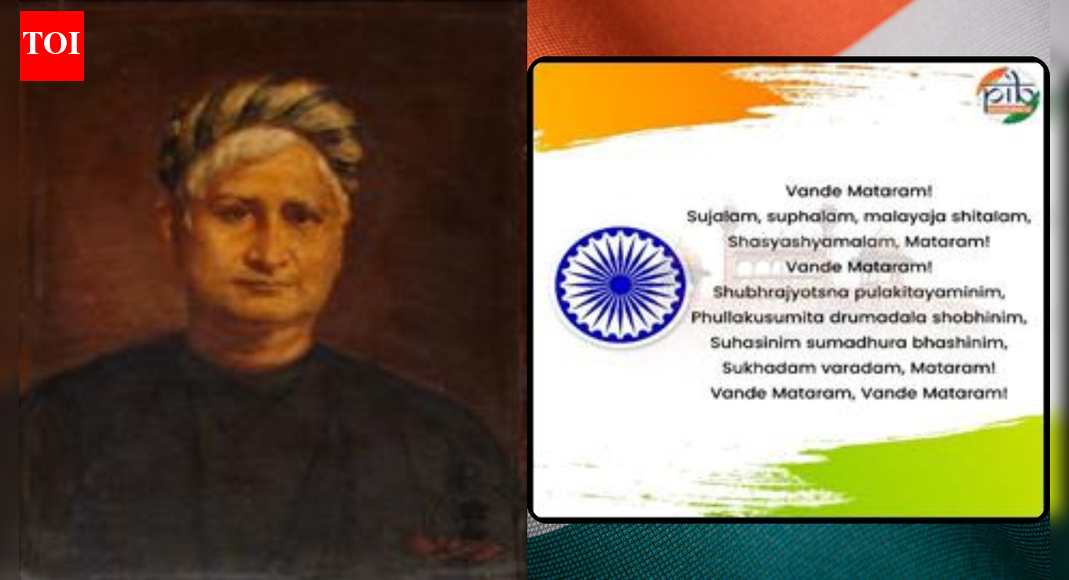
Bankim Chandra Chatterjee (Image credit: PIB)

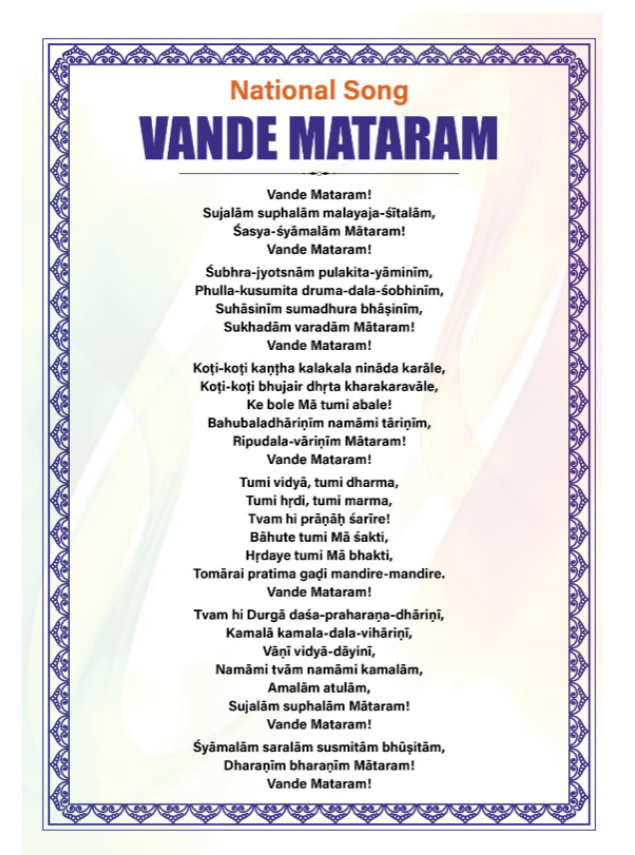
Parliament will begin a special discussion in the Lok Sabha on Monday to commemorate 150 years of Vande Mataram, a song that remains one of the most debated symbols of India’s freedom struggle.Prime Minister Narendra Modi will open the debate, with defence minister Rajnath Singh scheduled to conclude it. The BJP has been given three hours in the Lok Sabha, the total debate will span nearly ten hours. The Rajya Sabha will hold its discussion the next day, to be opened by Union home minister Amit Shah.The commemoration is not merely ceremonial. It arrives amid renewed political sparring over the song’s historical evolution, religious imagery, and the choices made by India’s pre-independence national leadership. What began as a patriotic hymn in a Bengali novel is once again a focal point of fierce political messaging, competing historical narratives, and questions about national identity.This explainer traces the 150-year journey of Vande Mataram—from its birth in Bankimchandra Chattopadhyay’s writing to its role in nationalism, the Congress’s 1937 decision to officially use only its first two stanzas, and its recognition in the Constituent Assembly as having “equal honour and status” with the National Anthem.

Why it’s in the news now

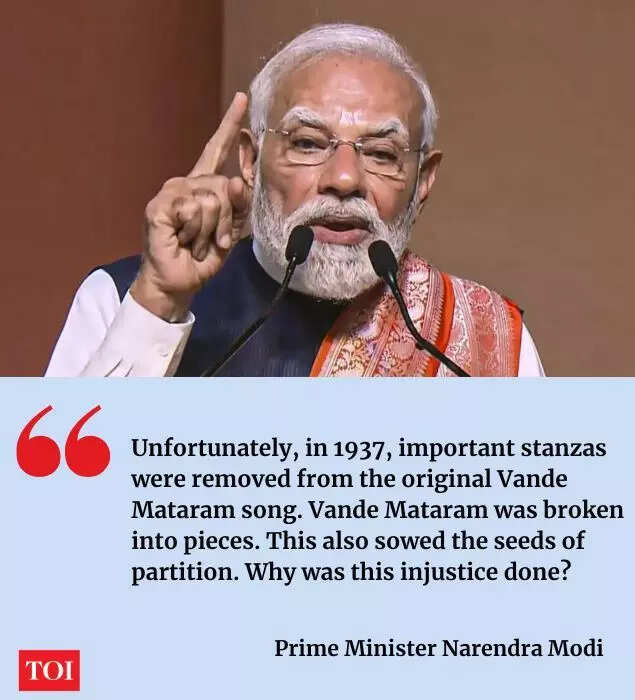
The upcoming debate is part of a special parliamentary focus on the legacy of Vande Mataram. But the political temperature was raised last month, during the commemoration event of 150 years of the national song, when Prime Minister Modi accused the Congress of having “removed important stanzas” from the original song during its 1937 Faizabad session, claiming this decision “sowed the seeds of partition.”According to the Prime Minister, the Congress’s move amounted to breaking the national song into pieces—an act that abandoned its original spirit and undermined unity. He has framed the issue within his broader narrative of ‘Viksit Bharat’, tying cultural heritage to national development.

-

The Congress hit back immediately. Citing The Collected Works of Mahatma Gandhi (Vol66, p46), the party argued that the 1937 decision was not an act of division, but a sensitive accommodation recommended by a Working Committee that included Mahatama Gandhi, Jawaharlal Nehru, Sardar Patel, Subhas Chandra Bose, Rajendra Prasad, Abul Kalam Azad, Sarojini Naidu, and other iconic leaders. The CWC noted that the first two stanzas were already the only widely sung and nationally recognised part, while the remaining contained religious imagery that some citizens objected to.The Congress also emphasised that the decision drew from the advice of Rabindranath Tagore, who had himself sung Vande Mataram at the 1896 Congress session.In its rebuttal, the party accused the prime minister of attacking the legacy of India’s freedom movement while avoiding present-day issues such as unemployment, inequality, and foreign policy challenges.This political exchange has made the upcoming parliamentary debate all the more charged.

Origins of Bande Mataram (1870s–1880s)

The PIB’s historical account helps clarify the origins of the song. According to Sri Aurobindo’s writing in the English daily Bande Mataram (16 April 1907), Bankimchandra Chattopadhyay composed the song around 1875. It was published more widely when Bankim’s novel Anandamath began serialization in the Bengali magazine Bangadarshan in March–April 1881.Song’s literary context: AnandamathAnandamath is built around a group of ascetic warriors, the Santanas, who dedicate themselves to freeing the motherland from oppression. Their devotion is entirely to Bharat Mata, envisioned not as a religious deity but as a personified motherland.In the temple of the Santanas stand three images of the Mother:

  1. The Mother that was – glorious and mighty
  2. The Mother that is – suffering and oppressed
  3. The Mother that will be – restored to strength and glory

For Aurobindo, the hymn embodied the essence of “the religion of patriotism.”Many later critics, however, would argue that the imagery—particularly in the later stanzas—draws from Hindu goddess symbolism that may not be inclusive of all communities.

-

From song to slogan: Birth of a nationalist cry (1900–1910)

By the early 20th century, Vande Mataram had escaped its literary origins and become one of the most electrifying symbols of Indian nationalism.Swadeshi and anti-partition movementAfter Lord Curzon’s 1905 partition of Bengal, the song became the rallying cry for:

  1. Boycott movements
  2. Protest marches
  3. Newspapers and political groups carrying its name

In 1906, at Barisal, more than 10,000 Hindus and Muslims together marched shouting Vande Mataram—a testament to its early cross-communal appeal.Figures who popularised it included:

  • Rabindranath Tagore
  • Bipin Chandra Pal
  • Sri Aurobindo

Aurobindo’s writings in Bande Mataram (the newspaper) turned the phrase into a political and spiritual exhortation for self-rule.

-

British repressionAlarmed by its galvanising effect, the colonial government tried repeatedly to suppress it through:

  • Fines for students
  • Police lathi-charges
  • Bans on marches
  • Threats of expulsion from schools and colleges

From Bengal to Bombay Presidency, chanting Vande Mataram became synonymous with nationalist defiance.In 1907, Madam Bhikaji Cama unfurled the first tricolour abroad—in Stuttgart—with the words Vande Mataram emblazoned across it.

The song and the Indian National Congress

The Congress adopted Vande Mataram not just culturally, but ceremonially.1896 —First Congress rendition: At the Calcutta session, Rabindranath Tagore sang the song, giving it national prominence.1905 — Nationwide adoption: At the Varanasi session, the Congress formally adopted Vande Mataram for all-India occasions. This was during the peak of the Swadeshi struggle, when the song had become the soundtrack of political awakening.

1937 CWC decision: Were the stanzas removed?

Yes.By the 1930s, debates around the song’s religious imagery had become politically relevant. India’s nationalist leadership wanted to keep the movement inclusive, and Muslim leaders raised objections to certain stanzas that invoked Hindu goddesses.

Did it ‘sow seeds of partition’?

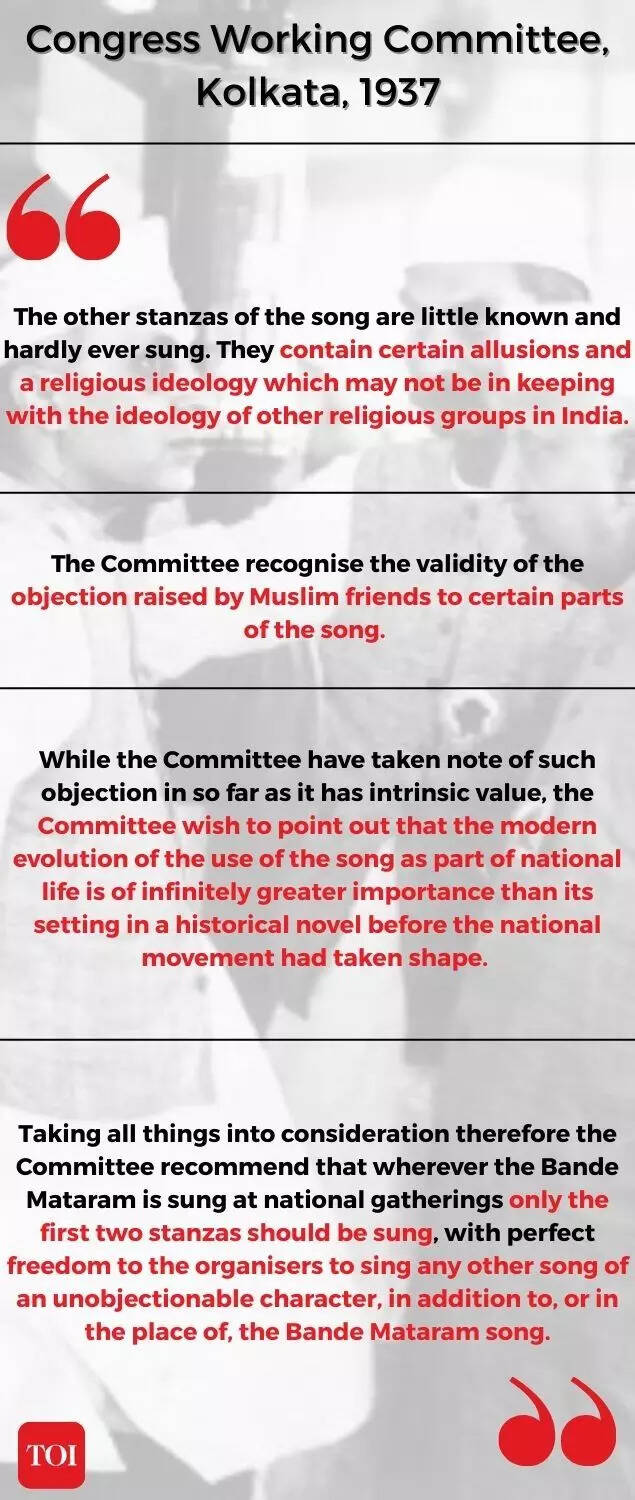
No.The CWC’s decision was more inclusive than divisive in nature.The eventual decision to restrict Vande Mataram to its first two stanzas drew directly from this history of selective popular usage. As the Committee noted, only the opening verses — celebrating the land’s beauty and abundance in gentle, inclusive imagery — had organically acquired national significance over the decades. The remaining stanzas were scarcely known, rarely sung, and contained religious allusions and ideological references that many felt were inconsistent with the beliefs of other communities. The CWC explicitly acknowledged the “validity of the objections raised by Muslim friends” to those portions. While emphasising that the song’s modern, unifying role in national life mattered far more than its origins in a historical novel, the committee concluded that only the first two stanzas should be sung at national gatherings. This, they argued, preserved the unifying spirit the song had come to embody while avoiding elements that could alienate sections of India’s diverse society.What the 1937 CWC actually saidThe CWC’s statement, issued between October 26–November 1 in Kolkata, recorded:

  • The first two stanzas had become widely used and carried no controversial imagery.
  • The remaining stanzas contained “allusions and a religious ideology” inconsistent with the beliefs of other religious groups.
  • Only the first two stanzas should be sung at national gatherings.
  • Organisers were free to choose additional songs if they wished.

The committee explicitly said that the modern national use of the first two stanzas was more important than the song’s original placement in a religiously infused novel.Tagore had long argued that when a cultural symbol is used nationally, it must not exclude or alienate. His views shaped the committee’s decision and remain central to the Congress’s defence today.

-

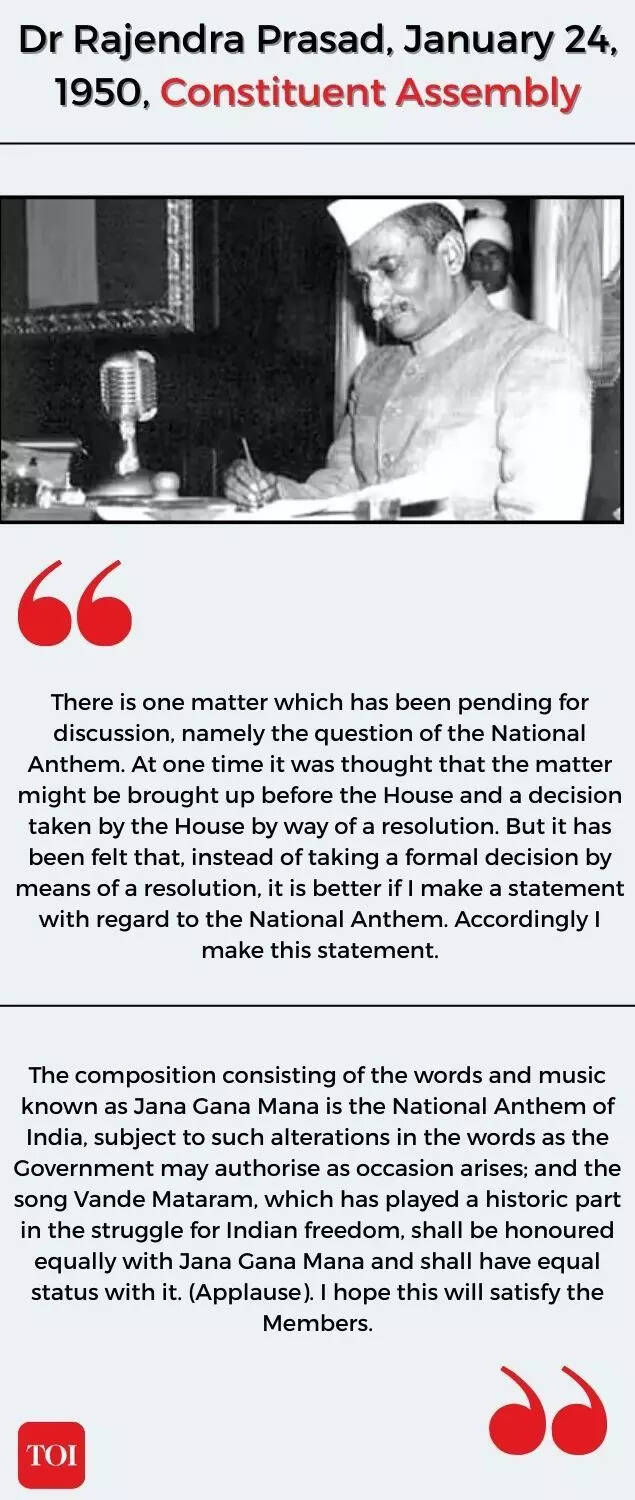
Constituent assembly: Equal honour, equal status (1950)When the Constituent Assembly met to choose India’s national symbols, there was no dispute between Jana Gana Mana and Vande Mataram.In his statement on January 24, 1950, DrRajendra Prasad, President of the Assembly, declared:Jana Gana Mana would be the national anthem.Vande Mataram, because of its historic role, would be honoured equally and accorded equal status.There was applause; no member raised objections.This dual recognition was meant to preserve both inclusivity and historical memory: the anthem would represent national unity, while Vande Mataram’s legacy would be canonised as part of India’s freedom story.

-

The debate today

Why is the BJP reviving the issue?For the ruling party, Vande Mataram is a civilizational invocation that predates partisan politics. The BJP frames the 1937 Congress decision as overly accommodative, even compromising, and often ties this critique to a larger argument about “appeasement.”In the government’s view, celebrating 150 years of the song is part of a project to reaffirm cultural pride and national self-confidence.Why is the Congress defensive?The Congress insists it is the party that first elevated the song, sang it at historic moments, and fought the British under its banner. It argues that:

  • The 1937 decision was guided by inclusivity, not division.
  • The BJP is weaponising history to distract from contemporary governance failures.
  • Tagore and the freedom movement need protecting from political revisionism.

What Jamiat Ulama-i-Hind has to say

The Jamiat Ulama-i-Hind, led by Maulana Mahmood Madani, has taken a clear and consistent position on the Vande Mataram debate: it accepts the first two stanzas as historically validated for national use but firmly rejects the remaining verses on theological grounds. Madani argued that the full composition contains imagery — particularly the depiction of the motherland as the goddess Durga — that conflicts with Islamic monotheism, making it impermissible for Muslims to recite.“He stated that Vande Mataram in its complete form is rooted in shirkiya aqaaid (polytheistic beliefs). Particularly, in the remaining four stanzas, the motherland is depicted as the goddess Durga and addressed with words of worship — concepts that clearly conflict with the Islamic belief in the oneness of God. ‘Muslims believe in one God and worship Him alone,’ Maulana Madani said. ‘Therefore, singing verses that ascribe divinity to anyone other than Allah goes against our faith and conscience,'” a statement by Jamiat said.




Source link

Maharashtra: Dy CM Eknath Shinde urges residents to support cluster redevelopment model for better housing and amenities | Thane News


Dy CM Shinde urges residents to support cluster redevelopment model for better housing and amenities

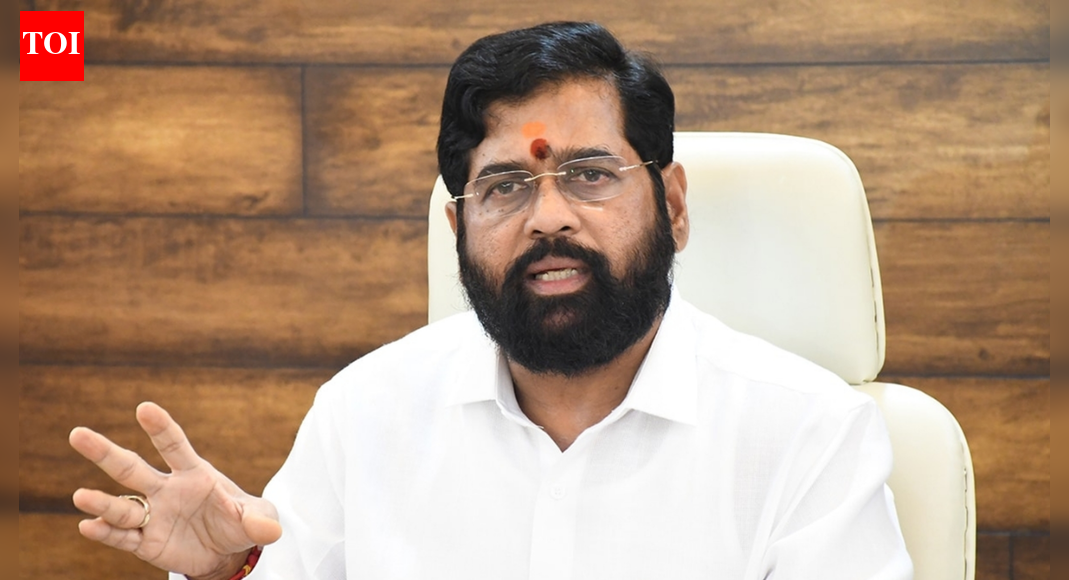
THANE: Deputy Chief Minister Eknath Shinde on Saturday urged residents to support the city’s cluster redevelopment model, highlighting its wider eligibility, larger homes, and better amenities compared to conventional rehabilitation schemes like the SRA.Speaking at an event in Thane on Saturday evening, Shinde drew a comparison between the SRA and the cluster redevelopment scheme, saying that while ground-floor residents were excluded under SRA norms, the cluster model includes them, along with absorbing applicants registered as recently as 2022. “This addresses concerns of families left out of earlier cut-off dates,” he added.He noted that as the cluster redevelopment project enabled larger planning areas, it allowed for more civic amenities like wider roads, open spaces, gardens, hospitals, parking facilities, and clubhouses that typical SRA projects may not be able to accommodate. The flats under the cluster scheme will be bigger, self-contained, and provided in-situ, ensuring residents remain within their neighbourhoods, he said.“The cluster model removes all limitations of SRA and is designed to provide good-quality, amenity-rich homes. There are few ongoing multi-storey constructions in the city under the scheme, which demonstrates our commitment to high-quality housing,” Shinde said, urging residents not to fall prey to opposition forces attempting to derail the initiative.


Source link

“I need to clarify that…”: Smriti Mandhana calls off her wedding with Palash Muchhal


India women’s cricket star Smriti Mandhana has officially confirmed that her wedding to music composer Palash Muchhal has been called off, putting an end to the intense speculation that has dominated social media in recent weeks.

Smriti Mandhana breaks silence on her wedding

In a rare personal statement posted on Instagram, the usually private opener said she felt compelled to address the rumours only because the chatter had spiralled beyond control. “I am a very private person… but I need to clarify that the wedding is called off,” Mandhana wrote, requesting that fans and media “close this matter here” and allow both families space to heal.

Mandhana added that she wants to “process and move on at our own pace,” firmly requesting privacy from all quarters.

Without revealing details behind the decision, Mandhana emphasised that representing India continues to be her highest priority. In her statement, she wrote that there is a “higher purpose driving us all,” and for her, that purpose has always been wearing the India jersey and striving to win trophies for the country.

Her message made it clear that the off-field turmoil will not shift her commitment to cricket. “I hope to continue to play and win trophies for India for as long as possible and that is where my focus will forever be,” she said.

The statement quickly gained traction across social platforms, with fans and fellow athletes expressing support for the 28-year-old opener.

Inside the wedding saga: From celebration plans to heartbreaking cancellation

The Smriti-Palash wedding was originally scheduled for November 23–24 in Mandhana’s hometown of Sangli, Maharashtra. Pre-wedding festivities, including the sangeet, had already begun and several photos and videos were widely shared online, suggesting that the celebrations were underway.

However, in a dramatic turn of events, the wedding was indefinitely postponed on the day of the ceremony. Reports indicated that Smriti’s father, Srinivas Mandhana, suffered a cardiac scare and required hospitalisation, prompting both families to halt all plans. Soon after, Palash and his family returned to Mumbai, with some reports suggesting he too sought brief medical attention due to stress. However, what followed was a burst of speculation across social media.

Smriti later removed multiple wedding-related posts from her Instagram and was seen publicly without her engagement ring, amplifying rumours that the relationship had been called off completely.

Also READ: BCCI announces complete schedule for WPL 2026; Royal Challengers Bengaluru will battle Mumbai Indians in the opener

Smriti requests fans to end marriage rumours 

With online theories spiralling – some of them highly intrusive – Mandhana said she had no choice but to issue a public clarification. She urged fans, media houses and content creators to refrain from drawing conclusions or assigning blame, stating clearly that she does not wish for the subject to be discussed further.

“I would like to close this matter here and implore all of you to do the same,” she wrote. Her appeal is being widely echoed by supporters, who have encouraged the public to respect her boundaries during a difficult personal moment.

Smriti Mandhana Instagram story (PC: X.com)

Also READ: Smriti Mandhana and Palaash Muchhal’s wedding controversy: After Gulnaaz Khan, Nandika Dwivedi reacts to cheating allegations

This article was first published at WomenCricket.com, a Cricket Times company.


Source link

Mumbai suburban services: No megablock on Central, no day block on western railway | Mumbai News


MUMBAI: Central Railway has cancelled its weekly megablock on the CSMT–Kalyan Main Line and the CSMT–Panvel Harbour Line — including the Trans-Harbour and Port Lines — in view of Mahaparinirvan Diwas, officials said on Sunday.Regular suburban services will operate as per the Sunday timetable, the official added.Western Railway has also confirmed that there will be no daytime block on its suburban section today.


Source link

Access Denied


Access Denied

You don’t have permission to access “http://www.ndtv.com/india-news/college-student-dies-by-suicide-at-noida-hostel-leaves-i-give-up-note-9766147” on this server.

Reference #18.76fdd417.1765099229.875ee875

https://errors.edgesuite.net/18.76fdd417.1765099229.875ee875


Source link

‘Have decided to move on’: Palash Muchhal calls off wedding with Smriti Mandhana, threatens legal action against rumours | Cricket News


'Have decided to move on': Palash Muchhal calls off wedding with Smriti Mandhana, threatens legal action against rumours
Smriti Mandhana and Palash Muchhal (Image credit: Instagram)

NEW DELHI: Indian women’s team vice-captain Smriti Mandhana and music composer Palash Muchhal have brought an end to weeks of speculation about their personal life, confirming that their wedding has been “called off”. Both Mandhana and Muchhal took to Instagram to share the news. The couple had been scheduled to marry on November 23, but the wedding was postponed after Mandhana’s father, Shriniwas, was hospitalised due to a heart ailment.Go Beyond The Boundary with our YouTube channel. SUBSCRIBE NOW!“I have decided to move on in my life and step back from my personal relationship. Its been very difficult for me to see people react so easily on baseless rumours about something which has been most sacred to me. Its the most difficult phase of my life and I will deal with it gracefully holding on to my beliefs,” Muchhal wrote.

Shimron Hetmyer interview: Opens up on hitting sixes, playing T20 leagues and ILT20 experience

“I truly hope we, as a society, learn to pause before judging someone based on unverified gossip, whose sources are never identified. Our words can wound in ways we may never understand. While we think about these things, many people in the world are facing drastic consequences. My team will be taking strict legal action against those spreading false and defamatory content,” he added.“Thank you to everyone who has stood by me with kindness in this tough time,” he said.Mandhana, one of India’s most prominent women cricketers, shared her first public statement on social media after rumours about her personal life intensified over the past month.“I need to clarify that the wedding is called off. I would like to close this matter here and implore all of you to do the same,” she wrote.“Over the past few weeks there has been plenty of speculation around my life and I feel it is important for me to speak out at this time,” she added in an Instagram post.Calling herself a “very private person,” Mandhana said she felt compelled to set the record straight.She asked fans and the public to “respect the privacy of both families” and allow them the “space to process and move on”.As she prepares for India’s upcoming international season, Mandhana emphasized that her focus remains on cricket.“I believe there is a higher purpose driving us all and for me that has always been representing my country at the highest level. I hope to continue to play and win trophies for India for as long as possible,” she said.The announcement comes days after singer Palak Muchhal commented on the matter.“I think the families have been through a very tough time. Like you just said, I would just want to repeat that we would like to believe in positivity at this time. We would like to spread positivity as much as we can. We are also trying to stay strong,” she had said.Both statements come amid intensified social media discussions and unverified reports, prompting public figures to step in to curb speculation.Mandhana, 28, has been a key figure in Indian women’s cricket for nearly a decade, with her contributions crucial across formats.With India set for a busy 2026 calendar, the left-hander reiterated that her professional commitments remain her priority.“Thank you for all your support. It’s time to move forward,” her note concluded.


Source link