Breaking News
Stock market holidays 2026: NSE releases holiday calendar; check key dates, weekend closures, Muhurat session & outlook


Stock market holidays 2026: NSE releases holiday calendar; check key dates, weekend closures, Muhurat session & outlook

Leading bourse NSE has published its official trading holiday calendar for 2026, offering traders and investors an early roadmap for days when equity and derivatives markets will remain shut. The circular, as reported ET, issued under exchange bye-laws and F&O regulations, lists 15 full trading holidays—one more than in 2025—and also details festivals falling on weekends and the date of Muhurat Trading.Fifteen market holidays across segmentsEquity, equity derivatives and currency markets will be closed on 15 days next year. The holiday list begins with Republic Day on January 26, followed by major festivals:

  • Holi (March 3)
  • Ram Navami (March 26)
  • Mahavir Jayanti (March 31)
  • Good Friday (April 3)
  • Ambedkar Jayanti (April 14)
  • Maharashtra Day (May 1)
  • Bakri-Id (May 28)

In the second half, markets will shut for Muharram (June 26), Ganesh Chaturthi (September 14), Gandhi Jayanti (October 2), Dussehra (October 20), Diwali Balipratipada (November 10), Guru Nanak Jayanti (November 24) and Christmas (December 25).A notable detail in the circular is the absence of a Diwali holiday, as Diwali Laxmi Pujan falls on a Sunday.Weekend festivals and Muhurat TradingFour prominent festivals in 2026—Mahashivratri (February 15), Eid-ul-Fitr (March 21), Independence Day (August 15) and Diwali Laxmi Pujan (November 8)—coincide with weekends and therefore do not trigger a market shutdown.The exchanges will hold the customary Muhurat Trading session on November 8 (Sunday). The one-hour auspicious trading window’s timing will be announced closer to Diwali.Why the holiday calendar matters for tradersA clear view of non-trading days helps market participants plan:

  • portfolio adjustments,
  • derivatives expiry strategies,
  • settlement cycles, and
  • liquidity management around global market timings.

Holidays often influence weekly and monthly index expiries and can alter short-term trading behaviour, especially for options traders.Market outlook for 2026Brokerages expect 2026 to be a recovery year for Indian equities after a volatile 2025. Morgan Stanley, Citigroup and Goldman Sachs have indicated that markets could regain lost ground as earnings stabilise and policy support strengthens, ET reported.ICICI Direct projects the Nifty could move toward the 30,000 level in 2026, citing technical breakouts and historical patterns of strong rallies following corrective phases. Kotak Securities has outlined a more bullish target of 32,032 for the Nifty by December 2026, with a preference for BFSI and IT stocks.(Disclaimer: Recommendations and views on the stock market, other asset classes or personal finance management tips given by experts are their own. These opinions do not represent the views of The Times of India)


Source link

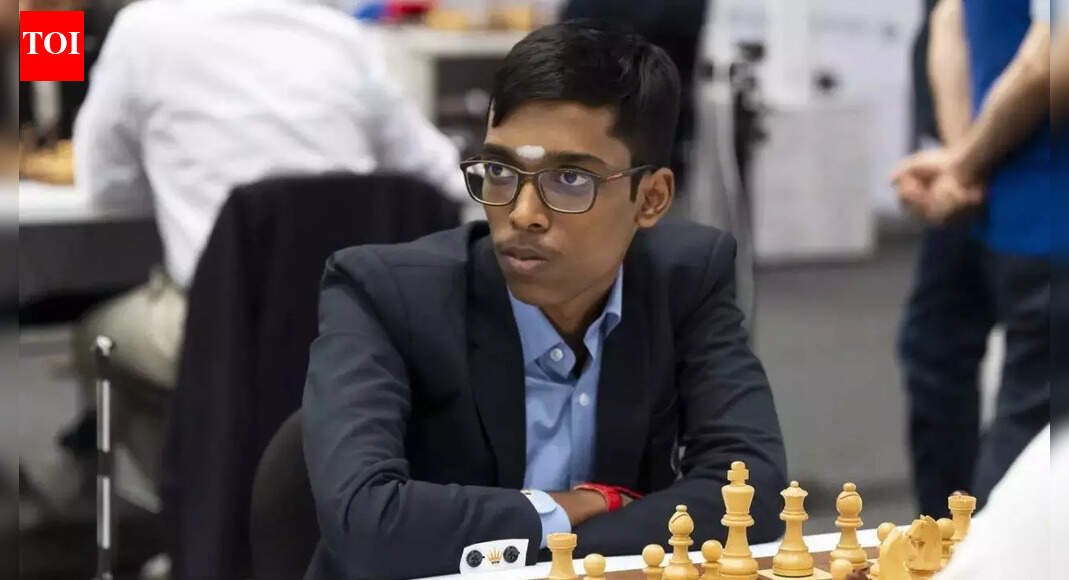
R Praggnanandhaa, only Indian to qualify for Candidates 2026, makes honest admission about new Total Chess World C’ship Tour | Chess News


R Praggnanandhaa, only Indian to qualify for Candidates 2026, makes honest admission about new Total Chess World C'ship Tour
R Praggnanandhaa (PTI Photo)

Indian Grandmaster R Praggnanandhaa believes the traditional world championship will remain dominant despite the upcoming Total Chess World Championship Tour, which will begin its pilot phase next year.The Total Chess World Championship Tour will become an annual event from 2027, featuring competitions in Fast Classic, Rapid, and Blitz chess formats, while the World Championship continues with the Classical format.

Total Chess World Championship Tour Explained: Norway Chess Answers Fans’ Queries | Exclusive

“I honestly haven’t really read through the regulations properly, so I don’t know how everything is shaped,” Praggnanandhaa told PTI during the Dharavi Chess Championship here on Friday.“But I do know that the winner of that will be qualified as a Candidate so that essentially means that the World Championship is still the priority,” he said when asked if the new competition would pose any challenge to the existing World Championship.Norway Chess CEO Kjell Madland has confirmed a long-term agreement with the International Chess Federation for the Chess World Championship Tour, which has received official FIDE approval.Praggnanandhaa welcomes the new tournaments as they create more opportunities for players to earn from the sport, including those focusing on Rapid and Blitz formats.“I am happy to see that there are new opportunities for the players to play, and since we have so many players, getting more opportunities for them to play is amazing, in that way it is great to see new tournaments coming up,” he said. “In terms of format, there are constant shifts which is happening. I am not sure if it is a good thing or a bad thing, but as a player, I think it is sometimes difficult to adjust to each format,” he said.“But it is also good that we have so many tournaments around, that players can participate in and they can make a living out of playing,” he added.Praggnanandhaa, who qualified for the 2026 Candidates Tournament after winning the FIDE Circuit 2025, plans to maintain his usual preparation approach.“Everything (including rest and mental preparation) is important, I will try to focus on everything and try to prepare well for it and we will see how it goes,” he said.“I am just going to take one game at a time, it is too far fetched to think about winning already — of course I want to do it — that’s the goal and I think I can do it, I have the ability so I will just try to give my best and see,” he added.ALSO READ: The rise of ‘Queen’: From ages 8 to 18, how an all-girl team is bringing free chess to rural India


Source link

Mumbai bizman on motorcycle who tried to speed away, dragging cop for 100m, gets 2 yrs’ jail | Mumbai News


Mumbai: Observing that the accused’s action of accelerating his motorcycle while being held by police officer amounted to using criminal force, a sessions court convicted and sentenced a 24-year-old Borivli businessman to two years’ simple imprisonment for using criminal force to deter a public servant from performing duty and voluntarily causing hurt. The accused, Sagar Gosaliya, was also fined Rs 7,500. The judge rejected the defence argument that no assault occurred. “I find that the accused had disobeyed the order of public servant, and therefore, being his duty to stop the accused, he caught hold of the accused’s forearm. Still, the accused did not stop and accelerated his motorcycle. This behavior and action of the accused definitely amounts to use of criminal force to deter the informant from discharging his duty,” said additional sessions judge KR Deshpande on Tuesday.The judge further said that merely because the accused did not assault Zende, it did not mean that the provisions of Indian Penal Code (IPC) 353 — assault or criminal force used to deter a public servant from performing their duty — are not attracted in this case. “On the contrary, it is clear cut case of using the criminal force by accelerating the motorcycle.”Regarding the charge of voluntarily causing hurt (section 332), the judge said that the intent to deter the officer from his duty was evident in the accused’s actions. “The accused dragging the informant by breaking the command caused simple injuries to the informant. I find that the provisions of both these sections are very well attracted in this case.”The FIR was registered on April 21, 2015, at the Borivli Police Station. Police constable Jagdish Zende was on duty at an anti-chain snatching point around 12.15pm. He grew suspicious of a motorcycle approaching from Sudhir Phadke Bridge and stopped the rider, later identified as Sagar Gosaliya. He was not carrying the vehicle documents.Gosaliya claimed his documents were nearby and requested permission to fetch them. Zende gave him Rs 30 for an autorickshaw and instructed him to go. However, instead of taking the auto, Gosaliya suddenly turned his motorcycle towards Devidas Lane, Borivli (W) and attempted to flee by accelerating.Zende deposed in court that he caught hold of Gosaliya’s arm, but he increased the speed, causing the cop to fall and be dragged for about 100 feet. Public assistance helped catch the accused. In the process, Zende suffered injuries, his spectacle frame was broken, and his uniform was torn. During the trial, the defence argued that the ingredients of Sections 353 and 332 of the IPC were missing, claiming there was no ‘assault’ and that Zende sustained simple injury only because he had grabbed the accused’s forearm.The judge, however, said “the prosecution established both the charges against the accused beyond all reasonable doubts.” The conviction was based on the consistent testimonies of Zende and eyewitness Arun Rathod, who corroborated the dragging incident.


Source link

Ayesha Curry’s intimate mother-daughter night out subtly counters swirling rumors surrounding Golden State Warriors star Stephen Curry | NBA News


Ayesha Curry’s intimate mother-daughter night out subtly counters swirling rumors surrounding Golden State Warriors star Stephen Curry
Ayesha Curry and Stephen Curry (Image via: stephencurry30/ Instagram)

Stephen Curry’s wife, Ayesha Curry, sent shock waves in the NBA world after a candid confession about her marriage. The popular entrepreneur diverted media attention for all the wrong reasons. As of now, both Ayesha Curry and her NBA husband haven’t spoken about it publicly or on social media. Despite all this, Ayesha has always posted about Stephen Curry and her kids on social media. Recently, the Sweet July Skin owner shared a glimpse of a mother-daughter night out with Riley and Ryan all the way from their favorite K-pop-inspired girl group, KATSEYE. Even the Golden State Warriors’ cornerstone shared the post on his Instagram story too.

Ayesha Curry shares a happy mother-daughter moment with Riley and Ryan

Stephen Curry’s wife, Ayesha Curry, loves posting about her NBA husband and kids. Recently, the International Smoke owner recently shared a happy mother-daughter moment with Riley and Ryan during their favorite K-pop-inspired group, KATSEYE. The proud momma posted an adorable picture and captioned it as, “Took my baby girls to see their FAVORITE KATSEYE World … a mommy-daughter night to remember. Swipe to the end to see our forever mood!” The snaps included sweet highlights of both Riley and Ryan enjoying the night out with their entrepreneur mom, Ayesha Curry while capturing the adorable moments away from the usual family routine.

Everything you need to know about the global pop group KATSEYE

The popular six-member global pop group KATSEYE came into existence from Netflix’s Pop Star Academy, and since then there’s been no looking back. The reputed group includes six members, Daniela, Lara, Manon, Megan, Sophia, and Yoonchae, who represent different cultures, walks of life, and countries. KATSEYE’s breakout song, Gnarly, went on to garner more than 100 million streams this year, and the six-member global music group has been performing extremely well with packed stadiums and millions of audience members across different venues in the U.S. during their Beautiful Chaos Tour. With the growing popularity of KATSEYE, it is quite understandable that Stephen Curry’s daughters, Riley and Ryan, are crazy about it. The concert attended by Ayesha Curry and her daughters even featured lively outfit changes and fan-favorite songs, including Time Lapse, Gabriella, and Torch, along with a colorful stage. Also Read: Stephen Curry limps off court as Golden State Warriors suffer another defeat against Houston Rockets


Source link

Match-fixing scandal hits domestic cricket: Four players suspended for allegedly being involved in corrupt practices during SMAT | Cricket News


Match-fixing scandal hits domestic cricket: Four players suspended for allegedly being involved in corrupt practices during SMAT

MUMBAI: The scourge of match-fixing has hit cricket, or more specifically, Indian domestic cricket, again. In a sensational development, the Assam Cricket Association secretary Sanatan Das informed the media on Friday that it had suspended four of its players — Amit Sinha, Ishan Ahmed, Aman Tripathi and Abhishek Thakuri — with immediate effect after allegations emerged that “they were involved in corrupt practices relating to the game of cricket” during the league stage of the Syed Mushtaq Ali T20 Trophy.“The above four players, who have represented Assam at various stages, are accused of influencing and attempting to instigate some of the current Assam team players, who took part in the Syed Mushtaq Ali Trophy 2025 held in Lucknow from Nov 26 to Dec 8. Following the emergence of these allegations, the Anti-Corruption and Security Unit (ACSU) of the BCCI conducted an enquiry. The ACA has also initiated criminal proceedings. Prima facie, there appears to be involvement of the aforementioned four players in serious misconduct, affecting the integrity of the sports,” Das stated in the release on Friday.

Ashish Nehra interview: Gujarat Titans head coach backs out of form Shubman Gill

The ACA stated that it had also lodged an FIR at the Crime Branch, Guwahati, against the four players on Friday. The ACA, incidentally, happens to be the home association of BCCI secretary Devajit Saikia. “The BCCI follows a zero tolerance policy regarding any kind of misdeeds or corrupt practices by any of the players, irrespective of which state they come from. Our anti-corruption unit is quite efficient to find out these kind of activities which is indulged by some players or bookies. We will continue our drive against those kind of persons who are involved in trying to malign the game of cricket,” Saikia told TOI. “We will not allow that to happen. As I said, our (anti-corruption) team is very efficient and is constantly working on this,” he added.Placed in Elite Group A, Assam, captained by India allrounder Riyan Parag, finished seventh out of eight teams, winning three games and losing four out of the seven matches they played in the competition. None of these four players accused of “indulging in corrupt practices” were a part of the Assam team in SMAT 2025.Amit Sinha, a batsman, has featured in 32 first-class matches (1208 runs at 22.79), 46 List A games and 31 T20s for Assam. Thakuri, a wicket-keeper batsman, has played 12 first-class matches (451 runs at 23.73), including two Ranji Trophy matches this season, besides having represented Assam in 11 List A and 10 T20s.“There was no particular match in which they were in fixing. These players were not there in the Assam squad for SMAT. They (allegedly) approached our team’s players with an intention of fixing. Those players approached the Assam captain (Riyan Parag), who reported it to the BCCI’s anti-corruption & Security unit. The BCCI’s ACSU investigated it and found that something was foul in the case. After conducting an investigation, the BCCI’s ACSU reported the matter to us. We have therefore suspended all these (accused) four players. If the names of more players emerge in the investigation (of the BCCI’s ACSU), then we will take action against them too. As of now, these four players have been found to be involved (in making a corrupt approach). They have admitted to us that they tried to make these corrupt approaches about producing a certain ‘performance’ from the players,” ACA president Taranga Gogoi told TOI from Guwahati.“We are all completely against corruption in cricket,” he added.The ACA secretary stated: “The suspension of the players was done to curtail any scope of further deterioration of the situation. Accordingly, during the suspension period, the players are barred from: Taking part in any State-level tournament or match conducted under the Assam Cricket Association, District Units or affiliated clubs. Participating in any cricket-related activity, including officiating as match referee, coach, umpire etc. The suspension will continue til the final outcome of the investigation and/or any further decision of the Association. All District Associations are directed to ensure strict compliance with this order and to inform clubs and cricket academies under their jurisdiction for the necessary action.”“The ACA reiterates its commitment to safeguarding the integrity and spirit of the sport and will continue to uphold the highest standards of transparency, discipline and ethical conduct,” concluded Das’ statement.


Source link

Psychedelic flight: Alaska pilot tries to cut fuel mid-air under influence of magic mushrooms— watch


An audio clip of an Alaska Air pilot who tried to shut the flight down mid-air under the influence of “mushrooms” has surfaced on the internet. The audio dates back to October 2023, which reveals the moment when the man cut off the fuel of the aircraft that was carrying 84 people.The audio captures the panic at the moment as the pilots could be heard cussing vehemently before they asked the ATC for an emergency landing in Portland, audibly out of breath.“We need to make an emergency landing,” the pilot said. “We got a jump seater who just tried to shut our engines off. We need to go direct to Portland now.”The video then cuts to the man being transported as he is visibly handcuffed. He can be heard mumbling, “I want to take accountability, but I want to be forgiven for being so stupid.”On October 22, 2023, Joseph Emerson, a former Alaska Airlines pilot who was sitting in the jump seat due to the flight being full. It was then, when he went under the influence of a psychedelic mushroom that he had consumed two days earlier. Aboard Flight 2059, he went to pull the red handle in the engine control, which is used to cut off the fuel of the aircraft in case of fire.The crew was able to subdue him successfully and make a safe landing.CBS reported that after talking to Emerson, he revealed that he did not mean to make the flight crash.“No, no. I had no intention of crashing the actual airplane. I wanted to wake up,” Emerson said, “I was convinced I wasn’t going home to my wife and kids. It wasn’t reality.”He further went on to reveal that he was mourning the loss of his best friend and initially sought comfort in alcohol before eventually trying psilocybin mushrooms for the first time.“It didn’t wake me up, right. It, I was in reality. I know that now,” he said. “It’s the most consequential three seconds of my life.”Emerson admitted to a federal charge of interfering with a flight crew and separately entered no-contest pleas to state counts of endangering an aircraft and 83 people.The federal plea resulted in a sentence of time served, 46 days in jail, along with three years of supervised release, while the state case concluded with time served and five years of probation.


Source link

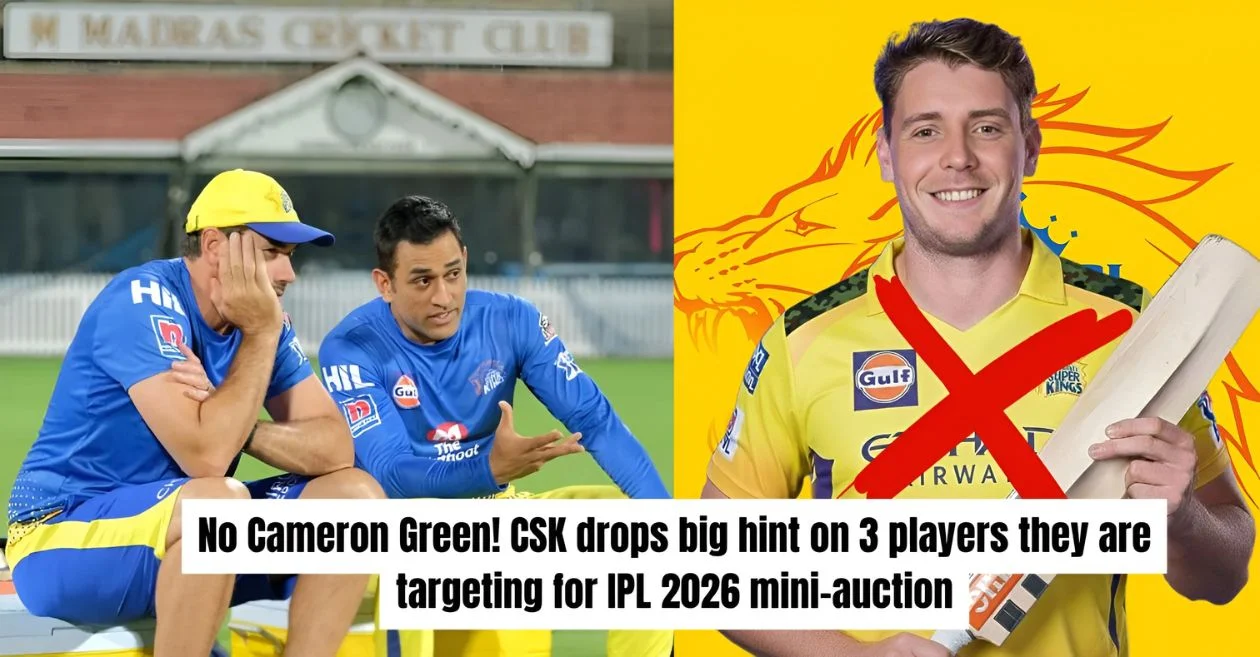
No Cameron Green! CSK drops big hint regarding Top 3 potential targets for IPL 2026 mini-auction


The Chennai Super Kings (CSK) franchise, entering the Indian Premier League (IPL) 2026 mini-auction with the second-highest purse of ₹43.40 crore and a significant rebuilding task following a bottom-place finish in 2025, has sparked massive speculation through a cryptic social media video. This short film, featuring the franchise mascot Leo on a shopping trip, has been widely dissected by fans and media, leading to strong suggestions about their top three targets while simultaneously hinting at a potential shift away from the widely touted chase for Cameron Green.

Decoding CSK’s cryptic top 3 IPL 2026 auction targets

The entire speculation hinges on the climax of the one-minute, 37-second video, where the mascot, Leo, makes three specific purchases at a vegetable market, placing them in a bag. These three items have been universally decoded as direct clues to the franchise’s intended acquisitions:

  • Kiwi Fruit (New Zealand Link): The purchase of the kiwi fruit is seen as a clear and almost unanimous hint towards pursuing a major New Zealand player. Given CSK recently released former New Zealand stars Devon Conway and Rachin Ravindra, this suggests the franchise is intent on bringing a high-impact Kiwi player back into the squad. Ravichandran Ashwin even fuelled speculation by suggesting the target could be pace bowler Matt Henry.
  • Apples (The J&K Connection): The apples are interpreted as a deliberate reference to the fruit’s strong association with Jammu & Kashmir (J&K). This clue points directly toward the uncapped domestic talent Auqib Nabi. Nabi, a fast bowler from J&K, has recently gained significant recognition in the domestic circuit, notably becoming the first bowler in Duleep Trophy history to claim four wickets in four balls. His strong performance in the Syed Mushtaq Ali Trophy and subsequent trial with the Mumbai Indians suggest he is a prime uncapped target for teams looking to boost Indian seam-bowling depth.
  • Local Mixture Packet (The Tamil Nadu Root): The local ‘mixture’ snack packet is widely viewed as a signal that CSK is targeting a player with strong local connections to Tamil Nadu. Fans quickly linked this clue to the Indore-born all-rounder Venkatesh Iyer, who was released by Kolkata Knight Riders (KKR) after an ordinary IPL 2025 season. Despite playing for Madhya Pradesh, Iyer has family roots in Tamil Nadu, and the ‘mixture’ may signify the franchise’s desire for a versatile, domestic all-rounder.

Also READ: 5 franchises that can target Cameron Green in the IPL 2026 mini-auction

The Cameron Green dilemma and alternative all-rounder strategy

The most talked-about omission from this cryptic three-item shortlist is the absence of any obvious hint towards Australian all-rounder Cameron Green, who is widely predicted to be the most expensive player in the auction. Reports noted a curious detail in the video where the mascot Leo ignores or turns away from shops selling green vegetables and chillies.

This subtle rejection has led to two main theories among the fan base:

  1. No Green Chase: One school of thought suggests that CSK’s management is convinced by Green’s immense expected cost, which could consume a majority of their ₹43.40 crore purse, and has therefore decided to drop the chase, exploring more cost-effective options.
  2. General All-Rounder Hint: The opposing theory holds that the ‘mixture packet’ is a broader, more generic hint indicating that CSK’s primary goal is to acquire a top-tier all-rounder to fill the void left by released players like Sam Curran, regardless of whether that is Green or another target like Liam Livingstone.

While CSK’s actual auction strategy remains a mystery, the video clearly suggests a focus on securing a New Zealand star, an exciting domestic fast bowler from J&K, and a left-field domestic all-rounder with local ties, while leaving the question of the high-profile Cameron Green chase purposefully ambiguous.

Also READ: IPL 2026 Auction: 350 players to go under the hammer; Cameron Green, Prithvi Shaw, Steve Smith among the big players


Source link

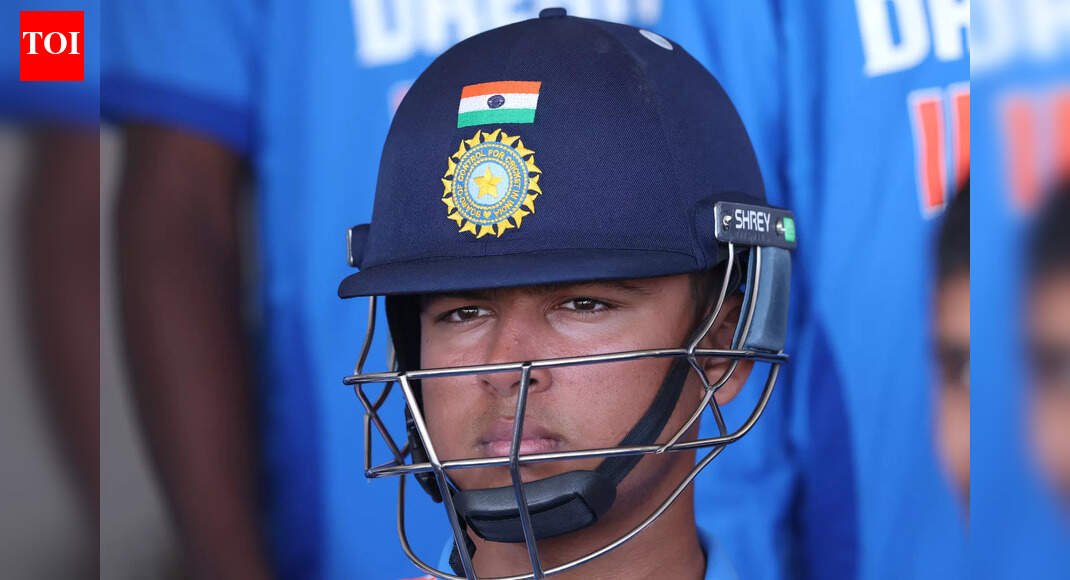
‘Main Bihar se hoon’: Vaibhav Sooryavanshi hits back at UAE sledging in U19 Asia Cup opener | Cricket News


'Main Bihar se hoon': Vaibhav Sooryavanshi hits back at UAE sledging in U19 Asia Cup opener
Vaibhav Suryavanshi of India (Photo by Michael Steele/Getty Images)

Vaibhav Sooryavanshi showcased an extraordinary performance in the U-19 Asia Cup match against UAE in Dubai on Wednesday, scoring 171 runs off just 95 balls. His remarkable innings helped India post a massive total of 433/6 in their allocated 50 overs.The 14-year-old left-handed batsman from Bihar set a new world record in U-19 cricket by hitting fourteen sixes and nine fours during his innings.

Ashish Nehra interview: Gujarat Titans head coach backs out of form Shubman Gill

During the 32nd over of India’s innings, when Sooryavanshi was approaching his century, an interesting exchange occurred between him and UAE wicketkeeper Saleh Amin.“Come on boys. 90’s curse. 90’s curse,” Amin was heard saying on the stump mic.“Tere saath selfie loon? (Wanna take selfie with me?)” Sooryavanshi responded to the UAE wicketkeeper.When asked about the incident later, Sooryavanshi responded confidently: “Main Bihar se hoon. Peeth peeche jo bhi baatein hoti hain, usse mujhko farak nahi padta.” (I am from Bihar. What is said behind my back does not bother me.)The match began with UAE captain Yayin Rai winning the toss and asking India to bat first. India faced an early setback when captain Ayush Mhatre was dismissed for just four runs in the third over.Sooryavanshi then joined forces with Aaron George at the crease. The young batsman initially played with caution before accelerating his innings, reaching his fifty in just 30 balls.His powerful hitting display earned him a new tournament record for most sixes in a single innings in the U-19 Asia Cup. He surpassed the previous record of ten sixes set by Afghanistan’s Darwish Rasooli in 2017.Sooryavanshi continued his aggressive batting, reaching his century in 56 balls. He maintained his momentum to score 150 runs in 84 balls before being run out after scoring 171 runs. His innings came at an impressive strike rate of 180.The innings now stands as the second-highest score by an Indian in Youth ODI cricket. The record is still held by Ambati Rayudu, who scored an unbeaten 177 against England U-19 in 2002.The Indian innings was well supported by Aaron George and Vihaan Malhotra, who both scored 69 runs each. Vedant Trivedi contributed 38 runs, while Abhigyan Kundu and Kanishk Chouhan added 32 and 28 runs, respectively. The combined effort helped India set an enormous target of 434 runs for the UAE team.UAE’s response resulted in a score of 199/7 in their allocated 50 overs. Their innings was highlighted by Uddish Suri’s unbeaten 78 and Prithvi Madhu’s fifty. India U19 secured a dominant 234-run win.India U19 will face their next challenge against Pakistan U19 in a group stage match on Sunday.


Source link

FDI reform push: Cabinet clears bill to raise foreign investment in insurance to 100%; key guardrails, LIC changes included


FDI reform push: Cabinet clears bill to raise foreign investment in insurance to 100%; key guardrails, LIC changes included

The Union Cabinet on Friday approved a bill to raise the foreign direct investment (FDI) cap in the insurance sector to 100 per cent, a major change aimed at deepening insurance penetration and accelerating sectoral growth, PTI reported citing sources.The proposed legislation — the Insurance Laws (Amendment) Bill, 2025 — is among 13 bills listed for the ongoing Winter Session of Parliament, which concludes on December 19. Sources said the bill may be introduced on Monday. A Lok Sabha bulletin notes that the draft law seeks to “deepen penetration, accelerate growth and development of the insurance sector and enhance ease of doing business.”Finance Minister Nirmala Sitharaman had proposed the move in this year’s Budget as part of new-generation financial sector reforms. The insurance industry has so far attracted Rs 82,000 crore in FDI.According to sources, the bill proposes amending the Insurance Act, 1938 to raise the FDI limit to 100 per cent, permit the merger of a non-insurance company with an insurance entity, and establish a dedicated policyholder fund. It also mandates that at least one senior leader — Chairman, Managing Director or CEO — must be an Indian citizen. Net worth requirements for insurers have been retained.As part of the wider legislative exercise, amendments will also be made to the Life Insurance Corporation Act, 1956, and the Insurance Regulatory and Development Authority Act, 1999. Changes to the LIC Act include empowering its board to independently take operational decisions such as branch expansion and recruitment.The proposed amendment, sources said, aims to promote policyholders’ interests, enhance financial security, and support the entry of more players into the sector while boosting growth and employment. The government has positioned these reforms as essential for achieving ‘Insurance for All by 2047.’Commenting on the move, Aditya Birla Sun Life Insurance MD and CEO Kamlesh Rao said the step may encourage more global players to consider India, adding that scale will depend on their ability to navigate the local distribution landscape.Deloitte India partner Debashish Banerjee told PTI, “Over the past few months, we have seen growing interest from several global insurers who are actively evaluating India as a long-term market, and greater clarity on ownership norms will help in moving those conversations forward.”Grant Thornton Bharat partner Narendra Ganpule noted that the proposal is designed “with the policyholders in mind, fostering an environment that delivers more choice, encourages highly innovative products, ensures robustly competitive prices, and hopefully delivers better service standards.”RenewBuy CEO Balachander Sekhar said the shift to 100 per cent FDI will bring global capital and expertise into the fold.


Source link

Rupee at historic low: How 9% real depreciation could reshape India’s economy – explained


Rupee at historic low: How 9% real depreciation could reshape India’s economy - explained
Rupee depreciation: Experts are of the view that this weakness may persist in the near term. (AI image)

The rupee has been in a downward spiral versus the US dollar – hitting new historical lows and even crossing the 90 mark. The depreciation has been steep, and even more on a real effective basis. In fact, the rupee is one of the worst performing major currencies. Experts are of the view that this weakness may persist in the near term, given the uncertainty of the India-US trade deal, and pressure on capital flows – and this can and will impact various macroeconomic variables in India, if it persists. A persistently weak rupee affects India through five major channels, influencing everything from inflation and imports to exports, corporate margins, and even investment decisions. While the short-term effects are mostly negative—such as raising costs and additional economic pressure—a weaker rupee can also support long-term growth by gradually shifting consumer and producer behaviour, encouraging more domestic output and improving export competitiveness, says BofA Securities in its latest report.

Rupee Slides To Record Low Of 90 Per Dollar As Trade Uncertainty, Dollar Demand And Oil Costs Spike

Rupee’s Depreciation vs Dollar: Some Startling Numbers

  • The rupee has depreciated against the dollar by 4.7% year-to-date in 2025, and over 5.8% in the last 1 year.
  • In Real Effective Exchange Rate (REER) terms, the weakness has been even larger, with year-to-date weakness at an estimated 8.6% until November, and 1-year weakness at 12.1%.
  • According to BofA Securities, this is a large amount of weakness both from the current episode and from a historical context, as the rupee had weakened something around 8.7% in 2018, 14% in 2013, and 18.7% in 2008, the previous episodes of large-scale depreciation in the rupee.
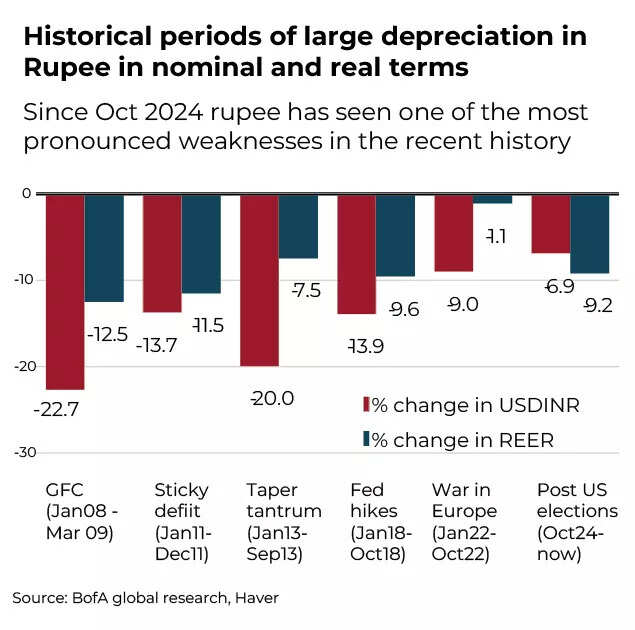
Historical periods of large depreciation in rupee in nominal and real terms

Historical periods of large depreciation in rupee in nominal and real terms

Despite recent expansion in the trade deficit, India’s current account deficit remains controlled. With crude oil prices ranging between $60-65/brl, approximately $15/brl lower than previous year’s average, the risk of energy costs affecting external financing needs appears limited.“This means the primary challenge has been on capital flows, and that has been an issue which remains multifaceted, and has been seen across FDI flows, FPI flows, and debt related inflows, which have to a certain extent stalled. Indeed, the RBI as per official data has sold $65 billion in the open market between October 24 to September 25, and is also running a large short forward book position of $63.6 billion until end October, which has probably increased in November given the extent of pressure on the rupee,” says BofA Securities.
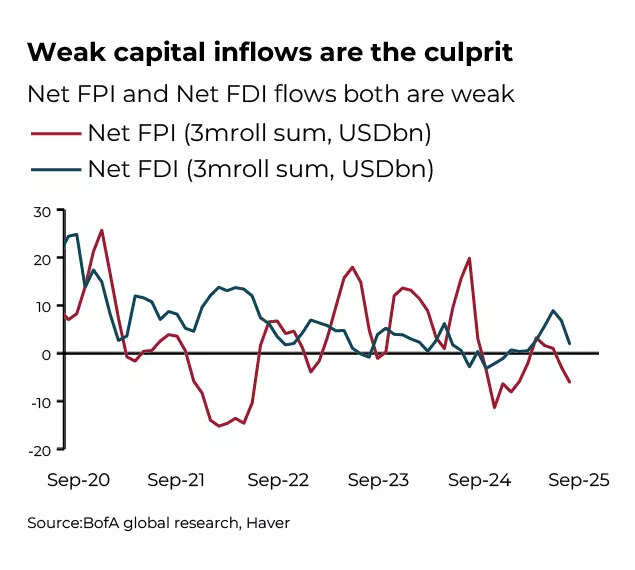
Weak capital inflows are the culprit

Weak capital inflows are the culprit

What does a weak rupee mean for the Indian economy? BofA Securities says that the economic impact of a weaker exchange is multifaceted, and the exchange rate influences several macroeconomic variables, through the interplay of sentiment, growth inflation and other balances.

First channel: Sentiment hit – possibly quick and large

According to BofA Securities, historically data suggests that a weak rupee causes a sentiment hit – which then tends to impact variables and key economic indicators – be it consumer confidence, business sentiment and policy uncertainty measurements, PMI. BofA’s analysis suggests that during periods of more than 10% weakness in the rupee, the catalyst for sentiment weakening could be seen in the data. “Given the extent of current weakness, it can feed through consumer sentiment and business sentiment potentially,” it warns.

Second channel: What happens to GDP growth?

The relationship between exchange rate and GDP is in several ways multifaceted. Several studies, including from the RBI, have documented the connections between exchange rates and GDP growth, examining both price and volume implications, specific component effects, and temporal aspects. The primary channel of impact of a weaker exchange rate comes through both exports and imports, which are the primary factors relying on the exchange rate to an extent, notes BofA.Let’s understand this better:The main effect of a weakened rupee manifests in import patterns – this can particularly affect discretionary and consumer-related imports. Research indicates that a 5% decline in RBI’s Real Effective Exchange Rate can result in a corresponding 2.3% reduction in imports. This in turn can push up GDP growth through the decreased import volumes.According to a study done by ministry of finance in 2023, the results of exports being meaningfully influenced by exchange rate weakness has been weakening in the recent years, but based on the results, the export sensitivity to 5% REER depreciation can typically increase exports by ~2%, implying almost a ~4% improvement in the current depreciation episode. BofA Securities quotes a recent RBI study which investigated the relationship between exchange rate fluctuations and trade balance, and concluded that rupee depreciation in real terms enhances the trade balance progressively. This impact appears more significant in periods of rupee’s depreciation compared to the appreciation periods.
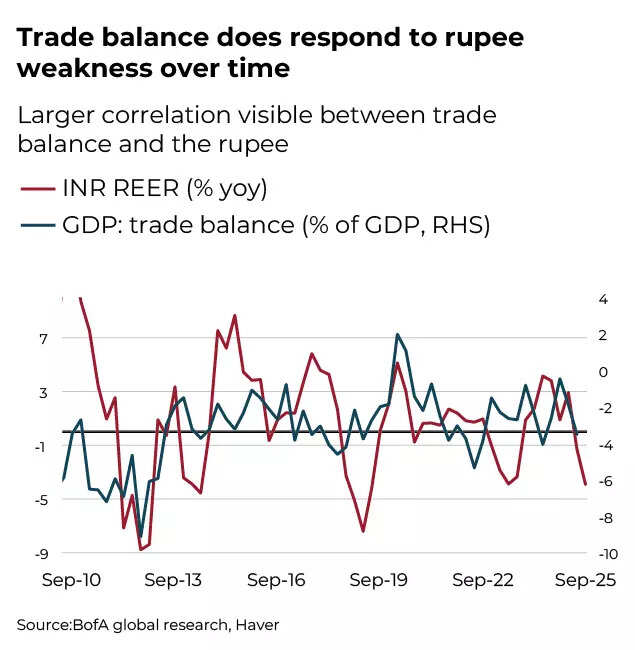
Trade balance does respond to rupee weakness over time

Trade balance does respond to rupee weakness over time

Their study showed that both in the short term and the long term, rupee depreciation does influence the trade balance positively, likely working more strongly through import demand compression, than through export improvement immediately.“Based on this study, if the current depreciation holds, the implied trade balance improvement could be as large as 5-7% of the trade balance which in current terms saves India almost $7-12 billion, in line with RBI’s study,” says the BofA report. “However, with the shadow of the weakness emanating from the tariffs imposed by the US, we believe the gains on the trade front, especially exports will be somewhat stunted, but the imports compression is still likely to play out, given the primary source of compression is on the domestic demand front, not external front,” it adds.

Third Channel: Inflation Trouble

This is one channel that can feed negatively into the economy, raising prices and hence, inflation. But, will that be the case for India? As per the BofA report, historically, the exchange rate – inflation nexus has always been strong in India, as typically rupee weakness can emanate from elevated inflation, which in turn can trigger more inflation.

Core CPI

Core CPI

This cycle however is not visible in the current scenario, and with typical channels of higher imported inflation appears to be relatively benign to cause any major inflation spiral, the report says,How does inflation get imported in times of rupee depreciation? There are three main channels:In today’s scenario, the comforting fact is that the fall in crude oil prices has been more drastic than the rupee’s depreciation. Further, even if crude oil prices rise at the margin, the government has kept the price of fuel in India elevated, over and above the implied prices based on crude oil levels, resulting in elevated gross marketing margins for oil companies, notes BofA.. “As such, even after a weaker exchange rate, the need to raise retail fuel prices will stay limited. This may not be the case for all energy products, or precious metals, which have been moving up, and the pass through will continue to be visible in the data,” it adds.

Gold prices

Gold prices

  • Intermediate and consumer goods

BofA is of the view that the ongoing deflationary trends in China have spread across the region, including India. This suggests that the effects of a weakened exchange rate may actually be limited. “This is visible as the persistent weakness in WPI inflation, which reflects input costs, and is much more sensitive to a weaker exchange rate and imported prices. Indeed, after a brief period, WPI inflation has been negative for an extended period, and in index terms, WPI index still remains below the highs seen in June 2022,” it says.Previous RBI analyses and current quarterly projection models indicate that a 5% reduction in REER can actually cause a 35-basis points rise in inflation across 3-4 quarters. This suggests that there could be a potential 60-70 basis points upward risk to inflation. However, considering the global economic context, this outcome seems unlikely in the current phase of rupee weakening, says BofA. According to the RBI, about 36.4% of the present inflation basket is directly or indirectly impacted by imported prices, which naturally may be impacted by a weaker exchange rate. Overall, while a large amount of rupee weakness is a precursor for higher inflation, the uniqueness of the global commodity price backdrop and the persistence of low food inflation can ensure that the pass through of a weaker exchange rate is somewhat less.The prospect of a favorable rabi crop sowing season will also further blunt the inflation impact, as volume growth will ensue even if input costs rise, the pass through will be somewhat quelled by large stocks availability.

Fourth channel: External Sector

On the external sector front, the long-term impact may actually bode well for the Indian economy. The impact on external finances is expected to be more noticeable through current account dynamics rather than capital account movements. Historical analysis suggests that trade balance actually improves – imports take a hit because they cost more and exports get a leg up because they are cheaper for the country that imports them.“For the implied trade balance, the improvement based on historical sensitivities can be anywhere between 0.8-1 times based on historical studies,” says BofA Securities. “However, the weakness in US trade activity, especially with exports, adds an element of uncertainty on the goods trade improvement that can typically be seen after every major correction in the rupee on real terms. This could mean that the typical “J – Curve” effect may not be as quickly visible in the data if rupee weakness persists, but eventually it should be seen, potentially in 2-4 quarters,” it adds.
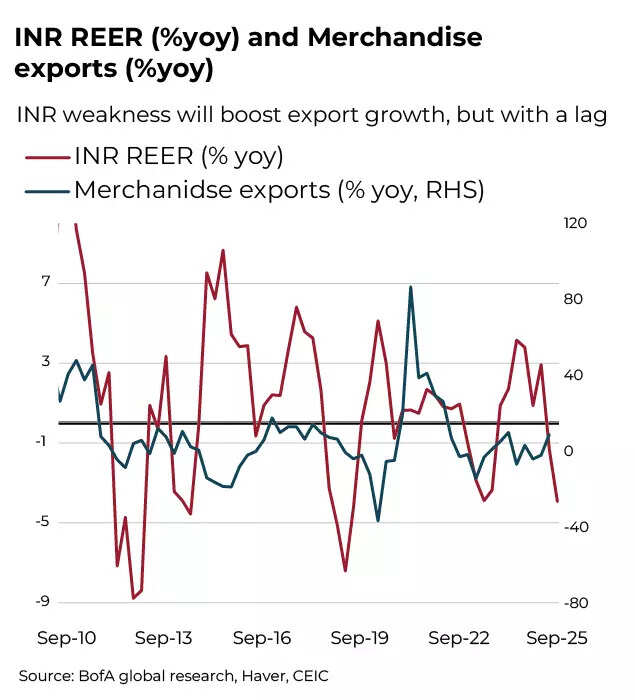
Rupee weakness can boost export growth

Rupee weakness can boost export growth

The depreciation of the rupee would significantly enhance competitiveness in services trade, although initial dollar surpluses might decrease as operational costs in India, particularly for GCCs, reduce.“This could mean lesser need to send operational capital, but over time could also result in a larger incentive to expand capacity given cost efficiencies. As per an RBI study, services exports improve by 0.8% for every 1% FX weakness over time. For other services items such as tourism and education, a weaker rupee would reduce incentives for outbound activity, but whether it can be seen meaningfully in a short time period is debatable,” says BofA.

INR REER and Secondary Income

INR REER and Secondary Income

The flow of remittances is a big positive of rupee depreciation. For remittances, bouts of a weaker exchange rate can result in a small period of lower inflows, but typically once the rupee depreciation stalls, it is followed by a meaningful increase in remittances flow, to use the better cross exchange rate. This is not the case with primary transfers, which typically is not impacted during currency fluctuations, the report says.“Overall, we believe the current account deficit tends to shrink over a period of time post a sharp bout of forex weakness, but that is more likely to be visible in the next 3-6 months, rather than the next 1-2 months. On the capital flows side, we do not see any meaningful impact of a weaker exchange rate on both FDI and FPI flows, but a weaker rupee can add to the public and private debt burden at the margin, especially if they are not matched fully from a forex hedging perspective. There will still be some increase in debt burdens, but we believe its implications will be relatively well managed,” it adds.

Fifth Channel: Does the fiscal situation pose a risk?

On the fiscal side of the economy, the implications of a weaker rupee are not immediately clear. This is especially so since the government no longer subsidizes fuel consumption meaningfully, outside of LPG products. Whilst LPG subsidies might increase marginally, fertiliser subsidies are likely to experience a more substantial rise due to currency depreciation.

Subsidies

Subsidies

The important thing is that the current rupee depreciation, combined with RBI’s ongoing market interventions, is likely to enhance the central bank’s foreign exchange earnings. This could result in increased RBI dividend payments in fiscal year 2026-27, offering potential revenue support.“This will be a similar dynamic to the weakness in rupee seen last year, potentially with a larger intensity, given the extent of intervention this year has been much larger in selling foreign exchange, which typically yields the RBI profits. As such, the overall fiscal impact remains unclear to us, as there are positive and negative aspects of the exchange rate weakness in our view,” BofA Securities says.

Where is the rupee headed?

The India-US trade deal is a key factor in ongoing weakness in rupee, and an effective resolution may pave the way for a relatively stronger rupee compared to the present scenario.BofA analysts are of the view that the rupee still remains dependent on portfolio flows next year after large equity outflows this year partly driven by tariffs. “Finalization of trade deal to reduce the tariffs would be important in reducing uncertainty for equity investors,” it says. “Further pick-up in growth momentum would be another key factor for next year which may support corporate earnings and ease equity valuation concerns,” it adds.Given this uncertainty, BofA believes that the central bank’s management of rupee levels will be key. “RBI’s reserves remain adequate, but continued portfolio outflows could make these operations unsustainable or build-up of RBI’s short dollar forward positions may skew return expectations on the rupee,” it says.“Overall, we believe dollar weakness next year would still support mild rupee appreciation and that could pick-up pace around the seasonally favorable first quarter for the rupee. We forecast the rupee to reach 86/USD by end-2026, in line with dollar weakness next year,” it says.Even though the RBI has been letting the rupee weaken to reduce pressure on the exchange rate markets, BofA believes that the RBI will likely stay involved in both the spot and forwards market, providing liquidity and curbing volatility. “Indeed, in the latest RBI meeting, the governor clearly stated that the tolerance for rupee volatility has not changed for the RBI, in our view, and we would expect them to remain visible, and smoothen out the direction of the move, without necessarily anchoring any specific level. This has been the strategy through 2025, where RBI has opportunistically sold and bought foreign exchange, when it could, and if inflows return in a meaningful way, we believe the RBI may also have a preference to rebuild its external buffers,” it adds.



Source link