Breaking News
AQI ‘severe plus’ in Delhi-NCR: CAQM suspends all outdoor sports; warns serious health risk to children | India News


AQI 'severe plus' in Delhi-NCR: CAQM suspends all outdoor sports; warns serious health risk to children

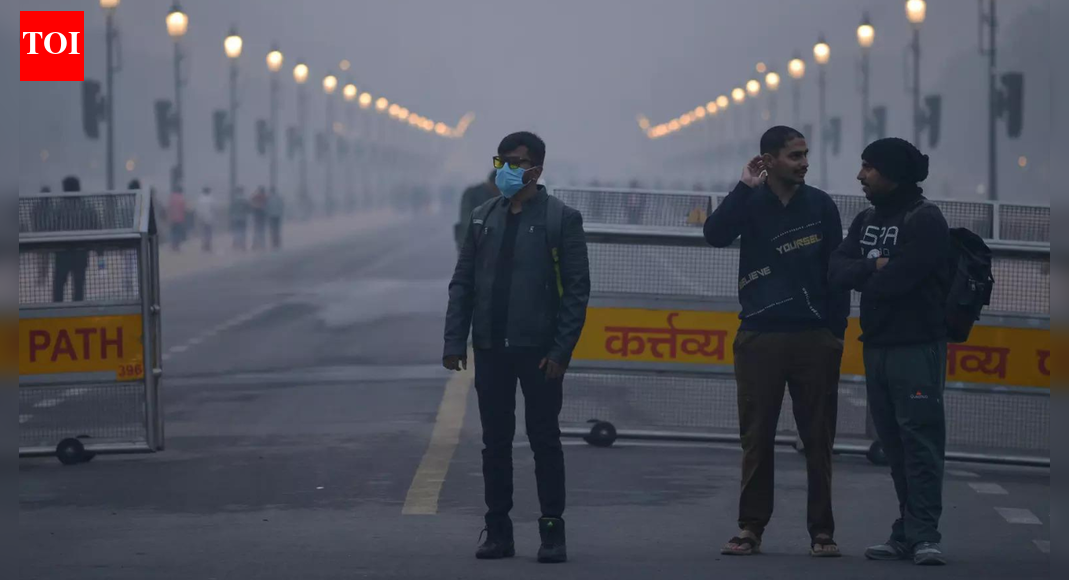
NEW DELHI: As air quality deteriorated to ‘severe plus’ across Delhi-NCR, the Commission for Air Quality Management (CAQM) on Saturday directed Delhi and NCR state governments to ensure the immediate suspension of all outdoor physical sports activities, warning that their continuation poses a “serious health risk to children.In a letter to the chief secretaries of Delhi, Haryana, Rajasthan and Uttar Pradesh, the Commission said it was concerned that “some schools and institutions in Delhi-NCR were still holding outdoor sports activities” despite earlier directions issued in line with a Supreme Court order dated November 19.It said allowing outdoor physical activities during periods of adverse air quality is “contrary to the spirit and intent of the apex court’s observations and the Commission’s instructions.”The directive came as the CAQM invoked the strictest measures under its Graded Response Action Plan (GRAP), Stage IV on Saturday, after pollution levels rose sharply due to unfavourable meteorological conditions. The Commission said it had earlier, in a letter dated November 19, called for the “postponement of physical sports competitions scheduled during November and December.”The CAQM asked the Delhi government and NCR states to ensure strict and immediate compliance with its directions. It also asked the government to issue necessary instructions to schools, educational institutions, sports bodies and local authorities to discontinue outdoor physical sports activities, and sensitise schools and parents about the associated health risks.Authorities were also told to closely monitor compliance on the ground and take action against violations.Under GRAP IV restrictions, all construction and demolition activities in Delhi-NCR have been banned, including linear public projects such as highways, roads, flyovers, power transmission lines, pipelines and telecom works.The entry of trucks into Delhi has been stopped, except those carrying essential commodities or providing essential services, with CNG, LNG, electric and BS-VI diesel trucks exempted.Schools in Delhi and the most affected NCR districts have been directed to run classes in a hybrid mode for students from primary classes up to Classes VI to IX and XI, with the option of online attendance where feasible.State governments have been asked to consider additional emergency measures if pollution levels worsen further, including closing colleges and educational institutions, shutting non-essential commercial activities and introducing odd-even vehicle restrictions.


Source link

Top market movers: Eight of top-10 firms lose Rs 79,129 crore in value; Bajaj Finance, ICICI Bank lead weekly drag


Top market movers: Eight of top-10 firms lose Rs 79,129 crore in value; Bajaj Finance, ICICI Bank lead weekly drag

The combined market capitalisation of eight of India’s 10 most-valued companies fell by Rs 79,129.21 crore last week, with Bajaj Finance and ICICI Bank taking the sharpest hit amid a broadly weak trend in equities, PTI reported. The BSE benchmark dropped 444.71 points, or 0.51%, during the week. Among the top-10 pack, only Reliance Industries and Larsen & Toubro managed gains, while HDFC Bank, Bharti Airtel, Tata Consultancy Services, ICICI Bank, State Bank of India, Infosys, Bajaj Finance and Life Insurance Corporation of India saw erosion in their valuations. Bajaj Finance’s mcap plunged Rs 19,289.7 crore to Rs 6,33,106.69 crore, making it the biggest loser. ICICI Bank followed with a decline of Rs 18,516.31 crore, taking its valuation to Rs 9,76,668.15 crore. Bharti Airtel’s valuation fell Rs 13,884.63 crore to Rs 11,87,948.11 crore, while State Bank of India shed Rs 7,846.02 crore to settle at Rs 8,88,816.17 crore. Infosys lost Rs 7,145.95 crore, bringing its market value to Rs 6,64,220.58 crore. TCS saw its mcap slip Rs 6,783.92 crore to Rs 11,65,078.45 crore, and HDFC Bank’s valuation declined Rs 4,460.93 crore to Rs 15,38,558.71 crore. LIC, meanwhile, recorded a marginal erosion of Rs 1,201.75 crore, taking its valuation to Rs 5,48,820.05 crore. In contrast, Reliance Industries added Rs 20,434.03 crore to reach Rs 21,05,652.74 crore, while Larsen & Toubro gained Rs 4,910.82 crore to stand at Rs 5,60,370.38 crore. Reliance Industries remained India’s most valuable company, followed by HDFC Bank, Bharti Airtel, TCS, ICICI Bank, State Bank of India, Infosys, Bajaj Finance, Larsen & Toubro and LIC.


Source link

Fake jewellery scam bust: 5 arrested for duping Mumbai resident of Rs 25 lakh; police recover Rs 15 lakh in cash from gang member | Mumbai News


MUMBAI: Five members of a gang from Rajasthan’s Jalore district have been arrested for defrauding a Mumbai resident of Rs 25 lakh by selling him fake gold ornaments they claimed were discovered during excavation near a temple in Nashik, police said on Sunday.The gang member Babulal Bhalaram Waghela befriended the victim, Dinesh Mehta, a 51-year-old Malad resident, by speaking to him in Rajasthani language. Waghela then told Mehta about supposedly finding 900 grams of gold ornaments during excavation behind a temple in Nashik.Waghela offered to either sell the ornaments to Mehta or sought his help in selling them. He showed Mehta some ornaments and provided gold beads as samples.After the beads appeared to be genuine gold, Mehta paid Rs 25 lakh in cash to purchase the ornaments. However, when he later had them tested by a jeweller, they were revealed to be counterfeit.Following Mehta’s complaint, police analyzed footage from over 100 CCTV cameras before apprehending five suspects from Gujarat and Virar in Maharashtra’s Palghar district.The arrested gang members were identified as Babulal Bhalaram Waghela (55), Kokubai Babulal Waghela (50), Mangalaram Manaram Waghari (34), Kesaram Bhagataram Waghari and Bhavarlal Babulal Waghari.Police recovered Rs 15.45 lakh in cash from Babulal Waghela’s residence. They revealed that Waghela is a repeat offender with multiple previous cases against him.Police are currently searching for one more suspect connected to this fraud case.(With agency inputs)


Source link

Four hours of waiting, over 1 lakh students in limbo, two outcomes: Why DU’s exam delay hit them differently


Four hours of waiting, over 1 lakh students in limbo, two outcomes: Why DU’s exam delay hit them differently
For Honours students, the delay was disruptive but cushioned while for Programme students, it meant tighter schedules, fresh exam dates, and extended uncertainty.

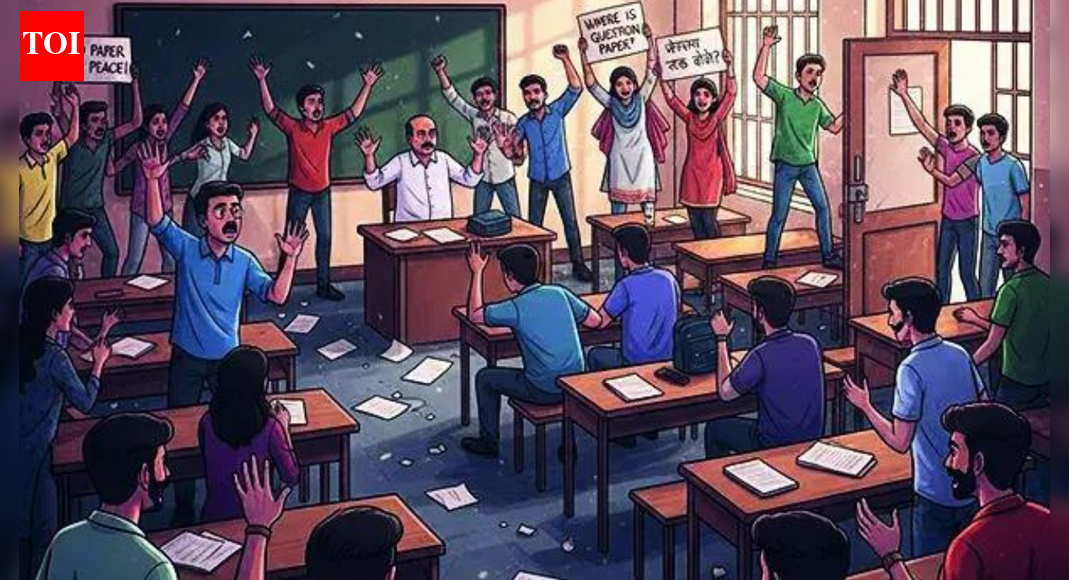
For thousands of Delhi University (DU) students, December 13 did not begin with an exam — it began with waiting. Semester examinations across more than 35 subjects were thrown into chaos after question papers failed to reach several centres on time, leaving students in limbo for up to four hours, suggests a TNN report. Some exams that were scheduled to begin at 9.30 am only started close to noon while others were cancelled altogether.The disruption was not minor. Up to 10 papers had to be cancelled, affecting over 100 students, while several other examinations were conducted later in the day “with considerable difficulty,” officials told TNN. The worst delays were reported in science and computer science courses, where two key papers — Digital Image Processing and Compiler Design — were not received across the university until 12.50 pm.In all, around 1.4 lakh students were impacted by the cascading delays, uncertainty, and uneven exam conditions. Well, while the disruption was shared, the fallout was not. Delhi University’s own clarification revealed a structural divide: For Honours students, the delay was disruptive but cushioned while for Programme students, it meant tighter schedules, fresh exam dates, and extended uncertainty. This is why the same delay landed very differently across DU’s classrooms.

DU Honours students: More slots, more breathing room

For DU Honours students, especially those in the fourth year appearing for seventh-semester Discipline-Specific Electives (DSEs), DU confirmed that no attempt would be lost.According to the university, Honours students appear for three core subjects but are given four optional examination slots. These slots were already announced as December 13, 17, 19 and 26. Even with December 13 disrupted, the examination calendar leaves room to recover. Three other slots remain open. That distinction is crucial. It ensures that a missed or delayed paper does not escalate into a lost semester. Students are allowed to reset, reorganise their preparation, and attempt the exam later, rather than absorb the consequences of a failure they did not cause. In a nutshell, Honours students can absorb the shock because the system allows them to.

Programme students of DU: Tighter schedules, fewer safety nets

For Programme courses, the situation is very different. DU stated that revised dates for affected Programme papers will be notified separately, with examinations to be conducted by the second week of January 2026. That single line signals a deeper problem: Programme students do not operate with spare exam windows in the same way Honours students do.When a Programme paper collapses due to logistics, it cannot simply slide into an existing slot. It must be rescheduled, reopening timetables, clashing with other exams, extending semesters, and prolonging academic uncertainty.The delay, therefore, does not end when the paper finally arrives. It stretches forward into January, into preparation cycles, and into students’ mental bandwidth.

Same delay, unequal damage

On paper, everyone waited. In reality, not everyone lost equally. Honours students faced a bad exam day. Programme students faced a broken schedule.This is not about merit or discipline. It is about course architecture. DU’s own exam design distributes risk unevenly: some students have built-in flexibility; others depend entirely on the system functioning perfectly on the day. When it doesn’t, they pay the price.

What actually triggered the DU exam fiasco?

According to the TNN report, teachers linked the chaos to the expanding scale of examinations under the National Education Policy (NEP). Each exam centre was conducting between 30 and 70 DSE papers for semester VII alone, a volume that has grown sharply with the introduction of multiple electives, interdisciplinary courses, and expanded choice frameworks. In simple terms: The number of papers has multiplied faster than the system managing them.The TNN report suggests that one faculty member wrote on social media that examination work has increased manifold, while logistics and capacity have not kept pace. The result, on December 13, was visible across DU campuses: Late papers, confused centres, anxious students, and a system buckling under its own weight.

What the rulebook actually says when exams break down

When exam halls descend into confusion, universities often fall back on discretion. But discretion does not mean absence of rules. The UGC’s Guidelines for Students’ Entitlement—which apply to every university and college in India without exception—set out a quiet but firm baseline for what students are owed when examinations are delayed, disrupted, or cancelled. Timely exams are not optional, they are an entitlementUGC states unambiguously that students are “entitled to timely conduct of examination and declaration of results as specified in the academic calendar”. A four-hour delay, mass cancellations, or rolling uncertainty therefore sits outside the ideal academic contract, even if it is later administratively “managed”.Cancellation triggers a duty to reschedule, not silenceThe Guidelines impose institutional obligations, not symbolic promises. If an entitlement is violated, students are explicitly told they may approach the Grievance Redressal Authority or the Ombudsman, and persistent violations can be escalated to the UGC itself. Translated to exam cancellations, this means:

  • The university must issue a formal notification
  • Specify how and when the paper will be re-conducted
  • Ensure students do not lose attempts arbitrarily.

Delayed but conducted exams still raise fairness questionsUGC also states that students are entitled to “fair, transparent and timely evaluation. An exam that begins hours late—after prolonged waiting, confusion, hunger, or exhaustion—raises a legitimate fairness issue even if the paper is eventually written.The Guidelines do not mandate cancellation in such cases. But they do give students grounds to:

  • Seek clarification on evaluation parity
  • Submit representations questioning whether conditions were uniformly fair.

Grievance redressal is time-bound, not symbolicCrucially, the UGC framework puts a clock on accountability. Students are entitled to have grievances addressed by the institution’s Grievance Redressal Committee within 10 days, and if unsatisfied, to appeal to the University Ombudsman within 30 days.


Source link

Shashi Tharoor Celebrates BJP’s Historic Win in Kerala Local Body Elections | Thiruvananthapuram News


UDF leads in Kerala local body elections

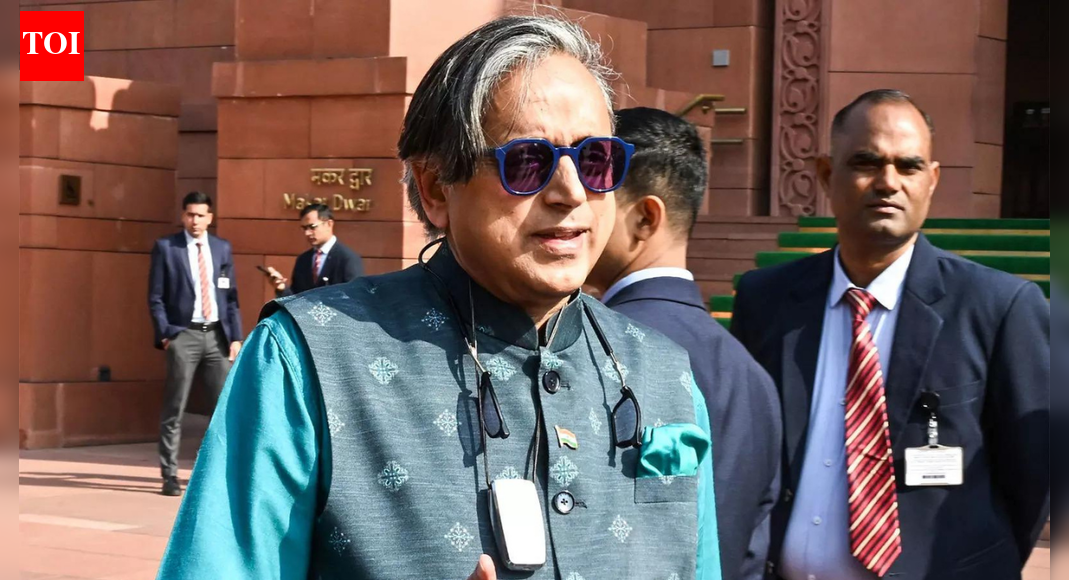
KOTTAYAM: Congress MP Shashi Tharoor welcomed the Kerala local body election results on Saturday, acknowledging the BJP’s historic victory in Thiruvananthapuram city corporation. The counting of votes began at 8am across 244 counting centres under tight security arrangements.

‘Namaste Trump’ Era Is Over As India–US Relations Turn Fragile Over Tariffs, Says Jairam Ramesh

The latest trends released by the State Election Commission show UDF leading in 3155 wards, while the Left Democratic Front is ahead in 2565 wards. The NDA, led by the BJP, is leading in 577 wards, with others leading in 532 wards.“What a day of amazing results in the Kerala local self-government elections! The mandate is clear, and the democratic spirit of the state shines through,” Shashi Tharoor wrote on X.“A huge congratulations to UDF Kerala for a truly impressive win across various local bodies! This is a massive endorsement and a powerful signal ahead of the state legislative elections. Hard work, a strong message and anti-incumbency have all clearly paid off to achieve a much better result than in 2020.” he added.He wrote, “I also want to acknowledge the historic performance of the BJP in Thiruvananthapuram, and offer humble congratulations on their significant victory in the city Corporation — a strong showing that marks a notable shift in the capital’s political landscape. I campaigned for a change from 45 years of LDF misrule, but the voters have ultimately rewarded another party that also sought a clear change in governance.”He added, “That is the beauty of democracy. The people’s verdict must be respected, whether for the UDF overall or for the BJP in my constituency.”Tharoor attributed the UDF’s impressive showing to hard work, a strong political message, and anti-incumbency sentiment, noting significant improvement from their 2020 local body poll performance.The Congress MP also recognised the BJP’s breakthrough in the state capital, congratulating them on their significant victory in the Thiruvananthapuram city corporation. He mentioned that while he had campaigned for change from LDF rule, voters chose a different alternative for governance change.UDF party workers gathered outside Maharaja’s College in Kochi, one of the key counting centres in Ernakulam district, celebrating with slogans of “UDF Zindabad,” waving party flags, and dancing to drumbeats.The latest figures indicate a considerable advantage for the UDF compared to earlier trends, particularly in urban and semi-urban areas.


Source link

“Sanju Samson at No. 3”: Robin Uthappa picks India’s playing XI for the 3rd T20I against South Africa


Former India cricketer Robin Uthappa has proposed a tactical tweak to India’s playing XI ahead of the third T20I against South Africa, calling for a change that could reshape the middle order. With the five-match series delicately poised, Uthappa believes India can gain a decisive edge by promoting a star batter to No. 3 while keeping their opening combination intact. The third T20I is scheduled to be played at Dharamsala on Sunday, December 14.

Robin Uthappa advocates of including Sanju Samson in the playing XI

Speaking on Star Sports’ show Follow the Blues, Uthappa opined that India should look beyond continuity and instead focus on maximising batting impact. He suggested that Sanju Samson should replace Jitesh Sharma in the XI and bat at No. 3, a move that would push Suryakumar Yadav and Tilak Varma one position down the order.

According to Uthappa, Samson’s ability to handle pace and spin alike makes him an ideal candidate to control the innings during the powerplay extension and early middle overs. He stressed that such a move could help India dictate terms rather than react to match situations.

Despite recommending a bold change in the middle order, Uthappa was clear about retaining the opening pair. He backed Shubman Gill and Abhishek Sharma to continue at the top, citing their complementary styles and potential to provide brisk starts.

“I would like to see Shubman and Abhishek Sharma opening the batting. Complete left field here, Sanju Samson at No. 3, Suryakumar Yadav at No. 4 and Tilak Varma at No. 5, and then so on and so forth,” said Uthappa.

Also READ: David Willey drops a truth bomb on why veteran overseas players are shifting from IPL to PSL

Depth and balance still intact in Uthappa’s XI

One of the major talking points around any reshuffle is whether it disrupts team balance. However, Uthappa dismissed those concerns, pointing out that India would still boast formidable depth in both batting and bowling.

With Hardik Pandya, Shivam Dube and Axar Patel to follow in the lower middle order, Uthappa believes India would effectively have eight genuine batting options. At the same time, the bowling attack remains strong with a mix of pace and spin, led by Jasprit Bumrah and Arshdeep Singh, alongside Varun Chakaravarthy.

“You still have Hardik Pandya, Shivam Dube and Axar Patel. So your eight batters are sorted, and you have five bowlers. I would love to see that XI. I think that would be the ideal XI for India,” added Uthappa.

Robin Uthappa’s playing XI of Team India for the third T20I:

Abhishek Sharma, Shubman Gill, Sanju Samson, Suryakumar Yadav, Tilak Varma, Hardik Pandya, Shivam Dube, Axar Patel, Varun Chakaravarthy, Arshdeep Singh, Jasprit Bumrah

Also READ: IND vs SA, 3rd T20I: Dharamsala Pitch Report, HPCA International Stadium Stats and Records


Source link

“CM Rekha Gupta can’t even properly pronounce AQI, let experts tackle pollution”: AAP’s Saurabh Bharadwaj | India News


'CM Rekha Gupta can't even properly pronounce AQI, let experts tackle pollution': AAP's Saurabh Bharadwaj

NEW DELHI: Aam Aadmi Party (AAP) Delhi unit President Saurabh Bharadwaj on Sunday criticised chief minister Rekha Gupta over the worsening air quality in the national capital, stating that she is unaware of the Air Quality Index (AQI) and its parameters, adding that she must leave the pollution problem for the experts to deal with.Speaking to ANI, Bharadwaj said, “This government has been in power for almost a year. Nowhere in this country are there incidents of stubble burning. The condition of pollution is that even inside a closed room, we can see smog. The CM of Delhi doesn’t know what AQI is? She says any instrument can measure AQI. She can’t even properly pronounce AQI. What will the people of Delhi expect from the Chief Minister for the next 4 years?”“I think experts should come in front and the Chief Minister should take a step back,” he added.Residents of Delhi on Sunday expressed deep concern over deteriorating air quality as the city’s AQI surged to 497, remaining in the ‘severe’ category, according to the Central Pollution Control Board (CPCB).Locals reported experiencing breathing difficulties, eye irritation and other health issues due to the worsening pollution levels. Many residents also expressed concern for vulnerable groups, including the elderly and children, who are more susceptible to respiratory problems.Speaking to ANI, Suresh, a resident of Jalgaon, highlighted the importance of clean air for health and well-being.According to CPCB, the AQI, which ranges from 0 to 500, is divided into six categories, each reflecting the level of pollution and associated health risks.As per the AQI categorisation, readings between 0-50 are classified as ‘good’, 51-100 ‘satisfactory’, 101-200 ‘moderate’, 201-300 ‘poor’, 301-400 ‘very poor’, and 401-500 ‘severe’.In response to the severe pollution, the Delhi Government’s Directorate of Education on Saturday directed that schools conduct classes for grades IX and XI in hybrid mode. This decision followed the Commission for Air Quality Management (CAQM) invoking Stage IV of the Graded Response Action Plan (GRAP) as AQI levels approached the ‘severe’ mark.


Source link

D-Street outlook: What could drive the market this upcoming week? Key cues to watch


D-Street outlook: What could drive the market this upcoming week? Key cues to watch

Stock market outlook: The markets this week were driven by macroeconomic pressures and mixed global cues. Domestically, the rupee slid to a fresh record low of 90.56 against the US dollar, dampening risk sentiment. However, some relief came after the US Federal Reserve announced a 25-basis-point rate cut, while optimism over progress in India–US trade talks helped cap further downside.Foreign Institutional Investors (FIIs) continued to trim equity exposure, keeping pressure on benchmarks. However, sustained buying by Domestic Institutional Investors (DIIs) provided partial support. For the week, the Nifty50 fell 139.50 points, or 0.53%, to close at 26,046, while the BSE Sensex declined 445 points to settle at 85,268.Markets saw a mild correction, with the Nifty trading in a downward consolidation phase before ending the week in the red.

Key cues to watch the upcoming week

India–US trade talks: Developments on the India–US trade front will remain in focus and could influence both equities and the rupee.Domestic data: The week ahead features key releases, including Wholesale Price Index (WPI) inflation and trade balance data. Flash readings of the HSBC Composite, Manufacturing and Services PMI will also be tracked for early signals on economic momentum.Currency movement: The rupee remains under pressure due to continued FPI outflows from both bonds and equities. Rising global yields and the unwinding of USD and JPY carry trades are adding stress to Indian bonds.“There are, however, incremental positives around the India–US trade deal, which could provide intermittent relief to the rupee. Overall, we expect a broad trading range of 89.50–91.00 on spot,” said Anindya Banerjee, Head Currency and Commodity at Kotak Securities, as reported by ET.FII-DII activity: Earlier on Friday, FIIs were net sellers to the tune of Rs 396.26 crore, while DIIs remained strong buyers with net inflows of Rs 2,828.21 crore.Technical front: The Nifty has reclaimed its key short-term moving average (20 DEMA) near the 25,950 level. Holding above this zone will be crucial to sustain the recovery and could open the path toward the record high of 26,300, with further upside potential up to 26,550.However, caution remains warranted. “Failure to maintain this support could lead to a retest of the previous swing low near 25,700, followed by the major support around 25,400, which coincides with the 100 DEMA,” said Ajit Mishra, SVP, Research at Religare Broking.He advised investors to remain selective, sating that, “participants should stay selective and maintain a balanced approach amid ongoing currency volatility and mixed global cues. Besides, traders should avoid chasing stocks facing negative news flow in anticipation of a rebound and wait for clear signs of stability before taking fresh exposure.”Sector-specific cues: The Auto retail activity stayed steady during the week, with November registrations rising 2% year-on-year across passenger vehicles, three-wheelers, commercial vehicles and tractors. Meanwhile, disclosures on public sector banks writing off Rs 6.15 lakh crore of loans over the past five-and-a-half years kept the financial space in focus.Commenting on Friday’s session, Ajit Mishra, said, “Markets extended their rebound on Friday, gaining over 0.5% on the back of favorable global cues. After a gap-up start, the Nifty saw some early volatility, but steady buying in index heavyweights helped the benchmark close near the day’s high at 26,046.95. All key sectors, barring FMCG, contributed to the up move, with metals, realty, and energy leading the gains. The broader indices moved in tandem, rising nearly 1% each and reflecting improved market breadth.”“The positive momentum was supported by global sentiment, particularly optimism stemming from the Fed’s recent rate-cut stance, which boosted risk appetite across equities. Domestic flows also remained healthy, with sustained retail and mutual fund buying, supported by stable macro indicators and improved liquidity conditions. However, foreign flows were mixed due to currency volatility and ongoing discussions around US–India trade dynamics.With currency volatility, global cues and key data releases in play, market participants are likely to remain cautious as trading resumes this week.(Disclaimer: Recommendations and views on the stock market, other asset classes or personal finance management tips given by experts are their own. These opinions do not represent the views of The Times of India)


Source link

Access Denied


Access Denied

You don’t have permission to access “http://www.ndtv.com/health/fitness-goals-soha-ali-khan-shows-her-go-to-core-workout-trick-9798643” on this server.

Reference #18.9cf856b8.1765701944.ef1cf23

https://errors.edgesuite.net/18.9cf856b8.1765701944.ef1cf23


Source link

Maharashtra Lok Bhavan tour offers sunrise, secrets and a slice of power | Mumbai News


Morning Tours Of The Former Raj Bhavan Open Doors To Its History

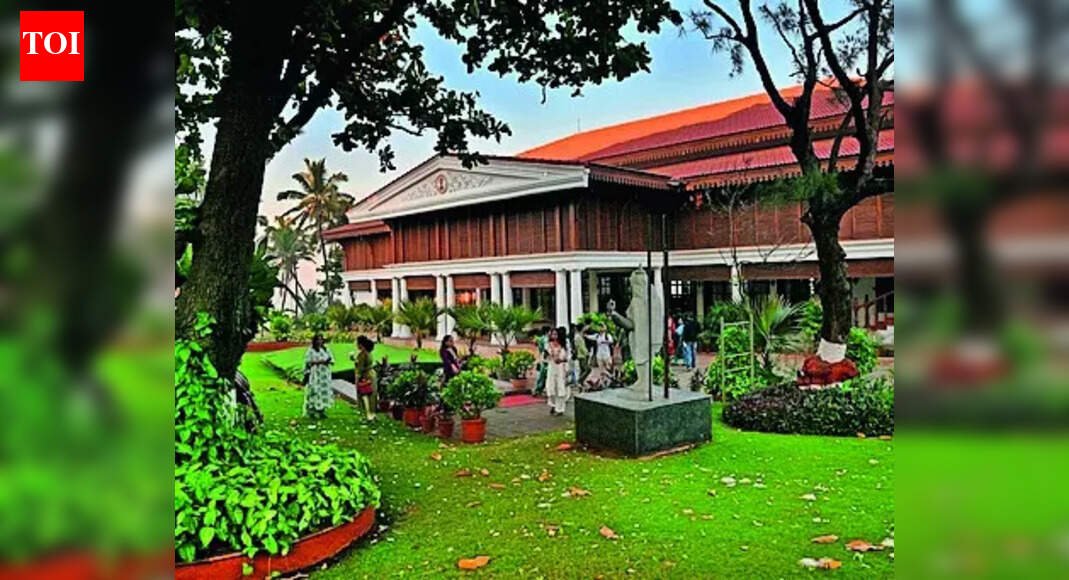
MUMBAI: Enjoying a slight nip in the Dec morning air, around 24 women enter the sprawling, still-sleeping bungalow through a side gate. Gun-toting police personnel ensure that nobody enters without a security check. As the clock strikes 6, Nagesh Rodewad, a staff member in the PRO office doubling up as a guide, meets us near the gate. “Please do not speak loudly as the staff members are still sleeping and use the washroom if you need, as you will not get time to go to the loo for the next one hour,” declares Rodewad as many line up outside the lone loo in the vicinity.We are at the Maharashtra Lok Bhavan, till recently Raj Bhavan, at Malabar Hill, an oasis built by the British as the nucleus of their rule in what was then Bombay Presidency, the residence of British governors and governors of Maharashtra since independence. The noticeable change in the name of the governor’s residence, from Raj Bhavan to Lok Bhavan, is on the massive main gate where it is emblazoned in bold golden letters and the fleet of cars parked under a shade a few minutes’ walk from the incumbent Governor Acharya Devvrat’s two-storey bungalow on the sprawling plot stretching 47 acres.These women, members of a Byculla-based ‘ladies club’ formed by wives of Central Railways’ employees, and three men are tourists visiting this Lok Bhavan. Ever since former president Pranab Mukherjee ordered the opening of the Rashtrapati Bhavan in Delhi and all the governors’ houses in the country to the aam junta in 2015, the Maharashtra Lok Bhavan hosts tourists, not more than 30 a day. The online booking at Rs 150 per tourist is done on the 10th of every month for the following month. “We keep organising picnics and visits for our members. We decided to see this iconic place about which we had only heard of and seen in reels and photographs,” says Kimaya Kamle, a motorman’s wife. “This is such a beautiful place, a gem in the city’s crown.”Its majestic setting on an ancient hill, beautiful sunrise point, British-era heritage buildings, lush, manicured lawns, a garden, a helipad, an ancient temple, and an underground British-era bunker rediscovered in 2016 earn it the nickname of ‘Queen of Lok (Raj) Bhavans’ in India. “For 140 years, since 1885, it was Government House and Governor House and hosted kings and queens, presidents and prime ministers. This is truly an iconic place,” explains Umesh Kashikar, the governor’s PRO.Before Lord Reay moved here as governor of Bombay in 1885, it served as the summer residence of British governors and those representing the East India Company till 1858. Governor Robert Grant called the place hugged by the sea from three sides “perfectly healthy.” We move to Jal Vihar, the 1875-built white banquet hall where the governor hosts dignitaries, most recently PM Narendra Modi and UK PM Keir Starmer. Perhaps the tour’s most exciting moment is below the ancient rocks, on the deck to view the sunrise. With mobile cameras ready, eyes fixed on the eastern horizon glowing in a golden hue, the tourists await the amazing moment. Behold, slowly emerging between the soaring buildings of Air India and Trident Hotel, is the enchantingly beautiful sun, its first rays heralding the day. Three friends, Nilesh Pawar, an IT engineer, and BDS students Shantanu Vichare and Mayur Kale, train their mobile cameras, creating selfies and reels. “We came here because we saw the reels of the sunrise and buildings. We will tell other friends to visit it,” says Pawar.Before the tour ends near the plaque commemorating the declaration of Maharashtra as a state by Jawaharlal Nehru on May 1, 1960, with a brief history of the Lok Bhavan by Kashikar, we are offered tea and coffee with biscuits at the chandelier-adorned majestic Durbar Hall, site of swearing-in ceremonies. They pledge to see it again. 


Source link