Breaking News
Bengaluru airport outrage: Passengers fume as KIA’s compel them to trek 800 meters for cabs; flyers irked by kerbside clampdown | Bengaluru News


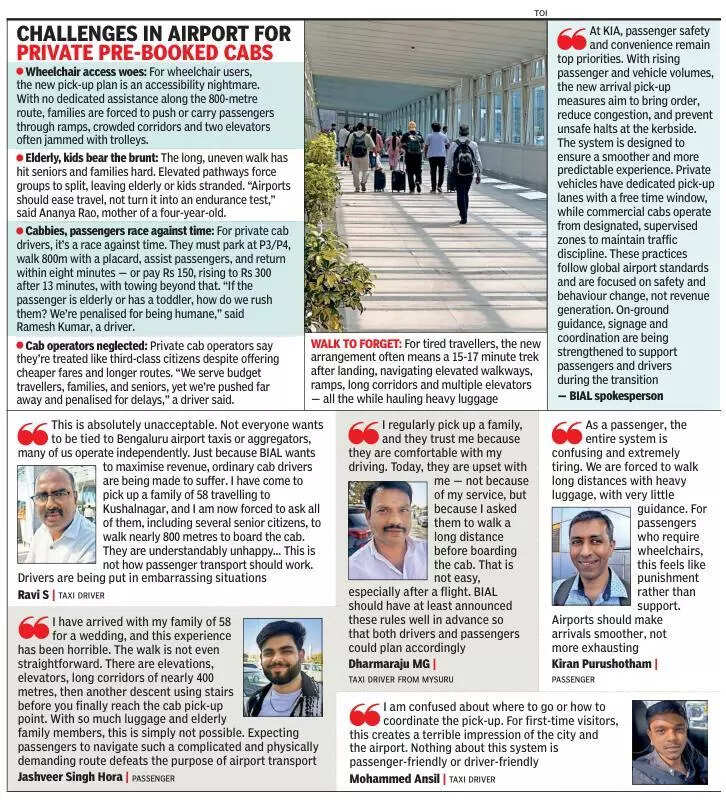
Passengers fume as Bengaluru airport’s new rules compel them to trek 800 metres for cabs

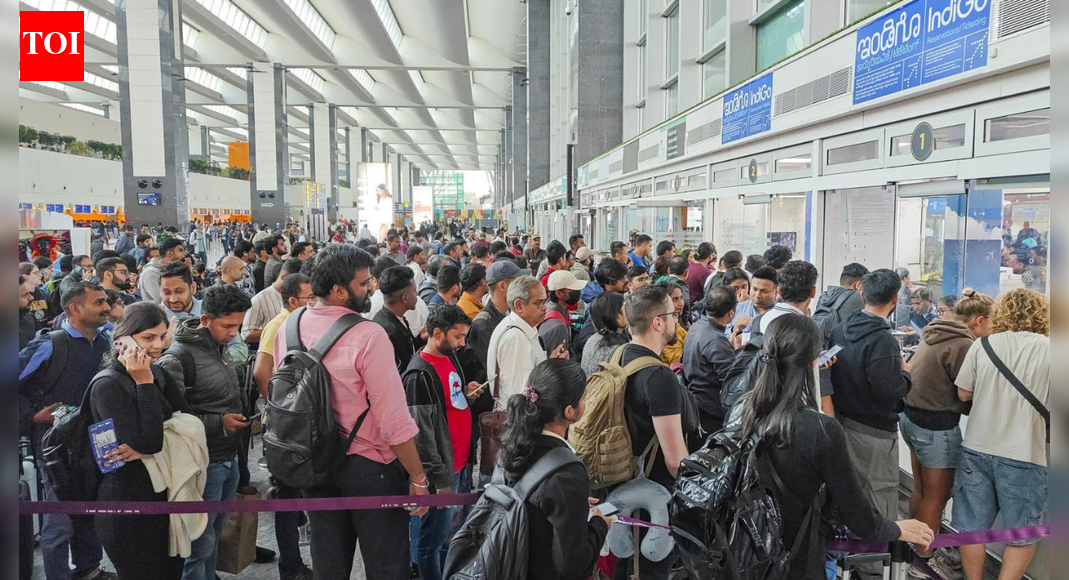
BENGALURU: What feels worse after a long flight — sitting inside the aircraft or walking for nearly 800 metres with luggage to board a private pre-booked cab? For hundreds of passengers arriving at Kempegowda International Airport (KIA) over the past few days, the answer has been unequivocal: the long walk.Bengaluru International Airport Ltd’s newly enforced traffic management and kerbside pick-up policy at Terminal 1 (T1) and Terminal 2 (T2) has triggered widespread frustration among passengers and cab operators alike. Rolled out to curb illegal parking, touting, and congestion outside arrival terminals, the policy allows only airport-authorised aggregator taxis to pick up passengers directly from the kerbside.

‘We Are Growing Rapidly’ Karnataka Minister Links Bengaluru Jams To Rapid City Growth

All other private pre-booked cabs — including long-distance and outstation taxis — have been shifted to designated pickup zones at parking areas P3 and P4, nearly 800 metres from T1. For tired travellers, the new arrangement often means a 15-17 minute trek after landing, navigating elevated walkways, ramps, long corridors, and multiple elevators — all the while hauling heavy luggage. Senior citizens, parents with young children, and families have been hit the hardest, with many describing the change as insensitive and poorly thought out.At T1, arrivals now face a complex lane system: the first lane is reserved for govt vehicles, the second for airport aggregator taxis, the third to fifth lanes for private white-board vehicles, and the remaining lanes for premium app-based services. While passengers opting for airport taxis can step straight into their vehicles, those who have booked private cabs must make the long walk to reach their drivers. At T2, the issue has taken a different form: a strict time window that many say is nearly impossible to meet.
Passengers fume as Bengaluru airport’s new rules compel them to trek 800 metres for cabs

Monday morning saw visible chaos at both terminals, with confused passengers asking for directions, pre-booked private cab drivers arguing with security personnel, and tempers flaring. Several travellers complained that the policy was implemented without adequate public communication or a transition period. “We landed around noon and were suddenly told our cab couldn’t come anywhere near the terminal. My parents are elderly, and my mother has knee problems. Making them walk nearly a kilometre was extremely stressful,” said Rakesh Sharma, a first-time visitor to Bengaluru from Jaipur who had pre-booked a private cab.Another passenger, Anita Fernandez, who arrived from Goa with her two children, said the experience was exhausting. “After paying airport charges and cab fares, you expect some convenience. Instead, we were made to walk endlessly, with hardly any staff to guide us. For families, this is a nightmare,” she said.Cab operators, especially private and outstation drivers, say the policy has directly affected their livelihoods. Many report passengers cancelling bookings midway and switching to airport taxis simply to avoid the walk. “Passengers are angry and take it out on us, but this isn’t our fault,” said Srinath R, a private cab operator who has serviced KIA for over a decade.At T2, commuters say the pressure is even higher. Drivers must pick up passengers within eight minutes to avoid penalties, turning arrivals into a frantic race against time. “After a three-hour flight from Lucknow, I felt like I was in a sprint just to help my driver avoid a fine,” said Mohammed Irfan, adding: “There was no prior information, no clear signage, and no assistance. An airport arrival should be seamless, not stressful.Voices from the ground“This is absolutely unacceptable. Not everyone wants to be tied to Bengaluru airport taxis or aggregators, many of us operate independently. Just because BIAL wants to maximise revenue, ordinary cab drivers are being made to suffer. I have come to pick up a family of 58 travelling to Kushalnagar, and I am now forced to ask all of them, including several senior citizens, to walk nearly 800 metres to board the cab. They are understandably unhappy… This is not how passenger transport should work. Drivers are being put in embarrassing situations.”— Ravi S | Taxi Driver“I regularly pick up a family, and they trust me because they are comfortable with my driving. Today, they are upset with me — not because of my service, but because I asked them to walk a long distance before boarding the cab. That is not easy, especially after a flight. BIAL should have at least announced these rules well in advance so that both drivers and passengers could plan accordingly.”— Dharmaraju MG | Taxi Driver from Mysuru“As a passenger, the entire system is confusing and extremely tiring. We are forced to walk long distances with heavy luggage, with very little guidance. For passengers who require wheelchairs, this feels like punishment rather than support.”— Kiran Purushotham | Passenger“I have arrived with my family of 58 for a wedding, and this experience has been horrible. The walk is not even straightforward. There are elevations, elevators, long corridors of nearly 400 metres, then another descent using stairs before you finally reach the cab pick-up point. With so much luggage and elderly family members, this is simply not possible. Expecting passengers to navigate such a complicated and physically demanding route defeats the purpose of airport transport.— Jashveer Singh Hora | Passenger“I am confused about where to go or how to coordinate the pick-up. For first-time visitors, this creates a terrible impression of the city and the airport. Nothing about this system is passenger-friendly or driver-friendly.”— Mohammed Ansil | Taxi Driver


Source link

Dharavi rehab: ‘Few thousand need to go to transit homes’ | Mumbai News


Mumbai: A few thousand Dharavi residents will need to move to transit or rental accommodation to facilitate the Dharavi redevelopment project (DRP), said Mahendra Kalyankar, Slum Rehabilitation Authority (SRA) CEO and DRP in-charge, contradicting the earlier promise of key-to-key rehab.He said such relocation can’t overshadow the intent of a smooth transition from slum to rehab homes. “Such decisions are part of any large, complex urban regeneration project. Our immediate priority is to open up construction fronts and begin rehab work at the earliest.” SRA/DRP recently issued eviction notices to 42 residents of Meghwadi-Ganesh Nagar in Sector 1 to allow BMC to lay a sewer line. Those eligible for free housing are being offered Rs 18,000 as rent and upper floors residents Rs 15,000. Another 302 Shatabdi Nagar residents have been shifted to Mhada tenements in Sector 5 in Dharavi. Earlier built as permanent housing, these have now been tagged as transit tenements. Activist Raju Korde of Dharavi Bachao Andolan said three years ago, 300 residents were resettled in these flats and the next batch is being given flats in the same building as rental units. “This must serve as a warning to residents.”


Source link

‘The Great Honour Nishan of Ethiopia’: PM Modi conferred country’s highest civilian award in Addis Ababa | India News


‘The Great Honour Nishan of Ethiopia’: PM Modi conferred country’s highest civilian award in Addis Ababa

Prime Minister Narendra Modi was on Tuesday conferred with Ethiopia’s highest civilian honour, The Great Honour Nishan of Ethiopia, during his first bilateral visit to the country.Speaking after receiving the award, PM Modi said it was a matter of pride to be honoured by “a very ancient and prosperous civilisation”. He said he accepted the award on behalf of all Indians and described it as a recognition of the many Indians who have contributed to strengthening India–Ethiopia ties.PM Modi also said, “On this occasion, I also express heartfelt gratitude to my friend PM Abiy Ahmed Ali. Last month, when we met during the G20 Summit in South Africa, with great love and right, you had urged me to visit Ethiopia. How could I have turned down this invitation from my friend, my brother? So, at the first chance, I decided to come to Ethiopia.”During the visit, India and Ethiopia agreed to elevate their relationship to a strategic partnership. PM Modi held delegation-level talks with Ethiopian Prime Minister Abiy Ahmed Ali, where the two leaders discussed a wide range of bilateral and regional issues.“We are elevating India and Ethiopia relations to a strategic partnership. This step will provide new energy, new momentum and new depth to our ties,” Prime Minister Modi said during the delegation-level talks.PM Modi said the talks focused on cooperation in areas including economy, innovation, technology, defence, health, capacity-building and multilateral forums. On Wednesday, PM Modi is scheduled to address a joint session of Ethiopia’s Parliament, where he will speak about India’s democratic journey and the value of the India–Ethiopia partnership for the Global South.PM Modi arrived in Ethiopia from Jordan, where he held talks with King Abdullah II and signed several agreements to boost bilateral cooperation. He will next travel to Oman on the final leg of his three-nation tour.


Source link

IPL 2026 Auction: Full list of unsold players along with their base price


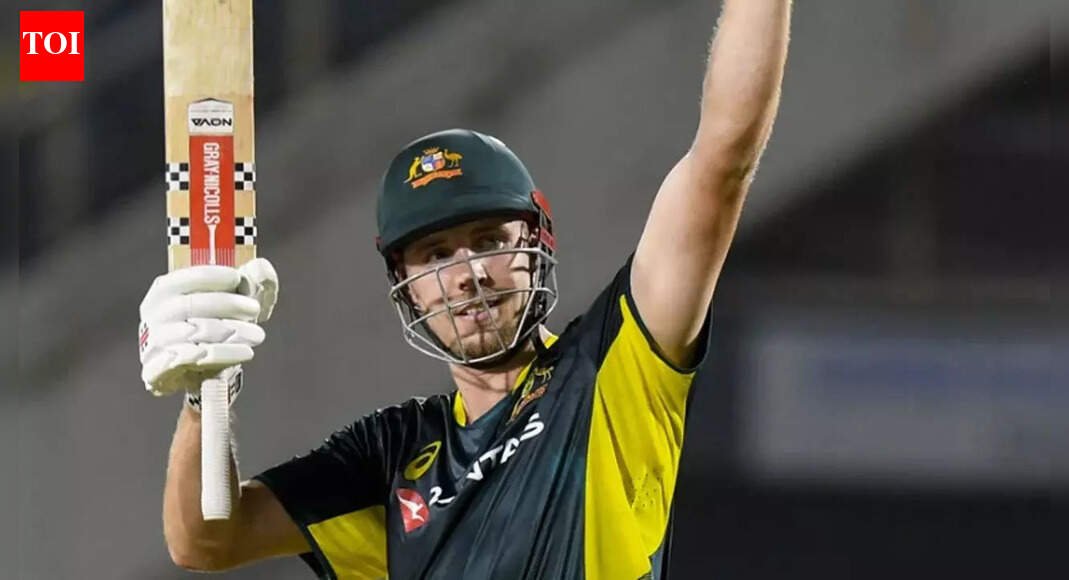
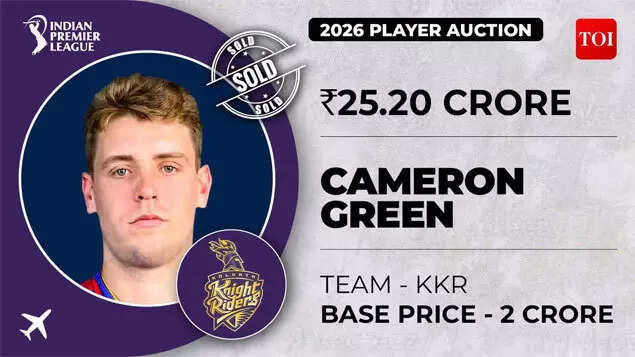
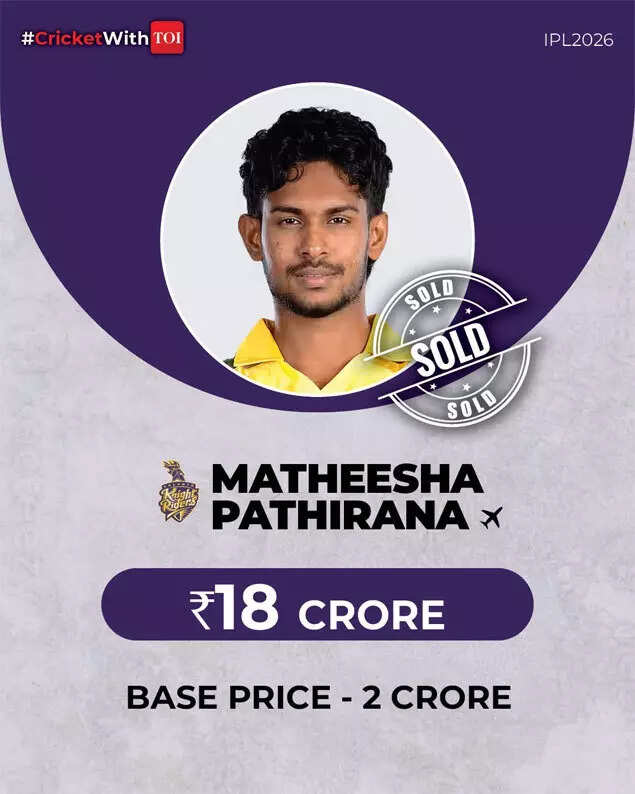
IPL 2026 mini auction unfolded at Etihad Arena in Abu Dhabi on December 16, drawing global attention as franchises vied for 77 slots with a combined purse of ₹237.55 crore. Amid record buys like Cameron Green to KKR for ₹25.20 crore and Matheesha Pathirana to the same team for ₹18 crore, numerous high-profile players failed to attract bids, reshaping narratives around team priorities. This event, featuring 359 shortlisted players from 1390 registrants, highlighted strategic purse management post-retentions, with uncapped Indians stealing the spotlight over veterans.​

Youth takes center stage in IPL 2026 mini auction

Franchises displayed a clear pivot from veteran superstars to young, uncapped Indian talents, reflecting long-term squad-building amid tight budgets. Chennai Super Kings set records by splurging ₹14.20 crore each on uncapped prospects Prashant Veer and Kartik Sharma, the joint-highest for domestics in IPL history, signalling faith in future stars over established names. Teams like KKR and RCB prioritized balanced units with emerging pacers and all-rounders, while Mumbai Indians, with just ₹2.75 crore left, focused on trades like Sherfane Rutherford to bolster depth without heavy auction spends.​

This youth influx aligns with recent trends, where 224 uncapped Indians dominated the pool, outnumbering overseas options and forcing captains to bet on domestic potential for consistency in IPL 2026. Purse leaders like KKR (₹64.3 crore pre-auction) restructured aggressively post release of Venkatesh Iyer, who later fetched only ₹7 crore at RCB, underscoring the devaluation of underperformers.​

Unexpected twist at IPL 2026 mini auction as star players go unsold

The auction delivered jaw-dropping twists, with England‘s Liam Livingstone (₹2 crore base) and Prithvi Shaw (₹75 lakh) among stars who stunned fans by going unsold despite hype. Livingstone, expected as an all-rounder fix, drew zero interest initially, while Shaw’s domestic form failed to sway bidders amid strategic oversights. New Zealand opener Devon Conway (₹2 crore) and Afghan spinner Mujeeb Ur Rahman (₹2 crore) also missed out, echoing past mini-auctions where timing trumped reputation.​

Other surprises included South Africa’s Gerald Coetzee (₹2 crore) and Sri Lanka’s Maheesh Theekshana (₹2 crore), overlooked as teams chased pacers like Anrich Nortje (₹2 crore to LSG). Jake Fraser-McGurk‘s unsold fate at the opener slot amplified the chaos, with franchises citing form dips and role mismatches. These moments, amid bidding wars for Ravi Bishnoi (₹7.20 crore to RR), exposed IPL’s ruthless evolution.​

Also READ: From Cameron Green to Josh Inglis: Top 10 most expensive buys at IPL 2026 Auction

Complete list of unsold players along with their base price in the IPL 2026 mini auction

Batters

  • Jake Fraser-McGurk – ₹2 crore
  • Devon Conway – ₹2 crore
  • Atharva Taide – ₹30 lakh
  • Anmolpreet Singh – ₹30 lakh
  • Abhinav Tejrana – ₹30 lakh
  • Abhinav Manohar – ₹30 lakh
  • Yash Dhull – ₹30 lakh
  • Arya Desai – ₹30 lakh
  • Sediqullah Atal – ₹75 lakh
  • Salman Nizar – ₹30 lakh
  • Dheeraj Kumar – ₹30 lakh
  • Chintal Gandhi – ₹30 lakh
  • Daniel Lategan – ₹30 lakh
  • Manan Vohra – ₹30 lakh
  • Swastik Chikara – ₹30 lakh​

Bowlers

  • Gerald Coetzee – ₹2 crore
  • Spencer Johnson – ₹1.5 crore
  • Fazalhaq Farooqi – ₹1 crore
  • Maheesh Theekshana – ₹2 crore
  • Mujeeb Ur Rahman – ₹2 crore
  • Raj Limbani – ₹30 lakh
  • Simarjeet Singh – ₹30 lakh
  • Akash Madhwal – ₹30 lakh
  • Wahidullah Zadran – ₹30 lakh
  • Shivam Shukla – ₹30 lakh
  • Karn Sharma – ₹50 lakh
  • Kartikeya Singh – ₹30 lakh
  • Chetan Sakariya – ₹75 lakh
  • Waqar Salamkheil – ₹1 crore
  • KM Asif – ₹40 lakh
  • Murugan Ashwin – ₹30 lakh
  • Tejas Baroka – ₹30 lakh
  • KC Cariappa – ₹30 lakh
  • Mohit Rathee – ₹30 lakh
  • Taskin Ahmed – ₹75 lakh
  • Richard Gleeson – ₹75 lakh
  • Alzarri Joseph – ₹2 crore
  • Riley Meredith – ₹1.5 crore
  • Jhye Richardson – ₹1.5 crore
  • Irfan Umair – ₹30 lakh
  • Mayank Dagar – ₹30 lakh
  • Jikku Bright – ₹30 lakh
  • Izaz Sawariya – ₹30 lakh
  • Money Grewal – ₹30 lakh
  • RS Ambrish – ₹30 lakh​

All-rounders

  • Gus Atkinson – ₹2 crore
  • Wiaan Mulder – ₹1 crore
  • Deepak Hooda – ₹75 lakh
  • Vijay Shankar – ₹30 lakh
  • Rajvardhan Hangargekar – ₹40 lakh
  • Mahipal Lomror – ₹50 lakh
  • Eden Tom – ₹30 lakh
  • Tanush Kotian – ₹30 lakh
  • Kamlesh Nagarkoti – ₹30 lakh
  • Sanvir Singh – ₹30 lakh
  • Sean Abbott – ₹2 crore
  • Michael Bracewell – ₹2 crore
  • Daryl Mitchell – ₹2 crore
  • Dasun Shanaka – ₹75 lakh
  • Dan Lawrence – ₹2 crore
  • Tanay Thyagarajan – ₹30 lakh
  • Nathan Smith – ₹75 lakh
  • Karan Lal – ₹30 lakh
  • Utkarsh Singh – ₹30 lakh
  • Ayush Vartak – ₹30 lakh
  • Manisankar Murasingh – ₹30 lakh
  • Macneil Noronha – ₹30 lakh
  • Siddharth Yadav – ₹30 lakh
  • Ritik Tada – ₹30 lakh
  • Chama Milind – ₹30 lakh
  • William Sutherland – ₹1 crore​

Wicketkeepers

  • KS Bharat – ₹75 lakh
  • Rahmanullah Gurbaz – ₹1.5 crore
  • Jonny Bairstow – ₹1 crore
  • Jamie Smith – ₹2 crore
  • Ruchit Ahir – ₹30 lakh
  • Vansh Bedi – ₹30 lakh
  • Tushar Raheja – ₹30 lakh
  • Connor Esterhuizen – ₹30 lakh

Also READ: IPL 2026 Auction: Fans erupt as CSK signs Prashant Veer and Kartik Sharma at record prices; making them joint most expensive uncapped players


Source link

NPS rules changed! Non-government subscribers can withdraw 80% of corpus from National Pension Scheme — new rules explained


NPS rules changed! Non-government subscribers can withdraw 80% of corpus from National Pension Scheme — new rules explained

In a significant overhaul of retirement withdrawal norms, exiting the National Pension System (NPS) has become more flexible for non-government subscribers. Under amended rules notified by the Pension Fund Regulatory and Development Authority (PFRDA), eligible NPS members can now withdraw up to 80 per cent of their retirement corpus as a lump sum at the time of exit, reported Economic Times.The revised rules apply to subscribers under the All Citizen Model and Corporate NPS, bringing major relief to non-government sector employees who were earlier required to allocate a larger share of their savings to annuity purchases.

Mandatory annuity requirement cut to 20 per cent

As per the amended PFRDA (Exits and Withdrawals under the NPS) Regulations, 2025, notified on December 16, the compulsory annuity purchase requirement for non-government subscribers has been reduced to a minimum of 20 per cent of the accumulated pension wealth in specified cases.Annuities provide regular pension income after retirement, while the remaining portion of the corpus can be withdrawn as a lump sum or through systematic unit withdrawal.Earlier, non-government NPS subscribers had to use at least 40 per cent of their retirement corpus to buy an annuity on exit.The revised annuity requirement applies to normal exits at the age of 60, exits after completing the minimum subscription period, and exits between the ages of 60 and 85.For subscribers whose accumulated pension wealth crosses certain monetary thresholds, at least 20 per cent of the corpus must be set aside for annuity purchase, while up to 80 per cent becomes available for withdrawal.

How the corpus thresholds work

The amended regulations lay down different withdrawal rules based on the size of the retirement corpus:

  • Accumulated pension wealth up to Rs 8 lakh: Subscribers can withdraw the entire amount as a lump sum. Annuity purchase is optional, up to 20 per cent.
  • Accumulated pension wealth between Rs 8 lakh and Rs 12 lakh: Lump sum withdrawal is capped at Rs 6 lakh, with the balance available for annuity purchase or systematic unit withdrawal over a period of up to six years.
  • Accumulated pension wealth above Rs 12 lakh: At least 20 per cent of the corpus must be used to purchase an annuity, while up to 80 per cent can be withdrawn as a lump sum.

Greater control over retirement savings

By lowering the mandatory annuity component from 40 per cent to 20 per cent, the PFRDA has given non-government NPS subscribers greater control over how they use their retirement savings. The move increases liquidity at exit and allows retirees more flexibility in planning post-retirement income, while still ensuring a minimum assured pension through annuity purchase.


Source link

KKR Squad IPL 2026: Complete Kolkata Knight Riders Team and Full Players List | Cricket News


KKR Squad IPL 2026: Complete Kolkata Knight Riders Team and Full Players List
Cameron Green (AFP Photo)

NEW DELHI: Kolkata Knight Riders made the biggest statement at the IPL players’ auction on Tuesday, shelling out a record Rs 25.20 crore to secure Australian all-rounder Cameron Green and spending another Rs 18 crore to bring in Sri Lankan fast bowler Matheesha Pathirana. In contrast, Indian batters Prithvi Shaw and Sarfaraz Khan failed to attract any bids despite enjoying a strong run of form with the bat.Green’s signing saw him overtake compatriot Mitchell Starc, who was bought for Rs 24.75 crore, to become the most expensive overseas player in IPL auction history. The hefty price tag came after an intense bidding battle between Kolkata Knight Riders and Chennai Super Kings, with KKR eventually prevailing.

IPL Auction: Abhinav Mukund on what could be Mumbai Indians’ approach | EXCLUSIVE

.

KKR also showed interest in retaining Venkatesh Iyer but pulled out of the contest as Royal Challengers Bengaluru stepped in to acquire the India all-rounder for Rs 7 crore.

.

The three-time champions later re-entered the spotlight during the bidding for Pathirana. After Delhi Capitals and Lucknow Super Giants bowed out following a fierce contest, KKR clinched the Sri Lankan pacer, who entered the auction at a base price of Rs 2 crore and went on to become the costliest Sri Lankan ever sold at an IPL auction.Despite the headline figure of Rs 25.20 crore, Green’s take-home pay for the season will be capped at Rs 18 crore (USD 1.9 million), with the remaining amount set to be allocated to the BCCI’s player development programme in accordance with auction rules for overseas players. Pathirana, however, will receive the full sum as his contract falls within the salary cap.Green, who has previously represented Mumbai Indians and Royal Challengers Bengaluru, has featured in 29 IPL matches to date, scoring 707 runs and claiming 16 wickets.

Kolkata Knight Riders Full Team List IPL 2026

Players retained: Ajinkya Rahane, Angkrish Raghuvanshi, Anukul Roy, Harshit Rana, Manish Pandey, Ramandeep Singh, Rinku Singh, Rovman Powell, Sunil Narine, Umran Malik, Vaibhav Arora, Varun ChakravarthyPlayers bought at auction: Cameron Green (Rs 25.20 crore), Finn Allen (Rs 2 crore), Matheesha Pathirana (Rs 18 crore), Tejasvi Singh Dahiya (Rs 3 crore), Kartik Tyagi (Rs 30 lakh), Prashant Solanki (Rs 30 lakh), Tim Seifert (Rs. 1.50 crore), Mustafizur Rahman (Rs 9.20 crore), Daksh Kamra (Rs 30 lakh), Sarthak Ranjan (Rs 30 lakh), Rahul Tripathi (Rs 75 lakh), Akash Deep (Rs 1 crore), Rachin Ravindra (Rs 2 crore)Full squad:Kolkata Knight Riders: Ajinkya Rahane, Angkrish Raghuvanshi, Anukul Roy, Harshit Rana, Manish Pandey, Ramandeep Singh, Rinku Singh, Rovman Powell, Sunil Narine, Umran Malik, Vaibhav Arora, Varun Chakaravarthy, Cameron Green, Finn Allen, Matheesha Pathirana, Tejasvi Singh, Kartik Tyagi, Prashant Solanki, Rahul Tripathi, Tim Seifert, Mustafizur Rahman, Sarthak Ranjan, Daksh Kamra, Rachin Ravindra, Akash Deep.


Source link

‘Playing at home again’: Ravi Bishnoi reacts after Rajasthan Royals seal Rs 7.2 crore deal at IPL Auction | Cricket News


'Playing at home again': Ravi Bishnoi reacts after Rajasthan Royals seal Rs 7.2 crore deal at IPL Auction
Ravi Bishnoi (PTI Photo/Shashank Parade)

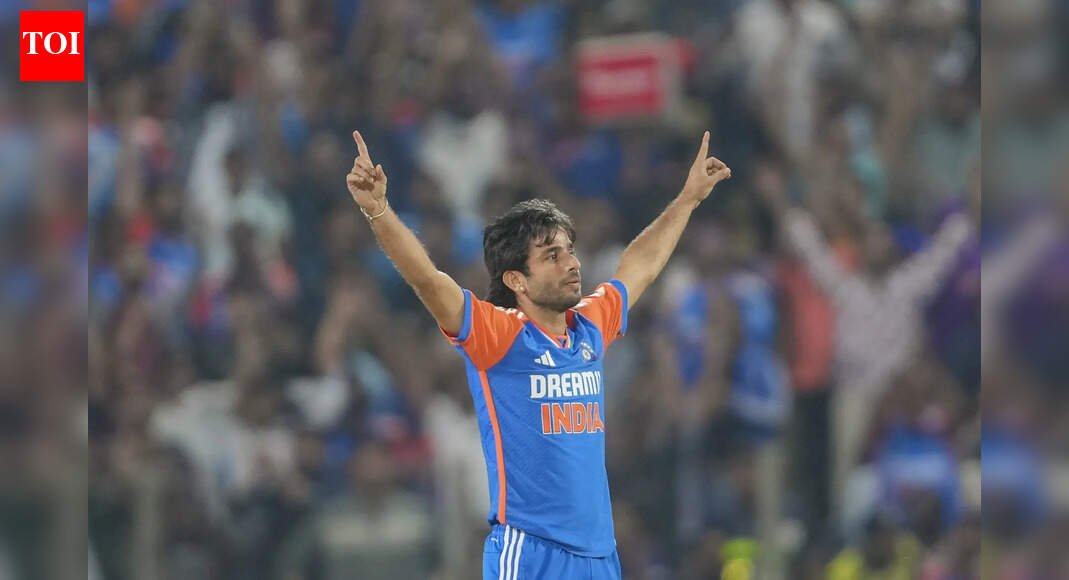
India leg-spinner Ravi Bishnoi described his return to Rajasthan Royals as “like playing at home” after the inaugural champions secured him for Rs 7.2 crore at the IPL 2026 mini-auction in Abu Dhabi on Tuesday. The bidding for the 25-year-old turned intense before the Royals finally had the last word at the Etihad Arena. A native of Jodhpur, Bishnoi’s move to Rajasthan carries strong personal significance. The leg-spinner began his early cricketing journey as a net bowler with the Royals, and returning to the franchise now as a full-fledged IPL player marks a full-circle moment in his career. Speaking after the auction, Bishnoi said representing a team that carries the name of his home state made the opportunity even more special.

IPL Mini Auction: Manoj Badale, Mahela Jayawardena & Mo Bobat Speak After bidding war

Rajasthan Royals lead owner Manoj Badale echoed those sentiments, calling Bishnoi’s signing a homecoming. He described the leg-spinner as a special talent who has long been admired by the Royals’ fanbase, praising his bowling ability, athletic fielding and competitive mindset that aligns with the franchise’s values. Bishnoi entered the auction with a base price of Rs 2 crore, with Rajasthan opening the bidding straight away. Chennai Super Kings soon joined the contest and steadily raised the stakes. After CSK pushed the bid to Rs 4.2 crore, Rajasthan briefly paused before re-entering at Rs 4.4 crore, reigniting the duel. The price climbed to Rs 5.8 crore before the Royals stepped in again at Rs 6 crore, at which point CSK backed out. Just as Rajasthan looked set to seal the deal, Sunrisers Hyderabad entered with a bid of Rs 6.2 crore, forcing another round of competitive bidding that finally ended at Rs 7.2 crore in favour of the Royals. On the field, Bishnoi brings solid recent form and valuable experience. During the 2025–26 Syed Mushtaq Ali Trophy, he picked up nine wickets in seven matches while maintaining an economy rate of 8.40. In the IPL, he has represented Punjab Kings and Lucknow Super Giants, featuring in 77 matches and claiming 72 wickets. Bishnoi was part of the LSG squad in IPL 2025. With his roots in Rajasthan and a growing reputation as a reliable leg-spinner, Bishnoi’s return is expected to add both quality and emotion to the Royals’ bowling attack in the upcoming season.


Source link

‘Gogo paper’ banned: Gujarat bars sale of rolling papers, pre-rolled cones; cites youth addiction | India News


'Gogo paper' banned: Gujarat bars sale of rolling papers, pre-rolled cones; cites youth addiction

NEW DELHI: Gujarat government on Tuesday imposed an immediate ban on the storage, sale, and distribution of rolling papers and pre-rolled cones, citing health risks, the state home department said.These ultra-thin paper sheets and cones are commonly sold at grocery stores and paan shops across the state. They are mainly used by tobacco smokers to roll cigarettes by filling raw tobacco inside.According to a notification issued by the home department, local media outlets and social organisations had raised concerns that these rolling papers, commonly known as “Gogo paper”, were also being used by youths and teenagers to smoke narcotic substances such as weed and charas.The notification said the rolling papers, which are sold in packets, contain harmful substances. These include titanium oxide, potassium nitrate, artificial dye, calcium carbonate, and chlorine bleach.Despite the harmful effects, the products were easily available at paan parlours and grocery shops, leading to the spread of addiction among young people, the notification said.The home department stated that the ban has come into force with immediate effect. Anyone found violating the order will be booked under section 223 of the Bharatiya Nyaya Sanhita, which deals with disobedience of government orders.


Source link

Bondi beach attack: Suspect Sajid Akram’s Hyderabad roots traced; cops rule out radicalisation in India


Sajid Akram, 50, and his 24-year-old son Naveed Akram, accused of killing 15 people in Sydney’s famed Bondi Beach, visited the Philippines last month, Philippine immigration authorities said.Sajid Akram, one of the suspects in the recent mass shooting at Bondi Beach in Australia, is a native of Hyderabad, the Telangana Police told PTI on Tuesday.According to a statement from the office of the Telangana Director General of Police, Akram migrated to Australia 27 years ago and maintained only limited contact with his family in Hyderabad.The police said the factors that led to the radicalisation of Sajid Akram and his son, Naveed Akram, appear to have no links to India or any local influence in Telangana.Akram completed his B.Com degree in Hyderabad before moving to Australia in November 1998 in search of employment, the statement added.

Sydney Attacker IDENTIFIED As Naveed Akram; 12 KILLED, 25+ Injured; PM Albanese, Israel OUTRAGED

Philippine authorities have said they are investigating the matter.

IES, ISIS-linked flags found in suspect’s vehicle

NSW said a vehicle, registered to the younger suspect, contained improvised explosive devices as well as two homemade flags linked to ISIS, a militant group designated as a terrorist organisation by Australia and several other countries.Earlier, ABC News, citing security sources, reported that the gunmen had travelled to the Philippines in the month prior to the Bondi Beach shooting, allegedly to undergo “military-style training.”“I can confirm that they did travel to the Philippines. The reasons why they went to the Philippines and the purpose of that and where they went when they were there is under investigation at the moment,” NSW police commissioner Mal Lanyon said.Police said the suspects had told family members they were going on a weekend fishing trip but were instead staying at a short-term rental in Campsie, where they were allegedly planning the attack. Counterterrorism officers later searched the property and recovered two firearms as part of the ongoing investigation, as cited by the Sydney Morning Herald.Lanyon said there was no indication that any security alert had been triggered when the pair travelled to the Philippines.“I don’t believe it was an intelligence failure at all,” he said.Authorities said the attack was intended to sow panic among the nation’s Jews, though they have so far provided few details about the gunmen’s underlying motivations.

Radicalised by ideology of hate, says Albanese

Prime Minister Anthony Albanese offered one of the first indications on Tuesday that the pair had been radicalised by an “ideology of hate.”“It would appear that this was motivated by Islamic State ideology,” Albanese was quoted as saying by ABC News.Also read: What we know about the shooters of Bondi beach attack – one killed, another critical“With the rise of ISIS more than a decade ago now, the world has been grappling with extremism and this hateful ideology,” he added.Albanese said Naveed Akram, described in local media as an unemployed bricklayer, had come to the attention of Australia’s intelligence agency in 2019, but was not assessed as posing an imminent threat at the time.“They interviewed him, they interviewed his family members, they interviewed people around him. He was not seen at that time to be a person of interest,” Albanese said. Sajid, who arrived in Australia on a student visa in 1998 and later held a resident return visa, was shot dead at the scene. Lanyon said he was a fruiterer who held a firearms licence for recreational hunting, legally owned six guns, several of which were taken to Bondi, and was a member of a gun club.Fifteen people were killed when the two gunmen targeted Jewish attendees at a Hanukkah event, including a 10-year-old girl, a British-born rabbi, a retired police officer, and a Holocaust survivor. Twenty-five others remain hospitalised, with six in critical condition.Bondi Beach and the surrounding area remained an active crime scene on Tuesday, with forensic and ballistic investigations still underway, Lanyon said at a news conference Tuesday afternoon.He added that the area is expected to reopen to the public by Wednesday afternoon, as cited by CNN.


Source link

Wisdom beyond markets: What is Warren Buffett’s success mantra & how to recreate it?


Wisdom beyond markets: What is Warren Buffett’s success mantra & how to recreate it?

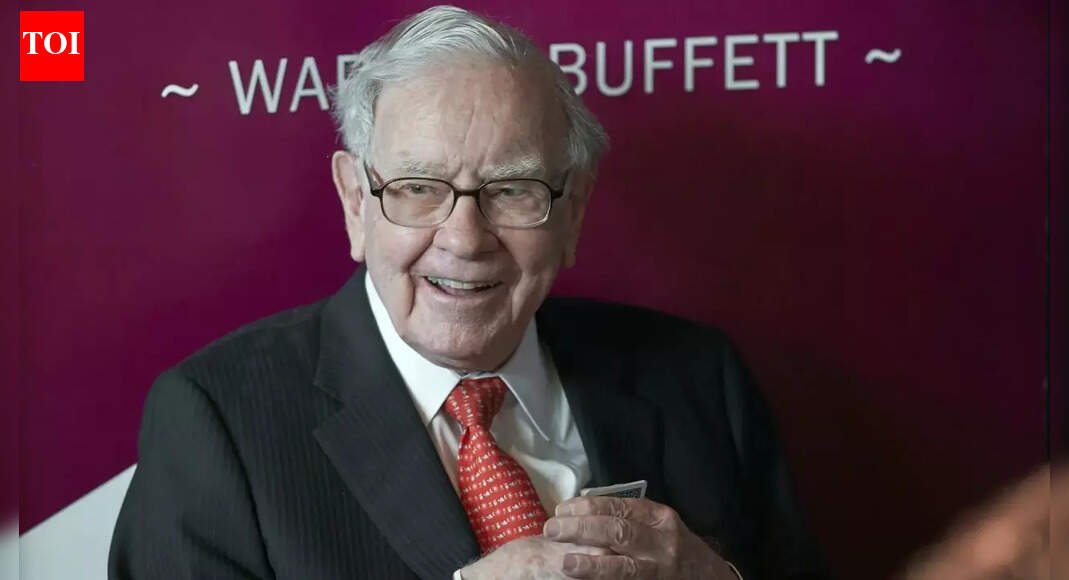
Warren Buffett’s lessons don’t just extend to markets and investment – they are often regarded as pearls of wisdom for dealing with life’s ups and downs. (AP file photo)

Warren Buffett is known for many things – he is one of the richest persons in the world, a master of investment, the ‘Oracle of Omaha’, Zen master and more. When it comes to business acumen and mastering the stock markets, Buffett’s mantras are cited as near-gospel by investors.As the 95-year-old approaches his retirement as Berkshire Hathaway’s CEO later this year, his remarkable investment acumen has garnered widespread recognition. His achievements have established him amongst history’s most accomplished investors, accumulating wealth estimated at $150 billion.But Buffett’s lessons don’t just extend to markets and investment – they are often regarded as pearls of wisdom for dealing with life’s ups and downs.According to a CNN report, Buffett’s teachings incorporate diverse philosophical traditions, drawing from Zen Buddhism, Confucian thought, Stoic philosophy and New Testament teachings. These principles provide guidance for navigating both financial markets and personal difficulties.

Warren Buffett’s Zen-like principles

Although not religious himself, Buffett’s career reflects substantial engagement with spiritual principles. Religious scholars and practitioners studying Buffett’s approach recognise him not only as a business leader but also as someone who embodies Zen-like wisdom in his methods and teachings, says CNN.Warren Buffett’s spiritual influence has extended globally over the years. His followers attend Berkshire Hathaway shareholder meetings to see the individual whom a financial expert described as “the God of investing.”Buffett himself serves as the primary source of his spiritual wisdom, having developed his own philosophical perspective. Both investors and non-investors study his sayings and teachings, including statements like “Someone is sitting in the shade today because someone planted a tree a long time ago.” He also notes that wealth “lets you be in more interesting environments, but it can’t change how many people love you or how healthy you are.Such philosophical observations from Buffett have led Leo Babauta, who practises Zen Buddhism, to recognise Buffett’s alignment with Zen principles.“He’s one of the richest men in the world, and yet I really don’t feel like he has made that a central part of who he is,” Babauta, author of “The Power of Less: The Fine Art of Limiting Yourself to the Essential…in Business and in Life,” tells CNN.“He’s surrounded by people who are focused on making money, and he sees how people are deluded (by that). That’s one of the central ideas of Zen: We’re all living these illusions of what’s going to make us happy.”In Buffett’s perspective, excellence in investing and personal integrity are inseparable. He suggests that one can always be in a bull market by adhering to three spiritual guidelines, which he articulates in his own words: ‘Envy and greed go hand in hand’The Ten Commandments include the directive against coveting, whilst envy features amongst the seven deadly sins. According to Buffett, amongst the seven deadly sins, envy stands alone as the only one devoid of pleasure. He has said, “Being envious of someone else is pretty stupid. Wishing them badly, or wishing you did as well as they did — all it does is ruin your day. Doesn’t hurt them at all, and there’s zero upside to it. If you’re going to pick a sin, go with something like lust or gluttony. That way at least you’ll have something to remember the weekend for.”This mindset has implications for investment strategies. Babauta’s analysis of Buffett’s investment approach reveals a conservative methodology rooted in Zen principles. Buffett acknowledges his own boundaries, particularly regarding technology investments, due to his limited understanding of the sector.“You would never find him chasing after cryptocurrency or the latest AI thing,” Babauta says according to CNN. “He looks for things that are fundamentally sound and that kind of discipline can only happen if he didn’t need to chase after things because of his contentment. That contentment, in his case, led to a lot of discipline.”‘More blessed to give than to receive’In June 2006, Buffett announced a big philanthropic commitment through a series of letters, pledging most of his wealth to foundations and charitable organisations. This philanthropic spirit continued in his recent shareholder letter, where he discussed plans to accelerate his charitable giving, allocating approximately a billion dollars to four family foundations.According to the CNN report, Buffett exemplifies the New Testament principle of giving over receiving, setting him apart amongst America’s wealthy. This characteristic inspired Robert L. Bloch, whose father established H&R Block, to compile “The Warren Buffett Book of Investing Wisdom: 350 Quotes from the World’s Most Successful Investor”. Speaking to CNN, Bloch identifies Buffett’s gratitude and generosity as essential spiritual values.Buffett demonstrates genuine concern for underprivileged and ordinary citizens, expressing a desire to contribute to society’s welfare, as Bloch notes. “That’s very spiritual. Not many billionaires are like that.”His charitable nature aligns with ancient Greco-Roman Stoic principles. Philosophers like Epictetus and Marcus Aurelius advocated that virtuous living was essential for happiness, whilst viewing material attachments as obstacles to self-control. As documented by Ryan Holiday, author of popular books on Stoicism, Aurelius, whilst serving as Roman emperor, liquidated palace possessions to reduce empire debt and support Roman citizens.According to Bloomberg Opinion columnist Beth Kowitt, Buffett credits his success to luck. “He is very clear that a lot of his success comes from being born a white male American in the year 1930. I think he believes that his wealth is a product of the system. It’s not all. He doesn’t buy into his own hype. And I think that is really different from what we see from a new cohort of Silicon Valley CEOs who seem to feel that they’ve contributed so much more to society than they’ll get back,” she tells Bloomberg. “This is a little bit of the secret of his success. It’s kind of helped him avoid hubris and the mistakes that come with it. And I think, you cannot recreate Warren Buffett’s luck, but you can certainly try to recreate this mentality,” she says.

Keeping the faith

People in the US have faced significant challenges recently. A Politico survey reveals nearly 50% of citizens struggle with essential expenses like food and healthcare. Various polls indicate that over half of Americans believe the country’s peak has passed.Nevertheless, Buffett maintains optimism in America. This optimistic outlook mirrors the Christian virtue of faith, despite his non-religious stance. According to Christianity’s central figure, faith possesses transformative power. Another New Testament author defines it as “confidence in what we hope for and assurance of what we do not see.”Warren Buffett stands as America’s foremost optimist. During challenging economic periods and political turmoil, he has maintained his positive outlook with statements like, “For 240 years, it’s been a terrible mistake to bet against America, and now is no time to start.” And: “We always live in an uncertain world. What is certain is that the United States will go forward over time.”This unwavering confidence motivated Bloch to explore Buffett’s statements in detail.“You got to have faith that it’s going to get better and we will come out of this,” Bloch explains to CNN, referring to the current political and economic climate in the US. “Look at 1776, 1820, and the Great Depression. America just got bigger and better throughout history.”This steadfast belief appears to be the source of Buffett’s consistent positive attitude. His wholesome Midwestern outlook is captured in his retirement letter: “Kindness is costless, but also priceless.”Unlike many billionaires who display domineering attitudes, Buffett maintains courtesy even towards critical voices at shareholder meetings and avoids associations with questionable individuals. As he stated, “You can’t make a good deal with a bad person.”He frequently discusses an unexpected topic in the competitive investment world: love.His perspective on love is clear: “The only way to get love is to be lovable” as money cannot purchase genuine affection. He believes in the reciprocal nature of love, stating, “The more you give love away, the more you get.”This approach, rather than his successful investments in Coca-Cola, Wells Fargo and Kraft Heinz, might be considered his most significant contribution. He has earned widespread respect in America not solely for his financial success but for his consistent consideration of others.His investment in human relationships may prove to be his most valuable achievement.


Source link