Breaking News
Adani eyes 12 more airports, checks into hospitality biz


Adani eyes 12 more airports, checks into hospitality biz

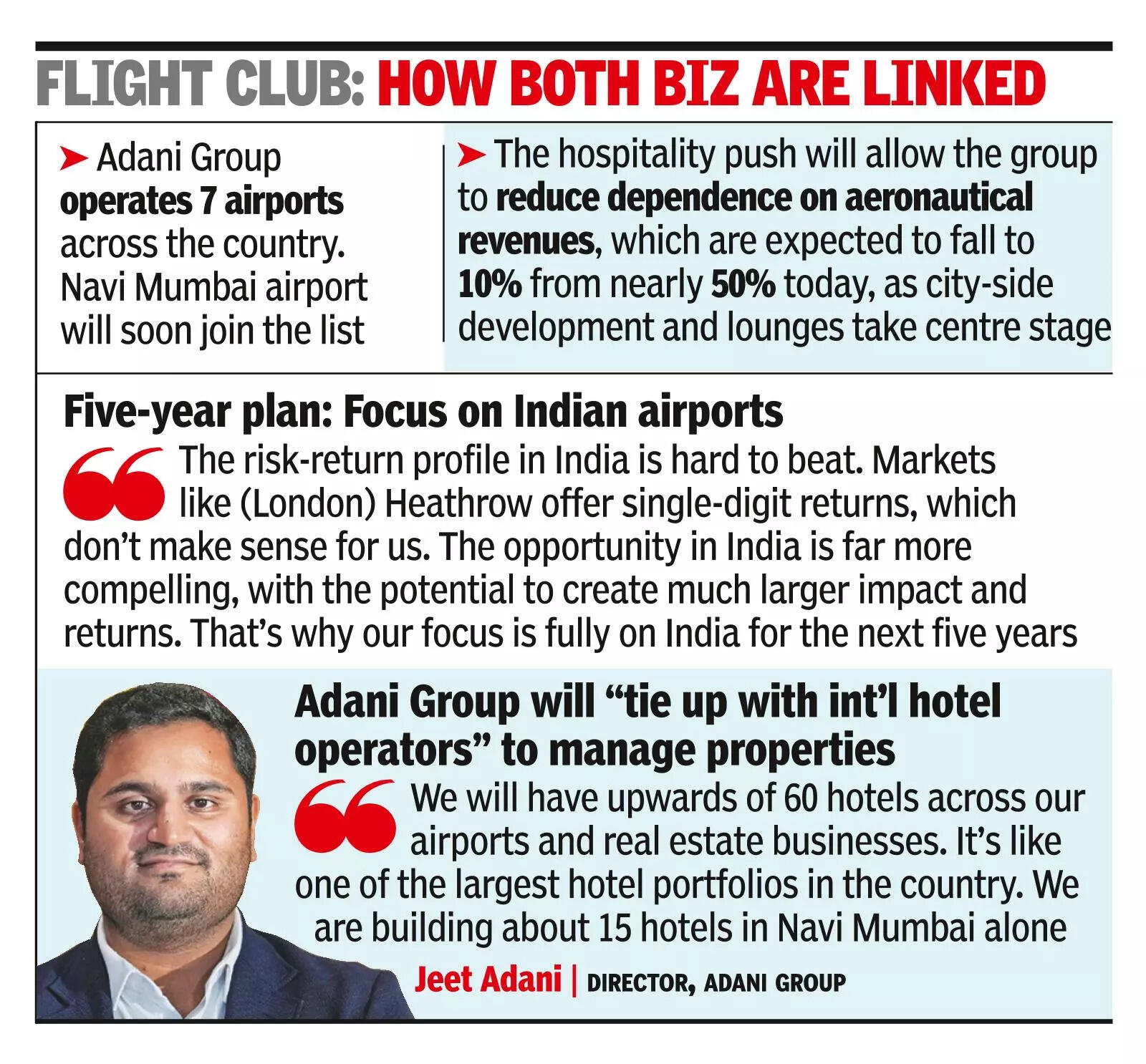
MUMBAI: Adani Group, India’s fifth-largest conglomerate by market value, intends to bid for nearly a dozen airports slated for privatisation as part of its Rs 1-lakh-crore investment plan for aviation infrastructure over the next five years. Earlier this year, govt announced plans to lease out 11 airports, including those in Amritsar and Varanasi.“Out of the Rs 1-lakh-crore, some part is earmarked and provisioned for the next round of airport bidding,” Jeet Adani, director at Adani Group, who oversees the country’s largest private airport network, told TOI. The investment, which will be funded through a mix of debt and equity, will also be deployed to build new terminals and upgrade aircraft-handling facilities and passenger amenities across its airports.
Adani eyes 12 more airports, checks into hospitality biz

The group entered the airport sector in 2019 after winning six airports in govt’s privatisation drive. Two years later, it acquired the Mumbai airport from GVK Group, expanding its footprint. It is set to operationalise the Navi Mumbai airport next week, its first greenfield airport project.Jeet (28), the younger son of group chairman Gautam Adani, is also preparing the airport business for a potential listing by 2030 through a demerger. The group has previously listed businesses such as power transmission and renewable energy through similar demergers, bypassing the traditional IPO route.Before a listing, however, the airport unit must meet key milestones, including turning cash positive. Housed under flagship Adani Enterprises, the unit is ebitda (earnings before interest, taxes, depreciation, and amortisation) positive. In FY25, it made an operating profit of Rs 3,480 crore. “Once the capex cycle slows and revenues start flowing from the Navi Mumbai airport, city side development such as retail, food and beverage, hotels, and from ongoing expansion, the business will become cash positive and will not need support from the parent,” said Jeet.For now, the group’s airport ambitions remain firmly domestic. Jeet said the group will focus on India for five years, following the cancellation of an airport contract in Kenya last year amid criticism over transparency. This story had continued from a page 35 story in the newspaper. For your reading convenience we have added it below.Adani Grp eyes 12 airports in 1L cr infra planThe Adani Group intends to bid for nearly a dozen airports slated for privatisation as part of its Rs 1 lakh-crore investment plan for aviation infrastructure over the next five years, group director Jeet Adani said. Govt announced plans to lease out 11 airports, including those in Amritsar and Varanasi, earlier this year.


Source link

Corp tax kitty surpasses personal I-T collections


Corp tax kitty surpasses personal I-T collections

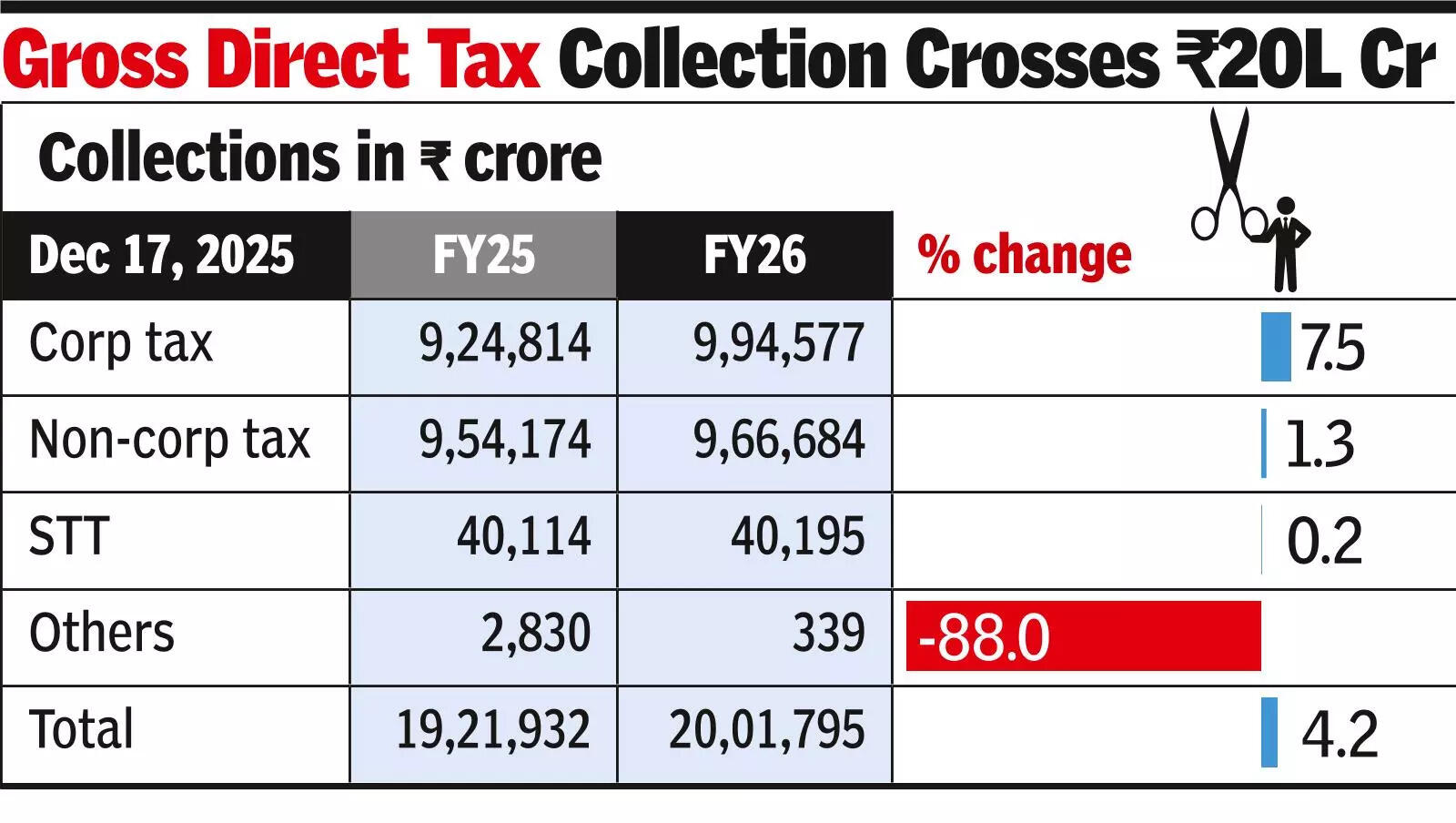
NEW DELHI: Corporation tax collections overtook the non-corporate tax mop-up, which went up 1.3%, pulling down the gross direct tax collections growth to 4.2% till mid-Dec with the overall kitty swelling past the Rs 20 lakh crore mark.Latest data released by the income tax department pegged corporation tax collections up to Dec 17 at Rs 9.94 lakh crore, 7.5% higher than a year ago, while non-corporation tax, which is personal income tax, was 1.3% higher at Rs 9.67 lakh crore.

Corp tax kitty surpasses personal I-T collections

The latest numbers came after the third instalment of advance tax payments, which showed that non-corporate tax payments fell 6.5% to Rs 1.8 lakh crore, while corporation tax was 8% higher at a little under Rs 6.1 lakh crore.“Overall, the corporate advance tax increase signals good corporate earnings. Non-corporate advance tax collections have… declined possibly on the back of rate cuts for individuals given in the previous Budget,” said Rohinton Sidhwa, partner at consulting firm Deloitte India. The bad news is that refunds fell 13.5% to a little under Rs 3 lakh crore, resulting in a 8% rise in net direct tax collections to over Rs 17 lakh crore.“A pickup in refunds would weigh on the growth in net non-corporate tax collections in the remaining part of the fiscal. Overall, ICRA expects a sizeable miss in PIT collections relative to the FY2026 Budget target of Rs 13.6 lakh crore…,” said ICRA chief economist Aditi Nayar.


Source link

Delhi-NCR Pollution: IMD issues orange alert for dense fog; AQI soars to 633, flight operations affected | Delhi News


Delhi-NCR Pollution: IMD issues orange alert for dense fog; AQI soars to 633, flight operations affected

NEW DELHI: Delhi woke up to a dense layer of smog on Saturday, with the India Meteorological Department issuing an orange alert for dense fog on Saturday.

From Work-From-Home To Vehicle Ban- Delhi Rolls Out Fresh Pollution Curbs

Flight operations affectedThe aviation ministry released guidelines for low-visibility procedures, while Delhi Airport advised passengers, “Low-visibility procedures are still in progress at Delhi Airport. All flight operations are functioning normally. Passengers are advised to contact their respective airlines for the latest flight updates.” Air India and IndiGo have also alerted travellers to possible disruptions. Air pollution in the capital has worsened, with the air quality index (AQI) reaching 633 at 7.22am on Saturday, according to AQI.in.Areas including Sarai Kale Khan, Barapullah flyover, Akshardham, and Rao Tularam Marg are reporting hazardous pollution levels. The Central Pollution Control Board (CPCB) recorded AQI readings of 428 at Sarai Kale Khan, 380 at Barapullah flyover, 420 at Akshardham, and 403 at Rao Tularam Marg, placing the air in the ‘Severe’ to ‘Very Poor’ categories. For reference, AQI levels are classified as ‘Good’ (0–50), ‘Satisfactory’ (51–100), ‘Moderate’ (101–200), ‘Poor’ (201–300), ‘Very Poor’ (301–400), and ‘Severe’ (401–500). The Commission for Air Quality Management (CAQM) has activated all measures under GRAP Stage-IV in Delhi-NCR to control pollution and protect public health. Authorities have urged residents to limit outdoor activities, wear masks when venturing outside, and stay updated on airline schedules and local weather alerts.


Source link

Cheaper medicines push: Donald Trump strikes deals with 9 major pharma firms; price cuts to match global benchmarks


Cheaper medicines push: Donald Trump strikes deals with 9 major pharma firms; price cuts to match global benchmarks
US President Donald Trump speaks during an event on prescription drug prices in the Roosevelt Room of the White House in Washington (Picture credit: AP)

US President Donald Trump on Friday announced agreements with nine major pharmaceutical companies to lower prescription drug prices in the United States, marking a significant push to align domestic costs with those paid in other rich countries. The companies include Amgen, Bristol Myers Squibb, Boehringer Ingelheim, Genentech, Gilead Sciences, GSK, Merck, Novartis and Sanofi.Under the deals, the drugmakers will rein in prices for medicines sold through Medicaid, charging rates comparable to what they levy in other wealthy nations. New drugs launched by these companies will also follow “most-favored-nation” pricing across all markets, including commercial insurance, cash-pay customers, Medicare and Medicaid, according to news agency AP.Trump said the agreements would end a system in which US patients paid far more than the rest of the world. “We were subsidising the entire world. We’re not doing it anymore,” he said at a White House press conference, according to Reuters. US prescription drug prices are often nearly three times higher than those in other developed countries.The companies also agreed to list pharmacy-ready medicines on a new direct-to-consumer platform, TrumpRx, set to launch in January, allowing patients to buy drugs directly from manufacturers. As per Reuters, some firms will offer discounts of up to 70% on select medicines, although analysts noted that Medicaid already receives steep rebates.Bristol Myers Squibb said it would provide its blockbuster blood thinner Eliquis free to Medicaid, a move described by health economist William Padula as “a thoughtful health equity move,” as per AP. Several companies also pledged to donate active pharmaceutical ingredients to a national reserve for use during emergencies.Markets reacted positively, with shares of most participating drugmakers rising, Reuters said, as the agreements also grant a three-year exemption from threatened pharmaceutical tariffs in return for commitments to invest in US manufacturing. Trump said he had warned companies of possible tariffs to push them to “do the right thing,” AP reported.According to CNBC, the administration has now secured pricing agreements with 14 of the 17 drugmakers it approached earlier this year, with negotiations continuing with the remaining firms.


Source link

‘I feel distracted when kids play on road’: Ex-gym trainer assaults multiple children in Bengaluru; arrested, released on station bail | Bengaluru News


'I feel distracted when kids play on road': Ex-gym trainer assaults multiple children in Bengaluru; arrested, released on station bail

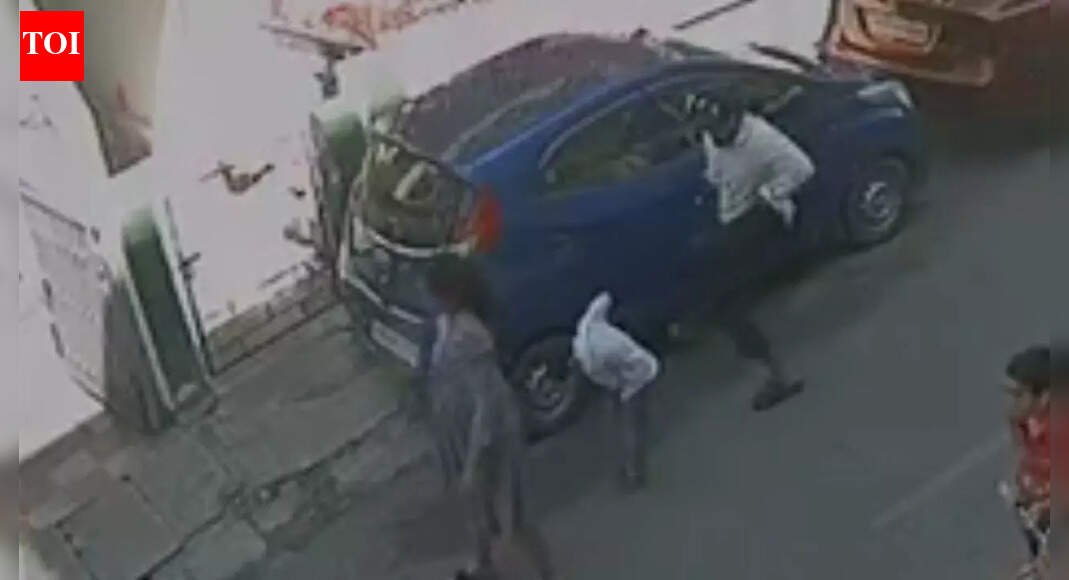
BENGALURU: Parents in Thyagarajanagar claimed that 35-year-old former gym trainer Ranjan M, also known as Ranjith, had recently targeted several children in the locality. According to them, he tried to hit a girl with his bike, pulled the hair of a boy riding a bicycle, and even followed another girl the next day, striking her with his elbow. “We have collected footage and handed it over to the police,” said one parent.The most serious incident occurred on December 14, when a five-year-old boy visiting his maternal uncle’s house in Doddamavalli near Lalbagh was kicked by Ranjan while playing badminton with other children on Old Post Office Road. The boy sustained an injury above his eyebrow along with scratches on his hands and feet and was taken to a hospital for treatment.The child’s mother filed a police complaint the same day, alleging that the assault was intentional. CCTV footage, she said, corroborated the incident.A senior police officer confirmed that Ranjan appears to be mentally unstable and is undergoing psychiatric treatment. “During interrogation, he confessed to having assaulted several children, claiming that he felt distracted and agitated by the children shouting and playing on the road,” the officer said. Ranjan, who is unmarried and resides locally, has no previous criminal record. He was arrested but later released on station bail. His parents have reportedly taken him to Madurai for further treatment. Police said they are continuing to collect his medical records and assessing the situation to prevent further incidents, urging parents to remain vigilant.


Source link

‘First casualty of the fusion wars’: Killing of MIT’s top nuclear scientist Nuno Loureiro sparks online speculation | World News


The killing of Nuno Loureiro, a leading nuclear fusion scientist and director of MIT’s Plasma Science and Fusion Center, has shocked the global scientific community and fuelled a wave of online speculation about possible motives. Loureiro, 47, was shot and killed at his home in Brookline, Massachusetts, on December 15, 2025. Police have confirmed the death as a homicide and say the investigation remains ongoing, with no suspects or motive publicly identified. In the absence of official details, social media has rapidly filled the information vacuum with theories linking his death to the high-stakes global race for fusion energy.

Wave of online speculation after the scientist’s death

Soon after news of Loureiro’s death emerged, social media platforms were flooded with speculative and often contradictory claims attempting to explain the killing in the absence of official details. Some users framed him as the “first casualty of the fusion wars,” arguing that his work on nuclear fusion threatened entrenched energy industries, particularly fossil fuel companies, by accelerating the path toward a cleaner, long-term alternative. Others extended this narrative to include renewable energy sectors, claiming that large-scale fusion could eventually disrupt existing wind and solar investment models. A separate strain of speculation focused on geopolitics. These posts suggested that foreign governments competing in the global race for next-generation energy technologies, including nuclear fusion, may have viewed Loureiro’s research as strategically significant. In these narratives, fusion was portrayed not just as a scientific goal but as a future source of economic and geopolitical power. Some posts went further by alleging state-level interference or industrial espionage. Other viral posts asserted that Loureiro was close to a major scientific breakthrough that could have rapidly accelerated the commercial viability of fusion energy. Authorities have repeatedly stated that there is no evidence at this stage connecting Loureiro’s research, industry interests, or geopolitical competition to his killing. Law enforcement officials have not identified a motive, named suspects, or suggested that his professional work played any role in the homicide. As a result, all such theories remain unverified online speculation rather than conclusions supported by facts.

Why fusion research draws intense attention

Fusion energy is often portrayed as a future solution to climate change and global energy security, offering power without carbon emissions and minimal long-lived radioactive waste. While progress has been significant, experts stress that fusion remains a long-term scientific challenge involving international collaboration across universities, national laboratories and private companies. No single scientist or institution can determine the pace or outcome of fusion development.

Who was Nuno Loureiro

Loureiro was an internationally respected plasma physicist who spent more than a decade at MIT working on some of the most difficult problems in nuclear fusion. As director of the Plasma Science and Fusion Center, he led research into turbulence and magnetic reconnection in plasmas, key challenges for making fusion reactors stable and efficient. Colleagues widely regarded him as a rare combination of deep theoretical thinker and gifted teacher.

What police have said so far

Law enforcement officials have confirmed that Loureiro died from a gunshot wound and that the case is being investigated as a homicide. No arrests have been made, and police have not released details about potential suspects or motives. Investigators have urged caution as the inquiry continues and have warned against drawing conclusions without verified evidence.Beyond the speculation, Loureiro’s death is being mourned as a major loss to science and education. Students and colleagues remember him for his generosity, mentorship and ability to make complex physics accessible. For many young Portuguese scientists, he was a powerful role model who showed that it was possible to rise from familiar classrooms to the forefront of global research.


Source link

Top 5 highest opening partnerships for New Zealand in Tests ft. Devon Conway & Tom Latham


New Zealand‘s opening batters have scripted some monumental stands in Test cricket history, laying foundations for historic victories and drawn battles. The latest entry came on December 18, 2025, when Devon Conway and captain Tom Latham smashed a colossal 323-run partnership against West Indies at Mount Maunganui, propelling New Zealand to 334-1 on day one of the third Test. This effort not only ranks as the second-highest opening stand for the Black Caps but also underscores the modern duo’s dominance, eclipsing several iconic partnerships over 50 years old.​

Top 5 historic opening stands for New Zealand in Test

  1. Terry Jarvis & Glenn Turner – 387 runs vs West Indies, Georgetown, 1972

This remains the gold standard for New Zealand openers, forged during the fourth Test of their gruelling tour of the Caribbean at Bourda, Guyana. West Indies declared at 365/7 after batting first, but Jarvis (182 off 555 balls) and Turner (259 off 759 balls) batted nearly nine hours to surpass that total, erasing the deficit in a match that ended in a draw after just ten wickets fell across five days. The stand, New Zealand’s highest partnership overall at the time, showcased unflinching patience on a wearing pitch, with Turner continuing to 259 as Jarvis anchored solidly against a potent pace attack led by Andy Roberts.​

  1. Devon Conway & Tom Latham – 323 runs vs West Indies, Mount Maunganui, 2025
(Image source: X)

In a clinical display under Bay Oval’s sunny skies, Conway (178*) and Latham (137) dismantled West Indies’ bowless attack on the opening day of the third Test. Latham fell just before stumps to a rash shot, but the pair’s methodical accumulation—blending crisp drives and nurdles—exposed the visitors’ lack of penetration, marking only the eighth 300-plus stand for New Zealand in Tests. As captain, Latham’s composure complemented Conway’s fluency, signalling New Zealand’s intent to dominate the series and cementing their status as the premier opening pair of the modern era.​

Also READ: Fans go gaga as Devon Conway hammers a double century against West Indies on Day 2 of the 3rd Test

  1. Stewie Dempster & Jackie Mills – 276 runs vs England, Wellington, 1930

New Zealand’s second Test ever produced a landmark on a perfect Basin Reserve day, as Dempster (136) and Mills built the then-highest opening stand globally, third overall in Test history. Batting first after winning the toss, they redeemed Kiwi cricket’s reputation against a strong MCC side, with Dempster becoming the first New Zealander to score a Test century in the process. The partnership propelled New Zealand to 385 all out, though England responded stoutly; it stood as the home record for 89 years until recent assaults.​

  1. Tom Latham & Jeet Raval – 254 runs vs Bangladesh, Hamilton, 2019
Top 5 highest Kiwi Test PARTNERSHIP Jeet and Tom
(Image source: X)

During the first Test at Seddon Park, Latham and Jeet Raval ground Bangladesh into submission on a slow pitch, erasing their first-innings lead and pushing New Zealand to 333/2 before Raval departed at 254. Latham (his 264* later in the innings set a personal best) dominated lengths with pulls and drives, while Raval’s resilience—surviving 75 balls for his first runs—frustrated the spinners. This stand, New Zealand’s highest home opening partnership for decades, paved the way for a series-clinching win, highlighting Latham’s consistency as an opener.​​

  1. Mark Richardson & Lou Vincent – 231 runs vs India, Mohali, 2003
Top 5 partnership Kiwi vincent
(Image source: X)

On a flat Punjab Cricket Association Stadium deck, Richardson and Vincent blunted India’s spin-heavy attack in the second Test, punishing loose deliveries to surpass New Zealand’s previous record against India. Their gritty strokeplay amid turning conditions set a platform for Ross Taylor‘s later counterattack, though the match drew. Vincent’s aggression complemented Richardson’s dogged defense, proving Kiwi openers could thrive subcontinentally and holding as a benchmark until Latham-Raval’s exploits.​

These partnerships reflect New Zealand’s evolution from defensive survival to assertive dominance, with Conway-Latham’s fresh exploit breathing new life into the list. As Test cricket adapts to shorter formats’ pressures, such stands remain vital for setting up victories, especially with Black Caps chasing World Test Championship glory.

Also READ: Fans react as Devon Conway and Tom Latham’s triple-century opening stand for New Zealand dismantles West Indies bowling attack on Day 1 of Mount Maunganui Test


Source link

Man kills self in police booth over ‘unlit lamp’ | India News


Man kills self in police booth over 'unlit lamp'

MADURAI: A 40-year-old auto driver allegedly immolated himself inside a police booth in Madurai Thursday in protest over the Thiruparankundram Deepam row. Police said no one was in the booth when Poorna Chandran allegedly doused himself in diesel and set himself ablaze. Cops said Chandran had sent a WhatsApp voice note to his friends and relatives, stating that he took the step since the Karthigai Deepam was not lit at the ‘Deepathoon’. The note went viral on social media. On Thursday night, police had said they were yet to check its veracity.

‘Hindus Are Lathi-Charged’: Anurag Thakur Attacks Tamil Nadu Govt Over Karthigai Deepam Row

On Friday, over 30 Hindu Makkal Katchi members organised a sit-in protest at Govt Rajaji Hospital mortuary, refusing to accept Chandran’s body. It was taken for last rites only after his mother intervened.BJP Tamil Nadu president Nainar Nagenthran, accompanied by state president of Hindu Munnani, Kadeswara Subramaniam and other BJP members, met the family and handed over a cheque of Rs 10 lakh.The BJP chief asked state govt to provide compensation of Rs 1 crore to the family and a job to his wife. He added that all temples in the state must light a ‘moksha deepam’ to mark the death of Chandran. Former TN BJP president K Annamalai had posted about Chandran’s death on Thursday.


Source link

Gajar halwa and gajak on autopilot? It’s time to pause and put heart health back at the centre of winter eating, warns physician


Gajar halwa and gajak on autopilot? It’s time to pause and put heart health back at the centre of winter eating, warns physician

It’s finally that time of the year! Winters in North India come with a distinct mood altogether. The atmosphere is cold, the quilt is all the more cozy, and the food table transforms into a procession of all sorts of delicacies: gajar ka halwa, butter chicken, sizzling pakode, revdi, and gajak. The catch is that while the “pure joy of winters” may unfold with innocence in the mouth, it may become a reality show of sorts in the heart, especially when the mercury goes down, and the blood pressure starts rising naturally.Now, here are the four most loved winter delicacies of all time that are a treat for taste buds but bane for our hearts and arteries. Dr Manan Aggarwal, a respected doctor warns about the dangers of our favourite deserts and crispy delights.

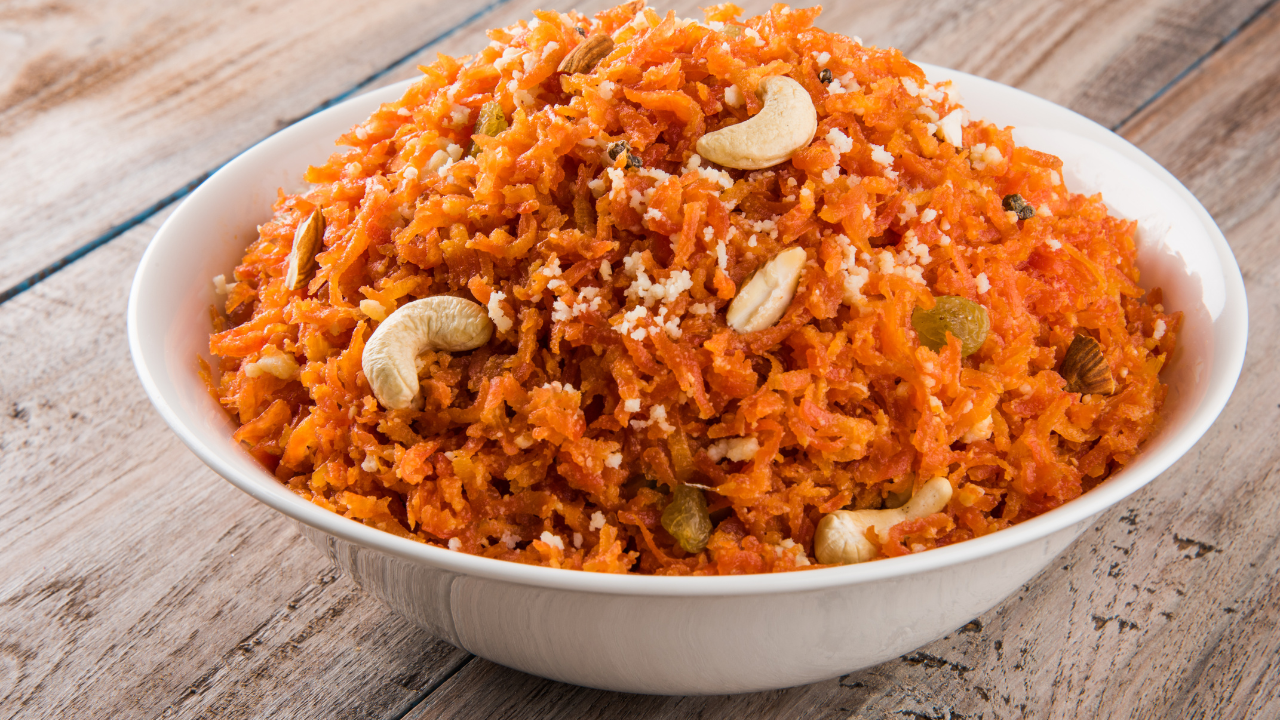
Carrot Halwa: Healthy name, Heavy game

2

The story begins every time with, “its just carrot, it shouldn’t be tha complicated! because carrot is actually the sidekick. The main stars are actually full cream, khoya, ghee, and sugar that transform that innocent-looking dish into a calorie and fat bomb.In fact, since everyone is less active during the winter months and their blood is a bit thicker, this regular indulgence in something like this can cause sugar, triglycerides, and weight to shoot up. Because the heart has to work so much harder to maintain blood flow during a cold climate, this heart, already working overtime, shouldn’t receive a steel bowlful of this on a daily basis.

Butter chicken & rogan josh: Comfort for the tongue, pressure on the arteries

There’s something about a cold night, some hot naan, and an indulgent, creamy gravy that makes everybody feel like they are in heaven! But the same elements that make the gravy so indulgent are what make it so bad for our heart. This cream, this saturated fat, this butter, it all increases the bad cholesterol in the body, fueling the chunks that clog heart vessels that are already narrowed down due to the cold.This doesn’t translate to a life imprisonment diet of boiled food. This is a guideline on how to reserve the rich gravy dishes for the real indulgences and not for every second day. Smaller helpings, lower use of cream, emphasis on tandoori or BBQ meals, and a minimum of fifty percent alongside rotis and sabzi can sustain the taste buds as well as the heart.

Samosa, Kachori, and Pakode: The Crispy treat with a price tag

3

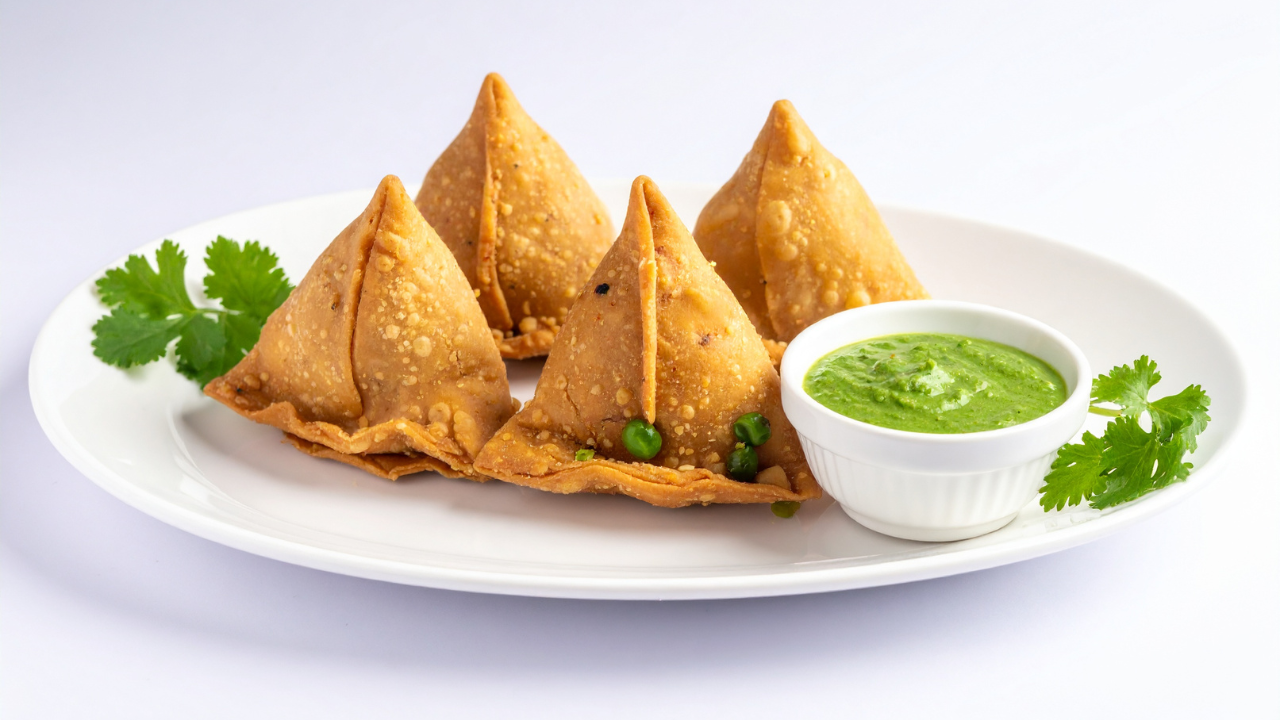
Every chai wala’s table in winter features one common guest – something fried. The initial bite of a hot samosa or pakoda during a foggy night can never be compared to anything else. However, the catch with these delights is that they are often fried with very hot oil, which makes them chock-full of unhealthy fats and oxidants. These unhealthy fats increase LDL levels, which increases inflammation, leading to increased coagulation levels, which can be very harmful as “winter itself” is pushing blood to become thicker and “stickier”.Nor will it be the same when, instead of platefuls of fried snacks for dinner, you get to enjoy them as weekend snacks. Roasted chanas, moderate peanuts, corn chaat, and air-fried snacks can be had on other days.

Revdi and gajak: Big on taste, bad for heart

4

Revdi and gajak are festive, nostalgic, and innocent because they are so small. “Bas do-chaar hi toh liye,” goes the typical remark. But the “two-four” bits are actually sesame or peanuts held together with sugar or jaggery, and lots of added fat too. This translates into a quick burst of calories and sugars with every mouthful. With minimal physical activity and increased sedentary time, such constant snacking silently contributes to increased weight, sugars, and triglycerides – all the wrong signals for the heart.The key is not to banish them, but to ritualize them: perhaps two little pieces after lunch on special days, and not a constant background snack throughout the evening. Keep them stored in a small dabba, and not in an open, overflowing thali that begs to be mindlessly grazed from.


Source link

HC seeks Customs reply on IndiGo duty refund plea


HC seeks Customs reply on IndiGo duty refund plea

NEW DELHI: Delhi HC on Friday sought a response from Customs department on a plea filed by InterGlobe Aviation, the operator of IndiGo airline, seeking a refund of over Rs 900 crore paid as Customs duty on aircraft engines and parts re-imported into India after overseas repairs, reports Abhinav Garg.A bench of Justices V Kameswar Rao and Vinod Kumar issued notice to deputy commissioner (refund) and directed the authorities to file their response within two weeks. The court listed the matter for hearing in April next year.

‘Worst Is Behind Us’: IndiGo CEO Says Airline Back on Track After Operational Crisis

InterGlobe contended that the levy of Customs duty on such re-imports was unconstitutional and amounted to a double levy on the same transaction.Opposing the petition, the counsel for Customs department submitted that it was premature, noting that the issue on which the present claim is based is pending before the Supreme Court.However, counsel for the airline argued that at the time of re-import of aircraft engines and parts after repairs, the company paid basic Customs duty without any dispute. The counsel contended that since the repairs constituted a service, the airline also paid GST on a reverse charge basis. Despite this, Customs authorities insisted on levying duty again by treating the same transaction as an import of goods, the counsel claimed.


Source link