Breaking News
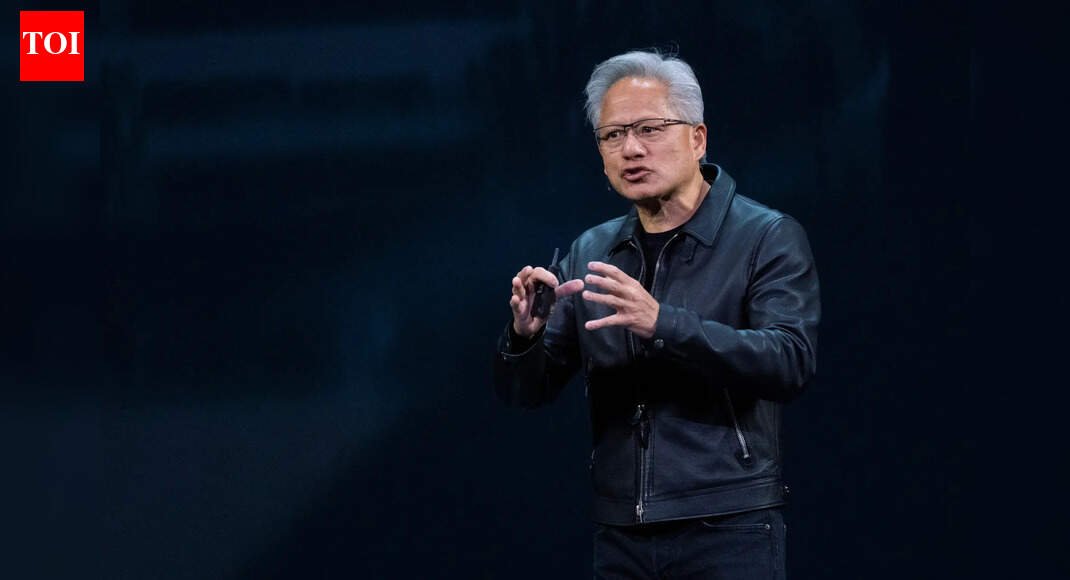
Nvidia CEO Jensen Huang on his ‘warning and clarification’ to Americans that China is winning the AI race: Let me simplify this …


Nvidia CEO Jensen Huang on his 'warning and clarification' to Americans that China is winning the AI race: Let me simplify this ...

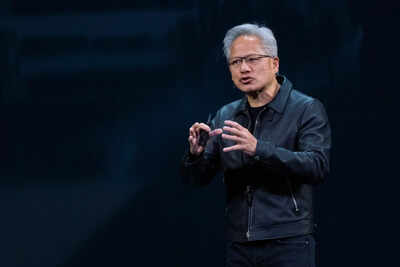
Nvidia CEO Jensen Huang’s recent apparent comment that China is winning the AI race made headlines across America. It went so ‘wild’ that the Nvidia CEO had to issue a clarification. During a fireside chat at the Center for Strategic and International Studies this month, Huang directly spoke about his statement on Chinese AI dominance vs America’s. CSIS President John Hamre asked Huang what he termed “very provocative”: You said something recently that was quite provocative. You said that China was winning the AI race, the AI competition. I know that you’ve got a powerful competitor in Huawei, and Huawei has a lot of advantages you don’t have. Why don’t you describe this competition? Are we really losing?In his reply to Hamre, Huang said, “And it apparently caught a lot of attention. As you know with headlines, the disclaimer part, the foundation part was left out of the headline. But the way to think about that is that let me just handicap it right now. If you look at AI and go back to the first thing that we said, AI is a five layer cake. Let’s just always simplify it. It’s not quite this simplistic, but let’s simplify AI into a five layer cake. Energy, chips, infrastructure, models, and applications. And let’s handicap it from bottom to top. At the lowest level, China has twice the amount of energy we have as a nation.”

China dominance in Energy is one of the ‘deal breakers’

“Twice as much energy as we have as a nation. And our economy’s larger than theirs. Makes no sense to me. We also know that one of the most important initiatives, one of the most important policies of this administration. And there was the first thing that President Trump said to me when we met: “Listen, we need to reindustrialize America. We need to do onshore manufacturing again. We need to help America make things again.” It’s going to create jobs. That part of the economy has been offshore and completely gutted the United States. We need to bring that back and he needs my help to do so. And so, that entire sector of the economy is missing,” Nvidia CEO went on to add. Then Huang added the energy problem that America is facing, where China is miles ahead. While talking about the same Huang did give a compliment to President Trump, saying that he is trying his best to solve the problem. “And however, without energy, how do we build chip plants, computer system plants, and these AI data centers? We call them AI factories. We’re simultaneously building three different types of factories in the United States. Chip factories, super computer factories, and AI factories, they all require energy, every single one of them. And so on, the one hand, we want to reindustrialize the United States. How do you do that without energy? And so, the fact that we vilified energy for so long, President Trump sticking his neck out, and taking it on the chin, and helping the country realize that energy is necessary for our growth, is really one of the greatest things he’s done right off the bat,” Huang said.

America is generations ahead in Chips

He said that while America is 50% of China in energy, the country is generationals ahead in Chips. But at the same time warned that the country cannot afford to be complacent. As semiconductors is a manufacturing process and anybody who thinks China can’t manufacture is missing a big idea. “And so, now at the energy level, back to that stack, we’re 50% and they’re growing straight up. We’re kind of flat right now. And so, number one, energy. Number two, chips. We’re generations ahead. We are generations ahead on chips, and I think everybody recognizes that. Number three, infrastructure. If you want to build a data center here in the United States, from breaking ground to standing up an AI supercomputer is probably about three years. They can build a hospital on a weekend. That’s a real challenge. And so, at the infrastructure layer, their velocity of building things, because they are builders. Their velocity of building things is extraordinarily high. Now, really quickly on chips. We’re several generations ahead, but don’t be complacent. Remember, semiconductors are a manufacturing process. Anybody who thinks China can’t manufacture is missing a big idea,” Hunag said.


Source link

Train travel gets costlier: Indian Railways to earn Rs 600 crore — here is how much your ticket will cost now


Train travel gets costlier: Indian Railways to earn Rs 600 crore — here is how much your ticket will cost now

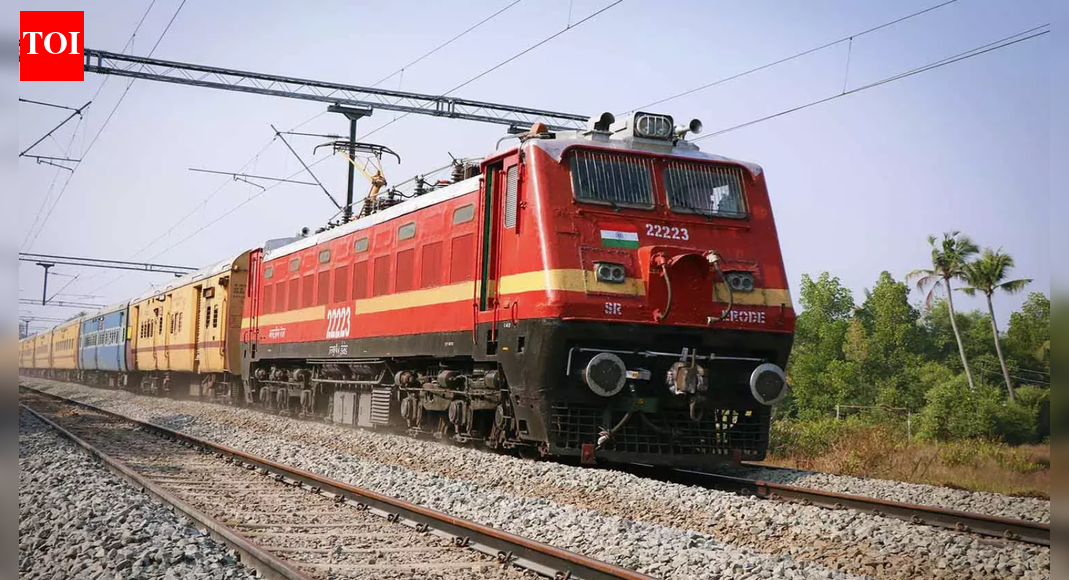
Indian Railways on Sunday announced a revised fare structure for passengers that will come into effect from December 26, as part of a fare rationalisation exercise to address rising operational and manpower costs.According to the Railways, the revised fare structure is expected to earn approximately Rs 600 crore in during the current year.Here’s the new price structure:

  • Passengers travelling up to 215 km in Ordinary Class will continue to pay the existing fares.
  • For longer distances, marginal revisions have been introduced. Ordinary Class passengers travelling beyond 215 km will see fares rise by 1 paise per kilometre.
  • Passengers travelling in non-AC coaches on Mail and Express services will pay 2 paise more per kilometre from December 26. This will translate into an additional Rs 10 for a 500 km journey.
  • Fares for AC class passengers on Mail and Express trains will also increase by 2 paise per kilometre from December 26.
  • Suburban and monthly season tickets will see no price increase.

Why the prices are hiked?

The decision follows a period of rapid expansion in the railways’ network and services over the past decade. With operations scaling up and a stronger focus on safety, manpower requirements have increased significantly. Manpower costs have risen to Rs 1,15,000 crore, while pension expenditure now stands at Rs 60,000 crore. Overall operational expenditure for 2024–25 has reached Rs 2,63,000 crore. To address these financial pressures, the Railways is relying on a combination of higher cargo loading and limited passenger fare rationalisation. Officials said these efforts have contributed to improved safety outcomes and better operational performance. India has now become the second-largest cargo-carrying railway system globally, reflecting the scale of its freight operations. The Railways also highlighted the successful mobilisation of more than 12,000 trains during the recent festival season as an indicator of enhanced efficiency.


Source link

UST–IIT Madras partnership aims to speed up healthcare startup growth | Mumbai News


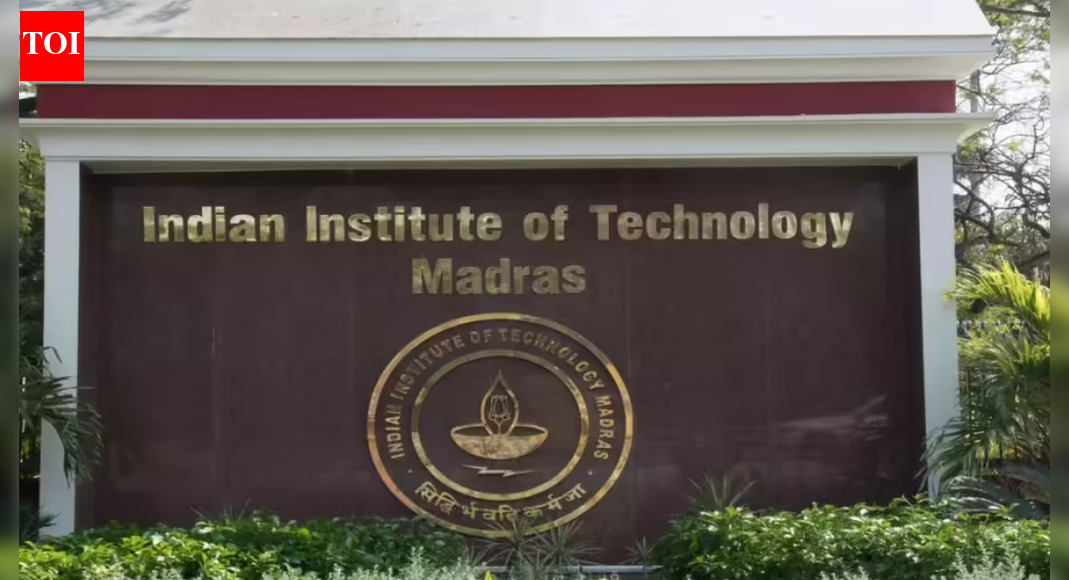
MUMBAI: In a quiet but consequential move that reflects the growing convergence of deep technology, healthcare, and institutional capital, UST has signed a Memorandum of Understanding with the IIT Madras Incubation Cell to accelerate research-driven startups in healthcare and life sciences. The partnership brings together corporate scale and academic depth, signalling a more structured approach to nurturing India’s next wave of high-impact, science-led ventures.Anchored at Indian Institute of Technology Madras, IITMIC has emerged as one of the country’s most active deep-tech startup hubs. The MoU establishes a collaborative framework through which UST and IITMIC will jointly identify high-potential startups, support them with targeted mentorship and conditional funding, and help translate early-stage innovation into pilots, proof-of-concepts, and eventual market-ready solutions. The agreement is designed to be scalable yet flexible, allowing industry needs, research pathways, and startup maturity to align without bureaucratic friction.As a first step, the partners jointly rolled out Pitch to Win: Pharma 4.0, an innovation challenge conducted with Pfizer as Knowledge Partner and Amazon Web Services as Technology Partner. The response was telling: over ninety startup applications poured in from 32 cities across India, underscoring both the geographic spread and growing confidence of India’s healthcare and life sciences startup ecosystem.From this pool, ten finalists were shortlisted and underwent a month-long mentorship programme led by UST, before pitching to a distinguished jury at IITMIC in Chennai. The final outcomes reflected a blend of scientific ambition and commercial promise. Nucleo-Vir Therapeutics emerged as the winner, followed by ChemBioSens as first runner-up and LN Infosphere Tech Transformers as second runner-up. The three startups received cash awards of Rs. 1.25 lakh, Rs. 75,000 and Rs. 50,000 respectively. Beyond this, UST announced total conditional funding support of up to Rs. 45 lakh for the winners, along with go-to-market and strategic advisory support.For UST, the partnership is part of a broader rethinking of how enterprises engage with early-stage innovation. Manu Gopinath, President, UST, described the collaboration as more than a sponsorship exercise. “Our partnership with IIT Madras Incubation Cell is a strategic leap in how we harness deep tech innovation across industries. With IITMIC’s proven incubation ecosystem and access to cutting-edge research, we are not just backing startups; we are nurturing bold founders, accelerating research-driven ideas, and building a strong pipeline of solutions that can transform businesses, communities, and society at large. By combining IITMIC’s cross-domain innovation capabilities with UST’s global reach, industry partnerships, and mentorship, we are creating a scalable platform to bring impactful, next-generation technologies from the lab to the market,” he said.From the incubator’s perspective, the value lies in sustained industry engagement. Dr. Tamaswati Ghosh, Chief Executive Officer, IITMIC, noted, “This collaboration with UST reflects our shared vision to advance India’s deep-tech innovation landscape, particularly in healthcare and life sciences. Through initiatives like Pitch to Win: Pharma 4.0, we’re not only nurturing high-potential startups but also building bridges between academia, industry, and investors to scale impactful solutions that can improve lives globally.Taken together, the partnership points to a maturing innovation ecosystem—one where startups are no longer expected to navigate the long road from lab to market alone, but are supported by structured alliances that combine research credibility, corporate mentorship, and patient capital within India’s evolving Life Sciences 4.0 landscape.


Source link

Plaintiffs in the first lawsuit against the $100K entry-fee for H-1B workers approach court to seek urgent relief


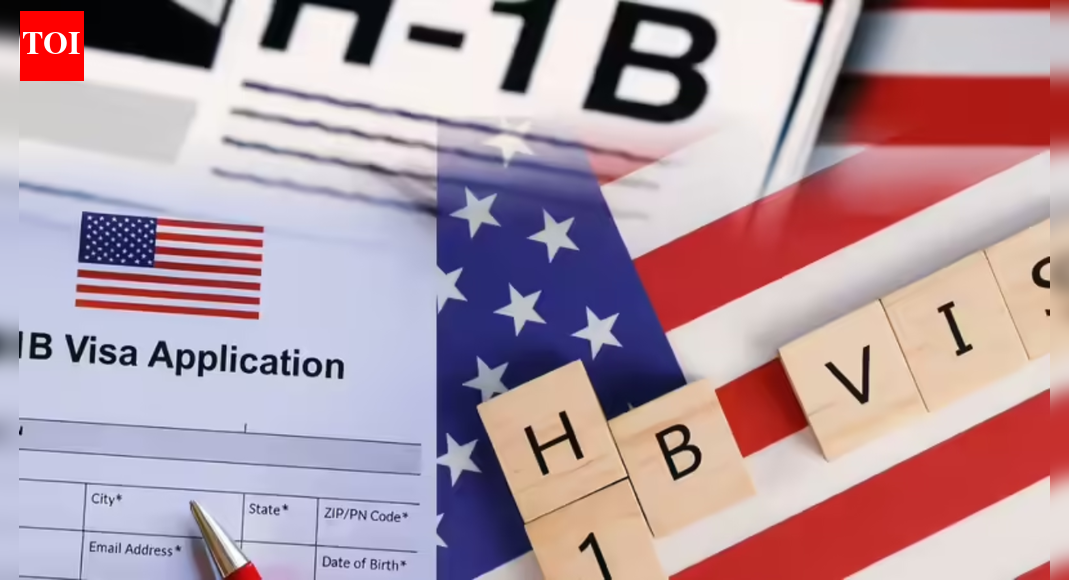
A coalition of US healthcare providers, educational institutions and employers have moved to court seeking urgent relief from the Trump administration’s controversial $100,000 entry-fee for H-1B workers, which was announced on Sept 19, via a proclamation. They have sought an immediate block on its enforcement and nationwide protection for affected employers.In two new filings before the US District Court for the Northern District of California, the plaintiffs have sought a preliminary injunction to pause the fee while the case is heard, and certification of a nationwide class to ensure that any relief granted applies uniformly across the country. The filings argue that the six-figure entry-fee imposed through a presidential proclamation is unlawful, arbitrary and beyond the executive’s authority, and is already disrupting medical care, education and local economies.

Trump’s H-1B Visa Chaos: Jobs At Risk, Families Traumatised As Wait Pushed To Late 2026

The legal challenge follows an earlier lawsuit filed by these plaintiffs on Oct 3 (duly reported by TOI), which questioned the Trump administration’s decision to bypass Congress and impose an unprecedented and unauthorised cost on the H-1B visa programme.Soon after this coalition led by Global Nurse Force filed the lawsuit (it was the first to challenge the entry fee), the Trump administration issued a new guidance seemingly backtracking on one of the proclamations’ most extreme provisions. It now stated that the fee may not apply to certain individuals already in the US who are in the process of changing their immigration status. For instance, the fee would not apply in case of an F-1 student who has transitioned to an H-1B visa ‘while’ in the US. However, the coalition points out that the fee remains in effect in many circumstances, harming students, workers, and employers in America.The new court filings seek to immediately halt enforcement of the fee, which applies to employers hiring doctors, nurses, teachers, engineers, researchers and other highly skilled professionals, regardless of their size or public-service role.The plaintiffs are represented by several advocacy groups, including Democracy Forward and the South Asian American Justice Collaborative (SAAJCO); and IMMpact litigation (a joint venture of four law firms).Kalpana V. Peddibhotla, executive director, SAAJCO, said: “South Asians comprise the majority of H-1B workers and are deeply woven into the US economy. By seeking class certification and a preliminary injunction, we seek to halt the proclamation’s imposition of an unlawful $100,000 H-1B fee and this attack on immigrant workers who make a difference to our day to day lives.” “If upheld, the Proclamation would establish a dangerous precedent by permitting the Executive Branch to impose sweeping financial barriers on lawful immigration programs without congressional authorization,” she added. The challenge mounted by healthcare providers and educational institutions is not the only one confronting the Trump administration’s $100,000 H-1B fee. The US Chamber of Commerce has also filed a separate lawsuit, arguing that the entry fee is unlawful, economically damaging and undermines the statutory H-1B framework enacted by Congress. In a further escalation, a coalition of 20 US states has more recently moved the courts, contending that the proclamation unlawfully shifts immigration policy by executive fiat and harms state economies, public services and employers reliant on skilled foreign workers. Together, the cases signal widening institutional resistance to the fee and raise the prospect of a broader judicial reckoning over the administration’s authority to impose sweeping immigration costs without legislative approval.


Source link

Key reasons why Shubman Gill was dropped from India’s T20 World Cup 2026 squad at the last moment


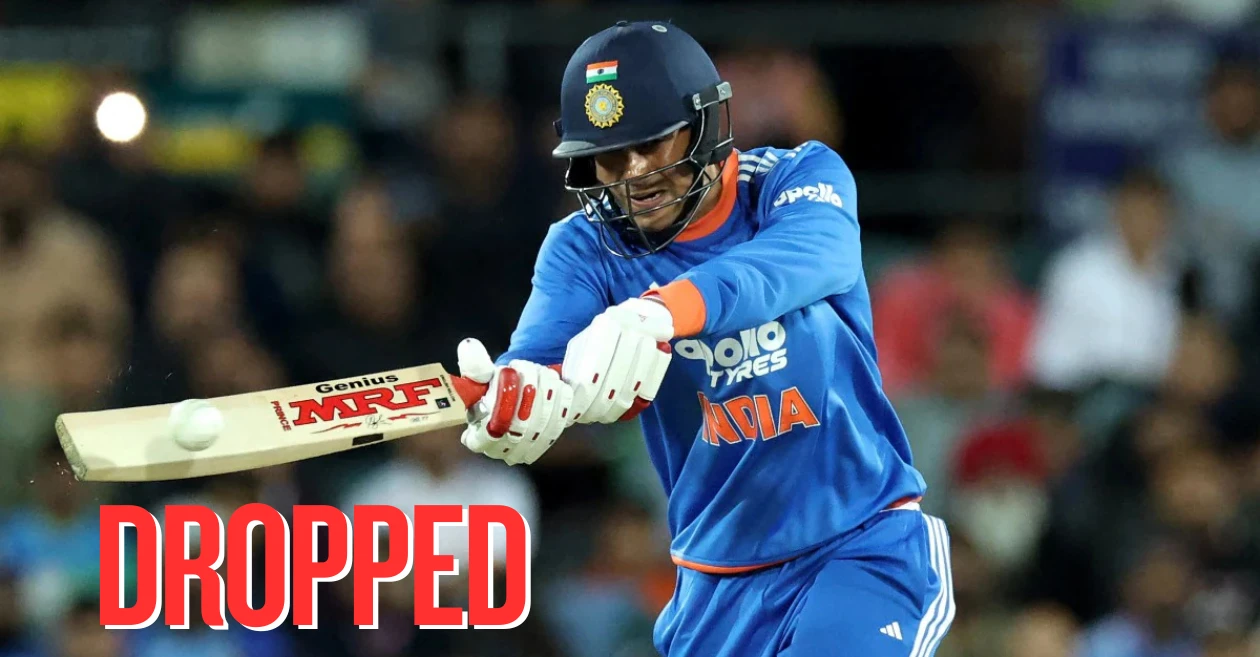
India’s selection panel has taken a bold, tactical call by leaving Shubman Gill out of the ICC Men’s T20 World Cup 2026 squad, prioritising explosive starts and late-innings flexibility over a traditional top-order anchor.

Why no Shubman Gill is India’s T20 World Cup squad?

According to officials, the decision was driven by form trends and the specific template the team wants to execute in World Cup conditions.

The selectors felt Gill’s recent T20I returns and limited impact in the powerplay did not align with the desired top-order balance. Instead, they preferred a structure built around two wicketkeeper-openers and an additional finisher – an approach aimed at maximising scoring in the first six overs while preserving depth for the death.

Current form and powerplay output prove costly for Gill

Gill’s omission follows a prolonged lean patch in T20Is. He has gone 18 innings without a half-century and has struggled to accelerate consistently during the powerplay – an area the selectors explicitly targeted for more aggression. The panel’s view was that World Cup matches demand immediate pressure at the top, and India wanted batters who can change gears from ball one.

Selection chair Ajit Agarkar acknowledged Gill’s current struggles, noting he was “short of runs at the moment.” Gill’s recent home series against South Africa yielded scores of 4, 0 and 28, and he then missed the final two T20Is due to a minor niggle – factors that weighed into the final call.

Two wicketkeeper-openers shape India’s top order

India’s decision to back Sanju Samson and Ishan Kishan as wicketkeeper-batters who can both open was pivotal. This pairing gives the side immediate attacking intent at the top while retaining flexibility across match-ups and conditions.

By locking in two keeper-openers, the selectors freed up a valuable slot elsewhere in the XI – one that could be used to bolster finishing power without sacrificing balance.

Also READ: 7 Indian players who featured in T20 World Cup 2024 but won’t play in 2026 edition

Extra finisher tips the scales

The restructured top order allowed India to accommodate Rinku Singh as a specialist finisher, a role the team considers essential in high-pressure World Cup chases. With Rinku in the mix, India can attack deeper into the innings while still fielding all-round options like Washington Sundar and Axar Patel.

Agarkar stressed the realities of squad selection: “Someone has to miss out when you pick 15,” adding that Gill was an “unfortunate” casualty of structure rather than a judgment on talent alone.

Tactical pivot backed by former players

The BCCI and ICC summaries frame Gill’s omission as a deliberate pivot toward power at the top and flexibility in the lower middle order. Former internationals have echoed that view. R Ashwin and Sanjay Manjrekar have both suggested that once Gill’s form dipped and minor injuries crept in, his exit from this specific World Cup squad became “inevitable” – a belated but necessary recalibration.

Also READ: Fans left shocked as BCCI drops Shubman Gill from India’s T20 World Cup 2026 squad


Source link

KDMC elections: Former MNS corporator Manda Patil switches sides, joins BJP | Thane News


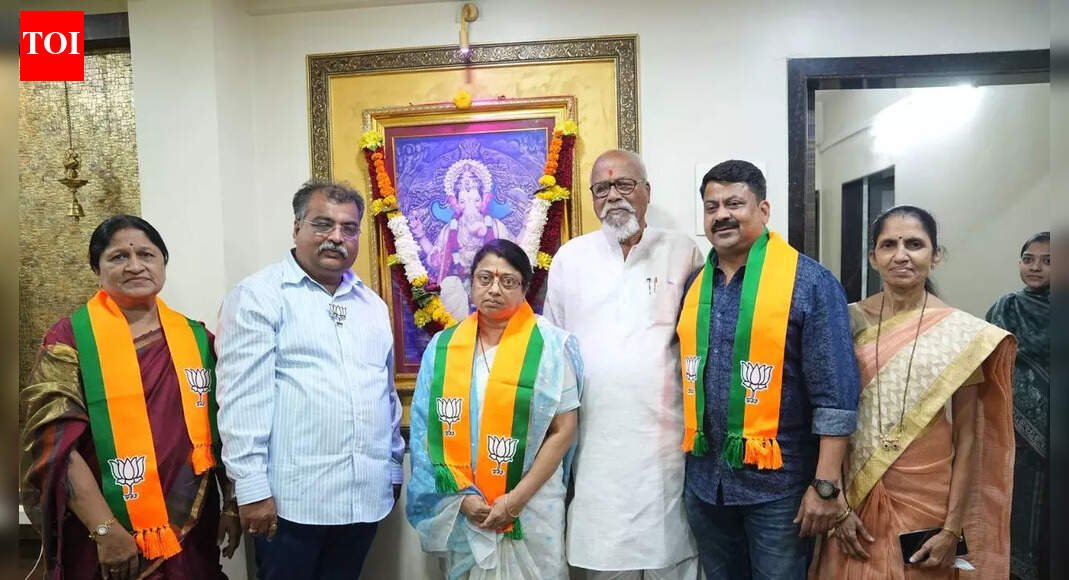
KALYAN: In a significant political development ahead of the Kalyan-Dombivli Municipal Corporation (KDMC) elections, the Maharashtra Navnirman Sena (MNS) has faced a major setback in Dombivli. Former MNS corporator Manda Patil officially resigned from the party and joined the Bharatiya Janata Party (BJP), marking a shift in the local political landscape. The induction ceremony took place in the presence of BJP State President Ravindra Chavan and senior leader and former minister Jagannath Patil.Manda Patil, who previously represented the Patharli area in Dombivli East, was a prominent face for the MNS in the region as she was also women wing’s city president. Her departure follows reports of growing internal friction within the party’s local unit, specifically regarding the recent appointment of new office-bearers. Patil had reportedly expressed her dissatisfaction with these organizational changes, leading her to resign from her post and primary membership just days before her formal induction into the BJP.This move is seen as a strategic win for the BJP as it looks to consolidate its power in the Kalyan-Dombivli belt. By bringing an experienced former corporator into its fold, the BJP aims to strengthen its grassroots connectivity in Dombivli East. Meanwhile, for Raj Thackeray’s MNS, this exit adds to a series of recent defections that have challenged the party’s stability in the region as it prepares for the upcoming civic polls.


Source link

Microsoft founder Bill Gates says he was very wrong when he thought that …


Microsoft founder Bill Gates says he was very wrong when he thought that ...

Microsoft founder Bill Gates has now acknowledged that he was ‘very wrong’ in assuming that making information widely available would naturally lead people to seek out accurate facts. Speaking in an interview with CNBC, Gates said that the had been quite naive to believe that access to information alone would curb misinformation. But now he sees that as a growing problem which is being passed on the younger generation. Gates admitted that he underestimated the appeal of confirmation bias, the tendency for people to gravitate toward platforms and connect which reinforce their present views. ““When we made information available, I thought people would want correct information,” Gates said. “But even I wallow. If there’s a politician I don’t like, and there’s an article criticizing him—even if exaggerated—I enjoy reading it.”Gates perspective further shifted after heading his daughter Phoebe Gates description. Phoebe described how she was harassed online underscoring the personal toll of misinformation and online abuse. Phoebe who is also the co-founder of AI shopping tool Phia, has previously spoken about being “memed” for her interracial relationship, highlighting how misinformation and online ridicule can distort public perception.

Bill Gates No Longer among Top 10 Billionaires: The Real Reason

Gates believes artificial intelligence could be a solution to misinformation

Gates believes that artificial intelligence could play an important role in combating misinformation and handling deepfakes. He emphasised that AI systems might be used to enforce rules and regulations around harmful content such as incitement to violence or vaccine misinformation available online.“We should have free speech. But if you’re inciting violence, if you’re causing people not to take vaccines, where are those boundaries? Even the U.S. should have rules. And if you have rules, is it some AI that encodes those rules?” Gates asked.Gates also acknowledged that the fight against misinformation will be cyclical, with new detection methods constantly challenged by countermeasures. In a 2023 blog post, Gates wrote: “It won’t be a perfect success, but we won’t be helpless either.”


Source link

Low awareness, fewer shelters: Why 1-stop centres struggle to help women in distress | Mumbai News


One-stop centres (OSCs) for women in distress, established after the Nirbhaya case, are struggling to fulfill their mandate

MUMBAI: She was picked up by the police in South Bombay on the suspicion of being a sex worker, but her emaciated frame, tear-streaked face, and inability to speak any local language flummoxed the officers. It was late at night, and the policemen took her to the only place they believed could help at that hour: the one-stop centre (OSC) at KEM Hospital, Parel.Tucked away in a corner of the main medical building, this five-year-old OSC operates 24×7, providing medical, counselling, and legal assistance for women in distress. The OSC counsellor on duty swiftly organised a translator and uncovered the harrowing truth: the woman was trafficked from Bangladesh, and the perpetrator was her husband. As doctors examined her for wounds from violent encounters, she was told she could stay at the centre for a few days while the police figured out the next steps.

-

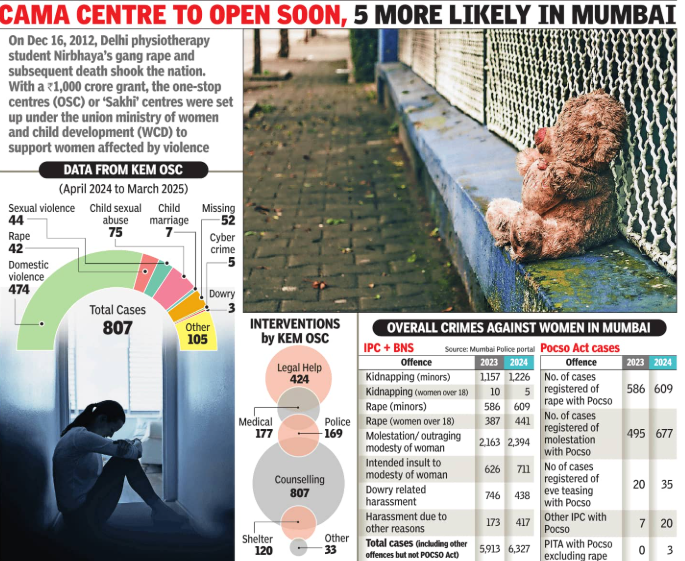
The OSC functioned seamlessly for this foreign woman, but social activists argue OSCs rarely fulfil their intended role as Nirbhaya centres for rape survivors. Thirteen years after the brutal gang rape of Delhi collegian Nirbhaya forced the govt to enact stringent laws and set up OSCs across India, rape survivors represent only a fraction of the women who reach them.Helping 1,000 YearlyTake the KEM Hospital OSC, for instance. Nearly 60% of the 807 cases (April 2024-March 2025) were about domestic violence; a mere 5% (42) were rape survivors. Advocate Audrey D’Mello, director of the non-profit Majlis Legal Centre, criticised OSCs—55 in Maharashtra and 700 across India —for devolving into “samjhauta (settlement) centres”.Academic dean Dr Harish Pathak, who is in charge of the KEM OSC, disagreed: “Our mandate now is to cater to women in distress. Whether she is a rape survivor, a victim of domestic violence, or cybercrime, we will provide her with medical and legal help.”The KEM OSC, with multiple cubicles for counselling interventions and a single shelter room, is considered small, admitted Shobha Shelar, the nodal officer of the District Women and Child Development Office, Mumbai city. Each OSC is supposed to have five beds, but this one has only one. “At times, the survivor needs medical attention and is admitted to the ward,” said Dr Pathak.The centre’s administrator, Sushma Gaikwad, said her 15member team has created a haven for women and children. “There is a gate, a security guard, and multiple case counsellors to help them,” she said. The centre caters to over 1,000 women and children annually. “There still isn’t much awareness about OSCs,” Gaikwad noted. “Rape survivors hence go to the police, who then direct them here.”6 More CentresMumbai has two OSCs, one at KEM and another at Jogeshwari Trauma Care Hospital. However, the latter isn’t fully staffed, and cases are sometimes referred out, said a state official.Now, a big centre with adequate infrastructure has been completed at Cama Hospital, near CSMT. “It was supposed to replace the KEM OSC, but given the need for such centres in the city, we now have permission to operate both,” said Shelar. The Cama centre will open after the Jan civic elections.“The union govt has also sanctioned five more centres for the suburbs. We are looking for hospitals that can grant us adequate space,” Shelar added.Police LinkMumbai police crime branch’s crime against women cell liaises between OSCs (or Sakhi centres) and local police stations. “When cases of violence against women are reported to the police station, a female officer records statements and registers an FIR. But, at times, a victim is unable to narrate or is stressed. We then seek help from the Sakhi centre,” said an officer from a suburban police station. He recalled a 14-year-old girl brought to the police station by her stepmother. “As the child seemed disturbed, we took her to the Jogeshwari OSC where counsellors helped her speak up about her father sexually assaulting her,” said the officer. The family disowned her, but the OSC offered her temporary shelter till she moved to a children’s home.Problems GaloreOSCs were meant to function as walk-in centres for women, but few know about it. D’Mello of Majlis said, “We were part of the drafting of this scheme, which envisaged a supportive mechanism with an administrator, counsellors for psychological support, a lawyer from state legal aid services, a policeman if she wishes to file a criminal case, and a shortterm shelter if needed.” She has been reviewing OSCs in Bihar and Maharashtra and found they had turned into ‘samjhauta centres’: The woman’s husband is called, she is counselled, and sent back with him. “There is no lawyer or policeman present,” said D’Mello.Launching more OSCs won’t serve the purpose if victims must run from place to place for help. “The truth is OSCs don’t have short-term shelters. The staff is not paid properly. The intention with which the scheme was envisaged hasn’t been achieved,” she said.A former employee said salaries fixed by the union women and child development ministry are low. “A multipurpose worker at the OSC gets Rs 15,000, but one can earn that in Mumbai by working as a domestic help with better hours and less stress than that associated with OSCs,’’ she said. Staff at the KEM Hospital centre not only get remuneration from the centre but also a token amount from a local NGO supporting their efforts.“The staff at the Jogeshwari centre doesn’t get such financial support, hence there is a huge shortage there,” said the former staffer. There is a geographical disadvantage. “Why will a rape survivor from, say, Mulund travel to Jogeshwari at a time she is feeling vulnerable?’’ asked a social worker. Dr Nayreen Daruwalla from NGO SNEHA said that OSCs in rural areas are located very far from where the victim lives, making access a significant challenge.


Source link

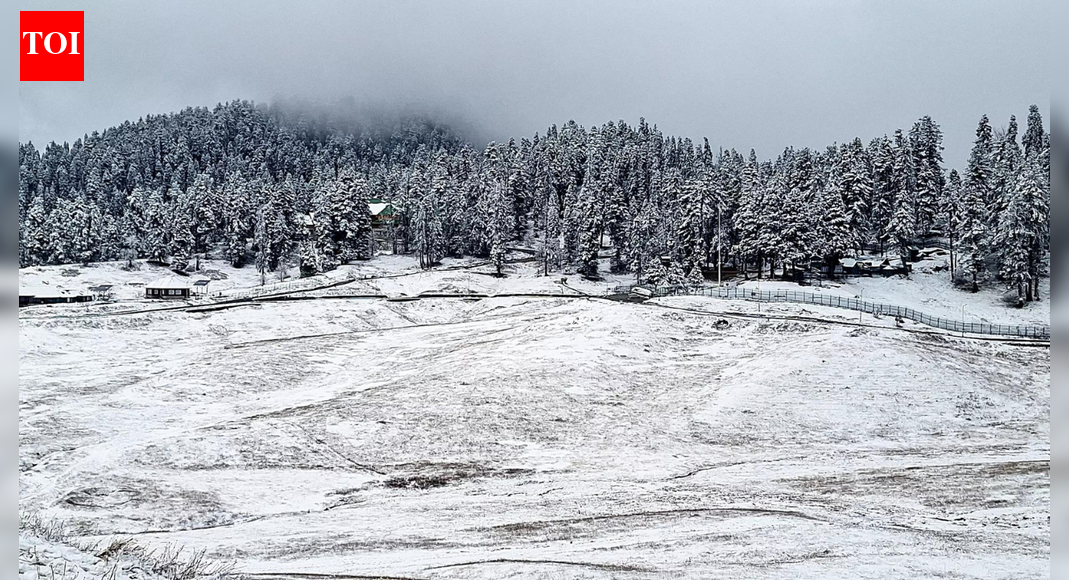
Chillai-Kalan begins: Kashmir sees snow and rain in its higher reaches – watch | India News


Chillai-Kalan begins: Kashmir sees snow and rain in its higher reaches - watch
Representative image (Picture credit: ANI)

NEW DELHI: The higher reaches of Kashmir witnessed fresh snowfall while the plains received rain on Sunday, bringing relief to residents as Chillai-Kalan, the Valley’s harshest 40-day winter period, set in after a prolonged dry spell, as per PTI.Officials said snowfall was reported from the Gulmarg tourist resort in north Kashmir’s Baramulla district, where around two inches of snow had accumulated.In Sonamarg, located on the Srinagar–Kargil highway, snowfall began early Sunday morning and continued till the last reports were received.Sadhna Top, the mountain pass connecting the Tangdhar sector along the Line of Control with the rest of the Kashmir Valley, recorded moderate snowfall, with about six inches accumulating since Saturday night.Light rainfall was also reported overnight in Srinagar and other parts of the Valley and continued intermittently through Sunday, officials said. The weather department has forecast an increase in snowfall and rain across Kashmir over the next 48 hours.The precipitation has brought much-needed relief after an extended dry spell that had led to a rise in common ailments such as cough and cold, particularly among children and the elderly. The rain and snow on the first day of Chillai-Kalan are traditionally considered a good omen by locals and seen as a sign of ample snowfall in the coming weeks.Authorities said preparations were in place to deal with heavy snowfall, with arrangements reviewed for roads, power and water supply, health services and essential commodities. “I took a review of both divisions, especially areas where it is expected to snow, all districts in the Valley and the higher reaches of Jammu. The administration has finalised all preparations, but, whether that would suffice, will only be known after tomorrow when it starts to snow,” CM Omar Abdullah said on Saturday.Despite possible hardships, the snowfall is expected to improve air quality and give a boost to winter tourism, which had suffered last year due to a largely dry winter.“Even if we face some hardships due to the snow, I do not think anyone should complain because we have been eagerly awaiting snowfall. It will clear the air, mitigate pollution, and kick off the winter tourism season,” he added.Chillai-Kalan, also known as the “big cold”, will continue until January 30, after which the Valley will enter the milder Chillai-Khurd and Chillai-Bacha phases.


Source link

‘Enough, sing something secular’: Noted singer Lagnajita Chakraborty abused, physically harassed for performing devotional song in West Bengal | Kolkata News


'Enough, sing something secular': Noted singer Lagnajita Chakraborty abused, physically harassed for performing devotional song in West Bengal

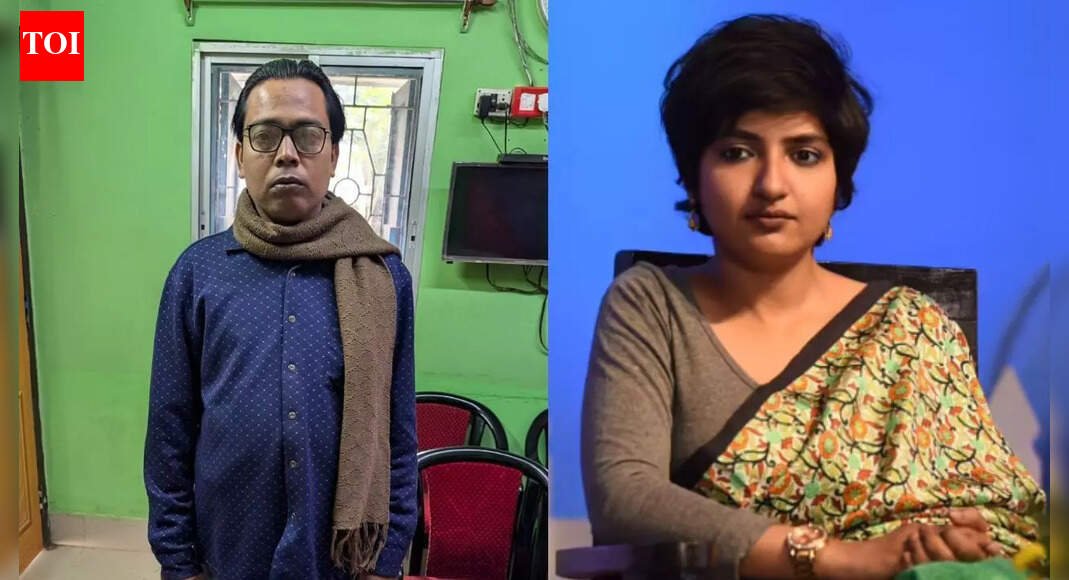
BHAGWANPUR (EAST MIDNAPORE): A cultural programme at a private school in East Midnapore’s Bhagwanpur descended into chaos on Saturday night after renowned Kolkata-based playback singer Lagnajita Chakraborty was allegedly heckled and physically harassed for performing a devotional song. The incident has sparked a major political controversy, with police arresting the school owner. A departmental enquiry has been ordered against the officer-in-charge of the local police station. Lagnajita, a prominent name in the Bengali music industry, had been invited to perform at the annual function of a private school. According to the formal complaint lodged by the artist, trouble began when she started singing ‘Joy Maa’, a popular track from the film Devi Chowdhurani. Witnesses claimed that in the middle of the performance, the school’s owner, identified as Mehebub Mallick, interrupted her. Lagnajita alleged in her written statement that Mallick used derogatory language and ordered her to stop the song. “When I began the ‘Joy Maa’ song, the owner, Mehebub Mallick, verbally abused me, saying, ‘Enough of this… now sing something secular.’ It wasn’t just verbal; I was subjected to physical harassment as well during the commotion,” the singer’s complaint stated. Following the alleged insult and physical intimidation, Lagnajita and her band members walked off the stage and left the venue. They proceeded directly to Bhagwanpur Police Station to record their statements. The district administration has taken a serious view of the matter. Speaking to the media, East Midnapore’s Acting Superintendent of Police, Mitun Kumar De, confirmed that an FIR has been registered. The owner has been arrested and a departmental probe has been ordered against the local OC. “The accused is in custody. We are committed to ensuring he is brought to justice,” De said. He added that the police are investigating whether there were any procedural lapses by local officers and have assured the singer of full cooperation and security.


Source link