Bombay HC quashes sexual assault FIR in online matrimony case after settlement | Mumbai News


MUMBAI: In a case highlighting the emotional and legal complexities of relationships forged in the digital age, the Bombay High Court has quashed an FIR registered under Section 69 of the Bharatiya Nyaya Sanhita (BNS) of sexual assault after noting that the parties had amicably settled their dispute and the complainant no longer wished to pursue the prosecution.The FIR was lodged at Arnala Police Station in November 2025 following a complaint by a victim woman who alleged that she had been induced into a physical relationship on the assurance of marriage after meeting the man through a popular matrimonial website. According to the complaint, what began as a sincere interaction gradually developed into a close relationship, with repeated assurances of marriage forming the basis of trust between them.However, the relationship later broke down when the man allegedly expressed unwillingness to marry, citing differences in religious and cultural backgrounds. Feeling emotionally betrayed, the woman lodged an FIR, invoking Section 69 of the BNS, which deals with sexual relations induced by a false promise of marriage.As the proceedings progressed, the woman submitted an affidavit before the High Court stating that the matter had been resolved amicably and that she had no objection to quashing the FIR. The court recorded that the affidavit was filed voluntarily, without any pressure or coercion, and that both parties were personally present and identified by their respective advocates.A Division Bench of Chief Justice Shree Chandrashekhar and Justice Gautam A. Ankhad observed that while courts are generally cautious in quashing criminal proceedings involving serious allegations, the inherent powers of the High Court can be exercised to secure the ends of justice depending on the facts of each case. Referring to a recent Supreme Court judgment, the bench noted that continuation of the proceedings would serve no useful purpose once the complainant herself was unwilling to pursue the case.Advocate Nirali Sharma for victim, and advocate Vijaykumar Mishra and Kunal Patel for the accused and additional public prosecutor Mahalaxmi Ganapathy appeared in the case. Legal experts said that such cases underscore the growing number of disputes arising from online matrimonial platforms, where private assurances can carry serious legal implications. The court’s order also reflects the deeply personal nature of such conflicts, where emotional resolution and forgiveness can ultimately shape the course of legal proceedings.


Source link

INSV Kaundinya: Navy’s engineless ship to embark on maiden voyage — all you need to know | India News


INSV Kaundinya: Navy’s engineless ship to embark on maiden voyage — all you need to know

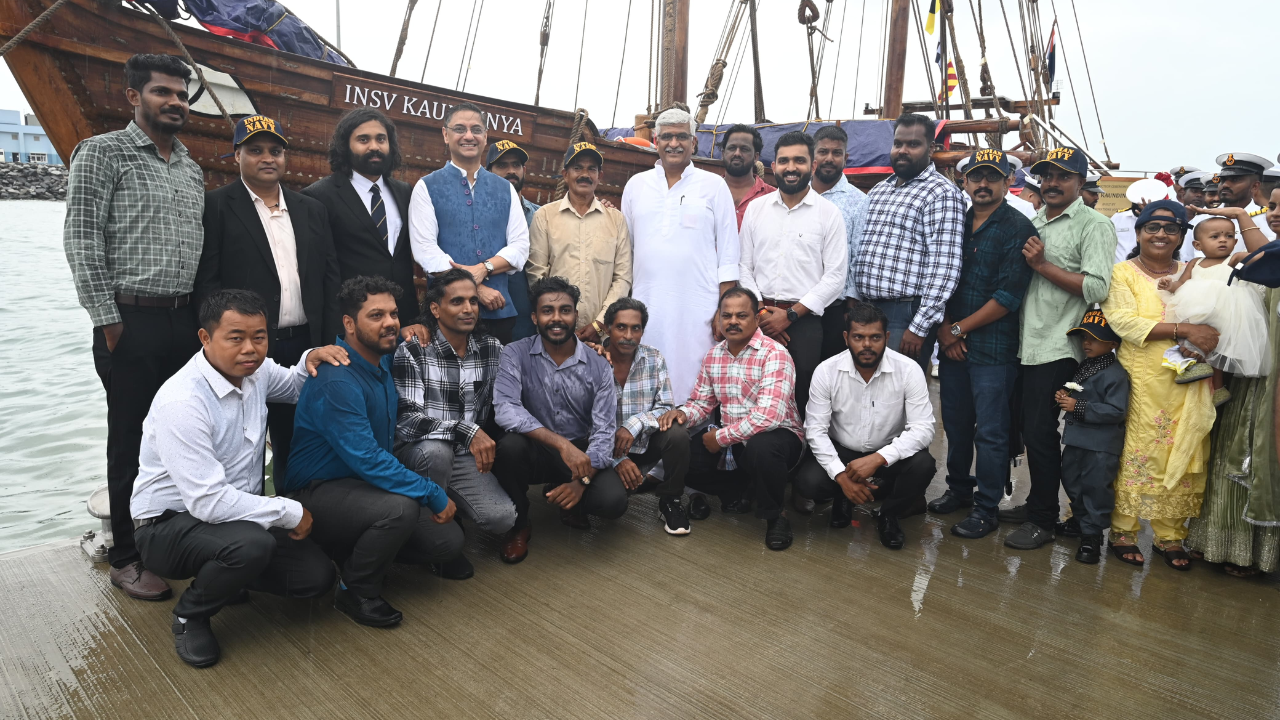
NEW DELHI: The Indian Navy’s stitched sailing vessel INSV Kaundinya will embark on her maiden overseas voyage on Monday, sailing from Porbandar in Gujarat to Muscat in Oman. The journey will symbolically retrace ancient maritime routes that once connected India with West Asia and the wider Indian Ocean world, testing traditional shipbuilding techniques that predate modern navigation by more than a millennium.The voyage marks a rare operational deployment of a vessel built entirely using ancient stitched-plank technology, with no engine, no metal fastenings and no modern propulsion systems. The ship will rely solely on wind and sails, recreating the conditions under which Indian mariners once undertook long-distance oceanic voyages.

A ship built without engines or metal

INSV Kaundinya is a non-combat sailing vessel constructed using a shipbuilding technique believed to date back to at least the 5th century CE. Unlike modern naval platforms, the wooden planks of the vessel are stitched together using coir rope made from coconut fibre and sealed with natural resins, cotton and oils to ensure seaworthiness.

INSV Kaundinya

This stitched construction allows flexibility in the hull, enabling the ship to absorb wave energy rather than resist it rigidly. Such flexibility was crucial for ancient sailors navigating rough seas across the Arabian Sea, the Bay of Bengal and beyond.

Inspired by ancient Indian sources

The vessel’s design draws inspiration from depictions of ships found in the Ajanta cave paintings, descriptions in ancient Indian texts and accounts left by foreign travellers. With no surviving blueprints, the Indian Navy reconstructed the design through visual interpretation and scientific validation.Hydrodynamic testing and stability studies were conducted with the support of academic institutions, including IIT Madras, to ensure the vessel could safely undertake open ocean voyages despite its ancient design.

Dimensions and crew

INSV Kaundinya measures approximately 19.6 metres in length and 6.5 metres in width, with a draft of around 3.33 metres. The ship is powered entirely by sails and is crewed by about 15 sailors trained to operate the vessel under traditional sailing conditions.

‘Crew underwent extensive training to sail onboard INSV Kaundinya’

The construction follows the Tankai method, an indigenous Indian shipbuilding practice in which the hull is stitched first and ribs are added later, avoiding the use of metal entirely.

A collaborative revival project

The project was initiated in July 2023 under a tripartite memorandum of understanding between the Ministry of Culture, the Indian Navy and Hodi Innovations, with funding provided by the Ministry of Culture. Traditional artisans from Kerala, led by master shipwright Babu Sankaran, stitched the vessel entirely by hand.The ship was launched in February 2025 and formally inducted into the Indian Navy in May at Karwar in Karnataka, marking a milestone in the revival of indigenous maritime knowledge systems.

Cultural symbols on board

INSV Kaundinya carries several motifs associated with India’s maritime and civilisational heritage. These include the Gandabherunda, the two-headed eagle of the Kadamba dynasty, sun motifs on the sails, a Simha Yali mythical lion figure on the bow, and a Harappan-style stone anchor placed on the deck.Each symbol reflects different periods of India’s seafaring past and its long-standing engagement with overseas trade and cultural exchange.

Named after a legendary mariner

The vessel is named after Kaundinya, a first-century Indian mariner referenced in Southeast Asian and Chinese records. According to these accounts, Kaundinya sailed to the Mekong Delta, married Queen Soma and helped establish the Kingdom of Funan in present-day Cambodia.The kingdom became one of the earliest Indian-influenced states in Southeast Asia, with later Khmer and Cham dynasties believed to trace their origins to this union. Although Indian records do not mention him, Kaundinya is regarded as the earliest named Indian sailor with a documented global historical impact.

Recreating ancient maritime highways

The Porbandar to Muscat route was once a vital corridor for trade and cultural exchange. Indian merchants and sailors used these sea lanes to transport spices, textiles and ideas across West Asia, Africa and Southeast Asia.By sailing this route again, INSV Kaundinya seeks to demonstrate the sophistication of ancient Indian shipbuilding and navigation while reaffirming India’s long-standing identity as a maritime civilisation.


Source link

Thalapathy Vijay gets mobbed and falls at Chennai airport as fans rush to get a glimpse of him – Watch |


Thalapathy Vijay gets mobbed and falls at Chennai airport as fans rush to get a glimpse of him - Watch
Thalapathy Vijay’s return to Chennai from Malaysia’s ‘Jana Nayagan’ audio launch saw him mobbed by enthusiastic fans at the airport. Overwhelmed by the crowd, the actor-turned-politician lost his balance and tripped near his car, but was quickly assisted by security and sustained no injuries. The event highlighted a stark contrast to the smoothly managed Malaysian function.

Thalapathi Vijay’s return from his trip to Malaysia after the audio launch event for his upcoming film ‘Jana Nayagan’ descended into chaos as he touched down in Chennai. A wave of overwhelmed fans caused the actor-turned-politician to lose balance and fall.

Vijay Thalapathy gets mobbed

As seen in the videos circulating on the internet, many fans ran to see the ‘Jana Nayagan’ star when he reached Chennai Airport. Fans wanted to take photos and be near him. There were too many people around him, which also led to everyone pushing forward to get closer. This made a small mess near his car.

Vijay loses balance and trips near his car

Because the crowd was so big, Vijay lost his balance and slipped and fell down just before he reached his car. The security guards came quickly to assist him. They picked him up, helped him stand and took him inside the car safely. Vijay did not suffer any injuries.

‘Jana Nayagan’ audio launch event

For the unversed, the Tamil star came from Kuala Lumpur after a huge show for his upcoming political thriller ‘Jana Nayagan’. The event took place at Bukit Jalil Stadium. It was a huge event, that the Malaysian Book of Records said it was the biggest audience for any audio launch in the country.

About ‘Jana Nayagan’

Speaking about his upcoming film, directed by H. Vinoth the movie is anticipated to be his final cinematic outing as he is said to solely focus on his political career. The movie stars him opposite Pooja Hegde as Kayal, with Bobby Deol as the antagonist.It will also feature Gautham Vasudev Menon, Prakash Raj, Priyamani, Narain, Mamitha Baiju and others in key roles.The movie is set for Pongal 2026 release on January 9. Additionally the film will be clashing with Prabhas’ much anticipated horror comedy, ‘The Raja Saab’ which will also release on the same date.


Source link

Gold price prediction today: What is the gold price outlook this week? Gold may head towards Rs 1,45,000 levels


Gold price prediction today: What is the gold price outlook this week? Gold may head towards Rs 1,45,000 levels
Gold prices are gradually trending higher, consistent with their typical behaviour, and have registered a record high of ₹140,000. (AI image)

Gold price prediction today: Gold prices may retest the recent support zone of ₹137,000 and ₹138,000, and dips should be utilized to accumulate gold, says Manav Modi, Senior Analyst, Commodity Research at Motilal Oswal Financial Services Ltd. He shares his views and recommendations for gold investors and key levels to watch out for in the near term:Gold prices remain firm, hovering near the $4,500 level on COMEX. Meanwhile, silver continues its strong upward momentum, supported by tight supply conditions, robust industrial demand, and broader market uncertainties. Recent US economic data indicated easing inflation and softer labor market conditions, strengthening expectations of multiple rate cuts next year, even as GDP growth surprised on the upside.Gold prices are gradually trending higher, consistent with their typical behaviour, and have registered a record high of ₹140,000 following a consolidation breakout from the ₹135,000 level last week. The broader technical structure continues to favor a buy-on-dips strategy, preferably through staggered investments.There remains a possibility of prices re-testing the recent support zone between ₹137,000 and ₹138,000. After the breakout, prices have been holding near the upper Bollinger Band, indicating sustained buying interest, with the mid-band around ₹135,000 acting as an immediate stop. Any pullbacks may be used for accumulation, while a decisive move above ₹140,000 could open the way toward targets of ₹143,000–₹145,000.It is a holiday-shortened week due to the New Year, though a few key events are lined up. Focus will be on US industrial production, housing numbers and FOMC meeting minutes.(Disclaimer: Recommendations and views on the stock market, other asset classes or personal finance management tips given by experts are their own. These opinions do not represent the views of The Times of India)


Source link

Boss sells company, gives employees ₹3.6 crore each and internet can’t believe it |


Louisiana businessman Graham Walker generously shared $240 million from his company’s sale with 540 employees. This significant bonus, spread over five years, acknowledges their decades of loyalty through fires and economic downturns. The gesture transformed lives, with one employee paying off her mortgage and starting a business, proving corporate success can reach the factory floor.

When Graham Walker sold his family-run company Fibrebond, he didn’t just walk away richer,he made sure the people who stood by the business for decades did too.Walker, a 46-year-old businessman from Louisiana, surprised his 540 full-time employees by setting aside a massive $240 million (around ₹19,900 crore) from the sale as bonuses. Spread over five years, that works out to an average of $443,000 per employee, roughly ₹3.6 crore each. Not bad for a thank-you gift.Fibrebond’s story goes back to 1982, when Walker’s father, Claud Walker, started the company in Minden, Louisiana, making enclosures for telecom and electrical equipment. The journey was anything but smooth. In 1998, a factory fire nearly wiped operations out. Instead of shutting shop, production was shifted outdoors so that no employee missed a salary and no client order was delayed.There were other rough patches too, the dot-com crash, slow demand, and layoffs during difficult years. When Graham and his brothers stepped in during the mid-2000s, their first priority was survival. They sold off assets, cleared debt, and took a bold gamble: a $150 million (about ₹1,245 crore) investment into modular power enclosures for data centres. That bet paid off. Sales grew, and soon, bigger players came knocking.When power-management giant Eaton acquired Fibrebond for $1.7 billion (around ₹14,100 crore), Walker laid down one non-negotiable condition, employees had to share the win. Despite warnings about tax and legal hurdles, he refused to budge. Eaton eventually agreed, earmarking 15% of the deal value exclusively for staff bonuses.Walker later said the decision had nothing to do with ownership and everything to do with loyalty. Workers had stayed through fires, layoffs, pay freezes and uncertainty. “It’s Christmas season, I’m a person of faith, and my faith compels me to do it,” he told NBC.For employees like Leisa Key, who spent 29 years at Fibrebond, the bonus changed everything. “We were living paycheck to paycheck. I can live now,” she said. She’s since paid off her mortgage and even opened a small clothing store nearby.When sealed envelopes detailing the payouts began arriving in June, some employees cried, others laughed, and a few thought it had to be a prank. It wasn’t. For once, corporate success didn’t stop at the boardroom, it reached the factory floor too.


Source link

Mumbai tops education department digitisation drive at 60%, several districts below 1% | Mumbai News


MUMBAI: Mumbai has emerged as the top performer in Maharashtra’s ongoing drive to digitise employment records of education department staff, with nearly 60% of employee data uploaded so far.The state-wide exercise covers both teaching and non-teaching staff across government and aided institutions. Employees were required to upload documents such as appointment orders, joining reports, approval letters and service records to the government’s Shalarth portal. The deadline for completing submissions was September 20.Progress across the state, however, remains uneven. Several districts have recorded extremely low levels of compliance, with Dhule, Akola and Solapur each digitising less than 1% of employee records. In contrast, Mumbai’s relatively higher completion rate places it well above the state average.The digitisation drive is focused largely on employees appointed before 2016, when creating a Shalarth ID was not mandatory. As a result, records for many earlier appointments continue to exist only in physical form at schools and education offices, complicating verification and audit processes.Shalarth is the state government’s centralised online system used to maintain salary, service and financial details of education department employees. The current exercise follows scrutiny of the portal after irregularities were flagged in the creation and use of Shalarth IDs.By digitising legacy records and linking them to verified employee profiles, the exercise seeks to consolidate employee data, identify discrepancies and bring uniformity to records that are currently scattered across multiple administrative levels.In districts where uploads remain negligible, the absence of digitised records continues to pose challenges for record verification, audits and administrative processes, highlighting the uneven pace of implementation across Maharashtra.


Source link

Fastest to 10,000 runs in Women’s international cricket ft. Smriti Mandhana


India’s vice-captain Smriti Mandhana etched her name into the pantheon of cricketing greats on Sunday, December 28, 2025, becoming the fastest player to surpass 10,000 runs in women’s international cricket. The left-handed opener reached the monumental landmark during the fourth T20I against Sri Lanka at the Greenfield International Stadium, further cementing her status as the premier batter of the modern era.

Smriti Mandhana goes past legends to attain a massive record

Mandhana entered the match needing just 27 runs to reach the milestone. She achieved the feat in clinical fashion during the seventh over, taking only 281 innings to cross the 10,000-run mark across all formats. In doing so, she shattered the previous record held by former Indian captain Mithali Raj, who reached the milestone in 291 innings. The star opener is now only the fourth woman in history to join the elite “10k Club,” and she is also the youngest to do so.

Masterclass in Thiruvananthapuram

The milestone was just the beginning of Mandhana’s dominance on the night. She went on to play a scintillating knock of 80 off 48 deliveries, laced with 11 boundaries and three towering sixes. Alongside her opening partner Shafali Verma, Mandhana stitched together a record 162-run opening stand, propelling India to a massive total of 221/2—the team’s highest-ever score in Women’s T20Is. The innings also saw Mandhana overtake Harmanpreet Kaur to become India’s leading six-hitter in the T20I format, while also registering her 32nd fifty-plus score in the shortest format—the most by any woman globally.

Also READ: Smriti Mandhana and Shafali Verma’s stellar show seals big win for India against Sri Lanka in 4th T20I

Fastest to 10,000 international runs in Women’s cricket

1) Smriti Mandhana: As mentioned above, Mandhana accomplished the feat during the 4th T20I against the Lankans when she smashed a scintillating knock of 80 runs at an impressive strike-rate of 166.67. Her powerful knock not only helped India to reach their highest total in the shortest format, but also laid foundation for the hosts’ clinical victory by 30 runs.

2) Mithali Raj: Mithali was the first Indian woman and the second player overall to reach this five-figure total. She achieved the feat on March 12, 2021, during an ODI against South Africa in Lucknow. She reached the mark in her 291st international innings. Known for her incredible longevity (spanning 23 years), she is currently the all-time leading run-scorer in women’s international cricket with 10,868 runs.

3) Charlotte Edwards: The England legend was the first woman in history to breach the 10,000-run mark in international cricket. She reached the milestone in 2016, taking 308 innings to get there. A classical batter and a long-time captain of England, Edwards retired with 10,273 international runs, holding the record for the most runs for several years.

4) Suzie Bates: Bates became the third woman to enter the elite club and the first New Zealander to do so. She reached the landmark on July 12, 2024, during a T20I against England. It took her 314 innings to cross the threshold. Bates is a unique entry on this list as she reached the milestone without ever playing a Test match, relying entirely on her dominance in ODIs and T20Is.

Also WATCH: IND-W vs SL-W – G Kamalini’s sensational juggling catch steals the show in record-breaking 4th T20I

This article was first published at WomenCricket.com, a Cricket Times company.


Source link

Access Denied


Access Denied

You don’t have permission to access “http://www.ndtv.com/india-news/tiger-death-in-madhya-pradesh-pushes-years-toll-to-highest-since-1973-10052064” on this server.

Reference #18.2ef63717.1766990467.e3c6e54

https://errors.edgesuite.net/18.2ef63717.1766990467.e3c6e54


Source link

‘Will pierce them with arrows’: UBT’s Anand Dubey hails Thackeray reunion; issues ‘Congress-mukt Mumbai’ warning | Mumbai News


Shiv Sena’s UBT faction leader Anand Dubey.

MUMBAI: The Uddhav Thackeray faction of the Shiv Sena on Monday lashed out at the Congress ahead of the crucial BMC polls, accusing the party of “backstabbing” them after the Grand Old Party formed an alliance with the Vanchit Bahujan Aghadi (VBA).UBT leader Anand Dubey openly criticised the MVA partner, saying the move could lead to a “Congress-mukt Mumbai”.

‘Batenge Toh Katenge’: Uddhav & Raj Thackeray Unite For Mumbai Civic Polls | Shiv Sena (UBT) | MNS

“Congress party has backstabbed us. BJP had backstabbed us earlier. This time, it will be a Congress-mukt Mumbai,” Dubey said.He also hailed the reunion of Uddhav Thackeray and his cousin ahead of the civic polls, but warned that those unhappy with the pact would be “pierced with arrows”.“MVA and INDI alliances were formed for the state government and the central government. This is the Mumbai Municipal Corporation election. In this, Raj Thackeray and Uddhav Thackeray are together. Those who are coming with us are welcome; those who are not — like in the Mahabharata — we will pierce them all with arrows,” he added.The statement came a day after the Congress and the Vanchit Bahujan Aghadi (VBA), led by BR Ambedkar’s grandson Prakash Ambedkar, announced an alliance for the BMC polls, with the VBA set to contest 62 of the 227 seats.Congress will contest more than 150 seats, while some seats will be allocated to the Rashtriya Samaj Paksha and the RPI (Gavai), news agency PTI quoted sources as saying.The Congress is expected to announce its nominees soon. Its screening committee met on Sunday to finalise the list of candidates.(With agency inputs)


Source link

‘An apple a day’ — but at what cost? Kashmir’s orchards raise health alarm | Srinagar News


‘An apple a day’ — but at what cost? Kashmir's orchards raise health alarm
Image Credit: Bilal Bahadur/TNN

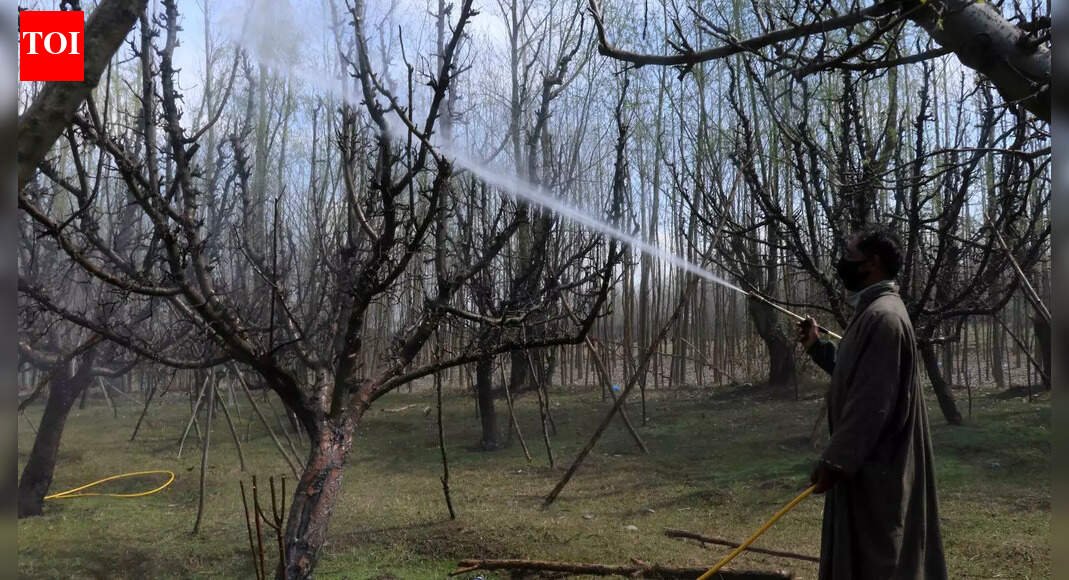
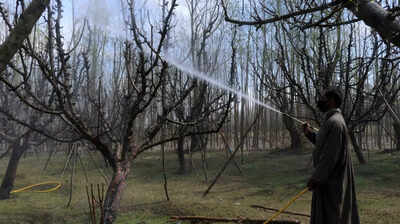
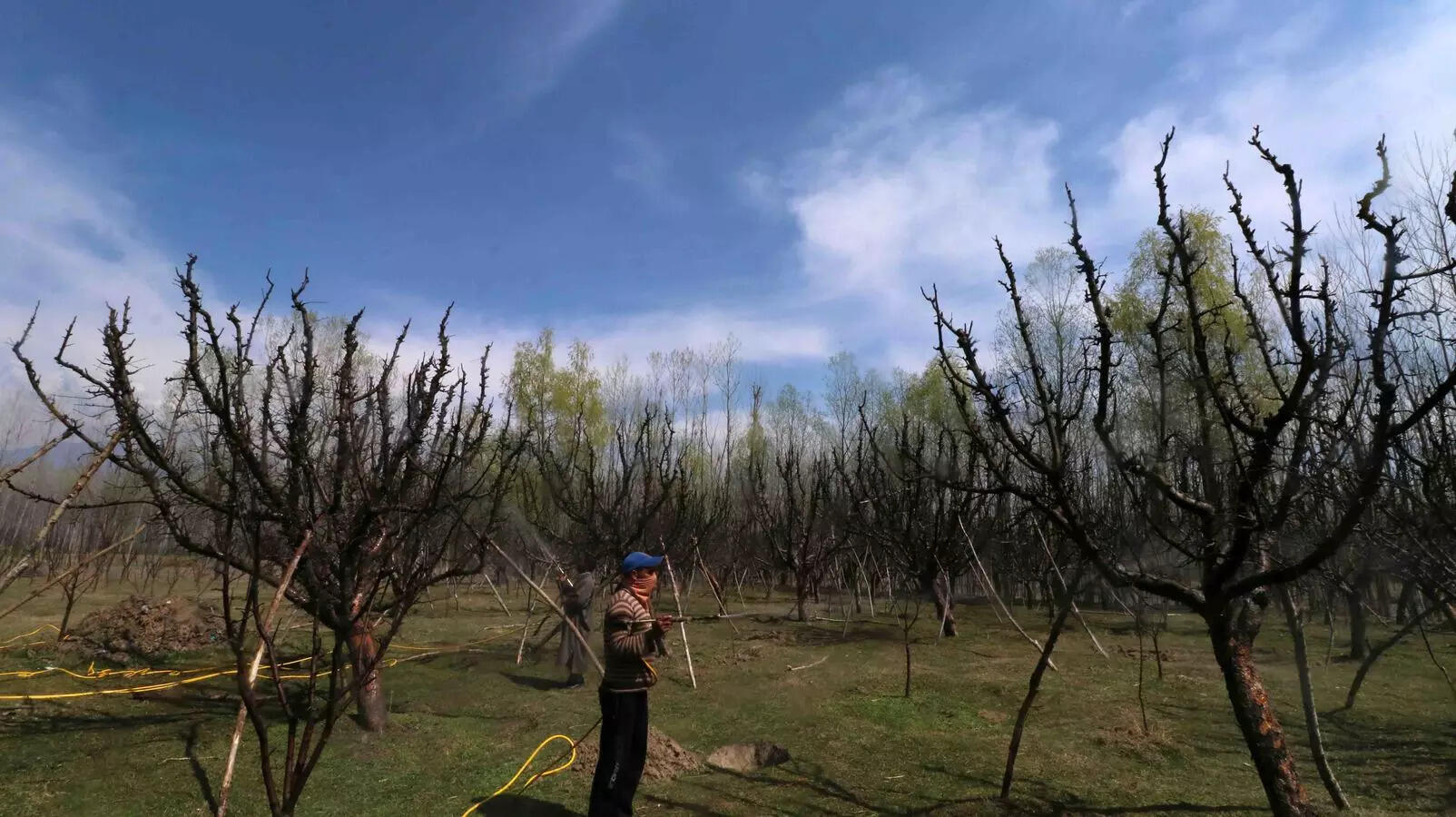
SRINAGAR: Kashmir’s apple orchards — the backbone of the Valley’s rural economy — are under renewed scrutiny as lawmakers and medical experts raise concerns over a possible link between decades of pesticide use and rising cases of malignant brain tumours among orchard workers.Lawmakers shift focus to farmers’ healthThe concerns were raised by the House Committee on Environment of the Jammu and Kashmir assembly, chaired by CPM legislator MY Tarigami, which met officials, scientists and health experts to examine the health hazards faced by those working in apple orchards.
-

Image Credit: Bilal Bahadur/TNN

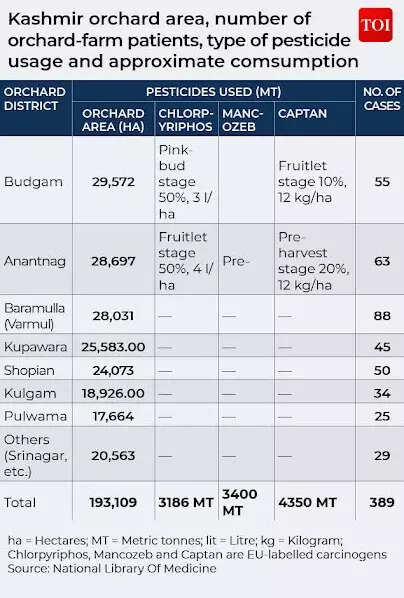
“For years, farmers have sprayed orchards unaware of the toxicity of constant pesticide exposure, leading to a rise in malignant brain tumors among those who power the valley’s billion-rupee apple economy and contribute more than 70% of India’s total apples,” the committee said.Evidence from Kashmir’s fruit beltThe discussion revisited findings from a study conducted by the Sher-i-Kashmir Institute of Medical Sciences (SKIMS), which examined more than 400 cancer patients between 2005 and 2008.The study reported high incidences of primary brain cancer in districts forming Kashmir’s core fruit belt, including Baramulla, Anantnag, Budgam, Shopian and Kupwara. It identified a “quite strong and possible” link between pesticide exposure and malignant brain tumours among orchard farmers.

-

Image Credit: Bilal Bahadur/TNN

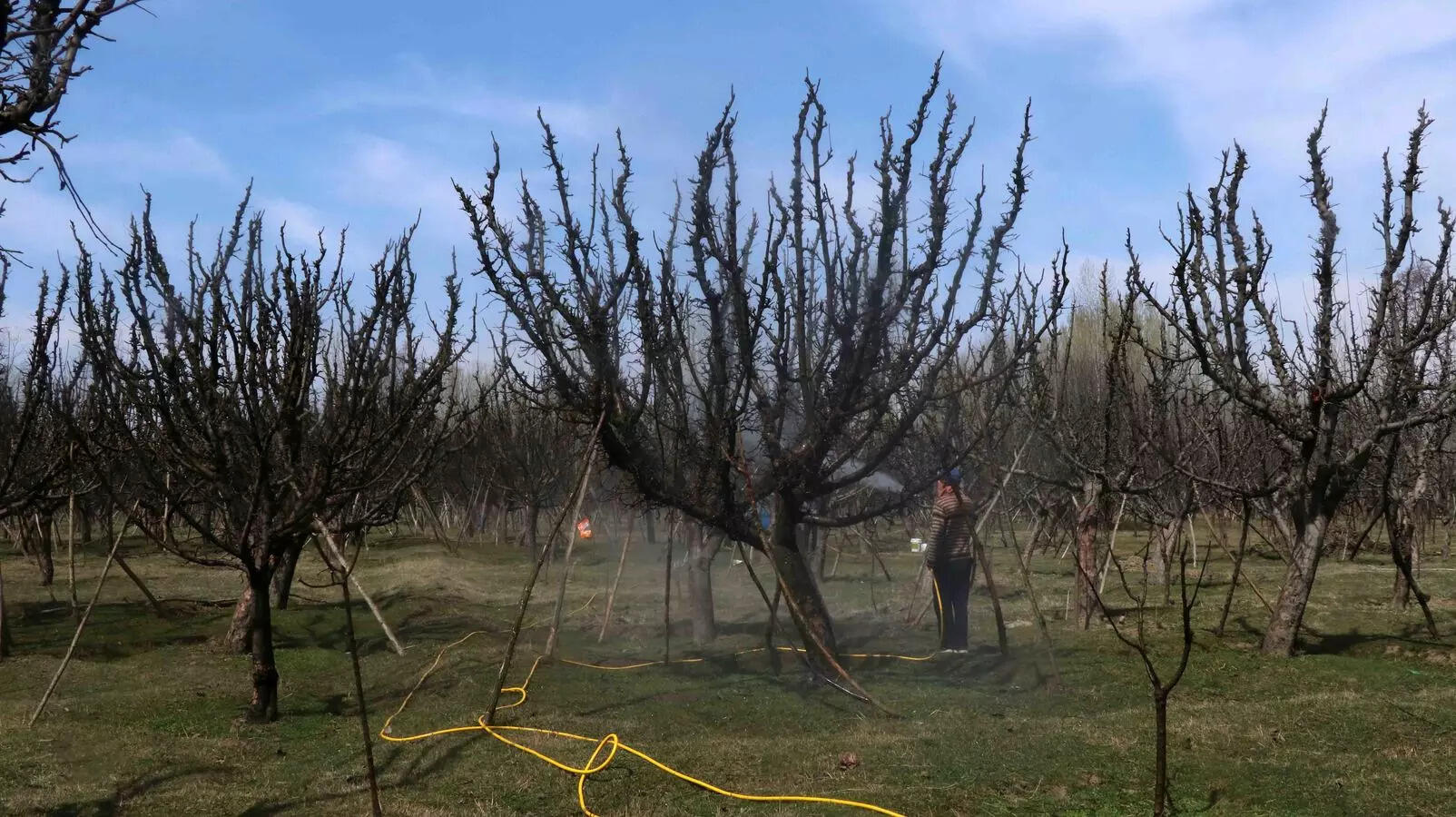
The findings were largely ignored when first published but have resurfaced amid growing medical evidence of pesticide-linked health disorders in the Valley.Tarigami told TOI, “We don’t want to create panic among farmers who spray their orchards every season. But neither can we sit idle when data indicates a serious health hazard. If pesticide spray is harming lives, it must be addressed.”Overuse of chemicals and lack of protectionScientists told the committee that pesticide use in apple orchards often exceeds recommended limits.Shahid Rasool, principal scientist at CSIR–Indian Institute of Integrative Medicine, said many orchardists spray chemicals every 10 to 12 days instead of the advised 18 to 21, believing it boosts yield.“Few can afford protective gear; chronic cough, rashes and irritation are common. Without gloves, goggles and masks, the risk multiplies,” he warned.Rasool said orchardists now use as many as 15 rounds of fungicide and insecticide each season, far beyond recommended schedules, and called for safer practices and protective equipment.Traces of pesticides found in human bloodFurther concerns were raised by Dr Sobia Nisar, a physician-researcher at Government Medical College, Srinagar, who has studied the biochemical effects of pesticide exposure among residents of apple-growing districts such as Shopian and Pulwama.“The initial idea was to check pesticides residue levels in the fruit,” she said. “But what we found was far more disturbing. Traces of these compounds in human blood samples.”
-

Image Credit: Bilal Bahadur/TNN

Her findings document pesticide residues in the bloodstream of orchard workers and nearby residents, along with higher rates of obesity, lipid disorders, metabolic syndrome and early kidney impairment.“When such patterns emerge consistently across populations exposed to pesticides, it demands urgent scientific scrutiny,” Dr Nisar said.Earlier studies show high exposure among cancer patientsA study published in the Indian Journal of Occupational and Environmental Medicine reported that 90% of brain tumour patients from Kashmir’s orchard belts had been exposed to pesticides, with all cases involving high-grade, aggressive tumours.The research focused on orchard workers in districts such as Anantnag, Budgam and Baramulla — areas that account for over 90% of the Valley’s apple-growing land — with smaller districts like Shopian and Kulgam also showing significant concentrations of cases.Committee seeks policy responseThe House Committee on Environment said it would recommend measures to the health and horticulture departments focusing on monitoring, research funding and worker safety, as concerns grow over the long-term health impact of pesticide use in Kashmir’s apple orchards.What the study foundA detailed study titled “Pesticides and brain cancer linked in orchard farmers of Kashmir”, conducted by researchers at the Sher-i-Kashmir Institute of Medical Sciences (SKIMS), examined the relationship between pesticide exposure and primary malignant brain tumours among orchard workers in the Valley.

-

The study analysed medical records of 432 patients diagnosed with primary malignant brain tumours and 457 control patients with non-tumour neurological conditions, all treated at SKIMS over a four-year period between 2005 and 2008.High exposure among cancer patientsThese patients had been exposed to multiple neurotoxic and carcinogenic chemicals, including chlorpyriphos, dimethoate, mancozeb and captan.Only 9.96% of patients had no recorded exposure to pesticides. Among the control group, 119 out of 457 patients had a history of pesticide exposure, while 338 had no such link. Of the pesticide-exposed cancer patients, 71.7% were male and 28.3% were female, including members of three families. Nearly a third — 31.9% — were younger than 40 years, having begun exposure at an early age.Tumour severity and mortalityThe study found that all orchard-related patients had high-grade, aggressive brain tumours, unlike those in the non-pesticide-exposed group. Mortality among pesticide-exposed tumour patients was recorded at 12%.Researchers measured serum cholinesterase levels — a marker used to assess exposure to organophosphate pesticides — and found higher-than-normal levels in 31.9% of exposed patients, while decreased levels were seen in 45.3%.
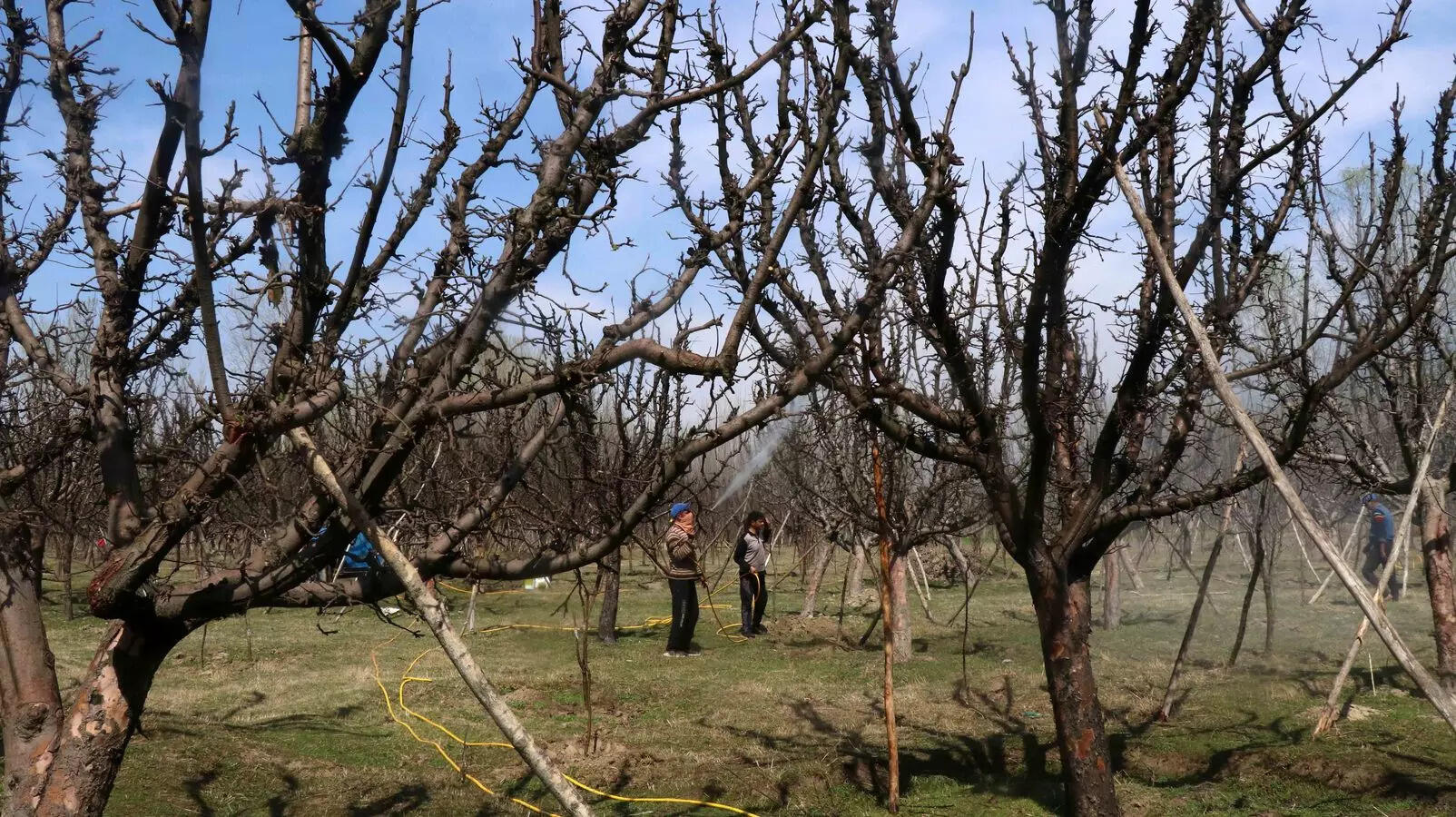
-

Image Credit: Bilal Bahadur

Statistical analysis showed a significant case-control odds ratio of 0.28, with additional hospital and family control serum cholinesterase odds ratios of 1.1 and 1.5 respectively, pointing to what the study described as a strong suspicion of a link between pesticide exposure and brain cancer.Wider environmental and occupational contextThe study noted that millions of tonnes of pesticides, insecticides and fungicides are sprayed annually across Kashmir’s orchards. Apple cultivation alone covers more than half of the Valley’s fruit-growing land, with around 40% of the population directly or indirectly exposed through farming, residence near orchards or recreational use of orchard spaces.Researchers highlighted that prolonged use of synthetic pesticides over the past three decades has coincided with a marked rise in admissions of high-grade malignant brain tumours from orchard districts to SKIMS.The study concluded that occupational and environmental exposure to pesticides in Kashmir’s fruit-growing regions poses a serious health risk, warranting closer monitoring and further investigation.




Source link