Breaking News
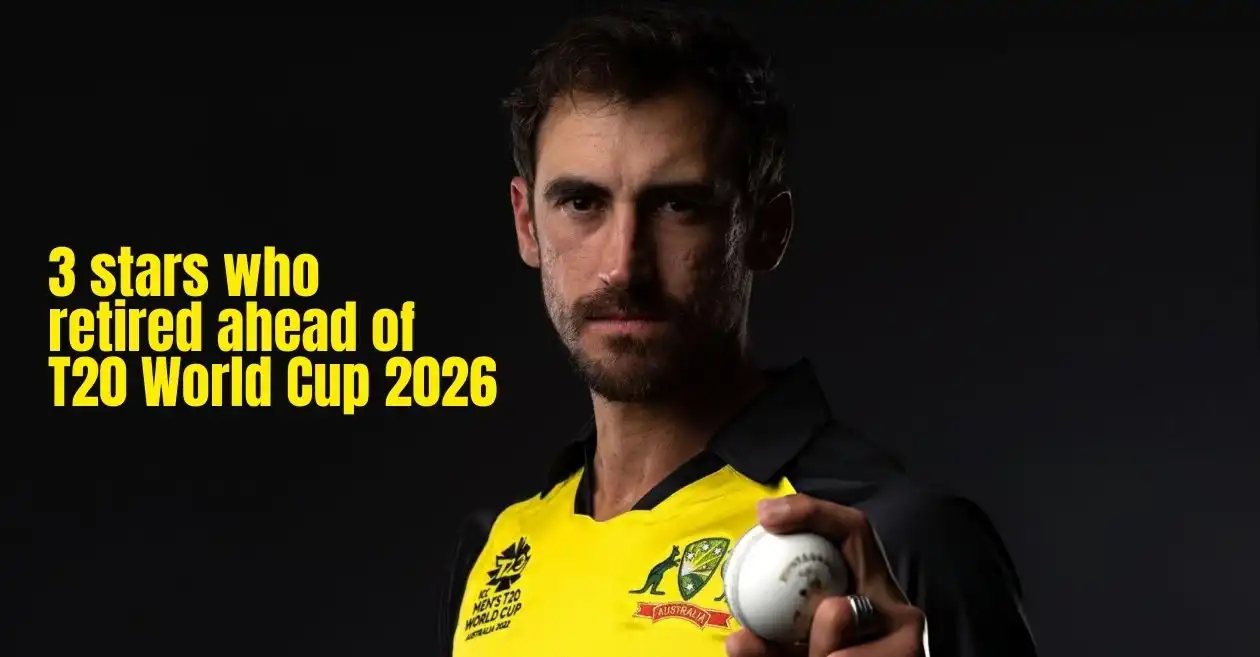
3 T20I superstars who bowed out before the T20 World Cup 2026


As the cricket world turns its collective gaze toward the ICC Men’s T20 World Cup 2026 in India and Sri Lanka, the landscape of the shortest format looks remarkably different. The year 2025 served as a definitive “end of an era,” with several modern-day greats choosing to hang up their boots in the T20 International format to make way for the next generation.

While the loss of these stalwarts leaves a void in their respective national sides, their departures have cleared the stage for a new, fearless breed of cricketers ready to chase global glory.

Iconic stars who retired ahead of T20 World Cup 2026

1) Mitchell Starc: The end of an express era

Perhaps the most significant blow to Australia’s bowling attack was Mitchell Starc’s decision to retire from T20Is in September 2025. The left-arm speedster, known for his toe-crushing yorkers and early breakthroughs, decided to prioritize Test cricket and the 2027 ODI World Cup.

Starc leaves behind a legacy of being one of the most feared white-ball bowlers in history. His absence at the 2026 World Cup means Australia will head into the tournament without their primary “X-factor” with the new ball for the first time in over a decade.

2) Nicholas Pooran: A shock exit for the West Indies star

In one of the more surprising announcements of the year, Nicholas Pooran retired from all international cricket in June 2025. At just 29 years old, the West Indies’ record-holder for T20I runs and appearances decided to focus on the global franchise circuit.

For the Caribbean side, losing a middle-order powerhouse of Pooran’s caliber just months before a major tournament is a massive hurdle. He was the bridge between the “old guard” of Gayle and Pollard and the rising stars; now, the Windies must find a new anchor for their explosive batting lineup.

Also READ: Rohit Sharma predicts the finalist of T20 World Cup 2026

3) Heinrich Klaasen: South Africa’s finisher bows out

South Africa’s middle-order superstar Heinrich Klaasen also called it quits on his international career in June 2025. Over the last few seasons, Klaasen had evolved into arguably the most destructive batter against spin in the world.

His retirement marks a significant shift for the Proteas, who relied heavily on his ability to accelerate in the death overs. As South Africa prepares for the 2026 event, the pressure now shifts to young talents like Tristan Stubbs to fill the “finisher” vacuum left by Klaasen.

T20I performance summary

Player Matches Runs/Wickets BBI/Best score
Mitchell Starc 65 79 Wickets 4/20
Nicholas Pooran 106 2275 Runs 98
Heinrich Klaasen 58 1000 Runs 81

Also READ: Jacques Kallis explains why South Africa have a real shot at winning T20 World Cup 2026


Source link

GST action: Vodafone Idea gets Rs 638-crore penalty order; telco plans legal challenge


GST action: Vodafone Idea gets Rs 638-crore penalty order; telco plans legal challenge

Vodafone Idea on Thursday said it has received a GST penalty order of about Rs 638 crore from the Office of the Additional Commissioner, Central Goods and Services Tax, Ahmedabad, and that it will challenge the order through legal action, PTI reported.In a statutory filing, the debt-laden telecom operator said it does not agree with the order and will take appropriate steps against it. The order was passed under Section 74 of the Central Goods and Services Tax Act, 2017, confirming a penalty of Rs 6,37,90,68,254 along with applicable tax demand and interest, the company said in a BSE filing.Vodafone Idea said the order pertains to allegations of short payment of tax and excess availment of input tax credit. “The maximum financial impact is to the extent of tax demand, interest, and penalty levied. The company does not agree with the order and will take appropriate legal action(s) against the same,” it said.The filing comes a day after the Union Cabinet approved major relief for Vodafone Idea by freezing its Adjusted Gross Revenue dues, granting a five-year moratorium on payments and allowing reassessment of capped AGR dues, PTI reported.


Source link

‘I love revenge’: Aryna Sabalenka calls for rematch with Nick Kyrgios after defeat in the ‘Battle of the Sexes’ | Tennis News


'I love revenge': Aryna Sabalenka calls for rematch with Nick Kyrgios after defeat in the 'Battle of the Sexes'
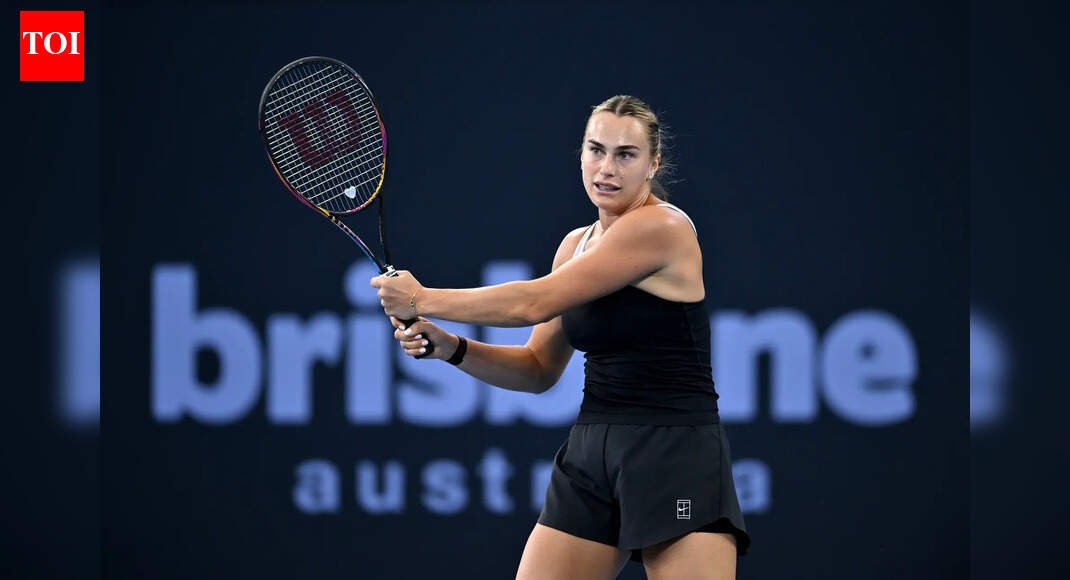
Aryna Sabalenka (Photo by Albert Perez/Getty Images for Tennis Australia)

World number one Aryna Sabalenka has signalled that she is eager for a rematch against Nick Kyrgios after being beaten by the Australian in their widely discussed “Battle of the Sexes” exhibition match. The high-profile clash took place in Dubai on Sunday, where Kyrgios claimed a 6-3, 6-3 win in a contest that drew significant attention for its intensity and entertainment value. The match, however, was played under modified conditions, with the court reduced by nine per cent to balance differences in movement and speed between male and female players. Looking back on the encounter, Sabalenka admitted she would approach a second meeting differently, especially when it comes to the format. Speaking on Thursday ahead of her Brisbane International title defence, the Belarusian said she would favour a full-sized court and adjusted serving rules if the matchup were to be repeated. “I think I would definitely do it again. I love revenge, and I don’t like to leave it the way it is. I think for the next match we will come up with a different format. Before the match I didn’t realise I would have to adjust, and it was a bit tricky for me. I think I would keep the full court, but I would take two serves. That would even our level a lot more,” Sabalenka said. She explained that the experience, despite ending in defeat, helped her understand Kyrgios’ game better and left her confident that she could improve in a rematch. “I always say that when you are losing, you are learning and I learned a lot about his game. I know Nick as a player and a person better and I feel I know how to play against him. I would do it again. I need revenge,” she added. Sabalenka also reflected positively on the contest, saying she was pleased to have tested Kyrgios physically and mentally. She described the match as an enjoyable challenge and wished him well ahead of his upcoming appearances in Brisbane and at the Australian Open. “I am happy that I was able to challenge him, make him work and make him physically get tired and mentally get tired. I felt really excited to see a man getting tired and going for his full game. It was a really cool experience and I really hope he will do well here in Brisbane and play incredible tennis in the Australian Open,” she said.


Source link

What to Expect from Xi Jinping Regarding Taiwan in 2026? | World News


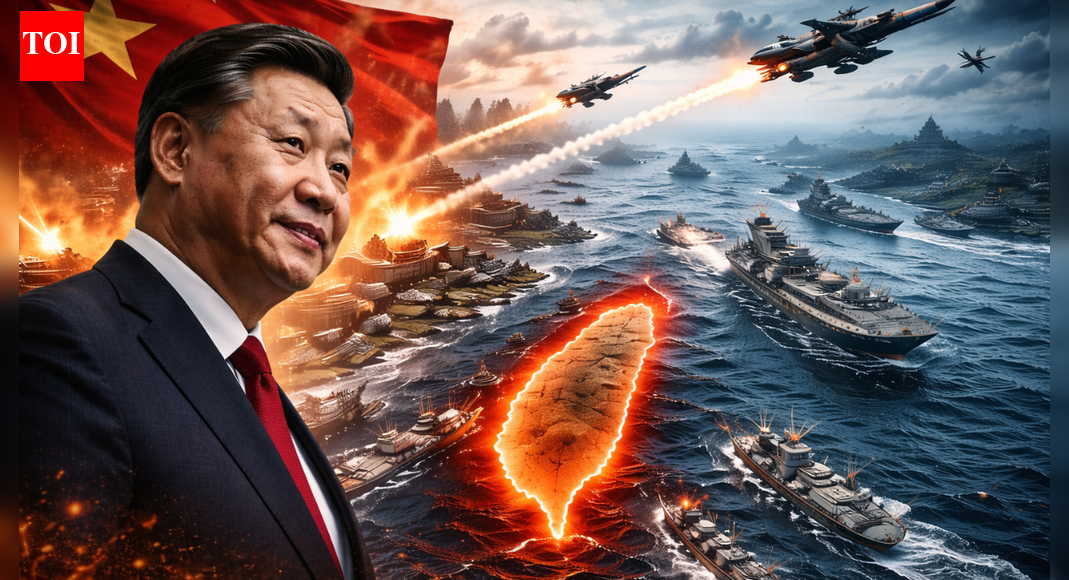
The year of temptation: Will Xi Jinping risk it all over Taiwan in 2026?

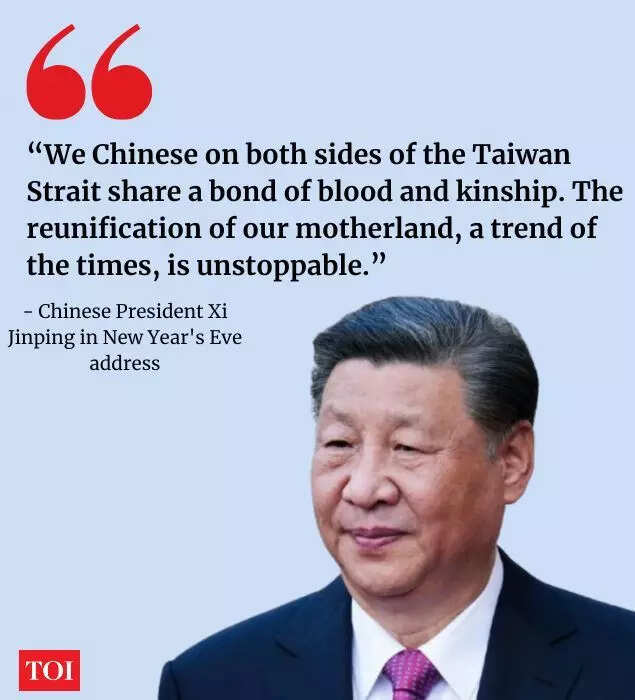
Will 2026 become the year when Chinese President Xi Jinping decides that the long-promised “reunification” of Taiwan can no longer wait?Driving the newsChina’s latest round of live-fire military drills in the air and seas around Taiwan landed with unusually sharp timing: just as the calendar flipped another year closer to 2027, a date that looms larger for US defense planners than almost any other.

‘3, 2, 1, FIRE!’: China Rockets ROAR On Day 2 Of Taiwan War Games Yet Trump Says He Isn’t ‘WORRIED’

Beijing described the exercises as a “stern warning” to separatist forces. They included simulated aerial strikes, naval live-fire exercises and maneuvers designed to demonstrate the People’s Liberation Army’s ability to encircle and isolate the island. Taiwan’s aviation authority warned the drills disrupted flight safety, affecting hundreds of flights and tens of thousands of passengers.The drills followed Washington’s announcement of the largest-ever US arms package for Taiwan – more than $11 billion – approved under President Donald Trump’s administration. The package includes HIMARS rocket systems, howitzers, anti-tank missiles, drones and other systems intended to strengthen Taiwan’s ability to fight asymmetrically against a far larger force.

.

While Chinese exercises of this type are often planned well in advance, the sequencing matters. Beijing reacted furiously to the arms sale, with a Chinese embassy spokesperson warning that such moves “risk turning Taiwan into a powder keg” and accelerate the possibility of conflict in the Taiwan Strait.Why it matters

  • For the better part of five years, the US military has planned around a single assumption: that China wants the capability to take Taiwan by force as soon as 2027. That belief has driven everything from force posture to industrial policy – even if intelligence officials stress that “ready by 2027” does not mean “invade in 2027.”
  • The timeline has already reshaped US strategy. Washington has expanded access agreements and infrastructure across the Pacific, poured billions into domestic semiconductor manufacturing, rushed arms to Taipei and repositioned naval and air assets with a Taiwan contingency in mind.
  • But the urgency of those moves has not always matched the calendar. With 2027 now just around the corner, Pentagon planners worry about a convergence of unfinished business: delayed weapons deliveries, a strained defense industrial base, and Pacific infrastructure projects still moving at peacetime speed.
  • “We’re not punching out ships any faster. Submarines aren’t getting submerged into the ocean any faster,” Mike Kuiken, a Hoover Institution fellow and member of the US-China Economic and Security Review Commission, told Axios. “There’s a real convergence of issues coming in 2027 as we think about whether or not we’re going to be prepared.”

The big picture: China’s ‘Anaconda strategy’Taiwan sits at the center of several overlapping global fault lines: great-power rivalry, semiconductor supply chains and the credibility of US security guarantees in Asia.The island produces the bulk of the world’s most advanced chips, making any conflict there a shock to the global economy. Randy Schriver, a former US assistant secretary of defense, has said the US decision to invest heavily in domestic chipmaking was explicitly shaped by the 2027 timeline.At the same time, Beijing increasingly sees Taiwan not just as a territorial issue, but as a test of China’s rise – and of whether the US-led order can still block Beijing’s ambitions.

.

Bloomberg Opinion columnist Hal Brands has described China’s approach as an “Anaconda strategy”: tightening pressure through cyberattacks, disinformation, diplomatic isolation and economic coercion until Taiwan yields. Undersea cables have been cut. Cyber intrusions are constant. Beijing squeezes Taiwan’s remaining diplomatic partners and blocks its participation in international bodies.The logic, Brands argues, is that isolation and demoralization can achieve what a risky amphibious invasion might not.FlashbackThe current moment is often framed through what US defense officials call the “Davidson window,” named after Adm Philip Davidson, the former head of US Indo-Pacific Command. In 2021, Davidson warned that China sought the capability to seize Taiwan “in the next six years.”Two years later, then-CIA director Bill Burns said intelligence showed Chinese President Xi Jinping had “instructed the People’s Liberation Army to be ready by 2027 to conduct a successful invasion.”

.

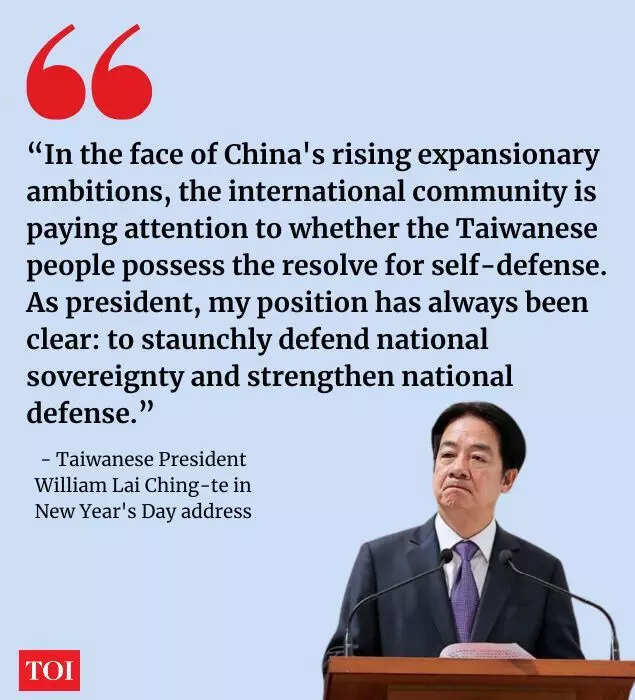
Those statements hardened 2027 into a planning assumption in Washington – one that still shapes war games, budgets and alliance consultations.Between the linesReadiness is not intent – and US intelligence agencies continue to stress that distinction. Officials believe Xi wants the option of invasion by 2027, not necessarily the order on his desk.That nuance matters because Beijing has many tools short of war. Analysts increasingly focus on scenarios like a quarantine or blockade, customs inspections that choke trade, or intensified gray-zone pressure that stops short of crossing a clear red line.The Economist’s Patrick Foulis warns that after a strong 2025, China’s leadership faces “a year of temptation” in 2026. With the Communist Party’s next five-year congress approaching in 2027 – when succession questions will loom – some of Xi’s advisers may argue that the strategic conditions for coercing Taiwan will never be better.Those conditions include what Beijing perceives as US ambivalence, polarized politics in Taiwan, and broad international support – roughly 70 countries – for “reunification by all means,” as Chinese diplomats phrase it.But temptation cuts both ways. Foulis also argues that hubris has been a recurring feature of Xi’s rule, from wolf-warrior diplomacy to zero-Covid. Overreach on Taiwan could trigger a regional arms race or a catastrophic war that derails China’s long-term rise.What they’re sayingChinese officials have left little doubt about how they view US arms sales. Embassy spokesperson Liu Pengyu told Axios the package “grossly violates the one-China principle and the three China-US joint communiqués,” adding: “The Taiwan question is at the core of China’s core interests, and is the first red line that must not be crossed in China-US relations.”Taipei’s message is defensive and resolute. A spokesperson for Taiwan’s de facto embassy in Washington said the island remains committed to maintaining the status quo, but “facing mounting aggressive acts from the other side, President Lai has said that Taiwan must make the best possible preparations for worst-case scenarios and be ready, regardless of the timeline.”

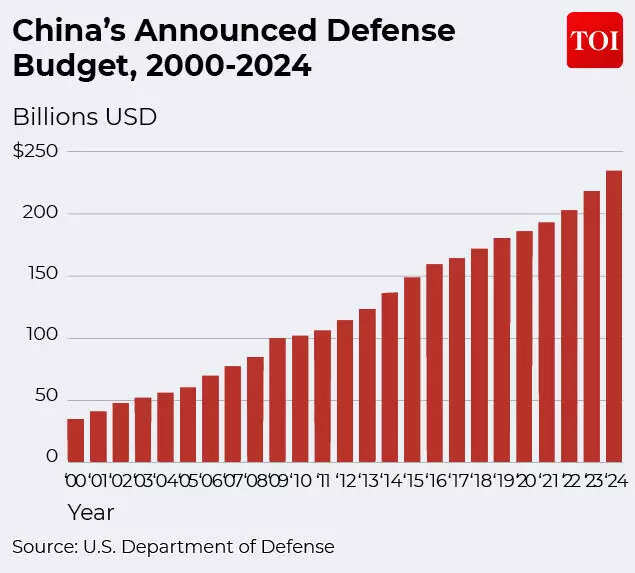
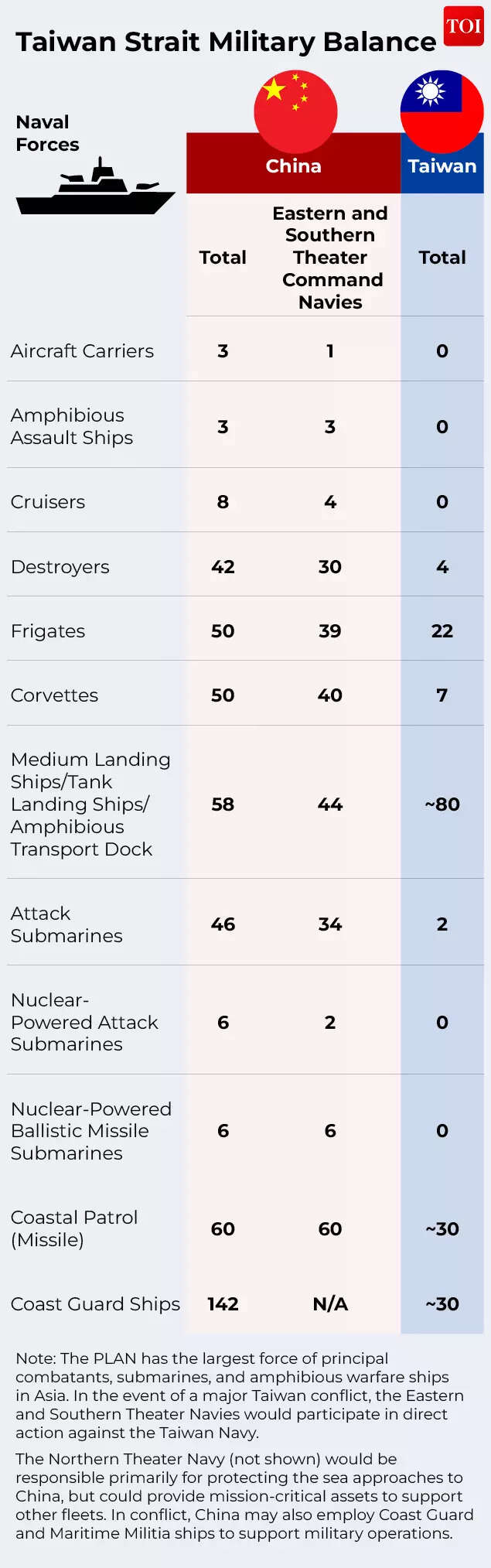
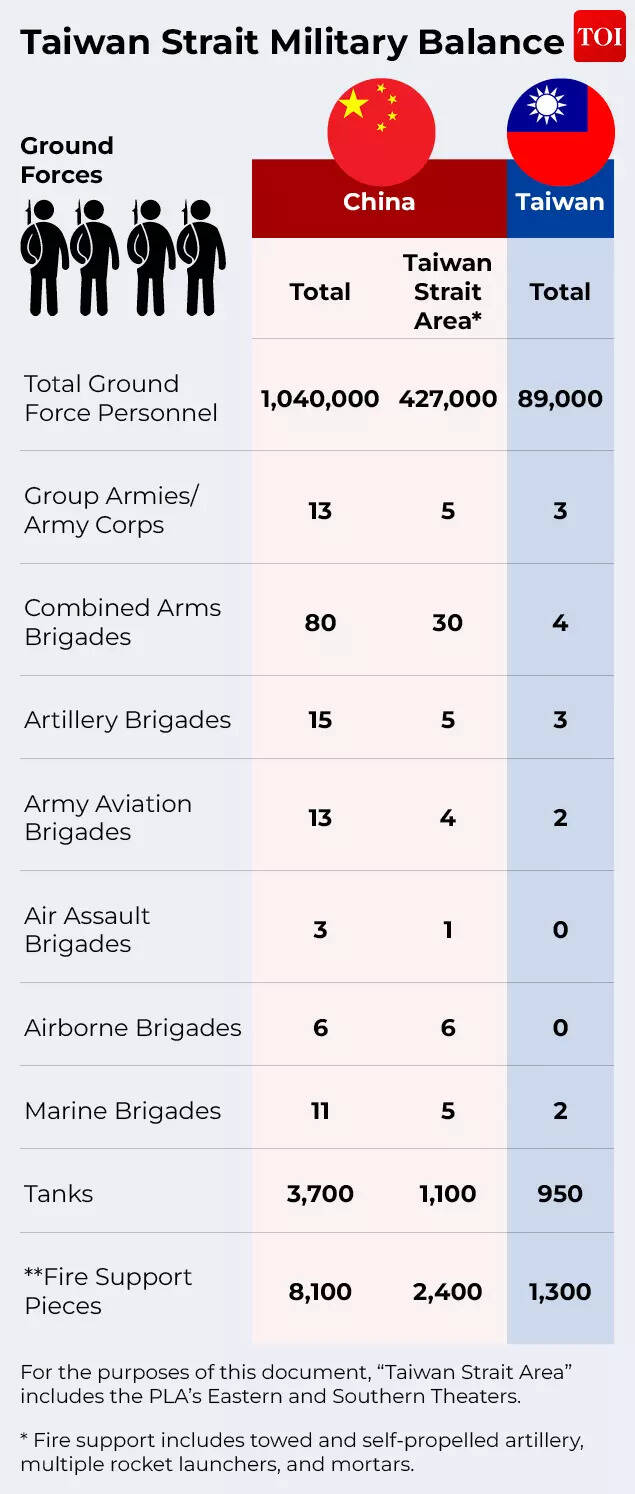
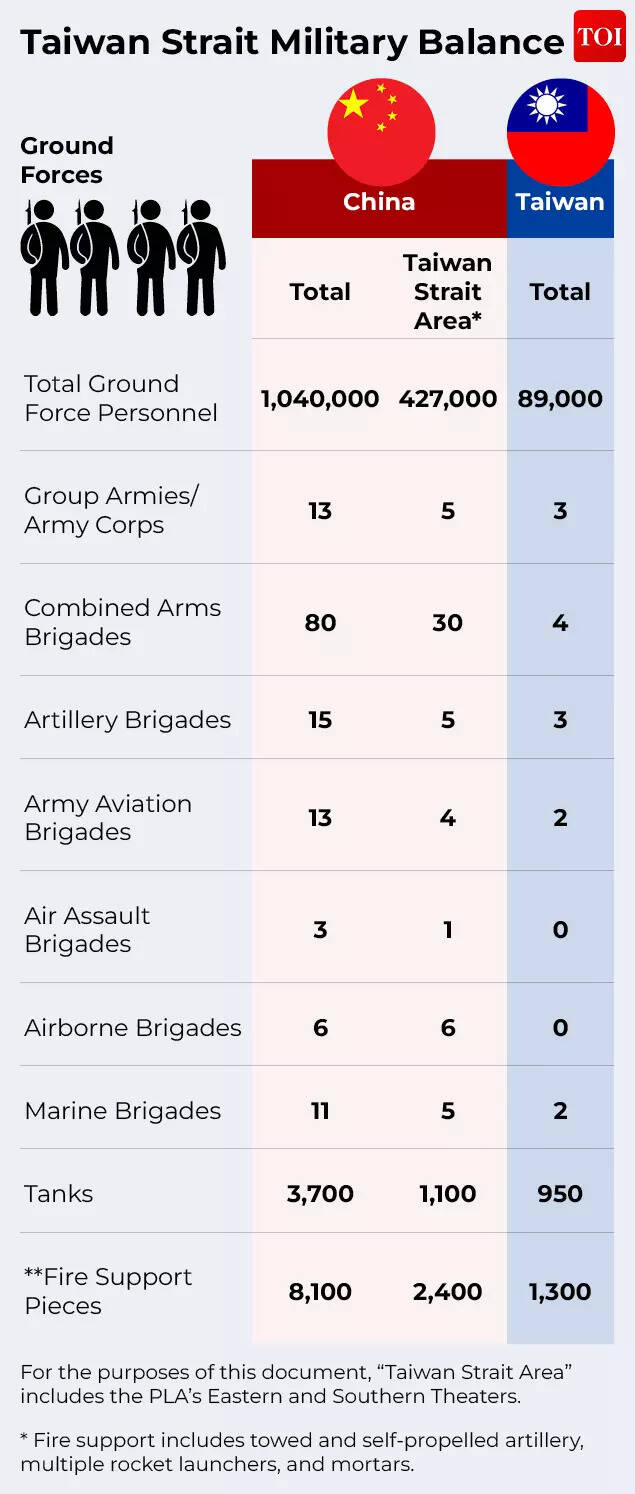
Taiwan Strait Military Balance

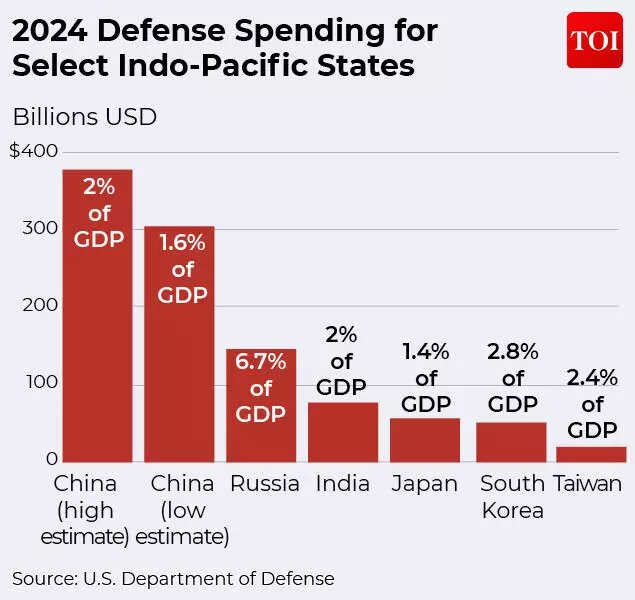
President Lai Ching-te has pledged to raise defense spending toward 3% of GDP, invest in mobile missile systems and drones, and conduct urban resilience drills designed to prepare civilians for sustained pressure.Trump, for his part, has sought to play down the immediate risk. Asked about the Chinese drills, he emphasized his relationship with Xi and said, “I don’t believe he’s going to be doing it.” He also dismissed the exercises as routine: “They’ve been doing naval exercises for 20 years in that area,” according to Bloomberg.Zoom inMilitarily, Taiwan remains one of the hardest targets on earth. Rough seas, narrow beaches, mountainous terrain and dense urban centers complicate any amphibious assault. Taiwan’s forces are increasingly optimized for asymmetric defense – mobile missiles, sea mines and drones designed to turn the strait into a killing zone.And any invasion would almost certainly draw in the US – and likely Japan – raising the risk of a major-power war. That reality underpins deterrence, even as Beijing’s capabilities grow.Yet deterrence is not static. US officials privately worry about the defense industrial base. Taiwan will not receive all of its F-16V fighter jets by the end of 2026 as originally promised. Pacific infrastructure projects – airstrips, ports and fuel depots – remain incomplete.Ely Ratner, who oversaw Indo-Pacific security policy in the Biden administration, has said much of the construction is still happening at peacetime pace – a mismatch with the compressed timeline.The regional angleChina’s pressure campaign is not confined to Taiwan. The Wall Street Journal has reported that Beijing is pairing domestic propaganda – what Mao once called “the pen” – with intimidation of Taiwan’s supporters – “the gun.”That includes sharp warnings to Japan after Prime Minister Sanae Takaichi suggested a Taiwan contingency would involve Tokyo. Chinese coast guard vessels have probed disputed islands, drones have flown near Japan’s westernmost territory, and officials have quietly discouraged Chinese tourism to Japan.

.

The goal, analysts say, is isolation: cutting off Taiwan diplomatically and psychologically, while testing whether its partners will blink.Reality check: The danger aheadHistory suggests that wars often begin not with certainty, but with miscalculation. Overconfidence in Beijing, defeatism in Washington, or panic in Taipei could each prove destabilizing.As a New York Times analysis noted recently, the widening gap between China’s confidence and America’s self-doubt increases the risk that each side misunderstands the other’s resolve.

.

Xi has made Taiwan a personal legacy issue, folded into his vision of national rejuvenation. Yet he has also shown patience, preferring to wait until conditions tilt decisively in his favor.The question hanging over 2026 is whether restraint will still seem wiser than action. Temptation does not guarantee invasion. But as the clock ticks toward 2027, the margin for error is shrinking.Despite the drumbeat of drills and deadlines, most analysts do not see an imminent invasion. China’s leadership understands the staggering risks: military failure, economic sanctions, capital flight and a rupture with the world’s advanced economies.

China and other Asian powers

Many believe Xi still prefers a peaceful outcome – or at least one that avoids a shooting war. Polls in Taiwan, however, show a supermajority now identify exclusively as Taiwanese, suggesting Beijing is losing the “hearts and minds” battle.That demographic and political reality may increase pressure on Xi over time. Taiwan is a legacy issue for him, central to his vision of national rejuvenation. But patience has long been part of Chinese statecraft.What nextThe next two years are likely to bring more of what the region is already seeing: Larger drills, sharper rhetoric, deeper gray-zone pressure – and more arms flowing to Taiwan.For Washington, the challenge is closing the gap between plans and capabilities before 2027 arrives. For Beijing, the challenge is resisting the temptation to believe its moment has arrived.Bottom line: 2027 is less a countdown clock than a stress test – of deterrence, alliance cohesion and Xi’s judgment. The danger is not just war by design, but miscalculation driven by confidence in Beijing and doubt in Washington.


Source link

ED freezes fresh Rs 192-cr deposits of WinZO in money laundering case | India News


ED freezes fresh Rs 192-cr deposits of WinZO in money laundering case

NEW DELHI: The Enforcement Directorate (ED) on Thursday said it has conducted searches at the accounting firm of real money online money gaming app WinZO and has frozen fresh bank deposits, mutual funds and fixed deposits worth Rs 192 crore.The raid at the office premises of the auditor was conducted on December 30.During the search, the federal probe agency said in a statement, “proceeds of crime” (name for illicit funds under the Prevention of Money Laundering Act) possessed by ZO Games Pvt. Ltd. (fully owned Indian subsidiary of Winzo Pvt. Ltd.) worth around Rs 192 crore were frozen.These funds are in the form of bank balances, fixed deposits and mutual funds, it said.In November, the agency had arrested the founders of WinZO — Saumya Singh Rathore and Paavan Nanda following their questioning at the Bengaluru zonal office of the ED.A Bengaluru court granted bail to Rathore a few days ago while a similar relief was denied to Nanda.The ED had conducted the first round of raids in this case in November and had then said that bonds, fixed deposits and mutual funds worth about Rs 505 crore “possessed” by WinZO Games were frozen by it.Reacting to these charges then, a spokesperson for WinZO had said in a statement that “Fairness and transparency are core to how WinZO designs and operates its platform.” The ED has alleged that the company was engaged in “criminal” activities and “unscrupulous” practices as customers were made to play with bots, Artificial Intelligence (AI), algorithms and software named ‘PPP, EP and Persona’ and not humans, without being informed so.“Winzo has also prevented/limited withdrawals of monies held by the customers in the wallets of Winzo Pvt Ltd. and it generated proceeds of crime in the form of ‘Rake Commission’ from the matches played by the bots with the real players on the Winzo app.“In this manner, the company made winnings of around Rs177 crore from the bots between May 2024 to August 2025,” according to the ED.It added that funds of Rs 557 crore were similarly generated between April 2022 and December 2023.The company, the agency alleged, was in possession of users’ monies worth Rs 43 crore, even after the ban on real money online gaming by the Union government (in late 2024).The ED had quantified the total proceeds of crime in this case at about Rs 802 crore.A part of these alleged illicit funds, according to the ED, has been taken out of India to the US and Singapore “under the garb of overseas investments”.Funds worth USD 54 million have been parked in their bank account in the US (bank account held in the name of WINZO US Inc.), which is a “shell” company since all the operations and day-to-day business activities, operation of bank accounts is done from India, the ED claimed.


Source link

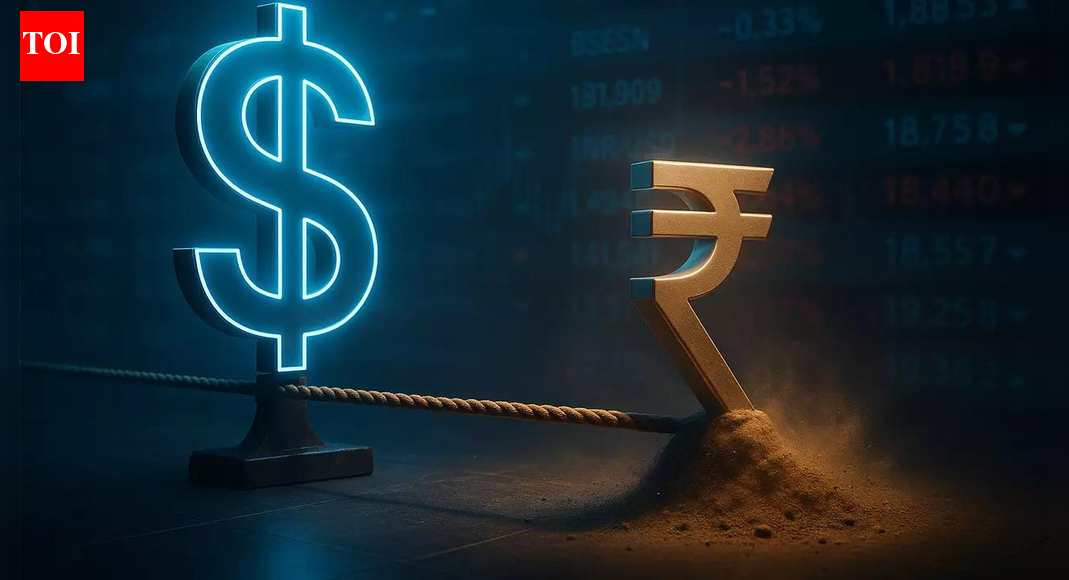
Rupee vs dollar: Currency closes lower at 89.98 in the first 2026 day; what set the tone


Rupee vs dollar: Currency closes lower at 89.98 in the first 2026 day; what set the tone

The rupee slipped 10 paise to close at 89.98 against the US dollar on Thursday, marking a weak start to the first trading session of 2026, as sustained foreign fund outflows and a subdued domestic equity market weighed on investor sentiment, PTI reported.Forex traders said the USD/INR pair moved in a narrow range during the session, with support from easing crude oil prices being offset by a firmer US dollar index and continued outflows by foreign investors. The domestic currency has remained under pressure after ending 2025 with a nearly 5% decline.At the interbank foreign exchange, the rupee opened at 89.94 against the dollar, touched an intra-day low of 89.99 and a high of 89.93, before settling at 89.98 (provisional), down 10 paise from its previous close, according to PTI. On Wednesday, the rupee had depreciated 13 paise to end at 89.88.In 2025, the rupee slumped around 5% amid persistent foreign capital outflows and elevated dollar demand from importers, making it one of the worst-performing Asian currencies.Meanwhile, the dollar index, which tracks the greenback against a basket of six major currencies, was trading 0.09% higher at 98.32. Brent crude, the global oil benchmark, rose 0.78% to $60.85 per barrel in futures trade.Market participants said the currency continued to face pressure due to a risk-off sentiment, driven by capital withdrawals by foreign investors ahead of the holiday period and sustained demand for dollars from importers.On the domestic equity front, benchmark indices ended the first trading session of the year on a flat note. The Sensex slipped 32 points to close at 85,188.60, while the Nifty edged up 16.95 points to 26,146.55.Foreign institutional investors sold equities worth Rs 3,597.38 crore on Wednesday, exchange data showed.On the macroeconomic front, gross GST collections rose 6.1% to over Rs 1.74 lakh crore in December 2025, compared with over Rs 1.64 lakh crore in December 2024, reflecting slower growth in revenues from domestic sales following recent tax cuts, government data released on Thursday showed


Source link

Mitchell Marsh’s 102, Aaron Hardie’s 94 lead Perth Scorchers to emphatic win over Hobart Hurricanes in BBL|15


Perth Scorchers started 2026 in emphatic fashion, securing a dominant 40-run victory over the Hobart Hurricanes at Bellerive Oval. On a day that began with the announcement of Mitchell Marsh as Australia’s permanent T20 captain, the “Bison” celebrated with a ruthless century that set the foundation for a Scorchers masterclass.

Mitchell Marsh, Aaron Hardie power Perth Scorchers to massive total

If there were any lingering doubts about Marsh’s form or his suitability for the Australian T20 captaincy, he shattered them all into the Hobart night sky with a breathtaking century that powered the Perth Scorchers to an colossal 229/3 against the Hurricanes.

This wasn’t just a captain’s knock; it was a statement. A declaration of intent from a man clearly thriving under the weight of expectation. Just hours after being confirmed as Australia’s T20 World Cup leader, Marsh strode to the crease at Bellerive Oval and unleashed a batting exhibition that left fans, commentators, and certainly the Hurricanes bowlers, in awe.

Marsh’s 102 off just 58 balls was a perfectly calibrated assault. He started with typical belligerence, finding the boundary with ease, but shifted gears seamlessly to a truly destructive pace once set. The scorecard tells part of the story: 11 fours and 5 sixes. But it doesn’t quite capture the sheer power and timing behind each one. There was one particular “Golden Moment” in the 14th over where he dismantled Mitchell Owen, going 4, 6, 6, 4 in a brutal display of clean hitting.

And he wasn’t alone in the fireworks! The partnership with the in-form Aaron Hardie (a blistering 94* off 43 balls himself) was simply phenomenal. A 164-run stand that turned a strong start into an utterly dominant one, leaving the Hurricanes chasing a mountain.

Also READ: Fans erupt as Mitchell Marsh lights up BBL|15 with thunderous century against Hobart Hurricanes

Hobart Hurricanes’ chase falters despite spirited middle-order effort

Chasing 230 was always going to require a miracle, and while the Hurricanes showed flashes of brilliance, they were never truly ahead of the required run rate. Hurricanes began with intent, with Tim Ward providing early momentum through a brisk 27 off 17 balls. However, the required rate quickly escalated, forcing Hobart’s batters into high-risk shots. Contributions from Nikhil Chaudhary (31 off 15) and Matthew Wade (29 off 14) briefly reignited hopes, as the Hurricanes kept the chase alive through the middle overs.

Despite a flurry of boundaries, Hobart never truly seized control of the chase. Regular wickets halted any sustained momentum, and the asking rate climbed beyond reach. Ashton Agar was the standout with the ball for Perth, claiming three crucial wickets to break the Hurricanes’ spine, while Hardie and Joel Paris chipped in with timely breakthroughs. Hobart eventually closed on 189 for 9, falling well short of the towering target.

Also READ: BBL|15: Sean Abbott, Babar Azam star in Sydney Sixers’ thrilling win over Melbourne Renegades


Source link

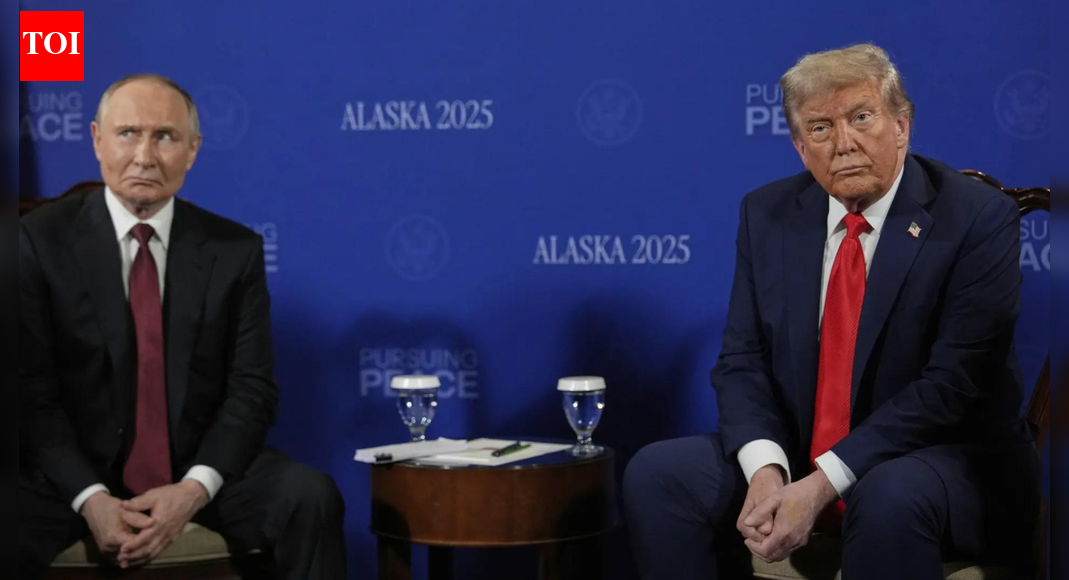
‘Turn up the heat’: Trump shares editorial critical of Putin; move amid failing Russia-Ukraine talks


'Turn up the heat': Trump shares editorial critical of Putin; move amid failing Russia-Ukraine talks

US President Donald Trump on Wednesday (local time) amplified pressure on Russian President Vladimir Putin by sharing a sharply worded editorial that urges Washington to abandon concessions and adopt a tougher line against Moscow. The move came amid mounting frustration over stalled Ukraine peace efforts.The editorial titled Putin ‘attack’ bluster shows Russia is the one standing in the way of peace and published in New York Post said that Russia was “opposing Trump’s agenda” across the world. It further asked to avoid giving the country “more concessions” and opt for a “bigger stick.” “The answer should not be more concessions, but a bigger stick. Kyiv has done its part. The onus should be on Putin to step up or face more stringent sanctions and more deadly weapons in Ukraine,” the editorial said.“Despite his defiance, Putin’s actions smack of a deteriorating internal situation. His economy is stagnating. Propaganda is flailing as soldiers return with missing limbs. His victory is neither imminent nor inevitable. Spare us his crocodile tears and turn up the heat,” it said.The editorial points to Trump’s upbeat assessment earlier in the week following his meeting with Ukrainian President Volodymyr Zelenskyy on advances toward a peace agreement, and contrasts it with the setback that followed on Monday after Trump’s phone call with Putin, during which the Russian leader said Moscow would harden its stance in the talks, citing an alleged Ukrainian drone attack on one of his residences.Russian authorities on Thursday accused Ukraine of carrying out a drone attack that left 24 people dead and at least 50 injured during New Year celebrations in a Russian-held village in Ukraine’s Kherson region, underscoring the sharp escalation in hostilities even as diplomats spoke of progress in peace efforts. Zelenskyy, meanwhile, said that Russia has carried its nearly four-year-long war into the New Year by launching more than 200 drones at Ukraine, with the attacks largely aimed at the country’s energy facilities.“Russia deliberately brings war into the New Year -– launching more than two hundred attack drones against Ukraine overnight,” he


Source link

‘Ceiling on fire’: Panicked partygoers smashed windows; witnesses recount Swiss bar horror


'Ceiling on fire': Panicked partygoers smashed windows; witnesses recount Swiss bar horror

NEW DELHI: Panicked partygoers smashed windows and fought through smoke and flames to escape a deadly fire that tore through a packed New Year celebration at a bar in Switzerland’s luxury ski resort of Crans-Montana, where dozens are feared dead and more than 100 people were injured, according to Swiss authorities. Witnesses described scenes of chaos, screaming crowds and parents rushing to the area in fear that their children were trapped inside.A witness who spoke to French broadcaster BFMTV said he saw people breaking windows to flee the blaze, some of them gravely injured, while panicked parents arrived in cars trying to find out whether their children had managed to escape. Watching from across the street, the young man said he saw around 20 people scrambling out through smoke and flames, likening the scene to a horror movie.

Happy New Year: Watch How World Welcomed 2026, From New York To Paris To Dubai To Auckland

Also read: Deadly fire ravages New Year celebration at luxury Swiss ski resort; dozens feared dead, 100 injured — what we know so far

‘The entire ceiling was on fire’

Two French women, Emma and Albane, who were inside the basement-level La Constellation bar when the fire broke out shortly after midnight, told BFMTV that panic erupted within seconds.“It was absolute panic, everyone was screaming,” they said, describing how crowd movement became uncontrollable as the flames spread.“One of them (candles – editor’s note) was brought too close to the ceiling, which caught fire. In a few dozen seconds, the whole ceiling was on fire. Everything was made of wood,” one of the women said.According to their account, the party was taking place in the basement when the fire quickly spread to the upper level of the venue.

Windows smashed as exits proved inadequate

The women said the main exit was too small for the number of people inside, forcing some to take desperate measures to escape.“The exit door was quite small compared to the number of people present. Someone broke a window so that people could get out,” one of them told BFMTV.They said firefighters and police arrived “within minutes,” but the flames were already dangerously close. “We had flames a meter away from us; if we hadn’t run away, we would surely have been injured too,” one of the women said.One of the witnesses also said she was injured during the stampede-like escape. She recounted being “thrown down the stairs” by the surge of the crowd, injuring her knee.

Young crowd feared among victims

While officials have not yet confirmed the final number or identities of those killed, the two women estimated that around 200 people were inside the bar at the time of the fire. They said many were minors, aged between 15 and 20.Accounts of parents rushing to the scene echoed fears that many young people were trapped as the fire engulfed the wooden structure.

Probe under way as rescue continues

Swiss authorities said rescue and identification efforts were continuing, with the area around the bar sealed off and a no-fly zone imposed. According to Reuters, the Valais canton prosecutor said an investigation was under way “to identify the circumstances which caused this dramatic situation to occur,” adding that “currently we are favouring a fire and at no time is there question of any attack.”For survivors and witnesses, the terror of the night remains raw. As one witness told BFMTV, the scenes unfolding in and around the bar felt less like a New Year celebration and more like a nightmare that unfolded in seconds.


Source link

‘Slow death’ – R Ashwin’s chilling warning on ODI cricket after Virat Kohli-Rohit Sharma era | Cricket News


'Slow death' – R Ashwin's chilling warning on ODI cricket after Virat Kohli-Rohit Sharma era
Rohit Sharma and Virat Kohli (ANI)

Former India off-spinner Ravichandran Ashwin has raised serious doubts over the long-term future of One-Day International cricket, warning that the format could struggle to survive beyond the 2027 World Cup once Virat Kohli and Rohit Sharma step away. Ashwin acknowledged the excitement generated by Kohli and Rohit’s recent appearances in the Vijay Hazare Trophy but pointed out that the growing dominance of T20 leagues, coupled with Test cricket’s enduring value, is steadily squeezing the space available for 50-over cricket.

Can Virat Kohli chase down Sachin Tendulkar’s hundred hundreds?

“I am not sure about future of ODI after 2027 World Cup. I am a little worried about it. Of course, I am following Vijay Hazare Trophy but the manner in which I followed SMAT, I am finding slightly difficult to follow,” Ashwin said on his Hindi YouTube channel Ash Ki Baat. He stressed that audience preference can no longer be ignored while shaping the game’s future. “Also, we need to know what audience wants to watch. I feel Test cricket still has space but ODI cricket, I truly feel it doesn’t have the space,” he said, offering a blunt assessment of the format’s current standing. Ashwin, India’s second-highest wicket-taker across formats with 765 dismissals, underlined how heavily ODI cricket still leans on the presence of its biggest stars. With Kohli and Rohit sharing 86 ODI centuries between them, their influence remains central to the format’s relevance. “Look, Rohit and Virat came back to Vijay Hazare Trophy and people started watching it. We have known that sport is always bigger than individuals but at times these players need to come back to make the game relevant,” he observed. Referring to domestic one-day cricket, Ashwin added, “Vijay Hazare Trophy, of course, is a domestic competition that not a lot of people follow, but they did because Virat and Rohit were playing. Even then, what happens when they stop playing ODIs?” Ashwin also spoke about how the nature of ODI batting has shifted dramatically under the influence of T20 cricket. He recalled a time when the format allowed players to build innings patiently, citing MS Dhoni as the perfect example. “One-day cricket, once upon a time, was an amazing format because it gave a player like MS Dhoni who would take singles for 10-15 overs before he went berserk at the end,” he said. According to Ashwin, that style has all but disappeared. “You don’t have players like that anymore and there isn’t any requirement to play like that, as you are playing with two new balls and five fielders inside circle,” he said, describing modern ODIs as being played in just two extremes, either all-out attacking or complete collapse on tougher pitches. Turning his attention to the international calendar, Ashwin urged the ICC to rethink its approach, while acknowledging the importance of revenue for the sport’s sustainability. “The ODI format has become redundant and to top it, ICC needs to see how they are conducting these World Cups. Every year, there is an ICC tournament for revenue generation pattern, but then look at how FIFA is doing it,” he said. He compared cricket unfavourably with football’s global structure. “There are leagues happening and they do their World Cup once in every four years. The World Cup is having value as it’s a marquee tournament. Too many bilaterals, too many formats, too many World Cups, so it’s a little bit of an overkill,” Ashwin added. Ashwin also suggested that certain match-ups in the upcoming T20 World Cup, such as India facing USA or Namibia, could risk alienating viewers rather than attracting them. When asked about possible solutions, Ashwin offered a stark proposal for preserving ODI cricket’s relevance. “If you really want to make ODI cricket relevant, then just play these leagues and play ODI World Cup once in four years, so when people turn up for events, there will be sense of expectation,” he said. Summing up his concerns, Ashwin concluded with a grim warning for the format’s future. “I feel it is going towards slow death.”


Source link