Breaking News
Hyderabad startup SmartGreen Aquaculture sets up India’s 1st inland trout farming project in Hyderabad


Hyderabad startup SmartGreen Aquaculture sets up India's 1st inland trout farming project in Hyderabad

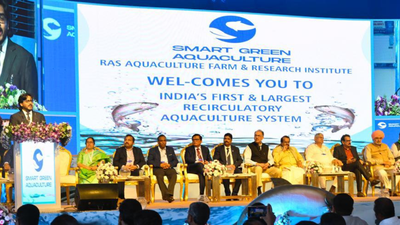
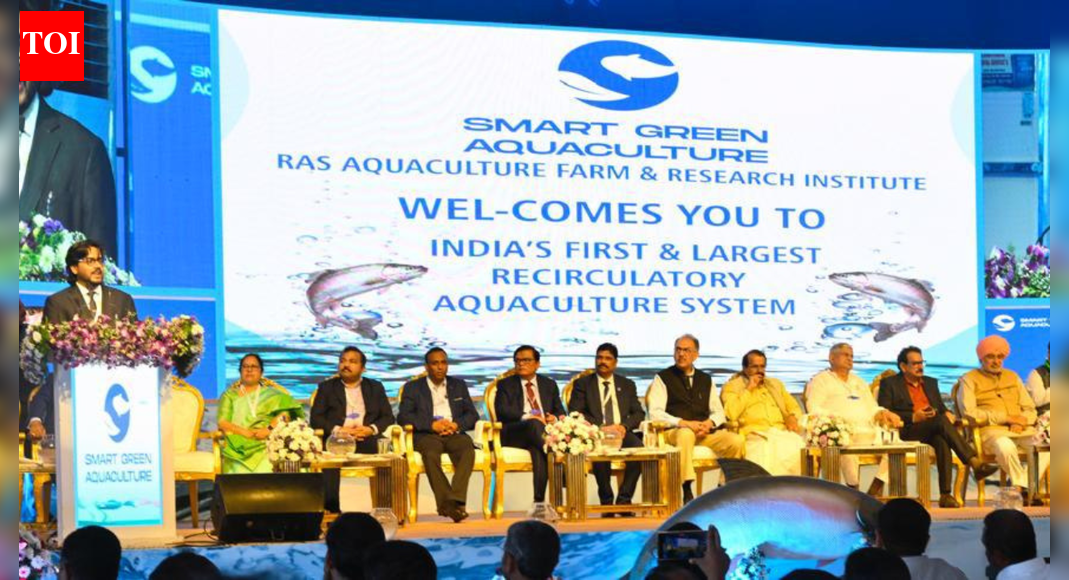
HYDERABAD: SmartGreen Aquaculture (SGA), a Hyderabad-based startup, has set up what is touted as India’s first inland, premium trout farming facility in Kandukur mandal of Telangana’s Ranga Reddy district, on the outskirts of Hyderabad, at an initial investment of $6 million (approx. Rs 54 crore).The facility, based on the sustainable recirculating aquaculture system (RAS) technology that enables year-round trout production in a controlled, biosecure indoor environment, will have a total production capacity of 1200 metric tonnes per annum and will create around 200 jobs.The facility houses a dedicated two-acre hatchery and indoor grow-out system operated under RAS, on-site processing for value-added rainbow trout products, cold-chain facilities as well as an online store to deliver directly to consumers.The company also plans to set up a flexi-scale premium microalgae biorefinery on the farm campus in addition to a skill centre for RAS.Inaugurating the first phase of the aquaculture farm and research institute, Union minister for fisheries, animal husbandry & dairying and Panchayati Raj, Rajiv Ranjan Singh (Lalan Singh) termed smart green aquaculture as a shining example of the innovation driving the country’s startup ecosystem.He said SGA’s harnessing of advanced technology to farm cold-water fish in warmer climate of a region like the Deccan Plateau was a remarkable feat akin to extracting oil from sand. He said the RAS technology increases production manifold and helps create high value products that have the potential to contribute greatly to exports.Union mines minister G Kishan Reddy said such innovative projects that can cultivate specialised fish species in warmer inland regions reflect the promising future of Indian aquaculture.“Trout farming in India has traditionally been limited by geography. Our precision engineered trout farm demonstrates that advanced closed-loop water system aquaculture technologies using RAS successfully brings premium cold-water species like rainbow trout closer to Indian consumers,” said 31-year-old engineer-turned-aquaculture entrepreneur Aditya Rithvik Narra, who is the founder and managing director of Smart Green Aquaculture.“By integrating hatcheries, farming, processing, and e-commerce under one roof, we are reducing dependence on imports and intermediaries,” he explained.


Source link

Access Denied


Access Denied

You don’t have permission to access “http://www.ndtv.com/world-news/nicolas-maduro-trial-juan-orlando-hernandez-donald-trump-us-venezuela-updates-drug-trafficking-10351301” on this server.

Reference #18.f5493417.1767632657.23083024

https://errors.edgesuite.net/18.f5493417.1767632657.23083024


Source link

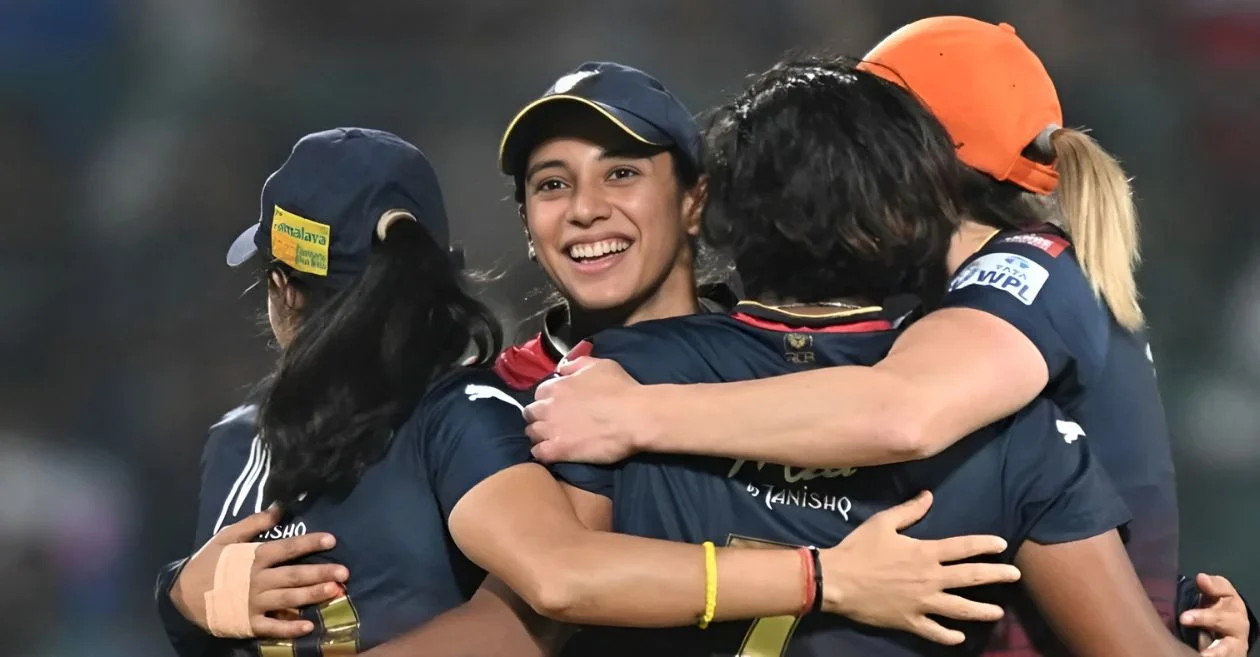
WPL 2026: RCB’s best playing XI for the Women’s Premier League


Royal Challengers Bengaluru (RCB) is entering a new era. After the high of their Women’s Premier League 2024 title and the disappointment of 2025, the franchise underwent a massive tactical overhaul during the November 2025 Mega Auction.

RCB superstar Ellyse Perry withdrawn from WPL 2026

However, the biggest shockwave hit the camp just three days ago: Ellyse Perry has officially withdrawn from WPL 2026 due to personal reasons. In her place, RCB have signed Mumbai’s domestic standout Sayali Satghare. This unexpected shift has forced the management to pivot from ‘star-power reliance’ to a more balanced, role-based ‘Indian core’ strategy. With the season opener against Mumbai Indians scheduled for January 9 at the DY Patil Stadium, the team is scrambling to integrate new international signings like Lauren Bell and Grace Harris into a unit that must now learn to thrive without its greatest legend.

RCB’s best playing XI for WPL 2026

1. Smriti Mandhana (Captain): The heartbeat of the franchise, Smriti enters 2026 after a prolific international season where she dominated the 2025 Women’s World Cup on home soil. Her role as the aggressive anchor is more critical than ever in Perry’s absence; she remains the most expensive Indian player in league history and is currently averaging 38.45 in T20Is over the last 12 months with a strike rate of 138.

2. Georgia Voll (Overseas – AUS): Signed for INR 60 Lakh at the mega auction, Voll is the explosive solution to RCB’s opening woes. A rising star from the Big Bash, she recently made headlines by becoming one of the youngest to score a domestic T20 century. Her ‘see-ball, hit-ball’ approach allows Mandhana the freedom to settle, providing RCB with a much-needed right-left dynamic at the top.

3. Dayalan Hemalatha: Secured for INR 30 Lakh, Hemalatha is the tactical bridge in the top order. After a resurgent 2025 international season where she showcased her ability to take on spin in the middle overs, she provides the stability required at Number 3. Her experience in high-pressure Indian conditions makes her a reliable backup to the aggressive openers.

4. Grace Harris (Overseas – AUS): The ‘powerhouse’ of the middle order, Harris was a steal at INR 75 Lakh. With a career T20I strike rate of 155+, she is the designated ‘spin-killer.’ In a lineup missing Perry’s stability, Harris’s ability to clear the boundary at will and her handy off-spin make her the most important overseas player in the XI.

Also READ: BCCI announces complete schedule for WPL 2026; Royal Challengers Bengaluru will battle Mumbai Indians in the opener

5. Richa Ghosh (Wicketkeeper): The premier finisher in world cricket, Richa’s stock has never been higher. Coming off a blistering 40 (16)* in the 4th T20I against Sri Lanka just last week, she enters WPL 2026 in red-hot form. Her power hitting in the “death overs” (overs 16-20) remains RCB’s biggest weapon to turn 150-run totals into 180+.

6. Nadine de Klerk (Overseas – SA): Re-signed for INR 65 Lakh, de Klerk is now the frontline seam-bowling all-rounder following Perry’s exit. She proved her worth in the 2025 World Cup semi-finals with a match-winning 2-wicket haul. She provides the “glue” in the lower middle order, capable of playing long innings or providing 4 overs of disciplined medium-pace.

7. Pooja Vastrakar: RCB broke the bank to secure India’s premier pace all-rounder. Vastrakar brings elite death bowling and lower-order pyrotechnics. After a 2025 international season where she became India’s leading wicket-taker in the Powerplay, her dual-threat capability offers RCB the balance they lacked in previous years.

8. Shreyanka Patil: The ‘Purple Cap’ hero of 2024 is back to full fitness after a frustrating 2025 sidelined by a shin injury. Her return is a massive boost; she recently proved her rhythm in the Women’s CPL 2025, and her ability to bowl the tough overs in the Powerplay and at the death with her off-spin is unmatched in the league.

9. Radha Yadav: A high-intensity left-arm spinner and world-class fielder, Radha was brought in to bolster the spin department. Her international experience of 75+ T20Is and her ability to squeeze runs in the middle overs (economy of 6.40 in 2025) makes her the perfect partner for Shreyanka.

10. Arundhati Reddy: Reddy joins RCB for INR 75 Lakh after a career-best year that saw her reclaim her spot in the Indian national side. Known for her “never-give-up” attitude and a deadly yorker, she provides the third seam option. Her recent international form includes 7 wickets in the T20 World Cup, the joint-most for India.

11. Lauren Bell (Overseas – ENG): RCB’s most expensive auction buy at INR 90 Lakh, “The Shard” is the pace spearhead. Standing 6’2″, the England international generates bounce and swing that is rare in the WPL. Currently ranked in the ICC Top 5 for T20I bowlers, her opening spells will be the key to breaking opposition top orders.

Tactical Breakdown

  • The Opening Pair: With Sophie Devine moving to Gujarat Giants, RCB secured Georgia Voll, who holds the joint-highest score in WPL history. She will partner Smriti Mandhana to provide a right-left explosive start.
  • The Power Middle-Order: Grace Harris is a massive acquisition from the auction. Her ability to dismantle spin and pace makes her the primary engine of this lineup. Richa Ghosh continues her role as the finisher who can also anchor if the top order collapses.
  • The Perry Replacement: While Sayali Satghare has joined as a replacement, she may start on the bench as RCB utilizes their four overseas slots for Harris, Voll, de Klerk, and Bell. Nadine de Klerk provides the seam-bowling all-rounder balance that Perry once offered.
  • Indian Bowling Core: RCB have one of the strongest Indian bowling units this year. Pooja Vastrakar and Arundhati Reddy provide international-quality pace, while the spin duo of Shreyanka Patil and Radha Yadav will be lethal on the dry tracks in Navi Mumbai and Vadodara.
  • Overseas Pace: Lauren Bell will lead the attack with her ability to swing the new ball, a crucial factor in the evening matches in Navi Mumbai.

Impact Player Options

  • Sayali Satghare: If the pitch favors pace, she can come in for one of the spinners.
  • Linsey Smith: An excellent left-arm orthodox option if the team decides to bench an overseas pacer for an extra spinner.

Also READ: Lauren Bell reacts after becoming the most expensive buy for RCB in WPL 2026 Auction

This article was first published at WomenCricket.com, a Cricket Times company.


Source link

Budget 2026: When retirement becomes a tax trap – why India’s salary earners need urgent relief


Budget 2026: When retirement becomes a tax trap - why India’s salary earners need urgent relief
India’s salaried class feels squeezed—not because they don’t want to pay taxes, but because the system increasingly treats retirement savings as a luxury. (AI image)

For a country that prides itself on a thriving middle class, India’s tax treatment of retirement savings has begun to feel oddly out of step with economic reality. Over the past few years, a series of amendments—presented as “rationalisations”—have quietly created a minefield for salaried employees who believed they were doing the right thing by saving for their future.Three provisions stand out for the burden they impose: taxation of employer contributions to provident and superannuation funds beyond ₹7.5 lakh; yearly taxation of accretions on such excess contributions; and taxation of interest earned on the employee’s own PF contributions above ₹2.5 lakh. In isolation each may appear technical. Together, they are reshaping retirement planning in ways that leave employees with little clarity, greater financial anxiety, and a rising tax bill on income they do not even receive today.A tax before the benefit arrivesThe first shock for employees came with the Finance Act, 2020, which capped employer contributions to recognised PF, approved superannuation funds and NPS at ₹7.5 lakh per year. Anything above that—common for senior professionals, mid-level employees in high-cost cities, and those in organisations with generous retirement policies—became taxable as a perquisite.But what stings more is that annual accretion—interest, dividend or similar growth—on this “excess contribution” is also taxed every single year. This is a tax on notional income, long before the employee sees a rupee of it.Many describe this as an upfront penalty on saving. Unlike bonuses or cash payments, retirement contributions are locked in for the long term. Yet tax is now collected today on money that may only be received decades later. That mismatch between tax incidence and actual receipt has become a major pain point.When exemption isn’t really exemptionThe hardship intensifies when the National Pension System comes into play. While the government justified taxing excess employer contributions by calling PF, superannuation and NPS an “EEE regime”, the law doesn’t fully support that claim.Under Section 10(12A), up to 60% of the NPS corpus can be withdrawn tax-free upon closure of the account or opting out of NPS. The remaining 40% must be used to purchase an annuity plan from a life insurance company, and the pension received from this annuity is fully taxable. Employees therefore argue that the premise of an entirely exempt regime is not accurate.Taxing the employee’s own PF savingsThe Finance Act, 2021 introduced another hit: PF interest earned on the employee’s own contribution beyond ₹2.5 lakh per year is taxable.For many mid-career employees, PF is the only disciplined savings instrument they rely on. A high PF contribution isn’t a luxury; it is a way to secure the future in the absence of universal social security.Yet the law now characterises high contributions—even when mandatory or part of salary structure—as an attempt to “enjoy full exemption”. The sting is sharper for those whose basic salary is high enough that the statutory 12% PF contribution itself may cross the ₹2.5 lakh threshold, triggering tax on interest even when the employee never intended to “over-contribute”. This change is seen as especially harsh in a country where inflation erodes purchasing power and pension adequacy is already a concern.“Also, these changes all appear to be part of the ultimate aim of the government to do away with all deductions and exemptions and make the ‘new tax regime’ the only regime available for all taxpayers,” says Ameet Patel, partner, Manohar Chowdhry & Associates.The bigger picture: When rules punish good behaviourAcross these provisions, a consistent theme emerges:India now taxes retirement savings more aggressively. Employees who save diligently, especially mid- to senior-level workers, face:

  • Tax on employer contributions beyond ₹7.5 lakh
  • Tax on the growth of such contributions
  • Tax on interest from their own PF contributions beyond ₹2.5 lakh
  • Tax on NPS pension at retirement
  • Tax again if early withdrawal triggers PF conditions

The result is that long-term savings face multiple tax points.Why reform is requiredThere is growing consensus across industry bodies that these provisions need urgent review. The argument is not about giving employees a windfall—it is about ensuring fairness and a safety net. With an ageing population, lack of a universal social security system applicable to all citizens, and rising cost of living, the existing provisions are detrimental . India’s salaried class feels squeezed—not because they don’t want to pay taxes, but because the system increasingly treats retirement savings as a luxury rather than a necessity. What was once a predictable, trusted savings pathway is now layered with caps, tax triggers, and compliance complications.“And this compounds the problems that the ageing population faces when insurance companies either refuse to issue new health policies to senior citizens or charge such high premia on the policies that having a Mediclaim policy becomes extremely expensive for such retired persons. As and when such a person needs large amounts to be paid to hospitals for medical treatments, the depleted savings are often inadequate and the entire family is put under huge financial stress,” concludes Patel.


Source link

Why does aluminium foil spark in a microwave but not in an oven |


Why does aluminium foil spark in a microwave but not in an oven

Domestic kitchens contain heating technologies that operate on distinct physical principles, yet they often appear interchangeable in everyday use. Aluminium foil is a routine accessory in conventional cooking, used to shield food surfaces or retain moisture, and it is generally unremarkable when placed in a standard oven. The same material behaves very differently inside a microwave oven, where its presence can provoke sudden flashes, crackling sounds, and visible electrical discharge. These effects are widely recognised in household safety guidance and have been examined in laboratory settings concerned with electromagnetic exposure and material response. The contrast arises from differences in energy delivery, field geometry, and the interaction between metals and electromagnetic radiation within confined spaces.

What happens when microwave energy hits aluminium foil

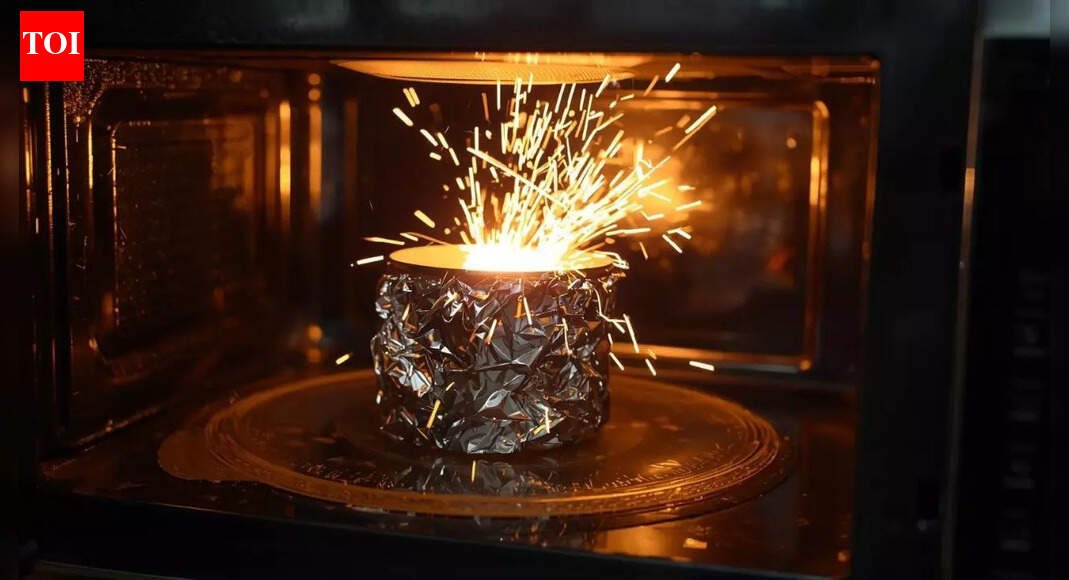
Microwave ovens are able to produce heating energy from microwave radiation at around 2.45 GHz. Many reflections of microwaves travelling through the cavity generate a standing-wave configuration within the metallic surface (the “Oven”). The introduction of an object made from metal (aluminium foil, for example) generates oscillations through the motion of the electric field. When the field exceeds the breakdown threshold of air, electrons are stripped from gas molecules, producing ionisation and a visible spark. This process has been described in experimental studies of metal objects exposed to microwave fields, published in Materials, where arcing was observed to originate preferentially from sharp features rather than smooth surfaces. Measurements reported in the literature show that even thin household foil can support sufficient current density to initiate discharge under typical microwave power levels.

Why foil edges and folds trigger sparks

The likelihood of sparking is governed less by the mass of metal than by its shape and placement. Flat, smooth metal plates can sometimes reflect microwave energy without immediate discharge, while crumpled foil presents multiple points of curvature with small radii. At these points, electric charge accumulates unevenly as the alternating field reverses direction billions of times per second. The rapid oscillation prevents charge dissipation through grounding, since the foil is usually electrically isolated from the oven walls. As a result, voltage differences arise across very short distances. Laboratory observations have shown that sparks often leap from foil edges to nearby air or to the oven cavity, following the shortest available path. Plasma-like electric discharges can occur and last for only microseconds duration. Repeated discharge events can destroy the inner components of the microwave oven and can create holes in the foil. The basic electromagnetic boundary conditions that create the discharge are the basic cause of the problem, i.e., there is little or no thermal heating caused by direct exposure to the heating elements.

How do conventional ovens heat aluminium foil safely?

The method used for producing cooking energy in a conventional oven is thermal energy released via hot air, thermal energy generated by the elements (in the oven), and via the rack/trays or other surfaces of the conventional oven. The energy involved is carried by moving molecules and infrared radiation, not by a coherent electromagnetic field oscillating at microwave frequencies. Aluminium foil placed in such an environment absorbs heat gradually from its surroundings. Its high thermal conductivity allows it to distribute that heat across its surface, but there is no mechanism for inducing large electrical currents. Without rapidly alternating electric fields, charge does not accumulate at edges in the same way, and the surrounding air remains electrically neutral. Temperatures in ovens can be high enough to soften or oxidise aluminium, yet these processes occur over minutes rather than microseconds and do not involve electrical breakdown. Observations from materials science show that aluminium remains chemically and electrically stable under typical oven conditions, provided it is not in contact with exposed heating elements that could cause localised overheating.

How does energy behave differently in microwaves and ovens?

The two appliances also differ in how and where the energy is contained or released. In terms of design, microwave ovens are constructed as resonators, keeping electromagnetic energy until such time as the energy is absorbed by food products, or the electromagnetic (radio) energy dissipates into the surrounding air (heat). This effect occurs primarily due to the efficiency of reflection caused by the metallic walls of the cavity, along with their compact size and high intensity of electromagnetic fields contained in the cavity. In most instances, the placement of non-intended (unplanned) conductors causes local increases in electromagnetic fields in the vicinity of the conductor, as opposed to allowing a more uniform absorption of energy. Conventional ovens do not act as resonators for electromagnetic energy; the heat energy produced by such an oven spreads outwards through convection- and radiation-based processes ranging from the reflections of walls or other surfaces to the heat energy of a convection/ radiative oven. The aluminium foil, therefore, experiences a diffuse thermal environment rather than a structured field pattern. Reports comparing these appliances note that the absence of sparks in ovens is not due to any special property of foil, but to the lack of conditions required for electrical discharge. The material responds predictably to heat, while remaining largely inert to the modes of energy transfer present in conventional cooking.Also Read | Why you should never kill a centipede in your home


Source link

On This Day: When 15-year-old Pranav Dhanawade stunned cricket with 1,009 runs | Cricket News


On This Day: When 15-year-old Pranav Dhanawade stunned cricket with 1,009 runs
Pranav Dhanawade (X-Cricbuzz)

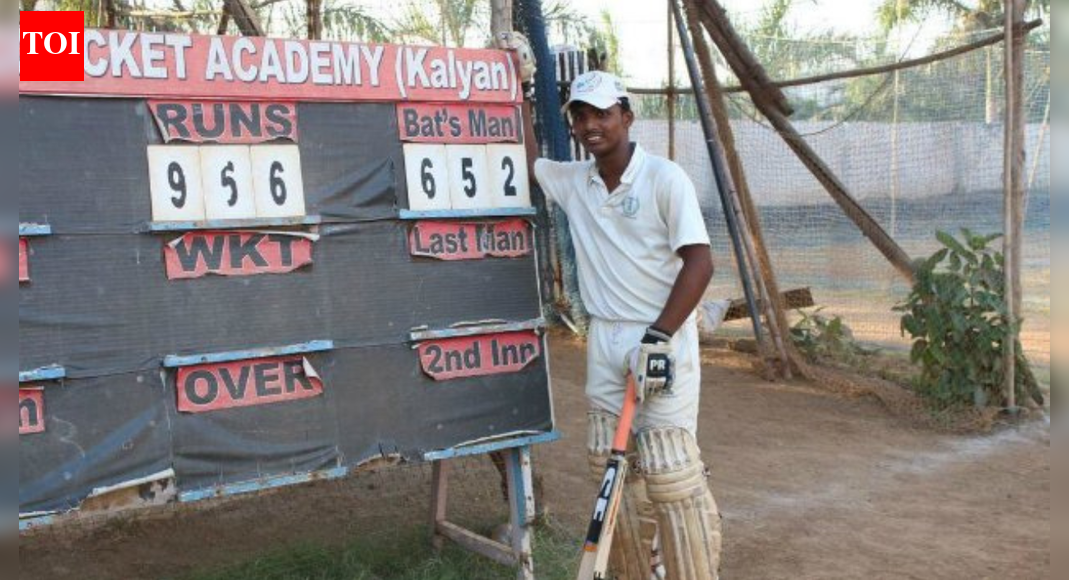
On this day ten years ago, a quiet patch of ground in a Mumbai suburb became the centre of the cricketing world. There were no grandstands, no roaring crowds, and no television history attached to it. Yet on 5 January 2016, it witnessed an innings that school cricket had never seen before.Pranav Dhanawade was fifteen. He opened the batting for Smt KC Gandhi School in a two-day inter-school match for the HT Bhandari Cup. By the time his team declared, he had scored 1009 not out off 327 balls. It was the first time anyone had crossed four figures in a recognised school match. A 117-year-old record was gone. Arthur Collins’ 628 from 1899 was history.

Bangladesh seek T20 WC match shift from India after Mustafizur Rahman’s IPL exit

The numbers still feel unreal a decade later. One thousand and nine runs. One hundred and twenty-nine fours. Fifty-nine sixes. A strike rate of 308.56. He spent 396 minutes at the crease, batting for over six and a half hours across two days. His team finished on 1465 for 3. Pranav alone had scored close to seventy per cent of the total.Pranav started cautiously. At lunch on the first day, he was on 45. By stumps, he had raced to 652 not out. Somewhere during that long evening, phones began ringing in the Dhanawade household. Friends and relatives called to say records were falling. By the time he walked off, he had already gone past Prithvi Shaw’s Indian school record of 546 and Arthur Collins’ mark that had stood for more than a century.Tuesday morning arrived with a new target in mind. One thousand. Reporters started turning up. Curious locals leaned against the fence. By lunch, Pranav was on 921. After the break, he crossed four figures. There was no celebration that matched the moment, just a young boy raising his bat on a dusty field as cameras scrambled for space.“I wanted to score big runs,” he later told The Indian Express. “I remember my coach telling me that no one will take me in the Mumbai team if I score these hundreds and two-hundreds.”When he went out to bat, the plan was simple. “When I go to bat, I only keep in mind that I had to play a big innings,” he told the BBC. “After playing on and on, I scored 100 runs, 200, 300, 400 runs.”There was luck along the way. A few catches were dropped. A stumping chance went begging. The boundaries were short and the opposition inexperienced. None of that takes away the stamina it required to stay there, ball after ball, session after session.The umpire noticed it. “I would say he was 101% fit temperamentally, and even after scoring so much, he was not tired,” Sunimal Sen told ESPNcricinfo. “Many times we see that batsmen, after scoring a hundred, say ‘Sir, we want water’, but he did not create this type of disturbance.”By the end of the match, Arya Gurukul were bowled out for 56 in their second innings. Smt KC Gandhi School won by an innings and 1382 runs. The result barely mattered anymore.Pranav’s father, Prashant, drives an autorickshaw around Kalyan. On the first day, a friend called him mid-shift. “Your son has 300 and won’t stop,” he said. Prashant rushed to the ground, watched another flood of runs, then returned the next morning with Pranav’s mother, Mohini, to see the moment everyone was waiting for.By Tuesday evening, the narrow lanes around Wayale Nagar were blocked by television vans. Prashant and Mohini gave interview after interview, barely catching their breath. Their son was being spoken about across the world.The Guardian called him “the first cricketer to navigate the nervous 990s”. Sachin Tendulkar posted on social media, congratulating him and urging him to work hard and “scale new peaks”. Ajinkya Rahane sent a message. MS Dhoni spoke about the importance of guidance. “To score like that anywhere, at that age, is very difficult,” he said. “The limelight will be on him, and it is important for his coach and parents to guide him right.”Michael Atherton mentioned the innings during a Test match broadcast. Maharashtra’s sports minister announced support for his education and coaching. Comparisons followed quickly. Too quickly, perhaps.Mumbai has always produced prodigies. Tendulkar and Vinod Kambli once put on 664 runs together as teenagers. Sarfaraz Khan scored 439 at twelve. Prithvi Shaw made 546 at fourteen. Pranav’s 1009 joined that list, louder and larger than all before it.Years later, the story sounded different. Pranav, now in his mid twenties, spoke about inconsistency, missed selections, and the weight of expectation. The pandemic took away opportunities. Others from his age group moved ahead. He was still chasing a place.“The expectation was huge after the record,” he admitted. “Every time I walked out to bat, I felt the pressure,” he told Cricket Graph.Yet the meaning of that day has not faded. On this day ten years ago, a boy from a modest family stood at a crease and refused to get out. For two days, cricket stopped being about levels and pathways and became something simpler. Bat. Ball. Time. A reminder that sometimes, history chooses the most unexpected corners to announce itself.


Source link

Trump warns of more tariffs if India does not make him happy


Trump warns of more tariffs if India does not make him happy
US President Donald Trump (AP)

TOI correspondent from Washington: US President Donald Trump is claiming that India is keeping him happy by meeting his demands to stop buying Russian oil, warning that failing to do so will result in his raising even higher tariffs “very quickly.“They (India) wanted to make me happy…Modi is a good guy….he knew I was unhappy…and it was important to make me happy,” Trump told reporters on Air Force One, interjecting as US. Senator Lindsay Graham was explaining how the threat of tariffs is effective in forcing countries to stop buying Russian oil as part of Washington’s purported efforts to starve Moscow of oil revenues that it says is funding the war.Graham himself claimed that he was at Indian Ambassador Vinay Kwatra’s residence a month ago and “all he (the ambassador) wanted to talk about was how India is buying less Russian oil.”“And he asked me to tell the President to relieve the 25% tariff… this stuff works… I really believe what he did with India is the chief reason why India is buying substantially less Russian oil,” Graham asserted. Graham is the chief proponent of the Sanctioning Russia Act of 2025, a legislation designed as a “sledgehammer” to force a conclusion to the Russia-Ukraine war by targeting the economic lifelines of the Russian military. Introduced in April 2025 as a legal shield for the executive to protect it from challenges to tariffs in courts, as is currently happening, the bill authorizes the President to impose secondary tariffs ranging up to 500 percent on imported goods, giving him “maximum flexibility” to act as a negotiator. The bill includes a waiver provision, meaning the President has the ultimate discretion over whether or not to actually implement the tariffs, fully ceding to the President what has long been a legislative domain. Graham has explicitly named China, India, and Brazil as primary targets, as they currently purchase roughly 70% of Russia’s oil exports. He claimed on Sunday that the bill now has 85 co-sponsors and indicated it could move forward in the Senate, which resumed its session on Monday.Graham appeared to be getting ahead of an expected US Supreme Court ruling this month on the legality of the current administration’s tariffs that is expected to go against the administration. The case, Learning Resources Inc. v. Trump, argued by Neal Katyal last November, challenges the President’s use of the International Emergency Economic Powers Act (IEEPA) to impose country-level “reciprocal” tariffs.The Trump-Graham remarks left unclear for now the status of the current 25+25 percent tariff on India, the additional 25 percent being punitive taxes for buying Russian oil. While Trump claimed India is making him happy by tapering down Russian oil purchases, Washington appears intent on keeping the tariffs in place till the court ruling, while waiting to see if New Delhi meets a particular publicly undisclosed target, even as India is ramping up purchase of energy from the US.According to industry estimates, Russian oil Imports in December fell to a three-year low of approximately 1.2 million barrels per day (bpd)—a 40% drop from the peaks seen in mid-2025 – after a brief spike in November. Imports are expected to fall below 1 million bpd in the coming months of 2026, a level not seen since the early stages of the Ukraine conflict. Last week, the Indian government ordered all refiners to submit weekly disclosures of their oil purchases from both Russia and the US, ostensibly for use in ongoing trade negotiations with the Trump administration.


Source link

US stock market: Wall Street opens higher in first full trading week of 2026, tech & energy stocks rise; impacted by Maduro’s capture


US stock market: Wall Street opens higher in first full trading week of 2026, tech & energy stocks rise; impacted by Maduro’s capture

US Wall Street opened higher on Monday as tech stocks bounced back and energy shares climbed after the US captured Venezuelan President Nicolas Maduro in a military operation over the weekend. The Monday session, marks the opening for the first full week of trading in 2026. US markets opened for the first time in the new year on Friday, January 2, with the 1st being a federal holiday.The Dow Jones Industrial Average opened with a surge of 93.4 points, or 0.19 per cent, at 48,475.81. The S&P 500 was up 33.7 points, or 0.49 per cent, at 6,892.19, while the Nasdaq Composite jumped 214 points, or 0.92 per cent, to 23,449.67.Shares of major oil companies also jumped in early Wall Street trading, in the aftermath of Maduro’s capture. Chevron and ConocoPhillips climbed more than 4 per cent at opening, while ExxonMobil shares were up 2.1 per cent.Tech stocks are in focus as the industry begins its annual CES trade show in Las Vegas. Nvidia shares rose 0.8 per cent, while Intel jumped 2.1 per cent.In the bond market, treasury yields were largely stable. The yield on the 10-year Treasury slipped to 4.18 per cent from 4.19 per cent late Friday, while the two-year Treasury yield eased to 3.47 per cent from 3.48 per cent.Meanwhile, US crude oil prices climbed 1.3 per cent to $58.07 a barrel, while Brent crude, the global benchmark, rose 1.1 per cent to $61.43 a barrel.


Source link

Red Fort blast: Probe unveils how terrorists spoke to Pakistani handlers – What’s a ‘ghost’ SIM card? | India News


NEW DELHI: Investigations into the blast near Delhi’s Red Fort on November 10 last year have revealed how a “white-collar” terror module relied on a sophisticated network of “ghost” SIM cards and encrypted messaging apps to stay in touch with Pakistani handlers.The accused, many of them highly educated doctors, used illegally obtained or fraudulently issued SIM cards and multiple mobile devices to evade surveillance.

Massive Car Explosion Near Delhi’s Red Fort Hours After Faridabad Terror Plot bust, Many Dead

The findings of this probe subsequently became the basis for a sweeping directive issued by the Department of Telecommunications (DoT) on November 28, mandating that app-based communication services such as WhatsApp, Telegram and Signal must remain continuously linked to an active physical SIM card installed in the device.A “ghost” SIM card is a mobile connection that is illegally issued or fraudulently activated without being linked to the actual user, security officials said. Such SIMs are typically obtained using forged or misused identity documents, including Aadhaar details of unsuspecting civilians, or through bulk activations that bypass verification norms. Investigators say these numbers allow criminals and terror operatives to communicate and use encrypted messaging applications while remaining largely untraceable, posing a significant challenge to telecom surveillance and law enforcement agencies.The ‘dual-phone’ playbookOfficials said the probe uncovered a tactical “dual-phone” protocol followed by the module. Each accused carried two to three mobile phones. One “clean” handset, registered in their own name, was used for routine personal and professional communication to avoid suspicion. The second, described as a “terror phone”, was used exclusively for encrypted communication with handlers in Pakistan through WhatsApp and Telegram, officials said.The SIM cards used in these secondary devices were issued in the names of unsuspecting civilians whose Aadhaar details had been misused, the officials told news agency PTI. In a parallel development, Jammu and Kashmir Police also uncovered a separate racket in which SIM cards were issued using fake Aadhaar cards.Among those arrested were Muzammil Ganaie and Adeel Rather, while Dr Umar-un-Nabi, another key accused, was killed while driving an explosives-laden vehicle near the Red Fort, officials said. The Pakistani handlers were identified by the codenames ‘Ukasa’, ‘Faizan’ and ‘Hashmi’.A disturbing trendInvestigators said security agencies noted a disturbing trend in which these compromised SIMs remained active on messaging platforms even when the devices were being operated from Pakistan-occupied Jammu & Kashmir (PoJK) or Pakistan. By exploiting app features that allow continued access without a physical SIM inside the device, handlers were able to remotely guide the module.Officials said the operatives were directed to learn improvised explosive device (IED) assembly through online videos and plan “hinterland” attacks, even though some of the recruits initially wanted to join conflict zones in Syria or Afghanistan.How does the government plan to tackle this?To plug these vulnerabilities, the Centre invoked the Telecommunications Act, 2023, along with the Telecom Cyber Security Rules, to “safeguard the integrity of the telecom ecosystem”. Under the new framework, all Telecommunication Identifier User Entities (TIUEs) have been given 90 days to ensure their applications function only when an active SIM card is present in the device.The order also directs telecom operators to automatically log users out of platforms such as WhatsApp, Telegram and Signal if no active SIM is detected. Messaging and social media platforms, including Snapchat, Sharechat and Jiochat, have been asked to submit compliance reports to the DoT.“This feature of using apps without a SIM is posing a challenge to telecom cyber security as it is being misused from outside the country to commit cyber frauds and terror activities,” the DoT had said while explaining the rationale behind the move.The directive is being fast-tracked in the Jammu and Kashmir telecom circle. While officials acknowledge that deactivating all expired or fraudulent SIMs will take time, the move is being viewed as a significant blow to the digital infrastructure used by terror networks to radicalise and manage “white-collar” operatives.Failure to comply with the new norms will attract stringent action under the Telecom Cyber Security Rules and other applicable laws, officials said.The white-collar terror moduleThe “white-collar” terror module began to unravel on the intervening night of October 18-19, 2025, when posters of the banned Jaish-e-Mohammad (JeM) appeared on walls outside Srinagar city, warning of attacks on police and security forces in the Valley.Treating the development as a serious threat, Senior Superintendent of Police, Srinagar, GV Sundeep Chakravarthy constituted multiple teams to carry out an in-depth investigation. Based on the statements of the arrested accused, the probe led police to Al Falah University in Haryana’s Faridabad, where two doctors, Ganaie, a resident of Koil in south Kashmir’s Pulwama, and Shaheen Sayeed from Lucknow, were arrested.A large cache of arms and ammunition, including 2,900 kg of ammonium nitrate, potassium nitrate and sulphur, was seized during the operation, officials said.The car explosion near the Red Fort, which claimed 15 lives, is being investigated by the National Investigation Agency (NIA).


Source link

Mumbai: 45-year-old man dies by suicide, shoots himself in Kandivli home | Mumbai News


Mumbai: A 45-year-old man died by suicide after shooting himself in the head at his Kandivali East residence on Monday. Police said Prabhakar Ojha worked as a private security guard and bouncer and had a licensed revolver. The motive is not clear as no suicide note was left behind. Police said Ojha’s wife is in shock and is yet to give them a statement.Ojha lived with his wife and two teenage children at Poisar in Kandivali East. He worked for a leading watch and luxury accessories brand at their Seepz outlet. Around 4 pm on Monday, he returned home to work. He went into a room and shot himself with his licensed revolver in the right side of the head. His wife and one of his sons were in an adjacent room and rushed to check on him, on hearing the sound of gunfire. They found him caked in blood and raised an alarm. Ojha was subsequently pronounced dead by doctors.Police will get his phone analysed by forensic experts to find out any leads as to why he took the drastic step. An accidental death report has been filed Need help? Contact, MPower Mental Health Helpline 1800-120-820050 or Ankahee Foundation’s helpline number 86-554 86-966


Source link