Breaking News
This country spent 40 years in isolation and built thousands of secret bunkers revealing a hidden past you won’t believe | World News


This country spent 40 years in isolation and built thousands of secret bunkers revealing a hidden past you won’t believe
Source: Albania Communism Legacy

The isolated country for decades! Albania was almost out of the world, where life felt controlled with strict rules and a constant fear in shaping daily life. As per the regime followed at that time, travel was limited, and news from outside barely reached people. Even in today’s time, you can still feel the traces of that time. Each change and trace conveys the story of that time, with bunkers being scattered across the land, old buildings, and more. But there is another side too. Culture survived. Traditions stayed alive. People still welcomed visitors warmly. Albania wasn’t completely frozen in the past. It seems the country has been quietly finding its own way, piece by piece, reclaiming its identity.

Albania bunkers found across the country from the communist era

Built over roughly 40 years, these concrete structures were ordered by Enver Hoxha, who ruled the country from 1944 until he died in 1985. Estimates vary, as some say over 200,000 bunkers, while others claim as many as 700,000 years are dotted with bunkers. Some forgotten and some painted bunkers built by Hoxha over 40 years meant to stop a foreign invasion. Each bunker was designed for one or two soldiers, armed and ready.Albania changed overnight when communists seized power in 1944. Industry was nationalised, people lost property, the middle class almost disappeared, and Albania became a Soviet-style state, which later aligned with China after a rift with the USSR. Despite the difficult arena, aid came, but the isolation persisted. Experts say this combination of fear, control, and foreign alliances kept Albania locked away from Europe. The regime pushed a constant sense of danger. Borders were sealed, foreign culture disappeared, books, music, films all tightly controlled. Religion was banned entirely, including churches and mosques. Albania declared itself the world’s first atheist state. Surveillance was constant, including writers, teachers, workers, and even party members.

How Albania kept its traditions despite years of control

After decades of strict control, writers and intellectuals were persecuted, and purges between 1973 and 1975 left little room for artistic or academic growth. The Communist system, while being rigid in view, still did not erase all the traditions from hospitality to local customs to family ties. It seems that while the government tried to control minds and land, it could not fully control the spirit. Today, Albania’s bunkers have found strange second lives. Some are museums. Like Bunk’Art 1 near Mount Dajti. Or Bunk’Art 2 in central Tirana. Others house exhibitions on surveillance, dictatorship, and repression. A few have become cafés. Even hotel rooms.With Hoxha’s death in 1985, a new era began. Ramiz Alia ruled, slightly gentler, but little changed. By 1990, young Albanians risked their lives seeking asylum in foreign embassies. Political pluralism arrived in 1990, and elections in 1991. The nation emerged from decades of ‘splendid isolation,’ its economy weak, society in ruins, intellectual leadership nearly gone. Yet, walking through Albania today, you can see resilience.


Source link

‘Population increased from 0 to 64 lakh’: Amit Shah attacks Cong over infiltrators in poll-bound Assam | India News


'Population increased from 0 to 64 lakh': Amit Shah attacks Cong over infiltrators in poll-bound Assam
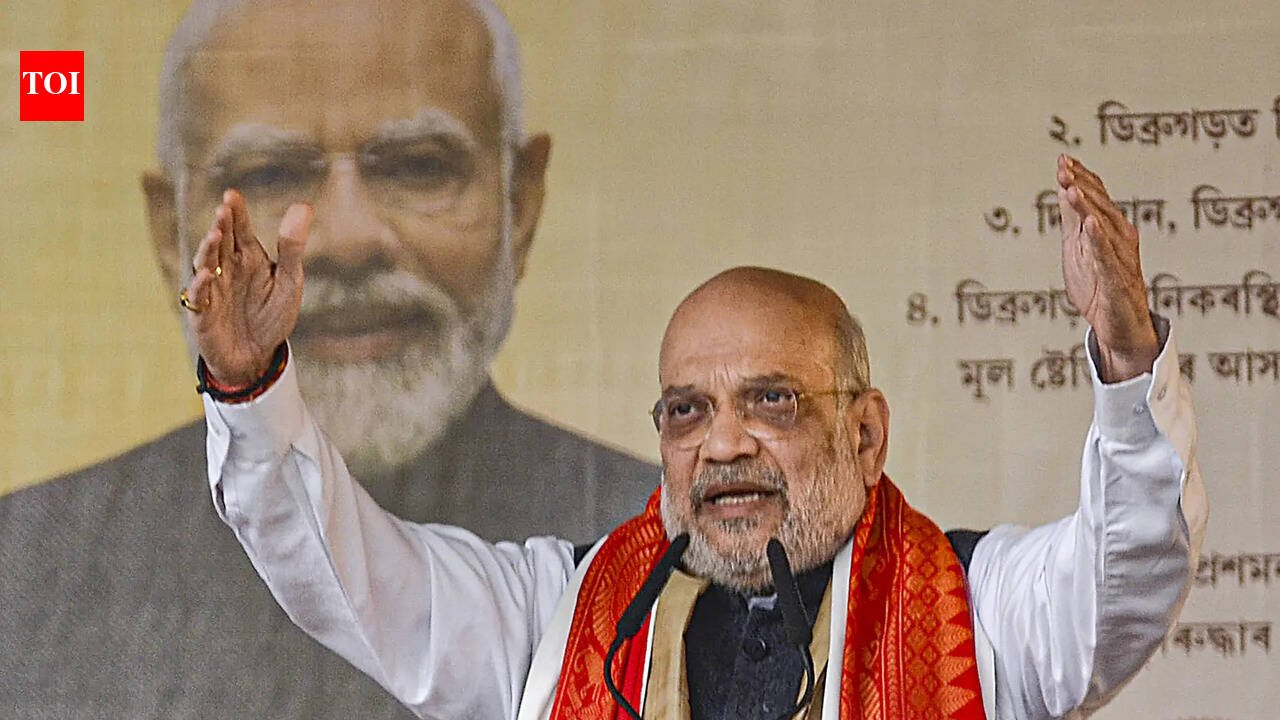
Union home minister Amit Shah addresses a public meeting in Assam on Friday. (PTI Photo)

NEW DELHI: Union home minister Amit Shah on Friday accused the Congress of “changing” the poll-bound state’s demography, a “trend” he said the current BJP-led government at the Centre is working to “reverse.”Shah made the remarks at the closing ceremony of the 10th Mising Youth Festival at Kareng Chapori in Assam’s Dhemaji. He also urged the people to vote for the state BJP government in the upcoming assembly elections to “completely free” Assam from infiltration.

Amit Shah Blames Infiltration For Muslim Population Growth, Backs CAA As Moral Responsibility

“Assam’s demography completely changed during Congress rule. The population of infiltrators rose to 64 lakh from nil, and infiltrators became the majority in seven districts,” the senior BJP leader alleged.“If you want to stop infiltration, then elect the BJP government for a third term and strengthen the hands of chief minister Himanta Biswa Sarma. Two BJP state governments in Assam have freed 1.26 lakh acres of land from encroachment by infiltrators,” he added.The BJP first came to power in Assam in May 2016 and won re-election five years later. It is now aiming for a third consecutive term when the state goes to polls in April.Meanwhile, Shah also highlighted the role played by the Mising community in preventing infiltrators from settling in Upper Assam through their hardworking lifestyle.“It is the responsibility of the Mising community to stop infiltration. You do not need to take up guns. Through your culture of hard work, infiltrators have not been able to settle here,” he remarked.The home minister further alleged that several tribal communities in Assam struggled to protect their identity during the Congress regime, while asserting that the BJP was committed to addressing the issues of the Mising society through an interlocutor appointed by the Centre.(With PTI inputs)


Source link

‘Only 50-over is the real one’: Sanjay Manjrekar questions T20 World Cup’s credibility | Cricket News


'Only 50-over is the real one': Sanjay Manjrekar questions T20 World Cup's credibility
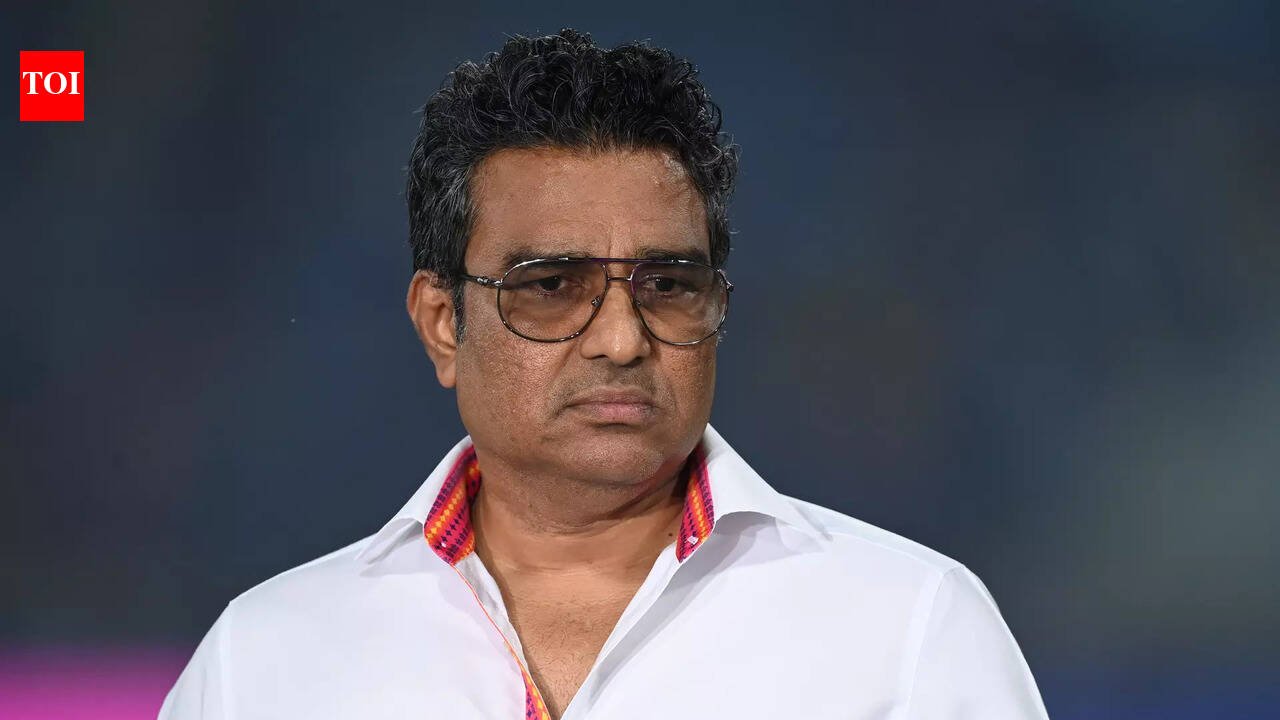
Former Indian cricketer Sanjay Manjrekar (Getty Images)

With the 10th edition of the men’s T20 World Cup just eight days away, former India batter Sanjay Manjrekar has reignited the debate around the tournament’s standing in the game’s global hierarchy. Manjrekar believes the shortest format’s showpiece does not carry the same weight or legacy as the 50-over World Cup and should not be viewed through the same lens. Manjrekar, who featured in India’s World Cup campaigns in 1992 and 1996 and played 11 matches across those tournaments, has long maintained that there is only one true Cricket World Cup. In his view, that status belongs exclusively to the 50-over event, which is held once every four years and demands a longer cycle of preparation and endurance.

Sanju Samson or Ishan Kishan? | Greenstone Lobo predicts the ideal player for T20 World Cup

He pointed to the frequency of the T20 tournament as a key reason for his stance, with the competition taking place every two years. For Manjrekar, that regularity dilutes its stature and separates it from the traditional World Cup narrative built around the ODI format.

Sanjay Manjrekar post

Sanjay Manjrekar post

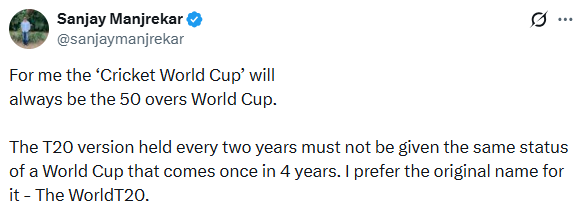
“For me, the ‘Cricket World Cup’ will always be the 50 overs World Cup. The T20 version, held every two years, must not be given the same status as a World Cup that comes once every 4 years. I prefer the original name for it – The WorldT20,” Manjrekar posted on X. His comments arrive at a time when the one-day format itself is facing uncertainty. Once the backbone of international cricket, ODIs are increasingly viewed as the least compelling of the three formats, with Test cricket and T20Is dominating schedules and attention. There is a growing belief that the 2027 World Cup in South Africa could potentially be the final ODI World Cup, despite the 2031 edition being officially earmarked for India and Bangladesh. The T20 event was originally branded as the ‘World T20’ for its first six editions, held between 2007 and 2016. The tournament was later renamed the T20 World Cup from the 2021 edition, which took place in the UAE following a five-year gap. Manjrekar’s outlook mirrors sentiments previously expressed by Rohit Sharma. The former India captain, despite lifting the T20 World Cup, has consistently placed the 50-over World Cup on a higher pedestal. That reverence perhaps explains why India’s defeat to Australia in the 2023 final continues to resonate so deeply.


Source link

Legal traps, jail terms & seclusion: How Pakistan has perfected the art of silencing dissent


Legal traps, jail terms & seclusion: How Pakistan has perfected the art of silencing dissent
Legal traps, jail terms & seclusion

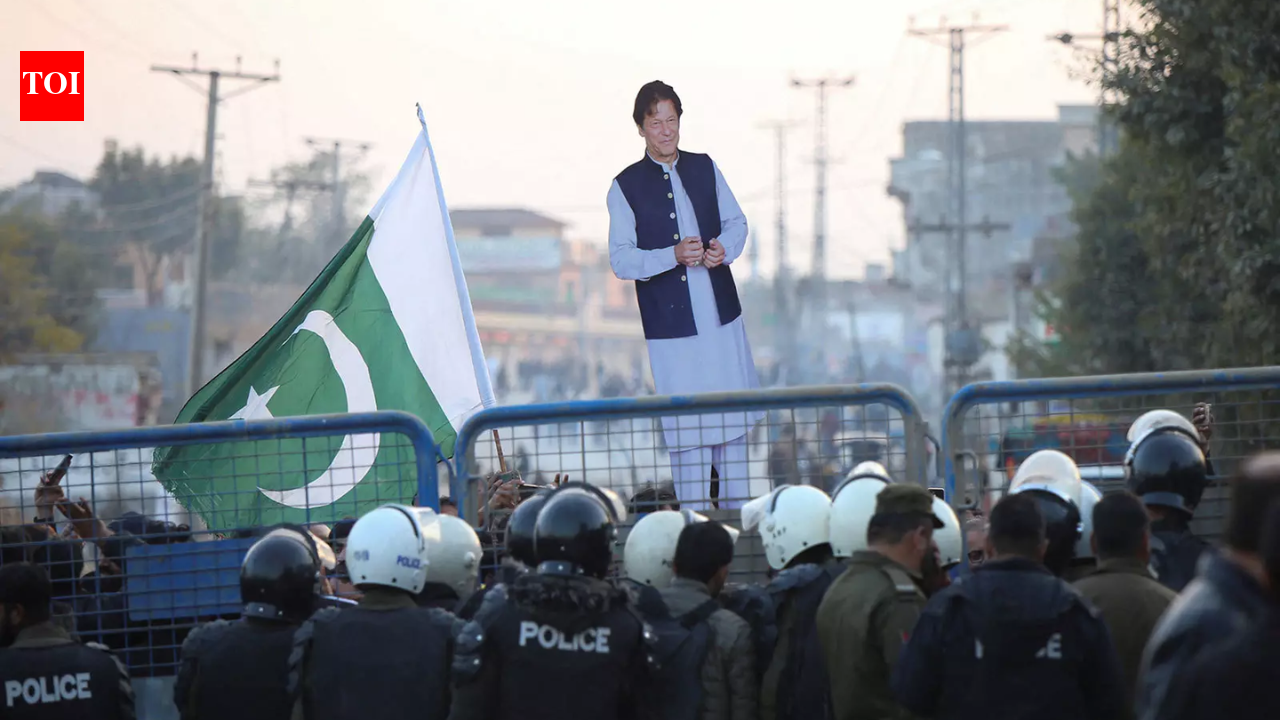
The Pakistani government is doubling down on its legal offensive against jailed former prime minister Imran Khan and prominent activists, framing the measures as essential for “national security.” However, as prison doors remain barred to visitors and human rights lawyers face decade-long sentences, critics warn that the country’s democratic space is vanishing under the shadow of military influence.Officials say restrictions placed on Khan, including the suspension of prison visits, were imposed after he violated jail rules that prohibit political activity and the dissemination of what authorities describe as anti-state narratives. The government and military deny claims that the measures amount to illegal isolation or an attempt to silence him.Interior minister Talal Chaudhry has rejected allegations of mistreatment, calling Khan “the most privileged prisoner in Pakistan” and citing access to facilities such as gym equipment and a personal cook. He said the restrictions were lawful and in line with prison regulations.The government also dismisses accusations that the military is driving political decisions. “The civilian government is [taking] decisions. We are all working hand in glove,” Chaudhry said, praising the chief of defence forces as “doing a marvellous job,” as quoted by BBC. Security sources insist the military operates strictly within constitutional and legal limits.Military spokespersons have argued that certain political narratives pose a growing threat to national security, particularly when a convicted politician is accused of using prison meetings to mobilise public opinion against state institutions. Officials say such actions cross the boundary from political expression into matters of national defence.Authorities stress that legal action against politicians, activists and lawyers is based on violations of existing laws, including the Prevention of Electronic Crimes Act (PECA), rather than an effort to suppress dissent. “Attempts to frame law-breaking as democracy or human rights are entirely misplaced,” Chaudhry said.The same legal rationale underpinned the recent conviction of human rights lawyer Imaan Mazari and her husband, Hadi Ali Chattha. The couple were sentenced to 10 years in prison after being found guilty of sharing what the state described as anti-state content on social media.According to prosecutors and the court ruling, their online activity involved “disseminating and propagating narratives that align with hostile terrorist groups” and undermined state institutions. Defending the verdict, information minister Attaullah Tarar said it reflected the proper application of the law, posting on X: “As you sow, so you shall reap!”The government maintains that these measures are necessary to prevent destabilisation and ensure accountability, regardless of an individual’s political profile or public standing.Critics, however, argue that the cases of Khan and Mazari show that he is not the only one being silenced, and warn that the space for dissent in Pakistan is narrowing as the military’s influence continues to loom large over civilian life.


Source link

Union Budget 2026: From assembly to autonomy – What’s next for India’s manufacturing?


Union Budget 2026: From assembly to autonomy – What’s next for India’s manufacturing?

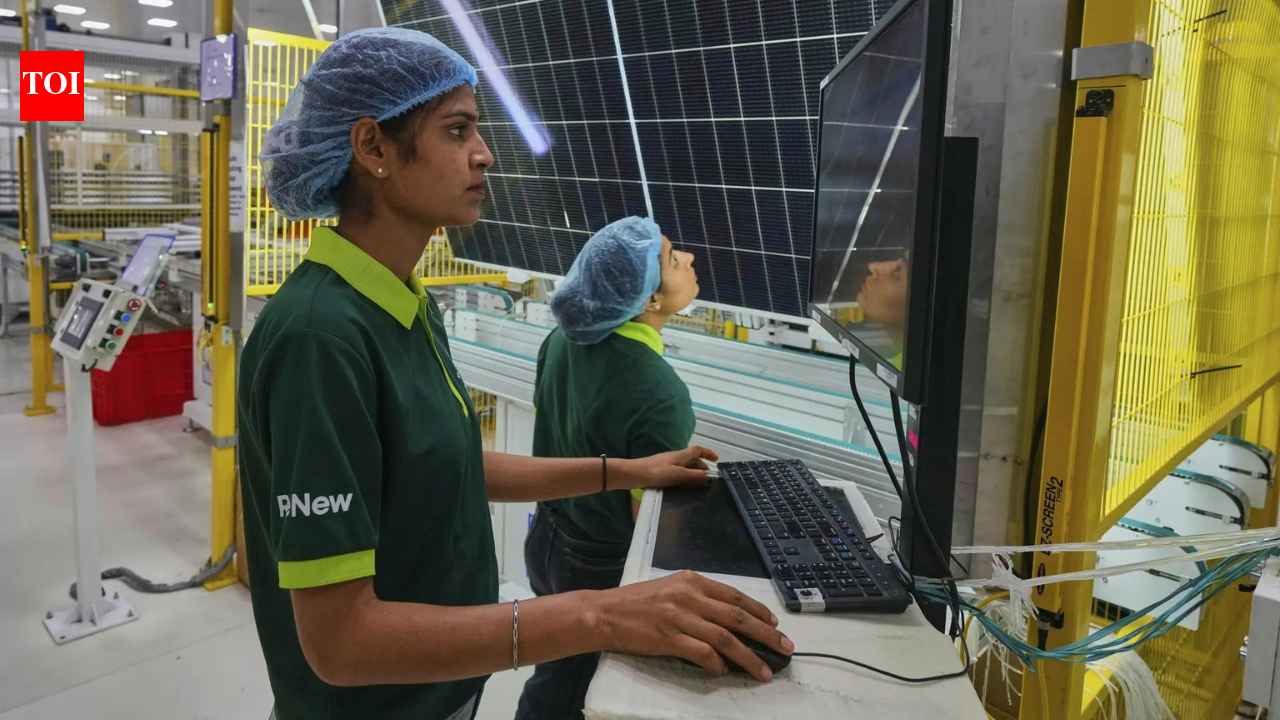
With the Union Budget just days away, the manufacturing sector is being seen as one of the main reasons India has stayed economically resilient—even as many countries face slow growth.The Economic Survey 2025–26 has set an upbeat tone, projecting India’s GDP growth at 7.4 per cent for the current financial year. In simple terms, that projection signals confidence that factories, construction, and businesses will keep expanding, creating jobs and supporting incomes.A big reason behind this optimism is the government’s push to make India a global export hub—meaning a country that not only produces for its own needs, but also sells more goods to the rest of the world. Exports matter because they bring foreign currency into the country, support industrial expansion, and can create steady employment in manufacturing and related services like logistics.Government data for FY 2024–25 shows India’s total exports reached $825.3 billion. However, this rise was mainly driven by strong growth in services exports—things like IT services, consulting, financial services, and back-office work sold to global clients.Manufacturing exports (physical goods like electronics, medicines, machinery, textiles, etc.) also got a lift, with one major driver being the Production Linked Incentive (PLI) schemes.Think of PLI as a government program that rewards companies for producing more in India: if firms meet certain production targets, they receive incentives. The goal is to make it easier and more attractive to manufacture at scale in India rather than import finished products.Based on the government press release, the PLI schemes (across 14+ sectors) have, as of late 2025:

  • Attracted over Rs 2.0 lakh crore in actual investment (money put into factories, equipment, and operations)
  • Generated incremental production and sales of more than Rs 18.7 lakh crore (additional goods produced/sold compared to earlier levels)
  • Directly contributed to exports of over Rs 8.20 lakh crore, led by electronics, pharmaceuticals, and telecom products

Put simply, the government is claiming that PLI has helped companies invest more, produce more, and export more—especially in sectors where India wants to become globally competitive.This year’s Budget is expected to give more clarity and funding for the National Manufacturing Mission announced last year. The idea is to create a practical blueprint for different types of industries—small, medium, and large—so that policy support is not one-size-fits-all.Key areas that are likely to get attention include:

  • Electronics and semiconductors: Continued funding for the India Semiconductor Mission, because chips are the “brains” inside phones, cars, appliances, and industrial machines; reducing chip imports can make India’s supply chains more secure and lower costs over time
  • Green energy manufacturing: Higher priority for EV batteries, solar PV modules, and green hydrogen, as India tries to build domestic capacity for clean-energy equipment (instead of importing it) while also moving toward net-zero targets
  • MSME support: Expanded credit guarantees (up to Rs 10 crore) and interest support to help smaller manufacturers access affordable loans; this matters because small firms often struggle with working capital, expensive credit, and the costs of meeting export-quality standards.

For common readers, the MSME piece is crucial. When smaller manufacturers can borrow at reasonable rates and invest in better machinery or quality systems, they can supply bigger companies, compete in export markets, and hire more workers locally.The 2025–26 Budget kept a strong focus on infrastructure-led growth by announcing a record capital expenditure (capex) outlay of Rs 11.21 lakh crore. Capex is essentially long-term spending—roads, railways, ports, industrial corridors, power systems, and logistics upgrades.This matters to manufacturing because infrastructure reduces the “cost of doing business.” Better highways and ports can cut delivery time, reduce fuel and storage costs, and improve reliability—key factors for exporters competing against countries with efficient logistics.For Budget 2026, the expectation is that the government will keep this capex momentum but focus more on “outcome-based” spending. In other words, not just announcing big allocations, but showing measurable results—like higher factory output, stronger exports, and improved global market share for Indian products.


Source link

Shubhanshu Shukla, IISc-IISER team, find how brick-building bacteria react to toxin in Martian soil | India News


Shubhanshu Shukla, IISc-IISER team, find how brick-building bacteria react to toxin in Martian soil
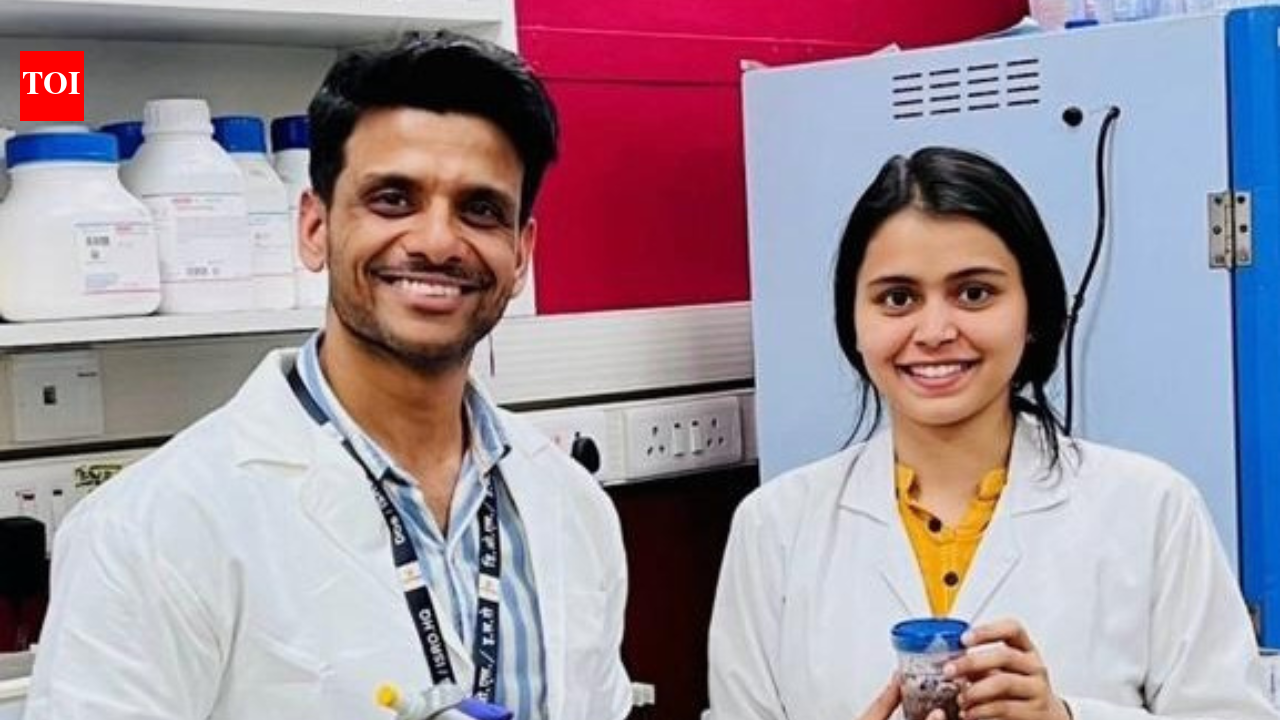
Shukla with lead author Swati Dubey | Credit: Aloke lab, IISc

BENGALURU: A toxic chemical long considered hostile to life on Mars, may not be an obstacle to building on the Red Planet after all. Instead, it could turn out to be an unlikely aid. Researchers at IISc, working with scientists at IISER-Kolkata and Isro astronaut Shubhanshu Shukla, have found that perchlorate, a chlorine-based compound known to stress living cells, can strengthen bacteria-made “space bricks” under the right conditions.“Mars is an alien environment. What is going to be the effect of this new alien environment on Earth organisms is a very, very important scientific question to answer,” Aloke Kumar, associate professor, mechanical engineering at IISc and corresponding author, says.

WhatsApp Image 2026-01-30 at 15.18.19.

Shukla with lead author Swati Dubey | Credit: Aloke lab, IISc

Perchlorates have been detected at several Martian landing sites and are considered hostile to life. They interfere with microbial growth and pose health risks to humans. For scientists exploring biological routes to construction on Mars, the compound has long been seen as a constraint that must be eliminated or avoided. The new study, however, points to a more complex interaction between chemistry, biology, and soil.The team focused on bacteria that can bind loose soil into solid blocks through biocementation. In earlier work, IISc researchers showed that the soil bacterium “Sporosarcina pasteurii” can produce calcium carbonate crystals that glue together particles of lunar or Martian soil simulants. The process requires urea, calcium, and guar gum, a natural polymer that supports bacterial survival.In the new study, published in PLOS One, the researchers used a more robust bacterial strain isolated from soils in Bengaluru. After confirming its mineral-forming ability, the team examined how it responded to perchlorate levels comparable to those measured on Mars, reaching up to about one per cent.The biological response was studied in collaboration with IISER-Kolkata, where Professor Punyasloke Bhadury’s group examined how perchlorate alters cell behaviour. The bacteria grew more slowly, became rounder in shape, and began clumping together, all clear signs of chemical stress. They also released higher levels of proteins and other molecules into their surroundings, forming an extracellular matrix.

WhatsApp Image 2026-01-30 at 15.18.19 (1).

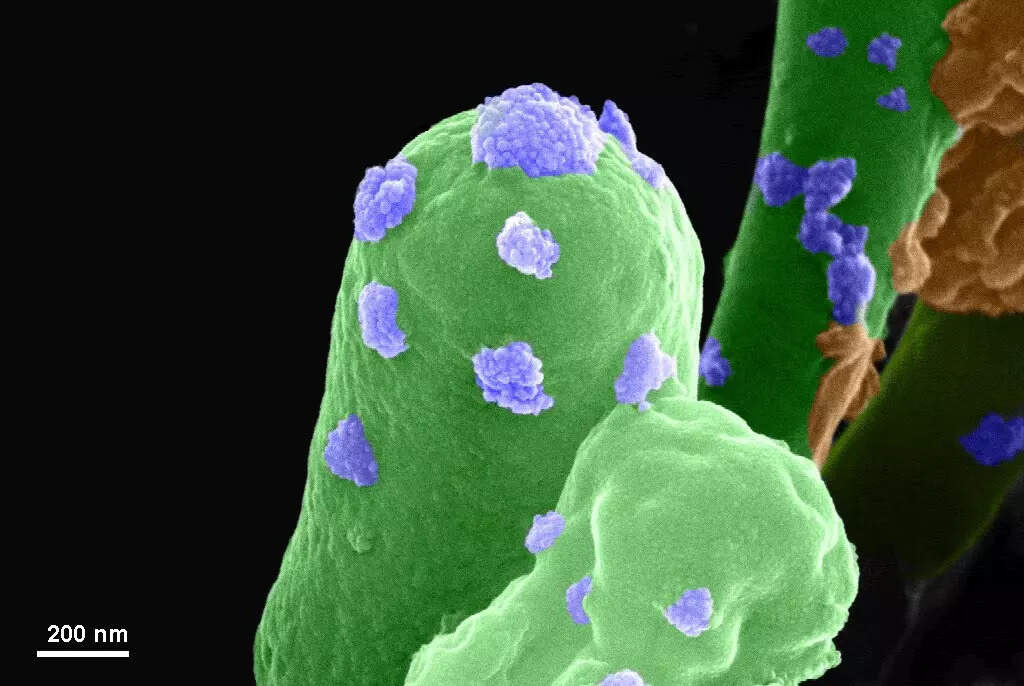
Microscopy image of Sporosarcina pasteurii | Credit: Aloke lab, IISc

When these stressed bacteria were added to synthetic Martian soil in the lab, the outcome surprised the researchers. With guar gum and a small amount of nickel chloride present, the resulting bricks were stronger than those produced without perchlorate. Microscopy revealed more mineral precipitates and fine “microbridges” formed by the extracellular matrix, linking bacterial cells to soil grains and minerals.“When the effect of perchlorate on just the bacteria is studied in isolation, it is a stressful factor. But in the bricks, with the right ingredients in the mixture, perchlorate is helping,” says IISc’s Swati Dubey, the study’s first author. Ultimately, the team’s goal is to deploy this method as an alternative, sustainable building strategy, to rely less on carbon-intensive cement-based processes – both on Earth and Mars. Co-author of the study, Shukla, who is pursuing his Master’s degree with Kumar at IISc, says such technologies can also help make future Mars landing missions smoother, by helping build better roads, launch pads, and rover landing sites. “The idea is to do in situ resource utilisation as much as possible. We don’t have to carry anything from here; in situ, we can use those resources and make those structures, which will make it a lot easier to navigate and do sustained missions over a period of time,” ,” Shukla added.


Source link

Businessman duped of Rs 11.50 crores, promising Rs 200 cr loan in Mumbai | Mumbai News


MUMBAI: A Ghatkopar based businessman was induced with a promise of availing a interest free loan of Rs 200 crores and was duped of Rs 11.50 crores. The complainant Hitesh Ajmera who is into Custom clearing has alleged that the accused identified as Vivekkumar Sinha, his wife Akanksha Awasthi and others allegedly conspired to cheat him by claiming that Rs 300 crore in cash was stored in a godown in Bihar, and demanded money to “redeem” the said cash. In return, they allegedly promised to provide the complainant with an interest-free loan of Rs 200 crore from the redeemed amount.According to the Pant Nagar police, the crime took place between March 2024 and July 2024. Ajmera claims that he came in contact with Shantilal Patel in January 2024 through an office employee. Patel allegedly claimed to own around 110 acres of land in Goa and discussed selling the property, offering Ajmera a commission. Patel introduced him to Vivek Kumar alias Abhishek Kumar Singh Chauhan and his wife Akanksha Awasthi. Patel allegedly told him that Vivek Kumar had Rs 300 crore in cash stored in a godown at Bettiah, West Champaran district of Bihar, and required funds to “redeem” the amount. Ajmera was allegedly promised an interest-free amount of ₹200 crore within a few days if he helped finance the operation.The complainant claimed that Vivek Kumar and Akanksha Awasthi, who allegedly projected herself as a Bhojpuri film artist running a studio in Mumbai, reinforced the claims, prompting him to invest money. Acting on their instructions, Ajmera initially transferred ₹50 lakh to Vivek Kumar’s bank account on March 22, 2024.In May 2024, Ajmera allegedly travelled to Patna along with Patel and Vivek Kumar, where he was introduced to the purported godown owner, Raviraj Sharma. He was allegedly told that ₹11 crore was required to redeem the cash, and was shown a photocopy of a notarised lease agreement of the godown dated December 14, 2023. Subsequently in total Ajmera transferred ₹11.50 crore to Vivek Kumar’s bank account.Ajmera further alleged that while travelling from Patna to Bettiah on July 5, 2024, Vivek Kumar stopped at a sweet shop and never returned. His mobile phone was later found switched off. After waiting for nearly 15 days and receiving evasive responses, Ajmera claimed Patel also left Patna without informing him. He then returned to Mumbai after running out of money.Ajmera said that repeated attempts to contact Vivek Kumar and others failed, leading him to believe that he had been cheated as part of a pre-planned conspiracy.


Source link

‘Main maar raha hoon teri behen ko’: Pregnant Delhi Police SWAT commando killed by husband with dumbbell; brother recalls chilling call before the killing | Delhi News


Image Credit: TOI

NEW DELHI: A 27-year-old Delhi Police SWAT commando died after being hit by dumbbell at her home in west Delhi.According to news agency PTI, Kajal Chaudhary, who was four months pregnant, was posted with the Special Cell of Delhi Police. She was at her residence in Mohan Garden on January 22 when the alleged assault took place.

Pregnant Delhi Police SWAT Commando Killed Over Dowry, Families Speak As Murder Probe Deepens

Her husband, Ankur, a clerk with the Ministry of Defence posted in Delhi Cantonment, was arrested hours later.Kajal succumbed to her injuries on January 27, after battling for life for five days at a hospital in Ghaziabad.

-

Image Credit: TOI

Her brother, Nikhil, a constable posted at Parliament Street Police Station, told PTI that he was on the phone when the attack occurred.Also read:‘Our son would’ve got a car’: Even after giving Bullet bike, dowry harassment continued, says family of slain SWAT commando

A chilling call

“He told me to put the call on recording, said it could be used as police evidence; (then) told me he was killing her. And then, I heard her screams,” Nikhil recalled, describing the moments before the call ended abruptly.According to Nikhil, the sequence of events began with a call from Ankur. “He called me and said, ‘Apni behen ko samjha le’ (Make your sister understand). I asked him to calm down and immediately called my sister,” he said.“She normally wouldn’t tell us much about what was happening, but that day she was sharing her ordeal. While we were speaking, he got angry that she was telling me things and snatched the phone from her,” Nikhil said.Also read: ‘Ye mar gayi hai hospital aajao’: Kin recall final call from Delhi Police SWAT commando Kajal Chaudhary’s husband“Then he said to me, ‘Is call ko recording pe rakh, police evidence me kaam aayega. Main maar raha hoon teri behen ko. Police mera kuch nahi kar payegi’ (Put this call on recording, it will be useful as police evidence. I am killing your sister. Police won’t be able to do anything). Then I heard her screams. The call ended abruptly,” he said.Barely five minutes later, Nikhil said he received another call. “He (Ankur) said, ‘Ye mar gayi hai. Hospital aajao’ (She is dead. Come to the hospital). We rushed there with police personnel. He and his family were already present. When I saw my sister not even an enemy kills someone like this,” he said.The family alleged that Kajal sustained severe head injuries and had multiple wounds across her body. Nikhil said they attempted to admit her to several hospitals but were allegedly told her chances of survival were minimal before she was finally admitted to a Ghaziabad hospital.The family has accused Ankur and his relatives of prolonged torture and dowry harassment, including during Kajal’s pregnancy. The couple has a one-and-a-half-year-old son, who is currently with his maternal grandparents.Recalling an earlier incident, Nikhil said Kajal had been slapped by her husband around five months ago. “I went there and asked her to come with me. Ankur apologised and swore on his child that he wouldn’t repeat it. I told my sister she could return home whenever she wanted and didn’t have to stay there,” he said.He also alleged that Kajal was made to do household chores despite being pregnant. “She would cook, wash clothes and utensils despite being pregnant,” he claimed.“Her son doesn’t know anything about the incident, and we have decided that we will only raise him. We will tell him when he is mature to understand such things,” Nikhil told PTI.Kajal’s father, Rakesh, alleged persistent dowry demands.

‘We gave them Bullet bike, gold jewellery’

“We gave them a Bullet bike, gold jewellery and cash at the wedding, but they said our son would have got a car (had he married someone else). Later, my daughter even arranged a car, but they didn’t stop harassing her. We couldn’t even speak freely to her,” he said.Her mother said the family had spent around Rs 20 lakh on the marriage and taken loans. “He (Ankur) had also taken Rs 5 lakh from her. She (Kajal) suffered a lot. I want justice. He is a monster,” she said.The couple had known each other since their college days in Panipat and married on November 23, 2023. Due to frequent disputes at their native home in Ganaur, Haryana, they shifted to a rented accommodation in Mohan Garden in December 2024, but tensions reportedly continued.Police said financial stress and domestic disputes were among the factors behind the conflict. “The couple had taken some loans and often had arguments over finances and household expenses,” a Delhi Police officer said.“On January 22, Ankur allegedly first banged Kajal’s head against a door frame before attacking her with a dumbbell,” the officer added.A case was registered at Mohan Garden police station based on Nikhil’s complaint. “He was initially booked for attempt to murder. After her death, the charges will be converted to murder,” the officer said.


Source link

HC quashes Maharashtra Protection of Interest of Depositors case against developer Ahuja | Mumbai News


MUMBAI: The Bombay High Court has quashed criminal proceedings under the Maharashtra Protection of Interest of Depositors (MPID) Act against developer Jagdish Ahuja, his family members and their associate, after the complainant parties had amicably settled a long-standing financial dispute.Justice N.J. Jamadar set aside MPID Special Case of 2023, arising of an FIR registered at Dindoshi Police Station for offences under Sections 406, 420 read with 34 of the IPC and Section 3 of the MPID Act.The court recorded that the complainant and other respondents had entered into consent terms to resolve the dispute, which stemmed from financial transactions involving advances made to the petitioner against bills of exchange.According to the FIR, the complainant had alleged that from 2014 onwards, Jagdish Ahuja, his wife Vandana Ahuja, son Gautam Ahuja, daughter-in-law Sheetal Ahuja, and their representative Vishal Hinduja, who were managing M/s Ahuja Properties and Associates, induced her and her family to advance loans for business purposes. The accused allegedly promised an attractive interest of 21%, assured that the funds would be kept in trust by the firm, and claimed the principal would be returned on demand.The complainant claimed that a total amount of ₹1.15 crore was advanced by her, her husband and her father-in-law. While interest was allegedly paid for a few months to gain confidence, payments later stopped, and despite execution of MoUs and consent terms, the principal amount was not returned, leading to allegations of cheating and breach of trust. Upon default in repayment, multiple proceedings had been initiated, including summary civil suits and complaints under Section 138 of the Negotiable Instruments Act.During the High Court proceedings, the complainant through his lawyer Parvez Memon and other respondents informed the court that the dispute had since been fully settled, with the entire agreed amount paid through demand drafts. An affidavit was filed confirming that there was no objection to quashing the FIR and related MPID proceedings.The prosecution informed the court that there were no other victims in the case. Relying on the Supreme Court ruling the High Court held that the dispute arose out of private financial transactions with a predominantly civil character and that continuation of criminal prosecution would not serve the interests of justice. The petition was accordingly allowed, and all proceedings were quashed. No costs were imposed. There are a couple of other cases pending against Ahuja.


Source link

“I’m meeting a girl during match time”: Yuvraj Singh spills the beans on link-up rumours


Former India all-rounder Yuvraj Singh has candidly addressed the long-standing link-up rumours that often surrounded him during his playing days, offering rare insight into how harmless moments were sometimes turned into controversies. Speaking on Tennis ace Sania Mirza’s YouTube talk show ‘Serving it Up with Sania’, Yuvraj reflected on the pressures of fame and the media’s role in shaping narratives around athletes’ personal lives.

During the conversation, Yuvraj recalled a specific incident that highlighted how easily rumours could spiral out of control. The former cricketer revealed that he had casually hugged his manager – something he described as a completely normal gesture – but the moment was sensationalised by the media.

“I had an agent, somebody whom I had just started working with. I had given her a hug. Just when you meet someone, you give them a hug, and they kind of turned it around that I’m meeting a girl during match time,” Yuvraj said.

The episode, according to Yuvraj, became an example of how everyday interactions were often misinterpreted once cameras and speculation entered the picture.

Yuvraj acknowledged that being linked romantically with different people is almost inevitable for high-profile sportspersons and celebrities. However, he was critical of how such rumours are deliberately amplified to drive attention and readership.

“It’s part of the life we live. If the media doesn’t make controversial or negative comments, they feel people are not going to read,” he explained. “I feel there’s much more negativity out there than positivity. I feel there should be more positive stories.”

Yuvi’s remarks shed light on the mental toll of constant scrutiny, especially during a time when social media was beginning to magnify speculation around athletes’ lives off the field.

Not the first time Yuvraj spills the beans about his personal life

This is not the first occasion on which Yuvraj has spoken openly about his dating life. In recent times, he shared a light-hearted anecdote from India’s 2007-08 tour of Australia, when he was briefly dating an actress. The episode ended humorously, with Yuvraj revealing that he once had to wear her pink slip-on shoes to the team bus after she accidentally packed his footwear.

The story, told in jest, contrasted sharply with the more serious tone of how rumours were sometimes portrayed during his career, reinforcing his point about perspective and exaggeration.

Also READ: Yuvraj Singh opens up on dating a Bollywood actress during the Australia tour

Yuvraj’s legendary cricketing career beyond the gossip

Beyond the off-field chatter, Yuvraj’s legacy in Indian cricket remains monumental. Making his international debut in 2000, he went on to represent India in 398 matches across formats before retiring in 2019. Over the course of his career, he amassed more than 11,500 international runs and played pivotal roles in India’s triumphs, including the 2007 T20 World Cup and the 2011 ODI World Cup.

As Yuvraj looks back on his journey, his reflections serve as a reminder that while rumours may fade, achievements on the field endure – and that athletes’ stories deserve to be told with balance, empathy, and accuracy.

Also READ: Yuvraj Singh’s hilarious taunt steals the show in Abhishek Sharma’s latest photo drop


Source link