Breaking News
Chicago Bears suffer brutal playoff injury setback as T.J. Edwards, Ozzy Trapilo ruled out for remainder of postseason | NFL News


Chicago Bears suffer brutal playoff injury setback as T.J. Edwards, Ozzy Trapilo ruled out for remainder of postseason

The Chicago Bears’ dramatic Wild Card win over the Green Bay Packers came at a heavy cost, with the franchise suffering a brutal injury setback that could define its playoff run. Linebacker T.J. Edwards and offensive tackle Ozzy Trapilo have both been ruled out for the remainder of the postseason.The Bears pulled off an emotional comeback at Soldier Field, keeping their Super Bowl hopes alive. However, the celebrations were short-lived once head coach Ben Johnson confirmed that both starters suffered season-ending injuries during the game.

Injury setbacks rock Bears’ playoff hopes

Edwards, a key leader in the middle of Chicago’s defense, went down in the third quarter. Medical evaluations later revealed a fractured fibula, an injury that immediately ended his postseason availability. Edwards had been one of the Bears’ most consistent performers all season, providing stability, communication, and physicality at linebacker.Trapilo’s injury followed late in the fourth quarter, delivering another tough blow. The young offensive tackle exited with a patellar tendon injury, which Johnson described as serious enough to rule him out for the rest of the playoffs. Trapilo had taken over the left tackle role late in the regular season and quickly became a crucial part of the offensive line rotation.

Bears turn to depth as pressure mounts

With Edwards sidelined, the responsibility now shifts to D’Marco Jackson, who stepped in after the injury against Green Bay. Jackson has shown flashes when given extended snaps and even earned NFC Defensive Player of the Week honors earlier in the season. Still, replacing Edwards’ experience and on-field leadership will be a major challenge in a high-stakes playoff environment.On offense, Chicago must reshuffle its line to protect the quarterback against elite postseason defenses. Theo Benedet is expected to be the next man up at left tackle. The Bears also have Braxton Jones available after his return from injured reserve, but he has yet to see game action following a long absence, making his usage uncertain.Chicago’s playoff run has been built on resilience, physical defense, and timely execution. Losing two starters one on defense and one on offense tests that formula at the worst possible moment. While the Bears remain confident in their depth, there is no denying that Edwards and Trapilo leave significant gaps.As the Bears prepare for the divisional round, the focus now shifts from celebration to survival. January football rarely forgives injuries, and Chicago will need contributions from every corner of its roster to keep its postseason dream alive.Also Read: Keon Coleman injury update: Will Bills WR play this week vs. Jaguars?


Source link

Piyush Goyal suggests concessions for precast, steel construction to curb pollution | Mumbai News


Mumbai: Union minister Piyush Goyal on Sunday stressed the need for incentivising precast and steel construction methods to reduce dust pollution during building construction work.“All over the world, you don’t see reinforced concrete (RC) mixers. You see steel and precast structures. Maybe they are a bit expensive. I was thinking of discussing this with Maharashtra chief minister Devendra Fadnavis on whether we can give concessions and incentives for this,” Goyal said.He was addressing a meeting of businessmen and housing society office-bearers at Adarsh Complex in Malad West, ahead of the January 15 municipal corporation elections in Mumbai.Dust caused during construction work leads to pollution, Goyal said, and called for reinforced concrete (RC) construction “mixers” to be shifted out of the city. “I removed four-five of them from my (parliamentary constituency) area,” Goyal said.Goyal also suggested that instead of making it mandatory not to use processes causing pollution, efforts should be made to have a consensus among builders to use precast and steel construction methods to check pollution.The minister, who is BJP’s member of Lok Sabha from North Mumbai, also emphasised the need to allocate public grounds specifically for holding religious, cultural and sports events.“As these are municipal corporation elections, I am not going into international issues, like my recent trip to Brussels, where I almost finalised the European Union-India Free Trade Agreement,” the Union Commerce and Industry minister said.


Source link

Amazon tells employees working from India due to H-1B visa issue: Do not do these 11 things


Amazon is allowing employees stranded in India due to H-1B visa delays to work remotely until March 2. However, strict restrictions prevent them from coding, making strategic decisions, or interacting with customers. These limitations, reportedly due to local laws, significantly hinder core job functions, leaving many engineers questioning their productivity.

Amazon has granted a temporary lifeline to employees stranded in India due to H-1B visa delays—but it comes with a surprisingly long list of restrictions that effectively bars them from doing core parts of their jobs.The tech giant is allowing workers who were in India as of December 13 to work remotely until March 2, according to an internal memo obtained by Business Insider. However, employees cannot code, make strategic decisions, negotiate contracts, or interact with customers while working from India.The restrictions, which Amazon says are mandated by local laws, include a ban on troubleshooting, testing, or even documenting code. Employees also can’t visit Amazon offices, sign contracts, hire anyone, or manage relationships with vendors and partners. All final decision-making and approvals must happen outside India.

Software engineers left wondering what they can actually do

For many Amazon employees in technical roles, the limitations raise serious questions about productivity. “Seventy to eighty percent of my job is coding, testing, deploying, and documenting,” one Amazon software engineer told Business Insider, highlighting the impracticality of the arrangement.The policy marks a rare exception to Amazon’s strict five-day office mandate, but one that comes with significant caveats. The company normally allows only 20 business days of remote work for visa renewals.

Trump administration’s new H-1B screening causes massive delays

The crisis stems from the Trump administration’s expanded vetting requirements for H-1B visas, which now mandate social media reviews for all applicants. The State Department announced in early December that consular officers must examine applicants’ social media profiles before issuing visas, causing processing delays that have pushed some appointments into 2027.Amazon filed 14,783 certified H-1B applications during the 2024 fiscal year, making it one of the program’s largest users. Other tech giants including Google, Apple, and Microsoft have issued travel warnings to visa-holding employees, advising them to avoid international travel.The memo offers no guidance for employees whose visa appointments extend beyond March 2 or those stranded in countries other than India.


Source link

IND vs NZ [WATCH]: Shreyas Iyer sends Michael Bracewell packing with a rocket throw during Vadodara ODI


India’s fielding standards touched another high in the first ODI against New Zealand in Vadodara on January 11. In a phase where every run mattered, Shreyas Iyer produced a moment of sheer brilliance in the deep. His sharp awareness and athletic execution turned the momentum firmly in India’s favour. The run-out of Michael Bracewell stood out as one of the defining moments of the visitors’ innings.

IND vs NZ, 1st ODI: Shreyas Iyer’s razor-sharp direct hit to remove Michael Bracewell swings the momentum towards India

The decisive moment unfolded in the 43rd over, bowled by Harshit Rana, with New Zealand looking to accelerate at the death. Rana nailed a yorker-length delivery that Daryl Mitchell could only jam out towards long-on, setting off a risky second run. Bracewell responded immediately, knowing the importance of maximizing every opportunity in the final overs. Iyer, positioned near the boundary, anticipated the danger instantly and charged in without hesitation. His pick-up was clean despite the ball coming at pace, and in one fluid motion he unleashed a powerful throw aimed straight at the non-striker’s end.

The throw was flat, fast, and arrowed directly onto the stumps, leaving Bracewell with no margin for error. Even a dive could not save the New Zealand captain, who fell inches short of his crease. The crowd erupted as the replay confirmed what the naked eye had already seen, a perfect direct hit under pressure. It was the kind of dismissal that lifts the entire fielding unit, injecting fresh energy into the side. India sensed the shift immediately, tightening the screws in the remaining overs. That single act of brilliance not only removed a key batter but also sent a clear message about India’s intent in the field.

Here’s the video:

Also WATCH: IND vs NZ: Prasidh Krishna cleans up Mitchell Hay with a jaffa in the first ODI

IND vs NZ, 1st ODI: Daryl Mitchell’s counter-attack revives Blackcaps after Indian bowlers strangle

The first ODI in Vadodara saw New Zealand post a highly competitive 300/8 in their 50 overs, recovering brilliantly after India threatened to derail their innings in the middle stages. Opting to bowl first at the brand-new Kotambi Stadium, India initially struggled to find a breakthrough as Devon Conway and Henry Nicholls navigated the new ball with relative ease.

The Kiwi openers put together a commanding 117-run stand, with both batters reaching well-constructed half-centuries that laid a solid foundation for a massive total. However, the introduction of Rana sparked a collapse, as the young pacer dismissed both openers in quick succession to bring India back into the contest. India’s spin twins, Kuldeep Yadav and Ravindra Jadeja, then tightened the screws, drying up the boundaries and causing a middle-order wobble that saw New Zealand slip from a position of strength to 237/6.

Just as the momentum seemed to favor the hosts, Daryl Mitchell took charge of the situation with a blistering counter-attacking knock of 84 runs off just 71 deliveries. Mitchell’s innings was a masterclass in modern ODI batting, as he frequently used his feet to the spinners and struck two massive sixes to keep the scoreboard ticking at a healthy rate. Even as partners like Bracewell and Glenn Phillips fell at the other end, Mitchell remained the anchor, ensuring the visitors crossed the 250-run mark.

A flurry of wickets in the death overs by Mohammed Siraj and Prasidh Krishna briefly gave India hope of keeping the target under 280, but some late fireworks from debutant Kristian Clarke and Kyle Jamieson proved vital. In the final over, New Zealand squeezed out 14 runs to reach exactly 300, a total that hasn’t been chased often at this venue’s historic debut. For India, the pace trio of Rana, Siraj and Krishna finished with two wickets apiece, but they will rue a few expensive overs at the very end.

Also WATCH: IND vs NZ – Harshit Rana deceives Henry Nicholls with a stunning slower ball in 1st ODI


Source link

Crypto rules tightened: Live selfies, geo-tagging mandatory for users; FIU rolls out tougher KYC norms


Crypto rules tightened: Live selfies, geo-tagging mandatory for users; FIU rolls out tougher KYC norms

India’s Financial Intelligence Unit (FIU) has rolled out stringent new Anti-Money Laundering (AML) and Know Your Customer (KYC) norms for cryptocurrency exchanges, making live selfie verification and geographical tracking mandatory during user onboarding, according to guidelines issued on January 8, PTI reported. Under the updated framework, crypto exchanges are classified as Virtual Digital Asset (VDA) service providers and will be required to go beyond basic document uploads for customer verification, the guidelines accessed by PTI showed.As per the rules, users must take a “live selfie” using software that verifies their physical presence through features such as eye-blinking or head movement, a step aimed at preventing the use of static images or deepfakes. Exchanges are also required to capture the latitude and longitude, date, timestamp and IP address from which an account creation process is initiated.In addition, exchanges must follow the “penny-drop” verification method, involving a nominal Re 1 transaction to confirm that the bank account provided is active and belongs to the registrant.Apart from a Permanent Account Number (PAN), users will now have to submit a secondary identity document such as a Passport, Aadhaar or Voter ID, along with OTP verification of both email ID and mobile number.The FIU, which operates under the Union Finance Ministry, has also taken a tough stance against mechanisms that conceal the trail of crypto transactions. The guidelines seek to “strongly discourage” Initial Coin Offerings (ICOs) and Initial Token Offerings (ITOs), citing their lack of economic justification and elevated risk.The FIU is the single-point regulator for cryptocurrency exchanges operating in India under the Prevention of Money Laundering Act (PMLA). All such exchanges must register as reporting entities, submit regular reports on suspicious transactions and maintain customer records to identify and combat money laundering, terrorist financing and proliferation financing risks. While crypto assets are not recognised as legal tender in India, they are taxed under the Income-Tax law.“The RE (crypto exchange) shall also ensure that the client whose credentials are being furnished at the time of onboarding is the same individual who is actually accessing the application and personally initiating the account creation process,” the guidelines stipulate.“The authenticity of such access and personal presence shall be established by capturing a live photograph of the client and employing liveliness detection technology to verify the client’s physical presence…,” they add.The guidelines mandate KYC updation every six months for “high-risk” clients and annually for all other users. Enhanced client due diligence is required for high-risk individuals or entities, including those linked to tax haven countries, jurisdictions on the FATF grey or black list, politically exposed persons (PEPs) and non-profit organisations (NPOs). This includes gathering information from open sources and consulting independent databases.On ICOs and ITOs, the FIU said these activities pose “heightened and complex” money laundering and terror financing risks as they “lack” justified economic rationale. It also flagged anonymity-enhancing crypto tokens, tumblers and mixers as tools designed to conceal or obfuscate the origin, ownership or value of transactions.Such transactions must not be facilitated and should trigger appropriate risk-mitigation measures, the guidelines said. Crypto tumblers or mixers, which blend coins from multiple sources after a transaction, make tracing extremely difficult.The FIU has also directed exchanges to preserve client identity, address and transaction records for a minimum of five years and retain them until any investigation is concluded.


Source link

IND vs NZ: Controversy! Sanjay Bangar calls Hindi ‘national language of India’ on air, faces heavy backlash during 1st ODI | Cricket News


IND vs NZ: Controversy! Sanjay Bangar calls Hindi ‘national language of India’ on air, faces heavy backlash during 1st ODI
Sanjay Bangar (PTI Photo)

NEW DELHI: During the first ODI between India and New Zealand on Sunday, a commentary moment sparked major controversy. Former India cricketer Sanjay Bangar was on commentary duty. He was part of the Hindi commentary panel. During the match, he referred to Hindi as the “national language of India.” The comment quickly drew criticism. The incident happened during the 13th over of the match. India had won the toss and decided to bowl first. Washington Sundar was bowling that over. Wicketkeeper KL Rahul looked unhappy with Washington’s pace.

Why India need leader Shreyas Iyer for 2027 World Cup | Greenstone Lobo prediction

Former fast bowler Varun Aaron was also on commentary. He mentioned that KL Rahul and Washington Sundar spoke in Tamil. Aaron said that KL told Washington he was bowling at the pace of a medium pacer. After this, Varun Aaron asked a question on air. He wondered if Washington Sundar understands Tamil better. At this point, Sanjay Bangar joined in and said he believes in Hindi, subsequently calling Hindi the “national language of India.” Soon after the comment, backlash followed on social media. Many fans reacted strongly. Several users pointed out that India does not have a national language. Hindi is one of the official languages of India. Many accused Bangar of making a factual mistake. The topic began trending online during the match. While the debate continued off the field, the game moved on. New Zealand posted a strong total. Daryl Mitchell played a key role, having scored an attacking 84. Thanks to that, New Zealand reached 300 for 8. India’s bowlers struck at regular intervals. Mohammed Siraj took two wickets. Harshit Rana took two wickets. Prasidh Krishna also picked up two wickets. New Zealand’s openers started well. Devon Conway scored 56. Henry Nicholls scored 62. The pair added 117 runs. Harshit Rana broke the partnership. He dismissed Nicholls. He then bowled Conway in the next over. Siraj removed Will Young for 12. Kuldeep Yadav dismissed Glenn Phillips for 12. Prasidh Krishna bowled Mitchell Hay for 18. Daryl Mitchell remained steady. He registered another strong ODI knock. He was run out after a direct hit from Shreyas Iyer. Debutant Kristian Clarke stayed unbeaten on 24. The ODI series will be followed by five T20 matches. The games will lead into the T20 World Cup, which will be held in India and Sri Lanka.


Source link

‘Chinki, momo, Chinese’: How everyday racism shadows Indians from the Northeast | India News


'Chinki, momo, Chinese': How everyday racism shadows Indians from the Northeast

“You people eat dogs, cats, pigs and all your animals, right?” This was a question Riba says she was repeatedly asked because she hails from the Northeast. Working at a high-profile firm did little to shield her from stereotypes. Friends, colleagues and acquaintances routinely questioned her food habits, appearance and even language.

‘Called Minor Matter, Refused FIR’: Tripura Student Angel Chakma’s Father Blasts Uttarakhand Police

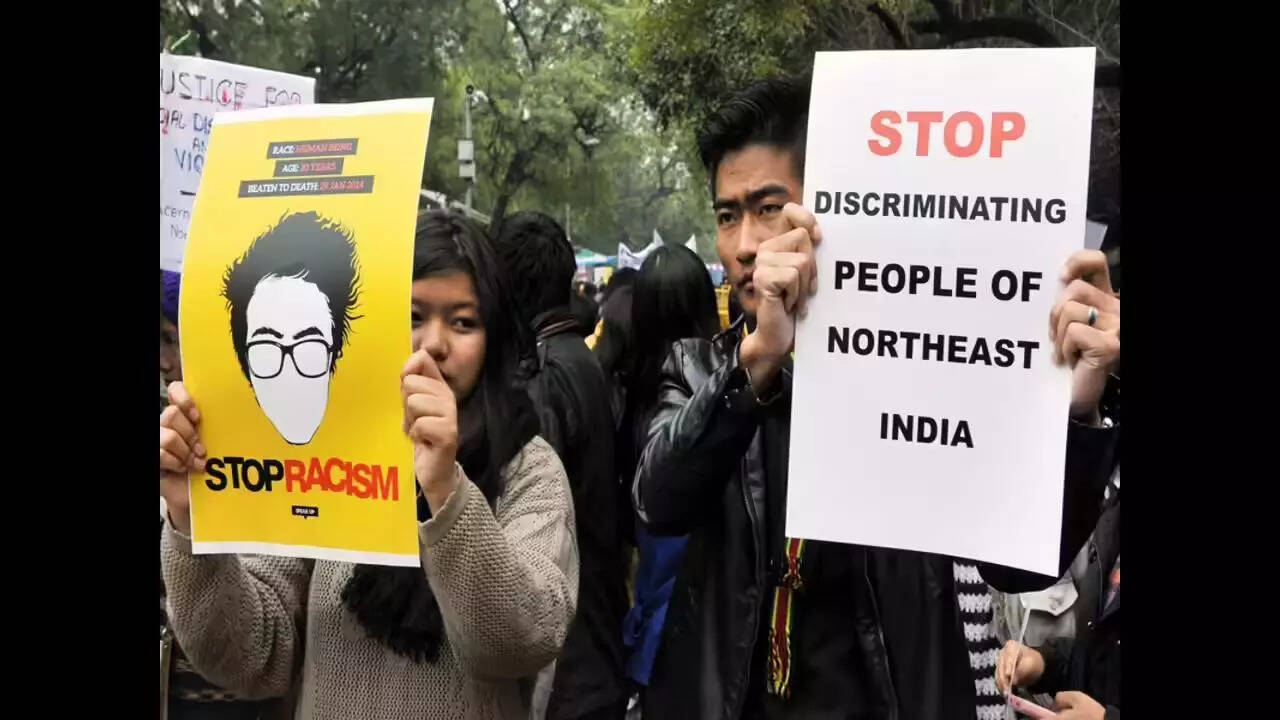
What hurt most, she says, was that many people did not see anything wrong with asking such questions. “It definitely triggered me being questioned every day about what I eat, how I look and where I belong,” she recalls.That casual prejudice, civil rights activists say often escalates into something far more dangerous.These day-to-day casual slurs, which come as no surprise in the lives of people from the Northeast, reveal that even India’s so-called cosmopolitan “melting pots” often fail to be truly inclusive. For many from the region living outside it, these cities remain spaces where identities are questioned and belonging is never fully accepted.

.

‘Oye Chinese

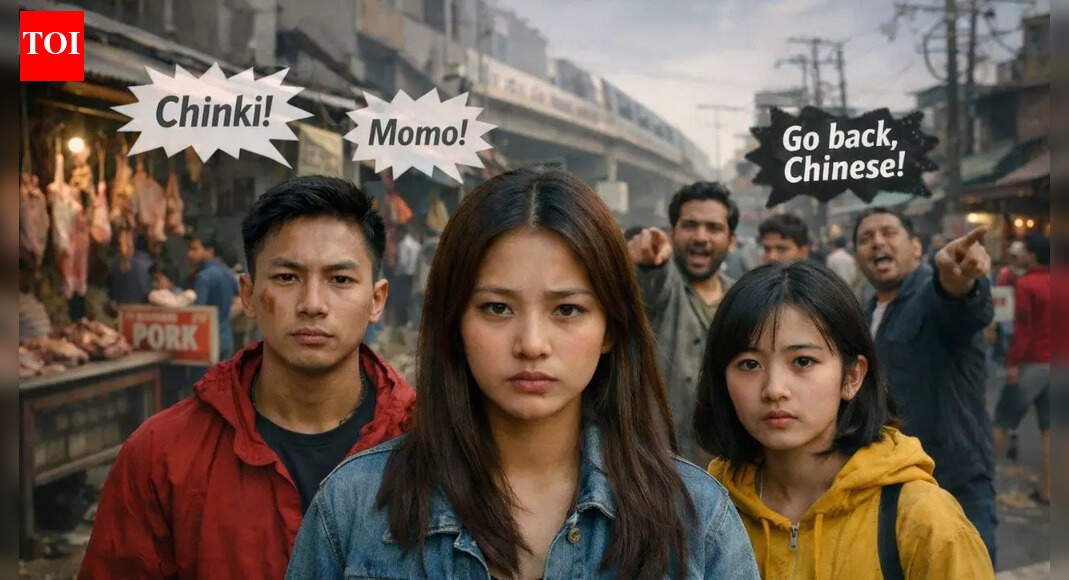
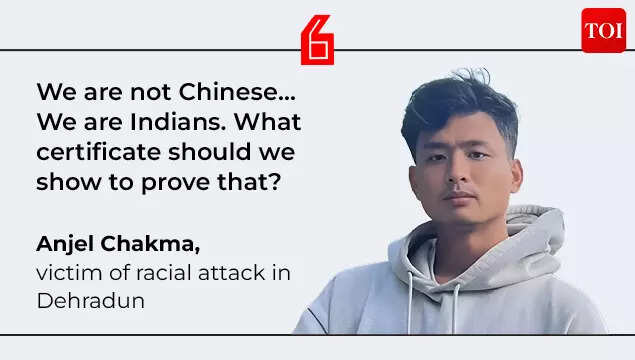
On December 9, what began as a routine visit to a local market in Dehradun ended in fatal violence. Twenty-four-year-old Anjel Chakma from Tripura lost his life.Anjel and his younger brother Michael had been planning a Chandrashila trek scheduled for December 22 and had even ordered new trekking shoes for the trip.The shoes arrived a day after the attack. They were never unpacked.According to Michael and other family members, the brothers were subjected to racial slurs — “Chinki,” “Chinese” and “Momo” during a grocery run in the Selaqui area. One of the men allegedly sneered, “Oye Chinese, have you come to buy pork?”Anjel objected to the abuse and asserted their identity. “We are not Chinese… We are Indians. What certificate should we show to prove that?” he allegedly said.What followed, according to family and friends, was brutal violence.

.

Anjel Chakma

“Soon after Anjel replied, they attacked him and his brother while hurling abuses,” said a friend who stayed at the hospital through the two weeks that followed. “Anjel suffered serious injuries to his neck and spine. Michael is also injured and remains in serious condition.”Dehradun senior superintendent of police Ajai Singh said the comments appeared to target the brothers’ appearance. Police said Anjel was struck with a knife and a metal kada, leaving him critically injured.The case drew national attention after Anjel’s father said his son was attacked despite clearly asserting that he was Indian.

‘I am an Indian’

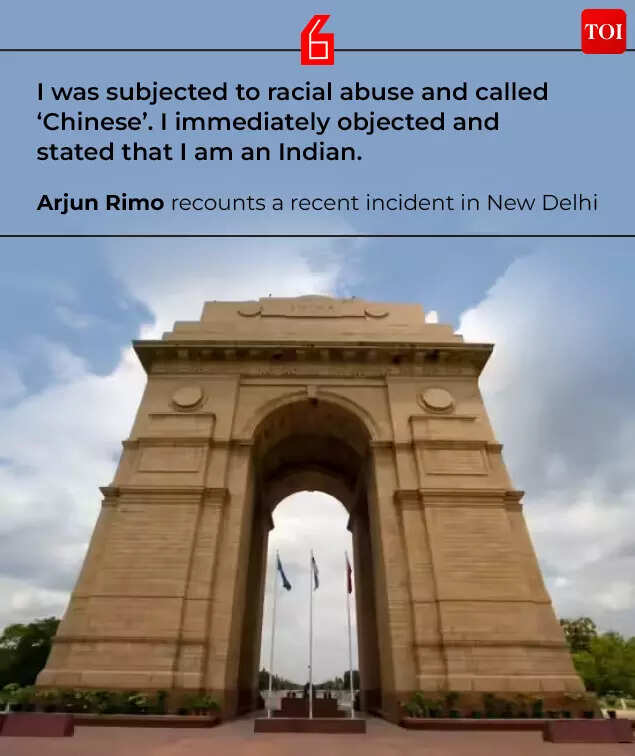
Similar incidents occur with alarming regularity.Arjun Rimo from Arunachal Pradesh recalls a recent incident in Delhi that left him shaken. “On January 8, 2026, in Karol Bagh, New Delhi, while buying meat at a shop, I was mistreated,” he told TOI.“As I chose to leave, I was subjected to racial abuse and called ‘Chinese’. I immediately objected and stated that I am an Indian.”He said a person associated with the shop attacked him first.“I reacted only in self-defence. I punched him, during which he sustained a facial injury. Soon after, two more individuals joined him, and the three of them assaulted me together.”

.

As a crowd of 30 to 35 people gathered, Rimo said he became overwhelmed.“I could no longer protect myself. Fearing serious harm, I sought police assistance,” he said, adding that he personally witnessed the accused being taken into police custody.“This episode,” he said, “highlights a broader, long-standing challenge faced by citizens from India’s North-Eastern region,” who frequently encounter bias and unequal treatment when living or travelling outside their home states, particularly in metropolitan cities.For many, stepping outside the Northeast means confronting suspicion, stereotyping and casual prejudice — not as isolated incidents, but as an everyday reality.

‘Do you even get Maggi there?’

For Sushma Pegu, who works at a high-profile firm in Bengaluru, discrimination followed her into corporate spaces.She recalls being bullied, subjected to racial slurs, and questioned relentlessly about her food habits.“A colleague literally asked me, ‘Do you even get Maggi there? How do you survive with all the non-veg food? I also heard you people eat cats and dogs.’”“I took a stand,” she said, adding that the colleague was eventually terminated.But the questioning, she said, often begins the moment she steps into a cab, with drivers routinely asking, “Which country are you from?” prompted solely by her appearance.

Do you even get Maggi there? How do you survive with all the non-veg food? I also heard you people eat cats and dogs.

A colleague asked Sushma, who hails from Assam

Fear during Covid

Roshni recalls how racial prejudice intensified during the Covid-19 outbreak.“During my time at Lakshmibai College,” she said, “a group of students passed a remark about one of my friends, saying, ‘Mujhe toh isko dekh kar dar lag raha hai’ (I feel scared just looking at her).”She said the comment, though made casually, carried a deep sense of exclusion and fear.“I felt shocked, angry and deeply uncomfortable,” she said.“It created a lasting sense of humiliation and helplessness.”

‘My only mistake is that I look like this’

In October 2025, a 27-year-old flight attendant from Meghalaya alleged that she was racially abused twice within an hour in Delhi; first in north Delhi’s Kamla Nagar and later on the metro.Her Instagram video went viral after Union minister Kiren Rijiju reposted it.In the video, the woman said a group of men sitting on a scooter mocked her using racial slurs and laughed. Shaken, she walked into a nearby Tibetan eatery but found herself unable to eat.“I did not feel like eating anything. My brain could not process what had just happened,” she said.“It breaks my heart,” she added. “My only mistake is that I am born in India and I look like this and I don’t look like what people expect Indians to look like.”Having travelled to several countries, she said she had never been made to feel unwelcome abroad.“But today, in my own country, my fellow Indians made me feel like I did not belong.”Addressing the alleged perpetrators, she said, “You didn’t just insult me. You insulted every person who has ever felt ‘othered’ in their own country. India is diverse our faces, our languages and our cultures are all valid. You don’t get to decide who belongs and who doesn’t.”
.

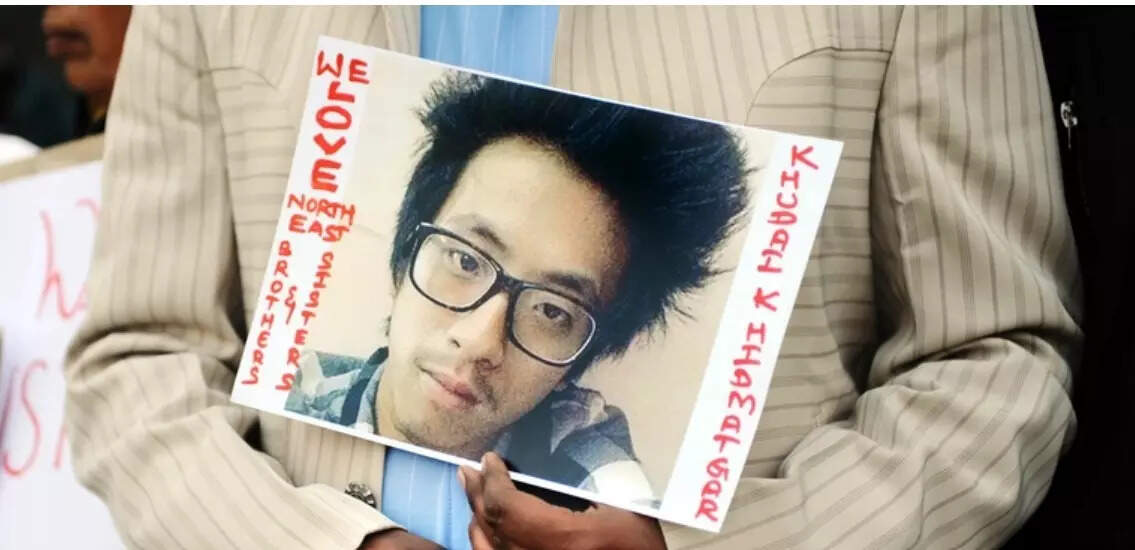
Nido Taniam

India has seen such cases for years

Such incidents are far from isolated.In November 2023, students from the Northeast reported racial and misogynistic abuse near Delhi University’s North Campus. In 2016, two youths from Mizoram were beaten in Bengaluru for not speaking the local language.One of the most chilling cases remains the killing of Nido Taniam in January 2014. The 19-year-old student from Arunachal Pradesh was beaten to death in Delhi’s Lajpat Nagar after shopkeepers mocked his hairstyle.A police investigation report detailed how Nido and his friends had gone to meet another friend when a shopkeeper made derogatory remarks about his appearance.An altercation followed, during which Nido smashed a glass pane. The shopkeeper and his associates allegedly assaulted him while making racist remarks about his caste, race and appearance.Although the immediate dispute was settled after Nido paid compensation, he was later assaulted again by the group and died in his sleep at a friend’s residence.The incident sparked widespread outrage among people from the Northeast living in Delhi, with allegations that the police failed to protect him despite repeated pleas.

.

A legal vaccum

India is a signatory to the International Convention on the Elimination of All Forms of Racial Discrimination, yet does not have a specific law addressing racial discrimination.Following Nido Taniam’s death, the MP Bezbaruah Committee recommended criminalising racial slurs such as “chinki” and “Chinese”, proposing jail terms of up to five years.While some administrative steps were taken, the proposed amendments to the IPC remain pending.In 2016, the Supreme Court directed the Centre to monitor the implementation of the committee’s recommendations. Activists, however, say enforcement remains inconsistent, with racial abuse often dismissed as a social issue rather than treated as a criminal offence.These incidents show how deeply racial prejudice is woven into everyday life. While stronger laws are necessary, activists argue they are not sufficient on their own.The fight, they say, must begin in schools, through education on diversity, history and discrimination. It must be carried forward by police, institutions, political parties and society at large.Multiculturalism cannot remain a slogan. It must be practised.

Source link

‘Exposing my identity’: Unnao rape survivor pleads for help; blames Sengar’s daughters | India News


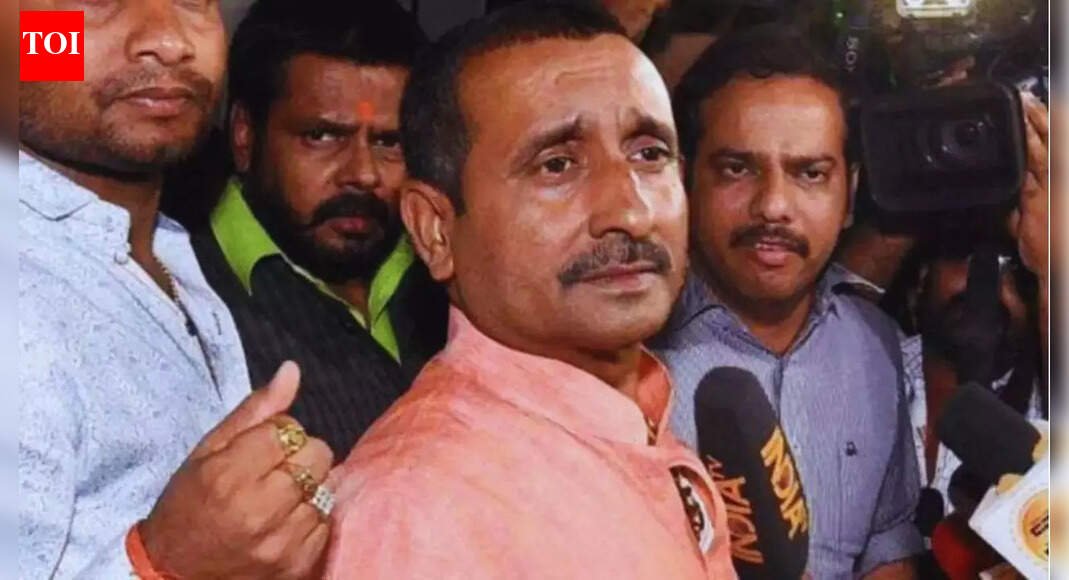
NEW DELHI: The survivor of the 2017 Unnao rape case on Saturday pleaded for support alleging that the daughters of expelled BJP leader Kuldeep Singh Sengar and their supporters are “exposing” her identity on social media, putting her safety at risk.In a video message, the survivor said, “Kuldeep Singh Sengar’s two daughters and their supporters have, for the past few days, been exposing my identity on social media.”

Unnao Rape Case: Activists Protest Outside Delhi High Court Over Sengar Bail

“I am seeing it everywhere, on Facebook, Instagram, everywhere,” she added.Sengar, a former Uttar Pradesh MLA, was convicted in December 2019 in the Unnao rape case and sentenced to life imprisonment along with a fine of Rs 25 lakh.

‘I am also a daughter of this country’

Earlier on January 1, the survivor made an emotional appeal on social media, urging people to stand with her beyond caste lines, as she alleged that she and her husband have been facing a sustained smear campaign online.Her appeal came days after the daughter of expelled BJP leader and Unnao rape case convict Kuldeep Singh Sengar claimed on X that “her father was innocent and sought public support.”In a video message, the survivor had said that over the past two days, she and her husband had been targeted on social media by people identifying themselves as Sengar’s supporters.She also alleged that posts were being circulated online in support of Sengar at Jantar Mantar on January 11, allegedly called by his daughters. “I am also a daughter of this country. Please become my voice. A criminal has no caste,” the survivor said in the video.Reaffirming her faith in the judicial process, she appealed to society to stand with her in the fight for justice instead of rallying behind a convicted offender.

Supreme Court stays bail

On December 29, the Supreme Court stayed a Delhi high court order that had suspended Sengar’s life sentence and granted him bail. The apex court said he shall not be released from custody.A three-judge vacation bench, led by Chief Justice of India Surya Kant and comprising Justices J.K. Maheshwari and A.G. Masih, was hearing the CBI’s plea against the high court’s December 23 order.Solicitor General Tushar Mehta, appearing for the CBI, urged the court to stay the order, calling it a “horrific rape” of a minor. “We are answerable to the child who was (aged) 15 years and 10 months,” he said, noting that Sengar was a powerful MLA at the time.

High Court order and reactions

The Delhi high court had granted bail citing that Sengar had already served seven years and five months in prison and questioned whether an elected representative fits the definition of a “public servant” under the IPC for the purposes of the POCSO Act. The order imposed several conditions while granting bail, including a personal bond of Rs 15 lakh with three sureties, a direction not to enter a 5-km radius of the survivor’s residence in Delhi, and a strict bar on threatening the survivor or her mother. The high court decision sparked protests by the survivor, her family and activists.

Sengar’s daughter’s open letter post SC verdict

Following the Supreme Court’s stay Sengar’s daughter, Ishita Sengar wrote an open letter saying she was “exhausted, frightened and slowly losing faith.”“I am writing this letter as a daughter who is exhausted, frightened, and slowly losing faith, but still holding on to hope because there is nowhere else left to go,” she wrote.She said, “For eight years, my family and I have waited… We trusted the law. We trusted the Constitution.” “Over these years, I have been told countless times on social media that I should be raped, killed, or punished simply for existing… It is daily. It is relentless,” she added.Meanwhile, the survivor’s mother welcomed the top court’s decision and reiterated her demand for justice for her daughter.


Source link

IND vs NZ [WATCH]: Prasidh Krishna cleans up Mitchell Hay with a jaffa in the first ODI


India fast bowler Prasidh Krishna delivered a breathtaking moment of skill and precision during the first ODI against New Zealand at the BCA Stadium, Kotambi, Vadodara. With a delivery that will be replayed countless times, Prasidh completely outfoxed Mitchell Hay, cleaning him up with a viciously jagging ball that left the batter rooted to the crease and gave India a crucial breakthrough at a vital stage of the innings.

India look for breakthroughs in the middle overs

After opting to bowl first, India’s bowlers were tested on a surface that offered good value for shots. New Zealand’s batters showed intent and discipline, ensuring the scoreboard kept ticking even as wickets fell at regular intervals. As the innings moved into the latter half, India were desperate for timely strikes to prevent the visitors from posting a formidable total.

Captain Shubman Gill turned to Krishna in the 38th over, hoping his pace and bounce could unsettle the set batters. What followed was a delivery that underlined why Prasidh is such a potent weapon in limited-overs cricket.

Prasidh Krishna stuns Mitchell Hay with a beauty

On the third ball of the 38th over, Prasidh ran in and delivered an absolute peach. Bowling to the right-handed Hay, the Indian pacer produced a sharp delivery that appeared to nip back in dramatically. There were immediate murmurs of reverse swing as the ball jagged back late, completely deceiving the batter.

Hay was caught deep in his crease, offering little foot movement as the ball sneaked past the inside edge. Before he could react, the delivery crashed into the top of the middle stump, sending the bails flying. The batter stood still for a moment, clearly stunned by the quality of the ball that had beaten him comprehensively. It was a classic fast-bowler’s dismissal—pace, movement, and precision coming together in perfect harmony.

Also READ: IND vs NZ: Here’s why Rishabh Pant is not playing the first ODI

Here’s the video:


New Zealand post a competitive total courtesy of Devon Conway’s blazing knock

New Zealand went on to post a competitive 300/8 in their allotted 50 overs, recovering well after losing momentum in the middle phase. The innings was anchored by solid contributions from the top and middle order, with Henry Nicholls scoring a fluent 62 and Devon Conway adding a composed 56 at the top, as the duo laid a strong foundation with a century opening stand. After both openers were dismissed in quick succession, New Zealand relied heavily on Daryl Mitchell, who played a crucial knock of 84 to steady the innings and guide the visitors through the middle and death overs. Despite India striking at regular intervals late in the innings, Mitchell’s counter-attacking approach ensured New Zealand reach 300-run mark, giving their bowlers a challenging total to defend in the first ODI.

Also WATCH: IND vs NZ – Harshit Rana deceives Henry Nicholls with a stunning slower ball in 1st ODI


Source link

Budget 2026: Biogas body IBA seeks Rs 10,000 cr subsidy fund; pitches higher support for CBG, organic manure


Budget 2026: Biogas body IBA seeks Rs 10,000 cr subsidy fund; pitches higher support for CBG, organic manure

The Indian Biogas Association (IBA) has proposed the creation of a Rs 10,000 crore fund to provide capital subsidy to the biogas industry in the Union Budget 2026, calling for higher fiscal support to accelerate investment, improve project viability and scale up green energy adoption, PTI reported.In its Budget recommendations, the industry body urged the government to raise the capital subsidy for compressed biogas (CBG) plants by 50 per cent to Rs 6 crore per 4.8 tonnes per day (TPD) of capacity, and increase the upper cap to Rs 25 crore per project, from the current Rs 10 crore limit. At present, the scheme offers Rs 4 crore per 4.8 TPD of capacity.IBA said it will share these recommendations with the Ministry of New & Renewable Energy and the Ministry of Finance, adding that it has raised the demands at multiple forums ahead of the Budget.The association said the capex cost of CBG plants has risen by over 50 per cent since the launch of the Central Financial Assistance (CFA) scheme in 2014, necessitating a revision in subsidy norms. It proposed that the enhanced subsidy structure be supported by a minimum corpus of Rs 10,000 crore, enabling projects of up to 20 TPD capacity.For Budget 2026, IBA said the biogas and CBG sector should be positioned as a fast-maturing pillar of green growth, which now requires deeper fiscal support, faster implementation and easier access to finance to unlock private investment and rural income opportunities.The association also called for scaling up project incentives by raising CFA levels, and proposed a mandated blending of fermented organic manure (FOM) in fertiliser use — at least 5 per cent by 2028, rising to 10 per cent by 2030.Pointing to the government’s annual Rs 2 lakh crore chemical fertiliser subsidy, IBA said this contributes little to soil organic content. Redirecting even 10 per cent (Rs 20,000–25,000 crore) of this subsidy towards FOM-linked or carbon-based incentives could improve soil health, reduce import dependence and promote climate-smart agriculture, it said.The association noted that the current Rs 1,450 crore allocation over three years for Market Development Assistance (MDA) for organic manure from CBG plants is “abysmally low” and only a starting point, especially when compared with chemical fertiliser subsidies.In line with the compressed biogas blending obligation (CBO) under the Ministry of Petroleum and Natural Gas, IBA suggested that the Ministry of Chemicals and Fertilizers consider introducing a FOM–Chemical Fertilizer Blending Obligation (FCFBO) under an Organic–Chemical Fertilizer Blending Programme.The industry body also pushed for carbon monetisation through a Green Certificate mechanism, urging the government to allow biogas and CBG producers to sell carbon credits in domestic and international markets. It said this would help meet climate targets while opening new revenue streams for producers.Carbon credits in voluntary markets are valued at USD 5–50 per tonne of CO₂, and even at the lowest price, the carbon premium for CBG’s greenhouse gas mitigation could be Rs 10–12 per kg of methane produced, IBA said. With around 1,000 CBG plants expected by 2030, the market value of CBG-based green certificates could be about Rs 4,000 crore, it estimated.IBA also suggested introducing ‘cap and trade’ practices for carbon-intensive entities, and subsidising part of the proposed carbon pricing mechanism to help kick-start the system.


Source link