Breaking News
Evening news wrap: Supreme Court rejects Umar Khalid’s bail in Delhi riots case; fire erupts at ONGC well in Andhra Pradesh & more | India News


Evening news wrap: Supreme Court rejects Umar Khalid's bail in Delhi riots case; fire erupts at ONGC well in Andhra Pradesh & more
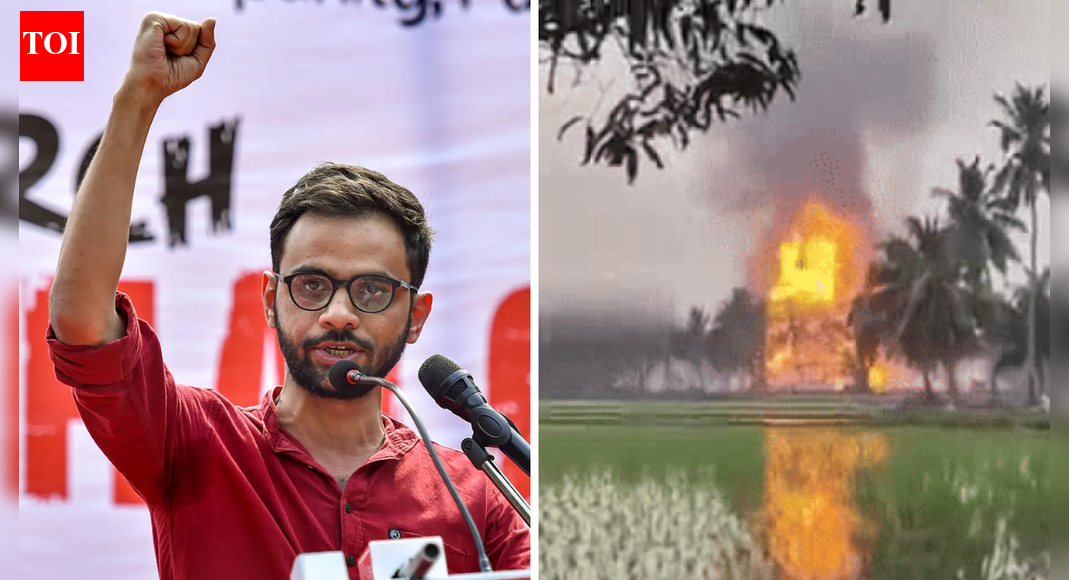
  • 2020 Delhi riots: Supreme Court denied bail to Umar Khalid and Sharjeel Imam in the 2020 Delhi riots case, with Khalid saying jail has now become his life.
  • Fire at ONGC well: A gas pipeline leak at an ONGC well in Andhra Pradesh’s Konaseema district triggered a fire at the site, but no casualties or injuries were reported.
  • Mustafizur row: The Bangladesh government imposed an indefinite ban on the telecast and promotion of the IPL after the controversy surrounding Mustafizur Rahman’s removal from Kolkata Knight Riders.
  • Delhi horror: A gym ownership dispute in East Delhi’s Laxmi Nagar escalated into a violent attack, leaving a man beaten, his wife allegedly molested, and their son assaulted on the street.
  • US strikes Venezuela: Chinese Premier Xi Jinping condemned US actions in Venezuela as “unilateral and bullying acts,” calling on major powers to respect international law and UN principles.

“US Has No Jurisdiction in Venezuela” Ex-UN Envoy Dilip Sinha Slams US Action In Venezuela

Here are the top five stories of the evening:

Supreme Court denies bail to Umar Khalid in Delhi riots case; activist says, ‘ab yahi zindagi hai’

The Supreme Court rejected bail for activist Umar Khalid and Sharjeel Imam, who are accused in the alleged larger conspiracy behind the 2020 northeast Delhi riots. Khalid remarked that jail had now become his life. His partner, Banjyosna Lahiri, quoting Khalid on X, wrote: “I am really happy for the others who got bail. So relieved.” When she mentioned visiting him the next day for a meeting, Khalid replied, “Good, good, aa jana. Ab yahi zindagi hai.” Read full story

Gas leak triggers fire at ONGC well in Andhra Pradesh; no injuries reported

A gas pipeline leak at a well in Andhra Pradesh’s Dr BR Ambedkar Konaseema district sparked a fire on Monday at a site operated by Oil and Natural Gas Corporation’s (ONGC) production contractor, Deep Industries Ltd. According to preliminary reports from a company official, no casualties or injuries have been reported. Senior ONGC officials from Rajahmundry rushed to Mori village following the blaze at the Mori-5 well. Read full story

Bangladesh bans IPL broadcasts indefinitely after Mustafizur Rahman row

The Bangladesh government indefinitely banned the telecast and promotion of the Indian Premier League (IPL) following the controversy over fast bowler Mustafizur Rahman’s removal from the Kolkata Knight Riders squad. An official order confirmed that all IPL-related broadcasts, promotions, and event coverage are suspended with immediate effect. The directive will remain in force until further notice. Read full story

East Delhi gym dispute turns violent, family assaulted in Laxmi Nagar

A man was beaten, his wife allegedly molested, and their son stripped naked and assaulted on the street, after a dispute over a gym operating from a residential property in East Delhi’s Laxmi Nagar turned violent. The complainant, Rajesh Garg, who owns the house and runs a gym in its basement, alleged that the gym’s caretaker, Satish Yadav, cheated him and tried to take over the business, leading to the ongoing conflict, according to his police complaint. Read full story

‘Bullying acts’: Chinese President XI condemns US operation in Venezuela

Chinese Premier Xi Jinping condemned “unilateral and bullying acts” in global affairs, following the arrest of Venezuelan President Nicolas Maduro by US forces. “All countries should respect the development paths chosen by other nations and abide by international law, as well as the purposes and principles of the UN Charter, with major countries leading by example,” Xi said, adding, “In a world beset with changes and chaos, unilateral and bullying acts are severely undermining the international order.Read full story


Source link

WATCH: Sean Abbott rattles Jack Wildermuth’s stumps with a peach of a delivery in BBL|15


Sydney Sixers’ seam attack seized early control of their Big Bash League 2025-26 clash against Brisbane Heat at Coffs Harbour, with Sean Abbott producing a spellbinding dismissal of Jack Wildermuth that lit up the 24th match of BBL|15. ​ The Heat, sent in after the Sixers won the bat flip, limped to 89/8 in 15.4 overs as the hosts’ experienced bowling group repeatedly exposed their brittle top and middle order. ​

Sean Abbott’s spectacular delivery floors Jack Wildermuth in BBL|15

Brisbane Heat’s innings had finally begun to find some momentum through Wildermuth, who counter-attacked superbly with 31 off just 17 deliveries, striking two fours and two sixes at a strike rate of 182.35. Having watched partners fall around him, Wildermuth took it upon himself to go downtown and break the early stranglehold imposed by the Sixers’ new-ball pair.​

Abbott, into his second over, responded with a classic fast-bowler’s reply – a full, bustling delivery that honed in on off stump before jagging back late. Wildermuth, looking to launch down the ground, left a gaping corridor between bat and pad, and the late movement was enough to send the middle stump cartwheeling, leaving the Coffs Harbour crowd roaring as the lights flashed in dramatic fashion. The dismissal, recorded at 3.6 overs with Heat 33/2, broke a dangerous stand and halted the only sustained surge of scoring Brisbane had managed in the powerplay.​

Abbott’s figures at that stage, 2 for 18 off three overs, underlined his impact, as he complemented the headline wicket of Wildermuth by trapping Jimmy Peirson lbw for 10 off 10 later in the innings. His disciplined lengths, subtle seam movement and refusal to over-pitch for cheap boundaries epitomized the Sixers’ bowling blueprint on a surface offering just enough help if bowlers hit the top of off.​

Here’s the video:

Also READ: David Warner’s century in vain as Hobart Hurricanes pull off a record run chase at ENGIE Stadium

Sydney Sixers’ bowlers dismantle Brisbane Heat lineup

The Heat’s scorecard told the story of a lineup repeatedly rebuilt and then broken again, with only Wildermuth and Hugh Weibgen offering any meaningful resistance. After a modest Powerplay 1 that yielded 33 runs for the loss of two wickets in the first four overs, Brisbane crawled to 50/5 by 7.6, then 58/5 at drinks, never once threatening to impose themselves on the contest.​

Ben Dwarshuis set the tone early, removing Nathan McSweeney for 11 and Max Bryant for 3 to finish with an incisive 2 for 19 from 2.4 overs, repeatedly angling the ball across the right-handers and dragging their strokes into the infield. At the other end, Jack Edwards (1 for 27) and Hayden Kerr (1 for 4 off two overs) used the seam-friendly conditions smartly, with Kerr allowing just four runs in his spell to choke the scoring rate in the middle overs.​

Joel Davies’ left-arm angle further tightened the squeeze, as he removed Xavier Bartlett and Matthew Kuhnemann in quick succession to return 2 for 19 from his full quota, triggering a collapse from 72/6 to 74/8. With Lachlan Hearne lbw for 1, Matt Renshaw dismissed for 2, and Oli Patterson unable to accelerate in his unbeaten 6 from 9, the Heat’s projected total hovered around a modest 104, underlining how comprehensively the Sixers’ attack had dictated terms.​ Brisbane Heat got bowled out for a low total of 114/9 setting  up a target of 115 against Sydney Sixers.

Also READ: BBL|15: Josh Brown sizzles as Renegades edge Stars in Melbourne derby thriller at the MCG


Source link

Rs 79,000 crore defence push: How India is rearming to counter China and Pakistan | India News


Rs 79,000 crore defence push: How India is rearming to counter China and Pakistan

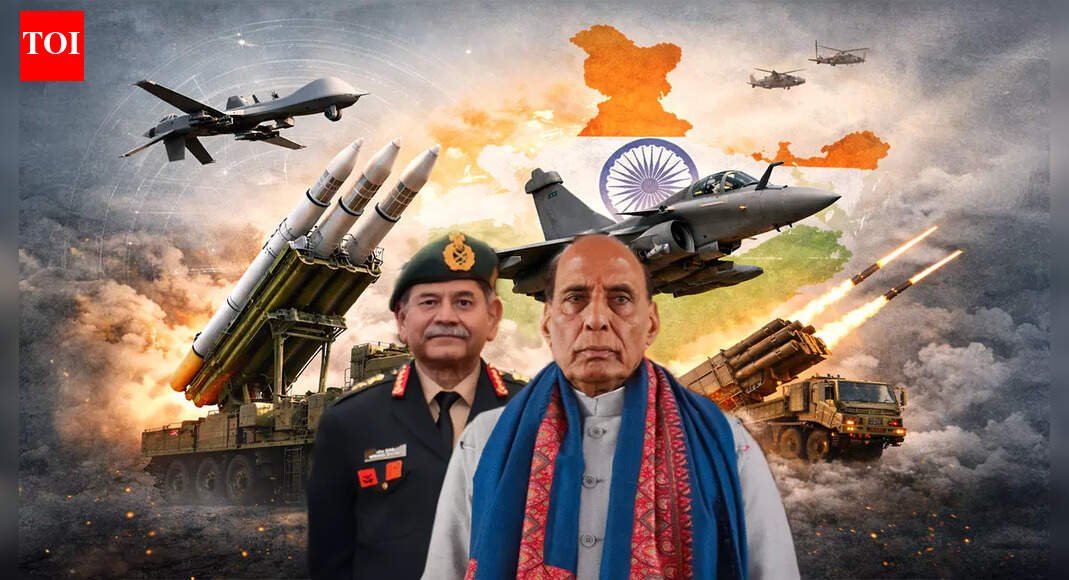
NEW DELHI: Amid a tightening security environment shaped by a militarily assertive China and a volatile Pakistan, the defence ministry has cleared military modernisation projects worth nearly Rs 79,000 crore, marking one of the most consequential procurement approvals in recent years. The clearances were accorded by the Defence Acquisition Council (DAC) chaired by defence minister Rajnath Singh, which approved a wide range of systems spanning air defence missiles, combat drones, long-range rockets, air-to-air weapons, aerial refuellers and counter-drone technologies.Senior military officials have repeatedly stressed that future conflicts will be defined by speed, precision and the ability to fight across domains. “Timely induction of critical capabilities is essential to maintain operational readiness in a rapidly evolving threat environment,” the Chief of the Air Staff, Air Chief Marshal AP Singh, said recently, underscoring the urgency behind such decisions. While Acceptance of Necessity (AoN) is only the first step in the procurement process, it formally establishes the armed forces’ requirements and allows detailed tenders, trials and negotiations to begin.

Rajnath Singh Links Lord Ram’s Ethics To Operation Sindoor, Says India Fought Terror With Dignity

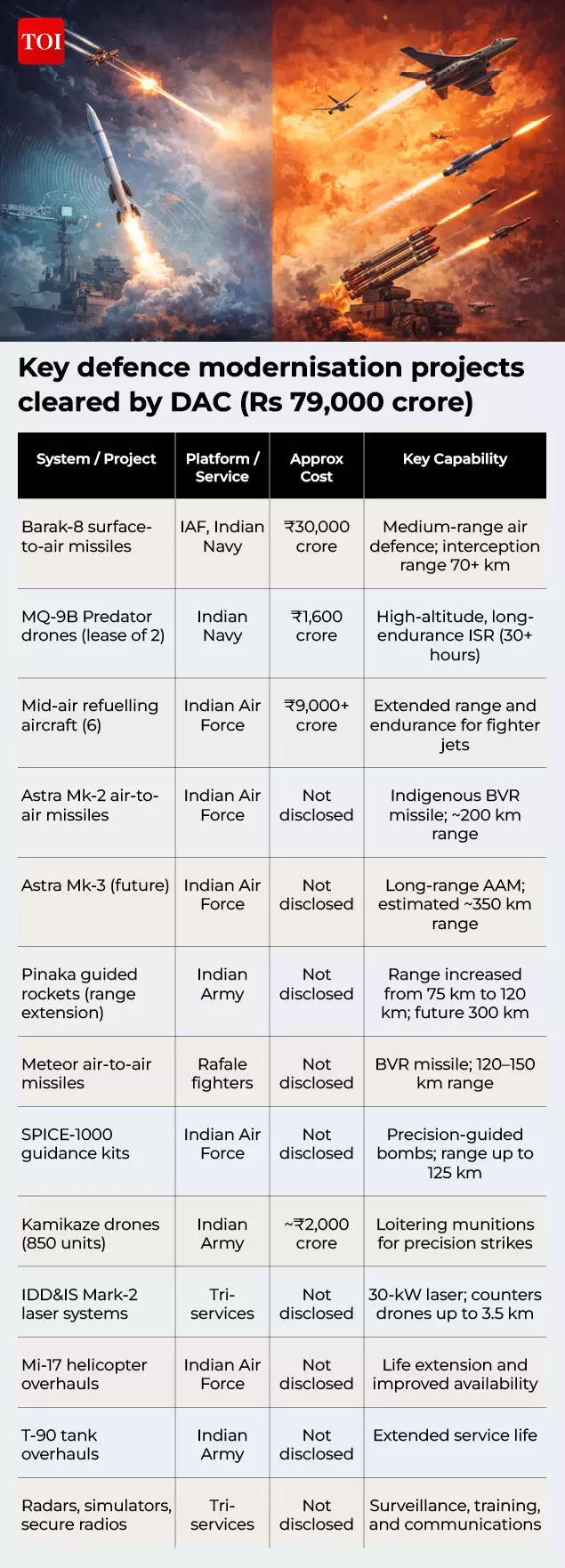
Key defence modernisation projects cleared by DAC

Taken together, the latest approvals offer a revealing snapshot of how India’s armed forces are recalibrating for wars that may unfold under the shadow of drone swarms, long-range missiles, electronic warfare and sustained precision strikes. Many of the systems cleared have been shaped by operational lessons from recent crises, assessed against the growing missile and air power capabilities of China and Pakistan, and aligned with a more pragmatic “Make in India with partners” approach rather than doctrinaire import substitution. What follows is not merely a list of acquisitions, but an emerging blueprint for how India plans to deter, and if necessary fight, high-intensity conflicts across its borders in the coming decade.Barak-8 missiles: Backbone of India’s layered air defenceThe single largest approval under the latest DAC meeting is the Rs 30,000 crore procurement of a large number of Barak-8 medium-range surface-to-air missiles for the Indian Air Force and Navy. Jointly developed by India and Israel, Barak-8 has become the backbone of India’s medium-tier air defence architecture.

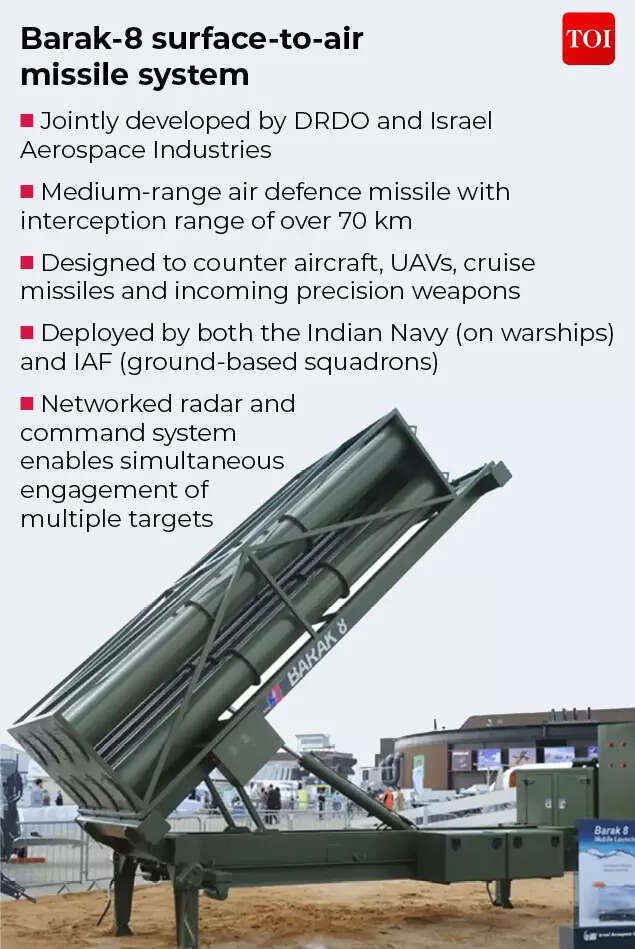
Barak-8 surface-to-air missile system

With an interception range of over 70 km, Barak-8 is designed to neutralise a wide spectrum of aerial threats, including fighter aircraft, helicopters, cruise missiles and unmanned aerial vehicles. Its advanced active radar seeker and ability to engage multiple targets simultaneously make it critical in countering saturation attacks.The missile system proved its operational value during the cross-border hostilities in May, when Pakistan launched multiple waves of Turkish-origin drones and Chinese missiles. Barak-8 was part of India’s multi-layered air defence network that successfully intercepted incoming threats, preventing damage to key military installations.For the Navy, Barak-8 is deployed aboard frontline destroyers, frigates and aircraft carriers, providing area air defence against anti-ship missiles and hostile aircraft. For the IAF, ground-based Barak-8 squadrons protect air bases and strategic assets. The new procurement aims to significantly bolster missile stocks, addressing concerns over wartime depletion and sustained engagements.MQ-9B Predator drones: Bridging the surveillance gap till 2030The DAC also approved the Rs 1,600-crore lease of two additional MQ-9B Predator drones for a period of three years. These high-altitude, long-endurance unmanned aerial vehicles will supplement the two Predators currently operated by the Navy.MQ-9Bs are capable of flying for over 30 hours at altitudes exceeding 40,000 feet, providing persistent intelligence, surveillance and reconnaissance across vast areas. They are particularly valuable for maritime domain awareness in the Indian Ocean Region, tracking hostile naval movements and monitoring choke points.

MQ-9B Predator drones (leased)

The leased drones are meant to bridge a critical capability gap until India receives 31 armed MQ-9B remotely piloted aircraft systems under the $3.8 billion deal signed with the US in October last year. Deliveries under that deal are expected only in 2029–30.By opting for a lease rather than outright purchase, the military avoids a capability vacuum during a period of heightened regional tensions, particularly in the Indo-Pacific and along the Line of Actual Control with China.Mid-air refuelling aircraft: Extending IAF’s combat reachAnother major clearance is the long-pending acquisition of six mid-air refuelling aircraft for the Indian Air Force at a cost exceeding Rs 9,000 crore. The lack of adequate aerial refuellers has long constrained the IAF’s ability to sustain long-range air operations.Under the approved plan, Israel Aerospace Industries will convert six second-hand Boeing 767 commercial aircraft into aerial tankers. The conversion involves structural reinforcement, installation of refuelling booms, fuel tanks and mission systems.

Mid-air refuelling aircraft

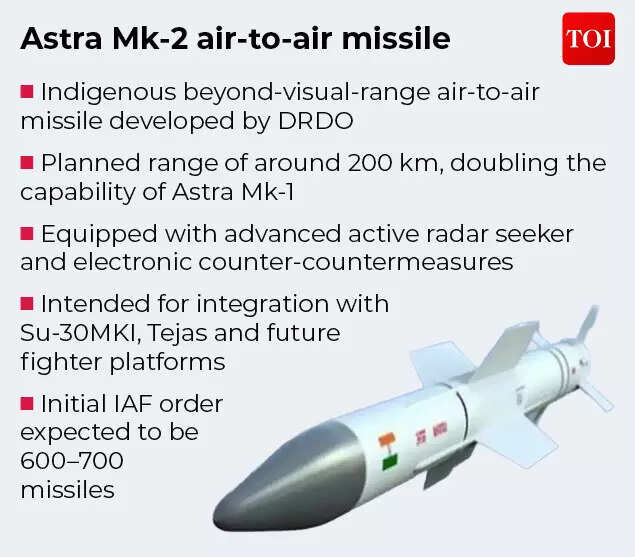
A fresh AoN was required because the tender resulted in a single-vendor situation. Despite that, the urgency of the requirement has pushed the government to move ahead.Mid-air refuellers dramatically extend the operational reach and endurance of fighter jets, transport aircraft and surveillance platforms. They are especially critical for deep-penetration strikes, rapid force mobilisation, and sustained air patrols over contested areas. With China operating a growing fleet of refuellers and Pakistan steadily upgrading its air force, the IAF’s refuelling gap had become increasingly stark.Astra Mk-2 and Mk-3: India’s push for long-range air dominanceTwo crucial indigenous missile projects cleared by the DAC focus on extending India’s air-to-air combat envelope. The first is the Astra Mark-2 air-to-air missile, whose range is being enhanced from the current 100 km to around 200 km.Developed by the Defence Research and Development Organisation (DRDO), Astra is India’s first indigenous beyond-visual-range air-to-air missile. It is already integrated with Su-30MKI fighters and is slated for deployment on Tejas and other platforms.

Astra Mk-2 air-to-air missile

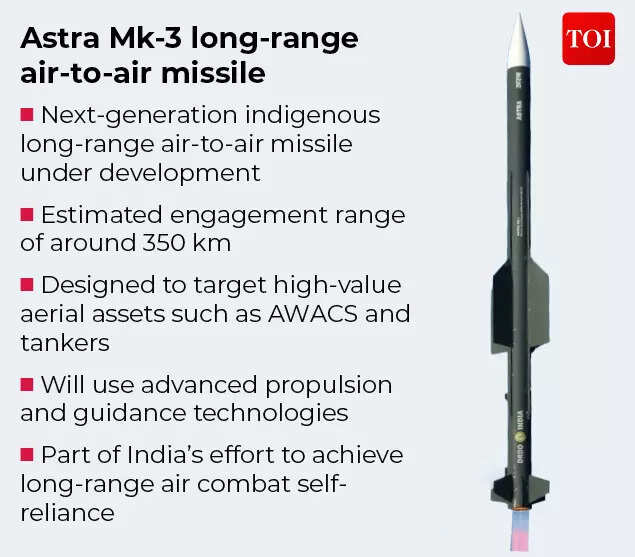
The IAF is expected to place an initial order for 600–700 Astra Mk-2 missiles. In parallel, work is underway on Astra Mark-3, which will have an estimated range of around 350 km, placing it firmly in the long-range interception category.

Astra Mk-3 long-range air-to-air missile

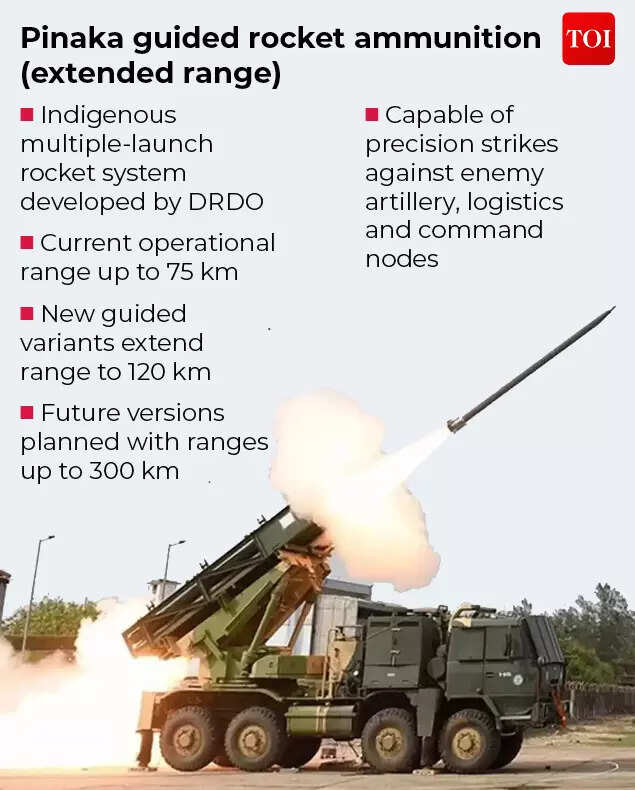
Indigenous long-range air-to-air missiles are increasingly important as aerial combat shifts from close dogfights to stand-off engagements, where detection, tracking and first-shot capability determine outcomes.Pinaka rockets: From 75 km to deep-strike artillery at 300 kmThe DAC’s nod for extending the range of Pinaka guided rocket ammunition marks a major leap in India’s artillery firepower. Pinaka multiple launch rocket systems currently fire rockets up to a range of 75 km, already giving them an edge over older systems.

Pinaka guided rocket ammunition

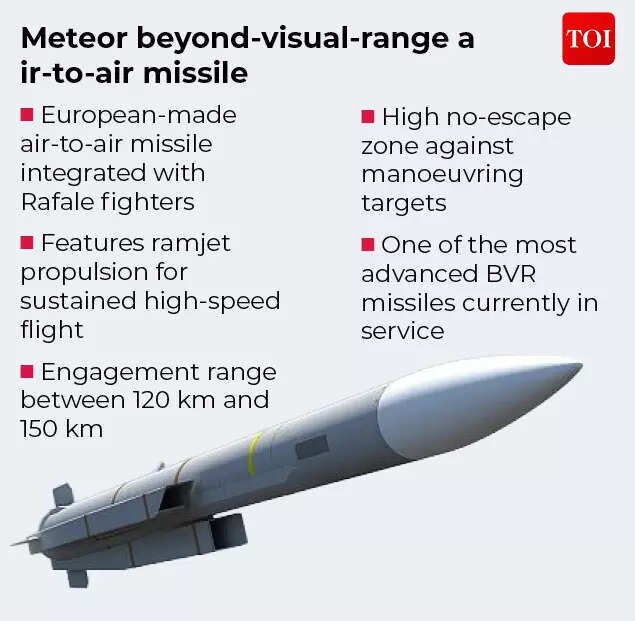
The new guided variants aim to extend that range to 120 km, with future plans to reach up to 300 km. According to officials, the 120-km version was successfully tested on Sunday, demonstrating improved accuracy and lethality.A 300-km Pinaka would fundamentally alter battlefield dynamics, allowing the Army to strike deep into enemy territory without relying on air power. Such capability is particularly relevant along mountainous borders, where terrain and weather often limit air operations.Pinaka’s modular design and compatibility with different warheads make it a versatile system for counter-battery fire, suppression of enemy air defences and destruction of logistics hubs.Meteor missiles and SPICE-1000 kits: Enhancing Rafale’s punchWhile indigenous systems form the core of the modernisation drive, the DAC also approved additional procurements of select foreign munitions to plug immediate gaps. This includes more Meteor beyond-visual-range air-to-air missiles for Rafale fighters.With a range of 120–150 km, Meteor is considered one of the most lethal air-to-air missiles in service today, featuring a ramjet propulsion system that maintains high energy throughout its flight.

Meteor beyond-visual-range a ir-to-air missile

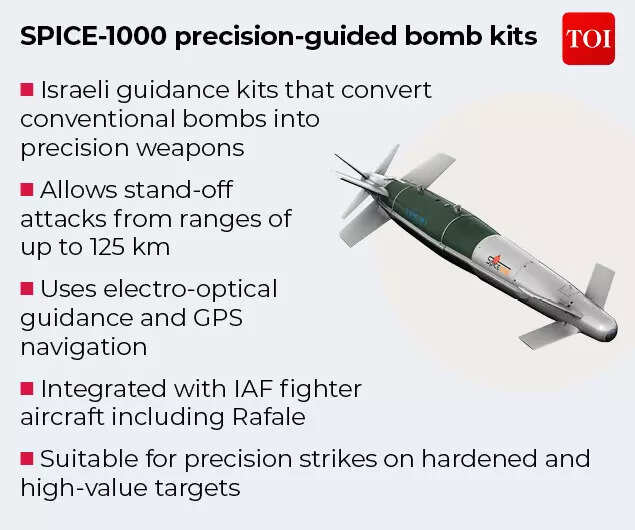
The council also cleared the acquisition of Israeli guidance kits for SPICE-1000 precision-guided bombs. These kits transform conventional bombs into long-range, highly accurate weapons capable of striking targets from up to 125 km away.

SPICE-1000 precision-guided bomb kits

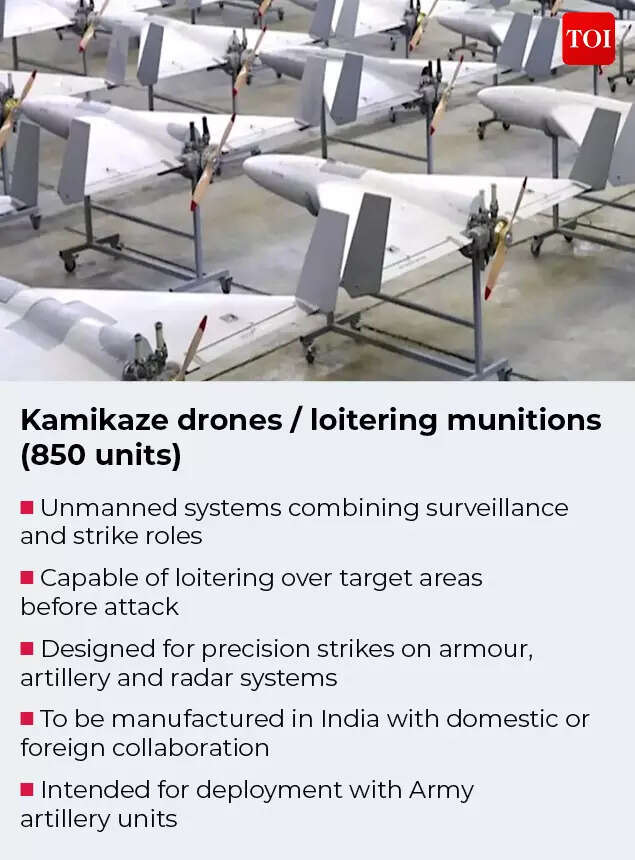
Together, these munitions significantly enhance the Rafale’s stand-off strike and air dominance capabilities, allowing it to engage high-value targets without entering heavily defended airspace.Kamikaze drones for the Army: Precision strikes and battlefield autonomyAmong the most telling approvals is the procurement of 850 kamikaze drones, or loitering munitions, for the Army’s new ‘Shaktibaan’ and ‘Divyastra’ artillery batteries at a cost of around Rs 2,000 crore.

Kamikaze drones/ loitering munitions (850 units)

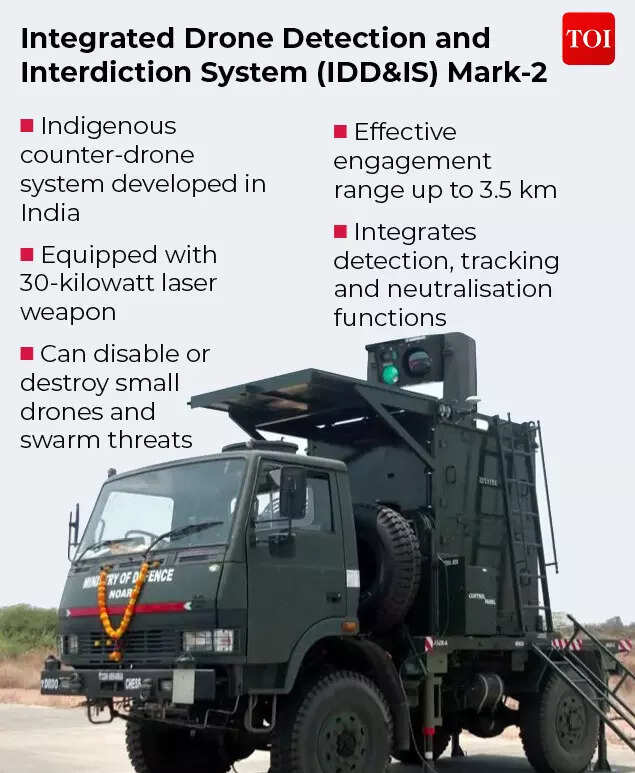
Loitering munitions combine surveillance and strike capabilities in a single platform. They can hover over a target area, identify enemy assets and then dive onto the target with an explosive payload.The drones approved under this programme will be manufactured in India, either by domestic firms or through foreign collaboration. Their induction reflects lessons drawn from conflicts such as Ukraine, where loitering munitions have been used extensively for precision strikes against armour, artillery and air defence systems.For the Indian Army, these drones provide a flexible, cost-effective tool for real-time battlefield engagement without risking pilots or high-value aircraft.Counter-drone laser systems: Preparing for swarm warfareThe DAC also cleared the indigenous Integrated Drone Detection and Interdiction System Mark-2. Equipped with 30-kilowatt lasers, the system can disable, degrade or destroy small remotely piloted aircraft and swarm drones at ranges of up to 3.5 km.

Integrated Drone Detection and Interdiction System (IDD&IS) Mark-2

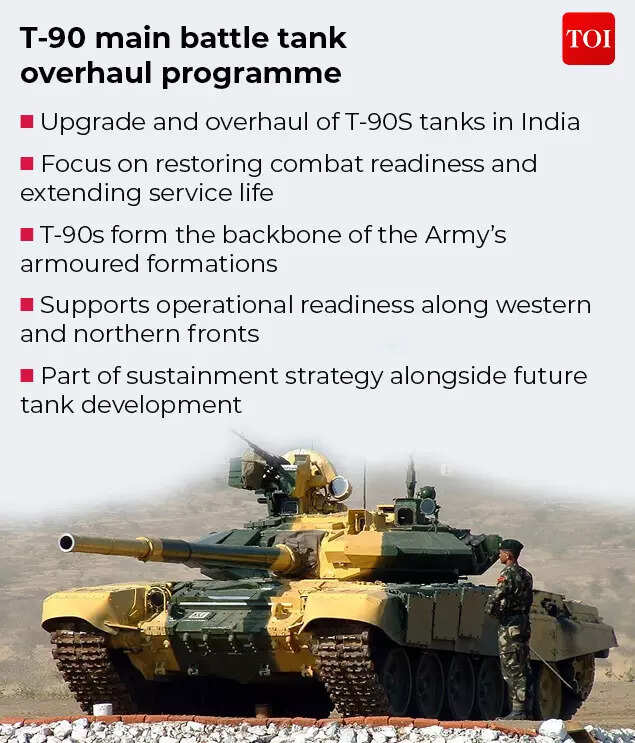
Drone swarms are increasingly viewed as a major threat, capable of overwhelming traditional air defence systems through sheer numbers. Laser-based systems offer a relatively low-cost, rapid-response solution to such threats.The IDD&IS integrates detection, tracking and neutralisation into a single platform, making it suitable for protecting air bases, ammunition depots and critical infrastructure. Its approval signals a recognition that future conflicts will involve contested airspace even at very low altitudes.Upgrades and overhauls: Mi-17 helicopters and T-90 tanksBeyond new acquisitions, the DAC approved overhauls of Mi-17 helicopters in Russia and T-90S main battle tanks in India. These overhauls aim to extend the service life and operational readiness of existing platforms.

Mi-17 helicopter overhaul programme

Mi-17 helicopters form the backbone of the IAF’s medium-lift fleet, supporting transport, casualty evacuation and special operations. T-90 tanks remain central to the Army’s armoured formations, particularly along the western front.

T-90 main battle tank  overhaul programme

Sustaining these platforms is critical even as newer systems are inducted, ensuring there are no capability gaps during the transition phase.Beyond missiles: Radars, simulators and secure communicationsSeveral smaller but vital projects were also cleared. These include low-level lightweight radars for detecting aerial threats, bollard-pull naval tugs for harbour operations, full mission simulators for Tejas fighter jets, and automatic take-off and landing recording systems for the IAF.

Bollard-pull naval tugs

The DAC also approved the acquisition of high-frequency software-defined radios to enable secure long-range communications across services. Such systems are essential for network-centric warfare, allowing forces to share data in real time.While less visible than missiles or drones, these enablers are critical for operational effectiveness, training and safety.

Low-level lightweight radar systems

Taken together, the Rs 79,000 crore modernisation push offers a clear snapshot of how India expects future wars to be fought. The focus is on layered air defence, long-range precision strikes, persistent surveillance, unmanned systems and electronic resilience.Rather than betting on a single platform or technology, the approvals reflect a systems-based approach, integrating missiles, drones, aircraft and sensors into a cohesive combat network. The blend of indigenous development and selective imports suggests a more mature procurement philosophy, driven by operational need rather than ideology.


Source link

‘You should have come earlier’: Delhi HC refuses to stay Lalu Yadav’s trial in IRCTC case; issues notice to CBI | India News


'You should have come earlier': Delhi HC refuses to stay Lalu Yadav's trial in IRCTC case; issues notice to CBI
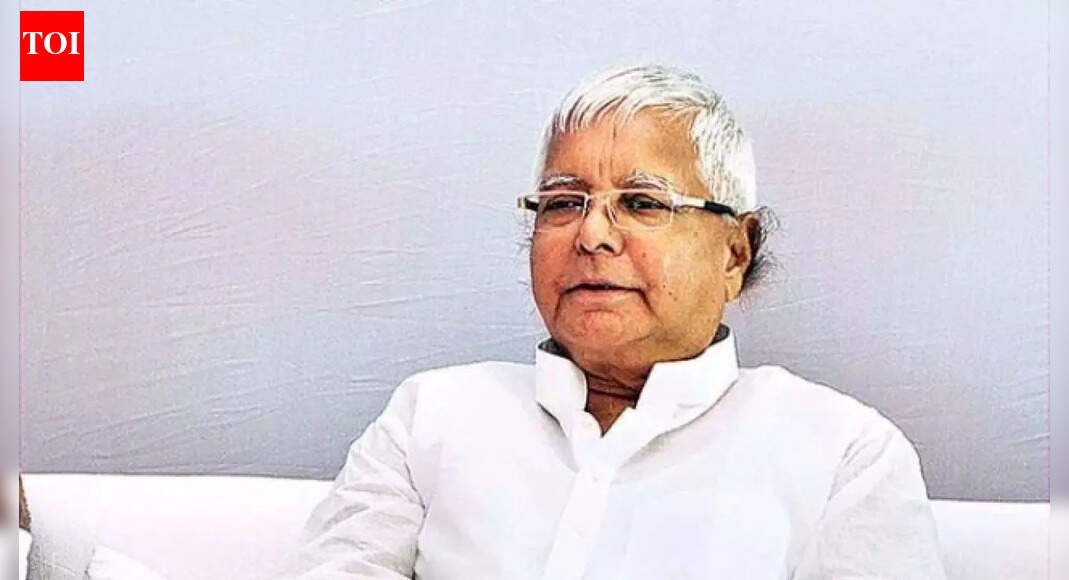
Lalu Prasad Yadav (File photo)

NEW DELHI: The Delhi high court on Monday refused to stay Lalu Prasad Yadav‘s trial in the alleged IRCTC scam case and issued notice to the Central Bureau of Investigation (CBI) seeking its reply.The single-judge bench of Justice Swarana Kanta Sharma told Yadav’s lawyers, Kapil Sibal and Maninder Singh, that it would not grant a stay without the CBI’s response and fixed January 14 as the next date of hearing.“Let them (CBI) file a reply. You should have come earlier; you didn’t come. The trial court order was passed earlier,” Justice Sharma said.The CBI’s counsel also sought time to file a reply in the matter.The trial court framed charges against Yadav, a former Union minister and ex-Bihar chief minister, in October last year. Charges were also framed against 13 other accused, including his wife and former chief minister Rabri Devi, and their son Tejashwi Yadav, a former deputy chief minister of the state.The charges relate to alleged irregularities in the award of operational contracts for two Indian Railway Catering and Tourism Corporation (IRCTC) hotels to a private firm during the RJD supremo’s tenure as the Union railway minister between 2004 and 2009.In a scathing observation, the trial court had said the land and share transactions in the case were “possibly an instance of crony capitalism fostered in the garb of eliciting private participation” in the Railways’ hotels at Ranchi in Jharkhand and Puri in Odisha.In its chargesheet, the CBI has alleged that a “conspiracy” was hatched between 2004 and 2014, under which BNR hotels of the Indian Railways, located in Puri and Ranchi, were first transferred to the IRCTC and later leased out for operations, maintenance and upkeep to Sujata Hotels Private Limited, a Patna-based firm.The agency further alleged that the tender process was rigged and manipulated, with conditions tweaked to favour Sujata Hotels, a private entity.(With PTI inputs)


Source link

US VP JD Vance’s house attacked: Windows smashed at Ohio residence; suspect in custody


US VP JD Vance's house attacked: Windows smashed at Ohio residence; suspect in custody

US vice president JD Vance’s home in Cincinnati was attacked at night, with several windows smashed, prompting a response from the secret service and local police. Secret service agents rushed to the East Walnut Hills residence in the early hours of Monday, and a suspect has been taken into custody, though authorities have not confirmed whether charges have been filed. Police told local outlet WCPO that the suspect was detained, but provided no further details.The Vance family, an official said, was not home at the time of the incident, and authorities do not believe the person entered the vice president’s home, according to preliminary inquiry, reported CNN.Last week Vance did not join Trump and other senior administration officials at Mar-a-Lago to watch the America’s operation in Venezuela unfold, amid concerns that his presence could compromise operational security. Instead, the vice president monitored the operation via a secure video conference before flying back to Cincinnati once it concluded. His office said he was “deeply integrated in the process and planning”.In a statement, Vance’s office said that due “to increased security concerns, the administration has aimed to limit the frequency and duration of the vice president and president being co-located away from the White House”.Police and secret service personnel were seen inside the property after the incident, though it is believed that neither Vance nor his family were at home at the time of the attack.The incident comes after heightened security in the area over the New Year holidays. Roads surrounding Vance’s residence had been closed for several days until Sunday, with checkpoints set up and residents asked to expect law enforcement presence, according to city officials.


Source link

Iran on edge: Is Khamenei planning his escape? Protests spread as Trump keeps close eye


Iran on edge: Is Khamenei planning his escape? Protests spread as Trump keeps close eye

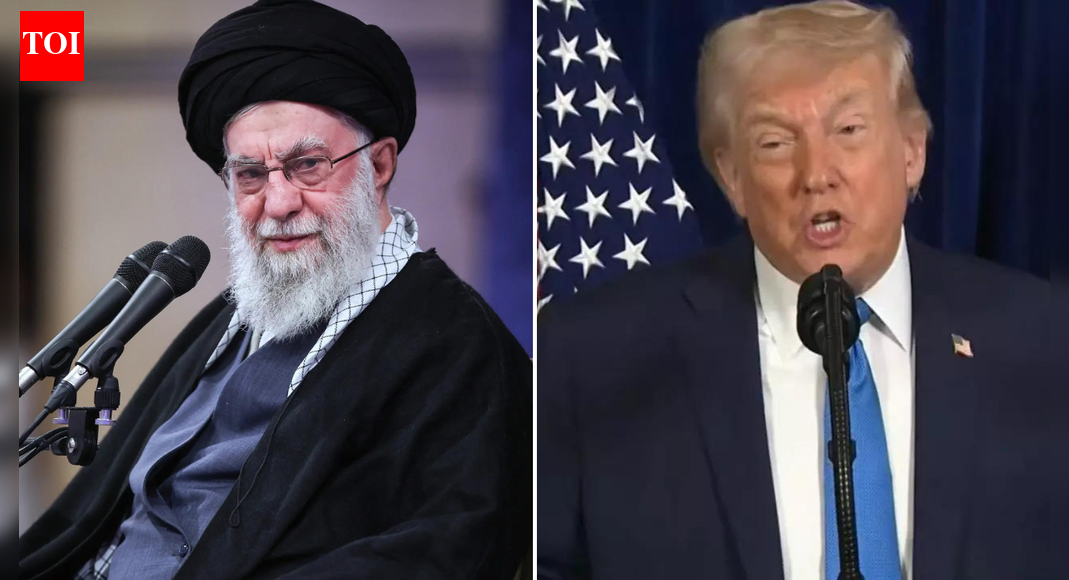
Iran’s Supreme Leader Ayatollah Ali Khamenei is understood to have prepared a contingency plan to flee the country should nationwide protests overwhelm the regime’s security forces, according to an intelligence assessment shared with The Times. Khamenei, 86, would leave Tehran with a tightly controlled group of fewer than 20 people, including close aides and family members, as per the report. Among them would be his son Mojtaba, widely viewed as his preferred successor. Intelligence sources say preparations include securing overseas assets, properties and liquid cash to enable a rapid exit should the regime lose control.Khamenei controls a vast financial empire through opaque charitable foundations, including Setad, estimated in the past to be worth tens of billions of dollars. Many senior figures close to the leadership already have relatives living abroad, including in the United States, Canada and the Gulf.Meanwhile, protests have continued for an eighth consecutive day, spreading to at least 222 locations across 78 cities in 26 provinces, according to Human Rights Activists News Agency. At least 20 people have been killed, including one member of the security forces, while dozens have been injured. Demonstrations began with labour strikes and economic grievances but have evolved into open calls for regime change.Videos circulating online show protesters burning images of Ayatollah Ruhollah Khomeini and Khamenei, chanting nationalist slogans and lighting fires in streets from Isfahan province to Karaj. Despite heightened security deployments, authorities have failed to contain the unrest.The protests are driven by deep economic strain. Iran’s currency has collapsed amid renewed sanctions, inflation is running at around 40 per cent, and the cost of basic goods has surged. A recent rise in subsidised fuel prices further inflamed anger.US President Donald Trump warned Iran that they will be “hit very hard if they start killing people.” “If they start killing people like they have in the past, I think they are going to get hit very hard by the United States,” Trump warned.


Source link

‘Only thought I’ll be an MLA’: Siddaramaiah to become Karnataka’s longest-serving CM; set to surpass Devaraj Urs | India News


'Only thought I'll be an MLA': Siddaramaiah to become Karnataka's longest-serving CM; set to surpass Devaraj Urs
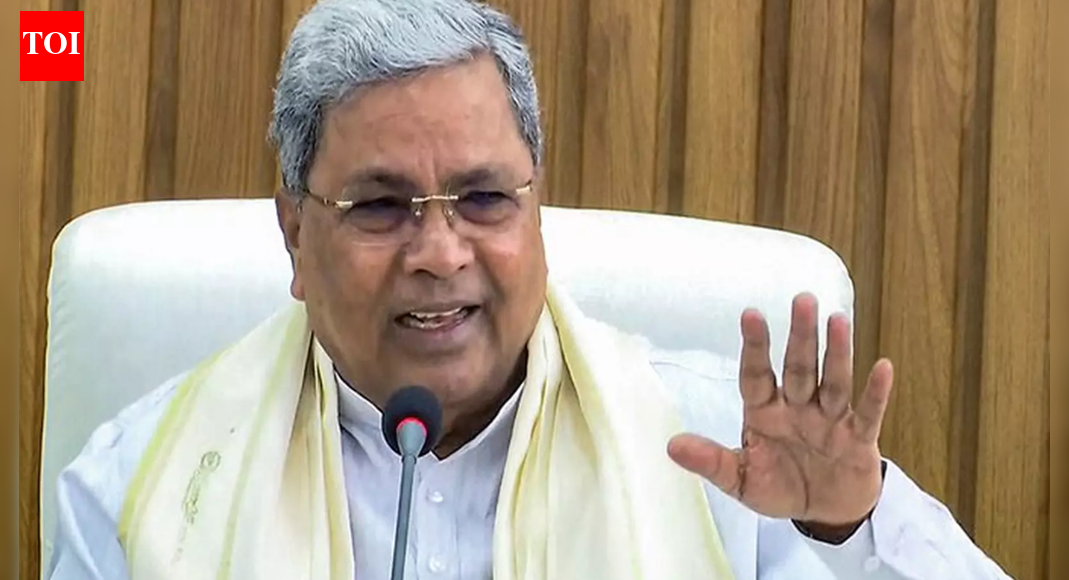
Karnataka CM Siddaramaiah (ANI)

NEW DELHI: Karnataka chief minister Siddaramaiah on Monday said he is set to surpass the late D. Devaraj Urs as the state’s longest-serving chief minister on January 6, but stressed that the two leaders should not be compared due to their different social backgrounds.“With the blessings of the people, tomorrow late D Devaraj Urs’ record of being the longest serving Chief Minister of Karnataka will be broken. The matter of pride is that I and Urs belong to Mysuru,” he told reporters.

Siddaramaiah, DK Shivakumar Project Unity After High-Stakes Karnataka Meet Amid Rumours Of Cong Rift

Reflecting on his political journey, Siddaramaiah said, “I had only thought that I will be an MLA after becoming the Taluk Board member. I have so far won eight elections. I lost two Parliament elections and two assembly elections. In my life, I have contested in 13 elections, including Taluk elections.”Claiming there is no direct comparison between himself and Urs, he said, “Devaraj Urs was not socially backward. In fact, he was from a forward class, the ruling class. He was from a community which is less in population, but he was a popular leader,” as quoted by PTI.Highlighting how politics has evolved over time, the Chief Minister added, “People gave him money and votes in 1962. Time has now changed.”On whether his record could be broken in the future, Siddaramaiah said, “Records are meant for breaking. I never said that no one will break my record. Someone may emerge to break my record of the longest serving Chief Minister or the one who presented the maximum budgets.” He has presented 16 budgets so far.Speaking about celebrations for his milestone, he said, “State Revenue Minister Krishna Byre Gowda is planning something, but I don’t have any details as such. I will speak to him.”On a potential cabinet reshuffle, he said, “It has to be done. I will speak to Rahul Gandhi whenever he calls me. I have told him that I will speak to him in January.”


Source link

On This Day: The accidental birth of limited-over cricket at the MCG | Cricket News


On This Day: The accidental birth of limited-over cricket at the MCG
Representative Photo: Melbourne Cricket Ground. Getty Images)

On This Day, 55 years ago, the game of cricket gave birth to a new form of international match when Australia hosted England at the Melbourne Cricket Ground in what turned out to be the first official One-Day International (ODI). It was a stop-gap solution to salvage a rain-washed Test at the MCG and, much to the surprise of the Australian cricket board, 46,000 fans turned up to watch the contest. With that, a new format of the game was born — by a happy accident.Go Beyond The Boundary with our YouTube channel. SUBSCRIBE NOW!The year was 1971, and the third Test between Australia and England was washed out due to rain. The teams decided to play a 40-over-a-side match instead. The grand reception to the game led to the birth of an exciting new format, which gained popularity in no time and witnessed its first World Cup just four years later, in 1975.

Bangladesh seek T20 WC match shift from India after Mustafizur Rahman’s IPL exit

Cricket has evolved significantly since then, including the emergence of Twenty20 Internationals in February 2005, first played between Australia and New Zealand. Even shorter formats of T20 are now being experimented with in franchise cricket, but officially, three formats remain active internationally — Tests, ODIs and T20Is.ODI cricket became an epitome of the commercialisation of the game, bringing in more money long before franchise-based T20 leagues became the toast of the town.That 40-over-a-side contest between Australia and England more than five decades ago has resulted in 13 World Cups so far, with the next scheduled for 2027.

Poll

Which cricket format do you prefer the most?

Australia are the most successful team in World Cups, held every four years, with six titles. India and West Indies have won it twice each, with the Caribbeans claiming the first two editions. England, Sri Lanka and Pakistan have each lifted the trophy once.Apart from the World Cups, the ICC — cricket’s world governing body — organised the highly successful ICC Champions Trophy, formerly known as the ICC KnockOut Trophy. The tournament, which began in 1998, has seen nine editions so far, with India the most successful side, winning it three times. They are also the reigning champions after lifting the trophy in 2025.India’s batting maestro Sachin Tendulkar is the most successful batter in ODIs with 18,426 runs and 49 hundreds in 463 matches, closely followed by modern-day great Virat Kohli with 14,557 runs, including a record 53 centuries in just 308 games. Among bowlers, Sri Lankan legend Muttiah Muralitharan leads the wicket-takers’ list with 534 scalps from 350 matches, followed by Pakistan great Wasim Akram with 502 wickets from 356 games.All these extraordinary developments began from a humble stop-gap match on this day — January 5, 1971 — at the MCG. And here’s how the first-ever ODI played out:In front of 46,000 spectators, Australia won the toss and captain Bill Lawry sent England in to bat.Geoffrey Boycott and John Edrich opened England’s innings in the first ODI. The stand was short-lived as Boycott was dismissed for 8 off 37 balls by Alan Thomson, reducing England to 21 for 1.Edrich then steadied the innings with a 66-run partnership for the second wicket alongside Keith Fletcher, who scored 24 off 47 balls before being dismissed by Ashley Mallett. Edrich held one end firmly, scoring the first-ever ODI half-century.A 37-run stand for the third wicket with Basil D’Oliveira (17 off 16) followed, but England then lost wickets at regular intervals. From 87/2, they slid to 156/7 with the dismissal of Edrich for 82. His 119-ball knock included four boundaries.England were eventually bowled out for 190 in 39.4 overs. Ashley Mallett (3/34 in 8 overs) and Keith Stackpole (3/40 in 8 overs) took three wickets each, while Graham McKenzie (2/22 in 7.4 overs) ended the innings by dismissing Alan Knott for 24 off 31 balls.Chasing 191 from 40 overs, Australia made a shaky start, losing opener Stackpole for 13 to Ken Shuttleworth, caught and bowled. At 19/1, Lawry and Ian Chappell added 32 runs before Lawry fell for 27 off 49 balls, leaving Australia at 51/2.Ian Chappell scored the second half-century in ODI history and added 66 runs for the third wicket with Doug Walters to keep the chase on track. Walters scored 41 off 51 balls, hitting six fours, as Australia reached 117/3.A further 41-run stand between Chappell and Bill Redpath (12) took the hosts close to victory. Chappell was eventually dismissed for 60 off 103 balls, with Australia needing 26 more runs and five wickets in hand.Greg Chappell (22 not out) and Rod Marsh (10 not out) then guided Australia home in 35 overs, sealing a five-wicket win with five overs to spare.Despite the defeat, England’s John Edrich was named Player of the Match for his 82 off 119 balls, becoming the first to get the award in limited-over cricket.


Source link

Ex-boyfriend immediately left country: Missing Indian woman found dead in US apartment, police reveal details


27-year-old Nikitha Godishala, who was reported missing since New Year’s Eve, has been found dead with stab wounds in the Columbia (Maryland) apartment of her ex-boyfriend, the Howard County police said Sunday. Police said they believe the ex-boyfriend killed Godishala. Police said they obtained a warrant for his arrest on first- and second-degree murder charges.

Ex-boyfriend reported Nikitha missing, then left for India: Cops

“Arjun Sharma, 26, of Columbia, made the missing person report to police and said he last saw his ex-girlfriend, Nikitha Godishala, 27, of Ellicott City, on Dec. 31 in his apartment in the 10100 block of Twin Rivers Road. Police later learned that on the same day as making the report, Jan. 2, Sharma left the country on a flight to India. Detectives on Jan. 3 executed a search warrant for his apartment and located Godishala deceased,” the police statement said. “Through investigation, detectives believe Sharma killed Godishala shortly after 7 pm on December 31. The investigation is ongoing and no motive is known at this time,” the statement added. Howard County Police said they are working with the United States federal law enforcement to locate and arrest Sharma.Nikitha’s friends earlier circulated her photo and appealed for help in looking for her. They said she was last seen on New Year’s Eve. Though investigators have not revealed the details of what went on between Nikitha and his ex-boyfriend before Nikitha was stabbed to death, their timeline makes it clear that Nikitha’s body remained in Sharma’s flat since December 31. It is not known what Sharma did later on 31st and 1st before going to the police on January 2 and then flying out of the US.


Source link

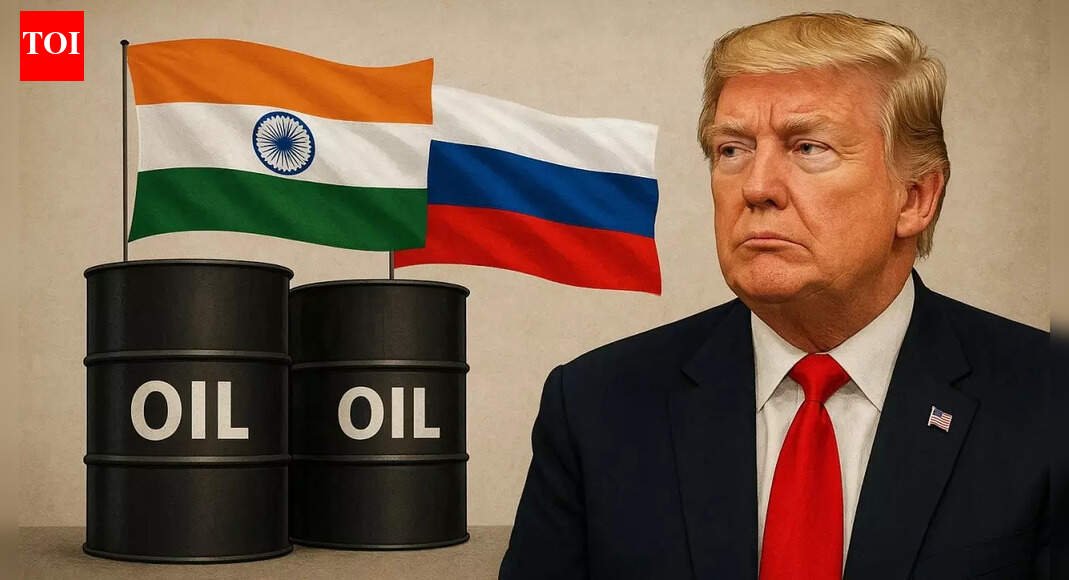
Trump’s fresh tariff threat: Will stopping Russian oil imports ease US pressure on India? Time for a clear call


Trump’s fresh tariff threat: Will stopping Russian oil imports ease US pressure on India? Time for a clear call
Russia continued to be the India’s largest crude supplier between April and November 2025. (AI image)

US President Donald Trump on Monday warned India of higher tariffs if it doesn’t cooperate with America on the issue of Russian crude oil imports. The warning comes at a time when Indian exports already face heavy trade penalties in the US market. At present, shipments from India are subject to a 50% tariff, with half of that burden directly tied to India’s ongoing purchases of Russian crude oil.Trump said M Narendra Modi was aware of his dissatisfaction over India’s continued purchases of Russian oil, adding that Washington has the ability to swiftly increase tariffs on Indian goods.Trump made the comments while speaking to reporters on Sunday aboard Air Force One as he travelled from Florida to Washington DC.“They wanted to make me happy, basically. Modi is a very good man; he is a good guy. He knew I was not happy, and it was important to make me happy. They do trade and we can raise tariffs on them very quickly. It would be very bad for them,” Trump said.Trump’s comments have also been by senator Lindsey Graham who is advancing a legislation that would impose stringent secondary tariffs on countries that import Russian oil and gas if Moscow does not agree to a ceasefire in Ukraine within a 50 day timeframe.

India’s crude oil imports from Russia & US

India’s crude oil imports from the United States surged by over 92% year-on-year during the first eight months of the current financial year, even as Russia continued to be the country’s largest crude supplier between April and November 2025.Data from the ministry of commerce and industry show that India imported a total of 178.1 million tonnes of crude oil during April to November 2025. Of this, around 60 million tonnes were sourced from Russia and about 13 million tonnes from the US. In the corresponding period a year earlier, total crude imports stood at 165 million tonnes, including 62.4 million tonnes from Russia and only 7.1 million tonnes from the US.As a result, the US share in India’s crude basket rose to 7.6 percent in the current fiscal period from 4.3 percent a year earlier. Russia’s share, meanwhile, declined to 33.7 percent from 37.9 percent over the same comparison period.The full effect of recent US sanctions on Russian oil companies Rosneft and Lukoil, both key suppliers to India, is yet to be reflected in official figures. Following Trump sanctions imposed in October on Russian oil giants Rosneft and Lukoil, large refiners such as Reliance Industries, along with several state owned companies, announced plans to stop buying Russian crude to avoid exposure to secondary sanctions.

Why India Needs To Make Its Stand Clear

According to Global Trade Research Initiative (GTRI) founder Ajay Srivastava imports of Russian crude have not stopped entirely, with lower volumes continuing – leaving India in a strategic grey zone. “This approach may be weakening India’s position. If New Delhi plans to stop Russian oil imports, it should do so clearly and decisively. If it intends to continue buying from non-sanctioned Russian suppliers, it must say so openly and support the stance with data. And if it plans to buy even from sanctioned entities, that choice too must be stated plainly. What no longer works is ambiguity,” he says.India’s decision making is further complicated by the absence of any assurance that stopping Russian oil imports would ease pressure from the Trump administration. “Complicating India’s calculus, there is no guarantee that cutting Russian oil will end US pressure. Even a full stop could shift the US demands to agriculture, dairy, digital trade, and data governance,” GTRI says.India must also factor in that the current use of tariffs as leverage is linked to a particular political phase in the United States and may not persist indefinitely, the think tank says. The European Union, Japan and South Korea opted to ease tensions with Washington by sharply reducing their intake of Russian crude.India’s position differs from China’s, which enjoys greater strategic leverage with the US. Despite being the largest buyer of Russian oil, China has largely been spared American pressure, as Washington is wary of the potential fallout.Although India has significantly increased imports of crude oil and petroleum products from the US, this has not translated into any visible softening of Washington’s stance.“Indian exports to the US have already fallen 20.7% between May and November 2025, and further tariff escalation could trigger a steeper decline. As the tariff threat hardens, India must take a clean call on Russian oil—own that decision, and communicate it unambiguously to Washington,” GTRI concludes.


Source link