Breaking News
US sanctions Iran: Additional 25% tariffs to have minimal impact on India, say government sources – here’s why


US sanctions Iran: Additional 25% tariffs to have minimal impact on India, say government sources - here’s why
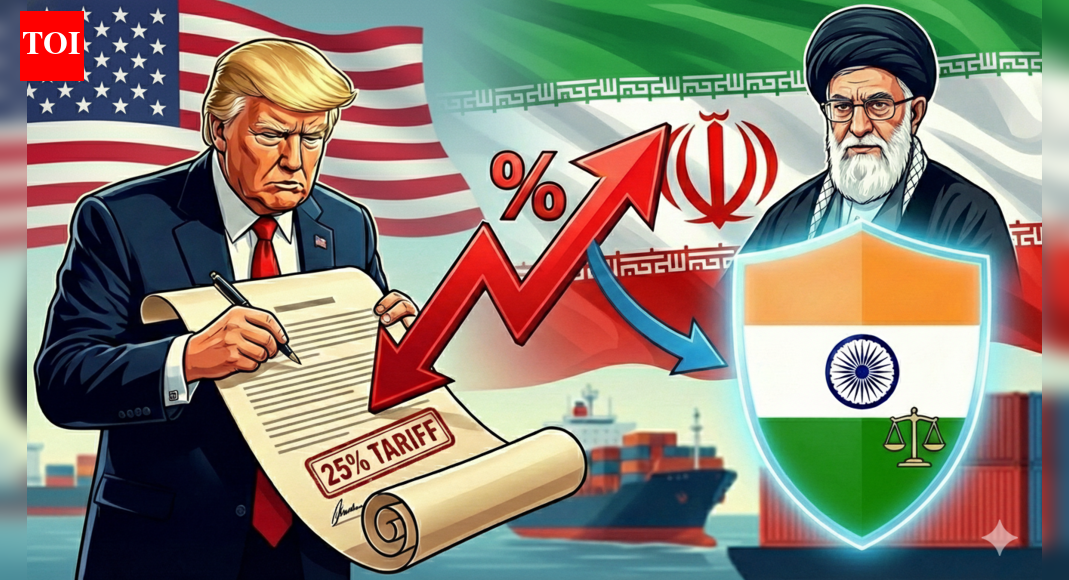
AI image (Picture credit: Google Gemini)

India is unlikely to face any major impact from the 25 per cent tariff announced by the US President Donald Trump on countries doing business with Iran, as per government sources cited by news agency ANI, who pointed to India’s limited trade exposure with Tehran.Newly announced US tariffs are ‘likely to have minimal impact on India’ as Iran does not feature among the nation’s top 50 trading partners, the government sources said. India’s total trade with Iran stood at around $1.6 billion last year, accounting for just 0.15 per cent of India’s overall trade. This figure is expected to decline further in the current financial year due to broader external economic factors. Of Iran’s total imports of about $68 billion in 2024, the UAE, China, Turkiye and the European Union together accounted for the bulk, while India’s share was only $1.2 billion, or 2.3 per cent.Exporters have also downplayed concerns. Ajay Sahai, director general of the Federation of Indian Export Organisations (FIEO), said Indian companies and banks remain fully compliant with US Office of Foreign Assets Control norms and engage only in permitted humanitarian trade, mainly food items and pharmaceuticals, reported news agency PTI.“There is, therefore, no basis to anticipate any adverse impact on India,” Sahai said.He noted that India’s trade with Iran largely falls outside the scope of sanctions due to its humanitarian nature. In 2024-25, India’s total trade with Iran was $1.68 billion, including $1.24 billion in exports, primarily from the farm and pharmaceutical sectors, as per PTI.Industry representatives, however, flagged other challenges. Sahai said the sharp depreciation of the Iranian currency is a bigger concern for exporters, as it weakens consumer purchasing power and raises risks of cancelled contracts. Rice exporters also said their current exposure to Iran is limited and increasingly routed through the UAE to manage risks, reported ANI.Overall, exporters remain cautious but believe the proposed US tariff will have little direct effect on India, given the small trade volumes and the humanitarian nature of most shipments.


Source link

Budget 2026: Will old income tax regime be discontinued leaving new regime as the only option?


Budget 2026: Will old income tax regime be discontinued leaving new regime as the only option?
Fundamentally, the government wants to move towards an income tax return regime with minimal deductions and exemptions. (AI image)

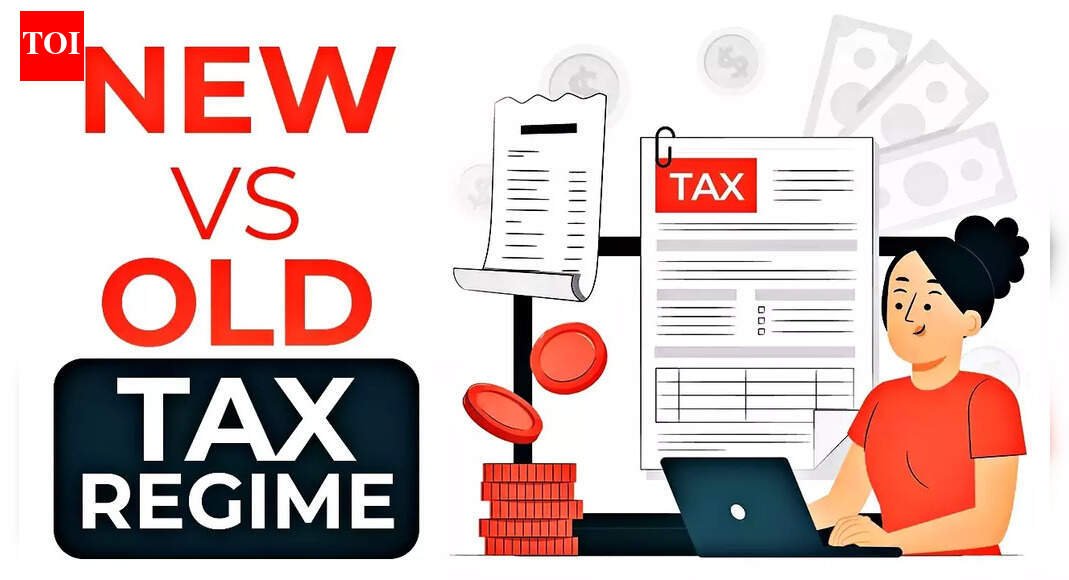
Finance Minister Nirmala Sitharaman will present the Union Budget 2026 on February 1, 2026 and like every year common man and taxpayers, especially salaried are watching out for possible changes on the income tax front. One big factor when it comes to income tax is the regime under which you choose to file your income tax return.Ever since the new income tax regime was introduced a few years ago, one question that has played in the minds of taxpayers is: will the old income tax regime cease to be an option soon?In a pre-Budget 2026 survey, most tax experts who spoke to Times of India Online said that the government may look to eventually do away with the old income tax regime, though the transition is likely to happen in a phased manner.

New vs Old Regime: The Fundamental Differences

The new and old income tax regimes differ on one basic fundamental: the former has lower tax rates at higher levels of income compared to the old tax regime and fewer deductions and exemptions.For example; the basic exemption limit under the new tax regime is higher. With the Section 87A rebate, the level of tax free income for salaried taxpayers goes to Rs 12.75 lakh (including standard deduction)! Simply put; an individual earning Rs 1 lakh a month needs to pay ZERO tax!
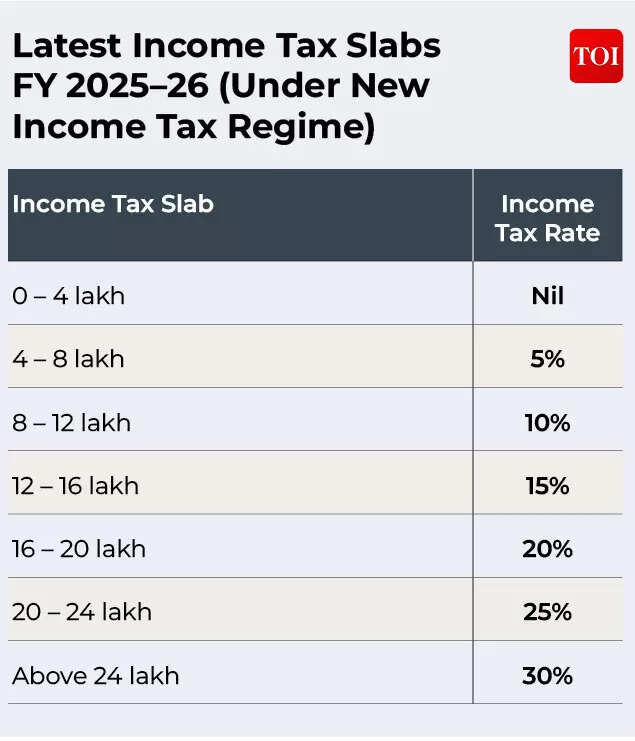
New Regime Tax Slabs

New Regime Tax Slabs

On the other hand, the option to avail deductions and exemptions under the old income tax regime work in its favour, though over the last few years the government has increasingly made the new income tax regime more lucrative.Some of the common income tax exemptions and deductions available under the old income tax regime are: Section 80C benefits (up to Rs 1.5 lakh for popular investments such as Provident Fund, PPF), Section 80D for medical insurance, NPS contributions, House Rent Allowance (HRA), Leave Travel Allowance (LTA), Section 80 TTA (interest on bank deposits etc.), home loan benefits.
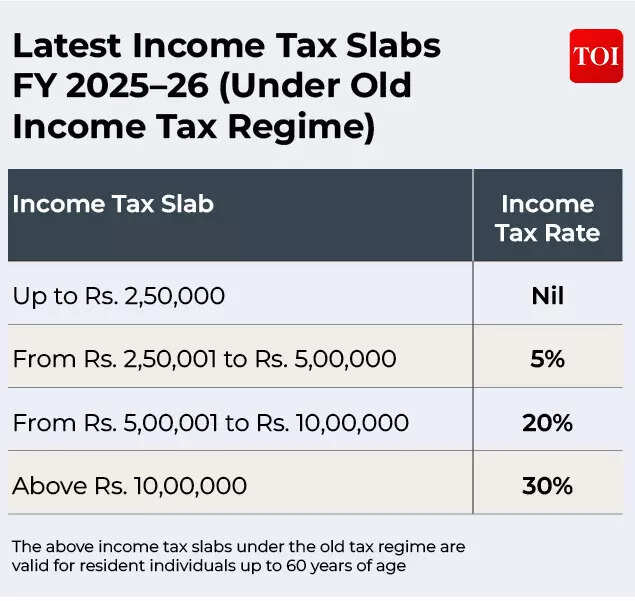
Old Tax Regime Slabs

Old Tax Regime Slabs

Why Was The New Income Tax Regime Introduced?

To get a better understanding of the future of the old income tax regime, let’s understand why the new income tax regime was introduced. Fundamentally, the government wants to move towards an income tax return regime with minimal deductions and exemptions to simplify the filing process and reduce the need for maintaining records and paperwork.In her Budget 2020 speech FM Nirmala Sitharaman had introduced the new income tax regime saying, “Currently the Income Tax Act is riddled with various exemptions and deductions which make compliance by the taxpayer and administration of the Income Tax Act by the tax authorities a burdensome process. It is almost impossible for a taxpayer to comply with the Income-tax law without taking help from professionals. In order to provide significant relief to the individual taxpayers and to simplify the Income-tax law, I propose to bring a new and simplified personal income tax regime wherein income tax rates will be significantly reduced for the individual taxpayers who forgo certain deductions and exemptions.As Parizad Sirwalla, Partner and Head, Global Mobility Services, Tax at KPMG in India explains: When the new tax regime was introduced for the first time from FY 2020-21 it was then indicated by the government that there was a long-term intent to phase out the plethora of exemptions/deductions. Over the years, the government has in fact made the new tax regime – which disallows many widely claimed exemptions/ deductions under the old tax regime – increasingly more lucrative for individual taxpayers over the years.

New Tax Regime & Its Growing Popularity

Surabhi Marwah, Tax Partner at EY India points out: recent data shows that for Assessment Year 2024‑25, around 72% of filers opted for the new tax regime, indicating broad acceptance of the simplified framework.“Given this trajectory, any move to retire the old regime, if considered, would likely be phased, allowing a cooling‑off period to support a smooth transition for taxpayers,” she tells TOI.The past two Budgets have reinforced the trends of trying to make the new income tax regime more popular, through more favourable new personal tax regime changes, including higher basic exemption and rebate limits in 2025, and increased standard deduction and NPS employer-contribution benefits in 2024. What’s interesting to note is that if 72% of taxpayers had opted for the new income tax regime by FY2025, the number will likely go up for FY 2025-26 after FM Nirmala Sitharaman tweaked tax slabs under the new income tax regime in last year’s Union Budget, and also made income up to Rs 12 lakh tax free.

Will The Old Tax Regime Be Phased Out?

Some experts are of the view that exemptions and deductions are important especially when it comes to encouraging savings and providing home loan related tax benefits. However, a gradual phasing out of the old tax regime, with stagnation is seen.Preeti Sharma, Partner – Tax and Regulatory Services at BDO India told TOI, “The government has clearly shown its preference for the new income tax regime and has made it the default tax regime. However, an immediate abolition of the old tax regime is unlikely.”
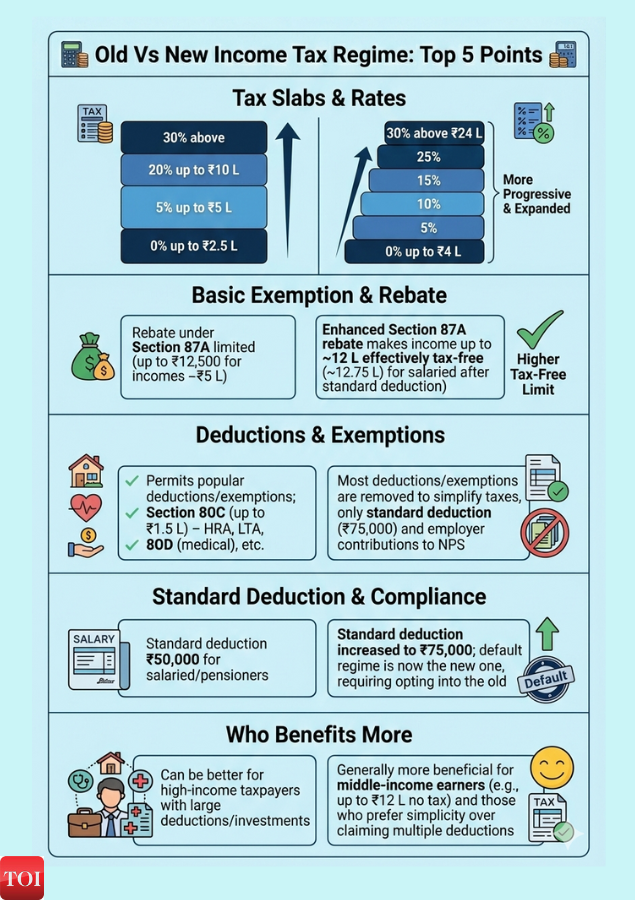
New Vs Old Income Tax Regime

New Vs Old Income Tax Regime

Why is the old income tax regime still relevant for many? The old tax regime continues to be beneficial for a certain group of taxpayers, particularly those who claim deductions such as House Rent Allowance (HRA), home-loan interest and benefits under Sections 80C and 80D, and especially for salaried taxpayers who claim deductions under Chapter VI-A. “As a result, the government is expected to follow a gradual approach, continuing with both tax regimes while nudging taxpayers towards the new tax regime,” she said.As Parizad Sirwalla of KPMG points out: many of the deductions (allowed under old regime) are basis long term commitment (e.g., renting a house/ buying a house, PPF, Life Insurance premium etc.) and hence complete deletion of old tax regime may have an impact on these long-term savings/ investment/ expenditure by the common man.“Additionally, prior to the New Income Tax Act being published there was expectation that the new Act may be a signal to do away with the old regime – however the final Act that has been passed continues the old tax regime as optional,” she says.Chander Talreja, Partner at Vialto Partners says that the government has given flexibility to the taxpayers to choose the best regime applicable for their case depending upon their personal situation and individual circumstances. “Few may find the old regime beneficial as a lot of deductions and exemptions help them to save tax and also ensure that they don’t hit the income ceiling where the surcharge becomes applicable,” he tells TOI.“Moreover, the government would also factor that there is a huge market for housing loans, various investments etc. which qualify for section 80C benefit and not allowing tax benefits for these may hamper their market demand. Hence, the flexibility to opt between the regimes would continue for some time,” he adds.On the other hand, Tanu Gupta, Partner at Mainstay Tax Advisors LLP finds merit in ending the old income tax regime to avoid confusion.She notes that while the government may not completely eliminate the old tax regime from the law, it is already moving toward making the new regime so attractive that the old regime could automatically become redundant. “Although the old regime still finds a place in the newly enacted Income Tax Act 2025, the changes introduced in last year’s budget—such as tweaking the slabs, raising the Section 87A rebate to Rs 12 lakh, and capping the surcharge at 25% for incomes above Rs 5 crore, while leaving the old regime unchanged—represent a significant step toward making the new tax regime beneficial for most taxpayers,” she told TOI.“For FY 2023–24, 72% of taxpayers opted for the new regime, and this percentage is expected to be significantly higher for FY 2025–26,” she adds.Tanu Gupta is of the view that two income tax regimes cause confusion, beating the purpose of simplification of tax filing. “Evaluating options by comparing the old and new regimes, and for business income taxpayers being allowed to switch only once in a lifetime, only adds to the confusion, contrary to the tax policy objective of simplification,” she says.“There have even been instances where tax officers, while processing returns under Section 143, inadvertently applied the old regime despite the taxpayer choosing the new regime, causing inconvenience and additional administrative burden. Therefore, there is merit in putting a final end to the old tax regime rather than letting it fade naturally by becoming redundant,” she explains.Radhika Viswanathan, Executive Director, Deloitte India sees a gradual stagnation of the old income tax regime. This is evident from the fact that one has to not only explicitly opt for the old income tax regime, it has not seen periodic updates to its slab rates and standard deduction.“The introduction of the Income Tax Act 2025 aims for simplicity. Keeping two parallel systems forever contradicts the goal of simplification. Hence, we may expect the old regime to remain for another 2-3 years to allow long-term investors (with 15-year PPF accounts or longer period home loans) to transition smoothly. However, it is increasingly becoming a legacy option unattractive for most taxpayers,” she tells TOI.Akhil Chandna, Partner and Global People Solutions Leader, Grant Thornton Bharat anticipates a gradual phase-out of the old regime over time. “Recent budget announcements have consistently enhanced the attractiveness of the new regime—through higher rebate limits and inclusion of standard deductions—while leaving the old regime unchanged. Consequently, the old tax regime is expected to become redundant in the coming years,” he says.

Source link

Gujarat Giants 0/0 in 0.5 Overs | MI vs GG, WPL Live Score: Mumbai Indians win toss, opt to field first against Gujarat Giants


MI vs GG, WPL Live Score: Gujarat Giants face their biggest test of the season as they take on defending champions Mumbai Indians in the Women’s Premier League on Tuesday. Giants arrive with momentum after winning their first two matches, both after crossing the 200-run mark. Mumbai Indians, meanwhile, will look to build on their win over Delhi Capitals after an opening loss to Royal Challengers Bengaluru. The contest brings together two in-form batting units and contrasting bowling strengths. Gujarat have shown a sharp shift in approach this season, while Mumbai continue to rely on discipline and control with the ball.

Mumbai Indians will rely heavily on their senior players as they aim to stop Gujarat’s winning run. Nat Sciver-Brunt has been among their key performers, while captain Harmanpreet Kaur returned to form with a 42-ball 74 against Delhi Capitals. Harmanpreet said the long batting line-up has given her freedom to play her shots without worrying about batting deep. Mumbai’s bowling has been their strength so far, conceding just 7.74 runs per over across two matches. They nearly defended 154 against RCB and then restricted Delhi Capitals to 46 for 5 while defending another total.

Stay with TOI for live updates, key moments, and turning points from this WPL clash.


Source link

‘Google has hired tons of people without college degrees,’ says Sergey Brin: Here’s why


'Google has hired tons of people without college degrees,' says Sergey Brin: Here’s why

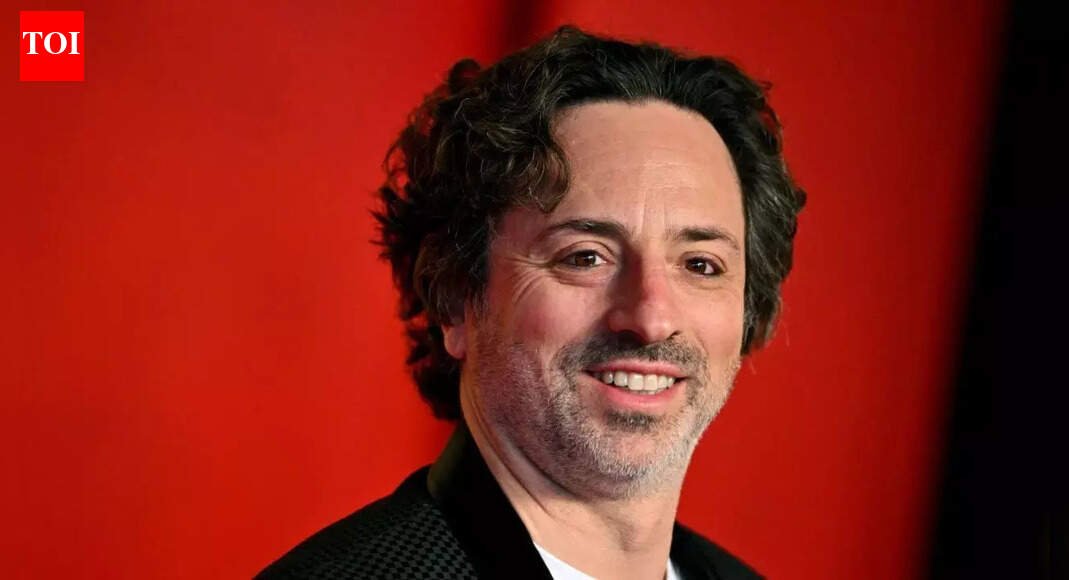
For decades, Stanford University has occupied a near-mythical place in the technology economy. From LinkedIn’s Reid Hoffman and Google’s Sergey Brin, its alumni list helped reinforce a simple idea: elite education functioned as a reliable gateway to elite opportunity. A four-year degree, particularly from institutions embedded in Silicon Valley’s orbit, was treated as both signal and filter.That assumption is now being tested. As AI changes entry-level work and companies rethink how they identify talent, the degree is slowly losing its role as a default gatekeeper. The shift is not being driven by universities, but by employers who no longer see formal credentials as the most efficient proxy for skill.

Brin on education choices in an AI age

Speaking to Stanford engineering students last month, Brin reflected on his own academic choices without dismissing them. He said he studied computer science because of interest rather than strategy. “I chose computer science because I had a passion for it,” Brin said, Fortune reports. “It was kind of a no-brainer for me. I guess you could say I was also lucky because I was also in such a transformative field.”At the same time, Brin cautioned students against making educational decisions based purely on fears about automation. AI he suggested, does not neatly spare some disciplines while dismantling others. “I wouldn’t go off and switch to comparative literature because you think AI is good at coding,” he said. “AI is probably even better at comparative literature, just to be perfectly honest anyway,” he added, Fortune reports.

How Google’s hiring practices have shifted

Where Brin’s words become more significant is in how Google now hires. The company, once known for privileging academic pedigree, has steadily reduced its reliance on college degrees as a requirement for many roles.“In as much as we’ve hired a lot of academic stars, we’ve hired tons of people who don’t have bachelor’s degrees,” Brin said, according to Fortune. “They just figure things out on their own in some weird corner.”That observation is backed by hiring data. Data from the Burning Glass Institute shows that between 2017 and 2022, the share of Google job postings requiring a college degree fell from 93% to 77%. Companies such as Microsoft, Apple and Cisco have also reduced degree requirements, signalling a move towards skills-based hiring rather than credential-based screening.This recalibration is forcing a larger question into view. If degrees no longer function as reliable signals of ability, what exactly are they meant to represent in the labour market.

Business leaders question the value of elite credentials

Leaders outside the tech sector have voiced similar doubts. JPMorgan Chase CEO Jamie Dimon said in 2024 that elite education does not necessarily translate into workplace effectiveness. “I don’t think necessarily because you go to an Ivy League school or have great grades it means you’re going to be a great worker or great person,” Dimon said, according to Fortune. He added that skills often remain invisible on resumes. “If you look at skills of people, it is amazing how skilled people are in something, but it didn’t show up in their resume.”Palantir CEO Alex Karp, despite holding three degrees including a law degree from Stanford, has been even more direct. Speaking during an earnings call last year, Karp dismissed the long-term relevance of educational pedigree once someone enters the workplace. “If you did not go to school, or you went to a school that’s not that great, or you went to Harvard or Princeton or Yale, once you come to Palantir, you’re a Palantirian,” he said, according to Fortune. “No one cares about the other stuff.”According to Great Place to Work CEO Michael Bush, this thinking is spreading beyond a narrow set of firms. “Almost everyone is realizing that they’re missing out on great talent by having a degree requirement,” Bush told Fortune. “That snowball is just growing.”

What this means for universities

For Brin, the implications extend beyond hiring practices. As credentials lose their power as screening tools, universities themselves may need to reassess their role. “I just would rethink what it means to have a university,” he said, according to Fortune.Degree requirements have become optional, alternative hiring routes have expanded, and skills learned outside formal institutions now gain legitimacy. Universities will continue to matter, but maybe less as gatekeepers and more as one pathway among many.Students may not feel the impact immediately. Over time, however, the distance between education as credential and education as capability is likely to widen. And as companies like Google continue to hire beyond the degree, the long-standing contract between universities and the labour market is being rewritten.


Source link

‘BJP-EC nexus’: Mamata says poll body deleted 54 lakh ‘genuine voters’, claims plan to remove 1 crore more | India News


'BJP-EC nexus': Mamata says poll body deleted 54 lakh 'genuine voters', claims plan to remove 1 crore more

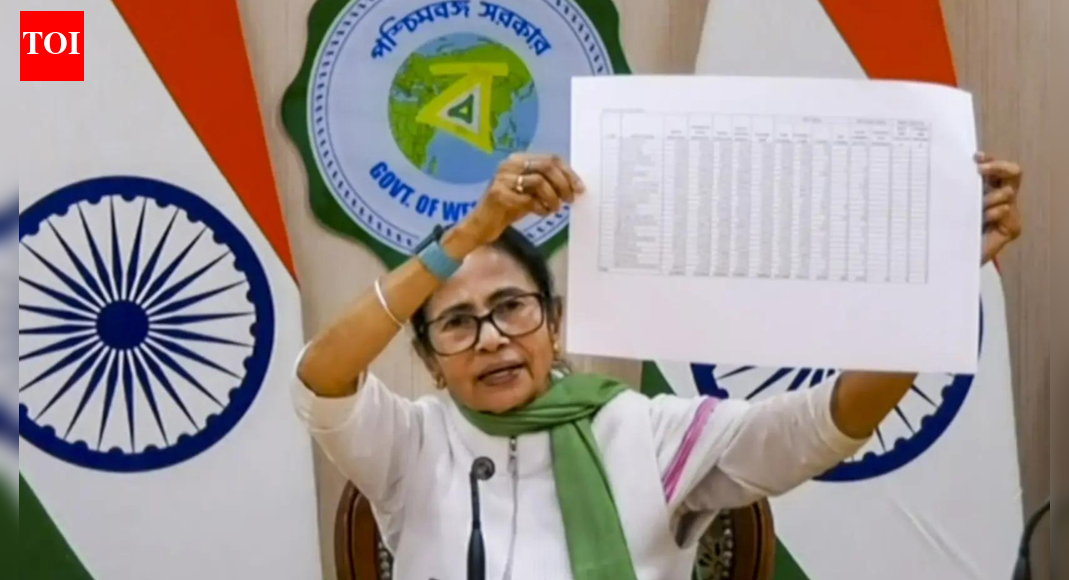
NEW DELHI: West Bengal chief minister Mamata Banerjee on Tuesday alleged that the Election Commission has unilaterally deleted 54 lakh names from the draft electoral rolls during the special intensive revision (SIR) in the state by using AI tools devised by the BJP and misusing the powers of electoral registration officers (EROs). Addressing a press conference at the state secretariat Nabanna, Banerjee claimed that a majority of those removed from the rolls were “genuine electors” who were not given an opportunity to defend themselves as they were not informed of the grounds for deletion, reported PTI.

‘Why? Why? Why?’ Mamata Slams EC, Flags ‘Unusual & Alarming’ Moves Ahead of Bengal Polls

“The EC, while sitting in Delhi, used AI tools devised by the BJP to delete names. These AI software accounted for the names mismatch in SIR data. They deleted names of women who changed surnames post marriage,” Banerjee alleged.The Trinamool Congress supremo further claimed that “logical discrepancy” was not part of the original SIR verification process and was “included as an afterthought to add to deletions”. She alleged that the “BJP-EC nexus” was planning to remove another one crore names from the final electoral rolls.Banerjee also accused the poll body of restricting the role of booth level agents during the verification exercise. “The EC has not allowed BLA-2s to attend hearings because the BJP couldn’t amass its workers to do the job,” she said.The chief minister’s comments come amid heightened political tensions in the state over the ongoing voter list revision exercise, with the Trinamool Congress repeatedly alleging that the process is being used to target certain sections of voters. The Election Commission has not responded to Banerjee’s allegations so far.


Source link

100,000 US visas revoked: State Department launches record immigration crackdown | World News


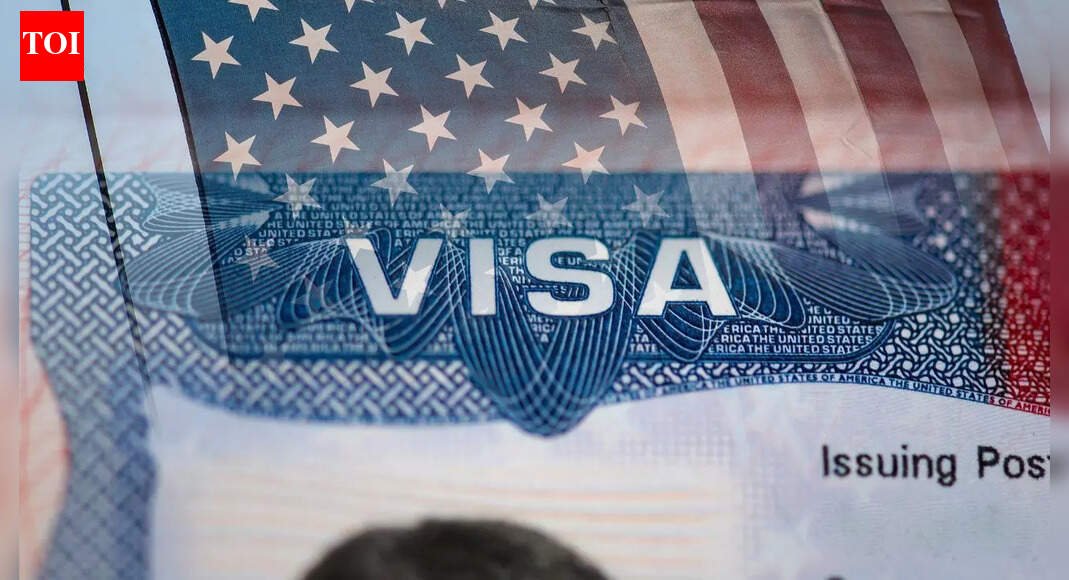
The US State Department has revoked more than 100,000 visas in 2025, the highest annual total on record. The figure is more than double the roughly 40,000 revocations reported in 2024.The department said the increase follows a January 2025 executive order signed by President Donald Trump, which reinstated stricter foreign-vetting rules and expanded post-issuance checks. The revocations span several visa categories.

US Issues Blunt Warning To Indian Students: Breaking Laws May Cost Visas, Careers And Future Dreams

Officials said about 8,000 student visas and 2,500 specialised work visas were cancelled. These cases involved visa holders who had encounters with US law enforcement for criminal activity. The majority of overall revocations, however, involved business and tourist visas, particularly overstays.A State Department spokesperson said many student and worker visas were revoked following arrests or criminal charges. Others were cancelled after reviews under enhanced screening procedures. Among specialised workers, cited offences included driving under the influence, assault, theft, fraud and drug-related cases.The surge comes alongside the rollout of a “continuous vetting” system. Under the programme, visa holders can be reviewed even after they enter the United States. In August 2025, the department said it was reviewing the status of around 55 million foreign nationals holding valid US visas.The enforcement drive also includes renewed use of the “public charge” rule. The rule allows visas to be denied or revoked if applicants are assessed as likely to rely on public benefits. Factors considered include health, age, financial resources and English proficiency.Officials said the policy is aimed at strengthening public safety and national security. They added that reviews and revocations will continue under the current framework.The scale of the cancellations has drawn attention from universities, employers and immigration groups. They have raised concerns about due process and the impact on international students and skilled workers. Earlier student visa revocations in 2025 prompted legal challenges and calls for clearer guidance.The State Department said additional reviews are expected to continue into 2026 as the expanded vetting measures remain in place.


Source link

WATCH: Mohammad Nabi gets visibly irritated by question on Mustafizur Rahman’s IPL 2026 saga


Post-match press conferences in franchise leagues are usually routine affairs—discussions about pitch conditions, turning points in the match, and individual performances. However, a recent media interaction during the Bangladesh Premier League (BPL) took a sharp turn when veteran Afghanistan all-rounder Mohammad Nabi lost his cool. Following a match between Nabi’s Noakhali Express and the Dhaka Capitals, the seasoned cricketer visibly snapped when dragged into the highly sensitive and politically charged controversy surrounding Bangladeshi pacer Mustafizur Rahman and his participation in the upcoming IPL 2026.

The atmosphere in the press room shifted dramatically when a local reporter directed a question at Nabi regarding his thoughts on the current situation facing Mustafizur.

Nabi, known for his calm demeanor on the field, was visibly irritated by the line of questioning. He immediately recognized that the topic—which involves complex cricketing boards and diplomatic relations between two other nations—had absolutely no relevance to him as an Afghan player or to the BPL match that had just concluded. Shutting down the reporter instantly, Nabi responded in Hindi, expressing his frustration at being pulled into matters outside his purview.

“Iska merese kya lena dena bhai? Mera Mustafizur se kya kaam hai? Politics me kya kaam hai mera? (What does this have to do with me, brother? What business do I have with Mustafizur),” Nabi retorted sharply.

He further clarified his stance, adding, “I know he is a good bowler, all these things. But the way you are questioning, it’s not related to me.”

Here’s the video:

Also READ: BCCI reacts amid reports of ICC exploring two venues for Bangladesh matches at T20 World Cup 2026

The controversy around Bangladesh’s pacer

Notably, the cricketing world is currently abuzz with controversy surrounding the IPL 2026. The Bangladesh’s premier left-arm pacer secured a massive deal during the auction, bought by the Kolkata Knight Riders (KKR) for a hefty INR 9.20 crore. However, following directives from the Board of Control for Cricket in India (BCCI), KKR released Mustafizur from the squad. The BCCI’s stance is rooted in current security concerns and strained diplomatic relations between India and Bangladesh. The situation has escalated to the point where the Bangladesh Cricket Board (BCB) formally requested the ICC to shift their upcoming T20 World Cup matches out of India due to security fears. Though, the international cricket body has reportedly denied BCB’s request.

Also READ: Tamim Iqbal under fire for questioning BCB’s decision to move Bangladesh’s T20 World Cup games from India


Source link

T20 World Cup: Pakistan-born USA pacer Ali Khan denied Indian visa ahead of tournament; posts on Instagram | Cricket News


T20 World Cup: Pakistan-born USA pacer Ali Khan denied Indian visa ahead of tournament; posts on Instagram

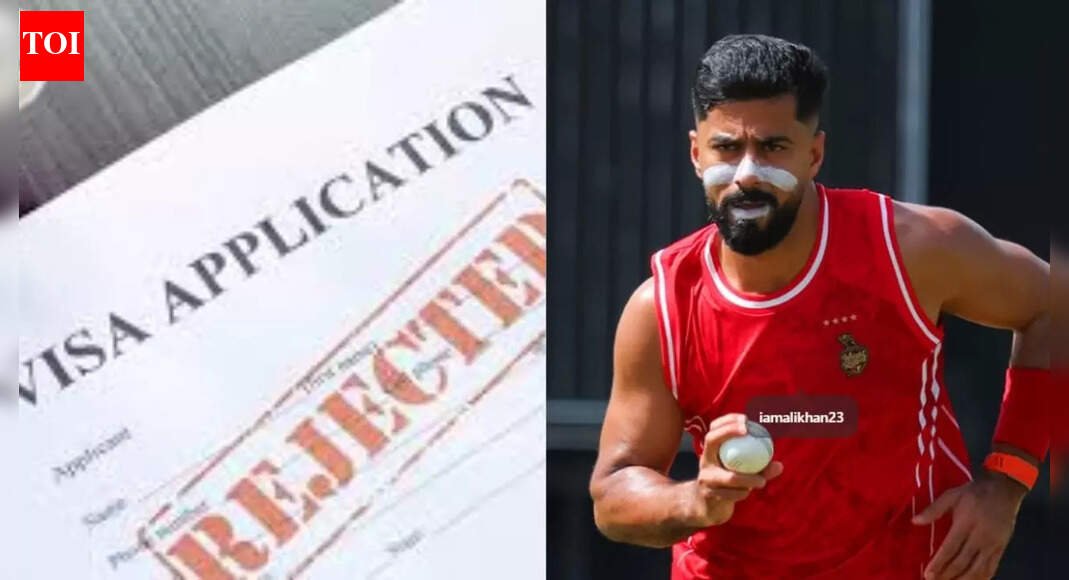
Pakistan-born USA fast bowler Ali Khan has been denied an Indian visa ahead of the upcoming T20 World Cup, raising uncertainty over his availability for matches scheduled to be played in India during the tournament.The 35-year-old, who was born in Pakistan’s Punjab, shared the update on Instagram Stories on Tuesday (January 13). He posted a picture of himself with the caption, “India visa denied but KFC for the win.”

Ali Khan Instagram story

Ali Khan has played 15 ODIs and 18 T20Is for the USA, taking 33 wickets in ODIs and 16 in T20Is. He was part of the USA squad at the 2024 T20 World Cup and featured in the group match in which the USA defeated Pakistan in a Super Over.Overall, Ali Khan has played 99 T20 matches and has taken 93 wickets. He represented Abu Dhabi Knight Riders in the first three seasons of the ILT20 and played for Gulf Giants in the 2025–26 season.The USA have not yet announced their squad for the upcoming T20 World Cup, but Ali Khan was expected to be in contention.The T20 World Cup 2026 will be held from February 7 to May 8 across five venues in India — Ahmedabad, Delhi, Mumbai, Kolkata and Chennai — and three venues in Sri Lanka — Colombo (R Premadasa Stadium and Sinhalese Sports Club Stadium) and Pallekele.The USA are placed in Group A along with India, Pakistan, Namibia and the Netherlands. They are scheduled to play three of their four group matches in India. The USA will open their campaign against India at the Wankhede Stadium in Mumbai on February 7, before facing Pakistan on February 10 at the Sinhalese Sports Club in Colombo. Their remaining group matches against the Netherlands and Namibia will be played on February 13 and 15 at the MA Chidambaram Stadium in Chennai.


Source link

Russian oil trade: India slips to third-largest buyer in December; imports fall after refinery cuts


Russian oil trade: India slips to third-largest buyer in December; imports fall after refinery cuts

India fell to third place among buyers of Russian fossil fuels in December 2025 after sharp cuts in crude oil imports by Reliance Industries and state-owned refiners, a European think tank said on Tuesday.According to data from the Centre for Research on Energy and Clean Air (CREA), India’s total imports of Russian hydrocarbons stood at 2.3 billion euros in December, down from 3.3 billion euros in November.

Trump Clears Russia Sanctions Bill, 500% Tariff Threat Looms As India Reworks Oil Import Strategy

Turkiye overtook India to become the second-largest importer, buying Russian hydrocarbons worth 2.6 billion euros during the month. China retained its position as the largest buyer, accounting for 48 per cent, or about 6 billion euros, of Russia’s export revenues from the top five importers.CREA said crude oil made up 78 per cent of India’s Russian imports in December, valued at 1.8 billion euros. Coal imports were worth 424 million euros, while oil products accounted for 82 million euros. India’s Russian crude imports fell 29 per cent month-on-month to their lowest level since the price cap policy was introduced, despite a marginal rise in the country’s overall crude imports.The reduction was led mainly by Reliance Industries’ Jamnagar refinery, which halved its Russian crude intake in December. “The entirety of their imports were supplied by Rosneft, albeit from cargoes purchased before the US Office of Foreign Assets Control sanctions came into effect,” CREA said, as per news agency PTI. State-owned refiners also reduced Russian imports by around 15 per cent during the month.The cutbacks followed fresh US sanctions on major Russian oil producers Rosneft and Lukoil, aimed at restricting funding for the Ukraine war. As a result, companies such as Reliance Industries, HPCL, HPCL-Mittal Energy and Mangalore Refinery have halted or reduced Russian oil purchases, while Indian Oil Corporation continues buying from non-sanctioned Russian entities.Russia supplied about 25 per cent of India’s crude oil imports in December, down from 35 per cent in November. India had emerged as a major buyer of discounted Russian oil after Western countries imposed sanctions following Russia’s February 2022 invasion of Ukraine, sharply raising Moscow’s share in India’s crude basket.


Source link

Evening news wrap: Blinkit drops’10-min’ delivery; about 2000 people killed in Iran protests and more | India News


Evening news wrap: Blinkit drops’10-min’ delivery; about 2000 people killed in Iran protests and more
  • Blinkit has moved away from ultra-fast delivery messaging as scrutiny and concerns grow over gig worker safety and work pressure.
  • Iran says about 2,000 people have died in weeks of protests, blaming armed groups as authorities intensify security measures.
  • J&K administration has dismissed five employees over alleged terror links.
  • Bangladesh has stood by its refusal to tour India for the 2026 T20 World Cup over security concerns, despite ICC pushback.
  • The Supreme Court has warned states of hefty compensation over stray dog bite cases, citing poor enforcement of animal control rules.

Here are your top five stories of the evening

Relief for gig workers: Blinkit drops ‘10-min’ delivery claim; Zepto, Swiggy may follow

Quick commerce platform Blinkit has dropped its “10-minute delivery” promise, replacing it with the message “30,000+ products delivered at your doorstep,” amid government deliberations on strengthening gig worker safety and welfare. The shift follows protests by delivery workers over the intense pressure created by ultra-fast delivery expectations, and similar changes are likely from other platforms.Read full story

Iran Street Fire: 500+ Killed, Say Activists As Tehran Blames Israel & U.S. For Unrest | WATCH

Iran unrest: About 2,000, including security personnel, killed; Tehran blames ‘terrorists’

An Iranian official has said that around 2,000 people, including civilians and security personnel, have been killed during ongoing protests, with authorities blaming what they describe as terrorists and armed groups for the violence. The government has dismissed portrayals of the unrest as peaceful, as demonstrations entering their third week have triggered a strong security crackdown and tighter controls on information.Read full story

Five J&K govt employees sacked over ‘terror links’; one was in ‘regular contact’ with top LeT commander

Jammu and Kashmir Lieutenant Governor Manoj Sinha on Tuesday ordered the termination of five additional government employees over alleged links to terrorist organisations. With these dismissals, the number of government staff removed since 2020 has risen to 85, as the Union territory administration has intensified efforts to eliminate what officials describe as the penetration of the terror ecosystem within government institutions. Read full story

Mustafizur Rahman row: ‘Position remains unchanged’ on India travel for T20 World Cup, Bangladesh tells ICC

The Bangladesh Cricket Board has reiterated that it is unwilling to travel to India for the 2026 T20 World Cup, citing security concerns and asking for its matches to be held at alternative venues. While the International Cricket Council has rejected these concerns and urged Bangladesh to review its position, the BCB has so far maintained its stance, with talks continuing to resolve the issue.Read full story

‘Take them to your house’: SC questions those feeding stray dogs; issues warning for states

The Supreme Court has cautioned states that failure to act on stray dog attacks could result in substantial compensation, noting that children and senior citizens are among the most affected. The bench also called for accountability from individuals feeding stray dogs, suggesting they take responsibility by housing the animals, and highlighted that poor implementation of Animal Birth Control rules by civic bodies has led to fatalities from dog bites and related accidents. Read full story


Source link