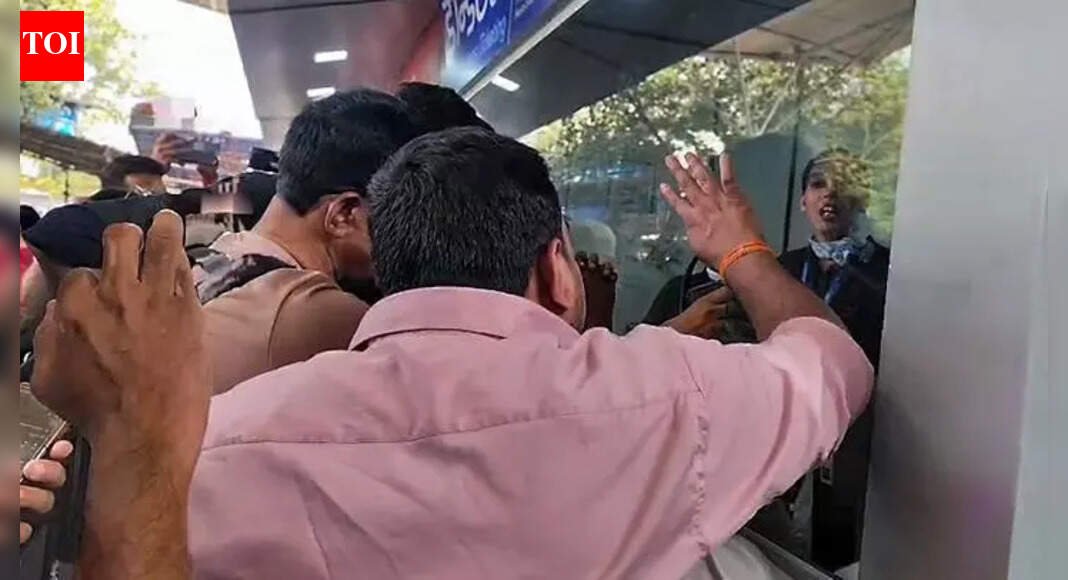
Indigo ground staff face violence, chaos during mass flight delays and cancellations | Mumbai News
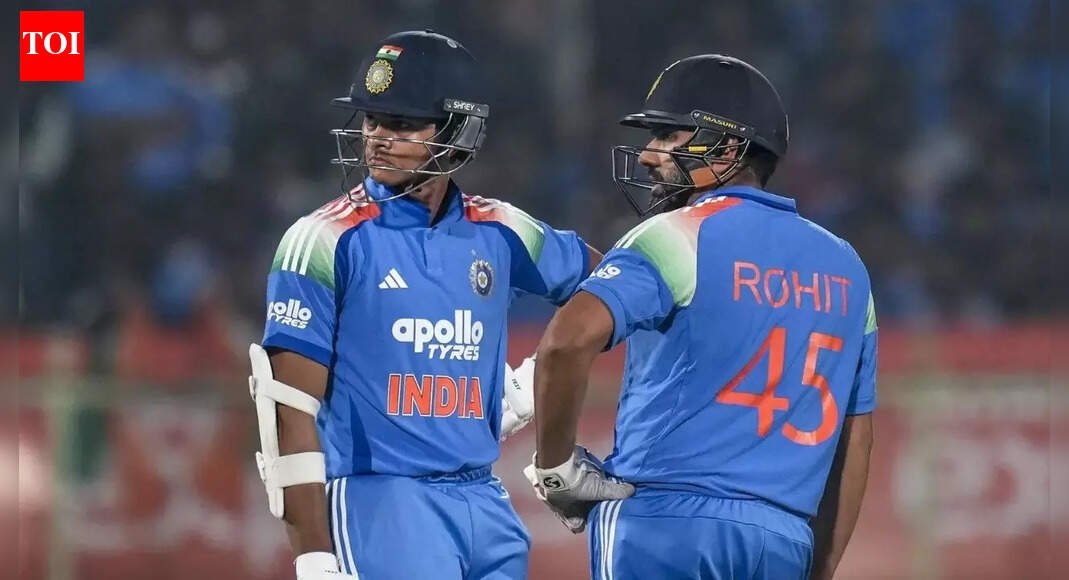
NEW DELHI: India, chasing a tricky target of 270 in the third ODI against South Africa in Visakhapatnam on Saturday, started well through Yashasvi Jaiswal and Rohit Sharma, who added 155 runs for the opening wicket.This was India’s 10th century opening stand against South Africa in ODIs, and the first since Rohit Sharma and Shikhar Dhawan put on 127 in the Champions Trophy 2013 match in Cardiff.
That was also India’s second-highest opening stand against SA in ODIs, only behind 193 between Sachin Tendulkar and Sourav Ganguly in Johannesburg in 2001.It was also the 35th time Rohit figured in a 100-run stand for the first wicket in ODIs. Only Sachin Tendulkar has more, with 40 such partnerships.The century stand was completed in the 20th over of India’s innings.India were 162/1 after 27 overs at the time of writing. Follow live updatesRohit Sharma also became the fourth Indian batter to reach 20,000 runs in men’s international cricket. He crossed the mark on the fourth ball of the 14th over of India’s chase.He joined Sachin Tendulkar, Virat Kohli and Rahul Dravid on the list.Earlier, Kuldeep Yadav (4/41) and Prasidh Krishna (4/66) took eight wickets as India bowled out South Africa for 270, even as Quinton de Kock scored 106 in the third ODI.De Kock scored 106 off 89 balls with eight fours and six sixes. Captain Temba Bavuma made 48 from 67 balls with five fours. The other South African batters did not build on the start.Prasidh dismissed Matthew Breetzke (24) and Aiden Markram in the 29th over. Kuldeep took charge of the remaining wickets, removing the lower order.Kuldeep continued his run against South Africa in ODIs, recording his fifth four-wicket haul against them in the final match of the series.Kuldeep (11) also moved past former spinner Anil Kumble (10) and former fast bowler Javagal Srinath (10) to become the third Indian bowler with the most four-wicket (or more) hauls in ODIs.
The 2026 World Cup draw had barely begun before President Donald Trump turned the global spotlight into another commentary on American sports culture. On a stage meant to celebrate nations, balls, brackets, and international football royalty, Trump instead took aim at the country’s most powerful sports league. With a grin and a dramatic pause, he questioned why the United States calls its most popular sport “football” at all, given that the rest of the world reserves that name for soccer. His comments echoed through a crowd already hyped for the country’s first co-hosted World Cup, drawing cheers and social media buzz before a single match was discussed.
The President’s words landed with the kind of theatrical flair usually reserved for primetime NFL broadcasts. “When you look at football in the U.S., soccer in the U.S., we seem to never to call it that because we have a little bit of a conflict with another thing that’s called football,” Trump said. “But when you think about it, shouldn’t it really be called football? We have to come up with another name for the NFL.”For a nation preparing to welcome 48 teams across three host countries, Trump’s comment instantly sparked debate: is it time for the NFL to surrender the term “football,” or was this another headline-grabbing showmanship moment? For decades, Americans have defended their version of football with near-religious loyalty, especially as the league dominates television, culture, and holiday traditions.Donald Trump’s history with the sport makes the remark even more intriguing. Reports earlier this year claimed he wanted a new Washington Commanders stadium named after himself, showing he’s no stranger to inserting personal branding into gridiron conversations. Now his playful challenge brings new attention to a World Cup already projected to break attendance and viewership records as the U.S. draws a group featuring Australia, Paraguay, and a European playoff winner.Whether his suggestion sparks genuine change or remains just another viral soundbite, Trump managed to do what the NFL itself does best: command attention, even on a global soccer stage.Also Read: “Mentally off”: Fans erupt after Jordon Hudson files FOIA request on behalf of Bill Belichick amid Pablo Torre controversy
Volkswagen Group plans to invest €160 billion ($186 billion) through 2030, a scaled-down outlay that reflects tightening capital allocation as Europe’s largest automaker grapples with mounting pressure in its two biggest markets — China and the United States, Reuters reported.The investment figure, announced by Volkswagen CEO Oliver Blume, is part of the company’s rolling five-year capital expenditure plan, which is updated annually. The latest commitment compares with €165 billion earmarked for 2025–2029 and €180 billion for 2024–2028, with 2024 marking the peak year for spending.Since that peak, the group — which houses brands such as Porsche and Audi — has been squeezed by higher costs and weaker margins, hit by US tariffs on imported vehicles and intensifying competition in China. The strain has been felt most acutely at Porsche, which derives nearly half of its sales from the US and China combined.Porsche recently unveiled a significant rollback of its electric vehicle strategy as profits came under pressure. Speaking to Frankfurter Allgemeine Sonntagszeitung, Blume said the focus of the latest investment plan was firmly “on Germany and Europe,” particularly in products, technology and infrastructure.Blume added that discussions on an extended savings programme at Porsche are expected to continue into 2026. He also said he does not expect Porsche to grow in China, though localising production across the wider Volkswagen group remains an option. A China-specific Porsche model could make sense at some point, he said.On Audi, Blume noted that any decision on building a manufacturing plant in the United States would depend on whether Washington offers substantial financial support.Blume, who will step down as Porsche CEO in January to concentrate fully on running Volkswagen Group, said his recent contract extension as Volkswagen chief executive until 2030 signalled continued backing from the Porsche and Piëch families as well as the German state of Lower Saxony, the company’s largest shareholders.“But it is true, of course, that shareholders have suffered losses since Porsche went public three years ago. I, too, must face up to this criticism,” he said.
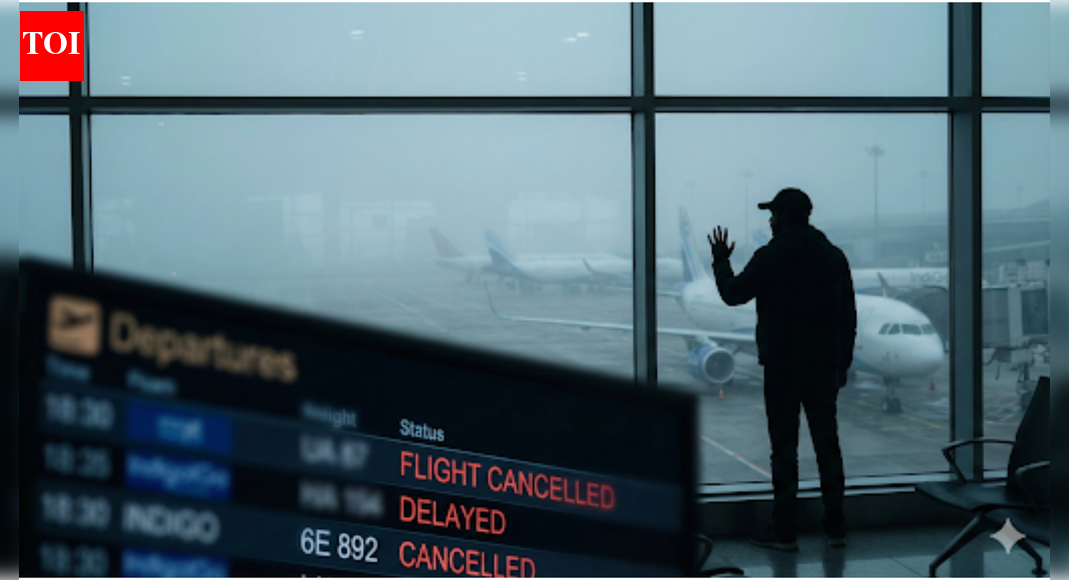
At airports, there was a time when a crackling announcement – “This is the last call for …” – meant panic, urgency, a frantic dash through terminals. When a voice reverberating in mechanical voice announced, “your flight has been delayed”, it was no less than a nightmare as it tested the patience. However, today, for IndiGo passengers, now these same words land like reassurance. It means the flight exists. It means the crew showed up. It means travel is still possible. In a week when cancellations ran into four digits a day, travellers like Soubik Majumder clung to every announcement not as a warning, but as hope because silence, not sound, has become the true alarm. With abrupt cancellations running into hundreds, sometimes even over 1,000 flights a day in the last week, the news of a delay has, ironically, offered some relief.Majumder had booked an IndiGo flight in advance from Delhi to visit Agartala for his brother’s wedding.

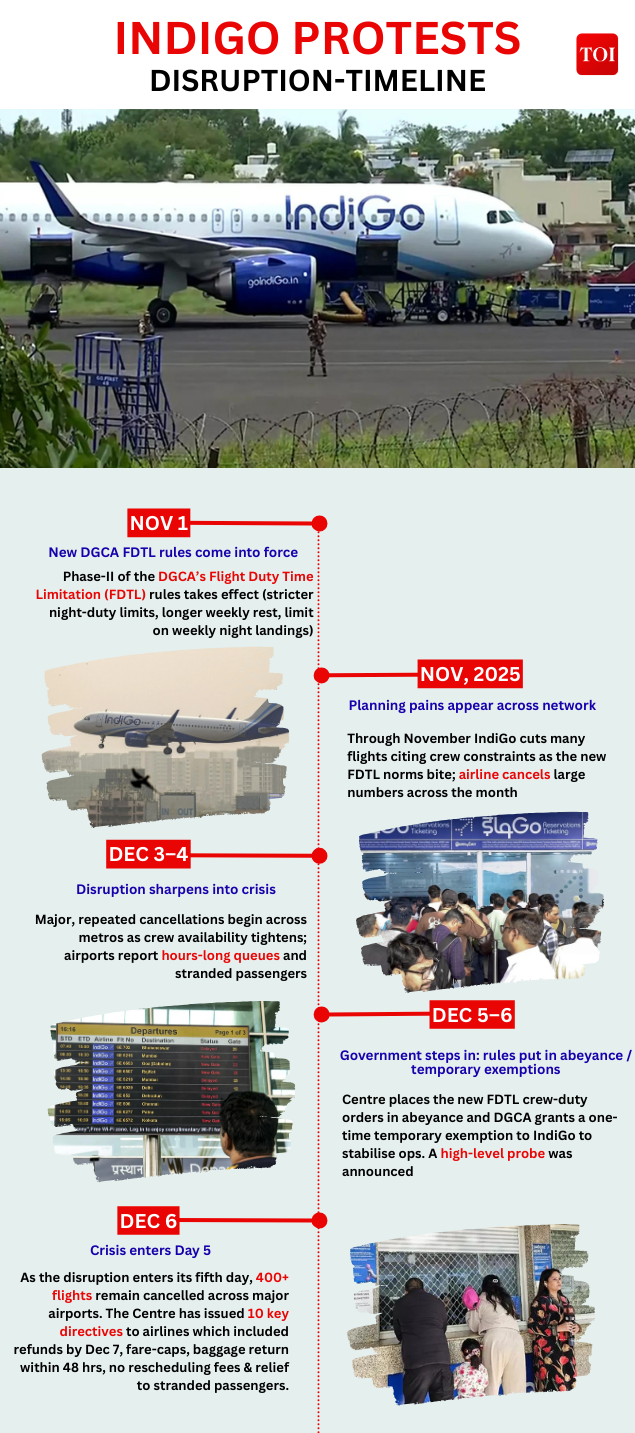
However, what should have been a pleasant ride home turned into a desperate hunt for buses, trains and anything that moved, all in a bid to reach the ceremony on time.He had booked the tickets one month before his actual flying date but the ongoing chaos and disruptions left him with nothing but a cancelled flight. “I booked my ticket almost a month in advance so that I wouldn’t have to face any hassle. But because of the changes that happened later due to the new aviation law, I am now facing problems for the same ticket that I booked one month earlier,” he told TOI.Delays came first, followed by endless queues and cancellations and gradually, everything erupted into utter chaos, turning airports into scenes similar to a fish market, with suitcases scattered everywhere. IndiGo’s flight disruption worsened on Friday as the airline cancelled over 1,000 flights across major cities. After remaining silent for three days during the crisis, CEO Pieter Elbers finally issued a video apology, expressing regret for the inconvenience caused to passengers.Delhi bore the brunt with 235 cancellations, followed by Mumbai with 104, Bengaluru with 102 , and Hyderabad with 84 cancelled flights.
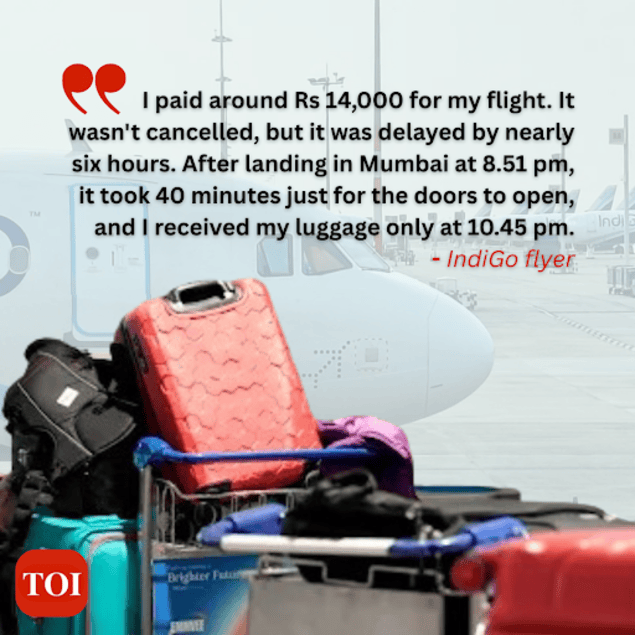
For many passengers, the trouble began long before the cancellation alert flashed on screens. Vaishnavi Shree, travelling from Tirupati to Delhi, recalled the confusion that unfolded in real time.“There’s only one direct flight from Tirupati to Delhi, it departs at 9 am and usually lands by around 11.30 pm. We completed all the usual procedures, but while going through security, I overheard a guard mention that the Delhi flight might be cancelled. No one seemed sure, so we continued to the gate,” she said.The uncertainty only grew. “The flight was delayed first by one hour, then two and finally it was cancelled,” she said.Passengers were offered two choices: reschedule for the next day with hotel accommodation and meals, or cancel their tickets. But those who urgently needed to reach Delhi were left stranded, with connecting routes via Hyderabad, Bengaluru or Chennai either fully booked or cancelled.Playback singer and performer Abhijit Ghoshal told TOI, ‘I paid around Rs 14,000 for my flight. It wasn’t cancelled, but it was delayed by nearly six hours. After landing in Mumbai at 8.51 pm, it took 40 minutes just for the doors to open, and I received my luggage only at 10.45 pm.”

Sunil D Shaligram said his son remained stuck at the airport for over 14 hours. “Despite repeated requests, we received no assistance,” he told PTI.Another parent, S Arora, said the airline “should have foreseen the chaos their decisions would trigger.”Several passengers said they were asked to deboard after being told there was “no pilot available.”Stranded travellers are now demanding clearer communication from the airline and better arrangements to deal with disruptions of this scale.
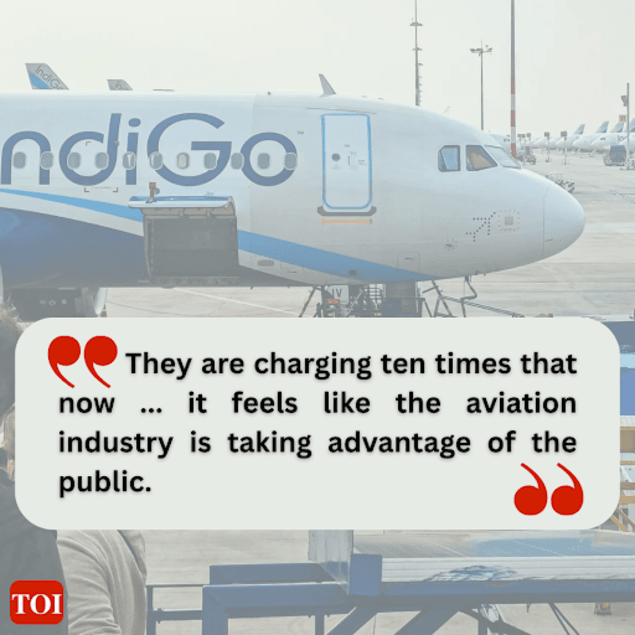
To support affected passengers, IndiGo announced automatic refunds for cancelled flights.The airline said, “All refunds for cancelled flights will be processed automatically to your original mode of payment. Additionally, we are offering a full waiver on all cancellations and reschedule requests for bookings between 5 and 15 December 2025.”However, frustration runs far deeper than refunds, with passengers now facing fares nearly ten times higher than their original bookings. Many received cancellation alerts just hours before departure.“My flight was at 9.00 am and I got the message at 4.00 am,” Majumder said. “In a way, it was slightly helpful that I didn’t have to go to the airport … but when you find out four to five hours before your flight that it’s cancelled, you can’t do much urgently.”Talking about the refunds, he added, “IndiGo is covering the amount I originally paid, yes, but that doesn’t solve the problem … I can’t find anything below Rs 50,000–70,000, and even then only connecting flights, no direct options.”After spending roughly Rs 8,000 for his tickets, Majumder believed his plans were set, until the chaos left him scrambling. “They are charging ten times that now … it feels like the aviation industry is taking advantage of the public,” he said.

Despite already missing part of the family wedding, he insisted he would try every possible route to attend the remaining ceremonies.Nomad Travel CEO and former Travel Agents’ Association of India president Ajay Prakash told PTI, “If a Rs 10,000 ticket is being sold at Rs 60,000 … I would call it black marketing, profiteering.” He argued the sector is now driven “purely by profit motives,” with IndiGo’s 64–65% market share giving it near-monopoly power.Fare spikes followed the chaos: after 1,000 flights were cancelled, a one-way economy ticket on SpiceJet from Kolkata to Mumbai touched Rs 90,000, while Air India’s Mumbai–Bhubaneswar fare hit Rs 84,485.It wasn’t just airfares that shot up. Ghoshal said even cab prices had tripled. “My usual fare … is between Rs 550 and Rs 650, but yesterday … it was showing Rs 1,871.”He added the crisis has hit livelihoods. “Many of my peer musicians have missed their concerts … We artists usually fly on the day of the performance itself,” he said, calling the situation “ridiculous” and deserving serious action if caused by mismanagement.Another passenger, Ritik Jha, also told TOI how his entire travel plan collapsed.“Initially the flight was scheduled for December 3 at 9.15 am, booked much in advance — in October — and was cancelled a few hours before take-off,” he said. Jha had booked four tickets at Rs 8,855 per person, but the last-minute cancellation forced him to look for alternatives that were 300–400% higher than his original fare.“Air India was charging Rs 33,353 per person for two of us in the morning, while Akasa was Rs 22,532 per person in the afternoon — which again caused delays for a planned event,” he said, adding that the entire schedule went haywire, leading to “inflated costs, delays, and complete chaos.”Jha also mentioned that an international client travelling with him faced similar issues. “He was supposed to fly from Pune to Bengaluru with IndiGo, but the last-minute cancellation made him take a connecting flight via Chennai, again costing much higher and causing delays and chaos.”
Beyond refunds, IndiGo has been providing accommodation and meals to stranded passengers. Shree said, “We were provided accommodation and food at Fortune Grand ITC.”“We got the cab that they (IndiGo airline) provided, and the food is there, three meals a day, and the hotel and everything is good.”For Ghoshal, however, the experience was far less satisfying.“On December 2, when I flew from Ranchi to Delhi and it was delayed in the Delhi–Prayagraj sector, they offered very meagre food. The quantity of food for delayed passengers was almost 30% of a usual thali. But at Prayagraj airport on December 4, IndiGo did give snacks, packets and tasty food (lunch) at around 3 pm.”
The disruption at IndiGo, India’s largest airline by market share, has not just crippled aviation operations, it has pushed passengers into deep emotional distress. Weddings, work commitments, medical emergencies and even final goodbyes now hang in uncertainty.In Guwahati, one passenger described the agony, “I have come all the way from Shillong this morning. My husband passed away, and I have come here to transport the casket to Kolkata so he can be buried in his hometown.”“We booked an IndiGo flight, and till now there is no information on whether it will take off. I don’t know if the flight will be cancelled or if it will actually depart,” the flyer told ANI.Another flyer from Delhi reached the airport at 2 in the afternoon, excited to attend an important wedding function, waited all day at the airport, only to return back home after spending almost 12 chaotic hours at the airport, and no flight in sight.
InterGlobe Aviation, also known as IndiGo, is reeling from the disruption not just on the ground, but also at Dalal Street. In the past 5 trading sessions, the airline’s stock price has tumbled down by over 7%.The company’s stock has been under pressure for four consecutive sessions, slipping 7.23% on the Bombay Stock Exchange and 7.30% on the NSE over the period. On Friday, it closed 1.22% lower at Rs 5,371.30 on the BSE after falling as much as 3.15% intraday to Rs 5,266, while on the NSE it ended 1.27% down at Rs 5,367.50. Since December 1, the firm’s market capitalisation has eroded by Rs 16,190.64 crore to Rs 2,07,649.14 crore.IndiGo’s on-time performance also collapsed amid worsening operational disruptions, plunging to just 8.5% on Thursday, according to data from the civil aviation ministry.The decline has been sharp, as the airline’s OTP dropped from 35% on Tuesday to 19.7% on Wednesday before hitting single digits a day later, a major setback for an airline that has long positioned punctuality as its key strength.
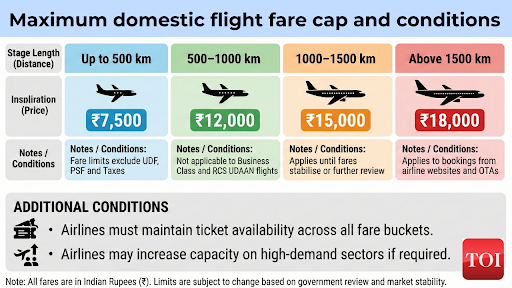
The government on Saturday intervened to control spiralling ticket prices as IndiGo’s operational crisis entered another day, triggering widespread cancellations, passenger unrest and uncertainty over return travel.The ministry of civil aviation said it had taken “serious note of unusually high airfares being charged by certain airlines during the ongoing disruption” and invoked its regulatory powers to ensure “fair and reasonable fares across all affected routes.”

The ministry has also instructed IndiGo to promptly process all outstanding passenger refunds. It has been mandated that refunds for all cancelled or disrupted flights must be completed by 8:00 pm on Sunday, December 7. Additionally, airlines have been directed not to charge rescheduling fees to passengers whose travel arrangements were impacted. The ministry cautioned that any delays or failure to comply with the refund processing will result in immediate regulatory measures.Meanwhile, passengers who have even travelled one way are still worried about their return plans. Hardik Sharma, who was one of the lucky ones who got to board their scheduled flight from Delhi to Vizag, is now feeling anxious about his return journey.“Thankfully, my flight was on time, but there’s still uncertainty about my return flight to Delhi on Sunday night”, he said.With thousands stranded nationwide, Delhi airport released a statement on Saturday afternoon saying operations were gradually improving, “We are glad to update that IndiGo flight operations are now steadily resuming and getting back to normalcy following the brief disruption. Please check the status of your booking and flight before leaving home.”In order to help passengers with no travel options, the South Central Railway announced four special trains to Chennai, Mumbai and Shalimar (Kolkata) to clear the extra rush. The move followed long queues and overcrowding at the airport due to the large-scale grounding of flights.Union civil aviation minister Ram Mohan Naidu Kinjarapu said restoring normalcy across airports “remains the immediate priority”. He added that authorities are closely monitoring the airline’s scheduling network and compliance with pilot duty and rest norms. “The immediate priority for us is to bring back normalcy and provide all the support to the passengers. We are deeply observing this, and observing the FDTL norms, scheduling network. We will thoroughly look into this and ensure that all airlines follow due diligence,” he said.IndiGo, which usually operates around 2,300 flights a day, has been cancelling services to manage the worsening operational disruptions tied largely to crew shortages, causing massive distress for passengers and triggering knock-on effects across the aviation and railway networks.How long it will take for IndiGo to resolve the ongoing disruptions remains uncertain, but one thing is clear: passengers will end up paying a price far beyond just their airfares.Even if this chaos resolves within the coming days and normalcy returns soon, it is certain that neither the emotional damage caused to passengers can be undone nor the trust shaken in the reliability of the airline can be restored in the near future.IndiGo will fix its roster, the ministry will probe and issue new directives, and eventually airports will go back to being temples of impatience, not despair. But until then, every time a speaker crackles, passengers will inhale sharply – not worried they’re late, but relieved they’re still on the list. In a week when ‘delay’ became the new ‘on time,’ travellers learned the hardest lesson of all – that in aviation, the most expensive seat isn’t business or premium economy. It’s certainty.
On Day 3 of the second Ashes Test, Australia inched ever closer to a commanding victory, leaving England on the brink of defeat. The Brisbane Cricket Ground witnessed a stark contrast between the two teams as Australia’s bowlers ran riot in England’s second innings, reducing them to 134/6 at the close of play.
England now trail by 43 runs, with just four wickets remaining. England’s batting lineup crumbled under the relentless pressure applied by Australia’s seam attack, led by Mitchell Starc and Scott Boland. With England on the back foot, Australia’s bowlers are poised to mop up the tail and take a crucial 2-0 lead in the series. Root’s lone resistance is the only hope for England, but it appears increasingly unlikely that they will be able to stave off defeat as the Australian juggernaut rolls forward.
England’s second innings unraveled spectacularly during second session of Day 3, as their middle order capitulated under the pressure from Australia’s pace and swing bowlers. Zak Crawley and Ben Duckett started strong and add quick runs to reduced deficit for England. Ollie Pope and Joe Root tried to steady the ship, but Pope fell quickly to Michael Neser. From there, the wickets continued to tumble, with Harry Brook and Jamie Smith all failing to make significant contributions. Their top and middle order was torn apart by a relentless Starc, Boland, and Neser, who repeatedly found the right lengths and swing to make life difficult. By the end of the day, with England on 134/6, the team’s chances of forcing a draw or staging a comeback were looking increasingly slim.
Australia’s first innings of 511 runs set a massive target for England, placing them in a commanding position right from the outset. The Australian batsmen, led by a well-paced innings from Steve Smith (61), ensured they built partnerships at key stages of the innings. However, it was Mitchell Starc’s late-order heroics that took the total past 500, as he struck a crucial 77 off 141 balls, playing with the kind of aggression that took the wind out of England’s sails.
Despite a determined effort from England’s bowlers, particularly Brydon Carse and Gus Atkinson, Australia’s batters showed resilience and scored freely, reaching the 500-run mark without significant disruption. This innings proved to be a crucial turning point in the match, giving Australia not only a solid first-innings lead but also the psychological advantage going into England’s second innings. The sheer weight of the total meant that England’s batters, who struggled in their first innings, were always going to be under intense pressure in their second outing.
Also READ: 5 players Chennai Super Kings (CSK) can target in the IPL 2026 mini-auction
With Australia’s dominant performance in both innings, England now stand on the edge of defeat, staring down a tough task of saving the match. Root’s monumental effort in the second innings, currently unbeaten on 138, has been the only positive for England as the rest of the batting order crumbled in a heap. Australia’s bowlers, having already set the tone with a commanding 511-run total, will now look to clean up the tail and dismiss England quickly on Day 4.
England’s frailty is evident, and with only four wickets remaining, the likelihood of them surviving the day is diminishing rapidly. The cracks in England’s batting have been laid bare, and Australia’s bowlers, led by Starc and Boland, will be eager to finish off the job, giving Australia a 2-0 series lead. The match has swung decisively in Australia’s favour, and unless there is an extraordinary turnaround, England’s dreams of levelling the series in Brisbane will be dashed.
England’s day of shame #Ashes pic.twitter.com/6Utk6ugsOf
— Vithushan Ehantharajah (@Vitu_E) December 6, 2025
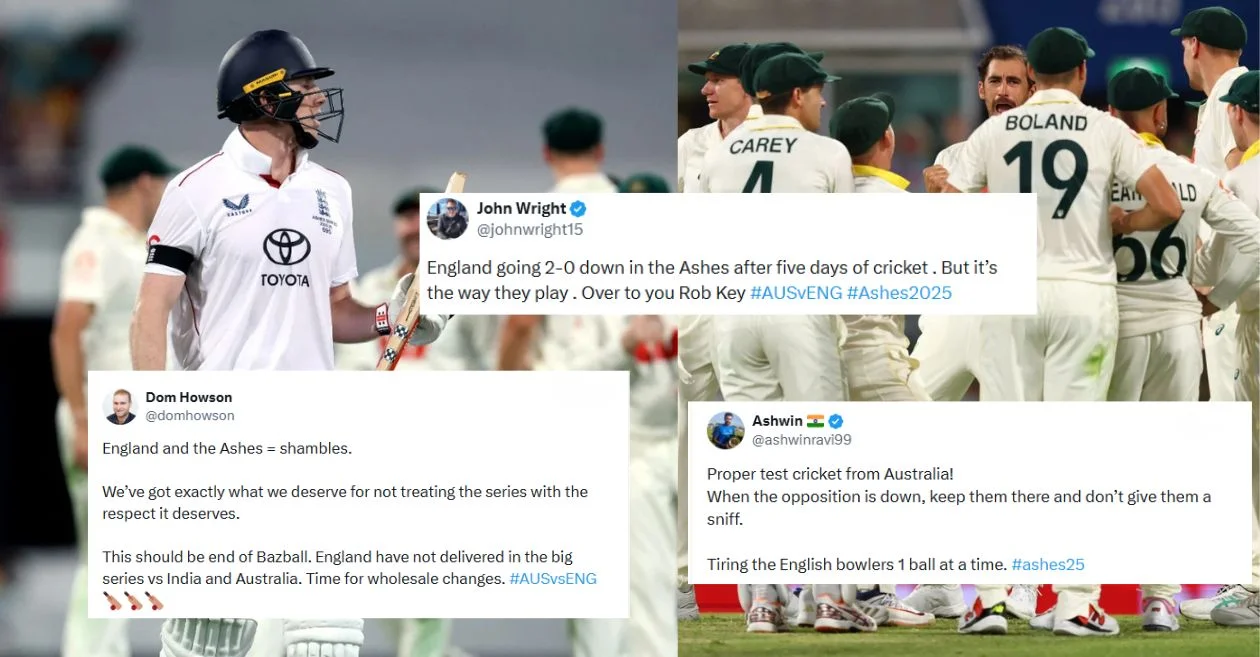
Proper test cricket from Australia!
When the opposition is down, keep them there and don’t give them a sniff.Tiring the English bowlers 1 ball at a time. #ashes25
— Ashwin 🇮🇳 (@ashwinravi99) December 6, 2025
England going 2-0 down in the Ashes after five days of cricket . But it’s the way they play . Over to you Rob Key #AUSvENG #Ashes2025
— John Wright (@johnwright15) December 6, 2025
England has lost a wicket every 29 balls in this Ashes series.@SEN_Cricket @1116sen #Ashes
— Tom Morris (@tommorris32) December 6, 2025
England and the Ashes = shambles.
We’ve got exactly what we deserve for not treating the series with the respect it deserves.
This should be end of Bazball. England have not delivered in the big series vs India and Australia. Time for wholesale changes. #AUSvsENG 🏏🏏🏏
— Dom Howson (@domhowson) December 6, 2025
Out Bazballed yesterday, out-thought today.
Two sessions of almost unremitting bleakness for England.#BBCcricket #Ashes
— Henry Moeran (@henrymoeranBBC) December 6, 2025
Here is an amazing stat from today’s Ashes Test.
– Australia’s 9, 10, 11 batters played 233 balls.
– England’s top 5 batters faced 166 balls on the same pitch.At this point I genuinely can’t tell who the tailenders are.
— Vijay Anaparthi (@VijayCricketFan) December 6, 2025
I almost prefer the Ashes when we have to go to England because at least it’s competitive.
Sure, gloating is fun, until it’s boring. I’m not there yet, but 3-0, and we’re there.
— Neal Gardner (@Nealbackup) December 6, 2025
Ashes is really the greatest cricket event.
Not because of the quality of cricket but the pure joy to watch England getting steamrolled every other year— Indian George Bailey (@StewartIndian) December 6, 2025
Can England avoid an innings defeat at the Gabba?#cricket #AUSvENG #Ashes #2ndTest #CricketTwitter pic.twitter.com/WLdeQXJqHd
— CricketTimes.com (@CricketTimesHQ) December 6, 2025
Also READ: Highest partnership for 7th wicket in 4th innings of a Test match ft. Justin Greaves and Kemar Roach
India’s expanding data centre and artificial intelligence ecosystem could position the country as a global leader in power trade, with experts pointing to surplus electricity capacity and rapid reforms in the power distribution sector, according to speakers at a national conference on energy and technology.Speaking at the National Conference on AI and Machine Learning based solutions in the power sector, Jitendra Srivastava, chairman and managing director of REC Limited, said the rapid rise of AI and data centres is creating a new era where electricity itself becomes a strategic asset, according to ANI.“With the exploding growth of artificial intelligence, with the exploding growth of data centres, with the sheer amount of power required to function these places…We are going to see an era when power will be the currency and we are uniquely placed with its huge potential with its already surplus status. We are poised to become world leaders. We are in a position where we can show the world that power is a tradable commodity and we can be global leaders in this,” Srivastava said.The conference brought together solution providers and power distribution companies with the aim of enabling collaboration and innovation. Shashank Mishra, Joint Secretary in the Ministry of Power, said the initiative was designed to create a common platform for developing new solutions.“Today we are bringing together solution providers and distribution companies on a single platform where they can interact and develop new solutions and ideas. We are also presenting several innovative concepts in the form of solutions, and the best among them will be awarded by the Minister of Power,” Mishra told ANI.He added that the government expects the initiative to be “a transformative” step for the sector.Highlighting ongoing reforms, Srivastava said the Ministry of Power has been driving changes under the Revamped Distribution Sector Scheme (RDSS), with smart metering forming a core pillar of the programme. He stressed that the benefits of smart meters can be fully realised only with the use of advanced analytics.“To understand the advantages of smart metering, it is essential to leverage the power of artificial intelligence and machine learning,” he said, adding that such tools can aid anti-theft measures, load forecasting and system rationalisation.According to Srivastava, the conference seeks to demonstrate how AI- and machine learning-based tools can improve consumer services, assist electricity regulators and help discoms function more efficiently.India’s energy sector has strengthened significantly in recent years, balancing rising demand with sustainability goals. Citing International Energy Agency projections, speakers noted that emerging and developing economies will account for about 85 per cent of the growth in global electricity demand over the next three years, with India playing a central role.As of June 2025, India’s total installed power capacity stood at 476 GW, while power shortages have declined sharply from 4.2 per cent in 2013-14 to 0.1 per cent in 2024-25, according to official data.

You don’t have permission to access “http://www.ndtv.com/india-news/wild-elephant-tramples-forest-official-52-to-death-in-kerala-9762760” on this server.
Reference #18.f5277368.1765025028.2ffcfcb7
https://errors.edgesuite.net/18.f5277368.1765025028.2ffcfcb7

You don’t have permission to access “http://www.ndtv.com/world-news/thai-family-waiting-to-welcome-gaza-hostage-sons-body-to-new-home-9762691” on this server.
Reference #18.bef856b8.1765024365.21b42991
https://errors.edgesuite.net/18.bef856b8.1765024365.21b42991
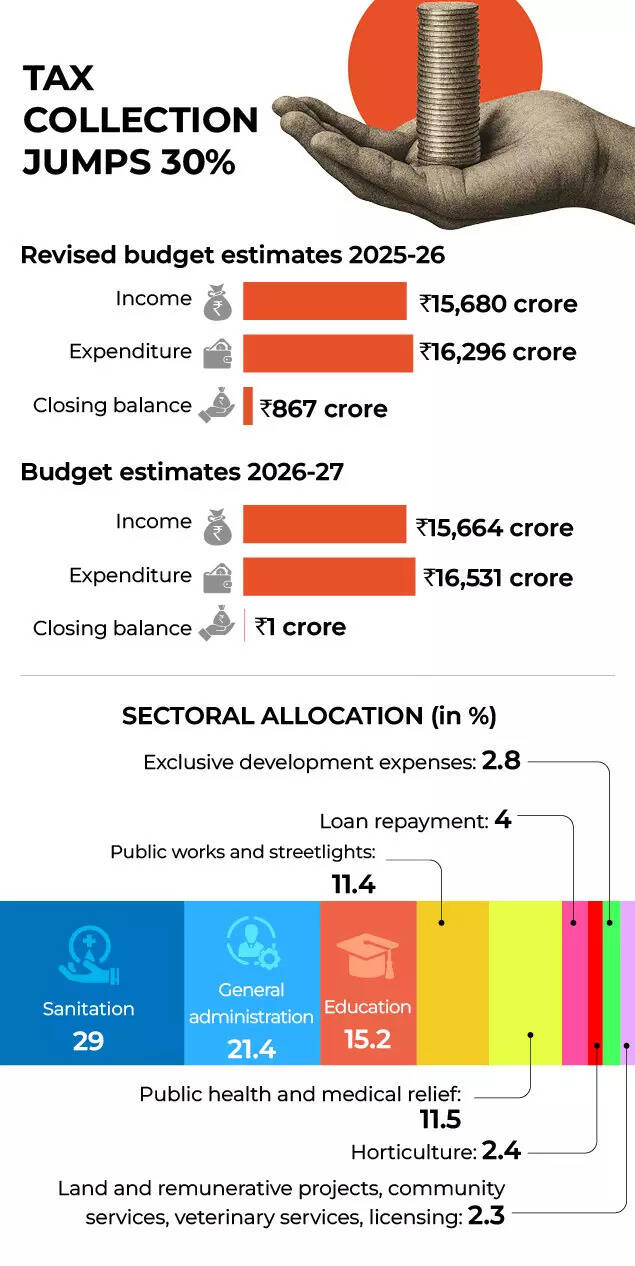
The revised budget estimate for 2025–26 shows a strong 30% surge in tax collections, pushing total income to ₹15,680 crore. Yet expenditure continues to exceed revenue, leaving only a modest closing balance as allocations rise across key public sectors.
Tax Collection Jump 30%