Breaking News
Mandaviya defends Labour Codes, flags safeguards for women tea workers in Assam | India News


Mandaviya defends Labour Codes, flags safeguards for women tea workers in Assam

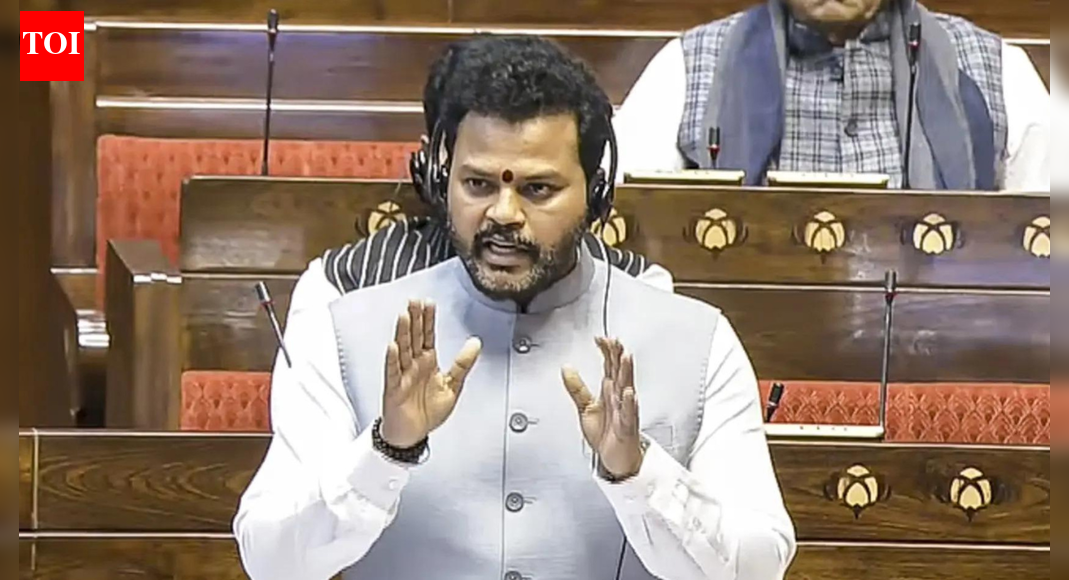
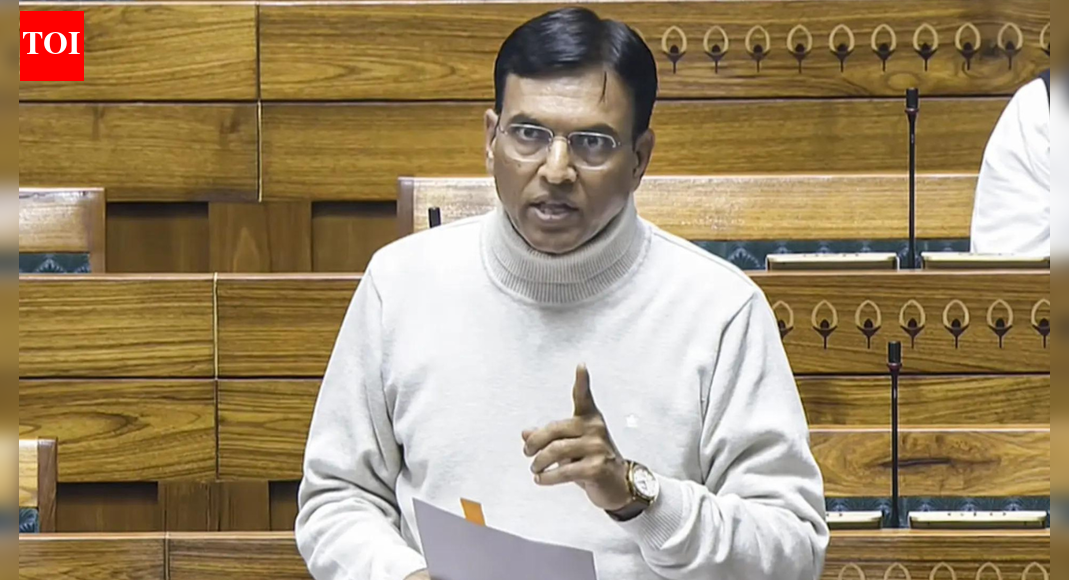
NEW DELHI: Union labour minister Mansukh Mandaviya on Monday defended the four Labour Codes in the Lok Sabha, citing their impact on women workers, particularly in Assam’s tea plantations, amid opposition’s criticism that the reforms dilute labour protections. His remarks came in response to questions on implementation and safeguards under the Codes.Responding to a question on women workers in tea gardens, Mandaviya said: “Whether it is a tea garden or any factory or establishment anywhere in the country, the Labour Codes have made strong provisions for the dignity, safety, health, and rights of women workers.” He said equal wages for men and women for the same work had been guaranteed, health facilities ensured and maternity benefits strengthened through provisions such as crèche facilities and paid leave.Referring to social security cover, the minister told the House that under Ayushman Bharat and ESIC, women workers and their families are entitled to cashless treatment, including for illnesses linked to hazardous work. He added that wherever 50 or more women workers are employed, housing, drinking water and sanitation facilities have been made mandatory. “In every establishment, an Internal Complaints Committee or grievance redressal committee is mandatory, and it is compulsory to include women members in it,” he said.Mandaviya noted that women constitute 70–80% of the tea garden workforce and said over 12 lakh plantation workers were benefiting from the Codes. He questioned the Opposition’s resistance, asking whether it objected to equal wages, maternity benefits and health security for women.Opposition parties, including Congress and Trinamool, have argued that the Codes favour employers through longer work hours and weaker enforcement. The government maintains that the reforms modernise labour laws and expand social security coverage. After the debate, Mandaviya reiterated his position on social media, listing equal pay, health security, maternity benefits, safe workplaces and mandatory grievance committees as core safeguards for women workers.


Source link

The trillion-dollar shock: What tariff? How Xi Jinping beat Trump in trade war


The trillion-dollar shock: What tariff? How Xi Jinping beat Trump in trade war
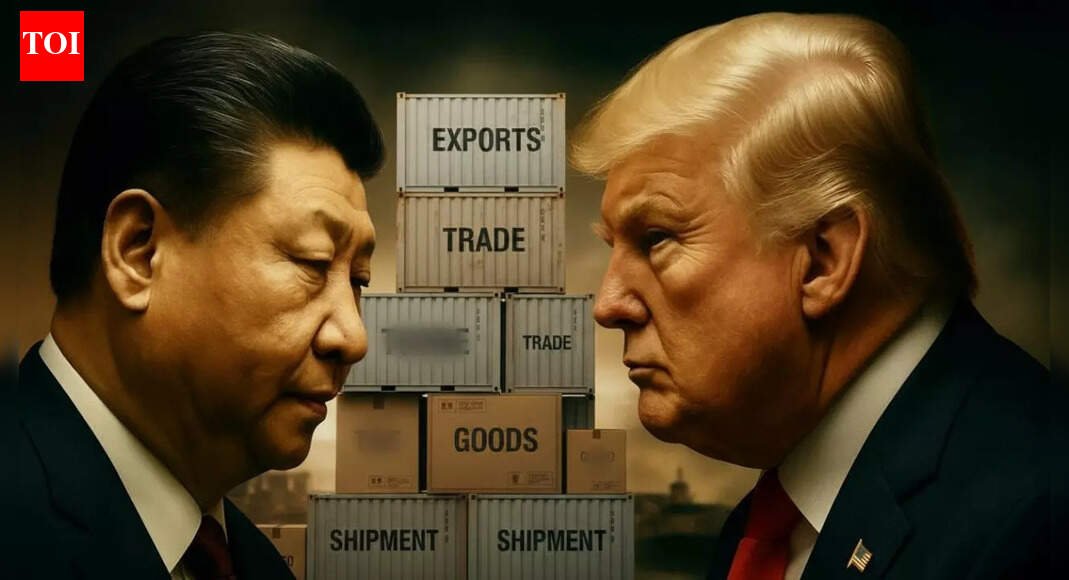
President Trump’s trade war strategy – featuring sweeping tariffs – has not curtailed China’s export machine. (AI image)

Driving the news:Despite nearly a decade of US tariffs under President Donald Trump, China’s trade surplus has exploded, hitting $1.08 trillion through November – the highest ever recorded globally and a level China didn’t reach until year-end just last year.The record, announced by China’s customs agency this week, represents a 21.7% increase over the same period in 2024 and underscores China’s rising dominance in global exports. “They should not be surprised that China is able to find markets outside of the advanced economies,” Mary Lovely, senior fellow at the Peterson Institute for International Economics, told the New York Times.
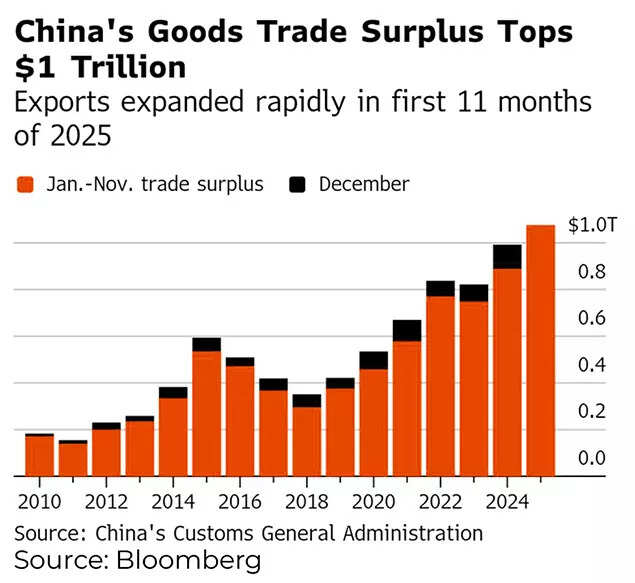
China's Goods Trade Surplus Tops $1 Trillion

China’s Goods Trade Surplus Tops $1 Trillion

Why it mattersPresident Trump’s trade war strategy – featuring sweeping tariffs, tough rhetoric, and promises to rebuild US manufacturing – has not curtailed China’s export machine.Instead, China has restructured, rerouted, and retooled, pushing more goods into emerging markets, Europe, and Southeast Asia – often by moving final assembly outside its borders to dodge tariff barriers. “Despite persistent trade tensions… we believe China will gain more share in the global goods export market,” said Morgan Stanley’s Chetan Ahya.This surge positions China not only as the world’s dominant supplier of goods but also as a geopolitical force, leveraging exports to build ties – and dependencies – across the Global South.Zoom inHere’s how China’s $1.08 trillion trade surplus was built:Diversified markets

  • Exports to Africa rose 42%, to Europe 15%, and to Latin America by double digits.
  • US-bound shipments fell 29% year-over-year in November, marking the eighth straight month of double-digit declines.
  • But sales to France, Germany and Italy boomed – all reporting double-digit growth.

Places buying more from China

Places buying more from China

Manufacturing shifts:* Chinese companies moved parts of their supply chain to Southeast Asia, Mexico, and Africa, which then export to the US – effectively bypassing Trump-era tariffs.* These “trans-shipping” tactics allowed Chinese firms to continue supplying American retailers while masking origin.
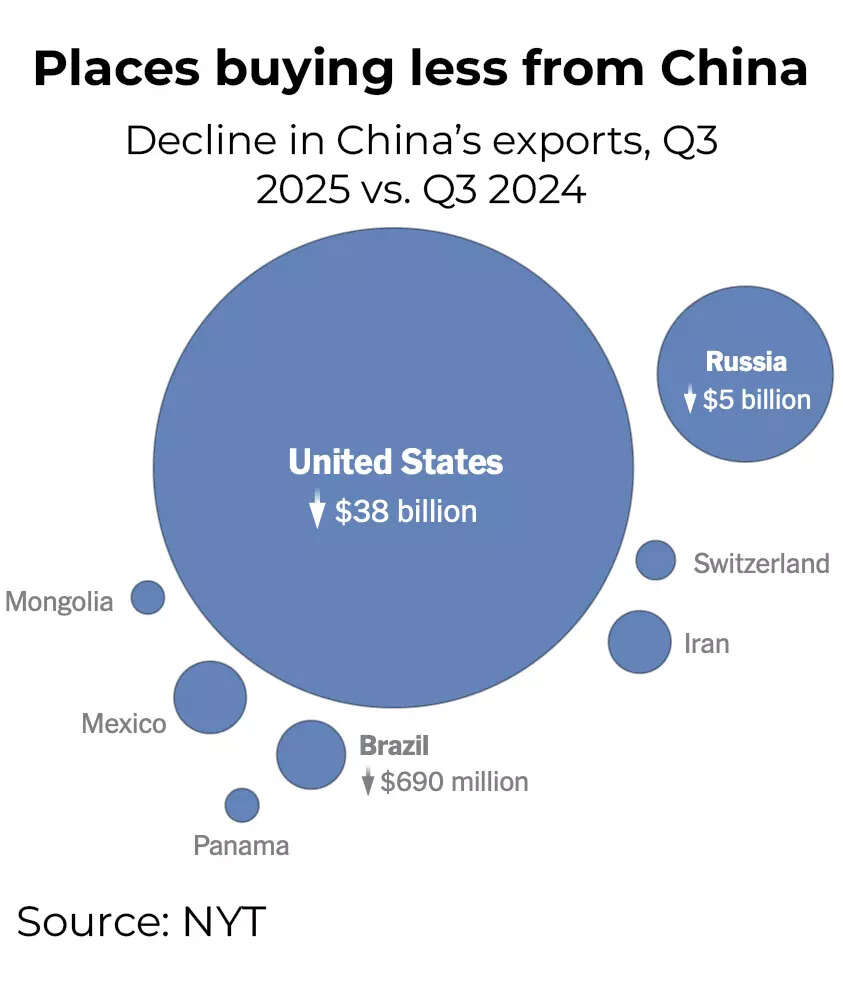
Places buying less from China

Places buying less from China

Currency advantage

  • The renminbi has weakened significantly, particularly against the euro, making Chinese goods even cheaper abroad.
  • Prices in China are falling, while those in the US and Europe are rising – supercharging competitiveness.

“With the renminbi undervalued by 30% against the euro… it will be exceedingly difficult… to compete against Chinese manufacturers,” said Jens Eskelund, president of the EU Chamber of Commerce in China .Between the linesTrump’s tariffs, once seen as a bold bid to reshore jobs and production, have created only limited disruption to China’s trajectory.

  • Exports of toys, electronics, and plastic goods to the US are down, but the loss has been overcompensated by booming sales elsewhere.
  • China is intentionally selling at low margins to emerging markets to gain long-term geopolitical and economic influence.

“The margins may not be as high,” Ilaria Mazzocco of the Center for Strategic and International Studies told the NYT. “But for those markets, it’s entirely transformational”.Meanwhile, US importers are increasingly turning to India, Vietnam, and Taiwan – but many of those supply chains still begin in China.The big picturePresident Trump’s trade war was meant to reduce America’s reliance on Chinese goods and give US factories a competitive edge.But instead, China has shown it can reorient its export model, reclaim global market share, and sidestep tariff pressure – faster than Washington anticipated.

  • China is now the world’s largest producer of electric vehicles, batteries, solar panels, and consumer electronics.
  • In many African countries, Chinese vehicles and tech – once nearly absent – now dominate markets.
  • Sales of Chinese-made EVs and solar panels to Nigeria and Algeria have multiplied, disrupting local industries.

This transformation was no accident. It’s the result of years of top-down industrial planning from Beijing – and decades of underinvestment in manufacturing capacity across the West.
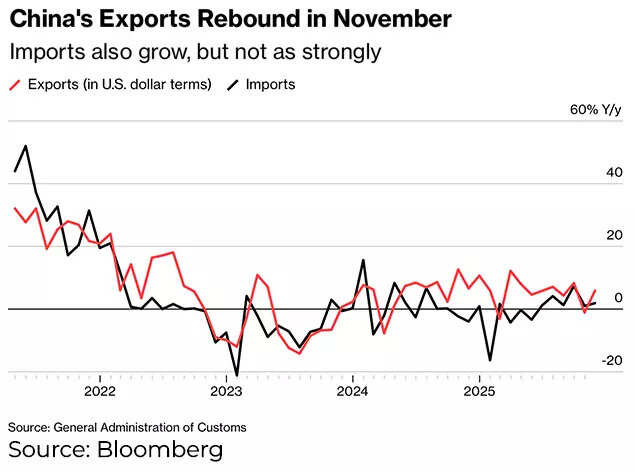
China's exports rebound in November

China’s exports rebound in November

“China’s trade surplus in factory goods is even bigger… than the US after World War II,” notes the New York Times.The Trump factorEven as President Trump agreed to a one-year trade truce with Xi Jinping in October, his administration continues to weigh additional tariffs, particularly on industries like pharmaceuticals and drones, where China dominates.And while he reduced some tariffs, they still hover at 45% – historically high levels.But critics argue that Trump’s trade war mostly reconfigured supply chains, rather than revitalizing American industry.What they’re saying“November’s stronger-than-expected export growth demonstrates the resilience and competitiveness of China’s exporters,” said David Qu, chief China economist at Bloomberg Economics.“The rebound of export growth in November helps to mitigate the weak domestic demand,” added Zhiwei Zhang of Pinpoint Asset Management.But while exports are thriving, consumer spending at home remains weak, and factory activity has now contracted for eight straight months, raising concerns about the sustainability of export-led growth.What’s nextThe International Monetary Fund is in China this week to assess its currency practices, including whether the renminbi is being kept artificially low to boost exports. A preliminary report is expected Wednesday.At the same time, calls are growing inside China to allow the currency to appreciate – a move that would:

  • Make foreign imports cheaper
  • Increase household purchasing power
  • But hurt exporters by reducing the value of foreign earnings

“To expand domestic demand, it is necessary to minimize the trade surplus,” said Zhang Jun of Fudan University .What to watch:Global pushback: As China’s exports flood markets, the EU is considering new anti-dumping measures. Other regions – including India and Brazil – are exploring safeguard tariffs.Slowdown risk: Despite strong export performance, China’s economy is losing momentum heading into 2026, and export growth may not be enough to offset weak domestic demand.Policy pivot: At a recent Politburo meeting, President Xi emphasized domestic demand as China’s top priority for 2026, signaling a longer-term effort to rebalance the economy away from exports .The bottom line:Trump’s tariffs were loud, but China’s strategy was louder.Through currency policy, transshipment, and industrial strength, China has not only survived the trade war – it has thrived, with a record-smashing $1.08 trillion trade surplus to show for it.If the US wants to challenge China’s dominance, it may need more than tariffs. It will require reinvestment, innovation, and allies – and a serious reevaluation of what a “win” in global trade even looks like.(With inputs from agencies)


Source link

Man arrested in Malad East with unlicensed pistol and live cartridge | Mumbai News


Mumbai: A 30-year-old man was arrested by Kurar police with an unlicensed country-made pistol and a live cartridge at Malad East recently. The accused, Faisal Shaikh, was intercepted by a Kurar police team while patrolling at Shanti Nagar slum, Pimpripada, on Dec 3. Shaikh is a Pune resident. The arms recovered from him are worth Rs 15500. Shaikh has been booked under provisions of the Maharashtra Police Act.


Source link

‘Very, very strict action’: Aviation minister vows to ‘set an example’ after IndiGo fiasco; what he said in Rajya Sabha | India News


'Very, very strict action': Aviation minister vows to 'set an example' after IndiGo fiasco; what he said in Rajya Sabha

NEW DELHI: The aviation minister K Rammohan Naidu vowed in Rajya Sabha on Monday that the government will take “very, very strict action” against Indigo over the recent fiasco to “set an example” across the industry.Speaking during question hour, Naidu said the disruption was a result of IndiGo’s internal lapses. Blaming the carrier for failing to manage its crew and duty roster, the minister said, “We are not taking this situation easily. We are doing an inquiry. We will take very, very strict action not only for this situation but also as an example.”

Aviation Meltdown Escalates As IndiGo Cancels 400 Flights And Government Enforces Fare Controls

Responding to a query from Congress MP Pramod Tiwari, who sought to know whether the cancellations stemmed from a malfunction in the automatic message switching system (AMSS) – the glitch that hit flight operations in early November 2025 – Naidu clarified that the two incidents were unrelated. The IndiGo crisis, he said, arose from “anomalies and mismanagement” in the airline’s crew roster system.The minister also outlined the timeline of the revised flight duty time limitations (FDTL), introduced after a high court order in April 2025. Of the 22 guidelines, 15 were implemented on July 1 and the remaining seven on November 1. He stressed that multiple consultations were held with all stakeholders, including IndiGo, and that the rules had to be followed “without any compromise on safety.” Naidu said the directorate general of civil aviation has been in continuous discussions with airlines since FDTL came fully into force, and had granted limited exemptions based on operational variations and safety assessments. Noting that the crisis erupted “almost one whole month” after the final phase of FDTL implementation, he pointed out that IndiGo did not flag any imminent issues during a meeting with the ministry on December 1.“This is a day-to-day operation – something that Indigo should have maintained. Indigo was supposed to manage the crew, roaster through its day-to-day operations,” he said.Reiterating that accountability is non-negotiable, Naidu added: “If there is any mis-compliance, non-compliance, non-adherence for any single person, entity and organisation, or any operator functioning in this civil aviation, we will take very, very strict action so that we set an example in the industry.”

Indigo crisis enters seventh day

Indigo’s operational crisis entered into its seventh consecutive day of chaos on Monday. With more 500-large scale flight cancellations continuing across major airports. According to the civil aviation ministry, IndiGo is scheduled to operate 1,802 flights across 137 of its 138 destinations on Monday. The ministry also said the airline has already returned around 4,500 misplaced bags to passengers and aims to deliver the remaining 4,500 within the next 36 hours.Separately, the Supreme Court refused to entertain a petition seeking judicial intervention over the large-scale flight cancellations, noting that the matter did not warrant its involvement at this stage.(With inputs from agencies)



Source link

5 winter foot scrubs for soft and glowing feet


Image credits: iStock, canva

You tippy tap all around the world with your feet. Be it dragging yourself to school or running as fast as you can to work, your feet are your forever accomplices that demand nothing but care in return. Especially during the winter season, when the socks-clad feet become dry and flaky and lose all their glow!Your feet are one part of the body that is connected to the entire nervous system and how you care for them affects everything from your stress to your sleep. In this case, a foot scrub that helps you remove all the dead skin seems like a godsend gift. Here are five winter foot scrubs that will leave your feet soft and glowing and ready to show off in a pair of stunning heels.

5 Foods that will keep your skin hydrated this winter

Lemon and sugar foot scrub

Lemon and sugar foot scrub

Image credits: canva

White sugar is great for scrubbing your feet and lemon is just the exfoliant you need. In a jar add eight tablespoons of white sugar, along with one tablespoon of olive oil and squeeze in the juice of half a lemon. Mix together until you have the preferred consistency and then scrub your feet with it, as per thought. After you are done make sure to lather on some moisturiser on them.

Oatmeal scrub

Oatmeal scrub

Image credits: canva

For those who have sensitive skin and need to be gentle with the products they use, this oatmeal foot scrub by Trendy Beauty is ideal. You will need two teaspoons of oatmeal, one teaspoon of baking soda, one teaspoon of honey and water as required. Make it into a paste and scrub your feet with it. While the honey moisturises the skin, oatmeal and baking soda work as exfoliators, peeling off the dead skin.

Coffee and brown sugar scrub

Coffee and brown sugar scrub

Image credits: canva

Coffee is also a famous ingredient in the DIY skincare world and its rejuvenating powers are not just limited to your soul, they also apply to the skin. Mix half a cup of ground coffee with one-fourth cup of brown sugar, half a cup of coconut oil and one teaspoon of vanilla extract. Once combined scrub your feet with the mix and then rinse, as per Treehugger. Make sure to apply some coconut oil to your feet later to make sure the skin is nourished.

Peppermint and salt scrub

Peppermint and salt scrub

Image credits: canva

Begin by taking a cup of medium grind sea salt in a bowl. To this add half a cup of coconut oil and ten to fifteen drops of peppermint essential oil. Mix together and apply this scrub suggested by Mommypotamus, on your feet to have them feel baby soft.

Pineapple and yogurt foot scrub

Pineapple and yogurt foot scrub

Image credits: canva

This scrub by TreeHugger is an absolute gem and will have your feet looking anew within minutes. All you need is half a cup of freshly crushed pineapple, half a cup of white sugar and two tablespoons of plain yogurt. Scrub your feet with this mix for ten minutes and let it sit for another ten. Now rinse and follow up with an essential oil. While you might don protective footwear like boots and sneakers all winter, your feet can still get dry and flaky because of the weather. Additionally, with them being covered in socks all day, the dead skin may keep on piling up and looking more dull by the day. Thus, it’s very important to keep replenishing the skin with easy-to-make and effective foot scrubs like these.


Source link

IPL 2026: No RCB matches at Bengaluru’s Chinnaswamy Stadium? Karnataka deputy CM DK Shivakumar puts all speculation to rest


Reports of a controversial shake-up for the Indian Premier League (IPL) 2026 season emerged following a tragic stampede at the M. Chinnaswamy Stadium earlier this year. With the stadium temporarily deemed unsafe for mass gatherings, the hosting rights for Royal Challengers Bengaluru’s (RCB) home games were thrown into serious doubt. Rumours gained traction suggesting that the franchise would be forced to relocate its fixtures to an alternative venue. The MCA Stadium in Pune quickly became the frontrunner, with officials from the Maharashtra Cricket Association confirming preliminary discussions were underway to offer their ground as a potential temporary home for RCB.

IPL 2026: RCB to miss Chinnaswamy Stadium games? Karnataka Deputy CM DK Shivakumar ends the uncertainty

Karnataka Deputy Chief Minister DK Shivakumar has emphatically shut down all speculation regarding the shifting of IPL matches from Bengaluru, assuring that all fixtures for the 2026 season will remain at the M. Chinnaswamy Stadium. Speaking after casting his vote in the KSCA elections, Shivakumar stated that losing the IPL was unacceptable, viewing the tournament as a symbol of the state’s pride.

He directly addressed the inquiries about relocating matches, including the IPL, following the stadium tragedy, providing a firm, unequivocal statement: “This is a matter of respect for the state of Karnataka and Bengaluru. We will take steps to ensure that the next IPL matches are held here.” Shivakumar stressed his personal commitment to the sport, stating, “I am a cricket fan.”

He added that the government would ensure all available cricket matches, including those from the Women’s cricket games, would be hosted: “We will allow whatever matches are available in the coming days.” His assurance stands as a significant political commitment to maintain Bengaluru’s status as a central hub for Indian cricket, dismissing the reports that cited safety and structural concerns.

Also READ: 5 players Royal Challengers Bengaluru (RCB) can target in the IPL 2026 auction

Commitment to safety upgrade and plan for a new stadium

The Deputy CM’s assurance came with an explicit commitment to addressing the safety concerns that led to the stadium’s temporary suspension following the stampede during the RCB title celebrations, which tragically claimed 11 lives. The incident, caused by overwhelming crowds, raised serious questions about crowd management and the venue’s infrastructure.

Shivakumar detailed the government’s dual strategy to restore the stadium’s reputation and expand the city’s cricketing capacity: “We will take care that the recent disaster does not happen again and ensure that the stadium’s dignity remains.” He emphasized that moving forward, the facility would be operated with stringent legal and safety measures: “The stadium will be developed by managing the crowd within the legal framework.”

Furthermore, he revealed a long-term plan to develop new infrastructure, which would act as a contingency and a way to support the growing demand for large-scale matches: “In addition, we will build a bigger stadium as an alternative.” This comprehensive plan is designed to safeguard the future of major cricketing events in Bengaluru.

Also READ: IPL 2026: Are KGF and Kantara creators Hombale Films planning to buy RCB? Here’s what we know so far


Source link

Access Denied


Access Denied

You don’t have permission to access “http://www.ndtv.com/india-news/parliament-winter-session-day-6-live-updates-stage-set-for-vande-mataram-debate-pm-narendra-modi-rajnath-singh-congress-priyanka-gandhi-gaurav-gogoi-9769142” on this server.

Reference #18.9cf856b8.1765184894.2662ff4b

https://errors.edgesuite.net/18.9cf856b8.1765184894.2662ff4b


Source link

‘This is a disaster’: Mamata Banerjee targets BJP over IndiGo fiasco; cites passenger agony | India News


'This is a disaster': Mamata Banerjee targets BJP over IndiGo fiasco; cites passenger agony

NEW DELHI: West Bengal chief minister Mamata Banerjee on Monday sharply criticised the Centre over the nationwide flight chaos triggered by IndiGo’s deepening operational crisis, calling the situation “a disaster” and accusing the BJP-led government of failing passengers as large-scale cancellations entered the seventh straight day.Indigo flight cancellations follow live updatesSpeaking in Kolkata, Banerjee said the crisis had left ordinary flyers abandoned without alternatives. “What is the alternative for the public? It is most unfortunate that the maximum number of flights have stopped. This is a disaster. Thousands of passengers are stranded in airports. They are feeling mentally tortured,” she said.She urged the Centre to intervene immediately, adding, “I ask the Government of India to make a plan to resolve this. The BJP government is not interested in matters related to the country and the people. But the BJP cares only about how to capture institutions.”Her remarks came as more than 250 IndiGo services were cancelled from Delhi and Bengaluru alone on Monday, as reported by PTI. The disruptions rippled across major airports including Hyderabad, Ahmedabad, Mumbai and Chennai. Delhi saw 134 cancellations, while Bengaluru recorded 117, marking one of the worst single-day breakdowns of airline operations in recent years.The airline, which has struggled with massive pilot shortages and new crew duty-time regulations, is under increasing scrutiny from regulators and the judiciary. The Directorate General of Civil Aviation on Sunday extended by 24 hours the deadline for IndiGo CEO Pieter Elbers and COO Isidro Porqueras to respond to a show-cause notice over what it said were “significant lapses in planning, oversight, and resource management.IndiGo has faced public anger after cancelling thousands of flights since December 2, culminating in an unprecedented 1,600 cancellations on Friday. Elbers later issued a video apology but passengers at airports nationwide continue to report long queues, confusion over rebooking, and inadequate assistance.The crisis has now reached the Delhi high court, where a Public Interest Litigation has sought urgent intervention. The petitioner described the airport situation as “inhumane,” alleging that many stranded passengers were left without support or timely refunds. The court has agreed to hear the matter in detail on Wednesday.


Source link

‘I chucked intentionally’: Shakib al Hasan’s shocking confession on bowling ban | Cricket News


'I chucked intentionally': Shakib al Hasan's shocking confession on bowling ban
Shakib al Hasan (Getty Images)

NEW DELHI: Out-of-favour Bangladesh all-rounder Shakib Al Hasan has revealed that physical fatigue led him to deliberately chuck during an English County match for Surrey — a decision that eventually resulted in his ban from bowling. The left-arm spinner was barred from bowling in all competitions under the England and Wales Cricket Board (ECB) after his action was found illegal during independent testing at Loughborough University in December last year.Go Beyond The Boundary with our YouTube channel. SUBSCRIBE NOW!The issue surfaced when umpires questioned his action during a first-class fixture for Surrey against Somerset in Taunton, where he bowled nearly 65 overs across two innings.

Shimron Hetmyer interview: Opens up on hitting sixes, playing T20 leagues and ILT20 experience

“I think I was doing it a little bit intentionally because I bowled more than 70 overs (in one match),” Shakib said on the Beard Before Wicket podcast.“I never bowled 70 overs in my career in a Test match. I was playing that four-day match for Surrey against Somerset in Taunton. I was so tired.”He added that he hoped for a warning before being reported.“I played back-to-back Test matches in Pakistan. We won that series and then I went to play those four-day matches. The only thing I was thinking the umpire could have done was just warn me first, at least. But it is in the rules, so they had the right. I didn’t complain.”Shakib revealed that he initially failed the correction test before working on his action.“I went to do the test, I failed. And then I saw my test. I was like, ‘okay, so these things are happening’. Then I had to train for a couple of weeks so I went back to Surrey again and they were kind enough to help me. I did two sessions and I was back to normal. I was like, ‘it’s so easy’.”Shakib, who will soon turn 39 and is a former Member of Parliament, left Bangladesh last year after Sheikh Hasina’s government was toppled. Since then, he has retired from Test cricket and has not featured in white-ball squads.He also failed a second bowling assessment in Chennai, after which BCB selectors omitted him from the Champions Trophy. The board later clarified that he remains available to play purely as a batter in both domestic and international cricket.


Source link

The stocks you must never touch! Most big losses don’t come from bad luck – they come from buying wrong kind of stocks


The stocks you must never touch! Most big losses don’t come from bad luck - they come from buying wrong kind of stocks

When people tell me about their stock market disasters, the story is almost always familiar. It’s rare, “I bought a solid company at a sensible price, held it for years, and it went to zero.” What I usually hear is closer to, “I bought stock based on this story… this penny stock… this F&O trade I didn’t really understand… and then it crashed.”In other words, most big losses don’t come from bad luck. They come from buying the wrong kind of stocks in the first place.That’s why, before we talk about what to buy, it’s more important to be very clear about what not to buy at all. At Value Research Stock Advisor (VRSA), this is actually where we begin. We have a clear sense of universes we simply don’t touch. You can—and should—do the same with your own money.Take penny stocks. The temptation is obvious. “It’s only Rs 2. How much can I lose?” The honest answer is: you can lose 100 per cent. A stock trading at Rs 2 is not more “affordable” than one trading at Rs 2,000. The absolute price means nothing by itself. A Rs 2 stock can be horribly overvalued; a Rs 2,000 stock can be genuinely cheap for the quality of the business.Penny stocks come with a standard set of problems. They are often thinly traded, which means you can happily buy, but you may find no one to sell to when you want to get out. Information is scarce and unreliable. A handful of players can push prices around. If your main reason for buying is “it’s so cheap, I can buy thousands of shares,” that’s not investing. That’s buying a lottery ticket. In VRSA, we simply avoid this low-quality, illiquid corner of the market. We want to study real businesses, not play with scraps just because the sticker price looks small.This is where a real-life example is useful. Think of a once-hyped penny stock like SecureKloud Technologies in the small cap IT space. At one point in 2016, it traded around Rs 900 after a wave of promotional stories and “multibagger” claims. A few years later, as the reality of weak profits and poor governance emerged, it fell to below Rs 50 by 2019 and currently trades at around Rs 25. Anyone who bought in near the top is now sitting on a loss of roughly 95 per cent—even though the stock always looked “cheap” in rupee terms. This is exactly the pattern we try to help investors avoid.Then there are the “story stocks” and permanent “turnaround” stories. These are companies that always have a narrative to sell. They’ll tell you they are entering a hot new sector, or that they will be a leader in some buzzword industry in three years, or that they’re on the cusp of a massive turnaround. The story keeps changing; the profits do not.Indian investors have seen this many times. Think of some of the real estate and infrastructure favourites during the 2007-08 boom that never recovered, even ten years later. Think of the supposed “next Infosys” names that went nowhere. Think of the “conglomerates” that kept announcing new ventures and funding them with more and more debt. At the peak, each of these had an attractive story. Today, many of those stocks trade at a fraction of their old prices, if they are even alive.Take the case of Suzlon Energy, which once promised to be “the next big thing” in renewable energy space has surged 4-5x multiple times on hope and headlines, and then slid back when the promised turnaround never showed up in earnings. The story was exciting, but the business never improved and to this date trades below its listing price which dates back to 2005.When we look at a potential idea in VRSA, we never start with the story. We begin with the track record and the numbers. If the economics are poor, a clever story doesn’t change anything. A good narrative sitting on top of a bad business does not get past our filters.And then there’s the new favourite: F&O punting dressed up as “investing”. Let me be blunt here. Buying random options or taking leveraged futures positions because someone said “this is a sure shot” is not investing in stocks. It is a leveraged bet on short-term price movement.F&O is dangerous because small price moves can magnify into big gains or losses. Positions expire, which means time is always working against you. You can lose fifty to a hundred per cent of your position very quickly, even when the underlying business is perfectly fine. If you like trading F&O and know exactly what you’re doing, that’s your personal choice. Just don’t confuse it with long-term equity investing.In our world at Value Research, F&O doesn’t feature at all when we talk about stocks. We mean owning slices of real businesses for years, not renting volatility for a few days.You might ask, if these things are so obviously dangerous, why do so many people still get sucked in? The answer is simple. These traps promise speed, excitement and simplicity. They promise that something will double in six months. They give you something to talk about every day. They tell you not to overthink—just act now.Real investing is the opposite. It’s often slow and sometimes boring. It doesn’t give you new bragging rights every evening. It asks you to think carefully about businesses, risks and your own behaviour. At VRSA, we deliberately choose boredom over drama. We are perfectly comfortable if nothing spectacular happens to a stock for three to five years, as long as the business quietly keeps compounding underneath.You don’t need advanced jargon to protect yourself. A few personal rules will do the job. If the main pitch is “it’s only Rs 10, buy a lot of shares,” walk away. If you can’t explain in a couple of sentences what the company does and how it earns money, walk away. If the story around the business keeps changing every year, walk away. And if the idea depends on leverage, exotic products, or you being forced to “act today”, again, walk away.The market will always have something thrilling to offer you. Your job is not to chase everything that sparkles. Your job is to protect your capital and let it grow steadily. That begins with cleaning up your investment universe. If you simply stop buying the wrong kind of stocks, you’ve already taken a huge step towards becoming a better investor. The rest—how many stocks to own, how to size them and how to diversify—is actually much easier once this first step is in place.(Ashish Menon is a Chartered Accountant and a senior equity analyst in Value Research’s Stock Advisor service.)


Source link