Breaking News
Steel inputs squeeze: Curbs on low-ash coke raise costs for makers; GTRI highlights input-side challenges


Steel inputs squeeze: Curbs on low-ash coke raise costs for makers; GTRI highlights input-side challenges

India’s steel capacity expansion is coming under pressure from a policy mismatch that raises input costs even as the government seeks to protect domestic producers, according to a report by the Global Trade Research Initiative (GTRI).“Protecting domestic metcoke producers is valid, but stacking quotas and duties on a non-substitutable input risks over-correction and macroeconomic consequences,” said Ajay Srivastava, founder of GTRI, referring to restrictions on low-ash metallurgical (LAM) coke alongside safeguards, anti-dumping duties and Quality Control Orders on finished steel imports.As quantitative restrictions approach expiry at the end of 2025, Srivastava said policy recalibration is needed. “India should restore predictable and adequate access to LAM coke by lifting or sharply expanding quotas, avoiding overlapping controls, and recalculating duties using realistic dry-bulk freight. A calibrated approach would lower steel costs, improve productivity, support MSMEs and strengthen growth. In steel — and in growth — inputs matter,” he said.LAM coke accounts for around 35–40% of steel production costs and is a critical input in the blast furnace–basic oxygen furnace steelmaking route. Its low ash content improves furnace efficiency, lowers fuel consumption and supports higher productivity. With most domestic coal carrying ash levels of 14–15%, imports of low-ash coke are technically unavoidable for many Indian steelmakers, the report said.Over the past year, controls on LAM coke imports have tightened through safeguard measures, quantitative restrictions and provisional anti-dumping duties, constraining both volumes and prices. A safeguard investigation in 2023 led to import caps, followed by country-wise quotas from January 2025 limiting imports to 1.4 million tonnes per half-year, a ceiling extended through December 2025, GTRI report claimed. In parallel, an anti-dumping probe covering Australia, China, Colombia, Indonesia, Japan and Russia resulted in provisional duties of $60–$120 per tonne in November 2025, the report noted.GTRI flagged freight benchmarking as a key concern in the anti-dumping investigation. While LAM coke is shipped largely as dry bulk with freight costs of about $20–25 per tonne, container freight benchmarks were reportedly used, inflating landed values and dumping margins beyond what trade economics would justify.The impact on supply is already visible, the report said. In the first half of 2025, steelmakers secured about 1.5 million tonnes of metallurgical coke against demand exceeding 3 million tonnes, increasing reliance on uneven domestic supply and raising the risk of production disruptions. With LAM coke making up roughly 38% of finished steel costs, a 20–25% rise in coke prices translates into a 3–5% increase in steel prices, squeezing margins and affecting competitiveness in domestic and export markets.Restricted access to quality coke has also reduced productivity by increasing coke consumption, raising energy use and causing operational downtime. MSMEs in secondary steel, foundries and ferro-alloys have been hit hardest, with cost pressures cascading into downstream sectors such as automobiles, infrastructure and engineering exports, the report noted.


Source link

Women’s safety in India: Between official data and lived reality in 2025 | India News


Women’s safety in India: Between official data and lived reality in 2025

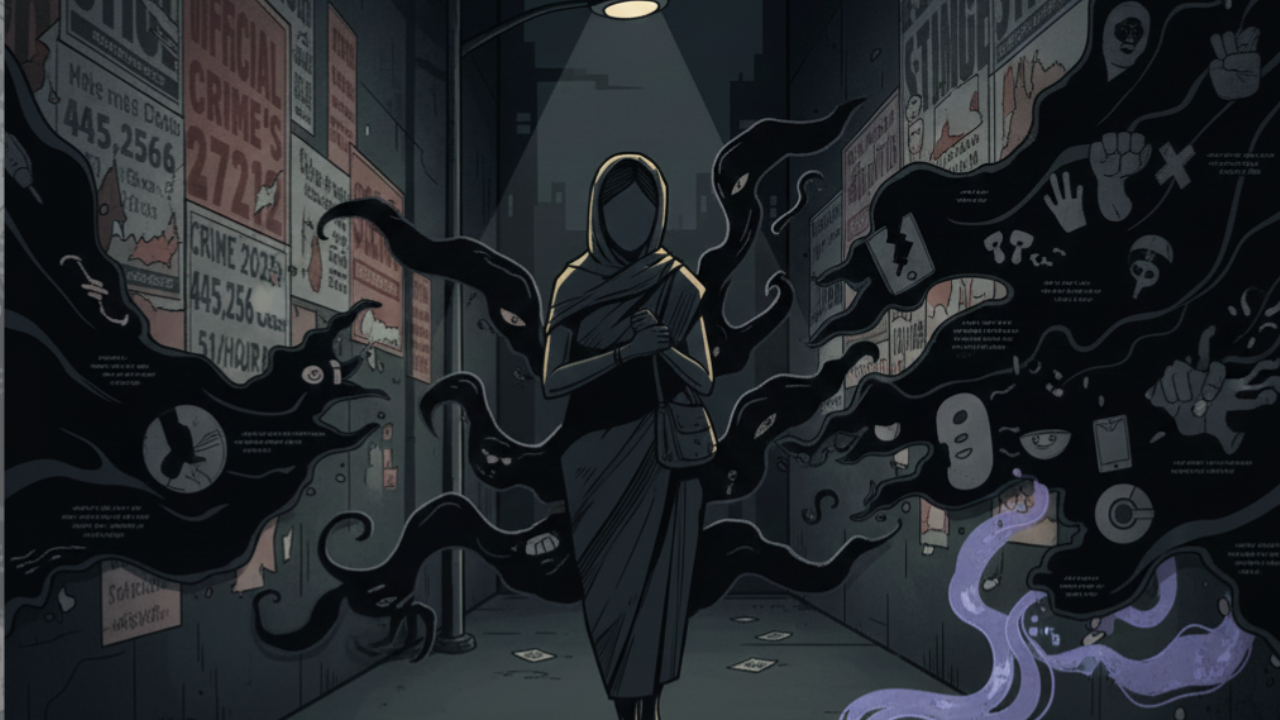
Women’s safety remains one of India’s most urgent and complex public policy challenges in 2025, cutting across domestic, public, and increasingly digital spaces. Despite decades of legislative reform, expanded policing frameworks, and growing public awareness, violence against women continues to persist in multiple forms, ranging from domestic abuse and sexual assault to trafficking, cyber harassment, and workplace exploitation. These crimes are not isolated acts but are embedded within broader structures of gender inequality, social stigma, and uneven access to justice. As India debates legal safeguards and governance reforms, official crime data offers an important, though incomplete, window into the scale and nature of the problem.Every reported crime carries a backstory that never makes it into the case file. Before the FIR, there is the moment of doubt, whether to speak, whom to trust, and what might follow. For countless women in India, that moment ends in silence.That silence is in reality filled with a lot of calculations – the fear that people might not believe you, families asking them to “let it go” because of the risk of retaliation or to protect family honour, the cost of legal battles that can go for years, and the silent understanding that the road to justice, even when promised, can be unforgiving. For most women, safety is not a fixed condition. It is something worked out every day — by calculation which roads to avoid, staying quiet in unfamiliar spaces, adjusting behaviour, and living with harm that feels easier to manage than to report.
.

.

In 2025, crime data remains the main way women’s safety in India is judged. These numbers shape headlines, policy debates, and official claims of progress. But they reflect only those cases that enter the criminal justice system. Far more experiences remain outside the record — abuse within homes, harassment in public spaces, threats online — incidents that never become complaints because the cost of speaking up feels higher than the harm itself.

What the numbers show — and what they don’t

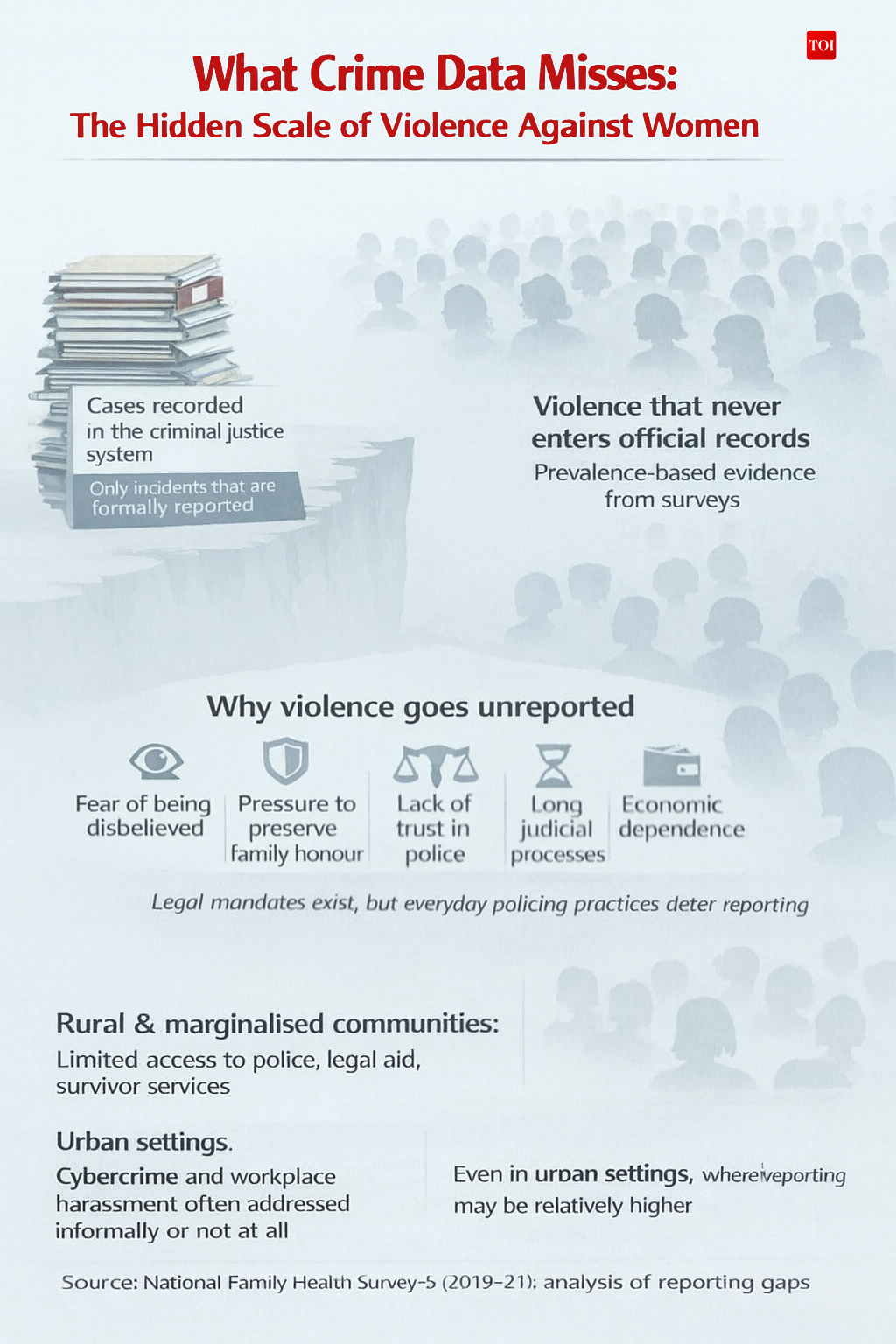
The most recent comprehensive figures from the National Crime Records Bureau (NCRB) are from 2022. Since then, no complete official dataset has been available, leaving a gap in understanding more recent trends. In 2022, India recorded 4,45,256 cases of crimes against women, reflecting a 4 per cent increase from the previous year and translating to an average of 51 complaints every hour. The national crime rate stood at 66.4 cases per lakh women. While these numbers point to the persistence of gender-based violence, they also reveal sharp regional disparities. Union Territory Delhi reported a crime rate of 144.4, more than double the national average, while Haryana (118.7) and Telangana (117.6) also recorded significantly higher rates. Such variations raise critical questions: do higher numbers indicate greater prevalence of crime, better reporting mechanisms, or a combination of both?Official statistics, however, capture only those incidents that enter the formal criminal justice system. A substantial body of evidence suggests that a large proportion of violence against women remains unreported, particularly when it occurs within households or involves perpetrators known to the survivor. Data from the National Family Health Survey–5 (2019–21) paints a starkly different picture of women’s lived experiences.
.

.

According to the survey, nearly one in three ever-married women in India—32 per cent, has faced physical, sexual, or emotional violence at the hands of their husbands at some point in their lives, while 6.1 per cent reported experiencing sexual violence. The contrast between these prevalence-based findings and police-recorded crime figures highlights a persistent gap between reality and reporting.This gap is shaped by multiple factors: fear of retaliation, social pressure to maintain family honour, lack of trust in law enforcement, prolonged judicial processes, and economic dependence. In rural areas and among marginalised communities, these barriers are often compounded by limited access to police stations, legal aid, and survivor support services. Even in urban settings, where reporting may be relatively higher, cybercrime and workplace harassment frequently fall through regulatory cracks or are addressed through informal mechanisms rather than criminal complaints.In 2025, crime data remains an indispensable tool for understanding trends, allocating resources, and holding institutions accountable. Yet numbers alone cannot capture the full extent of women’s vulnerability, resilience, or the systemic failures that allow violence to persist. This feature examines what India’s crime statistics reveal about women’s safety—and, just as importantly, what they leave out, by situating official data alongside social realities, institutional constraints, and the voices often missing from the record.

Reporting versus reality: When FIRs reflect access, not incidence

An increase in the number of First Information Reports (FIRs) registered does not automatically signal a rise in crime; in many cases, it reflects changes in reporting behaviour, policing practices, and legal awareness. This distinction is particularly important when interpreting data on crimes against women, where historically low reporting has long masked the true scale of violence.One key factor behind higher FIR counts is improved access to the criminal justice system. Supreme Court rulings mandating the compulsory registration of FIRs for cognisable offences, coupled with state-level women’s help desks, online complaint portals, and dedicated women’s police stations, have lowered procedural barriers that previously discouraged survivors from coming forward. In such contexts, rising FIR numbers may indicate institutional responsiveness rather than an actual surge in incidents.Shifts in social attitudes also play a role. Greater public discussion around gender-based violence, through media coverage, civil society advocacy, and movements demanding accountability, has contributed to increased awareness of legal rights among women.
.

.

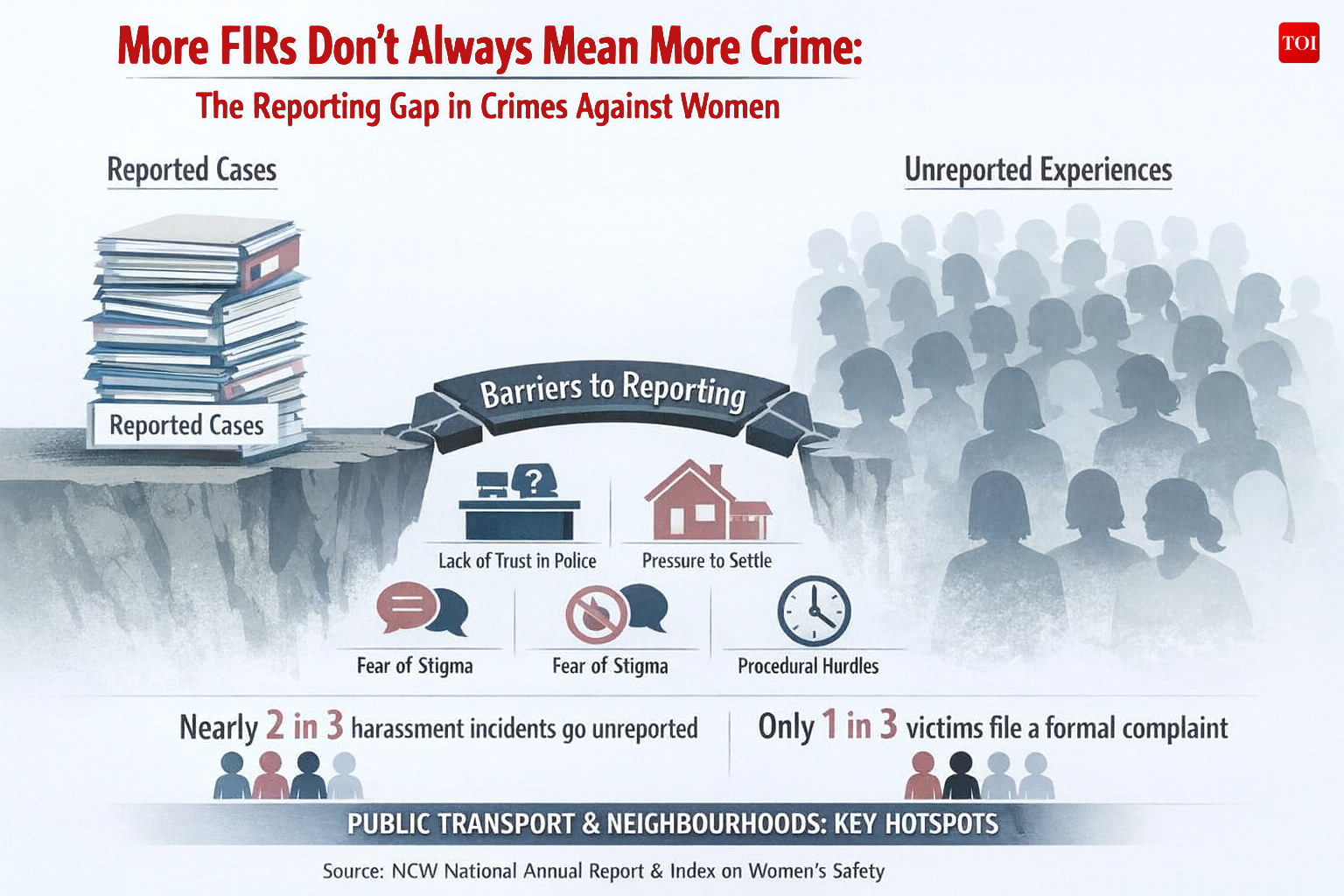
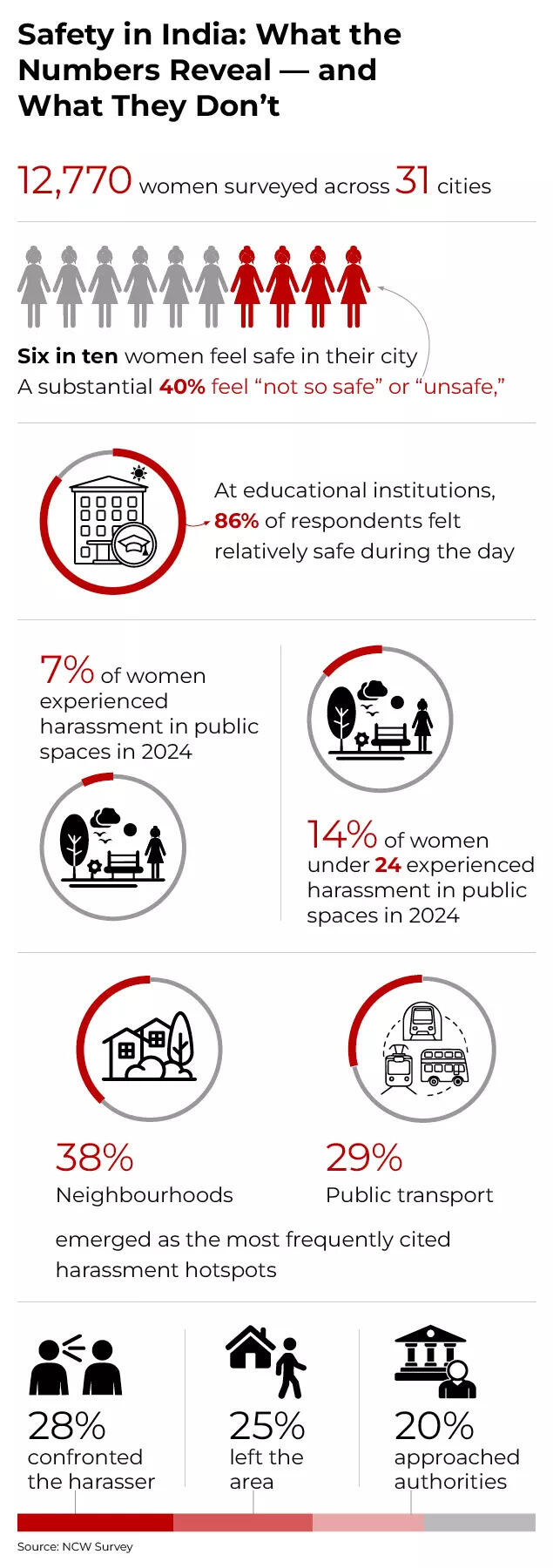
At the same time, increased FIR registration does not eliminate concerns about underreporting. Crimes such as domestic violence, marital sexual abuse, cyber harassment, and trafficking remain significantly underrepresented in police data. In many cases, complaints are withdrawn, informally “settled,” or never converted into FIRs due to pressure from families or local authorities. Moreover, higher FIR volumes are not always matched by proportional improvements in investigations, charge-sheeting, or convictions, raising questions about whether the system is equipped to handle greater reporting effectively.Recent findings from the National Annual Report and Index on Women’s Safety, released by the National Commission for Women (NCW), further underline the limits of relying solely on official crime statistics to assess women’s safety. Based on a survey of 12,770 women across 31 cities, the report seeks to document unreported harassment, everyday experiences, and perceptions of safety that rarely enter police records. India received a national safety score of 65 per cent, with six in ten women saying they felt safe in their city. However, a substantial 40 per cent still described themselves as “not so safe” or “unsafe,” revealing a significant perception gap.
.

.

The data shows that while educational institutions are viewed as relatively safe by 86 per cent of respondents during the day, feelings of safety decline sharply at night and in off-campus spaces. The survey also found that 7 per cent of women reported experiencing harassment in public spaces in 2024, a figure that rises to 14 per cent among women under 24, identifying young women as a particularly vulnerable group. Crucially, the report highlights pervasive underreporting, with nearly two-thirds of harassment incidents never formally reported, suggesting that NCRB figures capture only a fraction of the problem. Neighbourhoods (38 per cent) and public transport (29 per cent) emerged as the most frequently cited harassment hotspots. Women’s responses to harassment varied widely: 28 per cent confronted the harasser, 25 per cent left the area, and only 20 per cent approached authorities reflecting low confidence in institutional redress. Indeed, just one in three victims filed a formal complaint, pointing to enduring trust deficits in policing and complaint mechanisms, and reinforcing the gap between lived experience and recorded crime.

The violence that never reaches the police

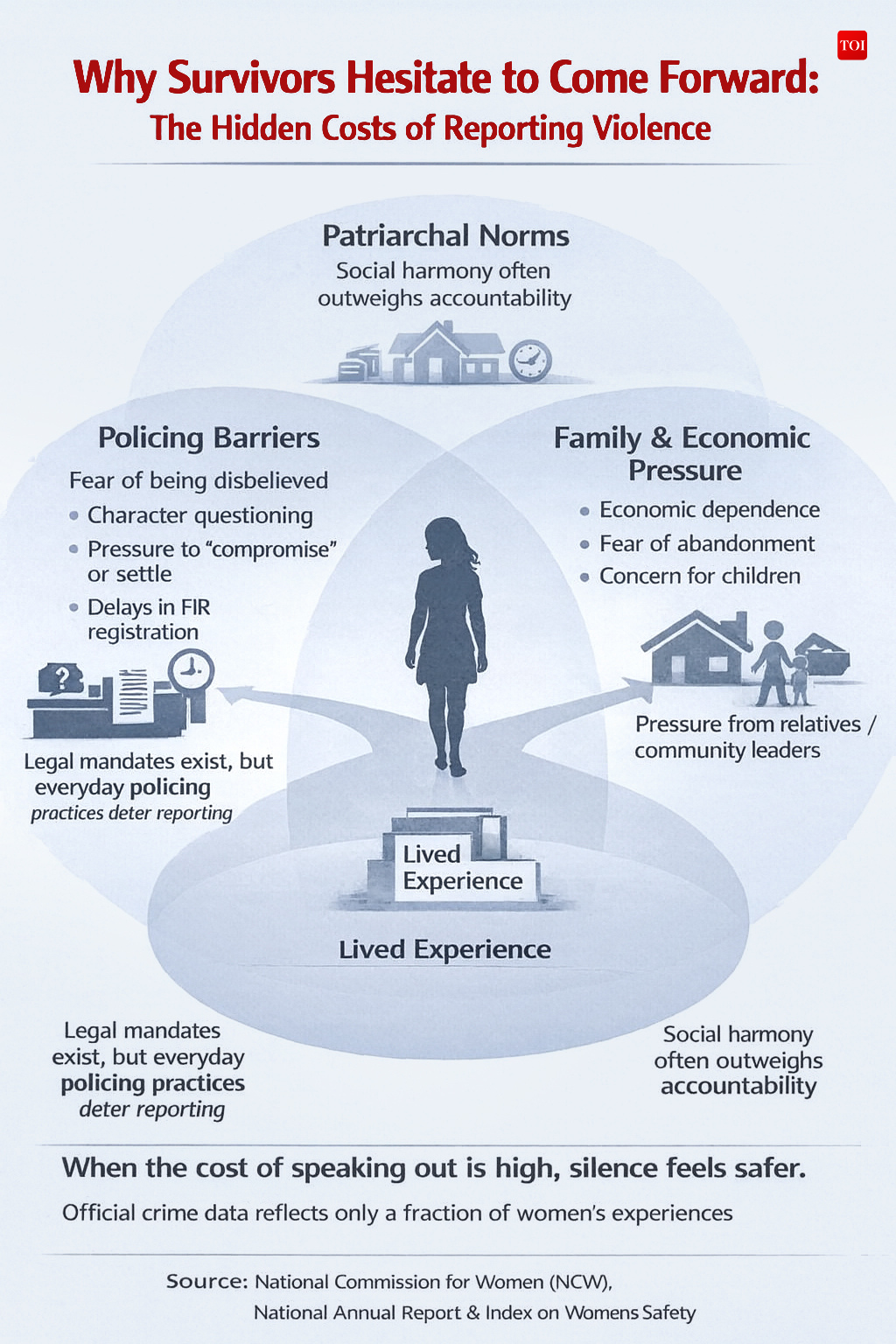
For many survivors of violence, the decision to report an offence is shaped less by the severity of the crime than by the social and institutional costs of speaking out. Policing structures, patriarchal norms, and sustained pressure from families and communities combine to create formidable barriers to reporting, particularly in cases involving sexual violence, domestic abuse, or harassment by known perpetrators. While legal frameworks mandate the registration of complaints, the lived experience of engaging with the criminal justice system often deters survivors from approaching it in the first place.Interactions with the police remain a significant point of friction. Survivors frequently cite fear of being disbelieved, questioned about their character, or pressured into compromise rather than a formal complaint. In cases of domestic violence or sexual assault, women are often encouraged to deal with matters in private spaces, reflecting deeply ingrained attitudes that prioritise social harmony over individual justice. Procedural hurdles, such as repeated visits to police stations, insensitive questioning, or delays in registering First Information Reports, further discourage reporting, especially for women with limited mobility, financial dependence, or caregiving responsibilities.

Policing, patriarchy, and pressure

Patriarchal expectations within families and communities add another layer of pressure. Survivors may be warned that reporting violence will bring shame, damage marriage prospects, or invite social ostracism. In intimate partner violence, economic dependence and concern for children’s welfare frequently compel women to endure abuse in silence. Young women, in particular, face heightened scrutiny, with families often prioritising “reputation” over accountability, discouraging formal complaints even when harm is severe.
.

.

These pressures are compounded by structural weaknesses in survivor support systems.Together, policing practices, patriarchal control, and social pressure create a climate where silence appears safer than disclosure. As a result, official crime data captures only a narrow slice of women’s experiences, masking the depth of violence that continues to shape everyday life.

Statistics and silence: What trauma leaves undocumented

Crime data is designed to count incidents, not to measure the enduring weight of trauma or the complex realities of survival. While statistics can indicate how many cases were reported, registered, or prosecuted, they remain largely silent on what violence does to women’s bodies, minds, livelihoods, and relationships long after the event. The aftermath of abuse, fear, anxiety, depression, disrupted education or employment, and fractured social ties rarely appears in official records, even though these consequences often shape a survivor’s life more profoundly than the crime itself.Numbers also fail to capture the uneven paths to survival. For many women, continuing daily life involves constant negotiation: avoiding certain routes, abandoning jobs, changing schools, or remaining in unsafe homes due to financial dependence or lack of shelter. These acts of adaptation and endurance are invisible in crime statistics, which treat incidents as discrete events rather than ongoing experiences. A closed case or a withdrawn complaint may signal resolution on paper, but it often masks unresolved harm or coercive compromise.Equally absent from the data are the cumulative effects of repeated, low-level violence, verbal abuse, intimidation, stalking, and digital harassment that may not meet reporting thresholds but steadily erode a sense of safety and autonomy. Crime figures can show whether violence is counted, but not whether dignity is restored. Without incorporating survivor-centred perspectives, trauma-informed indicators, and long-term outcomes, data risks reducing deeply personal suffering to abstract totals, obscuring both the cost of violence and the resilience required to live with it.



Source link

‘Flagged, engaged’: India on cancellation of pre-scheduled H-1B visa interviews — Here’s what MEA said | India News


'Flagged, engaged': India on cancellation of pre-scheduled H-1B visa interviews — Here's what MEA said

India on Friday flagged its concerns to the US over the cancellation of pre-scheduled H-1B visa interviews for large numbers of Indian applicants and said both sides were engaged on the issue. The interviews of thousands of H-1B visa applicants slated from the middle of this month in India were abruptly postponed by several months to scrutinise their social media posts and online profiles.

End Of H-1B Lottery: Donald Trump Overhauls US Work Visa System Prioritising High Pay And Skills

Some applicants whose visa appointments were scheduled last week received emails from US immigration authorities informing them that their interviews were being pushed back as late as May next year. The Indian government had received several representations from Indian nationals facing problems with the rescheduling of their visa appointments, External Affairs Ministry spokesperson Randhir Jaiswal said at his weekly media briefing. Visa-related issues pertained to the sovereign domain of any country, he said, adding: “we have flagged these issues and our concerns to the US side, both here in New Delhi and in Washington DC.” Jaiswal said several Indians had been stranded for extended periods in India, causing a lot of “hardships” to them and their families. “The Government of India has received multiple representations from Indian nationals facing delays and difficulties in scheduling or rescheduling US visa appointments. While visa matters fall under the sovereign domain of the issuing country, India has raised these concerns with the US authorities in New Delhi and Washington DC. These delays have caused extended hardships for affected individuals and their families, including disruptions to education. The government remains actively engaged with the US side to address the issue and minimise the impact on Indian nationals,” Jaiswal said.

Mass cancellation push applicants to more trouble

The mass cancellation of scheduled interviews for H-1B visa applicants, in view of enhanced vetting measures, resulted in significant delays in their return to the US. The rescheduling applied to all applicants who were previously given appointments from December 15 onwards. Most of them were already in India and were unable to return to the US pending their new interview dates since they did not have a valid H-1B visa to travel back for their jobs.Hundreds, possibly thousands, of high-skilled workers had appointments cancelled between December 15 and 26, a period many H-1B holders target since it coincides with the US holiday season.


Source link

Virat Kohli shines in last Vijay Hazare Trophy game as Delhi edge Gujarat by seven runs in thriller | Cricket News


Virat Kohli shines in last Vijay Hazare Trophy game as Delhi edge Gujarat by seven runs in thriller
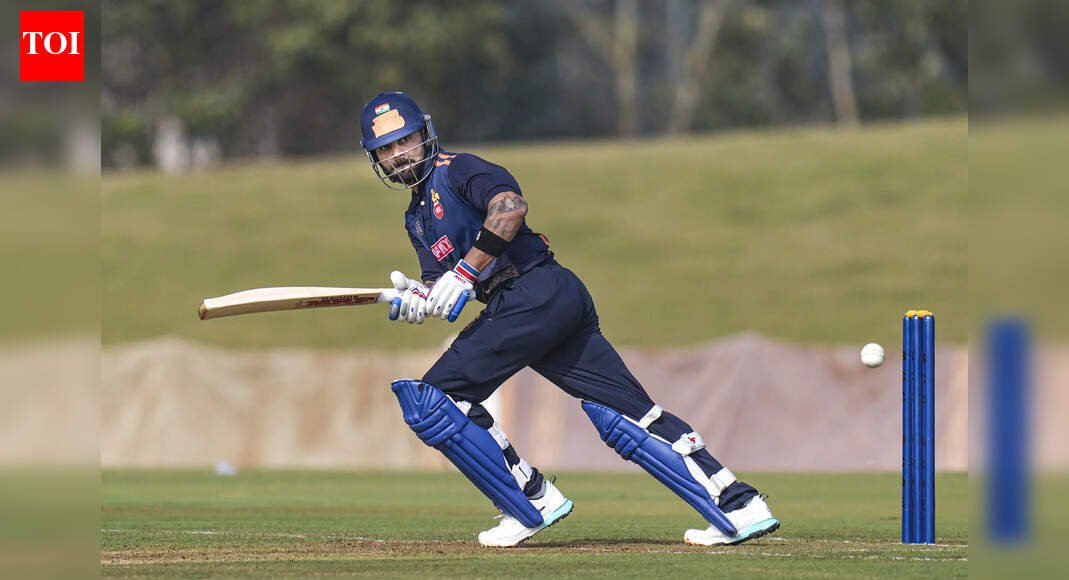
Virat Kohli plays a shot during the Vijay Hazare Trophy (PTI Photo/Shailendra Bhojak)

Star batters Virat Kohli and Rishabh Pant struck composed half-centuries before Gujarat unravelled under pressure, allowing Delhi to sneak home by seven runs in their Elite Group D Vijay Hazare Trophy clash on Friday. Kohli was named player of the match after a fluent 77 off 61 balls, while Pant contributed a measured 70 from 79 deliveries as Delhi posted 254 for nine in their 50 overs. Gujarat, despite being well placed for long periods of the chase, were bowled out for 247 in 47.4 overs.

Gautam Gambhir’s year as India coach ends like it started – on a chaotic note

Kohli once again had to walk in early following the dismissal of opener Priyansh Arya and immediately looked at ease. After defending his first delivery, he drove pacer Chintan Gaja straight down the ground for four, setting the tone for a stylish innings. While Delhi’s other batters struggled to break free against disciplined bowling, Kohli found rhythm with ease in his favoured white-ball format. A pulled six off Gaja and a wristy flicked boundary off Arzan Nagwaswalla followed as Kohli stepped up the tempo. The 37-year-old brought up his fifty in just 29 balls, an innings that featured 10 fours and a six. He later registered his 85th List A half-century by carving Ravi Bishnoi over the covers. Kohli looked set for back-to-back hundreds before left-arm spinner Vishal Jayswal brought his innings to an end. Reading Kohli’s movement early, Jayswal fired one through to have him stumped by Urvil Patel, leaving Delhi at 108 for four. The spinner had earlier removed Nitish Rana and Arpit Gupta, tightening the screws further. With wickets falling, Pant took it upon himself to stabilise the innings. Resisting his natural attacking instincts, the Delhi captain focused on strike rotation and partnerships. He crossed fifty in 64 balls, with his first moment of invention coming via a falling scoop off Bishnoi, which he attempted again later against Gaja. Pant’s stay ended when he lost his stumps to Jayswal, bringing an end to a vital 73-run stand with Harsh Tyagi, who made 40. Late runs from Simarjeet Singh and Ishant Sharma helped Delhi cross the 250 mark, giving their bowlers something to defend. Gujarat’s chase began promisingly on a slightly tacky surface at the BCCI Centre of Excellence. Urvil Patel and Aarya Desai put on 67 for the opening stand, before Aarya and Abhishek Desai added another 54 to take Gujarat to 121 for one after 25 overs. From there, the chase derailed rapidly. Aarya, Abhishek, Jaymeet Patel and Hemang Patel fell in quick succession as Gujarat slipped to 144 for five, adding only 23 runs in the process. Saurav Chauhan, who once represented Royal Challengers Bengaluru in the IPL, revived hopes with a counter-attacking 49 off 43 balls, adding 69 runs with Vishal Jayswal for the sixth wicket. Chauhan struck Arpit for two sixes to keep the asking rate manageable, but Simarjeet Singh returned to dismiss him, triggering another collapse at a crucial stage. A late run-out of Gaja left Gujarat needing 12 runs from 17 balls with one wicket in hand. The final blow came when Prince Yadav produced a sharp delivery to dismiss Bishnoi, finishing with figures of three for 37. Kohli sprinted in from cover to take the catch, celebrating emphatically as Delhi sealed a hard-fought victory. Brief scores Delhi: 254/9 in 50 overs (Virat Kohli 77, Rishabh Pant 70, Harsh Tyagi 40; Vishal Jayswal 4/42) Gujarat: 247 all out in 47.4 overs (Aarya Desai 57, Saurav Chauhan 49; Prince Yadav 3/37, Ishant Sharma 2/28)


Source link

Karnataka crash: Fuel tanker jumped divider, hit bus head-on; how a split-second collision sparked fire | Bengaluru News


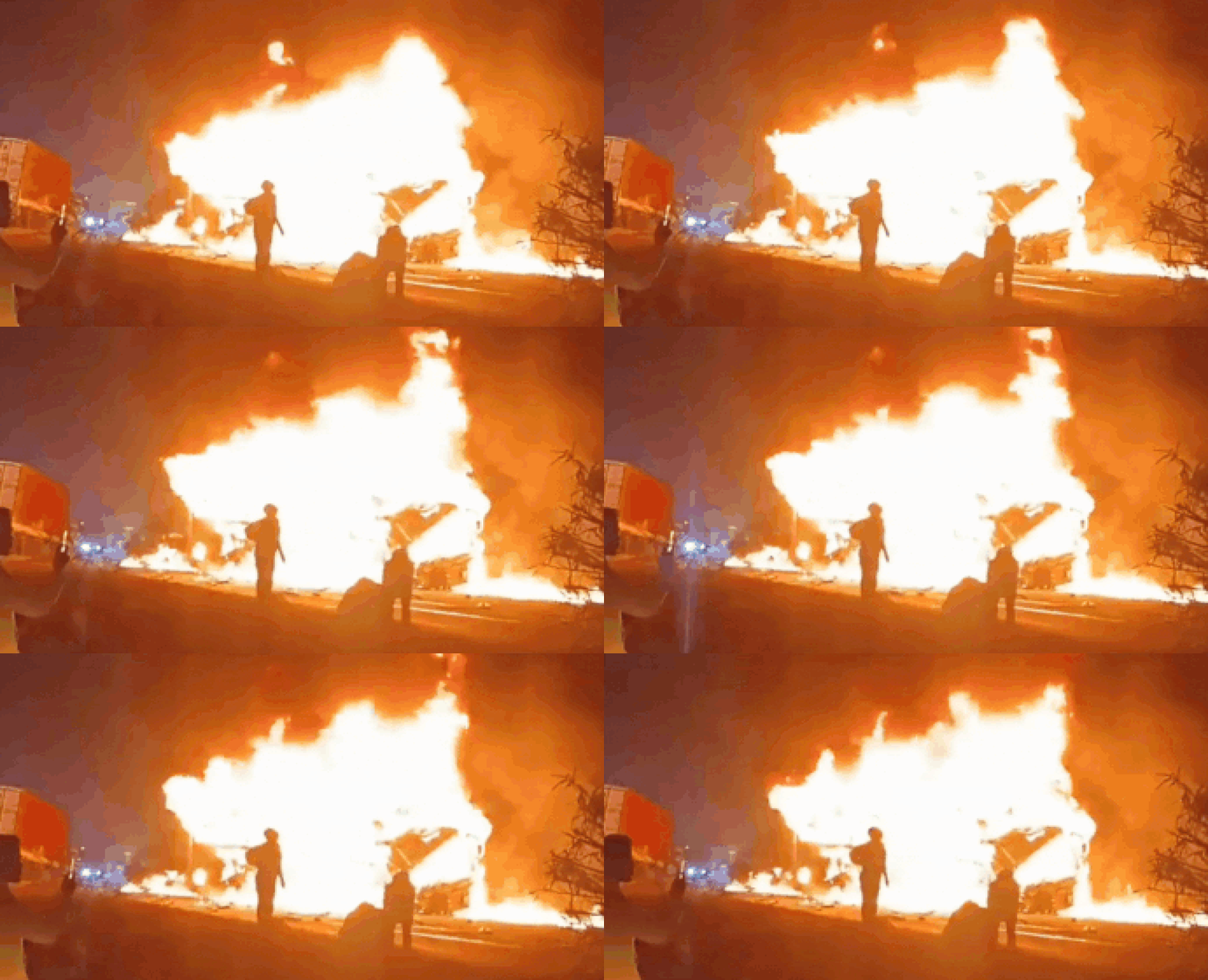
CHITRADURGA: The blaze that engulfed a private sleeper coach on National Highway 48 in Karnataka’s Chitradurga district in the early hours of Thursday was triggered when a fuel tanker truck jumped the road divider and rammed into the bus, causing it to burst into flames, police said to news agency ANI.The crash has so far claimed over five lives, while several others sustained serious injuries.

Karnataka Bus Tragedy: More Than 20 Killed As Sleeper Coach Turns Into Fireball After Crash On NH-48

The accident occurred around 3 am near Gorlath Cross in Hiriyur taluk of Chitradurga district. The impact of the collision engulfed the sleeper coach in flames in the middle of the highway, trapping several passengers inside the vehicle.Also read: Karnataka highway tragedy: Over 20 burnt alive as Bengaluru-Shivamogga bus catches fire in ChitradurgaPolice and fire service personnel rushed to the spot and launched rescue operations.

Here’s how tragedy unfolded

Preliminary investigations point to negligence on the part of the tanker driver, police said. The truck driver, identified as Kuldeep, died in the crash. The bus driver, conductor and a few passengers managed to escape by jumping out moments after the collision.Inspector general of police BR Ravikante Gowda told news agency ANI, “a school bus travelling parallel to the sleeper coach also collided with the burnt vehicle. However, all 48 students on board escaped unhurt. The school bus driver is an eyewitness to the incident.”Police said the bus was carrying 29 passengers — 15 women and 14 men — against a seating capacity of 32. Of them, 25 were from Gokarna, two from Kumta and two from Shivamogga.Chitradurga superintendent of police Ranjith visited the accident site to supervise rescue and investigation work. A case has been registered at the Hiriyur Rural police station.Reacting to the tragedy, Prime Minister’s Office (PMO) tweeted, “Deeply saddened by the loss of lives due to a mishap in the Chitradurga district of Karnataka. Condolences to those who have lost their loved ones. May those injured recover at the earliest. An ex-gratia of Rs 2 lakh from PMNRF would be given to the next of kin of each deceased. The injured would be given Rs. 50,000: PM Narendra Modi.”Karnataka chief minister Siddaramaiah also expressed shock over the incident, in a post on X, he said “Hearing the tragic news of several passengers being burned alive in the horrific accident between a lorry and a bus near Chitradurga has left hearts trembling. It is heartbreaking that the journey of those heading home for Christmas leave has ended in such a tragedy. A thorough investigation into the accident should be conducted to uncover the cause. I pray for peace to the souls of the departed. I share in the grief of the families who lost their loved ones in the accident.”The accident led to a massive traffic jam on NH-48, with vehicles stranded for nearly 30 km up to Shiravara, police said.


Source link

Ashes 2025-26 [WATCH]: Legends and fans unite to pay tribute to Shane Warne on Day 1 of the Boxing Day Test at MCG


Australia vs England locked horns in the 4th Test of the Ashes 2025-26 at the Melbourne Cricket Ground on December 26, 2025, with England winning the toss and bowling first. Australia managed 152 all out in 45.2 overs, skittled by England’s pace attack led by Josh Tongue‘s 5/45, before slumping to 110 in 2nd innings, visitors now trail by 38 runs as the hosts are at 4/0 at the end of the day. Day 1 unfolded amid raw drama on the pitch and an emotional tribute that paused the action.​

Emotional tribute to Shane Warne on Day 1 of Boxing Day Test

At exactly 3:50pm local time, the massive MCG crowd rose in unison, tipping their hats in Shane Warne‘s signature style—a poignant nod to his Australian Test cap number 350. Cricket legends including Ricky Ponting, Michael Vaughan, and Ian Botham joined fans, creating a sea of hats across the stands, with Warne’s children Jackson and Brooke leading the ceremony. This tradition, started post-Warne’s 2022 passing, featured a special video montage of his career highlights, halting play briefly as big screens replayed his magic.​

England’s Barmy Army had pledged this homage earlier, transcending Ashes rivalry to honour the leg-spin maestro who tormented their batters. Health stations around the ground promoted heart checks, tying into Warne’s legacy foundation. The moment drew global acclaim, with social media buzzing over the “beautiful scenes” amid a record Ashes crowd.​

Here’s the video:

Also WATCH: Josh Tongue stuns Steve Smith with unplayable delivery on Day 1 of Boxing Day Test | AUS vs ENG

Warne’s legendary Test legacy

Warne revolutionized leg-spin, claiming 708 Test wickets—the most by any bowler until surpassed—across 145 matches from 1992 to 2007, with an average of 25.41. He snared 37 five-wicket hauls and 10 ten-wicket matches, including a career-best 8/71, tormenting England most with 195 dismissals in 72 Tests at 23.25 average. Warne’s flair peaked in Ashes battles, like his “Ball of the Century” to Mike Gatting in 1993, reviving spin bowling’s artistry.​

Debuting as Australia’s 350th capped player, he took 195 wickets at the MCG alone, blending whopping accuracy with showmanship. Post-retirement, Warne’s commentary wit endeared him further, while statues and a stand at MCG immortalize him. His void lingers, but tributes like this ensure the “King of Spin” endures.

Also WATCH: Brydon Carse’ breathtaking run out of Cameron Green steals the show on Day 1 of Boxing Day Test match | AUS vs ENG


Source link

Forex watch: India’s reserves rise $4.36 billion to $693 billion; gold holdings lead weekly gains


Forex watch: India’s reserves rise $4.36 billion to $693 billion; gold holdings lead weekly gains

India’s foreign exchange reserves rose sharply by $4.368 billion to $693.318 billion in the week ended December 19, data released by the Reserve Bank of India showed on Friday, PTI reported.The latest increase follows a rise of $1.689 billion in the previous week, taking the country’s overall forex buffer to its highest level in recent weeks.Foreign currency assets (FCA), the largest component of the reserves, increased by $1.641 billion to $559.428 billion during the reported week. The RBI noted that FCA figures, expressed in dollar terms, reflect the impact of movements in non-US currencies such as the euro, pound sterling and Japanese yen held in the reserves.Gold reserves registered a stronger gain, rising by $2.623 billion to $110.365 billion, according to the central bank data.Special Drawing Rights (SDRs) with the International Monetary Fund edged up by $8 million to $18.744 billion, while India’s reserve position with the IMF increased by $95 million to $4.782 billion during the week.


Source link

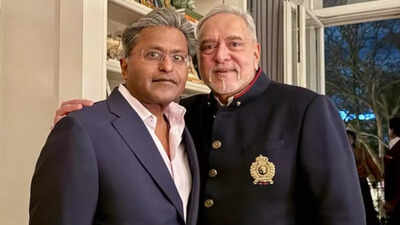
‘Committed to bring back fugitives’: MEA on Lalit Modi, Vijay Mallya; reaction after viral video | India News


'Committed to bring back fugitives': MEA on Lalit Modi, Vijay Mallya; reaction after viral video
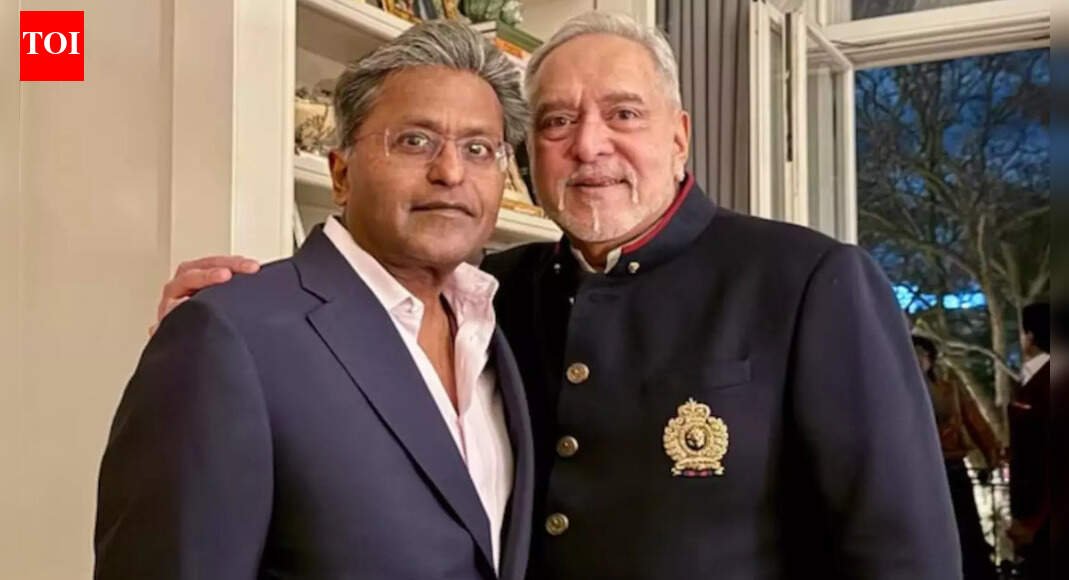
Lalit Modi and Vijay Mallya

NEW DELHI: Reacting to a video that surfaced showing fugitives Lalit Modi and Vijay Mallya at a party in London, the Ministry of External Affairs (MEA) on Friday reiterated that India remains firmly committed to bringing back individuals wanted by law to face justice in the country.Also Read | Lalit Modi hosts birthday bash for Vijay Mallya’s 70th birthday“We remain fully committed that people who are fugitive and are wanted by law in India, they return to the country. For this particular return, we are in talks with several governments, and processes are on,” MEA spokesperson Randhir Jaiswal told reporters at a weekly briefing in New Delhi.He added that there were several legal processes involved, but reiterated the government’s commitment to ensuring the return of such individuals to India.“As you know, in several of these cases, several layers of legalities are involved. But we remain committed to bring them back to the country so they can face trials before the court here,” Jaiswal said.The MEA’s remarks come days after Lalit Modi shared a video on Instagram from Mallya’s 70th birthday celebrations, in which he referred to himself and his fellow fugitive as the “two biggest fugitives from India.”“Let me do something to break the internet again. Happy birthday my friend #VijayMallya. Love u,” he wrote in the caption.Modi hosted the celebration at his upscale six-bedroom residence in London’s Belgrave Square, among the most expensive neighbourhoods in the UK. Several of Mallya’s associates travelled from India to attend the party.Mallya, who turned 70 on December 18, is the former owner of the now-defunct Kingfisher Airlines and previously owned the Bengaluru franchise in the Indian Premier League (IPL). He left India for the UK in 2016 after multiple cases were filed against him over alleged financial irregularities and loan defaults involving thousands of crores of rupees.Modi, a former cricket administrator and the founder of the IPL, left India in 2010 after investigations were launched into alleged financial misconduct and irregularities during the league’s early years.


Source link

Not enough balls! Bangladesh Premier League team’s head coach walks out of training session: ‘Never seen this’ | Cricket News


Not enough balls! Bangladesh Premier League team's head coach walks out of training session: 'Never seen this'
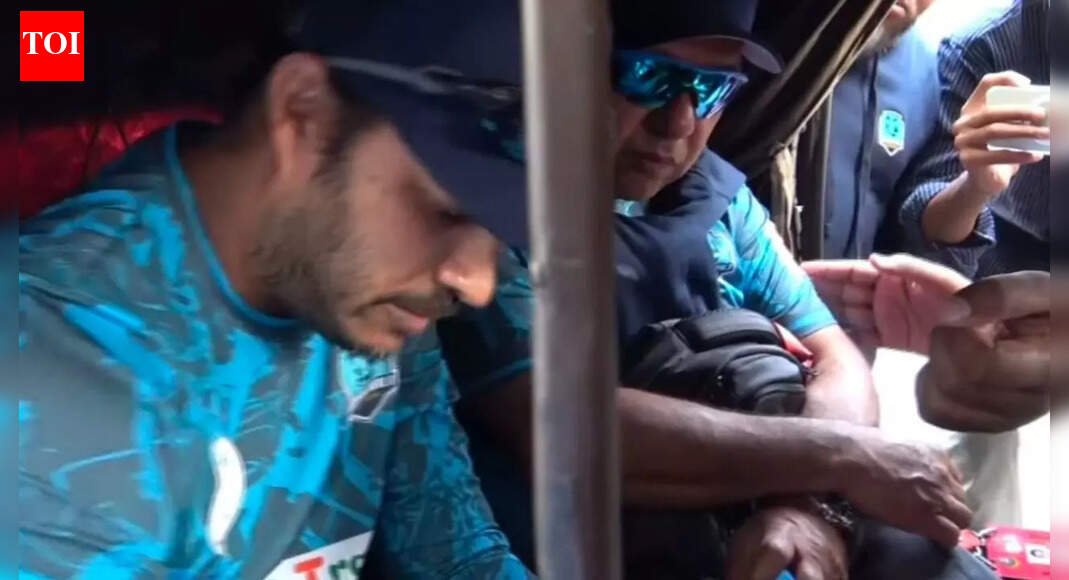
Khaled Mahmud, head coach of Noakhali Express, walks out of team’s training session (Screengrab)

Khaled Mahmud, former Bangladesh captain and head coach of Noakhali Express, created a stir on Thursday when he walked out of his team’s training session at the Sylhet International Cricket Stadium. The 12th edition of the Bangladesh Premier League (BPL) is set to get underway on Friday. Later this evening, Noakhali Express will play against Chattogram Royals in what would be their season opener and second match of the tournament overall.

Why the Mumbai Maidans are being ignored? | Bombay Sport Exchange

Ahead of the game, though, the head coach was clearly unhappy with how the team was being managed and decided to leave the practice midway. Mahmud was accompanied by Noakhali Express pace bowling coach and former Bangladesh fast bowler Talha. Speaking to reporters at the ground, Mahmud made his frustration very clear. “I will not do the BPL under any circumstances,” Mahmud said, as quoted by Cricbuzz. “I have never seen this in the BPL,” he added. Talha also expressed similar feelings, adding, “I don’t want to work. I don’t know about you, Sujon (Mahmud) bhai, but I am not working.” The incident happened after Mahmud and the team arrived at the ground around 1:30 pm to prepare for the upcoming BPL matches in Sylhet. Soon after, Mahmud and Talha were seen leaving the ground while angrily speaking to someone on the phone. Their sudden exit caught everyone’s attention. According to reports, the main issue was a lack of proper equipment during the training session. There were not enough cricket balls available for practice, which left Mahmud deeply disappointed. When he raised the issue with the owner of Noakhali Express, the situation worsened. It is understood that the owner misbehaved with Mahmud, leading to a heated exchange and the coach deciding to walk out. However, the drama did not last long. A few hours later, both Mahmud and Talha returned to the practice session. A close friend of the duo convinced them to stay as he was told that leaving the team abruptly could harm their careers in the long run.Earlier, the Bangladesh Cricket Board took over the ownership of Chattogram Royals, surprising the entire BPL governing council. BPL chairman Iftekhar Rahman said the move helped avoid further embarrassment. Speaking about Noakhali Express, Iftekhar added, “As far as Noakhali is concerned, what I heard their plane hasn’t arrived (carrying the balls and other things), but if they had asked to BPL governing council, we would have given them 10 balls, but having said that, this means they are unprofessional.”


Source link

‘There’s no arc, I’m still behind Tabu’: Rajat Kapoor on his role in ‘Drishyam 3’ | Hindi Movie News


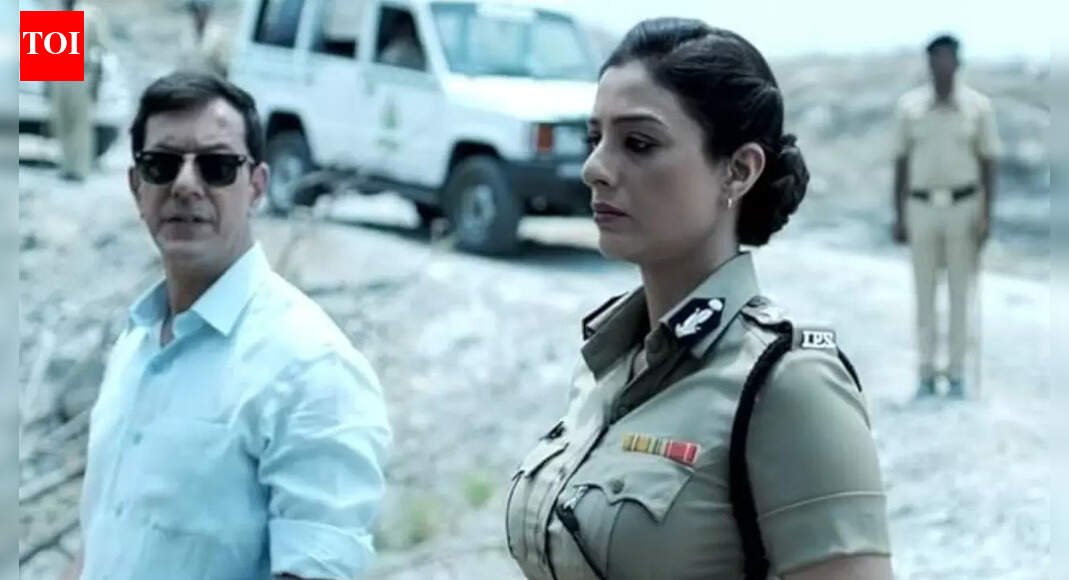
Rajat Kapoor is coming back in ‘Drishyam 3.’ He will again play the husband of Tabu’s character, Meera Deshmukh. This role was seen in the earlier films too.Talking openly, Rajat said his role has not changed much. He said, “There’s nothing to crack. I was standing behind Tabu; that’s it.”Talking to SCREEN, he added, “There’s no arc. I’m still standing behind Tabu.”

Known face of authority roles

In recent years, Rajat Kapoor has often played senior officers and authority figures. In 2025, he appeared as a senior income tax officer in Raid 2. In that film, he was shown as the boss of Ajay Devgn’s character. Later, he played a director general of police in Netflix’s Raat Akeli Hai: The Bansal Murders. There too, he was calm and silent, watching everything while others did the hard work. This has become a familiar space for him.

Paresh Rawal Rejects Role In Ajay Devgn’s ‘Drishyam 3’, Actor Explains Why!

Rajat knows the limits of such roles

Rajat Kapoor is very clear about the problem with these roles. He said, “Oh man, income tax, CBI—that’s where I’m stuck at.” He explained that such characters mostly react and do not act much. He also said that a generic cop role can be boring. He explained it simply. He said such characters come at the end and say, “Chalo sab andar!” He feels that without depth, these roles do not offer much to do.

No big change in ‘Drishyam 3’

In ‘Drishyam 3,’ Rajat’s character again stays close to Meera Deshmukh. Meera is a strong officer with inner conflict. Rajat’s role stays quiet and small. When asked if the third part will give his character growth, he laughed and said no. He clearly said there is no arc for him. Still, his calm presence adds balance to Tabu’s powerful role.Overall the hype is high for ‘Drishyam 3’.

Paresh Rawal Rejects Role In Ajay Devgn’s ‘Drishyam 3’, Actor Explains Why!


Source link