Breaking News
Saudi Arabia leads GCC in Indian deportations: Over 13,000 workers sent home in 2025 | World News

Saudi Arabia leads GCC in Indian deportations: Over 13,000 workers sent home in 2025
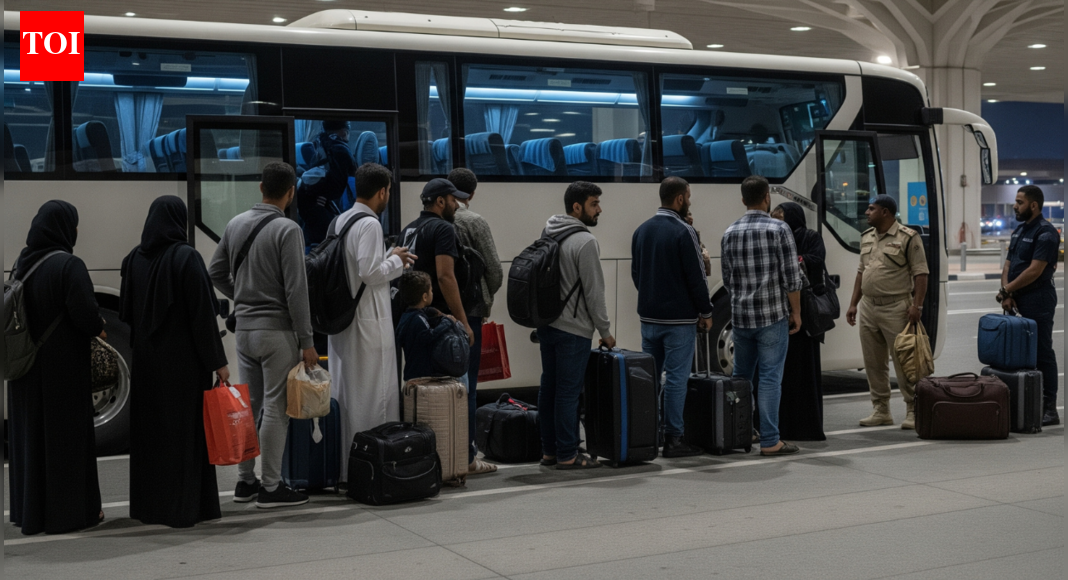
Saudi Arabia deported over 11,000 Indian workers in one year, mostly low-skilled labourers employed in construction, domestic work, and caregiving.

Saudi Arabia emerged as the single largest source of Indian deportations in the Gulf in 2025, overtaking even the United States, according to the figures tabled by the Ministry of External Affairs (MEA) in the Rajya Sabha. The data shows that more than 24,600 Indians were deported globally in 2025, spanning 81 countries, with Gulf Cooperation Council (GCC) nations accounting for a substantial share of removals. Among GCC countries, Saudi Arabia alone accounted for 10,884 deportations in 2025, out of a regional total of 13,133, followed by the UAE (1,469), Bahrain (764), and Oman (16). Figures for Kuwait and Qatar were not listed in the MEA’s Annexure-I for the year. The same annexure shows that between 2021 and 2025, total Indian deportations from GCC countries reached 56,460, with Saudi Arabia accounting for 49,084 across its Riyadh and Jeddah missions, again far outstripping the UAE (3,979), Bahrain (3,202) and Oman (195).

Why Saudi Arabia dominates the numbers

Saudi Arabia hosts one of the largest concentrations of Indian blue-collar workers in the Gulf, particularly in construction, domestic work, caregiving and other labour-intensive sectors. This is closely linked to the Kingdom’s aggressive build-out under Vision 2030, with mega-projects such as NEOM, Qiddiya, the Red Sea Project and Diriyah Gate driving sustained demand for foreign labour across infrastructure, housing and services.MEA data shows that Indian blue-collar workers are present across 14 countries, accounting for about 1.6 million people between January 2020 and June 2025, with the Gulf as the core destination. Among these, Saudi Arabia has the highest number of Indian workers, estimated at 695,269, followed by the UAE (341,365), Kuwait (201,959), Qatar (153,501) and Oman (116,840).Employers and officials say recruitment accelerated sharply after the pandemic, particularly in 2022 and 2023, when labour demand rebounded alongside stalled projects restarting. In 2023 alone, 398,000 workers were sent abroad, with Saudi Arabia employing 200,713 labourers that year and a further 167,598 in 2024. The scale of this intake, experts note, also increases exposure to regulatory enforcement, especially as the Kingdom tightens compliance checks around visas, permits and residency status.That pace continued into 2025. Between January and June, Saudi Arabia recruited 71,175 Indian workers, while the UAE hired 96,401, the highest among Gulf states in that period. Experts note that at such volumes, even limited instances of visa or permit non-compliance can translate into large absolute numbers of deportations once enforcement tightens.

The compliance challenge

As recruitment volumes expanded across the Gulf, enforcement followed. Authorities across the region tightened scrutiny of migrant workers, with overstays, visa violations and work-permit issues emerging as the primary triggers for deportation. Saudi Arabia, the UAE and Bahrain together accounted for thousands of removals as monitoring increased in step with large-scale labour intake and more systematic compliance checks.Bheema Reddy, vice-chairman of Telangana’s NRI advisory committee, said the scale of migration itself often increases exposure to enforcement action. Speaking to TOI, he said: “Gulf countries like Saudi Arabia attract a huge influx of Indian workers, many of whom are low-skilled and come through agents. In the pursuit of better earnings, minor violations of local laws can quickly escalate into deportation cases.After Saudi Arabia, the UAE recorded the second-highest number of Indian deportations in the GCC in 2025, with 1,469 nationals sent home, followed by 764 from Bahrain. As in Saudi Arabia, common causes included overstaying visas, working without valid permits, absconding from employers, or breaching labour regulations.Officials say enforcement has become increasingly systematic, with closer monitoring of visa timelines, employer records and residency compliance. “Indian workers must track their visa timelines carefully and understand local laws,” Naga Bharani of the Telangana Overseas Manpower Company told TOI, adding that “simple awareness and timely extensions can prevent deportation.”

Recruitment practices and India’s response

A recurring theme across GCC deportations is the role of recruitment agents in India. Misrepresentation of job roles, salaries or visa categories often leaves workers exposed abroad, sometimes without a clear understanding of host-country labour laws.Reddy told TOI that misleading recruitment practices remain a recurring problem. “Many cases arise from workers being lured by promises of better pay or conditions, only to face legal consequences when regulations are breached,” he said, adding that “education before departure is crucial.” The Government of India has repeatedly stressed that only legal migration routes should be used. Overseas recruitment is regulated under the Emigration Act, 1983, and since 2015, emigration to Emigration Check Required (ECR) countries has been processed through the eMigrate portal, a digital system for registering recruitment agencies and issuing emigration clearance. The MEA has also rolled out schemes such as the Pravasi Bharatiya Bima Yojana (PBBY), Pre-Departure Orientation and Training (PDOT), and the ‘Surakshit Jayen, Prashikshit Jayen’ campaign to improve awareness and reduce vulnerability among migrant workers. India has additionally signed Migration and Mobility Partnership Agreements with six countries, including the UK, France and Germany, and Labour Mobility Agreements with 12 countries, including several GCC states. Despite these measures, the latest figures underline the scale of the challenge. With Saudi Arabia continuing to dominate both Indian labour inflows and deportations, experts say stricter compliance, better recruitment oversight and stronger pre-departure awareness will be critical to reversing the trend.


Source link

‘Conspiracy to remove Gandhi’s name’: Congress announces nationwide protest on G Ram G Act; claims PMO took unilateral decision | India News


'Conspiracy to remove Gandhi's name': Congress announces nationwide protest on G Ram G Act; claims PMO took unilateral decision

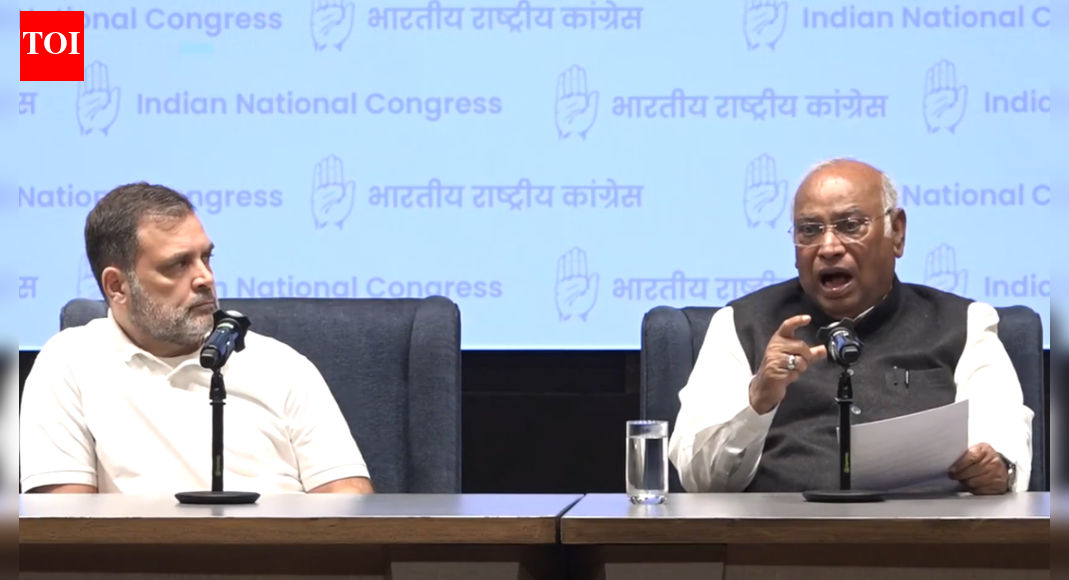
NEW DELHI: Congress on Saturday announced that it will launch a nation-wide protest against the Centre for replacing rural employment scheme – MGNREGA – with VB G-RAM-G law. After the Congress Working Committee meet, party chief Mallikarjun Kharge said that replacing the scheme named after Mahatama Gandhi is insult to the father of the nation.“In the meeting, we took an oath. We decided to launch a massive movement across the country, making the MNREGA scheme the central point. Indian National Congress party, taking a leading role, will launch the Save MNREGA Campaign from January 5th,” Kharge said during a media briefing.“We will protect the Mahatma Gandhi National Rural Employment Guarantee Act (MNREGA) at all costs. MNREGA is not just a scheme, but a right to work granted by the Constitution of India. We also pledge to democratically oppose every conspiracy to remove Gandhiji’s name from MNREGA,” he added.Kharge said that people are angry over repeal of MGNREGA and the government will have to face the consequences. Meanwhile, leader of opposition in Lok Sabha Rahul Gandhi claimed that Prime Minsiter Narendra Modi took the decision of replacing MNREGA without consulting the concerned ministers or the Union Cabinet.“MGNREGA was not just a scheme; it was a rights-based concept… This direct, rights-based concept is now under attack… Finally, I have been informed that this decision was taken directly by the Prime Minister’s Office, without consulting the concerned ministers or the Cabinet,” Rahul said.“This reflects the present situation, where governance has become a one-man show and whatever Narendra Modi wants is carried out,” he added.The Viksit Bharat-Guarantee for Rozgar and Ajeevika Mission (Gramin) Bill that replaced the UPA-era MGNREGA was passed during the recently concluded winter session of Parliament. President Droupadi Murmu has already given her assent to it.The Congress and other opposition parties have taken strong exception to the new law replacing MGNREGA, stating that it is an insult to Mahatma Gandhi as his name has been removed from its title.The new law makes a statutory guarantee of 125 days of wage employment in a financial year to every rural household whose adult members volunteer to undertake unskilled manual work.However, instead of being a Central scheme, the new law provides that the Centre and the states will have to share a 60:40 per cent ratio funding for the scheme


Source link

ILT20 | Eight wins and counting: Desert Vipers end Sharjah Warriorz’ playoff hopes | Cricket News


ILT20 | Eight wins and counting: Desert Vipers end Sharjah Warriorz’ playoff hopes

Desert Vipers survived a late wobble to register a five-wicket victory over Sharjah Warriorz at the Sharjah Cricket Stadium on Friday, officially knocking the Warriorz out of playoff contention. The win made the Vipers the first side in World ILT20 history to notch up eight group-stage victories.With this result, one of Abu Dhabi Knight Riders or Gulf Giants will claim the final playoff spot when they meet on Sunday, 28 December. Meanwhile, Saturday’s clash between MI Emirates and Dubai Capitals will decide a top-two finish.

Naseem Shah interview: Pakistan bowler opens up on bouts with injuries and tough recovery

Naseem Shah led the bowling effort with three wickets as the Warriorz were restricted to 140/7. Max Holden then anchored the chase with an unbeaten 66 off 46 balls, striking nine fours and a six. Despite Harmeet Singh’s three-wicket burst creating brief pressure, Holden found support from Sam Curran (25 off 28) and Hasan Nawaz (25 not out off 14), with the latter sealing the chase alongside Holden in an unbroken 47-run stand.Go Beyond The Boundary with our YouTube channel. SUBSCRIBE NOW!Sharjah made early inroads with Sikandar Raza and Richard Ngarava reducing the Vipers to 28/2 inside the powerplay. Curran and Holden steadied the innings with a cautious 64-run partnership before Harmeet struck again in the middle overs. However, the Warriorz could not sustain the pressure as the Vipers crossed the line comfortably.

Qais Ahmad

Qais Ahmad of Desert Vipers

Earlier, the Warriorz innings never fully recovered after slipping to 6/2. Johnson Charles top-scored with 43, while Tom Kohler-Cadmore added 20. Naseem Shah struck at crucial moments, supported by Qais Ahmad’s double blow, as Sharjah failed to push beyond a below-par total.Desert Vipers captain Sam Curran said, “It was great to get a win going into the Qualifier. We read the conditions well and adapted accordingly. Max played an outstanding knock, and Hasan finished things off with some powerful hits at the end. It was also encouraging to see a few batters spend time in the middle. Overall, it’s been a terrific season for us, winning eight of our ten matches.”

Johnson Charles

Johnson Charles of Sharjah Warriorz

Sharjah Warriorz skipper Sikandar Raza reflected, “Almost everything that could have gone wrong for us this season did. If we had handled some key moments better in a few games, we would already be through. On these pitches, 150 was a competitive score and we seldom managed to reach it, which hurts the most. The positives lie with our bowling — Harmeet has been excellent since coming in, Adil has bowled very well, and as a unit the bowlers kept us in games consistently.

Poll

What was the key factor in Desert Vipers’ victory over Sharjah Warriorz?

Brief Scores Sharjah Warriorz: 140/7 in 20 overs (Johnson Charles 43, James Rew 22, Ryan Burl 21 not out; Naseem Shah 3/35, Qais Ahmad 2/30)Desert Vipers: 144/5 in 19.3 overs (Max Holden 66 not out, Hasan Nawaz 25 not out, Sam Curran 25; Harmeet Singh 3/29, Sikandar Raza 1/27)


Source link

‘Wastage of public money’: Congress targets video of Bageshwar Dham head on govt plane, cop touching feet; BJP hits back | India News


‘Wastage of public money’: Congress targets video of Bageshwar Dham head on govt plane, cop touching feet; BJP hits back
Visuals from viral video (Video credits/X@RoshanKrRaii)

NEW DELHI: A political row broke out in Chhattisgarh after a video went viral showing Bageshwar Dham head Dhirendra Shastri arriving on a government aircraft. The clip also shows a uniformed police officer touching the preacher’s feet.Chhattisgarh Congress communication department head Sushil Anand Shukla on Saturday alleged that arranging a government aircraft for Shastri amounted to “wastage of public money” and “misuse of the state exchequer.”The clip, widely circulated on social media, shows Shastri alighting from the aircraft along with state minister Guru Khushwant Saheb at Raipur airport. In the video, an on-duty police officer is seen first saluting the minister and then removing his cap and shoes before touching Shastri’s feet. Shastri had arrived in the state to attend a religious discourse in Bhilai town of Durg district.Shukla questioned under what constitutional provision the aircraft was made available to the preacher and demanded an official clarification. He claimed that Shastri was neither a recognised religious head nor a peethadhishwar of any established shrine or ashram and accused him of acting “against the country’s composite culture.”The Congress leader further alleged that Shastri promotes social discord, which he said runs contrary to the inclusive values of Sanatan Dharma. Referring to Lord Hanuman, Shukla said that Hanuman symbolises love, tolerance, bravery and forgiveness and those invoking his name should embody these values. “Superstition and hypocrisy cannot survive for long,” he added.The incident also sparked debate online, with several users criticising the alleged use of a government aircraft for a religious figure at taxpayers’ expense and calling the police officer’s gesture a “mockery of uniform ethics.” Others defended the officer, arguing that he followed official protocol by saluting the minister and later expressed personal faith.Responding to the criticism, the BJP defended both the officer and the government. State BJP chief spokesperson and MP Santosh Pandey said there should be no objection to a police officer offering obeisance to a religious guru out of personal belief.“Don’t (Muslim) railway employees and airport staff offer namaz at railway stations and airports? Why does it upset the Congress when a police officer bows to a guru out of personal faith?” he asked.On the use of the state aircraft, Pandey countered by asking the Congress to explain instances during its own tenure when government helicopters and planes were allegedly used by religious figures. He accused the Congress of being “against Sanatan Dharma,” citing remarks by opposition leaders that he said were derogatory to the faith.


Source link

Kerala gets its first BJP mayor: Is the ‘red fortress’ collapsing? What it means for state assembly elections | India News


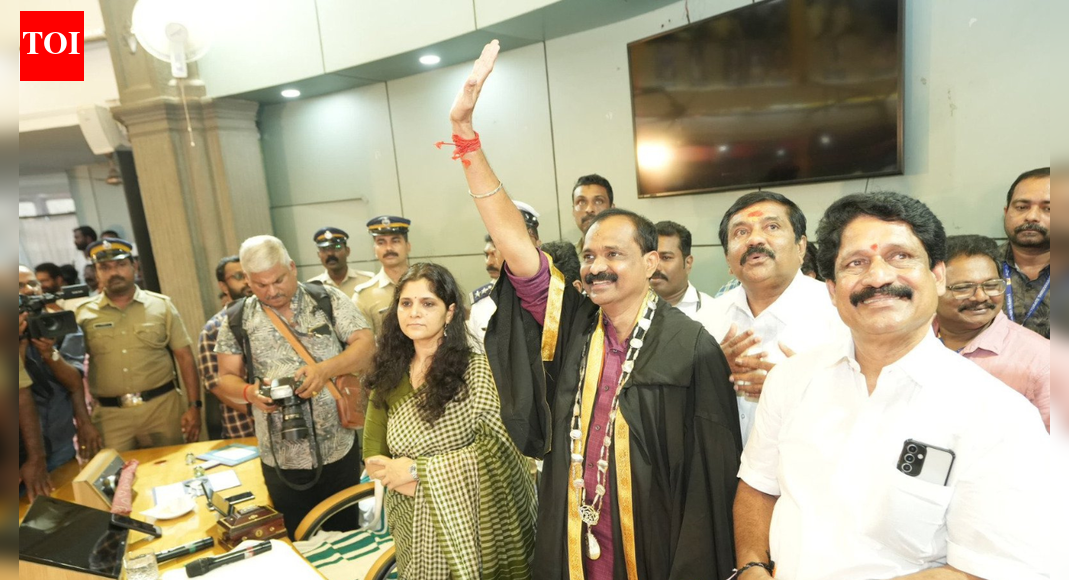
NEW DELHI: Kerala got its first BJP mayor, VV Rajesh, after the National Democratic Alliance won Thiruvananthapuram civic body elections, marking an end to 45 years of Left Democratic Front’s (LDF) rule in the city.Thiruvananthapuram was treated like “inherited property under Left–Congress dominance for decades,” said state BJP general secretary Anoop Antony Joseph.Prime Minister Narendra Modi had already hailed the saffron wave in the red-dominated region as a “watershed moment”, saying: “Thank you Thiruvananthapuram! The mandate the BJP-NDA got in the Thiruvananthapuram Corporation is a watershed moment in Kerala’s politics.”

What local body polls show?

In Kollam corporation, UDF’s AK Hafeez was elected mayor, while Kochi saw four-time councillor VK Minimol assume the mayor’s post. Thrissur also went the UDF’s way with Dr Niji Justin elected mayor, though the result was accompanied by internal dissent after councillor Lali James alleged she was sidelined following bribery by party leaders. In Kannur too, the UDF strengthened its position, with P Indira set to take charge as mayor.One of the standout moments of the results came from Pala municipality, where 21-year-old Diya Binu Pulikkankandam was elected chairperson with UDF backing, becoming the youngest municipal chairperson in Kerala. Diya, along with her father Binu and uncle Biju, won as Independents before extending support to the UDF — a move that ended Kerala Congress (Mani)’s long-standing dominance in Pala, once considered its political citadel.The NDA, meanwhile, posted selective but symbolically significant gains. The BJP retained control of Thiruvananthapuram and also emerged victorious in the municipalities of Tripunithura and Palakkad, underlining its expanding footprint in urban local bodies. While the LDF managed to hold its ground in Kozhikode by winning the majority of wards, it secured only one of the six corporations overall.

Will the ‘red fortresses’ collapse?

As the CPI(M) looks ahead to the 2026 Kerala Assembly election, it does so from a position of growing vulnerability. A strong wave of anti-incumbency and governance fatigue has begun to weigh on the Left after a decade in office.These fault lines were evident not just in the local body polls, but also in the 2024 Lok Sabha elections. The Left struggled badly at the national level even as the Congress regained momentum in the state and the BJP carved out space in what was long considered a near one-party arena. The parliamentary contests exposed a shrinking footprint for the Left beyond state politics.In both the 2019 and 2024 general elections, the CPI(M) won only a handful of Kerala’s 20 Lok Sabha seats, while the Congress-led UDF dominated and the BJP managed to open its account. This contrast has underscored a weakening appeal in national elections, even as the Left retains power in Thiruvananthapuram. That control was reaffirmed in 2021, when the LDF secured a decisive Assembly victory and achieved the rare feat of a second consecutive term in Kerala.


Source link

Problems with online refunds? NCH helps citizens recover Rs 45 crore since April; e-commerce complaints top list


Problems with online refunds? NCH helps citizens recover Rs 45 crore since April; e-commerce complaints top list

When five scheduled pickup requests were cancelled without explanation, Ramesh Kumar (name changed) approached the National Consumer Helpline. Months after ordering the furniture online, Kumar, the Jodhpur resident was still stuck with defective goods and no refund. Then his call to 1915, changed everything. Within days, government’s National Consumer Helpline stepped in and secured his money back.Thousands were stuck in a similar situation. Between April and December, the helpline resolved 67,265 consumer complaints and facilitated refunds worth Rs 45 crore, according to official data released on Saturday. “Thank you so much, Consumer Helpline, for helping cheated consumers like me,” he wrote after NCH intervened and secured a full refund within days.According to the data, e-commerce alone accounted for nearly 40,000 grievances and refunds worth Rs 32 crore, making up more than two-thirds of the total amount recovered. In Bengaluru, another consumer faced a prolonged struggle after paying for an annual internet plan. While the payment was deducted immediately, the promised connection never materialised. Customer care assured him that the refund would be processed within 10 working days. Four months later, after repeated calls, there was still no clarity. Once the National Consumer Helpline stepped in, the refund was issued almost immediately. “It was a good experience. Otherwise, it was difficult to get the amount back,” he said.Travel and tourism emerged as the next major sector, with refunds totalling Rs 3.5 crore. A similar intervention helped a consumer in Chennai who cancelled a flight ticket 96 hours before departure, well within the stipulated refund period. Despite repeated follow-ups, the airline failed to process the refund. “Thanks to NCH for the quick action. Am delighted by your efforts,” the consumer wrote. Unlike formal legal proceedings, the National Consumer Helpline operates at the pre-litigation stage. This allows disputes to be resolved without consumers having to approach Consumer Commissions under the Consumer Protection Act, 2019, reducing both costs and delays, while also easing pressure on the judicial system. The helpline accepts complaints in 17 languages and is accessible through multiple channels, including a toll-free number (1915), WhatsApp (8800001915), SMS, email, a mobile app and a web portal. This has enabled consumers from metropolitan centres as well as remote regions to seek redress. Officials point to the expansion of convergence partners, companies and platforms that work directly with NCH to resolve complaints, as a key factor behind its improved outcomes in 2025. The approach reflects growing cooperation within India’s consumer protection framework. Five sectors: e-commerce, travel and tourism, agency services, electronic products and airlines, together contributed over 85% of the Rs 45 crore refunded during the year. These are also areas where individual consumers often lack the means to pursue prolonged disputes. The spread of complaints across Tier-1 cities and smaller towns highlights the helpline’s national reach and the extent to which digital commerce has penetrated less-connected regions. It also points to a growing willingness among consumers across India to assert their rights. Over the course of 2025, the National Consumer Helpline has moved beyond being just a government service, emerging instead as a key gateway for consumer grievance resolution before legal action becomes necessary.


Source link

This day, that year: December 27, 1911 — When ‘Jana Gana Mana’ was first sung in Calcutta | India News


This day, that year: December 27, 1911 — When ‘Jana Gana Mana’ was first sung in Calcutta
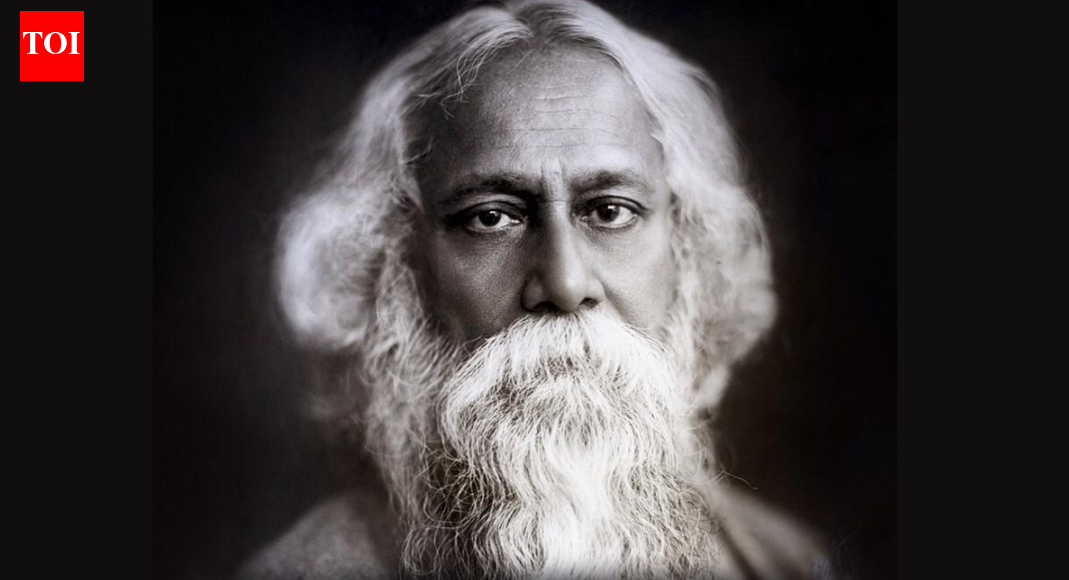
Rabindranath Tagore’s ‘Jana Gana Mana’ was publicly sung for first time on December 27, 1911

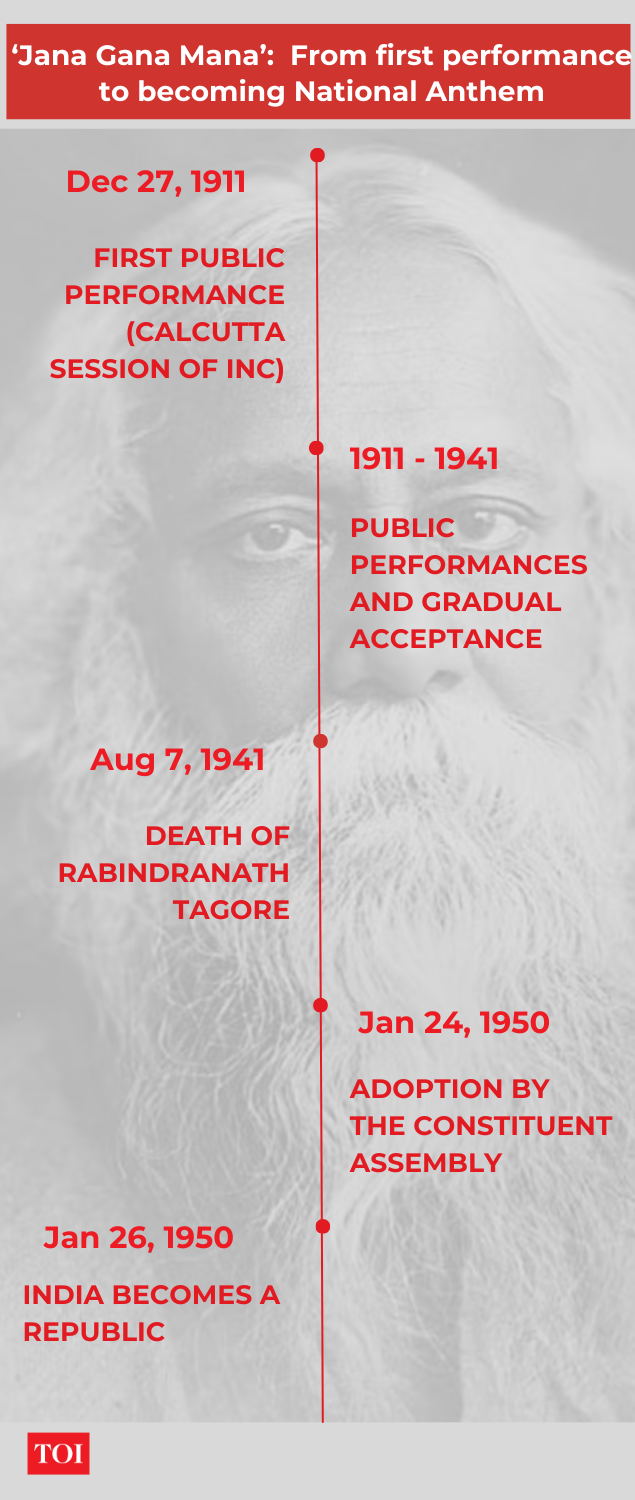
December 27, 1911– the day a song first heard at a Congress session in Calcutta began a chapter that would culminate in becoming India’s National Anthem, and become a shared national voice.Composed by Rabindranath Tagore, originally in Bangla, the hymn would, nearly four decades later, be adopted as the National Anthem of India. At the time of first rendition, it was introduced simply as a patriotic composition at a gathering of a political organisation that was still shaping its role in India’s anti-colonial movement.

The Calcutta Session of 1911

The 1911 Congress session was held at the Bharat Sabha, a single-storeyed structure on Bowbazar Street in Calcutta, in presence of then-Congress president, a senior moderate leader Bishan Narayan Dhar. Other prominent figures there were Ambika Charan Mazumder and Bhupendra Nath Bose.At this point in its history, the Indian National Congress was not a political party in the modern electoral sense but a national organisation bringing together leaders, intellectuals, professionals, and activists seeking constitutional reforms and, increasingly, self-government. Its annual sessions were platforms for political resolutions as well as cultural expressions aligned with emerging nationalist sentiment.

How 'Jana Gana Mana' ulitmatelt became the national anthem

The first performance

Jana Gana Mana was sung before the assembled delegates 114 years ago, which was the 2nd day of the Calcutta session. The performance was led by Tagore’s niece Sarala Devi Chowdhurani, along with a group of students. Contemporary Congress records referred to the composition as “Janaganamana Adhinayaka”, describing it as a patriotic song.The lyrics were written in highly Sanskritised Bengali, employing a register familiar to audiences associated with the Brahmo Samaj and the emerging Bengali intelligentsia. The song addressed “Bharata Bhagya Vidhata”, a phrase referring to the guiding force or destiny of India.

The political context of 1911

The Congress session came on the heels of the Delhi Durbar of December 1911, held to mark the coronation of King George V and Queen Mary as Emperor and Empress of India. It was also at the backdrop for the announcement made by the British Government about the nullification of the division of Bengal and moving the Imperial Capital from Calcutta to Delhi.While Jana Gana Mana was being performed in this politically fraught atmosphere, there are some newspaper accounts of that time that suggested that it was meant to serve as a welcome or tribute to the British monarch.

Tagore’s clarification

Rabindranath Tagore did not immediately respond publicly to these claims. However, in later years, he explicitly rejected the suggestion that the song praised George V. In a letter written in 1937, Tagore recalled refusing a request from an acquaintance to compose a song in honour of the British king, describing his reaction as one of “amazement mingled with anger.”In a more forceful letter written in 1939, Tagore stated that he found it insulting to suggest that he would write in praise of a temporal ruler. He clarified that the “Adhinayaka” of Jana Gana Mana referred to a timeless guiding spirit of the Indian people, not a colonial sovereign. These letters have since been cited in official and scholarly accounts addressing the controversy.“I should only insult myself if I cared to answer those who consider me capable of such unbounded stupidity as to sing in praise of George the Fourth or George the Fifth as the Eternal Charioteer leading the pilgrims on their journeys through countless ages of the timeless history of mankind,” he had said.

Publication as Bharata Vidhata

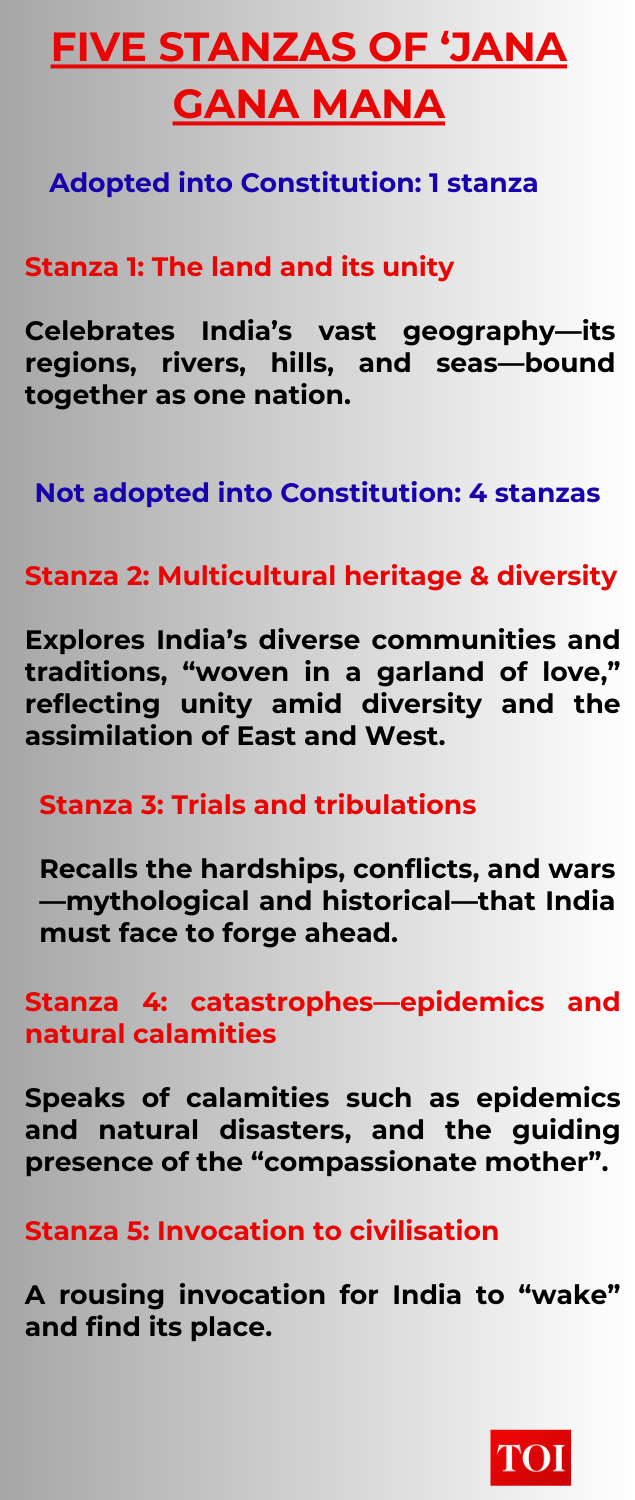
Within a month of its first performance, the song was published in January 1912 in Tattvabodhini Patrika, the journal of the Brahmo Samaj. The journal was edited by Tagore himself. In print, the song appeared under the title “Bharata Vidhata” and was classified as Brahmo Sangeet.At the time of publication, the composition consisted of five stanzas. Each verse invoked different aspects of India’s geography, people, and collective experience. The published text confirmed that the song was conceived as a hymn rather than a political chant.

Subsequent early performances

On January 25, 1912, less than a month after its Congress debut, Jana Gana Mana was performed again at a public gathering in Calcutta celebrating the Hindu month of Magh. This performance took place under Tagore’s direct guidance.Over the following years, the song circulated primarily within cultural and nationalist circles, without any official political status. It coexisted with other patriotic compositions, most notably Vande Mataram, which had already acquired widespread popularity during the Swadeshi movement.

English translation

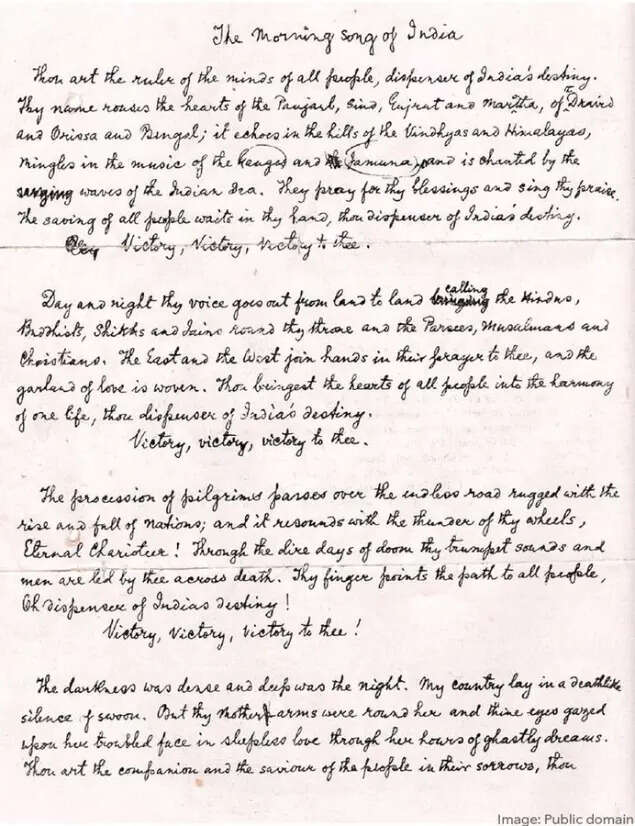
In 1919, Tagore journeyed to southern India and stayed at the Theosophical College in Madanapalle in what is now the state of Andhra Pradesh. It was here that he made a translation of “Jana Gana Mana” in English in his own handwriting. He titled it “The Morning Song of India.”This translation was not meant for replacement of the original text written in Bengali language, but to introduce its meaning in other languages. The handwritten manuscript has since been preserved and reproduced in various archives.

image (7)

An English translation of Jana Gana Mana by Rabindranath Tagore (Image credit: Nobel Prize handle on X)

The song during the freedom struggle

During the 1920s and 1930s, Jana Gana Mana continued to be performed at cultural gatherings, though it did not displace Vande Mataram as the most widely recognised nationalist song. Both compositions occupied distinct places within the freedom movement’s symbolic repertoire.The song acquired additional political resonance during World War II, when it was adopted by Subhas Chandra Bose’s Indian National Army (INA) as one of its anthems. It was sung by INA units in Southeast Asia and later by INA members in Japan. This further mainstreamed the song’s association with anti-colonial resistance.

1947: International exposure

Jawaharlal Nehru, the then Prime Minister of India, reported in a letter that the performance of “Jana Gana Mana” received positive reviews, with delegations of different countries requesting a copy of its sheet music.However, at that point, India had not yet adopted a national anthem, and no official choice had been considered either.

Debate in the Constituent Assembly

After Independence, the newly established government faced the question of choosing a national anthem. The decision was essentially one of constitutional and symbolic significance. Thus, the matter was therefore referred for consideration before the Constituent Assembly.Both Jana Gana Mana and Vande Mataram were considered. While Vande Mataram had played a central role in the freedom struggle, there were some apprehensions about its suitability for performance at international events as well as about its musical adaptability.The matter was raised in Parliament by Prime Minister Nehru on August 25, 1948. He said, “It was thought by some people that the “Vande Mataram” tune with all its very great attraction and historical background was not easily suitable for being played by orchestras in foreign countries, and there was not enough movement in it. It seemed, therefore, that while Vande Mataram should continue to be the national song par excellence in India, the National Anthem tune should be that of Jana-Gana-Mana.

Adoption as the National Anthem

On January 24, 1950, two days before India became a republic, Dr Rajendra Prasad, President of the Constituent Assembly, formally announced the adoption of Jana Gana Mana (hindi version) as the National Anthem of India. The announcement specified that, “The composition consisting of the words and music known as Jana Gana Mana is the National Anthem of India, subject to such alterations in the words as the Government may authorise as occasion arises; and the song Vande Mataram, which has played a historic part in the struggle for Indian freedom, shall be honoured equally with Jana Gana Mana and shall have equal status with it. I hope this will satisfy the Members.”Only the first stanza of Tagore’s original five-verse composition was adopted. The officially recognised version has a playing time of approximately 52 seconds.

Aftermath and legacy

Rabindranath Tagore did not live to witness the acceptance of his composition as the national anthem. He passed away in August 1941, almost nine years before the Constituent Assembly took its decision.Notably, Tagore is the only person in world history to have penned two national anthems. His song “Amar Sonar Bangla” was Constitutionally adopted as the national anthem of Bangladesh in 1972.With time, the final four verses of ‘Jana Gana Mana’ gradually phased-out. Although, the anthem has been performed in its entirety on special occasions. The musical composition of the national anthem of India was standardized to accommodate orchestral performances during official or international gatherings.

​What the five stanzas of "Jana Gana Mana' meant​

From its initial performance in a small auditorium at Calcutta way back in 1911 to its eventual adoption as a national anthem in 1950, Jana Gana Mana followed a long and documented journey shaped by political change, cultural debate, and constitutional process.


Source link

‘Master Blaster’ Ajit Pawar behind NCP’s success in municipal council and corporation elections: Party Vice-President | Mumbai News


MUMBAI: Crediting the impressive performance of the Nationalist Congress Party (Ajit Pawar) in the recent municipal council and municipal corporation elections across Maharashtra with party president and deputy CM Ajit Pawar, Vice-President Saleem Sarang has called him the ‘Master-Blaster’ who, like legendary cricketer Sachin Tendulkar, knows how to respond to his opponents.However, he said, politics, like cricket, is a team sport. “The time has come for the NCP to play as a collective unit rather than relying on individual brilliance alone,” Sarang said. “Internal politics, one-upmanship, and a tendency to prioritise personal gain over organisational interest are causing long-term damage to the party. If the NCP truly aims to grow, the interests of the organisation must take precedence over individual ambitions,”Sarang added.“This victory is not a matter of chance or political coincidence; it is the direct outcome of disciplined organisational planning, relentless groundwork, and decisive leadership. The structured and methodical functioning of the NCP is closely associated with Ajit Pawar’s political style and work ethic,” he said.Sarang also stated that had the same organisational discipline been implemented with equal seriousness at every level of the party, the electoral outcome could have been even more impressive. “The gap between leadership intent and grassroots execution remains a critical concern,” he added.Regions such as Navi Mumbai, Thane, Bhiwandi, and Mira-Bhayandar possess significant political strength for the NCP. Thousands of committed supporters in these areas continue to place their faith in the party. If these regions are approached with seriousness, planning, and collective effort, the party’s growth potential is immense. The reality is simple: if other leaders were to contribute even ten percent of the hard work and sincerity demonstrated by Ajit Pawar, the NCP could very well emerge as the number one political force in Maharashtra.He said that many workers stand firmly with Ajit Pawar, inspired by his performance and commitment, but also warned that concentrating multiple positions in the hands of a few individuals weakens the organisational fabric. Instead, leadership opportunities must be broadened.“True leadership does not emerge from air-conditioned rooms. A real leader is one who travels to villages, communicates ideology at the grassroots, engages personally in local body elections be it gram panchayats, zilla parishads, or market committees and ensures victory through direct involvement,” said Sarang.


Source link

Ashes 2025-26: Steve Smith opens up on Australia’s first home Test loss to England since 2011


England ended a 5,468-day wait for a Test win on Australian soil – their first since Sydney 2011 – by chasing 175 in the chaotic fourth Ashes Test at MCG, where Australia collapsed to 152 and 132 after England’s 110.

Steve Smith reflects on Australia’s first home Test defeat in 5,468 days

Stand-in captain Steve Smith, unbeaten on 24 in the second innings, called it ‘a tricky one’ and admitted the pitch was ‘too much’ in favour of bowlers.

“Tricky one. Quick game. If we’d managed that extra 50 or 60, we probably would’ve been right in the contest at the end,” said Smith in the post-match interview with Isa Guha.

Smith praised England’s performance, noting they played well on Day 2 despite the low-scoring madness with 20 wickets falling on the opening day alone. He highlighted the seaming conditions that triggered Australia’s batting implosion, marking their first home Test loss to England since 2011 and snapping a strong record.

“Credit to England, they came out today and didn’t let us get away. And the way they started with the bat, they were aggressive, got a few away and softened the ball so it didn’t offer as much from that point, so credit to them for the way they played,” added Smith.

Also READ: Records and stats – Least balls faced by Australia across both innings in Tests since 1900

‘A special feeling’: Ben Stokes

On the other hand, England captain Ben Stokes, speaking to TNT Sports, created his team for making a strong comeback after losing the first three Tests of the ongoing series.

“It is a special feeling. Me and Joe [Root] have been on a few tours, and it has not gone particularly well.

“In particular, the couple days build-up to this Test match was a tough time for us as a team. The way in which we were able to keep the focus on the most important thing, which is the cricket that is played out there, was pretty exceptional.

“To come out here and put in a performance like that in the way we did, a lot of credit has got to go to the way not just myself, but how the senior boys handled that situation.”

Also READ: Winless streak snapped – Fans react as Brydon Carse and Josh Tongue drive England to Ashes Test success in Australia


Source link

UAE salaries 2025: What workers really earn without a minimum wage | World News


UAE salaries 2025: What workers really earn without a minimum wage
The UAE is gradually moving toward structured wage regulation, with benchmark salaries and mandatory payment systems shaping worker protections despite the absence of a national minimum wage/Image: Pexels

As of 2025, the UAE has not enacted a formal nationwide minimum wage for all private-sector workers. The current labor framework, outlined in Federal Decree-Law No. 33 of 2021, provides the Ministry of Human Resources and Emiratisation (MoHRE) with the legal authority to establish a national wage floor but no binding law has yet been implemented.Instead, salaries are regulated through employment contracts and visa-related requirements. Employers must pay wages via the Wage Protection System (WPS); a government-monitored payroll platform. Failure to comply can result in suspension of new work permits, fines, and company blacklisting.Recent reforms have expanded WPS coverage to include domestic and semi-professional workers like private teachers, caregivers, nannies, and farm technicians. This shift reflects a broader move toward labor standardization and income protection across job categories.

What workers typically earn: A benchmark view

Although no legally enforced floor exists, salary benchmarks function as de facto minimums in many professions. These reflect industry standards, cost of living, and immigration thresholds.

Domestic workers:

Housemaids, nannies, and drivers employed in homes now fall under stricter payment rules, with most salaries ranging from AED 1,200 to AED 1,800/month (₹28,044–₹42,066), depending on experience and nationality. WPS compliance is mandatory for these roles, ensuring regular wage transfers and legal accountability for employers.

Construction and skilled trades:

Labourers and tradesmen form the backbone of the UAE’s infrastructure sector. While base pay for unskilled labourers often starts at AED 1,200–1,500/month (₹28,044–₹35,055), skilled tradespeople such as electricians, plumbers, and masons can earn between AED 2,000 and AED 4,500/month(₹46,740–₹105,165). Many of these roles are protected under labour laws that mandate written contracts, paid leave, and access to dispute resolution.

Retail and service staff:

Workers in retail outlets, supermarkets, cafes, and delivery platforms typically earn AED 2,500 to AED 4,000/month (₹58,425–₹93,480). In these sectors, wage variability is influenced by location (Dubai salaries often exceed those in Sharjah or Ajman), nationality, and employer size.

Office and administrative roles:

Clerical staff, receptionists, and data entry assistants generally receive AED 3,000 to AED 5,000/month (₹70,110–₹116,850), with larger companies or public sector institutions offering higher packages. For visa eligibility especially family sponsorship—employees must earn a minimum of AED 4,000/month (₹93,480), or AED 3,000 (₹70,110) plus housing.

University graduates and skilled technicians:

For professionals with technical or university qualifications, MoHRE guidelines recommend salaries of at least AED 5,000 to AED 12,000/month (₹116,850–₹280,440), depending on the nature of the role. Engineers, IT professionals, and finance specialists typically command salaries within or well above this range.

Visa rules and wage enforcement

Though no national wage law exists, immigration requirements act as an indirect filter. For example:

  • Family visa sponsorship: The UAE mandates a minimum salary of AED 4,000 (or AED 3,000 plus accommodation) for an expatriate to sponsor dependents.
  • Golden Visa applicants in employment-based categories must earn at least AED 30,000/month (₹701,100), particularly in scientific or technical fields.
  • Employment contracts must specify wages in UAE dirhams and be registered with MoHRE to be legally recognised.

The Wage Protection System ensures salaries are paid into local bank accounts within 10 days of the due date. Any delay beyond 15 days triggers automatic alerts, and repeated violations can lead to bans on new hiring.

Rising costs and reform pressures

Over the past few years, Dubai and Abu Dhabi have seen substantial increases in rent, school fees, and healthcare costs. As a result, there is growing pressure on authorities to formalise wage protections and align pay standards with inflation.While some companies voluntarily adjust salaries to retain talent, many low-income workers remain vulnerable to economic shocks. Calls for an indexed minimum wage system adjusted annually to match living costs, growing louder, particularly from labour advocates, unions in labour-sending countries, and international observers.

The road ahead: Formal minimum wage in sight?

Although the UAE has avoided a one-size-fits-all national wage model, change is on the horizon:

  • Free zones may begin enforcing internal wage floors for certain industries to standardise competition.
  • Sector-specific minimum wages could emerge in healthcare, hospitality, and logistics where migrant workers dominate and wage disparity is high.
  • Public-private harmonisation efforts may also push for parity, as Emirati workers often earn significantly more than expatriate counterparts in similar roles.

MoHRE has already hinted at “exploring mechanisms” to address income disparities. If implemented, a flexible minimum wage varying by sector or emirate which could strike a balance between labour protection and economic competitiveness.

Verdict

While there is no official minimum wage in the UAE today, the country is moving toward greater wage transparency, stronger payment enforcement, and benchmark-based income protection. Domestic workers, skilled labourers, and administrative staff now operate under more structured payment conditions—backed by technology and labour law.As the UAE positions itself as a global employment hub, expectations for formal wage regulation will continue to rise. A future where salaries are legally anchored to fair benchmarks seems not only possible but likely.


Source link