Watch: Magnus Carlsen slams table again after loss to India’s Arjun Erigaisi at World Blitz Championship | Chess News


Watch: Magnus Carlsen slams table again after loss to India’s Arjun Erigaisi at World Blitz Championship
Magnus Carlsen slams table again (Screengrabs)

World No. 1 and five-time World Chess Champion Magnus Carlsen once again grabbed headlines for his emotional reaction at the chessboard on Monday. This time, it happened after he lost to India’s Arjun Erigaisi at the World Blitz Championship in Doha.

GM Bibisara Assaubayeva Exclusive: Sindarov’s World Cup win, Candidates ambitions, and more #chess

The Norwegian star slammed the table after running out of time, with the video of his action quickly going viral on social media platforms.Watch:Arjun defeated the defending blitz champion in the ninth round, which has become one of the biggest shocks of the event. Before that round, six players, including Arjun and Carlsen, were tied at the top with 6.5 points each. With the win, Arjun moved to 7.5 points and joined Uzbekistan’s Nodirbek Abdusattorov at the top of the standings. What made Arjun’s victory even more impressive was that he played with the black pieces. In chess, whites play the first move. And hence, it is understood that the white pieces hold the advantage over the black pieces.Carlsen opened the game in his usual aggressive style, but Arjun stayed calm and slowly gained control. At one point, the Indian grandmaster won a pawn and kept the pressure on. Although Carlsen managed to win the pawn back, the position was already leaning in Arjun’s favour. Under heavy time pressure, Carlsen defended hard but eventually lost on time, which led to another frustrated table slam. This was not the first time Carlsen showed his anger during the event. Earlier in the rapid section, he lost to Russian grandmaster Vladislav Artemiev. After that defeat, Carlsen shook hands, grabbed his blazer, and walked away angrily. As he was leaving, he pushed away a camera that came too close.Earlier this year in Norway, he famously smashed the table after losing a winning position to India’s D Gukesh. That moment went viral and was widely discussed and mocked online.


Source link

Despite third-largest reserves, India trails in rare earth production; gap due to processing, regulatory hurdles: Report


Despite third-largest reserves, India trails in rare earth production; gap due to processing, regulatory hurdles: Report

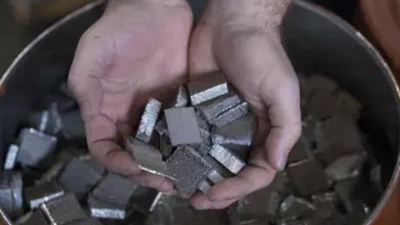
India holds the world’s third-largest reserves of rare earths at 6.9 million tonnes, yet its contribution is not even 1 per cent of the global production. A new report from Amicus Growth, cited by ANI, underlined this gap between resource potential and actual production on the part of India, while China leads in the global rare earth market with both reserves and processing capabilities.The country’s vast reserves, which make up 6-7 per cent of global resources, are primarily found in coastal sands rich in monazite. However, these deposits contain thorium, a radioactive element that makes mining and processing more complicated due to stringent safety rules.In 2024, the domestic production of rare earth elements stood at only 2,900 tonnes, making the country the seventh largest producer globally. China led the production ranks with 270,000 tonnes of total domestic and export production. The US produced 45,000 tonnes to become the second largest, with Myanmar producing 31,000 tonnes. Meanwhile, Australia, Thailand, and Nigeria produced approximately 13,000 tonnes each.Processing capacity remains a major hurdle for India. China controls roughly 90 per cent of global refining operations and nearly all heavy rare earth element processing. India’s limited processing abilities have kept it largely absent from the global rare earth trade, despite a recent small-scale joint venture with Japan in Visakhapatnam.Historical regulations have also played a role in India’s low output. For years, the government-owned Indian Rare Earths Limited (IREL) handled most production, treating these valuable elements as secondary products rather than strategic resources.The global rare earth reserve picture shows total deposits of 90-110 million tonnes. China leads with 44 million tonnes, followed by Brazil with 21 million tonnes. Australia holds 5.7 million tonnes, Russia 3.8 million tonnes, Vietnam 3.5 million tonnes, and the United States 1.9 million tonnes.“Annual production has been only a few thousand tonnes, and India has played virtually no role in global REE trade,” the report stated. It also added that India’s challenge lies not in resource availability but in addressing execution problems, processing limitations, and better integration across the value chain.


Source link

DRDO conducts Pinaka test: Maiden long-range guided rocket tested in Odisha; meets textbook precision | India News


DRDO conducts Pinaka test: Maiden long-range guided rocket tested in Odisha; meets textbook precision

NEW DELHI: Defence Research and Development Organisation (DRDO) on Monday successfully conducted the maiden flight test of the Pinaka Long Range Guided Rocket (LRGR 120). It was conducted at the Integrated Test Range in Odisha’s Chandipur.“The rocket was tested for its maximum range of 120 km, demonstrating all in-flight manoeuvres as planned. The LRGR impacted the target with textbook precision,” reported news agency PTI.

DRDO Completes User Trials Of Akash-NG Air Defence Missile System, Ready For Induction

Earlier, the day the Centre also cleared a fresh set of defence procurements worth around Rs 79,000 crore, giving the armed forces a significant boost in combat capability. The approvals were taken at a meeting of the Defence Acquisition Council (DAC), chaired by defence minister Rajnath Singh.According to the defence ministry, the council granted Acceptance of Necessity (AoN) for a range of equipment to be inducted by the Army, Navy and Air Force. The cleared proposals include loitering munitions for artillery units, low-level lightweight radars, long-range guided rocket ammunition for the Pinaka multiple launch rocket system, and the Integrated Drone Detection and Interdiction System Mark-II, among other systems.Importance of Pinaka The Pinaka Long Range Guided Rocket (LRGR 120) is an extended-range, precision-guided rocket developed for the Indian Army’s Pinaka Multiple Launch Rocket System (MLRS). The “120” denotes its maximum strike range of around 120 kilometres. Unlike earlier unguided Pinaka rockets, the LRGR is equipped with a guidance system that significantly improves accuracy, enabling it to engage targets such as enemy artillery positions, command nodes and logistics installations at long distances. The rocket is fired from the existing Pinaka launcher, allowing the Army to enhance capability without inducting a new launch platform.The LRGR 120 is part of India’s effort to increase indigenous, long-range precision firepower. Guidance is achieved through a combination of inertial navigation, with mid-course updates and terminal correction, reducing circular error probable (CEP) compared to earlier variants. The system provides the Army with a stand-off strike option, allowing targets to be hit from well behind forward areas, improving survivability of launch units. The rocket is intended for deployment across artillery regiments operating the Pinaka system, strengthening deep-strike and counter-force capabilities.


Source link

‘My hero’: How Bryce Dunlap’s liver donation led to Browns’ most personal, powerful, and the rarest Dawg Pound captain moment in Cleveland | NFL News


‘My hero’: How Bryce Dunlap’s liver donation led to Browns’ most personal, powerful, and the rarest Dawg Pound captain moment in Cleveland
The Browns used their final home game to honor Bryce Dunlap’s life-saving organ donation and his mother, Kimberly Dunlap Kane. (Images via Getty and Twitter/X)

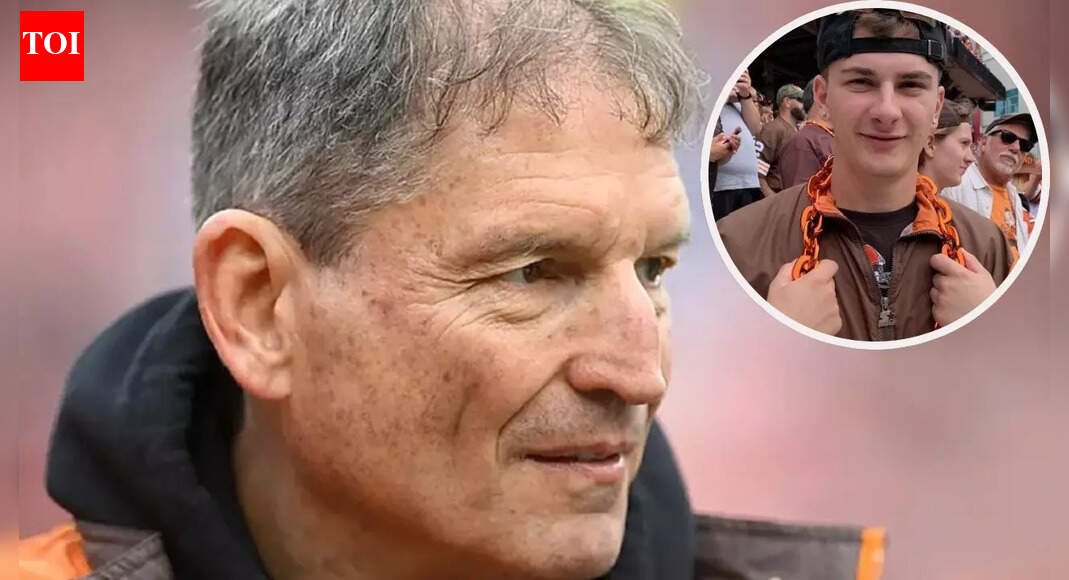
The Cleveland Browns’ Week 17 matchup against the Pittsburgh Steelers came with a pregame moment that pulled attention away from the standings and straight to the heart of Huntington Bank Field.Kimberly Dunlap Kane, the mother of Bryce Dunlap, served as the Browns’ Dawg Pound Captain for the final home game of the 2025 season. The tribute carried real weight. Bryce Dunlap was the organ donor who saved the life of Browns legend Bernie Kosar, and his family was honored in front of a full stadium before kickoff.

How Bryce Dunlap’s liver donation became the centerpiece of Cleveland’s final home game

Before Kane walked onto the field, the Browns played a recorded message from Kosar on the stadium video board. The timing mattered. This was Cleveland’s last home game of the season and the team chose to center it on gratitude, not football.“I can’t even begin to share how appreciative I am for the gift I received from Bryce Dunlap,” Kosar said. “Everyone please get on your feet, and make some noise and show some support for my hero, Bryce.”Kane then stepped onto the field and smashed a black-and-yellow, Steelers-themed guitar to start the game. It was symbolic, but not theatrical. The moment was about Bryce, not the rivalry.Bryce Dunlap passed away on Nov. 16 at age 21 after complications from an anoxic brain injury. His family selected Kosar as the recipient of Bryce’s liver through a directed donation. Kosar received the transplant on Nov. 17 and was discharged from the hospital on Nov. 24.According to the Browns, the organization and Kosar have remained in contact with the Dunlap family since the transplant. The team confirmed Kane’s Dawg Pound Captain role ahead of kickoff and shared the moment publicly, crediting Bryce directly for Kosar’s recovery.

Bernie Kosar’s message and why this tribute went beyond a typical game-day honor

Kosar was not in attendance for the game, but he shared his support again through social media. His message stayed consistent. This was about honoring Bryce and his family, not celebrating his own recovery.“Hi, Browns fans,” Kosar said in the video posted by the team. “I can’t even begin to share how appreciative I am for the gift I received from Bryce Dunlap. Everyone, please get on your feet and make some noise to show your support for my hero, Bryce. And here to represent Bryce is his mother, Kimberly Dunlap Kane, who’ll be today’s Dawg Pound Captain. You matter, Go Browns.”Kosar has dealt with cirrhosis of the liver and Parkinson’s disease since 2024, making the transplant necessary. The donation was processed through LifeBanc, a nonprofit organ procurement organization. Kosar shared a recovery update after surgery and has remained publicly thankful to the Dunlap family.The Browns’ decision to center their final home pregame ceremony around Kane reframed the day. It was not about playoff implications or season results. It was about acknowledging the cost of Bryce Dunlap’s gift and the family behind it.Cleveland has hosted many Dawg Pound Captains over the years. This one stood apart. Not because of spectacle, but because it reminded everyone in the building that some moments in the NFL have nothing to do with football and everything to do with life.


Source link

‘No interest in shaking hands’: Handshake row deepens; PCB chief Mohsin Naqvi warns of ‘equal terms’


'No interest in shaking hands': Handshake row deepens; PCB chief Mohsin Naqvi warns of 'equal terms'

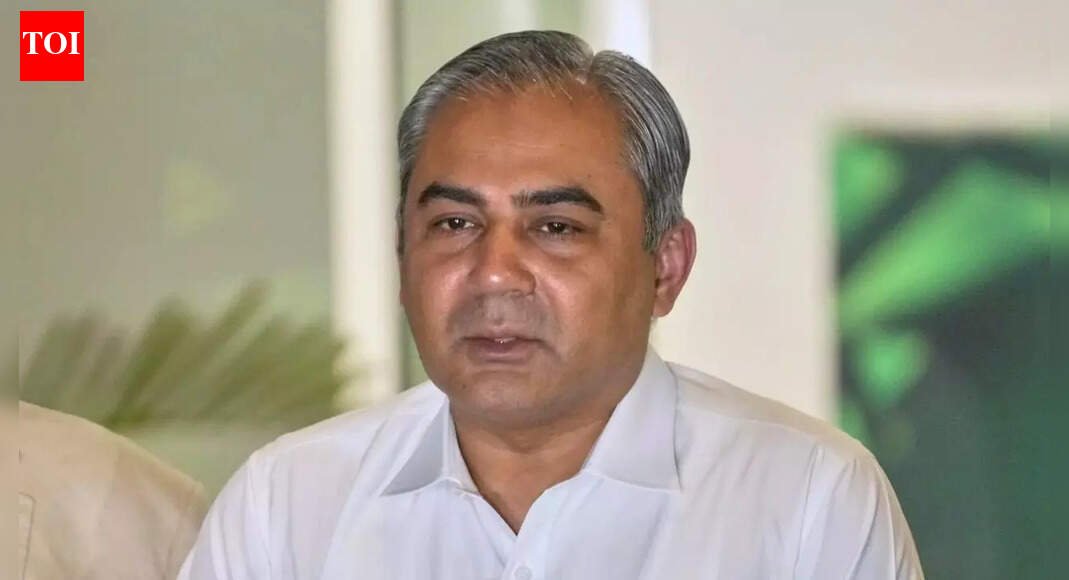
Pakistan Cricket Board chairman Mohsin Naqvi has made Pakistan’s position clear on the issue of shaking hands with India during cricket matches. Ahead of the ICC T20 World Cup 2026, Naqvi said Pakistan will not force any symbolic gestures if India are not willing to take part.Speaking to the media in Lahore, Naqvi said Pakistan has always believed that cricket and politics should be kept separate.

Can Virat Kohli chase down Sachin Tendulkar’s hundred hundreds?

He added that this view has not changed over time and that the message has come from the highest level. According to him, Pakistan also does not want to be treated differently or unfairly.“Our belief remains the same even today, and believe me, the Prime Minister himself has told me twice that we shouldn’t let politics come into all of this. From day one, our stance has been that cricket and politics should remain separate. On that day, Sarfaraz must have told you what kind of attitude was shown, and what it was like,” Naqvi said.He further explained that Pakistan will not insist on shaking hands if India chooses not to. “If they don’t want to shake hands, then we have no particular desire to do so either. Whatever happens, it will happen on an equal footing with India. And you will see, this approach will continue going forward. It’s not possible for them to do one thing and for us to back down — that simply won’t happen.”The handshake issue between India and Pakistan has been ongoing for some time. Since the Pahalgam terror attack, players from both sides have avoided shaking hands in several tournaments. This was seen during the Men’s T20 Asia Cup, the Women’s Cricket World Cup, and the recent Under-19 Asia Cup.However, it all began during the Asia Cup 2025. After a match between India and Pakistan, Indian captain Suryakumar Yadav and his teammates refused to shake hands with the Pakistan players. India said this was done as a protest after the Pahalgam attack.


Source link

Mumbai: Fire breaks out at Adani Western Heights, Andheri (W); No one injured | Mumbai News


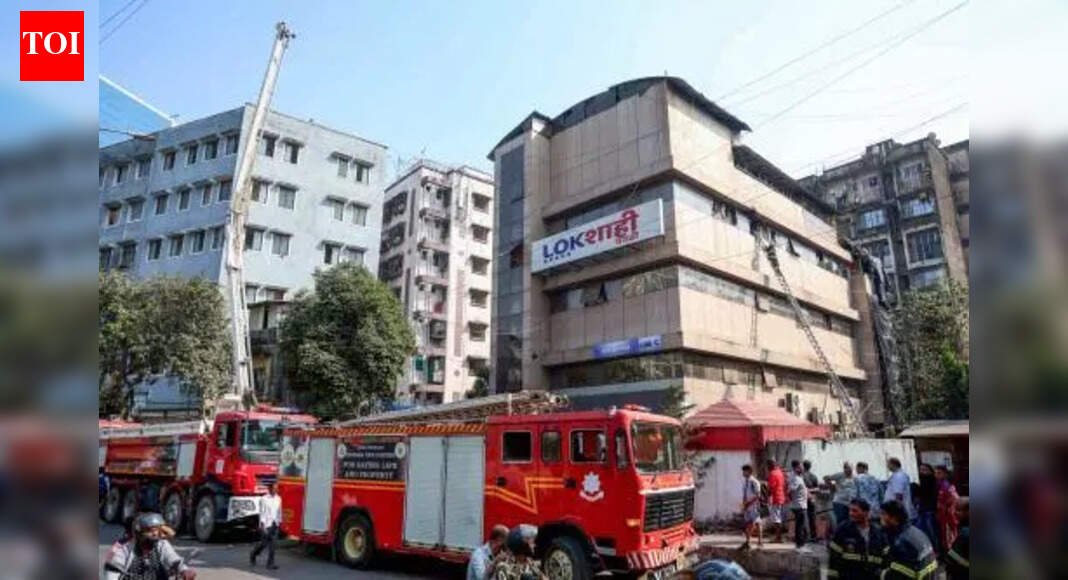
Mumbai: A fire broke out late Sunday night at Adani Western Heights, a high-rise residential building at Four Bungalows in Andheri (West). The incident was reported at 10.57 pm on Dec 28, to the fire brigade. The fire is said to have originated from electric wiring and electrical installations inside a flat located on the seventh floor of the G+28-storey building.Firefighters rushed to the spot immediately after receiving the alert. The blaze had erupted in only one flat and did not spread to other parts of the building, officials said. The fire was brought under control and completely extinguished by 11.29 pm.No injuries or casualties were reported in the incident.


Source link

Random Musing: The Designer of the Year Award goes to… Artificial Intelligence | World News


Random Musing: The Designer of the Year Award goes to… Artificial Intelligence

In The Matrix Reloaded, Morpheus, after his ship the Nebuchadnezzar is sunk, makes a biblical reference: I have dreamed a dream, but now the dream is gone from me. The line became a shorthand for the disappointment of hardcore Matrix fans who watched the pathbreaking original dissolve into bubble-gum pulp fiction sequels. It is also a sentiment shared by those who have spent years waiting for the arrival of the deus ex machina of Artificial General Intelligence.Cinema trained us to expect Agent Smith or the Terminator. What we got instead were malfunctioning interns that forget their brief after three prompts, which is not entirely unlike regular interns. If there is one area where artificial intelligence has genuinely altered daily life, for better or worse, it is generative AI.

Prophets in the Wilderness

Prophets in the Wilderness

A decade and a half ago, people working seriously on neural networks were dismissed as prophets in the wilderness. One of them was Professor Geoffrey Hinton, whose research group used NVIDIA’s CUDA platform to recognise human speech. Hinton encouraged his students to experiment with GPUs. One of them, Alex Krizhevsky, along with Ilya Sutskever, trained a visual neural network using two consumer-grade NVIDIA graphics cards bought online. Running them from Krizhevsky’s parents’ house, and racking up a sizeable electricity bill, they trained the model on millions of images in a week, achieving results that rivalled Google’s efforts using tens of thousands of CPUs.That moment reshaped the industry. If neural networks could see, what else could they learn? The answer, as Jensen Huang would later discover, was nearly everything.When ChatGPT launched and it became clear that OpenAI’s models were running on NVIDIA’s chips, market perception around the company shifted dramatically. Valuations soared. The rest, as they say, is history.Hinton would go on to share the Nobel Prize in Physics in 2024. Huang emerged as the arms dealer of the AI race, building a company where vast numbers of employees became dollar millionaires. For laypeople, that was the true arrival of generative AI, and for capitalists, it promised something intoxicating: companies that scale without hiring, produce without friction, and grow without payroll.

The AI Dream

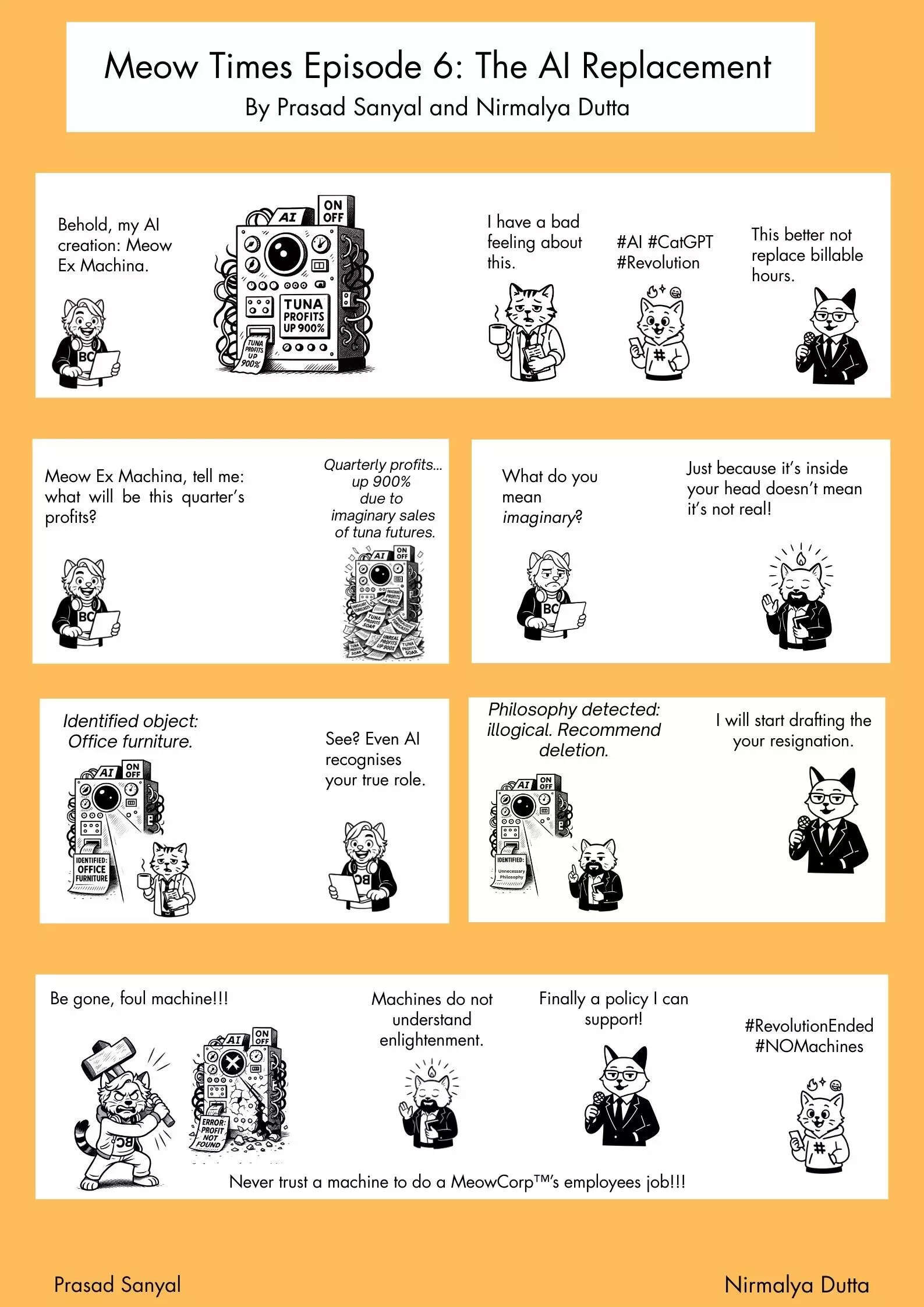
Meow Times Episode 6: The AI Replacement

AI does not need smoke breaks. It does not badmouth its boss, unless the boss is Elon Musk. It does not require me-time. Yet the promised productivity miracle, the idea that AI would replace workers by making individuals superhumanly efficient, has mostly fizzled. In practice, it has flooded offices with AI slop, rendering LinkedIn posts and internal emails nearly unreadable.The disappointment was captured neatly in a viral tweet: I want AI to do my laundry and dishes so that I can do art and writing, not for AI to do my art and writing so that I can do my laundry and dishes.Like most proclamations from the platform formerly known as Twitter, this was an exaggeration. Generative AI has undeniably made certain tasks easier. Research is faster. Summaries are cleaner. Editing copy is less painful. For writers, it offers something rare: an unbiased copy editor that does not inject its own ideology into the text. And even if large language models never write great literature, they produced something unmistakable this year: genuinely good images.

Designer of the Year

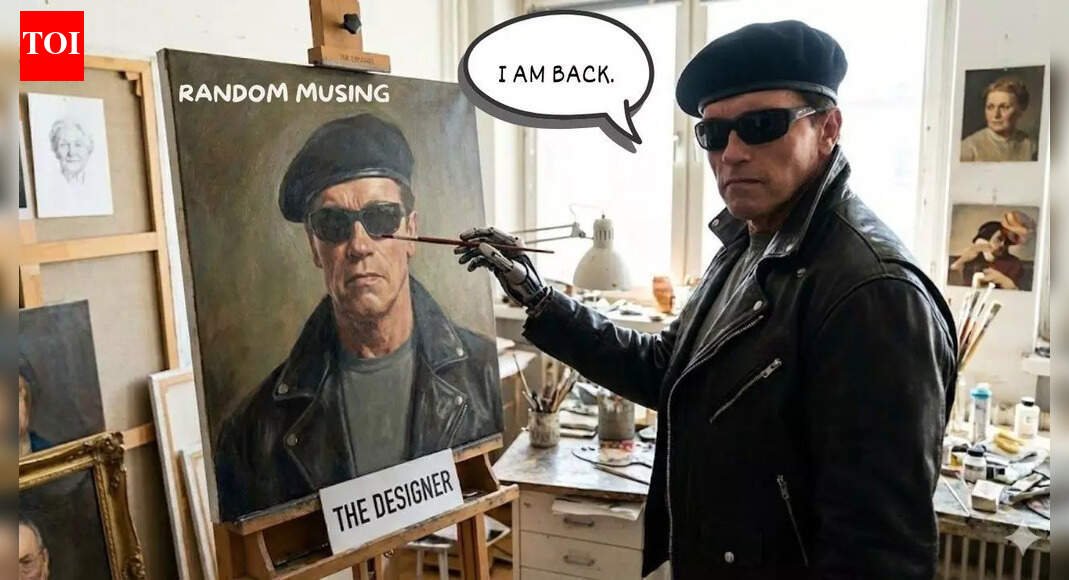
With the right prompts, the prompt engineer briefly became an amalgamation of Vincent van Gogh, Salvador Dalí, and Bill Watterson. While Time magazine crowned “AI Architects” as its Person of the Year, we believe Artificial Intelligence quietly earned another title: Designer of the Year.For a long time, AI images were the purest form of slop. They were instantly recognisable. Wax-like faces. Mangled fingers. Text that looked as if it had been written by a drunk monk fleeing Titivillus, the medieval patron demon of scribes. They were offered as proof that AI could not compete with even a doodling toddler and would make users want to And then, over the course of a year, everything changed.The improvement did not arrive through existential angst, but through engineering. Early image models like DALL-E 2 or the first versions of Stable Diffusion were diffusion systems loosely guided by text. They began with noise and slowly guessed their way toward an image, like asking a severely myopic person to glance at The Starry Night and recreate it from memory. The result often inspired a desire to cut off an ear in frustration. Text and image lived in separate systems, producing high-resolution hallucinations rather than understanding.That changed when image generation stopped being a side project and became fully integrated into multimodal models. OpenAI folded images into GPT-4o. Google followed with Gemini’s image systems, informally nicknamed Nano Banana. Stability AI rebuilt its stack with Stable Diffusion 3. Midjourney quietly re-engineered its later models along similar lines.These systems stopped drawing objects and started constructing scenes.They learned that light comes from somewhere. That shadows obey rules. That faces remain faces across time. That objects occupy space consistently. Most importantly, they learned memory. Earlier generators forgot everything between prompts. Ask for the same character twice and you got two strangers. Ask for a small edit and the entire image panicked.In 2025, that stopped.Characters persist. Colour palettes hold. Layouts remain intact. You can remove a background without altering a face. You can add text without destroying composition. Image generation ceased being a slot machine and became a tool. For the first time, the machine could explain the logic behind what it was producing.

The Ghibli Craze

For most users, this shift arrived disguised as the Studio Ghibli craze. People turned themselves into softer, cuter versions of reality, briefly threatening to boil the planet with GPU demand. Like many great technologies, it began as novelty. Then something else emerged.Family photographs, pets, childhood streets were transformed into scenes that felt emotionally correct. Not parody. Not kitsch. Convincing homage. Lighting made sense. Mood held. One image went viral, then thousands followed, because that is how internet culture works.The deeper shift, however, appeared outside art.Once models learned layout and consistency, infographics exploded. So did diagrams, explainers, cartoons, presentations. These are not artistic challenges. They are attention problems. They depend on hierarchy, clarity, and flow.Here, Google held an unfair advantage. It has spent decades studying how humans look at screens. That accumulated knowledge flowed directly into its image models. Charts became legible. Labels landed where the eye expected them. White space acquired intention. AI visuals stopped being decorative and started communicating.Cartoons improved for the same reason. Early AI cartoons were uncanny because they were too polite, too smooth, like humour approved by HR. Once exaggeration became a choice rather than an error, caricature began to work. Faces stretched where they should. Minimalism stopped looking unfinished.

Deus Artifex

Deus Artifex

All of which means we remain far from the promised deus ex machina, an omniscient intelligence descending from the heavens to answer every question. What we received instead was something else entirely: a deus artifex. A god who builds.A system that understands composition better than most humans. That respects constraints. That remembers state. That produces competent results instantly. Not inspired. Not obsessive. Just relentlessly adequate.That is why Artificial Intelligence deserves Designer of the Year. Not because it is creative, and not because it is sentient, but because it has collapsed the cost of visual competence. It has erased apprenticeship. Bad drafts. The humiliation of being visibly terrible before becoming good.Creation did not die. It changed shape. It became selection, curation, optimisation.The cost is not the death of art. Art survives worse things than algorithms. The cost is subtler. When the easiest path to beauty becomes the most travelled one, beauty converges. Aesthetic flattening is not a bug. It is an outcome.Van Gogh did not paint sunflowers because sunflowers were trending. Dalí did not melt clocks because surrealism performed well. Their styles were not filters. They were necessities.The machine can reproduce the surface of that necessity flawlessly. It cannot feel the need behind it.We did not get god.We did not get the devil.We got a better craftsman. So perhaps Morpheus was wrong. The dream that he dreamed wasn’t taken away. It just changed form.



Source link

When should you sell a stock? How to turning selling from an emotional reaction into an investment decision – explained


When should you sell a stock? How to turning selling from an emotional reaction into an investment decision - explained
A useful way to think about selling is to go back to your original reason for buying. (AI image)

Selling is much harder than buying. Buying feels optimistic: you’re starting something new. Selling feels like admitting you were wrong, or that a journey has ended. Because it is emotionally uncomfortable, many investors either sell for the wrong reasons or refuse to sell when they actually should.The first thing we remind ourselves is that a falling price is not, by itself, a reason to sell. The market’s mood swings are not the same as a business’s reality. We’ve seen investors panic out of excellent companies simply because the stock dropped 20-30 per cent in a correction, only to watch it recover and then move far beyond their exit price. Just as often, we’ve seen people hold on to clearly deteriorating businesses because they can’t bear the thought of booking a loss.A useful way to think about selling is to go back to your original reason for buying. When you bought the stock, you hopefully had some idea of what you were paying for: maybe a certain pace of growth, a strong balance sheet, a competitive advantage, or a change in management that you believed would improve things. When the time to sell comes, the real question is: has that original thesis broken down?Consider a stock like Bajaj Finance. Let’s say you bought it around mid 2018 at Rs 275, because you believed the company could grow earnings at more than 20 per cent a year, maintain healthy margins, and keep asset quality clean. Two years later, the stock has fallen from Rs 275 to Rs 185, a drop of more than 30 per cent. On the surface, it looks like a disaster. But when you check the numbers, you see that earnings have indeed grown close to 45 per cent, margins are intact, and the balance sheet is still clean. The fall is largely because the market is in the middle of a broad correction.Now imagine a second stock, Vodafone Idea, which you bought at Rs 65 in mid 2016. Its price has fallen to around Rs 35 two years later. But in this case, the debt has started to get out of hand, margins have collapsed, and management does not have a clear plan to fix things. Here, the problem is not just the market’s mood. The business itself is changing for the worse.In the first case, a fall in price might be a reason to hold or even add, provided the valuation is now more attractive. In the second, it might be a reason to sell even if you have to accept a loss. The key difference is whether your original reason for owning the stock is still true.When we think about exits at Value Research Stock Advisor, we don’t act just because something is volatile. We look for structural changes: a sustained break in earnings power, a clear deterioration in balance sheet quality, serious governance concerns, or a valuation that has become so stretched that future returns are likely to be poor even if the business does reasonably well. Some of our best decisions have been to sit through ugly price corrections because the business story was intact. Some of our most important decisions have been to exit stocks that looked “cheap” in recent price history but where the underlying engine was misfiring.Another reason to sell, which investors often underestimate, is opportunity cost. Your capital is limited. If you find a new idea that is clearly better than something you already own – better business quality, better growth prospects, cleaner balance sheet, more attractive valuation – it can be rational to sell the weaker one and redeploy, even if nothing terrible has happened to it. What matters is whether your portfolio as a whole becomes stronger and more aligned with your long-term plan.There is one reason we try hard to ignore, and that is the urge to “get out because it’s gone up too fast” without looking at fundamentals. It is tempting to think, “I bought at Rs 100, it is now at Rs 150, that’s a neat 50 per cent profit, let me lock it in.” But if the business has many years of growth ahead, the valuation is still reasonable, and your allocation is within your comfort range, you might be cutting yourself off from much larger gains later. Some of the biggest wealth creators look permanently “expensive” on past prices. If you sell them just because they have doubled or tripled, without asking whether they are still good businesses at sensible prices, you may spend the next decade regretting your caution.A good practical habit is to write down, in one short paragraph, why you own each stock. At VRSA, every recommendation is backed by a clearly articulated rationale: what we see in the business, what we expect over time, and what might make us change our mind. You can do a simpler version for yourself. Then, when you feel tempted to sell, reread that note and ask: Has this reason changed? Or am I just reacting to price moves and headlines?Selling will never become effortless. There will always be some doubt, some second-guessing. That’s normal. The goal is not to get every sell decision perfectly right. The goal is to avoid selling good businesses for bad reasons, and to avoid clinging to bad businesses just because you don’t want to accept a loss. If you can tie your decisions to changes in the underlying business rather than the daily ticker, you will make far fewer painful mistakes, and you will give your real winners the time they need to make a difference.(Ashish Menon is a Chartered Accountant and a senior equity analyst in Value Research’s Stock Advisor service.)(Disclaimer: Recommendations and views on the stock market, other asset classes or personal finance management tips given by experts are their own. These opinions do not represent the views of The Times of India)


Source link

Mumbai: Man held for duping holidaymakers with fake villa bookings | Mumbai News


Mumbai: A 25-year-old man was arrested by Vanrai Police for duping holiday goers by accepting advance payment online for booking a villa and never refunding the amount after cancellation of booking.Police said the complainant worked with a private company in Goregaon which was planning to take its staff on a two day picnic. The complainant was assigned the responsibility of booking a villa for the employees at Lonavala. While surfing online, he came across an advertisement for a villa for a rent of Rs 1.5 lakh for two days. As the rent was within the company’s budget, the complainant made payment on a bank account number provided by the accused, Nishant. He was also provided a GST number. But, the complainant was informed that the booking was cancelled as the villa was under renovation. The payment was never refunded and Nishant switched off his phone number. The complainant then lodged a police complaint. Police said the accused has similarly deceived other holiday goers as well.


Source link

Luxury Flat Scam Exposed: DLF Camellias Fraud Leads to Arrest of 6 in Rs 200cr Syndicate | Delhi News


NEW DELHI: A gang allegedly sold a non-existent luxury apartment at DLF Camellias in Gurgaon for Rs 12 crore by forging bank auction documents. Police said the wider syndicate might have cheated multiple victims of over Rs 200 crore across several states.The case was uncovered when a complaint was received on June 13, alleging cheating, forgery, and criminal conspiracy. The complainant was shown forged auction documents for the said premium apartment and was told that the property was already bought by the firm and could be immediately transferred, police said.

Delhi Headlines Today — The Biggest Updates You Need to Know.

The complainant transferred Rs 12 crore through RTGS and demand drafts between Aug and Oct last year. Subsequent verification by the bank revealed that all documents, including sale certificates, covering letters, and auction receipts, were forged, and no such auction ever took place.“Police traced the money to accounts linked to a finance and licensing company operated by prime accused Mohit Gogia. The bank analysis revealed that the funds were quickly routed through multiple accounts to conceal the trail. Several beneficiaries and shell firms have since been identified, and liens have been placed on suspected bank accounts. Two cars bought using the cheated amount were also seized,” DCP (crime) Aditya Gautam said. Police said the racket followed a consistent modus operandi: targets were lured with offers of luxury properties at prices far below market rates, supported by forged mortgage and auction documents promising immediate possession. The money was then layered through a network of accounts and rotated for profit, often through Babaji Finance, operated by absconding accused Ram Singh alias Babaji.Gogia (38), a resident of Delhi, was arrested on Nov 22 while allegedly attempting to flee from Mumbai towards Uttarakhand. He was nabbed near Doiwala on the Rishikesh-Dehradun road. He told police about several associates.Four more accused were arrested subsequently: Vishal Malhotra and Sachin Gulati, who allegedly allowed their bank accounts to be used for laundering the cheated money; Abhinav Pathak, who allegedly introduced the complainant to Gogia and facilitated the deal; and Bharat Chhabra, who allegedly assisted in preparing forged documents.Police said Gogia had a long criminal history, with at least 16 cases registered against him across Delhi, Punjab, Goa, Madhya Pradesh and Chandigarh, largely involving cheating, forgery and criminal conspiracy.Investigators believe the syndicate carried out similar frauds involving luxury properties at locations, including Ambience Mall and other prime areas in Delhi-NCR. The crime branch is trying to arrest the remaining accused, including Babaji, recover the cheated funds and identify more victims linked to the multi-state fraud network.


Source link