Breaking News
‘Hammer’: Used in Op Sindoor to crush Pakistan; India inks pact with France for homegrown hellfire – why the deal matters | India News


India’s decision to manufacture the HAMMER precision-guided air-to-ground weapon marks a quiet but consequential shift in how New Delhi is preparing for future conflict. More than a new addition to the arsenal, HAMMER represents a move away from importing finished munitions towards absorbing the technologies that define modern air warfare.Developed by France’s Safran Electronics & Defense, HAMMER is a modular precision strike system designed to hit targets from stand-off ranges while keeping aircraft outside heavily defended airspace. Its architecture combines guidance kits, propulsion and standard bomb bodies, allowing rapid adaptation across missions and platforms. The system is already combat-proven and integrated with aircraft such as the Rafale.
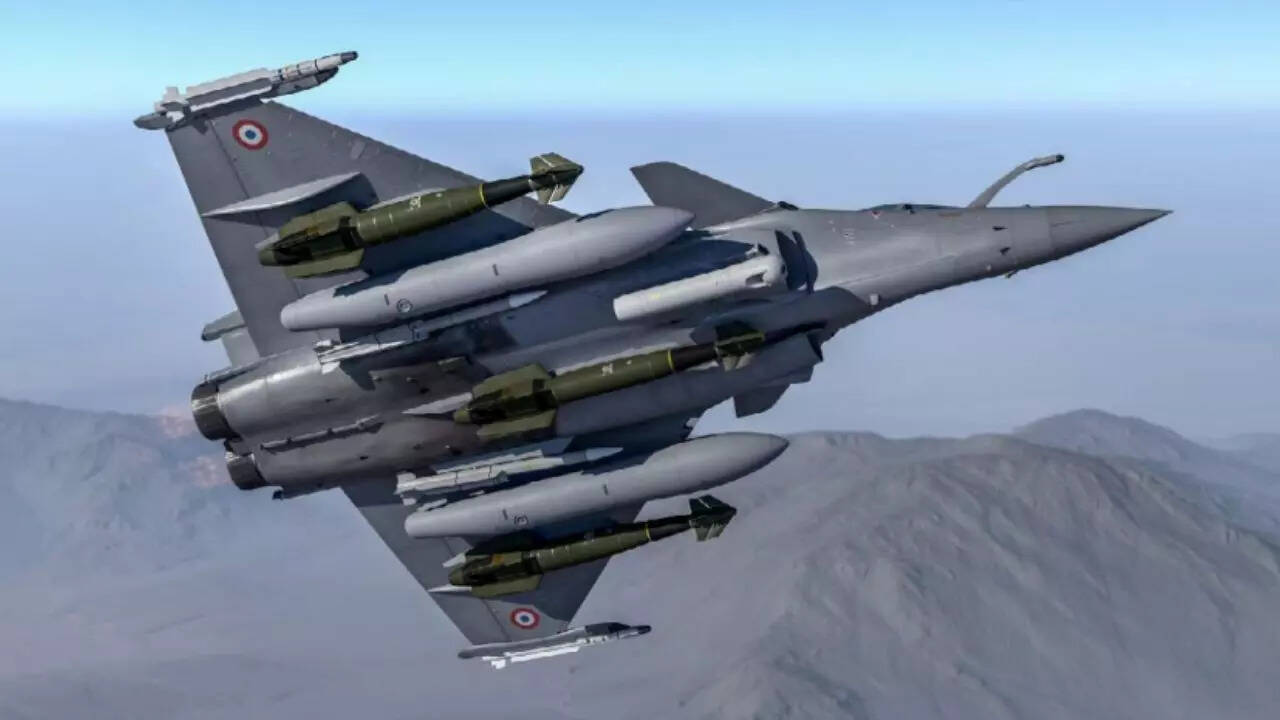
Aircraft outfitted with HAMMER

Indian Army Displays Turkish Yiiha Drone Used By Pakistan During Operation Sindoor

Under a new agreement, Bharat Electronics Limited and Safran will jointly manufacture, customise, supply and maintain HAMMER in India through a 50-50 joint venture. The weapon will be integrated across multiple platforms, including the Rafale and the indigenous Tejas light combat aircraft, creating a common precision strike capability across both imported and home-grown fleets. At a time when air power is defined less by numbers and more by accuracy, stand-off reach and controlled escalation, the localisation of HAMMER signals a strategic shift from buying weapons to mastering precision strike technology itself.

HAMMER in Operation Sindoor: Precision strikes with flexibility and control

The Indian Air Force deployed HAMMER precision-guided weapons during Operation Sindoor on 7 May 2025 as part of a carefully calibrated cross-border strike against terror infrastructure in Pakistan and Pakistan-occupied Kashmir.Operation Sindoor was launched in retaliation for the Pahalgam terrorist attack that killed 26 civilians on April 22. A total of nine sites were struck, including Jaish-e-Mohammed’s primary base in Bahawalpur and Lashkar-e-Taiba’s hub in Muridke.Weapon selection was central to the operation’s objectives. The Indian Air Force employed a layered mix of SCALP cruise missiles, HAMMER precision-guided bombs and loitering munitions.Within this mix, HAMMER was used where flexibility and adaptability were essential. Its modular design and multiple guidance options allowed the IAF to tailor strikes based on the nature of individual targets and real-time assessments.
.

HAMMER enabled stand-off engagement without requiring aircraft to fly directly over heavily defended areas. Its off-axis launch capability reduced exposure to Pakistan’s air defence network, particularly in areas close to population centres and sensitive military zones.The weapon’s precision supported the operation’s political and military messaging by reducing the risk of collateral damage. By pairing HAMMER with SCALP, the Indian Air Force demonstrated a layered strike doctrine, with SCALP neutralising deep, hardened targets and HAMMER engaging medium-range sites requiring precision and manoeuvrability.

What exactly is HAMMER and how it works in combat

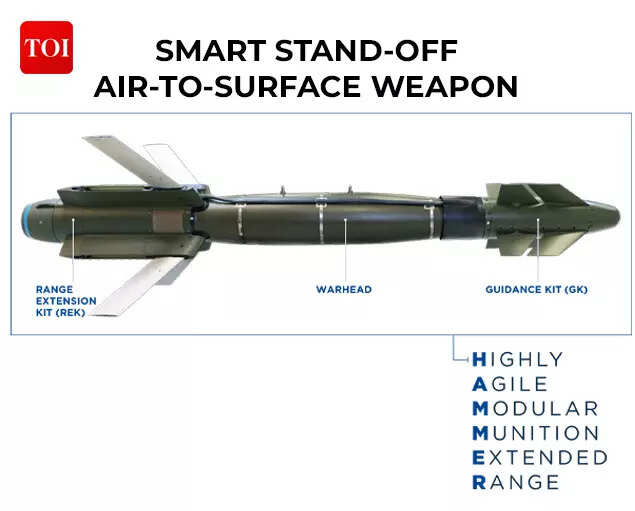
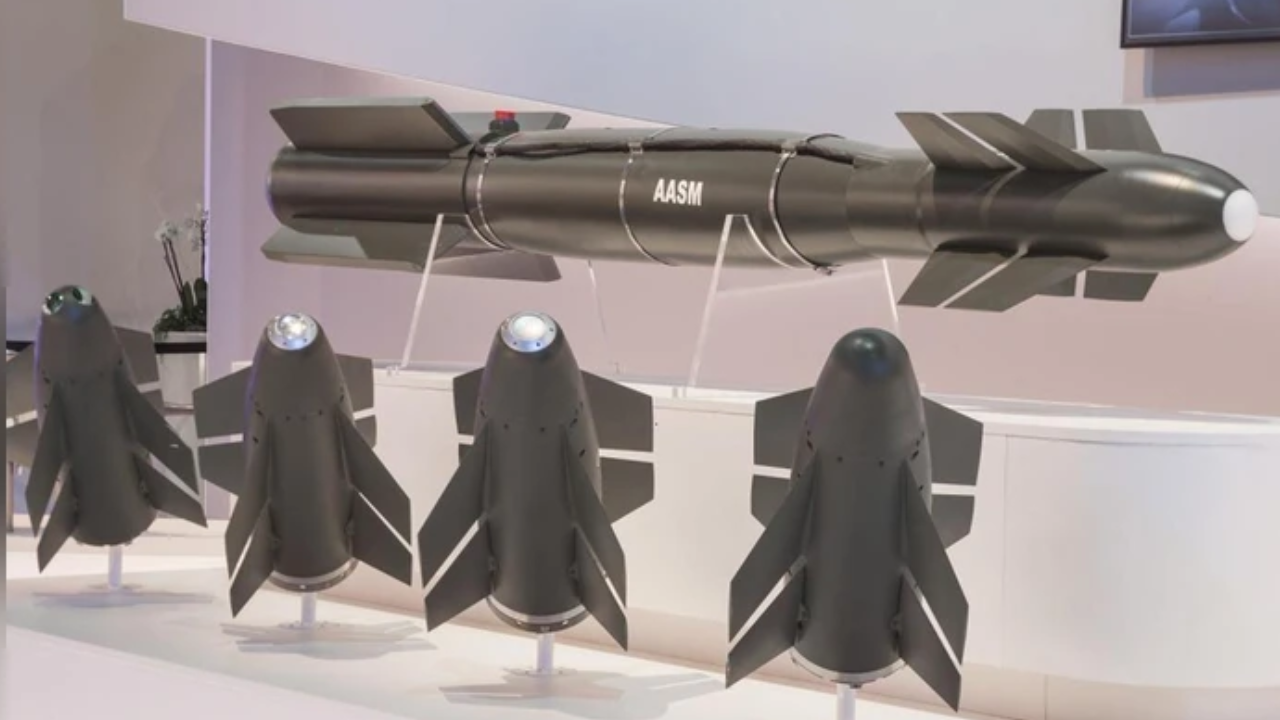
HAMMER, short for Highly Agile Modular Munition Extended Range, officially designated as AASM from the French Armement Air-Sol Modulaire, is a precision-guided air-to-ground stand-off weapon designed to bridge the gap between conventional bombs and cruise missiles.Despite often being described as a missile, HAMMER is fundamentally a guided bomb system. At its core is a standard unguided bomb, which becomes a high-precision strike weapon once fitted with modular guidance and propulsion kits. This design allows air forces to convert existing bomb inventories into modern precision weapons without developing entirely new missiles for each mission profile.
.

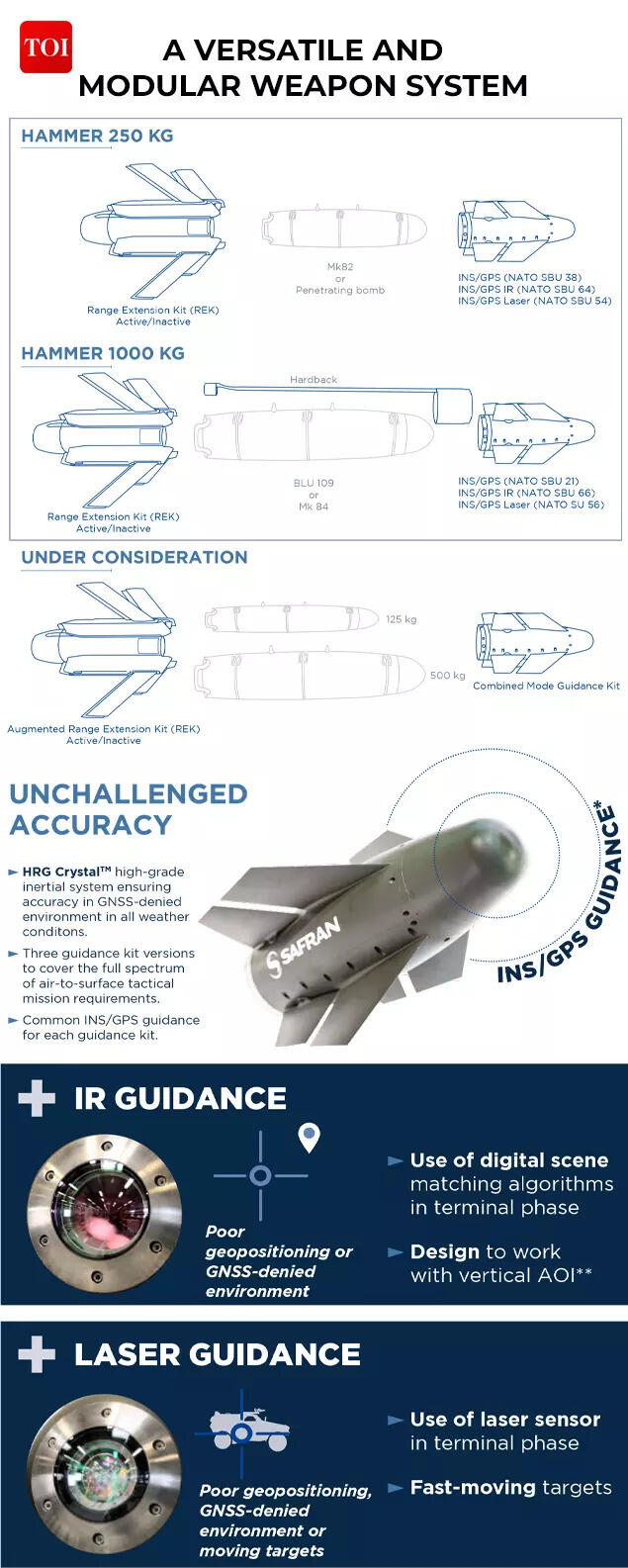
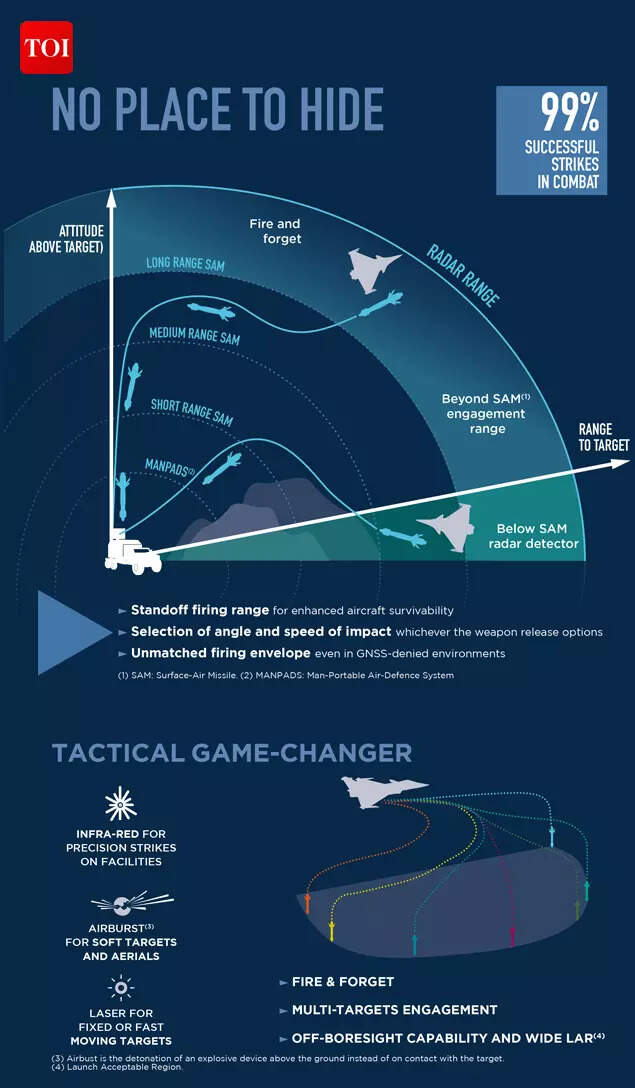
The system is built around two main components. The first is a nose-mounted guidance section that determines how the weapon navigates and locks onto its target. Depending on the mission, this guidance kit can combine inertial navigation and GPS for all-weather strikes, infrared imaging for high-precision attacks on fixed targets, or laser guidance for engaging moving targets.The second component is a tail-mounted range extension kit, which includes a solid-fuel rocket booster and manoeuvrable winglets. Once released, the booster ignites to increase stand-off range, while the winglets allow the weapon to alter its flight path, perform sharp turns and attack targets from off-axis angles. In combat, this enables launch aircraft to remain outside heavily defended airspace while still striking accurately.HAMMER kits can be attached to bombs weighing 125 kilograms, 250 kilograms, 500 kilograms and 1,000 kilograms, including widely used Mark 80 series bombs. This scalability allows the same weapon system to be used against a range of targets, from lightly protected structures to hardened bunkers.In operational use, HAMMER has demonstrated the ability to strike targets from significant distances, engage multiple targets in a single sortie and maintain accuracy in contested environments. Its combination of modularity, manoeuvrability and precision makes it particularly suited to modern air operations where speed, flexibility and controlled escalation are critical.

Guided bomb vs missile: Why HAMMER occupies a unique space

In modern air warfare, weapons fall broadly into three categories: unguided bombs, guided bombs and air-to-surface missiles.Unguided bombs are cheap but inaccurate and require aircraft to fly directly over targets. Air-to-surface missiles offer long range and precision but are expensive and limited in numbers.
.

HAMMER sits between these two extremes. It offers missile-like precision and stand-off range while retaining the flexibility and lower cost structure of a guided bomb.This distinction matters. Guided bombs like HAMMER allow air forces to carry larger numbers of precision weapons, adapt them to multiple target types and deploy them from a wide range of aircraft.

Modularity: The core strength of HAMMER

The defining feature of HAMMER is modularity. Instead of designing a single fixed weapon, Safran developed a system where guidance, propulsion and bomb body can be mixed and matched.The nose-mounted guidance kit determines how the weapon finds and tracks its target. The rear-mounted range extension kit determines how far it can travel after release and how sharply it can manoeuvre.This modular architecture allows the same basic weapon to be used for close air support, deep strike, bunker busting and attacks on moving targets, depending on the guidance kit selected.For India, this means fewer weapon types to manage logistically while retaining operational flexibility.

Guidance systems and how HAMMER achieves precision

HAMMER is available in three primary guidance configurations.The baseline version combines an inertial navigation system and a Global Positioning System receiver. Data from both systems is fused using Kalman filtering, allowing the weapon to maintain accuracy even if GPS signals are degraded or jammed. This variant achieves a circular error probability of around 10 metres and works in all weather conditions.The second variant adds infrared homing to the INS and GPS combination. This system matches the target area with a reference image stored in the weapon’s memory, allowing accuracy of around one metre. It works day and night in fair weather and is particularly useful against fixed targets with a clear thermal signature.
Top 5 long-range air-to-surface missiles globally

The third variant replaces infrared homing with laser guidance. This allows HAMMER to strike moving targets, provided they are illuminated by a laser designator from an aircraft, drone or ground team. This version was qualified in April 2013.These variants were redesignated in 2010 as SBU-38, SBU-64 and SBU-54 respectively, with the overall system renamed HAMMER for export.

Range, agility and survivability

HAMMER’s range depends on launch altitude and configuration. Safran cites a range of over 32 nautical miles from high altitude and around 8 nautical miles from low-level release.The winglets and rocket booster allow off-axis launches of up to 90 degrees, meaning the aircraft does not have to point directly at the target. This reduces exposure to enemy air defences.Multiple HAMMER weapons can be released in a single pass against different targets with one trigger press, a capability that significantly enhances strike efficiency.HAMMER entered service in 2007 with the French Air Force and Naval Aviation on the Rafale platform.
Top 10 surface-to-air missile systems globally

Its combat debut came in Afghanistan in April 2008, when a Rafale dropped two HAMMER weapons in support of ground troops.The system gained wider attention during the 2011 Libya campaign. A HAMMER weapon destroyed a Libyan Air Force G-2 Galeb aircraft on the runway at Misrata Airport shortly after it landed. Another strike destroyed a Libyan tank at a distance of 55 kilometres. In total, 225 HAMMER weapons were used in Libya.This combat history is critical. Weapons that have been tested in real conflicts carry credibility in terms of reliability, accuracy and resistance to countermeasures.

India’s induction and integration challenges

India ordered large numbers of HAMMER weapons in September 2020. Deliveries were completed by November 2020, with the French Air and Space Force transferring part of its own stock to ensure immediate availability.The Indian Air Force initially integrated HAMMER on the Rafale fleet. Work has since begun to integrate it onto the Tejas, a process that involves complex software, avionics and flight control modifications.Successful integration on Tejas would represent a major step in combining imported high-end weapons with indigenous platforms.

Cost, evolution and economies of scale

According to France’s Senate committee on defence manufacturing costs, the total cost of the AASM programme including development and delivery of 2,348 kits was €846 million, placing the per-weapon cost at around $300,000.
HAMMER

Earlier figures showed a unit cost of €164,000 excluding development and €252,000 including development. By 2017, Safran reported a unit cost of €120,000 for the AASM Evolution version, with a target of reducing it to €80,000 through larger production runs.For India, domestic production offers the potential to lower costs over time while ensuring availability during crises.

Where HAMMER fits in India’s precision strike ecosystem

India today operates a layered precision strike inventory.Indigenous systems include the Sudarshan Laser Guided Bomb, the Smart Anti-Airfield Weapon, and glide bombs such as Gaurav and Garuthmaa.Imported and jointly developed systems include the SPICE series from Israel, HAMMER from France and the BrahMos-A supersonic cruise missile.HAMMER fills a crucial middle ground between short-range guided bombs and long-range cruise missiles, offering flexibility, precision and affordability.Manufacturing HAMMER in India is not just about supply security. It allows Indian engineers and technicians to gain deep familiarity with guidance systems, propulsion integration and precision strike workflows.
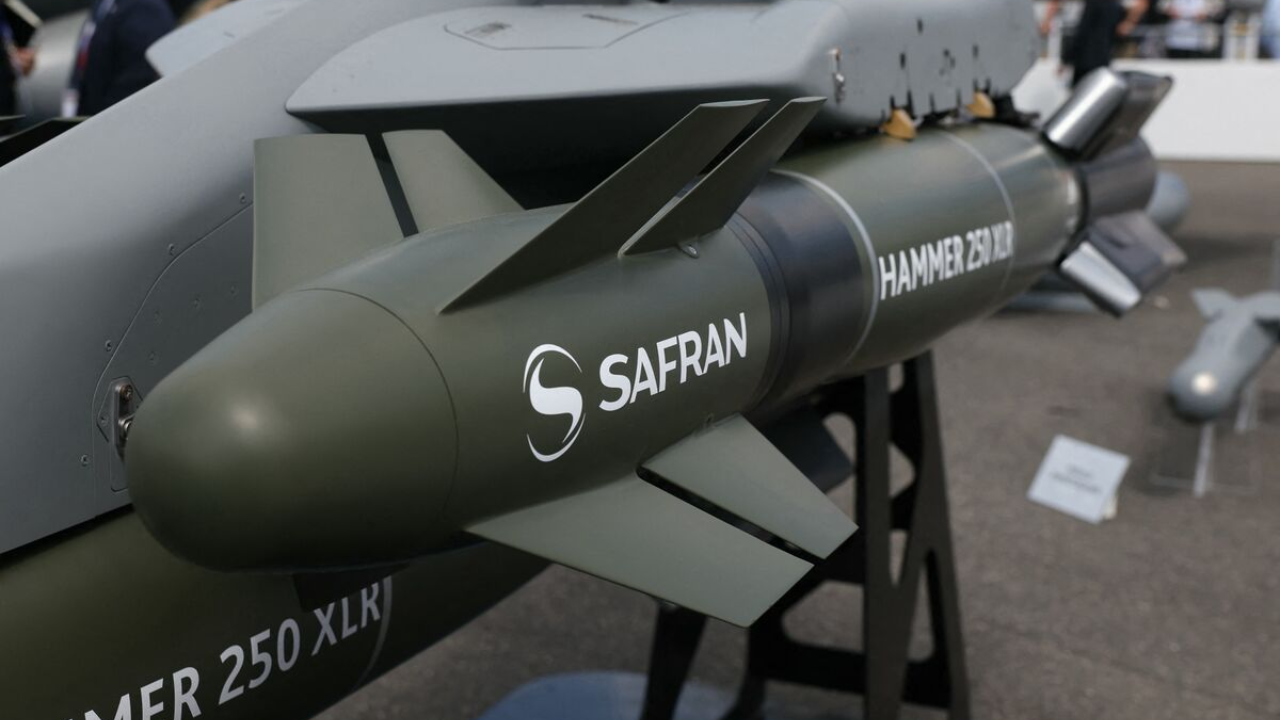
HAMMER

This knowledge is transferable to future indigenous weapons programmes and reduces long-term dependence on foreign suppliers for upgrades and maintenance.The deal also strengthens India’s defence partnership with France at a time when New Delhi is diversifying beyond traditional suppliers.The BEL–Safran HAMMER joint venture represents a quiet but important shift in India’s approach to air warfare. Precision, modularity and adaptability are now central to how air power is conceived and deployed.By moving HAMMER production to Indian soil, New Delhi is not merely acquiring a weapon. It is acquiring the ability to understand, modify and eventually design the tools of modern precision strike warfare.




Source link

Access Denied


Access Denied

You don’t have permission to access “http://www.ndtv.com/health/can-eating-one-chapati-with-ghee-in-the-morning-boost-energy-levels-9816274” on this server.

Reference #18.defed417.1765862635.fee53

https://errors.edgesuite.net/18.defed417.1765862635.fee53


Source link

Rupee falls to fresh low! Currency continues downward streak; reaches 90.83 against US dollar


Rupee falls to fresh low! Currency continues downward streak; reaches 90.83 against US dollar

Rupee extended its downward rally on Tuesday, slipping to a record low of 90.83 against the US dollar. The currency began trading on a weak note, opening 0.1% lower at 90.79 against Monday’s close of 90.73, as continued foreign fund outflows and trade-related uncertainty weighed on the domestic currency.The muted opening follows a sharp sell-off in the previous session, when the rupee slid to an all-time intra-day low of 90.80 before ending trade at a record closing level of 90.78 against the greenback. The domestic unit had registered a loss of 29 paise on Monday, extending its recent losing streak.According to forex traders, persistent risk aversion in the market, strong demand for dollars from importers, kept the currency weak. Concerns also rose over the timing and outcome of an India-US trade deal.VK Vijayakumar, chief investment strategist, Geojit Investments Limited told TOI that the currency “is likely to stabilise since November trade deficit has come down to $ 24.53 billion from $ 41.64 billion in October. This will take away some pressure on the FIIs to sell anticipating further depreciation.”Earlier on Monday, rupee opened at 90.53 at the interbank foreign exchange market. The latest slide came after the rupee had already fallen 17 paise, last week on Friday to close at 90.49, which was then its lowest-ever level against the US dollar.“The Indian rupee plunged to a record low, positioning it as the worst performer among the Asian currencies. Despite the better-than-expected trade balance number, the rupee was unable to find support,” Dilip Parmar, Research Analyst, HDFC Securities told PTI.Looking ahead, Anuj Choudhary, Research Analyst, MiraeAsset ShareKhan, said that the currency is likely to remain under pressure in the near term.“The rupee is expected to trade with a negative bias amid delay in Indo-US trade deal and FII outflows,” he said. “A weak dollar and any intervention by the RBI may also support the rupee at lower levels. Investors may watch for central bank monetary policy decisions from BOE, ECB and BoJ. USD-INR spot price is expected to trade in a range of Rs 90.30 to Rs 91.”


Source link

HH vs ST, BBL|15, Match Prediction: Who will win today’s game between Hobart Hurricanes and Sydney Thunder?


Hobart Hurricanes host Sydney Thunder in the third match of the Big Bash League 2025-26 at Bellerive Oval on December 16, marking an early clash between a confident home side and a motivated visitor seeking redemption. As defending champions, the Hurricanes boast a well-rounded squad under Nathan Ellis‘ captaincy, blending Matthew Wade‘s seasoned wicketkeeping with explosive finishers like Tim David and the pace firepower of Riley Meredith and Chris Jordan. Their home record at Bellerive, where batting first succeeds 56% of the time amid flattening pitches and sea breezes, gives them a tactical edge, especially with spinners Rehan Ahmed and Rishad Hossain to exploit any early grip.​

Sydney Thunder, led by Chris Green, counter with a potent mix of Sam Billings‘ aggression, Shadab Khan‘s all-round dynamism, and Reece Topley‘s swing to disrupt Hobart’s top order early. Finishing third last season, they crave an opening win after the Hurricanes dominated their prior final encounter, and their middle-order depth via Daniel Sams and Oliver Davies could punish any loose bowling on a venue averaging 147 in first innings but capable of 200-plus hauls. Analytical trends highlight Thunder’s superior death bowling economy in recent BBL outings, potentially curbing Hobart’s big hitters if the pitch holds true to its batting-friendly evolution.

HH vs ST, BBL|15: Match details

  • Date and Time: December 16 (Tuesday); 1:45 pm IST / 8:15 am GMT / 4:15 pm Local
  • Venue: Bellerive Oval, Hobart
  • Head-to-Head Record in BBL: Matches played: 22 | Hobart Hurricanes won: 14 | Sydney Thunder won: 08 | No result/Tied: 0

Bellerive Oval Pitch Report

Bellerive Oval’s pitch in Hobart promises a balanced T20 contest for the Big Bash League 2025-26 opener between Hurricanes and Thunder. Fresh grass offers early seam movement and low bounce, assisting pacers like Ellis and Topley in the powerplay, with an average first six overs scoring under 40 runs historically. As the match progresses, the surface flattens under sea breezes from the Derwent River, favouring batters and spinners like Rehan or Sangha in middle overs, where economy rates dip below 7. Teams batting first win 56% of games, targeting 160-170, though dew could aid chases later. High scores past 200 are possible if batters settle.

Squads:

Hobart Hurricanes: Nathan Ellis (c), Tim David, Ben McDermott, Riley Meredith, Billy Stanlake, Matthew Wade, Beau Webster, Jake Weatherald, Chris Jordan, Rishad Hossain, Rehan Ahmed, Mac Wright, Iain Carlisle, Nikhil Chaudhary, Fergus O’Neill, Ollie Peake

Sydney Thunder: David Warner (c), Sam Billings, Lockie Ferguson, Daniel Sams, Chris Green, Cameron Bancroft, Wes Agar, Ollie Davies, Shadab Khan, Matthew Gilkes, Tanveer Sangha, Ryan Hadley, Sam Konstas, Nathan McAndrew, Tom Andrews, Ravichandran Ashwin, Blake Nikitaras

Also READ: BBL 2025-26: Broadcast, Live Streaming details – When and where to watch the Big Bash League in Australia, India, USA, UK & other countries

HH vs ST, BBL|15: Today’s Match Prediction

Case 1:

  • Sydney Thunder wins the toss and bowls first
  • Hobart Hurricanes’ powerplay score: 45-55 (6 overs)
  • Hobart Hurricanes’ total score: 170-180

Case 2:

  • Hobart Hurricanes wins the toss and bowls first
  • Sydney Thunder’s powerplay score: 55-65 (6 overs)
  • Sydney Thunder’s total score: 180-190

Match result: Team bowling first to win the contest

Also READ: Fans go wild as Tim Seifert’s perfectly-timed BBL century sends strong message ahead of IPL 2026 auction


Source link

Top stocks to buy today: Stock market recommendations for December 16, 2025 – check list


Top stocks to buy today: Stock market recommendations for December 16, 2025 - check list
Top stocks to buy (AI image)

Stock market recommendations: According to Somil Mehta, Head – Alternate Research, Capital Market Strategy, Mirae Asset Sharekhan, the top stocks investors can consider buying today on December 16, 2025 are: Union Bank of India, UPL, and Britannia Industries. Let’s take a look:Union Bank of India – Buy in the range between Rs 153 & Rs 154; Stop Loss: Rs 145; Target: Rs 170Union Bank of India has been consolidating in a range from the last five weeks above 20 & 40 daily moving average, taking support from 10 day moving average i.e.151.85 the stock is expected to resume the uptrend. Momentum indicators have also given a positive crossover below the zero line. Key resistance is 160 and support is at 150 and 147.UPL – Buy in the range between Rs 764 & Rs 765; Stop Loss: Rs 730; Target: Rs 833UPL has been giving breakout of falling trendline above 20 & 40 daily moving average and the stock is expected to resume the uptrend. Momentum indicators have also given a positive crossover above the zero line. The stock has been consolidating in a broad range since last month and has given a breakout of the range above 20 daily moving average i.e. 747. Key resistance is at 786 and support is at 741.Britannia – Buy in the range between Rs 6045 & Rs 6030; Stop Loss: Rs 5810; Target: Rs 6460Britannia Industries has been consolidating in a range from the last few weeks around 20 & 40 daily moving average, taking support from 20 weekly moving average i.e.5870 the stock is expected to resume the uptrend. Momentum indicators have also given a positive crossover below the zero line. Key resistance is 6262 and support is at 5857 and 5723.(Disclaimer: Recommendations and views on the stock market, other asset classes or personal finance management tips given by experts are their own. These opinions do not represent the views of The Times of India)


Source link

IPL 2026 dates confirmed: Season to run from March 26 to May 31; Chinnaswamy opener in doubt | Cricket News


IPL 2026 dates confirmed: Season to run from March 26 to May 31; Chinnaswamy opener in doubt
Royal Challengers Bengaluru’s Virat Kohli and former cricketers Chris Gayle and AB de Villiers celebrate with the IPL trophy. (PTI Photo)

NEW DELHI: The Indian Premier League (IPL) 2026 will begin on March 26 (Thursday) and conclude on May 31 (Sunday), with the dates emerging as the central takeaway from a meeting between franchise representatives and IPL authorities in Abu Dhabi on Monday evening, as per a Cricbuzz report. The confirmation of the Season 19 window brings clarity to teams planning their campaigns, even as uncertainty continues to loom over the venue for the opening match.Go Beyond The Boundary with our YouTube channel. SUBSCRIBE NOW!The dates were formally communicated by IPL CEO Hemang Amin during a briefing held ahead of Tuesday’s auction. As per tradition, the tournament opener is staged in the home city of the defending champions, which would put Bengaluru’s M Chinnaswamy Stadium in line to host the curtain-raiser featuring Royal Challengers Bengaluru (RCB). However, the availability of the venue remains a major talking point among franchises attending the pre-auction meeting at the W Hotel in Abu Dhabi.

IPL mini auction: Lot of interest for Cam Green | Wait ends for Prithvi Shaw, Sarfaraz Khan?

The Karnataka State Cricket Association (KSCA) has received only a conditional clearance from the state government to host IPL matches at the Chinnaswamy Stadium, subject to meeting stringent safety and security requirements. The hesitation stems from the tragic stampede on June 4 during RCB’s IPL title celebrations, which claimed at least 11 lives and left several others injured. Since then, the state government has consistently denied permission for major cricket matches at the venue, forcing the BCCI to relocate Women’s World Cup fixtures away from Bengaluru.Asked about the possibility of IPL 2026 starting at the Chinnaswamy Stadium, a senior BCCI official said, “We hope so,” adding that Karnataka Deputy Chief Minister DK Shivakumar had publicly expressed optimism. Shivakumar was recently quoted as saying the government was positive about hosting IPL matches and had asked Home Minister G Parameshwara to engage with KSCA officials to address concerns.

Poll

Will the government give a green light for IPL matches at Chinnaswamy Stadium?

While the schedule dominated discussions, the build-up to the IPL 2026 auction has also gathered momentum. The auction, to be held at the Etihad Arena in Abu Dhabi on Tuesday, will mark the third consecutive year the event takes place outside India, following Dubai and Jeddah. On the eve of the auction, the BCCI finalised the player pool by adding 19 names, including Bengal opener Abhimanyu Easwaran, New Zealand pacer Ben Sears and South African all-rounder Ethan Bosch.All ten franchises will be keen to assemble squads capable of challenging for the IPL 2026 title. A total of 77 slots are available, including 31 for overseas players. Kolkata Knight Riders have the most vacancies with 13, followed by Sunrisers Hyderabad with ten. From an initial list of 1,355 players, 359 have been shortlisted — 244 Indians and 115 overseas — with 40 players entering at the maximum base price of Rs 2 crore.The spotlight at the auction will be on marquee names such as Cameron Green, Liam Livingstone and Ravi Bishnoi. Green, in particular, is expected to attract aggressive bidding amid a skewed demand-supply ratio for seam-bowling all-rounders, with projections suggesting bids could cross Rs 25 crore. With the IPL 2026 schedule now locked in, franchises will hope the remaining uncertainties — especially around venues — are resolved well before the season begins.


Source link

BMC polls: After 4-year delay, elections to be held on January 15; results on January 16 | Mumbai News


MUMBAI: The long-delayed poll for the BMC, the richest civic body in the country, will be held on Jan 15 along with elections to 28 other municipal corporations in the state. The State Election Commission (SEC) announced the date on Monday. The result will be declared on Jan16.The model code of Conduct has come into force and no announcement can be made which will influence voters in the 29 municipal corporations. Just before the code came into effect, though, a slew of project inaugurations and announcements were made.Besides local politicians inaugurating civic projects across the city, deputy chief minister Eknath Shinde announced a central park and underground sports complex for Mumbai and a host of projects for Thane.The BMC, too, awarded two major contracts, worth Rs 1,000 crore and Rs 4,800 crore. The BMC election is the next big poll after the assembly election, which was swept by the BJP-led Mahayuti.


Source link

Ford EV reset: US carmaker scales back electric ambitions after Trump’s policy rollback; forecasts $19.5 bn write-down


Ford EV reset: US carmaker scales back electric ambitions after Trump’s policy rollback; forecasts $19.5 bn write-down

Ford has redrawn its electric vehicle roadmap, announcing that it will pull back from large EVs as the US carmaker transitions towards hybrids, petrol-powered trucks and a new battery storage venture. The auto giant also predicted profits to take a hit of almost $19.5 billion in the next few years.The US automaker, on Monday, said that several large electric models will be dropped, including the F-150 Lightning, as demand has failed to meet expectations amid rising costs and changes in regulation. The decision marks a clear departure from Ford’s earlier EV-heavy ambitions, at a time when the industry is reassessing the pace of the electric transition.“This is a customer-driven shift to create a stronger, more resilient and more profitable Ford,” chief executive Jim Farley said, adding that “the operating reality has changed, and we are redeploying capital into higher-return growth opportunities.”The announcement follows a move by US President Donald Trump to roll back stricter fuel economy rules introduced under former president Joe Biden, which had encouraged US carmakers to accelerate investments in electric vehicles. Farley welcomed the rollback, saying Trump was “aligning fuel economy standards with market realities” and calling it “a win for customers and common sense.” Trump has frequently criticised what he called an EV “mandate”, while Republican lawmakers have also scrapped clean-energy tax credits that had supported EV sales.Going forward, Ford said its electric vehicle development will be limited to smaller, lower-priced models. Production of the current F-150 Lightning has already been stopped, the company said. Its successor will be launched as a hybrid model, pairing an electric battery with a petrol engine and offering a driving range of more than 700 miles.Plans to introduce new electric commercial vans in Europe and North America have also been abandoned. Instead, Ford will produce petrol and hybrid vans at its Ohio assembly plant from 2029. In Tennessee, the company will retool its EV-focused factory, now to be renamed the Tennessee Truck Plant, to build affordable petrol-powered trucks from the same year.As part of its broader reset, Ford is also entering the battery energy storage market. A plant in Kentucky will be converted to manufacture storage systems for data centres and power utilities. The company expects to invest around $2 billion over two years in the project and aims to reach an annual capacity of 20 gigawatt-hours by late 2027, positioning itself as a significant player in the fast-growing sector.


Source link

‘Steadily recovering’: Low visibility disrupts flight ops in Delhi; airport issues advisory | India News


‘Steadily recovering’: Low visibility disrupts flight ops in Delhi; airport issues advisory

NEW DELHI: Delhi airport on Tuesday issued an advisory to flyers, warning that disruptions in flight operations may persist for some arrivals and departures due to dense fog.In a post on X, Indira Gandhi International Airport (IGIA) urged passengers to check with airlines for real-time updates on flight schedules.“Flight operations are steadily recovering, but disruptions may persist for certain departures and arrivals. For accurate and timely updates, please contact your airline directly,” IGIA said.“Our personnel are available across terminals to assist passengers and provide necessary support,” it added.Low visibility had disrupted operations on Monday as well, with 228 flights — 131 departures and 97 arrivals — cancelled and five diverted to nearby airports, according to airport officials.Air India said it cancelled around 40 flights due to poor visibility, while other airlines, including IndiGo, did not share exact numbers of cancellations or delays.“Low visibility (below minima), due to dense fog, has severely impacted operations at Delhi and other airports across northern India,” IndiGo said, adding that some flights may face delays or proactive cancellations to prioritise safety.Air India also said operations would resume as soon as conditions improve, stressing that cancellations were made in the interest of passenger safety.Delhi airport, the country’s busiest, handles around 1,300 flight movements daily.


Source link

‘Rekha believes she belongs to Amitabh Bachchan in spirit and he belongs to her,’ says her friend revealing why their relationship ended: ‘When he joined politics…’ |


Rekha and Amitabh Bachchan make one of the most iconic onscreen pairs in Hindi cinema. They have worked together in films like ‘Muqaddar Ka Sikandar’, ‘Suhaag’, ‘Do Anjaane’, ‘Mr Natwarlal’, ‘Ram Balram’. Perhaps, that also had to do with rumours of their relationship offscreen. They were always linked to each other, though they’ve never admitted to it. Meanwhile, Rekha has expressed her admiration towards him at several instances. In an old interview with Simi Garewal, when she was asked if she ever fell in love with him, she had said, “Absolutely! That’s a dumb question!” She then added, “I’m yet to come across a man, woman, or child who can’t help but fall completely in love with him. Why should I be singled out?” Though, she had denied having any personal connection. Rekha had said, “You want to know the truth? There was never a personal connection with him. What do I deny? I’m not in love with him? Of course I am. Duniya bhar ka love aap le lijiyega and add some more, I feel that for that person. Bottomline”Now in a recent interview with ANI, Rekha’s friend has now spoken on their relationship. Author, fashion designer and entrepreneur Bina Ramani, who shared a deep personal bond with Rekha, recently spoke about the emotional phase the actress was navigating at the time. In an interview, Ramani indicated that Rekha was not seeking secrecy, but validation. According to her, Amitabh Bachchan’s marriage to Jaya Bachchan and his growing political ambitions ultimately made such acknowledgment impossible.Talking about Rekha’s childhood, Ramani said during a chat, “Rekha was a very good friend. She was childlike. She is pure. If she has made silly moves in her life, those were out of innocence. She was trapped by her childhood. Between the role of a mother and a father, she must have craved and couldn’t get enough of love. And then at a very young age 13–14, she started working. She didn’t really enjoy the childhood.” According to Ramani, this longing for emotional reassurance shaped Rekha’s personal relationships, and she felt that sense of security with Amitabh Bachchan. Speaking candidly about Rekha’s feelings, Ramani revealed how deeply consumed the actress was by that bond. “When I met her, her whole life was in encased in Amitabh Bachchan,” she said. When asked whether Rekha was genuinely in love with him, Ramani responded, “Yes, she believed she belonged to him in spirit. And she believed that he belonged to her in spirit. They had a communication. These things can happen.”The situation, however, became more complicated when Amitabh Bachchan stepped into politics. Ramani recalled that Rekha found it increasingly difficult to accept that their relationship could never be publicly recognised.“Amitabh had joined politics, and she had come to visit me in New York. She was going through hard time because Amitabh had now become a public person, and he may have probably said to her that there was no chance of him ever… their alliance must have had to drift…publicly no more,” Ramani shared.Rekha and Amitabh Bachchan were last seen together onscreen in in Yash Chopra’s ‘Silsila’ in 1981 which also starred Jaya Bachchan this was nothing less than a casting coup.


Source link