Breaking News
‘Main Bihar se hoon’: Vaibhav Sooryavanshi hits back at UAE sledging in U19 Asia Cup opener | Cricket News


'Main Bihar se hoon': Vaibhav Sooryavanshi hits back at UAE sledging in U19 Asia Cup opener
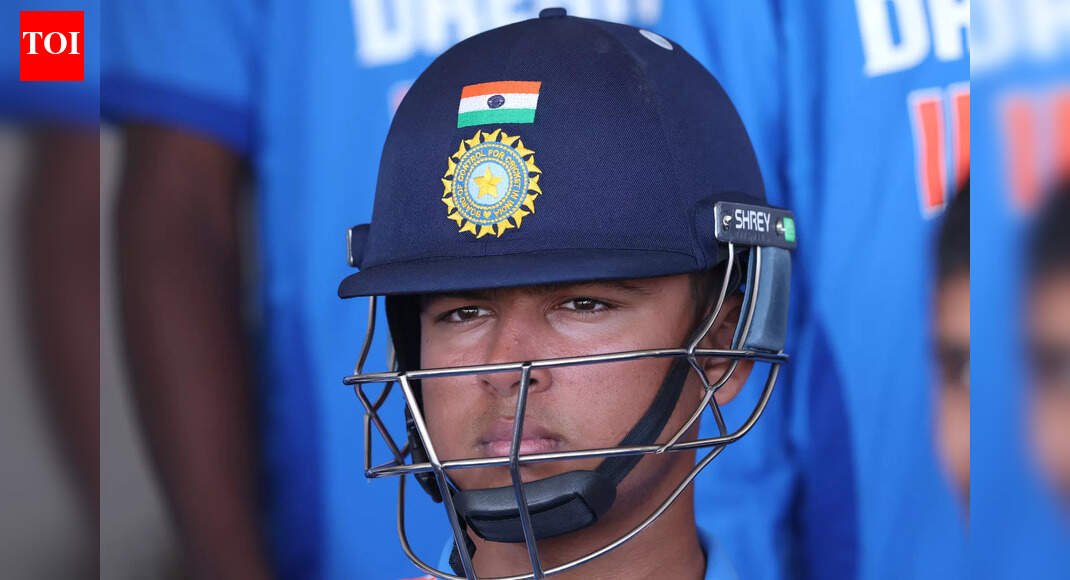
Vaibhav Suryavanshi of India (Photo by Michael Steele/Getty Images)

Vaibhav Sooryavanshi showcased an extraordinary performance in the U-19 Asia Cup match against UAE in Dubai on Wednesday, scoring 171 runs off just 95 balls. His remarkable innings helped India post a massive total of 433/6 in their allocated 50 overs.The 14-year-old left-handed batsman from Bihar set a new world record in U-19 cricket by hitting fourteen sixes and nine fours during his innings.

Ashish Nehra interview: Gujarat Titans head coach backs out of form Shubman Gill

During the 32nd over of India’s innings, when Sooryavanshi was approaching his century, an interesting exchange occurred between him and UAE wicketkeeper Saleh Amin.“Come on boys. 90’s curse. 90’s curse,” Amin was heard saying on the stump mic.“Tere saath selfie loon? (Wanna take selfie with me?)” Sooryavanshi responded to the UAE wicketkeeper.When asked about the incident later, Sooryavanshi responded confidently: “Main Bihar se hoon. Peeth peeche jo bhi baatein hoti hain, usse mujhko farak nahi padta.” (I am from Bihar. What is said behind my back does not bother me.)The match began with UAE captain Yayin Rai winning the toss and asking India to bat first. India faced an early setback when captain Ayush Mhatre was dismissed for just four runs in the third over.Sooryavanshi then joined forces with Aaron George at the crease. The young batsman initially played with caution before accelerating his innings, reaching his fifty in just 30 balls.His powerful hitting display earned him a new tournament record for most sixes in a single innings in the U-19 Asia Cup. He surpassed the previous record of ten sixes set by Afghanistan’s Darwish Rasooli in 2017.Sooryavanshi continued his aggressive batting, reaching his century in 56 balls. He maintained his momentum to score 150 runs in 84 balls before being run out after scoring 171 runs. His innings came at an impressive strike rate of 180.The innings now stands as the second-highest score by an Indian in Youth ODI cricket. The record is still held by Ambati Rayudu, who scored an unbeaten 177 against England U-19 in 2002.The Indian innings was well supported by Aaron George and Vihaan Malhotra, who both scored 69 runs each. Vedant Trivedi contributed 38 runs, while Abhigyan Kundu and Kanishk Chouhan added 32 and 28 runs, respectively. The combined effort helped India set an enormous target of 434 runs for the UAE team.UAE’s response resulted in a score of 199/7 in their allocated 50 overs. Their innings was highlighted by Uddish Suri’s unbeaten 78 and Prithvi Madhu’s fifty. India U19 secured a dominant 234-run win.India U19 will face their next challenge against Pakistan U19 in a group stage match on Sunday.


Source link

FDI reform push: Cabinet clears bill to raise foreign investment in insurance to 100%; key guardrails, LIC changes included


FDI reform push: Cabinet clears bill to raise foreign investment in insurance to 100%; key guardrails, LIC changes included

The Union Cabinet on Friday approved a bill to raise the foreign direct investment (FDI) cap in the insurance sector to 100 per cent, a major change aimed at deepening insurance penetration and accelerating sectoral growth, PTI reported citing sources.The proposed legislation — the Insurance Laws (Amendment) Bill, 2025 — is among 13 bills listed for the ongoing Winter Session of Parliament, which concludes on December 19. Sources said the bill may be introduced on Monday. A Lok Sabha bulletin notes that the draft law seeks to “deepen penetration, accelerate growth and development of the insurance sector and enhance ease of doing business.”Finance Minister Nirmala Sitharaman had proposed the move in this year’s Budget as part of new-generation financial sector reforms. The insurance industry has so far attracted Rs 82,000 crore in FDI.According to sources, the bill proposes amending the Insurance Act, 1938 to raise the FDI limit to 100 per cent, permit the merger of a non-insurance company with an insurance entity, and establish a dedicated policyholder fund. It also mandates that at least one senior leader — Chairman, Managing Director or CEO — must be an Indian citizen. Net worth requirements for insurers have been retained.As part of the wider legislative exercise, amendments will also be made to the Life Insurance Corporation Act, 1956, and the Insurance Regulatory and Development Authority Act, 1999. Changes to the LIC Act include empowering its board to independently take operational decisions such as branch expansion and recruitment.The proposed amendment, sources said, aims to promote policyholders’ interests, enhance financial security, and support the entry of more players into the sector while boosting growth and employment. The government has positioned these reforms as essential for achieving ‘Insurance for All by 2047.’Commenting on the move, Aditya Birla Sun Life Insurance MD and CEO Kamlesh Rao said the step may encourage more global players to consider India, adding that scale will depend on their ability to navigate the local distribution landscape.Deloitte India partner Debashish Banerjee told PTI, “Over the past few months, we have seen growing interest from several global insurers who are actively evaluating India as a long-term market, and greater clarity on ownership norms will help in moving those conversations forward.”Grant Thornton Bharat partner Narendra Ganpule noted that the proposal is designed “with the policyholders in mind, fostering an environment that delivers more choice, encourages highly innovative products, ensures robustly competitive prices, and hopefully delivers better service standards.”RenewBuy CEO Balachander Sekhar said the shift to 100 per cent FDI will bring global capital and expertise into the fold.


Source link

Rupee at historic low: How 9% real depreciation could reshape India’s economy – explained


Rupee at historic low: How 9% real depreciation could reshape India’s economy - explained
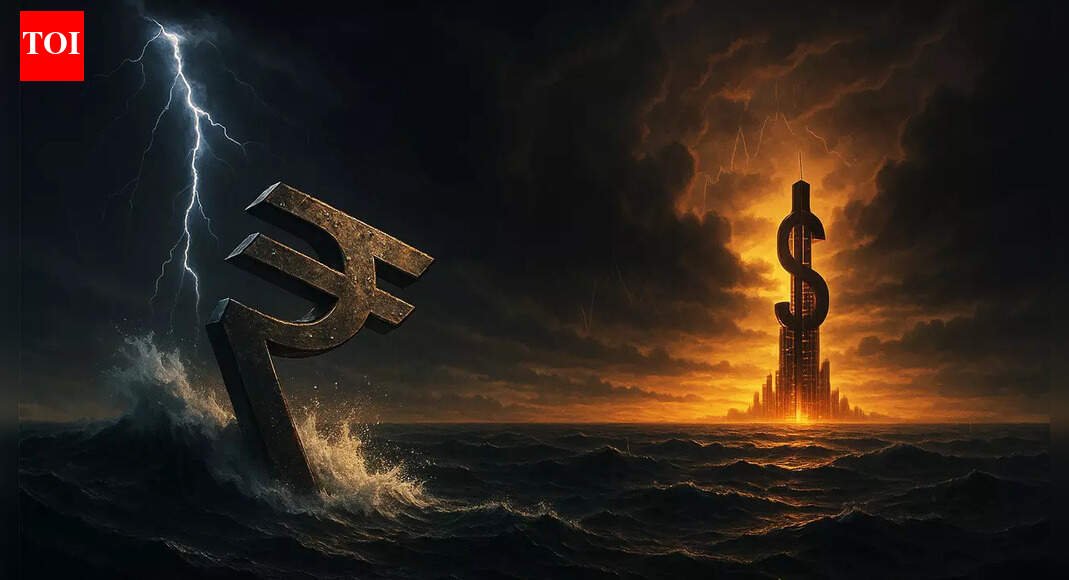
Rupee depreciation: Experts are of the view that this weakness may persist in the near term. (AI image)

The rupee has been in a downward spiral versus the US dollar – hitting new historical lows and even crossing the 90 mark. The depreciation has been steep, and even more on a real effective basis. In fact, the rupee is one of the worst performing major currencies. Experts are of the view that this weakness may persist in the near term, given the uncertainty of the India-US trade deal, and pressure on capital flows – and this can and will impact various macroeconomic variables in India, if it persists. A persistently weak rupee affects India through five major channels, influencing everything from inflation and imports to exports, corporate margins, and even investment decisions. While the short-term effects are mostly negative—such as raising costs and additional economic pressure—a weaker rupee can also support long-term growth by gradually shifting consumer and producer behaviour, encouraging more domestic output and improving export competitiveness, says BofA Securities in its latest report.

Rupee Slides To Record Low Of 90 Per Dollar As Trade Uncertainty, Dollar Demand And Oil Costs Spike

Rupee’s Depreciation vs Dollar: Some Startling Numbers

  • The rupee has depreciated against the dollar by 4.7% year-to-date in 2025, and over 5.8% in the last 1 year.
  • In Real Effective Exchange Rate (REER) terms, the weakness has been even larger, with year-to-date weakness at an estimated 8.6% until November, and 1-year weakness at 12.1%.
  • According to BofA Securities, this is a large amount of weakness both from the current episode and from a historical context, as the rupee had weakened something around 8.7% in 2018, 14% in 2013, and 18.7% in 2008, the previous episodes of large-scale depreciation in the rupee.
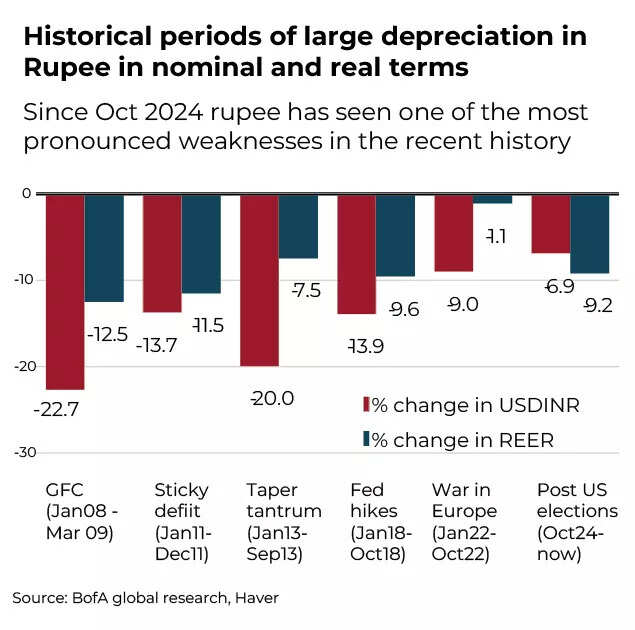
Historical periods of large depreciation in rupee in nominal and real terms

Historical periods of large depreciation in rupee in nominal and real terms

Despite recent expansion in the trade deficit, India’s current account deficit remains controlled. With crude oil prices ranging between $60-65/brl, approximately $15/brl lower than previous year’s average, the risk of energy costs affecting external financing needs appears limited.“This means the primary challenge has been on capital flows, and that has been an issue which remains multifaceted, and has been seen across FDI flows, FPI flows, and debt related inflows, which have to a certain extent stalled. Indeed, the RBI as per official data has sold $65 billion in the open market between October 24 to September 25, and is also running a large short forward book position of $63.6 billion until end October, which has probably increased in November given the extent of pressure on the rupee,” says BofA Securities.
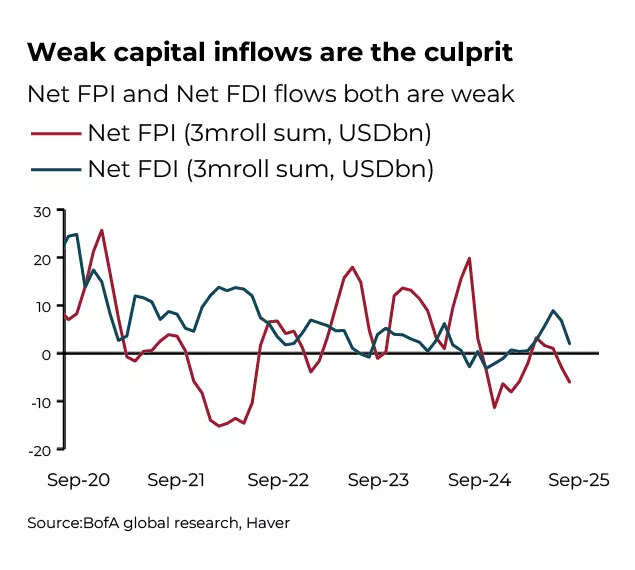
Weak capital inflows are the culprit

Weak capital inflows are the culprit

What does a weak rupee mean for the Indian economy? BofA Securities says that the economic impact of a weaker exchange is multifaceted, and the exchange rate influences several macroeconomic variables, through the interplay of sentiment, growth inflation and other balances.

First channel: Sentiment hit – possibly quick and large

According to BofA Securities, historically data suggests that a weak rupee causes a sentiment hit – which then tends to impact variables and key economic indicators – be it consumer confidence, business sentiment and policy uncertainty measurements, PMI. BofA’s analysis suggests that during periods of more than 10% weakness in the rupee, the catalyst for sentiment weakening could be seen in the data. “Given the extent of current weakness, it can feed through consumer sentiment and business sentiment potentially,” it warns.

Second channel: What happens to GDP growth?

The relationship between exchange rate and GDP is in several ways multifaceted. Several studies, including from the RBI, have documented the connections between exchange rates and GDP growth, examining both price and volume implications, specific component effects, and temporal aspects. The primary channel of impact of a weaker exchange rate comes through both exports and imports, which are the primary factors relying on the exchange rate to an extent, notes BofA.Let’s understand this better:The main effect of a weakened rupee manifests in import patterns – this can particularly affect discretionary and consumer-related imports. Research indicates that a 5% decline in RBI’s Real Effective Exchange Rate can result in a corresponding 2.3% reduction in imports. This in turn can push up GDP growth through the decreased import volumes.According to a study done by ministry of finance in 2023, the results of exports being meaningfully influenced by exchange rate weakness has been weakening in the recent years, but based on the results, the export sensitivity to 5% REER depreciation can typically increase exports by ~2%, implying almost a ~4% improvement in the current depreciation episode. BofA Securities quotes a recent RBI study which investigated the relationship between exchange rate fluctuations and trade balance, and concluded that rupee depreciation in real terms enhances the trade balance progressively. This impact appears more significant in periods of rupee’s depreciation compared to the appreciation periods.
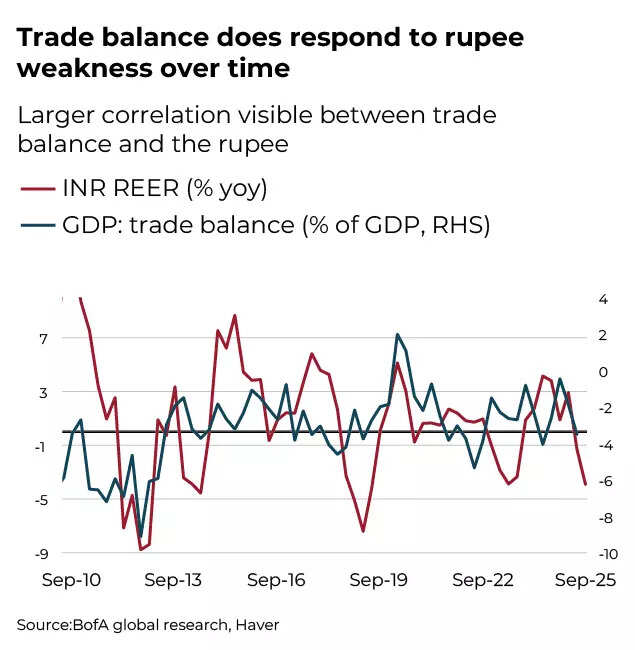
Trade balance does respond to rupee weakness over time

Trade balance does respond to rupee weakness over time

Their study showed that both in the short term and the long term, rupee depreciation does influence the trade balance positively, likely working more strongly through import demand compression, than through export improvement immediately.“Based on this study, if the current depreciation holds, the implied trade balance improvement could be as large as 5-7% of the trade balance which in current terms saves India almost $7-12 billion, in line with RBI’s study,” says the BofA report. “However, with the shadow of the weakness emanating from the tariffs imposed by the US, we believe the gains on the trade front, especially exports will be somewhat stunted, but the imports compression is still likely to play out, given the primary source of compression is on the domestic demand front, not external front,” it adds.

Third Channel: Inflation Trouble

This is one channel that can feed negatively into the economy, raising prices and hence, inflation. But, will that be the case for India? As per the BofA report, historically, the exchange rate – inflation nexus has always been strong in India, as typically rupee weakness can emanate from elevated inflation, which in turn can trigger more inflation.

Core CPI

Core CPI

This cycle however is not visible in the current scenario, and with typical channels of higher imported inflation appears to be relatively benign to cause any major inflation spiral, the report says,How does inflation get imported in times of rupee depreciation? There are three main channels:In today’s scenario, the comforting fact is that the fall in crude oil prices has been more drastic than the rupee’s depreciation. Further, even if crude oil prices rise at the margin, the government has kept the price of fuel in India elevated, over and above the implied prices based on crude oil levels, resulting in elevated gross marketing margins for oil companies, notes BofA.. “As such, even after a weaker exchange rate, the need to raise retail fuel prices will stay limited. This may not be the case for all energy products, or precious metals, which have been moving up, and the pass through will continue to be visible in the data,” it adds.

Gold prices

Gold prices

  • Intermediate and consumer goods

BofA is of the view that the ongoing deflationary trends in China have spread across the region, including India. This suggests that the effects of a weakened exchange rate may actually be limited. “This is visible as the persistent weakness in WPI inflation, which reflects input costs, and is much more sensitive to a weaker exchange rate and imported prices. Indeed, after a brief period, WPI inflation has been negative for an extended period, and in index terms, WPI index still remains below the highs seen in June 2022,” it says.Previous RBI analyses and current quarterly projection models indicate that a 5% reduction in REER can actually cause a 35-basis points rise in inflation across 3-4 quarters. This suggests that there could be a potential 60-70 basis points upward risk to inflation. However, considering the global economic context, this outcome seems unlikely in the current phase of rupee weakening, says BofA. According to the RBI, about 36.4% of the present inflation basket is directly or indirectly impacted by imported prices, which naturally may be impacted by a weaker exchange rate. Overall, while a large amount of rupee weakness is a precursor for higher inflation, the uniqueness of the global commodity price backdrop and the persistence of low food inflation can ensure that the pass through of a weaker exchange rate is somewhat less.The prospect of a favorable rabi crop sowing season will also further blunt the inflation impact, as volume growth will ensue even if input costs rise, the pass through will be somewhat quelled by large stocks availability.

Fourth channel: External Sector

On the external sector front, the long-term impact may actually bode well for the Indian economy. The impact on external finances is expected to be more noticeable through current account dynamics rather than capital account movements. Historical analysis suggests that trade balance actually improves – imports take a hit because they cost more and exports get a leg up because they are cheaper for the country that imports them.“For the implied trade balance, the improvement based on historical sensitivities can be anywhere between 0.8-1 times based on historical studies,” says BofA Securities. “However, the weakness in US trade activity, especially with exports, adds an element of uncertainty on the goods trade improvement that can typically be seen after every major correction in the rupee on real terms. This could mean that the typical “J – Curve” effect may not be as quickly visible in the data if rupee weakness persists, but eventually it should be seen, potentially in 2-4 quarters,” it adds.
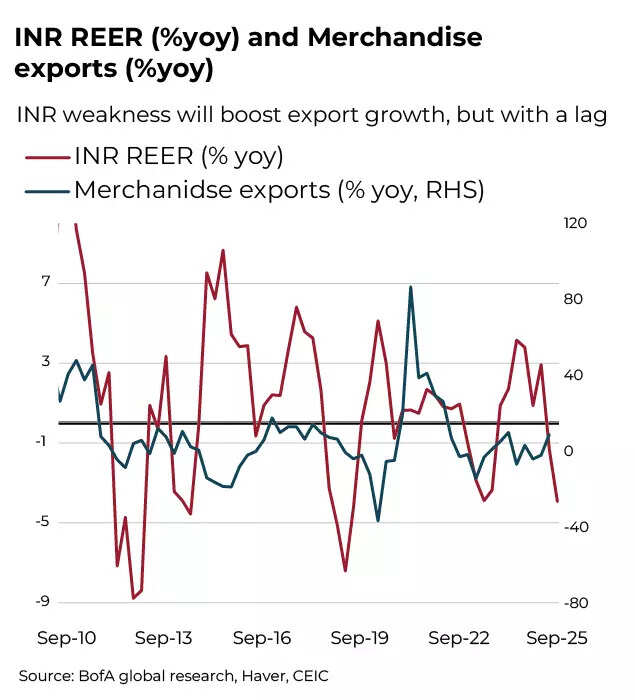
Rupee weakness can boost export growth

Rupee weakness can boost export growth

The depreciation of the rupee would significantly enhance competitiveness in services trade, although initial dollar surpluses might decrease as operational costs in India, particularly for GCCs, reduce.“This could mean lesser need to send operational capital, but over time could also result in a larger incentive to expand capacity given cost efficiencies. As per an RBI study, services exports improve by 0.8% for every 1% FX weakness over time. For other services items such as tourism and education, a weaker rupee would reduce incentives for outbound activity, but whether it can be seen meaningfully in a short time period is debatable,” says BofA.

INR REER and Secondary Income

INR REER and Secondary Income

The flow of remittances is a big positive of rupee depreciation. For remittances, bouts of a weaker exchange rate can result in a small period of lower inflows, but typically once the rupee depreciation stalls, it is followed by a meaningful increase in remittances flow, to use the better cross exchange rate. This is not the case with primary transfers, which typically is not impacted during currency fluctuations, the report says.“Overall, we believe the current account deficit tends to shrink over a period of time post a sharp bout of forex weakness, but that is more likely to be visible in the next 3-6 months, rather than the next 1-2 months. On the capital flows side, we do not see any meaningful impact of a weaker exchange rate on both FDI and FPI flows, but a weaker rupee can add to the public and private debt burden at the margin, especially if they are not matched fully from a forex hedging perspective. There will still be some increase in debt burdens, but we believe its implications will be relatively well managed,” it adds.

Fifth Channel: Does the fiscal situation pose a risk?

On the fiscal side of the economy, the implications of a weaker rupee are not immediately clear. This is especially so since the government no longer subsidizes fuel consumption meaningfully, outside of LPG products. Whilst LPG subsidies might increase marginally, fertiliser subsidies are likely to experience a more substantial rise due to currency depreciation.

Subsidies

Subsidies

The important thing is that the current rupee depreciation, combined with RBI’s ongoing market interventions, is likely to enhance the central bank’s foreign exchange earnings. This could result in increased RBI dividend payments in fiscal year 2026-27, offering potential revenue support.“This will be a similar dynamic to the weakness in rupee seen last year, potentially with a larger intensity, given the extent of intervention this year has been much larger in selling foreign exchange, which typically yields the RBI profits. As such, the overall fiscal impact remains unclear to us, as there are positive and negative aspects of the exchange rate weakness in our view,” BofA Securities says.

Where is the rupee headed?

The India-US trade deal is a key factor in ongoing weakness in rupee, and an effective resolution may pave the way for a relatively stronger rupee compared to the present scenario.BofA analysts are of the view that the rupee still remains dependent on portfolio flows next year after large equity outflows this year partly driven by tariffs. “Finalization of trade deal to reduce the tariffs would be important in reducing uncertainty for equity investors,” it says. “Further pick-up in growth momentum would be another key factor for next year which may support corporate earnings and ease equity valuation concerns,” it adds.Given this uncertainty, BofA believes that the central bank’s management of rupee levels will be key. “RBI’s reserves remain adequate, but continued portfolio outflows could make these operations unsustainable or build-up of RBI’s short dollar forward positions may skew return expectations on the rupee,” it says.“Overall, we believe dollar weakness next year would still support mild rupee appreciation and that could pick-up pace around the seasonally favorable first quarter for the rupee. We forecast the rupee to reach 86/USD by end-2026, in line with dollar weakness next year,” it says.Even though the RBI has been letting the rupee weaken to reduce pressure on the exchange rate markets, BofA believes that the RBI will likely stay involved in both the spot and forwards market, providing liquidity and curbing volatility. “Indeed, in the latest RBI meeting, the governor clearly stated that the tolerance for rupee volatility has not changed for the RBI, in our view, and we would expect them to remain visible, and smoothen out the direction of the move, without necessarily anchoring any specific level. This has been the strategy through 2025, where RBI has opportunistically sold and bought foreign exchange, when it could, and if inflows return in a meaningful way, we believe the RBI may also have a preference to rebuild its external buffers,” it adds.


Source link

Sanskrit in Pakistani university: In a 1st since partition, ancient language to be taught in college; Mahabharat, Gita on the cards


Sanskrit in Pakistani university: In a 1st since partition, ancient language to be taught in college; Mahabharat, Gita on the cards

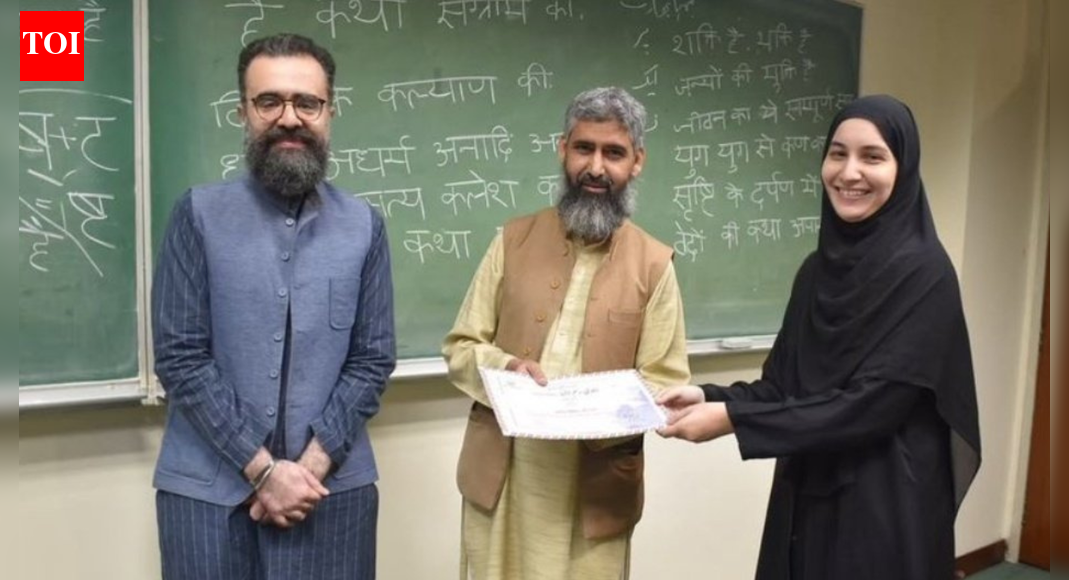
In a first since partition, a course on ancient language Sanskrit has been introduced in a university in Pakistan, The Tribune reported. The Lahore University of Management Sciences (LUMS) has introduced the course, with Hindu mythologies like Mahabharat and Gita on the cards too. “People ask me why I’m learning Sanskrit. I tell them, why should we not learn it? It is the binding language of the entire region. Sanskrit grammarian Panini’s village was in this region. Much writing was done here during the Indus Valley Civilisation. Sanskrit is like a mountain–a cultural monument. We need to own it. It is ours too; it’s not tied to any one particular religion,” The Tribune quoted associate professor, Shahid Rasheed, who is at the heart of the initiative saying. “A significant collection of Sanskrit palm-leaf manuscripts were catalogued in the 1930s by scholar JCR Woolner, but no Pakistani academic has engaged with this collection since 1947. Only foreign researchers use it. Training scholars locally will change that,” the news outlet quoted the director of the Gurmani Centre, Ali Usman Qasmi, saying.“In 10-15 years, we could see Pakistan-based scholars of the Gita and the Mahabharata,” Qasmi added.The Sanskrit course began as a three-month weekend workshop only to eventually become a four-credit university course after it received an overwhelming response. “After we saw the response, we decided to introduce it as a proper university course. Even though the number of students is still small, we hope it will grow over the next few years. Ideally, by spring 2027, we should be able to teach the language as a year-long course,” the director said.


Source link

CR plans mega block for razing Elphinstone Road bridge in Mumbai over Jan 25 weekend | Mumbai News


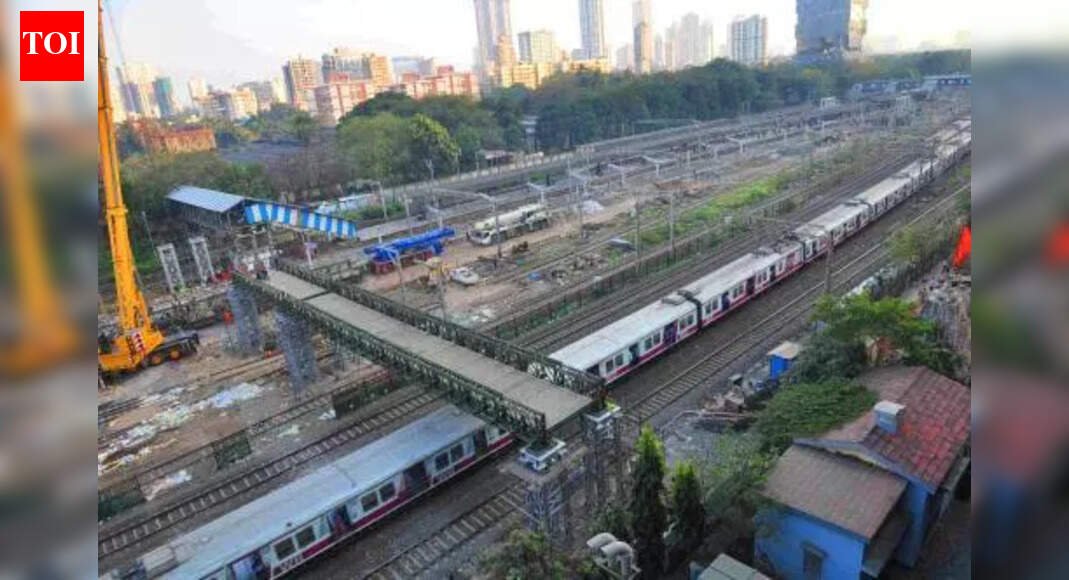
Mumbai: Central Railway is likely to impose a major block over the weekend of Jan 25, to facilitate demolition of the Elphinstone Road bridge, a crucial structure that must be removed for the construction of the Sewri–Worli Connector. With Monday being a Republic Day holiday, officials said the long weekend offers the most suitable window to undertake the work while minimising disruptions to daily commuters. The bridge, located between Parel and Prabhadevi stations, spans both the Western Railway and Central Railway mainline corridors. Its demolition requires a coordinated shutdown of rail operations across the two zones, along with strict safety protocols. Maharail, which is executing the demolition on behalf of MMRDA, had initially requested a 20-hour block. However, after joint inspections, machinery optimisation and sequencing of key activities, the required duration has now been reduced to roughly 13 to 15 hours.“The revised plan ensures the demolition can be completed safely and efficiently while keeping the impact on suburban and long-distance services to a minimum,” said a senior official. The Sewri–Worli Connector is a critical missing link that will provide seamless east–west connectivity between the Mumbai Trans-Harbour Link and the western seafront. Removal of the Elphinstone Road bridge is essential for the next phase of pier and ramp construction. CR and WR are expected to finalise the block schedule shortly, following coordination meetings, to manage train regulation, equipment deployment and emergency response arrangements. Advance advisories will be issued for commuters, and only limited cancellations are anticipated.


Source link

Who is Jeff Shiver, the father of Paige Shiver, whose name has sent cyberspace shock waves after her alleged link to Michigan HC Sherrone Moore? | NFL News


(Image via X: Jeff Shiver, Paige Shiver, and family)

On December 10, Jon Rhoades of The Big Ten Huddle shared a swirl of rumors, much of it traced back to Justin Spiro (Host of “The Spiro Avenue Show”), who first broke news about former head coach Sherrone Moore. Spiro had been hinting since mid-August, even before the season began, that Moore could face serious trouble or even be fired by the University of Michigan. After the Ohio State game, Spiro predicted Moore’s dismissal could come within a week or as late as two months. The heart of the rumor is that Moore was fired due to an alleged relationship with Paige Shiver, his executive assistant, who was promoted when Moore took over for Jim Harbaugh. Now, the latest twist claims Shiver is pregnant and that Moore is confirmed as the father. Paige Shiver’s news has sent shock waves through cyberspace. But Shiver’s ties to football run deeper than college sidelines. She is the daughter of Jeff Shiver, a respected NFL scout. To understand her father’s story, let’s revisit Dan Pompei’s 2019 biographical interview in The Athletic.

Jeff Shiver was cooking a hamburger when he got a call about joining the Chicago Bears

Sherrone Moore Fired & Arrested – Breaking Down Shocking Rumored Details with Insider Information

On a spring day in 1987, Jeff Shiver was flipping a hamburger in his Lafayette, Indiana, kitchen when the phone rang with a call that would change his life. Bill Tobin, the Chicago Bears’ personnel chief, was on the line, offering Shiver a chance to join the NFL’s scouting ranks. At the time, Shiver was earning $18,000 a year as a BLESTO scout, but Tobin’s offer of $25,000 felt like striking gold. Shiver eagerly accepted, feeling as if he had just won the lottery. As they sealed the deal with a handshake, Tobin promised, “You’re going to be with the Bears a long time.” More than three decades later, Shiver is still a fixture in Chicago, outlasting every other personnel man in the team’s hundred-year history. Only Scott DiStefano has served (five years) longer as a continuously employed NFL scout for the Denver Broncos. From fullback Brad Muster in 1988 to running back David Montgomery in 2019, Shiver has played a role in every Bears draft pick.“Jeff worked out even better than I thought,” Tobin said via The Athletic in 2019. “He’s a wonderful person and damn good scout. He’s been a giant in the scouting industry.”“I think the world of him,” said former Bears general manager Jerry Angelo. “I don’t know of anybody more respected and or revered in the scouting business than Jeff. I saw it from afar when I was with other teams, and I saw it firsthand when I got to Chicago. Whatever he says, you can take it to the bank.”

Jeff Shiver credits his wife Laura for his three-decade-long commitment to Bears front office

Shiver credits his impeccable endurance to his faith and to Laura, his wife of 34 years (at the time of the 2019 The Athletic interview, now they’ve been together for roughly 40 long years). “It’s a hard job,” Shiver said. “To be able to do it begins with a great wife. Not once did I walk in the front door and hear her complain about me not being there.” Laura’s patience is all the more monumental given that Shiver spends up to 275 nights a year away from home, crisscrossing the country in his Ford Edge and tallying about 30,000 miles annually. Life on the road has brought him moments of pure bliss, like hearing, “Honey, I think I’m pregnant,” and heartache, like learning, “Your brother-in-law was in a car accident, and he didn’t make it.” His fondest travel memories are the late-night phone calls from his young children, Brittany, John, Paige, and Nicole, soft voices asking, “Dad, when are you coming home?”

David Montgomery reminds Jeff Shiver of Matt Forte

The former Bears general manager, Ryan Pace, told The Athletic in 2019 that Shiver’s experience on the staff is invaluable. Think about the relationships he’s built and the resources he has. He can call people and get information that a younger scout can’t. He also has a mental library of players. In a draft meeting, he’ll quickly point out when one player reminds him of another and explain why. Sometimes, he’ll mention players from way back that nobody else remembers. David Montgomery reminds Shiver a bit of Matt Forte. He does a great job of describing players. He has a million one-liners that make everyone laugh. He brings passion and energy while keeping things fun.Rod Graves, the former Bears personnel director, told The Athletic in 2019 that he always relied on Jeff for core evaluation. He would be shocked if Ryan (Pace) and those who followed did not lean on Jeff in the same way. Shiver was the definition of dependability, an astute evaluator, and someone Graves trusted without a doubt. Few people ranked higher on his list, both as friends and as professionals. Graves has only praise for Shiver and says with complete honesty that he loves the man.

Jeff Shiver always appreciates everyone he encounters

Dan Pompei of The Athletic revealed in 2019 that one of the earliest and most profound lessons Shiver absorbed as an NFL scout was to appreciate everyone he encountered, not just those with influence or something to offer. He made it a point to value the everyday people: the gas station attendant, the custodian, the security guard. Shiver’s philosophy was simple: the mission never outweighs the people you meet along the way: “The mission never is greater than the people you come in contact with.Pompei also painted a picture of Shiver’s upbringing, shaped by his late parents, John and Myrtle. Jeff inherited his strong work ethic from his father, who spent over 80 years as an auto mechanic at Shiver’s Auto Service, often working twelve-hour days, six days a week. During World War II, John served as a flight engineer and gunner in the Army Air Corps. Meanwhile, Myrtle managed the books and cared for Jeff and his two sisters.Talking to Pompei in 2019, Jeff said he still feels his mother’s love when he bakes her Sour Cream Pound Cake. And when the call came that brought him to the Bears’ front office, he was in the middle of cooking a hamburger. Distracted by the life-changing news, he burned it, but as he told Pompei, it was still the best burger he ever tasted: “By far, the best burger I ever tasted.” Jeff Shiver currently serves as Executive Scout for the Chicago Bears. Since 1987, Shiver has been a staunch presence with the Bears. His decades of commitment were commemorated in February 2020, when he received the first-ever C.O. Brocato Award for Distinguished Service to Scouting. This prestigious honor pays tribute to a legendary scout who dedicated four decades to the Houston Oilers, now known as the Tennessee Titans, and inspired countless others in the profession. “It’s such an honor, it’s beyond belief,” Shiver said in his acceptance speech at the Indiana Convention Center.Also Read: Is Paige Shiver pregnant? Could a secret pregnancy from Sherrone Moore’s ‘inappropriate relationship’ have triggered the Michigan Coach’s downfall? Here’s what we know so far


Source link

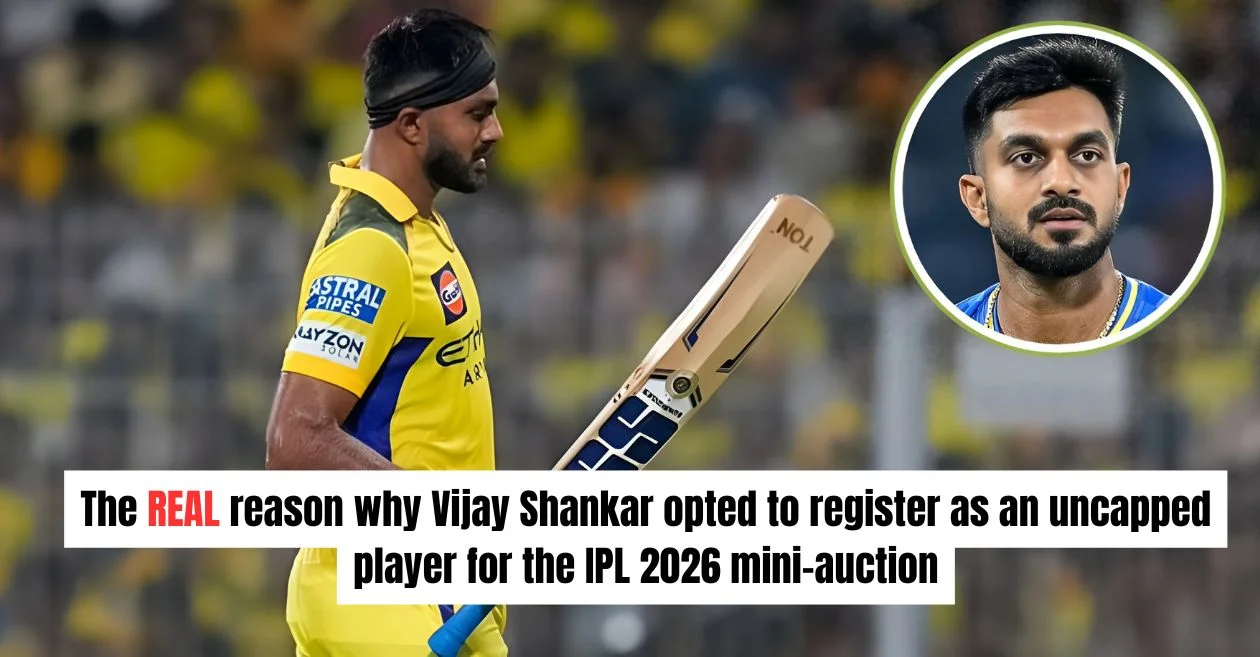
IPL 2026: Here’s why Vijay Shankar chose to register as an uncapped player for the mini-auction


The inclusion of former India all-rounder Vijay Shankar in the uncapped players’ category for the IPL 2026 mini-auction has become one of the most unexpected talking points leading up to the December 16 event. Despite having previously represented India in both ODIs and T20Is, his reclassification has sparked considerable curiosity among fans and franchises alike.

Why Vijay Shankar decided to enter the IPL 2026 mini-auction as an uncapped player?

Shankar’s ability to list himself as an uncapped player, despite his international experience of 12 ODIs and 9 T20Is, is governed by an IPL regulation introduced ahead of the 2025 season. This rule specifically applies to Indian players and allows a previously capped international to be classified as uncapped if two conditions are met: First, the player must not have been featured in the starting XI for India across any format, Tests, ODIs, or T20Is, in the last five calendar years preceding the auction year; and Second, the player must not hold a current BCCI central contract.

Shankar’s last appearance for the Indian national side was during the 2019 World Cup (Last ODI: June 2019, Last T20I: February 2019). By the time of the 2026 auction, he will be comfortably beyond the five-year cutoff, and having no central contract, he perfectly meets the criteria. This regulation was notably first applied to legends like MS Dhoni and veteran pacer Sandeep Sharma, enabling their retention at specific uncapped salary levels and establishing a clear precedent for Shankar’s current classification.

Also READ: BCCI updates IPL 2026 players auction list with last-minute changes; Swastik Chikara among 9 new players – check out the names and base prices

IPL 2026 auction outlook and and Vijay Shankar’s financial appeal 

Shankar enters the auction pool listed in the seventh set, which is dedicated to uncapped all-rounders, alongside other domestic names such as Kamlesh Nagarkoti and Mahipal Lomror. His base price of the minimum Rs 30 lakh is a critical factor in his appeal to franchises. While his recent form, including a modest campaign for Tripura in the Syed Mushtaq Ali Trophy following his release by Chennai Super Kings (CSK), does not position him as a marquee signing, his low base price minimizes the risk for any potential buyer.

At 34 years old, his value now lies in his considerable experience in big-match IPL situations and his versatility as a right-handed batter who can bowl reliable medium pace, offering critical squad depth and balance. For teams looking to fill their roster with economical, experienced Indian all-rounders without impacting their budget significantly, Shankar represents an appealing, low-cost option. His uncapped status combined with his proven, albeit inconsistent, track record ensures he remains a fascinating and viable pick for the upcoming bidding war in Abu Dhabi.

Also READ: IPL 2026 Auction: Players with highest base price of INR 2 crore – Cameron Green to Venkatesh Iyer


Source link

Access Denied


Access Denied

You don’t have permission to access “http://www.ndtv.com/india-news/does-sanchar-saathi-spy-on-you-what-the-apps-forensic-analysis-shows-9799516” on this server.

Reference #18.14092017.1765549830.4170526c

https://errors.edgesuite.net/18.14092017.1765549830.4170526c


Source link

PM Modi, Shubman Gill, fashion show: Lionel Messi’s ‘GOAT India Tour’ has everything but football | Football News


PM Modi, Shubman Gill, fashion show: Lionel Messi's 'GOAT India Tour' has everything but football
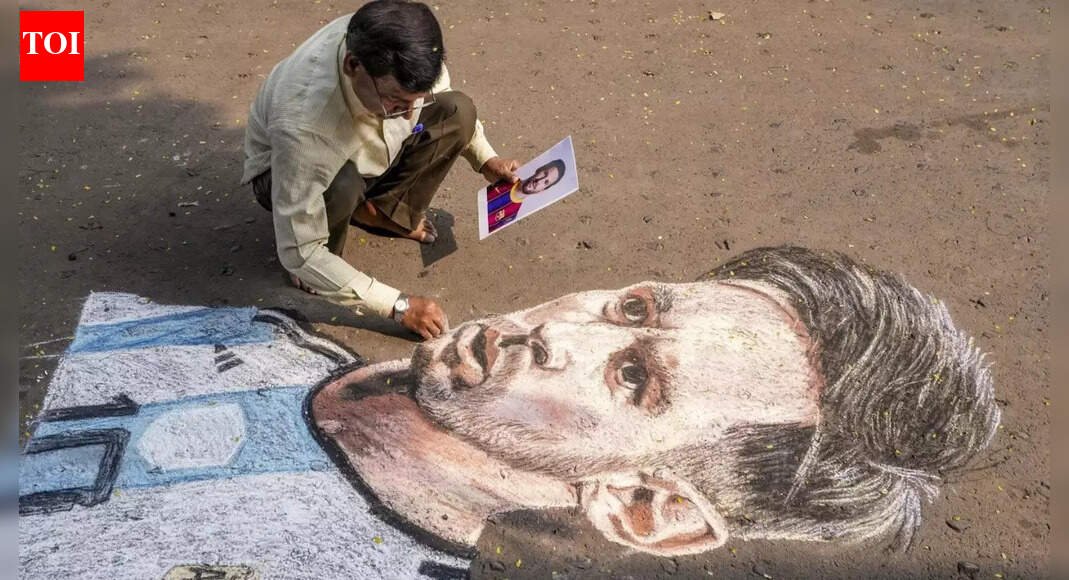
Artist Swapan Kumar Das draws a portrait of Argentine footballer and 2022 FIFA World Cup winning captain Lionel Messi ahead of his visit, in Kolkata, West Bengal. (PTI Photo)

Lionel Messi is returning to India after his first visit in 2011, but this trip will not involve any competitive football. His 2011 appearance at the Salt Lake Stadium drew more than 85,000 people who watched Argentina beat Venezuela 1-0 in a FIFA friendly. This time, his schedule under the ‘GOAT India Tour 2025’ is limited to events and appearances, beginning on Saturday in Kolkata and ending on Monday in New Delhi.Messi will not play a match during the tour. The event is promotional and commercially planned. Kolkata, which has welcomed football icons including Maradona, Pele, Dunga and Ronaldinho, will host him again.Organisers have opened 78,000 seats at the Salt Lake Stadium, with ticket prices going up to Rs 7,000 for a 45-minute appearance on Saturday morning.Messi will be in India for less than 72 hours and will travel to Kolkata, Hyderabad, Mumbai and Delhi. His schedule includes meetings with chief ministers, business leaders, film personalities and a planned meeting with Prime Minister Narendra Modi. India’s Test and ODI captain Shubman Gill, who has spoken about admiring Messi, is also expected to meet him after the Dharamshala T20I on December 14.Messi’s last India trip on September 3, 2011, remains a key memory for fans who watched him lead Argentina in a friendly.

Events planned across cities

The main event of the tour is a 45-minute charity fashion show in Mumbai on Sunday with Messi, Luis Suarez and Rodrigo De Paul.“There will be celebrity models, cricketers, Bollywood celebrities, millionaires, founders. Tiger and Jackie Shroff, John Abraham among others,” said Satadru Dutta, promoter of the tour.The organisers have requested Messi to bring “some memorabilia” of his trophy-winning 2022 World Cup campaign which will be auctioned during the Mumbai leg. Before the Mumbai event at Wankhede Stadium, there will be a Padel Cup at the CCI.Kolkata will welcome Messi on Saturday. He will stay at a hotel on EM Bypass and attend a sponsor-only event in the morning. A new ‘Messi landmark’, a 70-foot statue near the Sreebhumi Clock Tower, will be inaugurated virtually from his hotel after police declined permission for a public event. A Messi mural, 25ft x 20ft, planned for next year’s Durga Puja, will also be unveiled and later handed to him at Salt Lake Stadium.Messi will fly to Hyderabad at 2 pm. The stop was added after a planned friendly in Kochi was cancelled. In Hyderabad, he will attend the GOAT Cup, supported by Telangana chief minister Revanth Reddy, which will include a 7v7 celebrity match, penalty shootouts, a masterclass for young players and a musical event.The final stop is Delhi, where he will meet Prime Minister Narendra Modi.Young players from Minerva Academy, who won the Gothia Cup, Dana Cup and Norway Cup this year, will be honoured in his presence. A nine-a-side celebrity match is also planned.

Kolkata’s long football history

Messi’s visit adds to Kolkata’s long record of hosting major football names. In 1977, Pele and New York Cosmos played a 2-2 exhibition against Mohun Bagan. Pele returned in 2015 and told the crowd: “You can never have another Pele.”Other past visitors include Dunga, Bebeto, Mauro Silva and Colombia’s Rene Higuita, who showed his ‘scorpion kick’ in 2012. Oliver Kahn’s farewell match in 2008 drew more than one lakh spectators.Diego Maradona’s visits in 2008 and 2017 brought large crowds, and Diego Forlan was welcomed in 2010 soon after his Golden Ball-winning World Cup performance.

Criticism over a ‘handshake visit’

Some former Indian footballers have criticised the tour and expressed disappointment over not being invited.Former India and Mohun Bagan midfielder Gautam Sarkar, who marked Pele in 1977, said, “These are nothing but gimmicks. Messi is coming only to do a handshake… Pele had come here and actually played with us.”He added, “Instead of bringing Messi, our focus should be on how to improve football in the country. We must give utmost priority to Indian football and bring back the glory of the past.”Former India defender Subrata Bhattacharya also said he felt “insulted”.


Source link

Coal policy reform: Cabinet okays CoalSETU window for auction-based linkages; new route to allow industrial use and export


Coal policy reform: Cabinet okays CoalSETU window for auction-based linkages; new route to allow industrial use and export

The Cabinet Committee on Economic Affairs on Friday approved a new policy framework called the CoalSETU window, creating an additional auction route for long-term coal linkages for any industrial use and exports, according to an official release.The decision modifies the existing Non-Regulated Sector (NRS) Linkage Auction Policy of 2016, which restricts linkages to specified end-use sectors. The government said the new window will “allow allocation of coal linkages on auction basis on long-term for any industrial use and export,” while clarifying that coking coal will not be offered under this route.According to the release, the reform is aimed at improving ease of doing business, enabling accelerated utilisation of domestic coal reserves and reducing dependence on imports. “There was a need to have a fresh look at the current arrangements of coal supplies to the NRS and extend the linkages to coal consumers without any end-use restrictions,” the government said.Under CoalSETU, any domestic buyer—barring traders—will be eligible to participate. Linkages obtained under the window may be used for own consumption, export (up to 50% of the allocated quantity) or other permitted purposes such as coal washing, but resale within India will not be allowed. The government said washery-linked allocation would “result in increased availability of washed coal in the country and consequently reduce imports.Existing auctions for the specified NRS end-user categories — such as cement, steel (coking), sponge iron, aluminium and captive power plants — will continue. These end users may also participate in the new window.The release noted that falling imports and better utilisation of domestic reserves remain key priorities. In line with commercial mining reforms, the expanded auction mechanism for linkages removes earlier end-use restrictions and allows group companies flexibility in utilising the coal.


Source link