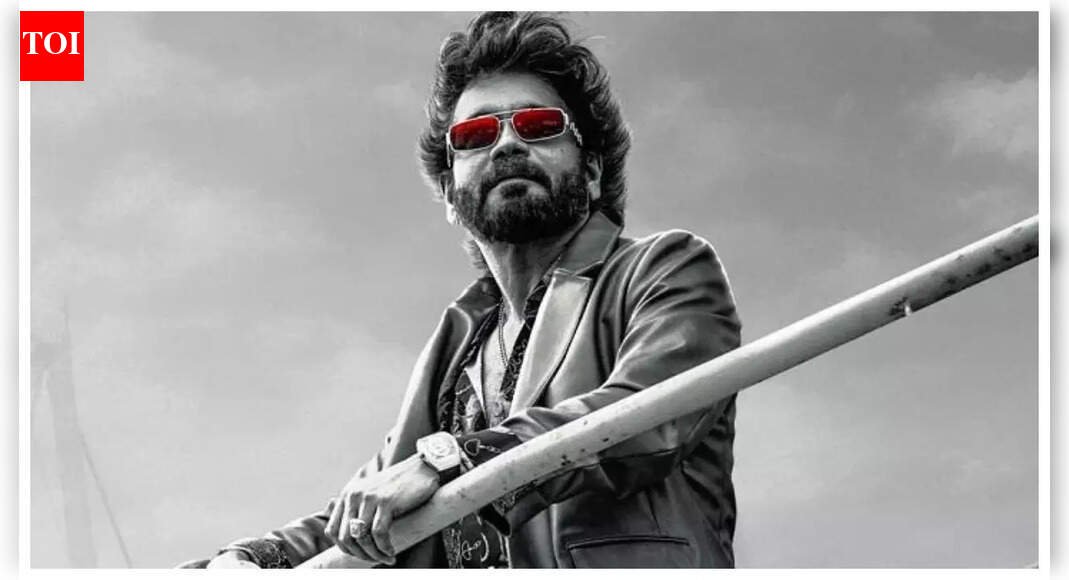
Court orders Mumbai sellers to vacate flat after 13-year delay | Mumbai News


Mumbai: In a relief for a flat purchaser who has had to wait for 13 years to take possession of a flat he had purchased, a civil court has ordered two residents of Goregaon to vacate a residential flat they had continued to occupy for over a decade after selling it.The sellers had doubled the price to Rs 1.38 crore despite the agreed amount of Rs 71 lakh already being paid by the buyer. The judgment marks the conclusion of a legal battle that began in 2016, ending with a clear declaration of ownership in favor of the purchaser and a stern rebuke of the sellers’ “unlawful” occupation. “…there is absolutely no evidence of oral agreement whereby the consideration amount was fixed at Rs 1.38 crore.

Mumbai Headlines Today — The Biggest Updates You Need to Know.

Mangilal Jain approached the court after Gajendra Jain and Kiran Jain refused to hand over possession of the flat, despite having executed a registered agreement for sale in May 2013. The dispute centered on a 675 square foot property located at Rekha Villa in Jawahar Nagar. During the proceedings, the sellers attempted to justify their continued occupation by claiming that the actual purchase price was orally agreed to be Rs 1.38 crore, rather than the Rs 71 lakh recorded in the official documents. They alleged that the buyer still owed them 77 lakhs. However, the judge dismissed these claims due to total lack of evidence. The court noted that the buyer had effectively proved the payment of over 71.47 lakhs through documentary evidence, while the defendants failed to provide any proof of a revised oral agreement.The court heard how the buyer had not only paid a substantial sum directly to the sellers but had also cleared their outstanding mortgage with a private bank to facilitate the transaction. There is also no evidence to show that the plaintiff (flat purchaser) is in arrears of Rs 10 lakh towards the original consideration amount. The particulars of payment made by the plaintiff to defendant… (flat sellers) is produced... It shows that the plaintiff paid Rs 71 lakh to defendant nos 1 and 2.“I am of the view that the plaintiff is owner of the suit property and defendant nos 1 and 2 are in unlawful possession of it,” the judge said. The judge further observed that once the agreement for sale was executed and the consideration paid, the original owners “left no interest in the suit property,” rendering their refusal to leave a violation of the buyer’s rights.The court has now granted the defendants a two-month window to voluntarily hand over vacant and peaceful possession of the flat. Should they fail to comply, the buyer is authorized to secure the property through a court officer. Further, the judge ordered an inquiry into mesne profits—compensation for the period the buyer was deprived of his property—and directed the housing society to officially transfer the share certificate to the new owner.Concluding the judgment, the court ruled, “It is hereby declared that the defendant nos 1 and 2 are in unlawful possession of the suit property,” and ordered them to pay the legal costs incurred by the plaintiff.


Source link

Delhi airport assault case: Air India Express Pilot arrested weeks after thrashing passenger | Delhi News


NEW DELHI: Police has arrested an off-duty Air India Express pilot in connection with an alleged assault on a passenger at Indira Gandhi International (IGI) Airport’s Terminal 1, days after the incident sparked outrage on social media and prompted a government-ordered probe.The accused, identified as Captain Virender Sejwal, was arrested following an investigation into the incident that occurred on Dec 19, when he allegedly assaulted Ankit Dewan, a passenger travelling with his family.Confirming the arrest, Additional Commissioner of Police (IGI) Vichitra Veer said, “In the process of investigation, after the registration of the case, the relevant CCTV footages had been collected and statements had been recorded. The accused was also called for questioning and his arrest was effected a few days back.”According to police, the altercation took place near the staff entry gate at Terminal 1. Dewan, who was travelling with young children and luggage, was reportedly directed by CISF personnel to use the staff entry. Captain Sejwal, who was “deadheading” to Bengaluru to operate another flight, was also using the same gate.An argument allegedly broke out when Dewan questioned crew members moving ahead in the queue. The verbal exchange escalated, and the pilot allegedly assaulted the passenger, following which CISF personnel intervened and separated the two.Dewan was asked at the airport if he wished to file a police complaint but declined in writing at that time and proceeded to his destination with his family. The pilot also continued his journey.However, after reaching his destination, Dewan shared details of the incident on social media, alleging he was physically assaulted, left bleeding, and had to seek medical attention. He also said his young daughter was traumatised by the incident.The Ministry of Civil Aviation took serious cognisance of the matter and ordered a probe, directing Air India Express to ground the pilot with immediate effect. Reports were sought from the Bureau of Civil Aviation Security (BCAS) and the Central Industrial Security Force (CISF).Air India Express, in a statement, condemned the incident and said the pilot had been removed from flying duties pending inquiry. “Appropriate disciplinary action will be initiated based on the findings of the investigation,” the airline said.Delhi Police is continuing its investigation, examining CCTV footage, witness statements, and medical records. Authorities are also looking into airport crowd management and why the situation was not defused earlier.


Source link

CSK’s new recruit delivers the most expensive figures in List A cricket


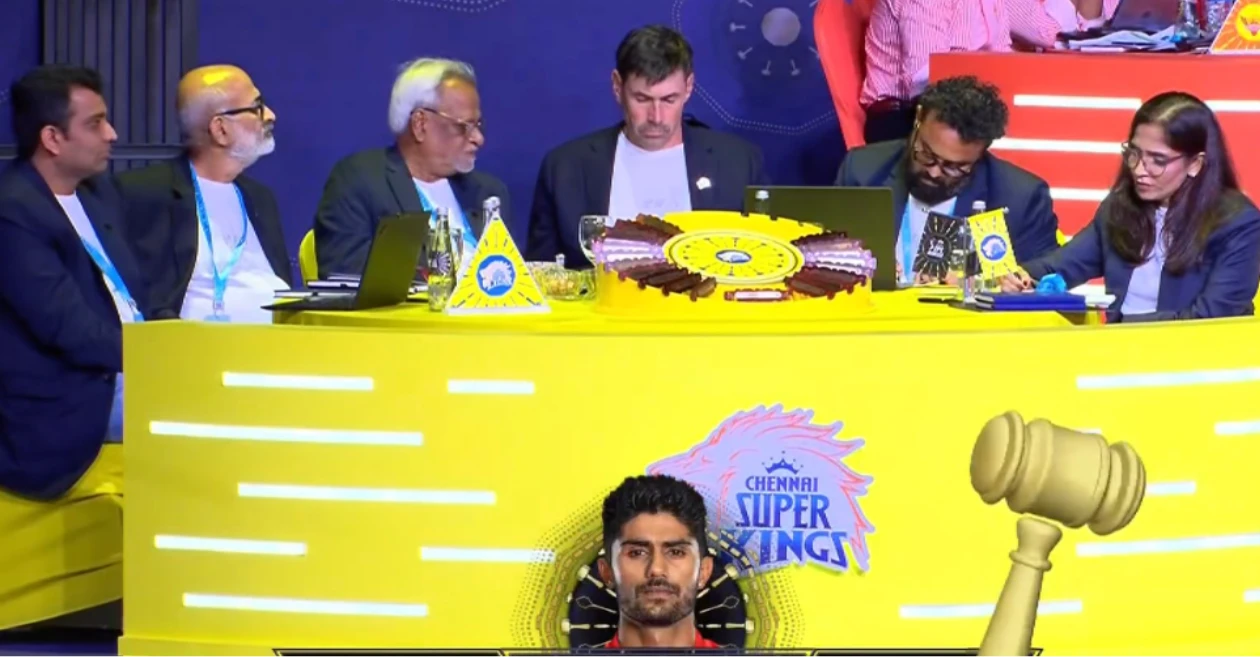
Puducherry captain Aman Khan, who recently grabbed headlines after being picked by Chennai Super Kings (CSK) at the IPL 2026 auction, found himself in the spotlight for an entirely different reason during a Vijay Hazare Trophy 2025-26 match. The encounter against Jharkhand, held in Ahmedabad, turned into a challenging day for the all-rounder as he ended up setting an unwanted record in men’s List A cricket.

Winning the toss, Puducherry opted to bowl first, hoping his side could exploit early conditions. However, the decision did not go according to plan as Jharkhand’s batters dominated proceedings from the outset, putting Puducherry under sustained pressure throughout the innings.

Jharkhand pile on the runs against Puducherry 

Jharkhand posted a massive total of 368 for 7 in their allotted 50 overs, thanks to several standout batting performances. Utkarsh Singh anchored the innings with a solid 74, providing stability at the top. Skipper Kumar Kushagra led from the front, scoring a commanding 105 that included 10 boundaries and two sixes, showcasing both patience and power.

The real momentum shift came from Anukul Roy, who played a blistering unbeaten knock of 98 off just 53 balls. His innings featured seven fours and eight towering sixes, completely dismantling the Puducherry bowling attack in the death overs. Mohammad Kounain Quraishi also chipped in with a brisk 43 from 35 deliveries, ensuring Jharkhand finished with one of the highest totals of the tournament season.

Puducherry’s chase falls short

Facing a daunting target, Puducherry never truly looked in control of the chase. Jashwanth Shreeram offered some resistance with a fighting 60, while Neyan Shyam Kangayan contributed 47. Despite these efforts, wickets kept falling at regular intervals, and the required run rate quickly spiraled out of reach.

Ultimately, Puducherry were bowled out for 235, suffering a heavy defeat by 133 runs. While the loss itself was significant, the match will be remembered more for what unfolded during Jharkhand’s innings.

Record-breaking spell for Aman Khan

The focus of the cricketing world turned to Aman Khan after he finished with figures of 10 overs, 1 wicket, and 123 runs conceded. This spell is now officially the most expensive in the history of men’s List A cricket. The previous record was held by Arunachal Pradesh pacer Mibom Mosu, who had conceded 116 runs in nine overs against Bihar last month.

Also READ: Vaibhav Suryavanshi shatters AB de Villiers’ world record with blistering 190 in Vijay Hazare Trophy

Aman’s IPL journey so far

Despite this setback, Aman’s career trajectory remains noteworthy. Bought for INR 40 lakh at the IPL 2026 auction, he has already represented multiple franchises. After making his IPL debut with Kolkata Knight Riders (KKR) in 2022, he featured for Delhi Capitals (DC) in 2023 before landing with Chennai for the upcoming season.

Across 11 IPL matches over two seasons, Aman has scored 115 runs at a strike rate of 110.57, including one half-century. His bowling opportunities in the league have been limited so far, with just one over bowled and no wickets to his name.

While the Vijay Hazare Trophy outing was one to forget, the coming months will be crucial for Aman Khan as he looks to regroup, refine his skills, and justify the faith shown in him ahead of IPL 2026.

Also READ: Dhruv Jurel notches highest List A score of his career in Vijay Hazare Trophy clash


Source link

SC dismisses plea by wife, orders payment of Rs 5 lakh to orphanage in Maharashtra | Mumbai News


Mumbai: The Supreme Court dismissed three special leave petitions filed by Poonam Shroff, seeking to challenge a Bombay high court order in a decade-long high stake divorce battle with estranged husband Jaidev Shroff, global CEO of UPL Ltd, and directed her to pay Rs 5 lakh to an orphanage in Maharashtra run by the state. “It is a classic case where a matrimonial dispute proceeded at a snail’s pace on account of the egos of the parties and is a mirror to the fact that it can reach these heights,” said Justices Aravind Kumar and N V Anjaria in a recent order.The SC three-Judge bench of then CJI Bhushan Gavai, Justices N V Anjaria and Alok Aradhe, on Aug 29 granted a final three-month extension for the Mumbai family court to decide the pending divorce petition. The family court requested the HC registry for a nine-month extension to decide the dispute.She sought permanent alimony of Rs 1,000 crore in the divorce proceedings.The SC, after hearing senior counsel Shyam Diwan and Vikas Singh for the wife, and senior counsel AM Singhvi with advocate Sameer Tapia for the husband, said the “parties seem more interested in multiplying litigation than putting an end to the saga.” The reasons for its observation, the top court said, were varied and based on facts narrated by the HC Judge who “painstakingly traced the history of the litigation” starting from a divorce petition filed by the husband in 2015. The SC appreciated the painstaking order of the HC Judge.She challenged an order passed by Justice Manjusha Deshpande of the HC, who found no reason to interfere with a January 2025 order of the Mumbai family court at Bandra and dismissed her petition seeking consolidation of proceedings. She wanted to club her maintenance plea with his divorce petition. The family court declined, and the HC said the family court made no error.The HC said the evidence in the divorce proceedings filed by the husband substantially progressed, whereas the proceedings for maintenance filed by the wife were still at an initial stage. “The issues involved in both the proceedings are governed by different enactments. Even the cause of action cannot be said to be the same,” and held that it would thus “be undesirable and impractical to make an order for consolidation.While dismissing her plea against the HC order, the SC said, “It appears from the record that the petitioner seems to be more interested in protracting the proceedings under the guise of espousing her justified cause or right, rather than taking the dispute to its logical end and the consequential fruits of such order, if any.”The SC gave her two weeks to make the payment, adding, “failing which the State shall be at liberty to recover” it from her as arrears of land revenue.Divorce proceedings filed in 2015• Oct 6, 2015: Husband filed divorce proceedings before Bandra Family court in Mumbai• Matter reached SC on more than one occasion over challenges to various orders in the pending divorce proceedings• Dec 3, 2021: SC directed family court to expedite the divorce hearing• July 7, 2023: Wife filed a plea for maintenance before the Family Court• March 18, 2024: SC again directed Mumbai FC to decide the divorce plea in six months; the same day, the wife filed an application seeking permanent alimony of Rs 1,000 croresin the divorce proceedings.


Source link

India cricket calendar 2026: Check full schedule Of Team India with dates and venues | Cricket News


January 11 Jan 2026 India vs New Zealand, 1st ODI BCA Stadium, Kotambi, Vadodara January 14 Jan 2026 India vs New Zealand, 2nd ODI Niranjan Shah Stadium, Khandheri, Rajkot January 18 Jan 2026 India vs New Zealand, 3rd ODI Holkar Cricket Stadium, Indore January 21 Jan 2026 India vs New Zealand, 1st T20I Vidarbha Cricket Association Stadium, Nagpur January 23 Jan 2026 India vs New Zealand, 2nd T20I Shaheed Veer Narayan Singh International Stadium, Raipur January 25 Jan 2026 India vs New Zealand, 3rd T20I Barsapara Cricket Stadium, Guwahati January 28 Jan 2026 India vs New Zealand, 4th T20I ACA-VDCA Cricket Stadium, Visakhapatnam January 31 Jan 2026 India vs New Zealand, 5th T20I Greenfield International Stadium, Thiruvananthapuram February 7 Feb 2026 India vs USA, T20 World Cup Wankhede Stadium, Mumbai February 12 Feb 2026 India vs Namibia, T20 World Cup Arun Jaitley Stadium, Delhi February 15 Feb 2026 India vs Pakistan, T20 World Cup R. Premadasa Stadium, Colombo February 18 Feb 2026 India vs Netherlands, T20 World Cup Narendra Modi Stadium, Ahmedabad Feb–Mar 21 Feb–1 Mar Super 8 matches, T20 World Cup Multiple venues, if qualified March 5 Mar 2026 T20 World Cup semifinal Wankhede Stadium, Mumbai, if qualified March 8 Mar 2026 T20 World Cup final Narendra Modi Stadium, Ahmedabad, if qualified April–May 26 Mar–31 May IPL 2026 Multiple venues June TBA Afghanistan tour of India, 3 ODIs and 1 Test Dates and venues TBA July 1 Jul 2026 England vs India, 1st T20I Riverside Ground, Chester-le-Street July 4 Jul 2026 England vs India, 2nd T20I Emirates Old Trafford, Manchester July 7 Jul 2026 England vs India, 3rd T20I Trent Bridge, Nottingham July 9 Jul 2026 England vs India, 4th T20I County Ground, Bristol July 11 Jul 2026 England vs India, 5th T20I The Rose Bowl, Southampton July 14 Jul 2026 England vs India, 1st ODI Edgbaston, Birmingham July 16 Jul 2026 England vs India, 2nd ODI Sophia Gardens, Cardiff July 19 Jul 2026 England vs India, 3rd ODI Lord’s, London August TBA India tour of Sri Lanka, 2 Tests TBA September TBA Afghanistan vs India, 3 T20Is TBA September TBA Asian Games Japan September TBA West Indies tour of India, 3 ODIs and 5 T20Is TBA Oct–Nov TBA India tour of New Zealand, 2 Tests and 3 ODIs TBA December TBA Sri Lanka tour of India, 3 ODIs and 3 T20Is TBA


Source link

Fans call it an “A+ wife move” as Ayesha Curry’s gesture toward Golden State Warriors star Stephen Curry explodes online | NBA News


Fans call it an “A+ wife move” as Ayesha Curry’s gesture toward Golden State Warriors star Stephen Curry explodes online
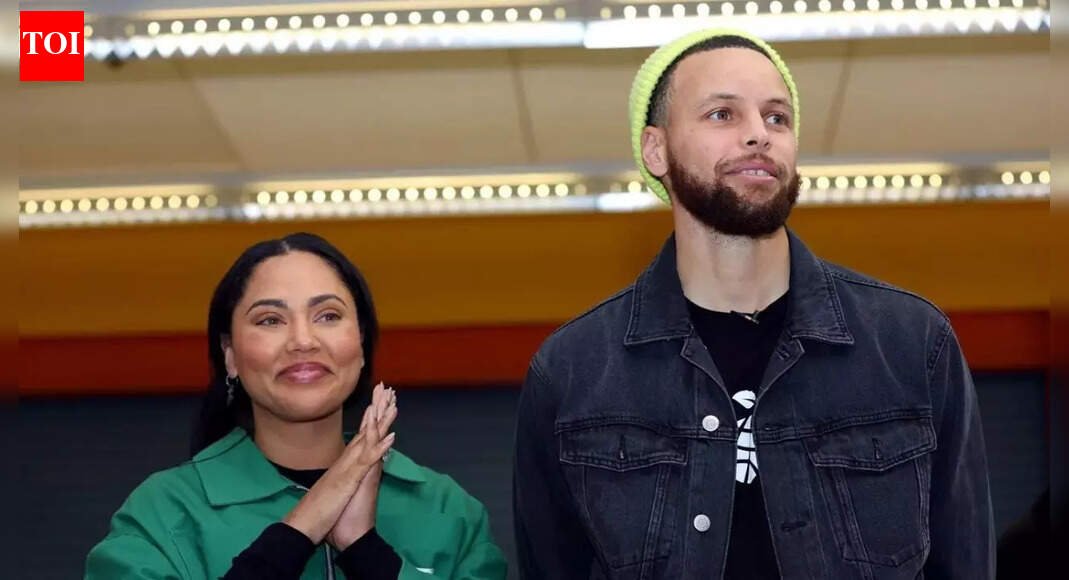
Ayesha Curry and Stephen Curry. Image via: Getty Images

Stephen Curry’s wife, Ayesha Curry, made an explosive statement on her marital life that diverted heads. The Golden State Warriors’ fans did not spare the International Smoke owner, as she was even subjected to backlash by the NBA star’s fans due to her comments on her marriage. However, both Stephen Curry and his wife, Ayesha, have never spoken about the ongoing rumors around their paradise. Amidst all this, Ayesha Curry’s recent gesture towards her husband, Stephen Curry, has won the hearts of his million fans on the internet. The Sweet July Skin owner was spotted wearing Stephen Curry’s Davidson jersey during his recent visit to the college. This simple and heartwarming gesture of Ayesha Curry has diverted the attention of NBA fans on social media.

NBA fans praise Ayesha Curry’s adorable gesture towards Stephen Curry

Stephen Curry’s rise to fame began during his time at Davidson College back in 2008. The two-time NBA MVP went on to become one of the most prominent scorers in school history while leading the Wildcats during the 2008 NCAA Tournament. Recently, the Warriors’ star returned to his school along with his entrepreneur wife, Ayesha Curry. The popular three-point star was given a tribute by the Davidson school during his recent visit to his alma mater. However, instead of the NBA star, his wife, Ayesha, diverted heads with her heartwarming gesture towards him. She was spotted wearing Stephen Curry’s Davidson jersey during the felicitation program. NBA fans were blown over by this simple gesture of Ayesha and could not stop from commenting about it. A Stephen Curry fan mentioned, “A+ wife move.”While others praised Ayesha Curry for her loving gesture towards her NBA man. “That kind of support never goes out of style love seeing pride and loyalty come full circle like that,” a fan mentioned“She is definitely stunning 🔥🔥,” said one fan.“That’s awesome! Ayesha is always supporting Steph’s roots in the best ways,” another fan wrote.Social media is buzzing with lovely comments from Stephen Curry’s fans on Ayesha’s sweet gesture towards her man. The mother of four clearly proved that the buzz around her marriage holds no weight and everything is great in the Curry’s paradise. The couple has been married for over a decade and share four adorable kids together. With Stephen Curry in the 17th year of his NBA career, he is a complete man, as when he is not busy representing the Golden State Warriors, he loves spending time with his beloved wife and kids. Also Read: Ayesha Curry sends sweet 4-word reaction to Stephen Curry’s once-in-a-lifetime moon-shot billboard


Source link

‘New chapter’ ahead: Bangladesh envoy on EAM’s Dhaka visit; signals positive tone for bilateral ties | India News


‘New chapter’ ahead: Bangladesh envoy on EAM's Dhaka visit; signals positive tone for bilateral ties

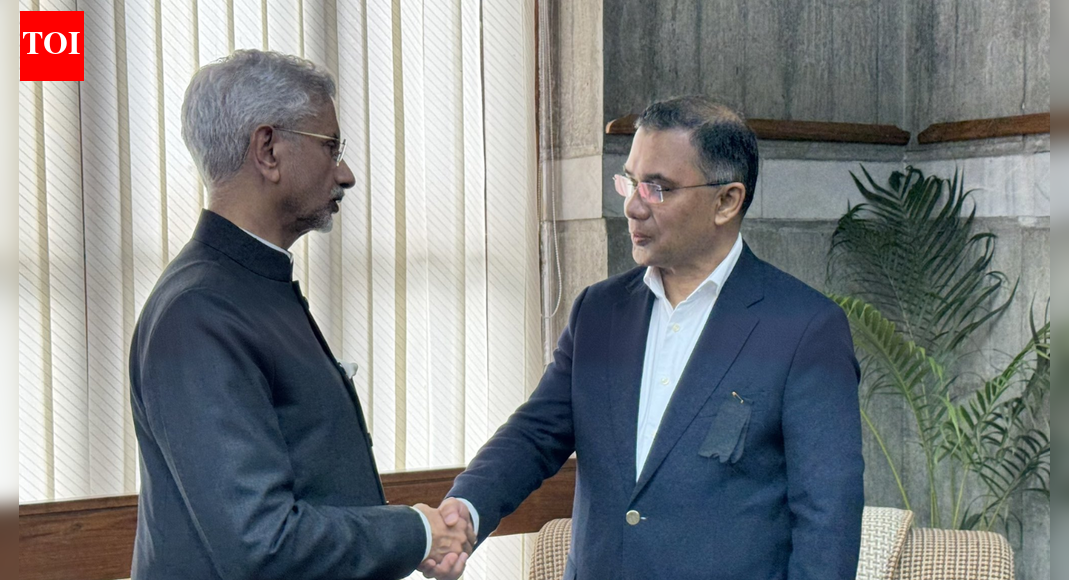
NEW DELHI: Bangladesh High Commissioner to India Riaz Hamidullah on Wednesday said external affairs minister S Jaishankar’s visit to Dhaka would help India and Bangladesh script a new chapter in bilateral ties, guided by shared interests, pragmatism and mutual interdependence.In a post on X, Hamidullah wrote, “As Hon External Affairs Minister Dr S Jaishankar left Dhaka following a whirlwind 4-hr visit, Bangladesh & India would look forward to script a new chapter in Bangladesh-India ties in shared interests driven by pragmatism and mutual interdependence, as indeed briefly discussed with BNP Acting Chair Tarique Rahman, this afternoon.”The high commissioner also shared his interaction with S Jaishankar. Adding the EAM’s optimism on strengthening bilateral ties, the commissioner wrote, “Hon. external affairs minister, in Dhaka, conveys condolences of the people, Govt of India as Bangladesh mourns passing of former Bangladeshi Prime Minister Begum Khaleda Zia.Hamidullah further added that Jaishankar “recognized her contribution to democracy and expressed optimism to strengthen ties following democratic transition in Bangladesh thru the upcoming election.”Earlier on Wednesday, EAM Jaishankar arrived in Dhaka on a special flight. He conveyed the condolences on behalf of the government and people of India. The minister also handed over a personal letter from Prime Minister Narendra Modi to Tarique Rahman, the son of the former PM of Bangladesh, Begum Khaleda Zia. Jaishankar also shared the interaction in a post on X and wrote, “On arrival in Dhaka, met with Mr Tarique Rahman, acting chairman of BNP and son of former PM of Bangladesh Begum Khaleda Zia. Handed over to him a personal letter from Prime Minister Narendra Modi.”“Conveyed deepest condolences on behalf of the Government and people of India. Expressed confidence that Begum Khaleda Zia’s vision and values will guide the development of our partnership,” the EAM added.Bangladesh is observing a public holiday on Wednesday and has entered three days of state mourning.Khaleda Zia, Bangladesh’s first woman prime minister, passed away on Tuesday at the age of 80 after a prolonged illness. She had been a prominent figure in the political history of Bangladesh and served three terms as prime minister.Zia also played a pivotal role in restoring democracy after years of military rule.


Source link

“2025 didn’t scare us with a virus, it scared us with…”: US-based Doctor’s eye-opening post flags unsettling health reality |


“2025 didn’t scare us with a virus, it scared us with…”: US-based Doctor’s eye-opening post flags unsettling health reality

We all remember the covid era, the years that were dominated by a deadly virus that claimed millions of lives. “2025 didn’t scare us with a virus,” this was quoted by a California-based doctor Siddhant Bhargava. The doctor’s eye-opening post hits us with the stark reality of something far more similar. The doctor’s words continue, “It (2025) scared us with how we’re choosing to live.” His post continues, “The danger wasn’t rare diseases. It was extremes, environment, and obsession disguised as optimisation.” Doctor Bhargava mentioned 10 things about health that 2025 taught us.

1. Over-optimising health can backfire

Doctor Bhargava writes, “extreme longevity finally showed its dark side.” He turns toward something deeper and writes “Living longer doesn’t mean living better.”

2. Air pollution as a health threat

The weeks-long air pollution exposed that in some part, the air we breathe is far above human tolerance levels. Dr. Bhargava writes, “Doctors reported spikes in asthma, heart attacks, pregnancy complications, and even cognitive decline. Air pollution wasn’t a winter issue anymore. It became a year-round health threat.”

Image: Canva

3. Lungs aged faster, even without smoking

Dr. Bhargava writes, “Pulmonologists warned that city air exposure was reducing lung capacity in people in their 20s and 30s. Many showed lung function similar to smokers, despite never smoking.”

4. Mental burnout is not only an “emotional” issue anymore

Dr. Bhargava says, “2025 studies linked chronic work stress to gut damage, autoimmune flare-ups, and hormone disruption.”

5. Social isolation hit as hard as smoking

Global research showed loneliness increased mortality risk comparable to smoking 15 cigarettes a day. Being busy and being connected turned out to be very different things.

6. Fitness obsession became more dangerous that ‘inactivity’

Doctors flagged a rise in joint injuries, cortisol imbalance, and menstrual disruption due to overtraining, under-eating, and “no rest day” culture.

7. Heat waves became a cardiovascular risk

Heat was no longer just uncomfortable, it was dangerous. India’s extreme heat was linked to dehydration-related strokes, kidney stress, and sudden cardiac events, even in young adults. The heat stopped being uncomfortable. It became dangerous.

8. Sleep debt rewired brains

Sleep deprivation also came into sharp focus. Chronic sleep deprivation was shown to shrink decision-making areas of the brain and worsen anxiety. Catching up on weekends didn’t reverse the damage.

Image: Canva

9. AI changed medicine’s ethics

AI tools revealed massive overtreatment in cancer and diagnostics. For the first time, the question shifted from “Can we treat?” to “Should we?”

10. Health anxiety quietly replaced health

Tracking every metric, every symptom, every number increased stress, not safety. Doctors warned that obsession was becoming its own illness.Doctor Bhargava wasn’t writing to mention records. Behind the post was a deeper message that the future doesn’t require extreme routines or relentless self-control, in fact, what it wants is balance.


Source link

Stock market outlook 2026: Why did Sensex, Nifty underperform in 2025 & where are indices headed next year? Top things to know


Stock market outlook 2026: Why did Sensex, Nifty underperform in 2025 & where are indices headed next year? Top things to know

If global markets were running a marathon this year, Indian equities were clearly trailing the pack. While South Korea saw Kospi skyrocketed nearly 76%, Japan’s Nikkei soared over 25%, and Hong Kong’s Hang Seng climbed more than 30%, China’s Shanghai Composite posted gains of over 16%. In the west, Wall Street also bagged doubled digit gains with tech heavy Nasdaq up 21%, S&P 500 rising 17.5%, and the Dow Jones advancing over 14%. Indian benchmark indices, Nifty50 and BSE Sensex, however, struggled to keep pace. Against these strong gains in global markets, India’s benchmarks posted more modest returns, with the Nifty 50 rising over 10% and the Sensex ending the year 8.55% higher. On December 31, the Sensex closed at 85,220.60, up 545.52 points, while the NSE’s Nifty 50 finished in the green at 26,129, gaining 190 points.Despite the Nifty 50 and Sensex recently touching record highs, broader market sentiment remained muted, with nearly half of the NSE’s top 500 stocks still trading below the benchmark. Though the indices ended 2025 in green, the relative underperformance has left investors struggling with two key questions as the calendar turns: Why did Dalal Street remain muted in 2025? And importantly, what’s the outlook for Nifty50 and Sensex in 2026?

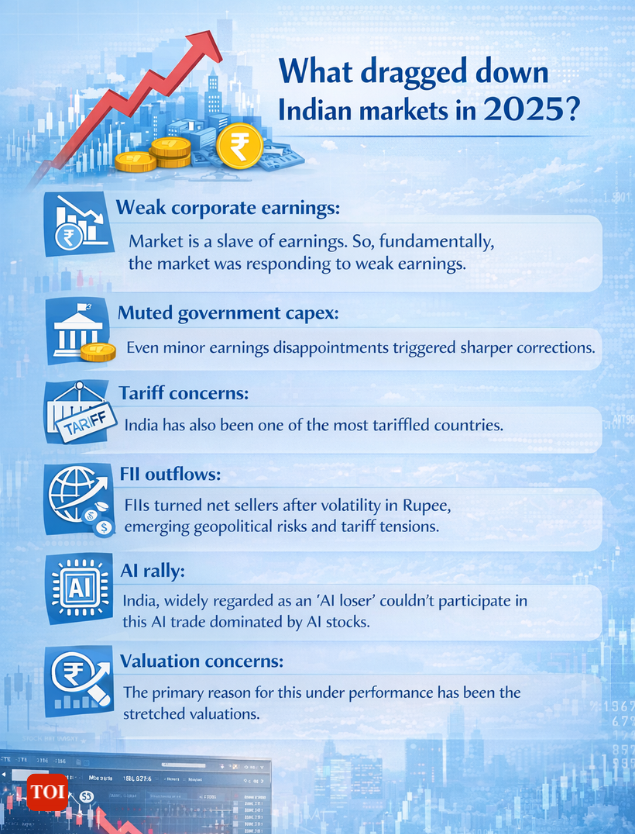
So, what dragged Indian benchmarks down?

What dragged down Indian markets

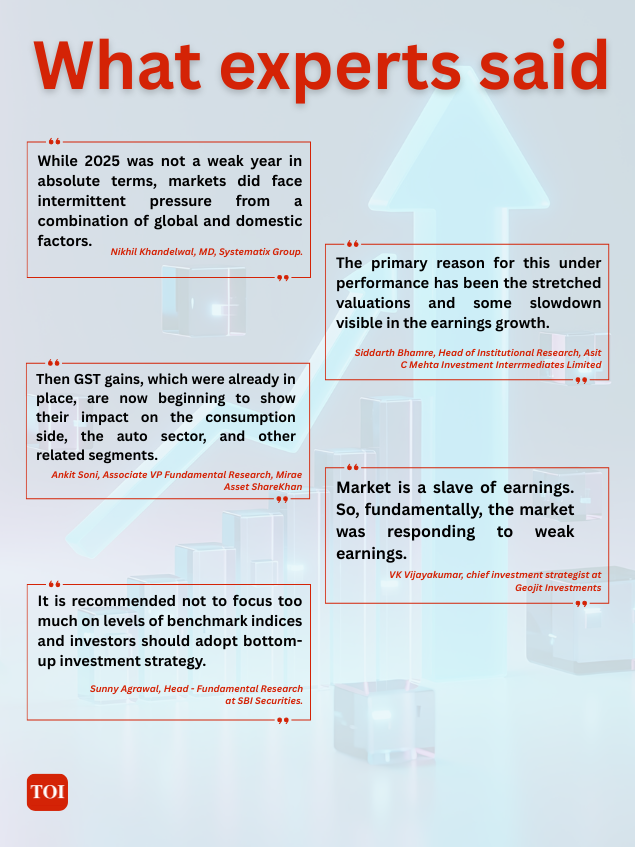
According to experts that TOI spoke to, the stock market was dragged down by a combination of factors, both internal and external. Factors like US-India trade deal delay, not participating in the AI race, muted corporate earnings, and FII selling weighed the market down.Earnings slowdownMuted corporate earnings emerged as one of the major reasons behind the stock market’s underperformance. VK Vijayakumar, chief investment strategist at Geojit Investments, told TOI that “during the last six quarters, earnings growth has been in single digits. In the long run, the market is a slave of earnings.” So the drag down was, ultimately, the market’s response to weak earnings.Despite the benchmarks trading near lifetime highs, the overall market appeared weak, weighed down by the deceleration in earnings momentum since the June 2024 quarter, following a robust 18% CAGR during FY20–FY25, said Sunny Agrawal, head of fundamental research at SBI Securities. Sharp divergenceAccording to Ankit Soni, associate vice president – fundamental research at Mirae Asset Sharekhan, market returns over the last one-and-a-half years remained largely single-digit, with a stark gap across segments.“Large-cap indices delivered around single-digit returns, while mid and small caps underperformed by nearly 10%,” he said, highlighting the high variability in returns and sustained weakness in the broader market. Agrawal also noted that “despite benchmark indices trading close to lifetime highs, the broader market continued to trade on weaker footing.”FII sellingMarkets hit new highs towards the end of the year, but failed to hold those levels. Soni pointed out that “there is always a pullback of around 2–4% from the 52-week highs,” largely due to foreign institutional investor (FII) selling. Agrawal added that persistent selling by Foreign Portfolio Investors (FPI), promoters and PE firms, despite strong domestic liquidity enabling smooth exits, weighed heavily on sentiment.According to Nikhil Khandelwal, managing director at Systematix Group, uncertainty around global interest-rate trajectories, currency volatility and geopolitical tensions led to intermittent foreign portfolio outflows.Valuation concerns versus global peersSeveral experts flagged stretched valuations as a key deterrent for foreign investors. Sunny Agrawal said Indian markets looked relatively expensive compared to other emerging markets, prompting capital outflows. Siddarth Bhamre, head of institutional research at Asit C Mehta Investment Intermediates Limited said that while Indian markets delivered higher single-digit returns, the valuation premium made the underperformance stark when compared with global equities and other asset classes.Missing the AI rallyOne of the defining features of global markets in 2025 was the AI-led rally, which India largely missed. Vijayakumar described India as an “AI loser” in a year when “AI winners like the US, China, Taiwan and South Korea gained substantially.” The lack of a pure-play AI story reduced India’s attractiveness for global fund managers, Agrawal pointed out.Currency volatilityRupee instability emerged as another headwind, as the currency is hovering around 90 per US dollar levels. Vijayakumar explained that FII selling weakened the rupee, which in turn triggered further FPI outflows, creating a negative feedback loop. This year the currency has fallen over 5%, depreciating past the 91 per US dollar mark, before recovering to 89. Tariff tensions and geopolitical risksFears linked to geopolitical tensions combined with US President Donald Trump’s imposition of trade tariffs worsened the sentiment and disrupted global business dynamics.India’s export competitiveness also came under strain. Khandelwal pointed out that India became “one of the most tariffed countries by the US under the new tariff regime,” impacting export-oriented industries. Ankit Soni further cited the non-closure of key trade deals as one of the factors preventing markets from sustaining rallies.The United States imposed a total of 50% tariffs on India – with a 25% tariff on Indian imports for purchases of Russian oil. Muted domestic capex and policy-related concernsDomestically, muted government capital expenditure added to the pressure, particularly in sectors dependent on public spending, according to Nikhil Khandelwal. Policy changes such as an increase in capital gains tax also dented investor sentiment during the year, Agrawal flagged.“Valuations have turned comfortable for Nifty50, which is trading at a 1-year forward P/E multiple of 19-20x vs 22x-23x during the last peak in Sept’24. During the last 14 months, there has been notable compression in the valuation premium of Nifty50 over MSCI EM index from 80% in September 2024 to 47% in December 2025, which is below the 10 year average of 57%. Barring few pockets, valuations have turned comfortable across mid and small caps,” Agrawal told TOI.Now that we know why Dalal Street’s performance was muted in 2025, it is time to dive into how the stock market is likely to perform in 2026. The answer depends on many factors including FII performance, earnings, balance sheets and much more!

What experts said

What about next year — Will Dalal Street stand stronger in 2026?

A short answer to if the Indian stock market is expected to perform better than their global peers in 2026 would be, Yes. Here’s why:Just a consolidation phaseSoni told TOI that the stock markets gave a strong rally from 2022 to 2025 and hence this subdued momentum was just a pause.“A good set of rallies we have seen, so there is always a gap of one year or two with respect to your continuation of the rally, and this we feel is good for the market to consolidate for some time and then give us a good set of rallies,” he added.”India has structural growth driversAs compared to other markets, India remains “relatively well placed” supported by key growth drivers such as strong domestic demand and improving balance sheets. “While global markets will continue to influence sentiment, India’s long-term fundamentals remain supportive,” Nikhil told TOI.Reversal of fundsAgrawal also placed India among emerging markets like Brazil and China, supported by reversal of funds from “safe haven US Bonds towards riskier assets like EMs and commodities.”Meanwhile, Vijayakumar said that while India is expected to perform better than it did in 2025, it would be tough to say if it will be able to outperform its global peers.

Will FIIs come back?

In 2025, FIIs turned net sellers, withdrawing Rs 1,04,050 crore from India throughout the year. Funds from FIIs are expected to return in 2026, reversing their current position as net sellers. These inflows will however, depend on many factors. According to Bhamre, declining Rupee against US dollar has fueled the possibility that FIIs will be returning in the upcoming year, as “not an expensive market and depreciated currency is an ideal setup for foreigners.”The expert further added that besides the case of heavy buying, “they won’t be bigger sellers in 2026 of Indian equities.” Soni believes that a strong monsoon and a favourable kharif season, along with other positive factors, could encourage FIIs to return to the country.“FIIs won’t be able to neglect the Indian market for long,“ he said, adding that they will be back given RBI initiatives with respect to the open market operations, a better Kharif season and a good earnings report. He further added that FII inflows are expected after the H2 earnings report. “We could get stabilized FII inflows maybe in financial year 2027”Meanwhile, Nikhil told TOI that FII flows are expected to remain volatile and largely data-driven, shaped by global interest rate movements and currency trends. However, he said consistent domestic inflows through SIPs, along with long-term investments from global private equity and strategic investors, should act as a strong cushion, lowering India’s dependence on FPI flows compared with previous cycles.

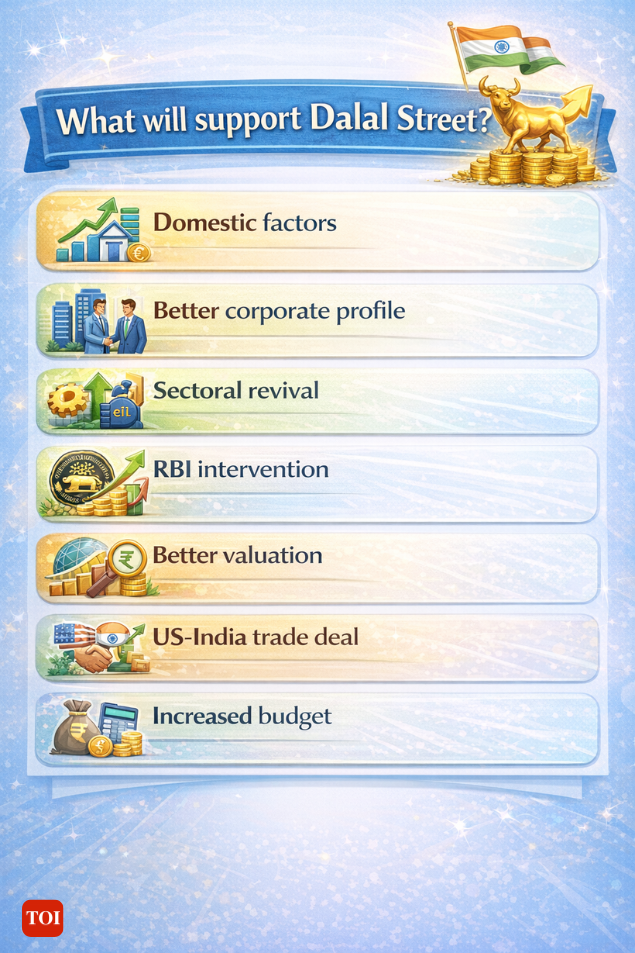
Stock market in 2026 — What will support Dalal Street?

What will support Dalal Street?

Domestic factors2025 was a year of policy changes with GST reforms, income tax changes, interest rate reduction by 125 bps and more. The effect, however, will be visible in the upcoming year, 2026, Bhamre said. On the internal side, “consumption trends and credit growth will be closely watched,” Khandelwal said, adding “While global developments will continue to shape short-term sentiment, domestic fundamentals are likely to play a larger role in determining market direction.”Better corporate profileOne of the major internal factors to push stock markets higher is the growth in corporate earnings. “Indian corporates in the long term are likely to deliver earnings growth in line with the nominal GDP growth of 10-11% and the same should get reflected in the performance of benchmark indices,” Agrawal said. Simultaneously, “sustained improvement in profitability, margins, and cash flows will drive confidence,” Nikhil told TOI.Vijaykumar added that the rally might be further helped by weakening artificial intelligence trade.Sectoral revivalAutos, especially commercial and passenger vehicles, along with IT are emerging as critical growth engines. After underperforming for nearly two to three years, the auto sector is now gaining traction and is expected to contribute meaningfully to earnings in 2026, Soni adds. The agriculture sector is also expected to remain upbeat, thanks to a good kharif season and an overall favourable weather.According to Khandelwal, “returns are likely to be in the 10 -12% range, with outperformance coming from more sector specific, asset class specific and company specific investments.”RBI interventionInitiatives by the Reserve Bank of India with respect to the open market operations, controlling inflation and other aspects.Better valuationComfortable valuation for NSE benchmark Nift50, is expected to lift investor sentiments in 2026. Nifty “is trading at 1-year forward P/E multiple of 19-20x vs 22x-23x during the last peak in September 2024, significant compression in valuation premium over MSCI EM index from 80% in Sep’24 to 47% in Dec’25, which is below 10 year average of 57%,” Agrawal noted.US-India trade dealFactors such as delays in concluding the India-US trade deal are also expected to play a major role in deciding the momentum of Dalal Street next year as markets are more favourable towards early closure of the deal.Increased budgetAnother major driver that could boost growth and create a platform for other factors to contribute is government capital expenditure. Announcements of significant capital spending, whether in the upcoming budget or through other channels, could set the momentum for Indian equities, Bhamre said.

Nifty and Sensex targets in 2026

So, where are Nifty and Sensex headed in the coming year and what are the targets. According to experts, Nifty is expected to touch anywhere between 28,500 to 29,800. Sensex, meanwhile, might reach 98,000 levels. Nifty50 began 2025 at 23637.65 while the BSE benchmark began at 77,500. In the bull case scenario, NSE benchmark Nifty is expected to reach 29,800 by the end of 2026 while BSE Sensex is expected at 98,000, Vijaykumar predicted.According to Soni, the NSE benchmark is expected to touch 28,000 in financial year 2027, “and then 28,500 would be a good range of approach going forward”, Soni told TOI. provided the FIIs come back. “Nifty 50 FY27E EPS is likely to be Rs 1280-1300. At upper PE band of 22-23x – Nifty can touch 28,500-30,000 levels and accordingly Sensex should also deliver inline returns,” Agrawal said, adding that from an investor’s perspective, focus will be on the broader market which has been underperforming since the past 12-14 months.“The indices are trading at approx 22-23x PE basis the FY26 estimated EPS of Nifty, which is at the lower end of the past 10 year Nifty multiple of 22-28x,” Systematix executive told TOI.Agrawal suggested traders to not “focus too much on levels of benchmark indices and investors should adopt bottom-up investment strategy.”

Which sectors & stocks to watch in 2026

Large caps remain the preferred safety play:Market experts see large caps as relatively better placed in 2026 due to reasonable valuations, stronger balance sheets and clearer earnings visibility. Vijayakumar told TOI that large caps are fairly valued and remain his preferred segment, while Nikhil noted that companies with balance-sheet strength offer comfort in a volatile environment. According to Bhamre, FIIs are more likely to return to large-cap stocks where valuations remain attractive.Mid caps need selectivity, not blanket exposure:Experts told TOI that mid caps still offer opportunities, but only through careful stock selection. Soni believes cherry-picking in mid caps can deliver returns, while Khandelwal points out that select mid-cap companies with scalable business models and disciplined capital allocation could outperform. However, the consensus remains that 2026 will reward bottom-up investing, not broad-based bets.Divergent views on small-cap valuations:Views on small caps remain mixed. Agrawal said that small-cap valuations have turned more comfortable and could outperform in 2026. In contrast, Vijayakumar and Bhamre remain cautious, flagging continued overvaluation in parts of the segment, especially amid heavy retail inflows through mutual funds, which could amplify downside risks if liquidity tightens.Retail-driven liquidity a key risk factor:The surge in retail money into mid- and small-cap stocks has led to valuation excesses, warns Bhamre, who says any reversal in liquidity could cause sharp corrections. This risk underpins the broader market view that stability will be concentrated in large caps, while volatility remains higher in smaller stocks.Portfolio strategyReflecting the cautious optimism for 2026, Bhamre suggested a large-cap dominated portfolio with “with some room for high growth not richly valued mid and small cap” proposing an allocation of around 70% large caps, 20% mid caps and 10% small caps.

Sectors likely to stand out in 2026

Sectors to watch in 2026

Metals: The metal sector is expected to deliver healthy returns, as valuations remain favourable when viewed over a longer horizon. While the sector is currently trading above its five-year average valuation, it is still well below the 10-year average. “So, we see a good set of values in the metal sectors out there,” Soni told TOI.PSU Banks: Public sector banks also continue to offer value, supported by relatively attractive valuations and improved balance sheets. “There is also good value in PSU Banks this year, as valuations remain at around 8–9x multiples…The last five years’ valuation is around 5%–10%, 11%–12%, which is currently at 8%–9%. So, we see a good value buying opportunity in PSU Banks.” IT: Soni said the IT sector is trading close to its long-term averages, creating a potential entry point for investors. “The IT sector itself is currently trading at a five-year average multiple of around 28, which is a five-year average multiple of 30X. So this could just provide you a good opportunity to invest into the IT sector; that sector is basically considered to be cheaper in relation to your stabilizing global macro environment,” he told TOI.Other industries like auto, auto ancillary, telecom, NBFCs, banks, AMCs, wealth managers, metals & mining, PEB, new age businesses, hotels, jewellery, liquor, dairy products, railway wagons, OMC, IT and Pharma-CDMO are also expected to outperform in 2026.

Risks for Dalal Street — factors that could hamper performance

Small caps at riskAn escalation in stress across the retail and MSME segments could lead to higher delinquencies, triggering market corrections, particularly in mid- and small-cap stocks, warned Bhamre, adding that a worst-case scenario would be rising NPAs in the NBFC space, which could dent consumption and create spillover risks across sectors.AI bubble shockA potential burst of the AI-driven tech bubble in the US is one of the biggest known risks for 2026, said Vijayakumar. While healthy corrections are desirable, a bubble burst could trigger sharp global market sell-offs. Vijayakumar also flags risks from a slowdown in India’s growth momentum and prolonged delays in a US–India trade deal.External macro risks could weigh on sentimentGlobal headwinds such as a sharper-than-expected slowdown in growth, renewed inflationary pressures and prolonged currency volatility could impact risk appetite, according to Khandelwal. Domestic factorsOn the domestic front, he cautioned that muted government capital expenditure and earnings disappointment in high-valuation pockets, such as the recent sell-off in EMS stocks, remain key concerns.Weak corporate profileMarkets are becoming increasingly unforgiving of weak execution, especially in over-owned themes where expectations are already stretched, Khandelwal noted. Companies that fail to deliver on earnings quality or governance could continue to underperform, reinforcing the need for disciplined stock selection.The absence of earnings upgrades could trigger meaningful market downside.Liquidity, crude oil and trade deficit risks loomA reduction in domestic liquidity support, a spike in crude oil prices due to geopolitical tensions, and a widening trade deficit could all act as pressure points for markets next year, said Agrawal.As the new year 2026 is knocking on the door, stakes are high for the stock market as investors look to bag bigger returns as compared to 2025. Traders need to watch out for internal and external components before making any investment decisions.(Disclaimer: Recommendations and views on the stock market, other asset classes or personal finance management tips given by experts are their own. These opinions do not represent the views of The Times of India)



Source link

Nagarjuna reveals secret to looking 40 at 65: ‘I don’t starve myself, haven’t missed exercise; never allow myself to get disheartened’ – Exclusive |


The National Award-winning actor Nagarjuna is one of the beloved stars who is not only known for his acting prowess, but also for his healthy lifestyle. The ‘Mass’ actor is 65 years old and doesn’t look a day over 40. Everyone wants to know the secret of his reverse aging. And while we had an exclusive conversation with him, Nagarjuna gave us three important things that he follows, and it’s more than just diet and exercise.

Nagarjuna reveals the secret to looking 40 at 65

When questioned about what makes him look and stay young after all these years, the actor, with all modesty, said, “I don’t know. I eat correctly. I don’t starve myself or go on a crash diet.”

South Superstar Nagarjuna Celebrates 66th Birthday In Style

Then he shared the second non-negotiable he has when it comes to his health, “I haven’t missed my morning exercise for fortyfive years, from when there were no gyms, unless I am really unwell.” Last but not least, the third and most essential element of his lifestyle goes beyond just surface work. He said, “Most importantly, I think positively. I never allow myself to get disheartened, no matter what the situation.”An example of his positive thinking is also reflected when he opened up about his 2025 journey and said that it has been ‘very satisfying.’ Spreading opitmisim he continued, “On both the personal and professional front, I couldn’t have hoped for more. My younger son, Akhil, got married to a lovely girl, and he is very happy with her. My elder son, Chaitanya, got married on December 24, and they have just completed one year of happily married life.”

When Rajinikath joked about Nagarjuna looking younger

On a lighter note, even Rajinikanth couldn’t get over Nagarjuna’s reverse aging techniques.During an event of ‘Coolie,’ the movie in which Rajinikanth and Nagarjuna shared the screen, ‘Thalaivar’ also pulled the ‘Shiva’ actor’s leg. Establishing that Nagarjuna never looks like he has aged, Rajinikanth said, “I once acted with him 33 (34) years ago (Shanti Kranthi in 1991). He looked younger than he did back then. I’ve lost all my hair, and yet he’s maintaining his skin and physique. I asked him how he did it, and he said, nothing but exercise and diet.


Source link