Breaking News
Happy New Year 2026: Top 50 Wishes, Messages and Quotes to share with your loved ones


Happy New Year 2026: Top 50 Wishes, Messages and Quotes to share with your loved ones

Christmas is now over and December is about to end, too. It’s that time of the year when there’s chill in the air and hope in people’s hearts, as a new year is just around the corner. New Year’s Eve on December 31 is one of the most widely celebrated occasions across the world and it symbolises fresh beginnings, renewed hope, and the promise of positive change. Most people celebrate New Year by spending quality time with their close friends and family by attending parties, hosting dinners, or participating in countdowns as the clock strikes midnight. Meanwhile, some cultures have traditional customs for the New Year. For example, in Spain eating 12 grapes at midnight on New Year’s Eve is considered to bring in good luck and love in the coming year. In Denmark, people throw old plates at their friends’ doors; they do this as it is believed to show their affection for their friends and also invite good fortune throughout the new year!

Happy New Year 2026

No matter how one celebrates the New Year, its essence remains the same– the New Year is all about connection, hope, and togetherness. It is also a reminder to heal, take up new opportunities and move forward in life. To help you wish your loved ones on this special occasion, here we list some wishes, messages and quotes you can send them this New Year. Read on to know more:

Happy New Year 2026: Wishes and messages

Happy New Year 2026

1. Here’s wishing you all a very happy new year, from our family to yours! 2. Happy New Year, my dear friend. Make the most out of these 365 days! 3. A new year is an opportunity to make new mistakes, learn from them and make memorable memories in the process. Happy New Year 2026! 4. May your 2026 be happy and prosperous. Happy New Year 2026! 5. Here’s wishing you and your family a very happy and prosperous 2026. Happy New Year 2026! 6. May the new year wrap you in hope and guide you toward everything you’ve been working so hard for. 7. Thank you for being such an important part of my journey this year. Happy New Year 8. May the new year bring you gentle mornings and peaceful nights. 9. I hope 2026 surprises you with kindness and strength. 10. May 2026 give you courage when life feels uncertain. Happy New Year! 11. Another year, another chance to forgive, grow, and love a little more. Happy New Year! 12. Wishing you more peace and purpose in 2026! 13. Here’s to more laughter, shared memories, and quiet moments in the coming year. Happy New Year! 14. We might be miles apart, but here I am wishing a very happy New Year to someone truly special. 15. Wishing you joy beyond measure in 2026! Happy New Year!

Happy New Year 2026

16. May the coming months be kinder, brighter, and filled with moments that remind you how strong you are. Happy New Year! 17. Here’s to fresh starts, open hearts, and dreams that finally find their way to reality. Happy New Year! 18. May this year reward your patience, celebrate your efforts, and surprise you with unexpected blessings. Happy New Year! 19. May your new year be filled with meaningful moments, heartfelt conversations, and reasons to believe again. Happy New Year! 20. 19. A fresh year, a fresh page— may you write a story filled with love, courage, and fulfilment.

Happy New Year! New Year quotes by famous personalities and authors

Happy New Year 2026

1. “A new year … a fresh, clean start! It’s like having a big white sheet of paper to draw on! A day full of possibilities! It’s a magical world, Hobbes, ol’ buddy … let’s go exploring!”– Bill Watterson, It’s A Magical World: A Calvin And Hobbes Collection 2. “Cheers to a new year and another chance for us to get it right.” – Oprah Winfrey 3. “Write it on your heart that every day is the best day in the year.” – Ralph Waldo Emerson 4. “The magic in new beginnings is truly the most powerful of them all.” – Josiyah Martin 5. “This is a new year. A new beginning. And things will change.” – Taylor Swift 6. “A new heart for a New Year, always!”― Charles Dickens 7. “For last year’s words belong to last year’s language And next year’s words await another voice.”― T.S. Eliot 8. “Isn’t it nice to think that tomorrow is a new day with no mistakes in it yet?”― L.M. Montgomery 9. “I made no resolutions for the New Year. The habit of making plans, of criticizing, sanctioning and molding my life, is too much of a daily event for me.”― Anaïs Nin 10. “The horizon leans forward, Offering you space to place new steps of change.”― Maya Angelou 11. “What the new year brings to you will depend a great deal on what you bring to the new year.” – Vern McLellan 12. “With the new day comes new strength and new thoughts.” – Eleanor Roosevelt 13. “You are never too old to set another goal or to dream a new dream.” – C.S. Lewis 14. “New Year’s Day is every man’s birthday.” – Charles Lamb 15. “Hope smiles from the threshold of the year to come, whispering, ‘It will be happier.’” – Alfred Lord Tennyson

Happy New Year 2026

16. “Tomorrow is the first blank page of a 365-page book. Write a good one.” – Brad Paisley 17. “If the doors of perception were cleansed, everything would appear to man as it is — infinite.” ― William Blake 18. “Hope Smiles from the threshold of the year to come / Whispering ‘it will be happier’…”-from ‘Robin Hood and Maid Marion’ by Alfred Tennyson 19. “The beginning is always today”-from The Short Stories of Mary Shelley by Mary Shelley 20. A new year. A fresh, clean start! It’s like having a big white sheet of paper to draw on!” – Bill Watterson 21. “Take a leap of faith and begin this wondrous new year by believing.” – Sarah Ban Breathnach 22. “New Year’s Day… now is the accepted time to make your regular annual good resolutions. Next week you can begin paving hell with them as usual.”-Mark Twain 23. “The beginning is the most important part of the work.” – Plato 24. “The new year stands before us, like a chapter in a book, waiting to be written.” – Melody Beattie 25. “I keep turning over new leaves, and spoiling them, as I used to spoil my copybooks; and I make so many beginnings there never will be an end.” -from Little Women by Louisa May Alcott 26. “Every moment is a fresh beginning.” – T.S. Eliot 27. “And now let us welcome the new year, full of things that have never been.” – Rainer Maria Rilke 28. “Each year’s regrets are envelopes in which messages of hope are found for the new year.” – John R. Dallas Jr. 29. “The object of a New Year is not that we should have a new year. It is that we should have a new soul and a new nose; new feet, a new backbone, new ears, and new eyes.”― G.K. Chesterton, A Chesterton calendar. 30. “The first step towards getting somewhere is to decide you’re not going to stay where you are.” – J.P. Morgan




Source link

Ashes 2025-26: Ben Stokes and Steve Smith slam MCG pitch after 4th Test ends in two days


England pulled off a stunning four-wicket victory over Australia in the fourth Ashes Test at the Melbourne Cricket Ground (MCG), but the result was quickly overshadowed by fierce criticism of the pitch after the match ended midway through Day 2. A total of 36 wickets fell across two days, with neither side managing an innings score of 200, prompting both captains to condemn the surface used for the iconic Boxing Day Test.

Bowler-friendly MCG pitch dominates the contest

The match, part of the Ashes 2025–26 series, saw seam bowlers dominate from the opening session. Australia were dismissed for 152 in the first innings and fared little better in the second, folding for 132. England, despite struggling themselves with the bat and being bowled out for 110, successfully chased a modest target of 175 to seal the win.

The unusually short Test immediately drew attention, with fans and pundits questioning how a marquee fixture at the MCG could be over so quickly. It was England’s first Test victory on Australian soil since 2011, but even that milestone could not mask concerns over the playing conditions.

Ben Stokes voices strong disapproval of the surface

England captain Ben Stokes was forthright in his assessment of the pitch, revealing that his feedback to the match referee was “not very favourable.” Speaking after the game, Stokes said the surface failed to live up to the expectations associated with a Boxing Day Test.

“To be brutally honest, that’s not really what you want,” Stokes said. “For a Boxing Day Test match, you don’t expect a game to finish in less than two days.”

Stokes went further, suggesting the reaction would have been far harsher had such a pitch been produced outside Australia. “There would be hell on if that pitch had been produced anywhere else,” he told the BBC, highlighting the imbalance that saw 36 wickets fall without a single innings crossing 200.

Steve Smith admits pitch offered excessive assistance to the bowlers

Australia’s stand-in skipper Steve Smith echoed Stokes’ sentiments, conceding that the surface provided too much help to the bowlers. Smith pointed to the amount of grass left on the pitch as a key factor in the excessive seam movement throughout the match.

“When you see 36 wickets across two days, that’s probably too much,” Smith said. “It probably did a little bit more than they wanted it to. Maybe if we dropped it down to eight millimetres, it would be about right.”

Smith acknowledged that both teams struggled to adapt, with batters rarely given the chance to settle as the ball continued to nip around.

Reflecting on Australia’s twin batting collapses, Smith felt that a lack of meaningful partnerships prevented the game from evolving. “If we could have just built a couple of those partnerships, perhaps the ball would have softened a bit and the game would have played a little easier,” he explained.

The relentless assistance for seamers meant batters were constantly under threat, turning what is usually a five-day spectacle into a frenetic, stop-start contest dominated by bowlers.

Also READ: Ashes 2025/26 – Steve Smith opens up on Australia’s first home Test loss to England since 2011

Rare two-day finish at MCG sparks wider debate

Two-day finishes at the MCG are rare and often remembered for extraordinary circumstances. While some observers likened the match to classic bowler-friendly Tests of the past, many felt this contest crossed the line, depriving fans of extended play at one of cricket’s most celebrated venues.

The independence enjoyed by Australian curators also became a talking point, with Stokes hinting at double standards in how pitches are judged globally. He stressed that while conditions cannot be changed once a match begins, marquee fixtures deserve surfaces that allow a fair contest between bat and ball.

Also READ: From Mitchell Starc to Dale Steyn – Top 5 bowlers with best strike-rates in a calendar year in Tests


Source link

Doc arrested for sex assault of minor patient | Mumbai News


Mumbai: A doctor was arrested by Malwani police for sexually assaulting a minor patient. He has been booked under provisions of Pocso Act.The incident occurred two days ago. The 12-year-old victim was unwell and was taken to see the doctor at a clinic. During examination, he sexually assaulted her. The child later complained to her mother. The family approached the Malwani police and lodged a complaint, following which the doctor was arrested.


Source link

China’s industry profits stumble: Profits in November fall 13.1%; biggest decline in over a year


China's industry profits stumble: Profits in November fall 13.1%; biggest decline in over a year

China’s industrial firms saw their profits drop by 13.1 per cent in November, from last year, marking the steepest decline in over a year. This fall came despite strong exports, putting focus on country’s ongoing economic struggles and increasing pressure for more government support. The National Bureau of Statistics released these figures on Saturday, as quoted by Reuters.The decline was worse than October’s 5.5 per cent. This trend comes as China faces persistent factory-gate deflation and weak consumer spending. For the first 11 months of the year, industrial profits barely grew, showing just a 0.1% increase compared to the previous year’s 1.9% growth.“The profit numbers show a broader cooling in economic activity in the fourth quarter, mainly due to the drag from soft domestic demand,” said Xu Tianchen, senior economist at the Economist Intelligence Unit. However, Xu remained cautiously optimistic about future profits, suggesting companies might find more opportunities overseas.Despite this, there were some industries that managed to register gains. The automobile industry posted a 7.5 per cent rise in profitability, while the high tech industry posted a 10 per cent rise. A massive decline of 47.3 percent in profitability was seen in the coal mine industry.An estimate by the think tank, Rhodium Group, quoted by Reuters, indicated a growth of 2.5 per cent to 3 per cent in the Chinese economy for the year, which is approximately half the officially-hinted growth.Chinese policymakers are now promising more support. At a recent meeting, they pledged to maintain “proactive” fiscal policies next year. The government has also committed to improving employment, boosting consumption, stabilizing prices, and helping the struggling property market.NBS Chief Statistician Yu Weining noted that industrial firms still need stronger support, especially given the uncertain global environment and ongoing changes in growth drivers. The data covers companies earning at least 20 million yuan ($2.85 million) in annual revenue from their main operations.


Source link

Watch: Khalistanis in UK disrupt protest by Hindus over killings in Bangladesh


Watch: Khalistanis in UK disrupt protest by Hindus over killings in Bangladesh

The protest led by the Hindu community against the killing of a Hindu man in a communally charged environment in Bangladesh was disrupted by the Khalistani miscreants outside the Bangladesh High Commission in London.Indian and Bangladeshi Hindus were outside the Bangladesh High Commission in London on Saturday when a handful of Khalistanis showed up outside in support of Bangladesh.Shattered by horrific lynchings of Dipu Chandra Das and Amrit Mondal, trapped and persecuted Hindus in Bangladesh are sending out an SOS to India to open the borders to escape Islamist mob fury. The fears were accentuated on Thursday by the groundswell of support to Bangladesh Nationalist Party leader Tarique Rahman, who’s considered a hardliner.VIDEO TOI reached out to a cross-section of Hindus residing in Rangpur, Chittagong, Dhaka and Mymensingh and spoke to them on Whatsapp call with the help of exiled Bangladesh Sanatan Jagran Macha leader, Nihar Haldar, accused of sedition along with former ISKCON monk, Chinmoy Krishna Das.The ripples could be felt in refugee pockets of Gadchiroli, Chandrapur in Maharashtra and Pakhanjur in Chhattisgarh, where Hindu immigrants from erstwhile East Pakistan were settled. Dr Subodh Biswas, president of Nikhil Bangla Samanbay Samiti, an organisation of former East Pakistan refugees, says, “Why don’t Hindu organisations get proactive? India is the only country where Hindus of Bangladesh can bank upon during a crisis. More Hindus will be killed, but borders remain shut. We plan to stage protests at the border.”“There are 2.5 crore Hindus in Bangladesh. It’s not a small number. Hindu organisations in India are doing nothing more than lip service. We are staring at a holocaust,” said a Sanatan Jagran Macha activist requesting anonymity. It’s not that there will be Hindu exodus after borders open, but we will be at least insulated from violence, said a resident of Mymensingh. “We are living the worst nightmare. Opening the Indian borders will at least create an escape route for those facing persecution,” said a Hindu from Dhaka. Many lead a hand-to-mouth existence in Bangladesh, including those like Dipu Chandra Das’ family.The acrimonious exchanges between India and Bangladesh in the past few weeks came to a head on Friday with India slamming Dhaka for “unremitting hostility” against minorities – including Hindus, Christians and Buddhists – in the country at the hands of extremists.Calling it a matter of grave concern, ministry of external affairs (MEA) condemned the recent killing of a Hindu youth in Mymensingh and stressed that the perpetrators of the crime must be brought to justice.Asked about the return of BNP acting chairman Tarique Rahman to Dhaka after 17 years, the Indian govt only said it should be seen in the context of India’s call for efforts to ensure free, fair and inclusive parliamentary polls in Bangladesh.


Source link

Brace for fog chaos at airports on Sunday: IndiGo cancels flights; Air India issues travel advisory


Brace for fog chaos at airports on Sunday: IndiGo cancels flights; Air India issues travel advisory

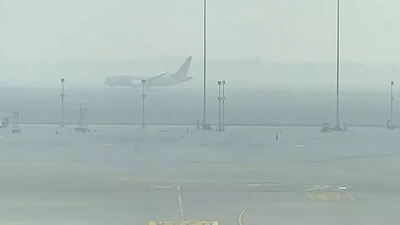
NEW DELHI: IndiGo has cancelled 13 flights scheduled for Sunday, citing forecasted bad weather across several airports, with two services affected by operational reasons. The cancellations impact routes to and from major cities, including Chandigarh, Mumbai, Ahmedabad, Hyderabad, Amritsar, Bengaluru, Delhi, Gaya, Kolkata, Chennai, Jaipur and Pune.The airlines on Saturday had cancelled 57 flights across their network at several airports, citing weather conditions.IndiGo, which had cancelled thousands of flights earlier this month due to stricter norms on pilots’ duty periods and rest, has continued to cancel some services for more than a week, citing “bad weather” as the reason.Meanwhile, Air India issued a travel advisory citing dense fog and reduced visibility across parts of northern India. The airline said the conditions may disrupt flight schedules on Sunday morning in cities like Chandigarh, Amritsar and Varanasi.“In the event of unexpected delays, diversions, or cancellations, please rest assured that our ground colleagues remain available to assist you.If you are flying with us tomorrow, we recommend checking your flight status here before heading to the airport and allowing extra time for your journey,” the airlines said through a post on X.The aviation regulator DGCA has designated December 10 to February 10 as the official fog window for this winter, requiring airlines to follow special low-visibility operating norms, as cited by PTI. Under the DGCA’s CAT-IIIB guidelines, airlines must roster pilots trained for low-visibility operations and deploy aircraft equipped to operate in such conditions.Category III systems enable aircraft to land in dense fog, with CAT-III A allowing landings at a runway visual range of 200 metres, and CAT-III B permitting operations at under 50 metres.Under its original winter schedule, IndiGo had approval to operate 15,014 domestic flights per week, or about 2,144 flights a day, around six per cent higher than its summer 2025 schedule. However, after widespread disruptions earlier this month, including the cancellation of about 1,600 flights in a single day due to stricter pilot rest norms, the government cut the airline’s domestic capacity by 10 per cent, or 214 flights daily. As a result, IndiGo is currently limited to operating no more than 1,930 domestic flights per day during the winter season.A four-member DGCA panel is probing IndiGo’s recent operational issues and has already questioned the airline’s CEO, Pieter Elbers, and COO, Isidre Porqueras. The panel’s report is expected later this week.The DGCA on Friday evening submitted its report on the circumstances leading to IndiGo’s operational disruptions to the civil aviation ministry, officials said. The report is expected to examine why the airline’s domestic network was severely affected while international operations remained largely unaffected.A ministry spokesperson said the inquiry committee, headed by DGCA Joint Director General Sanjay K. Bramhane, had submitted a confidential report. Aviation minister Ram Mohan Naidu has told Parliament that the government will take “exemplary” action against IndiGo once the probe is concluded.


Source link

Access Denied


Access Denied

You don’t have permission to access “http://www.ndtv.com/india-news/supreme-court-intervenes-in-aravalli-row-to-hear-case-on-monday-10039325” on this server.

Reference #18.14d92c31.1766859104.35eb76b4

https://errors.edgesuite.net/18.14d92c31.1766859104.35eb76b4


Source link

Thackeray cousins to address 7-8 joint rallies for civic polls | Mumbai News


Mumbai: The Thackeray cousins, Uddhav and Raj, will address 7 to 8 joint rallies for the Municipal Corporation elections in a blitz campaign from Jan 2 to 13. Sena (UBT) functionaries said at least 3 rallies will be held in Mumbai for the BMC polls in the last phase of the campaign to end the electioneering a high note. One joint rally each in the city, western, and eastern suburbs of Mumbai is planned. Similar joint rallies will be held in Thane, Kalyan Dombivli, Nashik, Navi Mumbai, and other parts of the MMR.Sena (UBT) functionaries said joint rallies will be the highlight of their campaign, and both cousins are expected to strike an emotional chord with voters on the Marathi Manoos issue and attack the BJP and Eknath Shinde-led Sena. The rallies have been planned even as talks to finalise the seat sharing between Sena (UBT) and MNS are still ongoing. The joint rallies will be held after the December 30 deadline for filing nominations and withdrawal of nomination dates.Sena (UBT) functionaries said under the proposed formula, the Sena (UBT) will get 145 to 150 seats, 65 to 70 seats will go to MNS, and 10 to 12 seats to NCP (SP). The Sena (UBT) has left 12 to 15 of its existing seats for the MNS. In most of these 12 seats, their sitting corporators have joined the Shinde-led Sena or BJP.“We have planned the rallies as the main highlight of our campaign. The two cousins will share the stage and address rallies after 20 years. So far, they have addressed meetings and press conferences together, but not political rallies. So this will have a big impact, and it will mobilise our cadre and also help in upping the ante against the Mahayuti,” a Sena (UBT) functionary said.After several rounds of talks, meetings, family gatherings, and cultural exchanges, the Shiv Sena (UBT) and MNS announced a formal alliance for the BMC and other Municipal Corporation polls, including Nashik, on Wednesday. The two Thackeray cousins, Uddhav and Raj, addressed a joint press conference to make the announcement in Worli. Both Uddhav and Raj struck an emotional chord. Uddhav told the Marathi people, “If you get divided or make any mistake now, you will be completely finished.Uddhav said the two of them have come together as their duty towards Maharashtra. Raj said Maharashtra is bigger than any dispute or fight, and that is why they have come together. However, no seat-sharing formula was shared, and Raj said that the list of candidates or seat-sharing formula won’t be declared, and candidates will directly be told to file their nominations.


Source link

Shocking! Dhaka Capitals assistant coach collapses, dies moments before BPL match | Cricket News


Shocking! Dhaka Capitals assistant coach collapses, dies moments before BPL match
Dhaka Capitals assistant coach Mahbub Ali Zaki died on Saturday (IANS)

Mahbub Ali Zaki, assistant coach of the Dhaka Capitals, died on Saturday after collapsing moments before his side’s Bangladesh Premier League fixture against the Rajshahi Warriors at the Sylhet International Cricket Stadium. He was 59.Go Beyond The Boundary with our YouTube channel. SUBSCRIBE NOW! Zaki fell ill during the team warm-up, prompting immediate medical attention from the Dhaka Capitals support staff, who administered CPR before he was taken by ambulance to Al Haramain Hospital. Doctors later confirmed his death. The Bangladesh Cricket Board’s chief physician, Debashish Chowdhury, verified the incident, with team officials stating that Zaki had not complained of any health issues beforehand.

Naseem Shah interview: Pakistan bowler opens up on bouts with injuries and tough recovery

The tragedy cast a shadow over the matchday, with players from Sylhet Titans, Noakhali Express and Chattogram Royals also rushing to the hospital on hearing the news. Both teams observed a minute’s silence during the innings break in tribute. The BCB, in a post on X, hailed Zaki’s lasting impact on fast bowling in the country, while the Dhaka Capitals expressed their grief and extended condolences to his family. A former fast bowler, Zaki represented Comilla District in the National Cricket Championship and featured for prominent clubs including Abahani and Dhanmondi in the Dhaka Premier Division Cricket League. Following his playing career, he transitioned into coaching and joined the BCB in 2008 as a High Performance coach. He became a respected figure in Bangladesh’s pace-bowling setup, notably assisting Taskin Ahmed during the scrutiny of the pacer’s bowling action at the 2016 T20 World Cup in India.


Source link

Salt Lines: A forgotten 4,000-km ‘living border’ reappears in a Mumbai museum | India News


Salt Lines: A forgotten 4,000-km 'living border' reappears in a Mumbai museum

In the open-air plaza of Mumbai’s oldest museum, a long, zig-zag wall of cloth ripples in the breeze. At first glance, it looks like a giant curtain. Step closer to squint at the crimson prints on it and the cloth becomes a partition: neat plant patterns on one side and chaotic termite marks on the other. Block-printed deliberately with dyes from homegrown shrubs like babool and karonda, this 20-metre-long cotton wall at the Dr Bhau Daji Lad Museum quietly leads visitors back to a little-known 4,000-km hedge that once formed a thorny botanical border across India, buzzing with birds and bees.Part hedge, part fence, the Inland Customs Line — a forgotten boundary created by the British in the 19th century to enforce the Empire’s deadly salt tax— is the centrepiece of ‘Salt Lines’, the first Indian solo exhibition by artist duo Himali Singh Soin and David Soin Tappeser who go by Hylozoic/Desires.Created in collaboration with RMZ Foundation and India Art Fair and supported by Alkazi Foundation, the show revisits the colonial 4,000km long border of which 2,500km constituted a fence of plants also known as ‘The Great Hedge of India’. Stretching from the Himalayas to the Bay of Bengal and patrolled by thousands of customs staff, the hedge–described as “utterly impassable to man or beast”–was built by the East India Company and later the British Raj to enforce the salt tax in the mid nineteenth century. “We first stumbled upon the incredible history of the Inland Customs Line when we were doing more general research on… salt,” the artists say. Its scale shocked them: “It seemed improbable to us that such a large botanical infrastructure could have existed for much of the 19th century without everyone knowing about it.”Salt, which had been lightly taxed under earlier Indian rulers and the Mughals, became one of the British Empire’s most lucrative revenue streams after Bengal Presidency governor Robert Clive’s victory at The Battle of Plassey in 1757. Through monopolies and price controls, the East India Company’s officials forced peasants and merchants to buy salt from government depots at inflated rates. Even during the catastrophic Bengal famine of 1770, which killed an estimated ten million people, land revenue and salt taxes were collected in full.Originally consisting of thorny branches and deadwood piled into a crude fence, it was designed to stop smugglers from moving coastal salt into British-controlled territories, where it was heavily taxed. From the 1860s, the British began converting it into a living hedge, planting hardy native shrubs, digging trenches, building embankments, and maintaining a patrol road. Under officials such as AO Hume, entire teams tended the hedge, watering, pruning, and replanting it.Between 1867 and 1870, Hume oversaw a dramatic expansion of the hedge. By 1869 it stretched more than 2,300 miles from the Indus to the Mahanadi, patrolled by nearly 12,000 men. The line snaked through what is now Pakistan, skirted Delhi, passed Agra, Jhansi, Hoshangabad, Khandwa, Chandrapur and Raipur, and terminated in present-day Odisha. Where living shrubs failed due to rocky soil or frost, stone walls were erected instead; elsewhere, dry hedges of dwarf Indian plum had to be rebuilt constantly after damage from insects, fire and storms.At its height, the hedge was said to be up to 12 feet high and 14 feet thick, made of tightly trimmed trees and shrubs of babool, Indian plum, carounda, prickly pear, and thuer, depending on the soil and climate, with a thorny creeper woven throughout. By the 1870s, more than 14,000 men were employed to guard and maintain it, making it one of the largest security operations in the subcontinent. “On no branch of their duties have the whole establishment bestowed anything like so much time, labour, care, and thought, as on the rearing of this barrier…after all it must be remembered that our barrier is to the Line what the Great Wall once was to China: alike its greatest work and its chiefest safeguard,” wrote Hume. The hedge was lost in the archives, say the artists who scoured the National Archives of India, the British Library, the South London Botanical Institute, the Alkazi Collections and more for its history. “We found textual evidence… but no imagery.” To fill the gap, they created speculative visual records such as re-enactments at Sambhar Lake, an important British salt outpost, and AI-generated images, printed using a 19th-century salt process and toned with gold.At the centre of ‘Salt Lines’ is ‘The Hedge of Halomancy’ (2025), a 23-minute film. It follows Mayalee, a courtesan known to history for resisting the British. “She refuses the British administrators… when they attempt to replace her traditional salt stipend with cash payments,” the artists explain. Salt, in the film, becomes material and metaphor. A three-dimensional salt crystal acts as “a magical talisman,” linking Mayalee to Hume and, symbolically, to Gandhi’s march to Dandi. In another room called the ‘Salt Office’, historical salt-tax objects including two photographs of Bombay’s salt satyagraha from the Alkazi Collection sit beside Salt Prints (2024). “Salt is an acid and a base, an amazing symbol of equilibrium,” the artists say. Sound underscores this tension. “The speculative chapters… are underpinned by bansuri and sitar,” says David. The archival sections use “tuba and percussion,” echoing British military bands and their transformation into Indian wedding music.How did the hedge disappear from public imagination? Nature played the first role. “Termites… begin to eat into the hedge,” the artists note. “Winds, rats, tigers stormed through parts of the hedge.” Human anger, it seems, finished the job. “During the 1857 mutiny, people burnt parts of the hedge down in fury.” When the British gained control over salt-producing regions like Sambhar Lake, they found a cheaper way to tax salt at its source. The hedge — expensive and unwieldy — was dismantled on April 1, 1879. Nature reclaimed it. The living shrubs died or were cut; deadwood was carted off by villagers; embankments eroded. Within decades, almost nothing remained. “The natural world’s resistance not only contributed to the fall of the hedge but also to its utter erasure from history,” say the artists.Many historians had never heard of it until British writer Roy Moxham rediscovered it in the 1990s, travelling across India to piece together its remnants for his book ‘The Great Hedge of India’. “People seldom realise how critical salt is to health,” wrote Moxham. “And yet, it seems inconceivable to me how this incredibly painful part of history, the immense abuse people endured at this time, could be so utterly forgotten.When he set out to find the remnants of the Customs Hedge, Moxham had imagined the barrier as a piece of British whimsy constructed to collect a minor tax. Along the way, he realized that the men posted along it, mostly local recruits, worked in isolation for months, patrolling harsh terrain with sticks, whips, and firearms. Those caught bypassing the hedge faced imprisonment. Famine, he discovered, was worsened by the Salt Tax. In 1877–’78, crops failed from poor rains in the North-Western Provinces while grain was exported, causing starvation. Official reports recorded 1.3 million deaths, with most deaths attributed to disease rather than hunger, though salt deficiency increased mortality. “I had assumed it was merely a flamboyant boundary, perhaps fashioned by administrators with fond memories of English hedgerows,” wrote Moxham. “It was a terrible discovery to find that it had been constructed, and ruthlessly policed, so as to totally cut off an affordable supply of an absolute necessity of life,” he concluded. The hedge entered public conversation again in recent years. In 2022, UK-based runner Hannah Cox set out to trace the forgotten border by running 100 marathons in 100 days, following the path of the Great Hedge across the country. Her journey — physically retracing a line most Indians have never seen — sparked renewed interest in how a structure so long, so intrusive, and so central to colonial revenue vanished almost without a trace.It is fitting that the exhibition sits inside the Dr Bhau Daji Lad Museum, Mumbai’s oldest, built by the British in 1857 as the Victoria & Albert Museum, Bombay. For the artists, its vitrines and industrial models echo the themes of extraction in the exhibition while Tasneem Zakaria Mehta, the museum’s managing trustee and director, says ‘Salt Lines’ allows the institution to “engage with the nature of colonial artistic production… including local people who harvested and consumed salt.As visitors leave ‘Salt Lines’, Hylozoic/Desires offer a last thought — a reminder of what the exhibition ultimately attempts: “All we know is that the artist’s work is to research rigorously, and then… enter into the missing gaps of history and the doubt of the future, and imagine how else we can be.”


Source link