Breaking News
Sri Lanka name strong squad for U19 World Cup 2026, Vimath Dinsara to lead


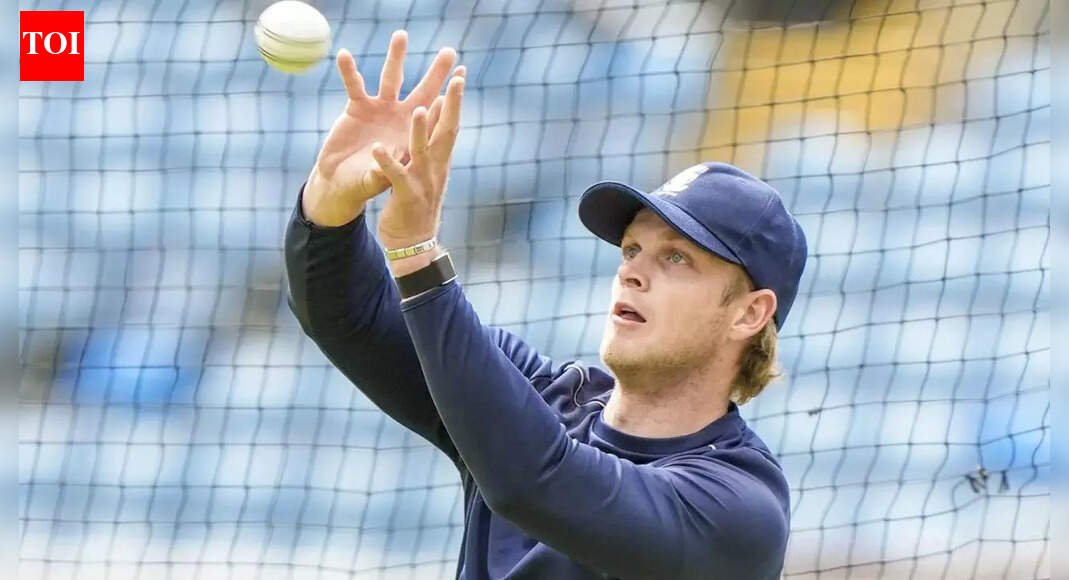
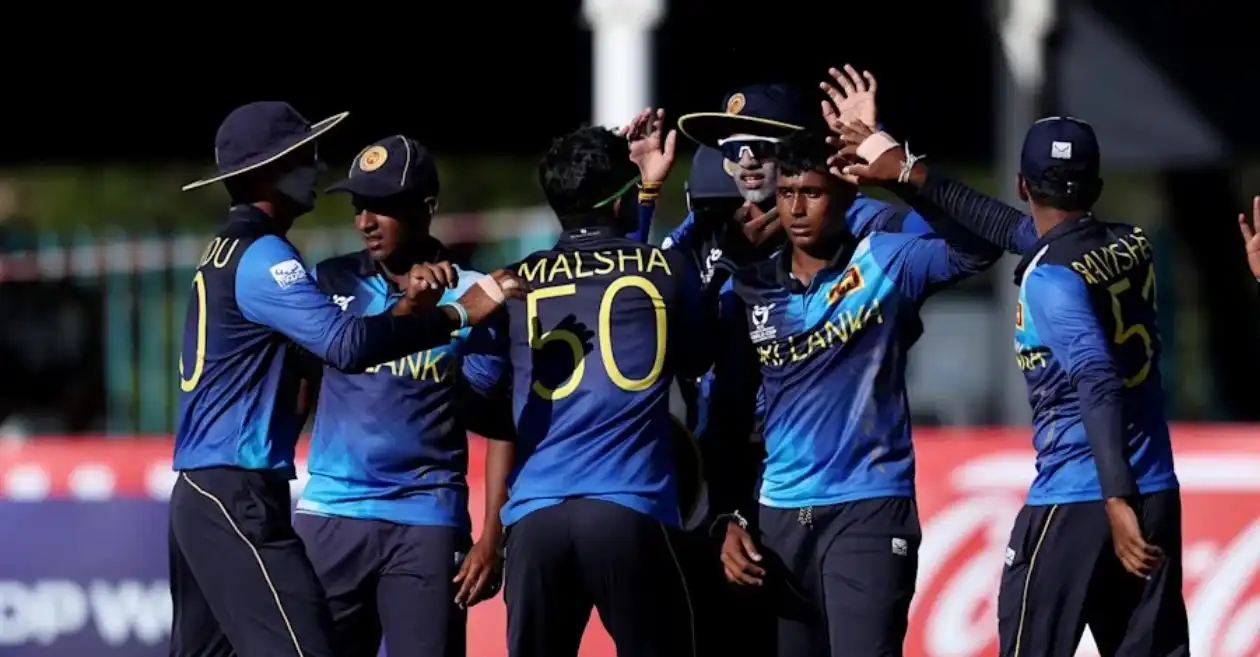
Sri Lanka have unveiled a well-rounded squad for the ICC Under-19 World Cup 2026, placing their faith in a new generation of talent as they look to make a deep run in the tournament. The team will be captained by Vimath Dinsara, with Kavija Gamage appointed as vice-captain, as Sri Lanka aim to build on their encouraging showing in the previous edition. The marquee youth event gets underway on January 15, with matches set to be played across Zimbabwe and Namibia.

Vimath Dinsara handed leadership responsibility

Dinsara has been entrusted with the captaincy after impressing selectors with his composure and consistency at the junior level. Known for his solid batting technique and calm presence in pressure situations, Dinsara is expected to anchor the innings while also leading from the front tactically. His deputy, Gamage, adds further stability to the leadership group, offering flexibility as both a batter and an all-round option.

Batting depth and all-round strength

Sri Lanka’s squad reflects a clear emphasis on batting depth and versatility. Alongside Dinsara and Gamage, Dimantha Mahavithana is another batter expected to play a key role at the top and middle order. The selectors have also placed considerable trust in a group of multi-skilled all-rounders, including Viran Chamuditha, Chamika Heentigala, and Gamage, who provide balance to the side with their ability to contribute in more than one discipline.

This all-round depth is likely to be crucial in the demanding conditions of Zimbabwe and Namibia, where teams often need to adapt quickly to varying pitches and weather. Sri Lanka’s think tank appears keen to avoid over-reliance on specialists, instead opting for players who can adjust their roles based on match situations.

Also READ: Australia name strong squad for U19 World Cup 2026, Oliver Peake to lead

Focus on adaptability and conditions

Sri Lanka’s approach for the 2026 edition is shaped heavily by lessons learned from the previous Under-19 World Cup in South Africa, where they progressed to the Super 6s stage. That campaign highlighted the importance of flexibility, particularly in overseas conditions. With venues spread across two countries, adaptability has once again become a central theme in selection.

The bowling unit features a mix of pace and spin options, with players like Sethmika Seneviratne, Kugathas Mathulan, Rasith Nimsara, and Vigneshwaran Akash expected to shoulder responsibility across different phases of the game. Their ability to exploit conditions early and control the middle overs could define Sri Lanka’s campaign.

Sri Lanka have been drawn into Group A, where they will face a stern test against defending champions Australia, along with Ireland and Japan. The group promises a blend of traditional powerhouses and emerging cricket nations, making consistency vital from the outset.

Sri Lanka will begin their tournament on January 17 against Japan, a fixture that offers an early opportunity to settle nerves and build momentum. However, clashes against Australia and Ireland are expected to provide a clearer picture of the team’s title credentials.

Sri Lanka U19 World Cup 2026 squad

Vimath Dinsara (c), Kavija Gamage (vc), Dimantha Mahavithana, Viran Chamuditha, Dulnith Sigera, Chamika Heentigala, Adam Hilmy, Chamarindu Nethsara, Sethmika Seneviratne, Kugathas Mathulan, Rasith Nimsara, Vigneshwaran Akash, Jeewantha Sriram, Senuja Wekunagoda, Malintha Silva

Also READ: Vaibhav Suryavanshi to lead India U19 in South Africa tour, Ayush Mhatre named captain for U19 World Cup 2026


Source link

Mexico earthquake: Magnitude 6.5 tremors hit Mexico City; President Claudia Sheinbaum suspends press conference


Mexico earthquake: Magnitude 6.5 tremors hit Mexico City; President Claudia Sheinbaum suspends press conference

An earthquake of 6.5 magnitude hit Mexico city on Friday, according to the national seismological service, quoted by AFP, as tremors hit Mexico’s capital.The country’s President Claudia Sheinbaum had to suspend her daily press conference when the quake struck.The epicentre was said to be near the town of San Marcos in Mexico’s southern state of Guerrero, close to the Pacific coast resort of Acapulco, according to the national seismological agency.There were no immediate reports of damage or injuries.(More details awaited)


Source link

Ask Dhirendra: ‘Why do I panic and stop my SIPs during every market fall — and how can I stop doing this?’


Ask Dhirendra: ‘Why do I panic and stop my SIPs during every market fall — and how can I stop doing this?’
So the next time the market is falling and you feel the itch to stop your SIP, remember this: the feeling is normal, the action is costly. (AI image)

Let me guess your SIP journey.You start with great enthusiasm. You’ve read about compounding, you’ve seen the long-term Sensex chart, you’ve promised yourself, “Yeh SIP toh 15 saal chalegi.” For a while, everything behaves. Markets are up, your app shows green, you feel like a genius.Then one fine day, markets start falling. Your returns go from +18% to +9%. You are uncomfortable, but okay. Then it goes to +2%. Then to –5%. Suddenly, the same SIP that made you feel smart now makes you feel stupid.And then the thought arrives: “Why am I putting good money after bad? Let me stop for now. I’ll restart when things look better.”Of course, when things “look better”, the market is already up again. You restart your SIP near the top. Next fall, repeat.If this sounds familiar, congratulations: you are completely normal and quietly sabotaging your own plan.The first thing to understand is what a SIP actually does. It does not guarantee returns. What it does is force you to buy more units when markets are down and fewer when markets are up. It only works if you let it do this job when it feels most uncomfortable.You don’t have to take my word for it. Let’s look at how SIPs behave through a bad period.

Stopping SIPs during market falls can be costly

Stopping SIPs during market falls can be costly

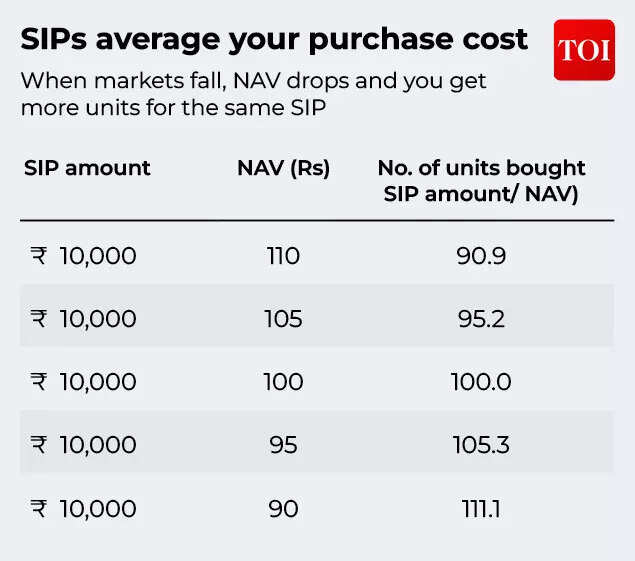
At Value Research, when we run such SIP-through-crash scenarios, the pattern is boring and brutal. The investor who continued investing during the fall usually ends up with more units at a lower average cost and a larger corpus a few years later. The investor who stopped and waited for “visibility” ended up doing the investment equivalent of buying umbrellas after the monsoon.So why do we keep stopping SIPs even when we know, at an intellectual level, that this is a bad idea?One reason is that we experience losses more strongly than gains. Behavioural economists call it “loss aversion”; in normal language, it’s just “mujhse ye nuksaan dekha nahi jaata.” A 10% fall hurts more than a 10% gain pleases us. So when you see your portfolio in red, your brain screams, “Stop the pain!” Stopping the SIP feels like doing something sensible, when in fact you’re just locking in the discomfort without getting the future benefit.Another reason is that we forget that the money going into a SIP during a crash is buying units at a discount. All we see is, “Market gir raha hai, mera paisa doob raha hai.” We don’t see, “I am picking up more of the same fund at a discount.”Here’s a small example to make that clearer.Imagine you run a SIP of ₹10,000 per month in a fund whose NAV moves like this for one year:

  • Month 1: ₹100
  • Month 6 (after a fall): ₹70
  • Month 12 (partial recovery): ₹90

If you stop your SIP exactly when the NAV is ₹70, you are refusing to buy when it is cheapest. That is the opposite of what you would do in a sale for anything else in life.

SIPs average your purchase cost

SIPs average your purchase cost

So what can you do to stop yourself from pressing the “pause” button every time the market misbehaves?The first step is to separate your money by time. If you are using equity SIPs for long-term goals—10, 15, or 20 years away—then you should not depend on that same money for near-term emergencies or short-term needs. That is why I keep repeating the boring basics: have an emergency fund and appropriate debt or bank savings for short-term goals. At Value Research, we insist on seeing this cushion before saying, “Haan, ab equity SIP karo.” If your SIP money is truly long-term, then a bad year is a bump, not a verdict.The second step is to decide your SIPs when you are calm, and then refuse to renegotiate with your future panicked self. You can even write down a simple rule for yourself: “I will not stop my SIPs because of market levels. I will only stop if my income situation changes drastically.” Treat it like a standing instruction to yourself, not just to the bank.A third step, if you can handle it psychologically, is to flip the script. Instead of thinking, “Market gir raha hai, mera nuksaan ho raha hai,” believe, “Market is on sale, my SIP is buying more.” Some disciplined investors even increase their SIPs slightly during big falls, but that’s an advanced move. For most people, just not stopping is enough. At Value Research, when we look back at long-term SIPs—10, 15, 20 years—the thing that stands out is not the “perfect entry” or “best fund”. It is this simple question: did the investor keep going through the ugly patches, or did they cut off the SIP just when it was doing its best work?So the next time the market is falling and you feel the itch to stop your SIP, remember this: the feeling is normal, the action is costly. Your SIP does not need you to be fearless. It just requires you to avoid one specific mistake—turning it off when it is finally buying things at a discount.If you really meant it when you said “long term”, don’t let a bad year scare you out of a good plan. Close the app, let the SIP run, and give your future self a chance to be pleasantly surprised.If you have any queries for Dhirendra Kumar you can drop us an email at: toi.business@timesinternet.in(Dhirendra Kumar is Founder and CEO of Value Research)


Source link

‘Misleading narrative’: Siddaramaiah defends Rahul Gandhi on ‘Vote Chori’ claims; slams misuse of EC-linked survey | India News


‘Misleading narrative’: Siddaramaiah defends Rahul Gandhi on ‘Vote Chori’ claims; slams misuse of EC-linked survey
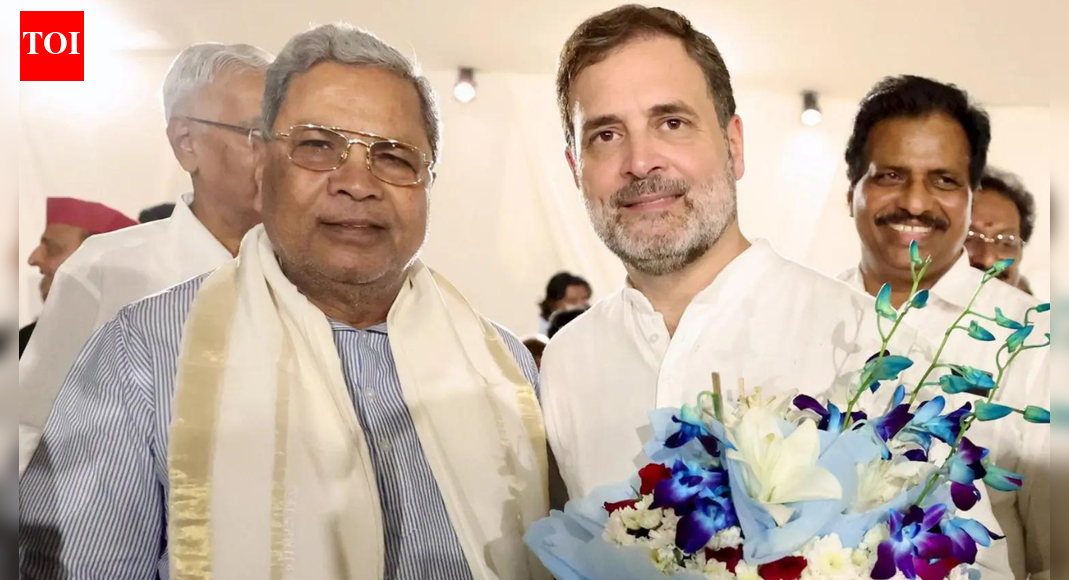
File photo: Karnataka CM Siddaramaiah with Congress MP Rahul Gandhi (Picture credit: PTI)

NEW DELHI: Karnataka chief minister Siddaramaiah on Friday came out strongly in defence of Congress leader Rahul Gandhi, accusing sections of the media and the BJP of misrepresenting an Election Commission-linked survey to undermine allegations of voter list manipulation.In a detailed post on X, the chief minister said an administrative survey conducted earlier this year was being selectively cited to suggest that concerns raised by Rahul Gandhi over electoral malpractice had been “disproved”, a claim he described as an attempt to ‘manufacture a misleading narrative’.

Siddaramaiah, DK Shivakumar Project Unity After High-Stakes Karnataka Meet Amid Rumours Of Cong Rift

Siddaramaiah said the survey in question was not a political or opinion poll but an end-line evaluation carried out under the Systematic Voters’ Education and Electoral Participation (SVEEP) programme.Conducted in May 2025, the exercise was meant to assess voter awareness efforts, not to validate the integrity of elections or respond to allegations that surfaced months later. “An awareness survey cannot be twisted into a certificate of electoral integrity,” he wrote.He also pointed to the timing of the exercise, noting that Rahul Gandhi raised allegations of organised voter list manipulation, which the Congress has described as “Vote Chori”, only in August 2025. Using data collected before those allegations emerged to counter later claims was not fact-checking, he said, but a distortion of facts.The chief minister questioned the statistical weight being given to the findings, highlighting that the survey covered 5,100 respondents in a state with over 5.3 crore adult voters. That, he said, amounted to less than 0.01% of the electorate. “In constituencies like Bengaluru Central, where allegations of voter list manipulation are most acute, the respondent count runs into mere double digits. Projecting this as the definitive “people’s verdict” is statistically indefensible,” he wrote.Siddaramaiah further alleged a conflict of interest, stating that the survey was conducted by an NGO called GRAAM, founded by Dr R Balasubramaniam, who currently holds a Union government-appointed position and authored a book praising Prime Minister Narendra Modi in 2024.He said this aspect had been ignored in much of the reporting.The chief minister also rejected claims that Rahul Gandhi was questioning democracy or the electoral process itself. He said the Congress leader had sought transparency on issues such as access to voter rolls, safeguards against surveillance, scrutiny of EVMs and the independence of the Election Commissioner appointment process, questions which he said remain unanswered.Referring to criminal investigations in Karnataka, Siddaramaiah cited the Aland case, where a police Special Investigation Team filed a 22,000-page chargesheet naming seven accused, including a former BJP MLA, for allegedly attempting to illegally delete nearly 6,000 genuine voters using OTP bypass technology. He said the probe was pursued by the Congress government despite winning the seat and led to systemic changes by the Election Commission.The controversy erupted after the BJP cited findings from a survey conducted across Karnataka to claim that a majority of respondents trust EVMs and believe elections in India are conducted freely and fairly. BJP spokesperson Shehzad Poonawalla said Rahul Gandhi gets a “reality check” every time he raises questions after electoral defeats.Congress leaders have since questioned the credibility of the survey. As quoted by news agency ANI, Priyank Kharge and Supriya Shrinate flagged concerns over the timing, sample size and neutrality of the agency that conducted the exercise, arguing that it cannot be used to dismiss allegations backed by criminal investigations.Siddaramaiah concluded that a limited, pre-event administrative survey cannot override evidence, chargesheets or unresolved questions, calling it unfortunate that these facts were ignored in favour of what he termed a distorted narrative.


Source link

Forex watch: India’s reserves rise by $3.29 billion to $696.61 billion; gold holdings lead the weekly jump


Forex watch: India’s reserves rise by $3.29 billion to $696.61 billion; gold holdings lead the weekly jump

India’s foreign exchange reserves rose by $3.293 billion to $696.61 billion in the week ended December 26, data released by the Reserve Bank of India showed on Friday, PTI reported.The overall reserves had increased by $4.368 billion to $693.318 billion in the previous reporting week, indicating a continued strengthening of the country’s external buffer.According to the RBI data, foreign currency assets (FCAs) — the largest component of the forex reserves — edged up by $184 million to $559.612 billion during the week. FCAs, expressed in dollar terms, include the impact of appreciation or depreciation of non-US currencies such as the euro, pound and yen held in the reserves.Gold reserves recorded the sharpest increase, rising by $2.956 billion to $113.32 billion, the central bank said.The country’s Special Drawing Rights (SDRs) with the International Monetary Fund increased by $60 million to $18.803 billion during the reporting week, while India’s reserve position with the IMF rose by $93 million to $4.875 billion, according to the RBI data.


Source link

Delhi: Court convicts 3 including MCD Engineer for demanding bribe for house construction | India News


Delhi: Court convicts 3 including MCD Engineer for demanding bribe for house construction

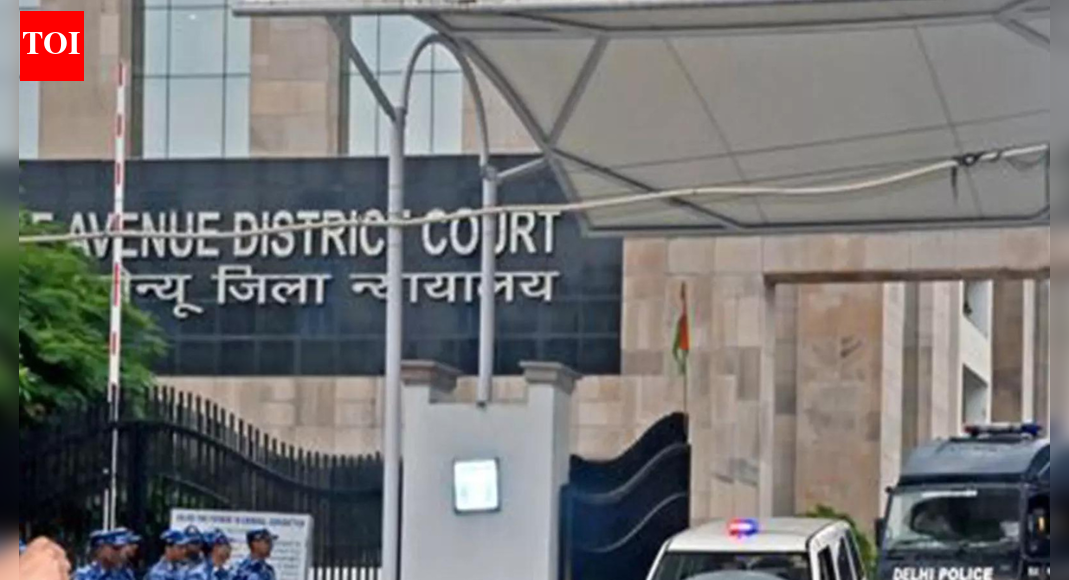
NEW DELHI: The Rouse Avenue court has recently convicted three people, including MCD’s Junior Engineer, for allegedly demanding and accepting a bribe for allowing the construction of a house. It was alleged that the complainant was threatened if the demand was not fulfilled. One accused was caught red-handed while accepting the bribe.While convicting the accused, the court said there was sufficient evidence to hold all three. The CBI registered a case in 2024 on a complaint filed by Arun Kumar Gupta.Special Judge (CBI) Shailender Malik convicted Surender Kumar, Surender Kumar Jangra and MCD Junior Engineer Ramesh Chand Jain.“Therefore, all three accused persons are held guilty for the offence under Section 7 of the P.C. Act, 1988 (as amended in 2018), read with Section 120B of IPC,” Special Judge Malik said in a judgment of December 24.The court concluded that there is sufficient evidence that Surender Kumar and Surender Kumar Jangra demanded the bribe, and that Surender Kumar was found red-handed accepting it, which was recovered from his possession.The court further concluded that there is sufficient evidence on the record that Surender Kumar and Surender Kumar were doing so in connivance and conspiracy with Ramesh Chand Jain, who was actually working as JE in MCD. It was alleged that on March 18, 2024, the accused demanded Rs. 30,000 to allow construction of the complainant’s house at the behest of Ramesh Chand Jain. This was reported to the CBI. Accused Surender Kumar was arrested while accepting the bribe of Rs. 15,000.The court has listed the matter for hearing arguments on the sentence on January 5.


Source link

No Ryan Rickelton and Tristan Stubbs! South Africa announce T20 World Cup 2026 squad – all you need to know | Cricket News


No Ryan Rickelton and Tristan Stubbs! South Africa announce T20 World Cup 2026 squad - all you need to know
Ryan Rickelton (AP Photo)

South Africa have announced their squad for the upcoming T20 World Cup and made a few big and surprising decisions. Young fast bowler Kwena Maphaka and top-order batter Jason Smith have been included in the team. However, there is no place for batters Ryan Rickelton and Tristan Stubbs. Jason Smith’s selection comes after his strong recent performances. He has been in good form in T20 cricket and earned his spot ahead of Stubbs, who was part of South Africa’s squad that finished runners-up in the 2024 T20 World Cup.

Sarfaraz Khan is knocking the selectors’ door again

Smith made his T20I debut in 2024 and has a strike rate of 128.30. He is currently playing for MI Cape Town in the SA20 league. One of his best recent knocks came in the T20 Challenge in November, where he smashed an unbeaten 68 runs off just 19 balls to help the Dolphins reach the playoffs. Ryan Rickelton, on the other hand, could not make the cut in a team already filled with top-order players. Captain Aiden Markram and wicketkeeper-batter Quinton de Kock are among the main options at the top of the order. Along with Smith and Maphaka, several players have received their first-ever T20 World Cup call-up. These include Corbin Bosch, Dewald Brevis, Tony de Zorzi, Donovan Ferreira, and George Linde. South Africa head coach Shukri Conrad spoke about the team’s preparation and conditions in the subcontinent. He said, “We are returning to the subcontinent, where we recently competed against hosts India. The experience we gained playing in those conditions will undoubtedly benefit us as we head into this tournament. “Many of the players selected for the World Cup squad were on that trip and experienced first-hand the pitches that we will likely encounter and that will stand them in good stead once we get to India.” Conrad also added, “We do have one more T20I series against the West Indies before we depart for the World Cup, and that squad will be announced later this month.” Star fast bowler Kagiso Rabada returns to the T20I side after missing the recent tour of India due to a rib injury. Anrich Nortje is also back in the squad after finishing as South Africa’s leading wicket-taker in the 2024 T20 World Cup. South Africa are placed in Group D along with Afghanistan, Canada, New Zealand, and the UAE. They will start their campaign on February 9 against Canada in Ahmedabad. Former all-rounder Albie Morkel will join the team as a specialist consultant.South Africa squad: Aiden Markram (captain), Corbin Bosch, Dewald Brevis, Quinton de Kock, Tony de Zorzi, Donovan Ferreira, Marco Jansen, George Linde, Keshav Maharaj, Kwena Maphaka, David Miller, Lungi Ngidi, Anrich Nortje, Kagiso Rabada and Jason Smith.


Source link

‘I was elected as a Democratic Socialist’: Decoding Zohran Mamdani’s inaugural speech | World News


'I was elected as a Democratic Socialist': Decoding Zohran Mamdani's inaugural speech

Zohran Mamdani’s inaugural address was notable not for its length or flourish, but for how explicitly it challenged the governing assumptions New York has lived with for years. Instead of emphasising constraints, he foregrounded ambition. Instead of defending incrementalism, he framed it as failure. And instead of presenting affordability as an unfortunate by-product of global forces, he treated it as a problem government has actively chosen not to confront.The speech was light on implementation detail, but heavy on direction. Read closely, it sets out a governing philosophy built around direct cost relief, public provision, and an openly confrontational posture towards institutions that block change.

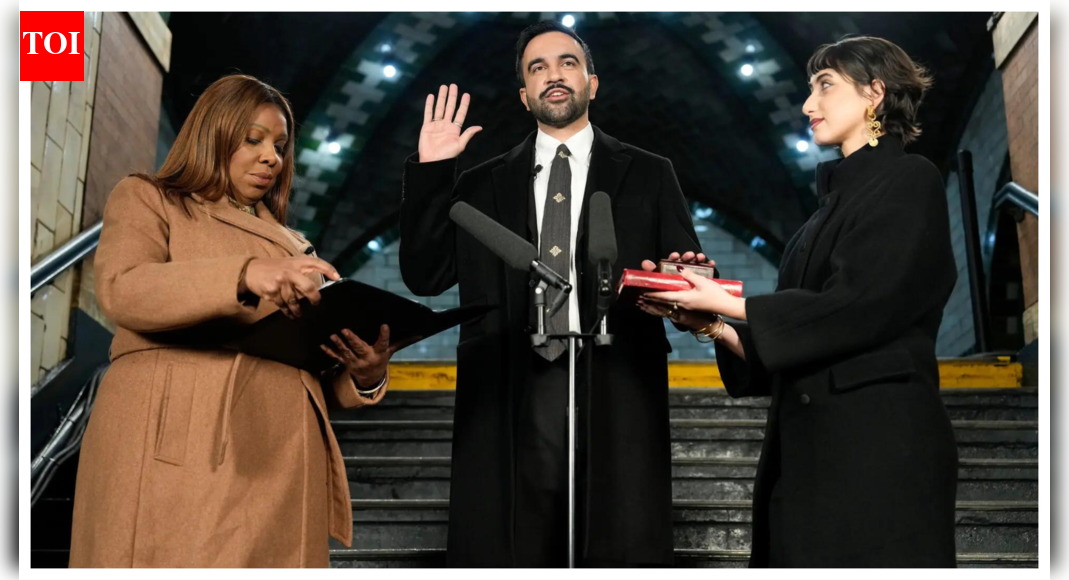
Zohran Mamdani Takes Oath On Quran In Historic First As New York Muslim Mayor | WATCH

Here is what Mamdani said, and what it actually means.

Resetting expectations: rejecting the politics of caution

“In writing this address, I have been told that this is the occasion to reset expectations, that I should use this opportunity to encourage the people of New York to ask for little and expect even less. I will do no such thing. The only expectation I seek to reset is that of small expectations.”What this signals:This is Mamdani’s clearest break from recent administrations. New York governance has increasingly been shaped by expectation management. Leaders promise process, cite constraints, and treat boldness as irresponsibility.Mamdani rejects that logic outright. He is not promising that everything will succeed. He is promising that failure will not be pre-empted by timidity. This line sets the tone for a mayoralty that prefers visible effort over quiet restraint.

Using state power unapologetically

“To those who insist that the era of big government is over, hear me when I say this: No longer will City Hall hesitate to use its power to improve New Yorkers’ lives.”What this signals: This is a direct rebuttal to the post-1990s consensus that city governments should defer to markets and limit intervention. Mamdani is arguing that government’s failure has not been overreach, but underuse of authority.The emphasis here is not on expanding government for its own sake, but on abandoning hesitation. It foreshadows regulatory fights, public provision, and policies that test the limits of what City Hall can do without waiting for permission.

Free buses: making relief immediate

“Getting on a bus without worrying about a fare hike or whether you’ll be able to get to your destination on time will no longer be deemed a small miracle, because we will make buses fast and free.”What this signals: Free buses are not presented as a transport reform alone. Mamdani frames them as a daily indignity that government has normalised.By choosing buses, he prioritises a policy that delivers immediate, visible relief across income and community lines. The political logic is clear: once a fare disappears, its return must be justified publicly. This shifts the burden of explanation from government to opponents.

Universal childcare: treating time as public infrastructure

“The cost of child care will no longer discourage young adults from starting a family, because we will deliver universal child care for the many by taxing the wealthiest few.”What this signals: Mamdani does not frame childcare as a labour-market efficiency measure or a demographic fix. He frames it as freedom from economic coercion.The emphasis on “starting a family” reflects how childcare costs reshape life choices in New York. By calling for universal provision, Mamdani is moving childcare from the realm of private sacrifice into that of public obligation.The speech deliberately avoids details on timelines or mechanisms. Its purpose is to establish childcare as a priority that must be funded, not a programme that can be deferred.

Rent freeze: turning housing into a political confrontation

“Those in rent-stabilised homes will no longer dread the latest rent hike, because we will freeze the rent.”What this signals: This is the most legally constrained and politically charged promise in the speech.Housing regulation in New York involves state law, courts, regulatory boards, and powerful landlord interests. Mamdani is aware of these limits. By promising a rent freeze anyway, he is forcing responsibility into the open.If the freeze is blocked, the focus shifts from inevitability to obstruction. The policy’s power lies as much in exposing who controls housing outcomes as in delivering immediate relief.

Public safety: redefining the role of policing

“New Yorkers will create a new Department of Community Safety that will tackle the mental health crisis and let the police focus on the job they signed up to do.”What this signals: Mamdani avoids abolitionist rhetoric. Instead, he reframes public safety as a system misaligned with its tasks.By separating mental health and social crises from policing, he positions this as a functional correction rather than an ideological overhaul. This allows the proposal to appeal both to communities harmed by over-policing and to voters concerned about order and response times.

Collectivism as policy logic

“We will replace the frigidity of rugged individualism with the warmth of collectivism.”What this signals: This line provides the connective logic for Mamdani’s policy agenda.Free buses reduce individual coping costs. Childcare reduces private improvisation. Rent freezes reduce solitary negotiation. Community safety reduces personal risk management.Collectivism here is framed not as ideological conformity, but as shared infrastructure for shared problems. Mamdani argues that New York’s fragmentation stems not from diversity, but from the privatisation of survival.

Defining “New Yorker” as a shared condition

“No matter what you eat, what language you speak, how you pray, or where you come from, the words that most define us are the two we all share: New Yorkers.”What this signals: Mamdani deliberately subordinates cultural difference to civic identity.“New Yorker” in this framing is not about heritage or ideology, but about shared exposure to high costs, long commutes, housing insecurity, and economic pressure. This allows Mamdani to justify universal policies without targeting specific groups.Relief is framed as something owed to New Yorkers as a class defined by material reality.

Governing without apology

“I was elected as a democratic socialist and I will govern as a democratic socialist.”What this signals: This line functions as narrative discipline.Mamdani is signalling that there will be no ideological softening once in office. Supporters are told not to expect triangulation. Critics are told not to feign surprise. The mayor is locking in expectations early to avoid accusations of bait-and-switch politics later.

From “no” to “how”: changing City Hall’s culture

“We will transform the culture of City Hall from one of ‘no’ to one of ‘how?’”What this signals:This is the most operationally significant promise in the speech.“No” is how bureaucracies preserve themselves. “How?” demands justification. It forces agencies, regulators, and higher levels of government to explain obstruction publicly.Mamdani is committing to governance that makes limits visible rather than quietly absorbed. Even failure, in this model, becomes politically useful if it clarifies where power lies.

The bottom line

Zohran Mamdani’s inaugural speech is not a detailed policy blueprint. It is a declaration of governing intent. He is not promising smooth delivery or consensus politics. He is promising confrontation, visibility, and a refusal to normalise unaffordability. The risk is overreach and voter fatigue if tangible relief lags behind rhetoric. The bet is that New Yorkers are already fatigued by caution disguised as realism. For now, the speech makes one thing unmistakably clear: New York’s new mayor intends to judge his administration not by how well it manages constraints, but by how hard it pushes against them.



Source link

‘Removed through conspiracy’: Brij Bhushan Singh’s big charge after sexual harassment-linked ouster; vows Lok Sabha return | India News


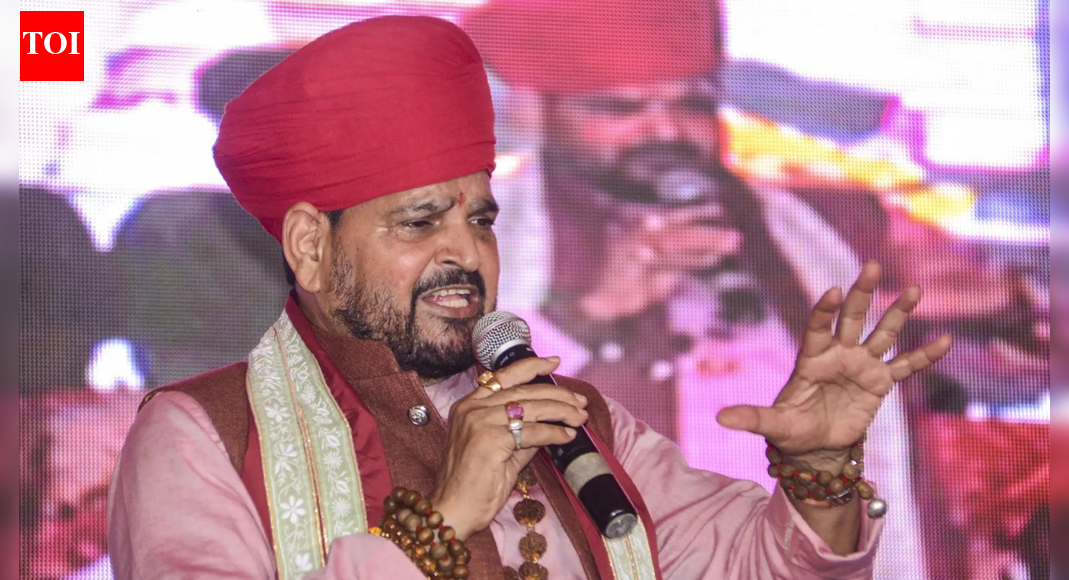
Brij Bhushan Sharan Singh (PTI image)

NEW DELHI: Former Kaiserganj MP Brij Bhushan Sharan Singh on Wednesday alleged that he was removed from the Lok Sabha through a “conspiracy” and not by the will of the people. The senior BJP leader asserted that he would contest parliamentary elections again if he remains alive.Speaking on a podcast, Brij Bhushan said that his political career in Parliament was “cut short” and that he was “humiliated and forced out” despite representing the region multiple times. “If I am alive, I will definitely go to the Lok Sabha once again. I will try to contest on a BJP ticket. If the party does not give a ticket, I will contest as an Independent candidate. But if I am alive, I will contest,” he said.Singh also said that he was hurt for not being invited to the second anniversary celebrations of the Ram Temple in Ayodhya, despite being a public representative, news agency PTI reported. He claimed that the original karsevaks of the Ram Janmabhoomi movement were ignored, while others with no role were invited. Singh said that he declined a later invitation on grounds of self-respect.Former MP added that he has not visited Ram Lalla yet and when he does, he will stand in the queue like an ordinary devotee.Referring to the period when allegations of sexual harassment were levelled against him by women wrestlers, Singh said Samajwadi Party chief Akhilesh Yadav did not make any statement against him, a gesture he said he would “never forget”. He added that leaders from the BSP, JD(U) and RJD also refrained from commenting against him at the time.Brij Bhushan Sharan Singh, a six-time MP who represented three parliamentary constituencies in Uttar Pradesh’s Devipatan division, was denied a BJP ticket in the 2024 Lok Sabha elections following allegations by six female wrestlers. The party instead fielded his son, Karan Bhushan Singh, who won the Kaiserganj seat and currently represents it in Parliament.Following the allegations of sexual harassment, several female wrestlers, including Vinesh Phogat and Bajrang Punia, protested against Brij Bhushan. In May 2024, a Delhi court framed charges against Singh for sexual harassment, outraging the modesty of women and criminal intimidation based on complaints filed by five women wrestlers. Singh pleaded not guilty, maintaining that he had committed no wrongdoing. The court said the allegations reflected a “systematic and recurring pattern” and ordered that the case proceed to trial. He was discharged in one related complaint dating back to 2012.In August 2024, Singh approached the Delhi High Court seeking to quash the FIR, chargesheet and trial court orders.


Source link

Max Bryant’s explosive knock guides Brisbane Heat to a thrilling victory over Melbourne Stars in BBL|15


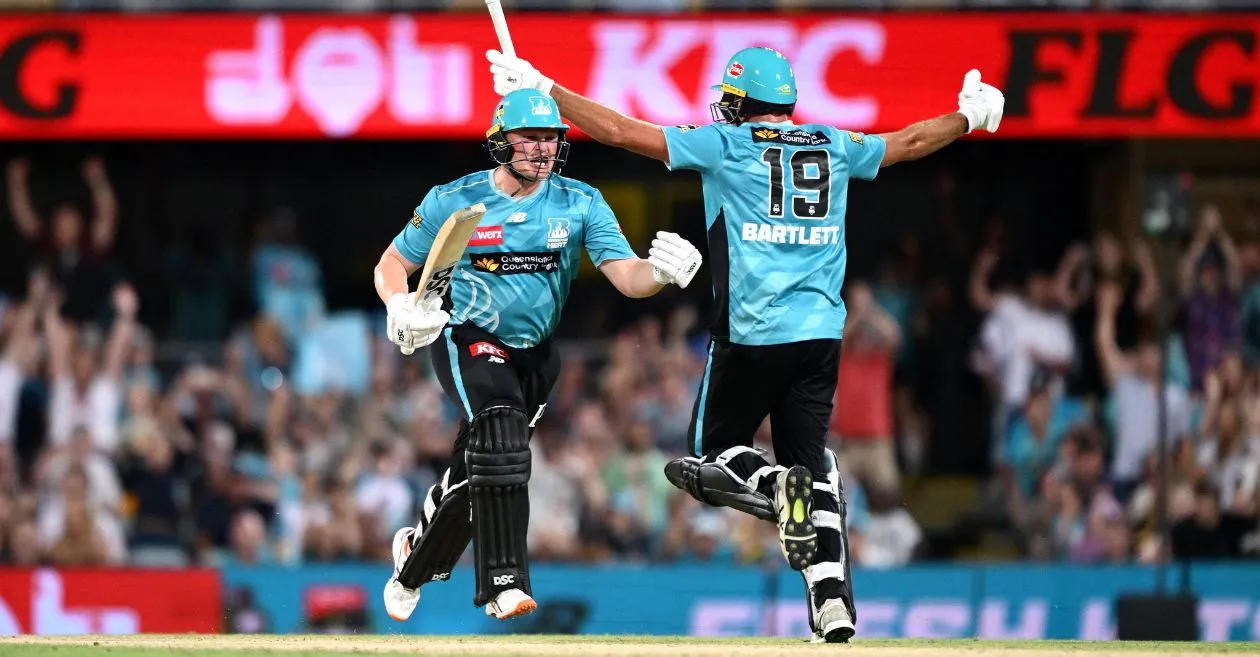
In a high-octane clash at The Gabba, Brisbane Heat edged out Melbourne Stars by four wickets in the 20th match of Big Bash League|15 on January 2, 2026, chasing down 196 with just two balls to spare. Brisbane Heat, who won the toss and bowled first, restricted Stars to 195/6 before mounting a tense pursuit that kept 31,948 fans on edge. Max Bryant‘s unbeaten 48 off 26 balls, laced with three fours and four sixes, proved decisive in this pulsating encounter.​

Melbourne Stars set a competitive target for Brisbane Heat

Stars powered their way to 195 for six after coming out with clear intent, fully exploiting the powerplay to surge to 47 without loss in the first four overs. Sam Harper set the early momentum with a fluent 37 from 23 balls, cracking five fours and a six, as he stitched together a 52-run opening stand with Thomas Rogers, who added 13. The partnership was broken in the sixth over when Thomas Balkin clean-bowled Harper. Marcus Stoinis then took charge with a composed 43 off 35 deliveries, while Campbell Kellaway lifted the tempo through a brisk 29 from just 14 balls, peppered with six boundaries. Their 53-run stand for the third wicket carried the Stars beyond 100 by the 11th over, even as Glenn Maxwell failed to get going.

The Heat fought back strongly in the middle phase. Xavier Bartlett accounted for Stoinis, while Matthew Renshaw and Matthew Kuhnemann provided crucial breakthroughs, triggering a slide from 113 for four to 137 for six, with Tom Curran departing for two. Stability returned late as Hilton Cartwright remained unbeaten on 26 off 20 balls and Blake Macdonald unleashed a late burst, hammering 37 not out from 12 deliveries with four fours and two sixes. Their unbroken 58-run stand in just 19 balls pushed the Stars to an imposing total at a run rate of 9.75. Kuhnemann impressed with figures of one for 22, but the Stars’ late surge ensured a tough challenge under the lights.

Also WATCH: Jim Peirson grabs a screamer to remove Glenn Maxwell in BBL|15

Max Bryant’s fiery innings powers Brisbane Heat past Melbourne Stars in BBL|15

Brisbane Heat were rocked early as their innings stumbled in the opening phase, losing Jack Wildermuth for 15 to the guile of Peter Siddle and Colin Munro for just 3, undone by Tom Curran, to slide to 34 for 2 inside the powerplay. Skipper Nathan McSweeney steadied the ship with a composed 43 from 31 balls, finding solid support in Renshaw, who struck a fluent 41 off 27. Together, the duo stitched a vital 69-run partnership for the third wicket, lifting Heat to 103 for 3 by the 12th over after bringing up their fifty in only 5.5 overs.

The momentum shifted again when Mitchell Swepson struck twice, dismissing both set batters to leave Heat at 107 for 4, before Hugh Weibgen followed soon after at 109 for 5. Pressure mounted further as Jimmy Peirson fell for 14, caught off Haris Rauf, reducing the total to 133 for 6.

That was when Bryant turned the game on its head. Blasting an unbeaten 48 off 26 balls, Bryant launched four towering sixes, including decisive hits in the 17th over, pushing the score beyond 150 by 16.5 overs. With Bartlett chipping in with a brisk 21 not out from 9 deliveries, the pair added a stunning 66 runs for the seventh wicket in just 20 balls. Heat raced to 199 for 6 in 19.4 overs at a scorching rate of 10.11. Despite Siddle and Swepson picking up two wickets apiece, Bryant’s blistering strike rate of 184.61 left the Stars stunned and powered Brisbane Heat up the standings in what became BBL|15’s tightest finish yet.

Also READ: Fans erupt as Mitchell Marsh lights up BBL|15 with thunderous century against Hobart Hurricanes


Source link