Breaking News
Ollie Peake guides Melbourne Renegades to thrilling win over Perth Scorchers in BBL|15


The Melbourne Renegades produced a disciplined all-round performance to defeat the Perth Scorchers by four wickets in Match 26 of the Big Bash League (BBL) 2025-26 at Perth Stadium. After opting to bowl first, the visitors restricted the Scorchers to a modest total before calmly chasing it down, led by a composed knock from Ollie Peake, who was named Player of the Match.

Perth Scorchers struggle after shaky start

Asked to bat first, Perth Scorchers never truly settled at the crease and were bundled out for 127 in 19.2 overs. Early wickets hurt their momentum, with Finn Allen and Cooper Connolly falling cheaply, putting pressure on the middle order. Mitchell Marsh attempted to stabilize the innings with a cautious 27 off 25 balls, while Aaron Hardie top-scored with a gritty 44 off 40 deliveries, anchoring the innings amid regular wickets.

Ashton Turner and Jhye Richardson provided brief cameos, but the lack of boundaries and sustained partnerships proved costly. Perth lost their final five wickets for minimal runs, underlining the Renegades’ stranglehold in the latter half of the innings.

Melbourne Renegades bowlers set the tone

The Melbourne Renegades’ bowling attack was clinical, led by Gurinder Sandhu, who ripped through the Scorchers’ batting with figures of 4 for 28 in his four overs. Jason Behrendorff was equally impressive with the new ball, conceding just 11 runs in three overs while picking up a key wicket. Hassan Khan chipped in with two scalps, ensuring Perth never gained control of the innings despite Hardie’s resistance.

Also READ: BBL|15: Joel Davies’ all-round brilliance guides Sydney Sixers past Brisbane Heat in a low scoring thriller

Ollie Peake anchors Renegades’ thrilling chase

Chasing 128, the Renegades adopted a cautious approach on a tricky Perth surface. Josh Brown gave them early impetus with a brisk 22 off 14 balls, but wickets at regular intervals kept the contest alive. Mohammad Rizwan and Tim Seifert tried to steady the innings, yet the Scorchers’ bowlers ensured the required rate never became too comfortable.

The turning point came through Ollie Peake, who played a mature and composed knock of 42 off 30 balls. Mixing patience with timely boundaries, Peake guided the Renegades through the middle overs and took the pressure off the lower order. Will Sutherland provided useful support as Melbourne reached the target in 20 overs with four wickets in hand.

For Perth, Joel Paris was outstanding, conceding just seven runs in his two overs, while Turner impressed with a rare over that yielded a wicket for just one run. However, inconsistent spells from the rest of the attack allowed the Renegades to keep chipping away at the target as they sealed a four-wicket victory.

Also READ: BBL|15: Jamie Overton shines in Adelaide Strikers’ thrilling win over Sydney Thunder


Source link

‘Not only dog bites’: SC flags road accidents due to strays; highlights civic lapses, warns states | India News


'Not only dog bites': SC flags road accidents due to strays; highlights civic lapses, warns states

NEW DELHI: Flagging lapses by civic authorities, the Supreme Court on Wednesday observed that fatalities across the country are being caused not just by dog bites, but also by road accidents involving stray animals.A bench of Justices Vikram Nath, Sandeep Mehta and N V Anjaria made the remarks while hearing pleas seeking modification of its earlier directions, filed by animal lovers as well as those demanding stricter enforcement of the court’s orders. The bench noted that several lawyers and animal rights activists had argued they were not heard before the November 7 order was passed.“The roads should be clear of dogs and stray animals. It is not only the dog bites but also the roaming of stray animals on roads that are proving dangerous and causing accidents. No one knows which dog is in what mood in the morning. Civic bodies have to implement the rules, modules and directions strictly,” the bench said, according to news agency PTI.Justice Mehta highlighted the seriousness of the issue, pointing out that two Rajasthan High Court judges had met with accidents in the past 20 days, with one still suffering from spinal injuries. “It’s a serious issue,” he told counsel appearing in the matter.Senior advocate Kapil Sibal, appearing for a petitioner seeking modification of the earlier order, argued that the solution does not lie in rounding up all stray dogs. He said a scientific and globally accepted approach was needed to reduce human-animal conflict.Sibal urged the court to adopt the CSVR model—Capture, Sterilise, Vaccinate and Release—for controlling the stray dog population, submitting that this method would gradually bring down dog bite incidents. “Prevention is always better than cure,” Justice Nath remarked, adding that the court’s earlier directions were limited to removing stray dogs from institutional areas and did not override existing rules.‘Strict enforcement of existing rules’The bench clarified that its focus was on ensuring strict enforcement of existing rules, regulations, modules and standard operating procedures by states and civic bodies. “Some states have not responded to compliance with our orders and implementation of the arguments. We will be very harsh with those states. All the rules, regulations and SOPs need to be followed,” the court warned.When lawyers pointed out ongoing dog attacks, the bench said it was aware that children and adults were being bitten and, in some cases, losing their lives.At the outset, senior advocate Gaurav Agarwal, appointed amicus curiae in the case, informed the court that the National Highways Authority of India had prepared an SOP to comply with the court’s directions. “They have identified 1,400 km of road as a vulnerable stretch. However, after detection, the NHAI says that the state governments have to take care of it,” Agarwal said.The bench suggested fencing highways and expressways to prevent stray animals from entering roadways. Agarwal also told the court that states including Madhya Pradesh, Uttar Pradesh, Karnataka and Punjab were yet to file compliance affidavits, while some submissions received so far were “disappointing”. Justice Nath said the court would deal with those states.‘If one tiger is a man-eater … ‘Continuing his submissions, Sibal said the response to the stray dog issue must reflect a mature and responsible society. “First of all, this is not an adversarial issue and we are here as dog lovers. If one tiger is a man-eater, we don’t kill all tigers,” he argued, stressing the need for sterilisation to systematically reduce dog populations. He claimed the CSVR model had brought down the stray dog population in Lucknow to almost zero.Sibal also cautioned that housing rabid and non-rabid dogs together could spread the disease. Responding in a lighter vein, the bench remarked, “The only thing missing is providing counselling to the dogs as well so that he doesn’t bite when released back.”Similar submissions were made by senior advocates Colin Gonsalves, Anand Grover and C U Singh, along with several animal rights activists who appeared in person. Senior advocate K K Venugopal, appearing for NALSAR, Hyderabad, highlighted data pointing to an acute shortage of shelters for stray dogs.The hearing remained inconclusive and is set to continue on Thursday.The case stems from the apex court’s November 7 directions, issued after noting an “alarming rise” in dog bite incidents within institutional areas such as schools, hospitals and railway stations. The court had ordered the immediate relocation of stray dogs from such premises to designated shelters after sterilisation and vaccination, and directed that the animals should not be released back to the same locations.It also instructed authorities to remove all cattle and other stray animals from state highways, national highways and expressways, warning that repeated dog bite incidents reflected administrative apathy and a systemic failure to secure public spaces from preventable dangers.The Supreme Court is hearing the matter as part of a suo motu case initiated on July 28 last year, following media reports on stray dog attacks leading to rabies, particularly among children, in the national capital.


Source link

Access Denied


Access Denied

You don’t have permission to access “http://www.ndtv.com/india-news/irans-decisive-response-warning-after-trumps-comment-10469698” on this server.

Reference #18.2ef63717.1767788631.18b16334

https://errors.edgesuite.net/18.2ef63717.1767788631.18b16334


Source link

Stock market slide: Nifty down 1%, Sensex sheds over 1,000 points in 3 days- key reasons for the fall


Stock market slide: Nifty down 1%, Sensex sheds over 1,000 points in 3 days- key reasons for the fall

Equity indices extended their decline on Wednesday, with the Sensex and the Nifty ending lower for a third consecutive session as sustained selling in heavyweight stocks, rising geopolitical unease and weak global cues dented investor confidence. The BSE Sensex has shed over 1,144 points in the past three sessions, sliding from a close of 85,762.01 on January 2 to an intraday low of 84,617.49 on Wednesday. The NSE Nifty 50 has declined nearly 1 per cent over the same period, pushing benchmarks firmly into the red for the week.By the close, the Sensex had pared some losses to end 102 points, or 0.12 per cent, lower at 84,961.14, while the Nifty slipped 38 points, or 0.14 per cent, to settle at 26,140.75.

Heavyweight stocks drag indices

Selling pressure in index heavyweights continued to exert disproportionate pressure on the benchmarks. HDFC Bank shares fell 1.7 per cent on Wednesday, while Reliance Industries declined 0.4 per cent. Trent dropped 1.4 per cent, extending weakness after plunging 8.6 per cent in the previous session amid concerns over intensifying competition in the retail segment.The drag from large-cap stocks was also evident earlier in the week, when HDFC Bank and Reliance Industries — the two heaviest constituents on the indices — fell 1.5 per cent and 4.3 per cent, respectively, amplifying benchmark losses.Dr V K Vijayakumar, Chief Investment Strategist at Geojit Investments, said recent market movements lacked clear direction, with a few mega stocks disproportionately influencing overall trends. “For instance, yesterday despite positive institutional buying Nifty drifted down by 71 points, mainly due to sharp declines in two stocks — Reliance and HDFC Bank. The large volumes in these two stocks in the derivative and cash markets indicate activity associated with the settlement day. In other words, the sharp dips in these stocks have nothing to do with their fundamentals; it is more technical in nature,” he said, as quoted ET.

Geopolitical shock adds to risk aversion

Global risk appetite was further shaken by political turmoil in Venezuela and uncertainty surrounding its petroleum reserves. Market sentiment turned cautious after a controversial US military operation on January 3 led to the capture of Venezuelan President Nicolás Maduro and his wife, Cilia Flores, and their transfer to the United States to face criminal charges. Maduro remains in custody in New York.The developments have heightened broader geopolitical and policy-related anxieties. “Going forward, there is scope for high volatility caused by events and news,” Vijayakumar said, adding that “Trump tweets and actions can always influence the market. Another important event that investors should closely watch is a possible Supreme Court verdict on Trump tariffs very soon. If the verdict goes against the reciprocal tariffs, it will create huge volatility in stock markets.

Weak global cues spill over

Indian equities also tracked declines across Asian markets, where shares retreated as investors assessed the fallout from the Venezuela crisis and uncertainty over global energy supplies. Japanese equities weighed on regional sentiment after China announced a ban on exports of dual-use items to Japan that can be used for military purposes, following remarks by Japanese Prime Minister Sanae Takaichi on Taiwan.The cautious tone across global markets spilled over into domestic trading, reinforcing the downward bias in Indian equities despite some support in commodity-linked stocks after an overnight rally in industrial metals.

Technicals point to consolidation, volatility risk

Technical indicators suggest the recent decline reflects a broader corrective or consolidation phase rather than a breakdown in the longer-term trend, though near-term volatility remains elevated.Jaykrishna Gandhi, Head–Business Development–Institutional Equities at Emkay Global, noted that since 1991 the Nifty 50 has seen seven major bullish cycles, typically followed by corrective phases. He said that post-2009, corrections have largely shifted from sharp price declines to time-wise consolidations, reflecting improved structural strength.According to Gandhi, the index has “recently completed a ~1–1.5-year time correction, which historically has been followed by the resumption of a bullish trend,” with upside potential seen “up to 28,500, with positional support band at 25,500–25,300.”On the sectoral front, he highlighted strength in pharmaceuticals, saying “Nifty Pharma has confirmed a breakout from an ‘inverted head and shoulder’ pattern, indicating bullish continuation with upside potential toward 24,000–24,500,” while adding that the bullish bias remains intact “above 23,500.”However, near-term signals point to choppiness. Anand James, Chief Market Strategist at Geojit Investments, said, “A strong close on Friday near the upper bollinger band suggests continuation of upside momentum. Oscillators are accommodative as well.” At the same time, he cautioned that “VIX being near record indicates potential for rise in volatility,” underscoring the risk of sharp swings despite a broadly constructive technical backdrop.(Disclaimer: Recommendations and views on the stock market, other asset classes or personal finance management tips given by experts are their own. These opinions do not represent the views of The Times of India)


Source link

Access Denied


Access Denied

You don’t have permission to access “http://www.ndtv.com/world-news/venezuelas-political-transition-can-keep-global-oil-prices-lower-report-10469543” on this server.

Reference #18.2ff63717.1767788036.15685d03

https://errors.edgesuite.net/18.2ff63717.1767788036.15685d03


Source link

Not Shubman Gill! Australian great picks this India player as next Test superstar | Cricket News


Not Shubman Gill! Australian great picks this India player as next Test superstar
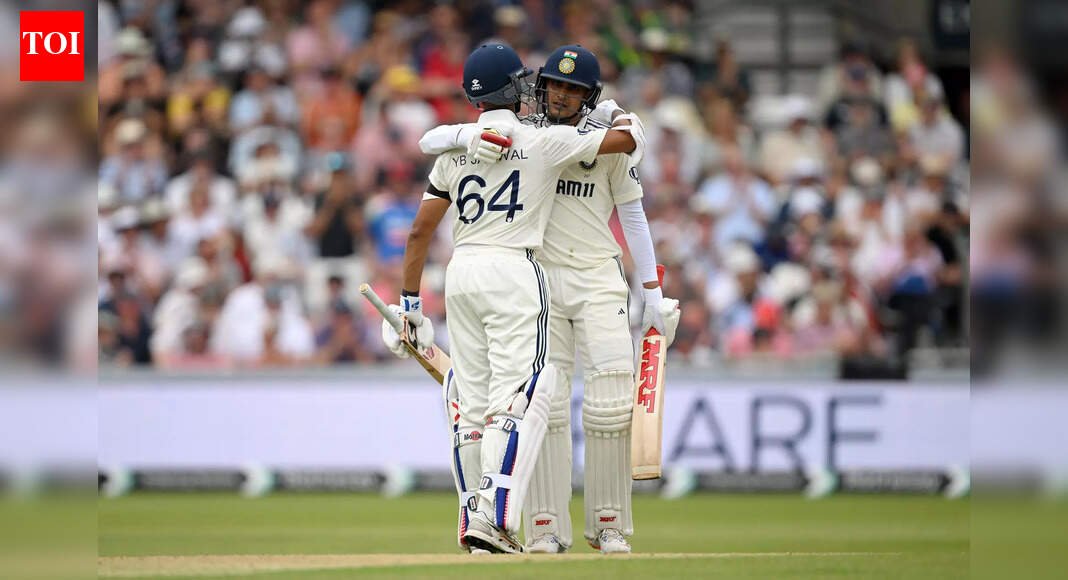
Shubman Gill & Yashasvi Jaiswal (Photo by Clive Mason/Getty Images)

With cricket’s legendary Fab Four – Virat Kohli, Steve Smith, Joe Root, and Kane Williamson – nearing the twilight of their careers, the spotlight is gradually shifting to a promising new generation. While still early in their journeys, players like Shubman Gill, Rachin Ravindra, Harry Brook, and Yashasvi Jaiswal are widely tipped to shape the landscape of world cricket over the next decade and beyond. Some have already started making significant waves: Gill has cemented his status as a leading Test captain for India and starred in a record-breaking series in England last year, Harry Brook has emerged as one of the most exciting young batters globally, Jaiswal has been steadily climbing the ranks, and Ravindra is quickly establishing himself as one of cricket’s most formidable all-rounders.

David Miller hails Paarl Royals’ all-round display after dominant bonus-point win

Amid this emerging talent pool, Australian great Mark Waugh was asked to name the next potential superstar of Test cricket. The former opener initially listed three contenders but was quick to single out his top pick. “I reckon there’s three in the run. Jaiswal, Brook and Ravindra from New Zealand. Well, I’m going with Jaiswal. At 24 years of age, he’s already scored a double hundred and averages just under 50. There’s something special about this kid. So I’ve got him down, Jaiswal, as the next champion batsman of the elite group. Look at him. Brilliant player. So that’s my pick, the young Indian,” Waugh said while speaking to Kayo Sports on the sidelines of the fifth Ashes Test between Australia and England in Sydney. Waugh’s endorsement comes as Jaiswal continues to impress on the field. In less than three years of his Test career, he has amassed 2,511 runs in 28 matches, including centuries in the demanding conditions of England and Australia. He has also shown an ability to convert his hundreds into big scores, recording two double centuries from his seven Test hundreds. However, former England captain Michael Vaughan holds a different view, naming Harry Brook as the next great Test batsman. Despite Brook having slightly more experience, with 3,052 runs from 34 Tests at an average exceeding 50, Vaughan believes the 26-year-old’s best is yet to come. “Harry Brook is the next one that we’re going to be talking about. We’re already talking about him on this trip, the way that he’s played. He hasn’t got the amount of runs I would have expected, but over the course of the next 10 years, I think we are going to see some of the most extraordinary innings from this chap. He’s already played quite a bit in his young career; red-ball cricket, white-ball cricket. He’s an all-format player, and he’s box office,” Vaughan said. Both experts agree that the baton is being passed, and while opinions differ on who will emerge as the next global Test superstar, the future of the game appears to be in promising hands.


Source link

Break law, lose visa: US Embassy issues stern warning to students, says ‘visa a privilege, not a right’


Break law, lose visa: US Embassy issues stern warning to students, says 'visa a privilege, not a right'

The United States Embassy in India on Wednesday issued a cautionary advisory to students, warning that violations of US law could lead to visa cancellations, deportation, and long-term bans on future travel.Emphasising that a US visa is a privilege rather than a right, the embassy said entry into the country is not an entitlement and depends on continued compliance with American laws and regulations.

U.S. Rewrites H-1B Rules, Setback To Indian Workers; Check Who Is Eligible & Changes | WATCH

In a post on X, the US Embassy said, “Breaking U.S. laws can have serious consequences for your student visa. If you are arrested or violate any laws, your visa may be revoked, you may be deported, and you could be ineligible for future U.S. visas. Follow the rules and don’t jeopardize your travel. A US visa is a privilege, not a right.”The advisory came amid increased scrutiny of immigration compliance in the United States and periodic warnings from US authorities to foreign nationals about maintaining lawful status while studying or working in the country.From December 26, mandatory biometric checking of all non-US citizens, including Green Card holders, at border points came into effect. Under the rule, US Customs and Border Protection officials took photographs of non-US citizens at every entry and exit point across airports, land crossings and seaports.The new rule applied to all non-US citizens entering or exiting the country, including children below 14 years and adults over 79 years.The biometric system aimed to address security and visa-overstay concerns. DHS said it was not for broad surveillance, though critics remained wary.Biometric collection at exit for the US was earlier limited to pilot programmes at select ports, but it was now mandatory.


Source link

Neena Gupta was engaged to a guy who ditched her and didn’t marry, urges women to not have a baby without marriage: ‘Bohot mushkil hai mat karna’ |


Neena Gupta is often called ‘brave’ for raising a daughter without getting married. The actress was in a relationship with cricketer Viv Richards. She had first met him at a dinner party hosted by the Maharani of Jaipur. They had a relationship and soon she was pregnant. In her autobiography, ‘Sach Kahun Toh’, the actress admitted that she was advised by many to have an abortion and not have a baby without marriage but she chose to continue with her pregnancy and gave birth to a daughter, Masaba Gupta. Now in a recent interview, Neena has revealed that she has not made any brave decision. The actress said that one doesn’t decide such things in life but sometimes, a person goes through some circumstances which makes them take some decisions and hence they shouldn’t be judged based on that. She said in an interview with Humans Of Bombay, “Maine kabhi yeh decision nai liya tha ke bina shadi ke bacha paida karungi. (I had never thought or decided that I will have a baby without getting married). Circumstances put you in situations where you to choose certain things, where you have no way out.”

Kitchen Queen! Neena Gupta Adds Star Power To South Indian Classic

She further recalled that she was once engaged to a guy who ditched her last minute and didn’t marry her. “I was engaged to one guy who ditched me at the last minute. We had exchanged rings, I was engaged. I had gone to buy my wedding clothes to Delhi and then he says, ‘abhi shadi nai karni’. He said, ‘mujhe sinus ka operation karaana hai. I said sinus ka operation to baadmein bhi ho sakta hai.’ (He told me he wants to undergo a sinus operation). Uske mummy, papa, sabko maine pucha, why he doesn’t want to get married and till today I don’t know.” Gupta further added, “He came to me after 6months and said let’s marry, I said ‘f**k off’ now I don’t want. Even then I asked the reason. Then he wanted to marry me but didn’t tell me the reason. So, we don’t know circumstances, we make decisions majboori mein. Let’s not judge people based on their decisions.” The actress further revealed how she remains unbothered about the opinions of others and how people percieve her. “Let people say what they want, na aap mujhe financial madad kar rahe hai aur na emotional madad kar rahe hai. (Neither are you going to come and help me emotionally or financially, so why should I even listen to you). If you’re my friend and I have a relationship with you, you can come and tell me.” Neena further gave some advice to young girls and said, “Young girls ko main yeh kahungi, agar aap mere jaise bina shadi se bacha paida karna chaahte ho, bohot mushkil hai, mat karna. Don’t do it because someone has done it. (My advice to all the young girls is that do not even think of having a baby without getting married, just because I did. It’s very difficult, don’t do it).” She further added, “My second advice is that, acting in TV or films is not a very nice profession. Agar aap uske bina nai reh sakte ho toh karo. If I have done well, I don’t get the fruit of it. It depends on so many factors, and not just how I’ve done – film bane, release ho, successful ho sab ek saath ho toh ho sakta hai (A film gets made nicely, the script is nice, it is successful, many factors come together for you to get success).


Source link

Senior Citizens Savings Scheme: At 8.2% interest rate, how does SCSS compare to bank FDs, RBI bonds, mutual funds? Explained


Senior Citizens Savings Scheme: At 8.2% interest rate, how does SCSS compare to bank FDs, RBI bonds, mutual funds? Explained
SCSS accounts help earn interest payments on a quarterly basis. (AI image)

Senior Citizens Savings Scheme or SCSS is a popular Post Office investment and savings scheme for senior citizens and retired individuals. The government-backed scheme is seen as a guaranteed cushion for regular interest income flow, especially for individuals who are looking for high interest rates but low risk options.SCSS accounts help earn interest payments on a quarterly basis and with the investment limit doubled to Rs 30 lakh from Rs 15 lakh a few years ago, Senior Citizens Savings Scheme continues to attract substantial flows. But, is investment in SCSS sufficient for retirees? How do other investment options like bank fixed deposits, small savings schemes, mutual funds compare on a return and taxation basis? We break it down for you:

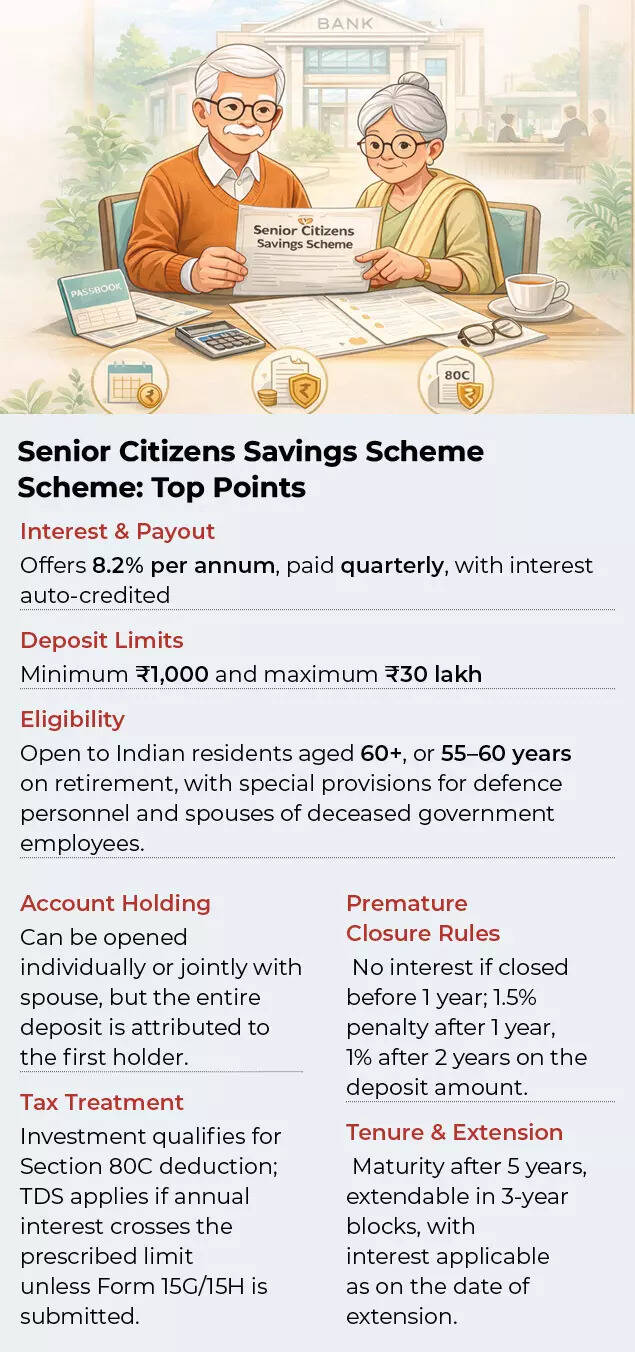
Senior Citizens Savings Schemes (SCSS): Eligibility, Investment Limits, Taxation – Top Points

  • The Senior Citizens Savings Scheme is open to resident Indians – any individual who is 60 years and above at the time of opening the account.
  • In special cases, individuals aged 55 years or above but below 60 years may also open an SCSS account if they have retired on superannuation or otherwise. However, this can be done when the SCSS account is opened within three months of receiving their retirement benefits.
  • Retired members of the defence services, excluding civilian defence staff, are also permitted to open an account on attaining the age of 50 years, subject to compliance with the prescribed conditions.
  • Also, the spouse of a government employee who attained the age of 50 years and died in harness may open an account under this scheme.
  • A joint SCSS can also be opened but in this case the entire deposit is treated as belonging solely to the first account holder.
  • For an SCSS account, the minimum account opening balance is Rs 1,000. The total investment account across all accounts cannot exceed Rs 30 lakh. Both spouses can open individual accounts or joint accounts with one another, subject to a maximum deposit of Rs 30 lakh per account, provided that they both meet the eligibility criteria independently.
  • SCSS accounts lock in the money for a period of 5 years and can be prematurely closed subject to certain conditions.
Senior Citizens Savings Scheme Scheme - Top Points

Senior Citizens Savings Scheme Scheme – Top Points

  • In case any amount above the maximum limit is deposited, it is refunded and the interest on such an excess amount is payable only at the Post Office Savings Account rate for the period from the date of excess deposit until the date of refund.
  • Investments made under the Senior Citizens Savings Scheme are eligible for deduction under Section 80C of the Income Tax Act, 1961 – which means that individuals filing their tax return under the old tax regime can avail this tax benefit.
  • Tax is deducted at source (TDS) if the total interest earned across all accounts, including SCSS, exceeds the prescribed threshold during a financial year, unless Form 15G or Form 15H is submitted, as applicable.
  • An account holder may extend the SCSS account for additional blocks of three years, any number of times. The extension must be requested within one year from the date of maturity or from the end of each three-year extension period, using the prescribed form at the concerned post office.
  • The extended account earns interest at the rate applicable on the date of original maturity or the date of extended maturity, as the case may be. If the account is closed before one year from the date of extension, a deduction of 1 percent of the deposit is made.
  • The extension is considered effective from the original maturity date, regardless of when the application is submitted.

Senior Citizens Savings Schemes (SCSS): Interest calculation

The interest on your SCSS account is calculated and paid on a quarterly basis from the date of deposit, for the quarters ending on 31 March, 30 June, 30 September, and 31 December. According to the rules, the interest amount is credited to the SCSS depositor’s savings account on 1 April, 1 July, 1 October, and 1 January, respectively. Account holders may opt for automatic credit of interest to their savings account or through the ECS facility. Any interest not claimed in a quarter does not earn further interest.
Senior Citizens Savings Scheme Interest Calculations

Senior Citizens Savings Scheme Interest Calculations

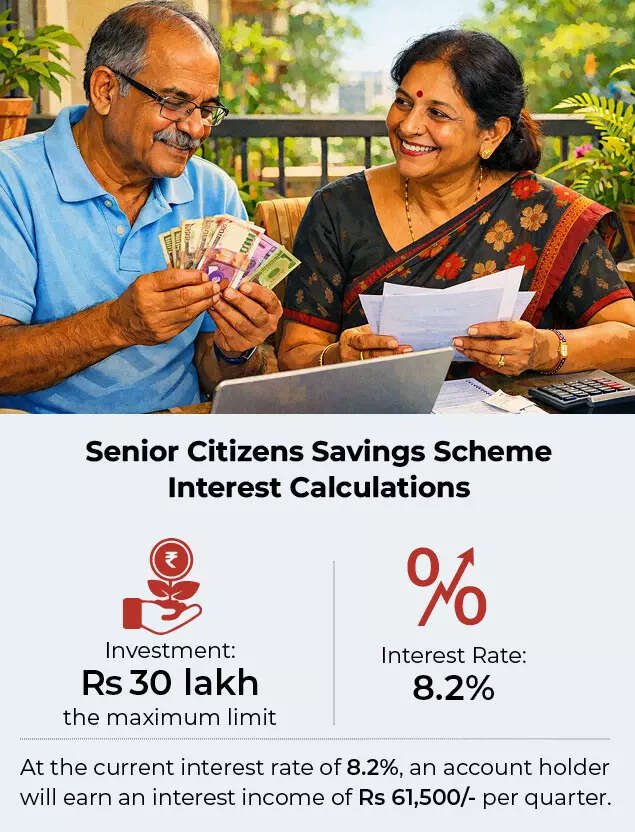
At the current interest rate of 8.2%, if a senior citizen were to invest the maximum limit of Rs 30 lakh, the quarterly interest earnings would stand at Rs 61,500, which is Rs 2.46 lakh in a year. Over a period of 5 years, the total interest earnings on the Rs 30 lakh investment will stand at Rs 12,30,000/-

Senior Citizens Savings Scheme (SCSS): Is it a good investment bet?

Experts are of the view that the guaranteed returns and an interest rate higher than most investment products makes SCSS an essential part of a senior citizen’s investment portfolio.Mohit Gang, Co-founder and CEO of Moneyfront explains that SCSS being a government-backed scheme works in its favour. “The scheme is currently offering 8.2% interest, which is higher than fixed deposit interest rates from all the banks,” he notes.“SCSS offers a regular income to senior citizens in the form of quarterly interest payouts on deposits up to Rs 30 lakh for a 5-year lock-in which is extendable by another 3 years. The deposit amount can also be claimed as a deduction under Section 80C,” he tells TOI listing the advantages of the scheme.Rohit Shah, Certified Financial Planner & Founder of Getting You Rich points out that the interest rate for SCSS is among the highest in government-backed small savings. It also typically beats senior-citizen bank fixed deposits on safety‑adjusted return, he says.“The appeal is clear: sovereign guarantee, quarterly interest for regular income, capital protection, and Section 80C benefit on investment up to Rs 1.5 lakh. For risk‑averse retirees who want predictable cash flows, it is a strong core product,” Rohit Shah tells TOI.

How does SCSS compare to bank FDs for senior citizens?

When SCSS is compared with bank fixed deposits on a post-tax basis, the picture becomes interesting. While both instruments generate interest income that is fully taxable as per the investor’s income tax slab, SCSS has a clear edge with its 8.2% rate compared to typical bank FD rates of around 7-7.5% for seniors.“More importantly, SCSS offers rate certainty. So once you lock in the 8.2%, it stays fixed for the entire 5-year tenure, regardless of future rate movements,” says Dev Ashish, SEBI Registered Investment Advisor and founder of StableInvestor.com.Mohit Gang of Moneyfront also notes that SCSS proves to be better than bank fixed deposits on a post-tax, inflation-adjusted return basis for senior citizens in India, primarily due to its higher interest rate and tax deduction benefits.

  1. SCSS offers a fixed 8.2% annual interest rate as compared to bank FDs which are currently offering interest rates in the range of 6 to 7.25 % depending on the bank.
  2. Both have fully taxable interest but SCSS principal of up to Rs 1.5 lakh qualifies for Section 80C deduction, unlike most FDs (only 5-year tax-saver FDs qualify). SCSS proves to be better on a post tax basis because of its higher interest rate.

Senior‑citizen bank FDs generally offer around 6.5–7%. Some NBFC and corporate FDs may match or exceed SCSS’s 8.2%, but they come with higher credit and liquidity risk, which many retirees should avoid, says Rohit Shah.“Thanks to its rate advantage of roughly 100 bps over most bank FDs, SCSS will typically deliver superior post‑tax income for the same risk level. However, adjusted for inflation, both SCSS and FDs still struggle to fully keep pace with real‑life inflation, especially in healthcare and services,” he adds.According to Dev Ashish, there is one practical reality that often gets overlooked. Most retirees don’t have substantial income sources beyond their investments. Consider a senior citizen couple parking Rs 60 lakh in SCSS (Rs 30 lakh each). At 8.2%, this generates Rs 4.92 lakh in annual interest income.Even if we add another Rs 3-4 lakh from other sources, their total income typically stays well below Rs 8-9 lakh annually.Under the new income tax regime with its Rs 12 lakh tax-free threshold (via enhanced standard deduction and Section 87A rebate for income up to Rs 12 lakh), many retired couples will end up paying zero income tax on their investment income. This dramatically improves the post-tax returns from SCSS, he says.“So while we discuss taxation of interest income, the ground reality is that for a large section of middle-class retirees without pension or rental income, the effective tax impact on SCSS returns is often negligible. This makes the 8.2% rate even more attractive – you’re essentially getting the full gross return as your net return. This is a significant advantage that shouldn’t be underestimated when comparing SCSS with other investment options where capital gains are taxed irrespective of the quantum of gains,” he adds.

SCSS vs other investment options & the right portfolio mix

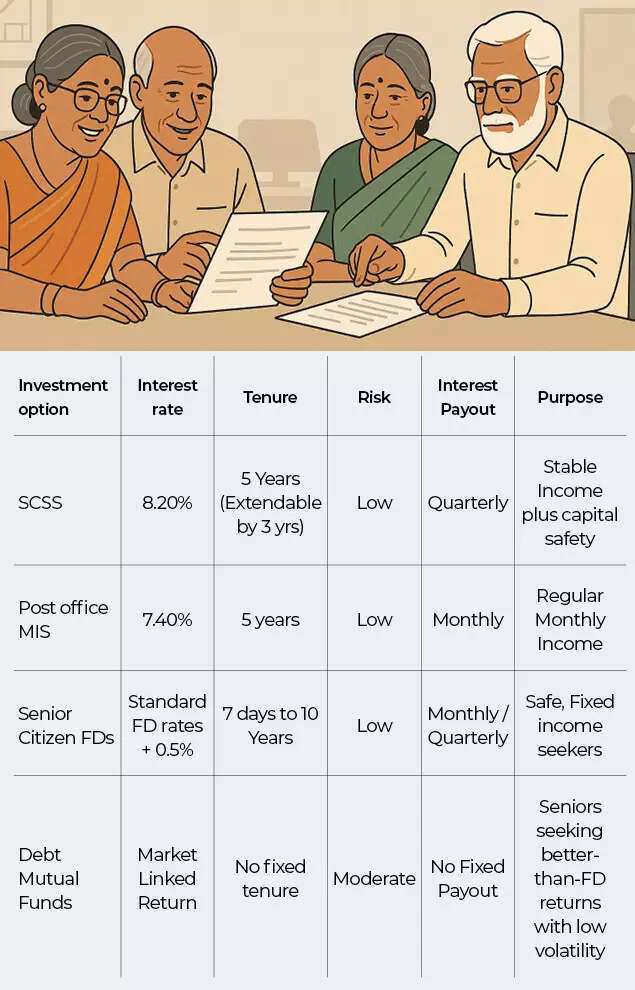
So, what are the alternatives to SCSS, how do they compare on a post-tax basis and what should be the right portfolio mix for senior citizens? Experts are of the view that SCSS is a very good investment option, others can be made use of for portfolio diversification.Mohit Gang elaborates:

  1. Post office monthly Savings Scheme: Provides fixed monthly interest income at 7.4% per year with a fixed 5 year tenure. There is no tax benefit for this scheme
  2. Bank FDs : Generally, banks and NBFCs offer an additional interest rate of 0.50% over the normal fixed deposit rates. The tenure is flexible as investment can be done from 7 days to 10 years duration.
  3. Mutual funds: For senior citizens, who focus on capital safety, low-equity options such as Debt Funds and Conservative Hybrid Funds are generally more suitable.
How SCSS compares to other options

How SCSS compares to other options

Rohit Shah lists some of the alternatives worth considering:•⁠ ⁠Government of India/RBI floating‑rate savings bonds (7‑year, floating coupon).•⁠ ⁠NSC (National Savings Certificates), with attractive compounded rates but lower liquidity.•⁠ ⁠Post Office Monthly Income Scheme (POMIS), which offers monthly payouts at slightly lower yields.“NSC can marginally outperform SCSS on returns but locks in money for longer and does not provide quarterly income. POMIS is useful for steady income but generally yields less than SCSS,” he says.

Is SCSS sufficient for retirement needs?

According to Dev Ashish, the real question isn’t just whether SCSS is good in isolation, but rather it’s about understanding where it fits in a senior citizen’s overall retirement portfolio, which not only needs to cater to their income needs but also keep an eye on moderate growth to ensure portfolio longevity in line with retirees’ life expectancy.He says that for someone worried about longevity risk and running out of money, parking a portfolio in annuities can also provide peace of mind, even if rates aren’t the highest.“While SCSS, in my view, is an excellent debt option – safe, high-yielding, and tax-efficient, it is still advisable not to treat it as the entire portfolio and rather a core part of the fixed-income (debt) side of the portfolio. It’s best to combine it with liquidity buffers and modest equity exposure for sustainable retirement, beat long-term inflation and preserve purchasing power,” Dev Ashish tells TOI.The approach he advocates is a bucketing strategy:The first bucket (typically 60-70% of the retirement corpus) should comprise debt instruments like SCSS, POMIS, PPF, debt funds, and annuities. This bucket generates regular income for day-to-day expenses. SCSS fits perfectly here as a core holding.But the second bucket is equally critical. This is the growth bucket where equity allocation (20-30% for most retirees) should be invested in well-diversified equity funds. Why? Because without equity exposure, your portfolio will struggle to beat inflation over a 20-30 year retirement period. The goal isn’t to chase returns but to ensure you don’t run out of money before running out of years.Mohit Gang is of the view that SCSS can serve as a core part of retirement but not as a standalone component in the portfolio because of limitations such as Rs 30 lakh individual limit, fully taxable interest and no equity-linked growth.He recommends an asset mix of 30% in SCSS + 30% in debt mutual funds + 20% in hybrid mutual funds + 20% Equity Funds.Rohit Shah also says that SCSS should be a core component, not the only one. “A sensible 60+ retirement portfolio should blend SCSS with other fixed‑income options (quality FDs, bonds, annuities) and a calibrated exposure to growth assets such as equity or conservative hybrid funds,” he tells TOI. The exact allocation must depend on each retiree’s risk profile, health, other income sources and legacy goals. The key is simple: use SCSS for stability and income, and complement it with carefully chosen products that offer liquidity and long‑term inflation protection, he advises.Bottom line – SCSS is a great investment product for senior citizens, but it is by no means sufficient and must be supplemented with other avenues.(Disclaimer: Recommendations and views on the stock market, other asset classes or personal finance management tips given by experts are their own. These opinions do not represent the views of The Times of India)

Source link

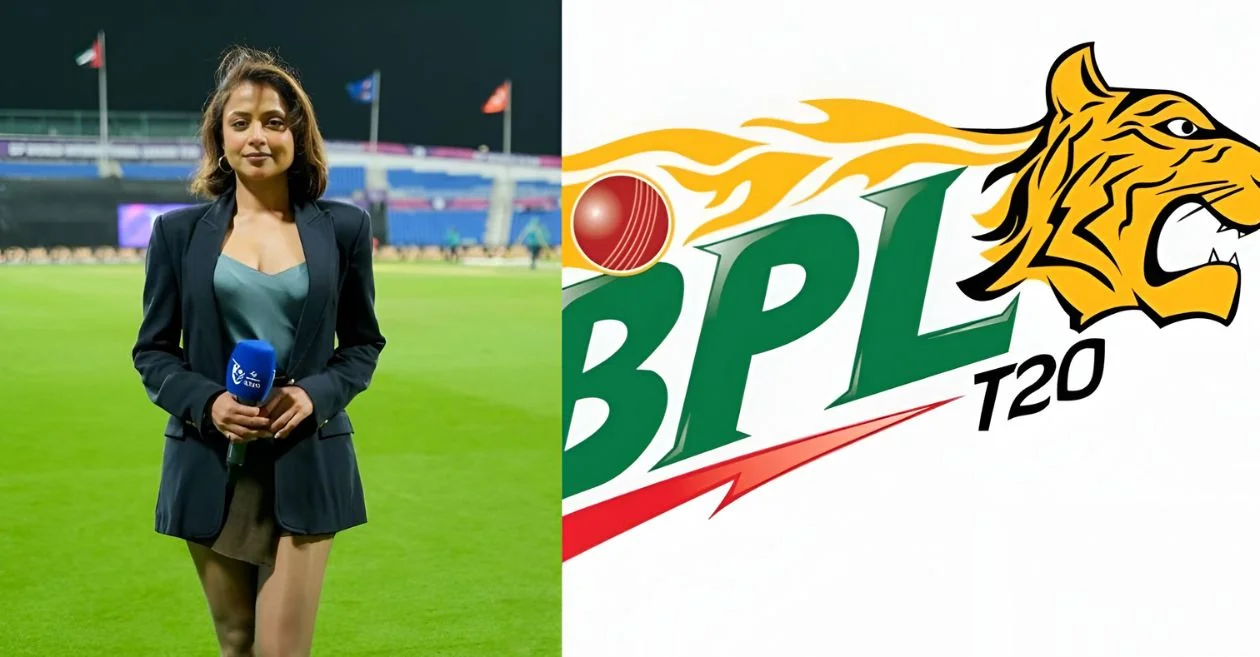
Did Bangladesh drop Ridhima Pathak from the BPL 2025–26 hosting panel? Indian presenter breaks her silence


The sporting ties between India and Bangladesh have taken a sharp downturn following widespread reports that the Bangladesh Cricket Board (BCB) has officially removed Indian presenter Ridhima Pathak from the hosting panel of the ongoing Bangladesh Premier League (BPL) 2025-26. This move is being viewed as the latest ripple effect in a rapidly escalating diplomatic and sporting row that reached a breaking point this week. As headlines began to suggest her career was caught in the crossfire of retaliatory measures, Pathak finally broke her silence on January 7, 2026, to address the situation.

Was Ridhima Pathak dropped from the BPL 2025-26 hosting panel by Bangladesh? Indian presenter responds

Amidst a flurry of narratives from various media outlets claiming she had been ousted due to the current political climate, Ridhima Pathak took to social media to clarify the circumstances of her exit. While initial reports suggested a targeted removal by the BCB as a response to recent cricketing tensions, Pathak revealed that her departure from the T20 league’s panel was a personal choice made with deep conviction. She stated that the narrative suggesting she was “dropped” is not true and explained that she made a personal decision to opt out because her nation comes first. Pathak, a mainstay in Indian sports broadcasting, emphasized that she values the integrity and clarity of the game far beyond any single assignment and thanked those who reached out with support, concluding that cricket deserves the truth.

“In the last few hours, there’s been a narrative suggesting I was ‘dropped’ from the BPL. That is not true. I made a personal decision to opt out. For me, my nation comes first-always. And I value the game of cricket far beyond any single assignment. I’ve been privileged to serve this sport for years with honesty, respect, and passion. That won’t change. I’ll continue to stand for integrity, for clarity, and for the spirit of the game. Thank you to everyone who reached out with support. Your messages mean more than you know. Cricket deserves truth. Period. No further comments from my side.” Ridhima Pathak wrote.

Also READ: Amid Mustafizur Rahman row, BCB urge ICC to relocate Bangladesh’s T20 World Cup 2026 matches from India

The Mustafizur Rahman wow and IPL 2026 broadcast ban

The friction between the two nations reached a tipping point on January 3, 2026, when the BCCI directed the Kolkata Knight Riders (KKR) to release Bangladeshi star pacer Mustafizur Rahman from their squad. KKR, who had signed Mustafizur for a record ₹9.20 crore, was forced to let him go after the BCCI cited “recent developments” and security concerns regarding the safety of minorities in Bangladesh. The fallout has been severe, as the Bangladesh government subsequently imposed an indefinite ban on the telecast of IPL 2026 via local operators, claiming the move was in the “public interest” after what they labeled an unprovoked insult to their national icon.

In a major escalation, the BCB formally informed the ICC that they were “reluctant” to travel to India for the T20 World Cup in February, demanding their matches be shifted to Sri Lanka due to security concerns. However, in a significant blow to the BCB’s demands, the ICC reportedly rejected the request on January 7, stating that there are no credible security threats to the Bangladesh team in India. The global body has reportedly informed the BCB that they must travel to the designated venues in Kolkata and Mumbai or risk forfeiting their matches and points. As Ridhima Pathak steps away from the BPL microphone, the cricketing world is left watching a complete breakdown in relations that now threatens the participation of an entire nation in the upcoming World Cup.

Also READ: Bangladesh name squad for T20 World Cup 2026; no place for Jaker Ali


Source link