Breaking News
U19 World Cup 2026 semi-finals: Understanding India, Afghanistan, Australia and England’s strengths and weaknesses with SWOT analysis


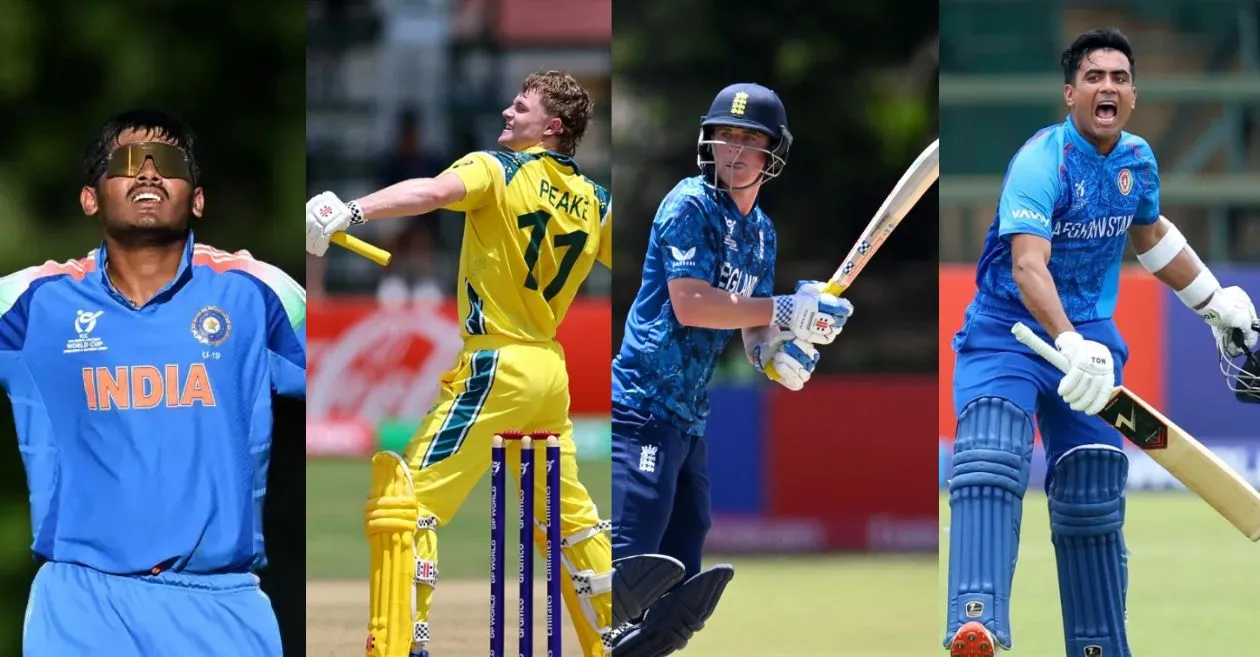
As the dust settles on the Super Six stage in Zimbabwe, the ICC Under-19 World Cup 2026 has whittled down sixteen aspiring nations to just four. India, Afghanistan, Australia, and England have emerged as the cream of the crop, each bringing a distinct brand of cricket to the knockout rounds. With the semi-finals scheduled for February 3 and 4, the tournament is poised for a grand crescendo that will determine who earns the right to fight for the ultimate crown in Harare on February 6.

The road to the knockouts: Unbeaten streaks and tactical dominance

The journey to the semi-finals has been a masterclass in resilience and skill. India enter the penultimate stage as the tournament’s powerhouse, maintaining an unblemished record. Their campaign reached a fever pitch in the final Super Six clash against arch-rivals Pakistan, where a clinical 58-run victory secured their spot as Group 2 toppers. Led by the composed Ayush Mhatre, the ‘Boys in Blue’ have shown they can pivot from aggressive power-hitting to gritty rebuilding whenever the situation demands.

Afghanistan’s progression has been nothing short of historic. They signalled their intent early with a statement win over South Africa and weathered a brief storm against Sri Lanka to reclaim their momentum. The highlight of their journey was Faisal Khan’s monumental 163 against Ireland, the highest individual score by an Afghan batter in U19 World Cup history. By finishing second in Group 1, they have set up a mouth-watering clash against India.

From the other side of the bracket, Australia and England have looked equally imposing. The Australians, under captain Oliver Peake, were the first to secure a semi-final berth from Group 1, showcasing a balanced attack and a ‘no-soft-centre’ batting philosophy. Meanwhile, England have been a revelation, remaining undefeated through the Super Sixes. Their clinical demolition of Bangladesh and a professional 65-run victory over New Zealand, powered by Manny Lumsden’s lethal five-wicket haul, have made the Young Lions perhaps the most balanced unit in the competition.

Also WATCH: Vaibhav Suryavanshi plucks a stunning catch during IND vs BAN clash at U19 World Cup 2026

SWOT analysis of the final four of ICC Under-19 World Cup 2026

To understand who holds the edge in these high-pressure knockouts, we must look deeper into the internal and external factors driving these teams.

India U19

  • Strengths: Explosive batting depth. With Vaibhav Suryavanshi providing “chaos” at the top and Abhigyan Kundu’s ability to anchor or accelerate, India’s top order is terrifying. Kanishk Chouhan provides elite all-round balance.
  • Weaknesses: Occasional middle-order collapses. As seen in the early phase against Pakistan (47/3), a quick burst of wickets can put the captain under immense pressure to rebuild.
  • Opportunities: The spin-friendly conditions in Harare. If the pitch offers turn, India’s spinners can squeeze the life out of any chase.
  • Threats: The weight of expectation. India have reached five consecutive finals; anything less than a trophy is seen as a failure, which can create mental fatigue.

Afghanistan U19

  • Strengths: Match-winning individuals. Faisal Khan and captain Mahboob Khan have the temperament to play big innings. Their bowling attack, led by Abdul Aziz, is relentless in the powerplay.
  • Weaknesses: Partnership consistency. Aside from the top stars, the middle order has occasionally struggled to build meaningful stands under pressure.
  • Opportunities: A nothing to lose mentality. Facing India in Harare gives them the chance to pull off the biggest upset in youth cricket history.
  • Threats: Tactical rigidity. If their primary plan (attacking with Faisal) fails, they sometimes lack a ‘Plan B’ to grind out low-scoring wins.

Australia U19

  • Strengths: Tactical flexibility. The squad is packed with multi-dimensional players who can bowl 4-5 overs and bat anywhere in the top seven. Oliver Peake’s captaincy has been proactive and sharp.
  • Weaknesses: Pace-department fitness. The team relies heavily on a few key arms; any niggle to their frontline seamers during the knockouts could leave them exposed.
  • Opportunities: Exploiting England’s occasional over-aggression. Australia’s “bend-but-don’t-break” defensive bowling can frustrate English batters into errors.
  • Threats: Slow starts. Australia have shown a tendency to take a few overs to find their rhythm, which could be fatal in a knockout match.

England U19

  • Strengths: Form and momentum. Ben Mayes and Manny Lumsden are arguably the best batter and bowler in the tournament right now. Their fielding, coached to professional standards, often saves 20-30 runs per game.
  • Weaknesses: Inexperience in subcontinental-style conditions. While they’ve handled Zimbabwe well, the extra heat and wear in Bulawayo for the semi-final could test their stamina.
  • Opportunities: Using Lumsden’s swing. Early morning moisture in Bulawayo could allow England to dismantle Australia’s top order before the spinners even come into play.
  • Threats: Over-reliance on the stars. If Mayes and Rew fall early, the lower-middle order hasn’t been tested in a high-stakes chase yet.

The stage is now set. On Tuesday, the traditional rivalry between Australia and England will ignite Bulawayo, while Wednesday will see India try to defend their territory against a surging Afghanistan. In the world of U19 cricket, where nerves are as important as talent, the team that manages the pressure of the SWOT will likely be the one lifting the trophy.

Also READ: Fans go crazy as India send Pakistan packing from U19 World Cup 2026 and qualify for the semis


Source link

Govt spent only 5% of funds for job, skilling schemes in FY 2026


Govt spent only 5% of funds for job, skilling schemes in FY 2026

NEW DELHI: The Centre spent 5% of the funds allocated under the flagship package for employment and skilling in FY 2025-26, raising concerns over the incentive structure, targeting and implementation of the programme.The special package announced by the finance minister Nirmala Sitharaman in budget 2024-25 consisted of the internship scheme, upgradation of 1,000 govt run industrial training institutes (ITIs), and employment generation schemes to skill youth and make them job ready. The programme had aimed to benefit nearly 41 million youth at a cost of Rs 2 lakh crore over a period of five years.Latest budget data released Sunday shows that govt spent nearly Rs 1,730 crore on the three components of the programme in FY26, out of a total of Rs 33,830 crore allocated in the 2024-25 budget.With the internship scheme having seen only two pilots, the Centre spent Rs 526 crore of Rs 10,800 crore allocated during FY26.As the scheme is being finalised and the ministry of corporate affairs will soon seek a cabinet approval, funding of the scheme has been pegged at Rs 4,788 crore in 2026-27.In the first phase of the internship scheme, nearly 6.2 lakh applications were received against nearly 1.3 lakh internship opportunities. While companies made over 82,000 offers, only about 28,000 were accepted.In the second round, more than 83,000 offers were made against 1.2 lakh internship opportunities, but nearly 24,600 were accepted.


Source link

Cheer for exports: Textiles, carpets, leather set to gain after India-US deal


Cheer for exports: Textiles, carpets, leather set to gain after India-US deal

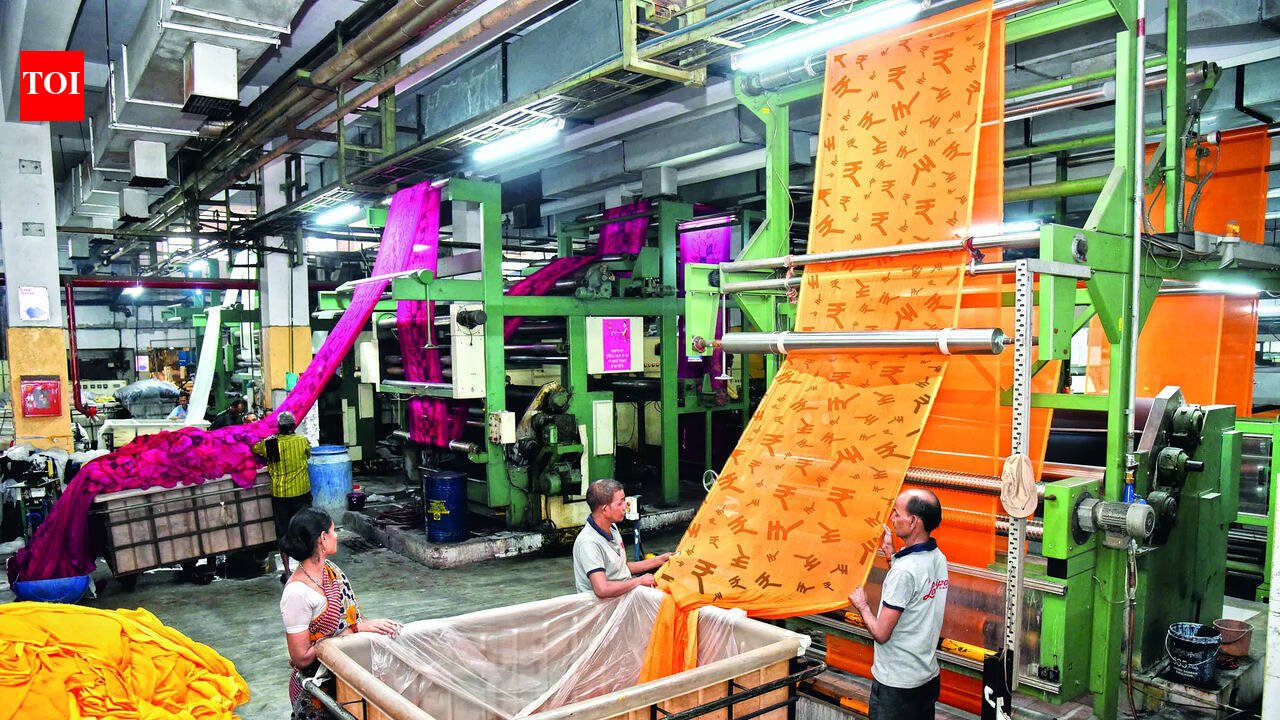
NEW DELHI: While details are still trickling in, the announcement of the India-US trade deal couldn’t have come at a more opportune time. Having just dispatched containers for the summer season, garment and leather and footwear makers were worried about orders for the next season.The smaller players had virtually stopped shipments over the last few months and the bigger ones, with deeper pockets, were sustaining it thanks to steep discounts that they were offering even as their US buyers too were taking a small hit.With the trade deal announced, Indian goods are suddenly looking more competitive. This means that a product will face 18% additional tariff over the MFN or product-specific rate.

Screenshot 2026-02-03 025601

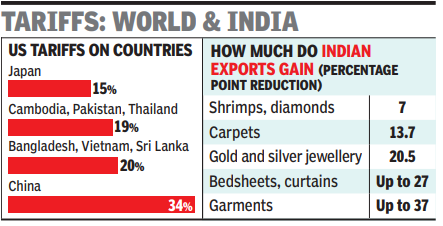
Tariffs on world & India

At 18%, the levy on Indian garments will be marginally lower than the 20% faced by those made in Bangladesh or Sri Lanka.Similarly, Indian carpets, which had lost significant market share, will now be competitive against those shipped from Turkey, while shrimps will be more affordable in American stores. Even gems and jewellery exporters can heave a sigh of relief as they had lost their competitive edge.With levies on several Chinese products at 34%, Indian goods will have a slight edge.Some of the sectoral tariffs such as those on auto parts and metals will, however, stay.Businesses are, however, awaiting full clarity on the terms of the trade deal given that there is no joint statement at the moment and the claims made by US President Donald Trump on his social media account have not been fully responded to by Indian authorities.With India having signed trade deals with the UK and the European Union, businesses will be able to rebalance their portfolios better by diversifying thee export destinations and hedge against flip flops by Trump in future.India’s exports to the US have risen 11.3% to $59 billion between April and Nov led by doubling of smartphone shipments to $16.7 billion. Frontloading of exports to beat the tariff deadline, which kicked in from Aug has also aided exports during this period. Besides, nearly 40% of India’s exports including electronics and pharma were not impacted by the tariffs.Deal unlocks power of 2 democracies: GoyalA big day for India-US relations as the trade deal has been locked with a significantly reduced tariff of 18%, paving the way for stronger trade ties and mutual growth… This historic deal will elevate our strategic partnership and greatly benefit both nations and their people. Business between India and US set to flourish further,” Union home minister Amit Shah posted on X.Commerce and industries minister Piyush Goyal said the deal “unlocks the power of two large democracies working together for shared prosperity of their people. Both India and US are natural allies and our partnership will co-create technologies, co-develop solutions, and work together for peace, growth, and a brighter future for India and the US”.“US and India have complementary strengths. Both countries can co-create technologies and co-develop solutions that will benefit the world. Trade deal between US and India will lead to brighter future for both countries. India-US trade deal is a win-win deal. Citizens and industries of both countries will benefit greatly from this deal,” IT and I&B minister Ashwini Vaishnaw said.Businesses were also upbeat. Aditya Birla Group chairman Kumar Mangalam Birla said: “The Aditya Birla Group is the largest Indian investor in the US, and we see this agreement helping shape more resilient supply chains, unlocking manufacturing opportunities and driving long-term economic competitiveness in both the US and India.”


Source link

Trade deal done, says Trump; PM Modi thanks him for cutting tariff to 18%


Trade deal done, says Trump; PM Modi thanks him for cutting tariff to 18%
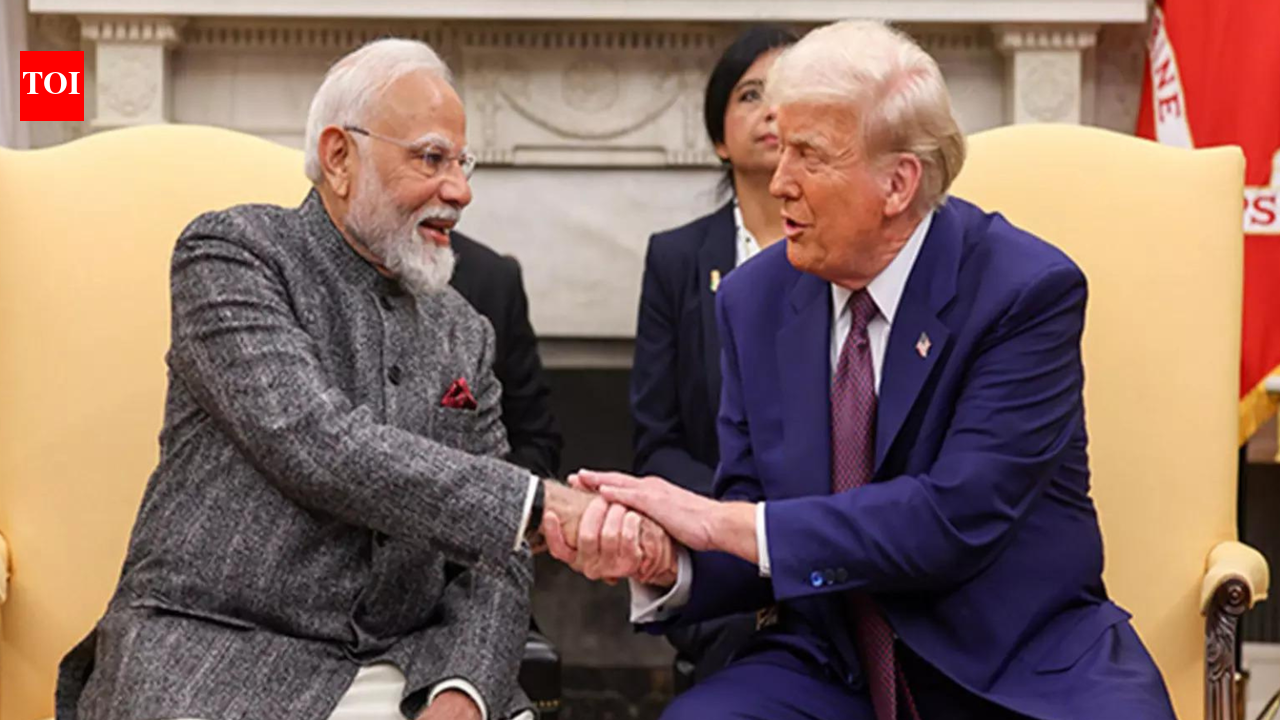
Prime Minister Narendra Modi with US President Donald Trump (File photo)

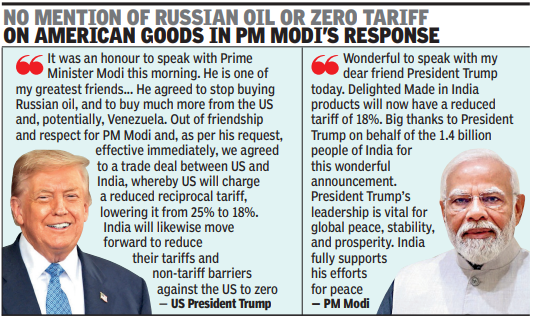
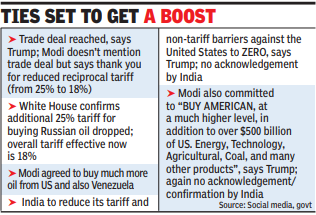
NEW DELHI/ WASHINGTON: After months of bruising trade tensions, India and the US on Monday announced a bilateral trade deal that will see Washington slash additional tariffs on Indian imports to 18%, from the current 50%, making it more competitive for textiles, leather and seafood exporters.While PM Narendra Modi, in a post on X, which followed US President Donald Trump’s announcement on Truth Social, said he had a wonderful conversation with “dear friend” Trump and thanked him on behalf of 1.4 billion people for the reduced tariff of 18% on Indian goods, he did not mention the trade deal at all in his post on X that followed Trump’s “wonderful” announcement.

Modi and Trump

PM Modi and Trump

Modi also did not comment on Trump’s claim that in their conversation the PM had agreed to stop buying Russian oil and purchase much more energy from the US, and potentially Venezuela. Trump had said Modi had agreed to stop buying Russian oil and to buy much more from the US — $500 billion of energy, technology and farm products — a step that the President claimed would help end the war in Ukraine.According to the American President, Modi also agreed to bring down tariff and non-tariff barriers against the US to zero. A US embassy spokesperson confirmed that the final tariff now on India is 18%, down from the earlier 50%. This is a better deal for India than countries such Vietnam, Bangladesh, Indonesia, South Korea and China, which face higher tariffs. The Trump-Modi conversation coincided with the visit of EAM S Jaishankar to US for a critical minerals ministerial that will be chaired by Secretary of State Marco Rubio this week.The announcement came six days after India and the EU announced the completion of talks for a comprehensive trade agreement.Trump leadership vitalfor global peace: ModiThe deal had drawn sharp comments from some members of the Trump administration, including attacks on the EU.In his X post, PM said, “When two large economies and the world’s largest democracies work together, it benefits our people and unlocks immense opportunities for mutually beneficial cooperation”. He added that Trump’s leadership was vital for global peace, stability, and prosperity. India fully supports his efforts for peace. Modi said he was looking forward to working closely with Trump to take the partnership to unprecedented heights.Apart from reciprocal tariff, Trump had announced an additional 25% tariff on India for its purchase of Russian oil.Trump said the US had agreed to the trade deal with India out of friendship and respect for Modi, and at the latter’s request. “Our amazing relationship with India will be even stronger going forward. PM Modi and I are two people that GET THINGS DONE, something that cannot be said for mos,” he added.Trump in his social media post also said that it was an honour to speak with Modi whom he described as “one of my greatest friends and, a Powerful and Respected Leader of his Country”.

Ties set to get boost

Ties set to get boost

While the US had acknowledged in past few months that India had cut down its Russian purchase, it had not eliminated the additional tariff.Trump also said, “We spoke about many things, including Trade, and ending the War with Russia and Ukraine. He agreed to stop buying Russian Oil, and to buy much more from the US and, potentially, Venezuela. This will help END THE WAR in Ukraine, which is taking place right now, with thousands of people dying each and every week!”Following the announcement last week of the successful conclusion of FTA negotiations with EU, India had suggested that India and US might be close to finalising the trade agreement they have been discussing since Feb last year.Trump’s disclosure of the trade deal was preceded by two India-related posts a few hours before, one of which featured him and Modi on a magazine cover with the caption “The Mover and the Shaker”. Another post featured New Delhi’s India Gate, which Trump called “India’s beautiful Triumphal Arch” and said, “Ours will be the greatest of them all!” — referring to a similar monument he wants to build in Washington DC.


Source link

Rescue act against Pakistan, idolising Shubman Gill, Sourav Ganguly’s influence: The Vedant Trivedi story | Cricket News


Rescue act against Pakistan, idolising Shubman Gill, Sourav Ganguly's influence: The Vedant Trivedi story
Vedant Trivedi (Special arrangements)

NEW DELHI: 47/0 was the scoreline. Four balls later, it became 47/3. A sense of unease crept in as India looked to have lost the early momentum against Pakistan during their crucial U19 World Cup 2026 match on Sunday. Against the same opponent, India had already conceded the plot recently, in the U19 Asia Cup final.

T20 World Cup: Squads, Full Schedule, Venues and Key Details Explained

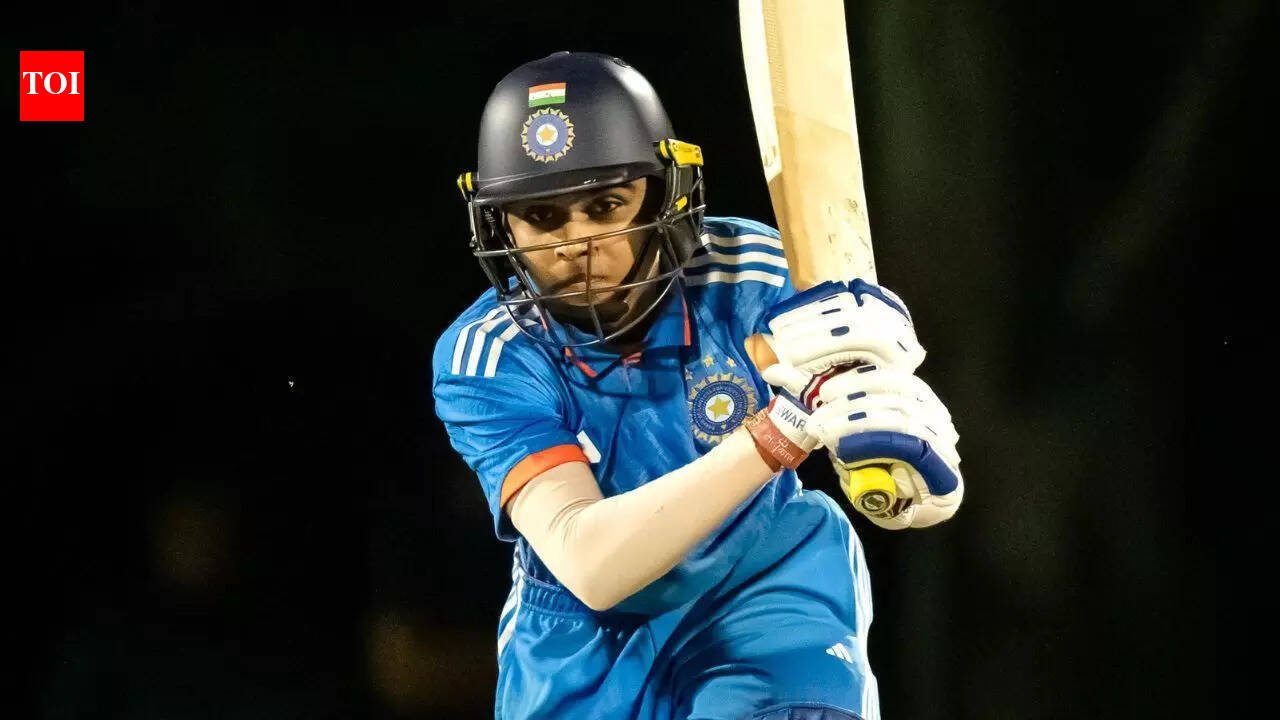
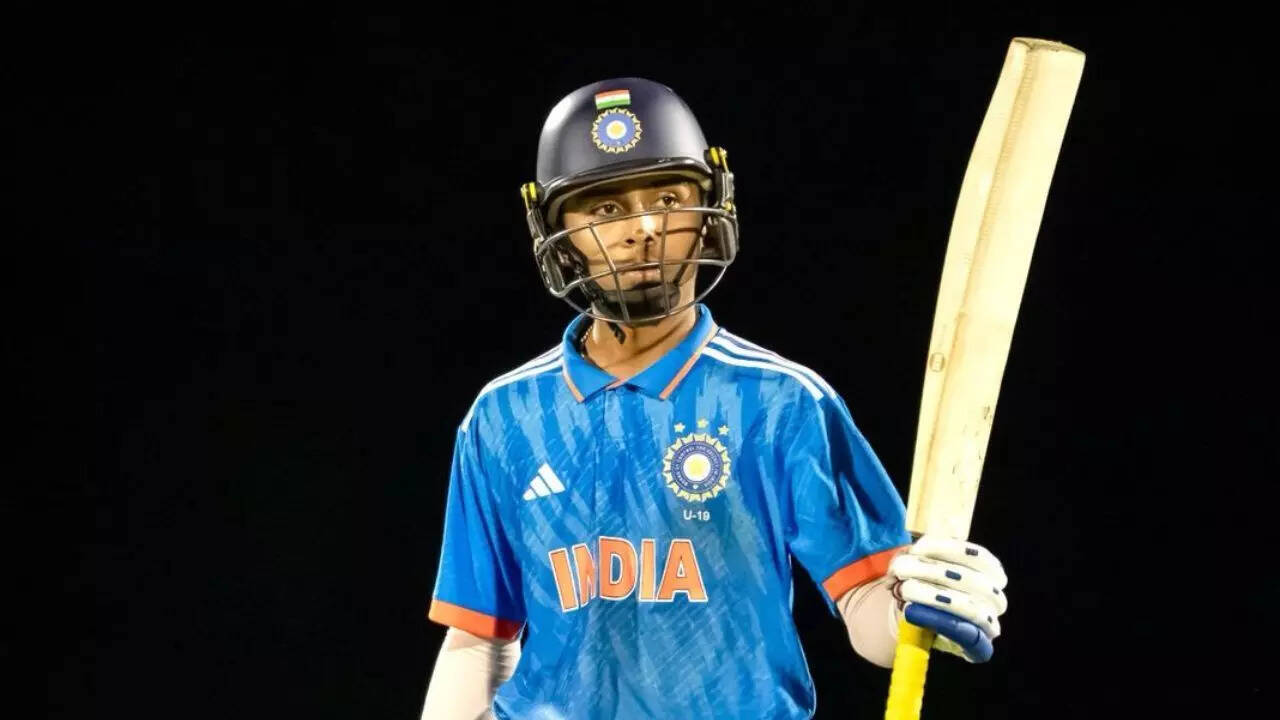
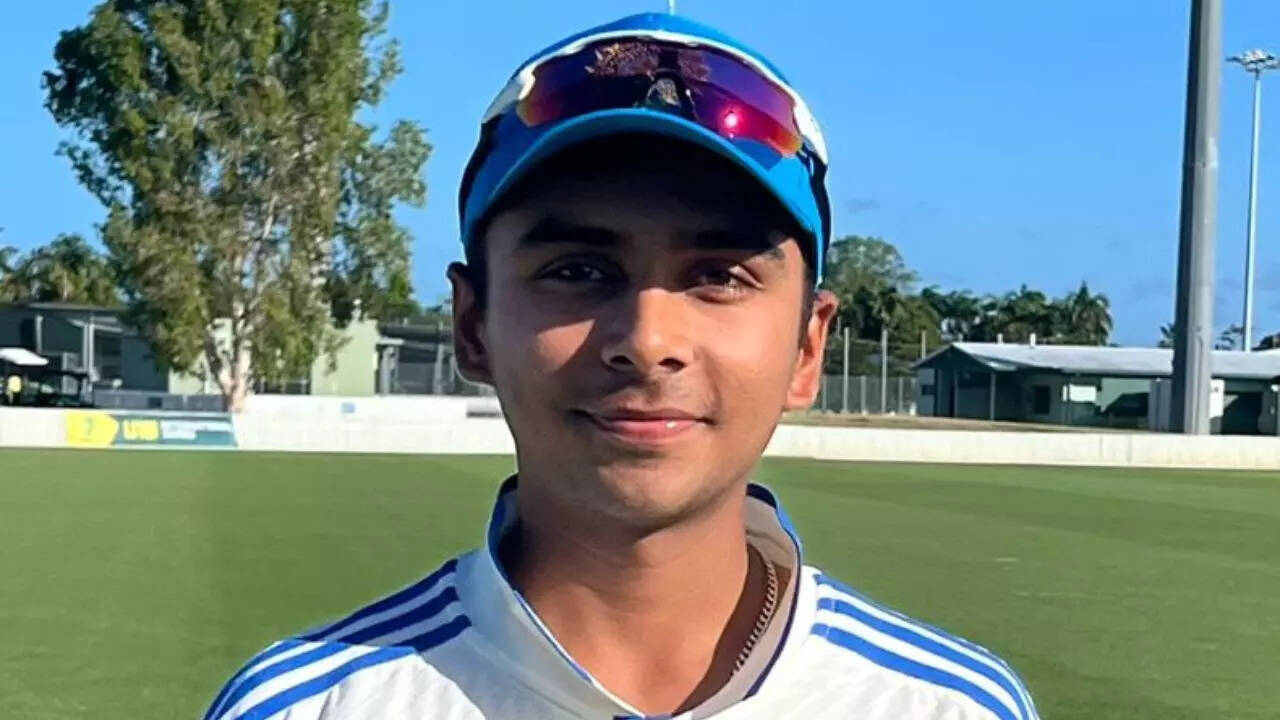
And when the hype around Vaibhav Sooryavanshi and Ayush Mhatre died down with their early dismissals, the need of the hour was the emergence of a saviour. In stepped, Ahmedabad-based batter Vedant Trivedi. When India needed a hero, Vedant, chipping in with a 98-ball 68, became the villain for Pakistan.Trivedi showed remarkable discipline on a pitch which was difficult to bat on, rescuing the Indian team from a precarious situation and enabling them to post a total of 252. The 18-year-old cricketer pulled off a strong comeback, having failed to cross the 15-run mark in previous matches, and now finishing as the top run-getter. ‘Focus on crossing the 30-run mark’“My initial few shots against Pakistan connected quite well, sparking confidence that it would be my day. The focus was on batting as long as possible. Runs weren’t flowing freely off the bat in the previous matches. I just told myself to focus on crossing the 30-run mark during that phase, as net sessions were going well,” said Vedant during an exclusive interaction with TimesofIndia.com.While the 18-year-old cricketer’s strong mentality certainly reflected in his shot selection, he maintains the same intent even off the field. Trivedi hasn’t consumed sugar since the age of 10, abstaining from eating biscuits in a strong show of internal discipline and clarity.‘Idolising Shubman Gill’The Gujarat batter idolises Shubman Gill as his association with the game began in a similar manner to that of the Team India captain, considering the role played by his father. Interestingly, the cricketer also emulated Gill’s celebration in a domestic match.

Vedant Trivedi (Special arrangements)

Vedant Trivedi (Special arrangements)

Trivedi’s father Alpesh used to bowl 300 deliveries daily to him, developing a strong initial framework with emphasis on technique rather than power. Eventually, the 18-year-old cricketer joined a coaching academy, which further involved sacrifices, travelling between 80 to 100 kilometers per day. Trivedi worked extensively with coaches Hem Joshipura and Jesal Karia, refining his gameplay.‘Converting 40s into tons, non-reliance on power’Joshipura helped imbibe awareness and clarity regarding the batter’s strengths and the areas where work was deemed necessary. “The best part is that he implemented the feedback immediately. Vedant worked upon taking quick singles, hitting boundaries down the ground as well as maintaining patience. I told him power is not the only necessity to score runs, which propelled his consistency to the next level especially during the last edition of the Cooch Behar Trophy,” stated the Gujarat coach.

Vedant Trivedi (Special arrangements)

Vedant Trivedi (Special arrangements)

Karia worked upon Trivedi’s gameplay against pace, helping him react in a sharper manner. There was also specific training for the ongoing World Cup, enhancing the number of shots which could be deployed against spinners considering the wickets in Zimbabwe. Karia developed Trivedi’s comfort levels while playing the cut and pull shot, boosting his ability to switch gears with some technical adjustments.“Initially, Vedant couldn’t concert his 40s into centuries leaving him very disappointed. However, he responded well and overcame that by batting for six hours daily. Many people feel that batting in an orthodox manner reduces scope to score runs. However, Vedant is well capable of accelerating when the chips are down despite his traditional gameplay,” stated Karia.‘Motivation from England series snub’The 18-year-old cricketer wasn’t picked in the U-19 squad for a tour of England in 2025, leaving him in a state of dismay. However, Trivedi took the snub as a challenge, finishing among the only two centurions during a series of matches conducted at the Center of Excellence (CoE) in Bengaluru. The consistent performances soon earned the batter a spot in the squad for a tour of Australia, where he finished as the top run-getter. Trivedi drew inspiration from Sourav Ganguly, who has influenced his approach, in order to excel during the overseas tour.‘Sourav Ganguly’s inputs prove vital’“Vedant saw a video of Ganguly where he discussed the shots which can be played in Australian conditions considering the importance of control on such wickets. He followed the approach discussed thoroughly, enhancing his comfort levels massively. There was also specific focus on a lot of training drills, facing synthetic balls to develop greater fluency,” stated the cricketer’s father. Impressively, Trivedi was back on the training ground just the day after landing in India following the Australian tour, showcasing his commitment levels and focus on the process. The 18-year-old cricketer faces 700 balls daily in net sessions, training for six to seven hours.

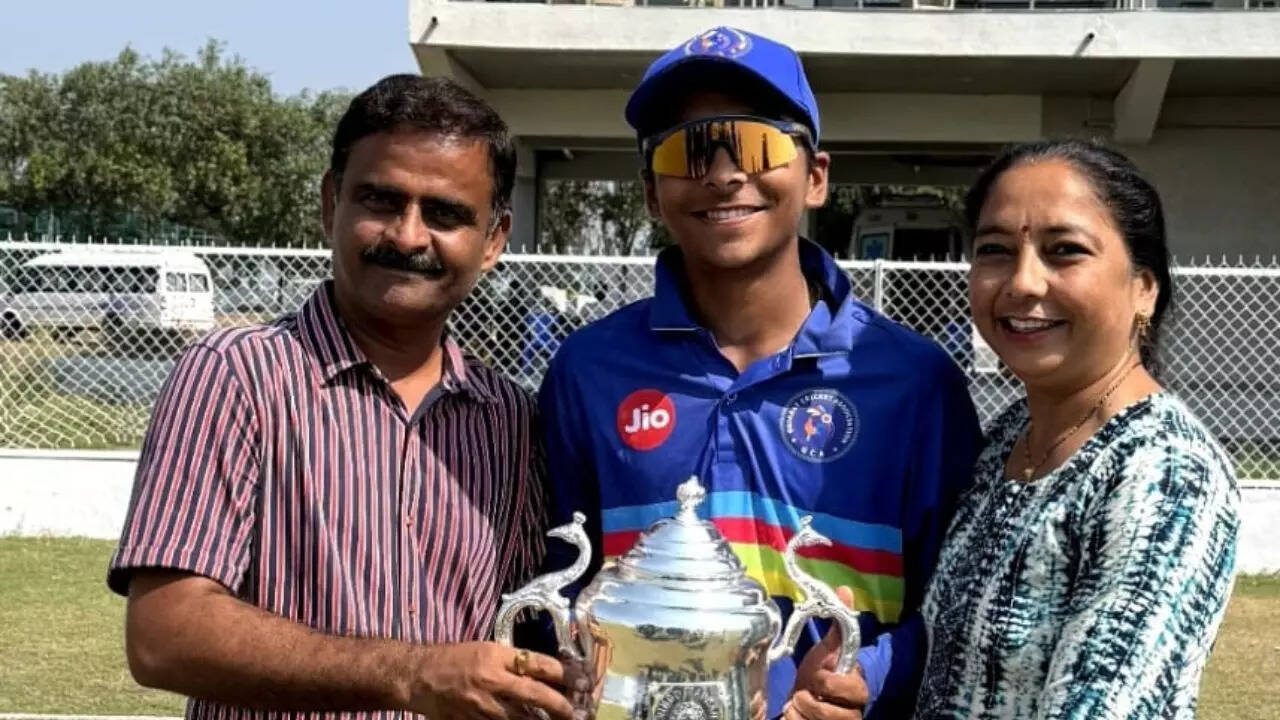
Vedant Trivedi with parents (Special arrangements)

Vedant Trivedi with parents (Special arrangements)

Former Team India cricketer Parthiv Patel has played a key role in developing this mental resolve, discussing the importance of a strong mindset. Interestingly, Trivedi is further quite talented off the field, excelling in playing the casio. “God is very kind. He times everything perfectly as evident from the comeback knock against Pakistan which came at the best possible time,” stated the cricketer’s father. With momentum on his side, Trivedi could well go on to make an all-important contribution in the semi-final against Afghanistan, emulating his idol’s heroics.


Source link

BMC carries out anti-encroachment drive on Mohammed Ali Road and Ibrahim Merchant Road in Mumbai | Mumbai News


Mumbai: BMC’s B ward on Monday carried out an anti-encroachment drive along Mohammed Ali Road and Ibrahim Merchant Road, removing unauthorised hawkers and extended constructions from footpaths.As many as seven illegal shops were removed, 12 platforms, tin/metal sheds, and 10 bollards were cleared. Action was also taken against two abandoned vehicles.

BJP-Cong Parliament Showdown, Sheikh Hasina Convicted Again, CBI Operation CyStrike And More

Mohammed Ali Road is a major thoroughfare connecting the Bhendi Bazaar, Masjid Bunder, and Byculla areas, while Ibrahim Merchant Road is located close to the Nagdevi and Mandvi areas. Both roads are of significant commercial importance and are critical from a traffic perspective, said officials.A BMC official said, “Unauthorised extended constructions were found on the footpath along both roads. In addition, unauthorised hawkers set up shops in the area. This caused obstructions to vehicular movement as well as inconvenience to pedestrians using the footpaths.”The operation was carried out using four encroachment removal vehicles, two JCB machines, and other equipment. During the drive, 40 municipal officers and staff were deployed, along with adequate police security.


Source link

Maharashtra: Charging electric two-wheeler’s battery explodes, triggers fire inside flat | Mumbai News


Thane: The battery of an electric two-wheeler exploded while being charged inside a flat in Diva area near Thane on Monday, triggering a fire, civic officials said. While the explosion caused extensive damage to the house, nobody was injured in the incident that occurred after 4 pm in a room on the third floor of Siddhant Regency Building No 1. The fire rapidly spread through the living room, said Yasin Tadvi, chief of the Disaster Management Cell of the Thane Municipal Corporation (TMC).

BJP-Cong Parliament Showdown, Sheikh Hasina Convicted Again, CBI Operation CyStrike And More

The fire brigade doused the flames by 4.40 pm.


Source link

Drunk youth strangled to death in Mumbai | Mumbai News


Mumbai: An 18-year-old working for a tea vendor was found murdered by strangulation in a chawl in Prabhadevi. Police said the deceased was under the influence of alcohol.The deceased was identified as Ansu Verma who used to work for Askhay Patil. Patil told police that on Jan 31, his two other staffers informed him that Verma has drunk too much and was lying on the road. Patil asked them to wake him up and send him home. Next day, his colleagues informed that he was not responding. Patil rushed to his rented house to find him dead. He immediately informed Dadar police. Police sent the body for post mortem and registered a murder case and are probing further.

BJP-Cong Parliament Showdown, Sheikh Hasina Convicted Again, CBI Operation CyStrike And More


Source link

Mumbai: State to plant 300 crore trees by 2031, says CM Devendra Fadnavis | Mumbai News


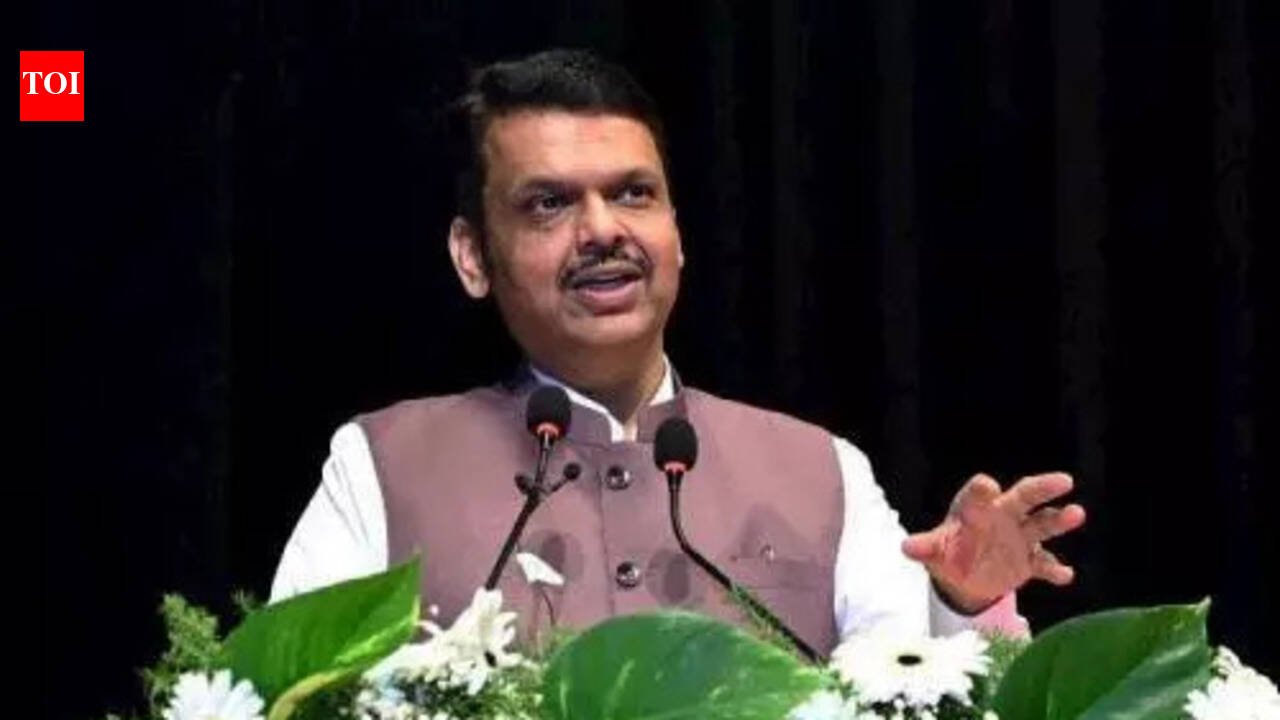
Mumbai: To increase the green cover in the state, CM Devendra Fadnavis on Monday directed a mission-mode program for planting 300 crore trees between 2026 and 2031 be undertaken. He also instructed that experts, NGOs, and startups working in this sector be actively involved in the plantation drive.Fadnavis called for a three-pronged approach of environmental conservation, climate change mitigation, and rural employment generation to increase the tree cover to 33 per cent.

BJP-Cong Parliament Showdown, Sheikh Hasina Convicted Again, CBI Operation CyStrike And More

He was holding a review meeting on the proposed Green Maharashtra Authority – 300 Crore Tree Plantation Mission at his official residence Varsha. He directed a proposal to establish the Green Maharashtra Authority be presented before the cabinet. Priority will be given to regions with low forest cover such as Marathwada. Under the Green Maharashtra initiative, approximately 20 crore trees will be planted in the first year, depending on sapling availability. Bamboo and teak plantations will be included. For sapling production, participation of government nurseries along with private nurseries and Self-Help Groups will be ensured and targets set, stated a govt press release.During the meeting, MITRA CEO Pravin Pardeshi made a presentation on the mission. Under this initiative, plantation will be carried out only with species suitable to local ecosystems based on agro-climatic zones. Grasslands and wetlands will not be afforested but restored. Implementation will be monitored through a digital and satellite-based real-time system, ensuring transparent recording of plantation and tree survival rates. Regular monitoring of tree survival, forest development, and sapling growth will be conducted.Maintenance for three to five years will be ensured through MGNREGA, CAMPA, Agriculture Department, and local self-government schemes. However, the tree survival period has been extended to 10 years.


Source link

Move beyond law varsity demand, press for J&K’s statehood, Omar’s NC tells BJP | India News


Move beyond law varsity demand, press for J&K’s statehood, Omar’s NC tells BJP

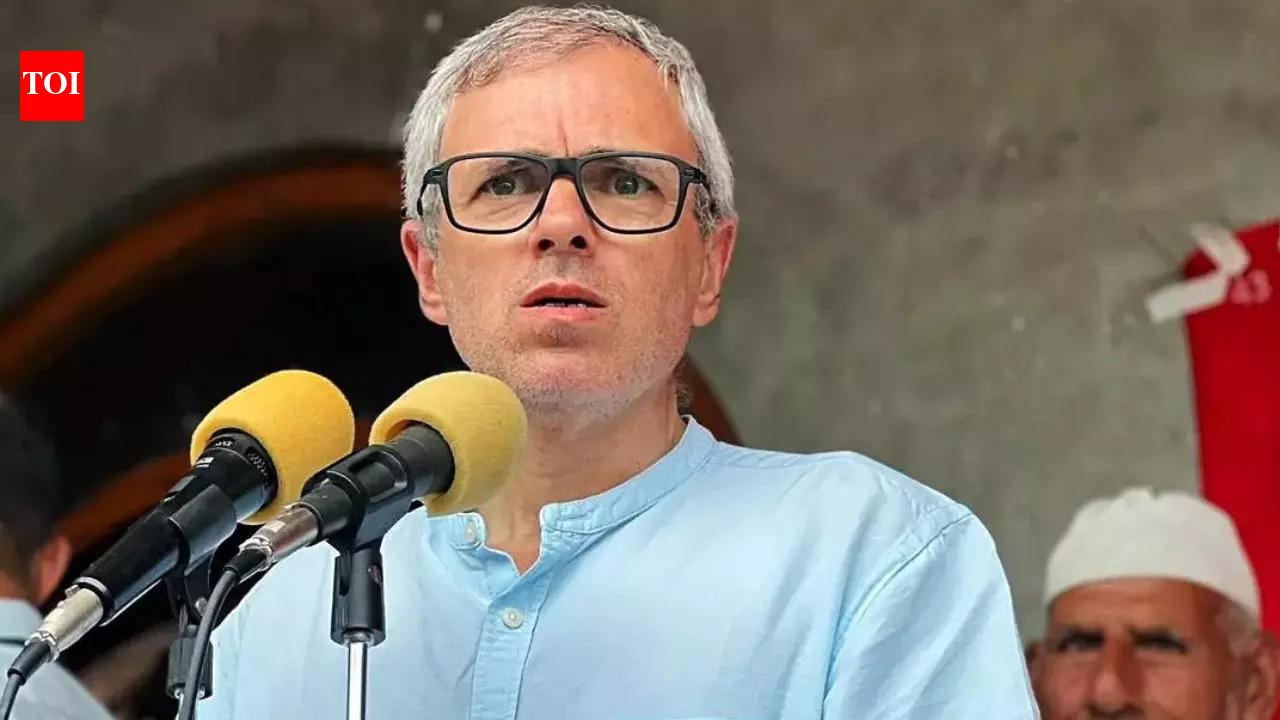
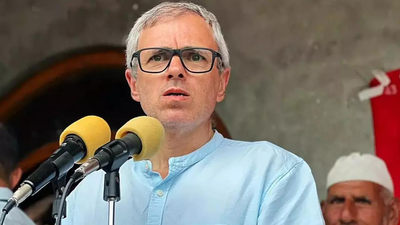
JAMMU: J&K’s governing National Conference (NC) on Monday urged BJP to move beyond demands for a National Law University (NLU) in Jammu and instead press the Centre to restore statehood to the Union territory.Surinder Choudhary, deputy chief minister in the Omar Abdullah-led govt, accused BJP of raising the NLU issue as part of its claims about discrimination against Jammu while remaining silent on larger concerns.“They (BJP) wake up every morning and start shouting that the Omar govt is discriminating against Jammu,” NC’s Choudhary said on the opening day of the J&K assembly’s 27-day budget session in Jammu.J&K has no NLU at present but the demand for it to be located in Jammu gained traction after CM Omar said last year that it would come up in Kashmir’s Budgam. Omar has rejected the recent BJP demands, calling the controversy “politically motivated” and pointing out that there were no protests in the Valley when Jammu was given both an IIT and an IIM.Deputy CM Choudhary stressed that J&K faced far more pressing issues than NLU and accused BJP of abandoning its promise of restoring statehood. “Why is he not asking the Centre to fulfil the promise of statehood,” Choudhary said. He was referring to Sunil Sharma, BJP leader of opposition who joined students’ protests at Jammu University over the NLU.A legislator from Jammu’s Nowshera, Choudhary rejected allegations of discrimination, arguing the NC govt would not have revived the “Darbar Move” after four years if that was the case.In June 2021, LG Sinha’s administration ended the Darbar Move, a 149-year-old practice of shifting the seat of govt between Srinagar and Jammu every six months. Sinha described the system as “a big racket”. Before its abolition, over 10,000 state employees shuttled between the two cities twice a year, boosting trade and commerce in Jammu. The Omar-led govt resumed it this year after demands from Jammu’s traders, who said its suspension had hurt business.Referring to the NLU demand, deputy CM Choudhary flagged “lack of statehood” as the biggest issue, leading to local jobs being taken away by “outsiders”. “BJP has a habit of sitting on roads and accusing the govt of discrimination. But they don’t look at Jammu University, where not a single vice-chancellor has been from Jammu. Are our professors from Jammu not capable of leading the university? But BJP will not talk about it,” Choudhary said.


Source link