Breaking News
‘Devastating’: Afghanistan coach reacts after loss to South Africa in double super over thriller | Cricket News


'Devastating': Afghanistan coach reacts after loss to South Africa in double super over thriller
Afghanistan’s Noor Ahmad and Rashid Khan (AP)

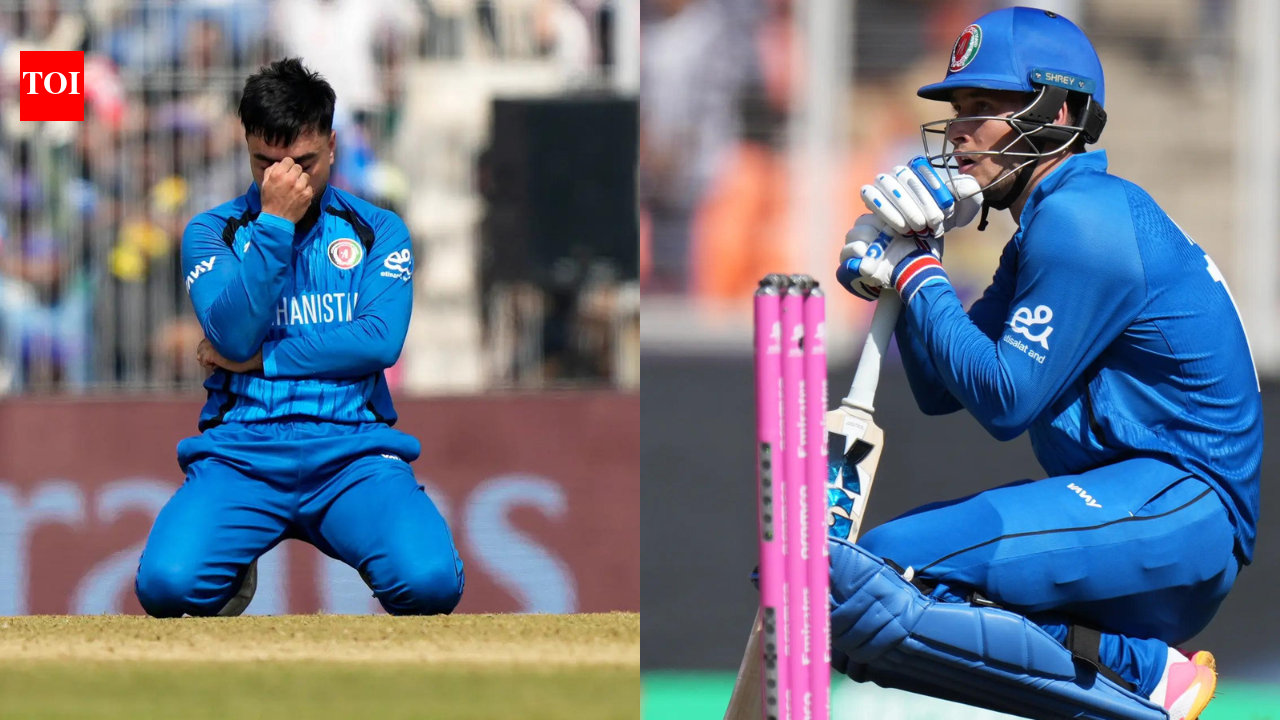
Afghanistan head coach Jonathan Trott described his side’s defeat to South Africa as “devastating”, admitting the narrow loss in a dramatic T20 World Cup contest would linger with his players. The Proteas edged Afghanistan after a gripping encounter that required two Super Overs, leaving South Africa relieved and Afghanistan heartbroken in one of the most remarkable matches since the tournament began in 2007. Addressing the media after the game on Wednesday, Trott reflected on the emotional toll of back-to-back defeats in a demanding group.

Abhishek Sharma in hospital – latest on his recovery and India nets

“Just shows what we have as a side. So we’ve got some amazing players and it’s just really devastating for the guys after a tough loss a few days ago against New Zealand and now against South Africa in a tough group as well,” Trott said. The South African-born former England Test batter acknowledged that such losses can hurt deeply. “These guys are never shy of rising up against the challenges that they face throughout their lives on and off the field. “So today they should be very proud and obviously these types of losses sometimes they can hurt and sting for a while but I think it’s important we look at those areas that we did really well in, but also areas that we could improve and things we could have done better. “I think South Africa fielded pretty well actually as well. The run out, a few catches on the boundary, on the ring, those sorts of things. I think they fielded really well. Maybe that was the difference today a little bit,” the Afghanistan head coach said. Under Trott’s guidance, Afghanistan have made significant strides, reaching the semifinals in the previous edition of the T20 World Cup and the quarterfinals of the 2023 ODI World Cup. Though he is set to step down after this tournament, Trott declined to reflect on his tenure, insisting his focus remains on the remaining fixtures. Trott also reserved special praise for Rahmanullah Gurbaz, who smashed 84 off 42 balls in the chase of 187 and followed it with a blistering 18 off 4 balls in the second Super Over. “Those innings as we saw today, I think he should play more often if I’m honest, with the amount of talent that he has and the physique and the sporting ability and natural hand-eye coordination. “He wears his heart on his sleeve and he’s quite an animated character. I think the years that I’ve been with him now, I’m just trying to get him to be a little bit more consistent in everything that he does.”


Source link

US stocks today: Jobless rate surprise lifts markets; S&P 500 nears record levels


US stocks today: Jobless rate surprise lifts markets; S&P 500 nears record levels

US stocks moved closer to record levels on Wednesday after data showed the country’s unemployment rate unexpectedly improved last month, boosting investor confidence about the resilience of the economy.The S&P 500 rose 0.5% and was trading just below its all-time high set late last month. The Dow Jones Industrial Average was up 222 points, or 0.4%, while the Nasdaq Composite gained 0.5% as of 9:35 am Eastern time, AP reported.Treasury yields also climbed after the US Labor Department said employers added 130,000 jobs last month, higher than economists’ expectations of 75,000. The stronger data helped ease concerns triggered a day earlier by a report indicating US household spending may be slowing.However, revisions in the report showed employers added only 181,000 jobs for the whole of last year, sharply lower than the previously reported 584,000, marking the weakest annual performance since 2020 when the COVID-19 pandemic disrupted the economy.“We all knew there would be downward revisions, but these were better than expected,” Brian Jacobsen, chief economic strategist at Annex Wealth Management, said.Energy and industrial stocks led gains in the S&P 500, reflecting optimism around economic activity. Caterpillar rose 3.9%, while Exxon Mobil gained 2.4%.The gains offset declines in some stocks. Moderna fell 10.5% after saying the US Food and Drug Administration is refusing to consider its application for a new flu vaccine made using mRNA technology. The move reflects heightened regulatory scrutiny of vaccines under Health Secretary Robert F Kennedy Jr.Robinhood Markets dropped 11% despite reporting stronger-than-expected quarterly profit, as revenue missed forecasts and analysts flagged concerns about rising expenses in 2026 and weak crypto trading volumes.Kraft Heinz declined 4.1% despite posting better-than-expected quarterly results. CEO Steve Cahillane said the company is pausing plans to split into two businesses while investing $600 million in marketing, sales, and research and development to restore growth.In the bond market, the yield on the 10-year Treasury rose to 4.17% from 4.16% late Tuesday, while the two-year Treasury yield increased to 3.51% from 3.45%.The stronger jobs data prompted traders to scale back expectations on the number of interest rate cuts by the US Federal Reserve this year, though most still expect at least two cuts, according to CME Group data.The Fed has paused rate cuts for now, but a weaker labour market could have prompted quicker easing. The next key data point for markets will be US consumer inflation data due on Friday.Globally, stock markets were mostly higher. South Korea’s Kospi rose 1%, while the UK’s FTSE 100 gained 0.9%.


Source link

Thane man duped of Rs 1.17 cr in ‘VIP Store’ investment con; global syndicate under scanner | Mumbai News


Thane: A 39-year-old man was defrauded of Rs 1.17 crore in one of the most elaborate “task-based” cyber scams reported this year. The victim was lured into a fake investment scheme operated by an international syndicate using encrypted messaging apps and cryptocurrency networks.The police said the fraud began innocuously when the victim received an unsolicited message on a messaging platform, offering a lucrative part-time job completing simple online tasks. The scammers promised attractive commissions for activities like liking products or placing dummy orders on websites mimicking legitimate e-commerce giants.According to the police complaint, the fraudsters initially paid out small commissions. The victim was given access to a professional-looking dashboard on a fake domain, complete with balance sheets and task assignments that appeared legitimate.Investigating officials noted that once trust was established, the scammers escalated their demands. The victim was told that investing larger amounts would unlock “VIP Store” status, yielding substantially higher returns. As the promised earnings grew, the fraudsters shifted the operation to cryptocurrency transactions.The investigation revealed that the victim was coerced into purchasing USDT (Tether) through digital exchanges and transferring the tokens to anonymous wallets controlled by the attackers. Transaction records showed multiple transfers, including a single instalment of approximately Rs 45 lakh, purportedly for “stock replenishment” in a virtual storefront.When the victim’s dashboard eventually showed a balance exceeding Rs 1.17 crore and withdrawal requests were made, the scammers blocked access. They claimed tax clearances and security verifications were required, demanding additional payments before releasing funds and siphoning the money.

Banner Insert


Source link

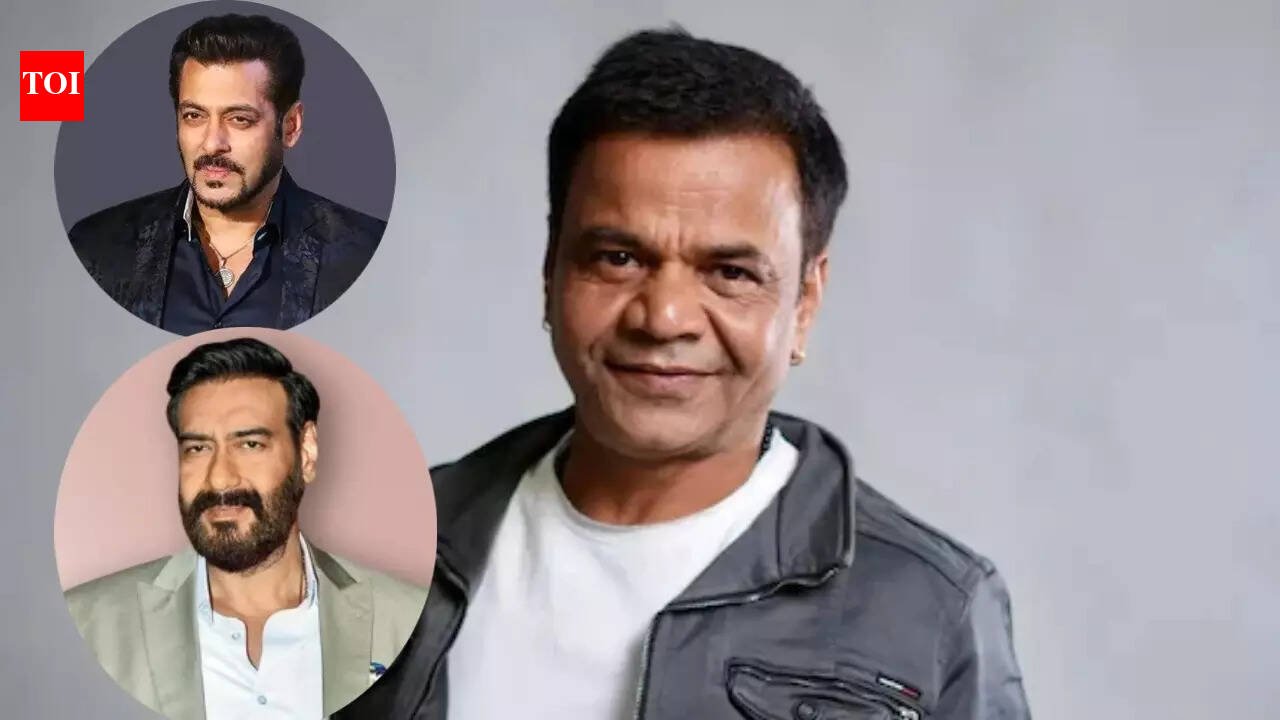
Rajpal Yadav Cheque Bounce Case: Salman Khan, Ajay Devgn and others come out in support of Rajpal Yadav after he surrenders to Tihar jail |


Rajpal Yadav has been going through a tough time amidst legal and financial struggles. The actor has surrendered himself to Tihar jail in a cheque bounce case of Rs 9 crore. Before surrendering to the authorities, Yadav made an emotional statement and had said, “Sir, kya karoon? Mere paas paise nahin hain. Aur koi upaay nahin dikhta… Sir, yahan hum sab akele hain. There are no friends. I have to deal with this crisis on my own.”After Yadav surrendered to the authorities, now several big names from Bollywood have come out to support the actor in clearing his debt of Rs 9 crore. The actor’s manager revealed how actors like Ajay Devgn, Salman Khan, Varun Dhawan among others have helped him. The actor’s manager Goldie, told Screen, “A lot of people have reached out to help Rajpal Yadav. Actors like Sonu Sood, Salman Khan, and Ajay Devgn have extended their support. I was just on a call with David Dhawan, he too reached out. Ratan Nain, Varun Dhawan… many people are coming forward to help him this time, which Rajpal has deeply appreciated.”

Rajpal Yadav opens up about losing first wife after childbirth, his equation with second wife and more…

When questioned about whether Rajpal had approached anyone for help before surrendering at Tihar, Goldie refrained from elaborating. “I would not like to comment on that,” he said. However, he acknowledged the industry’s solidarity, adding, “The good thing is that after his situation worsened, the industry has stood behind him like a rock—and that should be appreciated. Everyone has made commitments, but such transactions don’t happen overnight.Goldie also expressed optimism about Rajpal’s potential release in the coming days. “Mentally, the family has to remain strong. Rajpal Bhai himself is very strong, and that strength runs in the family. There are also several celebrations lined up at home, with family functions scheduled later in February. Everyone wants Rajpal Bhai to be out by then. Hopefully, he should be out by tomorrow.”See More: ‘Family is hopeful’: Rajpal Yadav’s BAIL hearing tomorrow; manager reveals Salman Khan, Ajay Devgn and others lend supportProviding further details, he told the publication, “We have his bail hearing scheduled for tomorrow, and we are hopeful that he will be granted bail and released. The bail application has already been filed. We will be able to share more details after the hearing tomorrow.”Earlier, a number of public figures had already voiced their support, including Sonu Sood, Guru Randhawa, Gurmeet Choudhary, KRK, and music composer Rao Inderjeet Yadav. While most chose not to reveal specific contributions, Rao Inderjeet announced he would donate Rs 1.11 crore and even shared Rajpal Yadav’s bank details publicly to encourage others to pitch in. His appeal reportedly prompted politician Tej Pratap Yadav to pledge Rs 11 lakh, while KRK declared he would contribute Rs 10 lakh toward the cause. Mika Singh has offered help of Rs 11 lakh to the actor.


Source link

T20 World Cup 2026: Quinton de Kock destroys AB de Villiers’ iconic record for South Africa with a powerful fifty vs Afghanistan


South Africa’s batting powerhouse took center stage in Ahmedabad on February 11, 2026, as they dismantled the Afghan bowling attack in a crucial T20 World Cup 2026 fixture. The innings was defined by clinical ball-striking from Quinton de Kock and Ryan Rickelton, whose massive second-wicket partnership essentially batted the opposition out of the contest. During this high-stakes encounter, Quinton de Kock managed to eclipse a legendary milestone previously held by AB de Villiers, rewriting the history books for South African cricket. Their collective performance propelled the Proteas to a formidable total of 187/6, leaving the Afghan side with a mountainous chase.

Quinton de Kock shatters AB de Villiers’ legendary Proteas record with a blazing fifty against Afghanistan

In a moment that will be etched in the annals of South African cricket, Quinton de Kock officially surpassed the legendary AB de Villiers to become the nation’s highest run-scorer in T20 World Cup history. Entering the match needing just a handful of runs to eclipse the previous benchmark of 717, de Kock played a measured yet authoritative knock of 59 off 41 balls, taking his tournament tally to 737 runs. This milestone was achieved in 29 matches, one fewer than the 30 appearances it took de Villiers to set the original record. Beyond the aggregate, de Kock also equaled de Villiers for the most fifty-plus scores for South Africa in the competition, with both icons now tied at five.

Also READ: ‘Extra pressure on them’: Usman Tariq reveals his bowling plans ahead of Pakistan’s T20 World Cup 2026 clash with India

T20 World Cup 2026: Ryan Rickelton-De Kock partnership decimates the Afghanistan attack

The defining phase of the South African innings was a blistering 114-run stand between de Kock and Ryan Rickelton, which dismantled Afghanistan’s spin-heavy strategy in the middle overs. After Aiden Markram fell early, Rickelton took on the role of the primary aggressor, smashing a maiden T20 World Cup half-century with 61 runs off just 28 balls. The 10th over proved to be the turning point, as the pair looted 23 runs off Noor Ahmad, forcing the opposition into a defensive shell. While Rashid Khan eventually managed to remove both set batters in the same over, the foundation had already been laid for a massive score. Late cameos ensured that South Africa capitalized on the early carnage, finishing with a total that required Afghanistan to score at nearly 9.5 runs per over.

Top 5 run-scorers for South Africa in T20 World Cups

Rank Player Runs Scored
1 Quinton de Kock 737
2 AB de Villiers 717
3 JP Duminy 568
4 David Miller 482
5 Aiden Markram 448

Also READ: Sri Lanka star Wanindu Hasaranga ruled out of T20 World Cup 2026; replacement announced


Source link

Rail electrification drive: Diesel use falls 178 crore litres since 2016-17; 99.4% broad gauge network now electrified


Rail electrification drive: Diesel use falls 178 crore litres since 2016-17; 99.4% broad gauge network now electrified

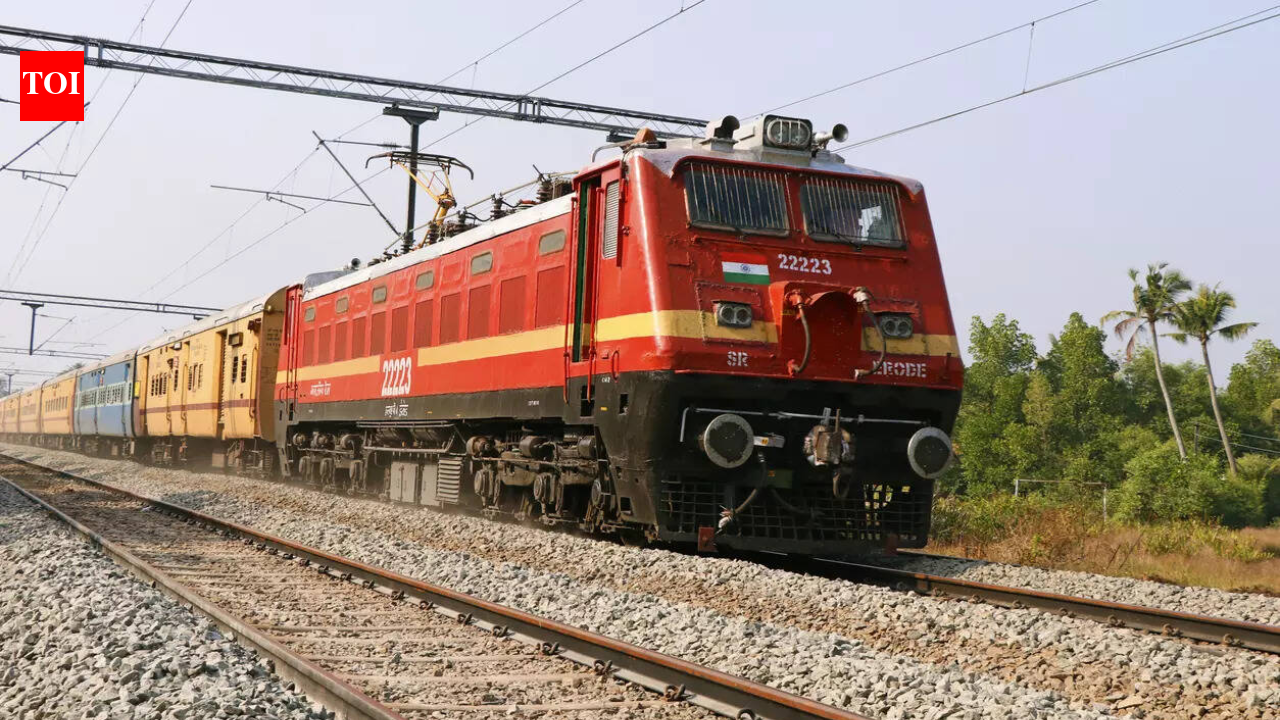
Indian Railways’ accelerated electrification push has sharply reduced diesel consumption, helping cut crude import dependence while expanding cleaner rail operations across the country. Mission-mode electrification has now covered about 99.4% of the Broad Gauge network, with the remaining stretches also taken up for completion.According to information shared by Railways Minister Ashwini Vaishnaw in the Lok Sabha, Indian Railways saved 178 crore litres of diesel in 2024-25 compared with 2016-17 levels, translating into a 62% reduction in consumption. The shift towards electric traction is being driven by both environmental and cost considerations, with electric traction proving more efficient than alternatives such as bio-diesel.Electrification progress has accelerated significantly over the past decade. Before 2014, about 21,801 route kilometres were electrified over nearly 60 years. In comparison, 46,900 route kilometres have been electrified between 2014 and 2025. Since 2023-24 alone, 10,932 route kilometres have been electrified till January 2026.Railways said all new line and multi-tracking projects are now being sanctioned and constructed with electrification as a standard feature.

Majority of railway zones fully electrified

Several railway zones have already achieved 100% electrification, including Central, Eastern, Northern, Western, East Coast, East Central, South Central, South Eastern, South East Central and West Central Railways, among others. Konkan Railway and Kolkata Metro have also achieved full electrification.A few zones are nearing completion, with North Western Railway at 99%, Northeast Frontier Railway at 99%, Southern Railway at 98% and South Western Railway at 96%.At the state level, 25 states and Union Territories have achieved 100% electrification of railway networks. Rajasthan stands at 99%, Assam at 98%, Tamil Nadu and Karnataka at 97%, while Goa has achieved 91% electrification.Seen geographically, the progress reflects a near nationwide transition to electric traction, covering major freight and passenger corridors.

Rs 29,826 crore spent on electrification in last five years

During the five-year period from 2020-21 to 2024-25, Indian Railways spent Rs 29,826 crore on electrification projects, including works in Tamil Nadu.Railways noted that project completion timelines depend on several external factors such as forest clearances, utility shifting, statutory approvals, terrain conditions, law and order issues and climate-related working constraints.

Shift to electric traction cuts energy import burden

The ministry said the transition has significantly reduced dependence on imported crude oil while improving long-term operational cost efficiency. Indian Railways spent Rs 32,378 crore on total traction energy consumption during 2024-25.Officials added that while bio-diesel testing has been undertaken in the past, electric traction remains significantly more beneficial from both cost and environmental standpoints.

Waste management push to improve passenger experience

Alongside electrification, Railways is expanding waste management and cleanliness infrastructure across trains and stations.Waste collected inside trains is disposed of at designated en-route stations. On-board housekeeping staff are prohibited from dumping waste on tracks, with penalties imposed for violations. Rag picking along tracks is carried out regularly to maintain cleanliness.Plastic bottle crushing machines have been installed at stations as required. Two-bin segregation systems have been introduced at many stations to separate biodegradable and non-biodegradable waste at source.Railways has also tied up with municipal bodies for waste disposal based on local feasibility. Infrastructure such as sewage treatment plants, effluent treatment plants and material recovery facilities has been installed at multiple locations.Passenger awareness campaigns are being conducted regularly to encourage proper waste disposal. Cleanliness drives under Swachh Bharat Abhiyan are also being organised periodically to maintain hygiene standards across the network.

Bio-toilet rollout eliminates direct waste discharge

Railways has also expanded installation of bio-toilets to eliminate direct discharge of human waste from trains. Between 2004 and 2014, 9,587 bio-toilets were installed. Since 2014, a total of 3,61,572 bio-toilets have been fitted in passenger coaches.


Source link

Nathan Ellis, Adam Zampa shine with four-fers as Australia crush Ireland by 67 runs | Cricket News


Nathan Ellis, Adam Zampa shine with four-fers as Australia crush Ireland by 67 runs
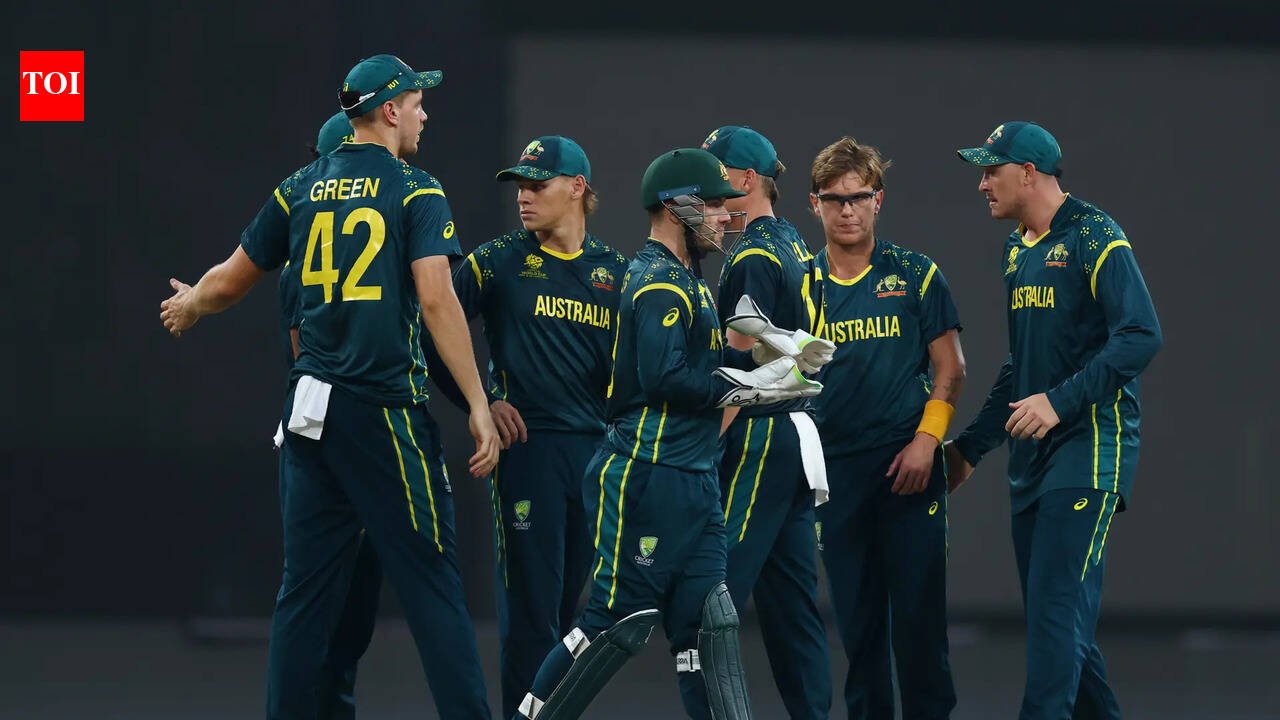
Adam Zampa of Australia celebrates with teammates (Getty Images)

Nathan Ellis produced a fiery opening spell to propel an under-strength Australia to a commanding 67-run victory over Ireland in their Group B opener of the T20 World Cup on Wednesday. Defending 183, Australia’s pace spearhead ripped through the Irish top order, finishing with outstanding figures of 4 for 12 in 3.5 overs. Leg-spinner Adam Zampa then dismantled the middle and lower order with 4 for 23 from his four overs as Ireland were restricted to 115 for 9 in 16.5 overs.

Abhishek Sharma in hospital – latest on his recovery and India nets

Veteran Paul Stirling was retired hurt and did not bat. With Mitchell Marsh sidelined by a groin injury and senior quicks Mitchell Starc retired, plus Pat Cummins and Josh Hazlewood unavailable due to injuries, Ellis stepped up as the leader of the attack. He struck early, bowling Ross Adair with a skiddy delivery before Ben Calitz dragged one back onto his stumps against sharp pace and bounce. His initial spell read 3 for 9 in three overs. Zampa then tightened Australia’s grip, although George Dockrell’s 41 off 29 balls ensured Ireland crossed the 100-run mark. Ellis returned to claim his fourth wicket and close out the match. Earlier, Australia posted 182 for 6 after being sent in on a sluggish surface. Josh Inglis (37) and Cameron Green (21) set the tempo before Matthew Renshaw (37) and Marcus Stoinis (45) combined for a crucial 61-run stand. Ireland’s spinners bowled tidily but dropped chances proved costly. After Travis Head was reprieved in the first over and then run out in the second, Inglis and Green counterattacked briskly. Green struck towering sixes before falling to midwicket, while Inglis was dismissed following a stunning diving catch by Stirling. Harry Tector removed Glenn Maxwell, but Renshaw and Stoinis rebuilt steadily before Humphreys bowled Renshaw. Stoinis followed soon after, despite a powerful six. Ireland conceded 53 runs in the final five overs as Australia sealed an emphatic start.


Source link

New START treaty expires: Russia says it will continue to observe pact if US does


New START treaty expires: Russia says it will continue to observe pact if US does

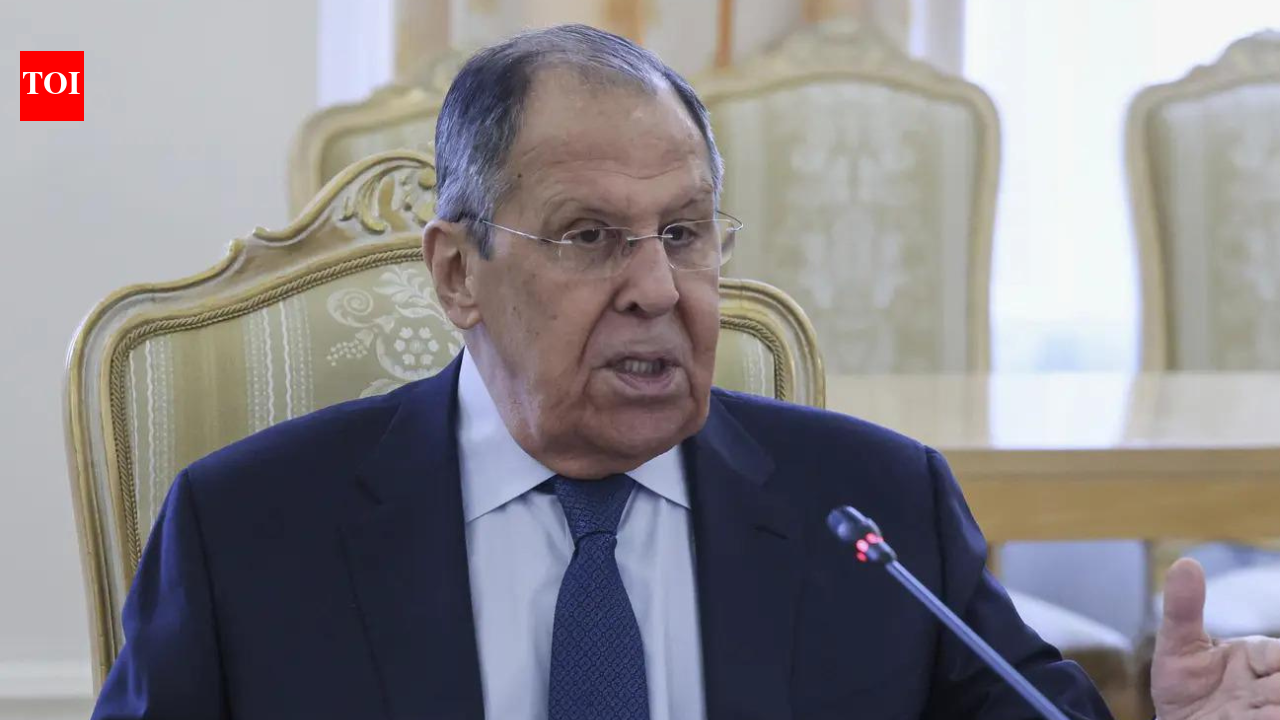
Russia’s foreign minister Sergey Lavrov on Wednesday said that Moscow will continue to observe the limits set under the New START nuclear arms control treaty, even after its expiry, as long as the United States adheres to the same restrictions.The New START treaty formally expired on February 5, leaving the world’s two largest nuclear powers without any binding restrictions on their atomic arsenals for the first time in more than 50 years. The development has raised concerns globally about the possibility of an unchecked nuclear arms race.Last year, Russian President Vladimir Putin said that Moscow was ready to continue adhering to the treaty’s limits for another year if the United States agreed to do the same. However, US President Donald Trump has insisted that China should be included in any future agreement, a proposal Beijing has rejected.Speaking to Russia’s lower house of parliament, Lavrov said that Moscow would maintain its commitment to the treaty’s caps despite the absence of a formal extension.“The moratorium declared by the president will remain as long as the US doesn’t exceed these limits,” Lavrov told lawmakers. “We will act in a responsible and balanced way on the basis of analysis of the US military policies.”He added that “we have reason to believe that the United States is in no hurry to abandon these limits and that they will be observed for the foreseeable future.”“We will closely monitor how things are actually unfolding,” Lavrov said. “If our American colleagues’ intention to maintain some kind of cooperation on this is confirmed, we will work actively on a new agreement and consider the issues that have remained outside strategic stability agreements.”Lavrov’s remarks followed a report by Axios claiming that Russian and US negotiators discussed a possible informal understanding to continue observing the treaty’s limits for at least six months during talks held last week in Abu Dhabi.Commenting on the report, Kremlin spokesman Dmitry Peskov said that any extension would have to be formal. “It’s hard to imagine any informal extension in this sphere,” he said.At the same time, Peskov confirmed that future nuclear arms control was discussed during meetings in Abu Dhabi, where delegations from Russia, Ukraine and the United States held two days of talks focused on a potential peace settlement in Ukraine.“There is an understanding, and they talked about it in Abu Dhabi, that both parties will take responsible positions and both parties realize the need to start talks on the issue as soon as possible,” Peskov said.The New START treaty, signed in 2010 by then-US President Barack Obama and Russian President Dmitry Medvedev, was the last in a series of agreements between the two countries aimed at limiting nuclear weapons, beginning with the SALT I pact in 1972.Under New START, each country was limited to 1,550 deployed nuclear warheads and no more than 700 deployed missiles and bombers. The treaty was originally due to expire in 2021 but was extended for five years.The agreement also allowed for on-site inspections to ensure compliance. However, inspections were halted in 2020 due to the COVID-19 pandemic and were never resumed. In February 2023, Putin announced the suspension of Russia’s participation in the treaty, citing tensions with the United States and NATO over the Ukraine conflict. Still, the Kremlin maintained that Russia would continue to respect the treaty’s numerical limits.In September, Putin proposed extending adherence to the treaty’s caps for another year to allow time to negotiate a replacement agreement.Despite the treaty’s expiration, both countries agreed on February 5 to restore high-level military-to-military communication following discussions in Abu Dhabi. The direct link had been suspended in 2021 amid worsening relations before Russia launched its military operation in Ukraine in February 2022.


Source link

Indian diaspora among UK’s most successful groups: Report links migration to post-war recovery, tech growth | India News


Indian diaspora among UK's most successful groups: Report links migration to post-war recovery, tech growth

A new white paper notes that “Indian migration to the UK has evolved in four distinct waves since 1947, each aligned with Britain’s shifting economic and labour needs.” and argues that it has played a central role in shaping modern Britain’s economyThe report titled “Migration of the Indian Diaspora to the UK”, released by Manish Tiwari of Here & Now 365 in collaboration with the Aston India Centre at Aston University, traces the evolution of Indian migration.According to the study, the first wave arrived during post-war labour shortages, with “post-war migration from India help[ing] address acute labour shortages across manufacturing, transport and public services, contributing to the foundations of the National Health Service.” The second wave followed the 1970s expulsion of Asians from East Africa, which “led to significant entrepreneurial activity and local economic regeneration.”Many of these families established businesses that revitalised local economies.As the UK economy transitioned toward a knowledge-based model, Indian migration increasingly comprised skilled professionals. The white paper estimates that “Indian-born professionals are estimated to account for around 15% of the UK’s technology workforce.” In the post-Brexit and post-pandemic period, the fourth wave is described as strategically significant. “Indian professionals have become strategically important in addressing critical skills shortages,” the report states.Describing the Indian diaspora as “among the most economically successful ethnic minority groups in the UK,” the study underscores the community’s continued role in healthcare, technology and entrepreneurship.


Source link

Bangladesh to vote tomorrow: What’s at stake for India, Pakistan and China


Muhammad Yunus Assures Smooth Handover Ahead Of Bangladesh’s First Elections After Hasina Exit

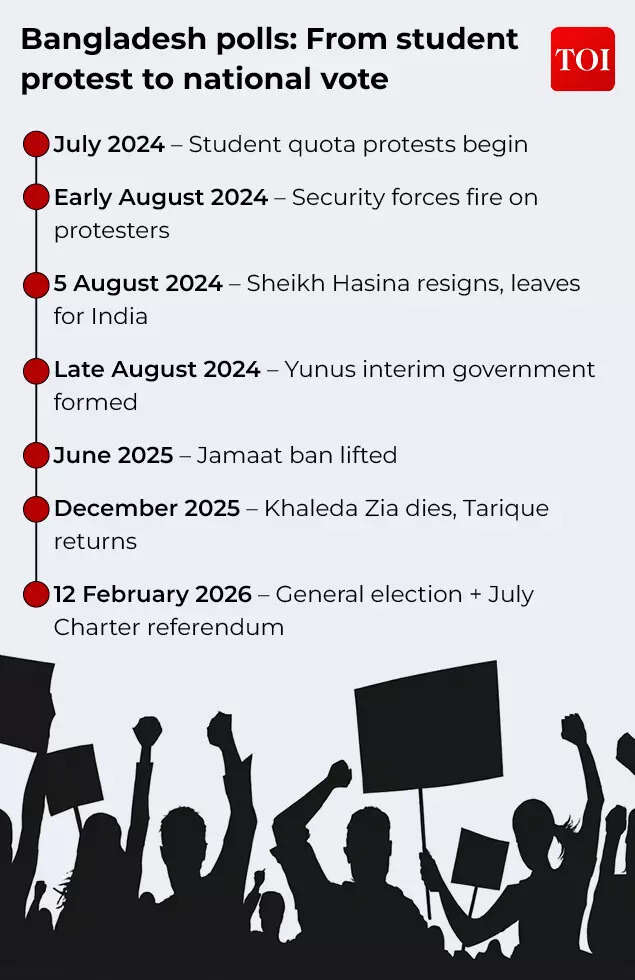
After months of violence, street protests and political upheaval, Bangladesh now faces its moment of reckoning. What began in July 2024 as a student agitation over public sector job quotas quickly spiralled into a nationwide revolt against Sheikh Hasina’s government, culminating in her resignation and flight to India. The unrest left more than 1,000 people dead and dismantled a political order that was entrenched in Dhaka’s politics for over a decade.Now, on February 12, Bangladesh votes in its first general election since that uprising, a ballot that will test not only the strength of its democracy but the direction of its national identity.

Muhammad Yunus Assures Smooth Handover Ahead Of Bangladesh’s First Elections After Hasina Exit

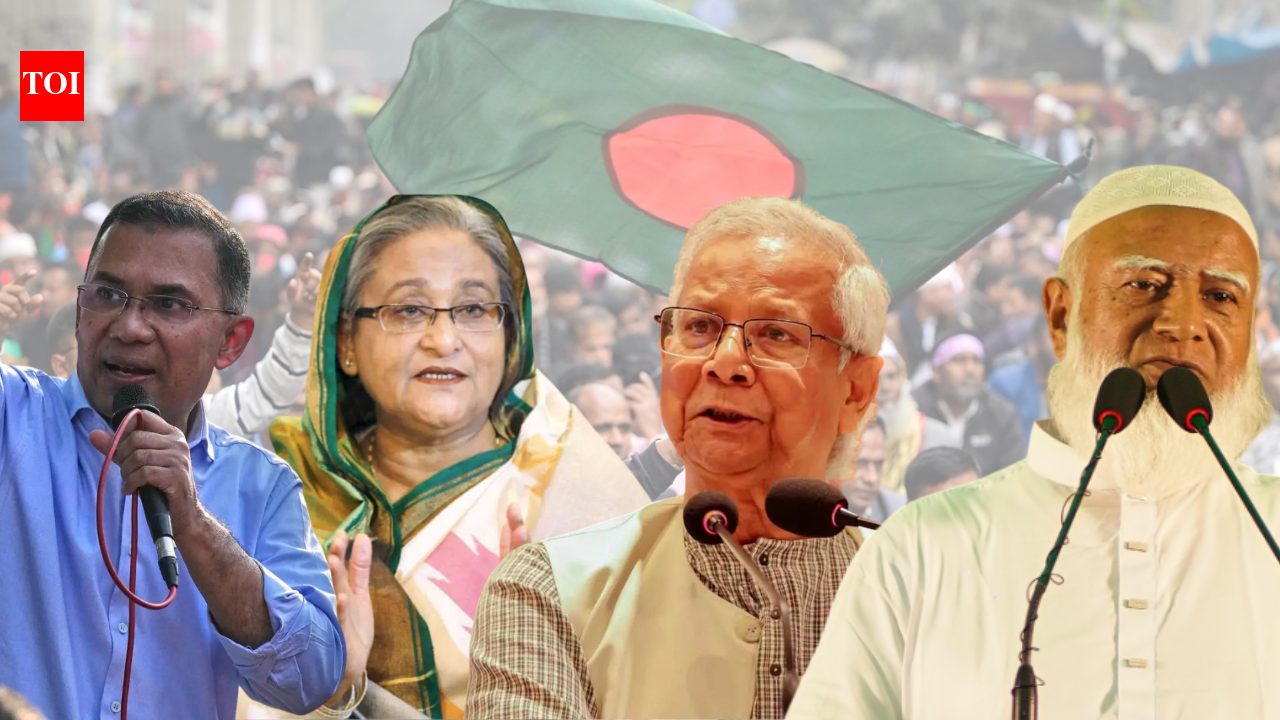
Nobel laureate Muhammad Yunus who took charge after Hasina’s ouster said that the interim government “will hand over the responsibility to the newly elected government with deep pleasure and pride.”But the field has been radically reshaped. The once-dominant Awami League has been sidelined, opening the field to a resurgent Bangladesh Nationalist Party under Tarique Rahman and an emboldened Jamaat-e-Islami seeking renewed legitimacy.For Bangladesh, this is a struggle to restore stability after a stint with instability. But it also holds a significant impact on a region that has battled with growing instability, where governments have fallen and leaders have fled faster than Pakistan’s military has overturned governments.For India, China and Pakistan, it is a moment that could redraw the strategic balance in South Asia.

How we got here

In 2024 widespread student protests erupted over public sector job quotas, but quickly escalated into a nationwide revolt against the Hasina government. By early July, protesters clashed violently with police in Dhaka and other cities. The unrest peaked in early August when security forces opened fire on demonstrators. On 5 August 2024 the situation culminated in the resignation of Sheikh Hasina, who immediately left for India. Over 1,000 people were killed in the clashes – the deadliest violence Bangladesh has seen since its 1971 independence war.

Bangladesh polls: How we got here

In the aftermath, a caretaker government was formed, headed by Nobel laureate Prof. Muhammad Yunus (best known for microfinance). This interim cabinet – comprising ex-bureaucrats, civil society figures and student leaders – took power in late August 2024. It promised to uphold order, prosecute crimes committed during the protests, and prepare for new elections. One of its first actions was to promulgate a provisional “July Charter” of reforms, advocating constitutional changes and term limits to curb executive power. A referendum on this charter is also being held alongside the election.By law the elections must be held by early 2026. Notably, the once-dominant Awami League (AL) was effectively excluded: the interim government has banned the AL in response to allegations of crimes during the protests. Instead, the race centers on the BNP-led opposition coalition (with Islamist allies) and several smaller groups including a new National Citizen Party (NCP) founded by student activists. Professor Harsh V. Pant, Vice President at the Observer Research Foundation, believes Bangladesh’s election is unlikely to produce a sharp geopolitical pivot. Instead, he argues, pragmatism will prevail.“But the most likely outcome is that whoever comes to power in Bangladesh is likely to be pragmatic in its engagement with both India and China,” Pant told The Times of India. In his assessment, it would be “very foolhardy of any government in Dhaka to take a one-sided view of the India–China relationship or to tilt to one side or the other”.Pant stressed that balancing both Asian powers is not merely diplomatic caution but strategic necessity. “It helps Bangladesh if they are engaged with both India and China,” he said, adding that such engagement allows both countries to “help Bangladesh shore up its capabilities”.

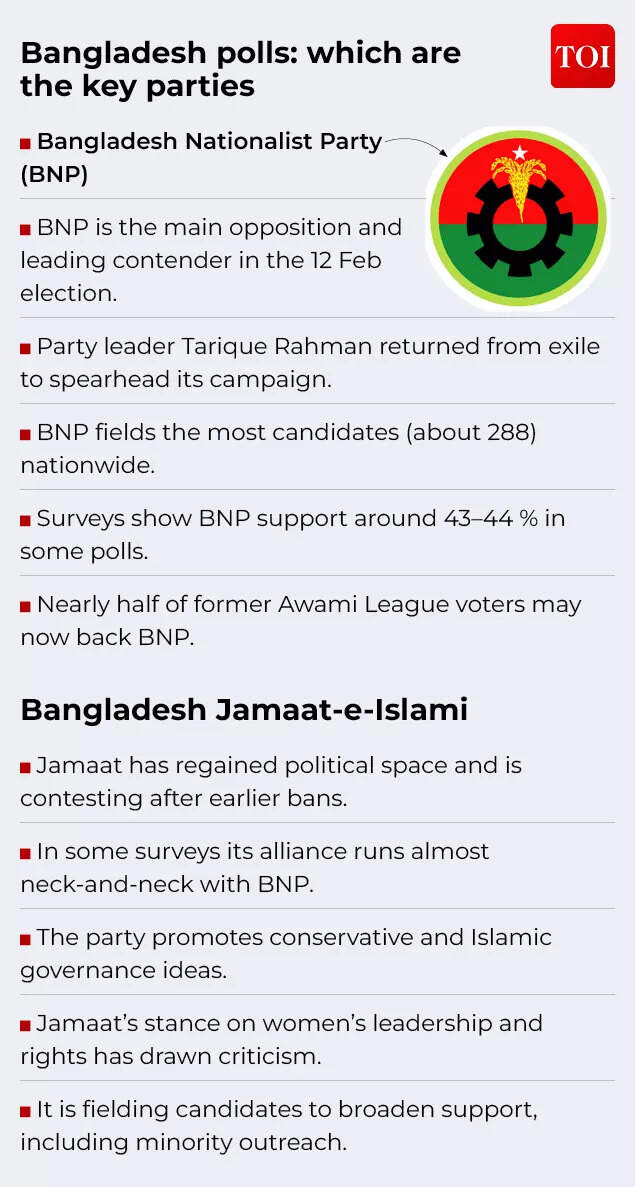
Which are the key parties?

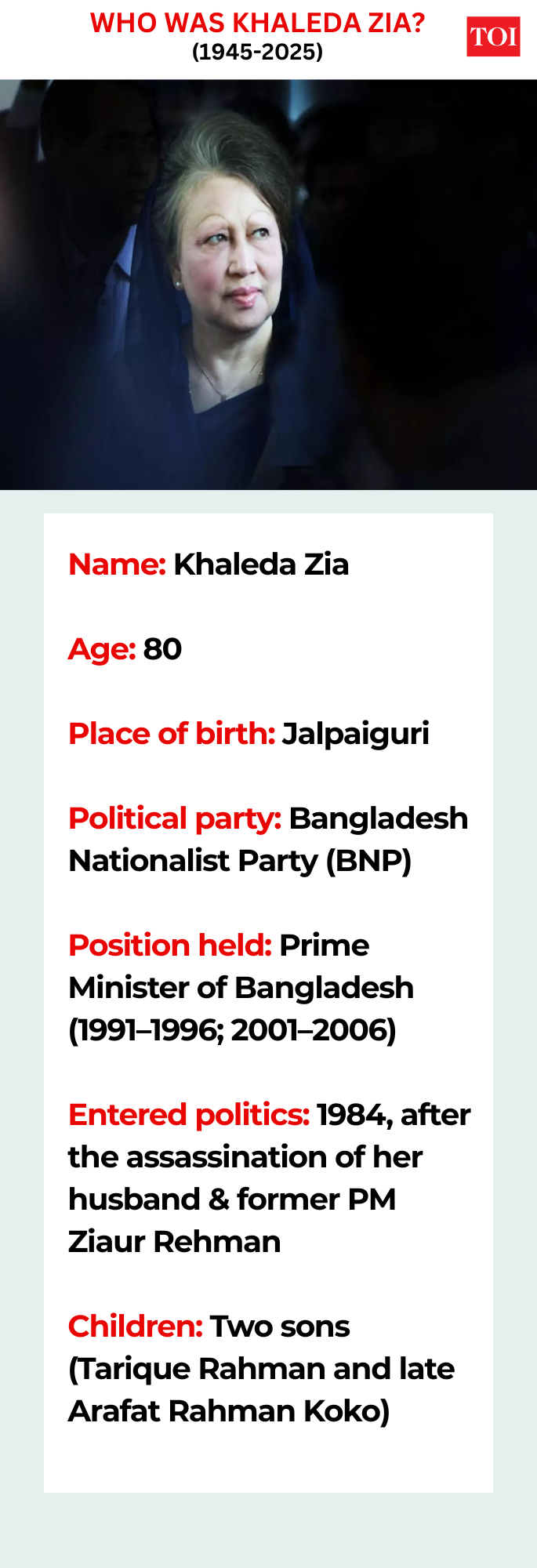
A BNP under new leadershipThe Bangladesh Nationalist Party (BNP) has been one of the two major parties in Bangladesh for decades. Founded by President Ziaur Rahman in the late 1970s, it has been led by his widow, Khaleda Zia, since 1984. Khaleda served three terms as prime minister (1991–96, 2001–06) and was a central figure in Bangladeshi politics.

Key parties

Khaleda Zia’s influence was immense, and even after years of legal troubles and house arrest in the late 2010s, she remained BNP’s unchallenged leader. Her death in late December 2025 has now left a leadership vacuum. The party immediately chose her eldest son, Tarique Rahman, as acting chairman. Tarique had fled the country in 2007 amid corruption charges, and for nearly 18 years lived in exile in London. His surprise return on 25 December 2025 was a dramatic moment: thousands of BNP supporters greeted him, and he has positioned himself as the torchbearer of his mother’s political legacy. BNP sources say Tarique will formally assume party leadership to guide the BNP into the poll.Tarique Rahman’s re-entry greatly energised the BNP base. He is widely expected to be the party’s prime ministerial candidate if the alliance wins a majority. In his very first campaign speeches, Tarique struck themes of national pride and stability: he criticized Islamist rivals for exploiting religion, and vowed to “uphold national sovereignty and work for women and young people”. Supporters wearing BNP’s yellow and green flocked to see him, chanting slogans of independence and democratic change.

Who was Khaleda Zia

The BNP’s weaknesses have also become apparent. Khaleda’s long illness had largely kept her out of politics since 2018, and the party’s cadres have suffered under AL crackdowns in recent years. Its alliance building is fragile: Jamaat-e-Islami (to be discussed below) is a key ally, but other Islamist groups have even broken away from Jamaat’s alliance over seat disputes. Nonetheless, with the AL absent, Tarique’s return has put BNP in the front seat for power. Indian officials have already moved to engage with the new BNP leadership: at Khaleda’s December funeral, EAM Jaishankar delivered PM Modi’s condolence letter to Tarique and “expressed optimism about strengthening bilateral relations following Bangladesh’s democratic transition”.

Jamaat-e-Islami’s resurgence

Jamaat-e-Islami (JeI) is Bangladesh’s largest Islamist party. It was banned from elections and effectively outlawed after 2013, when courts ruled its charter violated the secular constitution. Many Jamaat leaders had been convicted for war crimes in the 1971 Liberation War, due to the party’s support for Pakistan during that conflict. For over a decade under Awami League rule, the Jamaat was excluded from politics.That changed in mid-2025. On June 1, 2025, Bangladesh’s Supreme Court restored Jamaat’s registration. This landmark decision came as the interim government promised inclusive polls. The court lifted Jamaat’s election ban and overturned the conviction of one of its leaders, paving the way for its participation in the 2026 elections. Legal observers said the ruling allowed a “more democratic, inclusive and multiparty system”. With Jamaat back in play, the Islamist party formally launched an electoral alliance. It teamed up with ten other parties (including the Gen-Z-led National Citizen Party) to contest seats under a single banner.

Jamaat's resurgence

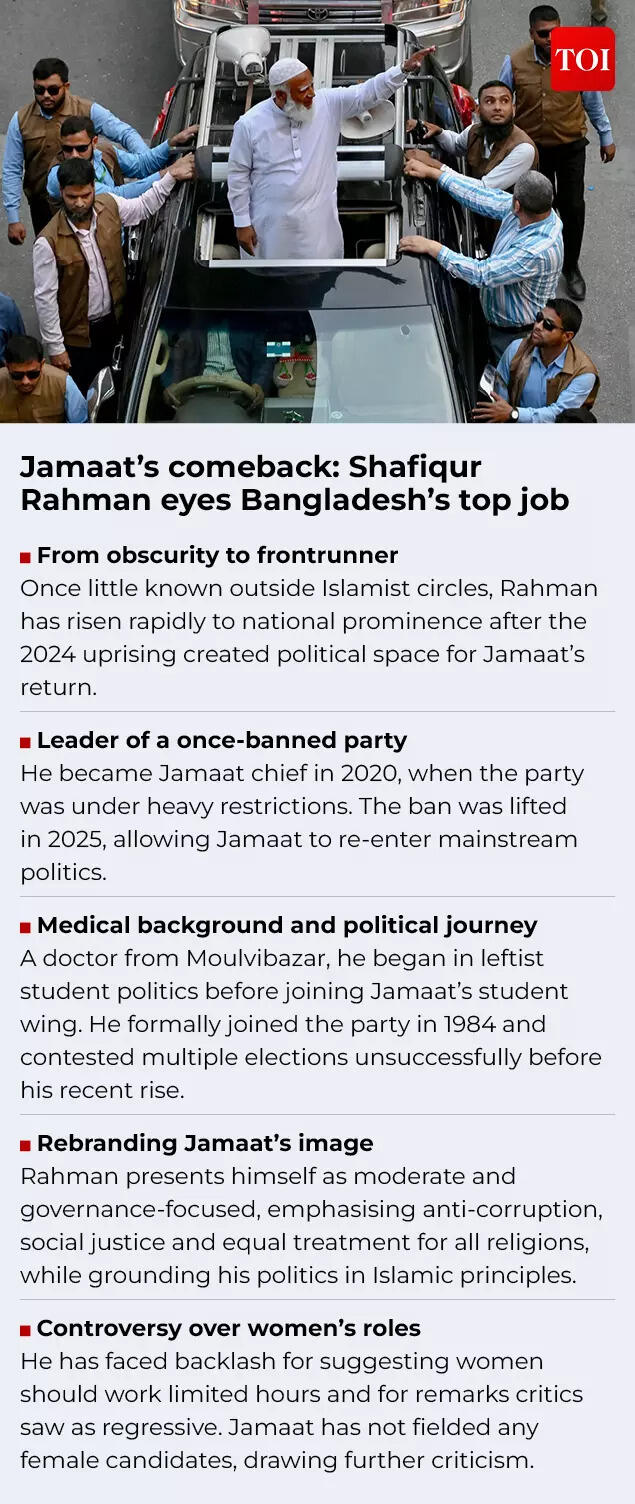
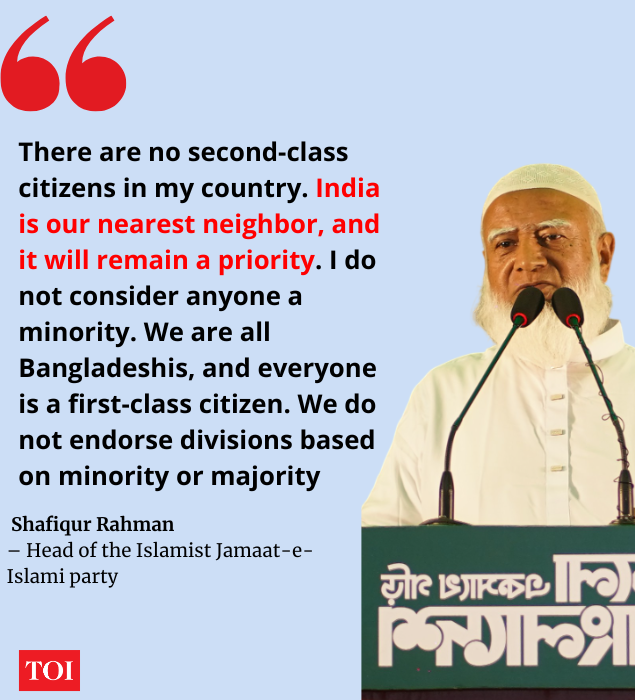
Jamaat’s platform is rooted in Islamic principles, but the party has visibly rebranded itself for 2026. Party leader Dr. Shafiqur Rahman has emphasized social welfare and anti-corruption measures, steering away from its former hard-line image. He told Reuters that Jamaat’s focus is now on “welfare politics, not reactionary politics,” highlighting its medical camps, flood relief and aid for protest victims as examples of a constructive agenda.

what Rahman said a day before Bangladesh polls

Indeed, Jamaat has reached out to demographics it once ignored: Reuters notes that for the first time Jamaat fielded a Hindu candidate for parliament and publicly condemned recent attacks on minorities.On Jamaat-e-Islami’s growing influence, Professor Pant offered a more cautious assessment. “Jamaat’s influence has been growing. The Islamist forces have been growing in Bangladesh,” he said, describing that trend as “a cause for worry”. If Jamaat gains greater sway, “there is certainly a likelihood that Pakistan can re-enter Bangladesh strategically”.However, he emphasised that history places limits on Islamabad’s ambitions. “History is an important marker and it is not that easy for Pakistan to re-establish its credentials in Bangladesh,” he said.Pant also noted that Islamist mobilisation has not gone unchallenged. “We have seen that there remains a strong pushback against the extremist factions in Bangladeshi society,” he said.

NCP: Gen Z party faces defining test

The National Citizen Party (NCP) was born out of the blood and fury of July 2024. The student portest propelled a new generation of activists into formal politics. Formed in early 2025 and led by 27-year-old Nahid Islam, the NCP says it aims to break decades of dominance by the Awami League and the BNP. Its platform centres on tackling corruption, ensuring judicial independence, protecting press freedom and reforming governance through the so-called July Charter. The party has also pledged justice for those killed in the uprising, lowering the voting age to 16, job creation through economic reform and greater women’s representation in parliament.Yet translating street power into votes has proved difficult. Opinion polls ahead of the February 12, election suggest the NCP trails behind the BNP and Jamaat-e-Islami. Lacking funds and grassroots machinery, the party struck an electoral alliance with Jamaat in December, describing it as a “strategic” and not ideological pact designed to prevent instability and electoral sabotage.The move has triggered internal revolt. At least 30 senior figures have opposed the alliance, with several resigning. Critics argue the partnership risks diluting the NCP’s centrist identity and tethering it to Jamaat’s controversial past. The deal has also raised concerns over women’s representation, with only a handful of female candidates fielded under the arrangement.

Why is the region watching closely

What’s the outlook for India?Bangladesh’s ties with India have long oscillated with domestic politics. Under Khaleda Zia’s BNP governments (1991–96 and 2001–06), relations were often tense. Khaleda herself famously positioned the BNP as a “protector of Bangladeshi interests against Indian domination,” raising issues like overland transit rights, the 1972 Friendship Treaty, and disputes over the Farakka Barrage on the Ganges. She refused to grant India unfettered transit of goods through Bangladeshi territory, calling it a threat to Bangladesh’s sovereignty. Khaleda’s alliance with Jamaat exacerbated those frictions. In the early 2000s Jamaat elements in Bangladesh harbored extremists hostile to India. Khaleda’s rival Sheikh Hasina – leader of the secular Awami League – worked closely with India. Hasina’s governments from 2009 onward cracked down on anti-India militants (including Jamaat-linked cells) and resolved various disputes.In the 1970s–80s Jamaat was pro-Pakistan and opposed to Bangladeshi independence.

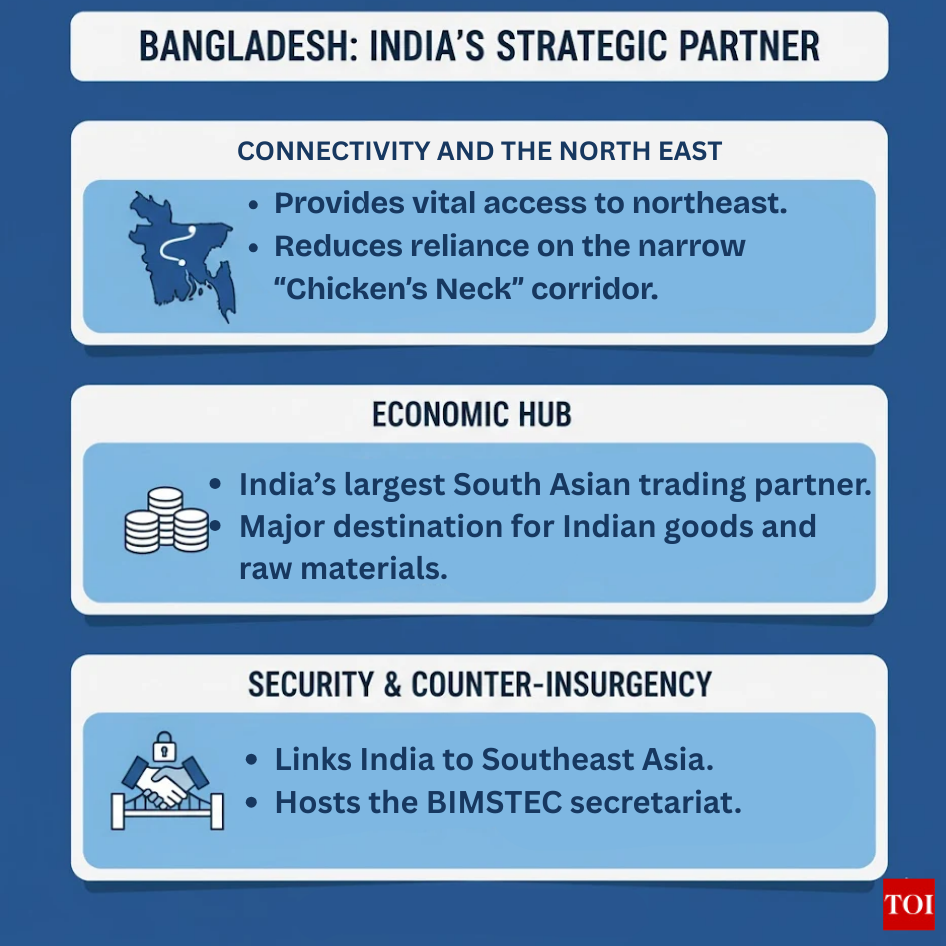
A strategic partner

However, Jamaat’s current leadership is publicly moderating its tone. In private, the party has sought dialogue with India: Reuters reports that Jamaat leader Shafiqur Rahman even met an Indian diplomat (confidentially) earlier in 2025 and said Bangladesh must “become open to each other”. At the same time, Shafiqur has voiced irritation that Hasina “continues to stay in India” after fleeing. This reflects the interim government’s hard line: Bangladeshi leaders have asked India to extradite Hasina for trial, and New Delhi has demurred.In its election manifesto, Jamaat declares it will seek “peaceful and cooperative relations” with all neighbours, including India. Whether this rhetoric will hold in practice is uncertain, but it suggests Jamaat knows India is a critical audience.From India’s standpoint, Pant suggested that “the best case scenario” would be a mainstream party such as the BNP winning the election, “now that Awami League is out of contention”, with Jamaat’s role “contained and limited” rather than decisive. Post-2024 strainsThe revolutionary upheaval that removed Hasina has strained relations with India. Hasina was seen in New Delhi as a reliable ally, and her abrupt ouster took Dhaka into a period of uncertainty. The interim government has been openly critical of India’s hospitality to Hasina. Yunus’s advisers complained that India allowed “incendiary” remarks from Hasina’s exile to go unpunished, and even that Yunus’s first official visit was to China – Bangladesh’s traditional rival of India. In April 2025 Prime Minister Modi met Yunus in Thailand, declaring a desire for “positive and constructive” ties, but also taking the opportunity to raise concerns about alleged “atrocities” against minorities in Bangladesh.Indeed, since late 2024 there have been multiple attacks on Bangladesh’s Hindu minority, often linked to the political turmoil. Hindus (about 8% of the population) historically tended to support the Awami League; after Hasina’s fall, mobs in several districts burned homes and temples belonging to Hindus. Why it matters for IndiaFor New Delhi, Bangladesh is far more than a neighbour; it is a strategic linchpin in south Asia’s evolving geopolitical architecture. The two countries share a 4,000km border, deep economic ties, and common concerns. Historically, India has tried to maintain good relations regardless of which Bangladeshi party was in power. As PM Modi’s handover letter at Khaleda’s funeral made clear, India expects Bangladesh’s “vision and values” – whether from Khaleda or others – to guide partnership building. On Dec 31, 2025, Jaishankar met Tarique Rahman and handed over PM Modi’s condolences, while earlier in April 2025, PM Modi met Yunus, pledging cooperation. Such meetings signal that India will work with the incoming government.A central strategic theme for India has been connectivity with its own north eastern states. The Siliguri Corridor, a narrow stretch of land in West Bengal commonly known as the “Chicken’s Neck,” (something that interim governments leader’s have alluded to much to India’s anger) remains a cause for India’s territorial cohesion because it is the sole land link to the eight north eastern states. New Delhi has invested in alternative logistics and security measures, including a plan for an underground railway line to strengthen this corridor against natural or geopolitical disruption. These infrastructure plans reflect India’s heightened awareness that reducing dependence on this bottleneck is a long-term priority. Access to Bangladeshi ports also intersects with India’s broader Act East Policy, which aims to link India’s north east with Southeast Asian markets. Ongoing infrastructure cooperation, such as expanded rail and road links across the border, has been encouraged in diplomatic dialogues, signalling that New Delhi views Dhaka not just as a neighbour, but as a partner in regional integration. These connectivity and security interests intersect with regional power competition. China has significantly expanded its influence in Bangladesh, particularly since the political transition in 2024, through infrastructure projects, diplomatic engagement and investment. Beijing’s involvement ranges from port facilities to broader development financing. Domestic political shifts in Dhaka have also strained diplomatic engagement. Earlier diplomatic frictions, including reduced issuance of medical visas by India, inadvertently created space that Beijing sought to fill with offers of infrastructure and hospital projects. Water and river diplomacy also remain perennial strategic issues. Shared rivers like the Teesta have long been part of bilateral discussions, with water sharing agreements seen as symbolic of deeper cooperation. Progress on these fronts will continue to be important irrespective of the electoral outcome.

What are the stakes for Pakistan and China?

Beyond ideology and geopolitics, both Pakistan and China are sensitive to economic fallout in Bangladesh. The garment sector, the backbone of Bangladesh’s export economy, remains fragile after tariffs and instability dented orders and investor confidence. A government that cannot reassure buyers, or that imposes policies that unsettle factory owners and foreign investors, will cascade economic pain through the region: lower exports, supply-chain disruption and slower regional growth. That would be bad for China (which trades and invests heavily in the region) and for Pakistan (which looks to Bangladesh as a market and a partner in regional forums). Stability and rules-based governance thus serve both capitals’ material interests. If Jamaat gains groundFor Pakistan, Jamaat’s rise would carry symbolic weight. The party’s historical links to Islamist politics in the subcontinent, and its controversial position during the 1971 Liberation War, have long shaped how it is viewed in Dhaka and Islamabad. A stronger Jamaat presence in government could open warmer political channels between Bangladesh and Pakistan, potentially softening decades of distrust.Islamabad would see opportunities for diplomatic re-engagement, expanded religious and educational exchanges, and closer coordination in multilateral forums such as the OIC. Even incremental thawing would be framed domestically in Pakistan as a geopolitical correction in South Asia.Yet the gains would be more symbolic than structural. Bangladesh’s economy is deeply intertwined with global supply chains and regional powers beyond Pakistan. Any government in Dhaka must prioritise export markets and macroeconomic stability over ideological affinity. Pakistan’s room to convert goodwill into concrete economic advantage would remain limited.For China, Jamaat’s rise presents a more complex equation. Beijing’s interests in Bangladesh are overwhelmingly economic and strategic: infrastructure, energy, digital networks and maritime access linked to the Belt and Road Initiative. China has become one of Bangladesh’s largest trading partners and a key financier of major projects.A Jamaat-influenced administration might not necessarily disrupt these ties. In fact, Islamist parties have often shown pragmatic streaks in foreign policy when economic survival is at stake. If the BNP winsA clear BNP victory alters the dynamic in subtler ways. The party, historically led by the Zia family, has long advocated a nationalist, sovereignty-focused platform. It has at times been critical of what it describes as overdependence on India. That posture could indirectly benefit Pakistan, as a Dhaka less closely aligned with New Delhi might reopen space for Islamabad to rebuild ties.However, BNP leaders have also signalled an interest in diversifying partnerships rather than pivoting wholesale towards any one country. For Pakistan, this means cautious optimism rather than guaranteed alignment. Diplomatic warmth may improve, trade delegations may resume, and symbolic gestures could follow. But deep strategic convergence is far from certain.Economically, Bangladesh’s trade with Pakistan remains modest compared to its commerce with China, India, the EU and the US. But symbolism cannot override economics. Pakistan remains a marginal trade partner compared to China, India and the WestChina’s calculus under a BNP government is more consequential. The BNP has previously engaged closely with Beijing, and China has cultivated ties across Bangladesh’s political spectrum to safeguard its investments. A BNP-led administration would likely continue major infrastructure projects while possibly seeking better financial terms or greater transparency to address domestic criticism.The challenge for Beijing could arise if a BNP government attempts a recalibration of foreign policy to balance China more visibly with Western partners. Efforts to court European or American investment, or to diversify defence procurement, might slightly dilute China’s relative influence. Yet this would represent adjustment rather than rupture.What are the economic implicationsWhichever party prevails, Bangladesh’s economic health will shape the regional equation. The country’s export-driven model, centred on garments, depends on stability, investor trust and access to Western markets. Prolonged unrest or policy uncertainty would dampen growth and affect regional trade flows.For China, Bangladesh is a gateway to the eastern Indian Ocean and a critical node in regional connectivity. For Pakistan, improved ties with Dhaka would signal diplomatic breathing space in South Asia. But neither capital can override Bangladesh’s domestic priorities: jobs, inflation control and social stability.In many ways, this election is less about ideological realignment and more about governance credibility. Pakistan may hope for renewed warmth if Jamaat gains or if the BNP distances itself from India. China will look for guarantees that its billions in infrastructure commitments remain insulated from political swings.

So, what does the future hold?

Bangladesh’s February 12 election is not simply a transfer of power; it is a reckoning with the political order that has defined the country for nearly two decades. The uprising of 2024 shattered the dominance of one party, but it did not resolve the deeper questions about identity, governance and the balance between secular nationalism and political Islam. Those questions now sit at the heart of the ballot.For the BNP, this is a bid for restoration under Tarique Rahman. For Jamaat-e-Islami, it is a quest for renewed legitimacy after years in the wilderness. For voters, it is a choice about stability, ideology and the limits of executive power.Beyond Bangladesh’s borders, the implications are strategic. India will seek continuity and security, China will guard its investments, and Pakistan will watch for diplomatic openings. The outcome will not simply decide a government. It will signal which direction a pivotal South Asian state chooses at a moment of regional uncertainty.But ultimately, this election will reveal something more fundamental: whether Bangladesh emerges from the crisis with a clearer democratic centre, or whether fragmentation and competitive nationalism become its defining features. In a region already unsettled by political churn, the direction Dhaka chooses will resonate far beyond its borders.


Source link